My Least Favorite Life: A Conversation with True Detective’s Lera Lynn

Fans of HBO’s critically acclaimed crime show, True Detective, are well aware of Lera Lynn, the remarkably talented singer whose original songs set the tone for a number of scenes in the show’s diviest of dive bars, the Black Rose. She took a few minutes to tell us how she landed the role; what it’s like to work with the show’s music supervisor, T Bone Burnett; and where we can find the songs she wrote for the show.

You got to play your original music on one of the coolest, most widely acclaimed shows on TV. Inquiring minds want to know how you managed to score that gig.

Good looks and charm!

My Dad used to say the same thing, but he was not nearly as charming and definitely not as good-looking.

[Laughs] My manager had been sending my music to T Bone and he was interested in using the title track from an EP I released last year called Lying in the Sun. So we had a meeting in Nashville — “a three martini lunch,” as he calls it — and we just hit it off. He asked me if I’d be interested in writing music for the show and [facetiously] I told him I’d have to think about it. I said, “Hell, yeah, I’d love to” so he flew me out to L.A. We wrote and recorded four songs in two days. We played those songs for [the show's creator] Nic Pizzolato and the producer, Scott Stevens, and they really liked the music. T Bone said, “What do you think about this girl as the singer?” I remember Nic saying they might have to give me a third eye for it to make sense. Luckily, I was just made into a junkie, not a three-eyed monster.

I interviewed Rhiannon Giddens back in the spring time. Her last record was produced by T Bone. Her response was the same as yours when he suggested he produce it. She said, “Yeah, you know, I have to think about it … for two seconds!” Tell me about working with him, about his approach.

I don’t know that his approach is the same for every project. For this one, he made it very clear to me that we were trying to shape a character through the tone, the style, the delivery. A character that would match the tone of the show, that would fit into that dive bar. That bar scene where the chick is always playing and nobody’s listening. Other than that, it was pretty relaxed and easy working together. He wanted to capture live performances, so we would just set up mic for the guitar and a mic for the vocal. I’d do a few passes and he would come in after every take and say, “Yeah … that’s good … let’s do some more.” It was a little nerve-wracking and surreal, too, the first time we sat down to write together. I didn’t really know what to expect; I haven’t done a lot of co-writing, so I’m not well-versed in that arena. But he’s a really easy-going guy and, I think, one of his greatest skills as a producer is knowing which person is right for the job. It was a really natural process.

Casting is everything. Knowing how to cast the right person for a role or the right person for a song.

Absolutely. Everyone T Bone works with is just great. Every musician, every engineer. He’s a very interesting person. He’s very easy-going, but you can tell the wheels are constantly turning.

How different was “shaping a character” from the way you have approached songwriting on your own?

I think there are a lot of advantages to having restrictions in art. Writing for a character other than myself was liberating because I don’t necessarily have to stand behind the sentiments expressed as being my own values and opinions. They weren’t tied to my personal identity. So it freed me up to explore things.

This question comes from our editor, who asks, "Why does your character look so bruised and beaten up? And why on earth is she playing music in that horrible bar filled with crime bosses?" 

It has to fit the show. It wouldn’t make sense for a person of sound mind and spirit to be playing that music in that place. The music is pretty high quality, it’s pretty sophisticated stuff. Most people who are capable of writing music like that would probably think, “Hey, I might be good at music; maybe I should try and pursue a career.” Unless, there’s one other problem, which she clearly has and is therefore lacking motivation.

… to go beyond that stage with that guitar and that voice.

Right. Exactly. And those songs.

One of my favorite episodes in which you appear is the one called “Down Will Come.” You’re doing this desolate tune about this man alone, just you and electric guitar, with Semyon and Velcoro doing some serious guy talk in the booth by the stage. For those of us who love the behind-the-scenes stuff, can you give us a little insight on how that scene was shot? Were they always in the room? Out of the room? Multiple takes, stuff like that.

They were always in the room. I was always in the room. Either just for eyeline or background shots. Every different angle is a different set up. They have to move the cameras and shoot it again. It was my first time being a part of any of that. It’s very elaborate and it’s very impressive how quickly and efficiently 50 people in one room can work together.

It is, isn’t it?

And then the actors, of course … their ability to jump into a character, at a moment’s notice … I can’t wrap my brain around that. I remember the first time they said, “Hey, singer, we need you over here for eyeline.” First of all, I thought, “What the hell is ‘eyeline’?,” ‘cuz no one was really explaining to me how the process worked or what any of the lingo meant. She said, “Just stand here so the actors can look at you, as if you’re on stage.” I didn’t know, when they were looking at me, if I was supposed to be looking at them, or am I looking at the floor, or was I supposed to smile and wave? [Laughs] It was a funny moment for me.

Vince Vaughn and Colin Farrell are pretty impressive actors. Did you get to hang out on set with those guys?

Yeah. They were so kind. They were very appreciative and complimentary of the music. I think they were really excited to have music being played in a scene; it was inspiring for them. They were very hospitable and nice to me.

We always like to hear that about actors we respect.

Yeah. I mean they’re nicer than “nice people,” actually. I was impressed with how kind they are to everyone around them.

I saw an email from your manager that read, “‘My Least Favorite Life’ — from True Detective, music from the HBO Series — is out today!” Tell me more about that.

Harvest Records has released the songs as singles as they’ve appeared on the show so that’s how “My Least Favorite Life” has become available. It says “unknown artist” until the song appears on the show, then it unveils itself to the world. It’s on iTunes, Amazon, all the streaming services, etc. Four of my songs have been released and then, I think, there are a couple others that have been released, as well. In August, they’re going to release the full soundtrack.

Are you interested in continuing acting?

Yeah, I’d love to explore it. I have no experience. I don’t know that it’s fair for me to say, "I want to continue acting." I haven’t paid any dues; I haven’t put in any time. But it would be great to explore.

Gillian Welch: Retracing the Miles of Music

There’s something about looking back at an old photograph — especially a candid one, a moment you didn’t ever know would be dug up and reflected upon some-odd years later — that makes you look at the present differently. Sometimes you recognize long-ingrained mannerisms that still pop up. Other times, you exhale with relief at the fact you’ve kicked a regrettable habit, letting out a smirk or a quick pang of embarrassment at the passing trends you rocked for the cameras or the half-smiles you favored to hide your braces. It’s a pretty personal thing, to take a piece of your life preserved in print and trace the way it led you to where you are now. Gillian Welch’s latest release, Boots No. 1: The Official Revival Bootleg, is the musical incarnation of that kind of endearing deep-dive into the past.

“I hear me before I really sound how I sing,” says Welch of the 21-song release, which is comprised of early demos and unreleased recordings from the time period leading up to her breakout debut, Revival, in 1996. “My voice is in there, but it's just not quite as focused, and there aren't as many miles on me. Dave [Rawlings] and I often talk about being able to hear the miles on a singer. There's just no substitute for the years and the hours and all of the gigs — literally, all the miles.”

For an artist like Welch, whose careful interpretation of bluegrass and gospel music effectively laid the groundwork for today’s thriving Americana scene, rewinding the mileage is all the more rewarding. A 1993 living room tape of “Orphan Girl,” for example, reveals a lighter, higher vocal than the one fans came to know three years later. (It’s a thrill, too, to realize that Emmylou Harris likely decided to record the number based on this very tape.)

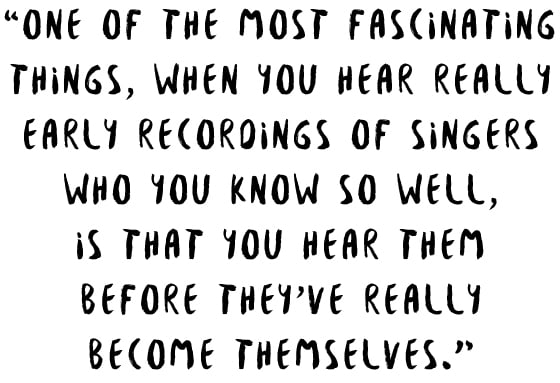
“[These sessions] were some of the first times I was ever recorded, and you can hear my influences,” Welch says. This act of retracing early work is one she’s enjoyed as a fan of other artists, too. “I think it's interesting to hear where they started and what they changed. One of the most fascinating things, when you hear really early recordings of singers who you know so well, is that you hear them before they've really become themselves.”

In addition to the novelty of hearing a greener Gillian on the more popular songs from her catalog, Boots No. 1 also boasts songs like “Wichita,” which appeared on set lists and a live DVD but never made a proper album, and “Dry Town,” which was written by Welch but recorded by Miranda Lambert and Nitty Gritty Dirt Band.

“I guess we just didn't feel like they fit in. I don't think we had any agenda, didn't have anything against these songs. We're really album-oriented artists,” says Welch. “This was a great way to have them come out in to the world, because they really make sense in context with Revival.”

The sessions for Revival began in the Summer of 1995 in Los Angeles, bounced down to Nashville in the Fall, and wrapped up back in L.A. at the end of the year. These recordings formed the basis for the archival project — after all, the fact that these forgotten sessions were mixed live was an unusual luxury.

“This is very rare now, and was fairly uncommon in the mid-'90s,” notes Welch. “This would have been how people were making records in the '60s and before. But it was great for this project because it meant that we actually had mixes of takes that never got used, alternate takes. People these days aren't often in that situation.”

Welch had lived in Nashville for about three years when the recordings featured on Boots No. 1 went to tape, mostly performing as a duo with partner Rawlings in small clubs and on writers’ rounds while finding a voice as a songwriter. “We were playing as much as we could,” she says, though the out-of-town gigs were only beginning to roll in.

“I had moved to town with two songs,” she says. “By the time we were going in to make Revival, I was going into the session with something like 35 songs. It had been, for me, an incredibly productive couple of years.”

Specifically, she cites a songwriting competition at North Carolina’s Merle Watson Memorial Festival as the catalyst for better gigs and more credibility as a writer, and the community she found there continued to push her forward.

“After that, people like Peter Rowan, and Tim and Molly O'Brien, and the Nashville Bluegrass Band, all these people suddenly knew who we were and started asking us to open for them. The bluegrass world was really the first place where we got acceptance. That was our home,” she says. “Actually, the night that I met T Bone [Burnett], we were opening for Peter Rowan at the Station Inn in Nashville.”

Burnett was the perfect fit for Welch and Rawlings in the studio, but if the final product he helped to sculpt on Revival sounds like a departure from what listeners hear on Boots No. 1, it’s not because the veteran producer was out to change their sound.

“Dave and I knew what we liked,” says Welch. “We really did, going into it; but even so, it's hard when you're that young and you've never done any recordings to just go in there and do it and feel confidence. He gave us that strength — not even to mention the fact that he knew his way around record-making like crazy. Nothing got put on that record that Dave, T Bone, and myself weren't happy with.”

That attention to detail is as evident today as it was in 1996 and, although each of the songs on Boots No. 1 is its own glimpse into Welch’s roots, each half of the double album stands as its own: a Revival for parallel universes.

“Dave felt very strongly that whatever we made should be playable like a record, not feel like a library project. I felt very strongly the same way,” she says.

These recordings may have been cast aside as the songs themselves evolved into live anthems and borrowed cuts. But to hear them emerge unchanged as puzzle pieces that fit together in such a meticulously curated collection as Boots No. 1 is a compelling message for any artist or maker: that even the less-polished parts of the past can be a vital part of the future.

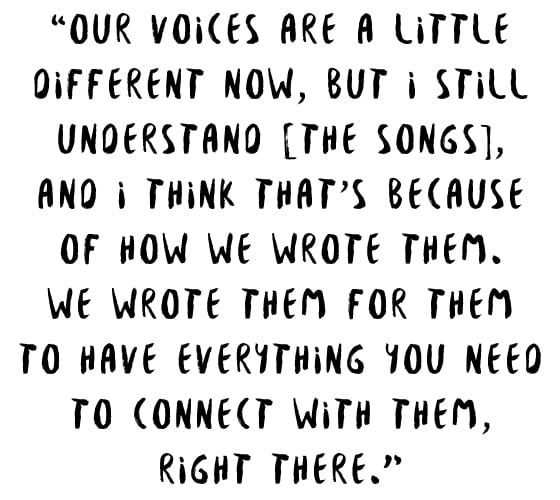
“I hear a starting place to where we ended up going, and hopefully that's interesting to people. I know, as a listener, it's interesting to me,” she says. “Obviously we play [the songs] a little differently, and our voices are a little different now, but I still understand them, and I think that's because of how we wrote them. We wrote them for them to have everything you need to connect with them, right there.”


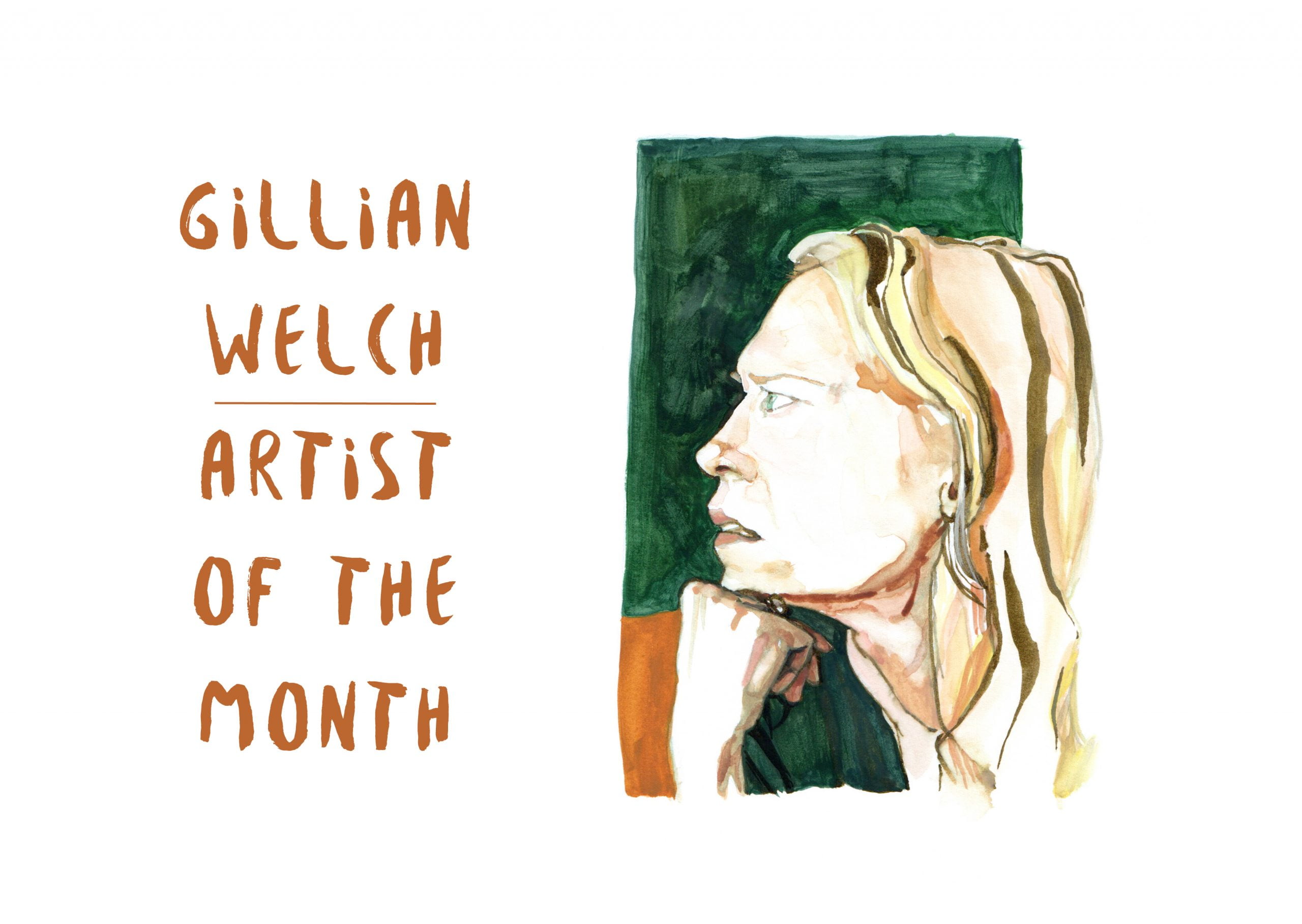
Lede illustration by Cat Ferraz.

The Producers: Joe Henry

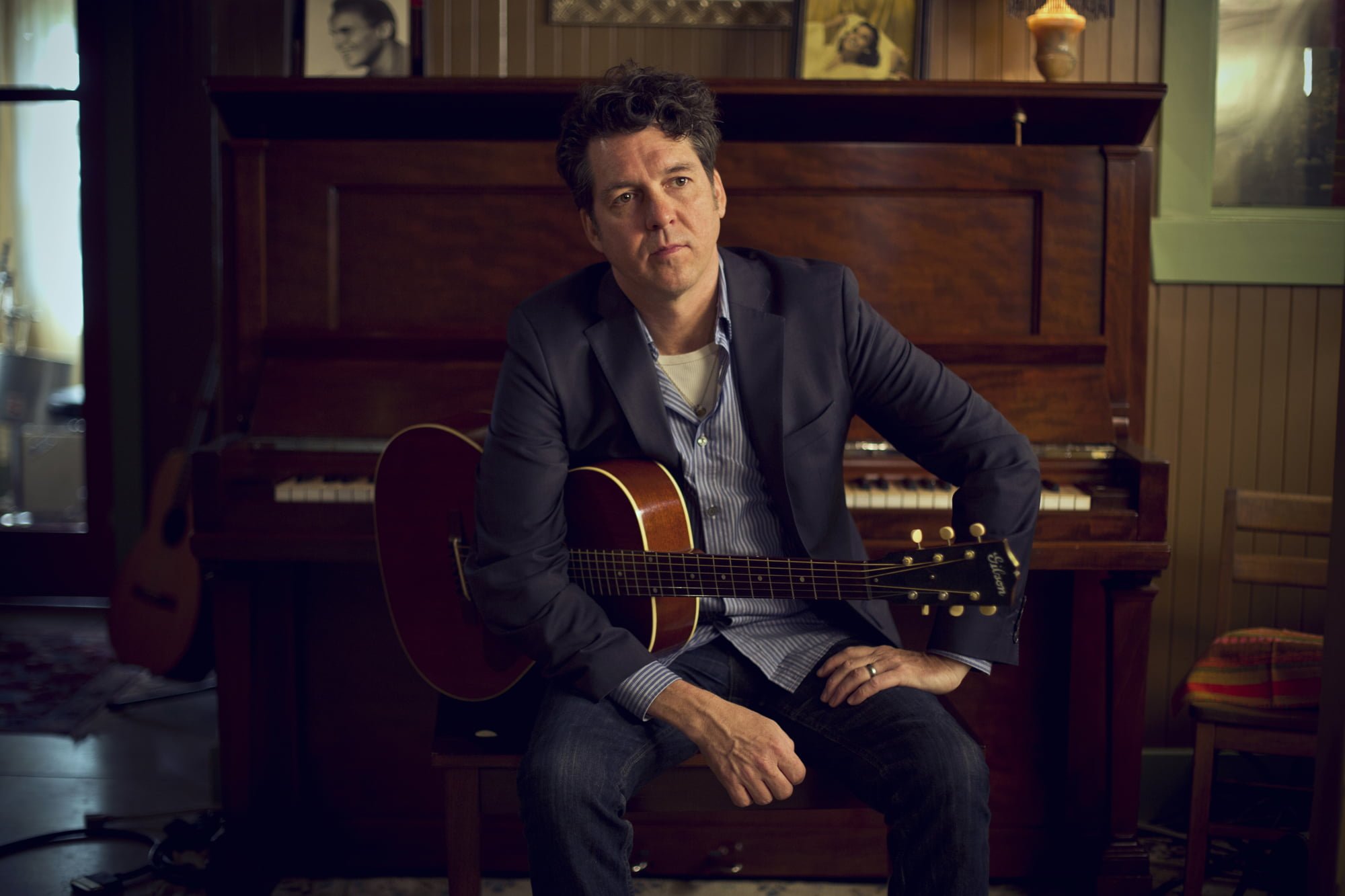
Leaving a home studio can be a tragedy for some musicians, especially when it’s beautiful both in its architecture and in its acoustics. But Joe Henry took it in stride. He recently moved his family out of their home in South Pasadena, which was built in 1904 for President Garfield’s widow and which housed the facilities where he recorded albums by Loudon Wainwright III, Over the Rhine, Ramblin’ Jack Elliott, and Aaron Neville, among others. The final sessions were a crowd-funded effort by the husband-and-wife croon-folk act Birds of Chicago.

“It was a wonderful, incredible experience to have that studio,” Henry says, “and some of the greatest musical moments of my life happened in that basement. But in a very real way, with so many changes in the record industry, it was just not sustainable.” He is, however, not particularly sentimental about the space. “Frankly, it asked a lot of my family to have that happening. Every time I had a project, it took over everybody’s life for a week. I didn’t step out of it by choice, but at the same time, I don’t feel diminished for having done so. You just look at it and say, 'What’s next?'”

Henry has been asking himself that very question for 30 years now. A Detroit native, he started out in the 1980s as a singer/songwriter in the John Hiatt/Alejandro Escovedo mode, eventually absorbed — somewhat reluctantly — by the alt-country movement of the 1990s. Although he did pen the liner notes for the Jayhawks’ epochal Hollywood Town Hall, Henry was never quite part of that scene, trading in what little twang he had for smokier and more sophisticated sounds on his excellent trio of late ‘90s/early 2000s albums: Trampoline, Fuse, and Scar.

His has been an unpredictable career, covering a wide swath of styles and expanding the definition of “roots” to be wide and inclusive. In addition to his own albums, he has manned the boards for the Carolina Chocolate Drops, jazz pianist Mose Allison, R&B singer Solomon Burke, Bonnie Raitt, Aimee Mann, Susan Tedeschi, and Hugh Laurie, among many, many others. To each of these diverse projects, he brings what might be called a signature elegance, spare and understated — the instruments all resonating against each other to illuminate the song.

His latest project is a slight reinvention of the Texas troubadour Hayes Carll, whose new album, Lovers and Leavers, chucks the full-band sound of his last two efforts. In its place is a quieter sound — introverted and melancholic — more akin to the low-key ruminations of Mickey Newbury than the wild romps of Ray Wylie Hubbard. That it succeeds is a testament not only to Carll’s vivid songwriting, but to the intimate setting Henry creates for these songs.

What kind of conversations did you have with Hayes Carll going into those sessions?

When we were first talking about working together, he did send me a few demos, so I had some sense of his landscape, but what he told me when we got on the phone was that he didn’t want to keep making the same record over and over. He didn’t want to go back to his old methodology and just create something that might be more wood on the pile, however good it might be. He wanted to do a record that arrives with its own atmosphere, its own movie. I always think of records as making movies. They have to add up to a narrative arc, even if it’s just an abstract one. So when he played me some songs and we talked more, I suggested doing something that was very austere — at least in terms of the number of ensemble members — yet something that would feel very complete.

How did you find that balance where it would sound sparse but not like a demo?

I always want records to feel like they have an orchestral element and, by that, I mean not just setting up excuses for musicians in the studio to riff on top of somebody’s song. I don’t ever in my life want to hear — and I certainly don’t want to be responsible for — anybody treating a song as simply an opportunity to be individually seen or heard. I want everybody involved to disappear into the songs, and I want the elements to always be speaking on behalf of the song’s dramatic arc. There are moments on this record that are just acoustic guitar, upright bass, and drums, but I think they play in a very widescreen sort of way. It’s more The Last Picture Show than it is Gone with the Wind, that’s for sure.

It definitely has a sense of place. Some of the songs sound like somebody playing a club right as it’s closing down for the night.

I always hope that there’s a sonic thread that grounds a record, no matter how different the songs might be. The common thread in this case is the singer’s voice and the character implied by that voice, which suggest a sense of place. A location where these stories are happening — even if the story is in process, even if it’s in motion, even if the locations shift like they would in a movie. Somebody might move from one town to the other, but the story itself has a coherent grounding. I think listeners want to feel that connectivity, and anybody who is willing to listen to a record in sequence, as presented, and take it in as a whole statement should be gratified and should be rewarded for bringing that kind of time and attention to bear.

With an album like Lovers and Leavers, which represents a dramatic change, it seems like an artist would have to really trust whomever he’s working with. Do you think it makes it easier for an artist to trust you as a producer because you were a performer first?

I would always hope so. I am a songwriter first and foremost and, as a result, even when I’m working as someone’s producer, I’m still looking at everything through the lens of the songwriter. I don’t turn that part of my brain off, jump the fence, and become a record producer. I am a songwriter standing at that wheel on the ship’s bridge, and I’m always thinking in terms of the song.

I’m not trying to create a song that reflects well on the artist, though. I’m trying to encourage the artist to reflect well on the song. That’s a distinct difference. It might seem like a fine line to some people, but there are great chasms on both sides of that line: "Are we in service to the song? Or do you think the song should be in service to some public persona?" I would like to think I give a certain authority with the people I work with because I walk that walk every day. I engage in the act of writing songs every day … some days more successfully than others. But it’s something that constantly occupies me, and I’m always listening for the moment in which the song becomes a living thing and just walks away from us.

How do you mean?

The song has to take over. We’ve all seen evidence of musicians who create songs that just serve as advertisements for the performer’s persona. There’s not a song that somebody else would cover. There’s not enough song there to engage anybody else. It’s there just to fly like a banner above a public performer. I’m interested in the ways that we, as devoted musicians, can disappear into the song and help to illuminate it. That’s not because I’m egoless; I just find my ego perfectly satisfied when a song is fully realized — when it is vividly itself and moving on its own steam. I don’t need people to see my face in their head when they’re hearing it. I don’t want them to hear my hand at work as a producer. That’s a failure to me. If we all do our jobs right, the song just sounds as if it were inevitable.

I remember reading a quote from a composer who specialized in film scores. I can’t remember who it was, but it has stuck with me. He said something to the effect of, "If you remember the music at the end of the movie, then I haven’t done my job."

I agree with that, for the most part. I certainly agree with the sentiment, in regards to somebody scoring a film. The score should be no less or more important than what the lighting designer or somebody else brings. The music should permeate everything, but you’re not supposed to be conscious of the craft. You’re supposed to be caught up in the moment. In that regard, I do agree. But there’s a disconnect for me: I could listen to somebody else’s record, and I’ll just picture people sitting in a room with headphones on. I picture the act of record making. And I don’t want to. I want to be seduced. I want to be seduced by the character and the story and the journey.

Is there a moment when you realize that a song has reached that point and become its own thing? Is that something you’re aware of happening?

I think you always know. There will be times when I’m sitting in the studio and I’m supposed to be listening to how this guitar overdub works or what this mandolin adds. And I sit there waiting for the playback and I forget what I’m supposed to be listening for. I go back to just hearing the story, and when I get to the end, I realize I completely forgot to pay attention to what I’m supposed to be paying attention to. So it must be working. Something else has taken over. There are moments when everybody undeniably knows that something has shifted and has become real. It’s not just an idea anymore. It’s wonderful when that happens in real time — in an immediate way that is beyond a doubt.

Is that when you know something is finished? Or do you ever know when a song is finished?

Songs can always be different. Some people are always discouraged by that idea. It makes it heard for them to reach a sense of peace and closure, because they’re thinking about what else might it be: "Is there some better way?" I don’t tend to think like that. Life is short. There are all kinds of ways a song might be successful. Our job is to find one of the ways a song might be successful and commit to it fully. I feel liberated by the fact that it can always be different. Sometimes time runs out, but that’s not necessarily an obstacle. You could chase a song in different directions all day, but we have more work that we’re obliged to do. You don’t have endless resources and endless time. I don’t see that as an obstruction. Instead, I see it as something else that’s guiding us. Otherwise, you’ll just get really lost: "Okay, we have this, but what else could it be?" It could be anything else. There are all kinds of things that it might be. But what about right now? Is the song being served and does the song then serve the whole project?

It’s not about finding the perfect mix or the perfect arrangement, but finding the iteration of the songs that works for itself and for the album.

There’s no such thing as perfect. As soon as you accept that we’re all going to die, that we’re all mortal, this idea of perfection just becomes ludicrous. Things are always in the process of blooming and decaying, so the idea that there is some static perfection becomes pointless. You could tune every note perfectly and snap everything to a tight grid, but you’ll end up with something that’s bloodless. That’s a fact I hear evident every day, and I’m not interested in that. I want to be jarred out of complacency. I want to be disturbed. I want to be seduced and I want to be confounded.

Does that desire guide you when you’re choosing projects? I think of you as someone who has worked with some very different artists.

Sure it does, because I don’t judge myself or what I think I’m capable of contributing based on any sense of genre. It doesn’t matter who I’m working with — whether as a producer or as a songwriter or as a performer or whatever — from Ornette Coleman to Madonna to Solomon Burke and Mose Allison to Harry Belafonte to anybody. The goal is always the same. The music has to be undeniably affirming and seductive. Those parameters never change. The way we get there might change from one artist to the next, but the goal is always the same.

Many of the artists you’ve worked with have long traditions in pop music. Is that something you think about when you’re working … not just their history but how to carry it forward?

I’ve had a chance to work with a lot of people who are so-called "legacy" artists. And I also work with younger people who are just beginning, too. That particular thing you’re talking about is something I think about a lot. When you approach somebody with an immense legacy — somebody who is already in the Rock and Roll Hall of Fame, somebody like Solomon Burke or Harry Belafonte or Mavis Staples — the question is, invariably, "How do you respect their legacy without ever being trapped by it?" 

I don’t think the goal is to look backwards and try to re-create something, but I also don’t believe that we’re required to ignore an artist’s tremendous history. You can’t bethinking, "Oh, I won’t look like a very smart producer unless I’m putting a new set of clothes on this person." The music has to feel like it’s in motion and speaking in the present tense. So when an artist has created a great and important body of work, the job isn’t to imitate it, but it’s also not to ignore it. So how do we stand with it? How are we making new music that respects the journey of this artist yet is its own thing at the same time?

You could knock something off. We’ve all heard examples of people doing that — people who are just as enamored with old Stax/Volt records as I am, who go in and try to re-create horn charts, who mic instruments as closely as they can imagine to how they were recorded ages ago. It’s not hard to do that, if you’re with people who know how to listen. A good recording engineer can listen to something and figure out how they were getting those sounds. But you’re looking over your shoulder. You’re looking into a tube. You can’t possibly be liberated and open to discovery, if what you’re trying to do is imitate something that’s already trapped in amber.

It almost sounds like the difference between a technician and an artist.

I’m not interested in the technical aspect of it, except as it serves to set us free. I’m not an engineer, myself. I work with a great one — a heroically great one. So I’m free of that. I can talk abstractly about how I want things to work and feel, and I can talk a lot about music as being the weather in the room. I know how it needs to move me. I don’t necessarily need to know what kind of gear allows this best to happen. I work with people who know how to do that.

How did you make the transition from singer/songwriter to producer?

Like most things, completely by accident. I made my third record in 1990, called Shuffletown, which was produced by T Bone Burnett, and then I moved to Los Angeles right as it was about to be released. Then my label, A&M Records, shipped the record on release date, but also dropped me as an artist on the same day. So I was a man without a country and no real way to promote the record that they had very carelessly and cruelly dispatched with no support. They might as well have given it to me. I would have been better off selling it out of the back of my car.

T Bone asked if I would come work with him as a production associate, and I didn’t even know that what I was doing was learning to be a producer. I did understand that I cared a lot about making records and that, if I was working only for myself, then maybe I would be lucky enough to spend four days in the studio every two years. And you don’t learn anything that way. You don’t learn to swim by getting in the water one day a year. You need to spend some time. You need to get lost in the process and then find your way through.

As you start learning, it becomes clear that some things are important; other things are a distraction. And there is a common language that we keep defaulting to. You just start learning by witnessing, and it’s a great way to learn. I was very lucky to be invited into that circle. And then people just started asking me. I never hung out a shingle that said, "Producer for Hire." People just started asking. I didn’t think about it much at the time, but looking back now, I think people knew I was associated with T Bone. Maybe they couldn’t get hold of him or couldn’t afford him, so they would climb a little bit down the totem pole — maybe pretty far down the totem pole — and there I was.

Do artists still seek you out? Or do you seek them out?

It happens every which way. There are people who seek me out because they’ve heard records I’ve made. But some of the most meaningful work I’ve done as a producer was because I went and asked for it. Bonnie Raitt is a good example. I didn’t wait for Bonnie Raitt to one day, hopefully, be visited by a mystical angel who told her she should give me a call. I reached out to her: "Here’s who I am. Here’s what I do. If you’re interested in trying an experiment, I’m wide open to it." I’ve gotten a lot of my best work by just going up to people I admire and saying, "Hey, you wanna go out with me?"

Your work with Bonnie Raitt [on 2012’s Slipstream ] is interesting in that those recordings don’t redefine who she is or what she does, but showcase it all in a slightly different way … as if it say, "Here’s why this person is still vital."

She was devoted to real-time discovery. Those are almost — without exception — live recordings where she and the band are putting their hands to the pulse of the song and conjuring something that can’t be conjured any other way. And it did feel new to her. To me, it seems like an old-fashioned way to work, because that’s how people always used to work.

Go back to Louis Armstrong in the mid ‘20s, when there’s one microphone and you’re cutting right into wax. There’s a microphone taking a picture of an experience. There’s no such thing as overdubbing or postproduction manipulation. What you’re asking people to do is stand together and have a mutual experience. Have a dram together. There’s something about that that’s very old-fashioned, very mysterious and mystical. I’m interested in all that. For Bonnie, at least in that moment, that approach felt brand new. I remember saying, "How can this be new to you? This must be how you always used to work." She said, very charmingly, "If it is, I don’t remember it."

I’ve worked with some people who have been making music longer than I’ve been alive, and I’ve had an amazing opportunity to work with people who have made music that was intensely important to my formation as a deep listener from the time I was 11 or 12, in my early teens. It’s amazing to stand with those people and get invited to be a part of what they’re doing.

I think it would be incredibly difficult not to revert to fan mode in the presence of somebody like Solomon Burke.

Well, that’s something that happens in the anticipation beforehand. There are certainly moments when I’ve worked with some of these artists when I’ve had to take myself out of the room. I look at myself in the bathroom mirror and just say, "How are you here? How did this actually happen? What do you really have to contribute to someone who has achieved this level of mastery?"

On the other hand, once you’re actually in it, a lot of that stuff falls away and people just become human beings trying to do something special in the short time they have to be alive. You get caught up in that. It’s not about you and it’s not about them. It’s about it. When you get to that place, you’re liberated from a lot of things, but you’re never liberated from outrageous respect and admiration. You have to get free from sheer fandom, though, or you’d never be able to challenge anybody. You couldn’t say, "That was great, Mose, but I think you can go further." You have a real job to do, and you’re doing a disservice to the project and the artist if you don’t do it.

When I was producing Allen Toussaint and Elvis Costello on their 2006 collaborative record called The River in Reverse, there was a moment toward the end of the first day when we hit a wall with a new song. I felt a little demoralized. I’ve got these incredible legacy artists, both of whom — especially Allen — have been tremendously successful producers themselves. Do I really have anything to offer? Allen divined that I was in this moment of struggle because he’s a mystical creature. He just insisted that I understand that I had an important role to play and that I wasn’t there because they were being nice to me. He told me I couldn’t just be a spectator. I had to take the wheel. That was the job. They were occupied being the artists, and they needed somebody to stand up and take the wheel. That had to be me. So I had to let loose of any sort of sense of being overwhelmed by how much I revered both of these gentlemen as artists and songwriters and producers. I had to understand that I could deal with that later. In the meantime, I gotta get busy. I can’t be lost there. I can’t just be a fan in this moment.


Photo credit: Kaleidoscope Pictures