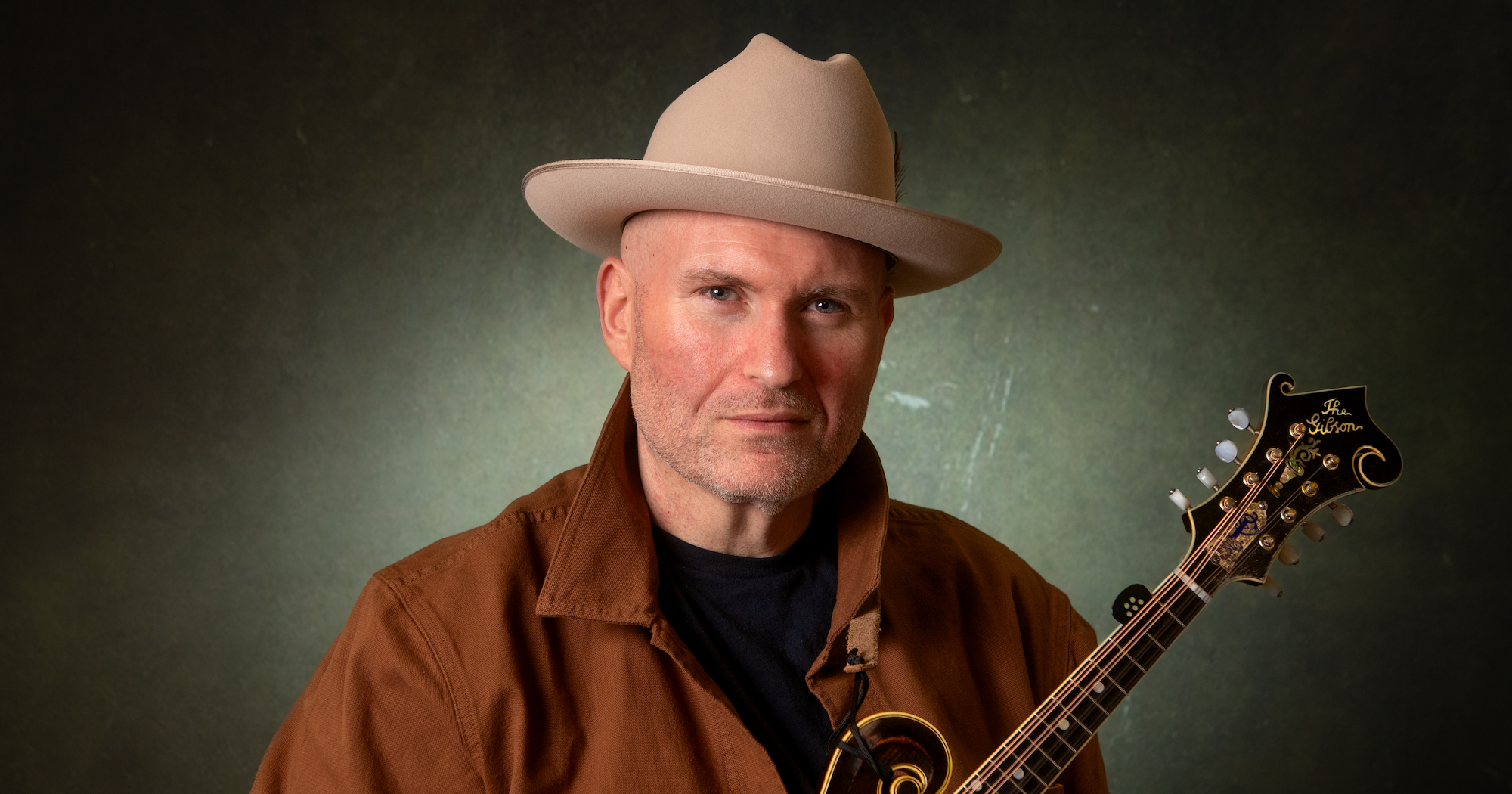
Over the past twenty-some years, Darren Nicholson has played mandolin all over the world – whether with Alecia Nugent, as a member of Balsam Range (a group he co-founded), or on his own (with or without a band). No matter where he traveled, you can be sure that Nicholson was bringing Western North Carolina with him. Nicholson was born, raised, and still lives in the area.
When BGS caught up with Nicholson, he was home in Canton, N.C., a town about 20 miles west of Asheville. It’s a region that he feels has been a bit overlooked in music history. “The oldest folk festival in the country [Mountain Dance and Folk Festival] is held in Asheville,” he shares. “There were recordings that happened in Asheville before the Bristol Sessions.”
The area he pointed out, despite its remoteness, also has been home to many significant musicians – as well as developing a dance-friendly style of bluegrass that drew from many different styles.
Nicholson’s love for the area has led to a rather unique sponsorship for his tour van and trailer. Through a friend he met with representatives of the Avalon Mountain Community, a private mountaintop neighborhood and development in the hills of Western Carolina. Nicholson calls it a “win-win” situation as he receives some financial support for touring expenses while Avalon now has a “rolling billboard.” “I even wrote a jingle for them,” he states.
Nicholson will be traveling around this year touring a fine new album, Lonesome Trails and Tall Tales. He counts it as either his fourth or sixth solo effort, depending on whether you factor in two EPs. Lonesome Trails and Tall Tales arrives after several particularly eventful years for Nicholson, including leaving his longtime band Balsam Range, getting sober, and acquiring a prized 1923 Lloyd Loar mandolin – all among the topics that he was more than willing to talk about with BGS.
How does your new album Lonesome Trails and Tall Tales tie in with your earlier albums?
Darren Nicholson: My records have a sound, you know. I’ve always been pretty much consistent – besides an electric country EP – doing the music that I consider my style of bluegrass or the bluegrass that I grew up on, which is to me the traditional bluegrass of the ’60s. Having a producer like Carl Jackson in the early days influenced how I made records, because Carl had played with Jim & Jesse and he came out of [when] an entire bluegrass movement had almost a country kind of feel to it. I love the sound of those records. And it was partly because I grew up in Western North Carolina and there’s a huge dance element here – the square dance music.
The old-timey driving style of rhythm with that light percussion – like Jimmy Martin, Flatt & Scruggs, the Osbornes – that really fits in with people who danced. And the modern kind of bluegrass – like the Alison Krauss style of bluegrass, which is amazing – does not lend itself to dancing. The modern style of bluegrass that was really kind of heavy on the one and three beat, and then the older style of bluegrass, which was very much more even, rhythmically.
And how does the new album differ from your prior ones?
What separated this particular recording from the others is just my growth as a songwriter… I was picking what I thought were the best songs I had or songs that were different from each other. A lot of times… [with] the way things are being mass produced now, if Nashville finds one song that’s a hit, they’ll write 10 more just like it for all the other artists. So they all start sounding the same.
To me, all the great artists of yesteryear, all their material was different. Their sound was different. Instead of just finding something you could mass produce, make a buck on, and then hop on to the next thing, they were actually creating art and trying to artistically be different. That was what was good about it.
So [in] the same way, I try to pick songs in my set. I don’t want to play five songs in a row that sound the same. Otherwise, it’s boring – I see bands do it all the time. They kick off in [the key of] B and they play five songs that could basically be the same song, you know? I understand why people who are non-bluegrass fans will go, “You know, all bluegrass sounds the same.”
I tried to pick six songs that were completely opposite from each other, so when you go down track by track, it’s a different journey and it doesn’t bore the listener. Every song is a different tempo, it’s a different groove, it’s a different key, it’s a different vibe, and so that’s how I put records together.
Were these songs ones that you’ve accumulated over the last couple years or are they all a recent crop of songs?
A few of them were really old and a few of them were really new. “Big Sky” has been around for a few years and I wrote it with Charles Humphrey. I thought it was “okay,” and this shows you how off-base I can be sometimes.
I’m driving to a gig one day with my buddy Kevin [Sluder]. He plays bass with us. It was a solo gig, but he was just riding with me. We’re listening to songs and Kevin goes, “That song is amazing. You’re an idiot if you don’t cut that song.” I was like, “That song? It’s okay.” He goes, “No, that song’s more than okay. That song is special. You need to cut that.” I took this batch of songs to Jeff Collins, who produced the record, and that was one of the first ones he picked. And sure enough, radio played it. Banjo Radio wore that song out. If it were up to me, I would have probably left that one on the pile of demos.
One of the newer ones was “Eager Overachiever.” I’d just written that song with Andrew Blythe. It was so fun. Every time I would sing it for somebody, they loved it. It’s a funny song about addiction.
It made me laugh, and the song also shows a lot of personality.
That’s the point, you know. That song has personality. One of my favorite artists [growing up] was Roger Miller and he would sometimes do these spoken pieces. Especially in country music, sometimes there would be recitations or things would set up songs. It was interesting and just funny, you know.
Can you talk a little about the music traditions of Western North Carolina where you grew up?
There’s a definite style. If you go across the country, there’s little pockets of bluegrass that have their own sound, for sure. But Western North Carolina and this region was so rural and cut off… If it’s 120 years ago and you’re in the mountains of Western North Carolina, people would walk for 10 miles to get to a barn dance or some place on Saturday night. And the band would be whoever showed up. It might be a banjo and guitar. It might be fiddle and banjo. But it changed the way you played. When Doc Watson plays his leads, he also plays his rhythm; he’s playing lead and rhythm at the same time. Where modern players who have a whole band behind them, they’re like playing rhythm and then when it comes time to take their solo, it’s a whole different mindset.
As [the area] grew and people got together more and more, they still played the same way. They passed it down from generation to generation, that strong sense of rhythm and timing that is a trademark for Western North Carolina. Look at Marc Pruitt and Steve Sutton; you know, Jason Burleson is from Western North Carolina. Doc Watson, Earl Scruggs, Mark Kuykendall, Tom McKinney, Mike Hunter – all of these amazing players are from Western North Carolina. Randy Davis – Bill Monroe introduced him every night for five years: “He’s the man from Asheville, North Carolina; he’s the man with perfect timing.”
At these musical gatherings in Western North Carolina, you’re describing how people frequently would bring whatever instruments they had – acoustic or electric. And it wasn’t doctrinaire about what a bluegrass instrument had to be.
Yeah, it was community. And I’m going to say this, and I don’t care to say this because I’m from here and I’m from generations and generations of people who play this music. It’s always somebody who got into bluegrass in college or they got into it older, and they’re not even from this area. It’s somebody that’s from New York or from California or from Oregon. They write articles, and they become self-proclaimed experts of bluegrass. And they say, “Well, this is bluegrass and this isn’t bluegrass.”
They didn’t come from generations of this music. They don’t know. They’re not at the epicenter of where it came from and how it started, but they’re always the ones who try to dictate. And then most of the time, they don’t even play. But that’s their way of being involved in the music somehow. It really hurts the music because any time you start segregating something, you’re just keeping somebody [out]. That’s not how this music started.
Do you think Earl Scruggs said, “I’m not going to play if there’s an electric bass here”? You know what I mean? Look at the people who created the music: Earl Scruggs, the Osborne Brothers – they had electric bass. They had drums. But there’s somebody, who’s basically a yuppie, who is trying to tell us what the music is. I do take offense to that.
That’s why the Gibson Brothers have that song called “They Called It Music.” That’s great. I love that because that’s what it was. It’s like, they just called it music. We got together and made music and everybody was welcome. And it sounded like bluegrass. It sounded like country. It sounded like old-time. And it’s just sad. It’s like bluegrass has almost tried to put too fine a point on itself. And it’s almost made itself smaller because of that.
To me, sometimes it feels like the more I write or listen to music, the less I know, in a sense – or, the more I learn, to say it another way.
That’s how we all should be. We should remain a green tomato. If we’re red, we’re done, right?
If I moved out to Seattle – I really enjoy grunge. And if after five years, I read about grunge as much as I could, all of a sudden I know more than the people who created it? But I see that happen [with bluegrass], you know. It’s almost like someone is such a fan or likes this so much that they take ownership to a point where they’re hurting it. It’s like a pet. They’re holding it and petting it so much that they’re actually hurting it.
Bluegrass can look like a lot of different things and so there’s different styles depending on the regions, too.
I was wondering who are the main musicians that have influenced your mandolin playing?
Basically, there are four guys who are on my Mount Rushmore of mandolin. Country music or bluegrass or whatever in roots music – and that’s Bill Monroe, Jesse McReynolds, Bobby Osborne, and Jethro Burns.
Every modern style has come out of those four guys or a combination of those guys. That’s where David Grisman, Ricky Skaggs, Doyle Lawson, Sam Bush, [were all] influenced by those. So, there are some songs that I try to sound like Bill Monroe and there’s some songs I cross-pick like Jesse. Then there’re some songs I play more fiddle-note stuff like Bobby and then there’re some songs that get a little swingy and jazzy and I’m channeling my Jethro, you know?
Those guys kind of set the landscape. My big influence, as far as players that I got to see and got close to, is Mike Hunter in Western North Carolina. He was a huge, huge influence. He was an incredible mandolinist.
You have said you tend to let the song guide you and not to impose a style on it. Did this approach come from someone’s advice or was it something you learned along the way?
I had a mentor named Steve Sutton. I started playing with Alecia Nugent in 2004 and Steve was the bandleader. He got me that job. During that time, musicians would come through in little waves, like in five-year clusters. A lot of my peers were Aaron Ramsey, Ashby Frank, Andy Ball, Jesse Cobb, and so there were a bunch of guys during that time. Not all of them are Adam Steffey clones, but a lot of my peers were influenced heavily by Adam Steffey.
It’s like, who can play like Adam Steffey? You can get close, but you’re not going to beat the guy. So, my mentor told me, “All of these other people are in that vein. You would be way ahead to do your own thing and just sound like yourself. You won’t mess up as much either, because instead of thinking about what somebody else did, you’re actually thinking about what you’re doing. So, your brain is actually in the moment with your hands.… Try to play what fits the song and instead of trying to settle into a style – just play what the song or the band needs.”
And, you know, I just never turned back from that. He really helped me with that. Then, all of the sudden, too, if you sound like yourself and everybody else is going after this other thing, then you’re a peacock in a room full of chickens.
A couple years back, you acquired a rare 1923 Lloyd Loar mandolin. How are you enjoying it?
Oh, it sounds incredible. It’s a hundred-year-old wood. You can’t replicate that. Ferdinand [named after the mandolin’s original owner] hadn’t really been played until I got it, but I’ve played it quite a bit. You can play that thing for just a few minutes and it’s just singing. It’s just unreal.
It gets better and better every minute that you play it. It’s balanced. It’s loud, but it’s also got these real pretty, sweet tones in it. It’s just a pretty magical instrument. It’s a life-changing instrument, for sure. It’s a rare bird amongst rare birds.
Early in the pandemic you got sober, which you’ve been quite open about. How has this changed your life?
Getting sober, I had all this time on my hands and I started getting productive. I started recording, writing songs, and all of a sudden, after all these years, I felt my creativity. I started throwing all my time into healthy things… I had my life back. I had my time. I had my energy. I had my mind, my spirit – all that came back because of sobriety.
So, I talk about it because I think talking about it is a great way to maybe touch someone who’s maybe struggling with it out there, you know? Give them a little shot in the arm and say, “You know what? If that poor bastard can do it, I can do it too.”
That was around the time you left Balsam Range too?
When I left that band, people were like, “Why would you leave a high-profile band?” And it’s like, there’s more growth over here [going solo]. The last year I was with them, we went on about 20 dates and I did about 160 dates on my own. I wasn’t stagnant anymore. A band has been together for a long time, people request the same songs and you’re playing the same songs all the time.
The pandemic also resulted in you having something of a revelation about performing music, right?
I found myself doing house concerts for 20 people, and they’re people who saw me on huge stages with Balsam Range. They would cry because they’d never experienced bluegrass like this. I’m like, “Well, this was how it was intended.” This was how it was created in these houses a hundred years ago in the mountains of Western North Carolina — community people entertaining each other.
So, there’s that. Then there’s sobriety. And then there’s like, “Wait a minute, am I doing this for my ego to get famous or am I doing this to be healthy and be part of a community?” It all goes together. Like, I talk about my sobriety to help others. I want to use my music to impact others.
If we do it with a good heart and the right intentions, all that other stuff will fall into place. We want to play anywhere. We’ll go and we’re ready. We’re road ready. We’ve got original music; we can do covers; square dances… I want to be the Bob Wills of Bluegrass.
Photo courtesy of the artist.