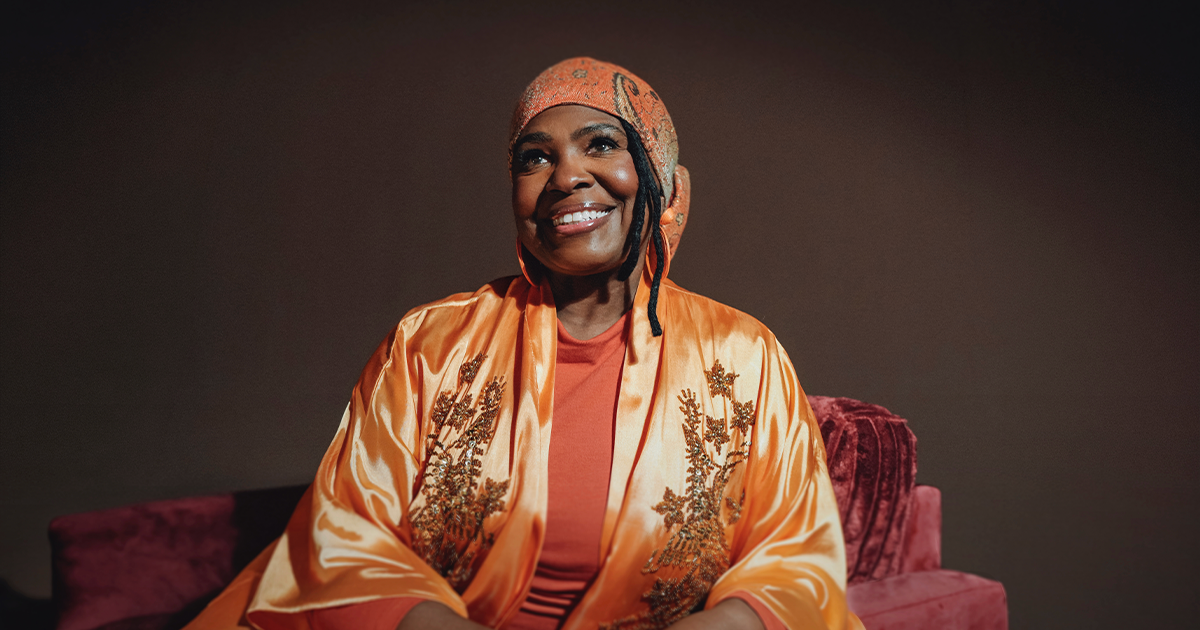
With a brand new album, Just Say Yes, Ruthie Foster is back on her feet.
Although she’s been on the go for decades as a runner as well as a troubadour, Foster was actually on crutches in the recording studio after injuring her right knee while running to catch a flight. During her slow but steady recuperation, she found songwriting to be a useful way to help get herself back together, both in body and in spirit. You can especially hear that effort in the lyrics of “Take Time” and “Sitting Still.” But there’s also an assertive side to Foster’s musicality in “Thank You,” where she’s just letting you know, “I keep a little attitude in my gratitude.”
Winning a Grammy award for Best Contemporary Blues Album for her previous effort, Mileage, Foster hasn’t lost a single step with Just Say Yes. Tyler Bryant returns as a songwriting collaborator and producer; his wife, Rebecca Lovell of Larkin Poe, also joins in as their co-writer on all 10 tracks. In addition, there are plentiful contributions from Megan Lovell (Rebecca’s sister and bandmate) and guitarist Mike Seal (Megan’s husband), while Tyler and Rebecca’s newborn son, Jesse, brought an extra dose of joy to the studio proceedings in Nashville.
Chatting with BGS from her home office in Austin, Texas, after a short run of shows, Foster spoke about unspooling her nervous energy throughout a live performance , the echoes of good advice from her elders, and why she gives big respect to bluegrass.
BGS: Where did the album title, Just Say Yes, come from?
Foster: I was talking to my co-creators. We were sitting in their living room, and I was telling them about this Post-It note with “Just Say Yes” that I used to put …well, it’s actually still on my computer monitor. I was taking a break from music at the time [in 1993], and just trying to take care of myself, take care of my mom, and I wanted to just open myself back up to music. I just put that on my computer and said, “Okay, I’m just going to say yes to any opportunity to play.”
And things just start happening. I had a day job working at a TV station and every other Friday was my senior living tour. I would go to two nursing homes and play during my lunch break, and it just kind of started from there – just being able to play again. And it opened up to coffee houses on the weekends, and now I’ve got a band together, and I’m now here. So it was really about saying yes to opportunity and whatever came in front of me. Use it for the better good of where I want to be.
And now saying yes is about taking care of me, taking care of myself, my time, my peace, making time for meditation every morning. That’s been the biggest thing for me – taking time for myself every morning before I even speak to anybody. Because when I do that I can go out in the world and I can respond rather than react. And it’s been huge for me.
My favorite song on here is “Take Time,” and I was going to quote my favorite lyric back to you, which is, “Maybe all that you’re doing is all you need to do.” That was such a poignant way to express the idea that it can be enough – what you’re doing can be enough.
I think that’s what this album is doing, and what it’s gonna do. I know it’s been therapy for me. Really, I guess we could just call this my therapy season. I think the last album, Mileage, was that way. I had a flight attendant just last night on the flight who came and sat next to me, and she said, “I read the list of people who were coming on, and I saw your name, and I just wanted to tell you how much your music means to me. I’ve had a rough couple of years, and your music has gotten me through that.”
That says it all. And I had to tell her, “Girl, wait ‘til you hear the next one!” (laughs) Because it’s that way for me too. It’s been therapy. I’m reminded all the time at the merch table that that’s my purpose. I guess this is why I’m here, to remind you that you’re doing enough.
That song, it’s not the Ruthie Foster that people expect. I’m not singing at the top of my voice. I’m just sitting on a porch watching my cows and my horses and my chickens. That song means a lot to me too, because it’s mixing in a lot of the things my big mama – my grandmother – would say to me, and my mother. It’s all of this advice and acknowledging their presence in the room and what they poured into me, and I’m just giving it to someone else.
I know you play a lot of festivals, and since this is The Bluegrass Situation, I thought I’d ask you, do you like bluegrass? Do you have any favorite bluegrass artists?
Oh, absolutely. Ralph Stanley. I got a chance to hang out with when he was still with us. That’s been years ago. Obviously, he’s been gone for a while, but I got a chance to see him, and he was such a gentleman, and the band was just beautiful. I mean, beautiful. They were pretty boys. (laughs) We got a chance to hang out at a festival, and to me, that was another one of those moments. It’s like, “I’m done!”
Del McCoury and his guys, I got a chance to hang out with them a few times because I did folk festivals for a long time. I still do, and so when I get a chance to run across great bluegrass players, I love to pick their brains about their style and how they pick so dang fast! I’m a guitar nerd but I can’t play like that. But I am a big fan of great players.
Oh, Mike Seal! You know, he’s all over this album, and he’s a wonderful guitar player. He can play anything. That’s the other thing I find with bluegrass players; they can play any instrument. And I love that. I’m a little bit jealous of that, actually. I do play other instruments myself, and maybe that’s why I’m interested in hanging out around those guys. Big respect for the genre.
So, how are you feeling now with this new record coming out? Is there an excitement or any sort of emotions raging through you?
Yeah, I’m a little scared because I’ve got to learn a lot of lyrics! The energy’s big, and talking about it is good for me. I still have a lot going on in my life. I gotta pick up my kid from school today, and I don’t want to forget that. (laughs) It’s like putting all these different hats on at the same time. So acknowledging the release is just part of my life.
And this is the other thing I’m learning – being a musician and being Ruthie Foster is one thing. What I’m learning to do is mix that with my everyday. Like this morning, I went over and I just wanted to sit and talk to my neighbor and ask, “How are you doing? What are you doing in your life?” I get why people want to talk about what I’m doing, but I want to know how someone else is. I want to know how she’s doing. Did her grandkids show up this weekend? You know, that’s the kind of stuff that I want to stay connected with.
And this album coming out, I just want that to be part of the conversation. I want to know what you got from it. I want to know, how did this make you feel? What song was it that stood out for you? That’s what I’m anticipating. I want to know what these songs mean to everybody, because I know what they meant to me. I’m excited to see what people think of it, and a little nervous at the same time. Because this is my life on the plate, and I’m handing it to you.
I think it’s good to have some nerves though. I still get nervous about certain things, and I think it means that I care.
That’s exactly what it is. It’s just energy. My voice teacher told me it’s good to be nervous. You want some kind of energy. You have to learn how to convert that into something positive. And you can let that go a little bit at a time as a vocalist. I know if I don’t have nerves, it’s almost like you don’t care. She taught me how to take that ball of energy and just unwind it as you go throughout the set, and give it out because someone needs that. That’s all.
When you talked about changing that energy to the positive, it reminded me of “Thank You.” There’s some energy going on in that song, but you shift it right away.
I do, yeah. I’m waiting to see who’s paying attention!
That’s such an attention-grabbing song. What was on your mind when you wrote that?
That was actually brought to me half done by Rebecca and Tyler. Megan and Mike were part of that one too.You know, people look at Ruthie Foster as doing all of these affirmation songs, but I’ve had discourse and people who were naysayers and telling me what I couldn’t get away with all my life. Especially all of my musical life, because people want to put you in this box all the time. And it may have a lot to do with why I’m still out here and nobody knows who I am, because I do move around in different genres. I think it’s okay to do that. There are no rules.
And I want to be singing these songs for a long time, and want to be interested in what I’m singing as well. I don’t want to sing the same thing all the time. That’s not how you live life. So why would I do that with music? So, I wanted to add a few more verses to this song and a few more choruses, and that’s what you’re hearing at the end of the song. “I put a little attitude in my gratitude,” all of that. And I want to say thank you. I’m gonna write a letter from jail if I end up there. That’s OK. I know how to braid. I know how to trade. (laughs) I’ll be fine!
I just put a little more attitude in the song as we were finishing it. That’s how it got so long. It’s one of the longest songs. We didn’t want to leave anything out! Rebecca was great with getting me started. She’s like, “OK, here’s what we’ve got right now. What do you want to add?” I was holding on to my drink, going, “Yeah, I got some more stuff I want to put in there!” So, yeah, the attitude in the song came from me!
Photo Credit: Jody Domingue