In an all-star acoustic tribute, the timeless music of O Brother, Where Art Thou? rambled across the Grand Ole Opry airwaves for a 25th anniversary celebration on Saturday, February 28.
In some ways, this night in Nashville felt different from a typical Opry show – no drum kit, no square dancers, and not a lot of commercials. On the other hand, it would be hard to find a more suitable place to stage a salute to O Brother than on the world’s longest-running radio show.
The GRAMMY-winning, 8-times platinum soundtrack was performed in its entirety by Opry stars such Alison Krauss, Emmylou Harris, Del McCoury, Old Crow Medicine Show, and the Whites, as well as guest performers like the Alaskan Sunnyside Sisters, the Fairfield Four, the Fisk Jubilee Singers, and Colin Linden alongside contemporary masters like Sarah Jarosz, Billy Strings, and Molly Tuttle. (To put the time frame in perspective, Jarosz was 9 years old when the soundtrack was released, Strings was 8, and Tuttle was 7.)
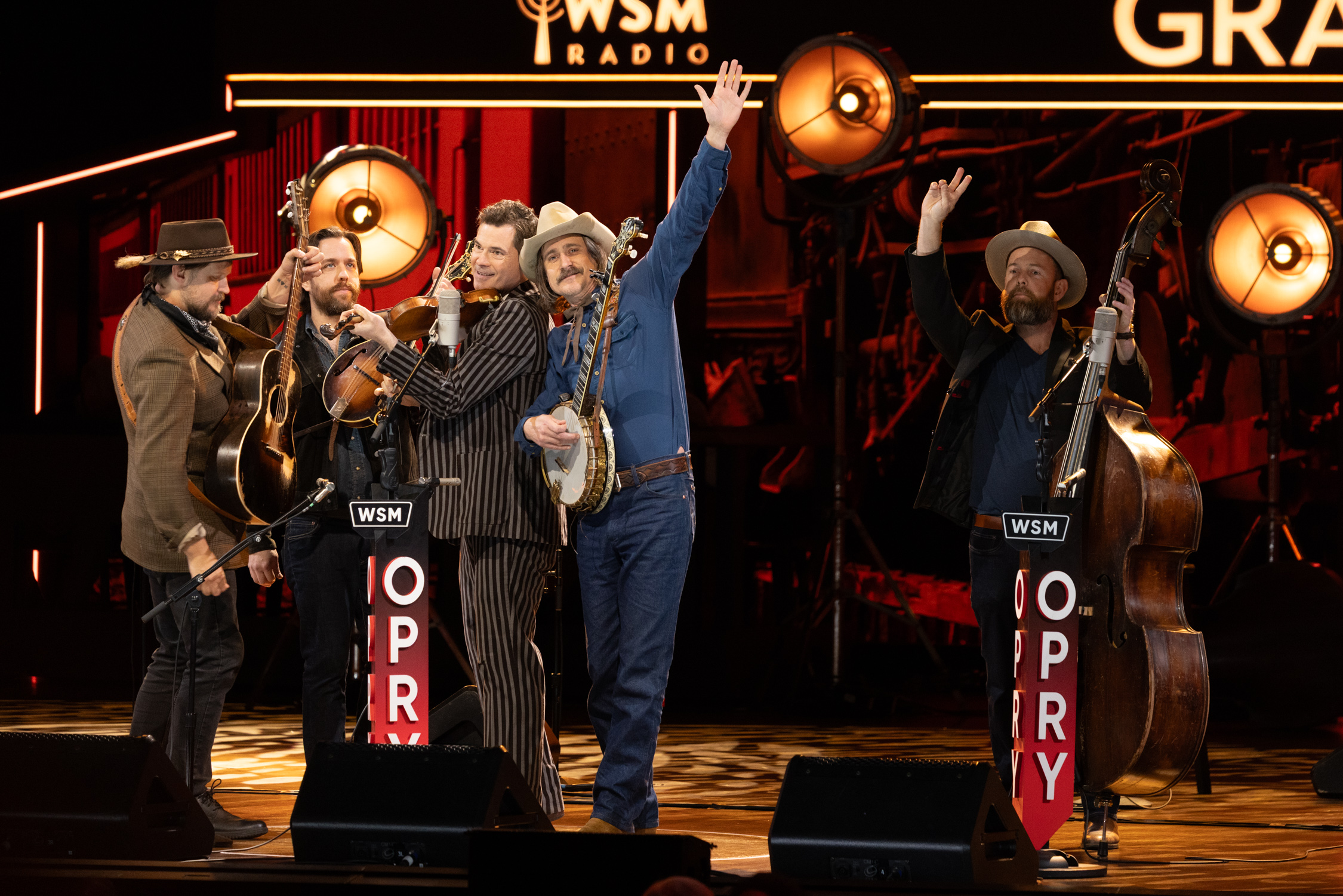
Old Crow Medicine Show perform during the Opry’s tribute to ‘O Brother, Where Art Thou?’
In addition, Chris Thomas King and Tim Blake Nelson also reprised their performances from the film, while the A-list house band was composed of Mike Compton on mandolin, Dennis Crouch on bass, Jerry Douglas on Dobro, Stuart Duncan on fiddle. And what O Brother tribute would be complete without Dan Tyminski delivering “I Am a Man of Constant Sorrow”?
As a bonus selection not included on the landmark collection, Krauss and the Fairfield Four opened the special evening with a lively rendition of “Every Time I Feel the Spirit,” which immediately immersed the audience in that same spirit. After Krauss stepped away, the Fairfield Four performed the soundtrack’s original opener, “Po’ Lazarus,” accompanied only by hand claps. Old Crow Medicine Show roused the crowd with “Big Rock Candy Mountain,” an enthusiastic choice that fit their high-energy demeanor. Bandleader Ketch Secor also co-hosted the event alongside Opry announcers Bill Cody and Mike Terry.
Dan Tyminski sings “I Am a Man of Constant Sorrow” with the evening’s house band.
Backed by the house band, Jarosz engaged the audience to sing along with a perennial favorite, “You Are My Sunshine,” and the sold-out Opry House was happy to oblige. Krauss returned with the Fisk Jubilee Singers for a sterling performance of “Down in the River to Pray,” where the audience sat almost perfectly still in reverent silence. Following the song, Krauss was presented with a commemorative scarf designed by the famed clothier Manuel; all Opry members are receiving the scarf as part of the Opry 100 celebration. The house band then shared an instrumental version of “A Man of Constant Sorrow,” which was a nice touch referencing the handful of variations of the song on the soundtrack.
That soundtrack practically came to life with Colin Linden and Chris Thomas King’s “Hard Time Killing Floor Blues” and The Whites’ “Keep on the Sunny Side.” Jarosz on mandocello and Molly Tuttle on guitar teamed with the house band for a wonderful take on “I’ll Fly Away.” Emmylou Harris and Alison Krauss then stood on either side of Tuttle for a trio rendering of “Nobody But the Baby.” (Gillian Welch, who sang with Harris and Krauss on the original album, was unable to participate in the show.)
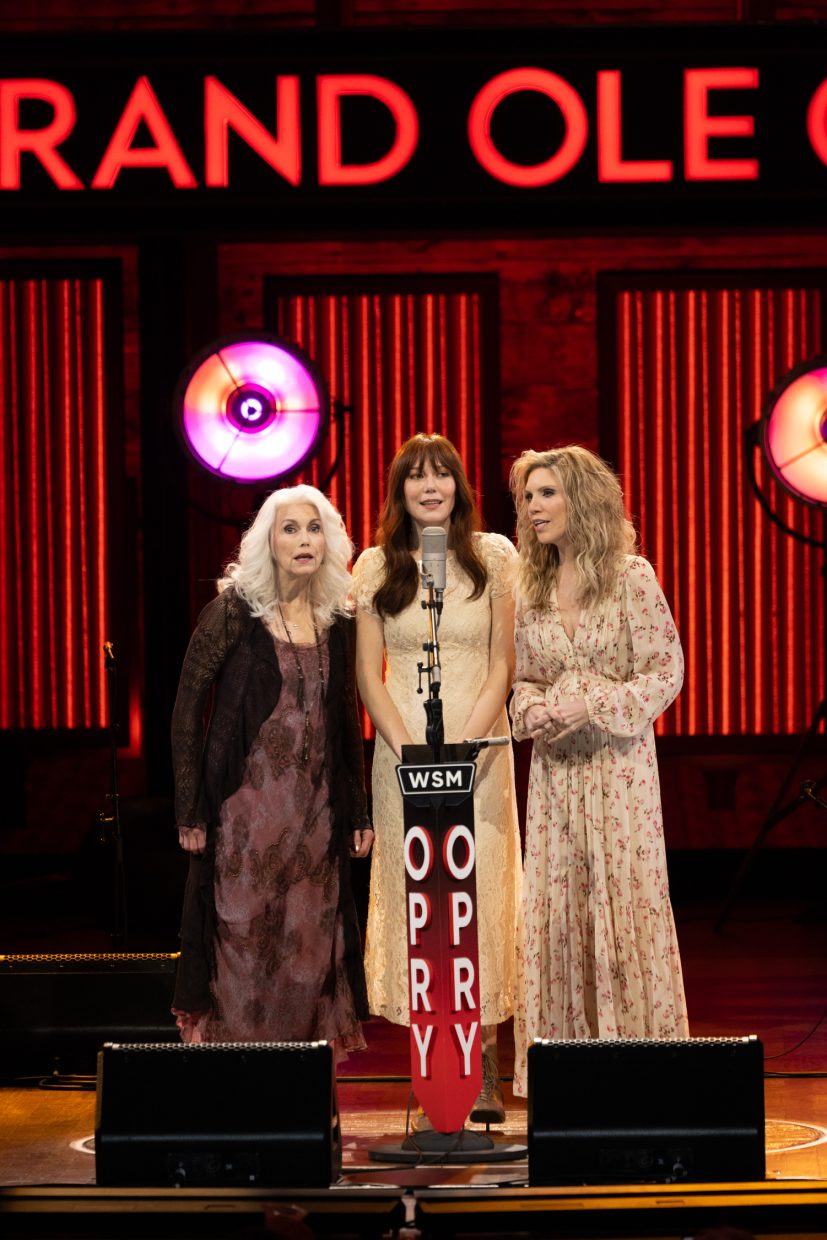
Emmylou Harris and Alison Krauss, both of whom appeared on the soundtrack, are joined by Molly Tuttle for an a capella rendition of “Nobody But the Baby.”
Folks, that’s only the first half!
After decades away from the spotlight, the Peasall Sisters returned to the stage to introduce “In the Highways,” the song they recorded as children; on this night, it was sung by an endearing kid quartet – and viral internet sensations – the Alaskan Sunnyside Sisters. Molly Tuttle returned for the emotional “I Am Weary (Let Me Rest),” which led into bluegrass phenomenon Billy Strings singing “Wild Bill Jones,” which appeared on the 2000 O Brother concert album, Down From the Mountain. Strings then welcomed Dan Tyminski for a duet of “O Death,” which was sung by the late Doctor Ralph Stanley on the soundtrack. (Incidentally, Stanley joined the Opry cast the same year the O Brother soundtrack was released on Lost Highway Records. The newly resurrected label co-presented the show with the album’s award-winning producer, T Bone Burnett.)
Billy Strings takes the stage to sing “Wild Bill Jones” with the house band.
The audience especially loved seeing and hearing one of the film’s stars, Tim Blake Nelson, revive “In the Jailhouse Now” on the Opry stage. Tyminski (who voiced George Clooney’s singing in the film) naturally brought the house down with “I Am a Man of Constant Sorrow,” then Old Crow Medicine Show offered the vivacious “Indian War Whoop,” recorded by John Hartford for the original project. The Fairfield Four also returned to the stage to sing “Lonesome Valley” just ahead of Del McCoury Band’s performance of “Get Down on Your Knees and Pray.” (That one’s not in the film, but it was a terrific addition.)
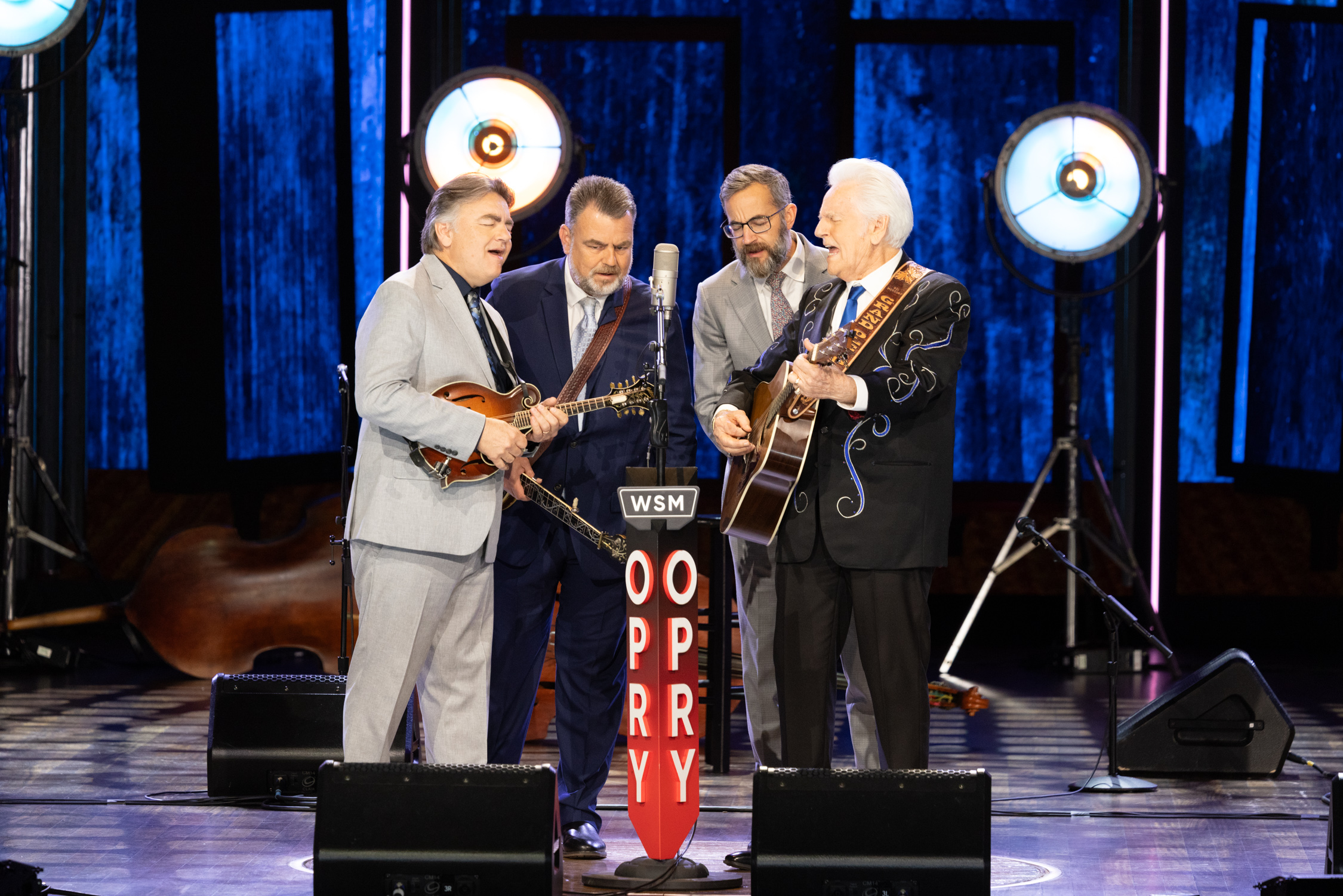
The Del McCoury Band sing “Get Down on Your Knees and Pray” before leading a sing along with the entire cast of performers.
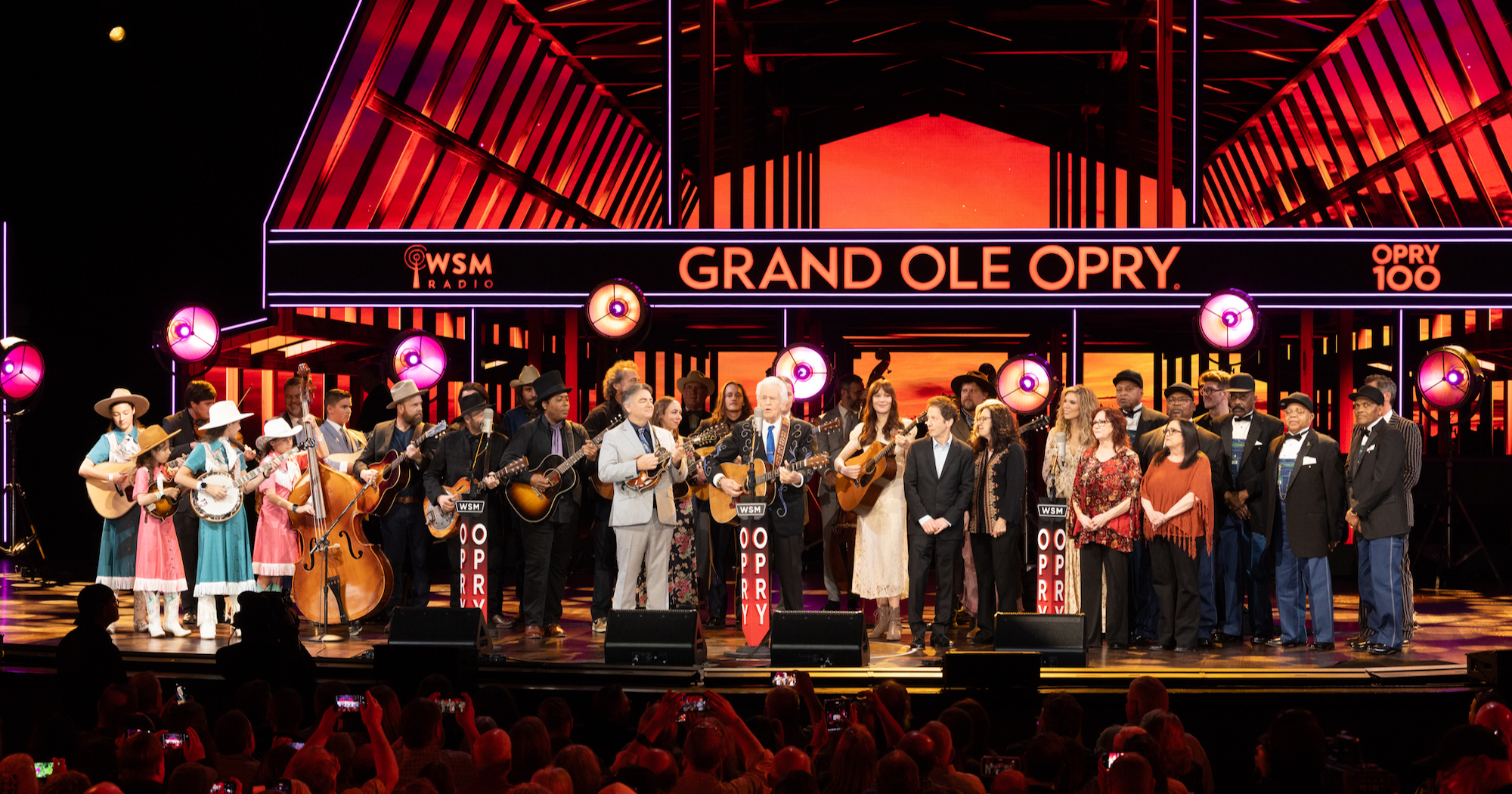
In his brief remarks, Burnett took a moment during a brief speech to acknowledge Denise Stiff, a visionary Nashville manager who recruited many of the musicians for the soundtrack back in the day. But of course, it wouldn’t be a tribute without everyone coming back on stage and singing at the end – in this case, “Angel Band” and a reprise of “I’ll Fly Away.”
Twenty-five years ago, the O Brother soundtrack brought old-time and bluegrass music into the national spotlight. This long-awaited encore underscored the staying power of this classic album.
Photo Credit: All photos by Chris Hollo for the Grand Ole Opry.
Lead Image: The entire cast of the Opry’s O Brother, Where Art Thou? tribute show take the stage to sing “Angel Band” and “I’ll Fly Away” to conclude the evening.
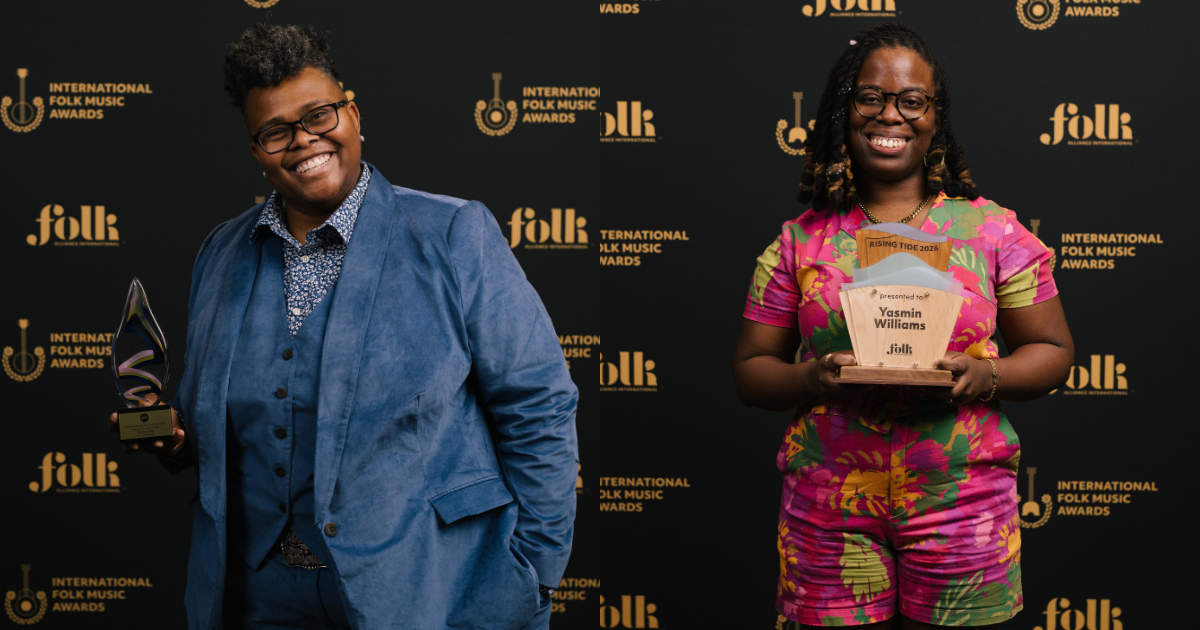
Yesterday, Wednesday, January 21, 2026, Folk Alliance International (FAI) – the world’s largest membership organization for the folk music industry and community – announced winners and recipients for their 2026 International Folk Music Awards. The awards show, held during FAI’s annual conference which just began in New Orleans, included handing out honors for the Best of 2025 nominees (which are nominated and voted for by FAI’s voting membership), plus presentations of the Lifetime Achievement Awards, the Spirit of Folk Awards, the People’s Voice Award, the Clearwater Award, the Rising Tide Award, and Folk Radio Hall of Fame inductions. The IFMAs were streamed live on YouTube, fans and viewers can watch the archived broadcast now below.
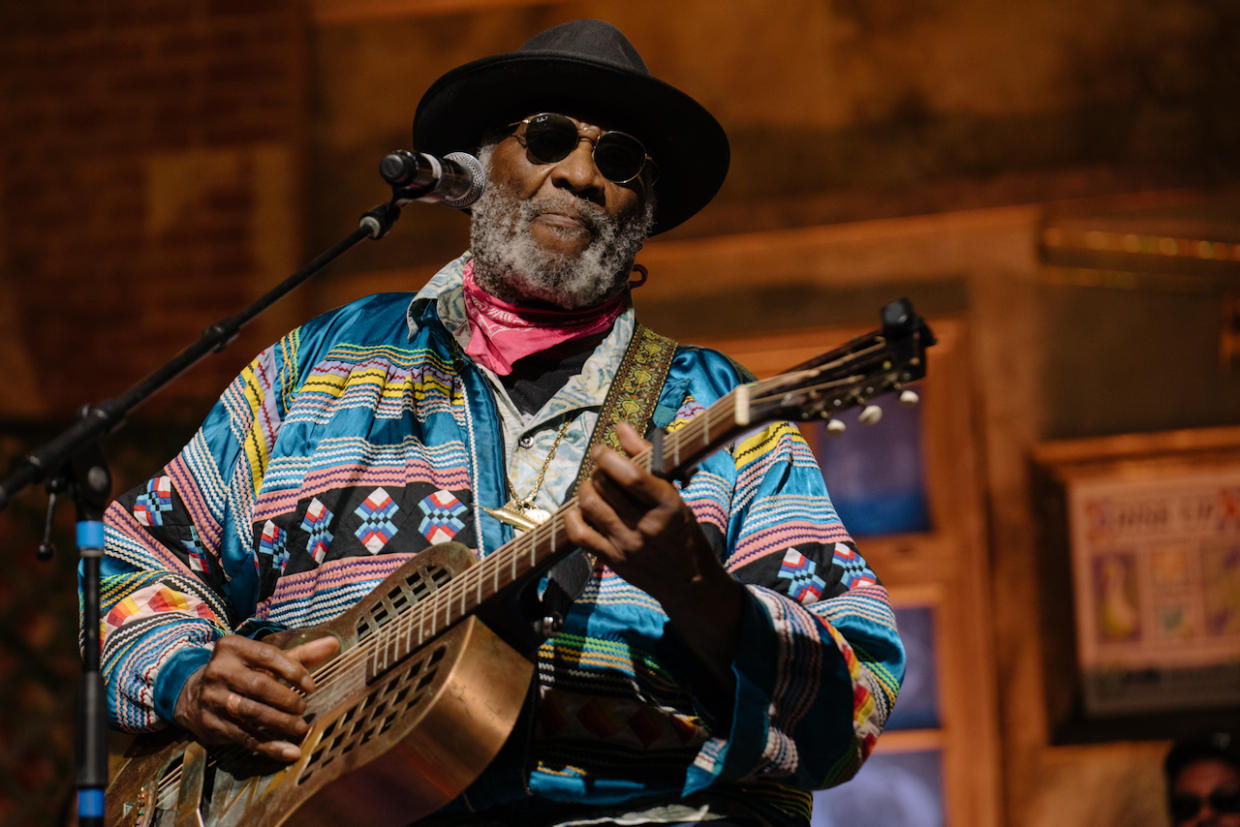
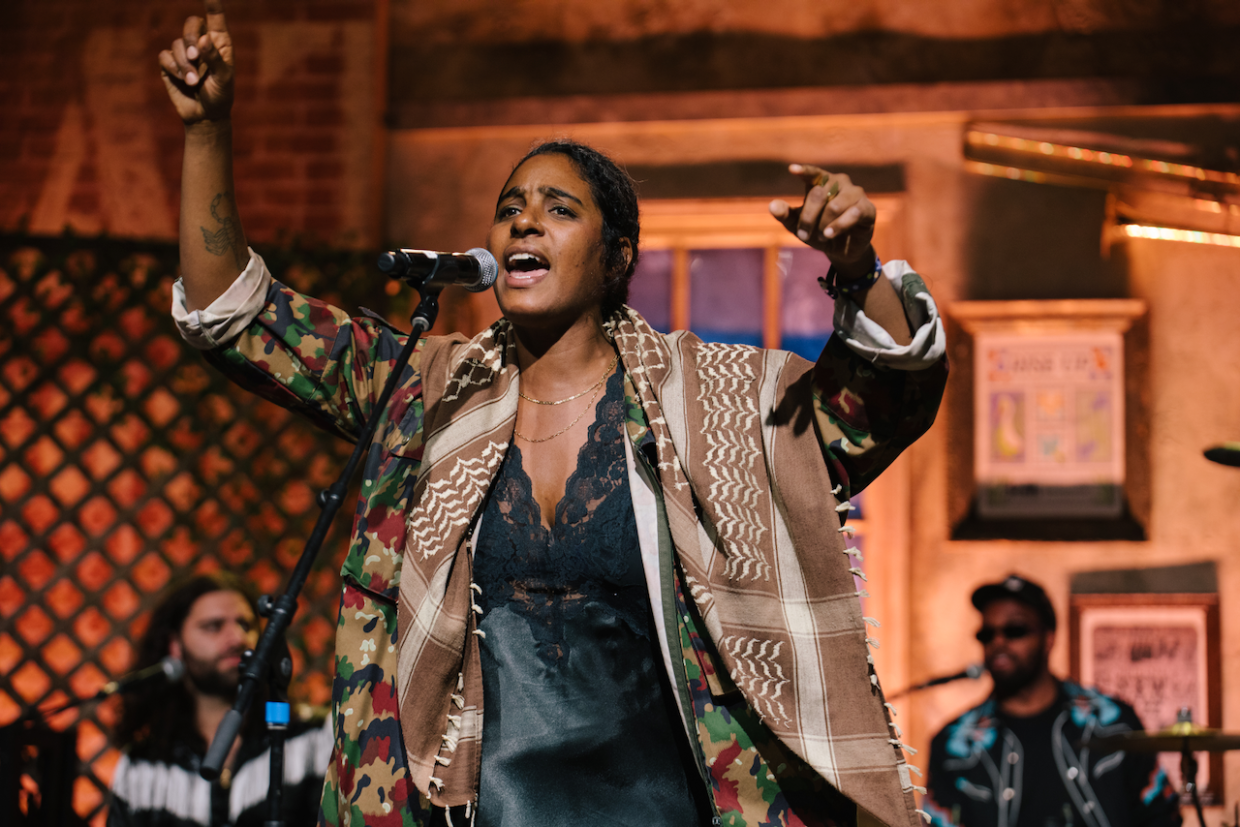
The awards show included stunning live performances by artists like Kyshona, Yasmin Williams, and Louisiana’s own artists and bands like Leyla McCalla, The Rumble, C.J. Chenier, and more. Taj Mahal, Clifton Chenier (father to C.J.), and Louisiana Folk Roots were each bestowed with Lifetime Achievement Awards. Meanwhile, the People’s Voice Award was handed out to Kyshona; the Rising Tide Award to Yasmin Williams; and the Clearwater Award to the Edmonton Folk Festival.
In the Best of 2025 categories, two acts tied for Artist of the Year: singer-songwriter, activist and protestor Carsie Blanton with folk and bluegrass supergroup I’m With Her. I’m With Her were also awarded Album of the Year.
The International Folk Music Awards show is always a highlight of each year’s Folk Alliance International conference. It’s a sort of kick-off on the first night of the event, a starting bell for showcases official and unofficial and for the next few days, all packed full of excellent folk music from all around the world – and a healthy helping from New Orleans, too.
Below, find the full list of winners (in bold) and awards recipients for the 2026 International Folk Music Awards.
Taj Mahal, a Lifetime Achievement Award recipient, performs during the 2026 IFMAs. Photo by Shadow Scape Records.
Lifetime Achievement Awards
Taj Mahal Clifton Chenier Louisiana Folk Roots
Artist of the Year
Abbie Gardner Carsie Blanton (TIE) Crys Matthews I’m With Her (TIE) Ordinary Elephant Sam Robbins
Album of the Year
Arcadia, Alison Krauss & Union Station
CHURCH, Flamy Grant
Room On The Porch, Taj Mahal & Keb’ Mo’
Reclamation, Crys Matthews
Wild and Clear and Blue, I’m With Her
Woody At Home: Volumes 1 + 2, Woody Guthrie
Song of the Year
“Ain’t Afraid To Die” – Woody Guthrie (songwriter: Woody Guthrie)
“Crying In The Night” – Andrew Bird & Madison Cunningham (songwriter: Stevie Nicks)
“I BOUGHT ME A PRESIDENT” – Cathy Fink & Marcy Marxer (songwriters: Cathy Fink, Tom Paxton)
“Room On The Porch” – Taj Mahal, Keb’ Mo’, Ruby Amanfu (songwriters: Ahmen Mahal, Henry St. Claire Fredericks, Jr., Kevin R. Moore, Ruby Amanfu)
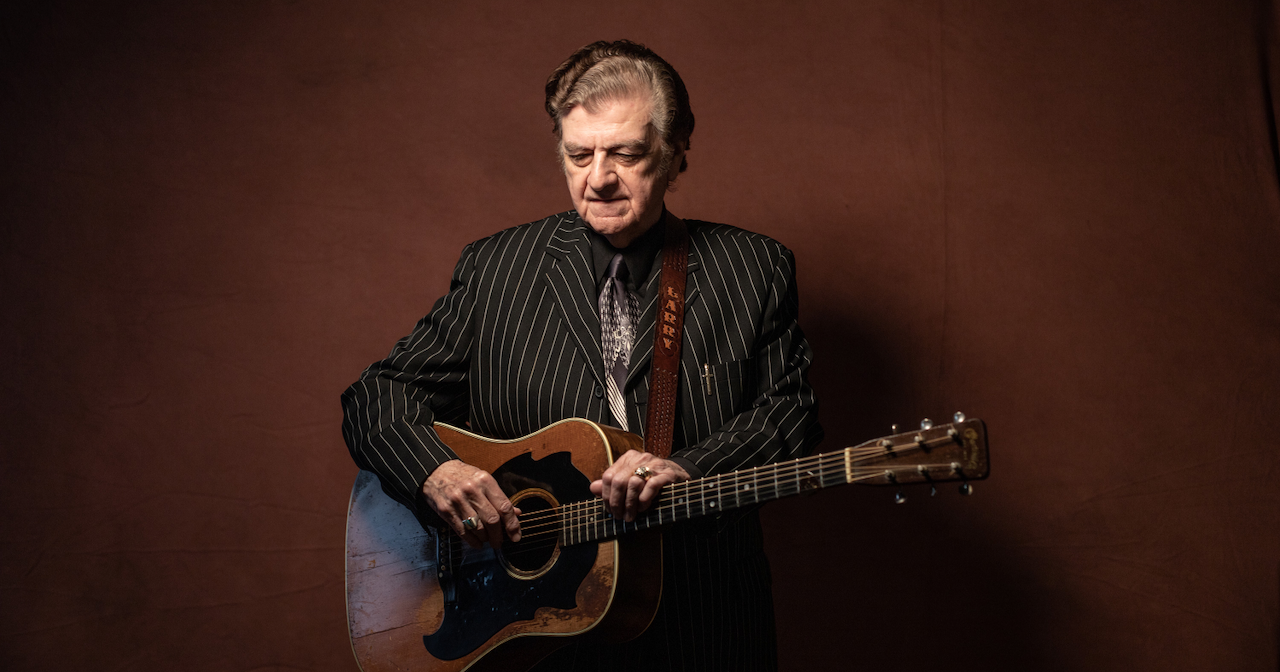
Speaking to Bluegrass Music Hall of Fame inductee and IBMA Award winner Larry Sparks over the phone, you might never guess you’re conversing with a living legend. He’s remarkably humble, down to earth, and plainspoken. And his approach to making bluegrass – as he has professionally for more than 60 years – is surprisingly zen.
His latest album, Way Back When, was released in late October 2025 and the project finds Sparks in exactly the same sonic space as any of his excellent LPs from the last six decades. If you were to take a short audio sample of Way Back When, it would be genuinely difficult to identify from which era of his lauded career it came. The project is warm, lively, and resonant, sounding like you’ve been dropped into a cozy living room with perfect acoustics and a superlative bluegrass string band.
The songs, as well, are timeless and classic, whether fresh tracks, iconic covers, or an old-timey instrumental fiddle tune with familial origins. Like his vocal style, guitar picking, and production preferences, Sparks’ song curation also feels like an intuitive extension of his personality. When he describes how he accomplishes this consistency across eras and executes the timelessness of his albums, it seems as though he becomes a sort of bluegrass guru.
“When songs touch me, they touch my feelings,” he explained to BGS . “When the song touches me, it’s saying something. I’ll take that and see what I can work with, and make it my song.
“The song’s me and I’m the song. And that’s the way that they did it back in the day. They become that song – the older singers, they became those songs. That’s the way that I do it, I try to make that song me and me the song.”
It’s a secret ingredient lacking from too many bluegrass records out there today. Not just his inhabitation of songs so that they can inhabit him, but also treating bluegrass like the forebears of this music did. As a living, breathing, cutting-edge thing that doesn’t need to be built on a foundation of regurgitation and emulation and litmus testing. Like Sparks puts it so simply – and eloquently – in our conversation, bluegrass has mainstream appeal. It requires heart, soul, and being present – becoming the music and becoming each song.
That right there is exactly how Sparks became a Bluegrass Music Hall of Famer and a hero to many – Alison Krauss, Billy Strings, and this writer included. It’s also how he’s maintained a consistent (never boring, stale, or regressive) sound over the course of his 62-year career. And, it’s what keeps him motivated to continue looking forward while inspiring all of us and reaching new audiences.
Let’s start by talking about your excellent new album, Way Back When. When I first listened to it in the fall, when it was released, I was struck by how old-school it sounds. The production style sounds so timeless, it sounds so warm and live – like real bluegrass. It also feels like it could have been pulled from almost any era of your career. with the way that it’s produced and the way that it stands out sonically. I wondered how you accomplished that?
Larry Sparks: I try to do things normal and just go for it. And all of the band– you just feel what you’re doing. You make it real. It’s hard to explain. It’s just, I sing and play from my heart, soul, and mind. Some songs you don’t have to do that, you just – like the old saying – rear back and let it go.
But some songs need attention, and you have to become that song and the song becomes you. That’s the way that I think probably all these songs are, everything I sing is pretty much that way. But, I don’t know, the feel just comes out natural. It’s more of an older feel, the real feel. That’s the way I like things. So much [that’s] added in today’s recording and music and everything, it’s okay – I’m not saying anything about it! But myself, I’d rather keep it pretty real, just like it used to be.
Are you tracking in isolation booths? Or are y’all tracking in the same room and live? It doesn’t sound like you’re putting the music under the microscope, as it were.
No, I don’t like that. You have to [sometimes], but I’d rather [not]. It’s [an] all in the same room deal. Sometimes you’ve gotta do an overdub break or something. You miss your hot lick, you gotta do it over again. Overdubs are good to use, but I don’t like to depend on them. I’d rather do it straight down the line, and if you make a mistake you do it over, you can overdub a spot or something.
Something else that stood out to me listening to the album is how consistent your sound has been over the decades. You have your own way of singing, you have a style that’s really consistent – as well how you pick the songs that go on your recordings. And you certainly have your own guitar-picking style. Almost no one picks like you these days. How do you think it is true, across 60 years in music, that when you listen to Larry Sparks, you know you’re hearing Larry Sparks and Larry Sparks alone?
It’s a natural style for me. I respect the older songs an awful lot. The older music and the older singers, that came along before I did, in the ‘30s, ‘40s, and ‘50s. I was a kid, but I remember the music mighty, mighty well in the ‘60s. All the older country singers were embedded in me, too. Some of the people just stayed in me. They were good singers and their music, their singing was real. It embedded in me.
I still had my own way of singing and playing. I never did wanna copy someone else. And although I respected what they did very much, the older music and the older country and bluegrass [artists] and whatever else – there is other music, too. It just became natural for me to have my own style of singing and playing, and I never really worked on it to do that. It’s just me, and the band pretty well feels what I’m doing.
The whole thing, you gotta keep it natural, real, and feel what you’re doing, from your heart and soul. That’s the way I do it. It’s nothing I plan to do. It just comes out that way.
I think that’s why it works and is so consistent across your entire career, because it’s not a costume that you put on, it’s not affectation, it’s not a target that you’re trying to hit. It’s just you being you.
People can feel that, too. The audience can feel what you feel. Most of ’em, they can feel exactly what you feel, what you do.
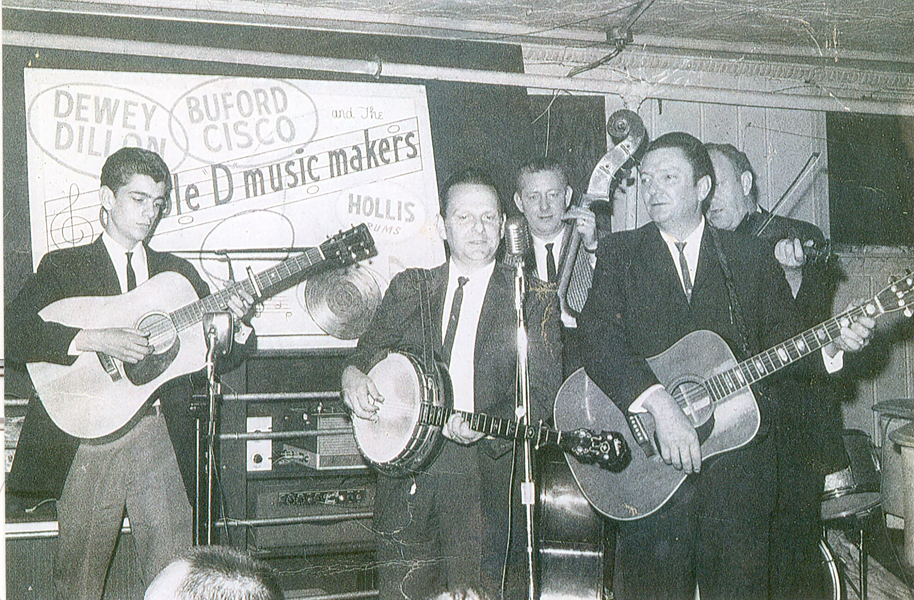
Larry Sparks (far left) performs with the Stanley Brothers before Carter Stanley’s death. Circa 1964. Image courtesy of Rebel Records.
I so appreciate that you bring up heart and soul, because I think people make the assumption that bluegrass is not a music that’s based on heart and based on soul. Especially when you listen to some barn burning, shredding bluegrass or jamgrass.
But for me, this music has always been as much about the stories, the heart, and the soul – and the feeling of it. And that’s clearly such an important part of it for you, too, and the storytelling. I think a lot of people don’t realize heart and soul are an important part of the tradition of bluegrass.
Yeah, sure it is. I’ve worked under the bluegrass name for years. Bluegrass is about 80 years old now, and I have been into it 62 of those years.
Wow.
I can’t believe I’ve been into it that long under the bluegrass name. My music is considered bluegrass, but actually a lot of my stuff could go either way. I’m considered bluegrass and that’s fine. I appreciate it. I’m honored, but a lot of my stuff can go into country or some other direction, too.
I just hold to what I’m doing and [what has] been a good business for me over the years. But you have to make it work and look ahead. The music is music, but you gotta make a business out of it. If you don’t, it’s not gonna work. And that’s what I did. It’s worked out for me. A lot of the bluegrass [industry] is not easy. It’s not one of the easiest forms of music to “make it” in.
And, it’s always been set behind [other] forms of music. I’d really like to see it be possible for bluegrass to be played on all stations. To play it [alongside] new country, modern country, rock and roll. Whatever it is, mix it up. But get bluegrass to program directors. If it ever could get played on other stations, with the right songs and the right artist – put in with everything else they’re doing – it would work. I don’t know if it’ll ever come to that or not, but that’s what it’s always been. We’ve always – like the old saying – took the backseat to the other forms of music.
But we got enough fans and that keeps it [going]. … I’m honored and I’m thankful for it. But it takes a lot of years, a lot of hard work. It’s not easy. I’ve done it all myself. I’ve done my own management, my own booking, my own phone calls, my own writing. This, that, this, that, this, that. I’ve done it all. Like I said, I’m gonna keep doing it, it’s working. It’s fine.
Like you mention, these songs really could go both ways. I love how much country is on this album, and you do such a great job of illustrating that bluegrass and country will always be related and that they cross-pollinate.
And I totally agree, bluegrass has mainstream appeal. And always has! I don’t know why we pretend like it doesn’t.
Yeah, we need more promotion on bluegrass. I wanna keep doing everything I can for it, because I respect it very much. Bill Monroe, the Stanley Brothers, and Flatt & Scruggs – these three names put [bluegrass] on the path and all that played bluegrass come after those three names.
Those three names are in you. I never did want to actually copy any one of those three names, but you take those three names – just to give you an idea. Take those three names I said and you put the Osborne Brothers with ‘em. Put Jim & Jesse with ‘em. Put Jimmy Martin, Mac Wiseman and others – and Larry Sparks – all those names. Every one of ’em are different sounds, different style. But they’re still on the same path. That’s what you gotta have. That’s what I knew, “I better stick to that and not be a copy.”
Let’s talk a little bit about your guitar playing style, because I think you’re carrying on a tradition of a particular kind of guitar picking in bluegrass that is rarer and rarer today. So few people who still make records and perform shows pick like you do. I love how front-and-center your guitar is on this album. Could you talk a little bit about your picking style and maybe who your influences were or how you came up in that type of picking?
Other guitar players are really good and there are a few players out there that can. But the way I do things, my playing is like my singing. I play the melody. And I don’t play over the melody. There’s less notes than normal guitar, it’s more of a feel. It’s hard to explain, but I just play the feel of the song and the melody. I try not to overdo it. I play it and when I hit a note or a slide or a backward– or whatever I do, a pull-off, I want it to come from me. I want it to be me and I wanna feel that note I’m doing, feel that slide I’m doing, whatever I’m doing. And [I want to] keep it that way and not overplay the song.
I also wanted to talk about the instrumental on the album, “Sleepin’ Lula.” Speaking of things that are rarer and rarer in bluegrass, having the clawhammer banjo on it is excellent. It feels like no one flogs the banjo anymore. There’s a lot of old-time players, a lot of clawhammer players, but it doesn’t really seem like anybody’s flogging it anymore. Hearing the instrumental, when the clawhammer kicks in, it was reminding me of that era of early bluegrass when you were just as likely to hear frailing banjo as a three-finger in a bluegrass band.
That’s great. Yeah, I thought it turned out pretty good. I was pleased with it. That’s an old tune. My grandpa, I got a recording of him playing that in 1953. Him and some guys, and he’s from Jackson County, Kentucky. Very good fiddle player. Very good. He was one of the best, he could’ve done something with his talent. He was born in 1877. Back in those days, up to the turn of the century, ‘20s, ‘30s, ‘40s, and ‘50s, he just played square dances around locally and stuff. He never did really go out. Stringbean asked him to go out with him some, but he never wanted to leave or go ‘round traveling and stuff. But he could have filled the bill for anything. He was that good.
I heard the tune from him. And I had never heard it before. “Sleepin’ Lula” – that was my grandma’s name, his wife’s name. She died in 1910 in childbirth and I never got to see her, of course. But her name was Lula, and so he recorded that “Sleepin’ Lula.” And I don’t know, I’m not going to say for sure if he wrote it. There’s a couple other fiddle players I heard play that from back in the ‘20s or ‘30s. But all respect to him. There wasn’t a player like my grandpa.
I don’t know who it came from. I don’t know if it came from my grandpa and he put it together because his wife’s name is Lula. Or if “Sleepin’ Lula” was the name [he gave another tune.] Someday I may try to trace that out a little further.
The other fiddlers that you know played it, did they use the same title for it, too?
Yeah!
Interesting. That’s so cool!
Yeah, it’s something else.
You’re a famous bluegrasser. You’ve been famous to me, for instance, my whole life. I was honestly nervous and a little starstruck to have this conversation. [Laughs] But you’re also becoming more famous at this moment, because two of the biggest bluegrass names to ever come out of the genre – Alison Krauss and Billy Strings – they’re such big fans of yours. I feel like both Alison and Billy see your legacy, they see how important it is, and they are translating that importance to people that maybe don’t know who you are or are just learning about you for the first time.
So I’ve just been curious to ask you, how do you feel about having these prominent “fans” – and it’s not just Alison and Billy, obviously. What does it mean to you to be part of that constellation of people that they look to as influences? And, what does it mean to you to see your music reach new audiences thanks to them and others?
It’s a new world. It’s a different world than what I’m used to. Which, there’s nothing wrong with it. I’m very honored that they stand behind what I do and my music. And, for the music, I’m very honored and thankful that they like it and that they maybe have it in their shows sometime or whatever.
But yeah, the new crowds in bluegrass – we have a very good crowd, but it’s bigger than it ever has been, now, bluegrass music is. But we still have that limited crowd [coming] from other forms of music. And that’s why I said, if it ever got to play on the big stations, give us a little room and respect for the bluegrass. It’s very important music and if the big country stations would give us some respect and get bluegrass to their program directors…
Don’t just [throw it out there]. You gotta be careful. Give it the right thing, the right artists, the right songs, and it would really help our music. It really would help.
But if it never happens, we still got a good crowd and we get more people all the time coming in. It’s a kind of a new crowd coming in, a new age group coming in. We still have a lot of the older people, but the younger people are coming into it. Teens to 20 years old, I’m seeing that happen more. That’s good. Bluegrass, it needs more push, it needs more promotion.
Do you see what Billy Strings is doing as that push or as that promotion? Can you tell, with younger fans coming in, that they started as Billy Strings fans and found you that way? I wonder, is there any way you’re measuring the impact of people talking about you and pushing your music?
I can’t really tell on that, for sure. I can’t. I’m just seeing people that’s young – teenagers and stuff – that wants to learn to play the music and are trying to play. And then that age group I was telling you about is. It’s coming in stronger all the time.
I’ll be honest with you. I don’t listen to other music. I don’t listen to anything hardly, music-wise. You gotta keep yourself fresh. But I respect other music. I respect it. All forms of music. I don’t have anything against the big bands and all the new names. But I like that old stuff. Of course, bluegrass and old country. And other things, blues, I like a lot of that.
You seem remarkably humble and so down to earth. You follow the songs, you put heart and soul into ‘em. But you’re literally a Hall of Famer and you’re one of the last of the first big generation of bluegrass makers that are still doing it today. You’re a legend to all of us. Does it feel like you’re a legend? To you, on the inside? Or no?
I would be to a lot of people, a legend, and to a lot of people I would be famous, I would be a star. But when I went into this business, went into music in my teens, I never looked at it as wanting to be a star or to be famous. I never looked at those two things. I wanted to take what talent I had. I knew I had something to offer. I had to put it together and see what I could do [to] make it work.
I don’t know if I’m a star or famous to people. I hope so, because that’d be nice. I’m pretty honored.
Photo Credit: Images courtesy of Rebel Records. Lead image by Michael Wilson.
When you’re walking around the halls of IBMA’s business conference, World of Bluegrass, for good reasons and bad, everything ends up sounding the same. The Earls of Leicester sound just like Flatt & Scruggs. (Thank goodness.) Every single version of “Carolina in the Pines” sounds exactly like Special Consensus. (As they should.) There are pickers born in the 2000s who sound like carbon copies of Frank Wakefield or Don Reno or Wilma Lee Cooper.
But, in the well-intentioned and admirable adoration, emulation, and preservation a homogeneity results. It’s why IBMA jams sound different from SPBGMA jams; why Californian trad bluegrass sounds completely distinct from say, Virginian trad bluegrass these days. Where music happens, ideas cross-pollinate, and we all start sounding like each other, little bit by little bit. It’s a blessing and a curse.
That’s why it’s all the more remarkable when, out of that bluegrass milieu, a singular voice or perspective or sound can pierce through the sameness and rise above. Especially when that sound utilizes exactly the same tools and is built on a similar respect for emulation and preservation. At this year’s IBMA World of Bluegrass in Chattanooga, Red Camel Collective were one such band.
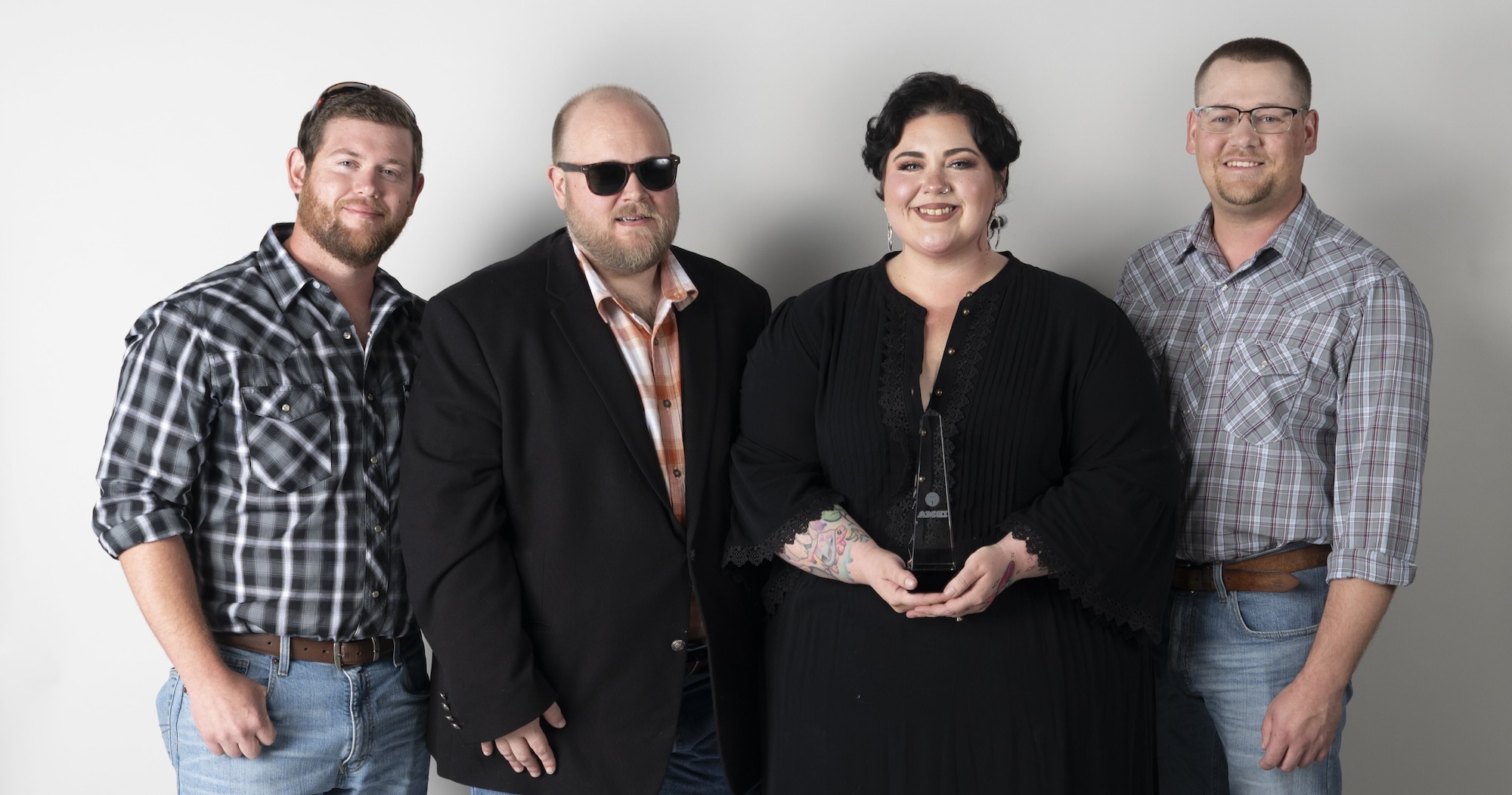
The group – made up of Heather Berry Mabe, Tony Mabe, Curt Love, and Johnathan Dillon – took home the IBMA Award for New Artist of the Year, their first such trophy. While it’s true they’ve only been a band for a few years (they came together first as Junior Sisk’s backing band and he has since encouraged them to take on work, make music, and record albums of their own), each of the Collective’s members are lifelong veterans of the bluegrass scene.
Perhaps that’s why they do sound like themselves and no one else. They know well by now the intricate little details that add up to a unique sonic brand. It’s intuition. They’re able to follow each other and each song wherever they may lead, landing in sometimes surprising or unexpected places. But still, the bones of this band and of their 2025 debut self-titled album are “just” bluegrass. Straight up and down. When you listen, though – or have the pleasure of chatting with any member of Red Camel Collective, like we did speaking to Heather Berry Mabe by phone – you’ll quickly realize this group has much more going on than the same ol’ same ol’.
Y’all sound like bluegrass, straight up and down, but you also sound like yourselves. Your sound has so much personality. You can tell that you’re holding up tradition, but also you’re trying to sound like your own band, your own group. How do you think that you’ve done that? How have you accomplished having a sound that feels within tradition, but also is something that’s all your own?
Heather Berry Mabe: First of all, thank you so much. That is a huge compliment, especially in today’s time. When I was growing up playing – I’ll soon be 38 years old – it was before YouTube and all of that. So I learned from my family members, I learned from my grandpa and my great-grandpa, and then also from the music that I was listening to at the time. Which was everything from ‘90s country to traditional bluegrass. To me, there was no box. I just loved music and it was just about getting as much of it as I could.
I think what influenced me and my husband, as far as having our own sound, I don’t think it was something that we set out to do [intentionally]. Like, “Hey, we’ve got to find a way to sound like ourselves.” I just think that happened organically. And I’m very thankful, because he’s such a recognizable picker, Tony Mabe. My husband is such a recognizable banjo player. You can hear the influences, but he totally sounds like himself. And his singing is the same way.
And, Johnathan, our mandolin player, he has so many influences, too, but he sounds like Johnathan. Nobody else sounds quite like him. I love that. I think on his part, it’s not focusing on trying to sound like anybody, but playing what you love and inspires you.
It’s not really uncommon for backing bands of bluegrass stars to have their own brand, their own shows, their own followings. I’m thinking about Quicksilver becoming their own band more than once or the New South becoming their own band once J.D. Crowe retired. Or how The Infamous Stringdusters got their start.
So could you tell us a little bit about how your relationship with Junior started as a band? And he just announced his eventual retirement at the end of 2027, as well. I’m wondering how y’all are thinking about what the next couple of years mean for you as a group. Is this your chance to springboard into having a full calendar of solo shows by 2028? Is that too far out to be thinking about?
Playing with Junior, I’ll answer that part first. Johnathan Dillon has been there with Junior since he was 18 years old and he is now 31 – or he’ll be 31 in January. So he’s been there for years and years. I’m not exactly sure how those two got hooked up, I can’t exactly remember the story. But for me and Tony, Junior called me in 2018 to sing a duet with him on an album that he was working on. The song is called “Backwards And Forwards.” I was so tickled when he called out of the blue, especially because I knew this is the first song that Junior Sisk & Rambler’s Choice had ever done with a woman. There’s never been a woman on anything [of theirs before]. So I felt really honored to get to be the first one.
A few months later, he called and said that he needed some help. He asked if Tony and I both would be interested in coming to work with him. Again, I was really tickled to get to be the first woman to play with Junior. We were just so thankful to have the work. It was at a time when my husband Tony was losing his vision. And the rest is history!
It was actually Junior’s idea [for us to be our own band], because there are songs that I’ve written and songs that we love, like I was saying, that really sing to us and speak to us and inspire us. We would sit around and jam on those and they don’t exactly fit Junior’s style. It’s two different styles there. But Junior suggested to us that we cut an album so that we would have something to sell at these venues, something to play on the radio, and all of that. He said, “I think it would be really good for you guys to do that.” So we did. Man, you can imagine our amazement at how much this has blown up! When it started as a side venture.
What are you feeling as you stare down a couple more seasons with Junior, but then his eventual retirement? What’s in the cards for Red Camel Collective? Are you looking ahead already?
We’re doing our best. It’s super hard to plan very far ahead. Lord, sometimes it’s hard for me to plan next week. [Laughs] I’ll be honest with you, most of the time I feel like I’m riding by the seat of my pants, as they say. But we are looking to the future and trying to secure bookings for ourselves so that Red Camel can continue on when Junior retires. And Junior, when he says “retire,” I’m sure that he’ll still keep making records and things like that. He’s using the word “retire” here, but he’s not gonna go away completely, because music is in his blood! It’s just like all of us, we’ll never [stop making music.]
We have plans to go as far with Red Camel as we possibly can. Man, if Johnathan Dillon and Curt Love will have me and Tony – I’m sure he feels the same way – if they’ll have us for the rest of forever, we’ll stay with them for the rest of forever! [Laughs] We love making music together. And we are working on a new album right now. As much as I loved the first one, this next one, it’s just beautiful to see the growth. It’s got several songs that I wrote. Of course, we’ve released one single, “In the Mexican Sun,” and it’s getting played on SiriusXM and a lot of bluegrass DJs are playing that one for us. We’ve got a music video that goes along with that, too.
I’m glad you bring up the single, I feel like it’s the perfect sunny, summer vacation song for moving through fall into winter. It reminds me of Jimmy Webb and the way he writes songs and it also reminded me of Dale Ann Bradley’s “Somewhere South of Crazy.” Can you tell us about the story of the single, because I know from the premiere we did that the songwriter has quite the bluegrass pedigree too…
Yeah, absolutely. We reached out to our buddy Malcolm Pulley, who is a banjo player extraordinaire and incredible bluegrass songwriter. He wrote “In the Gravel Yard” for Blue Highway. He wrote “How Many Roads,” several folks have recorded – Tina Adair, Michelle Nixon, and the list goes on. But he’s just such a good writer, so we reached out to him to ask if he had any songs. [We were] expecting traditional bluegrass, something along that line. I had no idea that he had ever written anything like this.
I believe this is right, he was playing with a jazz quintet at the time – I forget the name of the quintet. They had a [woman] lead singer who was so good. Anyway, he sent me this song that was written I guess in the early to mid ‘90s. The way they recorded it together, it sounded like a Hispanic song, I don’t know if you call it a rumba beat or whatever. It was most certainly not bluegrass! But I loved it, man. I loved the melody and the way that lady sang. It was so good.
I thought, “Man, this is just begging for banjo.” I could hear, instead of the four-quarter time that they were doing, like to halftime it and put a bluegrass spin on it. I thought, “This will really work.” I worked on a little demo of it and sent it over to Johnathan and he was like, “Wow, you’re right. I think that is really cool.”
Let’s talk about the IBMA Award you just won. It’s funny to me – and I think it’s funny to everybody – how every year in the New Artist of the Year category at IBMA barely any of the artists are new!
[Laughs] It is like that, ain’t it?
You just made the point, you’ve only been a band for two years. Your debut album just came out in February of this year. So you guys are new in so many ways, but you’re all also lifelong musicians, veterans. Tell me about what it meant to y’all to step on stage and receive that trophy, because these are peer-voted awards. And yeah, maybe you aren’t new, maybe you’ve been doing this for decades, but this is also a “moment” y’all are having as a band.
It’s so hard, because there are so many emotions. Tony and I, we’ve been married for 20 years and we’ve both, even before that, we’ve just been doing this our whole lives. This is all we’ve ever wanted to do is make music. I know and he knows that’s why the good Lord put us here. We know that it’s our purpose in life and it’s our story. As I look around and compare, I see these young people making such great strides and hitting so many marks so early in their careers. Tony and I, while we had some success, throughout the years for some reason we could just never get that momentum going.
When you’re a person who battles anxiety and crippling self-doubt, those types of things can really eat at you. [They] make you question, “Am I capable of this?” I will tell you the truth. I just said earlier, I’m 38 years old. I have never in my life grown in confidence the way that I have in the last two years. Putting together this album, writing these songs, working through the production process, putting ourselves out there as something brand new.
[Getting the award] felt like a confirmation. It felt like, “Yes. This is where you’re supposed to be.” At the end of the day, an award is a glass thing. It’s just a thing. Awards are not what matters, because there are so many incredible artists and musicians who will never be recognized in that way. Does that take away from their value? Absolutely not! On the other hand, it just felt surreal and it felt like a big kiss on the forehead from the good Lord above to me.
As a band, we were just all blown away. We were not expecting it. I know everybody says that, but this is absolutely the truth. [Laughs] In a category with Jason Carter, Bronwyn Keith-Hynes, AJ Lee [& Blue Summit], and Wyatt Ellis and all. Man, we absolutely were completely surprised and blown away – and just extremely grateful, because there are folks who work so hard for years and never get that sort of acknowledgement.
I wanna talk about the new album as well, which came out in February. It’s your self-titled debut. Like what we’ve already talked about, it combines traditionalism as well as contemporary sounds. It’s forward-looking.
But what I noticed first is how live it sounds, warm and inviting – like you’re in the room with y’all. It’s really crisp and it’s really clean, but it also sounds like real music. It doesn’t sound like it came out of a can of bluegrass cheese whiz.
[Laughs] I love it.
Can you tell me a little bit about how you guys accomplished that sound?
For Red Camel Collective, this was our first experience recording together. It was so different from recording with Junior, because the songs and the arrangements are different. I don’t know that we went in with any expectations except to do the very best job that we could. I think those were basically our only expectations.
As far as the sound, we record live. We track live and then we go back and fix and edit. I wish I could answer your question better! … Music is all about feel. Aaron Ramsey said one time, “It’s all about feel, it’s not a science project.” I think that you can strive so hard for perfection that you suck all the soul and all of the life right out of it. There has to be a balance between what we perceive as perfection and the feel and the groove of the music. Because all of the best albums, the ones that I love the most, were all created before autotune! And there are notes in there that would probably end up being tuned today. But they sure didn’t bother me. ‘Cause it’s all about the feel and the vibe.
I’m thankful to work with musicians who recognize that. While they want it to be right, more than anything they want it to have a good groove. We don’t want anything to interrupt that groove, ’cause that’s what makes people wanna get up and dance.
Speaking of sonics, I love how your voice sounds on the record, too. Could you talk a little bit about your vocal process and maybe your inspirations – or who you looked up to as you were developing your own voice as an instrument? I also can’t help but notice you have two vocal powerhouses guesting on the album, Suzanne Cox and Sharon White.
They’re heroes of mine!
Who are the inspirations and heroes that you feel have been infused into your own voice? Or maybe you’ve just done it all yourself?
Lord, no! Uh-uh, absolutely not. [Laughs] The first one that I have to list is Dolly Parton, because she was my earliest influence when I was just a little girl. The first song that I ever sang anywhere was in my grandpa’s church. I sang “Coat of Many Colors” and she was just my hero in every sense of the word, vocally, aesthetically, that she was a songwriter, an actress. I just adored her. I saw her in all these cute little movies like that Christmas movie she made and I just adored her.
Alison Krauss would’ve probably been the next one who came into my purview. Then that album that Alison did with the Cox Family. I was just a kid when that came out and I had never heard anything more beautiful in my life than their voices. They were so angelic. I would put that album on to go to sleep when I was just a little kid. I loved it so much. Suzanne Cox is probably my favorite female vocalist ever. Ever. I love Alison to no end, but there is just something that draws me to [Suzanne]. I call Suzanne Cox the queen of phrasing. Because no matter what it is that she’s singing, she will phrase it exactly the way it should be phrased. She’s a genius and she doesn’t even realize it, because it is so natural to her and it’s not forced. It’s just effortless. It’s just a gift. She just has one of those one-in-a-million voices and I’ll always sing her praises.
Then you mentioned Sharon White. It was so cool to have her come and Suzanne Cox come in and sing on that song, “Last Time I Saw Him.” But the Whites, man, oh my gosh. They were like the it group for harmony backup in the ‘80s and ‘90s country. That’s who everybody sought out, because their voices – it doesn’t matter who they’re singing with – they make whoever they’re singing with sound like a million bucks. And their singing lead, too. Their tone and their delivery is so pure.
That’s what draws me to vocalists. It’s purity. Sometimes with singing you can just hear it’s just put on. That just doesn’t sing to me. It’s a hard thing to describe really, isn’t it? It’s just something in the purity of people’s voices that really draws me in.
Today, Folk Alliance International (FAI) – the world’s largest membership organization for the folk music industry and community – announced the nominees and awardees for the 2026 International Folk Music Awards. The announcement includes Best of 2025 nominees, which are nominated and voted for by FAI’s voting membership, the Lifetime Achievement Awards, the Spirit of Folk Awards, the People’s Voice Award, the Clearwater Award, the Rising Tide Award, and Folk Radio Hall of Fame inductions.
The awards will be staged on the first night of FAI’s 38th annual conference, which will take place January 21-25, 2026 in New Orleans, Louisiana with a conference theme of “Rise Up.” Late last month ahead of the awards announcement, New Orleans icons Big Freedia and Tarriona “Tank” Ball (of Tank and the Bangas) were announced as keynote speakers for the conference.
Nominees for the Best of 2025 categories include artists from across many diverse folk genres like Alison Krauss & Union Station, Taj Mahal & Keb’ Mo’, I’m With Her, Carsie Blanton, Abbie Gardner, The Baltic Sisters, Flamy Grant, Woody Guthrie, Ordinary Elephant, Crys Matthews, and many more. Taj Mahal will also receive a Lifetime Achievement Award. Extraordinary guitarist Yasmin Williams was announced as the recipient of the Rising Tide Award, while singer-songwriter Kyshona has been tapped for the People’s Voice Award.
The International Folk Music Awards show is always a highlight of each year’s Folk Alliance International conference. It’s a sort of evening kick-off on the first night of the event, a starting bell for showcases official and unofficial and for the next few days, all packed full of excellent folk music from all around the world – and a healthy helping from New Orleans, too.
Below, find the full list of nominees and awards recipients for the 2026 International Folk Music Awards.
Lifetime Achievement Awards
Taj Mahal Clifton Chenier Louisiana Folk Roots
Artist of the Year
Abbie Gardner Carsie Blanton Crys Matthews I’m With Her Ordinary Elephant Sam Robbins
Album of the Year
Arcadia, Alison Krauss & Union Station
CHURCH, Flamy Grant
Room On The Porch, Taj Mahal & Keb’ Mo’
Reclamation, Crys Matthews
Wild and Clear and Blue, I’m With Her
Woody At Home: Volumes 1 + 2, Woody Guthrie
Song of the Year
“Ain’t Afraid To Die” – Woody Guthrie (songwriter: Woody Guthrie)
“Crying In The Night” – Andrew Bird & Madison Cunningham (songwriter: Stevie Nicks)
“I BOUGHT ME A PRESIDENT” – Cathy Fink & Marcy Marxer (songwriters: Cathy Fink, Tom Paxton)
“Room On The Porch” – Taj Mahal, Keb’ Mo’, Ruby Amanfu (songwriters: Ahmen Mahal, Henry St. Claire Fredericks, Jr., Kevin R. Moore, Ruby Amanfu)
“Sisters Of The Night Watch” – I’m With Her (songwriters: Aoife O’Donovan, Sara Watkins, Sarah Jarosz)
Global Folk Album Award
At the Feet of the Beloved, Rizwan-Muazzam Qawwali
Bagola, Trio Da Kali
Niepraudzivaya, Hajda Banda
Tales of Earth and Sun, Rastak
VÄRAV/VĀRTI/VARTAI, The Baltic Sisters
Vié Kaz, Votia
Spirit of Folk Awards
Laura Thomas, ComboPlate Booking
Rachel Ornelas, Cultural Heritage Manager, New Orleans Jazz & Heritage Festival
Alex Mallett, Deputy Director, Folk Alliance International
Cindy Cogbill, Overton Park Shell and Folk Alliance International
People’s Voice Award
Kyshona
Rising Tide Award
Yasmin Williams
Clearwater Award
Edmonton Folk Festival
Folk Radio Hall of Fame Inductees
Susan Forbes Hansen (WHUS) Kieran Hanrahan (RTE Radio 1) Ron Olesko (Folk Music Notebook) Michael Stock (WLRN)
Find out more about Folk Alliance International’s annual conference in New Orleans January 21-25, 2026 and make plans to attend the International Folk Music Awards here.
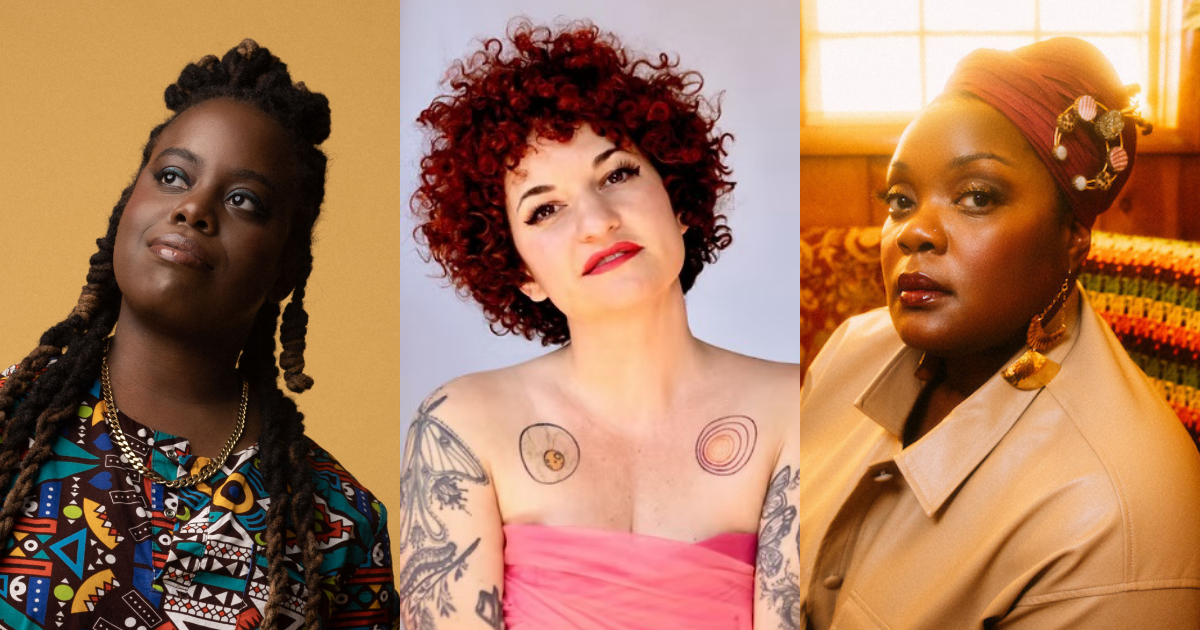
Photos courtesy of Folk Alliance International. Lead image (L to R): Yasmin Williams; Carsie Blanton; Kyshona.
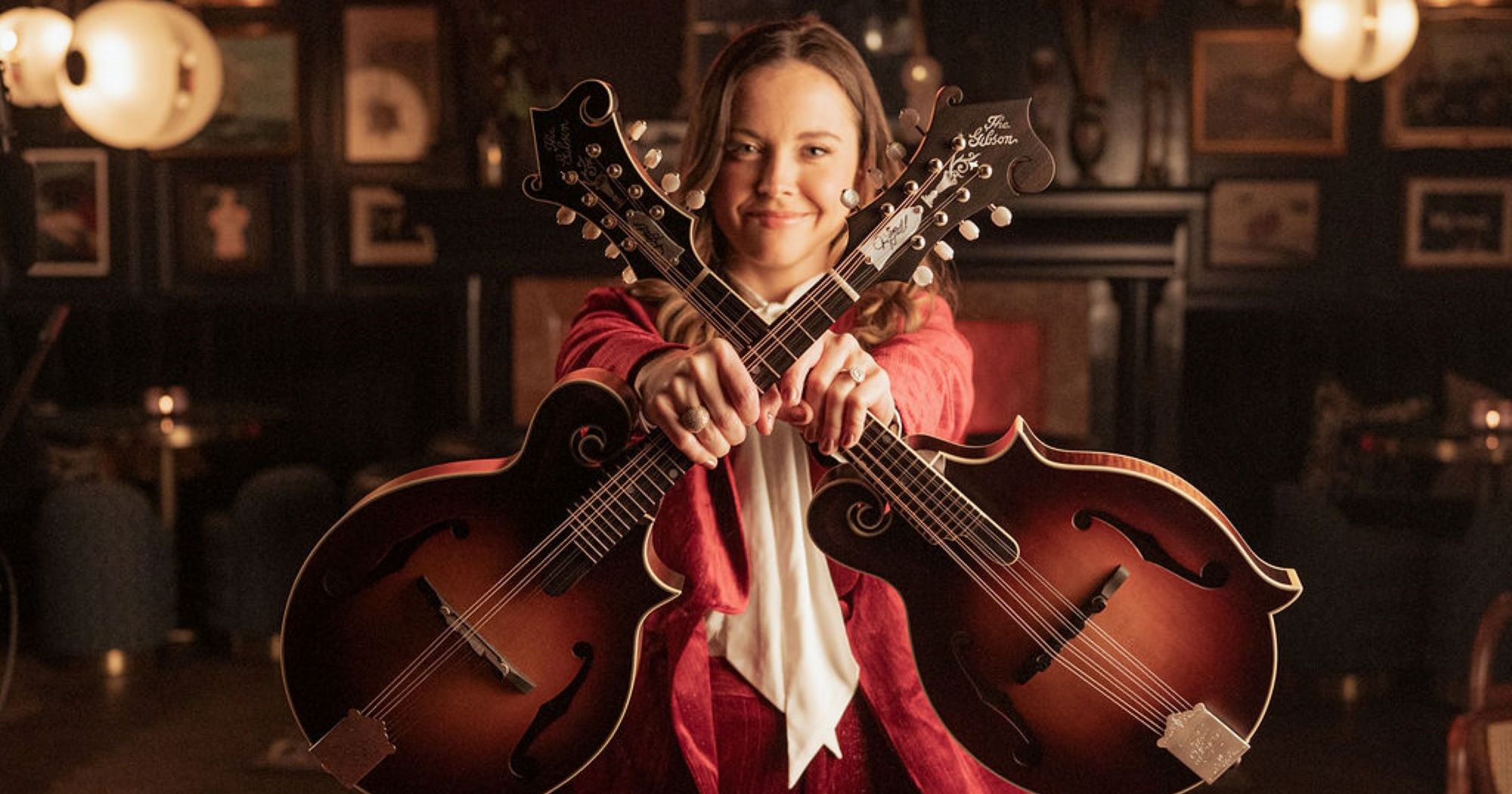
Eyes on the future, heart in the past – it’s the cornerstone of how award-winning mandolin player, guitarist, singer, and songwriter Sierra Hull crafts her music, and how Gibson Master Luthier David Harvey and the Gibson Custom Shop crafted her new signature mandolins: the F-5 Master Model and F-5G.
The F-5 Master Model boasts a red spruce top, eastern curly maple back and custom narrow neck, and ebony fretboard, while the F-5G offers a red maple neck and body, Sitka spruce top, and ebony fretboard. Both models feature the Sierra Burst VOS Varnish finish and come with certificates of authenticity, Sierra Hull/Gibson BlueChip pick, and mandolin cases – vintage replica for the Master Model and hardshell case for the F-5G.
The instruments are the result of Hull’s many years of dedication, hard work, and talent, alongside a working relationship with Gibson that began when she was 12 years old and already a four-year veteran on her instrument. Growing up in Byrdstown, Tennessee, with few if any resources for musicians, the slightest instrument repairs required a two-hour drive to Nashville, where, at the time, Gibson had a shop in the Opry Mills Mall.
Hull had graduated from her first F-style mandolin, “a starter-model Epiphone that was so cool because it said ‘Gibson’ on the truss rod cover,” she says, to a flatiron mandolin she bought used from a local player and still has in her collection. In need of new frets, and in Nashville with family, they went to the mall in hopes of a walk-in or referral. Hull had recently played the Opry with Alison Krauss and upon entering the Gibson Showcase shop, Grascals mandolin player and Gibson staffer Danny Roberts recognized her and put a new, limited edition Adam Steffey signature model in her hands.
“My dad remembers them saying, ‘How would you like to have one of these?’ He’s thinking, ‘Yeah, buddy, I bet she would, but we ain’t got that kind of money to spend on a mandolin,’” Hull recalls. “They gave me that mandolin and it was such an unbelievable moment, as a 12-year-old, to be given this incredible instrument. That was the beginning of my relationship with Gibson. I’ve mostly played a Gibson mandolin ever since.”
Fast-forward to 2009 and Sierra Hull’s main instrument: her Gibson Master Model, built by Gibson Master Luthier David Harvey. “The 2009 was brand new at the time,” she says. “Dave made some modifications to it to suit what I was looking for and it has become my voice.”
That mandolin eventually became the springboard for her signature Master Model and F-5G, in line with her original specifications for the 2009. “I have small hands, so Dave took the neck down a little bit for me,” she says. “We put an aged varnish on it instead of the normal gloss, which makes it a little more unique than one right off the line.
“I’ve always preferred that thin, matte varnish type finish, so we decided to recreate that with the signature line. So many people often ask me about my mandolin; they think I’m playing a Lloyd Loar most of the time. I’ve put a lot of miles on this mandolin since 2009. I’ve played it as my primary instrument since then. When I got it, it didn’t look anything like it does now in terms of being so worn, but it didn’t look brand new and shiny, either. I always loved that about it, that there was a certain aged vibe to it already because of the finish.”
In addition to the aesthetics, the Master Model parallels Hull’s unique sense of blending her deep bluegrass roots with contemporary sounds. It is, she says, the perfect instrument for that mix of past and present. “When I think about the kind of music I play, both these days and throughout my career, I’m so rooted in traditional bluegrass,” she says. “I grew up going to bluegrass jams on the weekends, sitting in a circle – you need a mandolin with volume, something you can dig into, like the Master Model.”
“Part of the reason we all want to play F-5 mandolins is because Bill Monroe, the Father of Bluegrass, played an F-5,” she continues. “I love an A-style mandolin as well, but there’s something that makes you feel legit about playing bluegrass on an F-5 mandolin, because it just feels right – the feel, the look, the sound, the pointedness that those F-style mandolins have. The idea of having a mandolin that you can really channel that traditional thing that as mandolin players we’re born to love in bluegrass music – Gibson is the gold standard for what we think of in terms of every F-style mandolin that you see.
“There’s a lot of great builders out there, so many talented luthiers building beautiful mandolins, so it’s no slight to any of them. But nobody would be doing that if Gibson didn’t exist and build these F-5 mandolins with Lloyd Loar’s stamp of approval on them. When I pick up my Master Model, it feels like the connection to that legacy.
“Even though I tend to think my sound is more progressive and modern – way more so than what you think of when you think of Bill Monroe – that’s the world I come from, so I want a mandolin that feels connected to those roots. But the clarity, the top end, the sparkle that these mandolins have, too – they have a large span on what they can bring to the table. No matter what musical direction I go in, I never find myself lacking from the side of what the instrument can do. It really shows up in all those situations.”
Bringing the Sierra Hull Master Model and F-5G from concept to showroom was a two-year process. Hull, David Harvey, and Gibson worked closely, taking time and care to not rush the work, but instead building the mandolins to her exact specifications.
“As a youngster I couldn’t have dreamed of having my own signature line with Gibson, so it was wild to get the call,” she says. “I’ve learned so much in this process over the past couple of years. Getting to go up-close, help pick out the wood, and see it go from a chunk of wood to mandolins that have my name on them is such an experience. To see it all come to life is a full-circle moment that takes me back to sitting in the Gibson Showcase at 12 years old and playing one of my heroes’ signature lines. To see these mandolins with my name on them is overwhelming. It’s such an honor.”
Mat Koehler, Vice President of Product at Gibson, joined the company almost ten years ago. He says bringing the vision of Sierra Hull signature mandolins to fruition was, in fact, over a decade in the making, beginning with conversations and leading up to the present.
“Even ten years ago, Sierra was one of the best, if not the best, mandolin players in the world,” he says. “When I got here, I was like, ‘Why don’t we have a Sierra signature model?’ The answer, of course, is very complicated. I think everybody’s intention was to make that happen, but we had a restructuring of the company, change of leadership, change of management, a lot of things, a lot of obstacles. So this is really the culmination of a long time spent both ideating what a Sierra signature model would be and then executing it, finally. I am very happy and proud to be involved in some small way. But this is all Sierra and speaks to her incredible talents.
“Her impact [on the instrument] has been huge,” says Koehler. “She represents the next generation of players. She really refreshed the mandolin and offered a completely fresh take. Mandolins are a little bit similar to banjos in that with bluegrass music in the mainstream, if it’s not Mumford & Sons or Nickel Creek, it’s almost ‘out of sight, out of mind.’ Sierra has done an amazing job of taking mandolins into the mainstream in both her music and her collaborations with other amazing musicians. I see a recharging of the bluegrass world right now and Sierra is one of the many leading the charge.”
At the intersection of tradition meets technology, precise replication of Hull’s Master Model in order to build her signature mandolins was done by 3D scanning of the 2009 Master Model, a process Hull describes as “kind of like an ultrasound of your instrument. They run it over the whole instrument, you see it on the screen, and they capture all the specs in a detailed way.
“It gave us a good, strong starting point to mimic the Master Model that I love so much. From there, I got to pick out the wood and watch the process in real time. Essentially they made a replica of my mandolin that Dave Harvey, for fun, distressed to look like my mandolin, and they nailed it on the first try. We used those scans to build the signature line.”
True to her preferences, she selected a thin matte varnish finish on the models, a custom look that Gibson titled “Sierra Burst.” She also opted for the traditional Loar nut width and flat, scalloped fingerboards. “It’s much like I feel my career tries to do – lean into traditional while having some progressive new things as well,” she says.
“We did a custom tailpiece design. I didn’t want a lot of flair on the instrument. I didn’t want crazy inlays or my name spread across the fretboard. But I’m so honored to be the first woman to do a signature mandolin line with Gibson, so part of me did want a little touch of feminine something on there. If you look closely, there’s a little heart dotting the i on my signature on the truss rod. On the tailpiece, the traditional script says ‘The Gibson,’ but where the tailpiece has a curve up top, you’ll see a little heart built into the design, and a little bit of a heart at the bottom and my initials.”
“Sierra has played dozens of original Lloyd Loar 1923 F-5s, so we couldn’t cut any corners with her,” says Koehler. “We wanted to make sure her instrument was on par with any of the amazing mandolins she has played, because she would know right away what looks right, feels right, and sounds right. There are lots of different ways you can spec mandolins, but hers is true to the 2009, which would have been, at the time, a core Master Model F-5.
“That mandolin is her number one instrument to this day, so obviously we had the recipe. … Sierra’s took the very same path as our historic reissue 1923 F-5, which was we scanned her mandolin, we detailed it down to every tiny little nick and ding on it, just so we had a record of the current state of that mandolin, how it looked. The feel of the neck is really unique on hers because it was handmade by Dave Harvey at Custom.
“[3D] scanning has been a complete game-changer for us. Not only has it opened the door to be able to recreate instruments more accurately, it’s rekindled relationships with artists. Customers and fans of Gibson who want the most accurate now can finally have it, knowing it’s mapped identically from the original instrument. … Now, in a matter of maybe twenty minutes, you can do an entire mandolin, just waving a wand over it. That wand is capturing thousands and thousands of points…”
When the mandolins were ready, Hull – still a bit incredulous about having her own signature line – made a special trip to the Gibson shop to test each Master Model. “I guess it’s rare for someone to ask to do that, but I was like, ‘Can I come in and play all these?’” she says. “So we just made a fun day of it. The consistency of the sound, the build, and the playability is all at an insanely high level. All this stuff is done by hand and it’s no small feat to accomplish that. Dave sets them all up. He is the only one to set up my Master Model since 2009, so he knows what I want. Not that I expected anything less, but it was comforting and confirming that this is something I could be proud of.”
“We were overjoyed that she wanted to do it,” says Koehler. “That’s going over and above. She wanted to support this every way she could and obviously she was really excited about it, which makes us really excited. … For her to go the extra mile with us – we were very appreciative. … The fact that the endorsing artist would go to that length of playing it to test it out is amazing.”
It’s been a long, remarkable journey from Opry Mills Mall to seven-time IBMA Mandolin Player of the Year and two GRAMMY nominations, but Sierra Hull hasn’t forgotten the early days. Cognizant that signature edition mandolins are beyond the financial grasp of most players, her next collaboration with Gibson is an Epiphone model, bringing her back to her first instrument.
“I want this to be something that doesn’t price everybody out,” she says. “We’re going to work on an Epiphone model that will be a little bit more affordable for young players and people who are just starting on mandolin, the same way I was when I was a kid. It’s important to me not to have those people feel forgotten. I’m excited to work on it with Gibson as the next part of this story.”
Artist:We Met In June Hometown: Currently living in Sogndal, Norway Latest Album:Going Home (released September 19, 2025)
What was the first moment that you knew you wanted to be a musician?
I remember my dad and I driving through Minnesota when I was about eight years old. He had bought Fleetwood Mac’s collection CD so we’d have something to listen to and we played it over and over again. I became completely obsessed and that’s when I found a deep interest in music. I knew I wanted to do what Stevie Nicks and Christine McVie were doing. – Sara
I think I was around seven when I saw the music video for “The Final Countdown” by Europe and I thought the guitar solo by John Norum was the coolest thing ever. I remember thinking, “I want to do that someday!” I’ve also always looked up to my dad, who’s a great guitar player. He was the one who introduced me to acoustic music and bluegrass, which has been the greatest gift. – Gjest
Genre is dead (long live genre!), but how would you describe the genres and styles your music inhabits?
We’d say it’s a blend of singer-songwriter, folk, Americana, and pop. Some journalists in Norway have called our music “Nordicana,” which is basically a Nordic take on Americana. We’re inspired by a lot of ’70s music like Fleetwood Mac, Jackson Browne, Crosby, Stills & Nash, and we also love Kacey Musgraves and the whole Nashville country-pop scene.
On top of that, we listen to a lot of acoustic music like Alison Krauss & Union Station, Gillian Welch, Nickel Creek, Molly Tuttle, etc. Our acoustic guitar playing is very influenced by those bands and the sound on our new record is a dreamy mixture of acoustic guitars, sometimes mandolin and banjo, plus drums, bass, keyboards, and synths. – Gjest
Which elements of nature do you spend the most time with and how do they impact your work?
Living on the west coast of Norway surrounded by mountains and fjords has given us a strong bond with nature – it’s part of our everyday life. I start every morning with a walk to clear my head and get some fresh air. It always seems to lift my mood a bit. – Sara
And then there’s the weather – we get a lot of cold, rainy days here, which makes it easier and more natural to stay inside and play music, write, and practice. We’ve been to Nashville, for example, and it’s hard to understand how people get anything done in that heat! – Gjest
If you didn’t work in music, what would you do instead?
I’d probably be a veterinarian. It used to be my dream before We Met In June. In Norway it’s really difficult to get into veterinary school and I’ve actually applied every year since high school just to see if I’d get in. This summer, for the first time, I was accepted – and I have to admit, it hurt a little bit to turn down the spot. [Laughs] – Sara
I honestly have no idea. As a kid, I thought excavators were the coolest thing, but I probably wouldn’t be good at anything else. I’m just glad I get to do music. – Gjest
What’s one question you wish interviewers would stop asking you?
We appreciate all questions, but there’s one that always comes up: “What’s it like being a couple and working so closely together?”
We get why people are curious, but for us it feels completely natural to spend so much time together. And, honestly, if you’re going to work that closely with someone, why not do it with your favorite person in the world? Of course it’s not without challenges, like any partnership, but most of the time it’s an advantage. That said, we could definitely be better at taking breaks – it’s music 24/7! – Sara
Tonight, September 18, 2025, the International Bluegrass Music Association held their 36th Annual IBMA Bluegrass Music Awards at the Soldiers and Sailors Memorial Auditorium in Chattanooga, Tennessee – the organization’s first awards show presented in their new host city.
The IBMA Awards are designed to be peer-to-peer, voted on by the professional membership of the IBMA, performers, artists, industry professionals, broadcasters, and beyond. As a result, the show this year – which was hosted by the hilarious and talented duo of Steve Martin and Alison Brown – was an evening celebrating mutual admiration, mentorship, sharing, and the diverse ways all of this music’s creators celebrate tradition, and the innovation at its core. That phenomenon has been a hallmark of the IBMA Awards over all of their 36 years. Through the many categories there were a wide array of winners from across generations, styles, and levels of notoriety.
Bluegrass’s most prominent artist at the moment, Billy Strings, took home the night’s highest honor, Entertainer of the Year – his fourth such trophy. Alison Krauss, who recently returned to the road with a brand new album, Arcadia, for the first time in 14 years, received her fifth Female Vocalist of the Year award, her first since 1995. Jason Carter & Michael Cleveland received three awards for their superlative debut album together and its songs including Album of the Year, Song of the Year, and Collaborative Recording of the Year.
Women were represented in force across the many categories this year, remarkable given the sheer number of years where women nominees were absent entirely or merely counted in the single digits. Along with Krauss winning Female Vocalist women took home trophies in many more categories: Gospel Recording of the Year (Jaelee Roberts; writer, Kelsi Harrigill); Instrumental Recording of the Year (Kristin Scott Benson, Gena Britt, Alison Brown); Banjo Player of the Year (Kristin Scott Benson); Bass Player of the Year (Vickie Vaughn); Fiddle Player of the Year (Maddie Denton); and Mandolin Player of the Year (Sierra Hull).
During the IBMA Bluegrass Music Awards, the 2025 class of Bluegrass Music Hall of Fame inductees were honored with speeches, plaque presentations, and incredibly special musical performances. This year’s inductees include Hot Rize, The Bluegrass Cardinals, and Arnold Schultz, the first Black person to ever be elected to the hall, the association’s highest honor, since it was begun in 1991.
Alison Krauss & Union Station Appalachian Road Show Billy Strings East Nash Grass The Del McCoury Band
SONG OF THE YEAR
“5 Days Out, 2 Days Back” – Alison Brown, Steve Martin, Featuring Tim O’Brien Songwriters: Steve Martin, Alison Brown Producers: Alison Brown, Garry West Label: Compass Records
“Big Wheels” – Authentic Unlimited Songwriter: Jerry Cole Producer: Authentic Unlimited Label: Billy Blue Records
“Coal Dust Kisses” – The Grascals Songwriters: Susanne Mumpower, Jerry Salley Producer: The Grascals Label: Mountain Home Music Company
“My Favorite Picture of You” – Darin & Brooke Aldridge Songwriters: Darin Aldridge, Brooke Aldridge, Dennis Duff Producers: Darin Aldridge, Mark Fain Label: Billy Blue Records
“Outrun the Rain” – Jason Carter & Michael Cleveland Songwriters: Terry Herd, Jimmy Yeary Producers: Jason Carter, Michael Cleveland Label: Fiddle Man Records
ALBUM OF THE YEAR
Arcadia – Alison Krauss & Union Station Producer: Alison Krauss & Union Station Label: Down the Road Records
Carter & Cleveland – Jason Carter & Michael Cleveland Producers: Jason Carter, Michael Cleveland Label: Fiddle Man Records
Earl Jam – Tony Trischka Producers: Tony Trischka, Lawson White Label: Down the Road Records
Highway Prayers – Billy Strings Producers: Billy Strings, Jon Brion Label: Reprise Records
I Built a World – Bronwyn Keith-Hynes Producers: Brent Truitt, Bronwyn Keith-Hynes Label: Sugar Petunia Records
VOCAL GROUP OF THE YEAR
Alison Krauss & Union Station Authentic Unlimited Blue Highway Sister Sadie The Del McCoury Band
INSTRUMENTAL GROUP OF THE YEAR
Billy Strings East Nash Grass Michael Cleveland & Flamekeeper Molly Tuttle & Golden Highway The Travelin’ McCourys
GOSPEL RECORDING OF THE YEAR
“Blue Collar Gospel” – Jerry Salley Featuring The Oak Ridge Boys Songwriters: Rick Lang, Bill Whyte, Jerry Salley Producer: Jerry Salley Label: Billy Blue Records
“Dear Lord” – Darin & Brooke Aldridge Songwriter: Daniel Davis Producers: Darin Aldridge, Mark Fain Label: Billy Blue Records
“Even Better When You Listen” – Joe Mullins & The Radio Ramblers Songwriters: Rick Lang, Mark BonDurant Producer: Joe Mullins & The Radio Ramblers Label: Billy Blue Records
“He’s Gone” – Jaelee Roberts Songwriter: Kelsi Harrigill Producer: Byron House Label: Mountain Home Music Company
“Wings of Love” – Authentic Unlimited Songwriters: Jesse Brock, Stephen Burwell, Jerry Cole, Eli Johnston, John Meador Producer: Authentic Unlimited Label: Billy Blue Records
INSTRUMENTAL RECORDING OF THE YEAR
“Bluegrass in the Backwoods” – Jason Carter & Michael Cleveland Songwriter: Kenny Baker Producers: Jason Carter, Michael Cleveland Label: Fiddle Man Records
“The Drifter” – Danny Roberts Songwriter: Danny Roberts Producers: Danny Roberts, Andrea Roberts Label: Mountain Home Music Company
“A Drive at Dusk” – Authentic Unlimited Songwriter: Jesse Brock Producer: Authentic Unlimited Label: Billy Blue Records
“Kern County Breakdown” – Jason Carter & Michael Cleveland Songwriter: Buck Owens, Don Rich Producers: Jason Carter, Michael Cleveland Label: Fiddle Man Records
“Ralph’s Banjo Special” – Kristin Scott Benson, Gena Britt, Alison Brown Songwriter: Ralph Stanley Producer: Alison Brown Label: Compass Records
NEW ARTIST OF THE YEAR
AJ Lee & Blue Summit Bronwyn Keith-Hynes Jason Carter Red Camel Collective Wyatt Ellis
COLLABORATIVE RECORDING OF THE YEAR
“5 Days Out, 2 Days Back” – Alison Brown & Steve Martin Featuring Tim O’Brien Songwriters: Steve Martin, Alison Brown Producer: Alison Brown, Garry West Label: Compass Records
“A Million Memories (A Song for Byron)” – Darin & Brooke Aldridge Featuring Vince Gill Songwriter: Vince Gill Producers: Darin Aldridge, Mark Fain Label: Billy Blue Records
“Cora Is Gone” – Bobby Osborne & C.J. Lewandowski Featuring Rob McCoury, Billy Strings Songwriter: Mac Odell Producer: C.J. Lewandowski Label: Turnberry Records
“Outrun the Rain” – Jason Carter & Michael Cleveland, Jaelee Roberts, Vince Gill Songwriters: Terry Herd, Jimmy Yeary Producers: Jason Carter, Michael Cleveland Label: Fiddle Man Records
“Ralph’s Banjo Special” – Kristin Scott Benson, Gena Britt, Alison Brown Songwriter: Ralph Stanley Producer: Alison Brown Label: Compass Records
MALE VOCALIST OF THE YEAR
Billy Strings Dan Tyminski Del McCoury Greg Blake Russell Moore
FEMALE VOCALIST OF THE YEAR
AJ Lee Alison Krauss Brooke Aldridge Jaelee Roberts Sierra Hull
BANJO PLAYER OF THE YEAR
Alison Brown Gena Britt Kristin Scott Benson Ron Block Tony Trischka
BASS PLAYER OF THE YEAR
Barry Bales Mike Bub Missy Raines Todd Phillips Vickie Vaughn
FIDDLE PLAYER OF THE YEAR
Bronwyn Keith-Hynes Jason Carter Maddie Denton Michael Cleveland Stuart Duncan
RESOPHONIC GUITAR PLAYER OF THE YEAR
Andy Hall Jerry Douglas Justin Moses Matt Leadbetter Rob Ickes
GUITAR PLAYER OF THE YEAR
Billy Strings Bryan Sutton Cody Kilby Molly Tuttle Trey Hensley
MANDOLIN PLAYER OF THE YEAR
Alan Bibey Jesse Brock Ronnie McCoury Sam Bush Sierra Hull
MUSIC VIDEO OF THE YEAR
“5 Days Out, 2 Days Back” – Alison Brown & Steve Martin Featuring Tim O’Brien Songwriters: Steve Martin, Alison Brown Producer: Alison Brown, Garry West Videographer: Joseph Spence Label: Compass Records
“A Million Memories (A Song for Byron)” – Darin & Brooke Aldridge Featuring Vince Gill Songwriter: Vince Gill Producer: Jenny Gill Videographer: Travis Flynn Label: Billy Blue Records
“Big Wheels” – Authentic Unlimited Songwriter: Jerry Cole Producers: Bryce Free, Kyle Johnson Videographer: Bryce Free Label: Billy Blue Records
“Gallows Pole” – Appalachian Road Show Songwriter: Traditional, arr. Barry Abernathy, Jim VanCleve, Darrell Webb Producer: Steve Kinney Videographer: Steve Kinney Label: Billy Blue Records
“Tennessee Hound Dog” – The Grascals Songwriter: Felice Bryant, Boudleaux Bryant Producer: Ty Gilpin Videographer: Nate Shuppert Label: Mountain Home Music Company
“The Auctioneer” – The Kody Norris Show Songwriters: Leroy Van Dyke, Buddy Black Producer: James Gilley Videographer: Nate Wiles Label: Rebel Records
Photo Credit: Billy Strings by Dana Trippe; Jason Carter & Michael Cleveland by Emma McCoury.
My new album’s theme, along with the theme of this Mixtape, is a roots-inspired journey through the South, with songs that evoke the feeling of traveling across its landscapes and into the heart of the Deep South. I hope the fans enjoy the journey of these songs and all the sounds and people it takes to make them come to life on Southern Sky – it takes a village.
That village comes to life across the nine-track journey of Southern Sky, where Irish roots fuse with Southern soul driven by Dobros, fiddles, and rich storytelling that soar with Appalachian tradition and Southern warmth. Inspired by the textures of the South, the spirit of the album is like Allen Toussaint’s Southern Nights, where Appalachian tales intertwine with the deep twang of the South.
Southern Sky features a multitude of musical titans – Vince Gill, Tim O’Brien, Ricky Skaggs, and Sam Bush to name a few – all contributing to the exceptional sound that I strive for. – Danny Burns
“Summer in Siam” – The Pogues
I always loved this tune, growing up listening to the Pogues and having met Shane many moons ago.
“My Old Friend the Blues” – Steve Earle
Steve is one of my favorites. I’ve had the honor to sing with him, open shows with him, and hang on his bus. His songs are epic; this is a great example of that.
“Southern Nights” – Citizen Cope
I first met Clarence Greenwood in New Orleans when I was driving him, Neal Casal, and Jon Graboff (the Cardinals) around while they were playing Tipitina’s. I fell in love with Clarence’s songs and his performances. Another great American artist and songwriter.
“Whenever You Come Around” – Vince Gill
I’m a huge fan of Vince and this track is about as good as it gets. I’ve always admired his songs, his voice, and everything he brings to the table.
“Locals Only” – ERNEST
I first heard this song down in Mexico during the pandemic while hanging out on the beach in Puerto Morelos. It became a bit of an anthem for those days by the water.
“Waiting On You” – Cecilia Castleman
A truly killer talent. Cecilia can play, she can sing, and I’m sure her skills as an engineer and producer are just as strong. This song is fantastic.
“Angel Flying Too Close To The Ground” – Willie Nelson
This has always been one of my go-to lonesome Willie tunes.
“That’s How Every Empire Falls” – John Prine
Epic song written by RB Morris out of Knoxville. I love both versions, but it was John’s take that first introduced me to it.
“The Lucky One” – Alison Krauss & Union Station
What can I say about Alison’s voice– absolutely world-class. Pair that with a world-class band, production, and song and it’s just unbeatable.
“Years” – Sierra Ferrell
This is pure ear candy. So intriguing and instantly captivating. It feels amazing and sounds incredible. Perfect work!
“Colony” – Damien Dempsey
A heavy hitter in the Irish scene, this track is a prime example of his finest work.
“Settle For A Slowdown” – Dierks Bentley
I really loved this album; it feels like a perfect introduction to where country meets bluegrass with a modern twist.
“Señor” – Tim O’Brien
Love Tim and his take on this epic Bob Dylan song.
“Linger” – Áine Burns
Love Áine’s take on this Cranberries hit – can’t wait to hear more from her before the year’s end.
In 1994, a not yet 20-year-old Dierks Bentley threw all caution to the wind when he packed up his dorm room at the University of Vermont with hopes to never return. Bentley’s relocation would not only forever change the course of his life – it would go on to catalyze his tremendous impact on roots music at large.
After a trip with his father to Nashville made quite the impression, Bentley decided to complete his college degree at Vanderbilt, dedicating his studies to English (the major most proximal to songwriting). After graduating, Bentley continued to foster both his musical education and career; his day job entailed archiving old country performances at The Nashville Network (in fact, his diligent field work even got him banned temporarily from the Grand Ole Opry), while his evenings were filled with bar gigs and songwriting sessions. After five years of grunt work, 2003 saw Bentley release a self-titled album with Capitol Records. His first single, “What Was I Thinkin’,” made waves on the country charts. Since then, Bentley has been responsible for the release of 20 No. 1 country singles and 10 additional studio albums, the latest of which, Broken Branches, arrived in June.
While Bentley’s career has seen major commercial country success, his deep respect for expansion and immersion has made him a beloved fixture within bluegrass, as well.
Of his instrumental move to Nashville, Bentley has shared, “I moved to Nashville in 1994 – I was trying to find that seed of truth, that authenticity, that thing ‘country music’ that I had in my head. And I got here and it was definitely different than I expected it to be. It’s big business, a lot of money.
“Luckily, for me, I found a little bar called the Station Inn where bluegrass music existed – and I found what I was looking for. Just the sound of a five-piece bluegrass band blew my mind. And they’re not trying to take meetings all the time and meet producers, and get their foot in the door. It’s funny, I moved to Nashville looking for country music, but I found bluegrass.”
Whether it’s his proclivity for cross-genre conversation, songwriting prowess, or patinaed tenor delivery, Dierks has proved himself a mainstay favorite for country, Americana, and bluegrass fans – here at Good Country and BGS, and beyond. In honor of his recent album release and his huge Broken Branches tour with Zach Top and the Band Loula concluding this month, we present you with our Dierkscography, a non-comprehensive compilation of more than 15 songs meant to show off some of our favorite Dierks gems from across genres sampled from the many years of his remarkable career.
“Never You” featuring Miranda Lambert, Broken Branches (2025)
Dierks’s new album, Broken Branches, arrived fresh off the press with a slew of impressive collaborators, from Riley Green to Stephen Wilson Jr. Dierks fondly calls the record a “special” display of “making music in the studio with our buddies.” Country giant and longtime collaborator Miranda Lambert joins Bentley on this banjo-driven track, with the pair’s velvety duet vocals imbuing tenderness and warmth into one of the album’s only love songs.
“High Note” featuring Billy Strings, Gravel & Gold (2023)
This rip-roaring tune off of Bentley’s tenth studio album features a whole handful of bluegrass greats. Not only does Billy’s high tenor soar above Dierks gravelly tones during choruses, his famous flatpicking joins the likes of Sam Bush, Bryan Sutton, and Jerry Douglas for a superjam ending.
Of the collaboration, Dierks recalls, “Bryan Sutton first tipped me off to Billy Strings about seven years ago, mentioning that the future of bluegrass was in good hands. I was totally blown away the first time I saw him. I’ve cut songs like these since my first record, and I knew I wanted to have him on this one, I’m such a huge fan. It was a lot of fun to have him, Jerry, Sam, and Bryan all passing licks around – having them all on this record means a lot to me personally.”
“American Girl” (2024)
Who doesn’t love an Americana “American Girl”? Bentley delivers this country-fied Tom Petty classic alongside some BGS favorites, including Chris Eldridge on guitar and Noam Pikelny on banjo. Dierks reprised the hit single joined by Bronwyn Keith-Hynes, Sierra Hull, and Molly Tuttle on stage at the 2024 CMA Awards, bringing down the house.
“For As Long As I Can Remember,” Broken Branches (2025)
The country canon has seen its fair share of heartache, murder, trains, and drinking. Also on his latest release, “For As Long As I Can Remember” shirks these motifs in favor of something a little more wholesome – a warm and adoring ballad dedicated to the strength of enduring familial bond. An ode to his brother and father, Dierks reminds that respect and love can be country, too.
“Train Travelin’,” Dierks Bentley (2003)
With many of his nascent Nashville days edified by nights at the Station Inn and in the surrounding bluegrass scene, iconic bluegrass family the McCourys quickly became repeat collaborators for Dierks. Their features pepper many of his earlier albums, dating all the way back to his debut self-titled release in 2003. “Train Travelin’” would become the first of many, with other gems such as Good Man Like Me (Modern Day Drifter, 2005) and Last Call featuring Ronnie McCoury (Feel That Fire, 2009) dotting the road to Bentley’s eventual bluegrass-centric album, Up On The Ridge.
“Up On The Ridge,” Up On The Ridge (2010)
The titular track off of Bentley’s bluegrass-inspired album is thrumming with energy, both quickly-paced and haunting with its descending melodic hook. Up On The Ridge was Bentley’s fifth studio album, featuring a star-studded list of bluegrass collaborators including Alison Krauss, Punch Brothers, Chris Stapleton, Tim O’Brien, Sam Bush, and beyond. Del McCoury even joins forces with Bentley and Punch Brothers to deliver a deliciously grassified cover of U2’s “Pride (in the Name of Love)” further evidencing the album as a culmination of both tradition and innovation.
“Freeborn Man,” (Live, 2025)
Another of our favorite timeless covers, Dierks has been adorning his Broken Branches Tour this summer with his vigorous take on “Freeborn Man.” This rendition includes a fiery feature by Zach Top, nearly toppling the stage with talent.
“Hoedown for My Lowdown Rowdy Ways” featuring Dierks Bentley, Lowdown Hoedown (Jason Carter, 2022)
With Jason Carter fiddling his heart out on Dierks’ records since 2003, it’s of course a polite roots custom for Dierks to return the favor. Released as part of Carter’s second solo album, Lowdown Hoedown, “Hoedown for My Lowdown Rowdy Ways” has Dierks singing harmony and strumming away on the bluesy breakdown. Lowdown Hoedown also features a tender Jamie Hartford number, “Good Things Happen,” that Dierks Bentley covered on his 2005 album Modern Day Drifter, yet another frame of conversation between the two artists.
“Prodigal Son’s Prayer” featuring The Grascals, Long Trip Alone (2006)
This acoustic tune features the bluegrass sensibilities of the Grascals, a long-running group lauded for their instrumental prowess. The song loosely follows the parable of the prodigal son, ultimately centering themes of repair and reconciliation. The song also features the stomps and hums of incarcerated individuals from Charles Bass Correctional Complex, who had been in Bentley’s producer’s Bible studies course at the time.
“Free and Easy (Down The Road I Go),” Long Trip Alone (2006)
From the same release, this breezy banger remains a hallmark of Bentley’s career, even after nearly two decades since it dropped. The fifth of his singles to top Billboard’s Hot Country charts, “Free and Easy (Down The Road I Go)” lures in listeners with its fast-paced country twang and life-affirming sentiment.
“Beautiful World” featuring Patty Griffin, Feel That Fire (2009)
No stranger to incredible collaborators, Dierks Bentley asked iconic folk and country singer-songwriter Patty Griffin to accompany him on this track, gushing, “Her voice is one of a kind and she’s such an important figure in the American music scene… She’s just amazing. And so I asked her.”
The result is a tender homage to the beauties of the world, largely inspired by his wife, who was pregnant with their daughter at the time of the song’s conception. “You hear people sometimes say, ‘Man, I can’t imagine bringing a child into this world. It’s so bad.’ That’s just such a negative outlook,” Dierks says. “You cannot live your life with that viewpoint of the world. Yes, there are a lot of things that are wrong, but it is a beautiful world, and you need to find the positive in it.”
“Heart of a Lonely Girl,” Home (2012)
From Bentley’s sixth studio album, Home, comes this spirited, emotionally deep number. The narrative song was penned by the infinitely talented Charlie Worsham, who would go on to join Bentley’s touring band a decade later – and you can currently see him on stage each night during the Broken Branches tour.
“Trip Around the Sun,” featuring Dierks Bentley, I Built a World (Bronwyn Keith-Hynes, 2024)
Fiddler Bronwyn Keith-Hynes first connected with Bentley through Molly Tuttle & Golden Highway, the popular bluegrass group that opened for him several times on tour. She’s also married to Jason Carter, so Dierks wasn’t just a professional collaborator, but a member of her personal Nashville network, as well. It’s no surprise, then, that she’d end up on stage with him at the CMA Awards and, in the same year, he would guest on her acclaimed and GRAMMY Award-nominated album, I Built a World.
“Mardi Gras” featuring Trombone Shorty, Black (2016)
Soaked in Louisiana charm, this tune was inspired by Dierk’s 2015 galavant on a Mardi Gras parade float. Featuring the indelible hornsmanship of Trombone Shorty, the track grooves along with bluesy undertones. “Getting Trombone Shorty to do his thing on it, what a great guy. I love working with him. He is so laid-back and so good at what he does,” Bentley boasts of his collaborator.
“Travelin’ Light” featuring Brandi Carlile, The Mountain (2018)
Featuring the powerhouse vocals of Americana giant Brandi Carlile, this tune appears on Bentley’s 2018 album, The Mountain. The collaboration between the two icons came to fruition after Bentley saw Brandi perform at Telluride Bluegrass Festival, inspiring him to approach her about dueting on the track.
“Sun Sets in Colorado,” Gravel & Gold (2023)
Written reflecting his pandemic move to Colorado (though he has since returned to Nashville), Bentley released this tune on Gravel & Gold. The song shouts out New Grass Revival and Telluride in a verse: “Sing an old new grass song with me/ Telluride along with me,” while also featuring New Grass Revival founding member Sam Bush on mandolin. Bryan Sutton also joins in on the studio recording, yet another sparkling collab with bluegrass greats.
Want more Good Country? Sign up to receive our monthly email newsletter – and much more music! – direct to your inbox.
Photo Credit: Robby Klein
This website uses cookies to improve your experience. We'll assume you're ok with this, but you can opt-out if you wish.AcceptRejectRead More
Privacy & Cookies Policy
Privacy Overview
This website uses cookies to improve your experience while you navigate through the website. Out of these, the cookies that are categorized as necessary are stored on your browser as they are essential for the working of basic functionalities of the website. We also use third-party cookies that help us analyze and understand how you use this website. These cookies will be stored in your browser only with your consent. You also have the option to opt-out of these cookies. But opting out of some of these cookies may affect your browsing experience.
Necessary cookies are absolutely essential for the website to function properly. This category only includes cookies that ensures basic functionalities and security features of the website. These cookies do not store any personal information.
Any cookies that may not be particularly necessary for the website to function and is used specifically to collect user personal data via analytics, ads, other embedded contents are termed as non-necessary cookies. It is mandatory to procure user consent prior to running these cookies on your website.