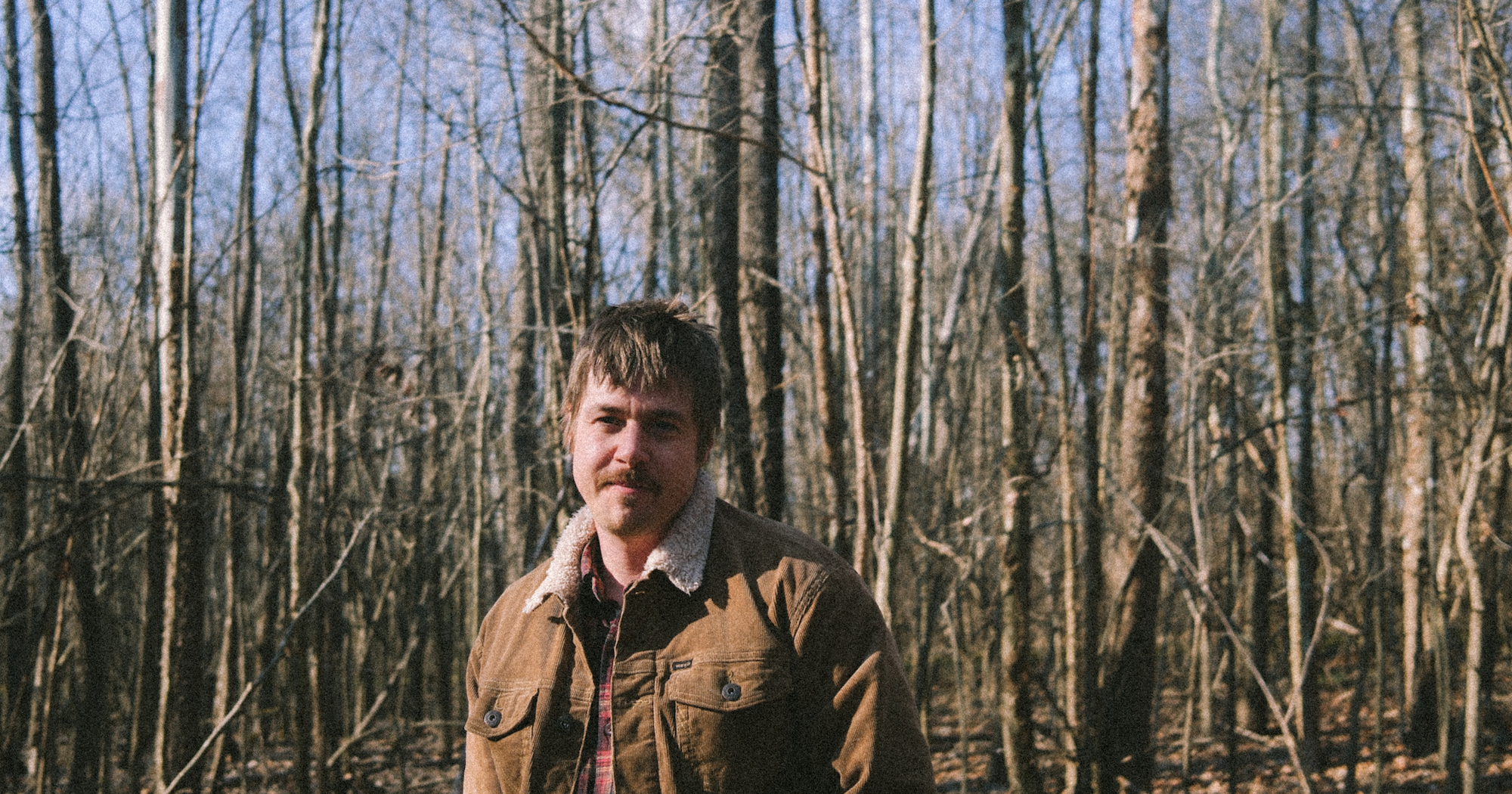
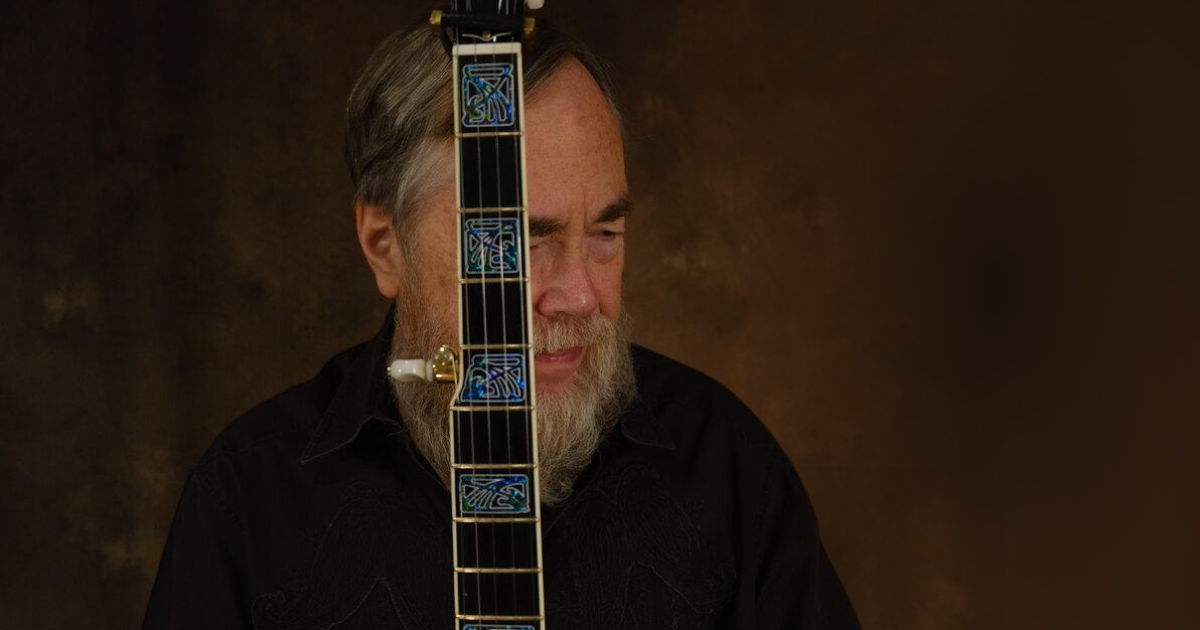
By now, Josiah Leming is a master of reinvention. In the early 2000s, he signed a major label deal, then went indie for a while. Some of his albums leaned on his rock influences; others were more folk-oriented. He’s released a healthy number of covers projects, but can write songs as well as anybody who’s been in the business for 20 years. Leming also recorded under his own name before rebranding himself as Josiah and the Bonnevilles. And he’s about to be all over the map, literally, when he launches his Redline North American Tour in May with openers Max Alan and Brenna MacMillan.
Josiah and the Bonnevilles’ base should only grow with As Is, out May 8 on Rounder Records. Returning with a more electric approach, Leming co-produced the album with Konrad Snyder.
“It was important to me that the album sound different, but not so different that people don’t recognize it,” Leming tells BGS. “That was actually a pretty tough thing to do, because it’s easy to change things and really turn them on their head, but to have it still feel like it came from the music that came before it was something I thought a lot about.”
A proud native of Morristown, Tennessee, and now living in Nashville, Leming caught up with BGS to talk about how he picked up the banjo, the positive results of listening to Ralph Stanley, and how Jack Reacher helped him define his relationship with his fans.
I noticed the first line of the first song on the new album is, “I’ve been staying out and off the internet,” and after listening to the album a couple times, I realized that’s an important line for this whole record. Was there sort of a recentering, or a desire to disconnect, maybe, as you went into this album?
Josiah Leming: It was a huge part of it. And I still struggle with it a little bit, because the reason I got to where I am now is because I embraced the internet, I embraced social media, and I shared my life with people, day in and day out. I was 33 years old, fighting and scrapping to have a place, making music as a living. But I found as we got toward the end of 2024, the things that I was doing to sustain the level that I was at were coming directly at the cost of the essential thing that goes into the music.
Like, things had never been better. My shows were as big as they’d ever been. Everything was cooking on all cylinders, but I didn’t have any new songs that I was very excited to share. I needed to completely cut myself off from that world of the promotion cycle and the daily posting. … I have always written so autobiographically, and it would have been very easy for me to write an album about the struggles of the road or an album that would make a lot of sense to me. But I started thinking about 13-year-old Josiah in Morristown, Tennessee, and that guy doesn’t care what it’s like to be in Tulsa on a Thursday night, and maybe you’re a little lonely. Like, I gotta cut deeper to the core of this thing that’s not just about me.
That took me 30 or 40 songs to write out all of that stuff, to get to where I could look a little deeper for the meaning and the songs that somebody would understand if they weren’t a touring musician. That was the ultimate goal for me with the record, to make something where people don’t think about me when they listen to it. They can maybe just put it on in the garage. When I put on Ralph Stanley or AC/DC in the garage, I don’t think about Angus Young or Malcolm Young or Brian Johnson. I think, “Damn, this is an awesome day. This is a soundtrack to my life.” And I hope I have done that somewhere on this album.
How much of an influence did your Appalachian roots have on this album?
It’s really interesting. So the bio for the album was written by an author named Silas House. We had a chat and he actually asked me a similar question. He was like, “It feels Appalachian, even though it isn’t that obvious.” I think that’s because of the language I use that I grew up with. I think a lot about when I write, “Would my dad understand it?” My dad’s a simple, working-class man. So if things get too complicated, lyrically, then I want to change that to make it simpler.
That’s a lot of it, and I really went into the deep phase with Ralph and a lot of older stuff. That really changed my perspective on how I see myself in this industry. It’s very easy to start to get into this race to the top, and you’re looking at analytics, and you want more monthly listeners and all this stuff. Listening to bluegrass, and Ralph Stanley especially, all that kind of disappears, and it just becomes about the raw emotion of it. Which is what I fell in love with in the first place, when it felt like I had to do music.
How did Brenna MacMillan get involved with the project?
I was tracking a demo to a different song, a song I love but that’s very strange. And I was like, “I really want a banjo player.” Back in the day, I used to use Craigslist to find background singers because I love finding new people. So I put up an Instagram story and somebody sent me Brenna’s account. I watched one video and I thought, “This is just like lightning in your veins.” She’s so awesome. The energy in the banjo and the voice. And we had connected but it didn’t work out that particular moment.
So when it came time where I wanted banjo on the record, I hit Brenna up again because we’d exchanged numbers. She came in, and she’s just amazing. She doesn’t know how good she is. She’s been tour managing the band East Nash Grass, which I love. I’ve been listening to them a ton right now. I was like, “We need you in the band.” So now she’s in the band, she’s touring with us, and she’s going to open up the shows. I’m so excited for people to hear her.
When did you first pick up the banjo?
My grandpa gave me a banjo. He loved George Jones. He was a hard-drinkin’, George Jones-lovin’, bluegrass-lovin’ guy. He had a banjo and a Dobro he gave me, and I fiddled around with that. And then, all of us guitar players, when we find the six-string banjo, we’re so pumped because we don’t have to learn all these new chord shapes. So, it’s been a couple of years that I’ve been adding in the six-string banjo on things when I play, and I still play that on “Redline.” I am using the finger picks now, rather than my nails. So I feel like I’m starting to cross the bridge… if I can learn some shapes on the real banjo, maybe I can do some damage one day.
In “Redline,” it seems like you’re writing for the people you grew up with. People in your life who have hope, but it’s just hard. Who do you have in mind when you write a song like “Redline”?
It makes me emotional, honestly. I think about my dad all the time. It’s like I have all this… it’s not anger, but there’s very strong feelings. While I’m doing very well in my career, it’s better than it’s ever been, most people that I know are not winning in this modern world. Where everything is through the phone, and it’s the only way to access social circles. It’s the only way sometimes to order a damn McDonald’s sandwich. And there’s just this barrier, there’s this divide.
I see it with my dad, and my grandparents, just being left behind. And also working people. We shot the video for “Hell Without the Flames” down in Colombia, because that’s where all these jobs have gone, and now they pay these people even less than they paid before. So there’s just something that I can’t get out of my brain. I think about it all the time. That’s an important song to me. We love playing it. The band loves playing it. So I appreciate you asking that, it means a lot.
You’re welcome, and this may be a good segue to ask about “You’ll Never Leave Harlan Alive.” I found your version when I was going through your Country Covers EPs. It tells a similar story, about how grandma and grandpa had to keep working to live. Why did that song pull you in?
I probably heard that song first on Justified and I think that would have been the Darrell Scott version, the original. And I had always loved it. I mean, that’s just one of the best songs ever made. Talking with Silas about it, or anybody from the region, it’s so complicated because there’s so much pride. I like to think that there’s so much pride in working for so little, but these people are exploited over and over again. We don’t have aspirations of gold palaces or island complexes, so we’ve just been consistently taken advantage of, because we have this value system that’s a lot different. It makes you sad, sometimes it makes you angry, and sometimes it also makes you proud, and it’s really complicated feelings around all of it.
But it also seems like it’s important for you to share the music that you like. You’re writing songs that you want your audience to relate to. You’re covering songs to maybe introduce the music you like to your fans. You’re bringing musicians you like out on tour with you. Your fans can tell what you’re into through the company you keep. Is that part of your creative vision, to share with your audience who you’re listening to and what you like?
I think so, yeah. I was thinking recently, I always had service jobs growing up. I would serve tables or I would bartend. As I get older, I just see myself as having a responsibility. I think I had the responsibility to get off the internet for a year to write the best album that I could, rather than perpetuating my brand with songs that sounded similar. I feel like I have a responsibility to have the upbeat songs in the set list. If people are flying into town or driving 10 hours, it’s my responsibility to give them an experience.
There’s a great quote that I love from the Jack Reacher books. I love anything like James Bond, Reacher, or Tom Clancy. I love that stuff. But the author of Jack Reacher has a great quote about a handshake. And to make a handshake work, there’s got to be the hand on the other side that shakes back. I think about that in everything I do these days, since I read that. I wouldn’t get a lot of benefit out of just making music that I love and putting it out in the world if there’s not that hand on the other side. So I am at the point in my life where I think about those people that I’m looking at when I play live, and there’s a responsibility to me to weave what I’m excited about into what I hope will connect with them.
Want to see Josiah and the Bonnevilles live at the Fonda Theatre in Los Angeles on May 21, 2026? Enter to win tickets here!
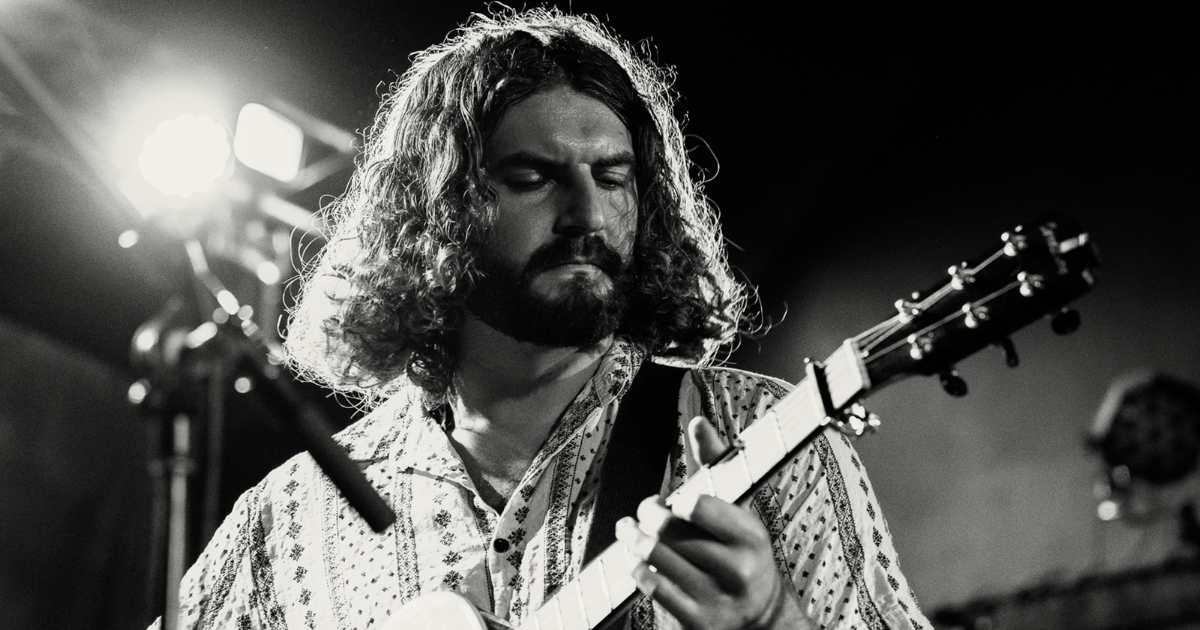
While many young talents, willingly or hesitantly, bow down to music industry boardroom suits who promise stardom if they’ll follow a professionally curated path, Cole Chaney takes a hard pass. He knows exactly who he is, what he does, and how he wants to get there. He creates songs, not content. He’s a career musician, not a brand. And the only thing he hopes to influence, maybe, is someone, somewhere, who wants to make music for all the right reasons.
Chaney grew up in Catlettsburg, Kentucky, surrounded by the legacies and storytelling of his elders. After graduating high school he worked as a welder, uncertain of his career path, but already fueled by his passion for music. Today, he keeps one musical foot in the bluegrass traditions of his Appalachian roots and the other in guitar-centric, amplified bands like Soundgarden, Nirvana, Alice In Chains, and Stone Temple Pilots.
His debut album Mercy and subsequent OurVinyl Sessions reflect his love of acoustic music and showcase his leanings toward introspection and melancholy. In the Shadow of the Mountain, released last fall, takes that darkness to a new place, balances it with moments of light and leans into the aforementioned rock influences, while never losing the origins of his sound. All of this shines at peak level onstage, captured by Western AF on a Live AF Session.
Sitting outside at home on an April morning, drinking coffee and surrounded by the sounds of birds and a breeze, Chaney spent a couple of hours on the phone with Good Country. He spoke candidly about his music, faith, values, mental health, and the intertwining of inner peace and inner turbulence that make all these things uniquely him.
When you were ready to do this professionally, you went to Lexington. Most songwriters would have chosen Nashville. Was yours a deliberate decision or a natural one?
Cole Chaney: To understand that decision, you have to look at who I was looking up to at the time – and still do – and what drove that decision. When I was in high school, probably around my freshman or sophomore year, 2014 or 2015, I started getting into this band called Sundy Best. They’re from Prestonsburg, Kentucky, which is just down the road from me. This was pre-Tyler Childers. At the time, in Eastern Kentucky, these guys were the biggest thing coming and going. They leaned heavily on being from Kentucky, the same way I do, and they moved to Lexington to get a foothold.
That was my early example, watching those guys. I knew they weren’t going about it the traditional way, which was to go to Nashville and pray somebody picks you up. They did it in Lexington. A couple years later, Tyler Childers comes along – another super-influential figure in my musical upbringing. Of course, he’s anti-Nashville – not the city, but the machine, if you will. I’m pretty sure he lived in Lexington, or at least around the area in the scene, for a while. So did Sturgill Simpson. The list goes on.
I was like, “What business model makes more sense to me? Do I go to the place where there’s more songwriters than the rest of the entire planet or somewhere where people will actually understand what I’m saying and I can maybe build myself a little bit of a foundation?”
The way I saw it is if I started building a sort of fan base or if I had enough ticket buyers, places like Nashville or Denver, these big music scene cities, what choice would they have other than to book us? That’s the way I looked at it.
And it worked.
It did work. It’s a simple business model, but the difference between that model and the other is you’re not sitting around waiting for something to happen. It’s on you to go out and make your own connections. It’s a very grassroots and organic way of doing it and that’s the way I like to do things. I’m anti-machine. Even though I work with some bigger companies, I keep it as limited as possible. That’s so I can play pretty much wherever I want, whenever I want, and they understand that.
On the Whiskey Riff Raff Podcast you said, “Music found me.” Would you mind expanding on that just a bit?
It did. I never would have dreamed at 16 years old that I would be doing this as my full-time job at 25. That was never on the horizon for me. I didn’t know what I was going to do. I knew I was going to weld for a little bit, see what happened, and maybe try to start my own business. And I did. But I really didn’t think it was going to end up like this.
I started realizing that people liked to hear me play and sing around the same time that COVID hit really hard. That gave me an opportunity to sit down, write some songs, and think about what I wanted to do with the rest of my life.
I’m very much a subscriber to the Bible, and I think the Lord has a mysterious way of working. He put me on a path without me even realizing it way back then and I do my best to stay on it now. I think my job while I’m here is to create as much good stuff as I can, stuff that means something, get it out to the people, and get out in front of them and play it for them. As somebody who enjoys going to shows in their free time and watching my favorite bands perform live, I know how that feels, and it’s truly a privilege to be able to offer that same service to other people.
There is music in your bloodlines, not professionally, but family members who played in church and at home. You obviously assimilated the sound of the area, and also this wider scope with bands like Alice In Chains and Stone Temple Pilots. When did all of that begin seeping into your songwriting?
We listened to the radio when I was growing up. I didn’t get educated on music or how to play until I started really getting into it. To this day, I’m still being educated and learning how to play on a daily basis. Part of what keeps it so fun to me is how much I don’t know and constantly learning about things.
Mercy was my first album, and I had access to what was around me. I had just moved to Lexington and I was really into bluegrass. There’s a band called the Wooks that, to this day, Glory Bound is one of my top three favorite records of all time. I was infatuated with that sound and that was what I wanted Mercy to sound like, or at least as close to it as I could get. A lot of the Wooks ended up playing on that album, plus Michael Cleveland. It was crazy.
Alice In Chains has been a mainstay in my musical taste since I was probably 15 or 16 years old. Since I first found them, I was very drawn in by the tone of Layne Staley’s voice and the weight of Jerry Cantrell’s guitar. It feels like you could bite it and chew on it. I don’t know how to describe it.
I’ve also always loved bluegrass, so it was [figuring out] how to bridge the gap of what I listen to and where I want to go with my writing without completely abandoning that sound. And bringing the alternative rock sound into the folk realm, where you have mandolin, upright bass, fiddle, acoustic guitars, and drums. The biggest change in the sound has been the addition of drums over the past two years, navigating that and seeing how it fits into the whole equation. It opened up a lot of avenues for me as a songwriter.
You began playing guitar at 13 or 14. Did you always play acoustic?
The thing about electric guitar, for me, is that it’s such a deep realm of gear and a deep dive. I’ve always been attracted to good-sounding acoustic guitars and players like Tony Rice, so I felt my effort was best spent getting really good at playing the acoustic guitar.
That will carry over whenever I decide to pick up an electric guitar, more so than if I only played electric guitar and tried to write some bluegrass-style acoustic lines. It would be a tougher transition to come over from light gauge strings on an electric guitar to .013s on a dreadnought and trying to play “Blue Railroad Train” or something like that.
Do you have an electric guitar?
I have several electric guitars. I’ve got a ’57 reboot Stratocaster, an American Professional Telecaster, my old Paul Reed Smith that I learned how to play electric on, and a nice Vox amp. I don’t know all that much about electric guitars. I still have a lot to learn.
Prior to this interview, you sent over your touring rig: a Gibson J-45 Banner in standard tuning with a K&K Pure Mini pickup, and a Breedlove sitka/rosewood Custom Dreadnought in drop D/double drop D, with an LR Baggs Element VTC pickup. Also two Grace BiX DI’s and a Lampifier Model 711 cardioid mic for lead vocals.
Those are my road guitars. They aren’t the ones I recorded everything with, but those are what you see at the shows.
In addition to the Gibson and Breedlove, do you have other acoustics?
I have two Gary Cotten guitars. [On] OurVinyl [Sessions, that] was my first Cotten I recorded with. On In the Shadow of the Mountain, many of those songs are my newer Cotten, which is sinker mahogany and an Adirondack top. “Alone?,” “In the Shadow of the Mountain,” “Into,” “Feels Like Rain,” and “Spirit” [were all recorded] on the Cotten.
That guitar sounds huge. It’s an outstanding guitar. I don’t tour with it because I’m scared something would happen to it and it’s too special to me. And Gary’s a great dude. He’s always taken really good care of me, and I want that guitar to stick around for a long time.
I don’t have any electronics in it, either. It’s a very traditional style, it’s a dovetail, and I want to keep it as traditional as I can and keep as much weight out of it as I can, because the more weight you add, sometimes it makes them sound worse.
What makes the Gibson and Breedlove right for touring?
They’re super-versatile and they both sound fantastic plugged in. That Breedlove is the longest-standing guitar I have that I’ve consistently played shows with. I got it in 2019 from 4 o’clock Rock Guitar Shop in Ashland [Kentucky]. It’s a custom dreadnought that they shop-ordered and it’s got the LR Baggs VTC Element in it. It has always sounded so good plugged in. I mean, all guitars sound bad plugged in, but it’s a matter of how much of the original sound can you actually preserve when you plug it in.
I’ve gotten to the point where I am almost starting to desire a little bit of that direct input texture. Maybe it’s because I’m listening to too much MTV Unplugged, but I’m starting to desire that kind of cardboard bad sound.
The Gibson, I put a K&K Pure Mini in and it sounds really close to what it sounds like not plugged in. Man, that Gibson is a beast. I love that guitar. It’s been to every show with me since I bought it last year.
I still have a Paul Reed Smith acoustic guitar and it’s a damned good little guitar. I’ll probably end up using it again on some stuff. It’s one of those that you plug in and it sounds great, too. But when I got into the whole bluegrass thing, I knew I needed something with a little more body.
Sometimes you use a pick, sometimes fingers. Either way, your attack is strong. How did your technique develop?
It’s one hundred percent out of necessity. I had a really bad injury in 2015 and I damn near cut my index finger completely off at the knuckle. I can’t wholly bend my index finger and I can’t feel the picking side of that finger. If you watch some of my older videos, my index finger is flailing around all the time. It’s because I’m picking with my thumb and middle finger, and that’s where I’m holding the pick. That took me long enough to learn how to do.
In recent years I’ve learned how to use my middle finger to lock my index in place and be able to hold a pick. It looks normal, but if you could see how the sausage is made, it’s not that pretty. I wish I had that dexterity in my finger. The takeaway message from that is, “Take care of your hands, y’all.”
Let’s talk about the through line from bluegrass to bands like Stone Temple Pilots and Alice In Chains. You blend the genres seamlessly and it all makes sense. Did you always feel that connection?
If you listen to any playlist I’ve had, I’ll go from Ralph Stanley to Chris Cornell in a heartbeat. Obviously the music is different, but there are common themes between the two. Mountain folk music, hard rock, and that era are very dark and brooding, and they can be heavy in their own ways too.
What is heavy? What makes a song heavy? You’ve got people drop-tuning their guitars, but it’s still not as heavy as Pantera or Black Sabbath or something like that. So it’s not necessarily the sound that makes it heavy. It’s the vibe of the song.
I feel like a salesman a little bit, trying to sell this idea that this stuff can be brought together and related in an authentic capacity. Let’s take [Stone Temple Pilots’] “Big Empty,” for example. To do a cover of that and be looked at as a folk artist or an Appalachian artist, or some people will even say country – which I disagree with, but whatever – it always seems like somebody will start into a cover of this great song, but then they’ll get hokey with it and it loses all its purity.
That’s not at all the intended purpose for me. It’s to say, “This is a fantastic song and it fits the vibe that we’re all going for in this realm.” A lot of people probably didn’t know that a mandolin or fiddle sounds great on “Big Empty,” but now they do, because it fits. That’s the way I listen to that kind of stuff. It’s just how to pull that off without being cheesy or coming off in a capitalistic way. More so in a way of, “I love this song and you guys should listen to it.”
Was it challenging to find musicians who understand going from bluegrass to Stone Temple Pilots and back again?
The band, I think through a lot of prayer/manifestation, has come together and, as you hear, they’re fantastic. They can play anything in any style. Ella [Webster] and Kyle [Kleinman] come from a more traditional folk music side of things. Kyle is a bluegrasser and Ella is an old-time fiddle player. Lars [Swanson] and James [Gooding] are jazz cats, so they have infinite vocabulary when it comes to music. If you can play jazz, then you’re going to be all right. If you can pull off that stuff, you don’t have anything to worry about when it comes to my type of music. Stone Temple Pilots is a walk in the park for you.
In our van, the most listened-to bands between us are Soundgarden, Pantera, whatever James’s choice of jazz is, and Alice In Chains MTV Unplugged. That’s a really good piece of music. But yeah, they’re a great band and they can play anything.
Did Lars and James know each other before they joined your band? To lock in a rhythm section…
No, they didn’t. Once you start playing with a jazz drummer, you need somebody who can comprehend the stuff he’s laying out and answer that on the bass. To have those two sit in a room and jam is really something to witness and listen to, because they speak a language to each other that I don’t understand. But I love when they do it, and it’s great to hear.
I’ll be playing onstage, singing and doing my thing, those guys are behind me and I’ll hear them back there, talking to each other while we’re doing this thing, and it’s awesome. They’re special. Those two dudes – they’re incredible. They’re the unsung heroes of music in general. That’s your metaphorical offensive line right there. If you don’t have a Lars and a James, then your quarterback’s getting sacked all the time.
This is you in 2025 on The Western Side, talking about Shadow: “a lot of darkness and an equal amount of joy in other songs. It’s a good depiction of where I’ve been for the past two years. A tumultuous and chaotic time period, but also great. And I’m still here.”
Then, In 2021, on With A View: “I load the pressure on. It’s how I operate. My brain lives in constant turmoil.” In 2020, talking about “Fever Dream,” “a song about trying to keep it all together. … the way I deal with this is isolation. And when you isolate yourself, you don’t have much of a choice but to hash some things out in your head.”
You are no stranger to the dark place.
Hearing those things, I look at that younger version of myself almost as I would look at a younger brother. Part of me wishes I could put an arm around that kid’s shoulders and be like, “You’re going to be all right, buddy.” Times got a little tough, as they probably should for anybody at points in their life. You can’t really enjoy the great parts of your life without having a little bit of adversity to overcome or deal with. The darkest part, for me, was maybe just growing up and gaining a new understanding of the way the world actually operates and how hopeless that can be at times, but also how beautiful it can be in the same stroke.
What I’ve realized is you get out of this world what you pay attention to, because whatever you want to find, you can find it. It’s there and it’s aplenty, whether you want to find the negativity and suffering, or whether you want to find the positive and the good. I don’t have the answer to where folks are supposed to operate and live, but I think it’s good to help people who are in that suffering side of things. But you can’t let that dominate your existence, and for a little while, I was maybe dominated by the darker side of life.
I try to be as empathetic as I can, but with that comes feeling a lot and also accidentally hurting people sometimes. That’s really tough, because then you have this cycle of guilt that you deal with trying to make it right in your head. As I’ve gotten a little older and maybe figured a couple things out, I try to have a lot more grace for myself. What I’ve learned about the pressure is that it’s really just perceived pressure and none of that exists, and you should just care less what people think.
Obviously, music is where you go during those times.
Absolutely. If something is eating at me that I’m having a hard time getting out in a linear fashion, a lot of times I find myself writing about it without even realizing it. My mom is an abstract painter, so I grew up with an understanding of what “abstract” means and abstract concepts. That’s how I materialize a lot of that stuff, because some of it is things I would never come right out and literally write down, for multitudes of reasons, but things you want to indirectly address. That’s when [abstraction] becomes a great tool for addressing those kinds of things. Metaphors.
It seems, when it comes to expressing those things, you’re in the balance between the emotionally open world of Cornell, Cobain, and others and the world of bluegrass, country, hunting, fishing, and those stereotypes of “manly men” – and not so much emotional transparency.
Not necessarily. I don’t know about the whole “alpha male” personality type. It’s always seemed to me that a lot of times the guys who are trying to be perceived as macho are probably the ones who need a hug the most. Now it’s everybody else’s problem because their dad didn’t do it, and that sucks.
As I’ve emotionally developed a little bit, I’ve really started to respect individuals like Chris Cornell. If you look into him as a person and watch some of his interviews, he’s intelligent and seemingly self-aware. I respect the way he conducted himself, especially in interviews, and the way he made sure to pay attention to people and make them feel seen. The only way you can empathize with people like that and make sure of those types of things is if you’ve been on the other end of that stuff and you’ve felt looked over and brushed off.
I may not be the best at answering Instagram DMs, and I definitely don’t stay on the internet because I think it sucks, but if I talk to somebody in person, I always try my best to give them that and be present in the moment. Somebody else that does a fantastic job of that is Nicholas Jamerson, the frontman of Sundy Best, who’s a mentor, friend, and hero of mine.
Have you ever felt any hesitation about publicly ripping off the mental health Band-Aids? Or, conversely, is there a feeling of opening the door to people having these conversations?
Sure, there’s hesitation about a lot of things. There’s a lot of decisions about, “How do you want to portray yourself in a public light?” But my main goal is and has been to just be as authentic as I can, as representative of how I feel about things as I can, and to be accepting of people and understand that they come from different places and have different perspectives.
With that hesitancy, there’s also much more in the way that when we were talking about 20-year-old Cole, the way I want to put my arm around that kid and comfort him, that’s what I want my music to do for people that feel the way I was feeling at that time.
Listening to you, I’m reminded of something Charlie Daniels said to me during an interview years ago: “Music is too precious for me to prostitute it.”
Oh, yeah. Absolutely. And, too, Charlie Daniels is one of the greatest country musicians ever. I want to go on record saying that.
The way I look at it is, could I see my heroes, people I look up to, going online and being like, “Comment what song you think I should release next”? No, I don’t think I could. When I see someone who has musical and artistic integrity, that’s how I’m going to operate. I’m going to try my hardest to uphold my integrity and not do the TikToks and the really cheap stuff.
You absolutely will suffer financially for not playing the game and if you don’t kiss the right ass, but, to me, that suffering is not negative suffering. I’m honored to be able to suffer like this, because if my options are suffer or have to watch Country Central’s “Hot Take Tuesday,” then give me suffering all day long, because I’m not paying attention to that bullshit. It’s ridiculous. I don’t care who’s beefing and I don’t care what dude is playing cowboy this week.
That’s why I’m trying to get out of the country scene. It’s becoming so fake and there’s so many people trying to be carbon copies of other people. There’s no authenticity. Everybody’s full of shit. We went through this period where people like Tyler [Childers] drove the spear through the heart of this mainstream country thing and it was akin to when Nirvana came on the scene and effectively killed hair bands for a while. But then the Nirvana copycats came along and garnered a lot of the same attention.
I’m not saying that just Tyler Childers is responsible for this. People like Sturgill, and a lot of smaller artists in their own scenes, are responsible for the turning over of the dirt, if you will. But it’s getting stale. It’s past getting stale. It is stale and it’s bad. There’s a lot of really shitty music being put out right now and I don’t want any part of that.
If I’ve got to step away and back off and be out of the internet eye, then fantastic. That doesn’t bother me one bit. If it means a few less people know who I am, then so be it. But I hold out hope that people will eventually realize how cheap and bad a lot of the music is that is being promoted right now, and there’ll be another turning of the dirt soon.
Yes, art is subjective, but art is subjective. Not this corporate bullshit that they’re trying to push. That’s not art. That’s six dudes in a room trying to come up with a song that’s going to sell on the radio or sell on the internet, or “We’re going to put thirty tracks on this album” so they can set streaming records. It’s like, “Man, y’all have lost the complete plot of the whole thing.” There’s nothing interesting about that to me. I’m all about authenticity. I want to believe the person on the other side of the microphone from me, and if I don’t believe you, then I’m out.
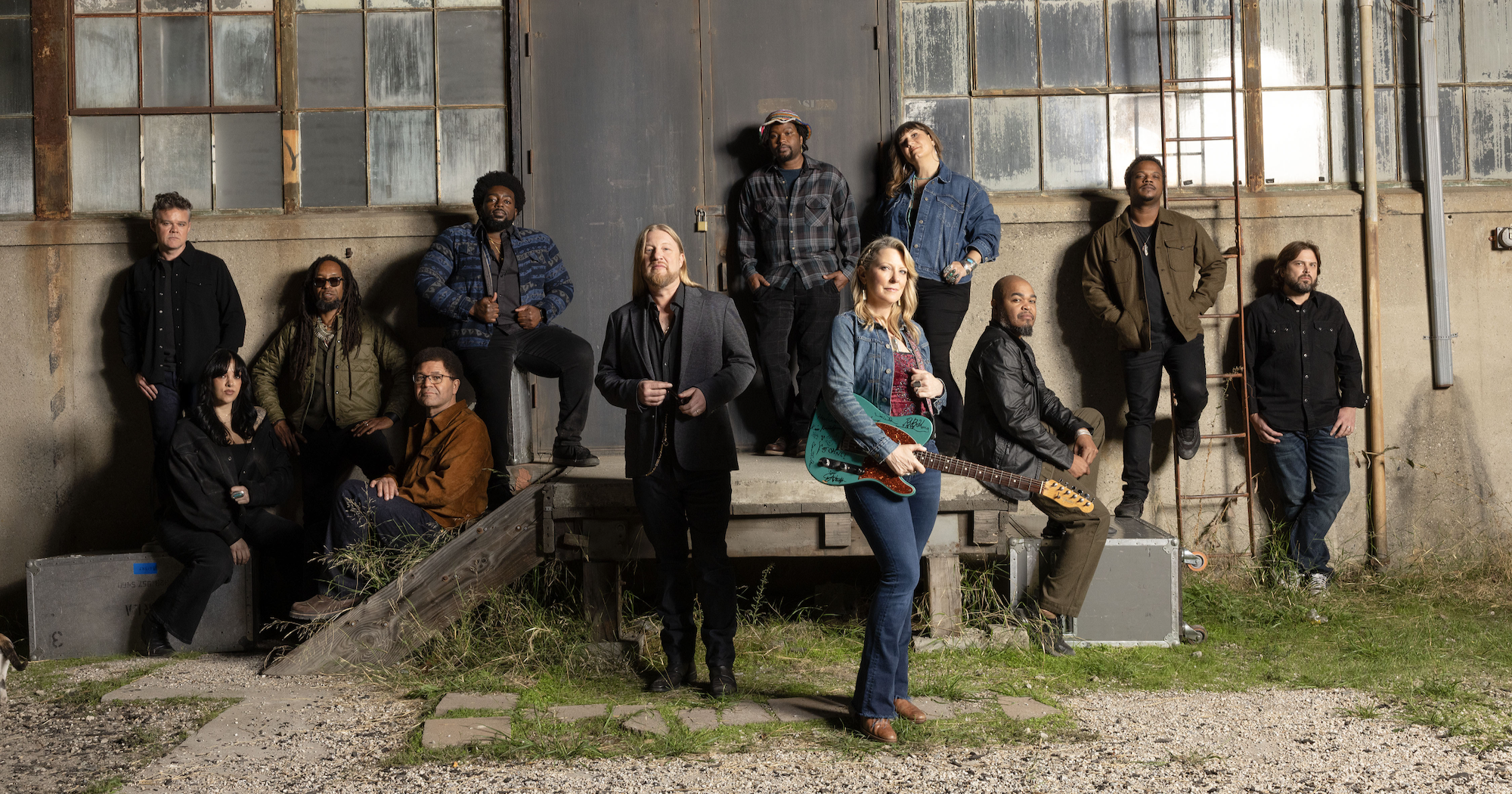
When it comes to entirely enjoyable, technically exquisite modern blues, Southern rock, and jam-band soul albums, Tedeschi Trucks Band have a statistically impossible batting average. Their new LP, Future Soul (released March 20 via Fantasy Records), is yet another “no skips” collection from the megalithic 12-person Americana group fronted by husband-and-wife guitarist Derek Trucks and guitarist-vocalist Susan Tedeschi.
On that strength of their catalog – and their ensemble – TTB have amassed hundreds of millions of streams, won eight Blues Music Awards and one GRAMMY, and a handful of their songs have become regarded as modern standards in the Americana and American roots music songbook.
Future Soul simultaneously feels like a surprising departure and familiar, essential territory for the band. With Mike Elizondo producing and songs and creative input sourced from across the group’s lineup, the set ends up sounding and feeling more acoustic than “usual,” while still reaching roaring crescendos and building it all on dank, wide open grooves. Perhaps those acoustic moments are a substantial contributing factor as well, but the cozy, plush pocket of the album is what gives it a laid-back, relaxed, and floating vibe no matter the track’s genre construction.
Screaming slide, no-holds-barred vocals, and wall-of-sound climaxes can all be found herein, as well. But the collection never thrashes or flails, it’s precise and exacting – as Tedeschi and Trucks are both known to be on their instruments, whether guitar or voice – but it’s certainly not sterile or gated or homogenized, either. It’s another remarkable feat for a group so large that you would almost have to assume, live or in studio, musical mud would be an inevitable byproduct.
But no, TTB seem to have no misses, at least not on Future Soul. It’s clear this group works together in harmony not just because of the down-to-earth and collaborative leadership of Tedeschi and Trucks, but because the artistic and musical responsibilities and ownership – of the songs themselves, of the album, of the makings of each, of “success” for the band – are decentralized and distributed throughout the group. The band has a sound, an art, that is consistently collective in the way it’s received by audiences and listeners because, forgive the obviousness, Tedeschi Trucks Band always work as a collective.
In our BGS conversation with Derek Trucks, the magic and unlikelihood of this creative dynamic and the processes by which the band continues to rack up success after success were on full display. We spoke about how they put together Future Soul as a group effort, the many inputs that went into Trucks fashioning his lyrical guitar style, and what bluegrass means to him personally, to Tedeschi, and the band as a whole. It was a joy-filled, passion-led conversation that again reinforced how this wailin’, rockin’, rollin’ band continues to flout and subvert expectations – and thereby has become so beloved.
Something that jumped out at me from the bio about the new album is that you say, “There’s just not a weak spot on this record.” I have to say, I totally agree. I think it’s remarkable that with a 12-person band and such a diverse catalog of recordings and releases, it really doesn’t seem like there’s any “fat” to trim or any duds to cull.
I have to ask, does it feel as magical on the inside of that process as it seems from the outside? It seems unlikely that y’all would work so well together towards a common goal, artistically, and be able to deliver again and again and again. And I don’t just mean commercially, awards-wise, or for audiences alone. Clearly you’re delivering artistically for yourselves and by your own standards, as well. So, does it feel as unlikely on the inside of that process as it maybe does to us on the outside looking in? [Both laugh]
Derek Trucks: That’s awesome. But it does, man! I mean, not every record you do feels the same way. They’re all their own beasts. For I Am The Moon, it was in a time of great uncertainty. We did four records and it was just kind of a heavy, heavy time – and that record feels like that.
This one felt completely different. The band felt much more confident [and] had been touring for two years straight. We had been playing so much together that when we finally got the core of the group up to our farm in Georgia to do some writing, there were a few songs right out of the gate. Like “Future Soul” and “Who Am I,” where immediately, Sue started singing, Gabe [Dixon] started singing these melodies. I got chills and I was like, “Oh, this is gonna be good.”
You’re always kind of worried about running out of ideas, or running out of runway – like a thing in the back of your head. But I feel like we’re incredibly fortunate where, when we’re together, everyone puts everything they have into it. Then, when we’re not on the road together, everyone’s all doing their own things musically. So, when we come back together, there’s a lot to talk about and a lot of music to remember together.
I think it keeps it really fresh and it keeps it moving forward. I feel like everyone’s out honing their craft when they’re away from this. When they come back, there’s a lot of new ground to cover. So far, we’ve been really, really lucky that way. And there’s a handful of just incredible songwriters in the band, so everybody comes in with two or three ideas. You’ve got a pretty strong record right out of the gate. That’s been something that I think me and Sue are just realizing – we’ve known how amazing that is but, you know, Gabe and Mike [Mattison], they show up with some serious ideas.
Then having Mike [Elizondo, the album’s producer] down, just some outside ears – I think that was really important. Sonically, he was trying some different things that I think inspired the band and made everybody play a little differently. That was exciting.
I was struck by the range of styles and the different genre infusions that y’all have put into this collection. What really stuck out to me, listening down to the project in one fell swoop, is there are still those really big energetic moments – and there are still those “wall of sound” moments that y’all are really known for. But I felt like this album is chill and laid-back in a way; it feels deep in the pocket. Can you talk about capturing those seemingly disconnected energies together?
I think one of the things is that with a band or an artist, I think if you’re maturing properly – we learn sometimes slowly – that you don’t have to force the issue all the time. You can trust things around you a little bit more, and sometimes the groove is enough. Sometimes the chord changes are enough, sometimes the melodies are enough. It doesn’t have to be these epic moments at all times. So when they do come, you’re excited about it and wrings you out. Then you lay them back down, and then you go on another little trip.
I think the band, having played together so much, we’re in a different place that way, where we realize that you don’t have to force the issue on every song. You can go to different spaces, different places. And then, again, having some outside ears – Elizondo really helps with that, too. He helps guide you to places that maybe you wouldn’t have gone naturally, so that’s a fun thing. Then you learn things about yourself musically in the band that you didn’t know before. That’s always a good place to be.
One thing that I’ve been obsessed with about your playing, specifically, ever since I discovered you as a teenager, is how lyrical of a guitar player you are. It jumped out at me from the bio, as well, when you’re talking about “I Got You” and how you’re doing a guitar-voice dialogue instead of guitar-guitar. I think of you as one of the most lyrical guitarists out there. You’re so present and so grounded. So I’ve always wanted to ask you how you’ve cultivated that style – as well as being able to have those moments of pure shreddy, lick-y wailing.
Then hearing that you really wanted to make that connection between voice and guitar on this album made so much sense to me, because I’m always thinking about how you’re a lyrical player. And Susan is, too, and you both dialogue with your instruments, and her voice, often.
Pretty early on I had a few musical epiphanies. One was Allen Woody, who played with Gov’t Mule and the Allman Brothers. When we toured with my solo band, opening for a Gov’t Mule in the early days, he would always turn me on to records. He gave me this CD by this guy named Aubrey Ghent, who was a gospel [steel] player. I put on “Amazing Grace” and I was like, “Wow, what an amazing voice.” And then I heard the pick and I realized that it was this guy playing lap steel! But it sounded like a woman singing. I got chills [over] my whole body, and I was like, “That’s it, that’s the thing.”
I had been listening to a lot of Indian classical music – a lot of vocalists and sarod players. Me and our old [Derek Trucks Band] bass player, Todd Smallie, went to Ali Akbar College of Music in San Rafael, [California] and they would let us sit in on classes. I realized he [Ali Akbar Khan] made all the instrumentalists take vocal classes, because his whole thing was that you should be singing through your instrument. So that made it just really obvious.
Those were a few of the things, and then there was a long time where I just stopped listening to any guitar player. It was only singers and horn players. That was kind of the idea [that] musical ideas can come from anywhere, but you really should be singing the thing. There’s time for all of it, but the stuff that moves me the most is, you know – even hearing Duane Allman on “Blue Sky” or something. It sounds like somebody’s singing, like somebody is walking down the road whistling. I think those are probably the touchstones for me.
Maybe I am projecting a little bit, because I’ve been a bluegrass banjo player my whole life – I started playing when I was seven. But when I think of guitarists, especially who end up reaching the pinnacle – whatever that is – or especially in flatpicking and in bluegrass, there tends to be this homogeneity of style. The people who get to the “very top” end up all sounding like each other. Then you have those folks that really stand out, and it tends to be because they’re using space and using air as much as they’re using 16th notes and 32nd notes. I think, being used to really shreddy flatpicking, that hearing steel or slide or blues guitar or jazz or acoustic jazz, anything plays with sustain and plays with space, I just drink it up.
Beautiful, man. I remember the first time I heard the Stanley Brothers, or Ralph Stanley, and I just remember it hit me in that place where those early blues guys hit me. There was just something about it. That kind of cracked that whole world open for me. I mean, I was always a Tony Rice fan. We have the same birthday, so I thought that was cool.
No way, I didn’t know that.
And I remember being at a MerleFest years ago, I think it was one of the last ones that Doc played. I remember seeing this old Oldsmobile or Cadillac – I don’t know, it seemed like an 1980s or ‘90s car – it pulled up to the stage and I see Tony Rice get out, just dressed to the nines. He pops the trunk, gets his guitar, hits the stage, and then right when that set was over, he was back in that car! I was over there thinking, “What a boss.” It was incredible, man. He went up and just annihilated everybody and got back in his car and drove his ass home. Pretty incredible.
So funny.
The last time we talked to you for the site, you were Artist of the Month in 2019 and you talked about Del McCoury and Jerry Douglas. I know you’ve played DelFest a bunch, you’ve collaborated with Billy Strings – oh, and I was super excited to see Molly Tuttle supporting on a couple dates of your TTB tour in April, too.
Yeah, we’re excited for that. That’s gonna be great.
What does bluegrass mean to you? Obviously, there’s Ralph Stanley, Tony Rice – there are pickers and makers in bluegrass that are infused into what you do, but what does the genre mean to you more broadly? And who in the space right now inspires you, or your musical vocabulary, or what you guys are doing in the band?
When I think of American music, I think of blues, I think of bluegrass, and I think of jazz. I think [those are] the things that we’ve really contributed to the world. To me, those are the cornerstones of it.
We’ve become good friends with Sturgill [Simpson] over the years, and he’s dipped into that [bluegrass] place. When I hear him sing it I’m like, “Oh yep, that’s because he’s from there.” He’s from the heart of it, and it makes me feel the way Ralph Stanley does at times. Even guys like Tyler Childers – and Sue’s a big Sierra Ferrell fan. She loves all those records.
That music, even the current guys, it’s always playing around here. I don’t know, it just feels inspiring to hear. People just get on an acoustic instrument and rip one. You’re like, “Oh yeah! There’s still people that know how to do things!” [Laughs]
That’s the big inspiration I take from it. Because [in the music industry] there’s a lot of cutting corners, and that’s a music that there’s no cutting corners. You gotta put your time in and take your licks or you’re just not gonna get on stage. I appreciate not just the dexterity, but the vocabulary and the heart that goes into it.
And there’s just something about seeing a group around one microphone just doing the dance that I think is always inspiring. We’ve done some shows recently with Sam Grisman, we did a benefit [for Camp Winnarainbow] out in San Francisco. Peter Rowan was on it, and me and Sue, and it was all acoustics. I had an old National, and just getting to play with that group – just the way that group felt. Sitting on a stool with a Dobro, and they were coming and going around the microphone. And then, getting to hang after the show with Peter Rowan and him telling these stories, man. It was just incredibly inspiring. Some of the songs that we got to play with them – that dude [David “Dawg” Grisman] has written some incredible music. That was one of the highlights of last year. It was pretty damn incredible.
There’s a lot of acoustics on this new album, too. I did find myself wondering, and maybe I’m biased, but does the world need a 12-piece bluegrass band? It might! It might! [Laughs]
Man, that sounds pretty fun to me. I mean, it would be a lot less gear to carry on the road! Which would make it more plausible.[Laughs]
If you wanted to speedrun pissing off a fan base, this might be the way to do it.
[Laughs] Yes, alright, we will be thinking about this! I’m gonna go talk to Sue.
This next one is kind of for me, so I thank you in advance for humoring me. But I wanted to talk to you about Jack Pearson. When I first moved to town, I just met this guy out jamming on mandolin at these bluegrass jams. I’d be like, “Man, this guy’s so nice.” He’s a great picker. He’s a great singer. I got a lot of practice playing swing with him at jams in town. Then folks started being like, “Hey, do you know who that is?” Oh my god, I did not know who it was. He was just my bluegrass jam pal. Then I worked at the Station Inn for a few years and I got to work a bunch of his trio shows. I’d die for the solo acoustic sets he’d do on the set break.
Incredible.
If I were to list maybe my top 5 favorite guitarists of all time, I feel like you and Jack would both be on that list. So I wanted to have a little nerdy moment to talk about Jack. [Laughs] Can you talk about his playing and your guys’ friendship? Of course, I see so many connections between your musical vocabularies and that lyrical style we were talking about.
Yeah, man I need to check up on him. It’s been a minute. I need to check in on old Jackie P.
He’s a monster, man. He’s one of the few people that can actually go play in a straight-ahead jazz band, in a bluegrass band, and then the Allman Brothers. I mean, maybe the only person that can actually do it.
I totally agree.
I mean, he played with Jimmy Smith. This dude is like, he’s an absolute monster. And a sweet fella! You can’t say enough good things. When I joined the Allman Brothers, Jack was just leaving. So all the tapes I got, like learning the new versions of the tunes, were Jack Pearson tapes. At the time, Bud Snyder was the sound man. He would mix these tapes for me with Jack really boosted in the mix. I could hear exactly what he was doing to learn these things. I got an intimate take on the way Jack was approaching these Allman tunes. It was so unique.
There’s no one [that] plays like him, and [his playing is] about as smooth as it gets. Sometimes, you watch him play – and I know he plays really light strings and he plays low action – and the way his hands move, I’ve never seen anyone play quite like that. Then he busts out a slide and you’re like, “Holy shit! This dude can do anything!” [Laughs]
I know!
He’s one of the unsung heroes. There’s no doubt about it.
He does this thing – and you do this as well – where you’re able to leverage that really gritty, aggressive, absolutely on-the-razor’s-edge style that comes with blues and Southern rock and Americana. Then at the same time, like you’re saying, with light strings and low action, still has such a deft touch. Yet he has such great attack and precision and cleanliness. He is a great lesson in taste. His taste is impeccable.
Yeah, I think that’s exactly it. I think we forget a lot of the time that most of what we love about music is the musician’s taste. I mean, you got to put in the work – and Jack has obviously done that, that dude is a master. But his taste is really as good as anybody.
I think he’s probably a bigger influence on me than I even realized. Probably because of that early Allman Brothers time for me. I was jumping in at 20 years old, 21 years old. And all of a sudden it’s, “Here’s 60 songs to learn, and rehearsal/tryout is in a few weeks. I was like, “Well, give me those dates.”
I’m stressed just hearing about that.
I mean, luckily most of that music I had listened to my whole life, but I had never bothered to learn any of them. I mean, I knew “One Way Out” and “Statesboro [Blues],” that doesn’t take long. It was all the other shit!
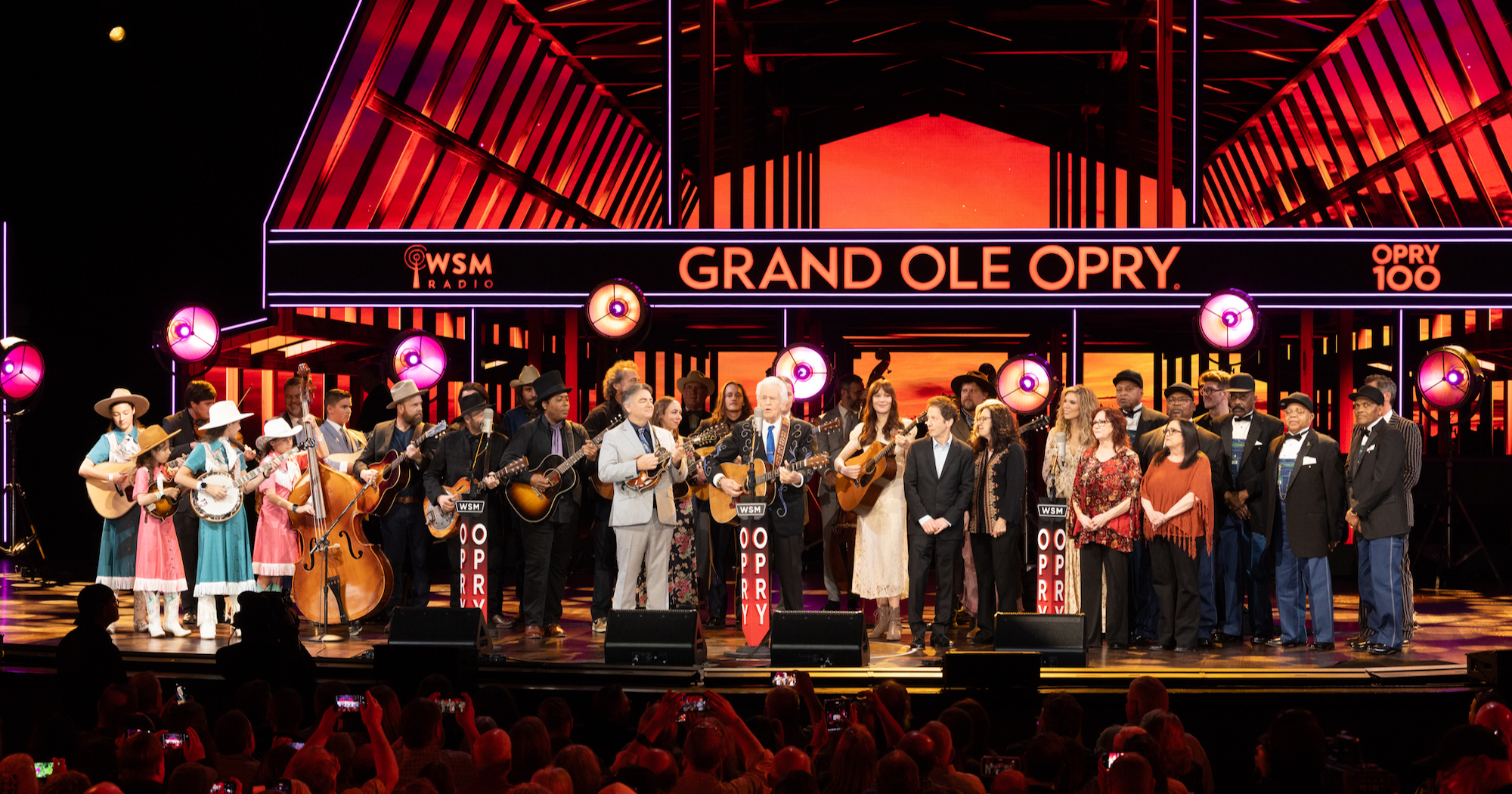
In an all-star acoustic tribute, the timeless music of O Brother, Where Art Thou? rambled across the Grand Ole Opry airwaves for a 25th anniversary celebration on Saturday, February 28.
In some ways, this night in Nashville felt different from a typical Opry show – no drum kit, no square dancers, and not a lot of commercials. On the other hand, it would be hard to find a more suitable place to stage a salute to O Brother than on the world’s longest-running radio show.
The GRAMMY-winning, 8-times platinum soundtrack was performed in its entirety by Opry stars such Alison Krauss, Emmylou Harris, Del McCoury, Old Crow Medicine Show, and the Whites, as well as guest performers like the Alaskan Sunnyside Sisters, the Fairfield Four, the Fisk Jubilee Singers, and Colin Linden alongside contemporary masters like Sarah Jarosz, Billy Strings, and Molly Tuttle. (To put the time frame in perspective, Jarosz was 9 years old when the soundtrack was released, Strings was 8, and Tuttle was 7.)
Old Crow Medicine Show perform during the Opry’s tribute to ‘O Brother, Where Art Thou?’
In addition, Chris Thomas King and Tim Blake Nelson also reprised their performances from the film, while the A-list house band was composed of Mike Compton on mandolin, Dennis Crouch on bass, Jerry Douglas on Dobro, Stuart Duncan on fiddle. And what O Brother tribute would be complete without Dan Tyminski delivering “I Am a Man of Constant Sorrow”?
As a bonus selection not included on the landmark collection, Krauss and the Fairfield Four opened the special evening with a lively rendition of “Every Time I Feel the Spirit,” which immediately immersed the audience in that same spirit. After Krauss stepped away, the Fairfield Four performed the soundtrack’s original opener, “Po’ Lazarus,” accompanied only by hand claps. Old Crow Medicine Show roused the crowd with “Big Rock Candy Mountain,” an enthusiastic choice that fit their high-energy demeanor. Bandleader Ketch Secor also co-hosted the event alongside Opry announcers Bill Cody and Mike Terry.
Dan Tyminski sings “I Am a Man of Constant Sorrow” with the evening’s house band.
Backed by the house band, Jarosz engaged the audience to sing along with a perennial favorite, “You Are My Sunshine,” and the sold-out Opry House was happy to oblige. Krauss returned with the Fisk Jubilee Singers for a sterling performance of “Down in the River to Pray,” where the audience sat almost perfectly still in reverent silence. Following the song, Krauss was presented with a commemorative scarf designed by the famed clothier Manuel; all Opry members are receiving the scarf as part of the Opry 100 celebration. The house band then shared an instrumental version of “A Man of Constant Sorrow,” which was a nice touch referencing the handful of variations of the song on the soundtrack.
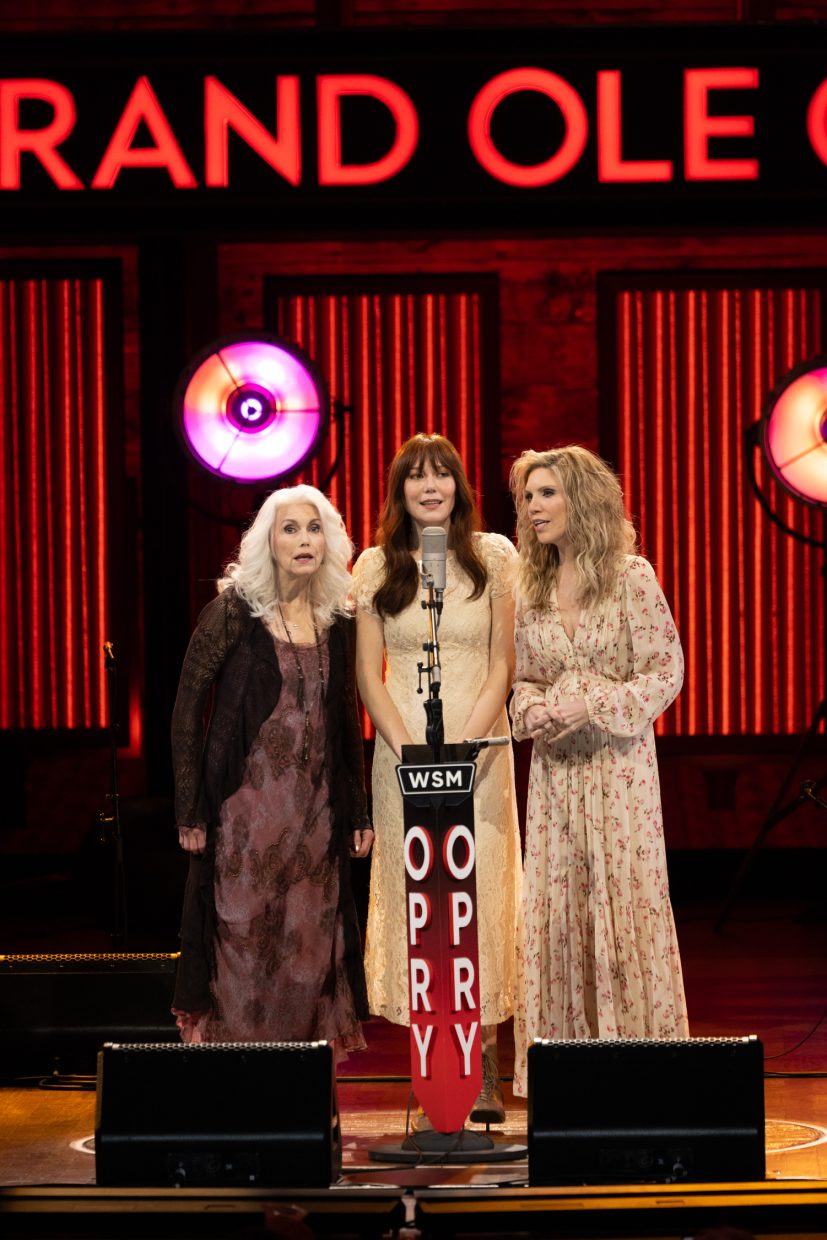
That soundtrack practically came to life with Colin Linden and Chris Thomas King’s “Hard Time Killing Floor Blues” and The Whites’ “Keep on the Sunny Side.” Jarosz on mandocello and Molly Tuttle on guitar teamed with the house band for a wonderful take on “I’ll Fly Away.” Emmylou Harris and Alison Krauss then stood on either side of Tuttle for a trio rendering of “Nobody But the Baby.” (Gillian Welch, who sang with Harris and Krauss on the original album, was unable to participate in the show.)
Emmylou Harris and Alison Krauss, both of whom appeared on the soundtrack, are joined by Molly Tuttle for an a capella rendition of “Nobody But the Baby.”
Folks, that’s only the first half!
After decades away from the spotlight, the Peasall Sisters returned to the stage to introduce “In the Highways,” the song they recorded as children; on this night, it was sung by an endearing kid quartet – and viral internet sensations – the Alaskan Sunnyside Sisters. Molly Tuttle returned for the emotional “I Am Weary (Let Me Rest),” which led into bluegrass phenomenon Billy Strings singing “Wild Bill Jones,” which appeared on the 2000 O Brother concert album, Down From the Mountain. Strings then welcomed Dan Tyminski for a duet of “O Death,” which was sung by the late Doctor Ralph Stanley on the soundtrack. (Incidentally, Stanley joined the Opry cast the same year the O Brother soundtrack was released on Lost Highway Records. The newly resurrected label co-presented the show with the album’s award-winning producer, T Bone Burnett.)
Billy Strings takes the stage to sing “Wild Bill Jones” with the house band.
The audience especially loved seeing and hearing one of the film’s stars, Tim Blake Nelson, revive “In the Jailhouse Now” on the Opry stage. Tyminski (who voiced George Clooney’s singing in the film) naturally brought the house down with “I Am a Man of Constant Sorrow,” then Old Crow Medicine Show offered the vivacious “Indian War Whoop,” recorded by John Hartford for the original project. The Fairfield Four also returned to the stage to sing “Lonesome Valley” just ahead of Del McCoury Band’s performance of “Get Down on Your Knees and Pray.” (That one’s not in the film, but it was a terrific addition.)
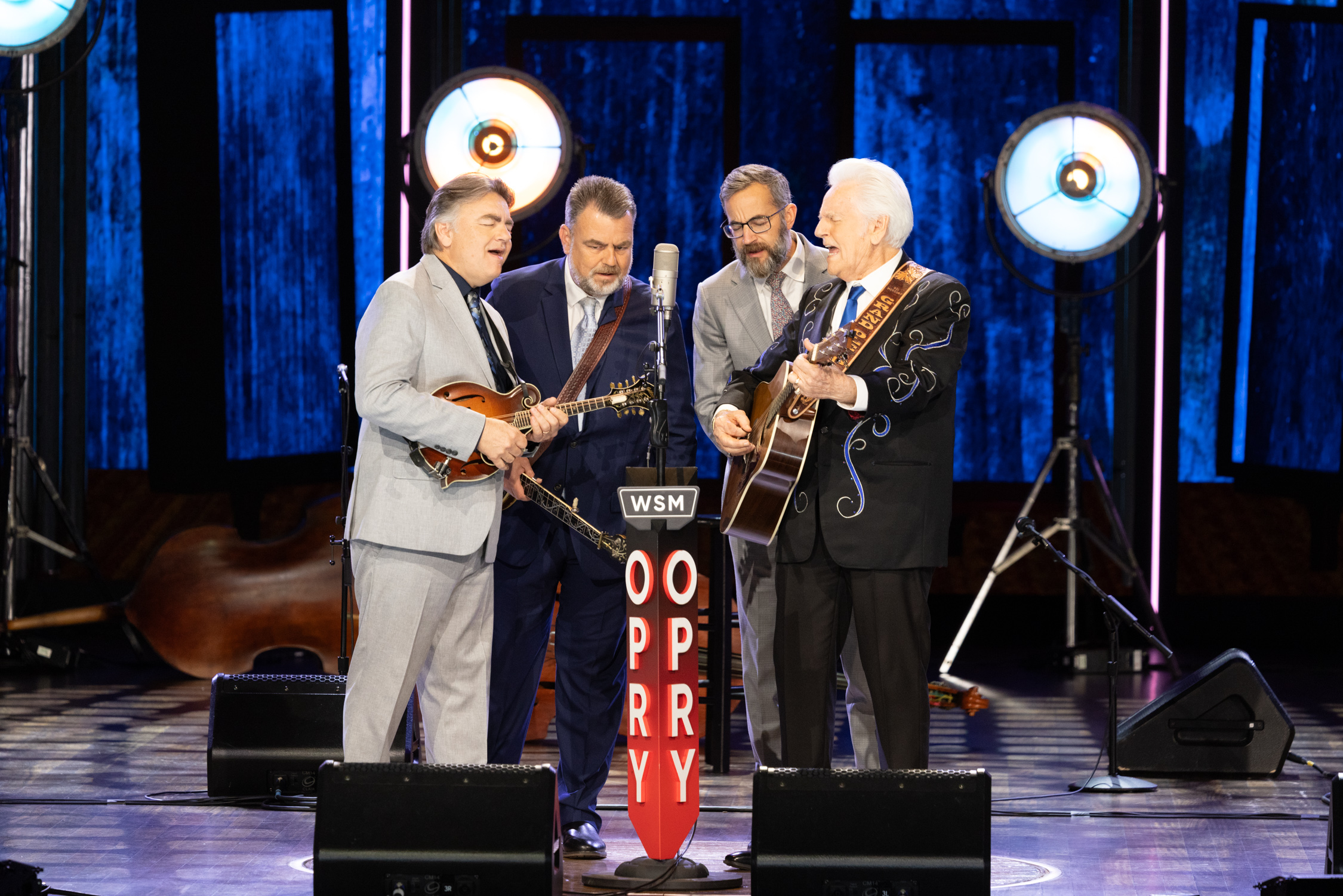
The Del McCoury Band sing “Get Down on Your Knees and Pray” before leading a sing along with the entire cast of performers.
In his brief remarks, Burnett took a moment during a brief speech to acknowledge Denise Stiff, a visionary Nashville manager who recruited many of the musicians for the soundtrack back in the day. But of course, it wouldn’t be a tribute without everyone coming back on stage and singing at the end – in this case, “Angel Band” and a reprise of “I’ll Fly Away.”
Twenty-five years ago, the O Brother soundtrack brought old-time and bluegrass music into the national spotlight. This long-awaited encore underscored the staying power of this classic album.
Photo Credit: All photos by Chris Hollo for the Grand Ole Opry.
Lead Image: The entire cast of the Opry’s O Brother, Where Art Thou? tribute show take the stage to sing “Angel Band” and “I’ll Fly Away” to conclude the evening.
(Editor’s Note: For Earl Scruggs’s birthday, Thomas Goldsmith revisits a star-studded bluegrass festival tribute to the banjo legend from 1971 in Camp Springs, North Carolina. The 102nd anniversary of Scruggs’s 1924 birth in Flint Hill, North Carolina, is January 6, 2026.)
Like speakers at a testimonial dinner, each musician strode to the microphone in turn.
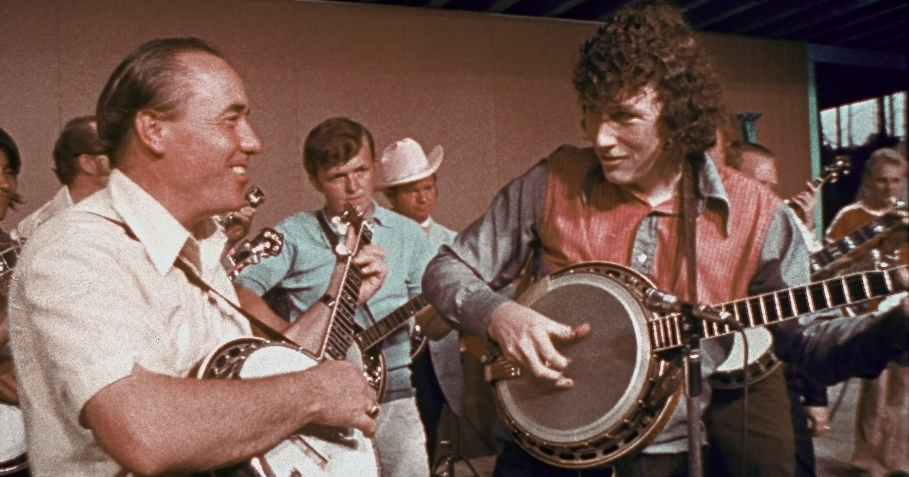
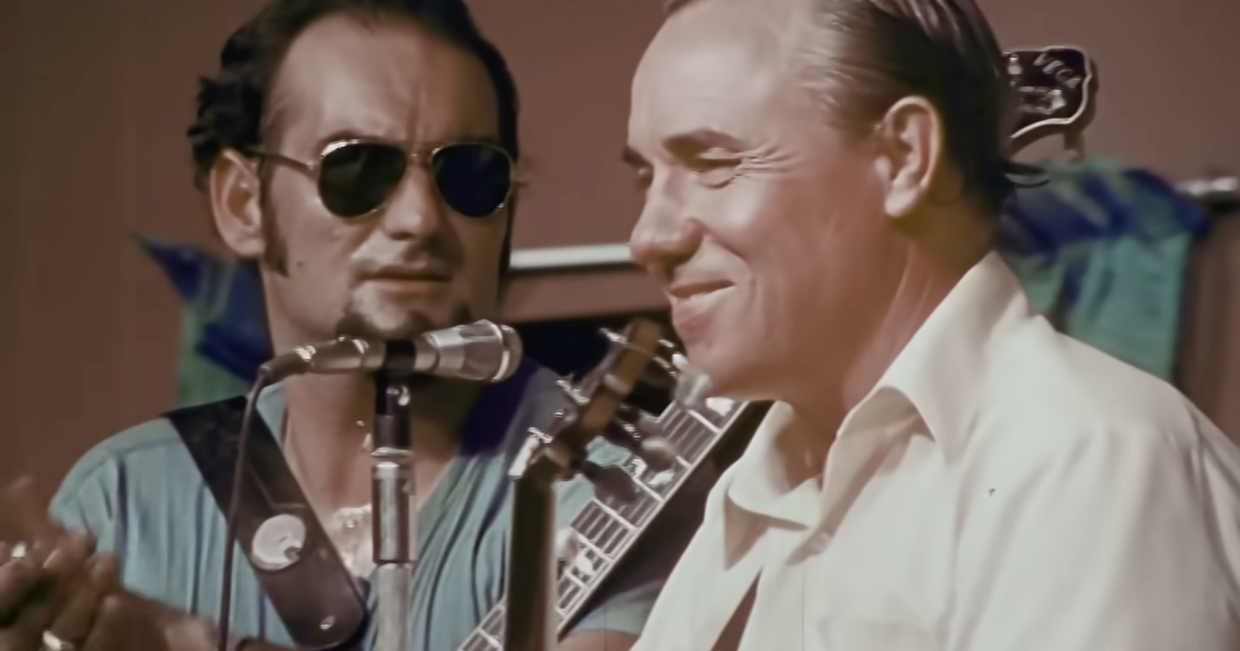
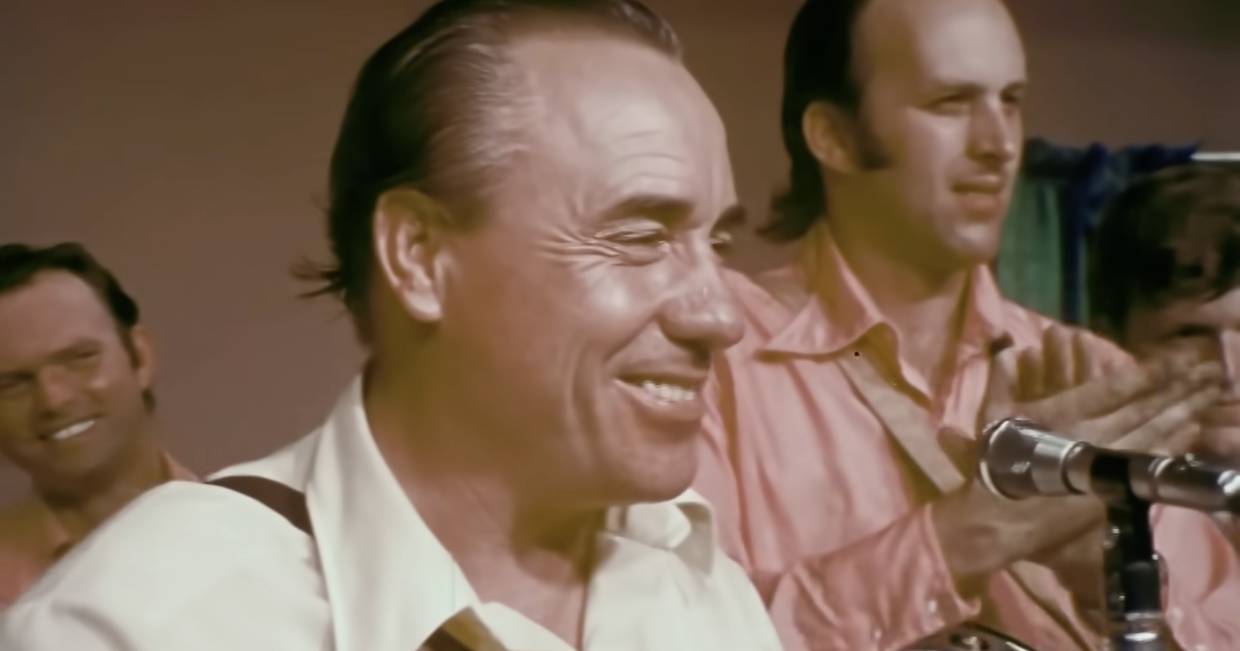
But instead of heaping on words of praise, a stage full of well-known pickers and up-and-comers used banjos to pay a lively tribute to Earl Scruggs.
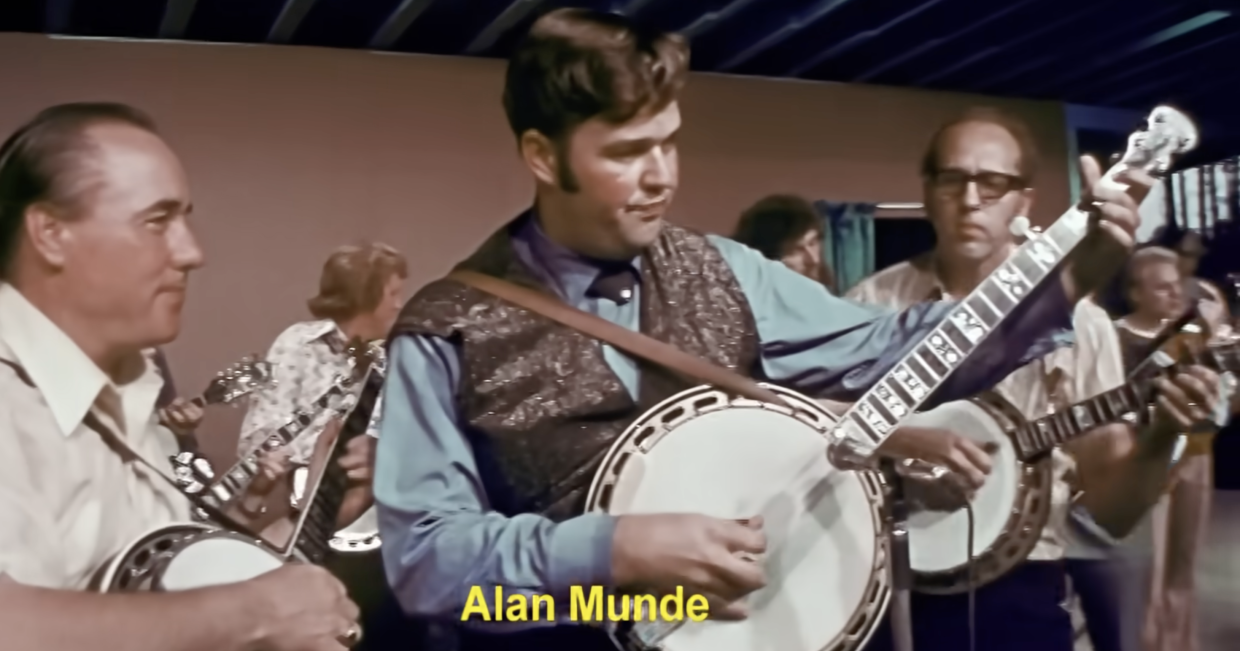
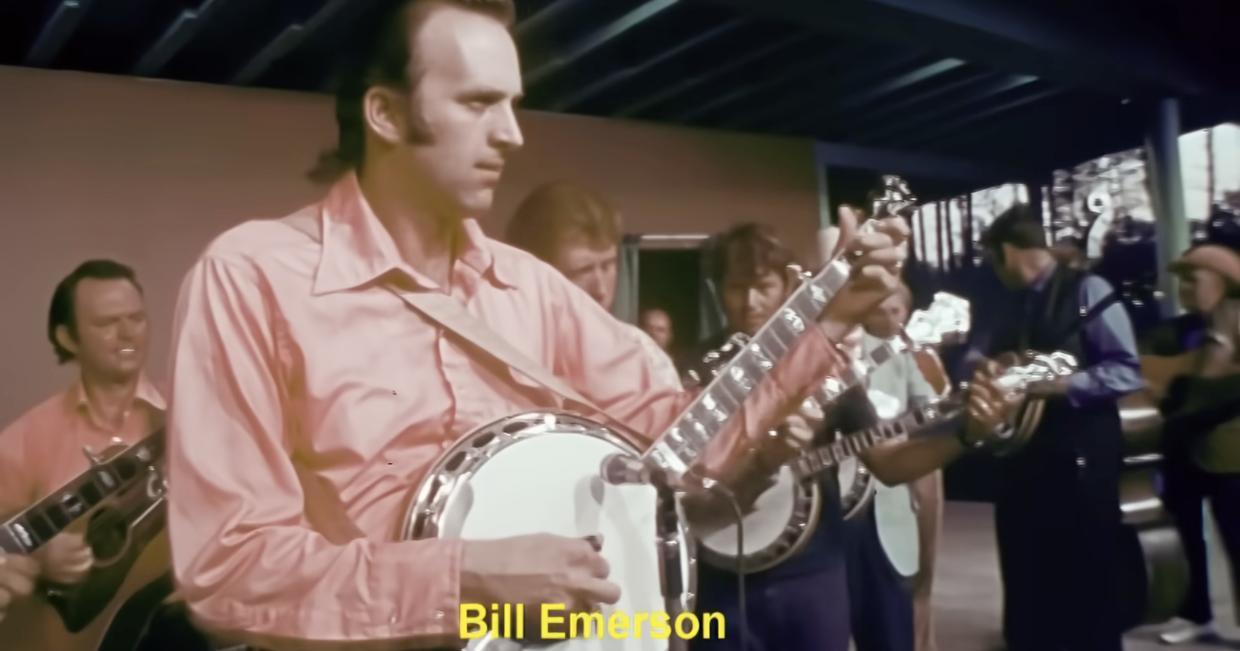
The scene was the 1971 Labor Day weekend bluegrass festival in Camp Springs, North Carolina, at a performance where some of the best banjo players around joined Scruggs on stage. Led by the five-string king himself, banjoists including Sonny Osborne, J.D. Crowe, Bill Emerson, and Alan Munde jointly played Scruggs’s signature tune “Foggy Mountain Breakdown,” some 22 years after its first recording.
Sonny Osborne (left) gets emotional onstage after introducing Earl Scruggs (right). Screenshot from clip courtesy of Bluegrass Country Soul, Inc.
Promoter Carlton Haney invited more than a dozen banjo players on the festival schedule to play along with Scruggs, who was then 47. (A second group performance, of “Dear Old Dixie,” doesn’t appear in the film. And a couple of the “Foggy Mountain Breakdown” performers didn’t make it to the screen.)
Millions of viewers have seen the clip as part of the movie or on YouTube, with Osborne bringing Scruggs on with an introduction that sounds starstruck.
“(It’d) be only right to call out probably the man that has made all of us guys up here play the banjo, or either has been a great influence, as he has in my complete life,” Osborne said. “In my whole banjo-playing ability … I could probably credit to this one man.
“Let’s all give a tremendous welcome to probably the best in the world, Earl Scruggs!”
Scruggs seemed overwhelmed by the audience’s ovation. The cheering feels as though it lasts forever, but took only a minute and a few seconds.
“That really fills my heart with joy,” Scruggs said after Osborne introduced him. “I did want to say one thing: Thank you, and guys like this is what keeps me going, my boys who works with me and you people who keep preaching music.
“I just don’t know what to say, except I’m picking with some guys that plays a tremendous amount of banjo. Don’t underestimate anybody up here. Man, they’re great.”
Earl at a Crossroads
In 1971, Scruggs had only broken up with his longtime duet partner Lester Flatt less than two years earlier. Not even a month before Camp Springs he had recorded along with other greats for Nitty Gritty Dirt Band’s country-roots-popularizing Will the Circle Be Unbroken set. He was venturing into a country-rock sound with his band the Earl Scruggs Revue, along with his sons Randy, Gary, and Steve.
However, Scruggs’s work as a musical innovator remained – and remains – fundamental to the way a large share of bluegrass banjo players address the instrument. That’s true despite the introduction of a single-note style most associated with Don Reno and a chromatic or melodic approach heard in the playing of Bill Keith and Bobby Thompson.
Most of the pickers in the 1971 “Foggy Mountain Breakdown” performance used the three-finger picking style Scruggs introduced in a band with Bill Monroe and Flatt on the Grand Ole Opry in 1945. The exception among the Camp Springs pickers, Rick Riman of the New Deal String Band, caused something of a stir with his chromatic rendition of the tune, not to mention his long hair, full beard, and striped shirt and pants.
How did Riman, who had also studied Scruggs style closely, decide to use the flowing melodic style for “Foggy Mountain Breakdown”?
“I just thought, “OK, let’s see if I can make this work,’” Riman, 83, said on the phone from Denver, Colorado, speaking to BGS in January 2026. “Because I had not prepared anything, and I didn’t even know what was on the program. They just said they want all the banjo players up there to pay tribute to Earl. And I said, ‘OK, I’ll get up there and do it.’”
And what has the reaction been?
“Mostly negative,” he said, with a touch of humor.
“One person said they were really glad to see somebody step out of the standardized [method], and that felt very, very good. Somebody else said, ‘You won’t believe how many people thought that you shouldn’t have been on stage at all.’
“And I get that a lot. That’s mostly the reaction I get, that I shouldn’t have been on stage. I shouldn’t have even been in the parking lot, like the least talented person on the stage and probably the least talented person in the whole park.”
The chromatic style remains one effective tool in the hands of players such as Béla Fleck and Noam Pikelny, but Riman, 28 that day in 1971, has gotten a load of grief over his choice to add some variety to the line of Scruggs-style players. “I would say, over the years, it’s pretty much been like 50-plus years of derision,” he said.
Riman has had one regret. “I should have practiced more,” he said. “I should have been better, but I had no idea.”
Although at Camp Springs he performed in the more recently created melodic and chromatic styles, like everyone on the stage that day in North Carolina, Riman was schooled in the style of the man honored beside them.
“I was really fascinated by Earl and anybody else who played his style pretty well,” he said.
Earl Scruggs reacts to his introduction and audience ovation and applause onstage in 1971 in Camp Springs, NC. Screenshot from clip courtesy of Bluegrass Country Soul, Inc.
“Everybody Headed for the Stage”
We were fortunate to reach three of the banjo warriors who performed that day. Sadly, most of the players heard then have since died. Eddie Hoyle, then 14, the youngest of the Camp Springs lineup, is among the survivors and is still actively performing. He talked to BGS on the phone in December from his home in Georgia.
“I was up there playing with Curtis Blackwell and the Dixie Bluegrass Boys and I just remember them telling me that Carlton wanted all the banjo players to come down on the stage and play a tune with Earl,” said Hoyle, now 68. “So I got my banjo out, and everybody headed for the stage.
“I didn’t know if I’d get to take a break or not, but somebody got me in the line that was walking up to the mic. So it was pretty cool. And I remember I was not nervous; OK, probably didn’t know enough to be nervous.”
Most of the players that day stuck fairly close to Scruggs’s own licks on “Foggy Mountain Breakdown,” but Hoyle and others ventured a bit from the classic performance.
“I always tried to learn the right way, as Dad told us to do, but then I would try to put my own twist on it,” Hoyle said.
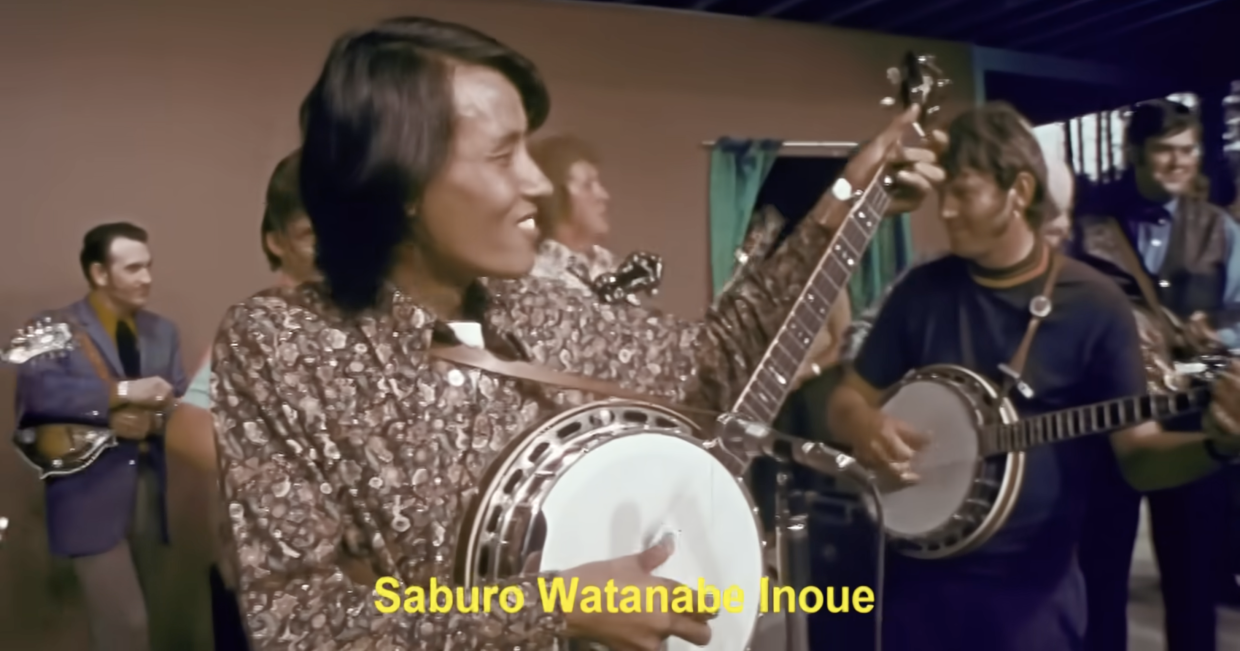
Nearly half the banjo players that day have been inducted into the Bluegrass Music Hall of Fame. They include Scruggs himself, of course, as well as J.D. Crowe, Bill Emerson, Alan Munde, Sonny Osborne, and Don Stover. Another banjo picker, Saburo Watanabe Inoue, founder of the pioneering Japanese band Bluegrass 45, won the IBMA’s Distinguished Achievement award along with his brother Toshio, in 1995.
Sab Watanabe (who passed away in 2019) of the legendary Japanese band, Bluegrass 45, takes his turn at the mic. Screenshot from clip courtesy of Bluegrass Country Soul, Inc.
Alan Munde Remembers it Well
Munde, 79, still a player and teacher, also spoke to BGS about the experience from his home in Springfield, Missouri. He recalled that he was playing with Jimmy Martin and the Sunny Mountain Boys at the festival and took part in the group performance because Martin wanted him to.
“Thinking back on it and also remembering at the time, I didn’t really want to be a part of it, just because, then and now, I thought I would be so unworthy,” Munde said. “But I think Jimmy wanted me to do it, and you notice he’s there [in the film.] He thought I needed to be there, so I did it.”
Munde remembers the day as a landmark for him, the only time he heard Scruggs play live. Given all the great banjoists and backing musicians including Martin and Charlie Waller, it was an enchanting moment from the sound of Scruggs’s first lick.
“The thing that I remember so much about it is … we’re all standing there and Earl’s talking, and then he’s going to start to play,” he said. “And he, I always call this his ‘chang,’ where he just plays the first, third, and fifth string together and starts into the tune.
“As soon as he did that, I thought, ‘Oh my God, there’s that sound.’ It just was immediately apparent that he was the one.”
Alan Munde (right) is flanked by Earl Scruggs during the all-banjos jam of “Foggy Mountain Breakdown.” Screenshot from clip courtesy of Bluegrass Country Soul, Inc.
Like the first players to tune into Scruggs’s playing in 1945 and like players from Béla Fleck on, Munde appreciates Scruggs’s sound in a way that seems almost mystical. Scruggs produced something that no other banjo player could.
Jimmy Martin, Munde’s boss at the time, used to tell a story involving the great banjo man Vic Jordan to illustrate the way Scruggs’s beautifully nuanced playing and full tone stood above the crowd of his followers.
“Jimmy was kind of down on Vic Jordan a little bit,” Munde said. “And he would tell this story to show that Vic didn’t know the right way. He said when Vic met Earl, he asked him what kind of microphone he used.
“And Earl said, ‘Sometimes I use those little bitty ones, and sometimes I use those real big ones.’
“And Jimmy’s point was that, in his mind, Vic was asking because he thought it was the microphone. But it didn’t matter. It all sounded like Earl every time.”
And hearing Scruggs’s sound that day at Camp Springs, not through a mic, not on a record, but right there next to him on stage, made Munde think the whole exercise was somehow wrong.
“When he did that pinch, I thought, ‘Oh, God, I don’t want to be a part of this.’ What we should have done is just stood back and listened to him, and then said, ‘Do it again.’”
Despite his misgivings at the time, Munde has wound up glad that he took part in the Earl-fest that day.
“Looking back on it, it’s been nothing but good for me, that I got to be there,” he said. “Here it is, 50 years later, people still bring it up. It’s helped get me a little legacy recognition, that I was there, so that’s been real good.”
A Star-Studded Lineup
The career of Sonny Osborne has been well documented, but Bluegrass Country Soul makes clear his admiration and friendship with Scruggs. During the tumult of applause following his introduction, Scruggs asked if he could say something, and Osborne appears to grin and say, “Not yet.” And Osborne cracks up when Scruggs uses his up-the-neck solo from “Foggy Mountain Breakdown” during the last time around for the tune.
Bill Emerson, whose long career included membership in the Country Gentlemen and much more, was interviewed at the time of the re-release of Bluegrass Country Soul. He talked about the pantheon of great banjo players.
“Don Reno, he had his style on the banjo; Earl Scruggs, he had his style on the banjo; Ralph Stanley, he had a style on the banjo,” Emerson said in the set’s booklet. “And on the radio, I could listen to any of them, just the first few notes of an intro, and tell you who was playing. Just by the style that they were playing, the tone that they had, and the timbre. Most people, when they started out playing the banjo back then, they got a bunch of Earl Scruggs’s records and sat down and tried to learn to play like Earl. But it’s mighty hard to sound like Earl, I can tell you. I was never able to do that, so I just tried to sound like Bill Emerson.”
Bill Emerson takes his turn playing a solo on “Foggy Mountain Breakdown.” Screenshot from clip courtesy of Bluegrass Country Soul, Inc.
Also on the show was multi-instrumentalist Jimmy Arnold (1952-1992), whose career was one of a kind, including excursions into Southern rock and solo albums on guitar and banjo as well as stints with Cliff Waldron, Charlie Moore, and the New Tradition, according to a 1983 Bluegrass Unlimited story. The article, by Chris Wathen, quoted Arnold on Scruggs: “When you learn all of what you think is hard stuff and then go back and try to play one of his tunes, you find out what the hard stuff really is. It’s his stuff. To play with that much power and volume, you’ve really got to be on top of things.”
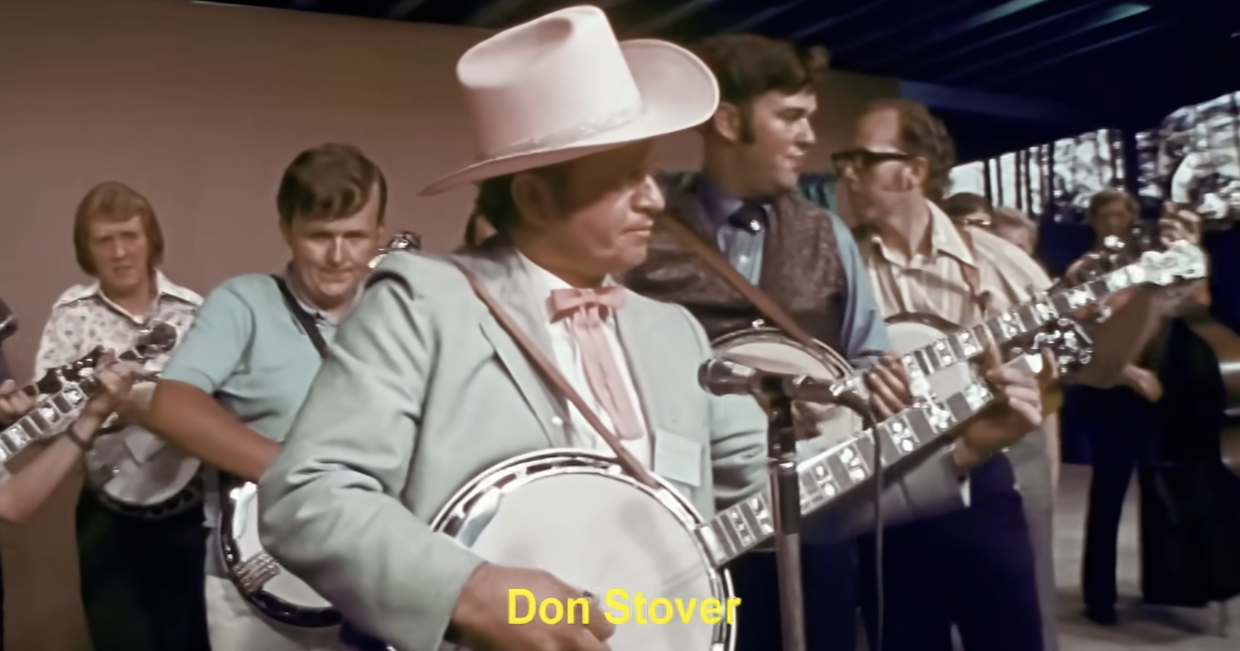
Another of the clip’s well-known pickers, Don Stover (1928-1996), had been an early convert to Scruggs style, learning it not long after Scruggs’s first performances with Monroe, according to the Bluegrass Music Hall of Fame.
Stover was known for his work with brothers Bea and Everett Lilly during many years of performances in Boston. He played and recorded as a member of Bill Monroe’s Blue Grass Boys in 1957, even contributing harmony vocals to “In Despair.”
Earl’s son Randy, who appears playing an archtop banjo just before the end of the clip, went on to a distinguished career as a musician, songwriter, and producer.
Doing Their Times
The 55th anniversary of this notable moment in bluegrass will arrive in September. Looking back, the picking ranges from respectable to spectacular, but doesn’t maintain the dead-even tempo that’s supposed to prevail in bluegrass music. Fans remember the story that Earl and brother Horace Scruggs, as boys, used to start playing a tune, then separate to walk around their Flint Hill house in opposite directions. The idea was to check if they were still in time with each other after being out of earshot.
The dozen players on the Camp Springs group number would not have passed this test, based on a stopwatch run-through. While Scruggs’s December 1949 original recording had consistent solos of right at 11 seconds, he started the round robin at about 12.69 seconds and tempos wavered from there.
By the start of Riman’s melodic solo, near the end, the time was more than half a second slower. Randy and Earl Scruggs wrapped things up at roughly the same tempo.
But that’s just a quibble.
A contemporary of Earl Scruggs, Don Stover also performed a rendition of “Foggy Mountain Breakdown” during the jam. Screenshot from clip courtesy of Bluegrass Country Soul, Inc.
Remembering Earl
Bluegrass Country Soul director Albert Ihde did bluegrass lovers a real service by capturing these moments and others at the Camp Springs festival. And promoter Haney had another brainstorm resembling the story, pronounced “stoah-ry,” that he recreated of Bill Monroe and former band members six years earlier at Fincastle, Virginia.
Viewers will keep calling up the video for its closeups of Earl, smiling and even bobbing up and down for his breaks, and for the scenes of several of his outstanding followers, appreciating their moments on stage as they rolled their way through “Foggy Mountain Breakdown.”
Many videos of Flatt & Scruggs can be found on the web that illustrate Earl Scruggs’s unmatched musicianship. In the Bluegrass Country Soul segment viewers can also see a strong memorial to Earl Eugene Scruggs the person, his warmth, humor, and unselfishness as well as his brilliance as a musician.
Thomas Goldsmith is an award-winning journalist based in Tennessee and North Carolina. In addition to producing many hundreds of articles for newspapers and magazines, he edited The Bluegrass Reader and authored Earl Scruggs and Foggy Mountain Breakdown: The Making of an American Classic, both books for the University of Illinois Press.
Learn more about Bluegrass Country Soul and purchase a Golden Anniversary Legacy Edition box set of the film here. Read more about the box set and the making of the film here.
All photos courtesy of Albert Ihde, Ellen Pasternack, and Bluegrass Country Soul, Inc. Lead image: Earl Scruggs (left) and son, Randy Scruggs (right), perform “Foggy Mountain Breakdown” flanked by bluegrass banjo stars of 1971.
Artist:Bonnie & the Mere Mortals Hometown: Avella, Pennsylvania Latest Album:Take Me to the Moon (available August 29, 2025) Personal Nicknames (or rejected band names): I get Bonald a lot. Bon Bon, Bonners, Bonnie Romano.
What’s your favorite memory from being on stage?
Two years ago for our Halloween show, I looked out in the crowd and saw a complete stranger scream-singing along for the first time. As an artist, I constantly question what I’m doing. This is a hard path we’ve chosen that can beat you down a lot, but you can’t fabricate that moment. You’ve reached someone, you touched their lives in some way. I’ve since had that experience dozens of times and have even gotten to do a Bonnie & the Mere Mortals tattoo on a fan, but you never forget your first.
What other art forms – literature, film, dance, painting, etc. – inform your music?
I truly think the difference between art forms is no wider than the difference of medium: oil or watercolor? Everything is how you choose to express your idea. I have a literature degree and I grew up in an abandoned coal town; I wanted to make music the way Southern Gothic writers like Michael McDowell made me feel. Southern Gothic is often seen as just slow Americana in a minor key, but I wanted to expand that thinking to include my experience growing up in a Southern Gothic tableau. I also dress up like a drag queen because I want the Mere Mortals to be as visual as we are musical. Our presentation is always firmly tongue-in-cheek because every murder ballad has a punch line and I never think you should take yourself that seriously.
What’s the most difficult creative transformation you’ve ever undertaken?
When I was growing up, it was the golden age of pop-country. Miss Shania Twain, Garth, the Chicks? Everywhere. I grew up on the values of Hank and “Raise Hell, Praise Dale.” Post 9/11 though, I really started to resent my upbringing. I discovered the Cure, Queen, and Bowie, and put aside Ralph Stanley. I moved to the city, came out as queer, and started a metal band. I never truly felt fulfilled though. I felt I had to hide a part of myself that made up so much of my character.
It wasn’t until I heard Gillian Welch for the first time that I started to dive back into myself and realized that I wasn’t really making art authentically. I bought a banjo and started to learn clawhammer. I rediscovered so many loves I had put aside and I began to feel myself again. I realized that what I loved about the Smiths was the same thing I loved about Jason Isbell, and I couldn’t see why they shouldn’t go together. Some of my folks couldn’t understand the transition, but they certainly do now.
What would a perfect day as an artist and creator look like to you?
Film an episode of The Muppets as a special guest and then head over to Dolly’s house to cook her a pasta dinner.
If you didn’t work in music, what would you do instead?
My day job for the last 15 years has been working as a tattoo artist. I co-own a shop in Pittsburgh called the Kindred Spirit Tattoo Co. It can be hard making it as an artist on both sides of the sun, but I feel so grateful I get to do two things I love so much.
While you know better, there’s a wide swath of the music-listening world in which Alison Krauss is best known as former Led Zeppelin golden god Robert Plant’s duet partner. Yet, Krauss has had a wholly remarkable career going back nearly 40 years, in which she has exhibited profound collaborative instincts and abilities.
On the occasion of the release of Arcadia, her first album with Union Station in 14 years (as well as a reunion with the founders of her former longtime label, Rounder Records), we look back at some of Krauss’ career highlights in and out of Union Station.
“Cluck Old Hen” (traditional; 1992-2007)
We begin with a literal oldie, “Cluck Old Hen,” from the pre-bluegrass era, which demonstrates two things – that Alison Krauss has always revered the history, roots, and traditions of bluegrass; and that Union Station is one incredible ensemble. Recordings of this Appalachian fiddle tune go back more than a century, to country music forefather Fiddlin’ John Carson in the 1920s.
Krauss first released an instrumental version of the tune on 1992’s Everytime You Say Goodbye (her second LP with Union Station), and won a GRAMMY with the onstage version on 2002’s AKUS album, Live. But feast your ears and eyes on this 2007 performance at the Grand Ole Opry, with a pre-teen Sierra Hull sitting in.
1992 studio version:
2002 live version:
“When You Say Nothing At All” (Paul Overstreet & Don Schlitz; 1994)
After a decade of steadily accelerating momentum, Krauss had her big commercial breakout with this AKUS cover of the late Keith Whitley’s 1988 country chart-topper. Krauss sang it on 1994’s Keith Whitley: A Tribute Album and it served as centerpiece of her own 1995 album, Now That I’ve Found You: A Collection. It reached No. 3 on the country singles chart and went on to win the Country Music Association’s single of the year plus a GRAMMY Award. You can hear why.
Whitley’s version:
“I Can Let Go Now” (Michael McDonald; 1997)
For any interpretive singer, the choice of material is key. And if the singer in question has Krauss’ range and chops and vision, some truly unlikely alchemy is possible. Among the best examples from the AKUS repertoire is “I Can Let Go Now,” a deep cut on Doobie Brothers frontman Michael McDonald’s 1982 solo album, If That’s What It Takes. Another amazing Krauss vocal in a career full of them.
McDonald’s version:
“Man of Constant Sorrow” (traditional; 2000-2002)
Before O Brother, Where Art Thou?, you wouldn’t have called singer-guitarist Dan Tyminski the unheralded “secret weapon” of AKUS. Nevertheless, he didn’t become a star in his own right until serving as movie star George Clooney’s singing voice in the Coen Brothers loopy, Odyssey-inspired farce. “Man of Constant Sorrow” was the hit in the movie and also on the radio, launching Tyminski to solo stardom.
Resonator guitarist Jerry Douglas especially shines on this version from 2002’s Live, recorded in Louisville – you can just tell everyone in the crowd was waiting for the “I bid farewell to old Kentucky” line so they could go nuts. Tyminski would have another unlikely hit in 2013, singing on Swedish deejay Avicii’s “Hey Brother.”
O Brother version:
“New Favorite” (Gillian Welch & David Rawlings; 2001)
Kraus sang on the GRAMMY-winning O Brother soundtrack, too, alongside Gillian Welch. It will come as no surprise that the Welch/Rawlings catalog has been a recurrent favorite song source for her. One of Krauss’ best Welch/Rawlings selections is “New Favorite,” title track of the thrice-GRAMMY-winning 2001 AKUS album. Though it’s edited out in this video, the album-closing version concluded with a rare in-the-studio instrumental flub, followed by sheepish laughter to end the record. Perhaps the AKUS crew is human after all?
“Borderline” (Sidney & Suzanne Cox; 2004)
The story goes that the first time Krauss was on the summer touring circuit, she’d go around knocking on camper doors at bluegrass festivals to ask whoever answered, “Are you the Cox Family?” Once she found them, she didn’t let go, and the Coxes became some of the best of her collaborators and song providers. Along with producing their albums, Krauss covered Cox compositions frequently; “Borderline” appeared on 2004’s Lonely Runs Both Ways, another triple GRAMMY winner.
When Krauss first sang with Robert Plant at a Leadbelly tribute concert in November 2004, it seemed like the unlikeliest of pairings. But here’s proof that they had more in common than you’d expect, with Krauss covering a solo Plant hit from 1983. She sang “Big Log” on her brother Victor Krauss’ album, Far From Enough, which was released earlier in 2004.
This video pairs the Krauss siblings’ version with Plant’s original 1983 video, directed by Storm Thorgerson.
“Dimming of the Day” (Richard & Linda Thompson; 2011)
Fairport Convention guitarist Richard Thompson is one of the finest instrumentalists of his generation as well as a brilliant songwriter, especially with his former wife and collaborator Linda Thompson. This stately, bittersweet love song dates back to their 1975 duo LP, Pour Down Like Silver, and Linda sets the bar high with a stoic yet emotional vocal. Krauss more than lives up to it on the 2011 AKUS album Paper Airplane, which also offers another great showcase for resonator guitarist Douglas.
Richard & Linda’s version:
“Your Long Journey” (Doc & Rosa Lee Watson; 2007)
Krauss isn’t just a spectacular lead vocalist, but also an amazing harmony singer, one of the few who can hold a candle to Emmylou Harris. Retitled from the Doc/Rosa Lee Watson original, “Your Lone Journey,” this closing track to 2007’s grand-slam GRAMMY winner Raising Sand has Krauss’ most emotional vocal harmonies with Plant on either of their two albums together.
Doc Watson’s version:
“Heaven’s Bright Shore” (A. Kennedy; 1989, 2015)
All that, and she’s an incredible backup vocalist to boot. “Heaven’s Bright Shore” is a gospel song Krauss first recorded as a teenager on 1989’s Two Highways, her first album billed as Alison Krauss & Union Station (and also her first to receive a GRAMMY nomination). It’s great, but an even better version is this 2015 recording in which she’s backing up bluegrass patriarch Ralph Stanley alongside Judy Marshall.
AKUS version:
“The Captain’s Daughter” (Johnny Cash & Robert Lee Castleman; 2018)
The late great Johnny Cash left behind a lot of writings after he died in 2003, some of which were turned into songs for the 2018 tribute album, Forever Words: The Music. None of his songs ever had it so good as “The Captain’s Daughter.” This superlative AKUS version fits Cash’s words like a glove.
Banjo master Tony Trischka is a bluegrass and roots music renaissance man whose career goes back nearly 60 years, to his early days with his first group, the Down City Ramblers. He’s been making recordings for almost as long, appearing on-record for the first time on Country Cooking’s 1971 debut for the fabled Rounder Records label.
Given the width and breadth of Trischka’s career and sprawling discography, summarizing the man’s recorded legacy is not just a tall order, but a mountainous one. Nevertheless, we’ve made the attempt. Here are a dozen recordings that give a sense of Trischka’s many artistic sides as collaborator, innovator, teacher, keeper of the flame, and all-around musical good spirit.
“Kentucky Bullfight” – Country Cooking (1974)
Trischka was one of two banjo players in this collegiate ensemble. The other was future Hot Rize member Pete Wernick, who spent some time talking up his bandmate to Rounder Records co-founder Ken Irwin. “I was writing a bunch of tunes, and Pete told Ken, ‘Tony should do a solo album,’” Trischka remembered. “Ken said, ‘Sure, go ahead.’”
Irwin cites “Kentucky Bullfight” as the Country Cooking song that convinced him Trischka would be worth signing as a solo act, too.
“China Grove” – Tony Trischka (1974)
Trischka hails from the Northern environs of Syracuse, New York, and it was fairly common for Yankee banjo players of his era to indulge some unusual tangents. “My first album was, comparatively speaking, a little on the bizarre side,” Trischka himself admits. That’s certainly the case for this instrumental from his 1974 solo debut, Bluegrass Light. “China Grove” has East Asian accents throughout and even a saxophone solo from his Country Cooking bandmate, Andy Statman.
“Roll in My Sweet Baby’s Arms” – Tony Trischka (1976)
It seems like a rite of passage that everybody has to put their own stamp on the venerable Flatt & Scruggs bluegrass classic, “Roll in My Sweet Baby’s Arms.” That goes for Trischka on his 1976 album, Heartlands, but few other artists would have the imaginative audacity to kick it off with a drum solo (plus more saxophone).
“Don’t Let Your Deal Go Down” – Tony Trischka (1978)
Another piece of classic repertoire from the wayback machine, “Don’t Let Your Deal Go Down” is the song that made bluegrass forerunner Charlie Poole a star in 1925. Trischka cut it on 1978’s Banjoland in an ambitious all-star arrangement alongside fellow banjo players Bill Keith and Béla Fleck. Also present are resonator guitarist Jerry Douglas, mandolinist Buck White, and guitarist Tony Rice, who adds a definitive vocal.
“They’ll Never Keep Us Down” – Hazel Dickens (1981)
Formerly half of the pioneering female duo Hazel & Alice (with Alice Gerrard), the late great Hazel Dickens was one of Trischka’s best longtime collaborators. His elegant banjo and her emotionally raw voice were a great match on many songs, among them this classic from Dickens’ 1981 album, Hard Hitting Songs For Hard Hit People.
“Bill Cheatham” – Béla Fleck, Bill Keith, and Tony Trischka (1981)
In which three of the foremost roots music banjo virtuosos of the 20th century mesh with tasteful seamlessness while deftly keeping out of each other’s way. From 1981’s Fiddle Tunes for Banjo, this was one of the album’s three tunes that featured Trischka, Fleck, and Keith all playing together.
“Country Death Song” – Violent Femmes (1984)
From Milwaukee, this folk-punk trio puts a gothic spin on folk music. To that end, they often enlist unexpected collaborators to do cameo appearances, adding just-right punctuation. Here is one of the Femmes’ early examples, featuring Trischka’s banjo on their 1984 second album, Hallowed Ground. Nearly two decades later, the Femmes would return the favor by appearing on “Down in the Cider House,” a track on Trischka’s World Turning album.
“New York Chimes” – Tony Trischka (1985)
Trischka has always had a way with clever puns, “New York Chimes” among them. From 1985’s Béla Fleck-produced Hill Country album, “New York Chimes” is also a fine example of Trischka’s higher-gear fast playing. And the band is, of course, spectacular – Jerry Douglas, Tony Rice, Sam Bush.
“Old Joe Clark” – Tony Trischka (1992)
As a dedicated keeper of the flame and teacher/mentor, Trischka has always been up for putting the music into unusual places. One of the most unusual was a 1992 episode of the children’s cartoon, “Where in the World is Carmen Sandiego?,” on which Trischka wandered on camera playing the 19th-century fiddle tune “Old Joe Clark” during a game-show segment.
“World Turning” – Tony Trischka (1993)
Among Trischka’s many virtues as a player, one of the best is that he knows how to back up great singers. And here is a classic example from Trischka’s wildly eclectic 1993 album, World Turning. The title track is a cover of the 1975 Fleetwood Mac song, sung by Dudley Connell and Alison Krauss with Trischka adding just-right banjo flair.
“Shifting Sands of Time” – The Wayfaring Strangers (2001)
Another of Trischka’s far-flung, multi-hyphenate genre experiments is his 2001 album, Shifting Sands of Time, with a wide-ranging guest list that goes from bluegrass patriarch Ralph Stanley to ’90s pop star Tracy Bonham. The title track is at least as worldly as anything his longtime mate Béla Fleck ever put out.
“Brown’s Ferry Blues” – Tony Trischka (2024)
We close with another of Trischka’s all-star collaborations, the opening track from this year’s Earl Scruggs tribute album Earl Jam. “Brown’s Ferry Blues” kicks off with very choice guitar and vocals from modern-day superstar Billy Strings, and Trischka, Fleck, Bush, and fiddler Michael Cleveland are all right there with him.
We could hardly think of a better guest with whom we’d conclude our second season of Toy Heart than 27-time Grammy Award winner, Alison Krauss. Arguably the most prominent bluegrass musician in the genre’s nearly one hundred year history – certainly the most well-known in her own generation – host Tom Power’s laughter-filled conversation with Krauss weaves through her childhood and upbringing, from her grandparents immigrating to Chicago (then her parents to Champaign, Illinois) and Alison’s first fiddle contests all the way to her first Grammy win as a young adult.
In a rare podcast interview, Krauss is funny, charming, and open, her candor painting a picture of the bluegrass community’s lifelong support and the winding journey that has brought her to the present, as one of the most recognizable voices and musicians in American roots music. From her earliest hits like “Steel Rails” and “Every Time You Say Goodbye” to collaborating with Robert Plant, James Taylor, the Cox Family, and more, to her Buddy Cannon-produced 2017 album, Windy City, Power and Krauss talk about song selection, her early days touring and road-dogging with Union Station, and how it felt when her musical career really began to take off.
But these stories aren’t just about awards and accolades. They chat about many moments, the big and small, that define Krauss, the festivals that became like homes, and the bonds that music forged with her band, Union Station, and her many collaborators. They explore how Krauss creates on the boundaries of many roots genres – plus what she views as bluegrass and what’s not bluegrass – the authenticity that she’s tried to capture throughout her career, and the cultural waves made by projects like O Brother, Where Art Thou? and the Down From the Mountain tour.
From personal anecdotes about Ralph Stanley and Larry Sparks to her feelings about Billy Strings’ massive success to a jaw-dropping and exciting revelation that she and Union Station are working on a new bluegrass album, our season finale with Alison Krauss is truly one of our best Toy Heart episodes to date.
In the latest episode of Toy Heart, we explore the roots and evolution of bluegrass in the modern era by examining the story of legendary bluegrasser, singer-songwriter, and recording artist, Laurie Lewis.
From her tales of growing up in Berkeley during what Lewis jokingly calls the “folk scare” of the ’60s to finding the joy of music through her father’s classical background and eventually becoming a pioneer for women in the genre, her lifelong career in American roots music is a perfect example of how the innovation and tradition-bending tendencies of bluegrass’s first generation continue full force today. Lewis’s musical transformation over the course of her life shows the entrancing power of bluegrass to steer and alter the course of hers and so many others’ lives.
In our Toy Heart interview, Lewis chats with host Tom Power about the magnetic pulls of Chubby Wise’s fiddle tunes, of albums by the Greenbriar Boys, and of a formative live show by the Byrds. She talks about studying modern dance, “disappointing” her father by “rebelling” and choosing folk music forms over classical, and what eventually led to late-night jams, fiddle contests, and navigating the Bay Area’s bustling bluegrass, folk, and women’s music scenes.
Their conversation closes with a reflection on the ways bluegrass has affected Lewis the most, and, how it continues to shape the identities of its artists and listeners with an intractable, ineffable pull. Power and Lewis point out how current generations – from Molly Tuttle to Tatiana Hargreaves, both mentees and collaborators of Lewis – continue in these same traditions. Plus, Lewis shares what it was like to tour and sing with Dr. Ralph Stanley, himself.
This Toy Heart episode dives deep into the many layers of the genre, helping to demonstrate just some of the many ways bluegrass interweaves itself into musicians’ and fans’ personal and musical identities. Lewis shows there are countless joys in staying true to one’s artistic vision amidst an industry that is always in flux; her insights offer a soulful perspective on continuity and change within the genre, echoing the sentiments of a community that, much like a family, supports and evolves with its members – and that continues to rightly hold Lewis up as a trail-breaker and standard-bearer for the entire genre.
Photo Credit: Irene Young
This website uses cookies to improve your experience. We'll assume you're ok with this, but you can opt-out if you wish.AcceptRejectRead More
Privacy & Cookies Policy
Privacy Overview
This website uses cookies to improve your experience while you navigate through the website. Out of these, the cookies that are categorized as necessary are stored on your browser as they are essential for the working of basic functionalities of the website. We also use third-party cookies that help us analyze and understand how you use this website. These cookies will be stored in your browser only with your consent. You also have the option to opt-out of these cookies. But opting out of some of these cookies may affect your browsing experience.
Necessary cookies are absolutely essential for the website to function properly. This category only includes cookies that ensures basic functionalities and security features of the website. These cookies do not store any personal information.
Any cookies that may not be particularly necessary for the website to function and is used specifically to collect user personal data via analytics, ads, other embedded contents are termed as non-necessary cookies. It is mandatory to procure user consent prior to running these cookies on your website.