Robert Earl Keen Explores Americana in New Podcast

Years before the term Americana entered the musical lexicon, Robert Earl Keen was out on the road that goes on forever, playing his unmistakable blend of folk, country, and Texas roots music. With decades of insight to provide, he’s launched Americana Podcast: The 51st State, where he sits down with some like-minded artists for warm conversation. His first two guests are Jamestown Revival (listen) and Lucero (listen).

“Is there a substitute for close-up, in-the-same-room communication?” Keen remarks. “I’ve spent my entire career on the interviewee side of the microphone. We are trying to replicate the environment that in my experience I’ve felt the most comfortable. I’m sure as we move through this podcast journey that we’ll make exceptions or compromises, but for now we want to be up close and face to face with the artists. It’s more real.”

Keen answered some questions by email for BGS.

BGS: What prompted the idea for you to launch a podcast?

REK: As a touring band it’s easy to spend all your time working the road. One can become isolated from the current music culture. Consequently, I keep my eyes and ears open for things that keep me connected.  My producer, Clara Rose, suggested a podcast. We decided Americana was our best route. She secured the name, and started making calls to artists. It’s been an accurate way to keep in touch with the current music culture. We are standing on the precipice of an artistic revolution overlooking the most creative group of artists in the last hundred years. I didn’t know this before our podcast. I’m sure some will argue to the contrary, but because of this podcast, I’m able to contribute to the discussion.

What is it about this community of songwriters and musicians that appeals to you?

I love the warts-and-all quality of Americana. I lived in Austin, Texas, in the ’80s and it was home to the richest artistic and chaotic neutral environments anywhere. Of course, there were world-class songwriters and guitar players (Willie Nelson and Stevie Ray Vaughan), and there were legendary folk heroes (Kenneth Threadgill and The Grey Ghost) but there were unclassifiable things as well. The Uranium Savages, Spamarama, the O’Henry Pun-off, Eeyore’s Birthday Party, Max for Mayor, and an untold amount of crazy music venues. One night I went into what might be considered the first craft beer emporium in the Southwest, Maggie Mae’s, and there was a guy on stage playing pots and pans from his kitchen. Maybe Americana doesn’t encompass a pots and pans player, but I love the kitchen-sink quality of Americana.
Is there a common thread among your guests for far?

Most all the artists were either guitar players or in a guitar sound-driven band. The thread that is most apparent to me is these are all seasoned and passionate musicians. They are all committed for the long haul. Not in for the money or fame, but like me, play music because the idea of any other kind of life doesn’t appeal.

What has surprised you the most as this podcast project has come to fruition?

The interest and positive reinforcement are overwhelming. When I told family I wanted to play music for a living, except for my mom, they were less than encouraging. Even she tried to talk me into going to piano-tuning school to have something as a backup. When I told my friends in the music industry that I wanted to jump from an independent label to a major label, they asked, “Why?” When I tell people that we’re doing a podcast, they send me confetti texts before they even ask what kind of podcast. I don’t know what the difference is but it’s a big difference.

What do you hope the fans will take away from the first two episodes of Americana Podcast?

I hope they hear in the first three minutes of this podcast that we’re dedicated to the highest quality of production values and we are adamantly committed to shining a ten thousand candle power light on the beauty and magic of Americana music. Anything less means we should up our game.


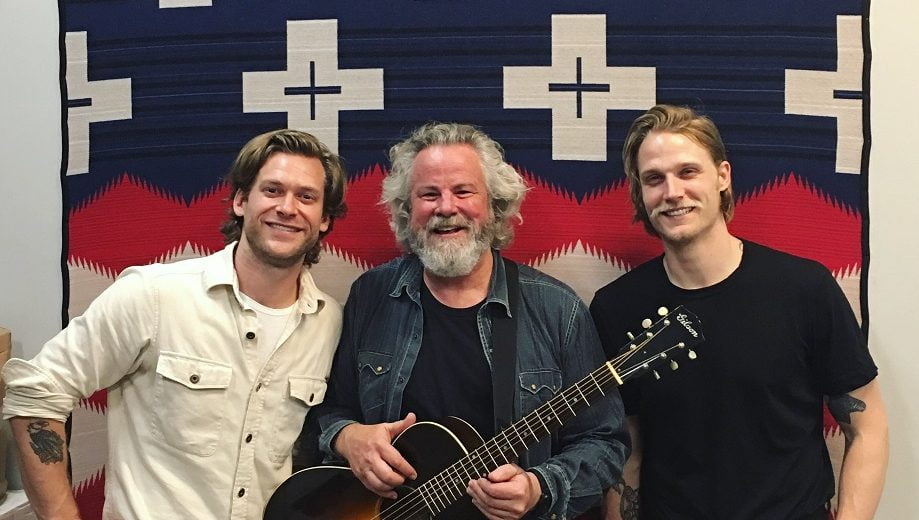
Top photo (L-R): Jonathan Clay of Jamestown Revival, Robert Earl Keen, Zach Chance of Jamestown Revival
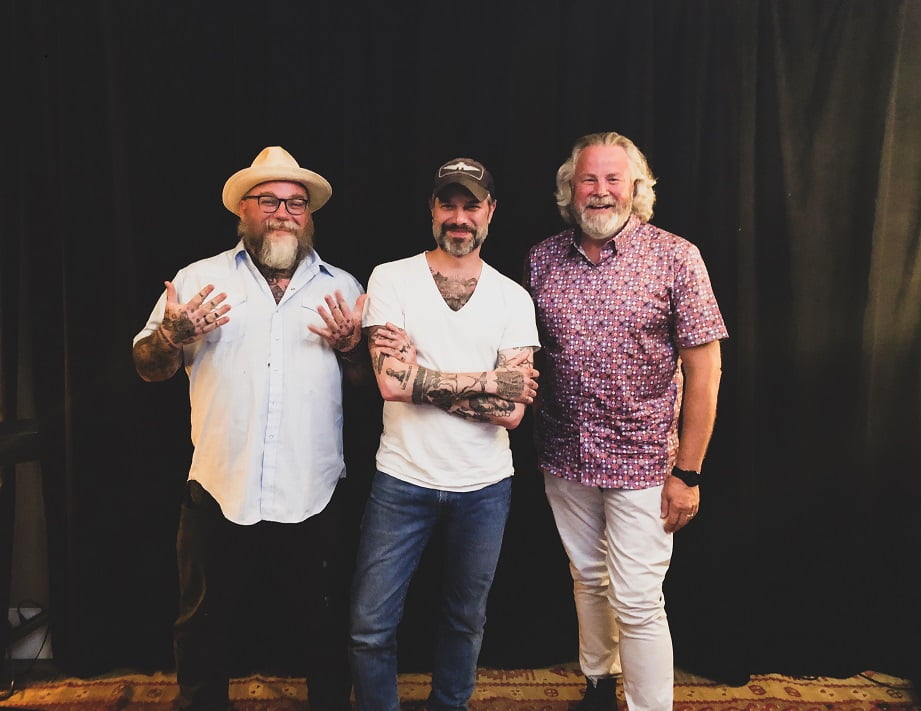
Middle photo: Lucero’s Brian Venable and Ben Nichols with Robert Earl Keen
Photos used with permission.
MIXTAPE: Bruce Robison’s Top Texas Songwriters

Who better than to make a Mixtape of Texas songwriters than a great Texas songwriter? No one. That’s why we asked Bruce Robison to compile a collection of his favorite Lone Star State representatives. And we think he did a mighty fine job of it.

Cindy Walker — “Bubbles in My Beer” (Bob Wills version)

But also “Cherokee Maiden,” “You Don’t Know Me,” and many more. From Mexia, Texas. She helped set the tone for Texas songwriters from Texas later. Incredible depth and honesty, yet simple and beautiful at the same time

Lefty Frizzell — “I Love You a Thousand Ways”

Lefty’s influence as a songwriter and singer is hard to understand. The folks listening to his incredible string of hits went out and created what we think of as country music today.

Buddy Holly — “True Love Ways”

What Buddy Holly did in two years coming from nowhere is an accomplishment rivaled only by the band who named themselves after his band.

Roy Orbison — “Crying”

From Wink, Texas. I can’t imagine what rock ‘n’ roll would be without Buddy Holly and Roy Orbison.

Willie Nelson — “It’s Not Supposed to Be That Way”

For good or bad, the great Texas songwriters were not easily contained in any genre. Nothing much I can add to what’s been said about Will.

Kris Kristofferson — “Loving Her Was Easier”

I love the Glaser Brothers’ version of this, too. See above.

Billy Joe Shaver — “I’m Just an Old Chunk of Coal” (John Anderson version)

Scary, sacred, sublime. Old buddy of mine who managed Billy Joe for 10 minutes said he had storage units full of poetry in Waco somewhere. Wouldn’t surprise me a bit.

Guy Clark — “Instant Coffee Blues”

From Monahans, Texas. Took all that came before and changed the rules.

Townes Van Zandt — “Tecumseh Valley”

Fort Worth’s tortured genius.

Rodney Crowell — “Adam’s Song”

Rodney is in the pantheon and right here walking among us. Like Bob, he might not play all your old favorites, but then again, he might.

Hayes Carll — “It’s a Shame”

With humor and attitude and a weird-ass voice, Hayes is a great songwriter by any measure and the original type of artist we are really proud of down here.

Damon Bramblett — “Sweet Sundown” (Kelly Willis version)

Kelly and I and Charlie and others have cut Damon’s incredibly original songs. Johnny Cash meets Bob Dylan.

Robert Earl Keen — “Village Inn”

After Guy and Townes, Robert started another era of Texas country music songwriting.

John Fullbright — “Me Wanting You”

I know he’s an Oklahoma guy … I don’t care. He’s a great songwriter and 90 percent of his gigs and fans are probably in Texas. Go see him and request “Hoyt Axton.”

Courtney Patton — “It’s a Shame”

This will be a hit someday.

‘Home’

Pat Green is one of those guys who can ride the fine line between commercial country and Americana, the kind of singer who can be a labelmate to the likes of Kenny Chesney and Keith Urban, and friends with guys like Robert Earl Keen and Lyle Lovett.

On this record, he makes the peace with both sides of his musical personality. The opening tune, “Home,” is a marginally clichéd slice of contemporary country about “finding his way back home” (and likely in the company of Thomas Rhett and Luke Bryan). “Break It Back Down” is one of those current events namedroppers that contemporary country programmers love to put on the radio, and “While I Was Away” draws on the “I was looking at you while you slept” theme that’ll get a country girl squirming in her Sheplers.

On the other side of the spectrum, there’s the best song on the record — the wryly sassy duet with Lyle Lovett called “Girl from Texas” — a dirty blues guitar strut called “Bet Yo Mama,” and a solid party song, “May the Good Times Never End” (cut with help from Delbert McClinton and Leroy Parnell). Green’s duet with Sheryl Crow, “Right Now,” gets a little trite at times, but the melody wins the song some high marks.

But as much as we like Green, and we're really happy about the Lovett duet, we’re a bit disappointed in this disjointed showing. It’s a far cry from the fabulously fun and energetic cover album he did with Cory Morrow a few years back and it lacks the emotional oomph of some of his previous showings. So we say Spotify this one up, playlist your faves, and go see him live, where he’s really at his best.