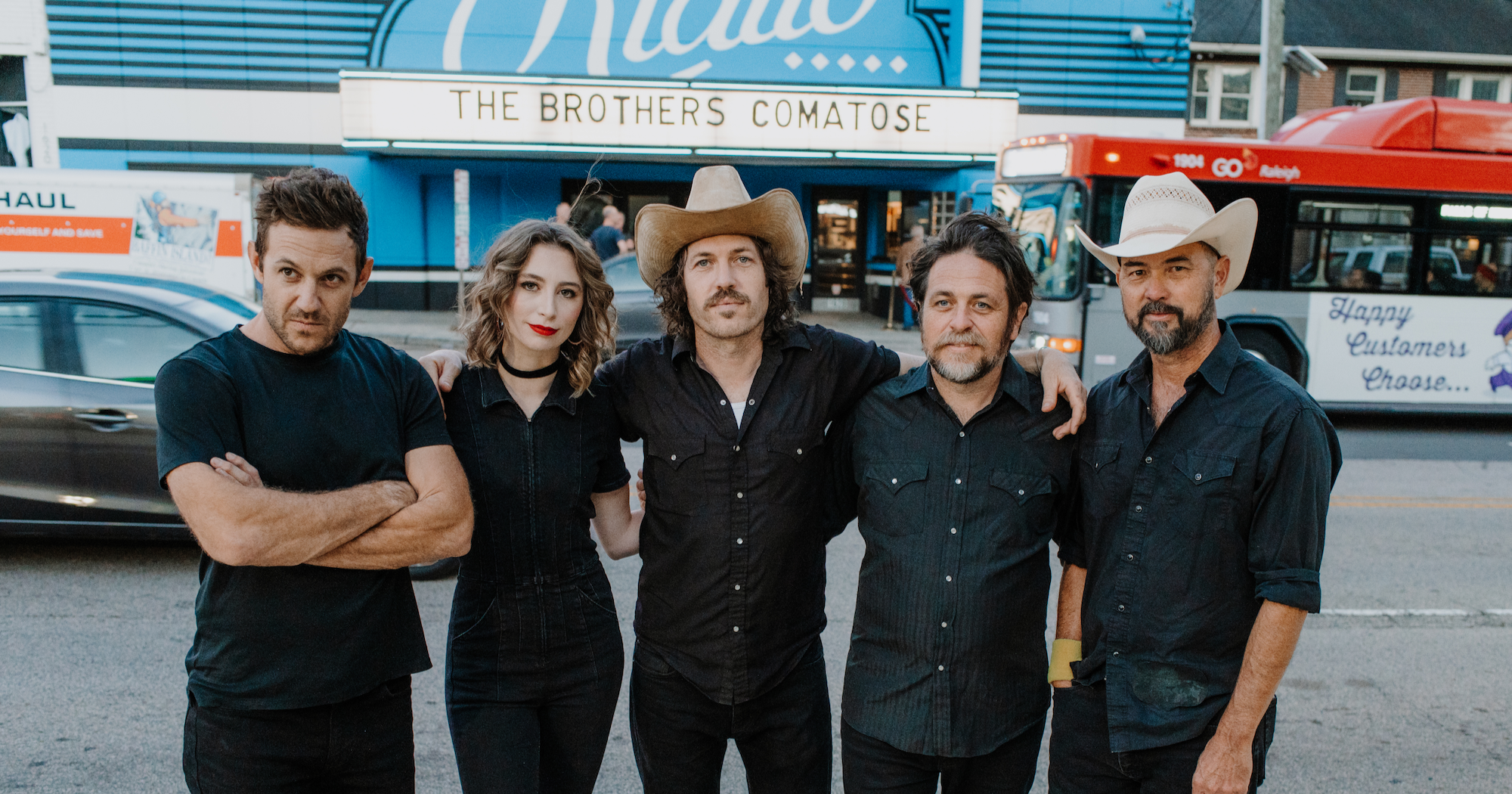
Bay Area five-piece The Brothers Comatose were actually founded by the brothers Morrison: that would be Ben on guitar and lead vocals and his brother Alex on banjo. The Morrisons came from a musical family and were influenced as much by classic rock as they were by country and bluegrass – their first album, Songs from the Stoop (2010), even contains a cover of The Rolling Stones’ “Dead Flowers.” Initially, the band’s lineup included bassist Steve Height, fiddler Phil Brezina, and mandolin player Greg Fleischut.
In the 15 years since, they have stayed busy both in the studio and on the road. As anyone who has seen the band’s concerts can attest, The Brothers Comatose are anything but… comatose. Their live performances are known to be high energy and often include audience participation. They have supported everyone from Gillian Welch & David Rawlings to Yonder Mountain String Band to Trampled By Turtles. In addition, the group has played festivals like Hardly Strictly Bluegrass and Outside Lands.
The Brothers Comatose returned at the end of July with their fifth studio outing, Golden Grass. The title track, which also opens the album, came from an unlikely source. “A fan started calling our sound ‘golden grass,’” explains Ben Morrison. “And the phrase just felt right.”
Golden Grass arrives three years after the band’s prior album and continues their mix of traditional bluegrass and rock. But behind the scenes, there have been some changes. The Brothers recorded Golden Grass in two separate installments with two different producers, Greg Holden and Tim Bluhm. While they were making the disc, mandolin player Greg Fleischut decided to leave the group. His replacement, Addie Levy, is the first woman in the band and, at just 23, significantly younger than her fellow members. “We always thought it would be cool to have a female voice to hit those high harmonies,” says Morrison. “Addie’s such an incredible mandolin and fiddle player, but she’s also a great singer and songwriter in her own right.”
Golden Grass is probably a bit more diverse than the band’s previous albums. Beyond being their first release to include a woman singer and mandolin player, it’s more collaborative in general. Ben wrote several songs, of course, but other tracks were penned by Levy, Brezina, and Alex Morrison. Still, Golden Grass maintains a pretty consistent sound over its 10 songs. The title track sounds like a lost Allman Brothers tune from back in the day and other highlights include lovely ballads like “Home Again” (featuring Lindsay Lou on guest vocals) and “My Friend” as well as the funny, rollicking “The IPA Song.”
I recently had the pleasure of catching up with Ben Morrison and Addie Levy for BGS.
To start with, tell me a little about the making of Golden Grass. I understand there were some changes between your last album and this one. Addie obviously is the new addition. And I guess Greg was the guy who left?
Ben Morrison: Yeah, Greg was in the band before. He left like halfway through the album. We recorded it in chunks. So we recorded half the album, we were working through the rest of the songs, and in that process, he left the band. Addie joined and recorded the second half of the album with us. But it’s funny. There are four mandolin players on [Golden Grass]. We had a couple of guest mandolin players on the album before Addie joined. Ronnie McCoury’s on there. It’s a good variety, I guess. [Laughs]
Tell me about the title track, which is also the first song on the album.
BM: That’s a good question. It started out with us trying to identify ourselves – that age-old question when you ask a musician what kind of music they play. “Well, it’s kind of hard to define. We’re jazz and pop and metal and boy band!” [Laughs] You know, it’s definitely pulling a lot from the bluegrass world. But also from a bunch of other influences.
We kept posting these things on Facebook and there’s this guy, Cyrus Clark, I believe his name is. He kept commenting about a lot of music coming from California – string band music specifically – going back to Old & In the Way. He kept saying, “Golden Grass! Brothers Comatose, Molly Tuttle, and AJ Lee.” We thought that was really cool.
I think I had just written it down in a notebook one day. And we did a cowrite – myself, our fiddle player Phil, and the guy that produced the second half of the record, Tim Bluhm. I was like, “What if we called it Golden Grass?” We started name-dropping different bands in the lyrics and kind of giving them a little shout out. We had fun with that and went with it.
“Home Again” – reading the press release, I know what inspired it. But just listening to the lyrics, I [probably] would have known anyway. For those of us on the East Coast, tell me a bit more about what [the wildfires] were like and how it affected the song.
BM: That wasn’t a personal story; it was about good friends of ours who lost their house in the Santa Cruz Mountains fires a few years back. For those of you not in California, there’s a fire season [here] where fires can just rip through and destroy communities. It’s pretty messed up and now it’s literally close to home. Some good friends of ours – all their property and their house got destroyed. I think it was during the pandemic and it hit me pretty hard. I was just really feeling for them and that song kinda came pretty quickly.
We had the song and thought about getting somebody to help sing it with us. Lindsay Lou’s been a friend for a long, long time and she’s such a great singer. We sent it to her and she was on it. It’s about a couple losing their house and building back together. So it made more sense to me as a duet.
I like the ballads on the album. Addie, I think you were the one who wrote “Blue Mountain?”
Addie Levy: I am.
Tell me a bit about the inspiration for that song.
AL: I’m from the Blue Ridge Mountains of Virginia. I grew up in Appalachia my whole life. [The mountains] have always been a very big inspiration for my writing and who I am as a person.
I was driving to work one day and was listening to the Infamous Stringdusters’ [version of the Cure’s] “Just Like Heaven” and got really inspired by having a keen lick throughout the whole song. I was like, “I need to write a song like that.” It all came to me within the drive to work. I showed it to my mom when I got home and she kind of looked at me with concern. She was like “Are you and your boyfriend okay?” I was like, “What does that have to do with the song I just played you?” I accidentally wrote the entire thing about him – which is bad ‘cause he cheats on me in the song! But he doesn’t in real life! [Laughs]
There were all these little pieces. Like, I pass his exit to work every day. He knows my Starbucks order. I painted the walls blue in his bedroom in one of our first months of dating. I pulled all these little things I didn’t mean to. Then I had to show it to him. I was like, “I am so sorry I wrote this song about you!” But when you’re in a nice, healthy relationship – I don’t have that much stuff to complain about so I can’t really write about it!
“The IPA Song” is a fun track. Anything either of you want to share with me about that?
BM: When we play shows, we like to get people onstage to help us out – you know, for sing-alongs or whatever it might be. I think we’ve had more children onstage for “The IPA Song” than any other song, which is ridiculous. But they make signs and stuff – like the IPA circled with a line through it. We had a 15-year-old last night playing mandolin with us for that song! I mean, the lyrics are goofy, but I guess it’s a catchy one. It’s been a fun song to play live.
Going back to the Bay Area music scene. In the late ‘60s, it was known for bands like The Grateful Dead, Jefferson Airplane, and the whole psychedelic thing. And in the late ‘70s, there was something of a punk scene. Even in the ‘90s, there were bands like Counting Crows that recorded in San Francisco.
What is the scene like now? And with all these different musical sounds that have come from the city, how did you settle on more of an Americana/bluegrass sound?
BM: The band got its start in 2008 in San Francisco. My brother and I were living in a house on Haight Street – right in the thick of it. Phil lived a few blocks down, so he would come over. We continued to live in the city for a long time and there was a bustling scene. With bluegrass too – like this [past] weekend was the Hardly Strictly Bluegrass Festival. I kind of credit that festival with my direct interest with this kind of music. It’s massive, three-quarters of a million people throughout the weekend. It’s all free. Huge headliners. It’s not all bluegrass but it definitely leans in that direction.
It was so cool being exposed to different kinds of music that I hadn’t really listened to before. What was also cool was watching artists play – Del McCoury, John Prine, Emmylou Harris – all these players that were older. It seemed like the older you get, the more respect you get in this world. [That] was interesting, because I felt like in the rock world there was sort of a shelf life. Like “Oh, you’re in your late 20s in a rock band? Give it up, kid.” That kind of thing. But in this world, when you’re 70, you’re doing it! That was always so cool to me.
So San Francisco does have a pretty cool scene. Probably 10 years ago, a lot of people started moving out because tech started moving in [and it became] more expensive. But I’ve heard that it’s getting cool again. I don’t hang out there as much anymore ‘cause we’re on the road a lot and I’ve got two kids. I mean, Addie probably hangs out there more than I do.
AL: Anytime I’m in town, I try to find a bluegrass gang. There’s a couple of bars [where] I’ve made some good friends. Sometimes there are jams, sometimes they’re just drinking. But there are some really cool musicians in town.
Ben, I know your brother is also in the band. Tell me what Alex brings to The Brothers Comatose that is unique.
BM: Alex has swagger beyond belief. [Laughs] Is that what you would call it?
AL: Yeah. [He’s] the most photogenic, most in the vibe of every situation.
BM: And the way he plays, too. To me, he plays banjo like Keith Richards plays guitar. You know, he’s not trying to be the Yngwie Malmsteen of the banjo or anything. He’s just trying to make it groovy, stanky, in the pocket. It’s just got such good feel to it. And also, he’s a great songwriter and singer. But a lot of his influences come from [bands like] The Rolling Stones, Led Zeppelin. We used to listen to a lot of classic rock when we were kids.
Addie, I guess I wanted to ask you what it’s like so far as the new member of the band and also the first woman. Crashing the boys’ club, as it were.
AL: My very first show with them was in Idaho. I had never met any of them, I had one phone call with them and I had never been west of Nashville! You know, I grew up traveling up and down the East Coast and never really left. I remember touching down in Sun Valley and the realization hit that I knew two people there and they were leaving the next day. And I was like, “I’m gonna get murdered. I am gonna die out here!” [Laughs] I never heard of the festival, it was in the mountains somewhere… I was like, “This is the end.”
[I was] super anxious to start. I mean, our first show was a headlining slot that Sunday. That was terrifying. But [the Brothers Comatose are] just the greatest people. They’re so welcoming. And I’m an only child. So they’re really the siblings [I never had]… They’re the best.
Photo Credits: Lead image courtesy of Burning House Management. Alternate image by Jessie McCall.