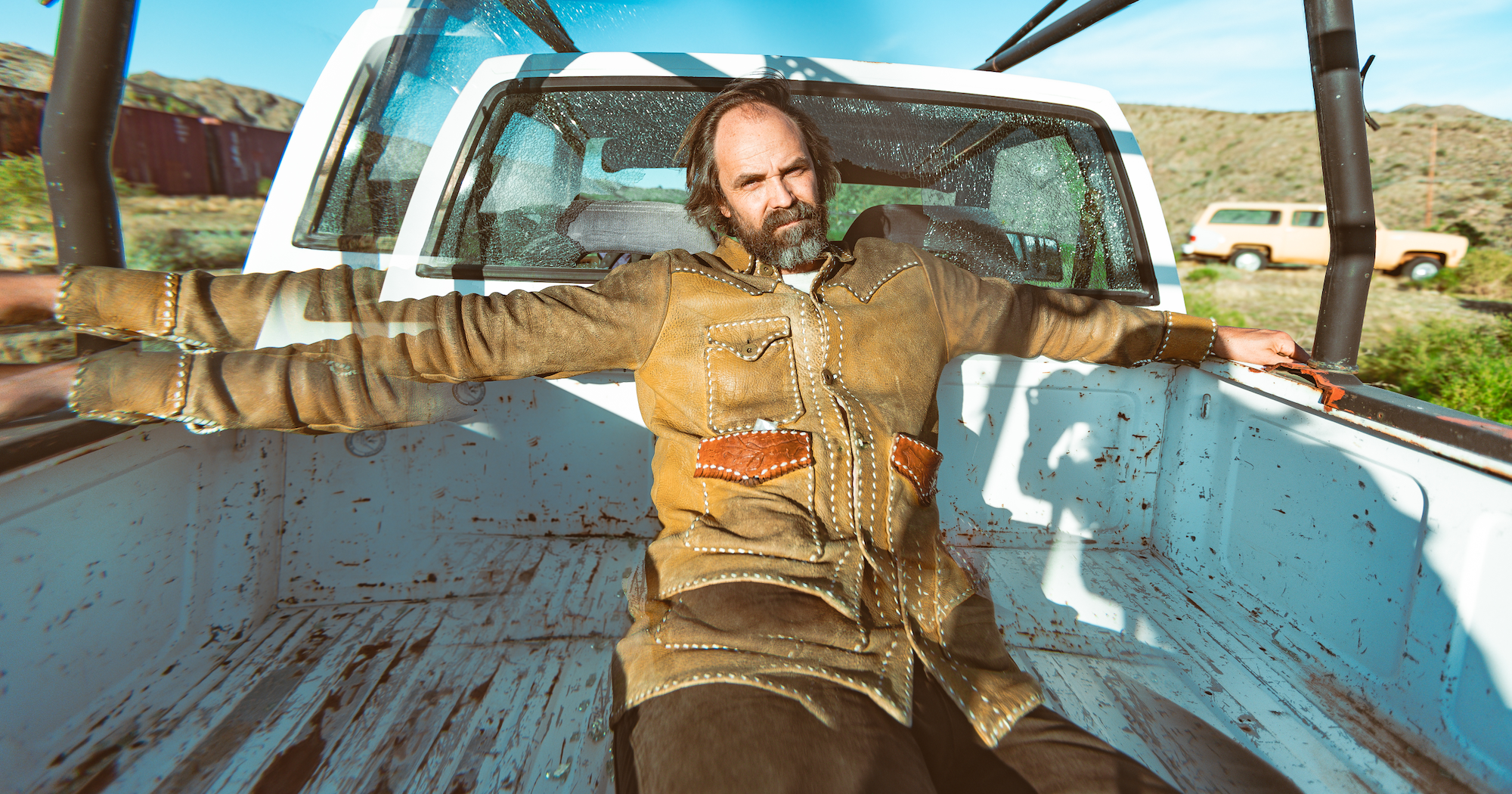
It is deeply joyful sitting with Jonny Fritz at a restaurant he suggested (Pollos Puebla #1) in an area of Los Angeles he’s an expert on (Pasadena/Altadena border) and talking about subjects he thinks about a lot, ranging from rebirthing ceremonies to alimony to how…“different” Nashville is now. He’s keenly honest about his life, his work, and his thoughts about any question thrown his way. Nothing is out of line or off limits. Nothing is filtered by a publicist or an agenda. It is off the cuff and real and wild.
We met over grilled chicken, rice, and beans to discuss his newest work, Debbie Downers (Woodwinds), a reimagining of the original 2025 album Debbie Downers. The conversation unfolded much like the album, with unexpected turns and humor that expose raw nerves about an unfriendly music industry, the beauty of PG Tips, the subtlety of serving a song, and the goal of taking a ride on the wave of a sliced open above-ground pool.
Well, let’s talk about Woodwinds. I’m a huge woodwind fan. How’d this come about?
Jonny Fritz: Oh, yeah? Me too. I love woodwinds. I’ve always loved them. I think they’re so great.
It’s so expensive making a record. It’s just stupid, you know? For example, the last record I made, Sweet Creep, I made it pretty cheap. I think it cost about 12,000 bucks. But ATO Records had an option on it so they could pick it up. They bought Dad Country, the record before that, for 5,000 bucks. It cost me five grand to make. “We’ll pay you five grand for it.” All right, fine. And then, hidden in the contract – or at least hidden to me – they got the option on the next one. Same deal. So when I made Sweet Creep they picked up the option. So for $5,000, they got this record that cost me $12k. I was like, “Jesus, man, this business is so rough.” And I just knew it was going to be something similar with the next one.
By this one, Debbie Downers, I thought, “What do I really want to do?” I might as well just do what I want, because there’s nothing worse than having something be expensive and unsatisfactory. I just decided I really wanted to make the record over and over and over again. I have a bunch of different visions for how it should go and I wouldn’t call any of them the one.
The Woodwinds one was something I’ve always just wanted to do. So I’m pretty pleased with it. I got this amazing guy in Highland Park who does film and TV stuff. There’s not a lot of work going on right now, so he was willing to do it. And the first couple of arrangements that he came up with, I was just giddy. I couldn’t believe how cool it was.
Were there any revelations for you? When you heard them in that arrangement, was there anything that shocked you about it?
Hmm… Yeah, some of the versions with the woodwinds really lent themselves to the winds better than any other version. I wrote this song called “Have You Seen Her.” I wrote it coming off of anesthesia. I was out of my mind. I got a hip replacement at UCLA 10 years ago. You know, coming off anesthesia affects people in weird ways. I’m one of them. It really got me, I wrote this song and I felt like it was the most brilliant thing.
It was so embarrassing. I wrote everybody who I knew who was high up at Rolling Stone, and all the Newport Folk Festival team, and all their PR team. I mean, I wrote everybody. And I wrote these really incoherent emails. I haven’t actually looked at them in a long time. I looked at them right after I wrote them and I was so ashamed. But I wrote all these emails being like, “You’re gonna want to get Scarlett Johansson down here. I need to perform this for her. And you need to get Joaquin [Phoenix] here, too.”
I’m not a social climber, but there was something in me that was like, “You need to make some moves. Call out a lifeline.” I was so ashamed of it for so long, because it was one of the most embarrassing moments in my life, for sure.
All of that to say, I didn’t want to play it or record it. I had to overcome it, admit it, and start talking about it. When I heard it with the woodwinds, I was blown away.
Years ago, I worked with Chris Crofton on a comedy event at Third Man Records that involved a compilation of found video footage that was submitted. There were so many submissions of people coming out of anesthesia, and I remember Chris immediately going, “No, that isn’t funny.” It really isn’t; you aren’t in your right mind.
God bless that man. He always knows exactly what the fuck is up. He is driven by pure heart and knows exactly where his morals should be. He’s incorruptible.
Do you spend a lot of time on social media? What is your relationship to it as a creator?
Pretty passive. I like social media. I feel like I’m kind of floating above social media. By like eight feet, just kind of looking down at it. Like, “What are you guys doing? That’s insane.” Then I dive into it to interact, and then just kind of get out of it. I get a little hooked on it for sure, but I hear about the addictions and the stuff that people fall for, and just like the amount of engagement. But it’s like engagement versus quality of life. I get so much fulfillment from everything else. I like playing with it. I always have fun with it, but I try not to let it get sticky.
Well, one of my favorite social media posts in the past bit is the one with your kiddo singing “Tea Man.”
Oh, wasn’t that so sweet?
So sweet.
She’s 6.5 now. She was like 2.5 then. And I just was like, I can’t post this. It felt so…I don’t know…
Personal?
It was personal, but I didn’t have a problem with that. I definitely want to protect her, you know? But that’s not her anymore. She doesn’t even look like that. She’s like doubled since that song came out. But then I was like, “Oh, fuck yeah, I’m posting this!” There was no risk of seeing her in public and recognizing that she’s the girl from the video.
Are you a tea man? In real life?
I got a PG Tips tattoo. I really like tea. I drink enough tea to float a canoe every day.
Really? All caffeinated?
Usually. Well, when I’m on tour, yeah. I get so tired. I can’t really mess with coffee. It just makes me so jittery. But I can just drink tea all day.
Are you an equal opportunist, or is it mostly black tea?
Oh, I like it all. Really like it all, but I love the black stuff, though. I think it happened when I was on tour 10 years ago with Josh Hedley. We were in England somewhere on a train, and they came down the lane with a steaming cart and it was £1 for a cup of tea. I don’t have an addictive personality. I don’t care about alcohol or anything. But I felt like, “Oh, I’m in trouble.” Just sitting on a cold, rainy train going through England with a cup of PG Tips.
It reminded me of something I heard about Andy Warhol. Although I’m not a big fan, I don’t know much about the guy. But what I do know about him is that one thing that made me really like him. I heard that he doused his whole world in a certain scent for a season. For example, in the summer of ‘63, he would just cover everything with lavender oil. And then come winter, it would be a totally different scent. And you’d put lavender away, and it’d be bergamot. So then the sense memory of whatever happened around that time would be so strongly connected to that scent that you could be completely brought back. And I really love that.
I think there’s something to it with the tea thing, because that tour was really big for me. It was a fantastic time. It was a really, really wonderful, lovely tour, and drinking PG Tips like that, I just got into English culture too. Everywhere you go, somebody’s like, “Well, you want a cup of tea?” Like, yes, I fucking do. I decided I’m never turning down a cup of tea. And I never have since.
Tell me about writing “Hot Chicken Condos” with Jordan [Lehning] and Skylar [Wilson]. I deeply connect with that song because I also left Tennessee, and for many of the reasons you list in the song.
Yeah, that was the point. Everybody who really gets this place will really understand these things, even like Pit Bull puppies in parking lots.
And humidity.
Fucking unrelenting humidity.
Were those things you were storing? How did that song come about?
God, why I love writing with Jordan and Skyler is because they don’t bring any ego to the write. They don’t fucking care. They’re just such good vibes. I’m really pretty neurotic about writing and also I’m pretty protective of my words, too. When I get into the writing space, I’m just so sensitive about what’s being said. So if somebody says or suggests the wrong thing, I can quickly be like, “This is the wrong association.” I can be a little trigger-happy.
But with Jordan and Skylar, they’re always just like, “Just play what you got.” And they usually edit everything that I have. With that song, one of the lyrics was “Mustard in the corner of his tiny little mouth.” And Jordan said, “Why don’t you say, ‘Mustard cracking in the corner of his tiny little mouth?'” And it was perfect. Mark Twain said the difference between the right word and almost the right word was the difference between lightning and the lightning bug.
It’s so true.
I got to hang out with Guy Clark once in Nashville, and it was like one of the best moments of my Nashville career. I was going through really bad writer’s block. And I asked him, “Do you ever get stuck?” And he said, “Yeah… Do you ever write with other people?” And I told him, “I don’t like the idea of giving somebody 50% of the song just because they’re sitting in the same room.” He leaned over and he goes, “Well, you never would have fucking wrote it if they weren’t sitting there.”
I was like, “Damn, old man schooled me.” Because so much of writing, I feel like, is picking up on something else that’s happening. And who’s to say you don’t owe somebody credit just because they’re sitting there?
The other thing that Jordan suggested for [“Hot Chicken Condos”], which was so right on, was that he asked me how high I could go on the Tennessee part. I told him I could go falsetto, and he told me to try it. I hit it and he said, “That’s it.” He took an idea of a song and made it a song. I just so appreciate those guys.
I just feel it is like a pedal steel player who plays about eight notes per song. That’s the best player in town, ‘cause all the other players are nonstop. Same with fiddle. Take Josh Hedley. The guy just stands there most of the time, then he pulls out something incredible, and he sets it back down. He doesn’t overplay. If you don’t overwrite and you don’t overplay, those are heavy attributes.
Those are both things to do in service of the song, not in service of self.
Absolutely. You know who I saw last night was Erin Rae. Kevin Morby and I were standing next to each other, just like, ”Oh my god, she’s so good.” One of the most amazing things about her is that she underplays the guitar. She’s playing the whole time, but if you really focus on how much she is actually playing, it is barely. It’s just enough to fill in where she’s not singing and she works the mic so well.
All those things are so important, but nobody teaches them, you know? You have to kind of know it. It’s innate, right?
Or you got to learn it trial by fire. And you have to be playing with players who know what they are doing to learn that.
Yeah. That’s right. Sometimes people are technically good, but they just don’t stop noodling, and it sucks.
You took a long hiatus from music, huh?
I did. I took nine years between records. I didn’t mean to. And I didn’t actually think that I was doing it. I was playing shows here and there. I blame it on real estate. I got into real estate because my heart got broken from music so many times from wanting to do better. Wanting to succeed more. Really, really caring what people said and thought and comparing myself. All the things you really shouldn’t do ever in any aspect of life. I mean, if you did that in a relationship, then your therapist would be like, “That’s your problem. Stop. Don’t do that.”
I couldn’t get out of it. I just felt so bad about how it was going. And I know what I’m doing is not for everybody, and it’s not gonna take off. But I love what I do. I’m not putting myself down, but I just knew my ambition was a lot faster than everybody’s interests. It was just wearing on me and I needed to do something that’s purely about money and doesn’t have anything to do with creativity, because I’m just getting my feelings hurt. And I got polyps in my vocal cords. I was touring too much. It just wasn’t going well.
So I thought, “I’m just going to pivot. I’ll still do shows and if somebody asks me to do something, I’ll do it. I love music.” I stopped prioritizing writing. I stopped prioritizing recording, and then the pandemic happened, and I had a kid, and real estate took off, and I looked up, and it was 9 years. It really was like, “Oh, crap, how did that happen?” It shocked me.
What’s your writing process like typically? Do you write everywhere?
I write everywhere. I use my voice memos a lot. I really love just making up new country songs and fake country songs – like, really bad ones. I find that if I can get them out, I can expand upon them or delete them and move on.
I was writing with Skylar [Wilson] one time and we were trying to write a song called “Remember the Alimony?” We wrote for hours and hours and it was a stupid song and it didn’t go anywhere. It went, “I’m just a poor man. All I eat is beans and write checks to my ex, one and only. I rolled the dice, but I lost my wife. But I remember the alimony.” So stupid. God. But we were writing all day and just hanging out, and neither of us thought to finish it. It just didn’t work. But then I got home and I had like 6 other song ideas that went on Sweet Creep. It’s that muscle thing that everybody talks about.
I’m also a pleasure seeker to the nth degree. If things aren’t fun, I just drop them so quick. I’m really bad about that. So I just make sure that it’s really fun and get the idea out quickly. I try to stay hovering above it, just stay light. Because as soon as I dig into it, that’s when I’m like, “Oh, my God, right. I don’t know how to do this.” Just keep it fun and it will grow. But I like to write all the time, every day.
Do you wake up and do it?
It is in the shower, on the way to school, washing dishes. You know, when you have a great idea and no way to write it down.
Soapy hands! Sometimes it happens when there’s an absence of anything else and those ideas pop up.
I have to really protect myself when I’m diving in. I wash all the dishes, do all the laundry, sweep up a bit, and make sure no one is going to ask me for anything. I’m really self-conscious about that. If nobody is home, I’m going to the basement and putting on Ken Burns’ Civil War, and I turn the radio on at low levels where it is just kind of humming. I drink a tremendous amount of caffeine. That’s my favorite.
But it is intense. I can get really emotionally rocky after diving in pretty deep.
I was thinking about Roger Miller when you were talking about the “Alimony” song. I’m drawn to that kind of writing because you can get really dark while staying very light.
People think that the meat is deep, but the nerves are on the surface. There’s meat down there, but it’s dead. I feel like the most cutting and incredible songs kind of sound like an email to an old friend. My favorite Lucinda Williams songs all sound like they were written to a buddy.
Or she’s talking to somebody over tea.
So true. And John Prine, too. Everyone’s like, “How did they do it?” They just did it. They’re just talking.
Will you play any live shows with the woodwinds?
Yes, actually, April 14, we’re doing a free show at Zebulon. It’s going to be good. I have this giant golf ball, it’s like a concession stand, and I’m bringing that to the show. The whole point of it is to give away free tea. It’s my tea ball. The tea is free, just buy a house from me!
What will the live configuration look like? How many players will you have?
Four, but they play multiple winds. It’s the players on the record. They’re such pros. They’re all symphony kids.
There’s something about stripping it down to just woodwinds; it’s so cinematic. It takes you directly to the meat and it makes you lighter when it is time, as music does for film. It helps direct your emotional experience.
I like that. I’ve always loved demos of songs. Sometimes I just want to hear someone play the songs, not the record. Or just hear someone sing it. As close to the song as I can get, I’m most happy. I love a cappella stuff. Sometimes the most powerful way to arrange a song is to remove everything.
With winds, too, it’s nice because that’s pretty much it. There’s the vocal and then there’s some wind behind it. I love that.
At the top of my notes that I took while listening to the record, I have the words “jello rebirth” scribbled down regarding the song “Polished Turd.” Can you tell me more about that concept?
For this record, it was a bit of a cynical and fatalistic career thought, but I wanted to make a record of real estate songs. The whole idea behind it was that people would hear it and would say, “This sucks.” And my reply can be, “Yes. That’s what happens when you give up on your dreams.” Music really suffers when you just write about what you’re doing. It’s like this martyrdom thing.
You know the three D’s in real estate are like death, diapers, and divorce – all the things that make people sell their homes. So I wrote one that went, “Death, diapers, and divorce. And the lottery, of course.”
During the pandemic, I had this fantasy of buying someone an above-ground pool. Have you heard of rebirthing ceremonies?
No.
Oh, rebirthing ceremonies are a thing. A fucking thing. People simulate a mother’s vagina in like a mega fucked up Christian ceremony. They make you relive your birth so you can be reborn and let go of all your childhood traumas. They have a gelatinous vagina and people push themselves through it. So anyway, I got that in my mind and thought, “What the hell is this world?” But I could see that for real estate, like a used car salesman going, “We are doing rebirthing ceremonies, come on down!”
And I have always wanted to slide through the tsunami of an above-ground pool that gets sliced open.
Yeah, that does look fun.
Right, who hasn’t wanted to do that? But then I want to turn it into jello. And then I thought maybe I should do that for my clients or have a commercial about it. I could cut a slice in the pool with a katana sword, then they’d ride in slow motion through the incision of the above-ground pool, I could hand them the keys, and they’d be reborn into home ownership. Follow me?
Yep.
That is a song very near and dear to me, but it is a hard one to explain. What was your experience with it?
Well my first thought was that wherever it was coming from and whatever it meant, you have thought a lot about it.
Fair enough, that’s true.
Photo Credit: Bobbi Rich