Technology and Tradition Combine on Sierra Hull’s Signature Gibson Mandolins

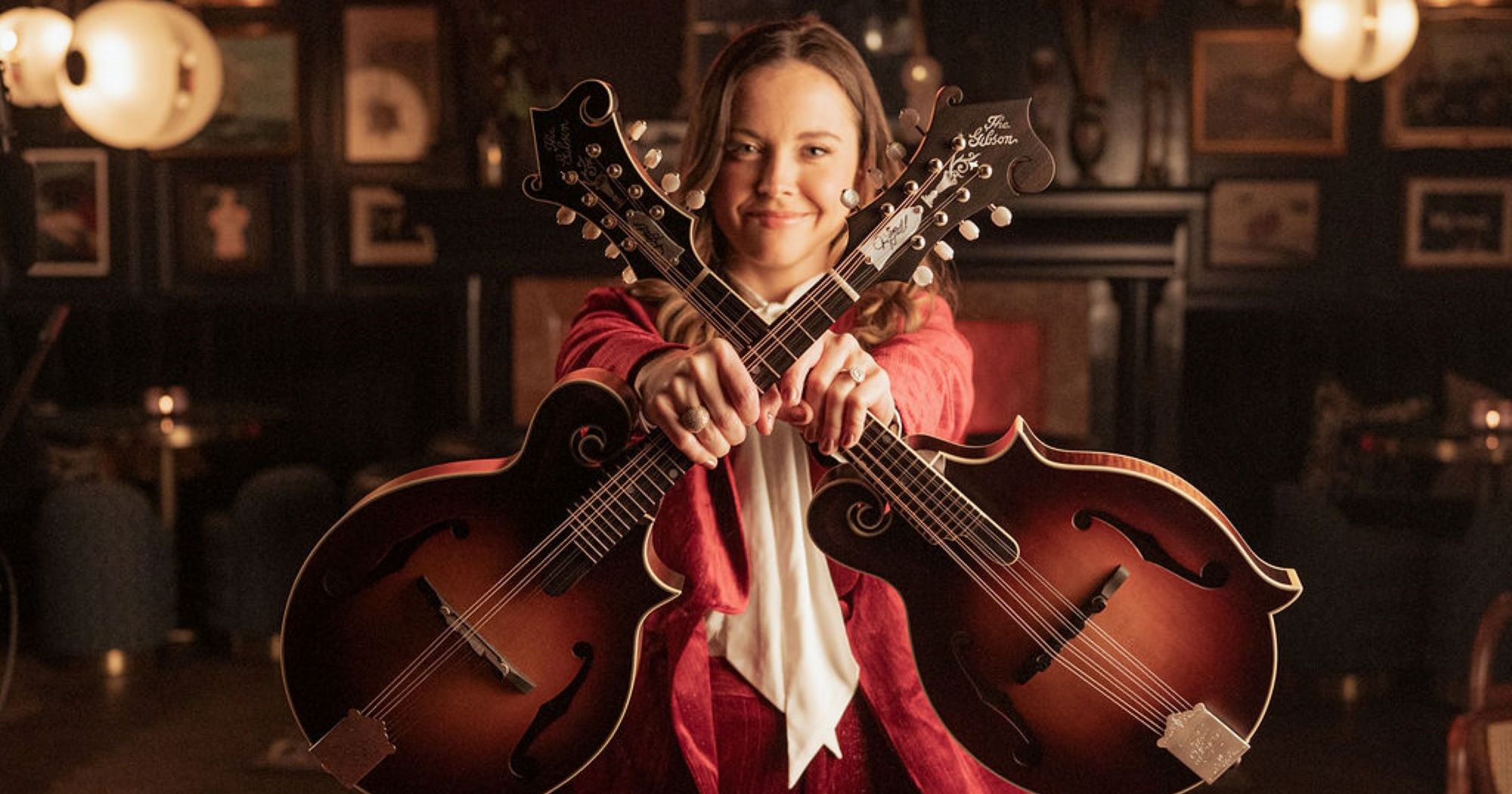
Eyes on the future, heart in the past – it’s the cornerstone of how award-winning mandolin player, guitarist, singer, and songwriter Sierra Hull crafts her music, and how Gibson Master Luthier David Harvey and the Gibson Custom Shop crafted her new signature mandolins: the F-5 Master Model and F-5G.

The F-5 Master Model boasts a red spruce top, eastern curly maple back and custom narrow neck, and ebony fretboard, while the F-5G offers a red maple neck and body, Sitka spruce top, and ebony fretboard. Both models feature the Sierra Burst VOS Varnish finish and come with certificates of authenticity, Sierra Hull/Gibson BlueChip pick, and mandolin cases – vintage replica for the Master Model and hardshell case for the F-5G.

The instruments are the result of Hull’s many years of dedication, hard work, and talent, alongside a working relationship with Gibson that began when she was 12 years old and already a four-year veteran on her instrument. Growing up in Byrdstown, Tennessee, with few if any resources for musicians, the slightest instrument repairs required a two-hour drive to Nashville, where, at the time, Gibson had a shop in the Opry Mills Mall.

Hull had graduated from her first F-style mandolin, “a starter-model Epiphone that was so cool because it said ‘Gibson’ on the truss rod cover,” she says, to a flatiron mandolin she bought used from a local player and still has in her collection. In need of new frets, and in Nashville with family, they went to the mall in hopes of a walk-in or referral. Hull had recently played the Opry with Alison Krauss and upon entering the Gibson Showcase shop, Grascals mandolin player and Gibson staffer Danny Roberts recognized her and put a new, limited edition Adam Steffey signature model in her hands.

“My dad remembers them saying, ‘How would you like to have one of these?’ He’s thinking, ‘Yeah, buddy, I bet she would, but we ain’t got that kind of money to spend on a mandolin,’” Hull recalls. “They gave me that mandolin and it was such an unbelievable moment, as a 12-year-old, to be given this incredible instrument. That was the beginning of my relationship with Gibson. I’ve mostly played a Gibson mandolin ever since.”

Fast-forward to 2009 and Sierra Hull’s main instrument: her Gibson Master Model, built by Gibson Master Luthier David Harvey. “The 2009 was brand new at the time,” she says. “Dave made some modifications to it to suit what I was looking for and it has become my voice.”

That mandolin eventually became the springboard for her signature Master Model and F-5G, in line with her original specifications for the 2009. “I have small hands, so Dave took the neck down a little bit for me,” she says. “We put an aged varnish on it instead of the normal gloss, which makes it a little more unique than one right off the line.

“I’ve always preferred that thin, matte varnish type finish, so we decided to recreate that with the signature line. So many people often ask me about my mandolin; they think I’m playing a Lloyd Loar most of the time. I’ve put a lot of miles on this mandolin since 2009. I’ve played it as my primary instrument since then. When I got it, it didn’t look anything like it does now in terms of being so worn, but it didn’t look brand new and shiny, either. I always loved that about it, that there was a certain aged vibe to it already because of the finish.”

In addition to the aesthetics, the Master Model parallels Hull’s unique sense of blending her deep bluegrass roots with contemporary sounds. It is, she says, the perfect instrument for that mix of past and present. “When I think about the kind of music I play, both these days and throughout my career, I’m so rooted in traditional bluegrass,” she says. “I grew up going to bluegrass jams on the weekends, sitting in a circle – you need a mandolin with volume, something you can dig into, like the Master Model.”

“Part of the reason we all want to play F-5 mandolins is because Bill Monroe, the Father of Bluegrass, played an F-5,” she continues. “I love an A-style mandolin as well, but there’s something that makes you feel legit about playing bluegrass on an F-5 mandolin, because it just feels right – the feel, the look, the sound, the pointedness that those F-style mandolins have. The idea of having a mandolin that you can really channel that traditional thing that as mandolin players we’re born to love in bluegrass music – Gibson is the gold standard for what we think of in terms of every F-style mandolin that you see.

“There’s a lot of great builders out there, so many talented luthiers building beautiful mandolins, so it’s no slight to any of them. But nobody would be doing that if Gibson didn’t exist and build these F-5 mandolins with Lloyd Loar’s stamp of approval on them. When I pick up my Master Model, it feels like the connection to that legacy.

“Even though I tend to think my sound is more progressive and modern – way more so than what you think of when you think of Bill Monroe – that’s the world I come from, so I want a mandolin that feels connected to those roots. But the clarity, the top end, the sparkle that these mandolins have, too – they have a large span on what they can bring to the table. No matter what musical direction I go in, I never find myself lacking from the side of what the instrument can do. It really shows up in all those situations.”

Bringing the Sierra Hull Master Model and F-5G from concept to showroom was a two-year process. Hull, David Harvey, and Gibson worked closely, taking time and care to not rush the work, but instead building the mandolins to her exact specifications.

“As a youngster I couldn’t have dreamed of having my own signature line with Gibson, so it was wild to get the call,” she says. “I’ve learned so much in this process over the past couple of years. Getting to go up-close, help pick out the wood, and see it go from a chunk of wood to mandolins that have my name on them is such an experience. To see it all come to life is a full-circle moment that takes me back to sitting in the Gibson Showcase at 12 years old and playing one of my heroes’ signature lines. To see these mandolins with my name on them is overwhelming. It’s such an honor.”

Mat Koehler, Vice President of Product at Gibson, joined the company almost ten years ago. He says bringing the vision of Sierra Hull signature mandolins to fruition was, in fact, over a decade in the making, beginning with conversations and leading up to the present.

“Even ten years ago, Sierra was one of the best, if not the best, mandolin players in the world,” he says. “When I got here, I was like, ‘Why don’t we have a Sierra signature model?’ The answer, of course, is very complicated. I think everybody’s intention was to make that happen, but we had a restructuring of the company, change of leadership, change of management, a lot of things, a lot of obstacles. So this is really the culmination of a long time spent both ideating what a Sierra signature model would be and then executing it, finally. I am very happy and proud to be involved in some small way. But this is all Sierra and speaks to her incredible talents.

“Her impact [on the instrument] has been huge,” says Koehler. “She represents the next generation of players. She really refreshed the mandolin and offered a completely fresh take. Mandolins are a little bit similar to banjos in that with bluegrass music in the mainstream, if it’s not Mumford & Sons or Nickel Creek, it’s almost ‘out of sight, out of mind.’ Sierra has done an amazing job of taking mandolins into the mainstream in both her music and her collaborations with other amazing musicians. I see a recharging of the bluegrass world right now and Sierra is one of the many leading the charge.”

At the intersection of tradition meets technology, precise replication of Hull’s Master Model in order to build her signature mandolins was done by 3D scanning of the 2009 Master Model, a process Hull describes as “kind of like an ultrasound of your instrument. They run it over the whole instrument, you see it on the screen, and they capture all the specs in a detailed way.

“It gave us a good, strong starting point to mimic the Master Model that I love so much. From there, I got to pick out the wood and watch the process in real time. Essentially they made a replica of my mandolin that Dave Harvey, for fun, distressed to look like my mandolin, and they nailed it on the first try. We used those scans to build the signature line.”

True to her preferences, she selected a thin matte varnish finish on the models, a custom look that Gibson titled “Sierra Burst.” She also opted for the traditional Loar nut width and flat, scalloped fingerboards. “It’s much like I feel my career tries to do – lean into traditional while having some progressive new things as well,” she says.

“We did a custom tailpiece design. I didn’t want a lot of flair on the instrument. I didn’t want crazy inlays or my name spread across the fretboard. But I’m so honored to be the first woman to do a signature mandolin line with Gibson, so part of me did want a little touch of feminine something on there. If you look closely, there’s a little heart dotting the i on my signature on the truss rod. On the tailpiece, the traditional script says ‘The Gibson,’ but where the tailpiece has a curve up top, you’ll see a little heart built into the design, and a little bit of a heart at the bottom and my initials.”

“Sierra has played dozens of original Lloyd Loar 1923 F-5s, so we couldn’t cut any corners with her,” says Koehler. “We wanted to make sure her instrument was on par with any of the amazing mandolins she has played, because she would know right away what looks right, feels right, and sounds right. There are lots of different ways you can spec mandolins, but hers is true to the 2009, which would have been, at the time, a core Master Model F-5.

“That mandolin is her number one instrument to this day, so obviously we had the recipe. … Sierra’s took the very same path as our historic reissue 1923 F-5, which was we scanned her mandolin, we detailed it down to every tiny little nick and ding on it, just so we had a record of the current state of that mandolin, how it looked. The feel of the neck is really unique on hers because it was handmade by Dave Harvey at Custom.

“[3D] scanning has been a complete game-changer for us. Not only has it opened the door to be able to recreate instruments more accurately, it’s rekindled relationships with artists. Customers and fans of Gibson who want the most accurate now can finally have it, knowing it’s mapped identically from the original instrument. … Now, in a matter of maybe twenty minutes, you can do an entire mandolin, just waving a wand over it. That wand is capturing thousands and thousands of points…”

When the mandolins were ready, Hull – still a bit incredulous about having her own signature line – made a special trip to the Gibson shop to test each Master Model. “I guess it’s rare for someone to ask to do that, but I was like, ‘Can I come in and play all these?’” she says. “So we just made a fun day of it. The consistency of the sound, the build, and the playability is all at an insanely high level. All this stuff is done by hand and it’s no small feat to accomplish that. Dave sets them all up. He is the only one to set up my Master Model since 2009, so he knows what I want. Not that I expected anything less, but it was comforting and confirming that this is something I could be proud of.”

“We were overjoyed that she wanted to do it,” says Koehler. “That’s going over and above. She wanted to support this every way she could and obviously she was really excited about it, which makes us really excited. … For her to go the extra mile with us – we were very appreciative. … The fact that the endorsing artist would go to that length of playing it to test it out is amazing.”

It’s been a long, remarkable journey from Opry Mills Mall to seven-time IBMA Mandolin Player of the Year and two GRAMMY nominations, but Sierra Hull hasn’t forgotten the early days. Cognizant that signature edition mandolins are beyond the financial grasp of most players, her next collaboration with Gibson is an Epiphone model, bringing her back to her first instrument.

“I want this to be something that doesn’t price everybody out,” she says. “We’re going to work on an Epiphone model that will be a little bit more affordable for young players and people who are just starting on mandolin, the same way I was when I was a kid. It’s important to me not to have those people feel forgotten. I’m excited to work on it with Gibson as the next part of this story.”


Photo Credit: Courtesy of Gibson Custom Shop.

“Ohana Means Family”
to Ohana Music, Too

When Ohana Music founder Louis Wu says, “Ohana means family,” it’s not hyperbole; it’s the tenet upon which the company was built.

“On an unspoken level it drives everything, including staff, dealer interactions, customers, and products,” says Chris Wu, who oversees the ukulele company’s operations and product marketing.

The Ohana story, which is also Louis Wu’s story, is an inspiring journey of determination and accomplished goals. Wu grew up in Hong Kong and relocated to the U.S. after high school to study engineering. In 2006, after twenty years in his chosen field, he decided on a career change, primarily to spend more time with his wife and two young children. That priority – family – became and remains the basis of Ohana.

Chris Wu was 10 years old when his father launched Ohana. He spent his teen summers alongside his father “doing a little work here and there.” In 2018, after college and a career in accounting, he says, “Things fell into place where it made sense to come onboard full-time.”

From Louis Wu’s Long Beach, California, garage to a 6000-square-foot warehouse, Ohana’s slow and steady growth has taken them from a small business serving one customer at a time to leaders in their field with both their expansive product line and custom shop.

“I have to give full credit to Louis as the visionary leader of the company since day one,” says Wu. “He knows how a company should and needs to be run. Myself and all the staff are here to support that vision, and that really drives the growth. As a team, we’re improving internally every day, and that has been life-changing. It’s wonderful seeing our employees grow in what they do and in their passion for their jobs.”

Ohana’s international reach stems from the dedication of a surprisingly small workforce. “We’ve never had more than ten people at one time,” says Wu. “It is a small company, but the size helps our operation run smoothly and efficiently.”

Ohana ukuleles are available across a spectrum of styles and price points, from beginner models to pro series. Built overseas, the instruments are individually inspected in Long Beach to ensure flawless playability. “At the core, again, we view our customers as family, and we don’t want family to end up with subpar instruments,” says Wu. “Every instrument is given a full inspection and proper setup before it goes to our worldwide dealers. This does affect our output, our capacity, per day, week, month, or year, but that is the way it should be done. We’ve always been proud to do things that way.

“When you receive your Ohana ukulele, you can rest assured that you can take it out of the box and start playing. At the end of the day, being able to connect people to their instruments and spread the joy of music – it feels like introducing another family member to something we love, something we know they will love, and that will work for them.

“As a disclaimer, I will say that there are manufacturers who offer things that we do not, for example, plastic or carbon fiber instruments. Those materials can take a beating on long journeys or camping trips, if you need an instrument to meet those needs. Those ukuleles have their place, but we stay away from making them.

“We focus on sound, acoustics, wood choice, and the quality of the instrument you’re getting right off the bat. Between our 150 to 200 different models, there’s something for everyone. When you buy an Ohana ukulele, you know there is love behind it. Our team has set it up with you, our family, in mind. We want you to have a good instrument, plain and simple, for the right price and the right value. With our custom shop we’ve expanded that range while still keeping the value, the quality setup. We’re just covering a larger market.”


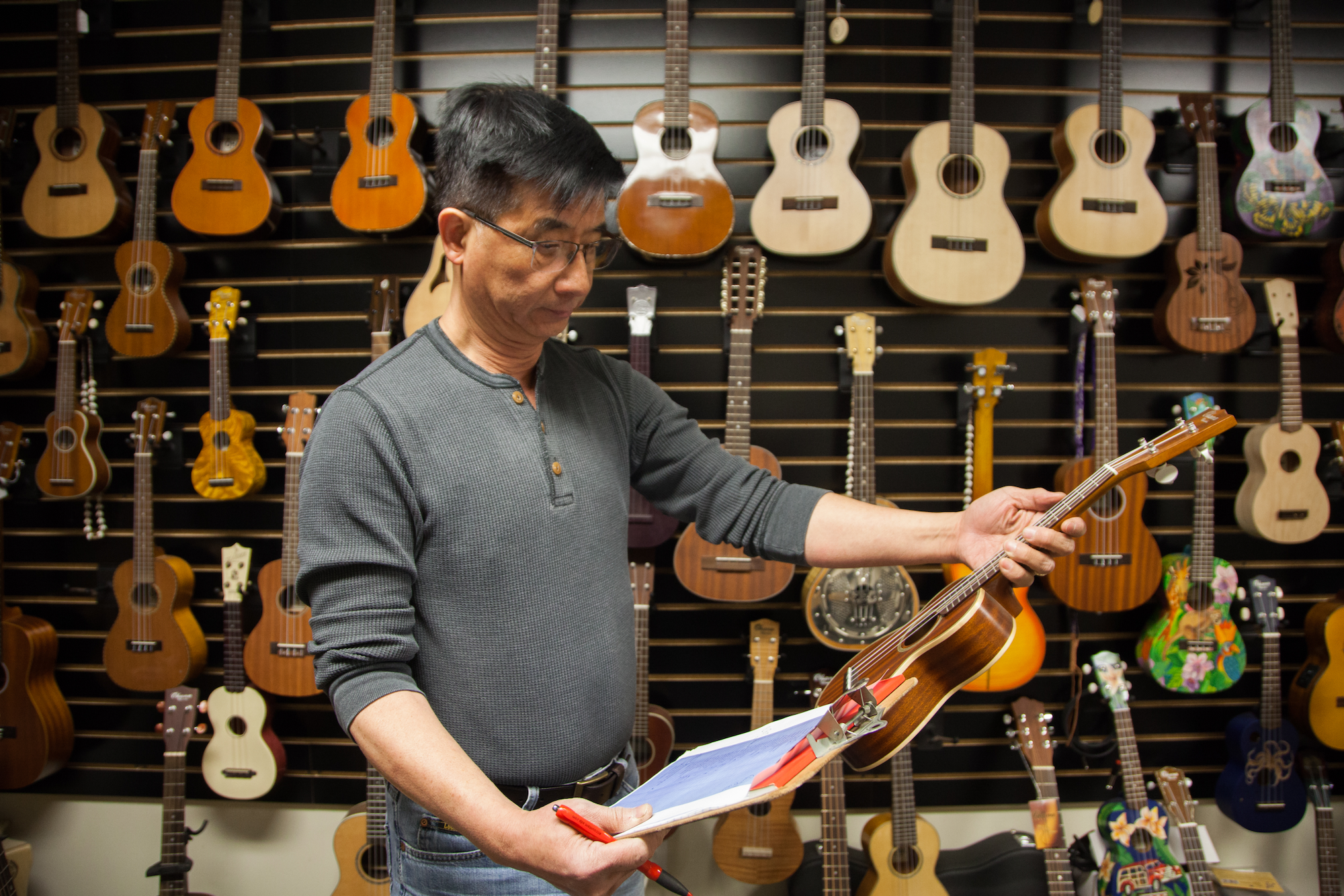
Ohana Music founder Louis Wu peruses the Ohana showroom.

All Ohana tonewoods are sustainably sourced. Most popular, says Wu, are redwood variations from the Pacific Northwest, which feature prominently in limited-edition models. They also source Hawaiian Acacia Koa, Canadian Engelmann spruce, and mahogany, cedar, and other wood sets from local harvesting companies. “We take our time to go through which sets look and sound the best, but are also in compliance with CITES,” he says. “Anything on that list, we won’t touch.”

Ohana Ukuleles will celebrate their twentieth anniversary in 2026. The lead-up to that milestone began unofficially this year at the 2025 NAMM Show with the introduction of their Custom Shop electric tenor and baritone ukuleles.

“Louis and our master luthier, Brad Kahabka, go all out when it comes to planning and executing things that come from the custom shop,” says Wu. “After building acoustic instruments and getting the shop going, it was a question of ‘What’s next?’ We made simple custom instruments, more elaborate custom instruments, and we even built one with wood from The Tree. We had explored the whole range of acoustic instruments and electric was the natural progression. We were excited to enter the market with electric instruments this year. That’s really been our focus for 2025.”

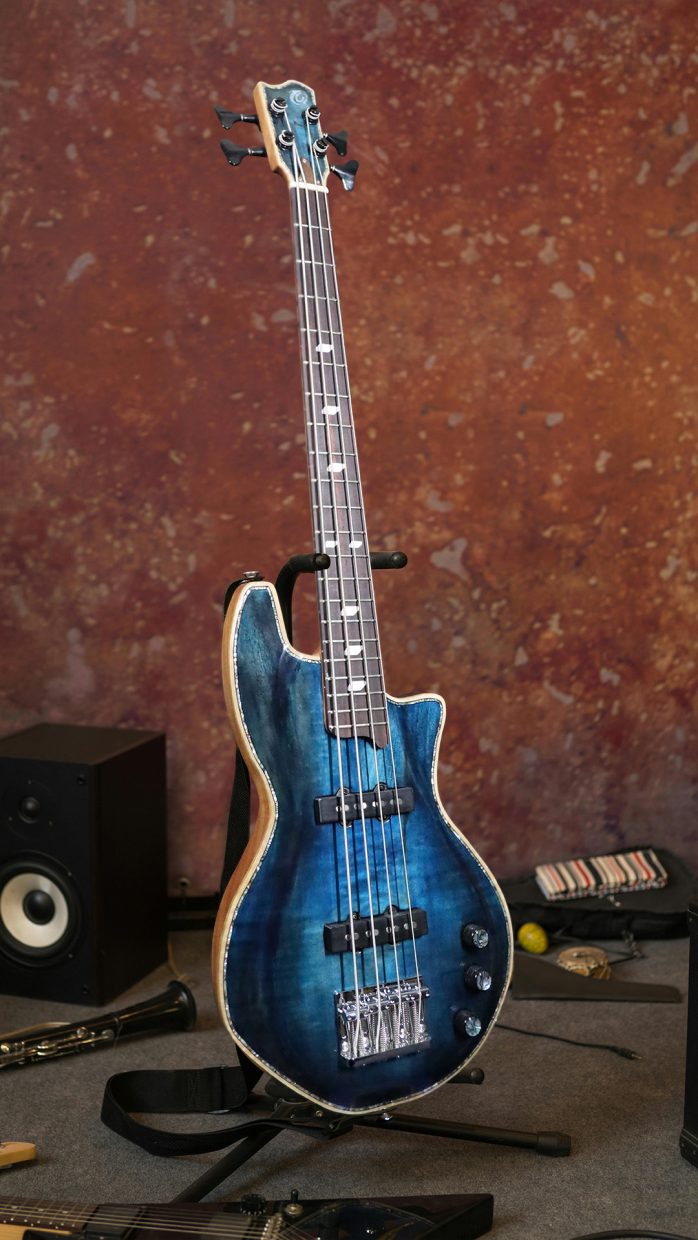
This month, Ohana debuts their Custom Electric Bass, also built by Brad Kahabka. The new instrument, which the company describes as “a counterpart” to their OBU-22 short-scale acoustic-electric bass, features a solid mahogany body, maple top, custom pickups, cutaway design, and 28-inch scale.


The brand new Ohana Custom Shop Electric Bass, which launched this month.

“We’re super excited to bring the first 28-inch-scale bass to market,” says Wu. “There are short-scale basses out there, but after trying different scales, Brad and Louis wanted something portable that we could make here in the shop. We wanted to come to market with this middle ground that still gives you the proper electric bass sound, but is more affordable and still does a lot.”

NAMM 2026 will mark the official kickoff of Ohana’s 20-year celebration, with other events and activities planned for the coming months. “We’ve been thinking about how we want to expand the family brand, ways we can look at to differentiate ourselves,” says Wu. “We’ve been successful in trying that out with our custom electric instruments, which can be additionally customized with different finishes, tuners, and other features. I think the future is in offering options to buyers and customers. We’re looking forward to exploring that more and offering some exciting things for our 20th anniversary.”

Once a wildly popular, then somewhat more niche, instrument – and, to some generations, an accouterment for tiptoeing through tulips – only to regain and increase its “cool factor” during the 2000s, the ukulele continues riding the crest of its popularity. (What could punch the uke’s “hip card” more than Taylor Swift…?)

“They call this the ‘third resurgence,’ this explosion of attention and rise in the number of ukulele players,” says Wu. “The pattern of history is that, in the last century, there were a couple of other rises and falls in popularity and maybe that’s the natural lifecycle of any instrument.

“What really pushed it along this time was the import side – specifically, affordable instruments made overseas, usually in China, but now also in Vietnam and Indonesia. You can pick up a ukulele for anywhere from under a hundred dollars to a few hundred. Making the instrument accessible that way, people took a new interest in ukuleles and stuck with them. There are also companies with longer histories that kept the torch going, and they, too, are part of this resurgence. Ohana began in 2006 and we’re proud to be a part of it.

“It’s been a community effort to get the instrument back on its feet and it’s staying popular. Music is somewhat recession-proof, at least on the stringed instrument side. Throughout COVID, also, people needed music and the ukulele community was able to provide that.”

Ohana keeps eyes and ears on the changing wants and needs of their growing family of customers. “The stereotype of a ukulele player was someone maybe a little older, or retired, or a person with disposable income and the time to play and collect different instruments,” says Wu. “Now, however, we have a younger demographic that is eager to get out there and explore. They see ukuleles all over TikTok, and that’s something we can’t ignore.

“We see patterns, we get feedback from our dealers and customers, and we also see that people of all ages like the baritone ukuleles, the larger instruments. Or they’re developing tastes for certain features: beveled edges, slotted headstocks, armrests, cutaways, different pickups. The options and combinations are endless.

“All of this plays a factor in our innovation, coming up with new combinations and new instruments that people are after. Going back to the baritone, for example, what used to be a one percent demand for that size instrument is now ten percent or more. That number doesn’t sound large on its own, but it is a significant jump. We keep a pulse on what’s out there, what people like or dislike, and we innovate based on that.”

One of Chris Wu’s personal and professional goals is to further expand upon the relationship between bluegrass and ukuleles. “I’ve learned a lot from our bluegrass players, including local players,” he says. “I don’t have a background in bluegrass, but I’ve learned from watching them play bluegrass on ukuleles how much can be created musically from that and in combination with other instruments as well.

“One of our new team members, who helps us with social media, played in a bluegrass band. Watching them go at it was just amazing, and I would really love to explore more of that. Ohana makes banjoleles, and we tried our hands once at a resonator ukulele. It might be time to bring that back. Who knows? As a company, I think bluegrass is something we could tap into.”

@ohanaukuleles @Bernadette from Bernadette Teaches Music demos the Ohana BK-70-8 Baritone from the More Than Four series! #baritone #baritoneukulele #multistring #morethanfour #ukulele ♬ original sound – ohanaukuleles

Integral to Ohana’s legacy and footprint as they enter their third decade is their philanthropic work and community involvement, including ongoing assistance with music programs following the Los Angeles wildfires of 2025.

“As often as we’re able, we love supporting the ukulele community far and wide,” says Wu. “It’s not such a big world, once you’re in it, and it is closely knit. Brands, manufacturers, artists – everyone knows each other, and it becomes even closer when organizations need our support. We do that whenever we can. It’s one of the crucial foundational things that Louis has always worked for with Ohana.

“A lot of times it’s local – schools and, lately, libraries that have started ukulele programs or clubs. We’ve partnered multiple times with the Los Angeles Public Library System as individual libraries have started programs. We provide support and ukuleles.

“A couple of years ago, after the unfortunate wildfires in Maui, one of our music store dealers on the island contacted us about helping rebuild school music programs. We shipped two large pallets of ukuleles to them. We’ve also partnered with Four Strings At A Time, a ukulele nonprofit in Hawaii, to help their local schools. On the continental U.S. side, there’s Ukulele Kids Club, which provides music therapy to children and also instruments to children in hospitals.

“As small as the ukulele community can feel sometimes, especially compared to the guitar community, there are still endless ways that people need support. It’s a blessing and an honor to be able to provide that to them.”

As Ohana moves into the fourth quarter of 2025, prepares for holiday sales, looks ahead to NAMM 2026, and plans its upcoming anniversary, Wu reflects on the year-to-date as “interesting, especially with the tariffs. Everyone has responded a little bit differently, but everyone has also been hanging in there, as much as I can speak for our music stores, our retailers, and the players,” he says.

“We’re looking forward to next year for new things, exciting things. It’s been interesting, but we’ve been getting through it and that’s all we can ask for.”


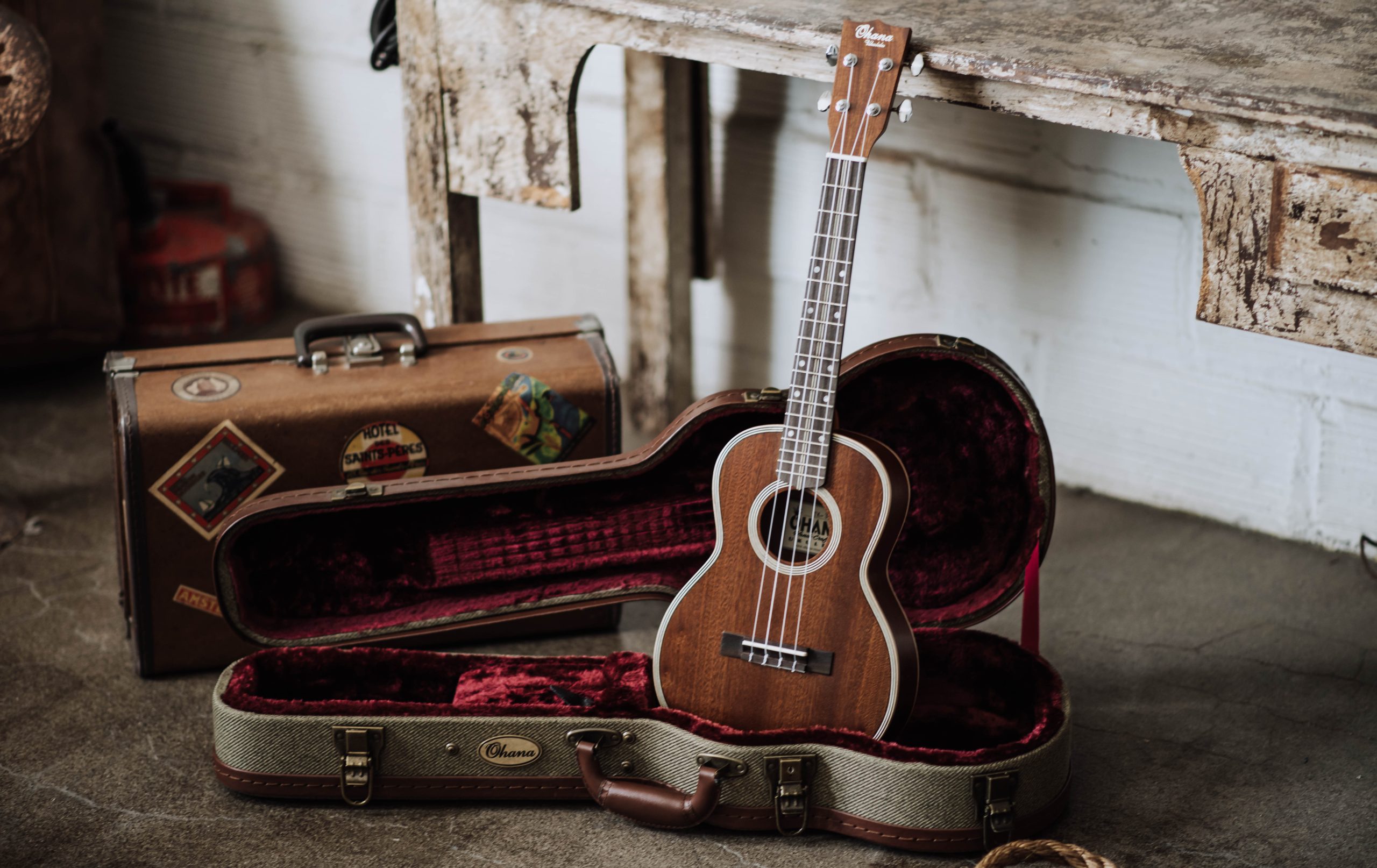
Ohana Vintage Line, 39 Series.


All images courtesy of Ohana Music. Lead image: Ohana O’Nina and Pineapple models lounge on the beach. 

Out Now: Lillian Werbin

If you’ve met Lillian Werbin before, you know that they possess a radiant energy and a deep love for community while working tirelessly to create a more inclusive music industry. Lillian is a behind-the-scenes star of the queer music industry. They are the Chair of the Board for Bluegrass Pride, they volunteer to support LGBTQ+ events, and they sit on the boards of International Bluegrass Music Association’s Foundation and the Rhapsody Project. In addition to all of this, they are the co-owner of Elderly Instruments and co-direct Midwest Banjo Camp, Midwest Ukulele Camp, and The Banjo Gathering

Lillan and I spoke together on a panel presented by Bluegrass Pride in 2023 at Folk Alliance International. The panel examined on a systemic level how the music industry can adopt more socially sustainable models of business, especially for folks who have been historically marginalized. Lillian works hard to promote inclusivity. They are a pillar of the queer music industry, a gem of a human being, and someone who isn’t often found on stage, but holds up the community from behind the curtain.

What is your greatest fear?

My greatest fear is having my intentions misunderstood. Being responsible for others and making decisions on their behalf can be nerve-wracking, and I like my reasoning to be clear.

What is your current state of mind?

Anticipatory! I feel I should state that my mother died earlier this year, so my “current state of mind” fluctuates regularly. In a year, there is so much to celebrate and mourn that I find myself generally in a state of anticipation of the next moment.

What would a “perfect day” look like for you?

My current ability to balance work/life can come down to the hour, as my personal and professional lives blend 7 days a week. A “perfect day” is when I’m able to accomplish what is needed professionally without sacrificing my personal relationships. Ideally, I’m awake before the sun, there are only a few tasks/meetings to accomplish, there’s at least 5 bouts of big laughter, and some time spent outside in the fresh air.

Why do you work in the music industry?

I can’t imagine being anywhere else. I find those who work in the music industry are a more serious type of authentic and genuine. Working from behind the scenes, I’m lucky enough to meet new people regularly. From the big smoke shows to hometown heroes, I find music lovers prefer to be unapologetically themselves. Which is interesting and entertaining most of the time!

When working on a project, what’s more satisfying to you, the process or the outcome?

The planning process is most satisfying and I enjoy the outcome more if I’ve helped execute. The process of taking a few ideas and elements, and building them into a project, can be magical for me.

You are the Chair of the Board for Bluegrass Pride. What drew you to getting involved with BGP? What do you like most about it? Are there any new projects that you’re excited about?

Yes, I’ve been Chair of Bluegrass Pride for a little over a year. I had been a board member and found I had more interest than my regular term. I enjoy developing programs and maintaining welcoming events for LGBT+ musicians. I’m most excited about our Rainbow Book initiative, which seeks to create a network of vetted venues to play and homes to stay. We launched the application process in early fall of 2023.

What has it been like for you to hold a behind-the-scenes role supporting queer music?

Being behind-the-scenes supporting LGBT and queer music allows me to revel in my own queer joy, which often takes a backseat to how I’m often perceived. When I’m able to fulfill these supportive roles, I feel more connected to the community.

In 2022, you won the IBMA Momentum Award for Industry Involvement. You are someone who is extremely involved. Could you share with us some of the great work you’re doing that led to this recognition?

My job by day is CEO and Co-Owner of Elderly Instruments, where I manage the overall business. It’s Elderly’s consistency that allows me to assist in other events and businesses in the U.S. I co-direct Midwest Banjo Camp, Midwest Ukulele Camp, and The Banjo Gathering. Aside from Bluegrass Pride, I sit on the boards of the International Bluegrass Music Association’s Foundation – where I am a committee member of The Arnold Shultz Fund – and the Rhapsody Project.


Photo courtesy of Lillian Werbin.

A Minute In the Pioneer Valley with Parsonsfield

Welcome to "A Minute In …" — a BGS feature that turns our favorite artists into hometown reporters. In our latest column, Parsonsfield takes us on a tour of the book mills and coffee shops of Pioneer Valley town Leverett, Massachusetts.

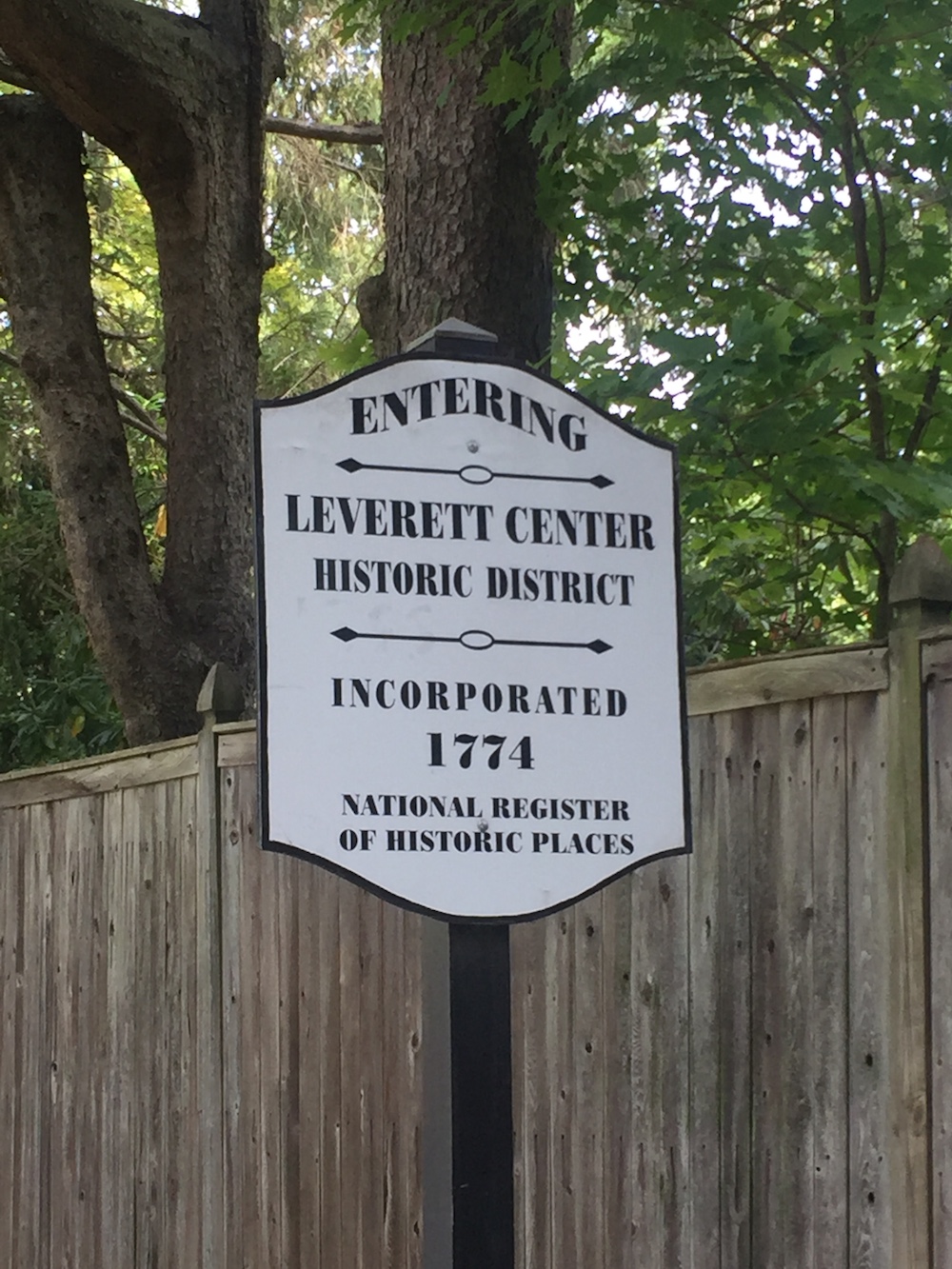
Usually when you tell someone you live in Leverett (unless they are in the Pioneer Valley, also known as the scenic I-91 corridor), they’ve never heard of it. The town is about 23 miles of mostly trails, ponds, and trees. Amongst these mysterious woods, we have found a few hidden gems we’d love to share with you. We’re proud to call this area our home. When you get to the Lady Killigrew, tell the staff that Parsonsfield sent you.

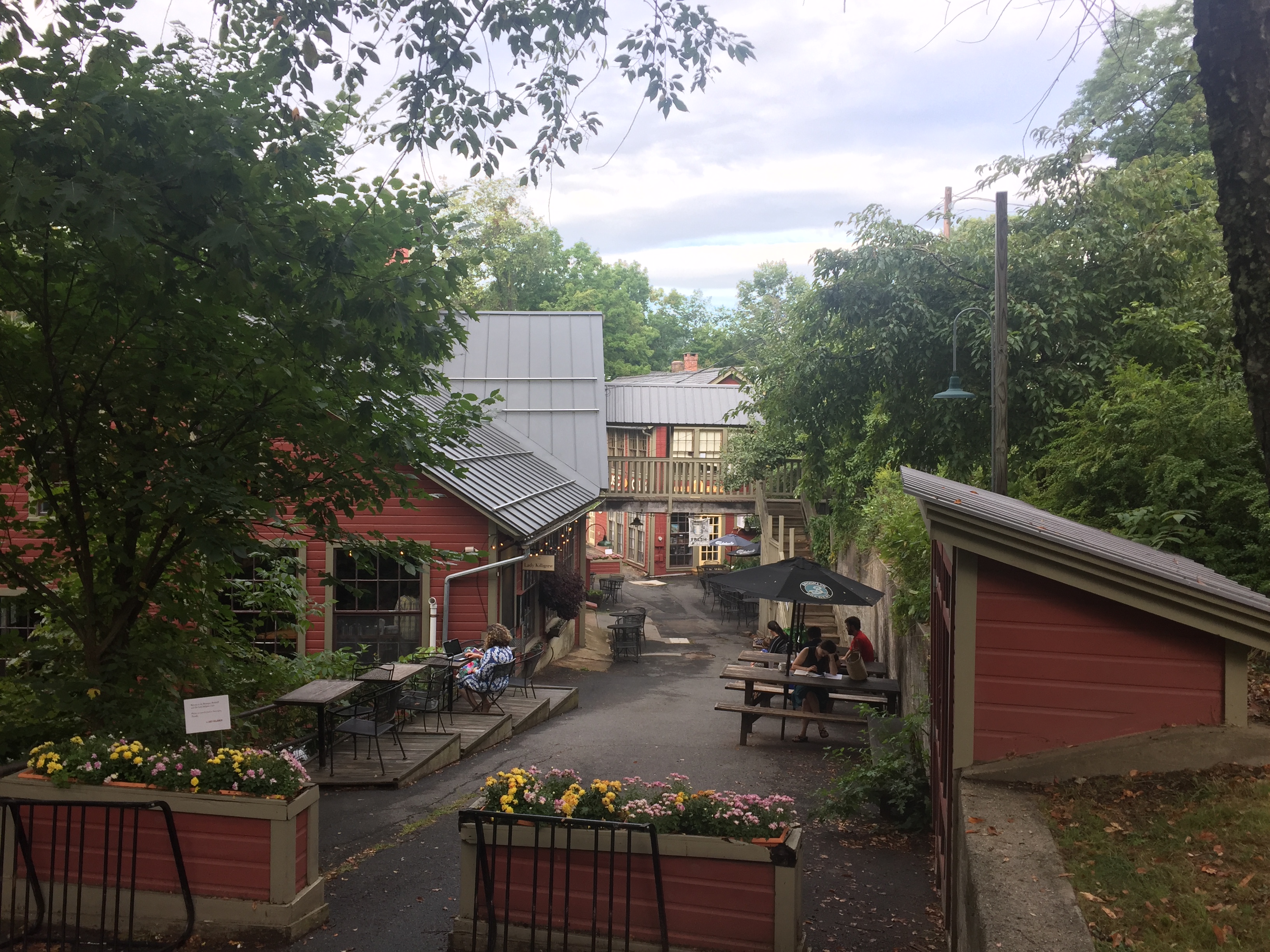
The Montague Book Mill: Their slogan says it all: “Books you don’t need in a place you can’t find." Once a grist mill, this unique building on the banks of the Sawmill River has been converted into a used book store, along with several other places to hang. Be careful: You may end up spending your entire day here. We certainly have. People have been known to make the 90-minute drive from the Boston area just to hang out here.

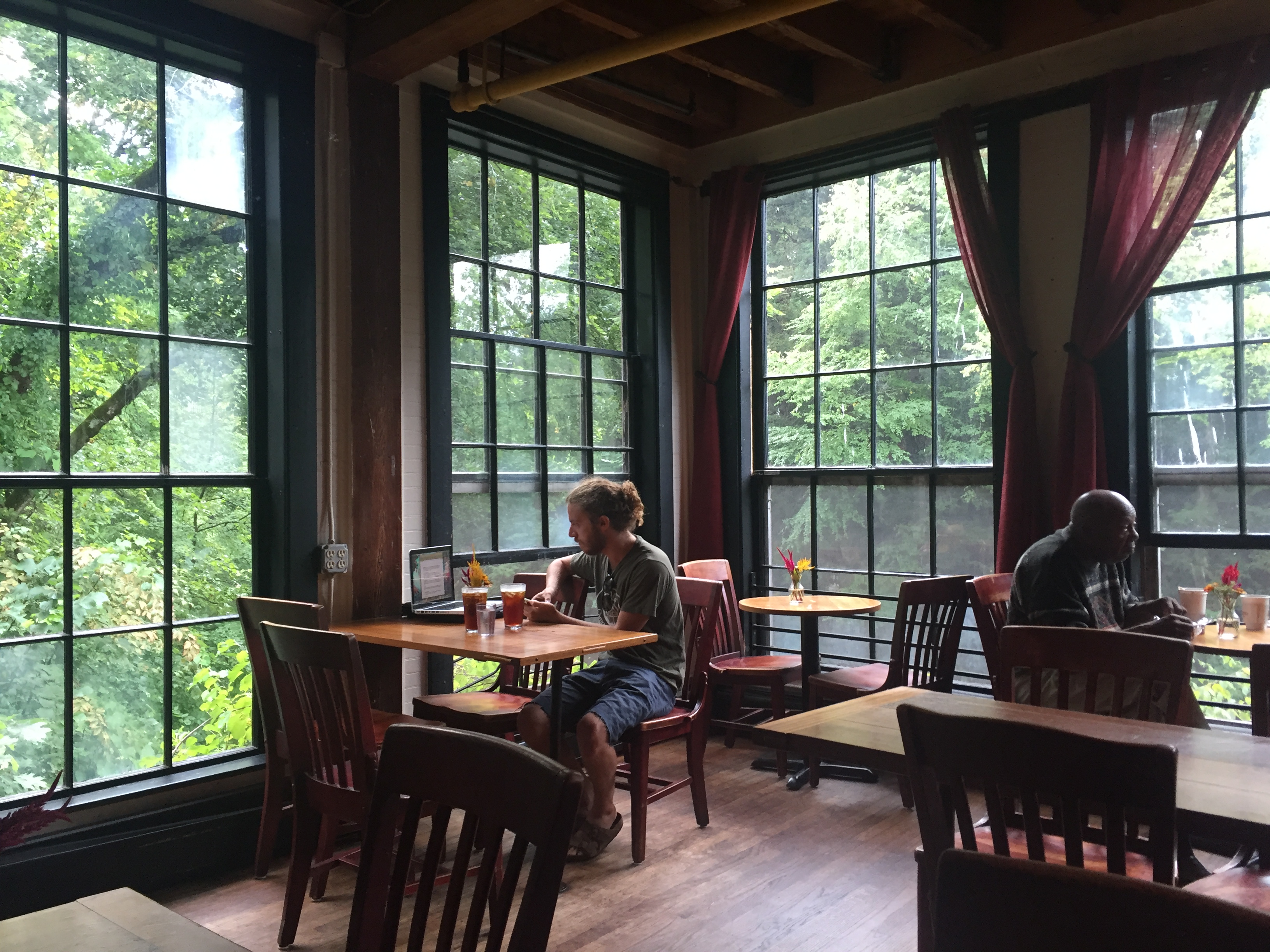
The Lady Killigrew: Step through a door in the book store and enter the absolute best spot for nitro-iced coffee and great sandwiches in a laid-back environment. Grab a table by the window and enjoy a relaxing morning overlooking the babbling stream below. If you go on a day we’re not touring, we’re probably already here. 

Turn It Up: Now that you’re all buzzed up on caffeine, walk across the courtyard to the record store. Although their other locations are a little bigger, somehow you always find something cool here.  

Lake Wyola State Park: If you’re here in the Summer, you can have a beach day without driving to the coast — our favorite spot in the area for a swim and a picnic.  

Peace Pagoda: “… A visible form of prayer for inseparable peace in the world and within the minds of all humanity.” Built in 1985, this is the first Peace Pagoda in North America and the one place you should not miss if you happen to be in Leverett. We’d rather not reveal its mystery, so take the short hike from the parking area to the top of the hill and enjoy what you see.

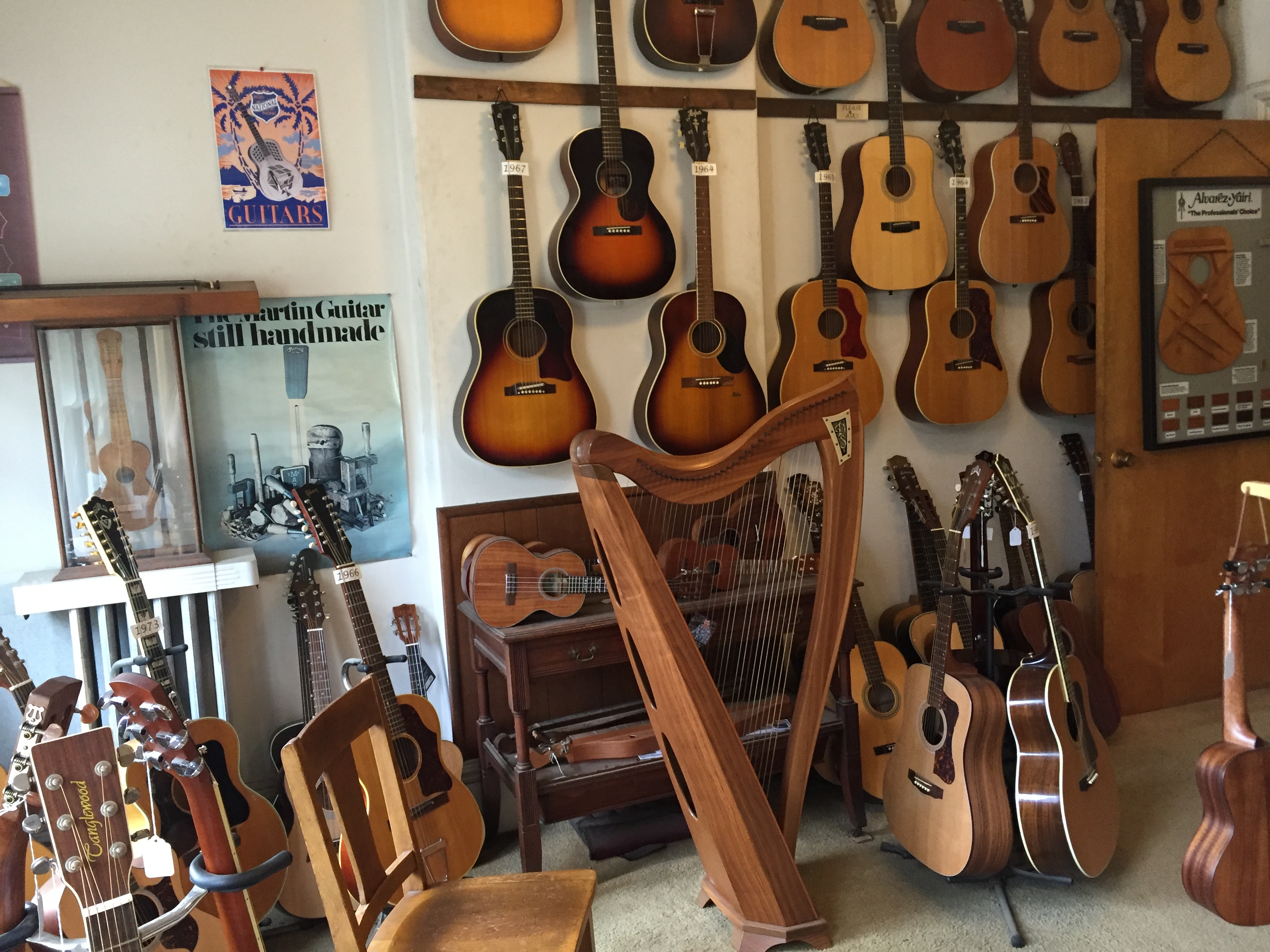
The Fretted Instrument Workshop: We think this may come of interest to some people who read a site that has the word bluegrass in it. Stop in for an unbelievable selection of new and vintage guitars, banjos, mandolins, and a few stranger instruments. This is where we bring our instruments for repairs, after we’ve rocked them a little too hard on tour. Tony will set you up with something real nice.

High Horse Brewery: As rock 'n' roll goes, our band is mostly filled with lightweight squares when it comes to drinking. In our first years of touring, we realized, if we take advantage of all the free booze at shows, we may sometimes wake up the next morning freezing cold, alone, and still on stage at a festival … That’s a story for a different outlet. However, when we’re at home, we like to whet our whistles here. Go upstairs to play some pool or downstairs for some great food. Either floor you choose, they’ve got great beer and cocktails.


After cruising through the Pioneer Valley, head down to Brooklyn and hit Victoria Reed's hot spots.


Lede photo by Shervin Lainez. All other photos by Parsonsfield, except High Horse photo by Brittany Ciullo. 

SaveSaveSaveSave