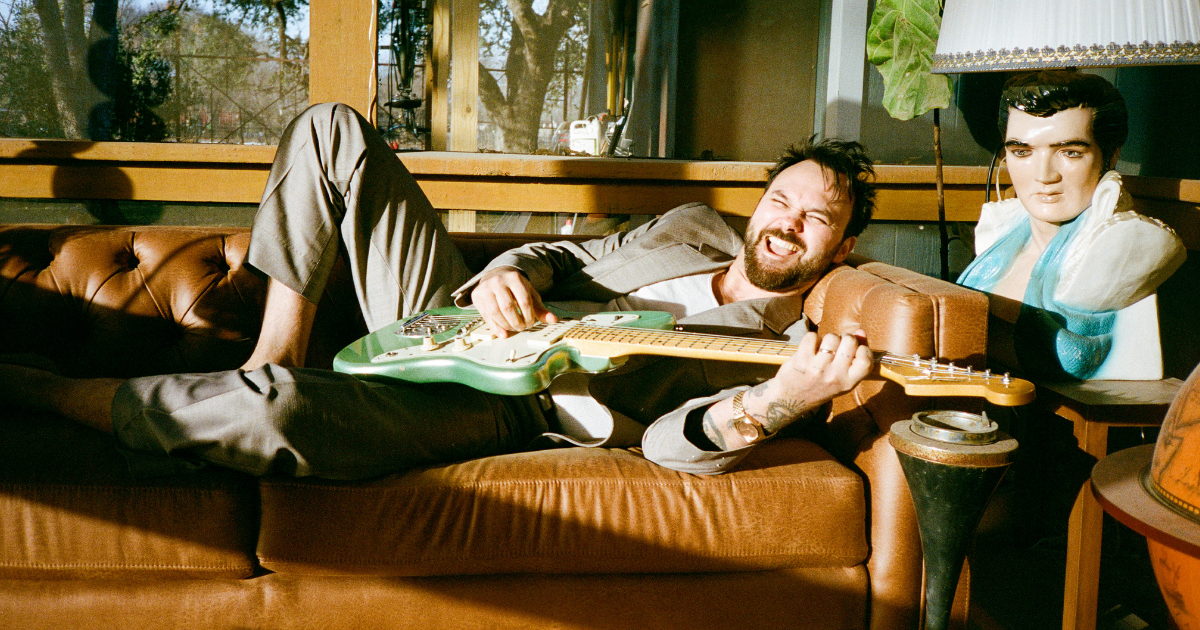
There has always been something uncontainable about Shakey Graves – a sense that his songs arrive not as glossy statements but as lived artifacts, scuffed at the edges, humming with the residue of wherever they’ve been. Born Alejandro Rose-Garcia, he first emerged from Austin’s DIY scene as a one-man band, stomping out rhythms on a suitcase kick drum while threading guitar lines that felt equal parts front-porch confession and desert hallucination. It was a sound built on immediacy and invention, earning him a devoted following long before the industry quite knew what to do with him.
That restless instinct runs straight through Fondness, Etc., his fifth studio album, due May 15, and the subject of the hour-long Artist of the Month conversation that follows. Where earlier releases by Graves leaned into the spectacle of one-man-band ingenuity, this collection turns inward – quieter, stranger, and more revealing. Recorded at home over a single, focused month, the album trades gloss for atmosphere, unfolding as a lo-fi meditation on time, memory, and the uneasy grace of becoming someone new while still carrying who you once were.
The record often feels more uncovered than constructed. Graves tracked the songs onto a pair of TASCAM tape machines, committing performances in ways that resist the endless revisions of digital recording. What remains are nine lived-in tracks that breathe with their surroundings – passing trains, stray birds, the soft blur of the tape – all of it absorbed into the music’s grain. In that sense, Fondness, Etc. becomes a document of a moment, caught before it could be refined into something less human.
That approach shapes the album’s sound, which drifts between avant-garde folk and restrained indie rock without settling too comfortably in either. Graves plays nearly everything – guitar, drums, synth, even Optigan – building arrangements that feel intimate but slightly off-center. There’s a tactile quality throughout, as if each sound has been handled, worn down, and set in place with intention rather than perfection.
“I Once Was an Ocean,” the album’s lead single, offers a clear window into that sensibility. Inspired by mid-century composer Martin Denny, the track re-envisions exotica through the stark geography of West Texas. It moves in a slow, dreamlike sway, as if the land itself were remembering what it used to be. The idea that the Big Bend area of the Rio Grande River was once a prehistoric ocean lingers beneath the surface, mirroring the album’s quiet fixation on change and the long arc of transformation – how nothing holds its shape forever, and perhaps never did.
Elsewhere, the album keeps its footing in that same reflective terrain. A cover of “Time Flies,” originally by Frankie Sunswept, is rendered with a measured restraint, its string arrangement adding a subtle weight to an already wistful meditation on love and impermanence. Across the record, Graves circles a familiar tension: how to hold onto the past without getting stuck in it.
That question carries added weight now. Removed from his early, road-worn persona, Graves approaches this work from a life reshaped by family and fatherhood. The songs don’t proclaim that shift, they absorb it. There’s a quiet awareness of time passing, of priorities morphing in ways that are less dramatic than they are decisive – changes that, indeed, tend to reveal themselves only in hindsight.
If there is a unifying thread here, it is the idea that imperfection can tell the truth more plainly than shine. By choosing limitation – tape over digital, immediacy over endless revision – Graves has made a record that resists easy categorization. It stands as a snapshot of a particular stretch of life, captured without much concern for how it might be received.
In the interview that follows, he traces that path with candor, moving between the making of Fondness, Etc., the milestones that have marked his recent years, and the earlier chapters that continue to echo through his work. It’s a conversation about process, memory, and the slow accumulation of experience – how a life in music is shaped not just by forward motion, but by the willingness to look back and take measure of what still lingers.
You’ve had an ongoing relationship with the Bluegrass Situation over the years, across different formats and moments. What has that meant to you?
Shakey Graves: I’ve always really loved the way Bluegrass Situation approaches things. It’s never just one lane – it’s a bunch of different formats, different kinds of events, different ways of presenting music. That flexibility feels true to how music actually exists in the world. I’ve gotten to be part of it at a bunch of different stages, and it’s always felt natural, never forced. There’s something about that openness that I really connect with.
Austin is a destination for so many people – a pilgrimage of sorts. But you were born there. What has it been like watching it change from the inside?
Growing up, Austin always felt small. Not isolated, but intimate – like a place where you could run into people you knew almost anywhere. Even as the capital, it had a small-town heartbeat. That’s probably the most noticeable shift: it’s now fully becoming a major city.
There was a time when “Keep Austin Weird” didn’t exist. That slogan showed up at some point during my lifetime and, honestly, people who grew up here didn’t feel like it was necessary. It was already weird. So when that phrase came along, it felt almost like labeling something that didn’t need to be labeled.
Now it’s different. The growth is real, the changes are real, but at the same time, the essence is still there if you know where to look. For me, Austin isn’t just a place – it’s the backdrop to everything I’ve done creatively. I don’t really know how to separate it from my identity.
Your parents were both involved in the arts. How did that shape your sense of what was possible?
They both ended up in Austin through the University of Texas theater department. My dad was a set designer, my mom’s an actor who later taught directing. So from the beginning, I was surrounded by people whose lives revolved around making things – plays, performances, stories.
But it wasn’t a traditional path. It wasn’t like there was a clear blueprint for success. I used to think of it as “magic beans income.” Somehow, through theater or dance or whatever project was happening, we’d get by. That unpredictability didn’t feel scary to me. It felt normal. What that did was make creativity feel viable. It never seemed unrealistic to pursue something artistic, because that’s what the adults around me were doing. The more I’ve traveled, the more I’ve realized that’s actually a rare environment. Austin gave me that without me even realizing it at the time.
What are your earliest musical memories – the ones that really stuck with you?
Music was always there, but it wasn’t always front and center. It was part of the atmosphere – something happening around me all the time. The first moment where I really engaged with it was in middle school. My mom let me go to a concert with my neighbor; we saw the Bloodhound Gang at La Zona Rosa. I got to come into school late the next day, which already felt rebellious. Then at the show, I got crowd-surfed, got kicked in the head – just total chaos. It was perfect. That’s probably my first vivid concert memory.
At home, my parents had their own band, Moon Coup. It was kind of this eclectic, world-music thing. There were always strange performances happening – Alejandro Escovedo playing in our backyard at a birthday party, stuff like that. It wasn’t polished or industry-driven. It was just… happening.
What about the records that shaped your taste early on? How did you discover music for yourself?
It was a mix of tapes and CDs, a lot of those old mail-order deals – buy one, get a bunch free. I got a steady stream of whatever my parents were into: R.E.M., Talking Heads, The Beatles, even Enya. For a long time, I didn’t really know what I liked. So I leaned heavily into soundtracks. If I loved a movie, I’d get the soundtrack, even if the music didn’t quite hold up outside the film. I had some strange ones – like the Predator 2 soundtrack, a lot of Alan Silvestri stuff. So my early listening habits were kind of all over the place. It wasn’t curated. It was just whatever stuck.
You’ve experimented with performance in a lot of settings, but busking never really stuck for you. Why is that?
I’ve barely done it – maybe a handful of times. It’s not something I enjoy. Even when I built my setup in LA, which could have worked for busking, it wasn’t about that. It was about having control over my sound wherever I went. I wanted to feel like I could present something intentional, not just fill space.
The challenge with busking – or even playing certain bar gigs – is that you’re often background noise. And I’ve always wanted the opposite. I want people to stop, to listen, to be pulled into it. I had friends who were incredible at busking. They had systems, routines, ways to make real money doing it. But for me, it felt like it took me away from what I actually wanted, which was connection.
Where did you first start playing your own material in a serious way?
A lot of that happened in Los Angeles. I was bouncing between LA and Austin at the time. One of my first gigs came through Craigslist – a Chinese restaurant on the [Sunset] Strip. I thought it sounded great. It wasn’t. I basically played to people who were just trying to eat dinner, yelling songs at them for half an hour.
Then there were the pay-to-play situations, like the Viper Room, where you had to bring a crowd or pay to perform. I didn’t always know what I was getting into, but I learned quickly. At the same time, I was playing DIY spaces – warehouse shows, house shows. That’s where things started to make more sense. When I moved back to Austin, everything clicked a bit more. I got a happy hour slot at the Hole in the Wall, and that place became foundational for me. It’s still one of the most important venues in my life.
You’ve said there’s no “right” or “wrong” way to make music. Where does that philosophy come from?
It’s something I come back to constantly. It’s kind of my guiding principle.
Recently, my daughter gave me a new perspective on it. She’s two, and at her preschool they were explaining how she loves the process of doing things. Like painting – she’ll get excited about setting everything up, picking colors, putting on the apron. But when it comes to the actual painting, she doesn’t really care about the result.
That hit me. Somewhere along the line, we lose that. We start focusing on outcomes – on whether something is “good” or “successful.” But the process is the real thing. You don’t need a studio or a perfect setup to make music. You can make it with anything. What matters is that you’re engaged in it. Some days I feel completely lost with my gear and other days everything aligns. That unpredictability is part of it.
How has fatherhood changed the way you approach your work and your life?
It shifts everything. Suddenly, the stakes are different. Spending hours worrying about a reverb setting feels a little absurd when you’re also responsible for raising a person. But at the same time, I’ve realized how important it is to hold onto your sense of self. Parenthood can completely disrupt your routines – everything you’ve built to manage your life just gets wiped out. You have to rebuild from scratch. That process – figuring out how to balance those things – is a big part of what this record came out of. It’s not about losing one identity to gain another. It’s about learning how to carry both.
Fondness, Etc. feels reflective, even intimate. How did it take shape?
It felt less like building something and more like uncovering it. Like an archaeological dig. I don’t usually go in with a clear concept. I start with a song, or even just a feeling, and follow it. The first piece was “When the Love Is New,” which I wrote before my daughter was born. It had a certain honesty, a kind of Western tone, and that became the direction. From there, the record revealed itself as a series of vignettes – little snapshots of relationships. Not necessarily my own, but drawn from experiences, observations, stories. It’s not linear, but it’s cohesive in its own way.
Big Bend shows up in your writing. What draws you to that landscape?
It’s an otherworldly place. Growing up in Texas, you learn that it was once a shallow ocean and when you’re out there, you can almost see that history. It looks empty, but it’s full of life – you just don’t always see it. That contrast is something I connect with. Texas in general has that dual nature. It’s complicated, layered, sometimes contradictory. No matter who you are, there’s a little bit of that mythology in you if you’re from Texas. Big Bend just makes it visible.
You’ve also talked about exotica music influencing you. What appealed to you about that genre?
I got into it pretty late – about 10 years ago – and then went all in for a while. What I love about it is that it’s not literal. It’s music imagining a place rather than representing it. It’s like fictional geography in sound form. That idea resonates with me. I’m not a traditional country artist, but there’s something Western in what I do. It’s not about authenticity in a strict sense – it’s about interpretation, imagination.
As a DIY artist, who helped shape your sense of independence?
Elliott Smith was huge for me – someone who could do everything himself. And Beck, especially One Foot in the Grave. That record felt chaotic and free. Hearing that made me realize there were no rules. Songs could be short, messy, weird – whatever they needed to be. That freedom has stayed with me.
Your audience has grown steadily over time. What does that connection feel like?
It means everything… The first time someone I didn’t know – someone far away – connected with my music, that was it. That was the moment I felt like I’d made it. What’s really amazing is how people continue to discover it. There’s always a new group coming in, finding something in it that I might not have even intended. That’s incredibly comforting.
Have you ever felt like walking away from it, or has it always been forward momentum?
I’ve never really felt like quitting, but I do think about expanding. If I could go back, I might have separated some of my projects under different names, just to give myself more freedom. Everything being under one umbrella can get a little limiting. Moving forward, I want to collaborate more, experiment more, maybe not always be the center of it. That feels exciting.
Storytelling is such a big part of your work. Where does that come from?
It’s always been there. My family are storytellers, my dad especially. And then there’s what I grew up on: Calvin and Hobbes, The Far Side, The Simpsons, Shel Silverstein. Those things are deceptively deep. They’re funny, but they’re also philosophical. Later, hearing artists like Townes Van Zandt or Tom Waits, it felt like a natural extension of that. Storytelling through music just made sense.
There’s a remarkable story behind the 1932 Gibson L-7 guitar that you’ve recorded with on this new album and other previous offerings. What does that instrument mean to you?
It’s one of those things that feels almost mythic. I met a guy at a weird speakeasy in LA, a bar in the warehouse district when I was figuring out who Shakey Graves was. After talking for a while, he told me he had this guitar – his grandmother’s boyfriend had owned it. The guy played on the Chitlin’ Circuit, took it to World War II, survived a fire that burned his hands, but still kept playing. It was a crazy guitar with all of the newspaper clippings of the guy who played it.
After the ten-year anniversary of my first album, Roll the Bones, the guy I met in LA gave it to me. When I first handled it, it was this stubborn, living thing – it didn’t want to stay in tune, felt like it had its own personality. But I connected with it immediately. I wrote some of my most important songs on that guitar. Then I broke it. The neck snapped clean off. It stayed like that for years before it was finally restored. Getting it back for this record felt like being reunited with something essential. Like picking up a tool that had shaped you in the first place.
What do you want at this point in your life and career?
I want everything. I want contradiction. I want to be obscure and famous. I want to be a family man and also like a scamp disappear into something unpredictable. I don’t think I’ll ever stop wanting all of it at once. That’s kind of the beauty of it. I don’t think I’ll ever be able to stop wanting every opposing direction in some shape or form.
Explore more of our Artist of the Month content on Shakey Graves here.
Photo Credit: Jonathan Terrell