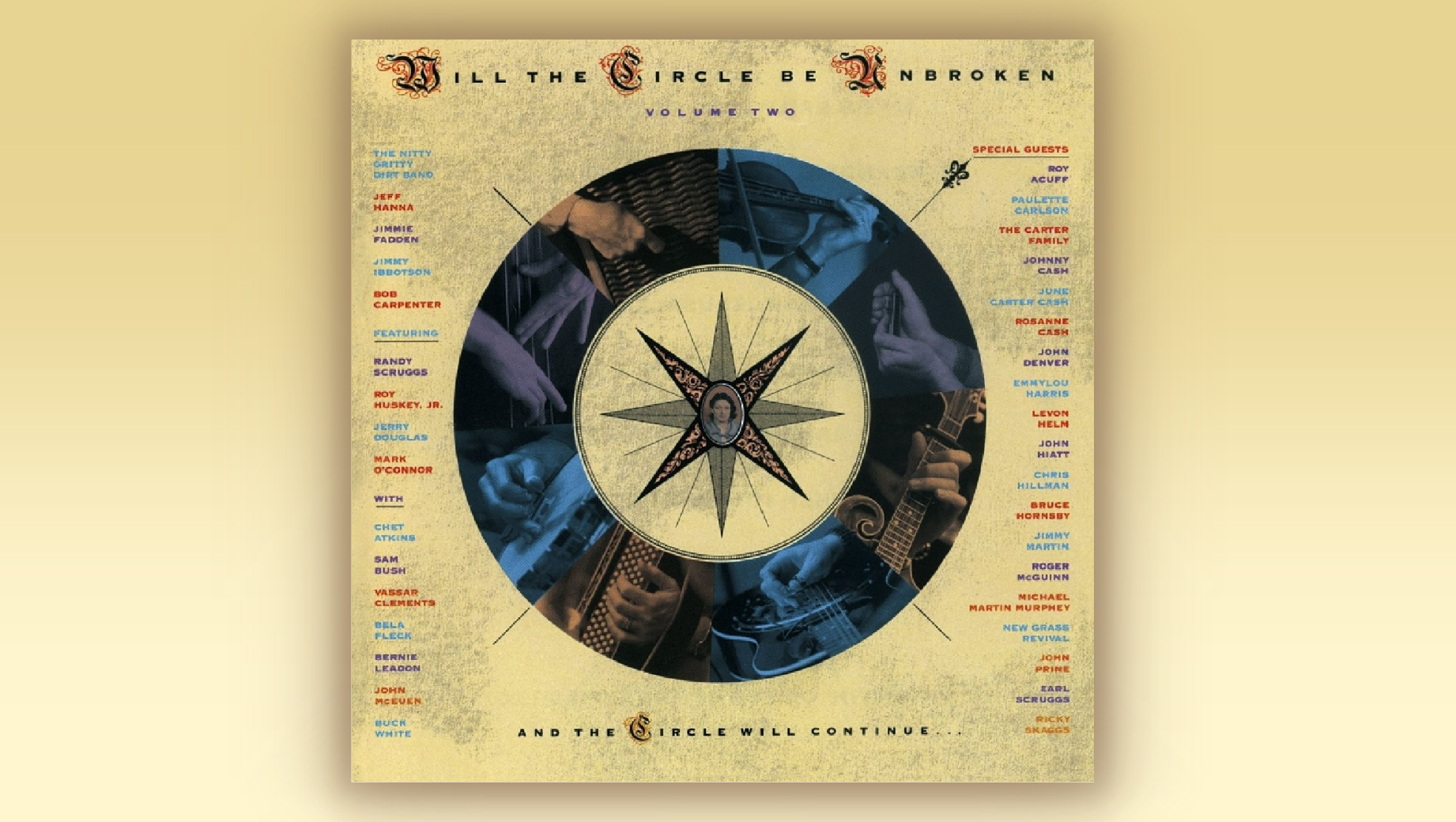
Nitty Gritty Dirt Band’s Jeff Hanna Reflects on ‘Will the Circle Be Unbroken, Volume Two’

Why mess with a classic? That was the original thought from a few members of Nitty Gritty Dirt Band when the idea was presented to record a sequel to their seminal 1972 album, Will the Circle Be Unbroken.

However, with encouragement from one of the group’s biggest fans, the legendary June Carter Cash, the recording sessions for Will the Circle Be Unbroken, Volume Two commenced in the winter of 1988, with a cast of accomplished musicians who are now considered cornerstones of Americana music.

Often referred to simply as Circle 2, the acclaimed project was released in 1989 and went on to win three Grammy Awards and a CMA Award for Album of the Year. To commemorate its 30th anniversary, Jeff Hanna shares its back story with the Bluegrass Situation.

Editor’s Note: Jeff Hanna and guest Sam Bush will participate in a screening of clips from a documentary film, The Making of Will the Circle Be Unbroken, Volume Two, at the Country Music Hall of Fame and Museum in Nashville on Wednesday, September 11 at 11 a.m., during AmericanaFest.

BGS: Can you explain why Circle 2 is such an important album for the band?

Hanna: It’s important in our history because at that point, we were no longer just the kids. We were all in our early 20s when we did the first Circle record, making music with those revered folks. And so we had a different point of view, somewhat. Here we were in the midst of our mainstream country career, and we still revered the first album.

The way we viewed Circle 1 was like something untouchable – just leave it. It is what it is. As time went on and as that project matured, it mattered a lot to a lot of people, including us. So we resisted the concept of doing another Circle record. Especially me, Jimmy Ibbotson, and Jimmie Fadden. Bob Carpenter was like, “I didn’t get to play on the first one! I wasn’t in the band! I want to do it!” He was pretty excited about the concept, and Chuck Morris, our manager at the time, brought it up a bunch. But we waited a while, and by the time it came out, it was 17 years between the releases.

When did you decide to move forward with it?

We were on tour with the Johnny Cash show, which included the Carter Family, and we were in Europe. I think it was in 1988 in Switzerland. June came into our dressing room — and she would visit us a lot. She was really sweet and she loved to talk about Mother Maybelle, and how much she loved us. She called us “them dirty boys.” I love that. And at the end of the conversation, she said, “You know, if you all ever thought about doing another Circle record, John and I would really love to take part in it.”

That was the tipping point. If you have that sort of endorsement from folks we idolized, and who were so important in the history of this music – and music in general — we thought, “Well, there you go.” That’s what we did. The winter of ’88, we started making calls.

How did you come up with the guest list, so to speak, for this one?

Our approach was to delve more into the next generation of folks, like New Grass Revival, and certainly a lot of our singer-songwriter buddies, like Bruce Hornsby, John Hiatt, Rosanne Cash, and John Prine. We had only recorded a little bit with Emmylou Harris and we really wanted to work with her. And we were really excited to do a record with Levon Helm. That was one of the highlights.

I think the collaborative spirit of this album really shines through when Bruce Hornsby is playing “Valley Road” with you guys.

I’d never met Bruce Hornsby but I was a huge fan of his music. I heard “Every Little Kiss” on the radio and it just blew me away. But then I’m reading an article in a magazine, and it was a “desert island disc” thing, talking about the records that you’ve gotta have, and he mentioned Will the Circle Be Unbroken. It was like, WOW! So I somehow got his phone number, I called him up — cold-called him — and he said, “Oh yeah, man, I love that record, I love you guys.” I said, “You’ve seen us play?” He said, “Yeah, my brother and I sneaked in.” We were playing a college show in his hometown, and those guys started carrying amps into the venue. We were unloading the truck and they started carrying gear in, and ended up sort of hiding behind the bleachers, and when the show started, came out and watched the show.

We hit it off right away, so there’s a direct line to Circle 1 right there. And when we were putting together our core band for the sessions, of course we included our buddy Randy Scruggs (who was on the first Circle album), Roy Huskey Jr. (whose dad Junior Huskey played on the first album), Jerry Douglas, Mark O’Connor… It was so much fun walking in and making music with those guys every day. Chet Atkins is on a track and played one of my guitars, which I liked. I know I’m never selling that guitar.

One of the coolest tracks on there is “You Ain’t Goin’ Nowhere.” How did that come about?

We brought in Roger McGuinn and Chris Hillman, because the Byrds and the Flying Burrito Brothers were so important to us. The Byrds had done Dylan’s “You Ain’t Goin’ Nowhere,” but they wouldn’t play it on country radio, so we cut a version of “You Ain’t Goin’ Nowhere” with Roger and Chris, and it became a Top 10 country single, which we thought was cool redemption. We were really excited about being on the track with them. We still play that tune now and again. That’s one of our favorites. We’re really happy to have a good excuse to play it, because for years we played it in sound checks anyway.

It’s been 30 years now, but what do you remember about how Circle 2 was received upon release?

Perhaps because we had the platform of being a hit country band right about then, the label promoted the heck out of the record when it initially came out. And it had hits on it, that’s the other thing. Circle 1 didn’t really have any radio impact, whereas Circle 2 had “You Ain’t Goin’ Nowhere,” and we had a song called “When It’s Gone” that was a Top 10 single.

It’s a significant record and it’s funny, having been there from the get-go with this band, and having that first Circle record so deeply ingrained in my DNA, I sometimes forget how important Circle 2 was to a lot of folks. I’ve had more than one songwriter and musician tell me, “That’s what got me into you guys.”


Nitty Gritty Dirt Band: An Unbroken Circle

In 1971, Richard Nixon was president and the United States was divided. It was an era marked by civil rights struggles, Vietnam War demonstrations, and labor union losses. The counterculture movement that evolved in the 1960s was continuing to take shape and was intrinsically linked to the outpouring of a whole generation’s worth of musical innovation. Amidst social upheaval, at a time when your music reflected your politics, a common ground was forged among unlikely sources. The Nitty Gritty Dirt Band’s milestone 1972 album, Will the Circle Be Unbroken, single-handedly bridged generational and cultural gaps by pairing country music veterans with young hippies from Southern California.

“I don't think we realized the sociological impact that that record would have,” says Jeff Hanna, founding singer and guitarist of the Nitty Gritty Dirt Band. “On the surface, it looked like, 'What the hell are they doing making music together?'”

The Nitty Gritty Dirt Band formed in Long Beach, California, in 1966 and became a staple of the wave of California rock that included acts like the Byrds, the Flying Burrito Brothers, and the Eagles who were all exploring old-time country sounds in their own music. By the time the recording sessions for the Circle record began, the Dirt Band was fresh off the success of their cover of Jerry Jeff Walker’s “Mr. Bojangles,” which had become a Top 10 pop single. Record executives and fans, alike, were anticipating a follow-up in the same vein. But the band’s manger and producer, Bill McEuen — brother of band member John McEuen — had another idea: to get the band in the studio with the bluegrass and country musicians that had influenced them when they were coming up.

“I have a lot of respect for [the Dirt Band] for doing it, for going out on a limb, you know, and doing that kind of thing in the middle of a career that was just really on its way up at that point,” says multi-instrumentalist and longtime Dirt Band collaborator Jerry Douglas. “They were the famous people on the record and their guests were the people that they were introducing to their audience, you see. So it was kind of going out on a limb for them. You know, the record company didn't wanna do it. Nobody wanted to do it. They just kind of pushed it through and it was a success.”

When it came time to recruit a slew of Nashville greats for the project, the generational divide ended up working in the Dirt Band’s favor. Their friendship with the Scruggs family began when Earl Scruggs brought his children, who were fans of the band, to a gig they played at Vanderbilt University in 1970. Scruggs became the first artist they invited to guest on the Circle record. They snagged Doc Watson the same way: his son, Merle, was a fan of the band.

“One of the things that was really interesting with a lot of these acts is, their kids were fans of the band. There was kind of a stamp of approval from the younger generation,” recalls Hanna. “And Merle Watson said something like, ‘Well daddy you love the way they sing and play.’ And also the invitation was, ‘We've got Earl Scruggs.’ And Doc said, ‘Yeah, that sounds like fun,’ so there it went.”

Other guests included heavyweights like Jimmy Martin, Mother Maybelle Carter, and Roy Acuff.

“I mentioned to Bill McEuen, at one point, that I'd read this article about Roy Acuff where he said he'd play real country music with anybody anywhere. And we talked about that and Bill said, ‘Well, let's see if he'll put his money where his mouth is,’” Hanna says.

But Acuff wasn’t an easy sell: His initial meeting with the band didn’t go as well as they were hoping. It turns out that the idea of West Coast hippies in their early 20s recording in Woodland Studios in Nashville was a bit of a hard pill to swallow.

“[Acuff] came in and he was just largely unimpressed with us. He was kind of like — he wasn't totally negative — it's just kind of flat and he said later, ‘Well, I don't trust a man that I can't see his face,’ and we all had like massive beards and mustaches and long hair,” Hanna remembers. “Meanwhile, we got in the studio and recorded our tracks with Merle Travis and, lo and behold, Roy Acuff comes strolling in, or sort of quietly walks in the back of the studio at the end of the day. And Bill played him — it was either ‘Nine-Pound Hammer’ or ‘Dark As a Dungeon’ — one of those. And Roy got this big smile on his face and he said, ‘Well, that ain't nothin' but country. I'll be here tomorrow. Be ready.’ So we cut those tracks, so he was in.”

The result was a monumental cross-generational album that combined genres and styles.

“Just to put it in context: You've got Merle Travis's Travis-picking; you've got Earl Scruggs' Scruggs-style banjo; you've got Maybelle Carter, Carter scratch; and Doc Watson — even though flat-picking isn't named after him, it should be,” says Hanna. “I mean, just all these guys that were just so big in our world.”

The Dirt Band’s love of country and old-time sounds goes way back, so it was a natural progression for them to want to honor and record with these musicians.

“A lot of us got into bluegrass because of the folk boom in the mid-60s. A lot of us also had older siblings and they'd bring home these records by Peter, Paul, and Mary or the the Kingston Trio,” says Hanna. “When I first started playing guitar, I bought a Pete Seeger instructional LP and book that had a section about the Carter Family and Maybelle Carter and her playing style, as well … I was a huge fan of the Everly Brothers. We all were. The Everlys, Buddy Holly, Eddie Cochran, Chuck Berry, Little Richard: that stuff killed us. But I think something we all had in common was our deep love of the sounds of Appalachia. And blues for that matter. But a lot of it was acoustic music, I've gotta say.”

Singer/songwriter Jackson Browne joined the Nitty Gritty Dirt Band when he was 17 years old, after meeting them at a gig at the Paradox club in Tustin, California, a little town in Orange County. “Getting to play with them was a huge installment in my musical education because I got to sit there and play these really intricate songs,” Browne recalls. “I mean, they were all better players than me, so I learned a lot.”

What struck him immediately about the band, he says, was their vast musical palette.

“The Dirt Band was great because they were true music fans and music aficionados. They weren't just kids that were playing folk music that they heard. They dug deep, is what I'm saying,” says Browne. “They found recordings of the Memphis Jug Band and those things were hard to find. I mean, like that wasn't just lying around. And they were kind of musicologists even then, from the very beginning.”

This year, the Nitty Gritty Dirt Band celebrated their 50th anniversary as a band. In commemoration, they returned to Nashville for a star-studded concert at the famed Ryman Auditorium last September, which aired on PBS and was released on DVD. Aptly titled Circlin’ Back, the show was both a nod to the first Circle record and a career retrospective that incorporated the musicians that have impacted the band’s history. Vince Gill, Alison Krauss, Rodney Crowell, Jerry Jeff Walker, John Prine, Jerry Douglas, and Jackson Browne were among the handpicked guests.

“What was even cooler to me than playing the show that night was the rehearsals that we had before,” Douglas recalls. “The first time you do a run-through of one of those songs is so magical. It has all of this extra spark and fear and everything in it. So there were sparks flying in the rehearsal hall when we were doing these things and trying to figure out who played on what.”

Just as the Dirt Band introduced their audience to their earlier influences on the first Circle record, the Circlin’ Back anniversary show connected the next generation of artists and fans together. Musicians like Vince Gill and Jerry Douglas, who remember buying the first Circle record when it came out, are now considered “little brothers” of the Dirt Band. Although they are each musical powerhouses in their own rights, the anniversary show was an opportunity for them to play with some of their heroes.

“I think the first time I played on the song with Jackson Browne that I played lap steel on, I held my breathe through the whole thing,” Douglas says. “I'm such a fan of all of those guys and then they bring Jackson Browne in, and I'm playing on this thing with Jackson Browne and I'm just going nuts inside. So much raw emotion that's happening.”

The Nitty Gritty Dirt Band has always had the ability to tap into emotion. Through their shared love of traditional music, they impacted legions of listeners by bridging generations and styles. Their legacy is littered with stories of parents and children bonding over the first Circle record, which is arguably one of the most significant releases in the history of music. At a time of cultural unrest, it showcased music’s ability to bypass divides and cross boundaries. The Nitty Gritty Dirt Band was Americana before Americana had a name, and their genre-bending illustrates the most important facet of music: how it connects us all.


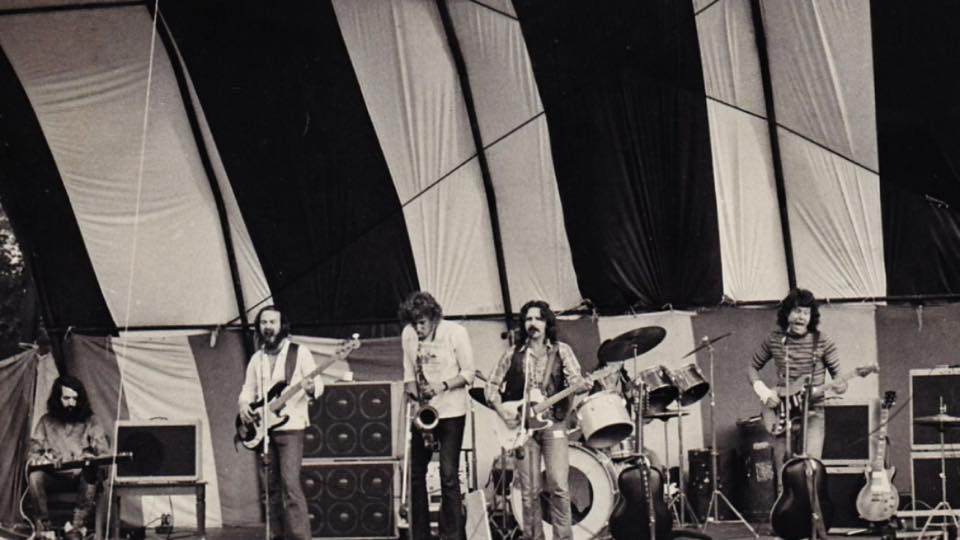
Photo of the Nitty Gritty Dirt Band in the early 1970s courtesy of the artist.