Somethin’ About Train Songz

What first began as a locomotive and string music meme page has transformed into one of the most quirky and beloved sources of independent journalism in roots music, one zine at a time.

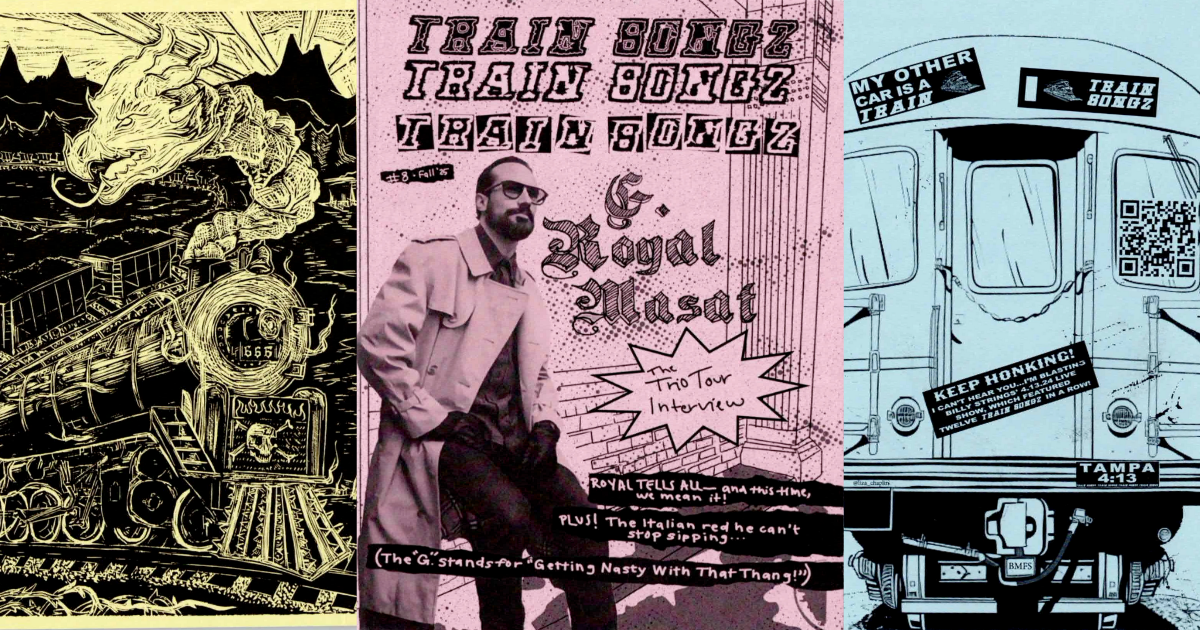
Founded by Anthony “The Conductor” Perasso and James “Promontory Paul” Lucey in July 2023, Train Songz has since grown its community to over 28,000 Instagram followers and more than 1,200 paid subscribers. Readers collectively contribute anywhere from $33-$99 per year (or $11 per copy), with three to four issues published per year. The latest, eighth edition features a 44-page interview with Billy Strings’ bassist Royal Masat.

The interview for Masat is a full circle moment for Train Songz, which began with a Billy-centric focus before expanding to feature other bluegrass acts like Mountain Grass Unit, East Nash Grass, and Valley Flower. In fact, it was a Billy Strings show in Bridgeport, Connecticut, attended by Train Songz co-founders (that they rode the train to themselves, no less) where the concept for the then-meme page first came together.

“At the show Billy was wearing a hickory-striped railroad hat that someone (who we’ve since connected with on Instagram) threw up on stage a few shows prior, as trains were passing by the stage,” recalls Perasso.

“I tweeted from my personal account a photo of Billy with the hat on and the caption ‘Train Songz,’ which was a Trey Songz pun – like if Trey Songz is Trey Songz, then Billy Strings is Train Songz,” Perasso laughs. “Four days later, I locked down the @train_songz username and posted our first meme.”

After publishing some popular Billy and Grateful Dead inspired memes, Train Songz began transitioning to a zine in December 2023, while Perasso was home for the holidays and more sedentary than usual after recovering from multiple surgeries. No stranger to producing print media, having previously worked on a satirical newspaper while in college, he says the zine quickly filled a void left empty since graduating in 2017. Now two years in with eight installments of the printed zine, Train Songz has grown into a thriving community bigger and wilder than Perasso, Lucey, and the rest of the core team – including Liza Chaplin (art/design) and Mitchell “Brakeman” Harbin (writer/editor) – could have ever imagined.
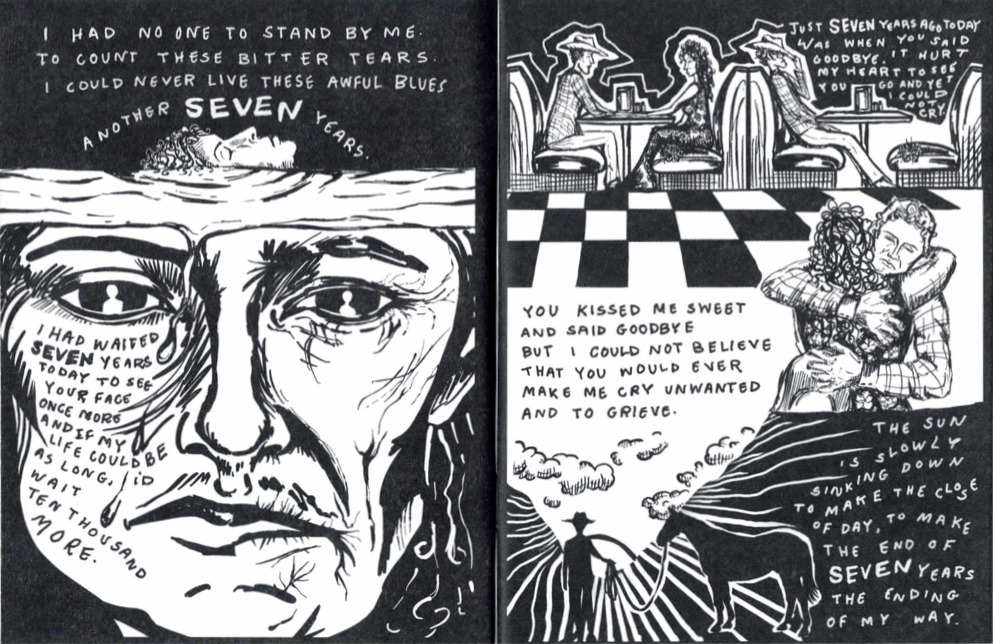
Original artwork by Morganne Allen from ‘Train Songz’ Vol. 7, Summer 2025.

“Beyond my personal penchant for print, Train Songz was gathering a community of wooden-instrument-music enjoyers, so print felt like a natural extension of that vibration,” Perasso continues. “And from a more boring media strategy point of view, print (and email!) offers you a direct relationship with your audience that algorithms can’t get in the way of and platforms can’t take away. So for both those reasons, a Train Songz zine felt like a perfect move.”

After wrapping up production on the eighth installment of the zine, the Train Songz crew spoke with BGS via Zoom about the zine’s origins, how they first discovered Billy Strings, the publication’s next steps for growth, and more.

Y’all use pen names in the zine (except for Liza). How did each of you come up with your alter egos?

James Lucey: Before I get to that, I’ll just add that leading up to this interview we all debated if we should do this as ourselves or go by our pen names. It’s been an interesting dynamic, [navigating] who are we in relationship to the zine [and] what the zine is in relationship to us and our audience. We made the zine to try and participate in some way in the broader conversation about modern-day bluegrass music; we’re not the face of the zine, we’re just the people that are powering it.

But regarding my pen name, “Promontory Paul,” he’s the voice of the Old Tune Review, which is one of the core pieces of the zine. In it we pick a handful of old songs [and] dive deep into [their] history through independent research. It’s born out of the idea that these old songs are still being played today and still resonate in some way. In some ways it’s like a time machine, because you’re feeling the same emotions that someone felt hundreds of years ago when they wrote these things. So it’s cool to dive in and see what the actual genesis of those songs are.

[Paul’s] the guy who runs that, but we also feature him in a little recurring cartoon series that sees him playing banjo and getting into all kinds of crazy adventures. “Promontory” is a reference to the Promontory Summit, which was the final completion [point] of the first transcontinental railroad in Utah, when the Union Pacific Railroad and the Central Pacific Railroads (which had been building from Nebraska and Sacramento, respectively) finally met.

This effectively connected the old world with the new one, sort of like what we do with the zine.

Mitchell Harbin: My name actually came out of the fact that a brakeman is a role on an actual train – he’s the guy that pulls the brakes. It was actually during the production of the zine’s third issue that I had come aboard to help with proofreading and copy editing. There were a couple of times in that process where James and Anthony were like, “Alright, we’re good to go, ready to launch” and I would pump the brakes and say, “Whoa, hold up.” Which is what eventually spawned the name idea.

Liza Chaplin: I’m still working on mine. [Laughs] It’s an ongoing thing that I’ve been thinking about, but so far I haven’t gotten anywhere with it. At first I decided to put my own name on it to use as a portfolio-building mechanism, but now with how the zine has grown it feels very silly to still have my actual name on it.

Anthony Perasso: “The Conductor” came to be when James and I were talking about taking the meme page offline [and moving] into print form with our first issue. We made a decision that Train Songz was the name of the publication and brand and community – or whatever vibration of people who value the same kind of music as we do, cultivating this eponymous meme page.

As the person who had started the meme page, I didn’t want Train Songz to be seen as an individual, as in, “That’s Anthony, he’s Train Songz.” Our desired outcome would be: “That’s Anthony, he’s The Conductor for Train Songz.” That allowed Train Songz [to be] less a single being and more of a vehicle for those involved. Pun intended. (A mentor even recommended to me that the title of The Conductor be something that can be passed on from individual to individual, like the Pope or the President. Time will tell if we get to that point!)
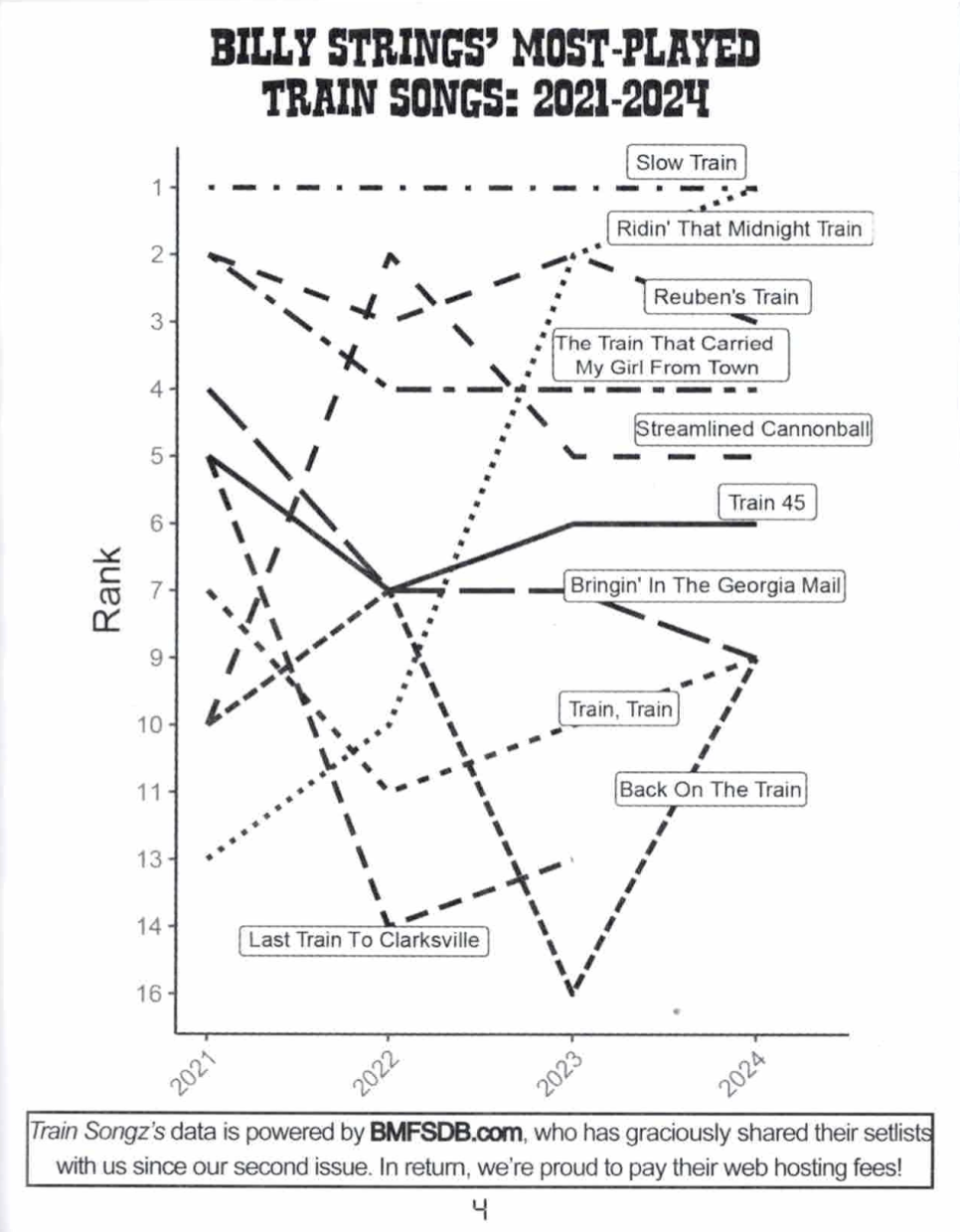
A Billy Strings train songs data visualization from ‘Train Songz’ Vol. 5, fall 2024.

What was Promontory Paul’s role in this latest issue of Train Songz given its focus on the Royal interview?

AP: Paul’s column still exists in the newest zine, but he went about it in a really cool way. The idea began with our third edition, when we gave Promontory Paul an entire section to write about old bluegrass songs regularly covered by the likes of Billy, the Sam Grisman Project, and whatever other bands we listened to or saw live that quarter. So we’d cite where we heard it played before diving into a history lesson and where it came from.

Then, for this issue with Royal, we took that Old Tune Review and instead of songs we heard out in the wild made it all about songs that he mentioned during the interview. Throughout the interview there are little interjections from Promontory Paul – almost like Clippy, the office assistant on Microsoft Word. It’s been fun to take these gimmicks that worked for us a year ago and apply them to the restrictions presented by this long-form interview. Royal gave us so much that we wanted to give him the entire issue, but we’re still going to sprinkle in the ethos of what our readers are familiar with and what we like to do, which is to connect something that’s happening in the present day – like the recent Billy Strings and Bryan Sutton tour with Royal – to the past. It’s been really fun connecting with folks like that through the zine. It’s almost like Paul’s on a time-traveling train or something. [Laughs]

We send surveys out to our subscribers after publishing each issue and Promontory Paul’s history lessons are always towards the top when it comes to [readers’] favorite parts of the zine. It’s also been a cool way to make note of the fact that it’s not just us behind the scenes who are enjoying this. It really speaks to how much we respect the audience that we have and how that drives us to create the best issue possible every quarter.


View this post on Instagram


A post shared by Royal Masat (@royalmasat)

I saw recently that Royal left a copy of Train Songz #7 at the NPR Tiny Desk following the session he recorded there with Billy. What did seeing that mean to y’all?

AP: He’s been a follower of ours for a long time and brought that copy of the zine to NPR on his own after reaching out to us to subscribe about a year ago. We knew he’d been reading along for a while, so once this tour came up with him, Bryan, and Billy, it just seemed like the perfect thing for the zine to cover. It was important for us to capture the combination of old and new in those shows dedicated to Doc and Merle Watson and T. Michael Coleman and featured the King of arena-grass playing these smaller rooms of 400 to [2,200] people with one of the most preeminent guitarists alive in Bryan Sutton.

It took us a second to come around to the idea, because we’ve been very cautious about not becoming a Billy Strings-exclusive fan zine. We want to serve the broader ecosystem, but that tour was something we couldn’t pass up, especially with Royal being a reader. Once we did reach out, he blew us out of the water with the time he put into it. His interview with Mitchell ended up being over 4,000 words that he sent us by email after wrapping up a tour in Europe. Once that wrapped I remember him sending us a literal tome – he took it very seriously and his responses were so thoughtful.

The final result almost looks like a children’s book with the way Liza designed it. None of that would be possible without our paying supporters, who make it possible for us to work with the 17 artists we partnered with on this issue to bring it even more to life with quirky illustrations that tie back to things Royal said, like throwing in an illustration of a medieval horse with a knight in shining armor where Royal refers to his bass as his trusty steed. I like to refer to what she does as “Andy Warhol-ing.” [Laughs]
Inset artwork by Sara Dennis from the 8th and most recent edition of ‘Train Songz.’

I know you just mentioned not wanting to become exclusively a Billy Strings fan zine. However, I’m curious to hear when and how y’all first encountered his music?

LC: The first time I saw Billy was at RiverRock, a free festival on Brown’s Island in Richmond in 2019 before he blew up. I had heard of him prior to that, but after seeing him live I became absolutely mesmerized. I didn’t like bluegrass for the longest time, but something clicked with me when I saw Billy and was like, “Oh, this is what I want to keep following and chasing.”

MH: In college, I was a huge Deadhead and Phish fan and was consumed by the jam world. Then I heard about Billy on some Facebook groups and message boards, talking about how he covers The Dead really well.

I moved to Boston shortly thereafter and the first month I was living there Billy played at the Wang Theater. I wound up buying a ticket and went without having listened to his music at all beforehand and was absolutely blown away. To me, it was like a psychedelic Dead or Phish show combined with bluegrass, which in hindsight probably hit on the homesickness I was feeling at the time, because I had been around bluegrass before, but wasn’t really interested in it when I was living in the South. From there, I jumped down the rabbit hole into more old-time bluegrass, which is when I started playing the music myself. So I attribute my musical pursuits now to that moment and think that is probably true of other people, too.

JL: I remember [going down] a YouTube [rabbit] hole in 2020 and coming across a set of Billy playing Doc Watson tunes. It may have been Royal’s first gig with him. I just so happened to be in a bit of a bluegrass moment at the time I found that video of Billy and was instantly hooked, resulting in me digging even deeper. I was already a Deadhead as well, so I loved his covers of those songs too. Then I worked my way to his original stuff – which is also sick – and I have YouTube to thank for it!

AP: I remember James, “Promontory Paul,” showing me Billy for the first time. Like most of the bands I like, I channel my music taste through him. When we first got into him there was still a lot of remote work going on, so we’d listen to Billy while doing that or even while we were playing games like Fortnite. I started listening to a lot of The Dead in order to try to get to the point where I could listen and name the year the show came from. But over time Billy started taking more and more of the market share of my listening time away from the “What year is this Grateful Dead show from?” project.

What are your next steps for continuing to grow Train Songz?

AP: We occasionally host concerts (the next one is February 12, 2026 with The Asheville Mountain Boys), and have captured audio recordings – which we call Tiny Train Sessions – in the past, but we look at them more as a marketing tactic than a growth mechanism.

My day job is a social media manager and doing that I’ve noticed that the best way to get a lot of views on Instagram is to post reels, because they [are served] to non-followers and new followers first. We could post a bunch of concert clips and other things to build our audience, but we intentionally opted to not do that because we’re firm believers that things that grow slow last a long time. We don’t want to gatekeep or make it hard to find us, but rather [hope folks will] find us organically through a friend sharing one of our memes or sending you a copy of the zine itself. I want the first point of contact to be someone who’s already within our ecosystem that really digs it and turns you onto it, one person at a time.


All visuals, artwork, and zine scans courtesy of Train Songz. Learn more about artists Morganne Allen and Sara Dennis.

You Gotta Hear This: New Music From Aaron Burdett, Trey Hedrick, and More

Happy New Year! We’re so excited to bring you our first collection of new music and videos for 2026. We’ve missed you over the past few weeks and, well, You Gotta Hear This…

Kicking us off, our old friend Joshua Britt returns with a new artist project, The Boy The Earth Sings To, and an official video for an original song, “Eyes Of God.” Falling on the continuum between gospel, sacred, and contemporary Christian roots music, the lush alt-folk track is built around the inspiration of a new mandola, tying the tone wood used to build the instrument to the forested visuals of the video. Meanwhile, Western North Carolina-based singer-songwriter Aaron Burdett unveils a new single, “Arthur’s Last Dance,” which pays tribute to folk dancer Arthur Grimes and his final performances at MerleFest before his retirement. It’s driving modern bluegrass appropriately perfect for flatfooting, clogging, and polishing those floorboards.

Then, from just up the mountains, Lonesome River Band also bring their first new single of 2026, “Bernadette,” written by Bob and Ginger Minner. Below, Bob offers his perspective on writing the tune, which he and his wife immediately imagined LRB recording, as soon as they had finished writing it. If you like crooked contemporary bluegrass that’s steeped in old-time mountain music – with a slightly dark, modal tinge – you’ll love this one.

Let’s continue up the mountains now, across Virginia and West Virginia to southeastern Ohio, where we’ll find the music of singer-songwriter Trey Hedrick and this new track, “Shoestring,” which features Tim O’Brien. It’s a testament to Hedrick’s grandpa, his relocation of the family to Ohio, and the way life, love, work, and place are passed down generation to generation.

Rounding out our collection this week, it’s a premiere we published elsewhere on the site this morning, as well. Celebrating his upcoming collaborative album, guitarist Bryan Sutton launches a hilarious and entertaining animated music video for “The Devil Went Down to Deep Gap” featuring Billy Strings, Del McCoury, and more. It’s a delightful reimagining of Charlie Daniels’ “The Devil Went Down to Georgia” that tells a fantastic version of Doc Watson’s origin story, pitting Doc’s style of picking against shredding metal electric guitars played by Sutton and Strings. You won’t want to miss this masterpiece of country, bluegrass, and flatpicking storytelling.

What a great way to kick off the year, right? There’s plenty to hear, love, and enjoy below. You Gotta Hear This!

The Boy The Earth Sings To, “Eyes of God”

Artist: The Boy The Earth Sings To
Hometown: Franklin, Kentucky
Song: “Eyes Of God”
Album: The Quiet Voice Of God
Release Date: November 7, 2025

In Their Words: “Years ago, my band played a show with Sierra Hull in Montana and that’s where she introduced me to mandolin builder Bruce Weber. Visiting his shop was unforgettable – an old schoolhouse where one room was filled with raw, uncarved slabs of wood that he would walk across, knocking on each piece, saying, ‘They all sound different, but some of them sing.’ It felt like he was listening for the mandolin already inside the wood, the way Michelangelo spoke about finding David inside the marble. Bruce built an octave mandolin for me that became the backbone of this album and while I was writing it I came across another Weber mandola. The first night I brought it home, I picked it up and wrote ‘Eyes Of God’ in one pass, as if the words and melody were already waiting inside that piece of wood. My favorite art has always felt more like discovery than invention.

“For the video I was inspired by time I spent in Bolzano, Italy, reading about the singing trees in the high altitude mountain forest – God placing the best wood high in the mountains, starved for air instead of down in the village. A reminder to me that making something great always requires adventure.” – Joshua Britt

Track Credits:
Joshua Britt – Vocals, mandola, other instruments, songwriter
Matt Menefee – Banjo
Neilson Hubbard – Drums
Colter Britt – Harmony vocals
Sarah Drake – Harmony vocals

Video Credits: Filmed on location in the Colorado Rockies.
Directed by Joshua Britt and Quincy Britt.


Aaron Burdett, “Arthur’s Last Dance”

Artist: Aaron Burdett
Hometown: Saluda, North Carolina
Song: “Arthur’s Last Dance”
Release Date: January 9, 2026
Label: Organic Records

In Their Words: “I was first introduced to Arthur Grimes when I lived in Boone, NC, in the ’90s. He’d materialize now and then at many shows I was playing or attending over the years. So when I played a set at MerleFest 2024 with Steep Canyon Rangers and heard that Arthur was going to be there with Old Crow Medicine Show – to do his last dance before largely retiring – my interest was piqued. After our set, I was checking out other performances and, sure enough, got to see Arthur doing his thing on the Watson stage one last time. It was an event that deserved a few songwriting notes. Those notes I took that night are what turned into this song commemorating Arthur’s long career dancing with any and every band or performer who came through the High Country of NC over the past 50 years or so.” – Aaron Burdett

Track Credits:
Aaron Burdett – Lead vocal, acoustic guitar
Kristin Scott Benson – Banjo
Carley Arrowood – Fiddle
Tristan Scroggins – Mandolin
Jon Weisberger – Upright bass
Wendy Hickman – Harmony vocal
Travis Book – Harmony vocal


Trey Hedrick, “Shoestring” (featuring Tim O’Brien)

Artist: Trey Hedrick
Hometown: Wilkesville, Ohio
Song: “Shoestring” featuring Tim O’Brien
Album: Sing, Appalachia
Release Date: January 7, 2026 (single); February 18, 2026 (album)

In Their Words: “‘Shoestring’ is a song about my Papaw, who was an incredible singer and multi-instrumentalist and the engine to the musical life of my immediate and extended family. Through him I came to the writers and songs that I still call on frequently in my own writings. Pap grew up in Parsons, West Virginia, and when work dried up or, more likely, after a need to move on after his brother Skip died in a mining accident, he moved north to southern Ohio. A move that anchored the geography of our family to southern Ohio after many generations in West Virginia and Kentucky. I didn’t try and likely couldn’t have written ‘Shoestring’ from any perspective other than reverent grandson, intentionally setting aside any precise detail. ‘Shoestring’ is about place, love, work, and life passed down, intentionally or not. I was honored to have Tim O’Brien sing and play fiddle on the track – Tim’s music has been an inspiration and has long meant a great deal to me.” – Trey Hedrick

Track Credits:
Trey Hedrick – Lead vocals, acoustic guitar, songwriter
Tim O’Brien – Lead and background vocals, fiddle
Maya de Vitry – Background vocals
John Mailander – Fiddle
Ethan Ballinger – Mandolin
Frank Evans – Banjo
Phillipe Bronchtein – Pedal steel
Jamie Dick – Drums
Rhees Williams – Bass


Lonesome River Band, “Bernadette”

Artist: Lonesome River Band
Hometown: Floyd, Virginia
Song: “Bernadette”
Release Date: January 9, 2026
Label: Mountain Home Music Company

In Their Words: “My wife Ginger and I write a lot of songs together and sometimes the ideas come from the strangest of places. ‘Bernadette’ came from when one of Ginger’s favorite authors, Shawn Inmon, who asked his fans to offer up unique women’s names to be used in his next novel. We were driving around and joking about names like Ethel, Maude, Calry, etc., and I just blurted out ‘How ’bout Bernadette?’ And out of nowhere I sang that name and first line. We got home and sat down and we wrote it in no time. It just fell out, so to speak. Plus, I always wanted to use the word ‘trifling’ in a song, so it seemed fitting for a woman like Bernadette in the story. We did a guitar and vocal demo of it and I sent it right to my buddy Jesse Smathers, because LRB was who we heard in our heads doing it as we wrote it. Thanks to LRB for cutting this one, we’re honored.” – Bob Minner, songwriter

Track Credits:
Sammy Shelor – Banjo
Jesse Smathers – Acoustic guitar, lead vocal, harmony vocal
Mike Hartgrove – Fiddle
Adam Miller – Mandolin
Kameron Keller – Upright bass
Rod Riley – Electric guitar
Bob & Ginger Minner – Songwriters


Bryan Sutton, “Devil Went Down to Deep Gap” with Billy Strings

Artist: Bryan Sutton with Billy Strings
Hometown: Nashville, Tennessee
Song: “The Devil Went Down to Deep Gap”
Album: From Roots to Branches
Release Date: January 9, 2026 (single/video)
Label: Mountain Home Music Company

In Their Words: “It was listening to Charlie Daniels’ original ‘The Devil Went Down to Georgia’ with my youngest daughter, Lily. She has very eclectic and broad musical tastes. I’ve loved sharing music with her and checking out what she has discovered. We found some other covers of the original and one that stuck with me was Jerry Reed’s interpretation, where he makes Johnny a guitarist instead of a fiddler. I have been working on a duets record for some time, collecting recordings here and there with my pals, and knew I wanted to do something different with Billy, as he and I have a whole record of duet playing.

“Billy and I also share a love for heavy metal. I was trying to think of a way he and I could do something connected to this duets project that would allow us to play acoustic and electric. It all kind of came together when I realized this song would allow for that. The Doc [Watson] origin story came about thinking how to make this not just a cover, but more personal and fun. It’s also another subtle tribute to Doc, who would oftentimes change or add lyrics to a song in order to make it fit for him. I fashioned the story, made a little demo, and sent it to Billy. He was into it and we were off.” – Bryan Sutton

Read more here. 


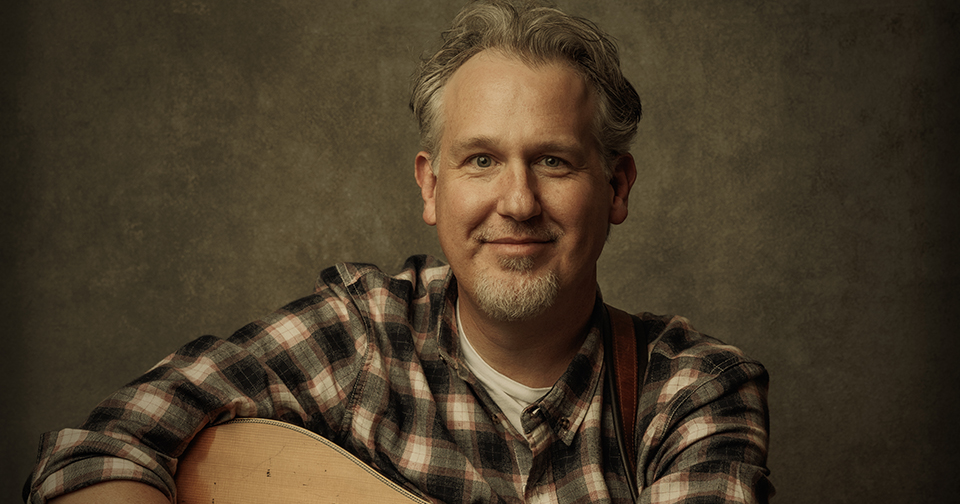
Photo Credit: Aaron Burdett by Sandlin Gaither; Trey Hedrick by Chris Heidl.

WATCH: Bryan Sutton, “The Devil Went Down to Deep Gap” with Billy Strings

Artist: Bryan Sutton with Billy Strings
Hometown: Nashville, Tennessee
Song: “The Devil Went Down to Deep Gap”
Album: From Roots to Branches
Release Date: January 9, 2026 (single/video)
Label: Mountain Home Music Company

In Their Words: How do you see Doc’s playing influencing both yours and Billy’s?

“I think beyond the specific influence of Doc’s guitar playing that informs most every note Billy or I may play, I know that we both are students of Doc’s complete artistry. To say Doc is just the most influential flatpicker ever is limiting. He brought so much to the table in his honest and emotional singing, his song choices and writing, banjo and harmonica playing, and Travis-style fingerpicking. He was not comfortable being labeled or limited within a specific genre. His onstage persona was true to him. Without being a ‘showman,’ he was informational when the song needed it and willing to share whatever emotion he might be experiencing. It’s also important to note that Doc and Merle’s duo playing has been a huge part of the overall focus for things Billy and I have done together. I know for both Billy and I, Doc provides a lifetime of inspiration, influence, and learning.”

How do you pay tribute to that in this song and video?

“First and foremost, this is kind of a silly or fun thing, along with being a somewhat serious tribute to Doc Watson. I wanted to use the song to have fun with the guitar shredding and good versus evil battle, but also imagine an origin story of how Arthel Watson could have become the ‘Doc’ we all have loved. Maybe it’s a gospel song in the way that Doc, even and especially in his blindness, can ‘see’ through the Devil’s lies. Ultimately, Doc carries his triumphant message to the world, and influences us all with wonderful and heartfelt music.”

It sounds like you had this concept before talking with Billy about it. How did the concept and song come to be, from start to finish?

“It was listening to Charlie Daniels’ original ‘The Devil Went Down to Georgia’ with my youngest daughter, Lily. She has very eclectic and broad musical tastes. I’ve loved sharing music with her and checking out what she has discovered. We found some other covers of the original and one that stuck with me was Jerry Reed’s interpretation, where he makes Johnny a guitarist instead of a fiddler. I have been working on a duets record for some time, collecting recordings here and there with my pals, and knew I wanted to do something different with Billy, as he and I have a whole record of duet playing.

“Billy and I also share a love for heavy metal. I was trying to think of a way he and I could do something connected to this duets project that would allow us to play acoustic and electric. It all kind of came together when I realized this song would allow for that. The Doc origin story came about thinking how to make this not just a cover, but more personal and fun. It’s also another subtle tribute to Doc, who would oftentimes change or add lyrics to a song in order to make it fit for him. I fashioned the story, made a little demo, and sent it to Billy. He was into it and we were off.

“I feel fortunate that Del was into playing the Devil. I also am so happy to have T. Michael Coleman and Sam Bush on the track, who played many years on the road and studio with Doc. My pal Jerry Roe, who is Jerry Reed’s grandson, plays the drums, connecting to the Reed version that inspired me. Once I had the concept and demo for the song, I knew it had to be an animated video and discovered Pat Bradley of Springshoe Animation. It was wonderful working with him to take what had been in my head and be able to visualize it. Ultimately, all this came about a little piece at a time, and I’m so happy to share it with the world.” – Bryan Sutton

Track Credits:
Bryan Sutton – Acoustic guitar, electric guitar, vocal
Billy Strings – Acoustic guitar, electric guitar, vocal
Del McCoury – Vocal
T. Michael Coleman – Electric bass, harmony vocal
Sam Bush – Mandolin
Jerry Roe – Drums

Video Credits: Animation by Pat Bradley, Springshoe Animation.


Lead image courtesy of the artist.

Doc Watson & Earl Scruggs’ Friendship in Photographs

It’s no secret that Earl Scruggs and Doc Watson were great friends, collaborators, and mutual admirers. Both of the bluegrass, old-time, and mountain-music stylists took inspiration and borrowed heavily from the other across their careers, whether they were making music together or separately in any of their many endeavors. The moments they came together, though – from The Three Pickers album and concert film, to David Hoffman’s iconic backyard jam session film of the Scruggs and Watson clans picking together, to many more appearances and recordings – were always magical. Two legendary stylists bouncing musical ideas off of each other as only these two could.

In honor of our Doc in December series for Artist of the Month, we’ve partnered with our friends at the Earl Scruggs Center in Shelby, North Carolina, to bring you an exclusive look inside their collection and archives at photos of Scruggs and Watson together. The Center’s executive director, Mary Beth Martin, pulled a selection of historic photos from the collection as well as a handwritten quote directly from Scruggs’ notes about Watson and his influence:

“There are two people’s sound no man can, in my estimation, duplicate,” Earl states in a notebook. “Of course I’m referring to Mama Maybelle and Doc Watson. I’ve had the pleasure to work [with] and visit these people. I will never cease to admire the courage of these people.”

You can certainly hear the impact and influence of Watson and Maybelle Carter on Scruggs’ playing, especially his approach to acoustic guitar, when he would most often fingerpick the six-string.

“Earl had enormous respect for Doc and admired him deeply,” says Martin of the Earl Scruggs Center via email. “Both grew up in humble North Carolina homes surrounded by rich musical traditions and went on to leave an incredible mark on music. Having Earl’s personal memories and photos of Doc in our collection makes their connection feel especially meaningful.”

Over the course of their careers in roots music, Scruggs and Watson performed, collaborated, and recorded together dozens and dozens of times. We’re very proud to be able to share these photographs from the Earl Scruggs Center Collection to celebrate the cross-pollination of these two Bluegrass Hall of Famers and Doc in December.

The Earl Scruggs Center is located in downtown Shelby, North Carolina, and celebrates the life, legacy, and groundbreaking sound of Earl Scruggs. Their collection includes many treasured Scruggs family objects and remarkable pieces from Earl’s career – including more than 2,000 photographs. In January, they’ll install new interactive exhibits that dig deep into the roots of the region’s music and the history of bluegrass. The entire ESC team is excited to welcome everyone back to the museum when they reopen on February 3, 2026, after renovations and completion of the new exhibits.

Beyond the museum, the Earl Scruggs Center team are also restoring the Earl Scruggs Homeplace in the Flint Hill community of Cleveland County, bringing Earl’s childhood home back to the formative era that shaped him as a musician.

To stay in the loop and to catch upcoming Earl Scruggs Center events like the Earl Experience Banjo Camp, visit their website and connect with them on socials. We hope you enjoy our special photo story with our friends at the Earl Scruggs Center celebrating Earl Scruggs, Doc Watson, and Doc in December.


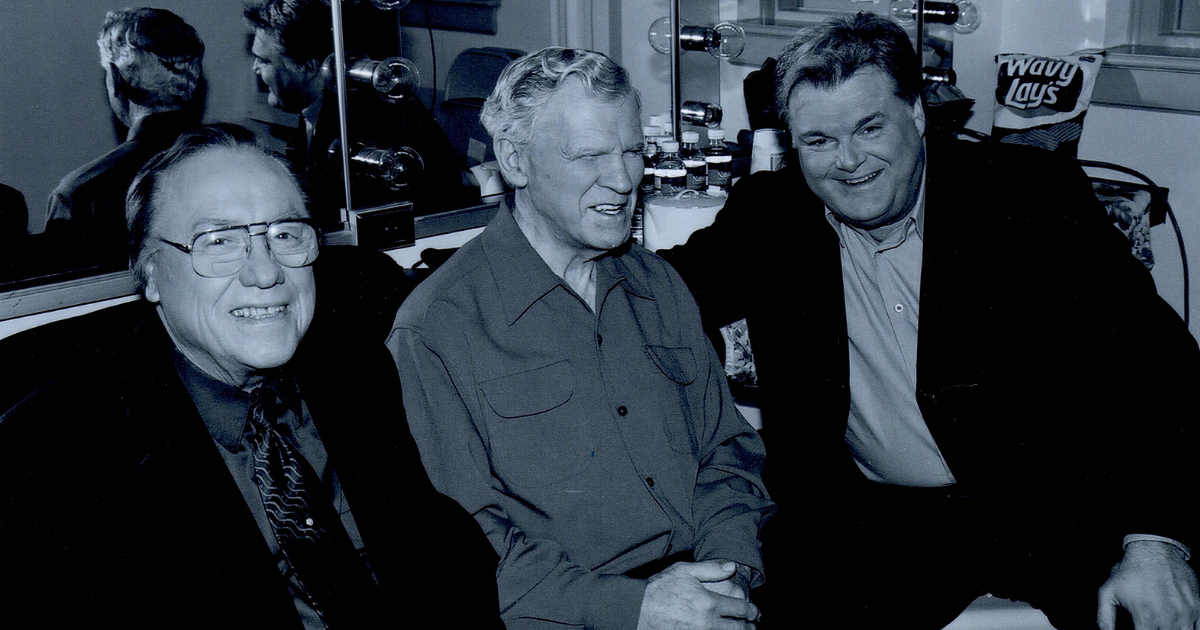
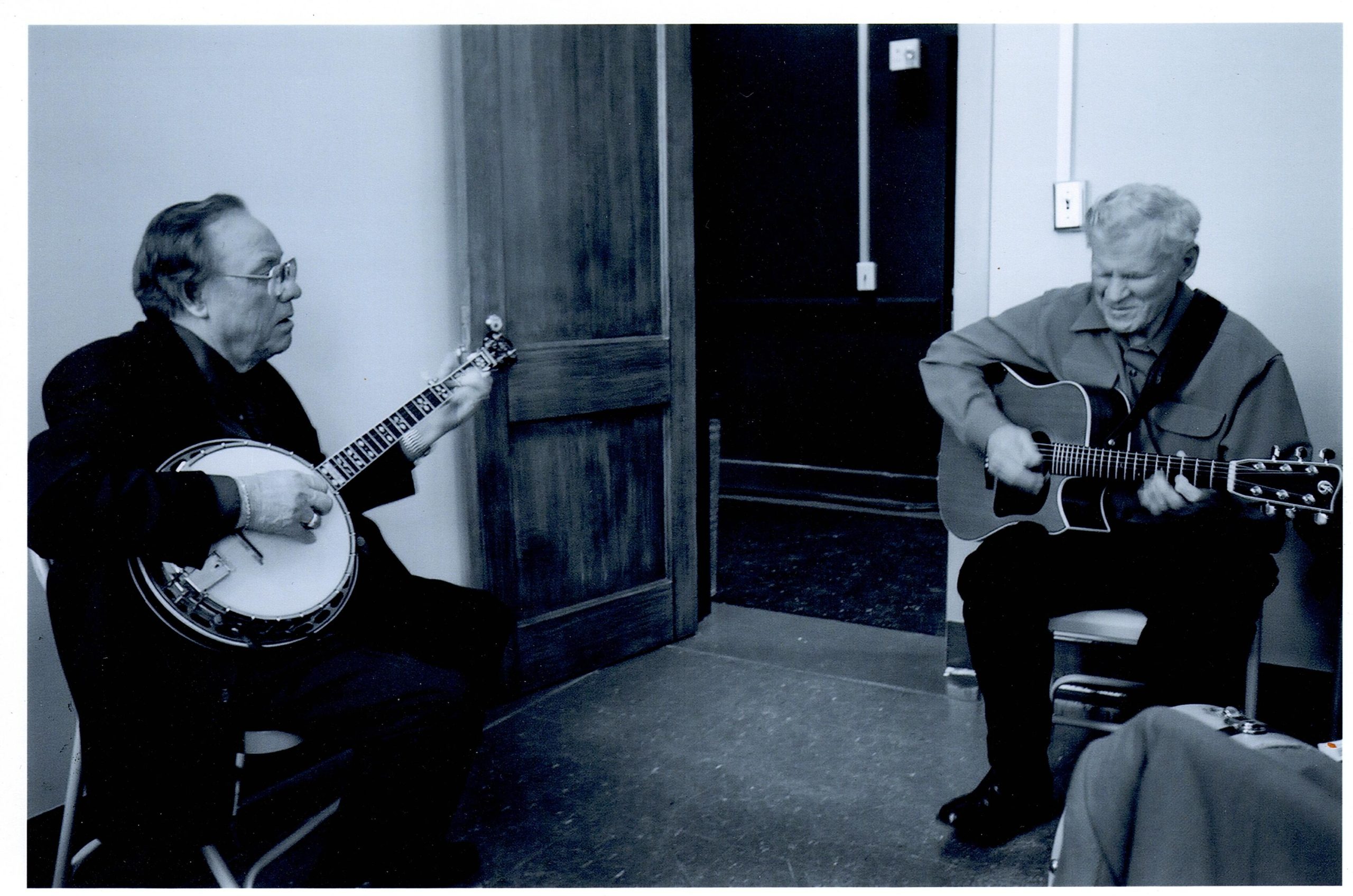
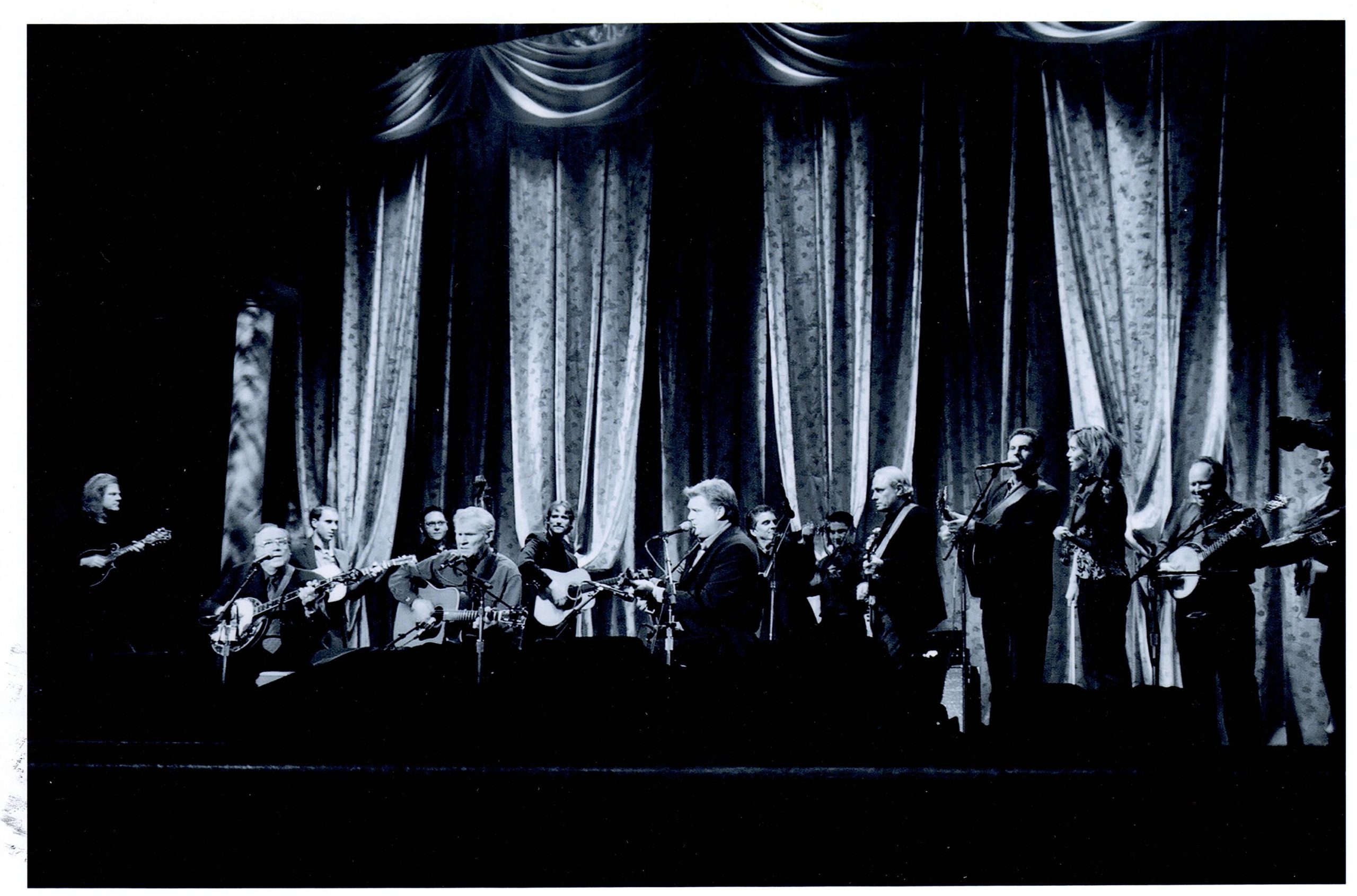
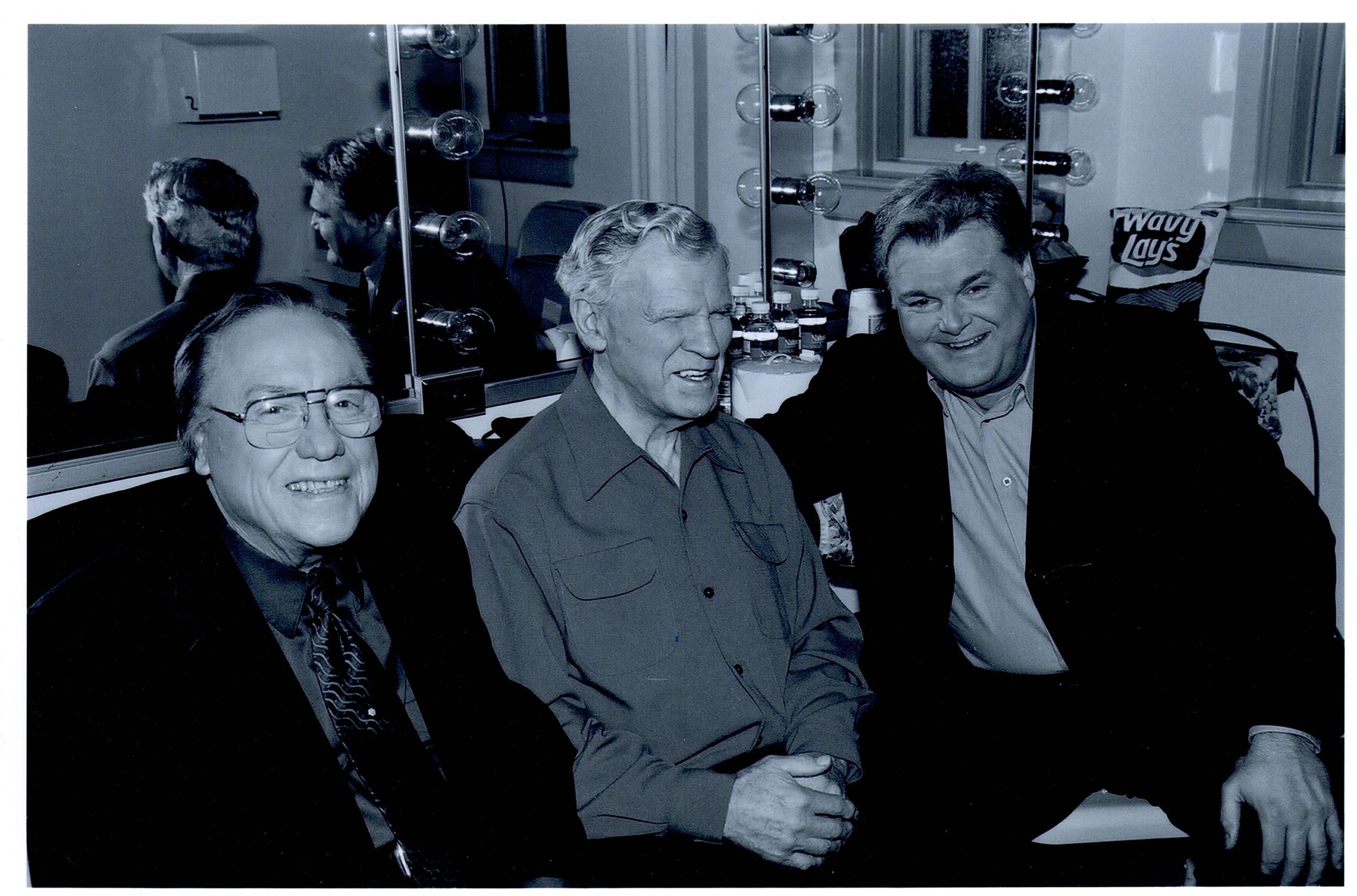
All photos courtesy of the Earl Scruggs Center Collection. Lead image: Earl Scruggs, Doc Watson, and Ricky Skaggs backstage at the taping for The Three Pickers.

The Five Pillars of Doc Watson’s Legacy

What a difference a Doc made.

Lots of people would like to think their lives have made a difference – whether through their family life, or work, or some sort of creative endeavor.

However, even to approach the enduring heritage of the great musician Arthel “Doc” Watson, a person would have to achieve lifetime landmarks as imposing as the North Carolina Appalachian mountains that were his home. During a lifespan from his birth in 1923 until his death in 2012, Watson created a legacy of music, folklore, and goodwill that no one has entirely equaled.

First a little background: Arthel Lane Watson was born March 3, 1923, near Deep Gap – he is not from Asheville – in Western North Carolina. An audience member suggested the nickname “Doc” when his given name was found less than compelling for an entertainer.

His life story before and after becoming an admired folk musician has been often told, notably in Doc Watson: A Life in Music, a 2025 biography by Eddie Huffman published by the University of North Carolina Press.

Blind since infancy, Watson started to develop life skills and musical ability from an early age. He learned both formal and popular styles when sent to the state’s school for the blind in Raleigh at about age 10.

The boy was consumed by music and persistent in getting better at it. Watson had learned both the rudiments of harmonica and a few banjo tunes from his father, General Watson, before he went off to Raleigh. While living within the strict environment of the school for the blind, Watson learned braille and grew familiar with classical and church styles of music taught there. Perhaps as strong an influence as that education was fellow student Paul Montgomery, the talented friend from whom he learned guitar chords. Young Watson and Montgomery, later a well-known Raleigh pianist and children’s show host, shared enthusiasm for the popular music of the day, including jazz and big-band sounds.

His parents, Annie and General Watson, taught the boy skills of growing crops and basic carpentry, and he contributed to the family despite his blindness.

After years of mostly local performances back in Western North Carolina, it wasn’t until the early 1960s, when East Coast musician and historian Ralph Rinzler tuned into and promoted his far-reaching ability as a singer and picker, that Watson’s name gained national, then international attention.

According to an account at the Blue Ridge Heritage Area website Watson recorded over 50 albums and was honored with “the National Medal of Arts, a National Heritage Fellowship, the North Carolina Folk Heritage Award, seven GRAMMY Awards, and a GRAMMY Lifetime Achievement Award.”

As fans know, Doc Watson contained multitudes of skills, a breadth of ability that inspired this list of the five pillars of his musical and artistic legacy.

The King Flatpicker

Watson largely created the challenging fiddle-inspired guitar style that led many followers along a flatpicking trail.

It was during the 1950s, when playing an electric Gibson Les Paul in the local Jack Williams Band, that Watson developed a style that would transform the way the guitar was played in folk and bluegrass music.

Generally, earlier acoustic guitarists in roots-derived styles used a flatpick to create basic “boom-chuck” back up, perhaps throwing in some fills and Jimmie-Rodgers-style bass runs.

But when dancers at Williams’s gigs wanted music for square-dancing, Watson worked up single-note versions of fast fiddle tunes such as “June Apple” and “Bill Cheatham” on his Les Paul. This approach enables lead guitar pickers to achieve the same flowing, rapid attack that fiddlers used for tunes, many of which had come over from the British Isles in past generations.

It’s not possible to say that Doc Watson was the first guitarist to flatpick fiddle tunes. After all, it wasn’t until Watson emerged as a folk artist in the 1960s that the broader music scene caught on to his musicianship. And high achievers such as Arthur Smith on “Guitar Boogie,” Don Reno on “Country Boy Rock ‘n’ Roll,” and Bill Napier on the Stanley Brothers’ “Mountain Dew” – along with some jazz and blues players – all recorded hot-licks acoustic soloing before Watson did. Joe Maphis was also cranking out ultra-fast flatpicking numbers in the 1950s.

But it was Watson’s 1960s performances that created a precedent for a wave of guitarists who had to muscle up to the speed and dexterity he displayed.

A long line of guitarists at the top of the field – from Clarence White to Tony Rice, from Bryan Sutton to Billy Strings – all show Watson’s clear influence not just in recreating fiddle tunes, but also in rapid-fire picking and clean sound on a broad range of material.

Player and educator Alan Barnosky wrote in “An Exploration of Doc Watson’s Innovative and Joyful Guitar Stylings” for Acoustic Guitar in 2023 about the spread of this kind of playing.

“Watson amazed folk fans in the early 1960s by taking tunes typically reserved for the fiddle and reworking them for the acoustic with speed, clarity, and flash,” he wrote. “He never claimed to be the first to play fiddle tunes on a guitar, but for the majority of listeners at the time it was an entirely novel and groundbreaking approach.”

Another world-class, tradition-based player, Earl Scruggs, praised Watson’s adaptation of fiddle tunes as the two were joined by Ricky Skaggs for the 2003 The Three Pickers performance and album.

“He was the first man I ever heard on the guitar that was fooling with tunes like that,” Scruggs said in a Three Pickers introduction. “You had all these good G-C-D pickers – that’s chord positions – but I had never heard anybody that actually took over a lead like a banjo or a fiddle or a mandolin and do those tunes. He could do it.

“And what amazed me about Doc Watson’s picking, and still does, is he’s got that – I call it ‘mountain sound’ to his picking, and he’s one of the best to keep it in that mode of sound.”

New generations of players have immersed themselves in Watson’s style. When I interviewed him for a Bluegrass Unlimited article, leading guitar picker and multi-instrumentalist Bryan Sutton talked about being captivated by Watson’s playing during Sutton’s youth on Western North Carolina.

“Doc and Dan Crary were the first great influences on me,” he said. “Doc Watson was one of the first professional musicians/guitar players that I ever saw. He doesn’t live too far from Asheville, so I saw him play some different festivals and at Maggie Valley. So, he was the first one to really catch my ear as far as what you could do with the flatpick.

“My right hand – it may not as much anymore – but I remember at one time it was kind of like Doc’s. It’s kind of like the way Sam Bush plays, using the whole forearm and wrist involved in the playing, whereas with jazz players or Tony Rice it’s more of a wrist thing. I think I’ve got a little bit of both now.”

Billy Strings, the artist who’s likely doing the most to promote Watson’s legacy in the 21st century, sounded almost evangelical during a September 2025 interview for NPR’s Fresh Air.

“He’s like the ground upon which I stand, you know?” Strings said. “My dad played his music all around the house growing up. And by the time I could play guitar, you know, 5, 6 years old, I was learning those tunes, too. I might’ve been able to play some of them before I knew how to tie my shoes or something, you know?

“It was like, I was learning how to speak and talk and walk, and I was learning all these Doc Watson tunes at the same time. And it was just, like, a religion in my house, you know? His music is just – it’s the best.”

To see some of the top pickers in the field paying tribute, check out this video shot at the Merle Watson Memorial Festival – what would become MerleFest – in Wilkesboro, North Carolina, in 1992.

A Model Fingerpicker

From his first albums on, Watson regularly also played guitar with a thumbpick and index finger. As he noted with his customary self-deprecating humor in the DVD “Doc’s Guitar: Fingerpicking & Flatpicking,” “See, I just play with one finger and a thumb. I don’t use the sensible three-finger method that you should use on finger-style guitar.” (Watch below.)

Watson sounded great with that approach, making finger-picked tunes such as “Deep River Blues,” “Nashville Blues,” “Omie Wise,” and “Doc’s Guitar” fan favorites and objects of long study. For every striving guitarist who practiced hard on his fiddle-tune adaptations, plenty of pickers also worked on showcases such as “Windy and Warm,” with its alternating bass, pull-offs, note bending, and a jazzy minor sixth chord at its conclusion.

Watson’s fingerpicking often showed off his acquaintance with diverse approaches, as in “Deep River Blues,” with an E diminished as its second chord. It also illustrates the way he put his touch on existing pieces such as 1933’s “Big River Blues” by the Delmore Brothers, who played with flatpicks.

“There were two guitars, a tenor – a little four-string, and the regular flattop, and I never could get my guitar to sound like both of theirs did,” Watson said. “Then I began to hear brother Merle Travis, the late Merle Travis, on the radio. And I thought, Now, wait a minute. If I can steal me a lick off brother Travis, maybe I can learn ‘Deep River Blues.’”

Multi-talented Kentuckian Merle Travis (1917-1983) popularized a style in which the thumb plays an alternating bass on the guitar’s lower strings while picking the melody on treble strings. Watson also studied the work of the great guitarist Chet Atkins. The picking buddies released the album Reflections in 1980.

The centuries-old, transatlantic ballad “Georgie” would have once been sung unaccompanied, leaving Watson and others free to craft a brand new style of guitar back up. With no clear precedent on guitar, he might employ the flowing, almost classical patterns that became popular among folk revivalists.

And fingerpicking became the tool Watson used to play the blues that he loved and drew on so deeply, music he followed from the time he heard Mississippi John Hurt on the family’s disc player in childhood.

In the end, there’s no easy way to pin down the many elements Watson brought to his picking, musical points of view that enriched his listeners along the way.

A Standout Singer

Doc Watson’s vocal abilities don’t generally get as much attention as his top-drawer chops as an instrumentalist. However, he was also a tuneful singer with a natural, angelic mountain baritone.

Watson came along during an era when rougher-voiced vocalists such as Hobart Smith, Dock Boggs, and his picking buddy Clarence Ashley represented mountain singing to a growing audience. And Watson’s less mannered style likely contributed to acceptance among listeners less familiar with the high lonesome sound. His direct vocal approach was often heard in performances with no instrumental backing.

It’s useful to remember that Watson also enjoyed the smooth country vocalist Eddy Arnold so much that his son Merle Eddy Arnold was named not just after fingerpicker Merle Travis, but also for Arnold.

Tunes from the Tennessee Plowboy’s repertoire such as “Tennessee Stud,” “I Couldn’t Believe It Was True,” and “Anytime” also showed up in Watson’s repertoire. These were only a few examples of the eclectic side of Watson’s vocal approach, with emphasis on great material over genre labels.

Given his broad taste, Watson at times put some extra grit into his singing on a number such as “Blue Suede Shoes” from his Jack Williams days of the 1950s, later a concert favorite. But more often he sang songs straight, even on one like “Nights in White Satin,” a 1967 pop hit by British rockers the Moody Blues. With waltz-time guitar and plain singing, Watson makes the song come across as relevant to himself and listeners as songs by the Delmore Brothers and Jimmie Rodgers.

Watson’s first memories of vocal music came in church, and he prized the straightforward, no-vibrato sounds that carved such songs in his memory.

“If you love music, you have to listen from the time you’re big enough to notice music,” he told me when recording his 1991 GRAMMY-winning CD On Praying Ground.

“If you’re looking for old-time material in songs, those old songs that you heard when you were young were the easiest to put down.”

From his first commercial recordings on, Watson featured gospel numbers such as the a cappella version of “Talk About Suffering” from 1964 and “Down in the Valley to Pray” from 1966. Both radiate belief and unornamented clarity.

More recent listeners may know the latter song as “Down in the River to Pray,” as it was opportunistically relabeled to match a scene in the 2000 hit film, O Brother, Where Art Thou?.

Always A Song Man

Doc Watson had an impressively broad range of musical interests, perhaps markedly so, given the period in which he came along.

Country or folk music didn’t start appearing on commercial records until Watson was about two years old. In childhood he listened to down-home picking as well as church and gospel songs. It wasn’t until the 1930s that the family owned a radio that let them hear music beyond their 78-rpm record collection.

Virtually every great musician is a song collector at heart. And like Bob Dylan, Watson took on songs from tradition and added new elements. Take the mournful ballad “Omie Wise,” based on a North Carolina murder from the early 19th century.

In the 1920s notable old-time artists G.B. Grayson and Clarence Ashley recorded it with modal accompaniment that was neither truly major nor minor. When Watson recorded in the 1960s, he ventured into folky, arpeggiated picking that put it squarely into minor-chord territory, opening up the song to young folkies who couldn’t play fiddle like Grayson or banjo like Ashley.

In fact, Watson’s playing on “Omie Wise” occupied the same guitar realm as folk star Joan Baez’s playing on “East Virginia” and other traditional songs.


He also tuned into compositions by folk musicians Bob Dylan (“Don’t Think Twice It’s All Right), Tom Paxton (“The Last Thing on My Mind,” “Leavin’ London,” and “Bottle of Wine”), and Townes Van Zandt (“If I Needed You”).

Watson isn’t chiefly known as a songwriter, but he enjoyed notable success with “Your Lone Journey,” which he wrote with wife Rosa Lee. The starry duo of Led Zeppelin frontman Robert Plant and bluegrass’s own Alison Krauss released it as “Your Long Journey,” leading to what biographer Huffman called significant royalties for the family.

Watson’s greatest legacy in songs may have come with the wealth of lasting favorites – just a few are “Deep River Blues,” “I Am a Pilgrim,” “Banks of the Ohio,” “House Carpenter,” and “Shady Grove” – that made their way into the folk, old-time and bluegrass repertoire and could otherwise have been forgotten.

Ambassador for the Old-Time Way

This role for Watson may be the hardest to pin down, as it overlaps with almost all the others. By cleaving to his Appalachian heritage while also making the most of decades of change, Doc Watson was able to introduce countless fans to a rich, living culture.

“I don’t live in the past,” Watson told me in 1991. “I still burn wood in a furnace at the house, but I have heat ducts and a blower on it just like an oil furnace.

“I love to burn wood and I love to split wood. There’s a few of the old-timey things I love to do. I like good dried-apple pie and I like ‘leather britches’ beans.

“And I like to be at home, dadburn it. I hate the road.”

Watson’s long career of traveling to take his music to listeners, often in the company of his beloved son, Merle, nourished their taste for music that he built upon sold timbers of musical tradition.

Wade Smith, a legendary Tar Heel lawyer, told me once about his first experience of hearing Watson, at a small coffeehouse in downtown Raleigh in 1965.

“What word would I choose to describe how I felt?” Smith said for a later Raleigh News & Observer story. “Electrified, stunned at the speed of his fingers and the way he played single strings, and the clarity of the sound. Each note was like a piece of gold, so amazing.

“We stayed to the last note. When we left, I remember thinking that I had never heard anything like it and that in some way I had been changed by it, that I was in an altered state of existence.”

Watson’s national and international impact becomes more impressive given that he wasn’t heard outside his North Carolina stomping grounds until his late 30s. That’s when he honed his broad range of expertise into a mountain-based style that captivated and often amazed listeners at first hearing.

When the Society for American Music, a distinguished non-profit scholarly and educational organization, made Watson an honorary member in 2012, musicologist and musician Greg Reish paid tribute to Watson’s broad impact.

“As I discovered more of America’s traditional musical styles through my teenage years, Doc Watson always seemed to be at the core, an entrée into both older and newer styles,” Reish wrote. “Through Doc’s music I found my way to the pre-war music of the Carter Family, Jimmie Rodgers, and the Skillet Lickers; to the first-generation bluegrass of Bill Monroe and Flatt & Scruggs; to the classic country of Merle Travis, Chet Atkins, and Eddy Arnold; to the country blues of John Hurt and Frank Hutchison; and to the contemporary and progressive flatpicking of Clarence White, Norman Blake, and Tony Rice.”

Huffman’s book quotes the great bluegrass musician Roland White as he talked about the way his guitarist brother Clarence was caught up in Watson’s flatpicking after hearing him at California’s Ash Grove club.

“After seeing Doc, his picking became an obsession, an everyday part of everyday life. To play music and practice every day. Whether we played gigs or not, he was always playing music.”

Sixty years after White’s epiphany, Doc Watson’s music continues to gain and inspire new followers, whether through the picking and testimony of contemporary players such as Sutton and Springs, or through his own dozens of albums and videos. His legacy of tradition and innovation still flows like one of the ancient streams that nourish his cherished mountainsides.


Thomas Goldsmith is an award-winning journalist based in Tennessee and North Carolina. In addition to producing many hundreds of articles for newspapers and magazines, he edited The Bluegrass Reader and authored Earl Scruggs and Foggy Mountain Breakdown: The Making of an American Classic, both for the University of Illinois Press.

Lead image courtesy of MerleFest.

Explore more of our Doc in December Artist of the Month series here.

Doc Watson’s Legacy in Collaboration:
8 Essential Performances

Few musicians have ever moved as fluidly between eras, genres, and generations as Doc Watson. From front-porch duets to grand-stage bluegrass revivals, Watson’s collaborations have a way of dissolving categories entirely.

His flatpicking precision, rhythmic calm, and vocal warmth made him the kind of performer who elevated everyone within earshot – young prodigies, genre pioneers, folk-tradition torch bearers, and musical iconoclasts alike. His reputation as a consummate accompanist was built not on showmanship or flamboyance, but on musical generosity and an intuitive sense of timing, phrasing, and expression that allowed others to shine while retaining his unmistakable voice.

Part of Watson’s power lies in the consistency of his musical identity. He never strained to fit into a new format or trend; instead, others bent gratefully toward his center of gravity. Whether playing an old-time fiddle tune, trading licks with a jazz-influenced mandolinist, or harmonizing with a younger bluegrass singer, he brought a sense of ease and groundedness that anchored every ensemble. That stability gave his collaborators the freedom to explore, improvise, and innovate – knowing Doc would be right there, steady and sure.

This sense of balance between precision and freedom made him a model collaborator for musicians across generations, and his impact can be traced through countless recordings, festival lineups, and mentorships of younger players.

Watson’s influence was not just technical but communal. He could guide a performance without overwhelming it, offering the ideal blend of authority and humility. In his guitar, listeners hear the voice of the North Carolina mountains, the pulse of Appalachian tradition, and the adaptability of a musician able to engage any genre without losing authenticity.

Today, YouTube’s patchwork archive of footage allows us to witness these collaborations anew: small moments of musical connection, sometimes real-time, sometimes reconstructed from archival sources. Below is a curated set of eight standout filmed or recorded collaborations that illustrate Watson’s reach. From storied duets with Chet Atkins or Earl Scruggs to meetings with newer-generation players.

“Roll in My Sweet Baby’s Arms” – Doc Watson, Earl Scruggs & Ricky Skaggs
(The Three Pickers)

This relaxed but virtuosic performance features Watson, Scruggs, and Skaggs playing with the ease of a porch jam made public. Watson’s crisp flatpicking forms a warm foundation, while Scruggs’ banjo drives with characteristic agility and Skaggs adds mandolin flourish and bounce.

The trio exhibits mutual respect and joy, and their lines interweave with natural conversation.
The recorded performance comes from the 2003 album The Three Pickers. The energy and clarity of the musicianship exemplify Watson’s ability to anchor an ensemble while remaining entirely supportive, a model of intergenerational teamwork. It is a performance that displays the combination of technical mastery and intuitive musical empathy that defined Watson’s career.

“Tennessee Stud” – Doc Watson & Nitty Gritty Dirt Band
(Will the Circle Be Unbroken)

Watson’s performance of “Tennessee Stud” on the Will the Circle Be Unbroken project exemplifies his ability to blend seamlessly with both established musicians and a younger ensemble eager to learn from him. His deep, resonant vocals float over understated but fluid flatpicking, supporting the Nitty Gritty Dirt Band’s harmony vocals and rhythmic drive.

Watson’s musical sensitivity allowed for a dialogue that bridged generations, bringing traditional songs into a contemporary context while retaining their original heart and vibrancy. This track also highlights Watson’s ability to adapt to the studio environment, shaping a sound that was both authentic and polished. The 1972 studio album is well-documented, though various YouTube versions may mix studio, rehearsal, or live takes.

“Tennessee Rag / Beaumont Rag” – Doc Watson & Chet Atkins (Reflections)

In this medley, Watson and Chet Atkins engage in a playful, masterful guitar dialogue. Watson’s flatpicking exhibits crisp, percussive articulation, while Atkins’ thumb picking introduces a smooth, jazz-inflected counterpoint. Both artists navigate tempo and dynamics with precision, creating a performance that is both technically dazzling and deeply musical.

The track appears on the Reflections album and while some online performances derive from live shows or reissued audio, the studio recording itself exalts the collaborative interplay. This duet demonstrates Watson’s ability to move effortlessly between folk and jazz guitar traditions, honoring both while creating something uniquely their own. The performance underscores his adaptability, an essential quality in a musician sought after by so many genres and generations.

“Black Mountain Rag” – Doc Watson & Merle Watson

The father-son dynamic between Doc and Merle Watson is in full display in this live rendition of “Black Mountain Rag.” Merle’s nimble, rhythmic energy dances atop Doc’s grounded guitar tempo, producing an interplay that is conversational, playful, and intricate. Their shared history and years of touring allow for spontaneous embellishments and musical commentary woven into the tune.

This performance captures the essence of the Watson family legacy, showing how Doc nurtured both musical skill and expressive interpretation in the next generation. The piece also serves as a lesson in ensemble sensitivity, as Doc balances his playing to give Merle ample space while maintaining rhythmic and harmonic cohesion.

“What Would You Give in Exchange for Your Soul?” – Doc Watson & Bill Monroe

Watson and Monroe’s pairing on this traditional tune combines the latter’s piercing, high-lonesome tenor with the former’s warm baritone, creating a striking emotional contrast. Watson’s guitar provides steady, unobtrusive accompaniment, allowing the vocal interplay to take center stage.

This recording exemplifies Watson’s ability to adapt to any partner, responding in real time to vocal phrasing and tempo shifts. The performance demonstrates his interpretive sensitivity, highlighting how he could honor a song’s emotional core while integrating his own stylistic voice.

“Shady Grove / Summertime” – Doc Watson & David Grisman

Watson’s collaboration with David Grisman blends Appalachian folk with progressive acoustic styling. In this rendition of “Shady Grove,” Watson’s rhythmic guitar backgrounds Grisman’s mandolin flourishes, resulting in a lively, conversational back-and-forth. Improvisation is key, as both musicians respond to each other’s phrasing, demonstrating mutual respect and spontaneity.

This collaboration underscores Watson’s versatility, showing he could navigate between traditional melodies and innovative interpretations, elevating both in the process. It is a reminder of his role in bridging traditional and progressive acoustic music for audiences and colleagues alike.

“Amazing Grace” – Doc Watson & Jean Ritchie

Watson and Jean Ritchie’s collaborations were well-established, including performances at venues like Folk City in the early 1960s. However, the specific attribution of some YouTube uploads titled “Amazing Grace” is ambiguous. The Live at Folk City album recording is the most reliable source, showing their complementary styles: Watson’s gentle, precise guitar lines support Ritchie’s clear, expressive vocals, blending Appalachian tradition with personal interpretation. They represent the transmission of Appalachian folk music to wider audiences and the seamless melding of their similar sensibilities.

“Summertime” – Doc Watson & Mark O’Connor

Watson’s influence on multi-instrumentalist Mark O’Connor is well-known; O’Connor cites him as a formative inspiration and their collaboration remains significant as a symbolic bridge between generations. Watson’s teachings and style informed O’Connor’s fiddle mastery, illustrating Watson’s mentorship and the continuity of American acoustic tradition. Indeed, their shared repertoire speaks to the passing of musical knowledge and the sustaining of tradition through personal and professional interaction.

These eight performances above collectively highlight Doc Watson’s role not only as a primary musician, but as a profoundly generous collaborator. He created space for others to excel, whether alongside legends like Bill Monroe, Earl Scruggs, and Chet Atkins or with younger rising stars such as Alison Krauss and Mark O’Connor. Watson’s approach combined technical mastery with emotional intelligence, allowing him to respond intuitively to fellow musicians in real time.

His collaborations illuminate the breadth of his influence. Watson moved with ease between old-time Appalachian tunes, rag medleys, gospel-inflected ballads, rocking hillbilly sounds, and improvised jam sessions. Across these contexts, he remained unmistakably himself: grounded, warm, and adaptable.

By mentoring younger musicians, bridging generations, and seamlessly adapting to new musical contexts, Doc Watson demonstrated that tradition is not static; it is a living, evolving practice. His legacy continues to teach musicians the art of generosity, the importance of listening, and the beauty of musical dialogue. Perhaps in every collaboration, Watson’s spirit resonates, ensuring that his contribution to music endures across time, space, and audience.


Lead image courtesy of MerleFest.

Artist of the Month:
Doc in December

For the past few years, as the music industry goes quiet, spooling itself down for a two-week sleep over the Christmas and New Year’s holidays, the team here at BGS has taken the opportunity to utilize December to spotlight a few of our heroes. We began the series with Dylan in December in 2018 and followed up the success of that nontraditional “Artist of the Month” pick in following years with Dolly in December, Del in December, Dawg in December, and last year’s incredibly popular Dead in December.

What better way to spend a cozy, holiday-filled, wintry month than celebrating some of the legends – artists, songwriters, musicians, and bands – that have made our roots music scene what it is today? This year, it’s clear who our December Artist of the Month should be: “Doc” Arthel Watson, himself.

Born in Deep Gap, North Carolina, in the heart of Appalachia in 1923, Doc Watson started playing guitar – and other instruments, too – as a child. Doc lost his vision in his youth, but would go on to become one of the most important American guitarists in history even with his disability. His position in modern roots music, especially in bluegrass, old-time, and folk, is canon. He is a legend to any and all, from the diehard lifelong acolytes to the recently initiated neonates. He’s one of our Americana music figures who tends to get lost, like the forest for its trees, within his own ubiquity and universal adoration. But no matter from which angle you drill down into his career, discography, artistry, and legacy there’s always more to find. To explore. And to enjoy, of course.

Over the course of December, we’ll be doing just that. Our writers and contributors will offer new articles considering Doc’s songs and output and his career as an American guitar hero. And, how even after his passing in 2012, he continues to be a definitional stylist on flat-top, flatpicked guitar. But don’t sell him short, either. Though most known for his fiddle tunes, folk songs, and old-time and bluegrass licks, Watson was accomplished in many genres across the roots continuum; he dabbled in and conquered sounds from hillbilly and rockabilly, electric guitars, blues, ragtime, fingerstyle, chicken pickin’, and more. He collaborated with artists from well within his own circle and far outside it – sonically, socially, and geographically. Watson was incredibly dynamic, a characteristic that has contributed greatly to his lasting, ongoing appeal.

We will also be dipping back into our BGS archives to share past features, playlists, and articles about Doc, and his son Merle; about his festival MerleFest, which continues to this day; and about the albums and offerings celebrating the 100th anniversary of his birth that were released in 2023. Truthfully, there’s nearly an endless supply of BGS content that touches on, focuses on, or mentions Doc. Because of course there is – these genres we all love and hold dear wouldn’t be what they are today without him.

You also won’t want to miss perhaps the most exciting aspect of our Doc in December Artist of the Month celebration. In 2023, BGS was invited to Bryan Sutton’s Blue Ridge Guitar Camp in Brevard, North Carolina. Sutton, alongside his friend and peer Billy Strings, is one of the most prominent proselytizers for Watson in the 21st century, so it’s no surprise his annual camp just up the mountains from Watson’s hometown of Deep Gap is usually dripping with Doc’s music.

That year, one of Doc’s most famous guitars, “Ol’ Hoss” – a 1968 G-50 Gallagher Guitar Watson played in the late ’60s and early ’70s and on many recordings – was also at the Blue Ridge Guitar Camp. The instrument was one of the first of a few Gallaghers that Doc owned. BGS made the trip to Brevard to capture special video performances and interviews with many of the event’s instructors and pickers, each of whom played Doc tunes and shared stories and memories while picking Ol’ Hoss. It was a magical week in the mountains. Now, for the very first time, we’re making select songs from these tapings available in a new series, the Ol’ Hoss Sessions. Three sessions pulled from the shoot celebrates Doc in December and features Bryan Sutton, Courtney Hartman, and will also feature Billy Strings. Stay tuned as we share those videos right here on BGS and on our YouTube channel throughout the month.

It’s not that Doc Watson is underappreciated or underrated, or that he needs any of the visibility that being a BGS Artist of the Month might afford. In our neck of the woods, seemingly everyone knows and loves Doc Watson already. But with so many folks and institutions shouting Watson’s praises from the rooftops lately – artists like Sutton, Strings, and a host of guitar pickers and roots musicians from across our community and scene; the folks who put on and attend MerleFest; the communities of Boone and Deep Gap, North Carolina; projects like I Am a Pilgrim: Doc Watson at 100 – it’s clear there’s always more to learn, love, and enjoy about Arthel Lane Watson.

Get started with Doc in December with our Essential Doc Watson Playlist, below. Plus, follow along right here on BGS and on social media as we share Doc Watson content throughout the month. We’ll have a new feature on Watson’s status as American guitar hero, and you can see our YouTube playlist of his incredible musical collaborations here. Plus, of course, our very special Ol’ Hoss Sessions, exclusively available right here on the Bluegrass Situation. (Watch Bryan Sutton here. Watch Courtney Hartman here.) Plus, we’ll be combing through the BGS archives for everything Doc Watson for y’all to enjoy. Buckle up for a mighty month of guitar pickin’ glory, it’s Doc in December!


Lead image courtesy of MerleFest.

You Gotta Hear This: Red Camel Collective, Wood Box Heroes, and More

It’s not only the end of the week, it’s the end of the month! And that, to us, is scary enough for October 31. Mark the occasion – whether Halloween, the end of the week, or the end of October – with our new music roundup.

Kicking us off, singer-songwriter Sophie Gault releases the title track from her upcoming album, Unhinged, today looking ahead to her full record release in January 2026. Inspired by a stroke of luck playing cards aboard a cruise ship, Gault leans into trusting your gut and doing what feels true – even if others might call that “unhinged.”

Red Camel Collective, 2025 IBMA Award winners for Best New Artist, have unveiled a new music video today for “In The Mexican Sun,” written by hit bluegrass songwriter Malcolm Pulley. Perfect contrast for the cool, rainy days of fall or the quickly approaching shivery weather of winter, “In The Mexican Sun” wasn’t intended to be a bluegrass number, but the Collective make it feel right at home in the genre.

Meanwhile, contemporary bluegrass (and everything else) guitar great Bryan Sutton has a special posthumous duet with Doc Watson that he’s sharing today. The new single, “Working Man Blues,” includes vocals and guitar by Watson and Sutton shares the story of how the Merle Haggard cover came to be.

Experimental old-time and indie musician Laurel Premo shares her new project today, Laments, a thoughtful and deep exploration of grief from a variety of perspectives. A sort of instrumental text painting, “Grief Of The Angler” listens like an entrancing dreamscape as resonant bow strokes and heart-wrenching vocalizations interweave in evocative and inspiring ways.

Bringing us home, Nashville bluegrass-Americana supergroup Wood Box Heroes pay tribute to K.T. Oslin with a video performance of their cover of “Do Ya.'” With fiddler/vocalist Jenee Fleenor on the mic, it’s a lovely homage to a relatively undersung hero of ’80s and ’90s country music. Of course, the track shines with the Wood Box treatment.

There’s plenty to enjoy in our weekly collection of new music, videos, and premieres. You Gotta Hear This!

Sophie Gault, “Unhinged”

Artist: Sophie Gault
Hometown: Nashville, Tennessee
Song: “Unhinged”
Album: Unhinged
Release Date: October 31, 2025 (single); January 23, 2025 (album)
Label: Torrez Music Group

In Their Words: “I wrote ‘Unhinged’ after going on the Outlaw Country Cruise. I was learning to play blackjack and everyone told me I was crazy for doubling down on a 17 – but I did it anyway, and won. That moment kind of summed up everything for me. The song’s about gambling, but really it’s about trusting your gut and doing what feels true, even when the odds are against you. Sometimes the biggest risk is the one that pays off inside. On the way off the boat, this guy stopped me and said, ‘Hey, you’re that unhinged girl from the blackjack table!’ and I thought, ‘Yup, that’s the spirit of the song right there.'” – Sophie Gault


Laurel Premo, “Grief Of The Angler”

Artist: Laurel Premo
Hometown: Traverse City, Michigan
Song: “Grief Of The Angler”
Album: Laments
Release Date: October 31, 2025

In Their Words: “The four pieces on this record each hold a different-sized relationship. The third track, ‘Grief Of The Angler / I Grieve In The Realization Of The Generosity Of Your Gift,’ is sung from a formed deeper intimacy with the ecosystem that I belong to. In my life, my relationship with a form of hunting has been fishing and this piece sings the shared experience of taking another body for nourishment.

“As every relationship deepens, as the bonds are woven together between individuals, there is the opportunity for those threads to hold beings closer together but also to create tension when one leans back. The ties stay connected in both directions and that reciprocity demanded is an exchange for the gift of being able to be closer in intimacy. This piece sings from the moment of gravity of the fisherperson deciding to keep a catch and the energetic blending of beings therein.” – Laurel Premo


Red Camel Collective, “In The Mexican Sun”

Artist: Red Camel Collective
Hometown: Wirtz, Virginia (Johnathan Dillon); Walnut Cove, North Carolina (Tony and Heather Mabe); Oakboro, North Carolina (Curt Love).
Song: “In The Mexican Sun”
Release Date: October 17, 2025 (single); October 31, 2025 (video)
Label: Pinecastle Records

In Their Words: “This tune comes to us from the pen of our buddy Malcolm Pulley. You may recognize that name as he also wrote the hit song ‘In The Gravel Yard,’ which went on to become a bluegrass jam standard. ‘In The Mexican Sun’ is one of those songs that you’re sure you’ve heard somewhere before. The melody seems familiar somehow. It has all the earmarks of a hit tune. This one wasn’t a bluegrass song from its conception, but I believe it was always destined to become one.” – Heather Berry Mabe

Track Credits:
Heather Berry Mabe – Guitar, vocals
Tony Mabe – Banjo, vocals
Johnathan Dillon – Mandolin
Curt Love – Bass
Stephen Burwell – Fiddle

Video Credit: Laci Mack


Bryan Sutton, “Working Man Blues”

Artist: Bryan Sutton
Hometown: Nashville, Tennessee
Song: “Working Man Blues”
Album: From Roots to Branches
Release Date: October 31, 2025 (single)
Label: Mountain Home Music Company

In Their Words: “On the original 2006 release, I would just show up, set my gear up, and we would record. Even in those sessions I had a general idea but not so much of a design on what exactly I needed to get. Once [Doc] got comfortable, he was just starting to talk and show me some different tunes. … He just launched into ‘Working Man Blues,’ out of nowhere! It felt like, ‘I hope I got all that, I hope the tape didn’t run out.’ Then he said at the end of it (and I kept it on the recordings), ‘I just wanted to hear what you did with it.’

“You never knew what you were going to get with Doc Watson – from Crystal Gayle songs and ‘Nights in White Satin,’ certainly all that Doc-abilly stuff and swing tunes – outside of just fiddle tunes and bluegrass and folk ballads and things like that. Certainly Doc Watson was a fan of Merle Haggard and probably knew more Merle Haggard songs than he ever played for anybody. And I don’t know that I’ve ever heard him play it any other place.” – Bryan Sutton

Track Credits:
Bryan Sutton – Acoustic guitar
Doc Watson – Acoustic guitar, vocal


Wood Box Heroes, “Do Ya'”

Artist: Wood Box Heroes
Hometown: Nashville, Tennessee
Song: “Do Ya'”
Release Date: October 31, 2025 (video)

In Their Words: “I heard K.T. Oslin’s ‘Do Ya” on the radio one day and immediately thought, ‘Now that’s a song I’d love to sing.’ I brought it to the guys and when we worked it up together the crowd response was incredible! K.T. has always inspired me – not just because of her artistry, but because her country career didn’t take off until she was in her 40s. I’ve been so blessed with a successful fiddle career, but I’ll admit, there were times I thought about stepping away from singing and letting that part of me go. Starting Wood Box Heroes reignited that spark and this song, in particular, hit me on so many levels. It’s a joy to perform and I hope we can all take a moment to remember and celebrate the great K.T. Oslin.” – Jenee Fleenor

Track Credits:
Jenee Fleenor – Lead vocal, fiddle
Josh Martin – Vocals, guitar
Barry Bales – Upright bass
Matt Menefee – Banjo
Thomas Cassell – Mandolin

Video Credits: Videography by Barry Rice, Steve Anderson, and Andy Jeffers.


Photo Credit: Red Camel Collective by Ed Rode; Wood Box Heroes by Eric Ahlgrim.

BGS 5+5: Meredith Moon

Artist: Meredith Moon
Hometown: Toronto, Ontario, Canada
Latest Album: From Here to the Sea (released September 12, 2025)

Which artist has influenced you the most – and how?

I’m a bit of a deep-dive Dylan archivist. I’m one of those people who knows every bootleg series and can never get enough of the intricacies and nuances surrounding the various versions of his works. So while I know I’m not unique in this answer, I’d have to say Bob Dylan.

Which elements of nature do you spend the most time with and how do they impact your work?

I spend most of my time outside in an attempt to maintain my humanity, but I’m pretty sure I’ve spent the majority of my most meaningful/intentional time in nature up in the lake country of Ontario, canoeing in places like Algonquin Park, The Kawartha Highlands, Northwestern Ontario, etc. I’ve gone on quite a few trips that are generally about a week or two in duration; I did one solo trip (with my dog) in Southern Algonquin Park that lasted five nights and six days. When you’re out there, you know exactly why you’re there and everything you need just comes to you. If you know you know! My belief is that when we put ourselves in vulnerable positions we can access something way back in our DNA that sort of guides us on how to survive. So I like doing that every once in a while, just to remind myself that I’m still connected to that.

What’s the most difficult creative transformation you’ve ever undertaken?

Getting sober, hands down. It took me months after quitting drinking to remember that I was still a musician and that I could still craft songs. I think part of that is the sort of “biopic culture” that follows you around as a musician. That we all have to be drunk cowboys in bars in order to have validity within the Americana scene.

However, as soon as I got sober and actually talked openly about it, it turned out that the majority of musicians I looked up to in the scene were actually sober, too, all along. It came back to me eventually, but there was definitely a period of reinvention before I could get anything out.

What is a genre, album, artist, musician, or song that you adore that would surprise people?

I was real big on ’90s grunge as a teenager. Some may be surprised that there’s actually a pretty strong connection between that stuff and traditional American folk tunes – the structure, some of the changes, etc. When I was a kid, I would have songs by Hole next to songs by Odetta and Doc Watson on the same playlist. I just like songs that have a strong melody and focused lyrics. And if you look at the song that way, there isn’t much difference.

If you didn’t work in music, what would you do instead?

My first love was painting and probably always will be. I’ve done photography professionally as well through the years, as well as other crafts. So I suppose if the music weren’t around, I’d just switch to the visual arts.


Photo Credit: Someari Benson-Jaja

Is Adam Wright the Poet Laureate of Music Row?

Adam Wright is a songwriter’s songwriter. An artist’s songwriter. A poet whose medium is best set to music. And not just any music, but the absolute highest echelons of bluegrass and country – radio, real, outlaw, Americana, and everything in between and beside. He writes daily from an office nestled between Music Square East and Music Square West in Nashville – the fabled Music Row.

His songs have been cut by stars like Alan Jackson, Lee Ann Womack, Garth Brooks, Trisha Yearwood, Brandy Clark, and Robert Earl Keen. In bluegrass, bands like Balsam Range and Lonesome River Band have carried his originals high up the charts, and he’s co-written with many players in the genre, like Sierra Hull, for example. His songwriting and its distinct, intentional, and artistic voice has gained him award nominations from the GRAMMYs, the Americana Honors & Awards, and the IBMA Bluegrass Music Awards.

Since early February of this year, Wright has been leaving a trail of musical breadcrumbs online and on streaming platforms, teasing out his brand new album, Nature of Necessity, in four parts, which he calls “sides.” Along with singles peppering the release cycle throughout the following months, the prior three sides of the project finally convene with the fourth today, September 25, as a coalesced and cohesive project of 18 songs. The novel delivery mechanism for Nature of Necessity feels like an extension of the intentionality Wright brings to each of these literary, textural, and fantastic songs. They each stand alone, certainly, but together they sing.

These are not Music Row fodder, or craven attempts at radio hits, or tracks churned out day-in-and-day-out for volume and viral potential. These are passion projects. Ideas and stories that stuck in Wright’s creative craw and demanded much more deliberate treatments. It’s not as though songs written with the bottom line in mind can’t be this successful as works of art – they often are. It’s just that it’s immediately tangible to the listener that these works by Adam Wright aren’t just some of his best, they were clearly written and produced without a single thought towards saleability. Rather, Wright and his creative partners – especially producer Frank Liddell – gave each of these songs the artistic treatment they deserved on their own merits as stories and tableaus, vignettes and pantomimes.

If you remember when Bob Dylan was awarded the Nobel Prize in Literature in 2016, there was a whole lot of “discourse” on the internet as to the actual literary value of songs and lyrics. It’s a painfully on the nose, forest for the trees moment to even have to accept the premise of that debate in order to refute it. But with a writer like Adam Wright – ever so rare in country and roots music and becoming even more endangered still – it’s easy, direct, and demonstrable connecting the dots between literature and songwriting. Nature of Necessity being 18 compelling points on that trail. With this album, Wright should perhaps be offered a term as the poet laureate of Music Row. Let each of its four sides stand as a resumé.

I really love the sonics of the album, the production. I’m a bluegrass banjo player, so when I listen to records I want to hear the pick noise, I want to hear the room, I want to hear the distance between a singer’s lips and the microphone. I want it to sound like music and I want it to sound like a moment in time.

Granted, I listen to a lot of music that doesn’t check any of those boxes and I like it a lot for sure, but the first thing I noticed about this album was that it sounds not just live, but alive. Can you talk about that and can you talk about how you accomplished it? It feels like, having heard so much of Frank [Liddell’s] work as producer that he was probably a perfect partner to accomplish that production style, too.

Adam Wright: Yeah, he absolutely was. And we wanted the same thing. We wanted it to be live and to sound live. With all the flaws inherent in performance, like a full unedited, undoctored performance.

‘Cause I’m like you – I’m a pretty poor listener currently but I have, in my long life of listening, listened to an awful lot of music and studied a lot of it. I know when I’m listening to a song that was gridded and then a singer came in and sang very carefully and then they cut it up and got it right. Because I’ve made records like that, too.

You sound your best that way, you truly do. It is so flattering to have someone do that to you and then listen back and go, “Wow, I sound fantastic.” So what I’ve enjoyed, for some reason, [is] getting used to what I sound like, giving it my best effort on a play down all the way through, one whole take, and go, “That’s what I sound like.”

It’s like looking at yourself like in a hotel mirror. [They] are the worst mirrors in the world. Like you go in the bathroom in the hotel room and you look awful and can’t figure out why. Something about the lighting or the quality of the lighting or where they’re placed. Every time I’m in a hotel mirror, I’m just like, “What am I doing out in the world?”

It’s a little bit like that. You listen back to yourself, play this song, and you go, “Man… that is not perfect.” There are things I just really dislike about the way I sing certain things on this record, the way I played. I hear me failing the whole way through. ‘Cause we did track it live. Me and Matt Chamberlain and Glenn Worf tracked us a three-piece, me on acoustic and singing with bass and drums. The idea was just to keep all of that as it is, intact, which we did.

I told Glenn, I said, “You’re the lead instrument. No one’s coming to save us. If something has to happen, we just have to do it right now.” We recorded it with that philosophy. The meat of it is my playing and singing with Glenn and Matt and we didn’t fiddle with it. The caveat was, “Okay, we can add things, but this has to remain what it is.” Whatever we did has to be live as it happened.

We did it a bunch of times. We did every song like seven times. So if I didn’t get it, is it gonna get better? No. That’s how I sing that line, obviously. There was some freedom in that … I’ve just gotten to enjoy it.

These feel like songs for you and not songs to sell or to get cut or to pitch on Music Row. Like, they feel like songs that, as they came out of you, you may have been squirreling them away, caching them for yourself for the future. I wanted to see if that was true or if that resonated with you. To me, they’re poetic and they’re literary without being “pick me” or “try hard.” They’re really thoughtful. I love your lyricism because it’s not too esoteric. But, these traits aren’t exactly regarded as commercial. So how did this collection end up… collected?

That’s exactly how that went. And thank you for the kind words, too. I do write every day for a publisher. Usually that means co-writing. I co-write almost every day of the week. Whether I want to or not. I’m usually writing with younger artists that want a record deal or have a record deal and they have some ambitions about the commercial music industry – and for some reason they thought I could help them. [Laughs] As misguided as that is, that’s usually what our job is in that moment. I don’t think a lot about, “Hey kid, I got a hit for you.” My brain just doesn’t really work that way. I just try to write a really good song that I think is tailored towards that particular artist.

I do a lot of that, but I would never try to force one of these ideas like [that] are on this record on someone that is trying to do something like that. This is a different endeavor. I do categorize it differently. That co-writing with people for their records or for whatever they would like to do is almost like a day job. And these songs are my night job. So they are very different. It feels like a different writing brain altogether. The process of writing ’em is very different. It’s not two hours of looking at each other. Some took me weeks, just because I couldn’t unlock ’em, but I kept tinkering away. It’s a much different thing.

I want to find out the deepest realization of whatever the story was or the idea or the character that I decided the song was gonna be about. Just follow that rabbit through the woods as deep into it and as dark as it got, that’s what we were gonna do. It’s rewarding! It’s a lot of work and it takes a long time and I’m so busy at the moment. I don’t know if I could write some of those songs right now. If you told me to write a song that had a lot of Latin in it about watching the dawn, I’m not sure I could pull it off. [Laughs]

But you know how it is when you find these things. You get a hold of this little spark, you follow it, and then at some point it dims a little. Then you’re looking for another spark to light up. I’m currently between sparks – I’m writing every day, but I haven’t found a new thread that I just can’t wait to chase yet. But sometimes you get a little hint of it.

Let’s talk about some of the music. On “Dreamer and The Realist,” are you the dreamer? Are you the realist? Is it about you?

I never really decided if I contain enough pragmatism to be both a dreamer and a realist. Like in some ways I am. Like when my wife says, “Hey, we’re going to Disney World,” that’s what we’re doing. I would never decide to go to Disney World [on my own], because I don’t like fun. [Laughs] But once I know I’ve gotta go, then I can get pragmatic about it.

But aside from those types of things, I’m pie in the sky. If I could stare out a window 10 hours a day every day for the rest of my life and not starve to death, I would do it.

Thank you!

All I really want to do is walk around the world and roll around inside my own brain. That sounds fascinating to me forever, endlessly. And not because I have a fascinating brain, just because I think it’s fun to just go, “What if” and then, “What if” and then, “What if.”

I feel like this is a long way of trying to say, I feel like everyone is some combination of a dreamer and a realist. Or you couldn’t function. But certainly nobody’s all dreamer or all realist, I don’t think. I think we all compartmentalize our dreaming and our realism to certain areas of our life and hopefully we each find someone that compensates for, or augments, [ourselves] in ways. And that’s never perfect. There’s always like a dueling going on with all that stuff. But I love the push and pull of it; within myself and within a relationship. There’s music in all of that I’ll always find it very interesting. The song really is within the same person.

With “All the Texas,” which features Patty Griffin, one of the first things I thought when I heard it was of Lyle Lovett’s “That’s Right (You’re Not From Texas).” Plus, I was thinking about this moment in time with Texas and politics and the culture wars. Country music tends to feature this thinking like, “Everyone loves Texas and you should too!” “Don’t we all agree, Texas is great??” And then you look at what’s happening in Texas and you’re like, “Oh my gosh, Texas. What the hell?” I’ve had all the Texas…

Help us help you, please! Exactly.

Can you talk to me a little bit about that song? Because I have a feeling that there’s much more going on than just the way we’re all feeling about Texas these days.

It really was written before Texas got so Texas-y, recently. I don’t remember what year it was, but it was probably four or five years ago. Texas is always pretty Texas-y, but this was before it got super Texas-y. It was just about a night opening for Patty Griffin there at the Moody [Center] in Austin. It was just a whirlwind of a trip; flew in day of show, ran around Austin for half an afternoon, and then played a show.

She’s so supernatural. There’s just something like… sorcery around her. Anytime you’re around her, she doesn’t come off that way. She doesn’t walk around like talking wizard speak or anything; she’s just such a lovely, cute, normal, funny individual. But there’s still something that swirls around her that is just supernatural.

With all of that, I was like jotting things down, like the whole 24 hours that we were there. I just kept getting like little snatches of things and they all started to have this kind of mythical quality to ’em. Some of it’s literal, the Driskill and all of that stuff was true. But it turns into a sort of dream logic, mythical stuff – which is like watching [Patty] perform. It was an exercise in playing with almost like a journal entry of that experience and then distorting it with mythical language or symbolism.

I also love “Weeds” – and not just because Lee Ann [Womack] is on it. But also because I am obsessed with wildflowers, with native gardening, and habitat restoration. Something that struck me about that line, “Heaven is a meadow with no weeds” is perhaps heaven is a place where we finally understand that a “weed” is a social construct, right? A weed is a plant that we’ve decided is in a place where it shouldn’t be, but maybe we’re the ones where we shouldn’t be–

Yeah, that’s right.

Maybe we changed so much of the environment that we look out and we see a weed, but that plant has been here all along. And [the habitat is] probably supposed to be all weeds.

Exactly.

When I heard “Weeds” I also thought of Dolly’s song “Wildflowers” and the idea of, “What is the difference between a wildflower and a weed?” So, in my own mind, I heard that line as maybe you get to heaven and you realize all these weeds were wildflowers the whole time. Maybe I’m projecting. [Laughs]

I don’t know how the farmer’s perspective developed [on that song], I just don’t remember. And I’m not trying to put any sort of romanticism on it, it just didn’t come to me. I don’t remember what the jump was, but I remember why I started the song initially. I was at the library looking for something new to read and I came across this book, it was like a catalog of late-1800s farming equipment and the techniques and things. You could order out of these catalogs in like, 1870-whatever.

It also had articles about how to fix your wagon or what to do about this particular tractor part. How to deal with a stubborn mule or a pig that wouldn’t do what you wanted them to do. I thought it was fascinating, and the language of it – I love lingo so much. I love getting into some endeavor or line of work or character where there’s lots of language that I haven’t heard before. Like specialized language to a particular job or whatever. This book was full of it. I was just fascinated by all of it.

The whole thing about the last verse about the pig, all of that, it’s just outta the catalog. Those were all things [from the book]. Like, “Are you dealing with a hog who’s ill-formed? And unquiet in his mind? Here’s what you can do.” I found it all so interesting.

Then the middle verse about the tramp, to me he was dressed in soldiers’ clothes. I imagined he’d been shot and was laid over this farmer’s fence. It would have been just at the close of the Civil War era stuff. I wanted all of it to hang together, but with all of these strange things going on the overarching thing is this farmer going, “I can’t get rid of these weeds.” Why does he care? I don’t know. I just liked the guy [because] the thing that sort of kept him going was that his eternal reward might be a meadow without all of these weeds in it.

Your career has intersected with bluegrass and has been part of your career in so many ways. You’re a picker – which is one of the first things I noticed about this album, you guys tracking it live means we get to hear you pick the guitar. All these bluegrass folks have cut your songs, you’ve been nominated for an IBMA Award. What does the genre mean to you? And of course, the inseparable community that comes with it. How does that fit into the constellation of how you make music, songwrite, and be creative in general?

That’s interesting. I love the world of bluegrass. Maybe I’m just a little particular. Like, if you looked at all genres of music as slices of a pie, there’s really only a sliver that I really love. Out of any genre. Whether it be jazz or a big band or blues or bluegrass or classic country or rock, there’s really only a little bit of it that I really like and most of it, the rest of it I find I can leave alone. Not quite for me.

But I always said, good bluegrass might be the best music ever. Like, when it’s good and it’s right. I wish I had started trying to play that kind of music when I was younger. I got fascinated with it too late to physically do it at a level that I appreciate. I can distinguish the difference in the nuances of really great players, but I’m not able to do that. I don’t lose a lot of sleep over it, but I’ve probably got carpal tunnel trying to figure out Tony Rice licks a few times in my life. There’s so much of it that I really like and I love.

I’ve never really sat down to try to write bluegrass songs. I just write songs. Like you were talking about this interview going under the Good Country category, I’ve always sat somewhere in the mushy in-between of folk, singer-songwriter, bluegrass, and country. I’ve just always existed somewhere in the middle of all that stuff. Some of my favorite artists have done that, as well.

Some of my favorite bluegrass artists were folkier or bluesy-er. Del McCoury or Doc Watson. Tony Rice was such a genre evader. I always appreciated that about certain bluegrass artists. But writing-wise, I just always wrote songs. And because of the nature of what I’ve ingested, they lend themselves fairly well to more traditional bluegrass arrangements. They always play everything a lot faster than I think they’re going to. [Laughs]

Last night at the Bluebird [Cafe] I did my version of “Thunder and Lightning,” which is a moonshining song of mine that Lonesome River Band cut. I think I’m playing my version fast, like it feels fast to me. And then I hear them do it and it’s about twice as fast as I play mine. It sounds great when they do it, but if I try to play it that fast it sounds ridiculous.

I write some with Sierra Hull, she’s so much fun to write with. It’s funny, she hardly plays when we’re writing, which I had to get used to. ‘Cause the first time I wrote with her I was like, “Oh I can’t wait to just watch her play!” And I don’t even know if she touched the instrument a couple of times, just to check a chord. But I got to like her so much and enjoy writing with her that it didn’t matter. [Laughs] …

My dad was a piano player – and still is. His dad was a piano player, too. So I started on piano when I… I think I was like four. I was kinda tugging on their shirt going, “Hey, I wanna play piano!” And they’re like, “Yeah, okay. Sure.” But they did let me, I started, and I did like classical piano for years. Then I went to saxophone and then I heard a Chuck Berry record and I needed a guitar. Today. Right now. This afternoon.

I was talking to a friend of mine who is a bluegrasser, saying, “I just don’t know how you guys do it, the flatpicking. How are you doing this?” And he goes, “You remember when you were learning Rolling Stones songs on a Stratocaster when you were a teenager? Most of these guys were playing D28s with grown men at festivals then.” When they were that age, that’s what they were doing. Picking with grown men.

Who were having pissing contests with those children. [Laughs]

Yeah! Sorry kid, not today. [Laughs]


Photo Credit: Emily McMannis