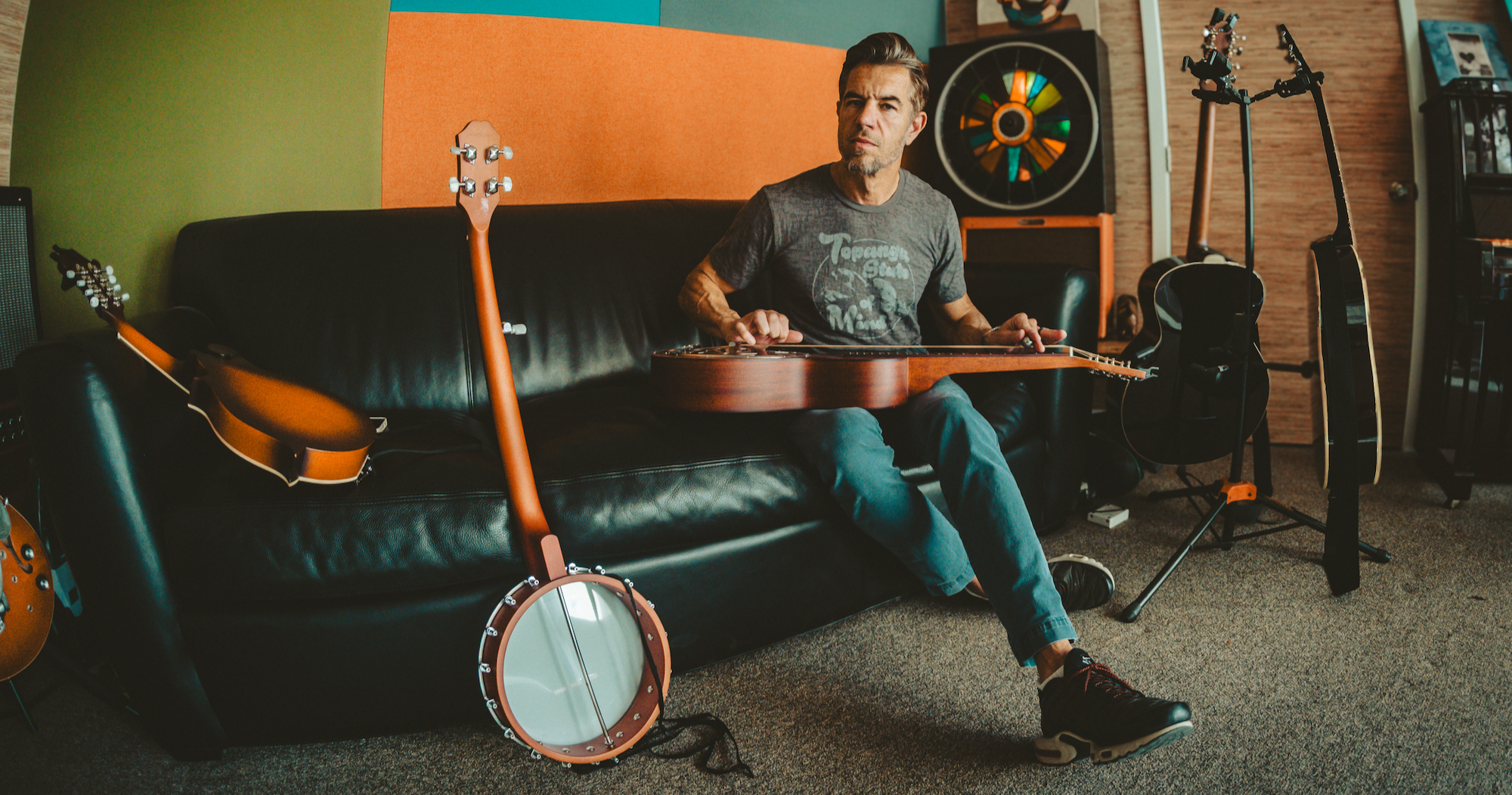
Normally, when singer-guitarist Nick Hexum plays a gig, it’s fronting legendary hard rock band 311, performing for massive audiences in huge venues around the globe. But, on a recent evening in Knoxville, Tennessee, he was backed by Americana/bluegrass act Water Tower in front of a small crowd at the Open Chord, a cozy space on the west side of the city along Kingston Pike.
“I’ve always been drawn to music that has energy, and there’s so much energy in flatpicking, the banjo, the tremolo picking of the mandolin,” Hexum tells BGS backstage. “This stuff has rock and roll energy that predates rock and roll.”
For Hexum, this deep dive into bluegrass, country, and Americana of late has become something of an intrinsic mission from within. It’s the current soundtrack of a 55-year-old rock star carefully aiming to dig up and examine the melodic roots of his past – these existential anchor points needed to move forward.
“This whole experience is just bringing it really full circle, like a home,” Hexum says. “My mom is from Nashville, so this is me getting in touch with [memories of] when we used to go to visit my great aunt Margaret in Gatlinburg and she’d play the autoharp.”
Retracing old routes, both geographically and sonically, was no more apparent for Hexum than when he and Water Tower appeared at Americanafest in Nashville. The stop in Music City was part of a larger tour throughout the Southeast in an attempt for Hexum to not only reconnect with his past, but also create an opportunity to break new ground for his craft – especially outside of the hard rock juggernaut that is 311.
“I’m just grateful that fans are showing up and are open to seeing me do something completely different,” he says.
During the intimate set in Knoxville, Hexum and Water Tower crowded around a single microphone, weaving in, out, and around each other in a whirlwind of acoustic instruments and Hexum’s signature vocals. The show ran a gamut of material, whether it be classic 311 numbers or selections from Hexum’s latest solo record, Phases of Hope and Hollow.
“The intimacy [of the show], it’s wonderful to be so up close. It’s totally different [for me] from a technical situation – it takes silence,” Hexum reflects.
This project is the brainchild of Hexum and Water Tower’s Kenny Feinstein. Water Tower is a rising ensemble from Los Angeles, one which initially started as an old-time/punk group, only to lean further into becoming a high-energy string band. They raised more than a few eyebrows when they performed at the recent Telluride Bluegrass Festival in Colorado.
“We’re walking into another side of Nick,” Feinstein says. “311 is all about bringing people together through unity and different styles of music, so this is another slice of Nick’s personality.”
For Feinstein, working with Hexum has been this surreal experience, personally and professionally. As a millennial growing up in the late 1990s and early 2000s, Feinstein was a huge 311 fan, so much so he vividly remembers their video for the smash hit “Amber” and seeing 311 guitarist Tim Mahoney sporting a mohawk haircut.
“My friend and I saw the video and [decided] we needed mohawks,” Feinstein reminisces with a laugh. “So, all three of us went to a party [that night] and got our heads shaved into a mohawk.”
This latest musical chapter for Hexum and Water Tower happened serendipitously through the sober community both Hexum and Feinstein are part of in Los Angeles. Leading up to their crossing paths, Hexum had been heading down the rabbit hole of an Apple Music playlist that featured singer-songwriter Faye Webster. His ear perked up.
“I really like her songs, the pedal steel [sound], and the beautiful arrangements,” Hexum says of Webster. “And then, I reached out to Drew Vandenberg, who produces her music. We started talking about working together and one of the things I wanted to do was learn some of those instruments. So, I bought a pedal steel and took some lessons.”
Making space in his studio for the pedal steel, Hexum wanted to add a few more instruments into his creative arsenal, including the mandolin. Cue Feinstein. Meeting him through the sober community, Hexum asked Feinstein if he would teach him how to play the mandolin.
“I had [Kenny] over and I was like, ‘Let’s do something that sounds like [Faye Webster],’” Hexum says. “And he was just a cornucopia of ideas.”
At that juncture in his career, Hexum “mostly had played six-string guitar,” with these other instruments “a new world” for the artist. And yet, even though he was just learning how to play them, he was already well-versed in the sounds of bluegrass and country.
“Nick saw a dulcimer on my wall and I was really impressed that he knew what that was,” Feinstein recalls. “He told me about his heritage and [growing up] in Omaha and how he loved country and bluegrass. Then I said, ‘We should jam sometime.’”
That initial jam session between Hexum and Feinstein resulted in the duo writing five songs right out of the gate. Soon, Feinstein brought in Water Tower banjoist Tommy Drinkard and wrote several more.
“And now we’re on tour. It’s so special to see the humility that [Nick] carries, the gratitude and appreciation for all of his fans after so many years of doing it,” Feinstein says. “It just inspires us to have gratitude for where we’re at now, and to know the journey we’re on is about continuing to lessen the suffering [of others through music].”
“There’s so many people out there in the crowd crying, really taking it in,” Drinkard adds. “These are very intense subjects and Nick does a good job of explaining where he’s coming from with the songs he’s writing.”
For Hexum, this recent journey into the bluegrass realm has become this incredibly cathartic experience. He found himself not only dissecting his past and that of his parents, but also that of his ancestors going back generations.
“My mom is from Tennessee and my grandpa was a Southern Baptist minister,” Hexum notes. “Half of my family does have these southern roots, so when I hear bluegrass, it just feels like part of my DNA.”
Beyond the new music itself, Hexum views this ever-evolving project as part of his ongoing quest to find himself through this vibrant kaleidoscope of sound and purpose. It’s about stripping everything down, focusing on the essence of a particular melody, and always being aware of the beauty of the sacred platform that is live performance. Turn off the amps, pick up the acoustic guitar and huddle around a lone microphone, together.
“It has gotten to a point where I’m like, ‘All right, time is limited here, and I want to make the most of the time that I have now,’” Hexum says humbly. “I mean, when you see your kids get older and get their driver’s license and stuff like that, you just feel this passing of an era. And so, for me, it’s getting into a different mode of songwriting – really focusing on sincerity and simplicity.”
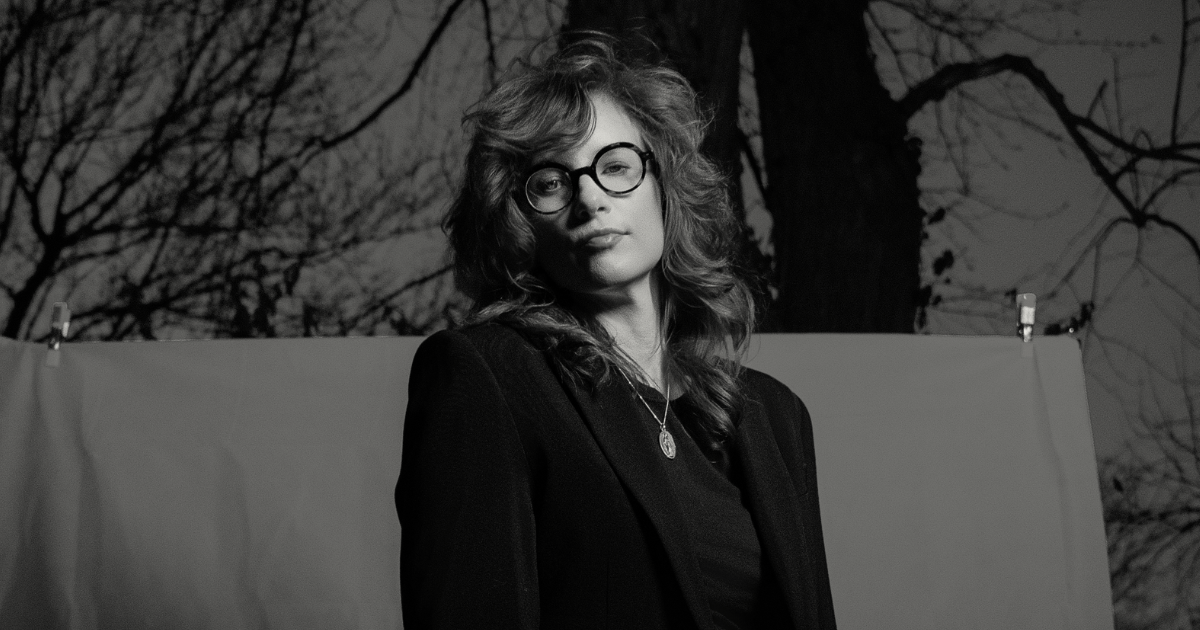
Equal parts old soul and trailblazer, Western Kentucky singer-songwriter S.G. Goodman explores rural belief systems with a forward thinking, synth-heavy, swamp rock aesthetic on Planting By The Signs.
Released June 20, the record is the first for Goodman since 2022’s critically acclaimed Teeth Marks and sees her diving into tales of love, loss, reconciliation, and grief. The ancient Appalachian concept it draws its name from subtlety influences all aspects of rural life from farming to self-grooming. According to Goodman, the idea to center her fourth album around this idea came in late 2022 after stumbling across a section about planting by the signs in Foxfire, a collection of books first published in 1972 that delve into Appalachian philosophy and ways of life.
“When I got to the passage about moon planting or planting by the signs I started having all these memories of hearing about [moon phases and zodiac signs] throughout my childhood,” Goodman tells Good Country. “My family and a lot of the people in rural areas like Western Kentucky have been taught these things but don’t think or talk about them in everyday conversation.
“For instance, my brother cuts his hair by the signs and I remember old people saying to never pull a tooth when the signs are in ‘the head’ [an area of the sky attributed to Aries]. I was weaned by my mother to the signs, potty-trained even. It’s an old belief system that I wound up immersing myself in and felt a responsibility to pass on.”
We spoke with the Americana Music Association’s 2023 Emerging Artist Of The Year ahead of the release of Planting By The Signs via Zoom. Our conversation covered the inspiration for the album’s concept, the themes of grief and reconciliation within its songs, the sonic evolution of the singer’s sound, and more.
What was it like taking the concept of Planting By The Signs and making it a reality? Did it turn out to be everything you envisioned?
S.G. Goodman: There were elements that were given over to studio magic. Sometimes the circumstances of recording force you to try different things you weren’t planning on, but for the most part I had a pretty clear vision of what I wanted this album to sound like before the songs were even written. This project leans toward a rougher sound that really hones in on the human element of the music. I also wanted to push myself sonically and add in new instruments that I normally don’t have in my music just to see what it would feel like.
In terms of trying new things, “Satellite” is a song that stands out. Is that a bunch of synths added to it or something else?
“Satellite” not so much. It sounds like synth, but it’s actually a little $150 makeshift Kent baritone guitar with a really wild, natural sound being played through a Fender Champ amp. There were a lot of synths elsewhere, but I’m just so ignorant when it comes to keys that I couldn’t tell you what they were. [Laughs] But I had [The Alabama Shakes’] Ben Tanner, a wizard on keys, come in to lay down and experiment some on organ, Wurlitzer, and other things.
For instance, because I do like an organic sound from my amps instead of using a bunch of pedals, we wound up playing along with the tremolos on the actual amps and ran the keys through that. But even with that, I’ve never had a record where there’s been keys on the majority of the songs, until now. That’s mostly been for economical reasons – I’ve been just a rock outfit with a lead guitarist, bass, drums and occasionally pedal steel, but it takes a minute before you can afford to not only have another player with you, but also a vehicle big enough to carry another person and their equipment. I was always leery to have songs focused around that, but with this album I was able to do it and shift around what kind of utility musician I wanted on the road with me and I’m really proud of it.
You mentioned working with Ben Tanner on these songs, but you also recorded down in Alabama as well. Tell me about what that experience was like?
Yeah, I was down in the Shoals, specifically the Sheffield area where Jimmy Nutt’s studio, The NuttHouse, is. It operates out of an old converted bank and felt really familiar to the small town I grew up in, where you could stand out in the middle of the road and pretty much bet a million dollars you wouldn’t get run over, because you’d never even see a car.
When you’re in the studio I’m not so big on doing destination recording, because in my opinion you should just be in a room working on music and not out seeing the sights. This was the perfect balance of not feeling like you’re missing something outside the room, but if you did walk out there it would be a calm environment.
Another sonic element on this album I wanted to touch on are the conversational audio recordings interspersed on tracks like “Heat Lightning.” What purpose were you trying to serve with those?
Going back to my mindset heading into this record and my desire to write about planting by the signs, I was really interested in the way that beliefs carry on and evolve over the years. We either accept, adapt to, or even stop telling these stories and letting them die, so [that was] one thing I wanted to showcase, either in a long narrative form or by adding elements you mentioned like the field recordings. I wanted to add those in because it’s another style we’ve used to capture stories and keep them alive. I’m a big fan of Alan Lomax’s field recordings – there’s a massive musical and oral history tied to them – so it was important for me to pay homage to that storytelling medium.
I even sought to do that through the album layout and artwork, too, by incorporating flash tattoos. Tattoos are a way that we have planted stories on ourselves and applied meaning to. Even its color scheme with red, yellow, and black – I don’t know if you’re ever heard this saying, but, “When red touches black you’re OK Jack, but when red touches yellow you’re a dead fellow.” That’s a sign from nature [about venomous snakes], so every element around this album, from allowing myself to write a nearly nine-minute song [with “Heaven Song”] while keeping this cohesive storyline to retelling a story from my youth in “Snapping Turtle.” I really wanted to showcase the history and art of passing down a story and drawing attention to that.
Someone whose memory you’ve preserved within these songs (as well as on older tunes like “Red Bird Morning”) is your longtime mentor and father figure Mike Harmon, who tragically passed away recently during a tree cutting accident. What kind of influence has he had on you, not just with this new record, but also on you as a person?
As far as Mike’s influence on my music goes, he was a huge encourager of me throughout the years going back to my days with The Savage Radley. I also played with him in a local Murray, Kentucky, band called The Kentucky Vultures. He was their bass player and we became fast friends and at one point even neighbors. He served as a father figure that I could bounce ideas off of musically, but more than anything it was his wisdom and support that impacted me most. He was such a go-getter and always an amazing person to have on the road with you.
One time I needed someone to help me get my van back from Boston, Massachusetts, to Western Kentucky, because the band and I had to fly out to Portland or Los Angeles in the middle of our tour before resuming the run a few days later in the Midwest. Mike simply asked when and where he needed to be and followed through. He was always down to help and be a part of things. It’s hard to wrap up exactly how meaningful his presence was during those early years. He was so proud of me and the boys when we were able to do this in a more professional way and regularly flew out to see our shows. In fact, in early 2023, he was supposed to be on tour with me in Austin for a sold-out show that I was particularly excited to have him at because he’d previously lived there for a time before losing his housing, only to die a week and a half later in a tree accident.
I continue to find myself thinking that Mike is still providing me with a lot of gifts and wisdom. When he passed away I was able to reconnect with my longtime friend and music collaborator of over 10 years, Matt Rowan. At that point we had a rupture in our friendship and musical relationship and hadn’t spoken in a couple years, but with Mike being the confidant, he was very aware of Matt and my falling out. [He] was always supportive around that and believed that we’d eventually reconcile with each other.
And that reconciliation is what you’re exploring on the song “Michael Told Me,” correct?
Correct. It’s a song that speaks to both Matt and Mike and kind of gives a snapshot of evolution and the processing of Mike’s death, but also the exact moment that Matt and I spoke after a few years of not.
You’re also singing with Matt on the album’s title track. What was it like getting to reunite in the studio with him for that?
Matt is also a co-producer on this album with me and Drew Vandenberg. He’s obviously been a longtime collaborator, so I thought it’d be interesting if he had an even bigger role on this album. I wasn’t wrong in my expectations of it working out really well.
Circling back to “Satellite” for a moment, lyrically the song seems to talk a lot about modern technology and human connection, or a lack thereof, in modern day society. What inspired you to explore those themes and how do you feel they fit into the record’s larger concept of planting by the signs?
I actually wrote most of the song in the studio. I didn’t start it there, but wasn’t expecting to have it on the album either. It’s something that came to me during the creative process of recording, which is not uncommon. When I was writing it I realized that one important thing for me to tie into talking about an ancient belief system was my curiosity of how that applies to our real, modern world. A lot of questions were coming up for me around that that I also tried to showcase within this album and my approach to talking about it with people. If Planting By The Signs revolves around paying attention to messages from nature, what does it mean for us as a society when we’re putting things between us and being able to see those signs?
For instance, we’re talking to each other right now through Zoom and are living in a world where more and more importance is being put on having more filters between us and nature – and even convoluting it. What are we gonna be [at] when I die, like 20G? [Laughs] How many satellites are going to need to be shot up into the universe to accomplish that?
Right now as a person, I’m in that weird land of [having been] a child in the early days of the world wide web when my parents got their first computer with dial-up internet. I didn’t start texting until I was 18. Nowadays I can pull up a waterfall on YouTube and hear the sounds of it in my living room without ever going somewhere like Cumberland Falls. Or I can go to a bar in public and not talk to a single person, because I’m just staring at my phone. I’m definitely a grandma when it comes to communicating with people.
I’ve noticed in the last 15 years that people are very hesitant to get back to a real human connection. There’s so many barriers nowadays to us having tangible connections with other people and nature. With that comes implications with AI and in the media, so it’s no wonder that a person who’s been watching the same creek bed over the course of 20 years evolve and cut differently and rise and fall may have a better idea that the weather patterns have drastically changed than a person who’s only receiving their information through technology.
Is “Nature’s Child,” which you sing with Bonnie Prince Billy, also touching on those themes?
That’s actually the one song on the album that I didn’t write. It was written by my friend Tyler Ladd. I first came across it over 10 years ago at an open mic in Murray and was floored by its lyrics. Everyone has different opinions on what makes a good song, but for me it’s really simple – a good song is one that you remember after hearing it.
Not long after that night, Tyler took off hitchhiking across the United States. Then years later I got a message from him saying that he was in Europe traveling and was writing to me from a hospital bed in Germany after getting his guitar stolen and beaten up pretty badly. I told him to get on home and about a year after that he showed up on my front porch in late 2016. I had him sit in my living room and play that song to me before asking him if I could start playing that song too and making it my own.
I’ve covered it live for years at this point, so when it came time to begin writing and thinking about this album Tyler’s lyrics and emotion he evoked in that song were a placeholder for me. He was gracious enough to let me record it. The song encapsulates everything this album is about.
Through the process of bringing Planting By The Signs to life, what is something that music taught you about yourself?
With each album you find yourself at a different place in life. I don’t necessarily have a lot of people ask me about my process of writing. It’s not linear and I’ve always held the belief, even though I’ve doubted it at times, that a story’s gonna go about its business. That was told to me years ago by a writing mentor, and a song does the same thing. Through that process one thing I’ve had to come to terms with with the fact that being an artist in 2025 is having pressure to keep churning out content and material, which has never been natural for me. I’ve never written that way, so being OK with and waiting for something to be in place where you feel you’ve said everything you need to say and not just succumbing to the pressures of putting something out while also being genuinely proud of what I created is a testament to the fact that I let this come when it was supposed to.
Photo Credit: Ryan Hartley
This website uses cookies to improve your experience. We'll assume you're ok with this, but you can opt-out if you wish.AcceptRejectRead More
Privacy & Cookies Policy
Privacy Overview
This website uses cookies to improve your experience while you navigate through the website. Out of these, the cookies that are categorized as necessary are stored on your browser as they are essential for the working of basic functionalities of the website. We also use third-party cookies that help us analyze and understand how you use this website. These cookies will be stored in your browser only with your consent. You also have the option to opt-out of these cookies. But opting out of some of these cookies may affect your browsing experience.
Necessary cookies are absolutely essential for the website to function properly. This category only includes cookies that ensures basic functionalities and security features of the website. These cookies do not store any personal information.
Any cookies that may not be particularly necessary for the website to function and is used specifically to collect user personal data via analytics, ads, other embedded contents are termed as non-necessary cookies. It is mandatory to procure user consent prior to running these cookies on your website.