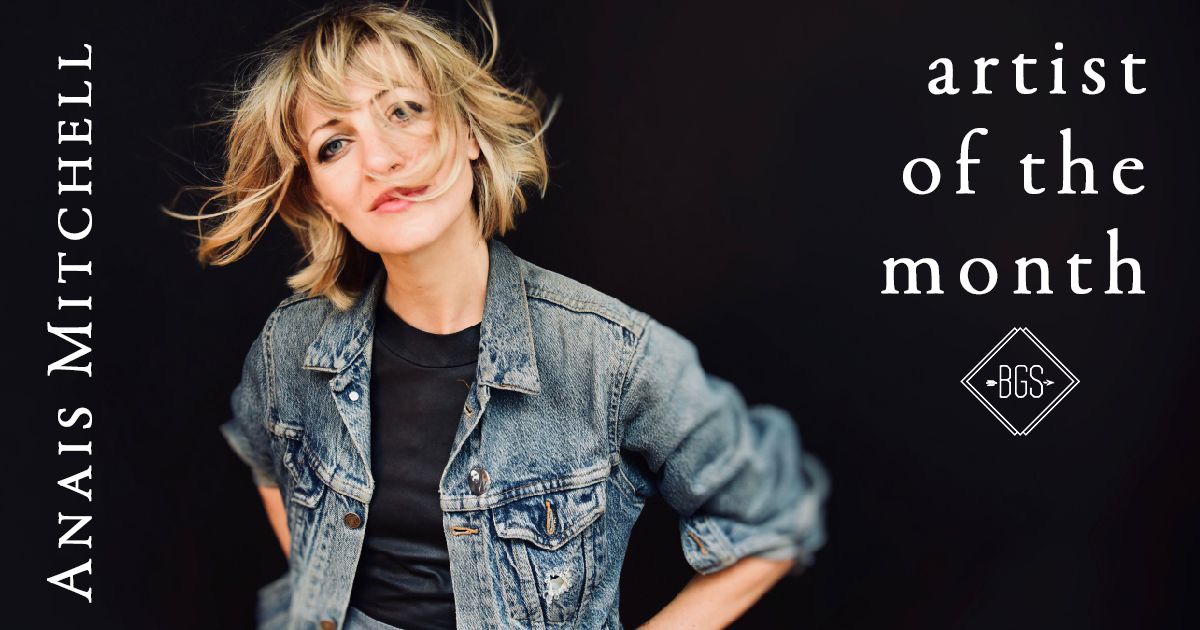
In June 2019, Anaïs Mitchell picked up her first Tony Award when Hadestown beat out bigger productions like Beetlejuice and Tootsie to snag Best Musical. It was an unlikely win for the eccentric and ambitious production — and the culmination of fifteen years of hard work bringing it to Broadway.
“I had no idea how long I was going to work on it,” she tells BGS. “I really didn’t. I just knew what the next step always was and just kept taking them.”
A folk musician born in Vermont and based in Brooklyn, Mitchell first staged Hadestown as a regional production around New England, and it resembled something like a traveling medicine show, as she and her friends toured it the way they might tour an album. In 2010, she released it as something like an Americana concept album, casting colleagues and collaborators in key roles: Bon Iver’s Justin Vernon plays the role of Orpheus, while Ani DiFranco is Persephone.
The story is old, even if the production is new. Mitchell borrowed characters from Greek mythology, combining the stories of Orpheus rescuing Eurydice from the underworld and Persephone warring with Hades. But she filtered them through John Steinbeck and Upton Sinclair, imagining the underworld as an industrial hellscape, like a sooty factory or a mine, with Hades abusing both the natural world and his workers.
In 2015, she began working with a stage director named Rachel Chavkin, who brought the award-winning Natasha, Pierre, and the Great Comet of 1812 to Broadway. Together with a team of producers, musicians, actors, set designers, choreographers, and many others, they began to rework Hadestown for a bigger stage, streamlining the story and rearranging the music for maximum impact. In some cases they rewrote entire characters or scratched entire songs, searching for the best possible way to tell this complicated story.
When it debuted at the Walter Kerr Theater in March 2019, Hadestown barely resembled the production Mitchell staged around Vermont. It was bigger, flashier, more accessible, but also truer to the big ideas that inspired her in the first place. At its heart is an America defined by conflicts between industry and environmental conservation, between commerce and art, between various forms of love and labor. Yet, in its most innovative stroke, the production retained its roots in folk music and its populist ideas. The original cast recording just earned a Grammy for Best Musical Theater Album.
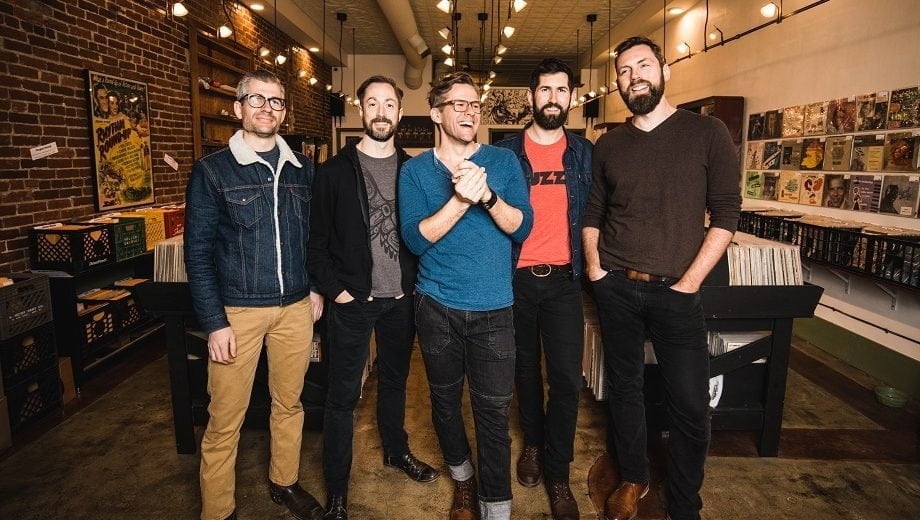
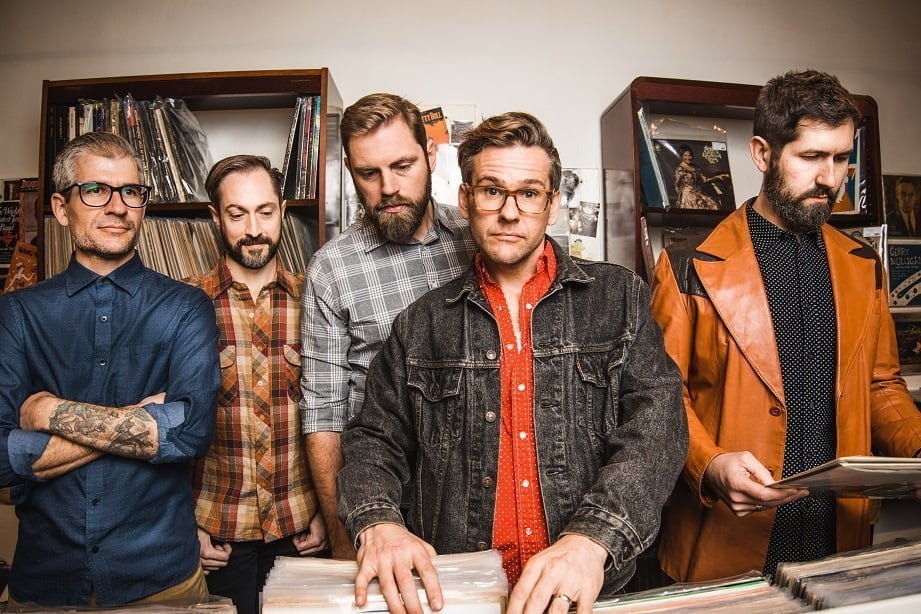
“It’s a little crazy to be on the other side of it,” Mitchell says. “I’m still trying to bend my head around what that means. Like, what kind of songs do I write now?” For the moment she’s focusing on her new band, Bonny Light Horsemen, which is something like a supergroup trio with Fruit Bats mastermind Eric D. Johnson and multi-instrumentalist/producer Joseph Kaufman. Featuring members of Bon Iver, the National, and Hiss Golden Messenger, their self-titled debut album resituates centuries-old folk songs in new settings. “Bonny Light Horsemen has been this really assuring kind of space to be creative in and make music and not feel like it’s my new statement,” she says. “Because it’s not.”
As she was packing to launch a lengthy tour with Johnson and Kaufman, Mitchell spoke with BGS about Greek and American mythologies, creative uncertainties, and songs that straddle the line between personal and universal.
BGS: You lived with Hadestown for more than a decade, during which time it morphed into a brand-new creature. What kept it compelling for you?
Mitchell: I would say that like the simplest answer to that question is that it never felt done. The studio record that we made in 2010 felt done for a studio record. It felt like a complete statement. But the show began as a stage performance piece and I always wanted to see it that way again. As soon as I started the next phase of development with Rachel Chavkin it was one chapter after another: We’re going for off-Broadway. Then we’re going for regional. Then we’re going for Broadway. And it always was like, “It can be better, it can be better…”
And the people kept the wind in the sails of the project. At a certain point it became so much bigger than me. Maybe it always was bigger, because there’s the orchestrators and the singers and all the people in the different cities. It became something like a whole community of people just chipping away at the same piece of stone. It was very exciting to be in the room with those actors and with Rachel and seeing the choreography and the sets coming into focus. It was like a hive. I couldn’t have turned my back on it.
Do you feel differently now that it’s up and running in its current form?
Now that it’s up and running, I don’t even go. It’s happening every night and I get a little report by email here in Brooklyn. It really has a life of its own. It’s become its own animal. And I think I did max out what I could give it in that period. So it feels great to just be making folk music with Bonny Light Horseman right now. It definitely feels like the right place to be.
Why did you want to pursue this story as a stage production? What made it something different than an album or even a book?
From the earliest moment of starting to work on the piece, I was excited by the idea of telling a dramatic, long-form story with larger-than-life characters. I love songs so much, but I remember noticing that even at my favorite concerts by my favorite songwriters I would start to get bored with all these tiny climaxes in the songs. There was a disconnect from one song to the next.
I will watch a terrible movie all the way to the end because there’s that question: How is this going to end? What’s going to happen next? That is so powerful and it will carry you through. I wanted that for this piece. I wanted all the songs to lean on each other, so that you had to watch the whole thing and get through to the end.
That took you well outside what most folk musicians and singer/songwriters are doing. What did you learn during that process?
There was so much learning in terms of writing a song that felt like it was structurally perfect for the album, like “Wedding Song.” It’s just three verses and a little interlude. I would play that at my songwriter shows and think, yeah, it’s so tight. But it fell flat as a dramatic scene. I had to find a way to explode the form without breaking what works about it.
I also learned about putting space into a song. You might put space into a song so that a musician can improvise or express themselves. The same is true for drama: There was to be space for the actor to create the character. As a write, I tend to want to fill that space with words. I think both of these mediums are really similar in the sense that you’re building something for someone else to inhabit. You’re building a house that someone else can live in.
If you can write a song that’s good enough that other people are going to sing it and cover it and let it live in the world, you’re creating something that is similar to a play, which can be revived just by other people’s involvement in it. It’s bigger than you. And hopefully it’ll outlive you.
That’s interesting, because right now it seems like most people prize the singer/songwriter model, where the song is heard as an extension of the person and means less when it’s covered by someone else. The idea of somebody telling their truth seems to have more validity right now than a song that can change and accommodate new interpretations and maybe means something different when different people sing it.
I think we’re approaching an idea that feels really important to me. I haven’t talked about it enough to have language about it, but I do think things need to be true emotionally for the person who’s writing them. I would say all of the songs in Hadestown came from a place of personal truth even though they maybe took on the clothing of the character or the needs of the scenario. There has to be some emotional truth. That’s a sacred thing. But there’s something intersecting that idea. What is universally true or part of some collective unconscious stuff can be exciting.
You could go about trying to write something like a hit or a standard as a kind of exercise, and it might not feel true to you. To be honest, I think a lot of Nashville co-writing scenarios end up this way, where you get something that feels structurally tight but is missing some kernel of personal truth. But you can go too far in the other direction where it’s like the person is totally self-expressing. How does that mean anything to me or to someone else?
It’s that middle ground you’re looking for, where you can sing from your own heart and experience, but you’re also singing from the heart of the world, from the world’s experience. Folk music is really interesting for that, right? Because it’s like water from a deep well. Those songs tap into a universal experience, and those archetypes and images are going to live forever. So if I can find a way to write that taps into that but also feels true to me, then that’s the zone I want to live in.
Do you feel like you reached that with this iteration of Hadestown? Is this the final form it will take, or will you keep developing the story?
There was a moment when I thought I was going to revise it for the tour that we’re doing in the fall. But we just put out this cast recording, which is beautiful and has all the material in it. I think people might want to go to the regional version and be able to experience the show that they’ve listened to on that recording. I do fantasize about a film version, but that’s maybe years down the line. For the time being I think it’s best for me to take a step away, but I could see getting really excited to roll up my sleeves again for what would essentially be another phase.
I’ve actually been working on a book, which has been very therapeutic. It’s coming out sometime this year and it’s basically the history of the project, the evolution of the lyrics. It’s called Working on a Song. I was able to go back and look at a lot of these songs and see where they came from and how they evolved. I often would say I felt like I was banging my head against the wall: The idea was wrong, the thing was wrong. It’s wrong, it’s wrong, and then suddenly it’s right. At the time it didn’t feel like those wrong choices I had made meant anything. But when I look back on the process, I can see more clearly the way certain lines came up or certain songs or ideas came about. They didn’t come up quite right, so they went back into the soil. They nourished the ground that then the right thing could grow out of.
So much of the time you feel like everything is futile. Like, I can’t believe I just sat here for however many hours and made only one rhyme that might not even be good. That happens to me all the time. So the metaphor that I came up with has to do with gardening. You have to rake around, and the raking is sort of aerating the soil. You’re preparing the ground for the right thing to come up. And when they do come up, they’re beautiful, like flowers. And then they go back into the soil and eventually nourish the next thing.
That definitely seems to fit with the story Hadestown is telling, about an artist who literally goes into the soil to rescue his beloved and finish this unfinished song. From a creative perspective, how much did you identify with or relate to the character of Orpheus?
Totally. It’s interesting that that character took so long to come into focus. Ever since our off-Broadway version of the show, Orpheus confused a lot of audiences. People weren’t falling in love with him. They found him and Eurydice to be less fully drawn and therefore less compelling than the older couple Hades and Persephone. I always thought of Orpheus as this really crazy optimist. He’s got this faith in the world and in his own music, but then he ends up besieged by doubt at the end, which is supposed to be crushing. But he has a lot of lines that if they were delivered wrong — even just by a tiny fraction of a percentage wrong — they felt swagger-y and cocky, which is not what I intended for him.
I always thought of him as this sensitive soul, and that kind of machismo was not in keeping with that idea. His first line was, “Come home with me.” And people were like, who is this guy? Why’s he trying to pick up this chick? Why should we love him? People weren’t identifying with him, and they didn’t care if he won or lost. Obviously, if you don’t love him and want him to succeed, then the story falls flat. You’ve got to love Orpheus.
After we debuted in London, there was a crisis moment when we had this awful nagging feeling that something was not quite in focus. People don’t love this hero. It came up in a lot of reviews. So we went into triage mode, me and the director and the producers. How can we fix this? So we decided that for Broadway, we would really lean into his naiveté. He’s a boy who’s lost in his own world. He undeniably has a gift to give the world but he’s not very good at living in the world the way it is. He’s socially inept. He doesn’t know what he’s doing.
Suddenly that made him appear much younger and much more innocent. It’s not like he’s so brave to stand up to Hades. It’s more that he just doesn’t know any better. He’s an innocent who finds himself in the belly of the beast, and he doesn’t know any better than to call out what he sees as true. What we fall in love with is his purity of heart. That’s what comes through in his singing. That was a really fascinating journey with that character for me. That song that Orpheus could never finish was also the song that I felt I could never finish.
(Read our second installment of our Artist of the Month coverage on Anaïs Mitchell tomorrow.)
Photo credit: Shervin Lainez