Tedeschi Trucks Band Have Done It Again

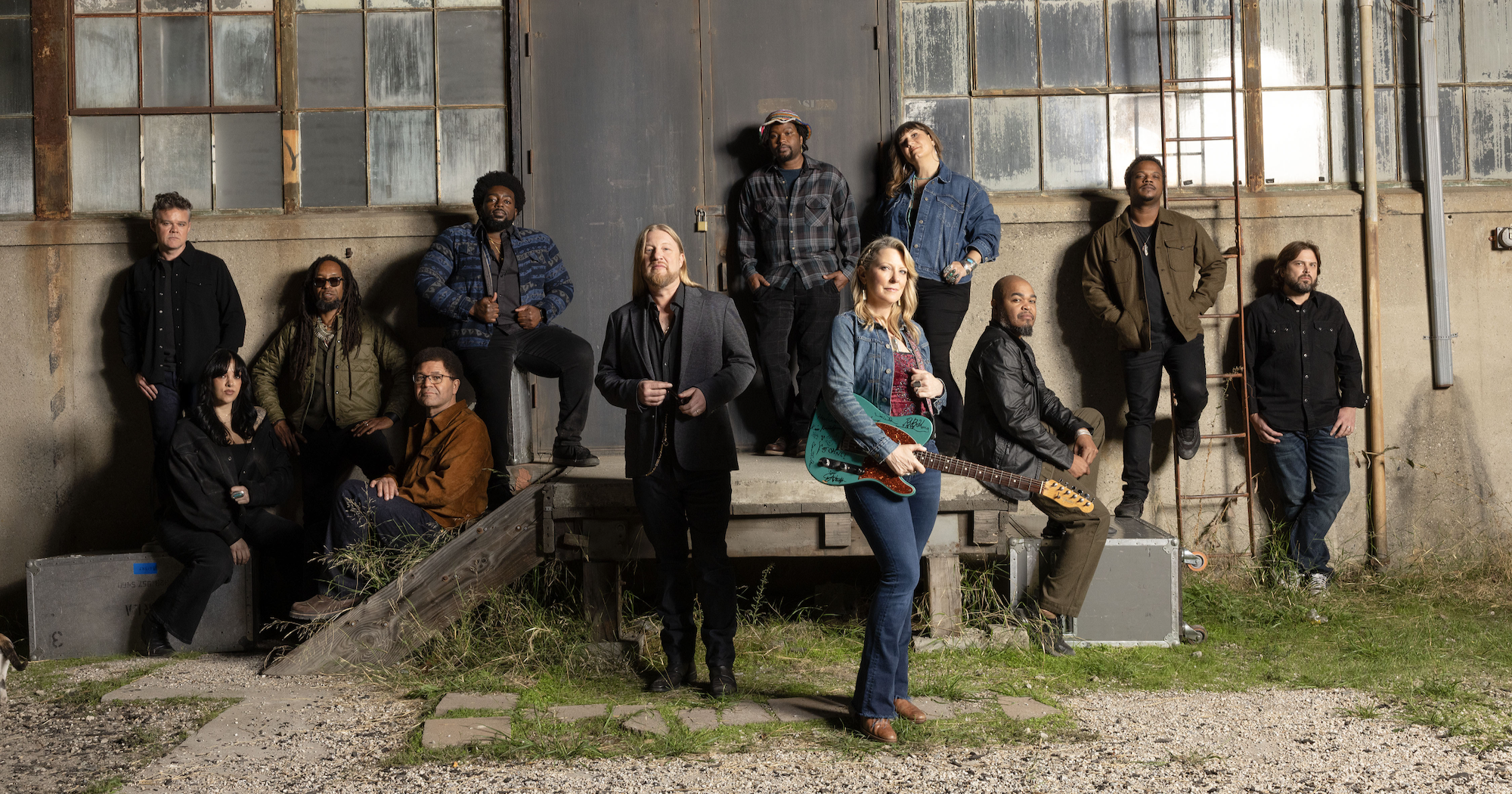
When it comes to entirely enjoyable, technically exquisite modern blues, Southern rock, and jam-band soul albums, Tedeschi Trucks Band have a statistically impossible batting average. Their new LP, Future Soul (released March 20 via Fantasy Records), is yet another “no skips” collection from the megalithic 12-person Americana group fronted by husband-and-wife guitarist Derek Trucks and guitarist-vocalist Susan Tedeschi.

On that strength of their catalog – and their ensemble – TTB have amassed hundreds of millions of streams, won eight Blues Music Awards and one GRAMMY, and a handful of their songs have become regarded as modern standards in the Americana and American roots music songbook.

Future Soul simultaneously feels like a surprising departure and familiar, essential territory for the band. With Mike Elizondo producing and songs and creative input sourced from across the group’s lineup, the set ends up sounding and feeling more acoustic than “usual,” while still reaching roaring crescendos and building it all on dank, wide open grooves. Perhaps those acoustic moments are a substantial contributing factor as well, but the cozy, plush pocket of the album is what gives it a laid-back, relaxed, and floating vibe no matter the track’s genre construction.

Screaming slide, no-holds-barred vocals, and wall-of-sound climaxes can all be found herein, as well. But the collection never thrashes or flails, it’s precise and exacting – as Tedeschi and Trucks are both known to be on their instruments, whether guitar or voice – but it’s certainly not sterile or gated or homogenized, either. It’s another remarkable feat for a group so large that you would almost have to assume, live or in studio, musical mud would be an inevitable byproduct.

But no, TTB seem to have no misses, at least not on Future Soul. It’s clear this group works together in harmony not just because of the down-to-earth and collaborative leadership of Tedeschi and Trucks, but because the artistic and musical responsibilities and ownership – of the songs themselves, of the album, of the makings of each, of “success” for the band – are decentralized and distributed throughout the group. The band has a sound, an art, that is consistently collective in the way it’s received by audiences and listeners because, forgive the obviousness, Tedeschi Trucks Band always work as a collective.

In our BGS conversation with Derek Trucks, the magic and unlikelihood of this creative dynamic and the processes by which the band continues to rack up success after success were on full display. We spoke about how they put together Future Soul as a group effort, the many inputs that went into Trucks fashioning his lyrical guitar style, and what bluegrass means to him personally, to Tedeschi, and the band as a whole. It was a joy-filled, passion-led conversation that again reinforced how this wailin’, rockin’, rollin’ band continues to flout and subvert expectations – and thereby has become so beloved.

Something that jumped out at me from the bio about the new album is that you say, “There’s just not a weak spot on this record.” I have to say, I totally agree. I think it’s remarkable that with a 12-person band and such a diverse catalog of recordings and releases, it really doesn’t seem like there’s any “fat” to trim or any duds to cull.

I have to ask, does it feel as magical on the inside of that process as it seems from the outside? It seems unlikely that y’all would work so well together towards a common goal, artistically, and be able to deliver again and again and again. And I don’t just mean commercially, awards-wise, or for audiences alone. Clearly you’re delivering artistically for yourselves and by your own standards, as well. So, does it feel as unlikely on the inside of that process as it maybe does to us on the outside looking in? [Both laugh]

Derek Trucks: That’s awesome. But it does, man! I mean, not every record you do feels the same way. They’re all their own beasts. For I Am The Moon, it was in a time of great uncertainty. We did four records and it was just kind of a heavy, heavy time – and that record feels like that.

This one felt completely different. The band felt much more confident [and] had been touring for two years straight. We had been playing so much together that when we finally got the core of the group up to our farm in Georgia to do some writing, there were a few songs right out of the gate. Like “Future Soul” and “Who Am I,” where immediately, Sue started singing, Gabe [Dixon] started singing these melodies. I got chills and I was like, “Oh, this is gonna be good.”

You’re always kind of worried about running out of ideas, or running out of runway – like a thing in the back of your head. But I feel like we’re incredibly fortunate where, when we’re together, everyone puts everything they have into it. Then, when we’re not on the road together, everyone’s all doing their own things musically. So, when we come back together, there’s a lot to talk about and a lot of music to remember together.

I think it keeps it really fresh and it keeps it moving forward. I feel like everyone’s out honing their craft when they’re away from this. When they come back, there’s a lot of new ground to cover. So far, we’ve been really, really lucky that way. And there’s a handful of just incredible songwriters in the band, so everybody comes in with two or three ideas. You’ve got a pretty strong record right out of the gate. That’s been something that I think me and Sue are just realizing – we’ve known how amazing that is but, you know, Gabe and Mike [Mattison], they show up with some serious ideas.

Then having Mike [Elizondo, the album’s producer] down, just some outside ears – I think that was really important. Sonically, he was trying some different things that I think inspired the band and made everybody play a little differently. That was exciting.

I was struck by the range of styles and the different genre infusions that y’all have put into this collection. What really stuck out to me, listening down to the project in one fell swoop, is there are still those really big energetic moments – and there are still those “wall of sound” moments that y’all are really known for. But I felt like this album is chill and laid-back in a way; it feels deep in the pocket. Can you talk about capturing those seemingly disconnected energies together?

I think one of the things is that with a band or an artist, I think if you’re maturing properly – we learn sometimes slowly – that you don’t have to force the issue all the time. You can trust things around you a little bit more, and sometimes the groove is enough. Sometimes the chord changes are enough, sometimes the melodies are enough. It doesn’t have to be these epic moments at all times. So when they do come, you’re excited about it and wrings you out. Then you lay them back down, and then you go on another little trip.

I think the band, having played together so much, we’re in a different place that way, where we realize that you don’t have to force the issue on every song. You can go to different spaces, different places. And then, again, having some outside ears – Elizondo really helps with that, too. He helps guide you to places that maybe you wouldn’t have gone naturally, so that’s a fun thing. Then you learn things about yourself musically in the band that you didn’t know before. That’s always a good place to be.

One thing that I’ve been obsessed with about your playing, specifically, ever since I discovered you as a teenager, is how lyrical of a guitar player you are. It jumped out at me from the bio, as well, when you’re talking about “I Got You” and how you’re doing a guitar-voice dialogue instead of guitar-guitar. I think of you as one of the most lyrical guitarists out there. You’re so present and so grounded. So I’ve always wanted to ask you how you’ve cultivated that style – as well as being able to have those moments of pure shreddy, lick-y wailing.

Then hearing that you really wanted to make that connection between voice and guitar on this album made so much sense to me, because I’m always thinking about how you’re a lyrical player. And Susan is, too, and you both dialogue with your instruments, and her voice, often.

Pretty early on I had a few musical epiphanies. One was Allen Woody, who played with Gov’t Mule and the Allman Brothers. When we toured with my solo band, opening for a Gov’t Mule in the early days, he would always turn me on to records. He gave me this CD by this guy named Aubrey Ghent, who was a gospel [steel] player. I put on “Amazing Grace” and I was like, “Wow, what an amazing voice.” And then I heard the pick and I realized that it was this guy playing lap steel! But it sounded like a woman singing. I got chills [over] my whole body, and I was like, “That’s it, that’s the thing.”

I had been listening to a lot of Indian classical music – a lot of vocalists and sarod players. Me and our old [Derek Trucks Band] bass player, Todd Smallie, went to Ali Akbar College of Music in San Rafael, [California] and they would let us sit in on classes. I realized he [Ali Akbar Khan] made all the instrumentalists take vocal classes, because his whole thing was that you should be singing through your instrument. So that made it just really obvious.

Those were a few of the things, and then there was a long time where I just stopped listening to any guitar player. It was only singers and horn players. That was kind of the idea [that] musical ideas can come from anywhere, but you really should be singing the thing. There’s time for all of it, but the stuff that moves me the most is, you know – even hearing Duane Allman on “Blue Sky” or something. It sounds like somebody’s singing, like somebody is walking down the road whistling. I think those are probably the touchstones for me.

Maybe I am projecting a little bit, because I’ve been a bluegrass banjo player my whole life – I started playing when I was seven. But when I think of guitarists, especially who end up reaching the pinnacle – whatever that is – or especially in flatpicking and in bluegrass, there tends to be this homogeneity of style. The people who get to the “very top” end up all sounding like each other. Then you have those folks that really stand out, and it tends to be because they’re using space and using air as much as they’re using 16th notes and 32nd notes. I think, being used to really shreddy flatpicking, that hearing steel or slide or blues guitar or jazz or acoustic jazz, anything plays with sustain and plays with space, I just drink it up.

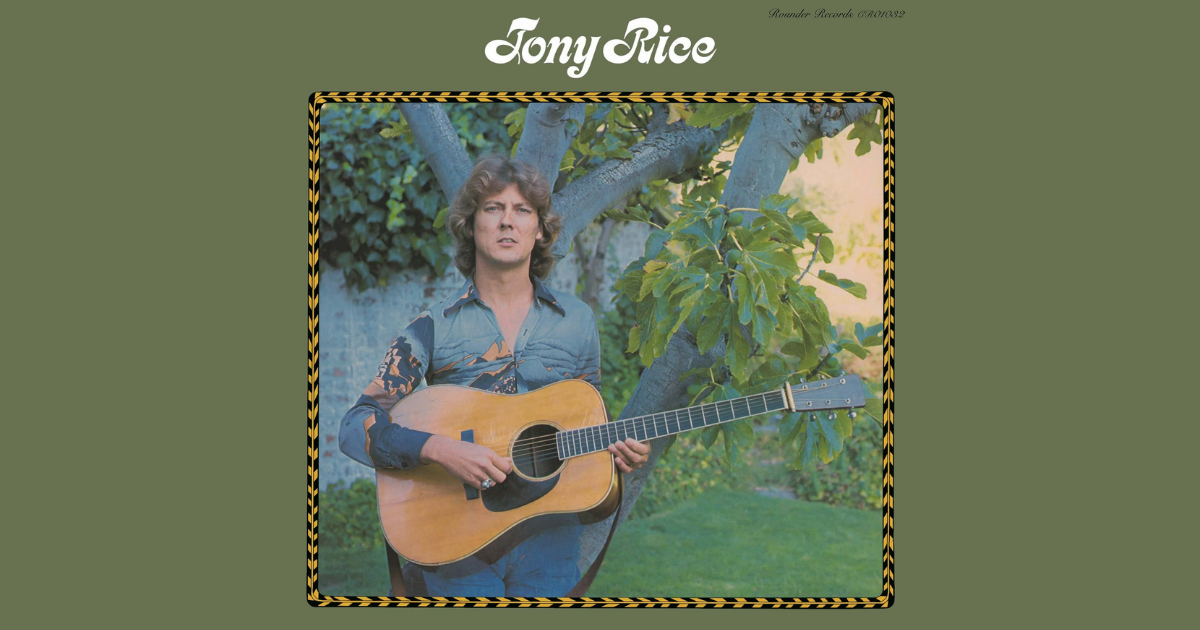
Beautiful, man. I remember the first time I heard the Stanley Brothers, or Ralph Stanley, and I just remember it hit me in that place where those early blues guys hit me. There was just something about it. That kind of cracked that whole world open for me. I mean, I was always a Tony Rice fan. We have the same birthday, so I thought that was cool.

No way, I didn’t know that.

And I remember being at a MerleFest years ago, I think it was one of the last ones that Doc played. I remember seeing this old Oldsmobile or Cadillac – I don’t know, it seemed like an 1980s or ‘90s car – it pulled up to the stage and I see Tony Rice get out, just dressed to the nines. He pops the trunk, gets his guitar, hits the stage, and then right when that set was over, he was back in that car! I was over there thinking, “What a boss.” It was incredible, man. He went up and just annihilated everybody and got back in his car and drove his ass home. Pretty incredible.

So funny.

The last time we talked to you for the site, you were Artist of the Month in 2019 and you talked about Del McCoury and Jerry Douglas. I know you’ve played DelFest a bunch, you’ve collaborated with Billy Strings – oh, and I was super excited to see Molly Tuttle supporting on a couple dates of your TTB tour in April, too.

Yeah, we’re excited for that. That’s gonna be great.

What does bluegrass mean to you? Obviously, there’s Ralph Stanley, Tony Rice – there are pickers and makers in bluegrass that are infused into what you do, but what does the genre mean to you more broadly? And who in the space right now inspires you, or your musical vocabulary, or what you guys are doing in the band?

When I think of American music, I think of blues, I think of bluegrass, and I think of jazz. I think [those are] the things that we’ve really contributed to the world. To me, those are the cornerstones of it.

We’ve become good friends with Sturgill [Simpson] over the years, and he’s dipped into that [bluegrass] place. When I hear him sing it I’m like, “Oh yep, that’s because he’s from there.” He’s from the heart of it, and it makes me feel the way Ralph Stanley does at times. Even guys like Tyler Childers – and Sue’s a big Sierra Ferrell fan. She loves all those records.

That music, even the current guys, it’s always playing around here. I don’t know, it just feels inspiring to hear. People just get on an acoustic instrument and rip one. You’re like, “Oh yeah! There’s still people that know how to do things!” [Laughs]

That’s the big inspiration I take from it. Because [in the music industry] there’s a lot of cutting corners, and that’s a music that there’s no cutting corners. You gotta put your time in and take your licks or you’re just not gonna get on stage. I appreciate not just the dexterity, but the vocabulary and the heart that goes into it.

And there’s just something about seeing a group around one microphone just doing the dance that I think is always inspiring. We’ve done some shows recently with Sam Grisman, we did a benefit [for Camp Winnarainbow] out in San Francisco. Peter Rowan was on it, and me and Sue, and it was all acoustics. I had an old National, and just getting to play with that group – just the way that group felt. Sitting on a stool with a Dobro, and they were coming and going around the microphone. And then, getting to hang after the show with Peter Rowan and him telling these stories, man. It was just incredibly inspiring. Some of the songs that we got to play with them – that dude [David “Dawg” Grisman] has written some incredible music. That was one of the highlights of last year. It was pretty damn incredible.

There’s a lot of acoustics on this new album, too. I did find myself wondering, and maybe I’m biased, but does the world need a 12-piece bluegrass band? It might! It might! [Laughs]

Man, that sounds pretty fun to me. I mean, it would be a lot less gear to carry on the road! Which would make it more plausible.[Laughs]

If you wanted to speedrun pissing off a fan base, this might be the way to do it.

[Laughs] Yes, alright, we will be thinking about this! I’m gonna go talk to Sue.

This next one is kind of for me, so I thank you in advance for humoring me. But I wanted to talk to you about Jack Pearson. When I first moved to town, I just met this guy out jamming on mandolin at these bluegrass jams. I’d be like, “Man, this guy’s so nice.” He’s a great picker. He’s a great singer. I got a lot of practice playing swing with him at jams in town. Then folks started being like, “Hey, do you know who that is?” Oh my god, I did not know who it was. He was just my bluegrass jam pal. Then I worked at the Station Inn for a few years and I got to work a bunch of his trio shows. I’d die for the solo acoustic sets he’d do on the set break.

Incredible.

If I were to list maybe my top 5 favorite guitarists of all time, I feel like you and Jack would both be on that list. So I wanted to have a little nerdy moment to talk about Jack. [Laughs] Can you talk about his playing and your guys’ friendship? Of course, I see so many connections between your musical vocabularies and that lyrical style we were talking about.

Yeah, man I need to check up on him. It’s been a minute. I need to check in on old Jackie P.

He’s a monster, man. He’s one of the few people that can actually go play in a straight-ahead jazz band, in a bluegrass band, and then the Allman Brothers. I mean, maybe the only person that can actually do it.

I totally agree.

I mean, he played with Jimmy Smith. This dude is like, he’s an absolute monster. And a sweet fella! You can’t say enough good things. When I joined the Allman Brothers, Jack was just leaving. So all the tapes I got, like learning the new versions of the tunes, were Jack Pearson tapes. At the time, Bud Snyder was the sound man. He would mix these tapes for me with Jack really boosted in the mix. I could hear exactly what he was doing to learn these things. I got an intimate take on the way Jack was approaching these Allman tunes. It was so unique.

There’s no one [that] plays like him, and [his playing is] about as smooth as it gets. Sometimes, you watch him play – and I know he plays really light strings and he plays low action – and the way his hands move, I’ve never seen anyone play quite like that. Then he busts out a slide and you’re like, “Holy shit! This dude can do anything!” [Laughs]

I know!

He’s one of the unsung heroes. There’s no doubt about it.

He does this thing – and you do this as well – where you’re able to leverage that really gritty, aggressive, absolutely on-the-razor’s-edge style that comes with blues and Southern rock and Americana. Then at the same time, like you’re saying, with light strings and low action, still has such a deft touch. Yet he has such great attack and precision and cleanliness. He is a great lesson in taste. His taste is impeccable.

Yeah, I think that’s exactly it. I think we forget a lot of the time that most of what we love about music is the musician’s taste. I mean, you got to put in the work – and Jack has obviously done that, that dude is a master. But his taste is really as good as anybody.

I think he’s probably a bigger influence on me than I even realized. Probably because of that early Allman Brothers time for me. I was jumping in at 20 years old, 21 years old. And all of a sudden it’s, “Here’s 60 songs to learn, and rehearsal/tryout is in a few weeks. I was like, “Well, give me those dates.”

I’m stressed just hearing about that.

I mean, luckily most of that music I had listened to my whole life, but I had never bothered to learn any of them. I mean, I knew “One Way Out” and “Statesboro [Blues],” that doesn’t take long. It was all the other shit!


Photo Credit: Chapman Baehler

John Reischman: Between the Salish Sea and Salt Spring

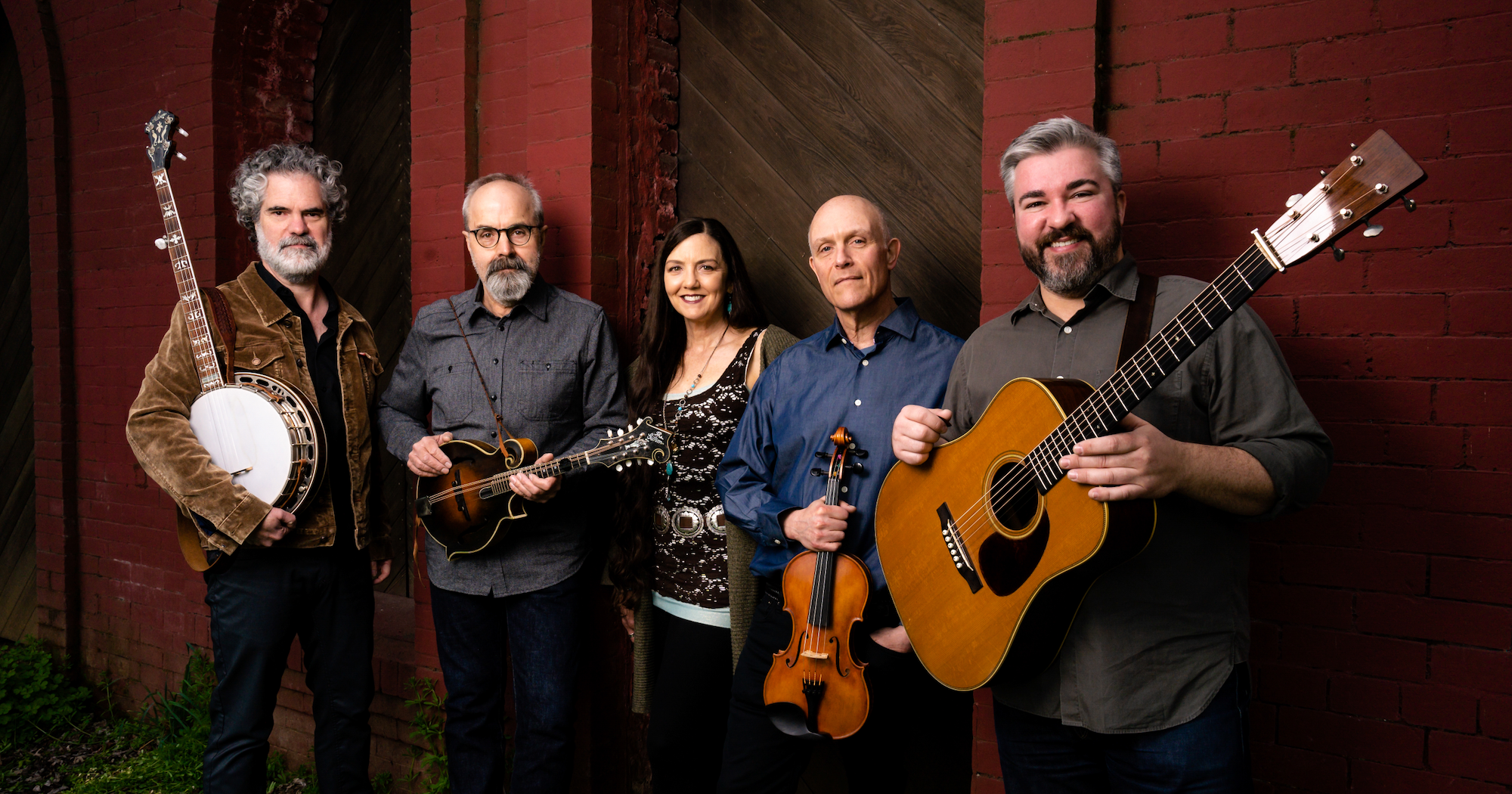
There are no U.S./Canada border wars when it comes to John Reischman. The revered mandolin master was born in Northern California but has lived in British Columbia since the early 1990s. His longtime band, the Jaybirds, are a quartet that includes two members who are also based in British Columbia (bassist/vocalist Trisha Gagnon and banjoist Nick Hornbuckle) and two who reside in America (fiddler Greg Spatz lives in Eastern Washington and guitarist/vocalist Patrick Sauber is from Southern California).

Their latest album, The Salish Sea, refers to the body of water between Vancouver Island and the British Columbia mainland. The record is their first since 2017’s On That Other Green Shore along with being the first to feature “new” guitarist Sauber on the entire album. The song “The Salish Sea” not only serves as the album’s title, but also is part of an original “Bluegrass Concerto” that Reischman was commissioned to create for FreshGrass in 2024. The honor is just one example in a long line of accolades for Reischman, who began his career in the Bay Area bluegrass/folk scene of the 1970s (including a stretch with the Tony Rice Unit) before moving to Canada, where he started the Jaybirds as well as performing solo and in other groupings.

In recent years, Reischman has seen his song “Salt Spring” become something of a modern bluegrass classic. He spoke with the BGS from his home in Vancouver about “Salt Spring” as well as The Salish Sea, his famous Lloyd Loar mandolin, and how he got into bluegrass music.

What was the process of putting the new album together?

John Reischman: There was one venue in Washington State where we had a residency. It was in the fall, in a beautiful spot. It was just ideal. So we took the extra day, worked up like six new tunes, and then started performing them right away. I guess this was October of ‘23.

And then you recorded the album in Vancouver?

In December of ‘23, I wanted the band to check out the studio here in Vancouver, where we ended up ultimately recording. I just want to make sure everybody was cool with it. I knew I liked it, because I had used it for my solo record, New Time & Old Acoustic. They all liked it. At the end of any tour we had that was close to Vancouver in 2024, I’d book a day or two in the studio, and we’d go record two or three or four songs. We were able to perform all this material mostly before we recorded it. … And it was great, because we’d be warmed up from the tour and we’d go in and track some tunes.

This album was the first in a while, and also the first that Patrick Sauber was fully on it.

Right, On That Other Green Shore came out in 2017. That was kind of the tail end of our time with [guitarist] Jim Nunally being a band member. He was exploring other things and decided he’d leave the band. We had a few more tracks to do… and we had some dates on the calendar.

I thought of Patrick immediately, because I’d known him for many years and I thought he’d be good. So he signed on for a tour and then another tour and it was just like, “This works great.” We asked him to join and he immediately said yes. He was a great fit.

How did the Jaybirds come together in the first place?

I didn’t really set out to have a band, except for the fact that I had a solo record called Up in the Woods. There was a local festival, so I put the band together to help promote the record. Seemed like a good idea. And I liked playing with all those people and it just continued on.

It’s called John Reischman and the Jaybirds, because I conceived of it. My name was probably the most well known at the time, but I wanted to be integrated into a bluegrass band. People present stuff, and I almost always accept it. Mostly it’s a pretty democratic presentation, I think. That’s what I like. It’s not Gladys Knight & the Pips.

Can you talk about the title track and how it’s also part of a larger project?

I had been asked to write what they call a “Bluegrass Concerto” by the East Coast festival FreshGrass, and I came up with these three tunes that work together. The first tune was the first movement, which ultimately was called “The Salish Sea.” I thought this will be my contribution to the new Jaybirds record, because they were involved with the performance of the Concerto.

We performed it [at FreshGrass in 2024] and I really liked the idea of having two mandolins and I’ve always loved two fiddles. I knew Darol Anger was going to there, so I asked him if he’d play twin fiddles on it. And then Sharon Gilchrist is a good friend and great mandolinist; we’ve played a lot together, and I asked her to play a mandolin on two of the three pieces.

I’ve got to acknowledge David Grisman, because the music is influenced by his “Dawg Music.” It’s also the sound that I initially heard on his first solo record, The David Grisman Rounder Record. He incorporated harmony mandolin on a lot of it.

It must have been very inspiring and gratifying to receive this commission.

You know, I’ve written a lot of tunes and a lot of folks have learned my tunes, which is really gratifying. But to have been commissioned to write this and have the confidence of this great festival and organization, yeah it was.

I had plenty of time to work on it and the time that it mostly came together was when I think my wife was visiting family. I had the house to myself. That first piece, in particular, really developed over a period of time. The second one [“The Family’s Farewell”], I came up with the A part pretty quickly and it took a while to get a bridge for it.

The third part [“The Little River Ramble”] was similar. … The thing about the concerto format is the third movement typically has an extended solo section and it’s often a bender where it’s just the featured soloist playing solo without any accompaniment. But I wasn’t really comfortable so much with that. I thought, I’ll just have it break down and I’ll solo all through there but have it build back up.

I’m really happy with the response it has gotten. Even playing it just as the five-piece band, I think the band sounds great on it. It’s only like icing on the cake when the twin fiddles and the twin mandolins are there.

And this spring, you’re going to record the entire concerto?

At the end of March, we’re going to be on tour on the East Coast and the FreshGrass Festival has a recording studio. They offered to make the studio available, so we’re going to record that just as we performed it, with Darol and Sharon joining in. That will be part of a solo record, even though I’m using those musicians. And I have other sessions planned. I’ve done one session that will add to the whole thing. Those three tunes of the concerto will just be one component of the new recording.

“Salt Spring,” one of your older songs, has become a highly popular instrumental now in the bluegrass world. How much of a pleasant surprise has that been?

It’s kind of remarkable to me that it’s as popular as it is. I mean, I’m not complaining. It’s great. … But it’s interesting how it’s just traveled all over and people think it’s just a traditional tune in some circles. They have no idea that it was composed by me. That’s cool, too.

The Jaybirds recorded it and it came out on a CD in 2001. We were at a music camp with some folks from Colorado and they learned it. I think that’s largely the beginning of it getting circulated among other people – where they took it back to Colorado. They’re the “patient zero,” I guess.

I know that a certain generation of Berklee students were playing it a lot, and maybe a bit later – maybe 10 years later. It’s pretty cool having people play your tune when you’re not there. That CD was never available digitally until recently, but we made a video of it around 2011… and that was the source, I think, for a lot of people learning it.

And then you recorded it again with Molly Tuttle, Alex Hargreaves, Max Schwartz, and Allison de Groot on your 2021 solo album New Time & Old Acoustic.

I didn’t have all the material when I started that whole project, but I knew I wanted to re-record “Salt Spring” with some of these younger musicians who had grown up playing it.

What do you remember about writing it? And why do you think so many musicians have gravitated to playing it?

I was on Salt Spring Island [in British Columbia] staying with some friends and they had a little old turn-of-the-century Martin small-body guitar. I was just playing the guitar and I was playing out of a D chord shape, and the A part of the tune just kind of took shape under my fingers. It was memorable enough that I don’t think I had to record it to remember it. The B part was just this little phrase I would play on the mandolin, just noodling around … so I just kind of stuck it on there and it worked pretty well.

I think the thing about the tune is the basic melody is very simple, but the way I played on the mandolin, the technique I use, is not quite cross-picking. But it falls into a right-hand pattern that sort of mimics the way the frailing banjo is played with that “bum-ditty, bum-ditty, down-down up, down-down up” pick stroke. So, these extra “down ups” are drone notes and that just kind of enhance the whole overall effect. Because of that, it lays out really nicely on the banjo. Then on the fiddle, you can add drones and add to it that way. And on the guitar also, you can fall into that kind of “bum-ditty” pattern as well.

I think you can learn the tune pretty easily. It’s not super challenging like some fiddle tunes where they’re very detailed in the melody. It’s pretty straight and so I think that’s partly why people gravitate towards it.

You grew up in Northern California. How did you get interested and involved in music, specifically bluegrass music?

Have you heard of a guitar player named Robben Ford? He grew up in the same town where I did in Northern California. He was in a high school band with my neighbors. I must have been 12 or 13. They were rehearsing on a patio and I went over to listen. I was interested in music and I heard them play the Freddie King tune “Hideaway,” which Eric Clapton recorded on the John Mayall & the Blues Breakers record. My brother Steve had that record. I recognized the tune and I thought, “What? This is impossible. This sounds as good as the record!”

From then on, I was just focused on trying to play the guitar. I had taken guitar lessons prior to that, but it didn’t really work. But there were guitars around the house. So that was the thing that really sparked my interest in learning to play. But I was open to all kinds of music. I’d have access to the PBS station KQED and they’d often air Pete Seeger’s Rainbow Quest, where he’d have different folk musicians, bluegrass musicians, old-time musicians. I thought, “Oh, this is cool!” And then the mainstream presentation of bluegrass with The Beverly Hillbillies, having Flatt & Scruggs on it, and the Dillards and the Country Boys playing on The Andy Griffith Show.

At some point, I had access to a mandolin, which I associated [with] bluegrass music, and taught myself to play it. I tuned it to an open chord for a long time, like a banjo, which was incorrect. And I didn’t use a pick. But eventually I got things squared away.

I discovered the John Hartford Aereo-Plain record. I saw them on TV as well. That was very inspiring. Then I discovered Norman Blake and Vassar Clements. I come to find out they had their own records. … That first Norman Blake record, I couldn’t believe it. I just flipped over that, and I thought, “This is so great!” And I’d heard Doc Watson at that point, so I just got really interested in it, and focused on that music, primarily.

So, was the Good Ol’ Persons your first significant band?

Yeah, it was the first real pro band I was ever in, and I was a fan of theirs before that. I [had] lived in San Francisco for a short while and saw their original lineup, which included all women. And it was exciting to get the opportunity to play with these folks. Because I was living near Eugene, Oregon, and I was just playing the mandolin all the time – a lot with my brother, Steve – but I wasn’t in a band, and I was working on a farm, just part-time. And a friend from the Oregon bluegrass scene had joined them and they needed a mandolin player. He said, “I know a guy.”

That placed me in the Bay Area, which was a great scene. There were lots of good bluegrass bands. And the Grisman Quintet was there. … But the thing that set Good Ol’ Persons apart was their original material, because Kathy [Kallick] is a fantastic songwriter. And Paul Shelasky, who was in the band, also wrote great songs. That opened the door for me to try and write tunes – because, “Oh, these guys write tunes. I’ll try it.” I wrote a few and people liked them. That just gave me encouragement to keep at it, which I have done.

So consequently, when Grisman and Tony Rice parted ways, Tony was aware of me. He’d heard me play at the local bar. He wanted to put a band together and needed a mandolin player. So, I went to the audition and he hired me.

You are well known for having an antique Gibson Lloyd Loar mandolin. What do you think makes those mandolins so special?

I guess that [mandolin] was kind of the ultimate expression of Gibson mandolins. But there’s plenty of new makers and a lot of them are using that basic design. So, aesthetically and as far as the craft of the instruments, some of these builders are way better than the Gibson mandolins were to look at, but the Gibsons have 100 years of aging and playing.

I think the playing of the instrument contributes hugely to its sound. Because, if there’s a Lloyd Loar that left the factory and went into someone’s closet and never came out for 50 years, I don’t think it’s going to sound like one like mine that has been played consistently over time.

I feel fortunate to be the caretaker for this great instrument. I think for most bluegrass musicians, it’s not only the music, but it’s the tools. These vintage instruments, like the Martins from the ‘30s and ‘40s, and Gibson mandolins from the ‘20s, and old banjos, it’s just a vibe that goes along with the music and aesthetic.


Photo courtesy of John Reischman.

Michael Daves Reconstructs R.E.M. Bluegrass Style

Although he lives in New York now, Michael Daves’ Southern roots permeate his music. That characteristic goes further than ever before on the newly released Fables, a six-song EP that reconstructs songs from fellow Georgia band R.E.M.’s 1985 album Fables of the Reconstruction.

In celebration of the record’s 40-year anniversary, Daves enlisted his longtime quartet bandmates – fiddler Alex Hargreaves (Billy Strings), mandolinist Jacob Jolliff (Béla Fleck, Yonder Mountain String Band) and Erik Alvar (Nefesh Mountain, Billy Strings) – and others to reinvent songs like “Green Grow The Rushes,” “Wendell Gee,” and of course, “Driver 8.” Together, they turn each track on its head, fully leaning into their bluegrass prowess while continuing to hold each song and their original formats in high regard. It’s something that Daves has plenty of experience with, having released the dual acoustic and electric bluegrass covers compilation Orchids and Violence in 2016 and Early Morning Sun – an EP of bluegrass and country standards from Ola Belle Reed, Dolly Parton and others – in August 2025.

“It was really important for me to try to make something that would stand on its own, even if people didn’t have any connection with R.E.M. or don’t even like them,” explains Daves. “I tried to make something that just works by its own logic as much as it’s paying homage to the original.”

During a Zoom call with BGS on release day in December, Daves spoke about his motivation for doing this cover EP, how he decided which songs to include on it, the plans for his label Wild Geranium Records, and more.

What motivated you to not only make an EP of R.E.M. covers, but to do it with songs from Fables of the Reconstruction?

Michael Daves: It’s an album I grew up with. R.E.M. was one of my first musical obsessions. I first discovered them in the late ‘80s at summer camp in Toccoa, Georgia, not too far from Athens where R.E.M. was from. All my camp counselors were [University of Georgia] kids, so I fully downloaded their musical tastes, which fortunately were pretty good.

As far as taking on the Fables thing now, there were a couple inspirations. For one, it’s the 40th anniversary of that record and it’s one that I don’t feel like a lot of younger people have heard or appreciated. People seem to know more of R.E.M.’s pop stuff from the ‘90s and beyond, but that ‘80s stuff was so good and weird. I also have this quartet I’ve led since about 2019 with Alex Hargreaves, Jacob Jolliff, and Erik Alvar in New York. They’re all incredible musicians who are very well versed in traditional bluegrass but also very adept at adapting music from outside the fold. We’d done some other projects over the years – like we did a whole mini set of Jimmy Webb songs one time including “MacArthur Park,” “Wichita Lineman,” and “Galveston” – and they learned that stuff in one rehearsal and just rendered it so beautifully. It made me realize that this is a quartet that really can handle a challenge.

The Fables idea came up because of the anniversary, but also because in August I had done a tribute along with Peter Rowan to the 1973 Muleskinner record that he was a part of. Initially he united with Bill Keith, Clarence White, David Grisman, Richard Greene, and Stuart Schulman to share a TV show with Bill Monroe, but Monroe never showed up. His bus broke down, so they ended up having the whole show to themselves and wound up getting an album deal out of it. Then they made this record that didn’t go anywhere because Clarence White died before it came out.

I taught a class about Clarence’s guitar playing on that record and through that became inspired to do a tribute to it with Peter at Vermont’s Green Mountain Bluegrass & Roots Festival this past August. When studying that Muleskinner record I discovered it had the same producer as R.E.M.’s Fables, Joe Boyd, who’s also worked with everyone from Nick Drake to Fairport Convention and Pink Floyd. That strange coincidence led to a Fables tribute show, which is then where the idea for this EP really came to life.

How’d you go about dwindling the original Fables of the Reconstruction down to the six tracks that are on this EP?

It was an interesting process choosing which songs to do. It was a combination of practical considerations, because when the quartet and I worked up this music for that one-off show in Brooklyn I initially picked songs that I thought were achievable on our tight constraints and would translate well to a bluegrass ensemble. There were definitely other songs on the original record that would have worked, but I’m feeling good about the song choices we made because the original record is sort of sprawling with a lot of digressions. There’s a lot of dreamer logic and a Faulknerian non-linearity in the writing, so to pare that down into what I think works as a distillation of the original recording that probably is more of an interesting statement on the original than if I just recorded the whole thing, you know. As my wife put it, we took it from a sprawling Faulknerian epic to more of a Flannery O’Connor gut punch.

Do you have any specific favorites of the six songs making up this project?

As far as song selection, I kept the first and the last songs from the record in their normal position. The record opens with “Feeling Gravity’s Pull” and ends with “Wendell Gee” so I kept those because the beginning and end of the story just felt right.

There’s something about the song “Good Advices” that just always just gets me with its meditations on mortality. It’s classic R.E.M. in the sense that it can be hard to parse the lyrics because they’re based more in dream logic than confessional writing. However, they still carry a lot of emotional weight and a sense of meaning that’s oftentimes hidden. For some reason, that song is the one that just always gets stuck in my head and gives me all the feels.

Part of this is due to the structure of the song, which is repetitive and drony. The bridge is basically four measures of the G chord and then it’s out, which I think is just brilliant how that works in the song. It was those repeated drone lines that Alex played over while the rest of the band had these repeated melody things going on. For me it’s the quintessential song off of the record. I don’t think it was a hit or anything at the time – that goes to “Driver 8” – which I almost didn’t include because it was the best known song off of that record.

The opening track, “Feeling Gravity’s Pull,” is one that was never my favorite track from the original record, but in rendering it I started liking it a lot more. I particularly like what Duncan [Wickel] brought to it on cello as well as the background vocals on it, especially at the end. That’s Jefferson Hamer from The Murphy Beds and Sean Cahill from The Next Great American Novelist. The parts they added took the song in this almost metal-like direction, which felt really good and different from the original, especially considering we’re all acoustic musicians. The whole experience with that song felt really cathartic. There’s an intensity that I always want out of bluegrass but don’t always hear, so I ended up being really happy with how that one came out.

This is the second release on your own label, Wild Geranium Records. What are your plans with that?

This is the second release on Wild Geranium. The first was my EP Early Morning Sun, which came out in August and was just a solo recording. The third one is coming out in March and is a full-length duo record with me and Jacob Jolliff where we’re paying tribute to Jim & Jesse, [who] are part of the first generation bluegrass legends. But most of what I do under Wild Geranium will be EPs and other shorter recordings.

Do you plan to record other folks on the label, or just your own projects?

It’s intended as a platform for various collaborations that I’ve had as well. All of the releases I’ve put out so far have zero original material, but some of that will be coming soon, too.

You’re also releasing Fables on cassette? What’s behind that decision?

The cassettes were part of the concept of Wild Geranium from the beginning. Cassettes first came back within the indie rock world almost 10 years ago, but to my knowledge isn’t something that’s been done much in the bluegrass world. I’ve had people joke with me and say, “Oh gosh, I’ve got to dust off my ‘78 Dodge Charger to play this!” [Laughs] In the age of streaming, I think having a physical item that is a little more affordable, easier to produce and keep in stock than vinyl is more important than ever.

The idea was to also include at least one song on each cassette release that’s not available digitally. On Fables that’s actually two bonus tracks – a duo version of “Green Grow The Rushes” with me and Jacob Jolliff and the other’s a live version of “Can’t Get There From Here,” which was from a full-band show back in August where we debuted the material. I just wanted to offer something unique and special to the listeners who care. If you get the cassette, you’re gonna have something that no one else is gonna have. It’s not bouncing around the internet, you have to have the physical thing. From a production standpoint, it’s an opportunity to tell a slightly different story than the digital release.

Do you have any other cover EP/album ideas up your sleeves?

Aside from the Jim & Jesse project, I also have some original material on the back burner. It’s fully demoed and is all music connected to Ponce de Leon Avenue in Atlanta where I grew up. It includes some stuff that I’ve written and co-written along with songs by family members and friends from that area and era. I’ve been performing music from that project for quite some time now, but haven’t made the record yet. So that’s something I’m hoping to make happen that would be another full-length, full band record.

What has bringing this R.E.M. covers EP to life taught you about yourself?

This R.E.M. stuff was among my first musical obsessions, so for years that’s just been baked into how I hear music in an uncritical way. So to actually get in there and break down what went into this record and think about how to render it in this other context was really interesting for me and fun to make a statement with that’s not based in nostalgia.

I also enjoyed getting to explore my feelings about how I want string band music to work. On my last full-length record Orchids and Violence I utilized a double-record concept where each disc had the same track list, but the first one was a very straightforward bluegrass record and the second disc is like all electric, experimental rock renderings of the thing. Fables was a little bit more like uniting both sides of Orchids and Violence into a string band expression, which is something I’d be open to doing more of in the future.


Photo Credit: Manish Gosalia

Doc Watson’s Legacy in Collaboration:
8 Essential Performances

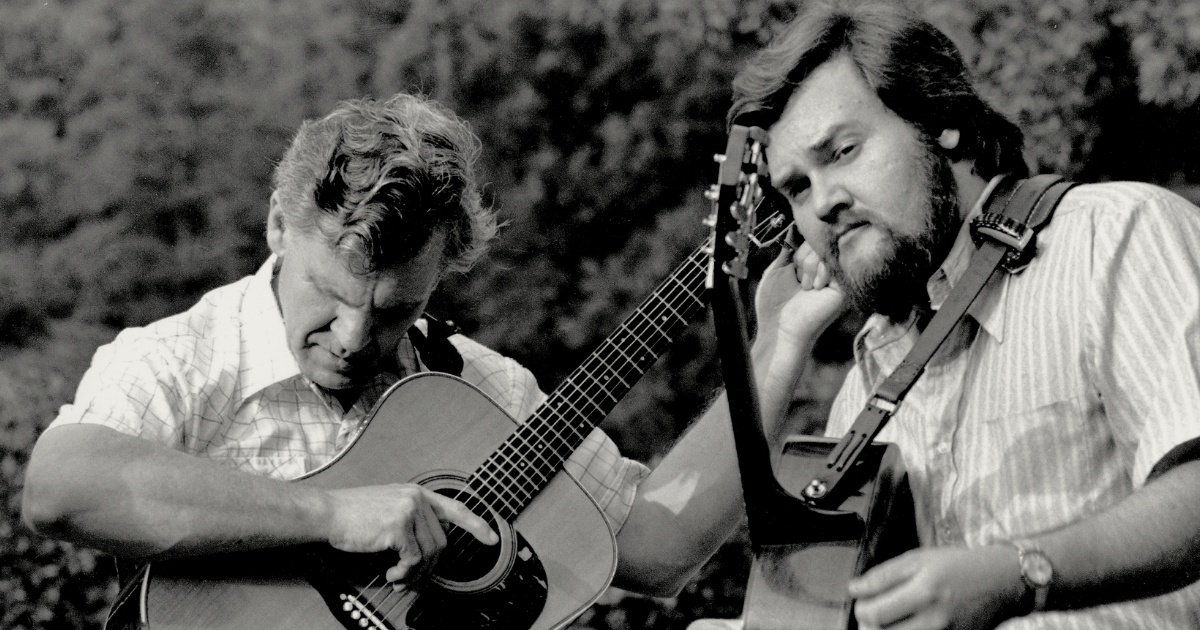
Few musicians have ever moved as fluidly between eras, genres, and generations as Doc Watson. From front-porch duets to grand-stage bluegrass revivals, Watson’s collaborations have a way of dissolving categories entirely.

His flatpicking precision, rhythmic calm, and vocal warmth made him the kind of performer who elevated everyone within earshot – young prodigies, genre pioneers, folk-tradition torch bearers, and musical iconoclasts alike. His reputation as a consummate accompanist was built not on showmanship or flamboyance, but on musical generosity and an intuitive sense of timing, phrasing, and expression that allowed others to shine while retaining his unmistakable voice.

Part of Watson’s power lies in the consistency of his musical identity. He never strained to fit into a new format or trend; instead, others bent gratefully toward his center of gravity. Whether playing an old-time fiddle tune, trading licks with a jazz-influenced mandolinist, or harmonizing with a younger bluegrass singer, he brought a sense of ease and groundedness that anchored every ensemble. That stability gave his collaborators the freedom to explore, improvise, and innovate – knowing Doc would be right there, steady and sure.

This sense of balance between precision and freedom made him a model collaborator for musicians across generations, and his impact can be traced through countless recordings, festival lineups, and mentorships of younger players.

Watson’s influence was not just technical but communal. He could guide a performance without overwhelming it, offering the ideal blend of authority and humility. In his guitar, listeners hear the voice of the North Carolina mountains, the pulse of Appalachian tradition, and the adaptability of a musician able to engage any genre without losing authenticity.

Today, YouTube’s patchwork archive of footage allows us to witness these collaborations anew: small moments of musical connection, sometimes real-time, sometimes reconstructed from archival sources. Below is a curated set of eight standout filmed or recorded collaborations that illustrate Watson’s reach. From storied duets with Chet Atkins or Earl Scruggs to meetings with newer-generation players.

“Roll in My Sweet Baby’s Arms” – Doc Watson, Earl Scruggs & Ricky Skaggs
(The Three Pickers)

This relaxed but virtuosic performance features Watson, Scruggs, and Skaggs playing with the ease of a porch jam made public. Watson’s crisp flatpicking forms a warm foundation, while Scruggs’ banjo drives with characteristic agility and Skaggs adds mandolin flourish and bounce.

The trio exhibits mutual respect and joy, and their lines interweave with natural conversation.
The recorded performance comes from the 2003 album The Three Pickers. The energy and clarity of the musicianship exemplify Watson’s ability to anchor an ensemble while remaining entirely supportive, a model of intergenerational teamwork. It is a performance that displays the combination of technical mastery and intuitive musical empathy that defined Watson’s career.

“Tennessee Stud” – Doc Watson & Nitty Gritty Dirt Band
(Will the Circle Be Unbroken)

Watson’s performance of “Tennessee Stud” on the Will the Circle Be Unbroken project exemplifies his ability to blend seamlessly with both established musicians and a younger ensemble eager to learn from him. His deep, resonant vocals float over understated but fluid flatpicking, supporting the Nitty Gritty Dirt Band’s harmony vocals and rhythmic drive.

Watson’s musical sensitivity allowed for a dialogue that bridged generations, bringing traditional songs into a contemporary context while retaining their original heart and vibrancy. This track also highlights Watson’s ability to adapt to the studio environment, shaping a sound that was both authentic and polished. The 1972 studio album is well-documented, though various YouTube versions may mix studio, rehearsal, or live takes.

“Tennessee Rag / Beaumont Rag” – Doc Watson & Chet Atkins (Reflections)

In this medley, Watson and Chet Atkins engage in a playful, masterful guitar dialogue. Watson’s flatpicking exhibits crisp, percussive articulation, while Atkins’ thumb picking introduces a smooth, jazz-inflected counterpoint. Both artists navigate tempo and dynamics with precision, creating a performance that is both technically dazzling and deeply musical.

The track appears on the Reflections album and while some online performances derive from live shows or reissued audio, the studio recording itself exalts the collaborative interplay. This duet demonstrates Watson’s ability to move effortlessly between folk and jazz guitar traditions, honoring both while creating something uniquely their own. The performance underscores his adaptability, an essential quality in a musician sought after by so many genres and generations.

“Black Mountain Rag” – Doc Watson & Merle Watson

The father-son dynamic between Doc and Merle Watson is in full display in this live rendition of “Black Mountain Rag.” Merle’s nimble, rhythmic energy dances atop Doc’s grounded guitar tempo, producing an interplay that is conversational, playful, and intricate. Their shared history and years of touring allow for spontaneous embellishments and musical commentary woven into the tune.

This performance captures the essence of the Watson family legacy, showing how Doc nurtured both musical skill and expressive interpretation in the next generation. The piece also serves as a lesson in ensemble sensitivity, as Doc balances his playing to give Merle ample space while maintaining rhythmic and harmonic cohesion.

“What Would You Give in Exchange for Your Soul?” – Doc Watson & Bill Monroe

Watson and Monroe’s pairing on this traditional tune combines the latter’s piercing, high-lonesome tenor with the former’s warm baritone, creating a striking emotional contrast. Watson’s guitar provides steady, unobtrusive accompaniment, allowing the vocal interplay to take center stage.

This recording exemplifies Watson’s ability to adapt to any partner, responding in real time to vocal phrasing and tempo shifts. The performance demonstrates his interpretive sensitivity, highlighting how he could honor a song’s emotional core while integrating his own stylistic voice.

“Shady Grove / Summertime” – Doc Watson & David Grisman

Watson’s collaboration with David Grisman blends Appalachian folk with progressive acoustic styling. In this rendition of “Shady Grove,” Watson’s rhythmic guitar backgrounds Grisman’s mandolin flourishes, resulting in a lively, conversational back-and-forth. Improvisation is key, as both musicians respond to each other’s phrasing, demonstrating mutual respect and spontaneity.

This collaboration underscores Watson’s versatility, showing he could navigate between traditional melodies and innovative interpretations, elevating both in the process. It is a reminder of his role in bridging traditional and progressive acoustic music for audiences and colleagues alike.

“Amazing Grace” – Doc Watson & Jean Ritchie

Watson and Jean Ritchie’s collaborations were well-established, including performances at venues like Folk City in the early 1960s. However, the specific attribution of some YouTube uploads titled “Amazing Grace” is ambiguous. The Live at Folk City album recording is the most reliable source, showing their complementary styles: Watson’s gentle, precise guitar lines support Ritchie’s clear, expressive vocals, blending Appalachian tradition with personal interpretation. They represent the transmission of Appalachian folk music to wider audiences and the seamless melding of their similar sensibilities.

“Summertime” – Doc Watson & Mark O’Connor

Watson’s influence on multi-instrumentalist Mark O’Connor is well-known; O’Connor cites him as a formative inspiration and their collaboration remains significant as a symbolic bridge between generations. Watson’s teachings and style informed O’Connor’s fiddle mastery, illustrating Watson’s mentorship and the continuity of American acoustic tradition. Indeed, their shared repertoire speaks to the passing of musical knowledge and the sustaining of tradition through personal and professional interaction.

These eight performances above collectively highlight Doc Watson’s role not only as a primary musician, but as a profoundly generous collaborator. He created space for others to excel, whether alongside legends like Bill Monroe, Earl Scruggs, and Chet Atkins or with younger rising stars such as Alison Krauss and Mark O’Connor. Watson’s approach combined technical mastery with emotional intelligence, allowing him to respond intuitively to fellow musicians in real time.

His collaborations illuminate the breadth of his influence. Watson moved with ease between old-time Appalachian tunes, rag medleys, gospel-inflected ballads, rocking hillbilly sounds, and improvised jam sessions. Across these contexts, he remained unmistakably himself: grounded, warm, and adaptable.

By mentoring younger musicians, bridging generations, and seamlessly adapting to new musical contexts, Doc Watson demonstrated that tradition is not static; it is a living, evolving practice. His legacy continues to teach musicians the art of generosity, the importance of listening, and the beauty of musical dialogue. Perhaps in every collaboration, Watson’s spirit resonates, ensuring that his contribution to music endures across time, space, and audience.


Lead image courtesy of MerleFest.

Our McCoury & Douglas Family Pickin’ Party Playlist

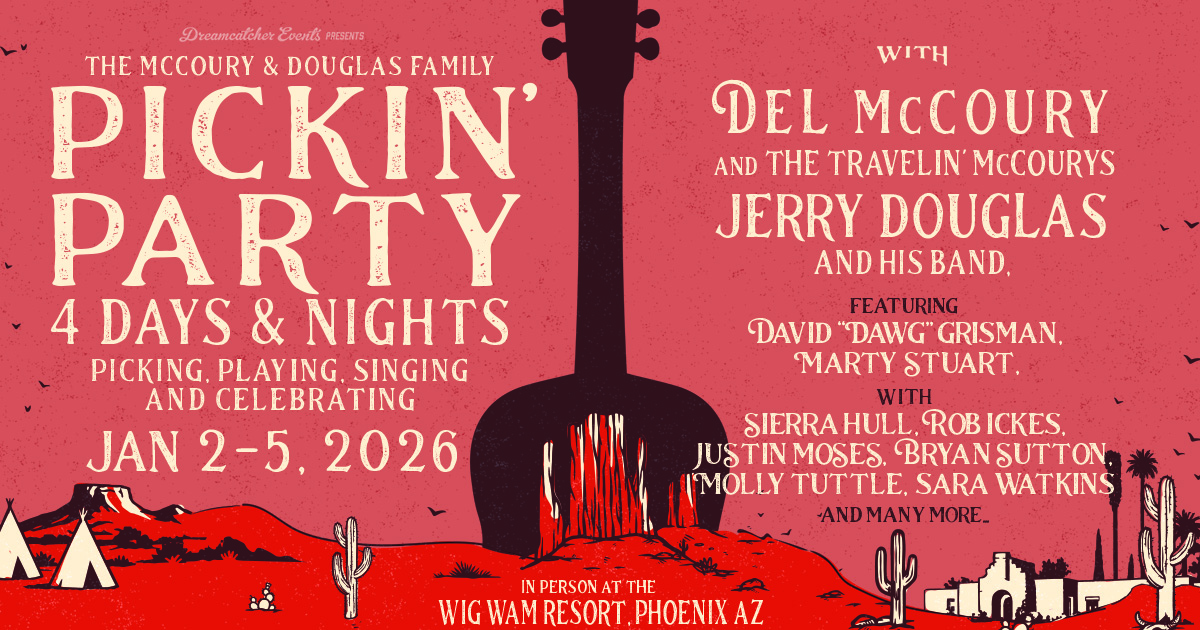
Have you ever dreamed of hanging out, jamming, and learning from your all-time favorite bluegrass artists? Then you don’t want to miss your opportunity to be part of the best pickin’ party ever, The McCoury & Douglas Family Pickin’ Party happening January 2-5, 2026 in Phoenix, Arizona.

We’ve assembled an exclusive playlist (listen below) featuring all of the amazing artists who will be on site for four days of masterclasses, performances, and workshops, including Del, Ronnie, and Rob McCoury, Jerry Douglas, Bryan Sutton, David “Dawg” Grisman, Sara Watkins, Molly Tuttle, Marty Stuart, Sierra Hull, and more.

Limited spots for this one-of-a-kind experience remain. And if you’re already registered, start getting excited by jumping into our BGS playlist. Registration and more information can be found at DelMcCouryPickinParty.com.


This content brought to you in partnership with the McCoury & Douglas Family Pickin’ Party and Dreamcatcher Events.

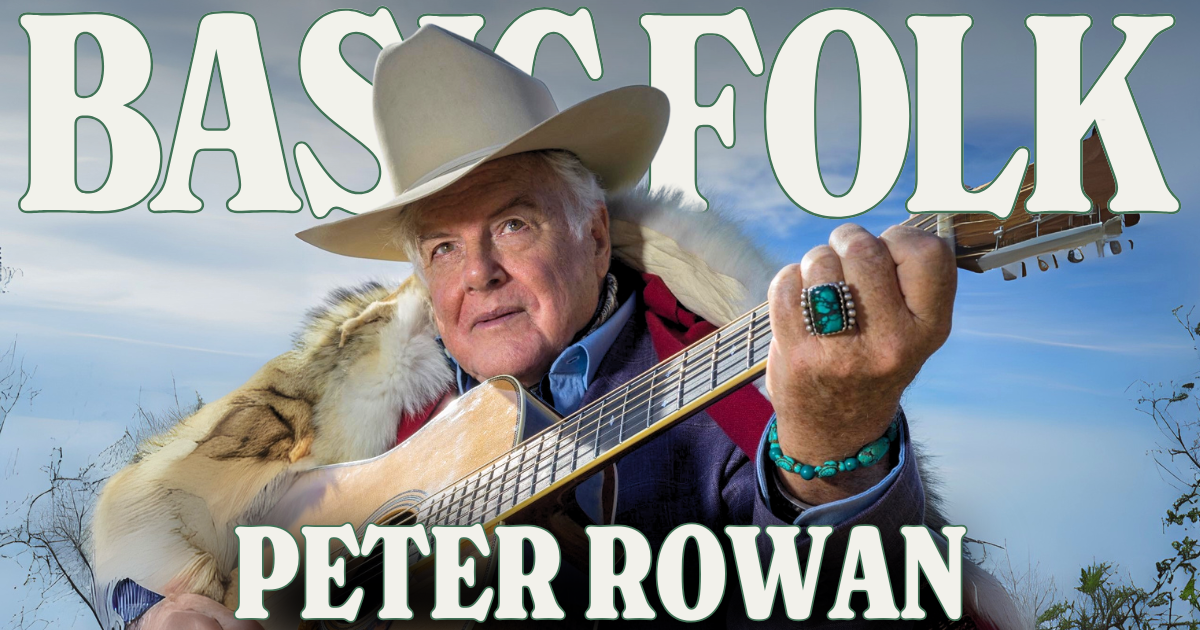
Basic Folk: Peter Rowan

Legendary Massachusetts-born, California-based musician Peter Rowan is best known for his bluegrass roots. A practicing Buddhist, he did time in Bill Monroe’s Blue Grass Boys as well as in the short-lived and epically important Old & In the Way with Jerry Garcia and David Grisman. However, his latest album, Tales of the Free Mexican Airforce, celebrates the music of the Southwest and draws a throughline from Tex-Mex to bluegrass. Rowan has a long history with this music from his very first solo record, which includes the original recording of “The Free Mexican Airforce” as well as “Midnight-Moonlight.” Both of those classic Rowan compositions got re-recorded for the new record and feature the late great Flaco Jiménez (as did the original 1978 recordings), who passed away in July 2025.

LISTEN: APPLE • SPOTIFY • AMAZON • MP3

In our Basic Folk conversation, we talk about Flaco’s enthusiasm for Peter’s music, the many collaborations they recorded, and why he included a recording of Flaco speaking on the album. Peter speaks about how immigrants and musical culture from Latin America are constantly inspiring him and keeping him patriotic. He also spoke about what keeps him aging well, what his energy and enthusiasm look like at 83 years old, and, of course, Bill Monroe’s baseball team.


Photo Credit: Amanda Rowan

Ethan Setiawan’s Personal Encyclopedia Mandolinnica

A short history of the mandolin in America: The mandolin is essentially a small lute which has been around since the 1300s. Italian immigrants brought bowl-back mandolins to the States in the 1800s. Mandolin orchestras were big in the 19th and 20th centuries, believe it or not. In fact, a whole mandolin family exists with mandolas, mandocellos, and mandobasses out there.

Around the turn of the 20th century, Orville Gibson started to develop flat-backed mandolins constructed more similarly to guitars. Finally, in the 1920s, Lloyd Loar created the F5 mandolin, with its longer neck and F holes. These new instruments were built to project and fill a concert hall, though they were ill-timed – the mandolin orchestra craze was fading and not ’til Bill Monroe picked up one of those instruments from a barbershop in Florida in the ’30s did they come back into their own. Since then, bluegrass mandolinists the world over have played these instruments or copies thereof. I play an instrument by John Monteleone, who started innovating on Lloyd Loar’s design in the 1980s – and so the tradition continues.

My new album, Encyclopedia Mandolinnica, turned into a survey of Western and Northern mandolin styles quite quickly. It’s very much been shaped by these inspiring musicians who were very kindly up for playing a duet with me. We go on a real journey through bluegrass both progressive and traditional, old-time, jazz, classical, and Scottish trad. The chance to get to work with these heroes of mine has been such a pleasure and invoked several “pinch me” moments. One of the most beautiful things was getting to see how everyone approached our little 8-stringed instrument so uniquely. I learned something from playing with and working alongside each of the mandolinists that agreed to be a part of the project!

In putting together this playlist I thought about my personal inspirations as well as the mandolin’s place in musical cultures across the world. It ranges from hardcore bluegrass, to Brazilian choro, over to Scottish trad – with lots of things in the middle. It mostly features folks you can hear on Encyclopedia Mandolinnica. I hope you enjoy my guided tour of the mandolin! – Ethan Setiawan

“Victoria” – Ethan Setiawan & Mike Marshall

Mike is a legend of the mandolin. He was an early member of the David Grisman Quintet and went on to collaborate with Darol Anger, among others. He helped write the book on progressive acoustic music and mandolin styles therein. This tune of mine falls within that realm and Mike was the perfect person to play it with.

“Shoulda Seen It Comin’” – Mike Marshall & Chris Thile

Mike also duetted with this young guy Chris Thile, whom you may have heard of. The live record that this cut is from is one of my very favorite recorded mandolin performances. Both mandolinists are at the top of their game. This tune was in my ear quite a bit when writing the previous tune, which maybe you can hear?

“There Will Never Be Another You” – Don Stiernberg

Don is one of the world’s foremost practitioners of jazz mandolin – a combination of words you might have never thought you’d hear. He studied with the great Jethro Burns of Homer & Jethro before forging his own path forward into a style where few mandolinists have ventured. Don was a teacher of mine during high school and it was great fun to get to be in the studio together for Encyclopedia Mandolinnica.

“Jiguaraña” – Ethan Setiawan & Maurizio Fiore Salas

Venezuela has a rich and beautiful mandolin tradition that not many folks are aware of. This tune is a co-write between myself and Maurizio. We took a jig (a Celtic form in 6/8) that I came up with and Maurizio had the bright idea of putting it over a Venezuelan rhythm called guarana (also in 6/8). It’s always a joy to play with Maurizio, he challenges me in the right ways.

“Wonderful” – Kinnaris Q (Laura-Beth Salter)

Laura-Beth is at the forefront of the Scottish trad revolution in Glasgow, Scotland. This track by her band Kinnaris Q puts the mandolin front and center – when she takes the tune at 1:52 check out the facile right hand triplets! We co-direct the Glasgow Mandolin Retreat as well and it’s always great to get a tune with LB.

“Blue Grass Stomp” – Bill Monroe

This is where it all started for a lot of us. Bill Monroe, along with Earl Scruggs and Lester Flatt, in the ’40s had something electric and powerful, so much so that in large part bluegrass has been unchanged since then.

“New Cimarron” – Matt Flinner

Matt Flinner is one of my favorite mandolinists out there. One of the many things that strikes me about his playing is how good it feels. Everything is placed so precisely and beautifully. He also writes great tunes that beautifully synthesize lots of things we love about bluegrass, old-time, and jazz. This is one of my favorite tunes of his.

“Golden” – Ethan Setiawan

In a similar tradition to the last tune, this is my take on a progressive “new acoustic” tune. Darol Anger on the fiddle here, he produced this album and it was such a joy to work with him on it.

“O Voo Da Mosca” – Jacob Do Bandolim

While bluegrass was developing up north, another mandolinist was fusing styles down south. Way down south. In short, choro is a fusion of classical forms with jazz harmony and Afro-Brazilian rhythms – similar on the page to ragtime. Jacob Do Bandolim (which translates to Jacob the mandolin, amazing) wrote many tunes that became staples of the style and was a virtuosic mandolinist to boot.

“Saint Cecilia Caprice” – Hamilton De Holanda

Hamilton De Holanda is the Chris Thile of Brazil. Amazing technically and a great musical mind. He wrote a double album of caprices and made the music public on his website, as well. Every mandolinist reading this: go download them, now!

“Salt Spring” – John Reischman

The greatest modern jam standard of our time! John is another great tune writer. He also gets the most beautiful sound out of the mandolin.

“Shetland Jigs” – Hildaland (Ethan Setiawan)

My own contribution to the Scottish trad lexicon from my duo with fiddler Louise Bichan, Hildaland. These are a couple nice jigs from Shetland. I’m playing mandola here, but I’ve tuned the highest string down a step and put on a capo so that the strings are tuned DAEA. This is inspired by the fiddle, which is crosstuned – common in old-time but not so common in Great Britain. We thought it was a cool connection to draw for our duo which goes between those styles at will.

“Canon at the Twelfth in Counterpoint at the Fifth” – Caterina Lichtenberg & Mike Marshall

Caterina is one of the greatest classical mandolinists to ever live. There have been vital classical mandolin traditions going on this whole time in Italy and Germany, which is so cool to see. Classical music is being made on the mandolin at very high levels and being taught as well.

“Queen of the Earth, Child of the Stars” – Sharon Gilchrist & John Reischman

A beautiful old-time tune, played so beautifully by Sharon on mandolin, John on mandola, and backed up by Scott Nygaard on guitar. I first heard this tune played late at night by Darol Anger and Bruce Molsky at Freshgrass a bunch of years ago now and it’s stuck with me ever since.

“Big Hill” – Ethan Setiawan & Andrew Marlin

Andrew has taken the mandolin scene by storm over the past several years with beautiful tunes and great trad bluegrass playing. Part of the thing that developed with this project was to write something that I thought might work well for each guest – not to explicitly write something that sounded like theirs, but to draw a little inspiration. I think this tune captured something there and I love the way Andrew accompanies the tune.


Photo Credit: Louise Bichan

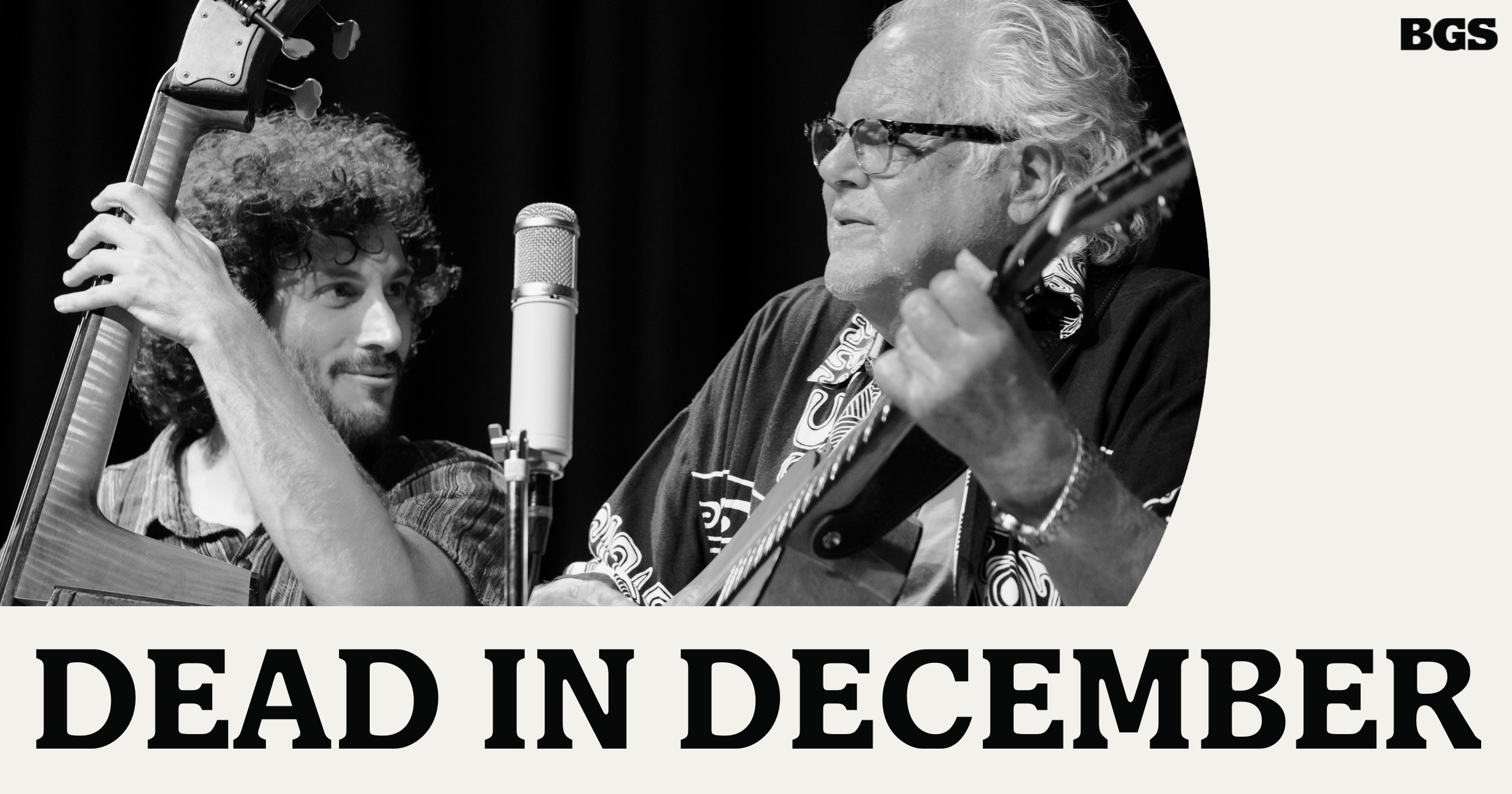
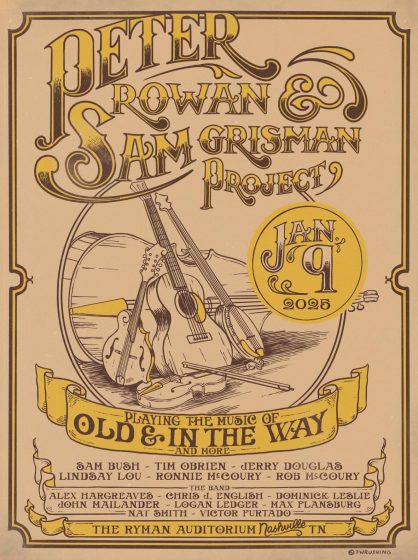
Peter Rowan and Sam Grisman Project Will Bring Old & In the Way to the Ryman

On January 9, 2025, there will be a special performance – more so a once-in-a-lifetime celebration – of the groundbreaking music of Old & In the Way at Nashville’s famed Ryman Auditorium.

Led by the “Bluegrass Buddha” himself, Peter Rowan, the legendary singer-songwriter and founding member of the group will be backed by the Sam Grisman Project. The gathering will also feature a murderers’ row of talent: Sam Bush, Tim O’Brien, Lindsay Lou, Ronnie & Rob McCoury, and more.

“In bluegrass, you just do the beautiful grace of presenting the music, being good neighbors and all that stuff,” Rowan told BGS in an exclusive 2022 interview. “But you could hear us in the band going, ‘go, man, go.’ Go for it, that’s where we came from. That’s what Old & In the Way was – the ‘go for it’ signal to everybody.”

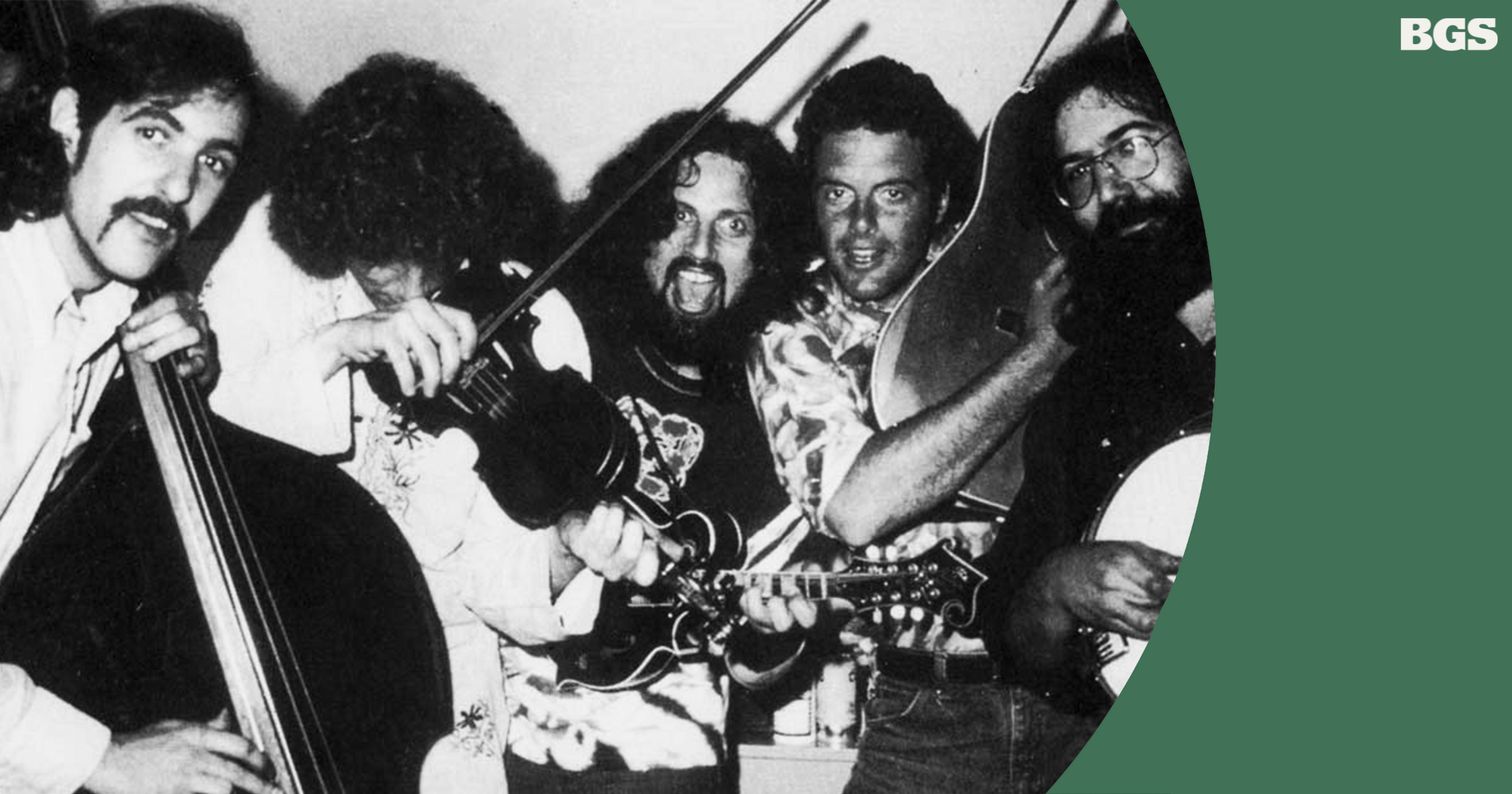
To preface, Old & In the Way started as impromptu pickin’-n-grinnin’ sessions in the early 1970s between Rowan, his longtime friend, mandolin guru David Grisman, and Jerry Garcia, iconic guitarist for the Grateful Dead, who reached for his trusty banjo during the gatherings at Garcia’s home in Stinson Beach, California.

“We started picking every night after supper [at Jerry’s],” Rowan remembers. “We went through old song books and learned a bunch of material.”

At the time, Garcia was searching for new avenues of creative exploration, seeing as the Dead were in the midst of taking a much-needed hiatus after years of relentless touring and recording. He was also, perhaps subconsciously, trying to tap back into his roots before the Dead, this landscape of the late 1950s/early 1960s where Garcia was heavily involved in the San Francisco Bay Area folk scene.

“And you realized that Jerry was an intergalactic traveler, just dropping in on the Earth scene for a little while, but he was totally at home,” Rowan says of Garcia’s restless penchant and lifelong thirst for acoustic music.

When Old & In the Way formed in 1973, the trio recruited bassist John Kahn, as well as a revolving cast of fiddlers (Richard Greene, John Hartford, Vassar Clements). Sporadic gigs were booked around the Bay Area, with the vibe of the whole affair casual in nature – the ethos one of camaraderie and collaboration, but without expectations or boundaries.

“I remember singing the ending of ‘Land of the Navajo’ at the first rehearsal and I looked over at Jerry,” Rowan recalls. “He kept nodding his head like, ‘go.’ It was like Jack Kerouac at Allen Ginsberg’s poetry reading at City Lights Bookstore – ‘go, man, go.’ Encouragement, encouragement.”

By 1974, Old & In the Way simply vanished into the cosmic ether, but not before capturing a handful of live performances that have become melodic sacred texts of a crucial crossroads for acoustic music. To note, Old & In the Way’s 1975 self-titled debut album went on to become the bestselling bluegrass album of all-time – until it was dethroned by the O Brother, Where Art Thou? soundtrack released in 2000.

As it stands today, Rowan, now 82 years old, is the only remaining member of Old & In the Way still actively performing. Garcia, Clements, Kahn, and Hartford have all sadly passed on, with the elder Grisman and Greene retired from touring. Grisman’s son, standup bassist Sam Grisman, is now carrying his father’s bright torch.

And although the tenure of the Old & In the Way was short-lived, the ripple effects of the band’s ongoing influence and enduring legacy remains as vibrant and vital as it was those many years ago, when a handful of shaggy music freaks kicked off a jam that will perpetuate for eternity.

In preparation for the upcoming Old & In the Way showcase at the Ryman on January 9, BGS recently spoke with Sam Grisman, who talked at-length not only about his continued work with Peter Rowan and the intricacies of Jerry Garcia, but also why a band Grisman’s father started over a half-century ago still captivates the hearts and minds of music lovers the world over.

You were five years old when Jerry Garcia passed away. You were really young, but do you remember anything that you hold onto?

Sam Grisman: Yeah, I have a very vivid memory of what our house felt like, smelled like, and just what the energy was like when Jerry was around. And I remember that sort of ease, just the way that he made people feel. It seemed like my parents were at ease when he was around.

And he probably felt at ease being around them. It was probably a safe haven at that house.

Definitely. And, you know, my parents smoked weed in the house. But, my mom was pretty strict about cigarettes. [She] wouldn’t let anybody smoke cigarettes in the house. But, when Jerry was around, he smoked cigarettes in the house. So, part of this smell in my blurry five-year-old memory is the smell of cigarettes. And Jerry would sometimes wear a leather jacket, maybe the smell of leather.

I remember the sound of his laugh. I remember all that music, and some of it I remember so vividly that I just know that part of that memory is reinforced by being there as a little toddler when they were working up [music]. Because they would often work on tunes upstairs in the living room and then take them down to the studio, put them on the mics and pull them.

You just wanted to be around it all and soak it all in.

I was a really curious kid.

With the Ryman show coming up, there’s been a lot of celebration of Old & In the Way as of late, especially with you touring with Peter Rowan and the current Jerry Garcia exhibit at the Bluegrass Hall of Fame & Museum. You’ve been around those songs your whole life. But, when you think about the context of Old & In the Way, and what you’re doing at the Ryman, what really sticks out with why that was such a special time in not only bluegrass, but in the lives of those people?

I mean, what a lightning-in-the-bottle chapter of all those people’s lives, you know? I think 1973, ’73/’74, was a particularly fertile time for Jerry. He was playing a full schedule with the Dead. He had Jerry Garcia Band stuff. He was playing in Old & In the Way. He was playing pedal steel with the New Riders of the Purple Sage. It seemed like he really had an itch to go back to where his roots were, especially when you look at [the Grateful Dead album] Workingman’s Dead [that was released a] couple years prior.

For all of us, who are looking back on it 50 years in the future, it seems like this momentous, heady time that was just meant to be. But, for those guys in the moment, it was just total serendipity. And the quintessence of just going with the flow – Stinson Beach, California, vibes. They just kind of stumbled into this reality.

“Y’all wanna play?” “Sure, why not.”

Yeah, where it would just be really fun to have this bluegrass band that they didn’t take super seriously, which I think really comes across in the recordings, you know? Because there’s all this joy in that music that might not necessarily have been there if those guys were taking it super seriously or if they needed it to pay their bills. It was a very interesting circumstance.

And for them to call their hero Vassar Clements into the mix, on a sort of whim because Peter found his number on a card in his wallet. It was sort of like a fantasy camp for these guys. Like a bunch of hippies sitting around on the beach, smoking a joint, thinking: “Wouldn’t it be great if we had the world’s greatest fiddle player just show up?” “I bet you we could book a gig.” “Hey Jerry, you got these legions of people following you around, you could probably get us a gig, right?”

And that’s kind of how it happened. Those gigs were so magical, because they happened mostly for all of these Deadheads in Marin [County, California], for like 16 months or something.

So, if you really had your finger on the pulse of it and you were going to the Keystone [music club in Berkeley, California], to see [the Jerry Garcia Band] and you loved what the Dead were doing, you knew that they were going to take this time off, but you just saw Jerry the week before and he never took his guitar off. He just finished the [Jerry Garcia Band] set and walked backstage with his guitar on and was smoking a cigarette, and then you saw him 30 minutes later talking to somebody off the side of stage, still had his guitar on — you’re thinking, “Gee, this guy’s not going to stop playing music this year, so I better keep my eyes peeled for what’s next.” And they played all these little gigs mostly around the Bay Area — they kind of captured some lightning in a bottle.

With playing these Old & In the Way melodies not only throughout your life, but also extensively nowadays with Peter Rowan, what’s been your biggest takeaway on what makes those songs and the ethos/history behind them so special to you? What about in terms of musicality, technique, and approach?

It’s hard to articulate how special it is to be exploring these beloved songs that mean so much to so many folks, myself included, with Peter and a cast of some of my best friends and favorite musicians. It’s a catalog that’s got a lot of depth.

Old & In the Way would play anything from songs by bluegrass heroes like Bill Monroe, The Stanley Brothers, Reno & Smiley, and Jim & Jesse to Vassar [Clements], Jerry [Garcia], and my pop’s instrumentals, to the tunes that Peter was writing at the time, which are some of my absolute favorite songs ever written.

Songs like “Midnight Moonlight,” “High Lonesome Sound,” and “Panama Red.” Playing these tunes with Uncle Peter makes me feel connected to the times he spent with David and Jerry in Stinson Beach in the early ’70s.

I grew up in Mill Valley and loved going to Stinson Beach with my friends, so I have a pretty vivid image in my mind’s eye. They played tunes, hung out, relaxed, took in the sea breeze, smoked a bunch of great weed, and developed a highly individuated “West Coast” approach to playing and singing this bluegrass music that they all loved and respected so much.

And then, they called one of my bass heroes, John Kahn, and their fiddle hero, the inimitable Vassar Clements and gave the world about one glorious year – I think around 50 shows – of a rare and lovable breed of bluegrass.

So much of everyone’s personality comes through in the music, and you can hear their camaraderie in the recordings. I guess my biggest take away from getting to play this music with Peter is how important it is to bring your own approach to these timeless songs that we love, while still honoring what it is that makes us love them in the first place.

You’ve known Peter Rowan since you were born. But, what has this latest endeavor together meant to you, to play the Old & In the Way catalog to not only lifelong fans, but also a whole new generation of acoustic music fans and bluegrass freaks?

It means the world to me to get to spend some time out on the road sharing space and time in service of this music with Uncle Peter. Getting to meet all of these folks who care so much about this music and feeling their appreciation and gratitude for Pete has been truly special.

There are so many people from so many different ages and different walks of life for whom this music has been the soundtrack to many fond memories, and I’m honored to be one of them. It’s also been a joy to see fresh faces in the audience and some folks taking in this music with a new perspective.

In your honest opinion, what is the legacy of Old & In the Way when you place it through the prism of the history of bluegrass and the road to the here and now, especially this current juncture where the torchbearers are selling out arenas and creating this high-water mark for acoustic, traditional and bluegrass music?

For many folks who know and love the music of Jerry Garcia and the Grateful Dead, Old & In the Way has been their first exposure to bluegrass. So many people over the years have told me how listening to Old & In the Way led them to further explore bluegrass music and its roots and branches. And others have told me how it inspired them to become pickers and start bands of their own.

I think Old & In the Way has been pivotal in bringing a wider audience with a more adventurous musical palette into the bluegrass universe. The legacy of Old & In the Way is one of exploration and preservation, and they certainly paved the way for many of us to walk a similar path — honoring the music that we love, while exploring its boundaries and finding our own voices and approaches.

It’s wonderful to see my friend Billy Strings out there playing for so many folks on such a big scale simply being himself, playing his own songs with a great group of friends, and also honoring the material that made him the musician that he is — maybe that’s a part of the legacy of Old & In the Way.


Photo Credit: Elliot Siff
Poster Credit: Taylor Rushing

9 Bluegrass Covers of Grateful Dead Classics

It’s certainly true that the Grateful Dead were never a bluegrass band, starting with the fact that their lineup had not just one drummer, but two. And yet it also can’t be denied that the group’s musical DNA has a wide streak of bluegrass deep within, both in terms of licks and improvisational flair.

In large part, that’s due to the late Jerry Garcia – “Captain Trips” – who started out as a banjo player before finding his most famous calling as the Grateful Dead’s lead guitarist. Before that, Garcia played in folk circles for years, and his many extracurricular collaborators included David Grisman, Peter Rowan, Don Reno, Chubby Wise and other titans of the genre. More than a quarter-century before O Brother, Where Art Thou? took bluegrass to the top of the charts, Garcia’s 1973 side project, Old & In the Way, stood as the top-selling bluegrass album of all time.

Garcia and the Dead’s bluegrass bona fides are solid indeed, as shown by artifacts like the Pickin’ on the Grateful Dead series (not to mention Grass Is Dead, a tribute act). But maybe the strongest testament to the strength of the Dead’s bluegrass-adjacent side is what other artists have made of their catalog. Countless bluegrass musicians have covered Dead songs in ways that would appeal to even the staunchest chair-snapping purists. Here are some of the best.

“Friend of the Devil” – The Travelin’ McCourys (2019)

This rounder’s tale is the granddaddy of ’em all, a bluegrass staple from almost the moment it appeared on the Dead’s 1970 proto-Americana classic, American Beauty. Long a picking-circle staple at festivals, it’s been covered by everybody from Tony Rice to Elvis Costello. But here is a fantastic cover by one of the finest family bands in all of bluegrass, captured onstage at the Grey Fox Bluegrass Festival in 2019. In contrast to the manic pace of the original, this version proceeds at more of an elegant glide. But it’s still got plenty of get-up-and-go, with killer solos over walking bass and a great Ronnie McCoury lead vocal.

“Dire Wolf” – Molly Tuttle (2022)

Among the most acclaimed young artists in bluegrass, Molly Tuttle is a two-time Guitar Player of the Year winner from the International Bluegrass Music Association. She also won IBMA’s Album of the Year trophy for 2022’s Crooked Tree, which included the 1970 Workingman’s Dead standard “Dire Wolf” as a bonus track. Equal parts folk fable and murder ballad, it’s something like “Little Red Riding Hood” with an unhappy ending. And Tuttle’s vocal is even more striking than her guitar-playing.

“Wharf Rat” – Billy Strings (2020)

Possibly even more acclaimed as a guitarist is William “Billy Strings” Apostol, another IBMA Awards fixture (and multiple Entertainer of the Year winner) who is frequently likened to Doc Watson. But few guitarists have ever conjured up Garcia’s sound, spirit, and all-around vibe as effectively as Strings. A song about a lost soul in a seaside town, “Wharf Rat” first came out on the Dead’s eponymous 1971 live album. Strings’ 2020 live version from the Capitol Theatre in Port Chester, New York, is amazing, as Strings doesn’t sing it so much as inhabit it. The money shot is his guitar solo that begins just after the five-minute mark.

“Scarlet Begonias” – The Infamous Stringdusters (2020)

Gambling is one of the Dead’s recurrent tropes and “Scarlet Begonias” gives it a playful spin with a loping guitar riff. The original dates back to 1974’s From the Mars Hotel and it’s been widely covered in oddball styles by the likes of electronic duo Thievery Corporation and the ska band Sublime. But “Scarlet Begonias” has never had it so well as in this excellent bluegrass version by The Infamous Stringdusters, shot onstage at Seattle’s Showbox just ahead of the pandemic in early 2020.

“Ripple” – Dale Ann Bradley (2019)

More often than not, vocals tended to be the Dead’s weak link. But that is not a problem for Kentucky Music Hall of Famer and five-time IBMA Female Vocalist of the Year Dale Ann Bradley. The elegiac “Ripple” began life as the B-side to the “Truckin’” single and was also a show-stopper on the Dead’s 1981 acoustic live album, Reckoning. Bradley covered it on her 2019 LP, The Hard Way, with Tina Adair providing truly lovely vocal harmonies.

“Uncle John’s Band” – Fireside Collective (2022)

One of the Dead’s folksiest numbers, “Uncle John’s Band” kicked off Workingman’s Dead at an easy-going amble – a clear departure from the psychedelic excursions of the Dead’s earliest work. This live version by the young Asheville, North Carolina, band Fireside Collective reimagines “Uncle John’s Band” as sprawling jam-band fodder.

“Cassidy” – Greensky Bluegrass (2007)

“Cassidy” first appeared on-record as a Bob Weir solo tune on his 1972 side-project album, Ace, but it’s been on multiple Dead live albums over the years. It’s always been something of an enigma, inspired by a young girl as well as Neal Cassady. Michigan jamgrass ensemble Greensky Bluegrass gets to its beat-poet heart on this version from 2007’s Live at Bell’s.

“Tennessee Jed” – Front Country (2018)

A frequent theme for the Dead was being in motion, whether traveling toward something or running away from it. So it follows that homesickness would be an aspect of their music, perhaps most overtly on this wistful song from the double-live LP, Europe ’72. California’s Front Country put “Tennessee Jed” through its paces in this 2018 version from their “Kitchen Covers” series.

“Touch of Grey” – Love Canon (2014)

If the Dead wasn’t a bluegrass band, they most definitely weren’t a pop band, either. But the group had occasional brushes with the Hot 100, most famously with the 1970 statement of purpose “Truckin’” and its “what a long strange trip it’s been” tagline (even though the group had only been together about five years by then). “Truckin’” stalled out at No. 64 and was later eclipsed by its 1987 sequel “Touch of Grey” – an actual Top 10 hit with its bittersweet conclusion, “We will get by, we will survive.”

From Charlottesville, Virginia, Love Canon strips away the ’80s pop keyboards and covers the song well as straight-up bluegrass on 2014’s “Dead Covers Project.”


Photo Credit: Old & In the Way, courtesy of Acoustic Disc.

A True Original, Italian Guitarist Beppe Gambetta is a Bluegrass Innovator

Most listeners would probably attribute the incredibly unique musical approach of guitarist Beppe Gambetta to his country of origin. Being a native of Genoa, Italy, he certainly brings a global and European folk flair to his bluegrass and old-time inflected six-string compositions. But it would be shortsighted to simply credit that truly original voice to mere geography.

Gambetta is an instrumentalist who always works with intention. Developed over a lifetime of playing and cultural cross pollination, his style exists in the fertile ground somewhere between a triangulation of Norman Blake, Doc Watson, and Django Reinhardt. He’s learned from, recorded, collaborated, and performed with so many of “greats” such as these across several generations of American roots music virtuosos. Gambetta is a bluegrasser through and through, but he’s also so much more.

His latest album, Terra Madre (released in April 2024), is a lovely continuation of his lengthy and harlequin catalog of recordings. It’s bilingual, cinematic, and thoughtful, while also impassioned and brash. But he’s never a one-note musician, so the collection is artfully subtle at the same time. Gambetta doesn’t just know this intersection – aggressive and gentle, bold and subdued – it’s as if he lives there. It’s his address.

Perhaps most of all, Gambetta is a perfect representation of how an individual can bring himself into a generational folkway and established aural tradition such as American roots music, while simultaneously preserving his selfhood and his singular point of view. Our email interview, like the new record, is a perfect representation of Gambetta’s melting pot style – and the way he uses the entire earth, terra madre, as his medium.

The title track  of Terra Madre is cinematic and vibey, with a bit of funk and a dash of charming silliness. I love that it starts with the sound of footsteps, grounding the listener on terra madre herself. Can you talk a bit about the song, its title, and how being embodied on earth, on this rock hurtling through space, inspires your music and songwriting?

The song “Terra Madre” is the most dramatic of the album: the footsteps are from a couple of escaping refugees, the song is about their dreams. They meet with friends and jump the border wall in the dark of the night with fear, pain and hope. We don’t know the exact story, the place where it happens is also unknown in order to represent a ubiquitous pain that can be found all over the world.

It was hard to express these extremely dramatic sentiments only with acoustic instruments, but the use of the flatpicking style with strong bass lines and heavy strums turned out to be a good tool. I used a regular guitar but also a low bouzouki guitar and few slide guitars “prepared” with special strings and tunings. As you noticed, I added the sound of the escaping steps in order to ground the listener to the earth and with drummer Joe Bonadio we decided not to use the snare drum in order to create a more “suspended” atmosphere only with toms and cymbals.

How much of the earth’s current worries are in this album? How much did the planet’s current state of being inform the song itself?

The album’s general concept is related to the cry of pain that rises from our Earth and to the right of musicians to dream about a better world in moments of darkness. In the different songs there are dreams for a better life, for peace, repentance, friendship through music, adventure, forgiveness, survival of minority cultures, redemption, dreams to win, rage, envy, hate, and more.

In a period where leaders and politicians in charge are not able to resolve conflicts and crises there is a need for every other category to give a positive contribution. Probably scientists, philosophers, historians, theologists will give important contributions, but also artists can do their part.

I’m sure that even in modern times there is still a strong power that comes from folk songs and I decided to write my songs in different languages. For different reasons the album is totally self-produced and if you self-produce you need to put more love, passion, time, and money using all your resources.

“Sit and Pick with You” is certainly the stand out track on the album. Can you talk a bit about that song, its meaning, and how important the community aspect of this music is? Because, truly none of us would exist as pickers in bluegrass and string band music without folks – whether friends or peers or heroes or legends – to sit and pick with.

The inspiration for the song came to me during a California tour. I wrote it in order to celebrate some musical encounters with legendary fathers of the music – David Grisman, Dan Crary, Peter Rowan – dear friends who, at the end of their careers, continue to hold high the torch of beauty. I wrote the song with the sounds of the 1930s in mind, with a guitar riff inspired by “The Wildwood Flower” or “Jimmy Brown the Newsboy,” because I believe it is a timeless sound that can still speak to people’s hearts and move them.

I decided to sing the song as a duo, like an old brother duet. I first asked Norman Blake by sending him a handwritten letter in pencil, as we used to do in our correspondence in the 1980s. The reply was really kind, also handwritten by Nancy and signed by Norman, who thanked me for the thought and encouraged me in the project, but at that time Norman felt that his voice was not at the right level to appear on an album.

Luckily, my friend Tim O’Brien was available to sing it and did it with a perfect vintage-style rendition. Then David Grisman added his unmistakable signature [sound] on mandolin. Dan Crary played guitar in harmony, taking advantage of the depth of his “long neck” guitar tuned down a tone. The final touch to the quartet’s sound came from bassist Travis Book.

The positive meaning of the song is felt by many fans who identify with the sentiments it expresses: The joy of getting together and the friendship that comes from the beauty of music. Many began to incorporate it into their jam sessions with friends, as it happened at the Walnut Valley Festival campground in Winfield, Kansas, a gathering place for music lovers par excellence. I received many requests for the guitar part and finally now I distribute the tablature at all my concerts. For sure, this is the standout track of the album and it got a very special recognition and attention. It was number one in the Folk DJ chart in June and July and still now it is present in the top positions.

Your approach to the guitar – and really, to music and composition and picking in general – is totally unique. You have a voice all your own on the instrument. I think a lot of listeners on this side of the Atlantic would attribute that to your being Italian, but I think that’s a bit shortsighted and simplistic. How have you cultivated your particular style and how do you keep your music and creativity fresh and innovative, to yourself and to your listeners?

I wanted to develop my own particular voice, starting from the style of the American fathers and filtering in the influences gained during my tireless journey on the road that has given me particularly formative encounters, not only in Italy but in the whole world. It took time and attention, choosing and adding to my style drops of beauty from different sources, trying to limit the obvious “Tony Rice mania” and using ideas also from Dan, Norman, Clarence and much more.

For sure, all my studies about old Italian music and generally my natural Italian aesthetic sense and passion for melody has influenced my style. The work that I did in researching and studying the “Italian string virtuosi” and performing the albums Serenata and Traversata (produced with David Grisman) left an important mark in my playing.

Studies and stylistic research in flatpicking can go in different and almost opposite directions. On the one hand, the virtuosity of breathtaking phrasing combined with speed and improvisation – the shiver in your spine that you start to feel when you listen for the first time to “Black Mountain Rag.” On the other hand, the search for expressive techniques and melodies that touch the listener’s soul – the passion and tenderness of “Church Street Blues” in Tony Rice’s version is the perfect eye-opener to the expressive potential of flatpicking beyond mere circus performance.

This second aspect, probably underestimated in the current scene, is the one that fascinated me the most. I worked a lot to learn to play slow (using tremolos, partial strummings, crosspicking, and “separate crosspicking” on two, four, five, six strings, string jumps, crosspicking to obtain grace notes, etc.).

Rhythmic tension and speed, however, continue to fascinate me; it was fun to develop the licks of my tune “Chipmunk,” an instrumental that describes the run of New Jersey’s fastest pet on the front porch of our Stockton home, using down-down-up on two strings at 162 beats.

The secret of the freshness of my style stays in continuing to be excited by both creating something new and playing something old, and in sharing this happiness every day with my wife Federica! Often before taking the stage I revive the memory of those who helped me and believed in my art (Mama Gambetta first of all) and this gives me a strong power. Even if I am close to my seventieth birthday I continue to be ready and happy to do my job.

I also think your shows are so stunning and one-of-a-kind, too. You do so much with just a guitar, your voice, and your stories. How do you keep your show engaging and interesting, when you have so few variables or so few inputs? Do you find such a stark set up to be limiting or empowering or…

Standing in front of an audience with one guitar, a voice, and a pick is certainly a big challenge. That is why I have been working over the years to create a show that I can take to audiences around the world and to distant places. I try to speak to people’s hearts and maintain my authenticity, deciding to minimize the use of excessive volume, technology, and sound effects, avoiding wiggles and winks, and simply presenting myself as I am, as if I were playing acoustically in a living room.

An artist who influenced me in this direction was John Hartford, for whom I opened a concert in Ohio many years ago and I was inspired by his charisma in communicating alone with the audience. Over the years I have studied singing, learned how to narrate and create special atmospheres with the use of open tunings and different languages, and also to joke with the audience with “Old World” irony. Not to mention “Gino,” the name I gave to my pedal loop, which I always use sparingly and treat as an old cousin who travels with me and accompanies me with his guitar.

In music, limitations are often a source of creativity; Django Reinhardt invented amazing phrases using only two fingers of the left hand, blues harmonica players got missing notes by inventing bending, and so on. In flatpicking, the strong limitation is the inability to play two distant strings at the same time as you would do easily with fingers. The effort to overcome this limitation has always forced me to invent creative solutions.

Can you tell us the story or stories behind “Saint James Hospital”?

In 2023, on the centenary of Doc Watson’s birth, in addition to visiting his grave and playing a tune for him, I decided to rearrange some of the master’s songs so that I could celebrate him on many occasions, because Doc was my most important influence and changed my artistic life.

Doc was a giant because he invented a fresh repertoire for the acoustic guitar and developed a unique and engaging way of building a show. Among the various songs of his repertoire, “Saint James Hospital” represents his extraordinary ability to discover and rearrange true gems of beauty. “Saint James Hospital” comes from ethnomusicologist Alan Lomax’s earliest field recordings, when he was first allowed to record the prisoners in a Huntsville, Texas, jail in 1933. Among the various prisoners was James Baker, known as “Iron Head,” and from this seemingly dangerous character came a song with a refined and touching melody that spoke of repentance, redemption, and a dream of a better end of life.

For me it was a challenge to create a new arrangement after Doc Watson’s and Tony Rice’s masterpieces. I decided to invent a new interlude using many guitars in different tunings and I completed the arrangement on the high register with the arpeggio of a Cuban tres. The result was well-rewarded because also “Saint James Hospital” appeared for many months on the Folk DJ charts.

What’s next for Beppe Gambetta? What should folks be watching out for?

One of the reasons I continue to be active and innovative with so many projects is because I am lucky enough not to have a retirement plan! It’s a joke that tells the truth: The anxiety of having to keep working for a long time feeds my creativity and helps my determination to invent new music, new productions, new events and embark on new journeys.

Future projects fortunately are many, first of all the upcoming tours in America and Europe in support of Terra Madre.

Besides touring, an event I’m very excited about will happen on February 15, 2025 in Mendocino, California. It will be a reunion concert with Dan Crary, who just turned 85. We will celebrate his legacy and more than 30 years of touring as a duo. On May 15-16-17, 2025 there will be the 25th edition of my Acoustic Nights, a thematic concert series with international artists on the stage of the Teatro Nazionale in Genoa, Italy, an event that we conceived with [my wife] Federica and made grow over the years. The edition number 25 promises to be a beautiful big party with a large audience of friends who will come from far away to celebrate.

Also, in Italy, I produced two different plays with actors and script, one related to my autobiographical book, Declarations of Love, and the other related to songs about legendary bandits.

Among the American projects I would like to mention, the trio show about Italian virtuosi of the early 20th century with Mike Guggino and Barrett Smith (members of Steep Canyon Rangers). It is a “side” project that is growing over the years and for the first time we will take it to a festival, Wintergrass, in 2025.

With the Folk Project in Morristown, New Jersey, we started an annual event, the New Jersey Guitar Summit, an educational full-immersion event with a final concert (held in October). And also in New Jersey on January 11 and 12 we will have my “home concerts” with guest Bruce Molsky at the Prallsville Mills in Stockton, New Jersey.

If there were any picker, living or passed, that you could sit and pick with today, who would it be and why?

In this respect I am very fulfilled, because one of the greatest joys of my artistic life is that at different times I was able to play “Salt Creek” with Doc Watson, Norman Blake, Dan Crary, and Tony Rice, four fathers of the music I love.

Of course, if I had the time machine, I would also choose to play “Salt Creek” with another great father of flatpicking, Clarence White, who I never met because he died young in a car accident. Using the same time machine I would certainly travel to Paris to play with Django Reinhardt, then I would move to Argentina to make music with the tanguero Roberto Grela. In Portugal it would be wonderful to meet the Portuguese guitar passion of Carlos Peredes, while in Italy I would certainly love to meet the early 20th century virtuoso Pasquale Taraffo, the inspiration for so much of my research.

The most enjoyable jam session of the last few years was with guitarist Cameron Knowler, a young picker who amazed me by cultivating and carrying forward into modern times the sounds of Riley Puckett and Norman Blake, a sign that among the new generations there is a refined aesthetic sense that goes beyond fashions and gives us hope for the continuation of the forgotten beauties of the past.


Photo Credit: Giovanna Cavallo