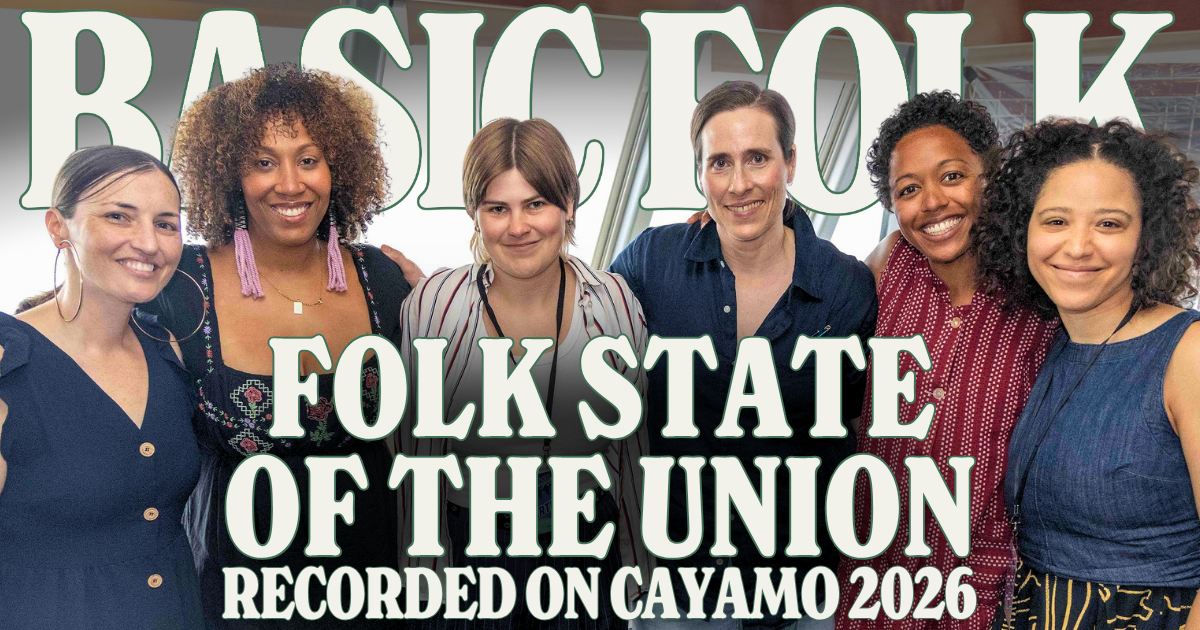
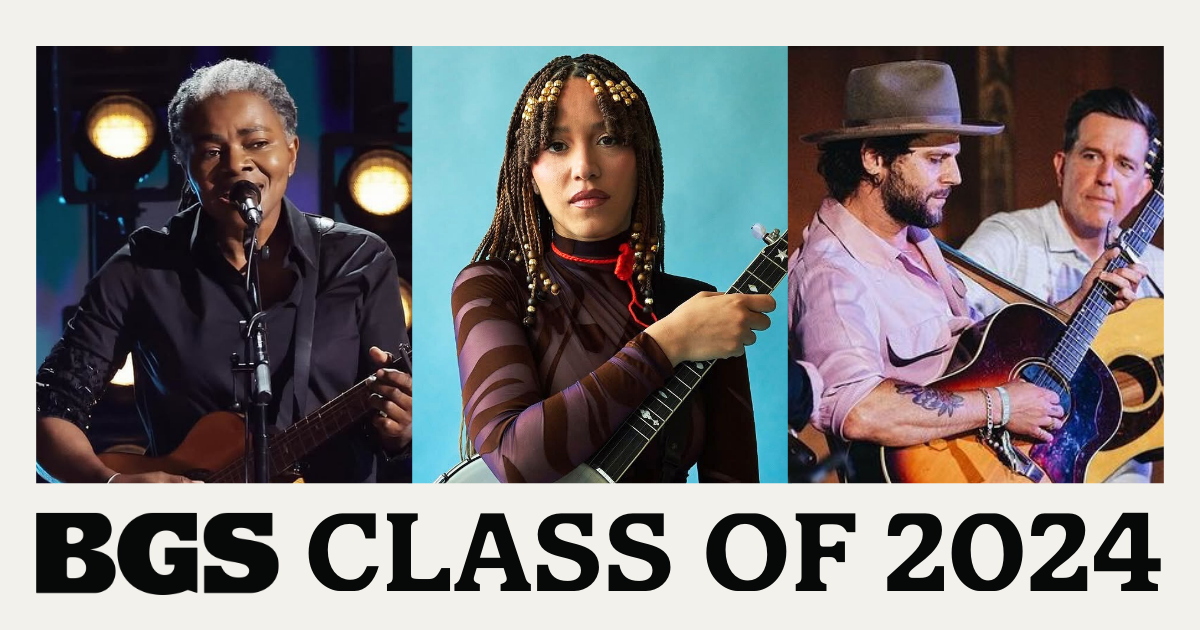
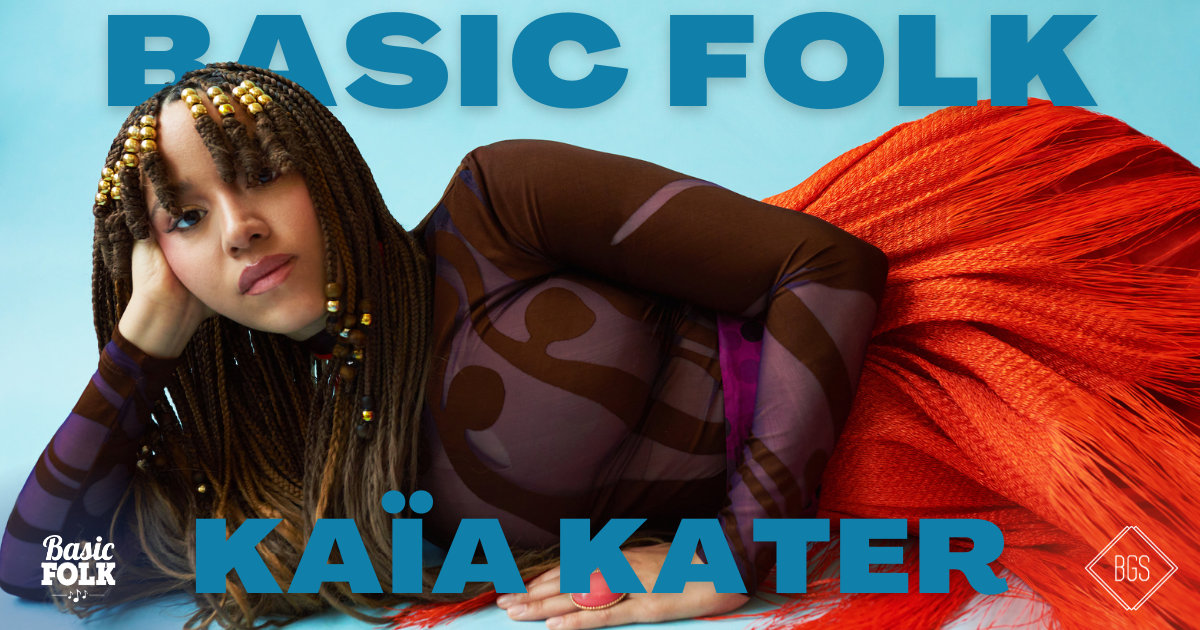
Well, is this not an excuse to get the girlies together if we’ve ever heard one!? For our final live interview aboard Cayamo, we arranged a check-in with some of our favorite folks to talk about the state of Folk Music (and folk-adjacent music). Our panel included country artist and host of Apple Music’s Color Me Country Radio Rissi Palmer, Canadian sweethearts Rose Cousins (CEO of emotions) and Kaïa Kater (Dean of Sad Songs), and Jobi Riccio, a self-proclaimed “rizzler.” We spoke about the function of folk songwriting, the hope and confidence of Gen Z, the inspiration taken from elders, and the fact that there are Black people in the future (thank you, Alice Randall).
We’ve noticed some folk songs coming out recently about moving forward and persevering despite living in hard times. It seems like the folk zeitgeist is collectively coming together to say something and we wanted to explore what’s happening with folk musicians at this time. What is the function of folk songwriting in modern times? Comfort? Information? Inspiration?
Folk is the big scoop that catches everyone. We need there to be a place for everyone else – and we are the everyone else. When you choose to be in this community, you grab onto this big rope, pulling against all that needs pulling against (feeling, current events, poverty, capitalism, things that homogenize, surveil, and control). These artists and the stories they tell take care of communities in a way that is similar to healthcare workers, but how are these workers being taken care of? We wanted to ask, “What’s the state of your workplace and how is care being taken?” And, “What does it feel like to be moving through the world playing music for people at this time?”
You know what would be the perfect way to end the week? A bevy of new roots songs and videos! Well, we have just the thing – and You Gotta Hear This.
To start us off, South Carolina-based husband-and-wife duo Benson – Wayne and Kristin Scott Benson – deliver a brand new instrumental, “Slayton Court.” Inspired by Wayne’s first address when he moved to Nashville 30+ years ago, and their young adult son’s similar journey in the present, it’s a thoughtful and tender tune that’s lyrical and evocative. Their labelmates, Unspoken Tradition, who hail from just up the mountains from Benson, also debuted a new single today, “Rhythm of the Ridge.” Written by North Carolina native Milan Miller, it’s an excellent song built on regionality, community, and the importance of the cultures that birth roots music.
Keep scrolling, though, as there’s plenty to explore. Singer-songwriter Cuchulain offers an adorable, painstaking stop-motion video for his new single, “Flip Turns.” As he puts it, it’s a song for swimmers and/or folks trying to keep their head above water wrapped in smooth and jazzy, alt-Americana sonics. New Jersey singer-songwriter Sean Kiely kicked off 2026 with a brand new track featuring his friend and hero, Kaia Kater. We’re pleased to share a live performance video of “This Is The Year,” a perfect song for starting the new calendar year on the correct foot.
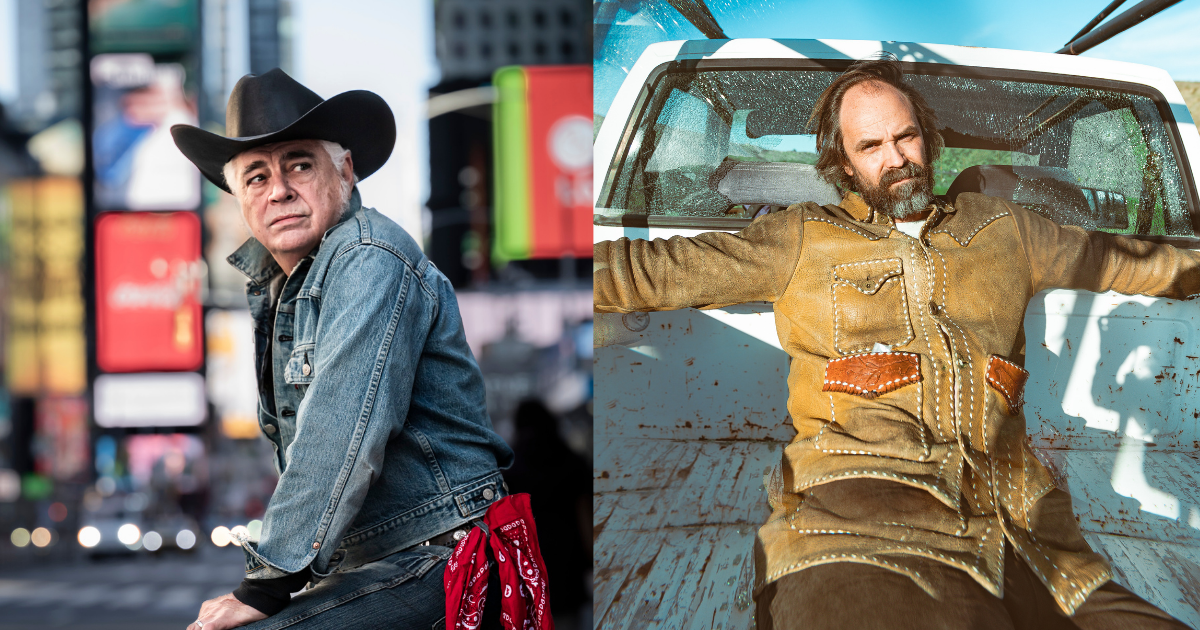
Los Angeles stalwart Jonny Fritz returns to his most recent album, Debbie Downers, to offer all of us a woodwinds version of that critically acclaimed LP coming in April. Today he unveils the first delightful woodwinds version from the reimagined collection, “Tea Man,” featuring clarinets, bass clarinet, flute, and Fritz holding it all together himself. For a dose of old-time, check out “Cheeky F” by George Jackson’s Local Trio. Stemming from the tradition of Texas-style old-time fiddling and melodies, Jackson, his trio-mates, and guest guitarist (and producer) Stash Wyslouch pick through the swinging and acrobatic pizzicato head with “Flight of the Bumblebee” aplomb.
To round out our roundup this week, we get a healthy dose of alliterative outlaw country from Ameripolitan crooner Dale Watson. “Willie, Waylon and Whiskey” brings alt-country, the Bakersfield sound, and psychedelic surf rock together as only Watson could. The track is driving and frenetic, leaning forward in the beat and referencing so many classic lines, melodic hooks, and tracks from his fellow outlaws. Would country be country without self-referential songs? It’s hard to imagine.
From bluegrass and old-time to folk and outlaw, there’s plenty to enjoy this week on BGS. You Gotta Hear This!
Benson, “Slayton Court”
Artist:Benson Hometown: Boiling Springs, South Carolina Song: “Slayton Court” Release Date: January 23, 2026 Label: Mountain Home Music Company
In Their Words: “‘Slayton Court’ was the first address that I had when I moved to Nashville, Tennessee, around 1993 with my good buddy Greg Luck. This instrumental is inspired by kind of reflecting on that time when you first gain your independence. For me, I was a young working musician for the first time playing with IIIrd Tyme Out. And you fast forward all these years and now I have a 19-year-old son going through a similar season. We were going to make a slideshow to document those years, especially with his activity as a young angler and going into the world of college fishing. As we made that slideshow it felt like this same melody would serve as great background for that, as well. I hope you guys enjoy ‘Slayton Court.'” – Wayne Benson
Track Credits: Wayne Benson – Mandolin Kristin Scott Benson – Banjo Cody Kilby – Acoustic guitar Kevin McKinnon – Bass
Cuchulain, “Flip Turns”
Artist:Cuchulain Hometown: Rock Hill, South Carolina, but currently live in Ithaca, New York. This was recorded in Eugene, Oregon, though, which was our hometown for the past five years. Song: “Flip Turns” Album:It’s Always Something Release Date: January 23, 2026 (single); April 3, 2026 (album)
In Their Words: “‘Flip Turns’ is a song for swimmers, for folks keeping their head above water. Written between swim breaks on summer tour 2024 and recorded live last January 2025, this song was our Tiny Desk Contest submission last year. I’ll be touring East Coast listening rooms in April 2026 to support It’s Always Something, the live in-studio album for which this is the lead single. A stop-motion music video accompanies the single release. The video took me most of fall 2025: I hand-felted the figures, constructed sets, and filmed frame by frame on my phone during my newborn daughter’s nap breaks. Equally at home on a coffee shop playlist or swimming workout playlist, the songs on this album are meant to be photographs of what my Oregon band sounded like at our peak, and love letters to hopeless romantics trying to make sense of this wild world.” – Cuchulain
Video Credits: Video by Cuchulain, color by Ashley Barry.
Jonny Fritz, “Tea Man”
Artist:Jonny Fritz Hometown: Los Angeles, California Song: “Tea Man” Album:Debbie Downers – Woodwinds Release Date: January 20, 2026 (single); April 3, 2026 (album) Label: Gar Hole Records
In Their Words: “I love woodwinds and have wanted to make this type of record for as long as I can remember. I’ve had this vision of clarinets playing chicken pickin’-style telecaster solos. Just imagine a Jerry Reed covers album played with clarinets and piccolos. There’s something about the staccato tonguing of a reed instrument that seems to me as enjoyable as playing roadhouse country solos. I’ve never played one, so I don’t know, but I do think about it all the time. I couldn’t be happier to finally hear it out loud and share it with the world.
“The version of this record I brought to Andrew Conrad was very different from what it became. My version was ‘Twinkle Twinkle Little Star’ and he made it into ‘The Star Wars Theme’ (or something like that). He was so clearly overqualified for the job and it made me appreciate him even more.” – Jonny Fritz
Track Credits: Jonny Fritz – Vocals, songwriter Christine Tavolacci – Flute Andrew Conrad – Clarinets Michael Mull – Clarinets Brian Walsh – Bass clarinet
George Jackson’s Local Trio, “Cheeky F”
Artist:George Jackson’s Local Trio Hometown: Originally, Christchurch, New Zealand. Now, Madison, Tennessee Song: “Cheeky F” Album:Center Of The Universe Release Date: January 26, 2026 (single); February 13, 2026 (album) Label: Adhyâropa Records
In Their Words: “I was inspired by the way Texas-style old-time fiddlers hide all sorts of weird notes on upbeats, so this was a bit of a riff on a Texas-style tune and seeing how many non-chord notes I could hide around the melody on weak beats. Stash took a break from producing in the control room to join us with some driving rhythm guitar, which really helped channel the Texas-style energy. I’m really happy with some of the spontaneous energy that we were able to capture in this take, a real edge-of-your-seat, improvised, studio take.” – George Jackson
Track Credits: George Jackson – Fiddle Frank Evans – Banjo Eli Broxham – Double bass Stash Wyslouch – Guitar
Sean Kiely, “This Is The Year” Featuring Kaia Kater
Artist:Sean Kiely Hometown: Jersey City, New Jersey Song: “This Is the Year” featuring Kaia Kater Release Date: January 1, 2026 Label: Multiple Logo
In Their Words: “I’ve been working on a new record since the fall and I was thrilled that Kaia Kater joined us on ‘This Is the Year’ singing and playing banjo. She elevated the tune so much, both in the vocal and in the groove of the banjo with the band. It came together really naturally and quickly, so we decided to release it on New Year’s Day, even as the rest of the album is still taking shape.
“I have a long list of favorite things about my friend and hero Kaia, but two in particular are her songwriting and her posture as a performer – the self-possession and power that’s just so right-there in everything she sings. They’re qualities I’m reaching for, so having her bring that craft to something I wrote was so rad.
“This video from the afternoon of New Year’s Eve is actually the first time we ever played the tune just as a duo and I gotta say it was no less exciting (and fun) to sit and pick ‘This Is the Year’ on Kaia’s couch just the two of us.” – Sean Kiely
Unspoken Tradition, “Rhythm of the Ridge”
Artist:Unspoken Tradition Hometown: Western North Carolina Song: “Rhythm of the Ridge” Release Date: January 23, 2026 Label: Mountain Home Music Company
In Their Words: “The first time I heard the demo of ‘Rhythm of the Ridge,’ I realized it was as deeply meaningful for me as it was for Milan [Miller]. I grew up in an immigrant family and straddling two worlds. The mountains of Appalachia are where I found the inspiration to write my American story. It feels timely to tell a story of grounding ideals and identity in a time where external forces attempt to rend us further away from each other. Just as the culture of my family’s home is written on their hearts long after they left it, so too is the ‘Rhythm of the Ridge’ on my own.” – Sav Sankaran
“Although it wasn’t my original intention when I began writing ‘Rhythm of the Ridge,’ the song quickly took on a deeply personal narrative as the lines started falling into place. I left the mountains of North Carolina for Nashville almost 30 years ago, yet home is a melody that follows you long after you leave it – a rhythm in your bones and blood that quietly keeps time. This isn’t a song about longing or looking back; it leans into a sense of place that steadies you and guides you through new endeavors and experiences. Fully adept at honoring the traditions of bluegrass while championing material that feels fresh and forward-thinking, Unspoken Tradition has become one of my favorite bands to emerge in the genre over the past decade, and I am beyond thrilled that they’re adding ‘Rhythm of the Ridge’ to their stellar catalog.” – Milan Miller, songwriter
Track Credits: Audie McGinnis – Acoustic guitar, harmony vocal Sav Sankaran – Upright bass, lead vocal Tim Gardner – Fiddle, harmony vocal Ty Gilpin – Mandolin Zane McGinnis – Banjo
Dale Watson, “Willie, Waylon and Whiskey”
Artist:Dale Watson Hometown: Austin, Texas Song: “Willie, Waylon and Whiskey” Album:Unwanted Release Date: January 23, 2026 (single); April 24, 2026 (album) Label: 40 Below Records
In Their Words: “This song was written on stage in San Antonio at the Lonesome Rose Bar. Inspired by a large man standing in front of me all night because he was wearing a shirt that simply said ‘Willie Waylon and Whiskey.’ I asked if it was a band name or a song name and he just said, ‘No, I just saw it in Walmart and liked it.’ Well, I liked it, too, so I wrote the song on the spot. I knew it would be a keeper when by the second time the chorus came around the entire crowd was singing it with me.” – Dale Watson
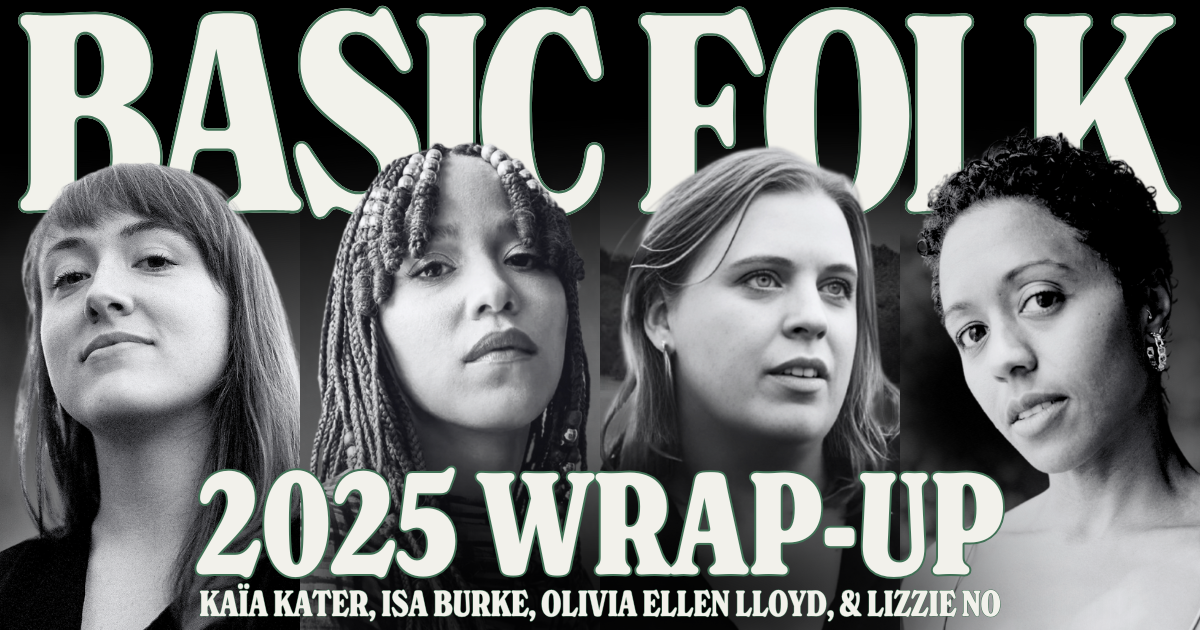
To send 2025 off into the great abyss, we have a sensational year-end Basic Folk roundtable featuring Lizzie’s group chat: Kaia Kater, Olivia Ellen Lloyd, and Isa Burke. It can feel so challenging to know which media you can trust and whose takes you can really take to the bank. There is no one we trust more to wrap up this wild and wacky year than these gals. We turned to them at the end of 2025 to hear their hot takes, what they’re grateful for, what they’ve learned, and what four poppin’ folk musicians were up to in this crazy year in the industry.
We also share a couple of Basic Folk clips from 2025! Our most-listened-to episode featured Ani DiFranco and Carsie Blanton onboard Cayamo, so of course we wanted to share a portion of their conversation about periods. Lizzie tees up a clip from her favorite episode featuring Cindy’s meet-cute moment with Morgan Toney. Morgan spoke of how he started to get more familiar with his Indigenous musical heritage and shares incredible insights about how to connect with your cultural heritage as a marginalized artist.
Lizzie & Cindy then get into what each has been up to this year, together and separately. They especially reflect on their trip to Alaska with Parlor in the Round, the pod’s new baby, Lizzie’s Yallidarity Social Club podcast, and the latest on their dogs – including one emergency surgery to remove a six-month-old corn cob. Goodbye, 2025!
Lead Image: Olivia Ellen Lloyd by Mandi Fountain Photos; Isa Burke by Sam Kassirer; Kaia Kater by Janice Reid; Lizzie No courtesy of the artist.
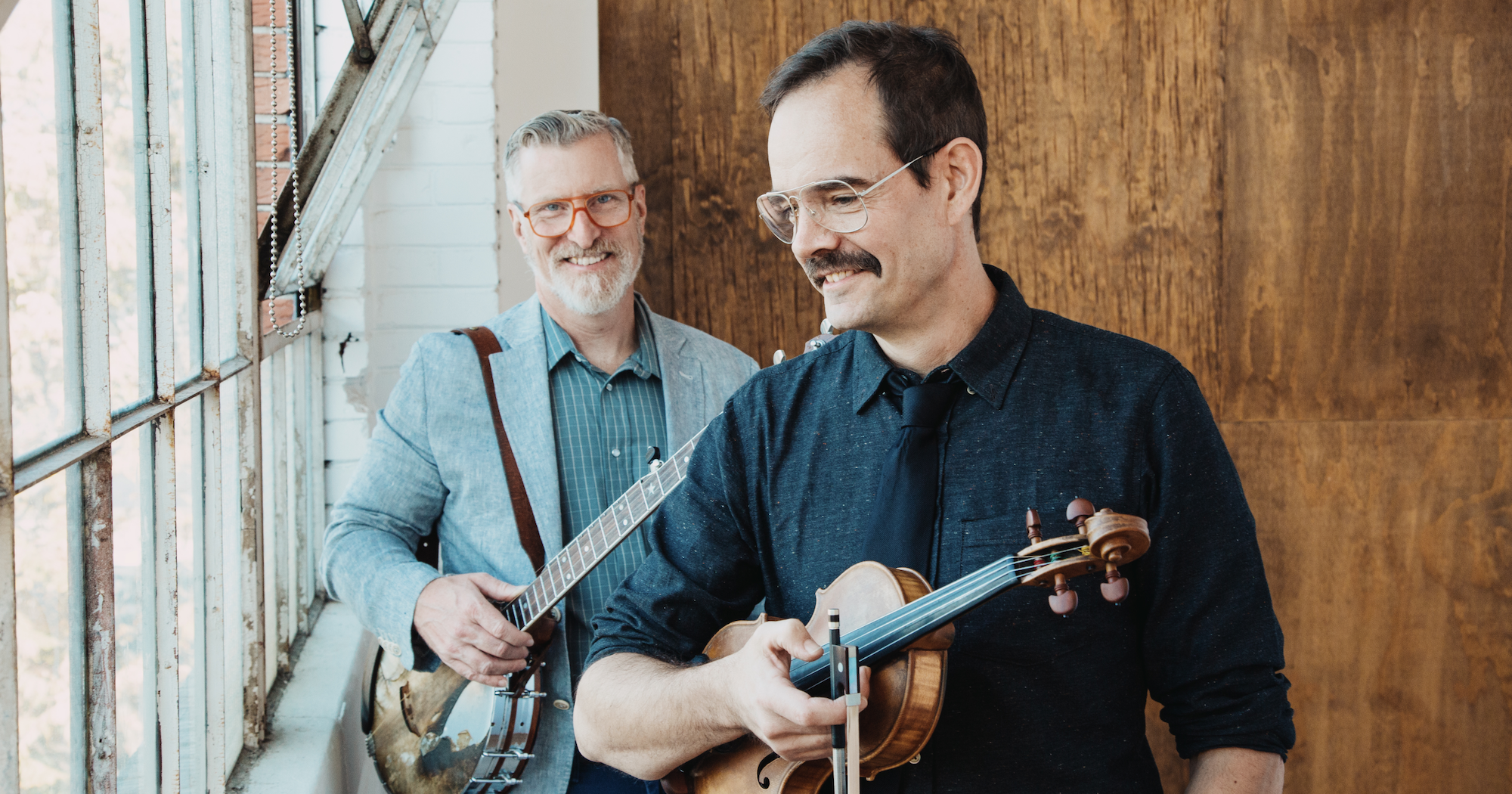
A few years back, we put out an album called Modern Old-Time Sounds for the Bluegrass and Folksong Jamboree. The title was a nod to that 1960s trend of naming records in a way that tried to cover every possible base. It was tongue-in-cheek, but it still sums up what we do – and what you’ll hear on our latest Lonesome Ace Stringband album, Big Wing. We don’t really play old-time music so much as make a modern old-time sound, and that’s exactly what this playlist is all about
Up here in Canada, we have a wealth of traditional music – distinct regional fiddle styles from coast to coast, songs and ballads that reflect the multicultural makeup of our country, and Indigenous music that predates all of it. Even with this abundance of homegrown music to draw from, many of us have found ourselves charmed by the traditional “old-time” sounds of the American South.
Being far away – geographically and culturally – from the source of the music you love presents some challenges, but it also affords a certain freedom. The first step is always to understand where the music comes from and its history; eventually, though, we all need to find our own voice within it. That’s sometimes easier to do when you’re removed from entrenched scenes and long-established communities.
One way I see this playing out in the old-time music coming from Canada is that writing original tunes and songs seems to come naturally and early in the journey. Whether it’s composing new tunes in the tradition or letting the sounds and themes of traditional music color our lyric writing, we’ve developed a wealth of modern old-time sounds up here – and I’m excited to share a few examples in this playlist. – Chris Coole, Lonesome Ace Stringband
“Maggie At The Door” – Arnie Naiman
Arnie Naiman has been playing old-time music longer than anyone else on this list. When I first met him in the early ’90s, he’d already been playing for around 20 years. Back then, he was mostly on fiddle, but sometimes he’d pull out the banjo at the end of the night and share some of the original tunes he always seemed to be writing. This led to us making a couple of albums together – and to me becoming a lifelong fan. “Maggie at the Door” is a great example of how he can write a banjo tune that also works on the fiddle – not as easy as it sounds. It was written for his dog and it’s probably the most badass-sounding tune ever written for a golden retriever.
“Lonesome Song” – Rube & Rake
Rube & Rake are Josh Sandu and Andrew Laite. Both live in St. John’s, Newfoundland, and are writing beautiful songs while touring hard. We ran into them in the UK last year and were instantly taken by their deft playing and the “low lonesome” sound of their harmony singing. “Lonesome Song” is a moody example of all that.
“Platform Four” – The Slocan Ramblers
The Slocan Ramblers are Canada’s bluegrass band – at least as far as I’m concerned. Although Frank Evans no longer plays full-time with the group, I chose this tune to remind everyone that while he’s mostly known for his three-finger bluegrass playing these days, he’s also on another level as a clawhammer player. There are a few licks on “Platform Four” that he’ll probably take to the grave.
“Narrow Line” – Mama’s Broke
Mama’s Broke are another duo from Eastern Canada (Nova Scotia). We crossed paths with Lisa Maria and Amy Lou Keeler at the Baltimore Old-Time Gathering a few years ago. They put on a riveting show and blew us away with their singing and playing. The arrangements on their records are so imaginative – they capture the spaciousness of their live sound while layering on subtle textures. “Narrow Line” is an excellent example of this and one hell of a song.
“White Horse Plains” – The Red River Ramblers
The Red River Ramblers feature the music of Douglas Richard Sinclair, a Red River Métis musician whose last album, Reverie, showcased original tunes inspired by the Métis fiddle tradition. “White Horse Plains” highlights Douglas’ tuneful guitar playing and answers the question: What would Norman Blake have sounded like if he’d been Métis?
“Saint Elizabeth” – Kaia Kater
Kaia Kater’s 2016 album Nine Pin made a lot of folks take notice of this exceptionally talented songwriter. Kaia is a perfect example of someone who’s really tried to get to the roots of the music; she studied Appalachian traditions at Davis & Elkins College in West Virginia. She’s taken what she learned there and carried it to a creative place that defies genre or categorization. “Saint Elizabeth” is a perfect example.
“New Caledonia” – Pharis & Jason Romero
Pharis & Jason Romero probably need no introduction to anyone here. They’re old friends of ours and we’re big fans of their music. It almost seems remiss to share a song that doesn’t feature their beautiful singing and lyrics, but we’re always enchanted by Jason’s tune writing, backed by Pharis’ always-right-on-the-money guitar playing. “New Caledonia” is one of those tunes that instantly takes you somewhere. It manages to say a lot without a single word.
“The Wheels Won’t Go” – Hannah Shira Naiman
Hannah Shira Naiman comes to the music honestly. She grew up learning fiddle and banjo from her dad, Arnie Naiman, while listening to her mom, Kathy Reid-Naiman, sing the songs of Jean Ritchie, the Georgia Sea Island Singers, and the Delmore Brothers. Hannah has taken it all in and made something uniquely her own. “The Wheels Won’t Go” is the title track of her 2022 album.
“Wellington” – Allison de Groot & Tatiana Hargreaves
Allison de Groot is one of our most treasured banjo exports – clean, hard-driving, and full of tone. Best known these days for her work with Tatiana Hargreaves, she’s also a fine composer. “Wellington” is one of her own tunes, a reminder that she’s as creative as she is technical.
“Mama’s Boy” – Lotus Wight
Lotus Wight (AKA Sam Allison) is best known for his work with Sheesham and Lotus & Son. He’s a beautiful banjo player, a lovely jaw-harpist, a rock-solid bassist, and even plays the contrabass harmoniphoneum. I didn’t know until his last album that he’s also a moving songwriter, somewhere between John Hartford and Leon Redbone. “Mama’s Boy” tells the story of the three men who were fathers to Sam over the course of his life. I can’t remember the last time I heard such an honest and tender song.
“From Silence” – Daniel Koulack
Daniel Koulack hails from Winnipeg, Manitoba, where he’s been making music and teaching banjo for many years. (Allison de Groot is one of his students.) Daniel has always been game to take the clawhammer banjo to new and unexpected places – which might explain “From Silence,” possibly the only clawhammer banjo and saxophone duet in the known universe.
“At the Airport” – Old Man Luedecke
Old Man Luedecke is one of the crown jewels of Canadian singer-songwriters and he also happens to be one hell of a clawhammer banjo player. He’s written most of his songs on the banjo (at least the early ones), which gives them those unmistakable twists and turns – in both phrase and melody. And he has that rare gift for putting a bit of hope into everything he writes, whether the song is sad, funny, or introspective. “At the Airport” is a perfect example.
“May Day” – The Andrew Collins Trio with The Lonesome Ace Stringband
The Andrew Collins Trio (Andrew Collins, James McEleney, Adam Shire) collaborated with us on “May Day,” a tune Andrew and I wrote together many years ago. These three are next-level players who are always pushing the boundaries of what’s possible on their instruments. Known for mixing new acoustic bluegrass with classical and jazz influences, we had fun diving into some weird old-time with them on this track from our new album.
Music is all about moments. It’s a fact we tend to lose sight of, forest for the trees, despite the fact that music can only exist in this, the present moment. Each pluck of a string, each breath of a voice, each lick, hook, and improvisation – no matter how practiced or free – is but a mere moment.
As we all rewind the calendar year to relive the last twelve months and all of the turmoils and triumphs they held, we asked our BGS contributors to reflect on which musical moments they experienced this year that were most memorable, most moving, and most transportive. Which musical moment would you return to, if you could? Which musical moment returns to you, again and again and again?
Our year-end lists are not intended to center on superlatives or “bests;” we don’t so much care about what “should” or “shouldn’t” land in one of these collections. Curation of this sort is never truly objective, so why pretend it is? Instead, we hope our writers and our readers will be able to demonstrate and appreciate that music is never about measuring or comparison, metrics or accomplishments, accolades or awards. Music is about moments – and about wholly inhabiting those moments, together.
Below, our first-rate writers, thinkers, and contributors share the musical moments from 2024 that impacted them most. From Beyoncé galloping through our hearts with Cowboy Carter to intimate, people-first festivals like Laurel Cove Music Festival in Kentucky. There’s also music from harlequin creators like American Patchwork Quartet, Kaia Kater, and Rhiannon Giddens alongside memories of the late Dexter Romweber and the strength of mutual aid and community solidarity in Western North Carolina post-Hurricane Helene.
2024 held so many intricate, ineffable, one-of-a-kind moments, good, bad, ugly, and gorgeous. We hope you’ll take a second to recall your own most memorable musical moments of the year while we share ours – and while we all look forward to many more in the year to come.
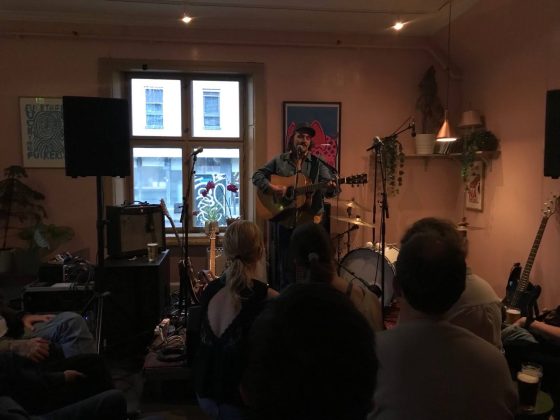
August 20, 2024 – Chris Acker and Dylan Earl at Folk i Storgata, Oslo, Norway
Photo by Dana Yewbank taken at a show by Chris Acker and Dylan Earl at Folk i Storgata in Norway.
While this doesn’t quite fit any stereotypes about Scandinavia, black metal, or Viking-inspired neo-folk, Norway has a thriving Americana music scene that welcomes and celebrates even lesser-known American folk and country artists. Chris Acker and Dylan Earl are two of these undersung artists, both represented by Nick Shoulders’ record label Gar Hole Records out of Arkansas. This past summer, Acker, Earl, and I all coincidentally ended up in Oslo, Norway, at the same time, where the pair put on an intimate, inspiring, and tightly-packed show for a crowd of about 30 people in a tiny bar with pink walls. They bantered with the audience, backed each other up on a few songs, and even spontaneously formed an unrehearsed superband with the bar owner and their Norwegian opener – and they were damn good. Acker and Earl are both deeply thoughtful musicians who use their power and presence as men on stage to question the status quo of “good ol’ boy” country and stoic male musicality. Their candidness and subversive humor drew the room together that night with a sense of camaraderie, safety, and concentrated joy. – Dana Yewbank
Act Now! A Paperface Zine Benefit Tape for the Palestine Children’s Relief Fund
A harrowing statistic from the UN agency for Palestinian refugees (UNRWA) reports that as of March 2024, the number of children killed in Gaza over a mere five months (October 2023 to February 2024) surpassed the number of children killed in global conflict over the four years prior, combined (2019-2022). As of December 2024, we are a year and two months into the ceaseless genocide being waged against the innocent civilians of Palestine and the horrific violence only continues.
I salute everyone who has waged resistance against genocidal powers, be it contacting senators, galvanizing communities to action, participating in rallies, or, in this instance, artists and musicians who have used their platform as an act of protest. Paperface Zine, a blog that writes and interviews an eclectic mix of underground artists, spearheaded this collection of tunes in an effort to express solidarity with Palestine and raise funds towards the Palestine Children’s Relief Fund. This Benefit Tape is a shining example of how most any skill can be mobilized to support greater communities; creativity and care forever go hand in hand. – Oriana Mack
American Patchwork Quartet, American Patchwork Quartet
American Patchwork Quartet have pieced together one of the best albums this year. Don’t take our word for it: they’ve been nominated for a GRAMMY for Best Folk Album. That’s the moment we want to celebrate. With all due respect to the other nominees, it’s exciting to see a brand new project get recognized so quickly – particularly one that colors outside the lines like APQ. The quartet add a number of global influences to traditional American songs: a guitar solo here, a sitar there, and a fine sprinkling of tabla make the quartet live up to their name. Now, especially, we need statements that American traditions were born of a tapestry of European, African, and Indigenous cultures that continue to be built upon by everyone who chooses to make this place a part of their own quilts. – Rachel Cholst
September 26, 2024 – Asheville, North Carolina’s Music Scene and Hurricane Helene
On the night of September 26, Hurricane Helene ravaged Western North Carolina with unprecedented rainfall and flooding. What resulted was a tight-knit area completely decimated and utterly distraught by the destruction of numerous communities. The current death toll for the state sits at 103, with many others still missing.
Beyond the cultural, economic, and unbelievable physical devastation to Asheville and surrounding towns, the city’s vibrant and world-renowned live music scene was brought to its knees – a radio silence that lasted several weeks, with numerous unknowns lingering for certain storied venues. But, with great resolve and a steadfast attitude of helping your friends and neighbors, the vast music community in Asheville and greater WNC came together with countless benefit concerts and fundraiser album compilations (Caverns of Gold, Cardinals at the Window) — an effort that remains at the forefront of the region’s recovery that will take years, if not decades, to return to normalcy. – Garret K. Woodward
Beyoncé, “Jolene”
Country music is for everyone and there is something fascinating about an album which ends up in the territory between categories. Beyoncé is a great singer, and has been flirting with country for a very long time; she has the chops to sing “Jolene” better than Dolly. So, when she sings that she’s “still a Creole banjee bitch from Louisiana,” she is making a series of arguments: that country exists in response songs; that the other woman should be given the mic; that the landscape mirrors the territory; and that the gatekeepers should be torn down, like the walls of Jericho. – Steacy Easton
February 4, 2024 – Tracy Chapman & Luke Combs, “Fast Car”
Luke Combs released his version of Tracy Chapman’s “Fast Car” in 2023, but it was his performance with Chapman on the 2024 GRAMMY Awards primetime telecast that rocketed the song from country radio back into the mainstream zeitgeist. Where Combs’s recording highlighted the song’s working-class vibes, seeing him perform it alongside its (Black, queer, female) writer gave the song’s legacy even greater heft. “Fast Car” was always a song about women carrying more weight than any single human can; about the urgent, nagging desire to flee toxic cycles; about how fleeting freedom can sometimes feel. For better or worse, all these things became emblematic of 2024. – Kim Ruehl
Rhiannon Giddens
You would be hard-pressed to cite anyone in any genre who had more memorable musical moments in 2024 than the superb vocalist, composer, and instrumentalist Rhiannon Giddens. Her writing brilliance was showcased through the Silkroad Ensemble group and project. Her arrangements of folk songs were part of their landmark American Railroad tour program along with commissioned pieces from jazz artist Cécile McLorin Salvant and film composer Michael Abels, as well as fellow Silkroad artists Wu Man, Layale Chaker, Haruka Fujii, and Maeve Gilchrist. Giddens was featured on banjo and viola on the hit single “Texas Hold ‘Em,” part of Beyoncé’s huge Cowboy Carter LP. Giddens added another GRAMMY nomination for Best American Roots Performance with “The Ballad of Sally Anne” from the excellent compilation My Black Country: The Songs of Alice Randall, too. Hard to believe there’s any ground left to cover for the MacArthur Genius and Pulitzer Prize winner, but Rhiannon Giddens continues to stun and surprise audiences with everything she does. – Ron Wynn
November 14, 2024 – Zachariah Hickman’s Power Outage Party! at Club Passim, Cambridge, MA
Not sure how bassist and music director Zachariah Hickman (Josh Ritter, Ray Lamontagne, Barnstar!) pulls off his many acts of mischief, but the Power Outage Party! shows are the most creative, beautiful, and emotional musical experiences around. Presented in mid-November by Club Passim, the shows featured a collective of musicians (including members of Della Mae and Session Americana) and guests (this year including Taylor Ashton, Mark Erelli, and Kris Delmhorst) performing without any power in the historic 100-seat club in Harvard Square. The band is lit with camping lanterns and tea lights. The audience is shoehorned in so tight (I was nearly sitting on the cello players’ lap) that you can’t help but feel a part of a very special community. Every time I go, I carry the experience and inspiration with me as we all work through the darkest part of the year. – Cindy Howes
February 24, 2024 – Kaia Kater, “In Montreal” at Folk Alliance International
One of my favorite and most memorable musical moments of the year occurred at Folk Alliance International, where Kaia Kater and her band performed tracks from her brand new album, Strange Medicine, at BGS’s private showcase. In a small hotel room with a handful of audience members, Kater began “In Montreal” with her looping, cyclical, trance-like clawhammer banjo groove. I was immediately transported, immediately grounded, gently – and forcibly – brought to the moment. I still experience the same visceral sensation each time I hear this track begin, the old-time banjo hook leaving and rejoining the beat deliciously, sketching out an expansive pocket. This night, in cold Kansas City, Kater was joined by flutist Amber Underwood (AKA Flutienastiness), who was even further transportive and dreamy in her interpretations of the track. It was a transcendent song, a daring banjo-flute dialogue, a mind-blowing mini set, and a perfect harbinger of what Strange Medicine would cure and balm. – Justin Hiltner
June 7-8, 2024 – Laurel Cove Music Festival
The gem of a festival located just north of the Cumberland Gap in Pineville, Kentucky, has fostered several special moments in recent years, but none come close to matching the memories from Wyatt Flores and The Red Clay Strays headlining sets there this past June.
The first came when Flores’ mics were cut off before an encore, leading to his band sitting atop the speakers lining the stage for a crowd sing along to Tyler Childers’ “Lady May” that to this day still gives me goosebumps. But if that wasn’t enough, The Strays topped it the following night when their show turned into an impromptu baptism after people in the crowd began jumping into the shallow pond surrounding the stage during a performance of their hit song, “Don’t Care.”
Both occurrences were pure magic from two of the year’s hottest country-adjacent acts in an intimate setting with only 1,500 people in attendance, showing that even in the age of corporate mega-festivals the best things still do come in small packages. – Matt Wickstrom
Though he was never top of the pops – or even on the charts at all, either solo or with Flat Duo Jets – wildman proto-rockabilly guitarist John Michael Dexter “Dex” Romweber was still an inspirational icon in the roots-rock world and a key influence on major bands like White Stripes and Black Keys. Romweber was just 57 years old when he died from a cardiac event this year, a shocking event that inspired a worldwide outpouring of tributes that went on for days. Maybe the best of all came from Jack White, who was always wide open about the depth of Romweber’s influence on White Stripes. Writing on Instagram, White proclaimed that Dex “was the type that don’t get 3 course dinners, awards, gold records and statues made of them because they are too real, too much, too strange, too good.” That’s the truth. – David Menconi
July 27, 2024 – Langhorne Slim, “We the People (Fuck the Man)” Live at the BGS Jam at Newport Folk Festival
While putting together the set list for the BGS Late Night Jam, “A Bluegrass Situation,” at Newport Folk Festival back in July, our old pal Langhorne Slim suggested a new tune he had just written. Would the house band be willing to learn it for this special occasion? In the words of our jam host and BGS co-founder Ed Helms, the song was an “instant Newport Classic.”
Slim’s new tune, “We the People (Fuck the Man)” – later released on streaming platforms just before the election – echoed through the Pickens Theatre that Saturday night and immediately got the audience on their feet. Its lyrics are as timeless and rallying as any Guthrie tune, but amidst all the declarations against greed and polarization there’s an optimistic plea in the chorus:
So let us love our neighbors Protect the land Look our brother in the eye When we shake his hand It’s been this way a long time It’s hard to understand The time has come for everyone We the people, fuck the man
In these tumultuous times, Slim gave us words (and a performance) we shouldn’t soon forget. – Amy Reitnouer Jacobs
Sam Williams & Carter Faith, “‘Til I Can Make It on My Own”
Sam Williams and Carter Faith drape their fringe-laced voices over Tammy Wynnette’s “‘Til I Can Make It on My Own.” While honoring the song’s 1976 roots, the two rising stars spin their own lonesome and delicate performance that seems to transcend time and place. “Lord, you know I’m gonna need a friend,” they sing, trading stunningly confessional lines and background harmony. “‘Til I get used to losing you/ Let me keep on using you, ‘til I can make it on my own.” Through a honeyed, emotionally resonant arrangement, Williams and Faith demonstrate exactly why they’re among the best of today’s new crop of talent. – Bee Delores
Yasmin Williams, Acadia
The guitar is perhaps the most ubiquitous instrument in the modern world, making it even more notable that a picker like Yasmin Williams could still stake out fresh territory on the instrument, finding and championing her own truly original sound and approach. Acadia is a masterwork, breaking still new ground after Williams’ incredibly successful 2021 album, Urban Driftwood. While Acadia isn’t exactly a reinvention for the picker-composer-innovator, it does limitlessly expand the acoustic universe she’s been fleshing out since releasing her debut, Unwind, in 2018. That’s a fairly short runway for a creative to accomplish so much, especially given Williams seemingly treats her guitars as brand new devices each time she picks them up to compose. The results are often bafflingly, jaw-dropping, and dramatic – but always musical and ceaselessly inspiring. – Justin Hiltner
Photo Credit: Tracy Chapman live on the 2024 GRAMMY Awards; Kaia Kater by Janice Reid; Langhorne Slim with Ed Helms at Newport Folk Festival by Nina Westervelt.
When you wake up in a world where hatred and fascism have been resoundingly endorsed by so many of your neighbors and fellow citizens, how do you proceed? That question becomes even more daunting at its second or third or umpteenth asking.
Yes, music will play a vital role over the next handful of years, as we continue the fight for justice, self-determination, and agency for all people, in the U.S. and around the world. But music, the arts, and creativity won’t be enough to save us. They won’t be an end-all, be-all solution to the political and cultural hurdles we will have to clear in the near future.
This is a moment that calls for so much more. Solidarity, first and foremost – the idea that, at the beginning or end of the day, all we have is each other – and community, organizing, and advocating for each other will be essential. Mutual aid will be more necessary than ever. Putting our own privilege on the line in order to protect and ensure safety for those more marginalized than ourselves is the task immediately at hand. Showing up – yes, for our country, but more importantly, for our friends and neighbors – is the very next step. Literally and figuratively.
Still, the soundtrack we will all write, that we will all curate, that we will all partake in while opposing the craven and hateful policies being proffered by our would-be dictator will be a powerful tool. Music – especially roots music, country and bluegrass, blues and old-time, folk with a lowercase and capital F, and more – are traditions steeped in populism, in worker’s rights, in justice, in standing up for the downtrodden and beleaguered. There are no better genres for this exact moment. There are no betters artists, musicians, and songs than those in and made by our very community.
BGS and Good Country include in our mission a commitment to intentionally crafting a roots music space, a bluegrass- and country-centered universe, where everyone is welcome, regardless of identity, background, nationality, ethnicity, disability, class, or belief system. We are determined to continue that work, to be a place where – hopefully – anyone and everyone can feel seen, heard, safe, and valid in their love for and appreciation of all things roots music.
As we summon courage for the work ahead and lean on our community, here are eight songs perfect for this exact moment in history, to hold up as we remind ourselves our goals are the same at the end of this week as they were at the beginning: liberty, agency, and self-determination for all. – TheBGS & Good Country Team
“Mercy Now” – Mary Gauthier
A modern Americana classic, singer-songwriter Mary Gauthier shared “Mercy Now” on social media very early on Wednesday morning, after the news broke that Trump had won another term. It spread quickly on social media with many a repost and reshare. The message here, of mercy applied broadly, universally, and without qualification, is more than timely. It’s evergreen.
“Crisis” – Aoife O’Donovan
Connecting our current struggle to those of past generations is exactly how we continue to put one foot in front of the other, despite setbacks and losses and despair. Aoife O’Donovan’s latest record, All My Friends, is a perfect intergenerational connecting of the dots, centering women, girls, and femmes, and shines a light on the non-linear track that leads to victory. We know we will continue to return to this music over and over in the future, as a balm and a catalyst for progress.
And, as our friends at Basic Folk reminded us yesterday, Aoife’s and Dawn Landes’ episode of the podcast – which focuses on their similar albums centering women, feminism, and women’s issues – is an incredibly timely re-listen. Find that episode here.
“Sun to Sun” – Alice Gerrard
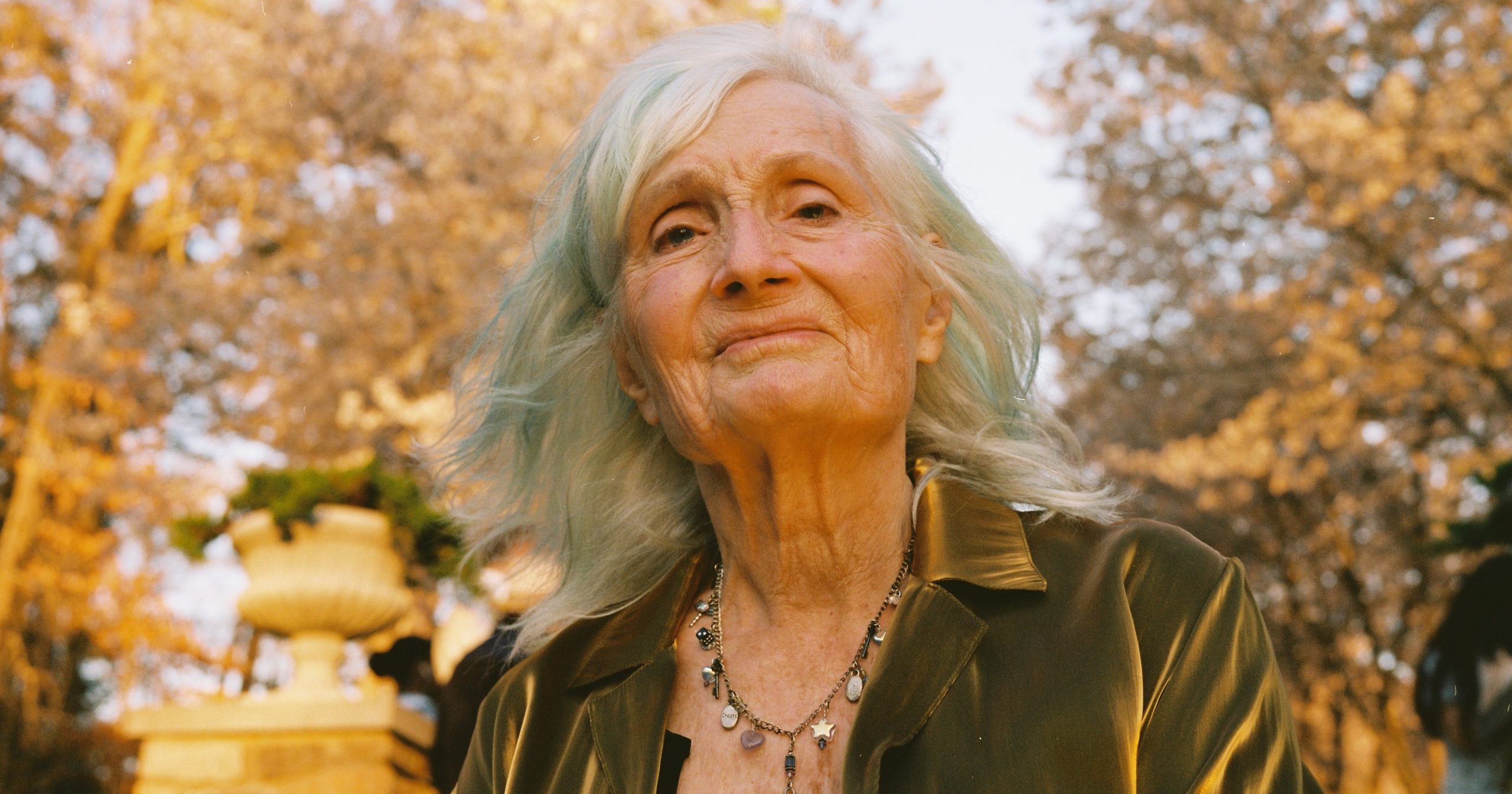
Looking to our roots music elders in this moment is exactly what we all need! Alice Gerrard’s most recent album, Sun to Sun, and certainly its title track, indicate a kind of perseverance and long view that we all could take on as we face the uncertain future.
With a loping, almost marching rhythm, there’s a grounded, realistic, and convicting approach here on “Sun to Sun.” While we all talk, and talk, and talk, and talk, the problems we face continue unabated and unchallenged. What will we do besides talk?
While we talk another fool goes and buys a gun…
“Listen” – Kyshona
Speaking of talking… why don’t we take a turn at listening? The challenge has been set by Kyshona, a powerful and restorative singer-songwriter and activist who channels her ancestors, connects generations, and builds community with every note and every word sung. Originally released in 2020, “Listen” is just as encouraging now as it was then, and just as indelible in its striving for a better, more compassionate world. Media, social media, and the internet all incentivize us to speak, to center ourselves, to prefer “me” and “I” over “us” and “we.” Let’s maybe listen more, instead. Especially right now.
“Beautiful” – Sam Gleaves
Appalachian singer-songwriter and multi-instrumentalist Sam Gleaves – who was raised in southwest Virginia but now lives in eastern Kentucky – released one of the most quietly and emphatically radical queer country and old-time albums of this year, Honest. “Beautiful” is the collection’s stunner, a track about how there’s endless beauty, mystique, and life lessons to be drawn from the ways we’re all different from each other. Through the lyrics, you see the world from the eyes of a young Gleaves, singing about sights and sounds unfamiliar and foreign to a boy from the mountains, loved and cherished by his family and shown that love without question.
Seeing beauty in our differences? What a way to live…
“The Numbers” – Mipso
THE ECONOMY! THE ECONOMY! THE ECONOMY!
What about those of us for whom this economy has never worked well or fully functioned? What about the millions who can’t make ends meet right now, under blue or red presidents? From their 2023 album, Book of Fools, Mipso turn over this very question, examining how and why “The Numbers” could be soaring – hiring numbers, the stock market, crypto values, Tesla market cap – while so many are still struggling day to day.
“Put No Walls Around Your Garden” – New Dangerfield
From Black string band supergroup New Dangerfield – which features Jake Blount, Kaia Kater, Tray Wellington, and Nelson Williams – “Put No Walls Around Your Garden” is an Americana-tinged old-time number, written by Kater, with a collectivist stance and a solidarity through line. There may be instincts in the near future to revert to an “every man for himself” sort of survival strategy, but the only way we’ll get through is together. Rather than hoarding, walling ourselves off, retreating, or recoiling, now is the time to throw open our garden gates and welcome each other in. Share our abundance, work through our scarcity and lack, and care for each other’s needs – big or small.
“Trees” – Laurie Lewis
Consider the trees. Consider the birds, the rivers, the oceans, the saguaro, the pikas, the whooping cranes. Did their realities change between Tuesday and Wednesday? Is the world any less or more likely to burn, to flood, to be blown away by hurricanes and tornadoes now than on Monday? Sadly, no. The march towards climate apartheid continues entirely unfettered, regardless of who holds the White House.
Laurie Lewis, a bluegrass forebear who has carried the mantle of climate justice for her entire life, embodies trees in the title track of her latest album. She and her band show how the fight for justice – climate justice, racial justice, gender equality, LGBTQ+ rights, immigrant rights – is a fight not measured by human lifespans and human time, but against earth’s clock. The trees will continue to watch, waiting, for us to either figure it all out or to fail at our mission.
We must not fail. The work continues and we’ll be working – and singing – alongside you all, the entire way.
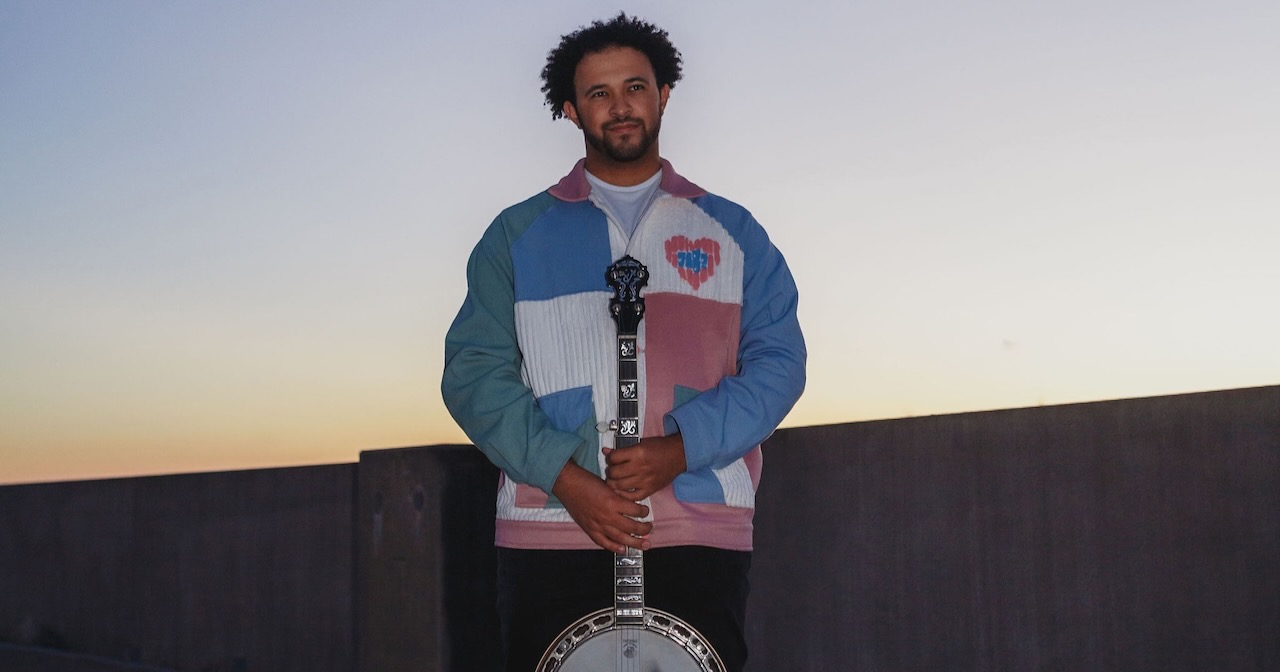
On his 2022 album Black Banjo, Tray Wellington thwarted stereotypes and pushed the boundaries of what bluegrass music can be. On his new EP, Detour To The Moon, he picks up right where he left off, weaving in jazz, hip-hop, country, and more into his trailblazing banjo bangers.
The meshing of influences on the seven-song project serves as a segue between full-length records; the EP is the first of a planned conceptual series showcasing the picker’s sonic and personal evolution.
“I want to keep pushing myself and growing until I’m at my max potential, and I don’t feel like I’m anywhere close to reaching that yet,” Wellington tells BGS of the project’s concept. “So if we’re talking in terms of the universe, I want to get way past the moon, because we’ve already been there and because my influences are constantly evolving and I want to be able to reflect on all of it.”
Although he’s most proficient on banjo now, Wellington’s musical development began years prior on the guitar – until he stumbled upon Doc Watson’s music while browsing his grandfather’s record collection. By middle school, the Western North Carolina native had joined a mountain music club that traveled to local communities playing traditional bluegrass music. Eventually one of his teachers, Josh Church, introduced him to the banjo and he never looked back.
“I’d never heard him play banjo to that point, but he pulled it out that day and started playing ‘Salt Creek,’” Wellington recalls. “I was instantly hooked by its sound and fell in love. From there he taught me a song or two, leading me to beg my mom for a banjo over the summer before starting ninth grade.”
Since taking to the banjo Wellington has grown to be one of it’s most promising young pickers, most notably winning the International Bluegrass Music Association’s 2019 Momentum Award for Instrumentalist of the Year, graduating from East Tennessee State University’s Bluegrass, Old-Time and Roots Music Studies program, and helping to form New Dangerfield — a Black roots supergroup also comprised of vocalist/multi-instrumentalist Kaia Kater, bassist Nelson Williams, and fiddler/vocalist Jake Blount.
That promise shines bright throughout Detour To The Moon, which sees an equal mix of him creating his own instrumental soundscapes as well as taking other’s songs, like Duke Ellington’s “Caravan,” “John Hiatt’s “Lift Up Every Stone,” and Kid Cudi’s “Pursuit Of Happiness,” and making them entirely his own.
In particular, Wellington says that Cudi’s certified diamond hit, first released in 2009, was one that he had to record upon first hearing it in 2023, due to its message of drug abuse and escapism that he resonated with deeply.
“That, and witnessing the profoundly positive impact it had on others of lifting them out of the dark places they were once in, is what made me want to record it,” Wellington explains. “If a tune has that much power, it deserves to be re-recorded and spread to as many new audiences as possible.”
In addition to pushing boundaries with his music, Wellington also pushed them with his own creative abilities on the artwork for Detour To The Moon, which he made himself. The first-time occurrence is one that he was thrust into after a graphic designer he had commissioned back out of the project as a deadline for their work was fast approaching. Rather than hire someone new to complete the work or delay it (and risk pushing back the entire project as a whole), he began completing it on his own. Featuring Wellington standing stoically with his banjo on a cratered moon surface with a looming purple glow, the artwork is a display not only of his creativity, but the improvisation and ingenuity that also make him a top notch musician.
“It took me 30 hours to create,” Wellington says with a chuckle of making the artwork. “I had to imagine the concept and find reference pictures before sketching ideas and putting it all into Photoshop. It took a long time, but I’m proud of how it turned out and now I have this new skill I can continue to hone and potentially help other artists with as well.”
Aside from Wellington’s ingenuity coming out in the EP’s cover art and in its choice of songs, it’s also displayed in the players who joined him on the project. For the first time in his three studio albums Detour To The Moon includes drums courtesy of the Steep Canyon Rangers’ Michael Ashworth. It also features fellow Asheville mainstay Drew Matulich (The Grass Is Dead) on guitar. Pedal steel guitarist DaShawn Hickman, vocalist Wendy Hickman, and Kater were other contributors.
Those pivots came after Wellington went into the recording process, planning for the players joining him to be exclusively from his traveling band – bassist Katelynn Bohn, mandolinist/fiddler Josiah Nelson, and Nick Weitzenfeld. While it does include each of them on all or a portion of the project, it also blossomed into something bigger that celebrates not only Wellington’s sonic evolution, but the many ways that Black music of old still shares with that of the present.
Connecting those dots and pushing for more diversity within bluegrass and roots music have long been part of Wellington’s creative work. While he’s done more than his part to advance those efforts, he says it’s going to take much more to see representation where it matters most – the audience.
“I’ve seen a lot more Black and other people I didn’t usually see before picking up a banjo, fiddle, or mandolin and playing bluegrass music in the last five years, but in the grand scheme of things it’s still a very small number of us,” asserts Wellington. “It’s on the venues, labels, artists, fans – all of us – to get involved and push for change because at the end of the day nobody wants to go out to shows where they know they won’t feel comfortable at.”
It’s seven months into the year and music and media outlets are looking back while looking forward, pondering and collating all of the incredible music that’s been released in 2024… so far. From Beyoncé to Zach Bryan to “brat summer,” there’s certainly been no shortage of seismic album drops – and in our bluegrass corner of the roots music world, the same holds true.
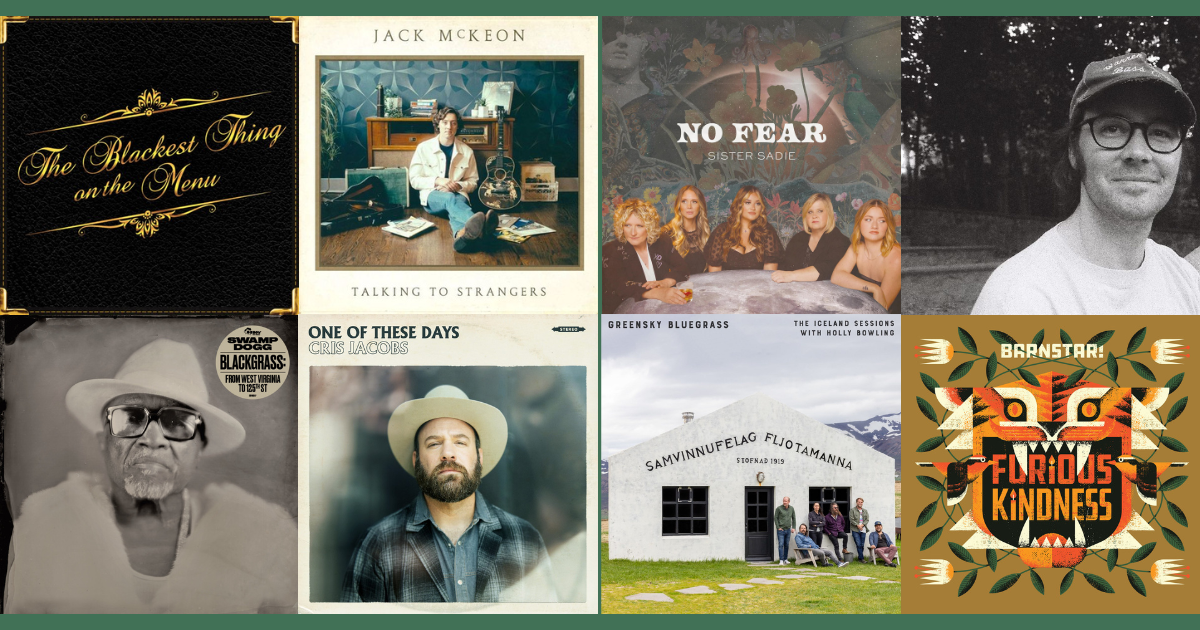
So far this year, there have been stellar releases by the biggest names in the genre, like Béla Fleck, Billy Strings, Tony Trischka, Laurie Lewis, and the Del McCoury Band. Country singer-songwriter Brit Taylor and roots-soul legend Swamp Dogg both released bluegrass titles this year as well, demonstrating how the age-old tradition of various styles and sounds cross-pollinating with bluegrass continues in the present day.
Supergroups like Sister Sadie, Greensky Bluegrass, and Gangstagrass have all unleashed critically-acclaimed projects in 2024, too, while newcomers like Wyatt Ellis and Jack McKeon impressed with records that sound mature and fully-realized for debut releases. And of course there’s plenty yet to come, as anticipation builds for long-awaited albums from bluegrass stalwarts and heroes like Jerry Douglas – who was just unveiled as a 2024 Bluegrass Hall of Fame inductee – and Gillian Welch & David Rawlings, who recently announced a new project, Woodland, their tenth studio album and first release in four years.
No matter how you cut it, 2024 has been a banner year for superlative bluegrass albums – and there is still so much more to come! Take a minute to amble through our favorite bluegrass releases of the year so far (in approximate chronological order), plus a few honorable mentions that pull heavily from bluegrass traditions and inspirations, and we’ll set the table for the albums we can’t wait to arrive later this year, too.
Cary Morin, Innocent Allies
A jaw-dropping acoustic guitarist who toggles between flatpicking, fingerstyle, blues, and many other styles, Cary Morin released a gorgeous visual art-inspired album earlier this year entitled Innocent Allies. The entire project oozes images of the West done up in bluegrass textures and tones, especially so in Morin’s rendition of “Whiskey Before Breakfast.” Read our feature on the album here.
Sister Sadie, No Fear
For a band that boasts alumni like Dale Ann Bradley and Tina Adair, it’s saying quite a lot to make the statement that this may be the best lineup of Sister Sadie yet. Their latest offering, No Fear, brings striking Nashville vibes together with a dash of the Chicks and features collaborations with country stars like Cam and Ashley McBryde. It’s no surprise this supergroup and their newest album are all over this year’s IBMA Awards nominations. Read our March Cover Story on No Fear here.
Wyatt Ellis, Happy Valley
A mere 15 years old, mandolin picker Wyatt Ellis certainly deserves the “bluegrass prodigy” designation he often receives, but dare not sell this young virtuoso short with such a moniker. There’s musicality, touch, and taste evident across his debut album, Happy Valley, well beyond his teenaged years. That’s just part of the reason behind why he’s able to attract such notable collaborators and guests as Marty Stuart, Sierra Hull, Mike Compton, and more. Keep an eye on this one, ‘cause there’s no telling just how far he will go in music, but it’s sure to be way up there!
Brit Taylor, Kentucky Bluegrassed
Pulling a page out of the bluegrass playbook of the ‘60s through ‘90s, country singer-songwriter Brit Taylor demonstrates the inseparable interconnectedness of country and bluegrass with Kentucky Bluegrassed, a reimagination of her 2023 country album, Kentucky Blue, played by a cracking bluegrass band. There are touches of Alan Jackson, Vince Gill, Patty Loveless, and so many more through the project. It certainly reminds of those eras, in which bluegrass artists and bands were just as likely to identify simply as “country” as they were “bluegrass.” The lines between these genres used to be much more blurry; we’re happy to see folks like Taylor – and many others – smear, complicate, and dirty up those genre demarcations once again. Kentucky Bluegrassed is a “don’t miss” album that may not be on every diehard grasser’s radar.
Missy Raines & Allegheny, Highlander
Missy Raines never left bluegrass, but Highlander feels like something of a return by this trophied and exalted bassist, singer, and songwriter after her last few more experimental and Americana-geared outings. This is her first recording with her “new” backing band, Allegheny, who have performed with her now for a handful of years. It’s a rollicking, up-tempo, dynamo of an album, but it’s never one note or stolid – or trying to pander to digital radio. There are calm moments, songs that will bring a tear to your eye, and political tones, too, all bolstering the tightness of the band and the trad-tastic, meta-mash energy herein. “Who Needs a Mine,” the stand out track in a superlative song sequence, will most likely go down in history as one of the best issues-oriented bluegrass songs ever written. Every bit as biting and timely as Hazel Dickens, Jean Ritchie, and so many other activist artists from the regions Raines grew up in. Read our recent feature interview here.
Béla Fleck, Rhapsody in Blue
The most traditional aspect of Béla Fleck’s music-making across his lifelong career is his constant and effortless innovation. As a community, we lose sight so easily of the fact that every first generation bluegrass star was an innovator, so many consummate musicians just “making it up as they go along.” Referring to Fleck’s Rhapsody in Blue as “making it up as he goes along” might raise an eyebrow at first, but one of the most fascinating threads throughout Fleck’s countless albums is his ability to ground whatever musical vocabulary he chooses within the traditions, styles, and physicality of bluegrass banjo. He doesn’t so much care what “does” or “doesn’t” fit on the banjo, he follows his whims, fancies, and inspirations and always makes it work. Perhaps only he could do so with Gerswhin! (And we are so glad that he did.)
Kyle Tuttle, Labor of Lust
Banjo player Kyle Tuttle released his second studio album, Labor of Lust, in February. You may know him from Molly Tuttle’s band, Golden Highway, or from his ubiquitous presence in jamgrass scenes over the past decade or so. The new album demonstrates his particular approach to newgrass, jamgrass, and engaging and exciting improvisational picking. His voice on the instrument is indelible. A modernist banjo player with endless panache, a strong sense of humor, and buckets of stamina and drive. We spoke to Tuttle about the project earlier this year.
Barnstar!, Furious Kindness
New Englander and Northeastern-based bluegrassers will be more than familiar with this raucous outfit, but the national bluegrass scene may need to be put onto the singular sounds of Barnstar! Made up of Mark Erelli, Zachariah Hickman, Charlie Rose, and Taylor and Jake Armerding, Barnstar! started as a side project for these in-demand musicians and songwriters and quickly blossomed into a chaotic, bombastic, and hilarious group that can just as easily go earnest, emotive, and touching. Furious Kindness is another selection here that you may not have yet encountered – and we’re here to rectify that. Need more? We hosted Erelli and Hickman on Basic Folk to chat about the project.
Cris Jacobs, One of These Days
If your first introduction to Cris Jacobs was the above song – “Poor Davey,” featuring Billy Strings – fed to you by the algorithm or a roots DJ or found via the “appears on” section of Strings’ streaming profiles, you certainly aren’t alone. A well-known musician in alt-country, rock and roll, and the often nebulous regions between these genres, Americana, and bluegrass, Jacobs may read as a newcomer in bluegrass, but his Jerry Douglas-produced album, One of These Days, is anything but a one-off or novelty project or ‘grassy interloping. This is deep and broad bluegrass that feels straight ahead and genre-expansive at the same time, drawing on guests like Lindsay Lou, the McCrary Sisters, Sam Bush, and more. The Strings track may be what first grabs you, but this album deserves a deep dive follow-up, immediately.
Greensky Bluegrass, The Iceland Sessions(featuring Holly Bowling)
An EP we loved so much it just had to be included on our Best Bluegrass Albums list. Pianist and keys player Holly Bowling joins illustrious jamgrass group Greensky Bluegrass to revive the often latent, near extinct, and severely underrated tradition of bluegrass piano. Over four tracks recorded in remote northern Iceland in 2023, the band and Bowling have curated a vibe that hinges on the present, focusing in on the exact moments in time wherein they captured these sounds and songs. It’s why we love jamgrass to begin with, right? The way the music calls all of us to be grounded in the present. That’s the exact spirit in which these recordings were made and the translation of that intention is more than just successful, it’s deeply resonant.
Bronwyn Keith-Hynes, I Built A World
Fiddler Bronwyn Keith-Hynes has found her voice – literally and figuratively. While her last studio release, Fiddler’s Pastime (2020), was more instrumental-focused, her latest project, I Built A World, finds her stepping up to the vocal mic with confidence. Her voice is strong and well-practiced while homey and down to earth, too. The song selections are bold, her collaborators are glitzy and first-rate, but each feature, guest, and musician serves the track they’re on and the album as a whole first and foremost. Keith-Hynes has certainly found her groove and her creative community, and we’re all reaping the benefits of her commitment to challenging herself and looking ahead to the future. We recently chatted with Bronwyn and her pal Brenna MacMillan about their respective solo projects – check it out here.
Swamp Dogg, Blackgrass: From West Virginia to 125th St
When the initial announcement of Swamp Dogg’s latest album, Blackgrass, reached the BGS team, electricity and excitement shot through our ranks. Here’s a project that speaks deeply to one of our highest-priority missions in bluegrass: to showcase the multi-ethnic, melting pot, diverse roots of our favorite genre of music. Bluegrass has never been a music for white folks only, no matter how prevalent that narrative is today, and this legendary multi-hyphenate musician, creator, and producer, Swamp Dogg, demonstrates that fact part and parcel over the course of this impeccable collection of music – with a backing band that includes many of the best pickers around today. There are countless remarkable aspects of this album, too many to include in this simple blurb, so head to Lizzie No’s feature on the project to learn more about why this project is purposefully rebellious and revolutionary.
Laurie Lewis, TREES
California bluegrass keystone Laurie Lewis was just announced as one recipient of this year’s IBMA Distinguished Achievement Awards. For decades she has been a center of gravity around which the California and West Coast bluegrass scenes orbit, like a perseverant mother tree from which so many young shoots and saplings have sprung. Her brand new album, TREES, draws upon her wellspring of through-hiking and naturalist knowledge to encounter, process, and challenge so many modern day realities – health issues, the ever-quickening climate crisis, personal and professional life hurdles, and much more. The result is touching, emotional, encouraging, and inspiring, wrapped in traditional bluegrass trappings that feel more in service to the songs than to legalistic genre criteria. Lewis is one of the best to ever make bluegrass and TREES is one of the best releases in her lauded and superlative catalog. We recently published our exclusive interview, which you won’t want to miss.
Tony Trischka, Earl Jam
One of the greatest banjo players today, our current Artist of the Month Tony Trischka has made a career trailblazing on melodic-style three-finger banjo, writing, composing, and recording music that only he could’ve made. For his latest album, Earl Jam, though, he instead leans on the timeless bluegrass task of emulating the greats – namely, Earl Scruggs. The track list is pulled from recordings of casual, at-home jam sessions between Earl, John Hartford, and others, and with his all-star band and fabulous guests, Trischka reiterates Earl’s idiosyncratic playing from these previously unheard recordings. It’s a fascinating context in which to rediscover the limitless intricacies behind Trischka’s playing and the way he synthesizes others’ influences into his own musical vocabulary. Whether stepping into the role – or, shall we say, roll – of Scruggs or making modern banjo compositions out on his own creative limbs, Tony Trischka makes it look effortless and executes everything he does at the highest level. Don’t miss our Artist of the Month feature and our discography deep dive.
Gangstagrass, The Blackest Thing on the Menu
With a band as incisive and forward-looking as Gangstagrass, there will always be countless reasons naysayers will attempt to use to disqualify their music as “bluegrass.” But when viewing this now 15-year-old group through an objective lens, you can see many more bluegrass qualities than not. Innovation (the oldest bluegrass tradition), improvisation, virtuosity, conversational lyrics, a blending of styles, genres, and textures, and the bringing together of creators and inspirations from a variety of backgrounds – that all sounds like bluegrass to us! Gangstagrass’s latest opus, The Blackest Thing on the Menu, finds the critically-acclaimed group at their strongest yet, with a Jerry Douglas track feature (“The Only Way Out is Through”) and plenty of hip-hop-meets-bluegrass excellence. In the present, folks may errantly write off this band as a novelty or an aberration, but in the future we will all view Gangstagrass as they have always been: one of the firsts in the quickly-developing tradition of roots hip-hop, rap string bands, and postmodern bluegrass re-interpreters.
Jack McKeon, Talking to Strangers
In the vein of country songwriters with bluegrass careers – or bluegrass songwriters with country careers (think Shawn Camp, Tom T. Hall, John Prine, Darrell Scott) – Jack McKeon’s debut album, Talking To Strangers, isn’t just bluegrass, but it certainly tracks as first class ‘grassy, down home, front porch music. These thoughtful, introspective lyrics are perfectly set, to a straight ahead bluegrass band like Ashby Frank, Justin Moses, Christian Sedelmeyer, and Vickie Vaughn. McKeon is inaugurating his catalog of recorded works demonstrating that his songs and his voice can be shapeshifters, at home on Music Row and on bluegrass stages and radio, both.
The Del McCoury Band, Songs of Love and Life
Del McCoury is one of the most-awarded personalities in the history of bluegrass and it’s truly no wonder why. He’s spent his entire life honing the family trade: the highest quality bluegrass around. At 85 years-old, every album, concert, performance, and festival we enjoy from Del and the boys is a gift that we’re determined to cherish and savor. His latest full length album, Songs of Love and Life, is sure to be shortlisted for the highest honors handed out by the Grammys and IBMA. This particular track, “Only the Lonely,” is a Roy Orbison cover that showcases Del’s lifelong penchant for not worrying about what is or isn’t bluegrass and instead doing his utmost to serve the song – hence the tasty, honky-tonkin’ bluegrass piano. (Bluegrass piano? Twice in one list??) The record includes a few more charming covers, plenty of brand new tracks, and a Molly Tuttle feature, too.
Brandon Godman, I Heard the Morgan Bell
A killer fiddler from Kentucky who’s performed with Laurie Lewis, Dale Ann Bradley, Jon Pardi, and many, many more, Brandon Godman recently released his first studio album as a solo artist since he was a teenager. Based in San Francisco, Godman is a touring fiddler turned luthier who remains an expert in so many musical styles from his home turf in northern Kentucky. From contest fiddling to western swing to pop country to bluegrass breakdowns and transatlantic hornpipes, Godman’s playing has grit, drive, and aggression, sure, but what stands out the most on I Heard the Morgan Bell, his album of all original compositions, is his emotional range, lyricism, and heartfelt tenderness. Throw in guests like Darol Anger, Patrick Sauber, Sam Reider, and more and you’ve got what will end up being one of the best fiddle-centric albums of this decade.
Tray Wellington, Detour to the Moon
Carrying the banjo innovation banner for millennial cuspers and Gen Z, Tray Wellington is anything but a traditional bluegrass banjo player – and that fact alone is what will always land him in the “solidly bluegrass” camp, by our reckoning. Like fellow listees Trischka, Tuttle, and Fleck, Wellington has found a voice of his very own on the five-string banjo and in recent years his musical offerings – which were already top-notch – have become exponentially more fascinating, fun, and entrancing as a result. His new EP, Detour to the Moon, includes seemingly through-composed, instrumental new acoustic music a la Punch Brothers alongside more straightforward original banjo tunes and a Kid Cudi cover that may just be the best bluegrass cover of a non-bluegrass hit in recent memory. Watching the excited recognition of “Pursuit of Happiness” ripple through the audience at a bluegrass festival while Tray Wellington Band is on stage kicking off the number will certainly never get old.
Billy Strings, Billy Strings Live Vol. 1
The People’s Bluegrass President, Billy Strings, is out with his first live album, Billy Strings Live Vol. 1. No one is doing it like Billy; selling out arenas, coliseums, and gigantic amphitheaters with what’s actually just a five-piece bluegrass band will always be remarkable and noteworthy. Plus, the way he and his team bring his audience into the creative process, feeding their insatiable appetites for content, for music, for four-hour-long tribute shows, is not simply to sell tickets, fill seats, and move product. Strings, at the beginning of the day and at the end of the day, is just a big ol’ bluegrass and guitar nerd. We love that about him. There’s almost no one else in the history of this music from whom we’d tolerate a 13 minute track. (By the way, that’s not the longest runtime on the album!) Keep doing it like only you do it, Billy, and we’ll all stick with you the whole entire way.
AJ Lee & Blue Summit, City of Glass
The last time we had a bluegrass artist take off on our website and socials like AJ Lee & Blue Summit are taking off now, it was Billy Strings playing “Meet Me at the Creek.” We’ve been following this Santa Cruz, California-based string band – featuring AJ Lee, Jan Purat, Scott Gates, and Sully Tuttle – for years, so it’s no surprise to us that the greater bluegrass audience is catching onto the special sound and style of Blue Summit and their brand new album, City of Glass. This is pointedly Californian bluegrass, meaning it is effortlessly traditional and organically inventive and generative. High lonesome harmonies and fiery pickin’ skills combine with soul, groove, emotion, and thoughtful writing. There are country moments, there are barn burners, but overall, it’s clear this young band have hit their stride and know who they are. We aren’t here to tell you the best of the best, per se, but if we were City of Glass would be at the very top.
Andrew Marlin, how dare you surprise release this divine album!? (Seriously, thank you, it was indeed a wonderful surprise.) Out last week with hardly more fanfare than a handful of social media posts, Marlin’s brand new collection, Phthalo Blue, has already charmed its way onto our “Best So Far” list. Featuring Stephanie Coleman, Allison de Groot, Clint Mullican, Josh Oliver, and Nat Smith, this is the perfect kind of bluegrass to put on while you work, tidy the house, or tend to your garden. You’ll find the healing effects herein don’t just come from rabbit tobacco.
Near-Bluegrass Honorable Mentions
Whatever you think about our list so far – and whether or not the albums on it qualify as bluegrass to you – here are just a handful of albums we would have regretted not including, but may have more tangential relationships to the genre than their fellows in this piece. Still, each of these fine records has obvious bluegrass bones, however subtle or overt they may be.
Willi Carlisle, Critterland
Many an old-time troubadour/poet such as Willi Carlisle has been a bluegrass musician, but perhaps Carlisle himself wouldn’t identify in that way. Still, there’s bluegrass throughout the critters and characters on this critically-acclaimed album, Critterland. We did a feature on the project, read that here.
Sierra Ferrell, Trail of Flowers
Her new album is markedly post-genre, but those in the know are already well aware that Sierra Ferrell came up through bluegrass circles. From her patinaed West Virginia voice – that brings Hazel Dickens to mind – to her cutting fiddle bowings, wherever she may roam musically, Ferrell will always have a home in bluegrass.
Rachel Sumner, Heartless Things
Rachel Sumner (formerly of Twisted Pine) is decidedly bluegrass, but somehow that seems too simplistic an umbrella for the nuanced music she creates and the special tones she strikes. She infuses so much of the Northeastern bluegrass, folk, Celtic, and jazz scenes and their respective vocabularies into her songs – they may not be exactly bluegrass, but they certainly don’t fall entirely outside that umbrella, either.
Zach Top, Cold Beer & Country Music
Now, this ain’t no bluegrass album – it’s Good Country, that’s for sure – but there’s a bluegrass story embedded within Zach Top’s hugely popular debut, Cold Beer & Country Music, that we’re determined to tell. Once a winner of SPBGMA’s band contest, Top grew up idolizing Tony Rice and Keith Whitley and playing in a bluegrass family band on the weekends. You can see bluegrass touches throughout this mainstream country record, just like when Ricky Skaggs, Whitley, the Osborne Brothers, and more targeted country radio with their songs and sound. Our Good Country feature interview explores all the ways bluegrass filters into his music.
Kaia Kater, Strange Medicine
Kaia Kater is another genre expander who hasn’t ever quite made bluegrass music, but has never been too far from that sonic space, either. She pulls more readily from indie and old-time and folk traditions, but her new album, Strange Medicine, feels like she’s developed an entirely new thing, where genre is a third space, something liminal, or purposefully transitional. Perhaps the most bluegrass thing about this stunning collection is groove, an ever present character through these gorgeous and intricate songs. Kater was our Artist of the Month in May.
Anticipated Albums Still to Come This Year
There’s plenty more where all that came from! Here are just a few of the as yet unreleased recordings we’re sure will be on our “Best Of” lists when we reach the end of the year. It’s not as far off as you think! Luckily, we’ll have a stellar soundtrack to get us there.
Alison Brown, Simple Pleasures (reissue) – available August 9
Rhonda Vincent, Destinations And Fun Places – available August 9
Bella White, Five For Silver– available August 16
Po’ Ramblin’ Boys, Wanderers Like Me – available August 16
Dan Tyminski, Whiskey Drinking Man – available August 16
Fruition, How to Make Mistakes – available August 23
Gillian Welch & David Rawlings, Woodland – available August 23
Caleb Caudle, Sweet Critters – available August 30
Various Artists, Bluegrass Sings Paxton – available August 30
Willie Watson, Willie Watson – available September 13
Jerry Douglas, The Set – available September 20
Twisted Pine, Love Your Mind– available October 18
Brenna MacMillan, Title TBA – release date TBA
BGS Staff also contributed to and assisted curating this list.
After banjo player Kaïa Kater attended AmericanaFest in 2016, the music industry started telling her she was a part of the genre, which encompasses all kinds of roots, acoustic, folk, singer-songwriter and alternative country music. She was singing about heavy themes like historical trauma, her cultural heritage (her father is from the Caribbean country of Grenada) and her music history. She confesses in our interview that she never felt comfortable in Americana, that she was always just on the outside, never fully feeling accepted by this mostly white world. Kater has declared that her new album, Strange Medicine, comes from a place that lies beyond the white gaze of Americana. This music is filled with emotional healing, with production that sonically reflects the vulnerability she is expressing so deeply for the first time in her career. It’s also the first time she’s avoiding metaphors and really letting her most raw feelings about colonialism, sexism, racism, and misogyny rip. These songs see her using violent language and releasing emotions she’d previously kept frozen, like anger and revenge.
While creating Strange Medicine, she listened to a lot of instrumental music, allowing her ears to be bigger than they had been on previous records. Which translated to her being more willing to take big swings and risks. Kater attended school to learn film composition, allowing her to be more comfortable with being a little bit more overstated in her songs, which certainly proves true on the new record. Another good piece of news is that the banjo is back! After using it very minimally on her last release, Kaïa picked it up again after listening to a lot of Steve Reich, a composer who developed a groundbreaking minimalist style in the 1960’s that’s marked by repetition. His work helped Kater conceive of the banjo as an instrument that could hypnotically play patterns over and over. We go through this monumental album track by track and unwind songs with topics from Tituba’s revenge (the first to be accused during the Salem witch trials) to getting the critic out of the room, to realizing the critic is you. She also recounts her history in her hometown of Montreal and what the Internet was like when she first logged on in the 2000’s.
A deep reflection born from a time of the extreme silence and noise of the pandemic, Kaïa Kater’s new album, Strange Medicine (out today, May 17), digs into the feelings society tells us not to feel, imagines healing and revenge from abuses, and reckons with themes of racism and sexism of the past and today. While the undercurrents are heavy, the arrangements are gentle and flowing, juxtaposing our expectations of what we think it means to process the darkness in life with the truth that many emotions can exist simultaneously.
Written from home in Montreal, Strange Medicine takes us on a cathartic journey imagining characters interwoven with parts of Kater and parts of the world she observes. Drawing on inspiration from artists like Steve Reich, Brian Blade, and Johnny Greenwood and partnering with Montreal-based producer Joe Grass (The Barr Brothers and Elisapie), she took a different musical path than in the past.
Leaning into her primary instrument, banjo, Grass and Kater built the framework for each of the tracks slowly, starting with bedroom tracks and expanding to include arrangers like Franky Rousseau (Andrew Bird, Chris Thile) and Dominic Mekky (Caroline Shaw, Sara Bareilles) and musicians Rob Moose (Bon Iver, Phoebe Bridgers, Paul Simon), Robbie Kuster (Patrick Watson), and Phil Melanson (Andy Shauf, Sam Gendel). Kater spoke to BGS via Zoom.
Hi! How are you?
Kaia Kater: I’m okay! A couple of days ago I dropped my phone directly onto my laptop screen and it cracked. I had to go to Apple. So I am without a laptop, but thankfully have my 10-year-old iPad, bless her!
Apple is coming in clutch. Also, Apple product destroying Apple product is kind of funny.
Yeah, it’s an Apple-on-Apple hate crime. It’s terrible. I feel so weird about it. But I have AppleCare, which is good.
With the couple of sentences that you just said it’s no wonder the Department of Justice is looking into Apple as a monopoly. Vertical integration. Well, how are things going other than Apple problems?
The record is out in a week, so I’m excited. Thank you for doing this piece. I never take any press for granted, especially after the pandemic, when things were so terrible and hard.
What a weird time. Is that when you started writing this record?
Yeah, pretty much. I wrote my first song in April of 2020. We finished the record in 2023. So I would say like 2020 to 2022, was the writing window.
This album is a pandemic baby!
It is. Yeah, I’m proud of my little pandemic baby. Born out of a lot of feelings of stasis and confusion, but also just so fun to record. I think that there’s a lot of grief in the lyrics. But you can still vibe to sad songs, especially when they feel groovy. So that was the intent.
So when did you start recording it?
Let’s see, we went in to record in October of 2022 but the official recording days were preceded by a ton of demo days. So throughout 2021 and into 2022, I would go to my co-producer Joe’s studio in Montreal. We would just track stuff and either bring people in or ship the songs out to people and pay them a demo fee and have them kind of like splash around and see what their interpretation of the song was. That was kind of like how we selected personnel. I think we had a pretty strong idea of what we wanted to do by the time we got into the studio, which is so different from other projects I’ve been part of and other records I’ve done.
How was it different?
I guess, with the pandemic, I had the blessing of time, which I never had before really. With Nine Pin, I recorded on my winter break from college in my senior year, and then Grenades was done from start to finish in two weeks. And so with Strange Medicine, it was about two years. There are advantages and drawbacks to that. It is very easy to start second guessing some choices that you’d made in the previous calendar year, but I think it was to me such a novelty to be able to write and then listen back, and send the arrangement to someone and have them send their work back. It was so much more thoughtful because we had the time to do that.
That makes total sense. So you started writing it during the pandemic. What was your writing process like? Did you have ideas that you came into the lockdown with, or were you processing things in real time?
Well, originally I was like, “I’m never gonna play banjo again.” I don’t know what I was thinking. I think I was trying, to a certain extent, to escape my roots, transform, or do this phoenix thing. Where people are like, “Whoa! She was a banjo player and now she’s an electronic pop musician.” That was maybe a facet of my mid-20s to late 20s, having that crackling feeling that all the different paths your life can take feel like they’re narrowing. And so you’re kind of like fighting against that and going, “No, I still can transform again, musically.”
Really what led me to write more songs on the banjo, especially for Strange Medicine, was that it was really comforting to me. I think I went back to it after wanting to spread my wings. Once I was alone in a room I was like, “What do I want to do right now? I just wanna play banjo.” And for a long time that’s all I did. I didn’t really write. The songs trickled in bit by bit. But you know I definitely gave up that idea of trying to metamorphosize in the way that I thought I was going to. I think I did it in a different way.
Can you talk a little bit about what it meant to be in Montreal writing this record and just in general? What influence did the town have on this particular record? And how does the music community there influence you?
Well, it’s very experimental there. And there’s a kind of freedom and risk-taking. People are not afraid to have things fail or to have things not quite work. Even now, I’m sort of deconstructing the idea that I grew up with, this idea of what a songwriter is, which is that you work really hard at your craft, you play the song down. And the way that you improve every night is how you perfect and tighten the song as much as possible. I’ve been getting into this idea of improvisation.
I don’t know if it’s because the rent is cheaper there, so you don’t have to hustle as much. I just felt so much more space to play around.
While we’re on the subject of Montreal, you collaborated with Allison Russell on “In Montreal” about your shared hometown. I was curious since Aoife O’Donovan is from Massachusetts and you’re talking about witches on “The Witch” – was that a purposeful choice?
No, but that occurred to me about a week ago. I was making dinner, and I was like, “Wait. Aoife’s from Massachusetts!” It must have been in some way subconscious. I kind of see people as the roots that they’ve grown from. And definitely, when thinking about the features I wanted, I wanted it to make sense with who that person is. For example, with Taj Mahal, he’s who I learned about the black roots of the banjo from first. He was doing that in the ‘60s, and he has a lot of Calypso and Caribbean influences and heritage. Bringing him into a song about a Caribbean revolutionary felt like, “Well, of course.” I even wrote him a little letter explaining the song, because he’s 80. He doesn’t need to be on anybody’s record. And so I was like, “Let me tell you what the song is about, and maybe you’ll want to sing on it.”
That’s so cool. And how did the collaboration on “The Witch” come about?
Aoife has always been really supportive of me as a person and as an artist, going back to 2017. She’s kept me in mind for a lot of things and she’s suggested me for opportunities. She’s also really community-oriented. She’s very cognizant of supporting women musicians and young musicians. I’m a mega fan of hers.
I had written “The Witch” and I thought she would sound great on it. Fast forward to the end of the process, when all we had left to do was harmony vocals and I was really nervous to ask her because I think I was scared to get a no. But I’ve been practicing. You have to ask, because if you don’t ask you don’t receive anything. I texted her, and she immediately responded yes without even hearing the song. Then she laid down all these like really intricate harmony parts. She’s a genius.
Your voices are beautiful together. It works really well. And the Massachusetts thing — it’s perfect. While we’re on the subject of that song, what connects you to the stories of these women who were accused of witchcraft or adultery and were punished for it?
To me, it is the juxtaposition of having this perceived power in the minds of men as being capable of influence, capable of seduction and luring, and superseding a man’s high intelligence and thoughts of himself and overtaking will power. But then, when women were accused of being witches, their already limited power just absolutely disintegrated and they were executed by mobs. I was thinking a lot about these kind of polar ideas of women having so much power over men, but then we’re struggling to be taken seriously in a workplace or struggling to feel like we are on equal footing.
I think sexism and racism today are much more insidious – as are homophobia and transphobia. It’s so palpable. Being able to give voice to someone in history who may meet a different fate; maybe they try to kill her, and she’s like,”Ha! I survived. And now, aren’t you scared of me?”
The influence came from a lot of different places; the witches from Macbeth, and the Roald Dahl witches. They are all in our popular consciousness to a certain extent, and I think we have a fascination with them.
Absolutely. Let’s talk about the song “Floodlights.” It reminded me of Joni Mitchell for two reasons. One is the sonic palette and the orchestration reminded me of her. Second, I saw a video of her recently and she was talking about how a good song should make a listener think of themselves rather than of her. That’s obviously an objective idea, but this song, though focused on a romantic relationship, reminded me of some of my own, but also friendships and working relationships and how the dynamic of one person’s power over another can be so incredibly detrimental. But there is hope and life on the other side of that. It is a special way you tell the story in a cafe where the protagonist is feeling herself rise over a past love for the first time. I was wondering if you find that you have clarity around power dynamics yourself as you grow older as the protagonist does?
I’ve recently turned 30. And to me, that seems to be the absolute blessing of your 30s, that you have this kind of clarity and understanding of who you are and what you are willing and not willing to tolerate. That song itself is about an age-gap relationship that I was in. We had an 11-year age difference. I was super young. I was 18 or 19 when we got together, and this whole conception that I had was, “I’m mature and I’m actually better than the other women my age, because I have someone who is super mature and who thinks that I’m interesting. I’m also better than the women his age. There’s something special about me,” like I felt chosen.
That was such a powerful feeling at that time when so much of my self-esteem was dependent on what other people thought of me. Slowly, through the course of this relationship, I realized that he chose me, but not for the reasons that I thought I had been chosen.
I mean he was a walking red flag and I just did not trust my intuition to understand that. This wasn’t a good scenario, and now, on the other side of it, at 30, I couldn’t imagine dating a 20-year-old. There’s an inherent power dynamic there. I wrote the beginning of the song two years before I finished it, because in the beginning, I couldn’t think of an ending. I couldn’t have seen him at a bar (which really happened) and just been scared and left. I wanted to give the protagonist a better ending than that.
It sounds like you did a lot of processing on this record through your writing, like maybe you released some frozen anger. I think most women can relate to that in general, because we are so often encouraged or told to suppress that emotion. I was wondering how your relationship with anger and revenge evolved and shifted through the creation of this album?
I think therapy seems to be a theme in a lot of artists’ albums these days. I didn’t realize how much anger I carried until I went to therapy. I had always grown up thinking that any kind of anger is debasing yourself. You’re losing power and you’re not being your highest, most evolved self.
Every time I got angry, I felt like I’d failed to access my more evolved emotions. It was through therapy that I learned that anger is, in many ways, necessary. We are refusing to be treated a certain way.
I think adventuring through these ideas of revenge where it’s like, “Well, what if I don’t choose forgiveness? What about that? Why do I have to be the peaceable one? Why do I have to be the one to absorb all of your violence, and then somehow process it out so that we’re good?” I have to say, it was really fun to write these lyrics and not shy away from some more violent imagery, especially in “The Witch.”
I heard someone say something like, “Anything that’s human is mentionable. And anything that’s mentionable is manageable.” I think singing it out is so nice because it’s mentionable. It’s manageable.
Speaking of, this is a great segue. How does it feel to perform these songs live?
It feels really good. It feels vulnerable too, having lived with them so long during the pandemic. It’s interesting to start sharing them with people. I have this ritual where the day before a single comes out, I listen to the song on a walk. And I’m like, “Okay, this is the last time this is gonna be only mine.” I think that ritual has really helped me. It’s a really personal album in a lot of ways for me.
I’m looking forward to trying it out in many different configurations, continuing the idea of play that we started out with this record, and seeing the different ways it can evolve and change.
Photo Credit: Janice Reid
This website uses cookies to improve your experience. We'll assume you're ok with this, but you can opt-out if you wish.AcceptRejectRead More
Privacy & Cookies Policy
Privacy Overview
This website uses cookies to improve your experience while you navigate through the website. Out of these, the cookies that are categorized as necessary are stored on your browser as they are essential for the working of basic functionalities of the website. We also use third-party cookies that help us analyze and understand how you use this website. These cookies will be stored in your browser only with your consent. You also have the option to opt-out of these cookies. But opting out of some of these cookies may affect your browsing experience.
Necessary cookies are absolutely essential for the website to function properly. This category only includes cookies that ensures basic functionalities and security features of the website. These cookies do not store any personal information.
Any cookies that may not be particularly necessary for the website to function and is used specifically to collect user personal data via analytics, ads, other embedded contents are termed as non-necessary cookies. It is mandatory to procure user consent prior to running these cookies on your website.