How Courtney Hartman
Made With You

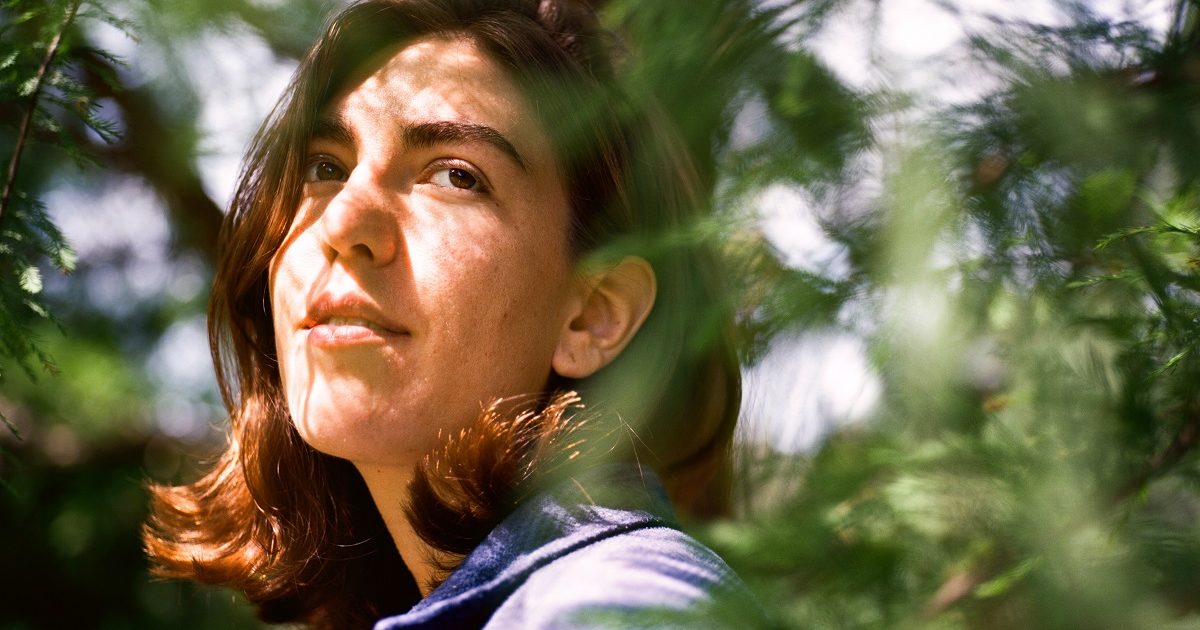
In the late summer of 2022, Courtney Hartman realized that the songs she had written for a new album were not the songs she needed to release. “I had found out I was pregnant a few months earlier, [and already] had a batch of material I was working on for a new record. I felt this quiet urging to set all of that aside and give my attention to what was happening in our life and in my body,” she says.

She discarded everything and began writing her third album, With You, a personal journey through motherhood set to music.

“What was happening in our life” refers to a tumultuous string of events that saw Hartman and her husband, John, through the best and worst of times. Best because the couple were expecting their first child, rebuilding their house in Eau Claire, Wisconsin, and Hartman was on tour; worst because her husband fell off a ladder, could not work for months, lost two jobs, she was dropped by her booking agent, and they totaled their car.

The cumulative effect left the couple in need emotionally, physically, and financially. They soon found themselves uplifted by their community – their immediate one and her music community at large. The experience left Hartman deeply grateful and dedicated to giving back even more than she received.

In September of that year, Hartman began writing “in earnest” the songs that became With You. She and her husband welcomed their daughter in February 2023 – more best of times followed by worst of times as Hartman struggled with postpartum depression.

“At the end of [2023] I had all this material and realized I wanted to invite in other voices and stories and perspectives, specifically those of other mothers,” she says.

Once again, she drew on her community, calling on a fellowship of songwriter mothers – Sarah Siskind, Dawn Landes, Ana Egge, Tift Merritt, Kristin Andreassen, and Emily Frantz Marlin of Watchhouse – to help take her deeply personal new songs to an even higher level.

“I spent another few months, December [2023] to February [2024], writing mostly over Zoom, finishing the material with those other writers,” she says. With You was recorded in June and July 2024, at The Hive studio in Eau Claire, with Hartman producing and Brian Joseph as co-producer and engineer.

As one might expect from Hartman, there are plenty of guitars on the album – her Lawrence Smart Archtop, Bourgeois Parlor,
PreWar (modeled after a Gibson J-45), Bischoff Dreadnought, Martin 00,
and a Telecaster – but if you’re looking for the lightning flatpicking work that makes her a bluegrass force to reckon with, you’ll be best served on YouTube. With You tells a story that calls for understated guitars as a palette for its songs.

“Things weren’t all bright and shiny in that season,” she says, “but the impetus to write and pay attention helped me pay attention to some of those lighter moments. Not all the songs on With You are about everything being light, because that’s just not how it is. But there was this extra attention to some of those details that do help buoy your spirit when things are a little more challenging.”
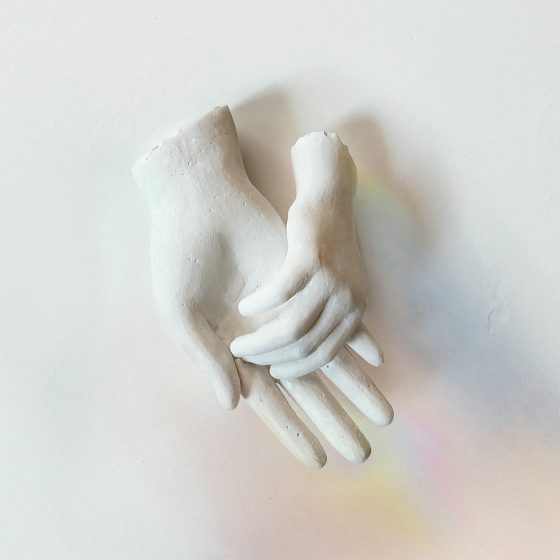
Courtney Hartman’s ‘With You’ album cover art, created by Claire Lindwall.

Completing the journey is With You’s striking cover art. The work of Hartman’s close friend Claire Lindwall captures the music’s delicate intimacy. “Claire is primarily a watercolor artist and illustrator,” says Hartman. “A special part of creating an album, for me, is giving the music to someone who then translates it into a visual piece of art. Every time, it’s surprising and expansive in a new way.”

Lindwall cast her own hand and that of her daughter’s, and positioned the casts so that one holds the other. “We experimented with drawings around it, then having just a splash of watercolor behind the piece,” says Hartman. “That’s all it needed.”

With this album now making its full debut, how do you feel about sharing so much vulnerability?

Courtney Hartman: The processing has happened in phases. I think it started just by saying yes to writing the material. There was an accepting of, “I’m writing about this thing that feels more vulnerable and more naked than anything I’ve written about before.” Bringing those songs to other writers, to collaborators, there was another level of vulnerability there.

A year ago I brought all of this material to my greater community and asked for support, because at that point I needed help putting the album out. Now, to give it to the rest of my community and listeners in the world, there’s a level of vulnerability, but I feel mostly excited. It feels like, “We made it.”

You’ve explained in other interviews that you had to use funding meant for the songs that came before these in order to get back on your feet. Needing financial assistance is also a vulnerable place and one that often brings publicly imposed shame and guilt. How did you process it?

You’re bringing up something that my husband and I have been talking about a lot, just with the news cycle and trying to get an understanding of what we can do for folks in our community. And having had small tastes of that in our life, because I know what we’ve experienced is so small compared to what so many people live through and are currently living through.

An important [word] that you touched on is shame – the shame of needing help; of not feeling like you can do it on your own or you can stand on your own two feet; of needing help for basic things like groceries. I think maybe accepting help and accepting care expands our capacity to feel compassion and to be able to then care for others.

In a podcast for Acoustic Guitar, you used the phrase “the intimacy of sound.” Could you talk more about what that means in the songwriting and guitar playing?

What I hear when you reflect that phrase back to me is the sound of the skin of your finger on the guitar string, or the sound of hands against a percussive instrument. When we went into the studio, I told the friends that were with me there on the first day, “Just as a guiding directive, whenever we imagine a sound that we want to create, let’s see if we can find something natural to create it with.”

Everyone took it in their own way, some on their instruments. Sean Carey was heavily involved on the record and he took that more literally in a lot of the percussion work. He found a nest outside when he was wandering around and that became the percussion on a track. Or even just the sound of skin on skin being a sound that we used as well; bringing in and magnifying some of these quieter sounds and allowing that to be a part of the soundscape [was part of the intimacy of sound].

Did you select the guitars around the songs or did some of the songs develop around your guitars?

Sometimes you think you know what a song wants before going into the studio and then you sit behind a mic and you’re like, “This isn’t serving it quite right.” And sometimes that experimentation takes a little longer than you think it will. Or sometimes you sit down with a first instinct and it’s totally right. That’s part of the reason it’s fun to have a good array of instruments in the studio.

Is the guitar as much a part of expressing your feelings as the lyrics?

It is. I think part of that comes from how long it’s been an instrument that feels like a voice to me. Songwriting came around the same time. I was about 12 when I started writing songs. Singing feels like something I still have so much exploration and learning to do.

How did working with other mothers, and their lived experiences, bring understanding to what you were going through?

What I was given [was the] shared experience and the acknowledgement of, “This is really hard. It’s really beautiful, but it’s also really challenging.”

So much of the caregiving that happens [as a mother], especially in that first year … so much of it is invisible. Maybe an aspect of that applies to all sorts of giving care – that it’s invisible other than to the one giving the care and the one receiving the care. When you feel invisible, it can also make you feel isolated and that can really feed into some of the struggles. A lot of folks have postpartum [depression] and societally we’re not set up to honor and support that season very well at all. It’s something I care a lot about, both from experiences with my family, but also as I’ve delved into work as a birth doula.

When you say, “Societally we’re not set up to honor and support that season very well at all,” what do we need to do?

We need to honor and uphold the importance of rest and nutrition and preparation. Parents are prepared for “Here’s what birth might look like,” but after that six-week checkup [traditional care usually ends]. Postpartum extends far longer than that.

A lot of [postpartum] mental health struggles won’t show up until maybe nine months or a year after a child is born. Better supporting [people postpartum] that would be the first thing I can think of. We live pretty isolated lives, as families in our insular homes, and so we’re not set up to receive support very well.

Or ask for it.

Yes, totally, [we need to be] preparing [people] to know that this is a time to accept and receive care. Preparing your heart for that is such a big piece of it, to know that we, as your village and your community, want to care for you in this time.

You’ve spoken openly about postpartum depression. What was that period of time like for you?

Moments of real happiness, but also moments of hitting my head against the wall … when I was struggling. [It was] hard to admit to myself and then to speak that [struggle] out loud to anybody. It wasn’t until afterwards that I could say, “That was hard.”

All depression is misunderstood and will often make people in your circle run away.

Let’s go back to your community, and the community of mothers, and how they lifted you.

I felt so cared for by our community in a way that was deeply humbling and in a way that somehow prepared me to do some of the caregiving that was going to be required of me. I was receiving so much love and support and meals and folks showing up. That kind of care is life-changing. It changes the way we see the world and our community around us.

My daughter was about nine months old or so when I started reaching out to other mothers, asking if they would collaborate on some songwriting. Having some tether creatively helped pull me through that season. It helped weave together the woman I was prior to having a child with the woman I was in that new space. … Sometimes it feels like … you almost can’t remember who you were before.

I was really afraid of [losing parts of myself]. I was afraid I wouldn’t create music again. There’s all these fears, irrational or not, that show up. Creating and being able to have these conversations that normalize what you’re experiencing. Having women who are [a] few years ahead of me be like, “It might be extra-challenging now, but it doesn’t stay that way forever.”

It’s almost 2026 and society still misunderstands and stigmatizes mental health, certainly PPD, and even some aspects of pre- and postpartum healthcare. Why are we uncomfortable talking about things that are so natural and important to discuss? Are we making progress or going backward?

I hope we’re making progress. It was a lot easier for me to ask, “Why don’t we talk about these things?” when I wasn’t part of the “we.” As soon as it was also part of my story to talk about and share, [I had to come] to terms with my own hesitancy. Why do I not want to talk about something as normal as pregnancy and motherhood in my songs? Why do I feel like if I put this music out, it will be discredited and potentially ignored, even though it may speak to so much of the population? …

I still don’t have an answer. Maybe it’s because there’s so many generations of women having to hide those things for fear of losing wages, or jobs, or discrimination, whatever it might be. For everybody’s sake, there’s so much we have to learn from mothers’ voices, and I hope we’re beginning to really listen.

On a podcast, The Other 22 Hours, you reflected on the period after Della Mae and the realization, at the time, that “Music was not a healing thing.” What role does music now play in your healing and mental health?

It has become healing again. Years ago, I was dealing with physical pain in my hands. That was magnified by touring all the time, being on the road so much, and the strain on my body. So I was speaking about it in a physical way. [Music] has become a lot more than just physically healing [for me]. I think this album exemplifies that.

You have worked with so many people. Who is your wish-list artist or artists?

Oh my gosh. The first person that came to mind – and maybe it’s because I’ve been listening to her record all week – I would love to play music in the same room as Brandi Carlile. She gives all of herself and it’s so good.

We had a listening party [for With You] and as I was listening to the album for the first time with a whole group of friends and collaborators, what I hear on it is my friends and heroes, which is such a joy. There are so many folks on this album that I look up to so much and who have been dream collaborators. So, in that way, a lot of it has been a dream list fulfilled.


Photo Credit: Michelle Bennett
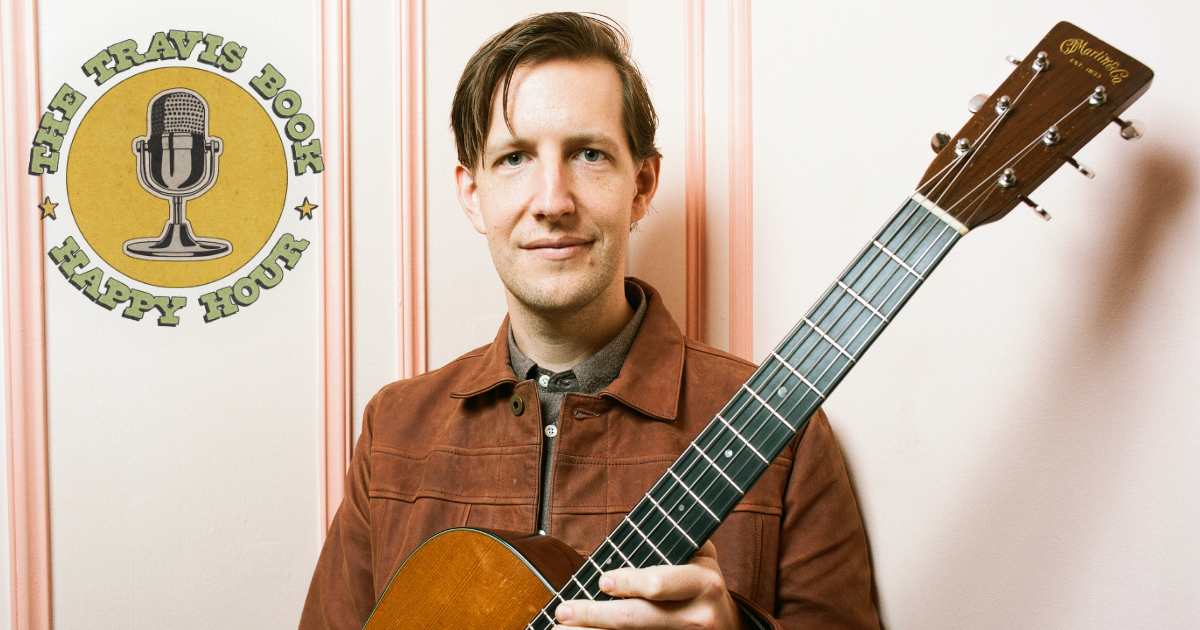
Travis Book Happy Hour: Chris Eldridge

Chris Eldridge and I met when I stepped off of an elevator with my bass at the International Bluegrass Music Association’s convention in 2004. The Infamous Stringdusters were forming in Nashville at the time and they needed a bass player for the jam that night and, it turned out, for the band in general. We spent the first two years of that band traveling and making music together and Chris is still one of my favorite musicians and humans. A member of Punch Brothers and Mighty Poplar, he’s also made a couple great records with guitarist Julian Lage and plays in a duo with his wife Kristen Andreassen. Our conversation started when he arrived at my house and didn’t end until he pulled out of the driveway the next day, but we’ve captured some of the best parts here for the podcast.

LISTEN: APPLE • SPOTIFY • STITCHER • AMAZON • MP3

This episode was recorded live at 185 King St in Brevard, NC on November 12, 2024


Photo Credit: Laura E Partain

Editor’s Note: The Travis Book Happy Hour is hosted by Travis Book of the GRAMMY Award-winning band, The Infamous Stringdusters. The show’s focus is musical collaboration and conversation around matters of being. The podcast includes highlights from Travis’s interviews and music from each live show recorded in Brevard, North Carolina.

The Travis Book Happy Hour is brought to you by Thompson Guitars and is presented by Americana Vibes and The Bluegrass Situation as part of the BGS Podcast Network. You can find the Travis Book Happy Hour on Instagram and Facebook and online at thetravisbookhappyhour.com.

Basic Folk: Dinty Child

Dinty Child, founding member of Session Americana, the beloved Boston roots music collective who’ve accidentally been a band for 20 years, has just released his second solo album, Letting the Lions In. The new songs feature co-writing on all tracks between Dinty and Boston area songwriters like Mark Erelli, Kris Delmhorst, and Dave Godowsky. A self-proclaimed slow-writer, the majority of these songs were written on the annual Sub Rosa songwriting retreat Dinty runs on Three Mile Island (no, not that Three Mile Island) on Lake Winnipesaukee in New Hampshire. Owned by the Appalachian Mountain Club, Dinty’s family has been working at the island for over 100 years. Dinty currently serves as the off-season manager, putting his musician and carpenter skills to good use hosting songwriter friends at said retreat – like Rose Cousins, Rose Polenzani, Rachael Price, Miss Tess and many more, as well as Miles of Music, a summer camp run by Dinty, Kristin Andreassen, and Laura Cortese.

LISTEN: APPLE • SPOTIFY • STITCHERAMAZON • MP3

Letting the Lions In was co-produced by Zachariah Hickman (Josh Ritter, Ray LaMontagne) and recorded at Great North Sound in Parsonsfield, Maine over the course of three days in the spring of 2021. Dinty says, “I often trade construction work for studio time there.”

During our conversation, we dig into why these songs needed to be recorded. Our consensus is that legacy and spreading joy to his community are the top two reasons. Also, Dinty, who says an annoyingly large percentage of his songs start as dreams, talks about what kind of sleeper he is, what’s with the lion, and his thoughts on drinking – thanks to the handful of alcohol songs on the new album. Dinty is a dear friend to the podcast and an important part of the New England musical landscape, we’re thrilled to have him on the show!


Photo Credit: Sam Kassirer

WATCH: Maya de Vitry, “Dogs Run On”

Artist: Maya de Vitry
Hometown: Lancaster, Pennsylvania
Song: “Dogs Run On”
Album: Violet Light
Release Date: January 28, 2022
Label: Mad Maker Studio

In Their Words: “I grew up with a black lab named Georgia who was like a fifth sibling in our family. A little while after Georgia passed away, my parents got another black lab named Sylvie (she’s the one in this video). A lot of my musician friends got to meet Sylvie over the years, snuggling with her for a little bit while passing through Pennsylvania on tours. When Sylvie got sick in 2020, I really thought I was going to get to see her again, and at first I wrote a completely different song — it was called ‘Hold On, Sylvie.’ I finally realized I just wasn’t going to get to see her again, and the song became ‘Dogs Run On.’ My parents cared for their sweet friend until the difficult end, and Sylvie passed away in the sunshine in my mom’s arms in November 2020. Many thanks to Chris ‘Critter’ Eldridge for embodying the playful spirit of dogs in his gorgeous lead guitar playing on this track. Critter, Kristin Andreassen, and Ethan Jodziewicz are all such dog lovers, and it was really meaningful to make this song with them. This song is for all the best dogs, running through our hearts forever.” — Maya de Vitry


Photo Credit: Laura Partain

BGS 5+5: The Bright Siders

Artist: The Bright Siders (Kari Groff, MD, and Kristin Andreassen)
Hometown: Brooklyn & Nashville!
Latest album: A Mind of Your Own
Personal nicknames (or rejected band names): How about a rejected song title? “Everybody Goes to Therapy” We actually recorded a demo of that one… but we might have to save it for these kids when they grow up!

Which artist has influenced you the most … and how?

There’s one album that influenced both of us deeply as children. The record is Free to Be…You and Me created in 1972 by author and actor Marlo Thomas, Carole Hart of Sesame Street and Letty Cottin Pogrebin of Ms. magazine. Free to Be… was a collection of songs and skits about gender issues, performed by Thomas and a cast of the era’s most prolific stars. The messages were clear to us as children (Girls can be anything! Boys can play with dolls too! Parents are people! Good stuff like that…). But the reason we listened again and again was because the music just sounded amazing. When we started to work together on the project of making kids’ music with a mental health message, this album gave us a gold standard to work toward. So here we are as adults feeling grateful for this music once again. — Kristin

What was the first moment that you knew you wanted to be a musician?

I don’t think I had a choice. I grew up in a very musical family. My parents were both music teachers as well as my grandfather. It was just a given that you would play music along with whatever else you decided to do. In my case, that was medicine and psychiatry. — Kari

How often do you hide behind a character in a song or use “you” when it’s actually “me”?

Good question for a psychiatrist. Not that often. I usually try to own my own emotions! — Kari

What other art forms — literature, film, dance, painting, etc. — inform your music?

My first true musical passion was actually traditional percussive dance, and I toured as a clogger before I started playing stringed instruments. Often, when I start working on a song, the melody and rhythm come most easily, and I always figured that was somehow related to the time I spent in the dance world. — Kristin

What’s the toughest time you ever had writing a song?

I tried to write a few songs in the early days of the pandemic but I couldn’t capture the intensity of the experience here in NYC so I chose to write a short children’s story instead (releasing soon!). — Kari


Photo credit: Jefry Wright

MIXTAPE: The Steel Wheels’ Music for Your Community Gathering

Building community is part of what music, and all good art, does. It brings us together. Music is a common rhythm, a poetic notion, an underlying common language for us all. A good mixtape grabs hold of that commonality and builds on it, with a few surprises along the way. As a band, The Steel Wheels curate a music festival each year, and a mixtape, or playlist, is kind of the digital version of that venture. So, let’s stop talking about it, and start building community with a PERFECT mix. – Trent Wagler, The Steel Wheels

Fruit Bats* – “Humbug Mountain Song”

Let’s start with a groove anyone can get behind. It’s accessible for the pop music lovers who wandered into this gathering — they didn’t know they liked the banjo at all until the second half of this intro kicks in. But now they’re engaged. And why can’t the piano, banjo, and drums live together in harmony? Stop closing your mind.

Kristin Andreassen* – “Get Together”

A good mixtape needs to establish that everyone is included. Loading things up with all your favorite new and rare songs isn’t always inviting. A cover song is common language at the very best. A little freshening up of a classic song will get us all swaying together in time. And what better theme than coming together? Now we’ve got everyone in the room in tune and we can introduce more variance in the mix.

The Wood Brothers* – “Sing About It”

The foundation of community is the strength we have together. Nothing better exemplifies this than the tight grooves and sweet harmonies of the Wood Brothers. And their message here is spot on. No matter where we are in our journey of pain, loss, trouble, or fear, singing a song just might help it pass.

Kaia Kater* – “New Colossus”

Now that we’re all in this, let’s tie the knots tighter. This song is like a sweet honey that helps stick us tightly. The way the melody veers and twists through literary verses encourages your conversations to dig a little deeper.

Jerry Garcia & David Grisman – “Russian Lullaby”

I think it’s more than nostalgia that brings me back to these late Garcia recordings, when he teamed up with longtime friend and musical pioneer David Grisman. The loose nature of these recordings makes you want to sit crisscross applesauce and share most embarrassing moments with a new acquaintance. If the ice wasn’t broken earlier, Jerry will rockabye you, baby. Collaborations are community building at their core.

River Whyless* – “All of My Friends”

Now that we’re all floating together in a musical high, don’t pull away. Leave the phones in your pocket. Let’s be here together fully. River Whyless is a band that simultaneously indicts and playfully dances with the information-overwhelmed age we live in.

Cedric Burnside* – “Hard To Stay Cool”

What is more true blue than these dyed in the wool Burnside family blues. Cedric Burnside’s whole album is full of these tasty grooves. It’s not hard for him to stay cool.

Tim O’Brien* & Darrell Scott – “With a Memory Like Mine”

Here’s another one of my favorite collaborations. The album Real Time by Tim and Darrell has had such a musical impact on me. To hear two great songwriters, who sing and play any instrument they pick up with such mastery, is humbling and inspiring.

Bahamas – “No Wrong”

I’m obsessed with Bahamas’ music right now. The guitar, the groove, and the vocals. The presence of this recording is also so immediate and direct. When you’re among your people, it feels like you can do no wrong.

The Steel Wheels* – “Road Never Ends”

I couldn’t help but include one from our new record. The love and joy of the road is bittersweet. This song puts words to the difficulties of transience while acknowledging the beauty of the strange kind of mobile community it creates.

Ana Egge – “Rock Me (Divine Mother)”

There are few songwriters who tap into deep spiritual depths without cliché like Ana Egge. She’s a treasure. And this song has slayed me every single time I’ve ever heard it.

Tinariwen – “Imidiwan Win Sahara” (feat. Tunde Adebimpe)

All music conjures up a sense of place. Tinariwen was introduced to me by our drummer, Kevin Garcia, and I’ve regularly wanted to go to where their sound takes me. As a songwriter and specifically a lyricist, it’s helpful to reset your listening ear and turn off the language centers of your brain by listening to music with lyrical content in a language you do not speak.

Dr. Dog – “Listening In”

A good mixtape has some curveballs. Dr. Dog has been a sonic companion for me since I first saw them live 10 years ago at Bristol Rhythm and Roots. The lyrical tapestry is so full and always connects through some kind of thought-lightning striking through your brain. I love the line, “I can hear the fear in me…talking.”

David Wax Museum – “Time Will Not Track Us Down”

We’re getting towards the end of our little mixtape. Like the Sunday afternoon lazy picnic, we are starting to wind it all down. David Wax is known for his high energy original Latin-inspired masterpieces, but this simple paired down guitar/vocal really calms my spirit and prepares us to part.

Robert Ellis & Courtney Hartman* – “Up On The Hill Where They Do The Boogie”

One more cover song for good measure. Let’s celebrate the most wacky and wonderful souls among us, and let’s boogie like John Hartford.

Josh Ritter – “Homecoming”

Remember that curating music for your gathering is a privilege. You are setting the sonic table for everyone in your presence. It’s also a responsibility. Everyone wants to feel at home at the end of the day. Everyone wants be at their best and be reminded that they are capable of their best. Music replenishes the various ways daily life drags us down. A mixtape is a good refuge and stand-in for when music festival season is slow.


Photo credit: Josh Saul

*2019 Red Wing performers. Red Wing Roots Music Festival takes place in Mt. Solon, Virginia, on July 12-14, and is hosted by The Steel Wheels

Woody Rolls On: Cahalen Morrison in Conversation with Jon Neufeld

The Great Depression was just sputtering to a close, Europe was a mess, and the attack on Pearl Harbor was still several months away when Woody Guthrie moved his family from New York City to Portland, Oregon. He’d been hired by the Bonneville Power Administration to pen a series of songs for a documentary film about various engineering projects in the Pacific Northwest — namely, the Grand Coulee Dam in Washington State and the Bonneville Dam across the Columbia River. Spearheaded by the Public Works Administration and the U.S. Army Corps of Engineers, these feats of American ingenuity would bring water and power to areas that had previously seemed uninhabitable or unfarmable.

The film was never completed, but during the month he and his family lived in the Pacific Northwest, Guthrie wrote 26 songs — which itself seemed a feat of American ingenuity. The populist folkie extolled the achievements of industry, as well as the heroic fortitude of the common American worker. Some of the lyrics never made it off the page of his notebook, while others became … well, Guthrie never had what you might call hits, but “Pastures of Plenty” and “Grand Coulee Dam” and even “Roll, Columbia” became popular tunes within his catalog.

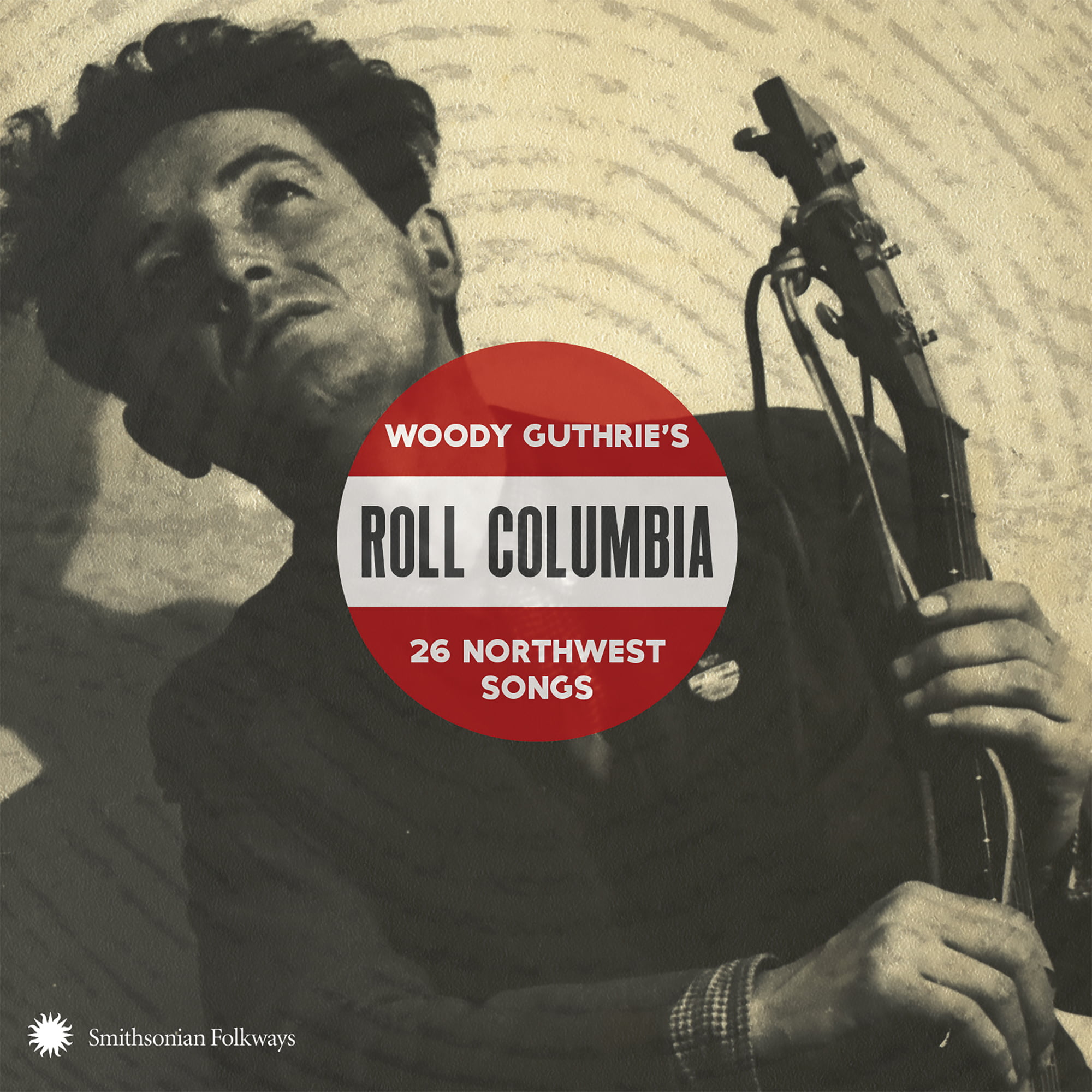
To mark the 75th anniversary of Guthrie’s short but productive tenure with Bonneville, Smithsonian Folkways is releasing a rambunctious double album of new covers called Roll Columbia: Woody Guthrie’s 26 Northwest Songs, featuring mostly musicians based in the Pacific Northwest and still affected by these engineering projects. Contributing their own interpretations of these tunes are members of the Decemberists, R.E.M., the Minus Five, Timberbound, and Dolorean, along with Orville Johnson, Martha Scanlan, David Grisman, and Michael Hurley, among others.

(The album follows the excellent book, 26 Songs in 30 Days: Woody Guthrie’s Columbia River Songs and the Planned Promised Land in the Pacific Northwest, by KEXP radio DJ Greg Vandy and journalist Daniel Person.)

While neither Jon Neufeld nor Cahalen Morrison are Pacific Northwest natives, they both have lived there long enough to call the region home and have been active in the Portland and Seattle folk scenes, respectively. A veteran of Dolorean and Black Prairie, Neufeld oversaw nearly every aspect of Roll Columbia, while Morrison covers two songs: the rip-roaring industrial cautionary tale “Lumber Is King” and the majestic “Ballad of Jackhammer John,” which rolls along like the Columbia itself.

What is your experience with Guthrie’s Columbia songs? How familiar were you with them before you started this project?

Jon Neufeld: Well, my initial experience was, “Oh, I recognize some of these songs.” Nothing further than that. I didn’t recognize them as being songs that he wrote after he was hired by the Bonneville Power Administration or any of the specific history that goes along with it. My dad’s a folk singer, so I grew up on Woody Guthrie, Bob Dylan, Simon & Garfunkel, and all that classic folk music — a lot of the peace-and-justice songs. A lot of Guthrie’s songs were familiar to me, but when [executive co-producer] Joe Seamons approached me about doing the project, I started listening further and could see a thread through these songs that had been somewhat invisible to me. That made me think about the music a little differently because it seemed so obvious, in retrospect, that they were all connected.

Cahalen Morrison: I had a similar introduction, I guess, in that I was familiar with a handful of the songs, the more well-known ones — “Pastures of Plenty” and things like that. But I wasn’t familiar with the majority of it. I’ve never been a huge Woody-head or anything like that. Joe approached me, as well, and offered me the gig, which turned out to be fantastic. I’m not originally from the Northwest, but I’ve been living here for quite a while now. It was fun to hear all this music written so specifically for the area. I’ve done a lot of touring and traveling around, so I’m familiar with the countryside around it and really enjoyed digging into these songs and seeing how they represented this part of the world. That it was all bought and paid for by Bonneville was a funny thing to discover, but it didn’t make it any less cool or discredit the songs in any way. I find it impressive that he did what he did.

JN: Twenty-six songs in 30 days is a lot.

CM: I’m a songwriter and a fairly prolific one, I suppose, but that is pretty insane. I can’t even fathom that.

Did this project change the way you see this area that you both moved to?

JN: I’ve lived here for 20 years now, longer than I’ve lived anywhere else, and these songs described the area pretty much to a tee. They reminded me of the beauty that’s around here, but also of this issue of self-sufficiency. You want to provide your own electricity and jobs, but at what cost? Harnessing the environment around you, in order to derive your own power initially seems like a good idea, because you can be self-sufficient. You can have light and power and jobs and you don’t have to borrow them anybody else. It’s right here in this rushing river, and the feats of engineering were really celebrated at the time. But you end up losing sacred land of the Native Americans. You have erosion in places that never had it before. But you also have water coming to places that were never able to grow wheat before. Basically, you’re changing the landscape and, at first, I think that was seen as a good thing. For some places, it certainly is. But overall, maybe not so much.

CM: You can look at it from both an environmental perspective and from a social or humanistic perspective, and it’s a double-edged sword. It does give water to places that weren’t getting water, which allows people to grow food and attract jobs. But, at the same time, it does take away from the natural beauty of the area and it does completely change the habitat for people and for wildlife. So you can look at it as thing that was great for humans and culture and society, at that point in time, but it has swung the other way now. Now we’re trying to get rid of dams.

JN: We’re still discussing these same issues right now in the same places, but back then it must have seemed like uncharted waters. They were a lot more excited about it then; these are songs of hope. They’re historical documents about that time.

CM: I had a similar experience. The songs sound really accurate and contemporary even though, at this point, they’re historical documents. None of these issues have changed. In fact, I feel like it’s only gotten more severe, so maybe it’s even more poignant now than it was then. Guthrie is more famous now than he was then, but I don’t feel like he has the reach he had then and the gusto that came along with being a current icon. Now, people are more able to write off historical songs like these as some cute thing that happened long ago and don’t really apply to anything going on right now.

That was one thing that struck me about Roll Columbia. It walks a fine line between celebrating these songs and exploring the consequences of the Bonneville Power Administration.

JN: I strongly believe that, if Woody were alive today, he could still sing these songs. He might have to change a word or a turn of phrase here and there. I recently read a biography of him and, during this time in his life, he was looking for work. He had a family, three kids, and he would go back and forth between being completely broke and having a job. So this place wants to hire me to write these songs and move the family up there and I’ll have work for a month? Sure. In some ways it was just another gig for him, but just another gig for an artist with his perspective turned out to be another batch of great songs. I think the beauty of the Northwest really overtook him and was the catalyst for these songs, but it’s interesting when you look at it in the context of his life: This was only 30 days out of all those years.

Cahalen, you address some of these issues in your version of “Lumber Is King.” What drew you to that song?

CM: Lyrically I thought that song was fantastic. I love the lyrics. It goes back to what I was saying about the double-edged sword. It’s all about these booming lumber towns that were making all this money. People were happy and prosperous. But then it all dries up and everything is gone: the jobs, the money, the land. It just destroys everything. As a piece of art and as a political statement, I thought “Lumber Is King” was really powerful. Woody did a great job on that one.

That was a set of lyrics that he had never set to music, much less recorded. What was it like taking it that next step?

CM: I did that for both of the songs I sing on here. It’s another reason why I chose them, because they didn’t have music. Being a songwriter, I thought it would be a fun thing to take a whack at. For “Lumber Is King,” I wrote this romping bluegrass waltz sort of thing, and I was inspired by a town called Darrington, up north of Seattle. It has a big Tarheel population, from when people relocated from North Carolina for logging. There’s a big bluegrass festival there now and there’s a funny pocket of bluegrass culture there. I liked the continuity of arranging this song in a fast bluegrass style. It felt natural to me, even though — and I don’t mean this in a negative way — it was written in a very obvious cadence that fits well within whatever kind of tune you wanted to write to it.

And you both worked on your other song, “The Ballad of Jackhammer John.”

JN: There’s a funny story behind that one. Some of Woody’s titles are really similar, and I was in the studio with [Montana-based singer-songwriter] Martha Scanlan and Joe Seamons working on a song together. I thought, “Wow, this is really working. It sounds great.” Totally different song than the one we were supposed to be doing. It wasn’t “The Ballad of Jackhammer John,” but “Jackhammer Blues (Jackhammer John).” Completely different song. I got a call at 8 o’clock the next morning, about an hour before we were supposed to start the next day’s session. It was Joe saying we had a problem. Martha had recorded a song that we had already recorded with another artist [Orville Johnson]. Well, that is a problem because Martha just left for the airport. We had to figure something out. Was it your idea, Cahalen, to record it yourself?

CM: It was not my idea, no. I remember the initial idea was that we were going to trying to get everybody to sing a verse, but we were still trying to figure out the lyrics. Talk about not an easy cadence! With that one, I felt like Woody was like, “I gotta get 17 more verses,” so he just sat down and pounded them out. There’s some really awkward phrasing and strange words in there. So I sat down right before I left, figured out how to sing all those verses, and recorded myself reading off the lyrics sheet. It was just to have a blueprint for everybody to follow, but later I found out it’s just me on the final recording!

JN: I don’t remember how we came up with it, but it was Joe Seamons playing banjo and I was playing a guitar. It’s an eight-minute song and we didn’t have any vocals to play to, so he had to develop a system of signals for when we would change. Joe would turn his head to the left, and we would switch to the minor chord. If he put his head down, we went to the 5-chord. We did it all in one take — about nine minutes’ worth of playing. Then Cahalen went in there and did all the verses in one take. After he had gone home, I remember listening to it and thinking, “Hey, this really works!” The song is this eight-minute monster with all these complicated verses, but it ended up being the simplest one of them all.

When did you find out that they were using your take, Cahalen?

CM: I don’t remember. I think it was when the mixes came. “Oh, okay, I guess we’re doing it that way.” I would have done another take or two to get some of that squirrelly stuff figured out, but hey, at least it was organic.

JN: That was one of the things I was aware of most during the production. There was zero polish on Woody’s songs, so I felt we should lean toward grittier takes. That seemed to reflect where the songs came from. And “The Ballad of Jackhammer John” is a perfect example of knowing how you’re going to do it and just doing it.

At what point in the process did you decide that you wanted to emphasize regional musicians?

JN: That was from the very beginning, the first conversation we had. The songs are about the Pacific Northwest, and there are a lot of great musicians in the Pacific Northwest, so let’s do that. It’s not like we were only going to use musicians from this area; if we thought someone on the East Coast could be great, or from the South, or from wherever, we’d consider them. But when you live out here or on the West Coast, in general, there are just so many great musicians that you meet but never get to hang out with until there’s a project to do. So it becomes a perfect reason to reach out and say hello. I met Pharis and Jason Romero when I was on Vancouver Island touring with my friend Kristin Andreassen, so I thought of them for this project. They recorded all the way up in Horsefly, which is way up there in northern British Columbia, and they sent the tracks back to me. There are all these little connections between different people, even though it’s a big area up here. It starts to seem pretty small when you tour for a long time.

CM: That’s true. It’s good to hang with people you don’t get to see very often. When you hear other people’s takes on their tunes, even though I didn’t get to see them, it can have a nice effect and make it seem like a community project. It’s good to have friend along for the ride.

That’s an enormous amount of territory to seem like a small community.

JN: The Pacific Northwest is Montana all the way down diagonally to California and up into Canada. It’s all different kinds of music, too. Not just folk or old-time or bluegrass, although those are some of the most tight-knit communities I’ve ever seen. I don’t know why there is so much music out here. It may have a lot to do with the land because, when I go out to the East Coast, it feels very different. There are tight-knit communities in certain boroughs of New York, but those people wouldn’t necessarily be tight with people in Boston, even though that’s the equivalent of us going to southern Oregon. On the East Coast, though, you cross a couple of states. So I think it has a lot to do with landscape.

How does the landscape inform the music you make?

JN: Cahalen, do you find yourself pulling from the things around you that are outside the realm of relationships?

CM: I would say it’s equally inspiring, even if it just reminds you of your relationships and experiences with people. Not to sound cheesy, but being out there in the wilderness and seeing those big vistas really does open your mind up. It has a very strong effect on me, and that’s mostly what draws people to the West. You get a lot of likeminded people who have chosen to be here. Outside the West, I think people just live where they live because they live there. It’s maybe not as intentional. I know there are communities like that outside of the West, but I would say it’s a prevailing thing that the West has in common with the Southwest, which is where I’m from. People move to New Mexico because they want to live in New Mexico.


Photos courtesy of the artists.

WATCH: Adam Moss, ‘Stolichnaya’

Artist: Adam Moss with David Moss & the Campfire Choir
Hometown: Brooklyn, NY
Song: “Stolichnaya"
Album: Introducing the Music of Adam Moss
Release Date: February 26

Every year since 2011, about 100 songwriters and lovers of traditional roots music convene for a week on a tiny island in Lake Winnipesaukee for an event called Miles of Music Camp. This year, for the first time, camp founders Kristin Andreassen and Laura Cortese invited a videographer to come along. He captured this night of mayhem around a bonfire, featuring identical twin brothers Adam and David Moss leading a rowdy band of fiddles, cellos, drums, tuba, banjo, accordion and marshmallow roasters.

In Their Words: "'Stolichnaya' is my anthemic drinking song from an American boy whose roots are in Eastern Europe. I've been singing this song for a long time, and it's always been an immediate sing-along. But I think the perfect manifestation of any sing-along is on a secluded island surrounded by some of your favorite people. David and I wrote this song after a hard day’s work, waiting for a huge musician gathering to form in Austin, Texas. It turned into a great party that night.” — Adam Moss


Photo credit: Manny Moss

WATCH: Laura Cortese, ‘Three Little Words’

Artist: Laura Cortese
Hometown: Boston, MA
Song: “Three Little Words"

This video is the first release from a project documenting the creative happenings at an event called Miles of Music Camp. Every year since 2011, about 100 songwriters and lovers of traditional roots music convene on a tiny island in Lake Winnipesaukee to teach, learn, and make music with each other. This year, for the first time, camp founders Kristin Andreassen and Laura Cortese invited a videographer to the island. His videos document works in progress and special collaborations like this one.

In Their Words: "The week before Miles of Music, Zack Hickman (bass) and I spent an afternoon on my porch talking about new love and old habits, and writing this song. On the first night of camp, we always have an instructor concert, so we taught this brand new creation to Kristin Andreassen (vocals), Oliver Craven (mandolin), Jefferson Hamer (guitar), Taylor Ashton (banjo), and Dinty Child (accordion), and then we performed it for the campers. That night, the lyrics were a little different. While teaching songwriting classes throughout the week, I found myself coming back to the images in the song and looking for stronger words to express them. Luckily, I was surrounded by many inspiring friends and peers who helped shape the song as you hear it in this video. And, since then, I've settled on a few more changes that you’ll have to come hear at a live show.” — Laura Cortese


Photo credit: Amanda Kowalski