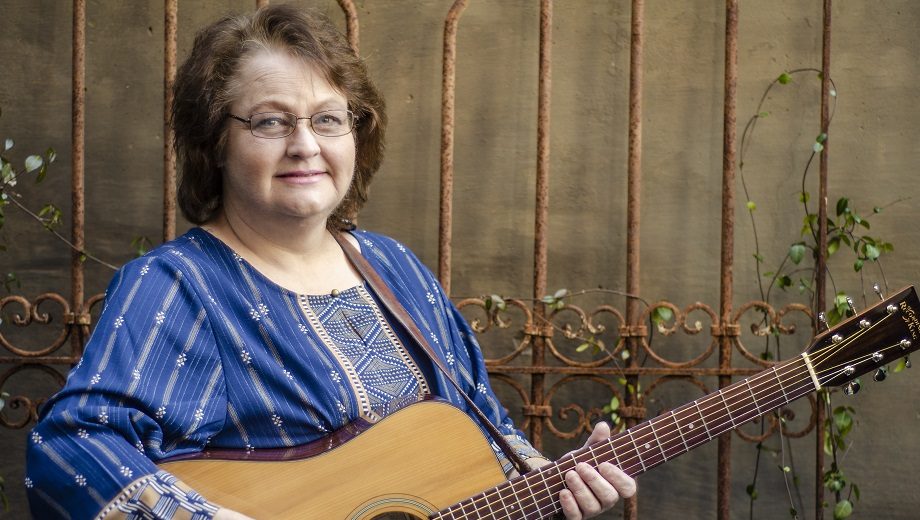
Dale Ann Bradley Hears the Truth in ‘The Hard Way’

Dale Ann Bradley has made a lasting impression with bluegrass listeners as a solo artist, as well as a member of the all-female band Sister Sadie. And before that, she recorded and performed with the New Coon Creek Girls in Renfro Valley, Kentucky, where she established a foundation that would carry to her multiple performances on the Grand Ole Opry and five IBMA awards in the female vocalist category.

An approachable artist who describes her audiences as “my people,” Bradley is quick to admit that her musical path hasn’t always been easy – in fact, her new album is named The Hard Way, a nod to the Jim Croce song she covers, “The Hard Way Every Time.” But in spite of that title, it’s a beautifully subdued project that stands among the most satisfying of the Kentucky native’s long career. That’s as much due to her gentle singing as her gift for finding songs that suit her.

Bradley invited the Bluegrass Situation to chat prior to a Nashville show earlier this month at the Station Inn.

BGS: I wanted to start by asking about the production on this record, because to me it sounds very crisp. It seems like there’s a “less is more” approach.

Bradley: It is. I have learned, on some things, that’s the correct approach. This one’s more guitar-oriented than a lot of them I’ve done – since [1997’s] East Kentucky Morning. Because I had such good guitarists play, it really didn’t need to be souped up. And the lyrics are so story-telling that the song, and the great musicians that I had, found their own way and their own place to be. … This is the third one I’ve produced and I’m always scared to death! I never take that for granted because it’s just like painting a picture or having a young’un! [Laughs] You don’t know what’s going to happen.

What is it about production that makes you want to keep coming back into that role?

If I want to try something, to able to do it. Even though I know that sometimes it works and sometimes it don’t. I have the utmost respect for any producer that I’ve had because I’ve had the best there is. … From Sonny Osborne, I learned that a good performance is a lot better than everything being technically perfect. He drilled that into my head – it’s all about emotion. With Tim Austin, I learned drive and punch with the guitar, and he helped me a lot with my guitar playing. And with Alison Brown, I learned not to be afraid of creativity. Put it down, and if it works, it works. And if it don’t, then you’ll know not to do it the next time. She’s so creative. I’ve worked with three different producers with three different outlooks, and learned from all of them.

“The Hard Way Every Time” is a beautiful song, with a lot of truth in there.

It is for me. The generation that I come from, we’re all at that point where we’re looking back, and we think, “Well, I sure did that the hard way.” Kept doing it and kept doing it. I hope it reaches a young generation. It seems to be, but I think there’s something in there hopefully for everybody.

How do you find the songs you want to record?

All the memories… I may not be able to recall what I had for lunch or breakfast, but a song will stay with me. Songs that have been poignant in my life have been so much so that I’m never going to forget them. I don’t cut cover tunes just to be different. I do it because it shows how talented these musicians are. … And I want to show that in music it doesn’t really matter what genre it is. If it really breaks your heart or makes you happy, it’s all good. Then there are songs that I want to do in the bluegrass style because I didn’t want to do them in the other style.

I’ve often thought that there might not be any song that’s off limits for you. Is that true?

Well, it was close this time. I’ve never been as scared as I was with “Wheel in the Sky.” I really belabored it. Everybody was saying, “Let’s cut it,” but what do you do after Steve Perry’s cut something? Or Journey’s played it, you know? Then I got to looking at it some more. That was probably the last song that I picked. And I got to listening to those lyrics, and I thought, Bill Monroe would have wrote that: “Winter’s here again, O Lord…”

And I’ve done that with other songs, like “Summer Breeze.” The lyrics are just about life and emotions, and it’s important to me. I love novelty, funny little songs but I just really like the ones that have a message, or maybe leave one.

How did the guitar come to be your instrument?

It was probably going to be the only one that I had any possibility of getting. I would have loved to have had a banjo and mandolin, but I finally got a little ol’ cardboard, classical-style guitar that somebody ordered from a catalog. I knew I might get that one if I pressed enough. If I pressed too hard, I wasn’t going to get nothing! But I had a love for it. And still do.

I never was around anybody that played, is the thing. I had a friend who was my age, and we wrote songs together. He was very talented and he didn’t play bluegrass-style. He was a Jim Croce fan, so he would play that and I was so mesmerized, but that was the only guitar influence I had until I came to Renfro Valley. They were all seasoned Central Kentucky musicians and I learned so much from them.

You were at Renfro Valley for years, and then you became a bandleader. What do you remember most about that time? What was that transition like for you?

It was a transition that had to take place, before I would have ever gotten out of the community I was from. I learned a lot about the history. I learned Bradley Kincaid songs and who Bradley Kincaid was, and how Renfro Valley is such a treasure. I loved it and I got to perform country and gospel. I started singing traditional country there, and then the entertainment director would let me do traditional bluegrass songs with the country band. And that worked out good.

When that position with the Coon Creek Girls came open, I was tickled to death to get that. … Renfro Valley is in “The Hard Way Every Time.” Major, maybe over 50 percent! [Laughs] But I learned, and I’m thankful now that I learned those hard life lessons with good people that had hearts. I was thrilled to work there. The talent there in the late ‘80s and ‘90s – I’m telling you, it was as good as you’d hear anywhere.

And then you decided you wanted to be in front, and go on tour?

Well, what happened was, the Coon Creek Girls had been together for years and everybody got married and had babies. I still didn’t want to step completely out, so we called it Dale Ann Bradley and Coon Creek. And then things changed from there, and I signed with Compass, and then it grew its way into me totally being responsible. [Laughs] Good, bad, and indifferent!

What is some of the best business advice you’ve ever gotten.

[Laughs] Don’t spend your money! Cut corners, but not so much where you make somebody uncomfortable. But when you can, cut corners. Don’t buy what you can’t pay for. And work hard. Respect your money. I had to learn that the hard way, too — that’s the other 50 percent of The Hard Way!

Who would you say are some of your heroes?

Oh, Dolly Parton of course. I loved John Duffey and John Starling. What got me really hooked on bluegrass was that I’d hear Ralph Stanley and Bill Monroe on the radio — and Lester and Earl on The Beverly Hillbillies when I got to see that. Dolly was a hero, and the Seldom Scene, The Country Gentlemen, Charlie Waller, so many in the country field, too. Dolly could do anything. Bluegrass was naturally there, with her being 80 miles across the mountain from where I was from. And I loved Glen Campbell – he was another one that could do everything. So many that you can’t name.

So many of those artists you named have an incredible ear for a song.

They do, and it’s a gift that they can sing anything. And I adore Aretha Franklin, Stevie Wonder, and Ray Charles. You can’t stay on this earth and get any better than that.

You’ve won some IBMA Awards, and Sister Sadie earned a Grammy nomination this year. I would imagine that aspiring musicians may look to you as a role model. Do you see yourself that way?

Well, I don’t feel that I’m even worthy enough to put myself up as a role model. But if they like this style of music, I want to be somebody that makes them unafraid to express themselves. And I’ve always tried to treat people as good as I can. In those two ways, I hope that I am. In other ways, everyone’s got to walk their own journey, you know?

The IBMA Awards now have women winning the instrumental categories. As a woman in bluegrass yourself, what does an accomplishment like that mean to you?

Well, obviously it’s good that the mindset has changed, in order to really study the female musicians because some of them are quite great. The thing that worries me a little bit is that I don’t want it to matter if it’s male or female, if you’re a good player. I know so many females who are wonderful players and I don’t think we should get it just because we’re women. Let’s get it on our playing and our accomplishments. I don’t get into that (mentality of) “you’ve got to let me play because I’m a girl!” [Laughs] I’ve never been thrown out of a jam session, but I ain’t been in too many either.

Do you see a difference from when you started until now?

Definitely. I see girls cutting their gig, is what I see. Learning. And playing and singing and writing. I do see a female presence strongly coming in there. There was a time of course, I know not so very long ago: “Well… girls can’t sing bluegrass.” Now that needed to go!

I’d like to see the festival scene open those doors more.

Yeah, they’ve moved up to about two girl acts. And I didn’t really realize that was the case, because in the ‘80s and ‘90s, the Coon Creek Girls were the girl act. [Laughs] And I thought, “We’re getting hired, what’s the problem?” “Well, you’re the only girls!” [Laughs]

Going back to the title of this record for a second, I know there’s a lot of hard work that goes into a career like yours. But what would you say is the reward in that?

Oh gosh. There’s been so many. The reward was that I was able to do it. I was able to sing from the very first venue until now. I got the opportunity to sing and to write and to express myself in a musical way. I’ve met the most precious angels — and a lot of musicians have. They’re angels themselves. So many good friends that have been so good and gracious and merciful to me. And along with that, it provided a way for me to support myself and my son. That’s the reward. That right there is everything.


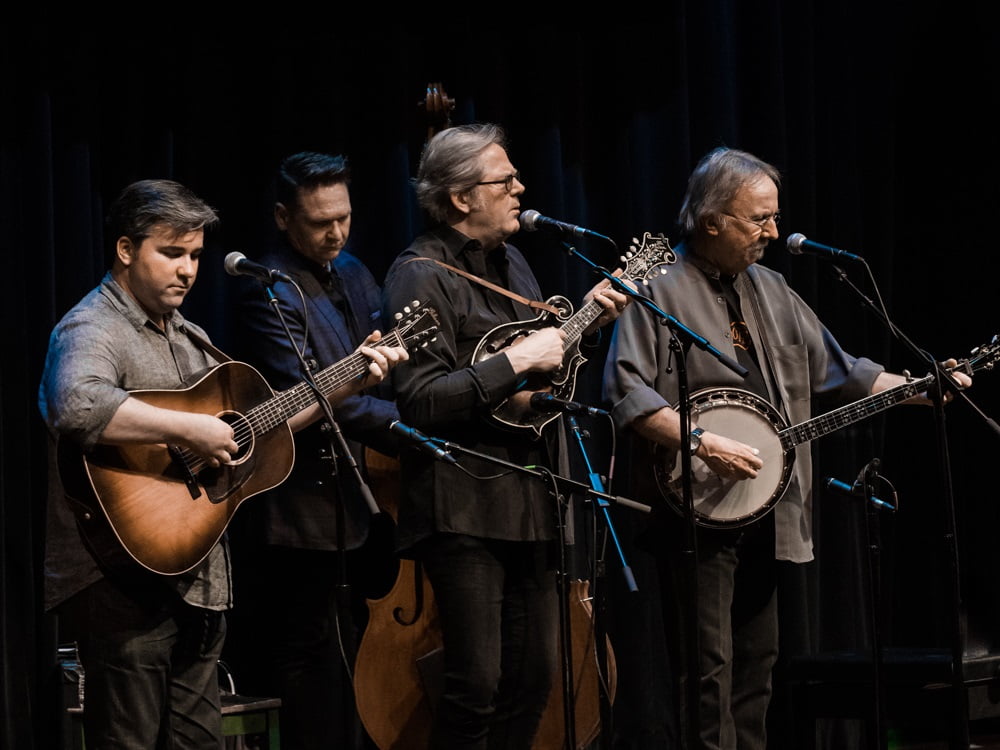
Photo credit: Pinecastle Records
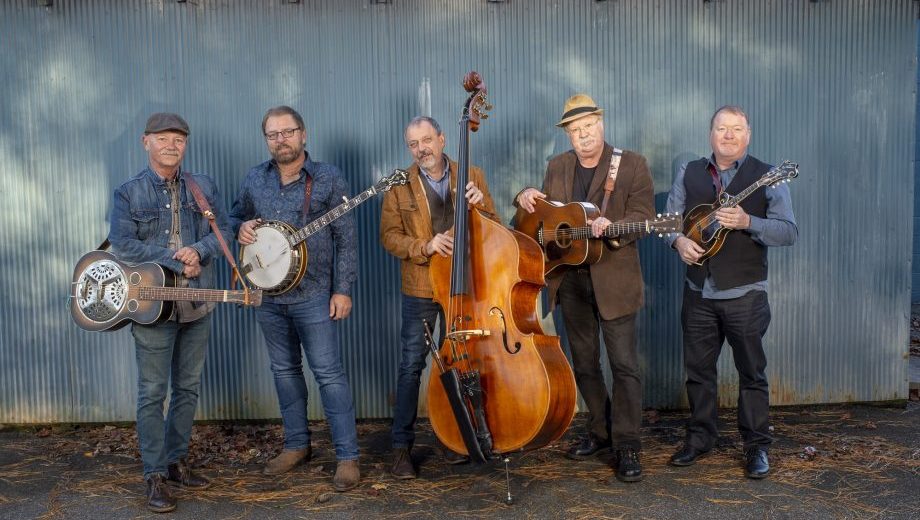
LISTEN: The Seldom Scene, “Steel Rail Blues”

Artist: The Seldom Scene
Hometown: Washington D.C.
Song: “Steel Rail Blues”
Album: Changes
Release Date: June 7, 2019
Label: Rounder Records

In Their Words: “Ken Irwin from Rounder Records turned us onto ‘Steel Rail Blues,’ a tune from Gordon Lightfoot’s debut 1966 album. I connected with the lyrics about a lonesome boy who left his home only to find himself in a strange town with no friends, no job, and since his car died in his pursuit of adventure, no way out. His only hope was from a girlfriend back home who bought him a train ticket home, but the night before leaving, he gambled it away, leaving him stranded once again. I think we all want to find our way back home to a place of comfort and familiarity. In this story, Gordon ends up alone on a broad highway, his possibilities — and trucks — passing him by, knowing that he only has himself to blame.” — Dudley Connell, The Seldom Scene


Photo credit: Jeromie Stephens

John Jorgenson Revisits His Southern California Bluegrass Roots

John Jorgenson is not only a man of many talents, he’s a musician with many interests. Perhaps you’ve heard his gypsy jazz, or remember when the Desert Rose Band — a neo-trad country group that included Jorgenson, Chris Hillman and other luminaries of the California country and country-rock scene — was riding high at radio, or perhaps you saw him playing an indispensable role in Elton John’s touring band. As Jim Reeves might have put it, he’s done a lot in his time.

Even so, you might not know that John Jorgenson is also a bluegrass guy — unless, that is, you saw him on the road with Earl Scruggs during the legend’s final touring years, or happened to buy his 2015 box set, Divertuoso, which included a disc of bluegrass alongside one of gypsy jazz and another of eclectic, electric music. Earlier this year, that disc was issued as a standalone album, From the Crow’s Nest. Featuring the regular (and equally eclectic) members of the John Jorgenson Bluegrass Band (J2B2) — Herb Pedersen, Mark Fain and Jon Randall — it’s a delicious collection that scatters well-known songs (Pedersen’s “Wait a Minute”; Randall’s “Whiskey Lullaby” co-write; and the Dillards’ “There Is a Time”) among a trove of newer material, much of it written or co-written by Jorgenson.

From the Crow’s Nest ought to go some distance in alerting wider audiences to a new standard-bearer for a style of bluegrass that, while its roots trace back to the early 1950s, hasn’t gotten the attention it deserves. Though Southern California is a long way from the Grand Ole Opry and other spawning grounds for the original bluegrass sound, it served in the post-World War II years as a magnet for job seekers from both sides of the Mississippi River, and that meant bluegrass pickers, too — and so, when we met up, that made for a good starting point for our conversation.

Listening to your album reminds me that you are a product of a Southern California roots music scene that included bluegrass from early on. How did you get exposed to it?

Probably the first time was when a band came to my high school and I thought they were from another planet, because I’d never heard anything so fast in my life. I played music already — I played classical music, and rock — but that was sort of an anomaly, and then I didn’t really see it again for a while.

I came to it sort of in a backwards way. I had a scholarship to the Aspen Music Festival. They brought me in as a jazz bass player; they wanted to start a jazz program. And I accepted the scholarship as long as I could also be in their classical program, playing the bassoon. Well, I had my tuition paid for, and my room paid for, but I didn’t have money for meals. So I needed to figure out how to make some money, and then I saw an ad that said: Wanted: strict jazz player for immediate gigs. So I checked out an upright bass from the school and went to this audition. And they weren’t playing jazz — what they were playing was David Grisman’s first album. This was the summer of 1978, so this album was new. I’d never heard it.

So they’re playing all instrumental stuff and I thought, OK, I really like the sound, especially of that mandolin. I liked the flatpicking guitar, too. I was already a guitar player, but I just loved the mandolin. When I got home that summer, my neighbors had a Gibson A model and I borrowed it. Not too long after that, I ran into a friend who had been instructed to put together a band that could play bluegrass and Dixieland to cover two different areas of Disneyland. And he asked, “Hey, do you know anybody that could play bluegrass fiddle and Dixieland cornet?” And needing a job at the time, I said, “I can play mandolin and clarinet.”

And then I kind of learned backwards, whatever I could. I learned from New Grass Revival, and then Bill Monroe, and Flatt & Scruggs, and the Stanley Brothers, and the Osborne Brothers. And all the others — Tony Rice, Sam Bush, the Bluegrass Cardinals, whoever was playing around at the time. Larry Stephenson was playing with the Cardinals at that time, and I remember I was — I don’t want to say shy, but I’m shy around people I don’t know. And to me at the time, they were real bluegrass musicians and I was a pretender. I sort of felt an attitude from some people, too, but he was not like that at all. He was really friendly.

Did playing bluegrass at Disneyland motivate you to build connections with the larger bluegrass scene, or was it a standalone kind of gig?

Actually, when we first started, we were terrible! We learned three songs and then we’d play those, move to a different place and play them again. But everyone was ambitious, so we all practiced; we learned songs, we got better. And then we started to play out around Los Angeles. I think the first time we played out as an act, we opened for Jim & Jesse at McCabe’s [Guitar Shop]. There was also a venue called the Banjo Cafe, with bluegrass every night, on Lincoln [Boulevard] in Santa Monica. So the Cardinals played there; Berline, Hickman & Crary would play there; and touring acts, too — Ralph Stanley would play there. And a young Alison Brown, a young Stuart Duncan.

I know that there are a lot fans of Desert Rose Band among bluegrassers, and some gypsy jazz fans, too, but for a lot of people, you came onto the radar when you were going places with Earl Scruggs — 15 years ago, maybe? How’d that come about?

Actually, it was because of Brad Davis. He was playing with Earl, and we were kind of guitar geek friends. We ended up sitting next to each other on a plane one time, and were chatting, and he said, “I’m playing with Earl Scruggs,” and I said, “I’d love to do that.” He said, “You know, they like to have an electric guitar, maybe there might be a spot.” He really set that up for me.

I said, “OK, I’m happy to play electric guitar, but I would really love to play the mandolin.” So I would bring both, and if I played too much mandolin, Louise [Scruggs] would say, “John, don’t forget that electric guitar.” Then they said, “Don’t you play saxophone? We used to have that on a song called ‘Step It Up and Go.’” So I said, “What about the clarinet? It’s not quite so loud.” And as it turns out, Earl said his favorite musician was Pete Fountain, and he loved the clarinet. So every time after that, Gary Scruggs would call me up: “Dad says don’t forget the moneymaker.”

The J2B2 record was originally part of a box set — a disc of gypsy jazz, one of bluegrass, one of electric stuff. So you have these different musical itches, and some musicians would choose to try to synthesize these things into something new and different and unique, but you seem to have an interest in keeping them each their own thing. Why is that?

It’s because, to me, the things that I love about bluegrass are what make it bluegrass. I love the trio harmony, I love these instruments, the way each instrument functions in the band. And I love gypsy jazz, and some folks might say they’re closely related — they’re string band music, they both have acoustic bass and fiddle and acoustic guitar, and each instrument has a role. There are a lot of similarities, but the things that I like about each one are what make them different. I think each music has an accent, and a history and a perspective, and I really want to be true to those, because those are the elements that touch my heart.

I feel like what I do and what this group does is quite traditional, compared to a lot of people. It’s not jamgrass. It’s not Americana. It’s bluegrass. There are folk elements, and all those other things, of course. But really, my touchstones for that style of music are all the classics: the trio harmonies of the Osborne Brothers, and the slightly softer Seldom Scene and Country Gentlemen sounds, the early Dillards, the Country Gazette, and the whole Southern California sound… you don’t think of Tony Rice’s roots as Southern California, but they are.

And probably at one point, if I could have sounded like I was from Kentucky, I wouldn’t have minded that. But at the end of the day, well, I love Bill Monroe as much as the next guy, and I’m going to take inspiration, but I feel like I’m part of a lineage of bluegrass that’s just as viable as any other, and why not have that sound be a part of me?


Photo credit: Mike Melnyk

Punch Brothers’ Chris Eldridge: Influences and Integrity

Chris Eldridge, the good-natured guitarist for Punch Brothers, comes by his bluegrass pedigree honestly. As a young man, he attended innumerable shows by Seldom Scene, a pioneering ensemble whose lineup included his father, banjo player Ben Eldridge. After studying at Oberlin Conservatory, he co-founded the Infamous Stringdusters, which won three IBMA Awards following their 2007 debut project, Fork in the Road. Indeed that album title proved auspicious, as Eldridge took a different path with the formation of Punch Brothers – a rewarding partnership that a decade later has yielded their newest project, All Ashore.

This interview is the third of five installments as the Bluegrass Situation salutes the Artist of the Month: Punch Brothers.

When I saw you guys at the Ryman, I noticed you were wearing a Hawaiian lei, so I take that as a sign that things are going well on the tour. What’s the vibe so far?

The vibe has been really fun and it’s great because the band’s back together, as they say. We’ve been connected, all of us in various ways, even in this time off from the band. I see Thile a bunch because I’m usually playing guitar on Live From Here. Paul lives really close to me, so I see him like every other day in Nashville. And Noam is close, and I see Gabe, but to have all of us in the same place out on the road for me is a really fun thing because one of the real privileges of my life is getting to play music in Punch Brothers, getting to be the guitar player in a band with those guys.

One of my favorite songs on this record is “The Gardener.” I feel like it sets a nice tone and tells a hopeful story. Tell me what the band was hoping to capture with that song.

Well, the music was started on that years and years ago, probably in 2012. We were in London doing a thing with T Bone Burnett for a movie and this simple melody kinda just sprung up. We were trying to brainstorm some stuff for this movie and it almost sounded like a Christmas carol. And so it was this thing that we always really liked, and we didn’t give it to that project that we were there working on. We wanted to hold it close to our chest and keep it ourselves. It was something that we had sitting around, even for The Phosphorescent Blues, but we just didn’t develop it into anything.

And then Thile had come up with that kind of weird, modulating, tonally ambiguous guitar that starts the song. He showed that to me and it was really cool. The way it works for us is, we always work on music before there’s any content, in terms of story. That’s pretty much how it tends to progress for the band. We’re definitely a music-first band. So it was a matter of making both of those ideas interesting. And the original idea from 2012, the Christmas carol idea, was really neat and we really liked it but it had a limited amount of development. A lot of Punch Brothers music, the song will have to have a certain amount of development. It’ll tend to go places. Usually we won’t just repeat a thing over and over.

And as we were trying to develop that, someone had the idea, “What happens if we do that crazy, weird, finger-picked guitar thing — the ambiguous tonal thing – and pop it together?” We had to change the key around a little bit but we found a key relationship that worked and it solved this problem.

So then it’s a matter of figuring out what the song is going to be about. Thile had this idea about a gardener, some guy kinda tending. You know, because the music is not lonely exactly but there’s like a forlorn imagination, like optimistic vibes, that are encoded into the sound of that melody. So it was trying to find a story to go along with it. And it dovetailed with a lot of the things that we’ve been thinking about and talking about as a band, in terms of society today. People who have things and people who don’t have things. People who feel protective of themselves and their tribe. It’s a meditation on a lot of those kinds of thoughts. I’m barely touching on them, but that’s kind of where it came from.

You guys would make a pretty cool Christmas record. Has that ever come up?

We’ve talked about it before. I don’t know if we’ll ever do it, but I think that would actually be really fun. There are so many cool, beautiful songs. Really timeless, gorgeous melodies. There is some solid music there in that canon of holiday music. It’s so hard to get everybody’s schedules to align now. People have three children in the band at this point, and three wives, and essentially all of us are in completely and deeply committed relationships … and we’re all older. The band can’t sit totally in first place anymore, which is necessitated by having families and that’s now the most important thing. So we really have to be deliberate about our time and it means that we don’t do as much stuff together – but when we do, we try to really make it count. That being said, I would love to make a Christmas record.

I thought with your connection to Seldom Scene, I’d ask if you knew John Duffey well.

I didn’t know him that well, but I certainly grew up around him. John didn’t really know how to relate to little kids. I have a lot of memories of being around John, just being around the band, but I didn’t really interact with him much until towards the very end of his life. We’re talking probably the last less-than-six months he was alive really. He started to acknowledge me because I was probably 13 or 14 years old. I was just getting to the age where he related to me as more than just a small child. I was starting to feel a little more like someone he could relate to.

I remember the last time I saw him alive. I was sitting backstage at the Birchmere. They have these big chairs and I was sitting in one of them. He came up behind me and just scruffed me by the hair and said, “Hey there, guy.” That’s kind of where the story ends but I was just so blown away, like, “Whoa! John Duffey just talked to me!” That was an amazing thing!

I have very clear memories of the sound of his voice. I probably went to hundreds of Seldom Scene shows and I heard those guys play hundreds of times when I was a kid and the sound of Duffey’s tenor, the sound of his mandolin playing, the sound of Mike Auldridge’s Dobro bouncing off the walls. That stuff is burned so deeply within me. I’m so thankful and grateful for that. It’s this crazy privilege that I was just born to have those experiences. As I get older, I appreciate more and more how cool it was. But I don’t think I ever really took it for granted. I loved the music, I loved the sound of that band from the time I was a boy.

I know that Tony Rice is one of your heroes too. How has his music shaped the music that you’re making now?

Oh man, profoundly. He provided such a great example of musical integrity. In terms of rhythm, not just rhythm guitar playing, but actual timing, his sense of time and elegance and grace and power and intelligence – all these things that I really try to emulate. The goal was never to be a clone of Tony. I mean, it’s easy to learn the note that he plays. It’s not that hard but I feel like once you do that, then the real learning begins. What’s he doing with those notes? Why is it so good when he plays them? What’s going on there? That to me is when the rubber hits the road and that has everything to do with his musicianship and his sensibility. And so those are the lessons that I studied so hard and it affected my outlook and approach to how I want to present music on acoustic guitar. And just music in general.

But I would argue that Tony had strong ideas about that and his enormous integrity to those kind of musical values was really influential to everybody in the acoustic music community. His high level of musicianship – and how he retains some of the essence of bluegrass, the rhythmic essence – sets the stage for a lot of the modern music that we like. And certainly Punch Brothers. Certainly all of us were deeply influenced by that example of musicianship.


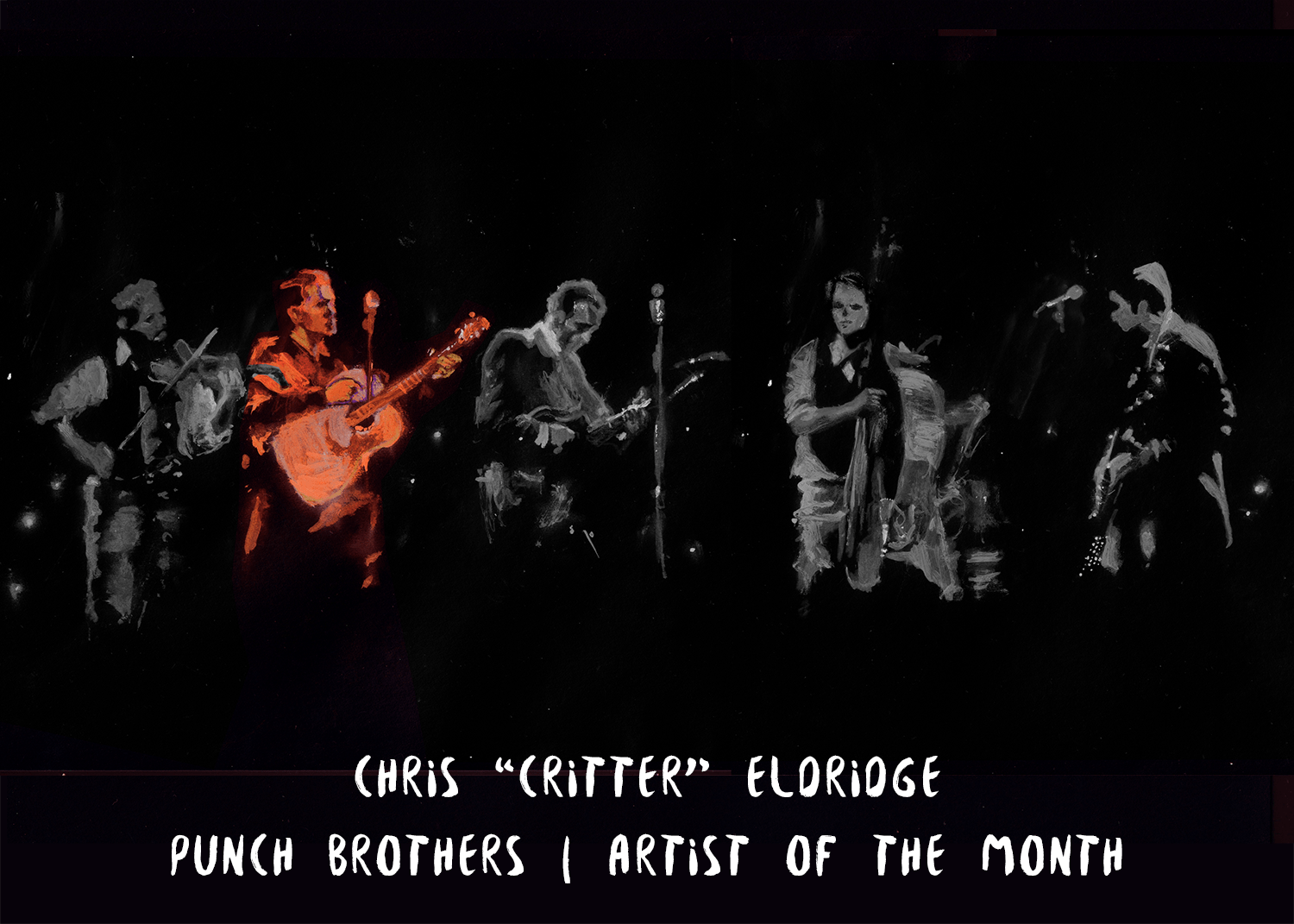
Illustration: Zachary Johnson