The Man That Made All of Us Play the Banjo

(Editor’s Note: For Earl Scruggs’s birthday, Thomas Goldsmith revisits a star-studded bluegrass festival tribute to the banjo legend from 1971 in Camp Springs, North Carolina. The 102nd anniversary of Scruggs’s 1924 birth in Flint Hill, North Carolina, is January 6, 2026.)

Like speakers at a testimonial dinner, each musician strode to the microphone in turn.

But instead of heaping on words of praise, a stage full of well-known pickers and up-and-comers used banjos to pay a lively tribute to Earl Scruggs.

The scene was the 1971 Labor Day weekend bluegrass festival in Camp Springs, North Carolina, at a performance where some of the best banjo players around joined Scruggs on stage. Led by the five-string king himself, banjoists including Sonny Osborne, J.D. Crowe, Bill Emerson, and Alan Munde jointly played Scruggs’s signature tune “Foggy Mountain Breakdown,” some 22 years after its first recording.

The performance is a highlight of the 1972 documentary Bluegrass Country Soul, which enjoyed a 50-year deluxe re-release five years ago. Watch the clip here.
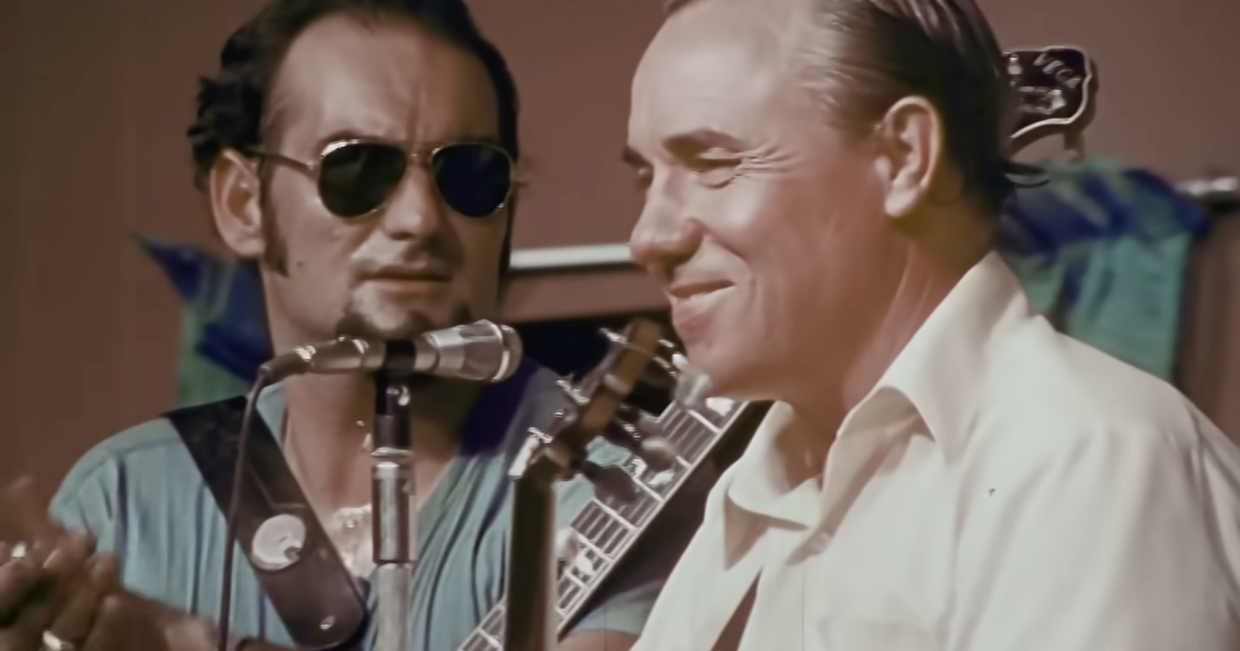
 

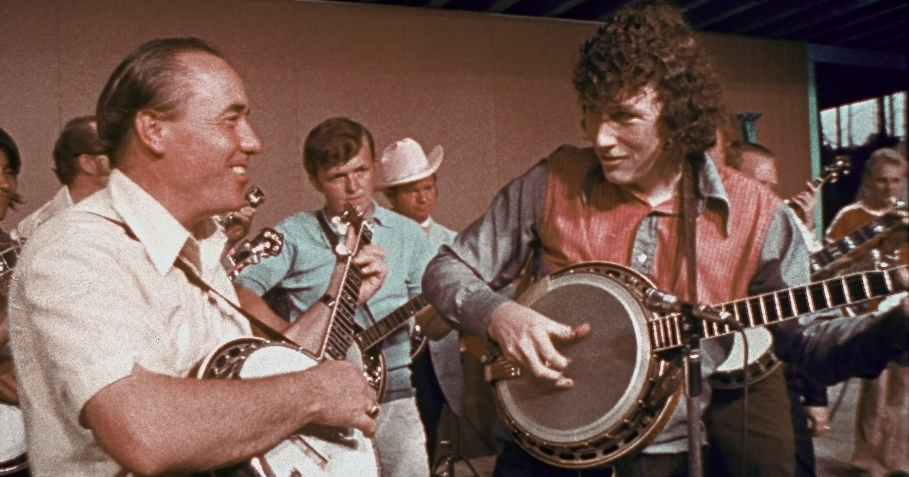
Sonny Osborne (left) gets emotional onstage after introducing Earl Scruggs (right). Screenshot from clip courtesy of Bluegrass Country Soul, Inc.

Promoter Carlton Haney invited more than a dozen banjo players on the festival schedule to play along with Scruggs, who was then 47. (A second group performance, of “Dear Old Dixie,” doesn’t appear in the film. And a couple of the “Foggy Mountain Breakdown” performers didn’t make it to the screen.)

Millions of viewers have seen the clip as part of the movie or on YouTube, with Osborne bringing Scruggs on with an introduction that sounds starstruck.

“(It’d) be only right to call out probably the man that has made all of us guys up here play the banjo, or either has been a great influence, as he has in my complete life,” Osborne said. “In my whole banjo-playing ability … I could probably credit to this one man.

“Let’s all give a tremendous welcome to probably the best in the world, Earl Scruggs!”

Scruggs seemed overwhelmed by the audience’s ovation. The cheering feels as though it lasts forever, but took only a minute and a few seconds.

“That really fills my heart with joy,” Scruggs said after Osborne introduced him. “I did want to say one thing: Thank you, and guys like this is what keeps me going, my boys who works with me and you people who keep preaching music.

“I just don’t know what to say, except I’m picking with some guys that plays a tremendous amount of banjo. Don’t underestimate anybody up here. Man, they’re great.”

Earl at a Crossroads

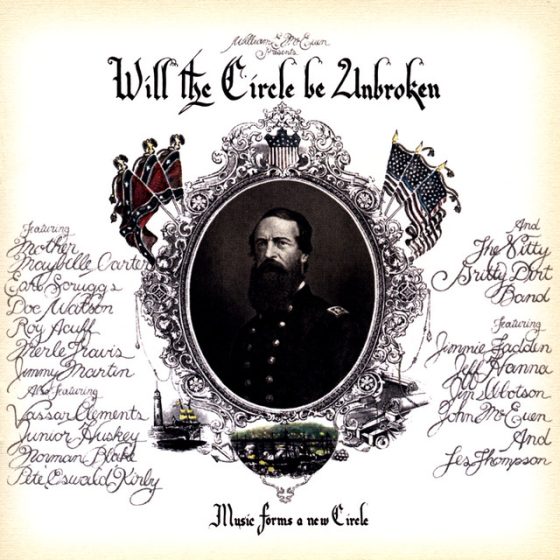
In 1971, Scruggs had only broken up with his longtime duet partner Lester Flatt less than two years earlier. Not even a month before Camp Springs he had recorded along with other greats for Nitty Gritty Dirt Band’s country-roots-popularizing Will the Circle Be Unbroken set. He was venturing into a country-rock sound with his band the Earl Scruggs Revue, along with his sons Randy, Gary, and Steve.

However, Scruggs’s work as a musical innovator remained – and remains – fundamental to the way a large share of bluegrass banjo players address the instrument. That’s true despite the introduction of a single-note style most associated with Don Reno and a chromatic or melodic approach heard in the playing of Bill Keith and Bobby Thompson.

Most of the pickers in the 1971 “Foggy Mountain Breakdown” performance used the three-finger picking style Scruggs introduced in a band with Bill Monroe and Flatt on the Grand Ole Opry in 1945. The exception among the Camp Springs pickers, Rick Riman of the New Deal String Band, caused something of a stir with his chromatic rendition of the tune, not to mention his long hair, full beard, and striped shirt and pants.

How did Riman, who had also studied Scruggs style closely, decide to use the flowing melodic style for “Foggy Mountain Breakdown”?

“I just thought, “OK, let’s see if I can make this work,’” Riman, 83, said on the phone from Denver, Colorado, speaking to BGS in January 2026. “Because I had not prepared anything, and I didn’t even know what was on the program. They just said they want all the banjo players up there to pay tribute to Earl. And I said, ‘OK, I’ll get up there and do it.’”

And what has the reaction been?

“Mostly negative,” he said, with a touch of humor.

“One person said they were really glad to see somebody step out of the standardized [method], and that felt very, very good. Somebody else said, ‘You won’t believe how many people thought that you shouldn’t have been on stage at all.’

“And I get that a lot. That’s mostly the reaction I get, that I shouldn’t have been on stage. I shouldn’t have even been in the parking lot, like the least talented person on the stage and probably the least talented person in the whole park.”

The chromatic style remains one effective tool in the hands of players such as Béla Fleck and Noam Pikelny, but Riman, 28 that day in 1971, has gotten a load of grief over his choice to add some variety to the line of Scruggs-style players. “I would say, over the years, it’s pretty much been like 50-plus years of derision,” he said.

Riman has had one regret. “I should have practiced more,” he said. “I should have been better, but I had no idea.”

Although at Camp Springs he performed in the more recently created melodic and chromatic styles, like everyone on the stage that day in North Carolina, Riman was schooled in the style of the man honored beside them.

“I was really fascinated by Earl and anybody else who played his style pretty well,” he said.
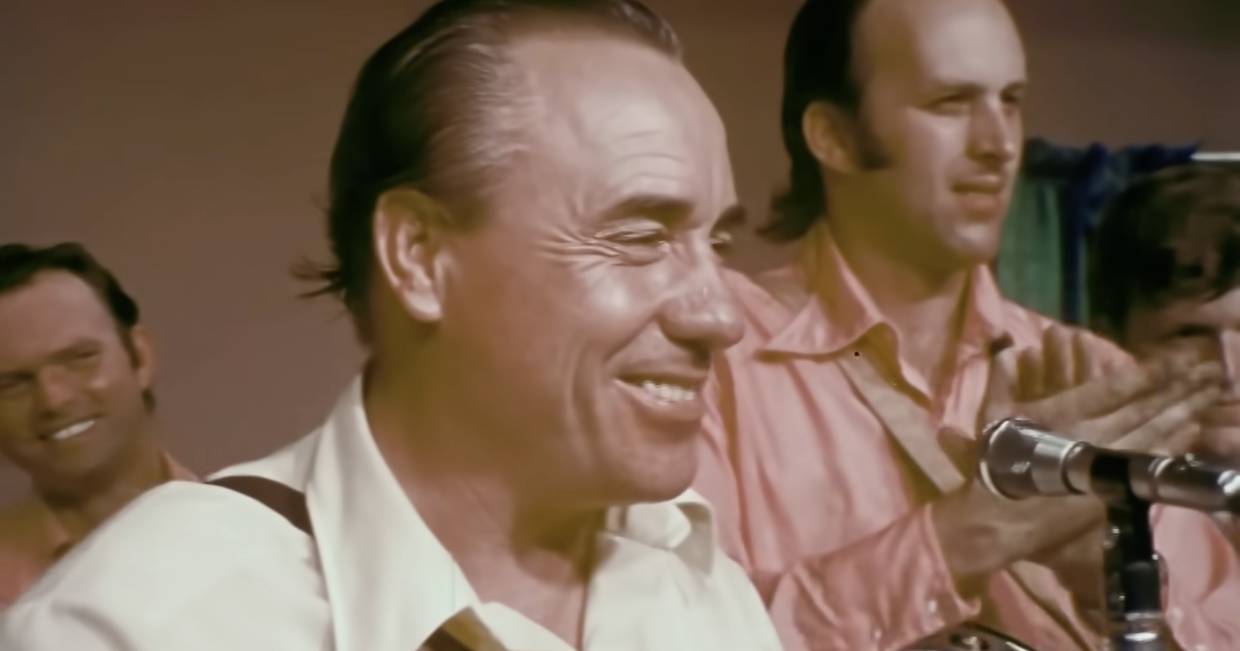
 

Earl Scruggs reacts to his introduction and audience ovation and applause onstage in 1971 in Camp Springs, NC. Screenshot from clip courtesy of Bluegrass Country Soul, Inc.


“Everybody Headed for the Stage”

We were fortunate to reach three of the banjo warriors who performed that day. Sadly, most of the players heard then have since died. Eddie Hoyle, then 14, the youngest of the Camp Springs lineup, is among the survivors and is still actively performing. He talked to BGS on the phone in December from his home in Georgia.

“I was up there playing with Curtis Blackwell and the Dixie Bluegrass Boys and I just remember them telling me that Carlton wanted all the banjo players to come down on the stage and play a tune with Earl,” said Hoyle, now 68. “So I got my banjo out, and everybody headed for the stage.

“I didn’t know if I’d get to take a break or not, but somebody got me in the line that was walking up to the mic. So it was pretty cool. And I remember I was not nervous; OK, probably didn’t know enough to be nervous.”

Most of the players that day stuck fairly close to Scruggs’s own licks on “Foggy Mountain Breakdown,” but Hoyle and others ventured a bit from the classic performance.

“I always tried to learn the right way, as Dad told us to do, but then I would try to put my own twist on it,” Hoyle said.

Nearly half the banjo players that day have been inducted into the Bluegrass Music Hall of Fame. They include Scruggs himself, of course, as well as J.D. Crowe, Bill Emerson, Alan Munde, Sonny Osborne, and Don Stover. Another banjo picker, Saburo Watanabe Inoue, founder of the pioneering Japanese band Bluegrass 45, won the IBMA’s Distinguished Achievement award along with his brother Toshio, in 1995.
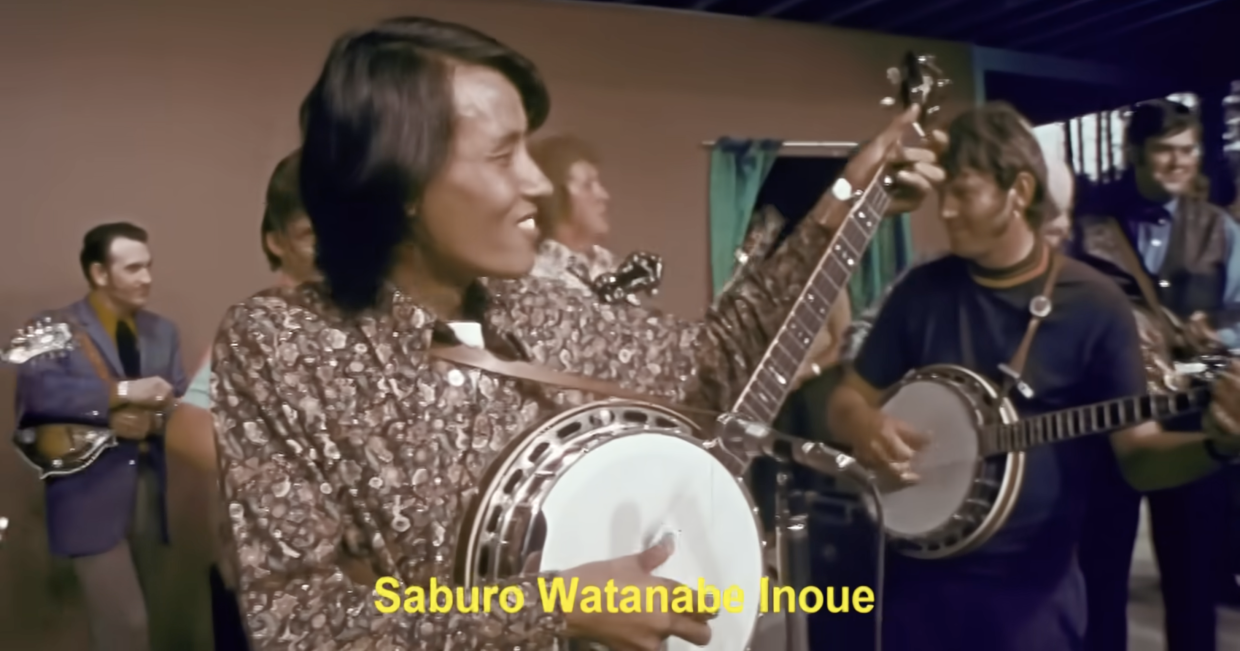
 

Sab Watanabe (who passed away in 2019) of the legendary Japanese band, Bluegrass 45, takes his turn at the mic. Screenshot from clip courtesy of Bluegrass Country Soul, Inc.


Alan Munde Remembers it Well

Munde, 79, still a player and teacher, also spoke to BGS about the experience from his home in Springfield, Missouri. He recalled that he was playing with Jimmy Martin and the Sunny Mountain Boys at the festival and took part in the group performance because Martin wanted him to.

“Thinking back on it and also remembering at the time, I didn’t really want to be a part of it, just because, then and now, I thought I would be so unworthy,” Munde said. “But I think Jimmy wanted me to do it, and you notice he’s there [in the film.] He thought I needed to be there, so I did it.”

Munde remembers the day as a landmark for him, the only time he heard Scruggs play live. Given all the great banjoists and backing musicians including Martin and Charlie Waller, it was an enchanting moment from the sound of Scruggs’s first lick.

“The thing that I remember so much about it is … we’re all standing there and Earl’s talking, and then he’s going to start to play,” he said. “And he, I always call this his ‘chang,’ where he just plays the first, third, and fifth string together and starts into the tune.

“As soon as he did that, I thought, ‘Oh my God, there’s that sound.’ It just was immediately apparent that he was the one.”
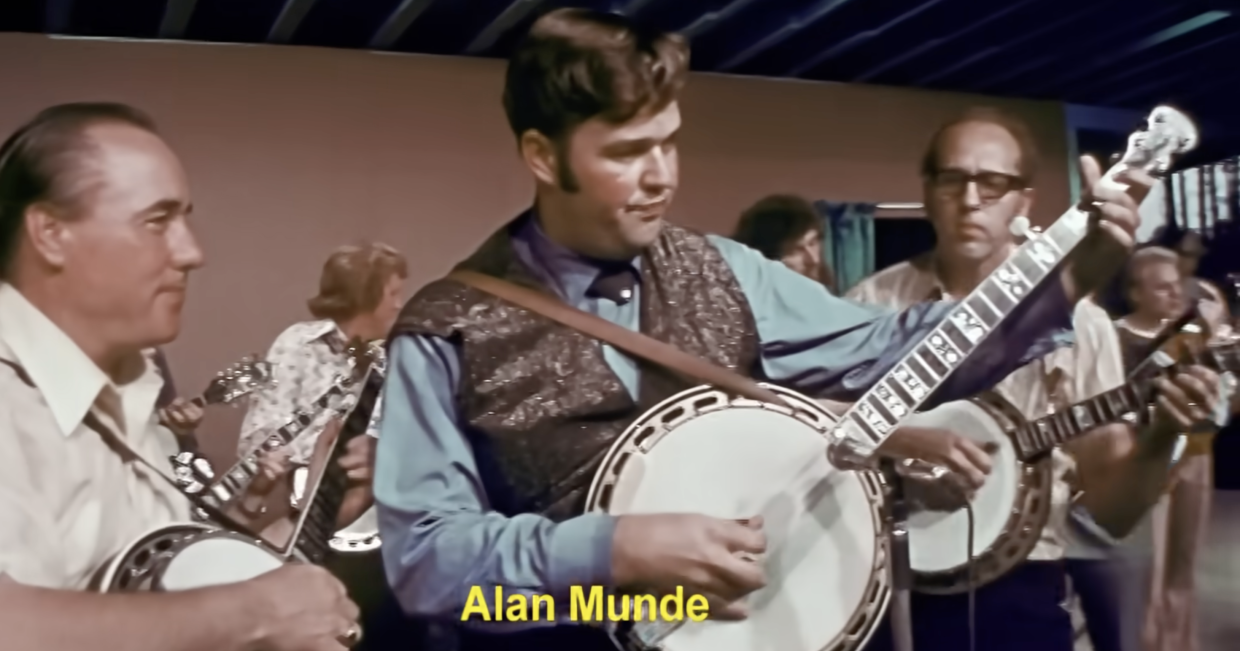
 

Alan Munde (right) is flanked by Earl Scruggs during the all-banjos jam of “Foggy Mountain Breakdown.” Screenshot from clip courtesy of Bluegrass Country Soul, Inc.

Like the first players to tune into Scruggs’s playing in 1945 and like players from Béla Fleck on, Munde appreciates Scruggs’s sound in a way that seems almost mystical. Scruggs produced something that no other banjo player could.

Jimmy Martin, Munde’s boss at the time, used to tell a story involving the great banjo man Vic Jordan to illustrate the way Scruggs’s beautifully nuanced playing and full tone stood above the crowd of his followers.

“Jimmy was kind of down on Vic Jordan a little bit,” Munde said. “And he would tell this story to show that Vic didn’t know the right way. He said when Vic met Earl, he asked him what kind of microphone he used.

“And Earl said, ‘Sometimes I use those little bitty ones, and sometimes I use those real big ones.’

“And Jimmy’s point was that, in his mind, Vic was asking because he thought it was the microphone. But it didn’t matter. It all sounded like Earl every time.”

And hearing Scruggs’s sound that day at Camp Springs, not through a mic, not on a record, but right there next to him on stage, made Munde think the whole exercise was somehow wrong.

“When he did that pinch, I thought, ‘Oh, God, I don’t want to be a part of this.’ What we should have done is just stood back and listened to him, and then said, ‘Do it again.’”

Despite his misgivings at the time, Munde has wound up glad that he took part in the Earl-fest that day.

“Looking back on it, it’s been nothing but good for me, that I got to be there,” he said. “Here it is, 50 years later, people still bring it up. It’s helped get me a little legacy recognition, that I was there, so that’s been real good.”

A Star-Studded Lineup

The career of Sonny Osborne has been well documented, but Bluegrass Country Soul makes clear his admiration and friendship with Scruggs. During the tumult of applause following his introduction, Scruggs asked if he could say something, and Osborne appears to grin and say, “Not yet.” And Osborne cracks up when Scruggs uses his up-the-neck solo from “Foggy Mountain Breakdown” during the last time around for the tune.

Bill Emerson, whose long career included membership in the Country Gentlemen and much more, was interviewed at the time of the re-release of Bluegrass Country Soul. He talked about the pantheon of great banjo players.

“Don Reno, he had his style on the banjo; Earl Scruggs, he had his style on the banjo; Ralph Stanley, he had a style on the banjo,” Emerson said in the set’s booklet. “And on the radio, I could listen to any of them, just the first few notes of an intro, and tell you who was playing. Just by the style that they were playing, the tone that they had, and the timbre. Most people, when they started out playing the banjo back then, they got a bunch of Earl Scruggs’s records and sat down and tried to learn to play like Earl. But it’s mighty hard to sound like Earl, I can tell you. I was never able to do that, so I just tried to sound like Bill Emerson.”
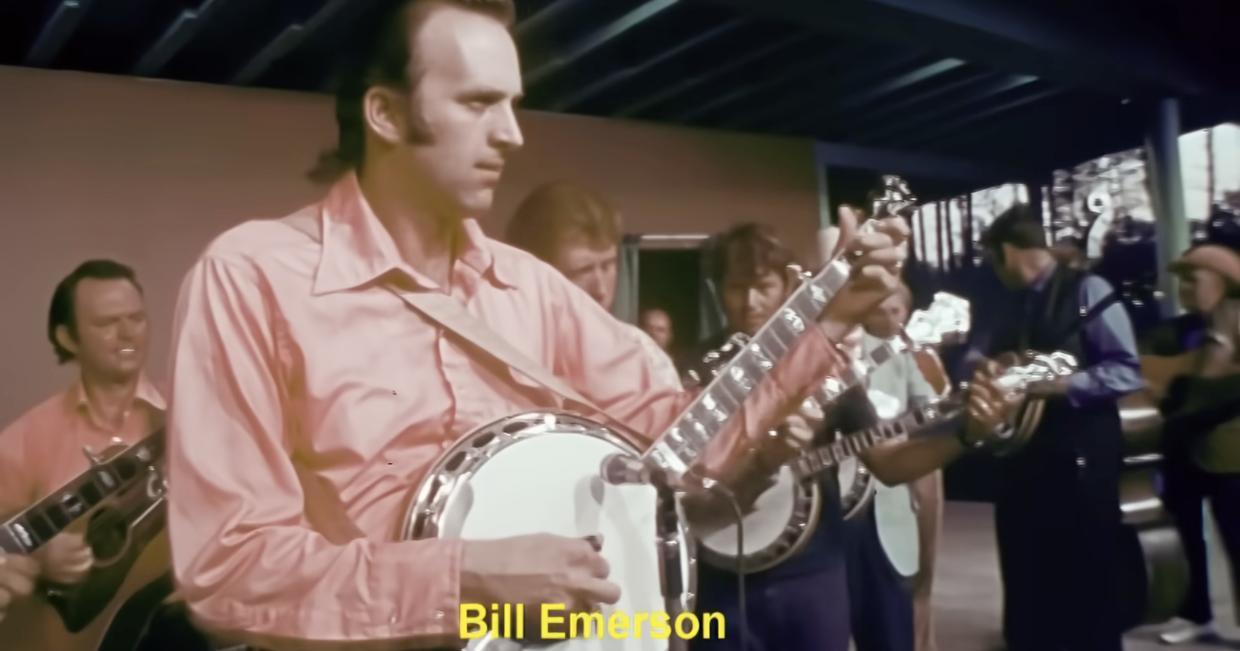
 

Bill Emerson takes his turn playing a solo on “Foggy Mountain Breakdown.” Screenshot from clip courtesy of Bluegrass Country Soul, Inc.

Also on the show was multi-instrumentalist Jimmy Arnold (1952-1992), whose career was one of a kind, including excursions into Southern rock and solo albums on guitar and banjo as well as stints with Cliff Waldron, Charlie Moore, and the New Tradition, according to a 1983 Bluegrass Unlimited story. The article, by Chris Wathen, quoted Arnold on Scruggs: “When you learn all of what you think is hard stuff and then go back and try to play one of his tunes, you find out what the hard stuff really is. It’s his stuff. To play with that much power and volume, you’ve really got to be on top of things.”

Another of the clip’s well-known pickers, Don Stover (1928-1996), had been an early convert to Scruggs style, learning it not long after Scruggs’s first performances with Monroe, according to the Bluegrass Music Hall of Fame.

Stover was known for his work with brothers Bea and Everett Lilly during many years of performances in Boston. He played and recorded as a member of Bill Monroe’s Blue Grass Boys in 1957, even contributing harmony vocals to “In Despair.”

Earl’s son Randy, who appears playing an archtop banjo just before the end of the clip, went on to a distinguished career as a musician, songwriter, and producer.

Doing Their Times

The 55th anniversary of this notable moment in bluegrass will arrive in September. Looking back, the picking ranges from respectable to spectacular, but doesn’t maintain the dead-even tempo that’s supposed to prevail in bluegrass music. Fans remember the story that Earl and brother Horace Scruggs, as boys, used to start playing a tune, then separate to walk around their Flint Hill house in opposite directions. The idea was to check if they were still in time with each other after being out of earshot.

The dozen players on the Camp Springs group number would not have passed this test, based on a stopwatch run-through. While Scruggs’s December 1949 original recording had consistent solos of right at 11 seconds, he started the round robin at about 12.69 seconds and tempos wavered from there.

By the start of Riman’s melodic solo, near the end, the time was more than half a second slower. Randy and Earl Scruggs wrapped things up at roughly the same tempo.

But that’s just a quibble.
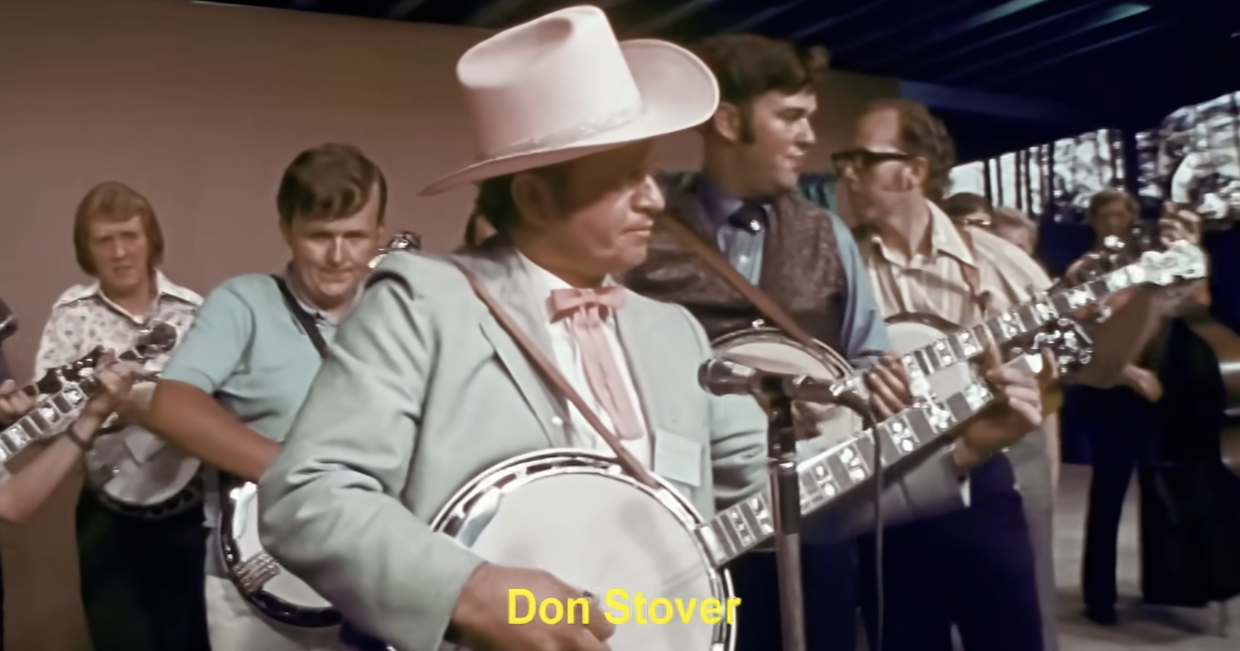
 

A contemporary of Earl Scruggs, Don Stover also performed a rendition of “Foggy Mountain Breakdown” during the jam. Screenshot from clip courtesy of Bluegrass Country Soul, Inc.


Remembering Earl

Bluegrass Country Soul director Albert Ihde did bluegrass lovers a real service by capturing these moments and others at the Camp Springs festival. And promoter Haney had another brainstorm resembling the story, pronounced “stoah-ry,” that he recreated of Bill Monroe and former band members six years earlier at Fincastle, Virginia.

Viewers will keep calling up the video for its closeups of Earl, smiling and even bobbing up and down for his breaks, and for the scenes of several of his outstanding followers, appreciating their moments on stage as they rolled their way through “Foggy Mountain Breakdown.”

Many videos of Flatt & Scruggs can be found on the web that illustrate Earl Scruggs’s unmatched musicianship. In the Bluegrass Country Soul segment viewers can also see a strong memorial to Earl Eugene Scruggs the person, his warmth, humor, and unselfishness as well as his brilliance as a musician.


Thomas Goldsmith is an award-winning journalist based in Tennessee and North Carolina. In addition to producing many hundreds of articles for newspapers and magazines, he edited The Bluegrass Reader and authored Earl Scruggs and Foggy Mountain Breakdown: The Making of an American Classic, both books for the University of Illinois Press.

Learn more about Bluegrass Country Soul and purchase a Golden Anniversary Legacy Edition box set of the film here. Read more about the box set and the making of the film here.

All photos courtesy of Albert Ihde, Ellen Pasternack, and Bluegrass Country Soul, Inc. Lead image: Earl Scruggs (left) and son, Randy Scruggs (right), perform “Foggy Mountain Breakdown” flanked by bluegrass banjo stars of 1971.
1994 AIDS Benefit Album Red Hot + Country Was Ahead of Its Time

During the 1992 CMA Awards, Kathy Mattea had a decision to make. The singer-songwriter and 1989 and 1990 CMA Female Vocalist of the Year had opted to wear four red AIDS awareness ribbons, which had become prominent at award shows such as the Tonys, the GRAMMYs, and the Oscars. In ‘92, the Country Music Association decided to hand out green ribbons to promote environmental protection. According to a Billboard article, reports of the CMA’s decision sparked controversy and the organization reacted by offering to distribute red ribbons to artists backstage.

But there was no plan to publicly address the disease on the broadcast. After a local columnist wrote that country fans may not know what the red ribbons symbolize, calling for Mattea to publicly speak out on AIDS – which had become the number one cause of death for all Americans ages 25 to 44 – Mattea realized simply wearing the ribbon was not enough.

“We went to the CMA and said, look, we’ve been called out and I don’t wanna grandstand and I don’t want to go against you guys, but can you help me?” Mattea says. “We basically got no response. So the night of the show I had to decide what I was going to do. I didn’t want to be sanctimonious… How do you stand up in a moment when you feel called to do something bigger? I just went backstage during the commercial before and searched my heart.”

When Mattea took the stage to present, she spoke the names of three of her friends who had died from AIDS. One of those names belonged to her dear friend Michael, who had died without ever telling Mattea he had the disease.

“The problem was he couldn’t tell me,” she says. “You didn’t know who you could talk to and who you couldn’t back then. It’s hard to fathom now, but that’s the way it was.

“Something in me just kind snapped and I thought, I’d like to do something to help. I had a long talk with my manager and I was like, these people in New York who are working on this, they don’t even know that I’m down here in Nashville and we’re dealing with it, too.”

Mattea got in touch with the Red Hot organization, which was founded by Leigh Blake and John Carlin in 1989 to raise awareness and financial support around the AIDS epidemic. Carlin, who got his start in the New York art world, where he curated shows at the Whitney Museum of American Art and befriended artists such as Keith Haring and David Wojnarowicz, had already experienced immense loss among his friend group.

“Being in New York in the 1980s was at the start this kind of paradise liberation. There was all this creativity. If you think of the late ‘70s and early ‘80s in New York, it’s when hip-hop, punk art, music, the East Village arts scene, graffiti, all these things were really being born culturally,” Carlin says.

“Then by the mid ‘80s, the specter of HIV and AIDS turned what felt like a paradise into an inferno. All of a sudden people that you would see at parties or at openings – you’d go, ‘Where’s Nicholas?’ and people get that kind of quiet look and say, ‘Oh, he’s sick. He’s in St. Vincent’s.’”

Carlin, who had since left his job as an art curator to work as an entertainment lawyer, began working on Red Hot’s first project, 1990’s Red Hot + Blue, a compilation album featuring pop and rock artists such as Sinead O’Connor, Debbie Harry, Iggy Pop, U2, David Byrne, and more covering the songs of Cole Porter. The album was a smash hit, raising money for AIDS organizations, including ACT UP, a grassroots protest movement which successfully pushed the government and pharmaceutical companies to release drugs that now allow people to live with HIV.

Despite its success, Carlin had no initial plans to release more Red Hot compilations. He left the law firm where he was employed after the partners gave him an ultimatum. (“My reward for [organizing the project] was basically the partners of the law firm said, ‘stop doing that or leave,’” Carlin says.) Then he received a phone call that would change everything.

“I got a call from George Michael’s manager saying George was a big Red Hot fan. He wants to contribute a song to your next album,” Carlin says. “At the time, we didn’t have a next album. But, in 1991, if George Michael says he wants to give you a track, we were like, ‘Well, we better get an album together.’”

In 1992, the organization released Red Hot + Dance, featuring Michael, Madonna, Sly & the Family Stone, Lisa Stansfield, and more. The album cover featured artwork by Keith Haring. No Alternative, featuring Nirvana, Soul Asylum, Pavement, Patti Smith, and more, followed – and even spawned an MTV special with live performances. AIDS awareness was becoming a key issue among the MTV generation, but the country music industry was still mostly silent.

“I don’t think the seriousness of the problem has hit home yet with the country audience,” Mark Chesnutt, who co-chaired the Country Music AIDS Awareness Campaign alongside Mary Chapin Carpenter, told Billboard in 1992. “Most of the people who speak about AIDS and participate in the awareness programs have been in the pop business, movie stars and rock stars.”

Starting the Conversation

If Nashville’s music industry was slower to respond to the AIDS epidemic, it certainly wasn’t because the community hadn’t been impacted.

“If people found out you were HIV positive, there were landlords who threw people out on the street,” Mattea says. “There were medical facilities that would not take them in. I had a friend who worked on my crew for a while who was legendary in Nashville for taking people in during the AIDS crisis. If you had nowhere to go, you went to his house and he had an army of volunteers. There were lots of stories like that. But there was also a lot of rejection and a lot of stigma.”

After Mattea’s statement at the 1992 CMA Awards, she was quietly approached by people who had been impacted by AIDS. At an event the morning after the award show, Mattea was approached by a man named Bubba who worked at a large radio station in the Deep South who had lost his high school best friend to AIDS. Later, a man who worked for The Nashville Network’s hit talk show Nashville Now told Mattea his son was diagnosed with HIV. Another, a Nashville radio DJ, told Mattea that he had AIDS, but didn’t feel comfortable telling anyone else in his workplace.

“There were all these people in our community who couldn’t talk to each other about it,” Mattea says. “That’s what I was wanting – some compassion and support and for people to be able to speak up about what they were struggling with and hear each other.”

In 1992, Nashville mayor Phil Bredesen and Jo Walker-Meador, former executive director of the CMA, co-chaired the city’s first AIDS Walk. Mattea and Chesnutt performed at the event. With Red Hot + Country, Mattea set out to help expand country music’s AIDS outreach beyond Music City, leaving nerve-wracked answering machine messages for anyone she thought might be interested in taking part in the project.

“Kathy was very brave. I think it’s almost like a heroic gesture for her to take a stand at that moment,” John Carlin says. “Let’s just say [there was] a lot of homophobia in the South and country music in general, and AIDS-phobia. It was not a topic people wanted to talk about. It was really difficult. I think she made it her business so that people couldn’t ignore it.”

Hunter Kelly, a country journalist who hosted Apple Music Country’s Proud Radio from 2020 to 2024, says, as a gay kid growing up in Alabama, artists who championed LGBTQ+ causes felt like a safe place. He remembers Mattea’s speech at the 1992 CMA Awards and attending Reba McEntire’s 1996 tour and seeing her bring a replica of the famous AIDS Memorial Quilt, an ongoing community project to honor the lives lost to HIV/ AIDS.

“I definitely knew on some level I was gay, but I was also in a Southern Baptist church, so I was drawn to those things,” Kelly says. “I was drawn to that mainstream representation that was more open to queer people.”

“Teach Your Children Well”

Carlin says the original idea for the Red Hot + Country album was to have country artists cover John Lennon songs. He even met with Yoko Ono, who granted the organization permission to use Lennon’s songs for the project. But when that idea didn’t come to fruition, the theme shifted to the Laurel Canyon folk-rock scene of the ‘60s and ‘70s and the songs of Jackson Browne, James Taylor, and Bob Dylan. The album would be produced by Randy Scruggs, a GRAMMY-winning musician and songwriter whose own father, Earl Scruggs, had played a significant role in the cross-generational Nitty Gritty Dirt Band album Will the Circle Be Unbroken two decades earlier.

“Randy kind of wanted to recreate that spirit of bringing generations together and, obviously, because of his dad, he had access on a level that I never could get,” Carlin says.

Alongside renditions of Crosby, Stills, Nash & Young’s “Teach Your Children Well” and Jackson Browne’s “Rock Me on the Water,” the album featured covers of country classics, such as the Carter Family’s “Keep On the Sunny Side” that had inspired California folkies of the ‘60s.

The album also features the first recording by the band Wilco, which was formed by Jeff Tweedy in 1994 after the breakup of his former band, Uncle Tupelo. The group teamed up with singer-songwriter Syd Straw to perform “The T.B. is Whipping Me,” an Ernest Tubb song inspired by his hero Jimmie Rodgers, who died of tuberculosis in 1933.

Carlin says he wanted to highlight that Rodgers, known as the father of country, had also died from a disease that weakened the immune system.

“What is the difference between tuberculosis and HIV? Really nothing other than homophobia,” Carlin says. “It’s a disease; it doesn’t choose people.”

Other standouts include Nanci Griffith and Jimmy Webb’s “If These Old Walls Could Speak,” Patty Loveless’ “When I Reach the Place I’m Going,” and Marty Stuart and Jerry & Tammy Sullivan’s cover of the traditional gospel tune, “Up Above My Head/ Blind Bartimus.”

Perhaps the most stirring song on the album is Mary Chapin Carpenter’s “Willie Short,” which was written by Carpenter’s producer and guitarist John Jennings after seeing a Newsweek feature called “The Faces of AIDS.” There, he spotted the photo of a Houston dishwasher named Willie Short.

“I was looking at the pictures, and under the picture of Willie Short, there was a very affecting caption and it just got to me: ‘Don’t forget me. From time to time, mention my name’,” Jennings told The Washington Post in 1994.

Red Hot also produced a Red Hot + Country television special, which aired on CMT. The program featured Mattea, Griffith, Earl Scruggs, Carl Perkins, Waylon Jennings, Vassar Clements, and more performing at the Ryman as well as interviews with rural and Southern folks impacted by the AIDS epidemic.

“Three Chords and the Truth”

In many ways, the early ‘90s seemed to usher in a new era in country, where queer issues were concerned. Kelly points to Garth Brooks’ song “We Shall Be Free,” which includes the line “when we’re free to love anyone we choose.”

“You also had Bill Clinton, who was a Southerner, but also a Democrat, in office,” Kelly says. “Culturally, in ‘94, there was a lot going on that dovetailed – I really see the Red Hot + Country album as country music being a part of the mainstream at that time.”

None of that translated to radio play, however. Despite the Red Hot + Country’s wealth of talent, Carlin says the album was “dead on arrival,” a huge contrast to the compilation album Common Thread: The Songs of the Eagles which was released the year prior and was certified Platinum three times by the RIAA. Red Hot + Country peaked at No. 30 on the U.S. Billboard Top Country Albums chart.

“Sadly, it was pretty clear it was homophobia in country radio,” Carlin says. “At that time, if you didn’t get played on radio, you couldn’t get arrested.”

Though Red Hot + Country didn’t gain the listenership of previous Red Hot releases, Carlin and Mattea both remain extremely proud of the project.

“It’s a beautiful cross section of musicians and music. Many of these people I know and love, and I feel proud of my community for stepping in and stepping up and doing something to try to contribute in this situation that just felt so impossible back then,” Mattea says. “I’m more of a ‘fraidy cat than it might appear, and I’m happy with my younger self that I could listen to my heart and step in.”

In the years since Red Hot + Country, LGBTQ+ representation in country music has grown tremendously. Queer artists such as Chely Wright, Brandi Carlile, Brandy Clark, Orville Peck, T.J. Osborne, and the Kentucky Gentlemen have opened doors within the genre. But Kelly says when he launched Proud Radio in 2020, he faced many of the same roadblocks Red Hot + Country faced 25 years earlier.

“There were artists whose publicists would be like ‘We don’t want to make [being gay] the main focus or we don’t want to belabor it,” Kelly says. “With the anti-DEI [diversity, equity and inclusion] thing [from the] Trump administration coming in, we might as well be in 1994, as far as the mainstream country space.”

Kelly champions LGBTQ+ country artists Adam Mac and Chris Housman’s recently released “The Outside” as an anthem for queer country artists who’ve never felt embraced by the industry.

“I keep going and keep hoping for progress, but it’s disheartening,” Kelly says. “But also I look to artists like Chris and Adam who keep making great music and purposefully [making music] in the mainstream.”

Earlier this year, singer-songwriter David Michael Hawkins, an openly gay and openly HIV-positive country artist, released his song “Sin,” which addresses the stigma around HIV.

“When I started to look back on the emotion surrounding primarily the stigma attached to the diagnosis, that’s where the emotional well ran really deep,” Hawkins says. “Stigma is rampant in a lot of LGBTQIA identities. For me, the HIV diagnosis was a big part of it, which was also surrounded by poverty, which was surrounded by substance abuse. They were all in this weird cycle of feeding each other. The healthier I got physically, mentally, and emotionally, the more I was able to put words to that deep well of emotion.”

Hawkins says he wants to expand the conversation around HIV/AIDS by helping more artists feel comfortable with sharing their personal connection to the disease.

Sin is not the first country song written about HIV. There are probably hundreds or thousands, but up until very recently and maybe up until my song, there’s no one that’s been transparent about that being the root of why the song was written,” Hawkins says.

“I think if the industry is doing our job, which is to offer a safe space for artists to come up with inspiration from anyone or anything, then the artists should feel comfortable saying, ‘Yes, this is about HIV, or this is about drug use, or this is about domestic violence,’ and however closely it’s attached to them as an individual. I think we could probably do a little bit better about letting artists know that no matter the subject matter or the inspiration, if it’s a good song and if it helps people – if it’s three chords and the truth – then we’ve done our job as country musicians.”


The Earl Scruggs Revue Made a Movie Soundtrack

The Earl Scruggs Revue’s only movie soundtrack, Where The Lilies Bloom (1974), is not well known. That’s a pity because in 1973, when it was recorded, the band had been together for four years and was a very solid outfit. At the beginning of 1973 the group included Earl, Randy, and Gary Scruggs, Josh Graves, and Jody Maphis. Steve Scruggs was an occasional member. Vassar Clements’ last credited appearance on record with the Revue was on Earl ScruggsDueling Banjos (C 32268), released early in 1973, and he was still with them when they recorded the soundtrack.

The movie was filmed between May and August 1972 and released in 1974 through United Artists. The soundtrack album, Columbia KC 32806, is credited to the Revue and their longtime producer, Ron Bledsoe. Movie soundtrack recordings are made after the film has been edited; the musicians perform in a studio setting while the film is rolling. This is a precision business, obviously; I have yet to find accounts of the Revue’s involvement in this process, which must have taken place in early 1973.

Soundtrack albums focus on eliciting memories of the film. Viewing and listening are, in the final analysis, two very different things. The music in Where The Lilies Bloom was, in the first instance, the musicians’ responses to the visuals, shaped by the movie producer and director.

Earl came up with new tunes and restatements of old ones; Randy contributed deft and creative electric and acoustic guitar, both flatpicked and fingerpicked; Vassar performed masterful fiddle from a point in his career when he was doing the old-time tunes brilliantly while developing his new jazz-inflected style; and Josh played the creative and brilliant Dobro that a generation would follow.

The film’s producer, Robert B. Radnitz, based the picture on Vera and Bill Cleaver’s award-winning young adult novel of the same title. It tells the story of the struggle of the Luther family siblings, four young Appalachian country youths – the oldest is 16 – to live at home together following the death of their widower father. They do this by “wildcrafting,” gathering and selling wild herbs as health supplements. The narrative focuses on the two teen daughters’ growth and relationships.

Where The Lilies Bloom was shot on location in Watauga County on North Carolina’s northwestern border. Producer Radnitz strove to employ workers from Appalachia, such as screenplay writer Earl Hamner Jr. and actor Harry Dean Stanton, who had a leading role as the older “Kiser Pease.” The young actress who had the leading role as 14-year-old “Mary Call Luther,” Julie Gohlson, was a Georgia native chosen after a nationwide search. She was nominated for a Golden Globe in 1975. This was her only movie appearance.

Radnitz worked with toymakers Mattel on this co-production, their second. The first was Sounder, released in 1973. That acclaimed film about young teens in Black Mississippi propelled Cicely Tyson to stardom and featured blues star Taj Mahal for its soundtrack. For his second movie’s soundtrack, Radnitz again sought music reflecting the cultural background of the film’s narrative – in this case, the oral traditions of Appalachia. He chose the Earl Scruggs Revue.

The film got a good reception, with prizes and nominations of various sorts. It’s well worth watching – not only is there a DVD with commentary, it’s also available VOD on YouTube and is available to watch via select streaming services. The album, on the other hand, pretty much sank like a stone – no ripples. But if you want to hear what the Earl Scruggs Revue sounded like when they were together just playing by themselves, with no added stars in the studio, this is the album to try. There’s plenty from them to appreciate on the film’s soundtrack, as well. A lot of nice creative moves here!

This was a hard album to find. By the time I finally got it in the ’80s I wasn’t as interested in the band as I’d been earlier. I listened once, filed it away, and only listened again recently. Holding and looking at the album cover during this playback reminded me why I only listened to it once before. The liner notes must have been composed by some 9-to-5er at United Artists. There’s nothing there about the music. Who’s the female vocalist? What’s the band doing? No mentions. The visuals and most of the copy are from the movie. Not much of a musical souvenir!

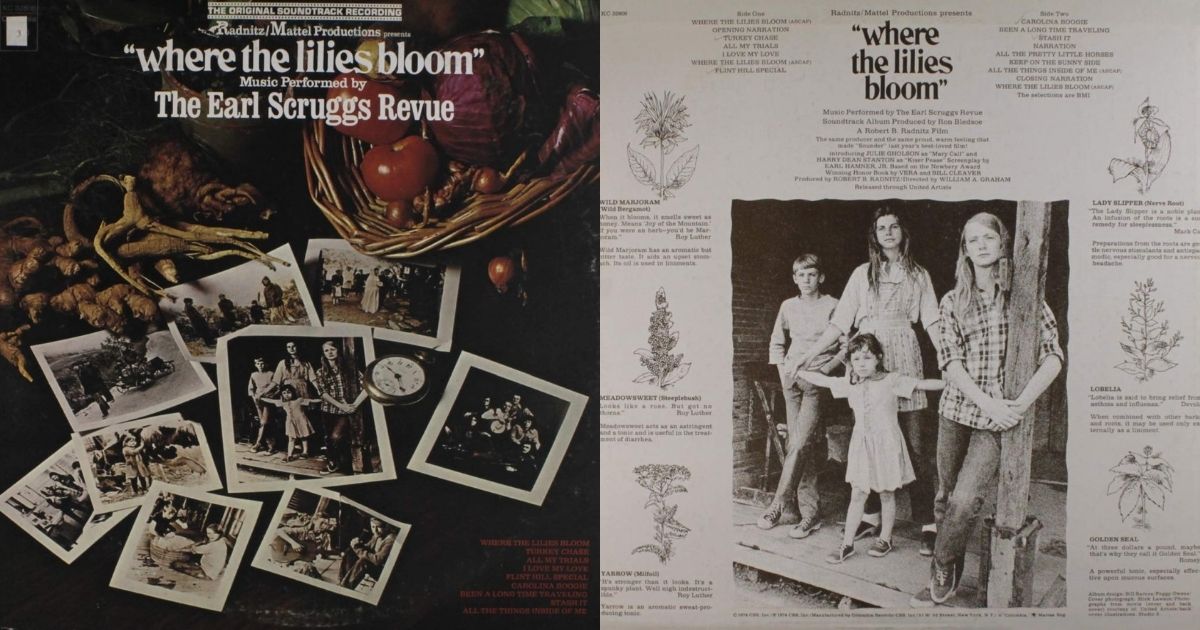
The album cover of Columbia KC 82806 announces at the top: “The Original Soundtrack Recording.” Below that comes “Radnitz /Mattel Productions presents, where the lilies bloom (all in large lowercase), then: “Music Performed by” and finally “The Earl Scruggs Revue.” All this is printed over a collage of color shots of herbs, along with nine little black and white stills from the film – one of which is the Revue.

On back of the album cover, we are told this is a ”Soundtrack Album Produced by Ron Bledsoe [for] A Robert B. Radnitz Film.” Cast members (but not band members) are listed. Next to this info are small columns, left and right, that list the tracks. Filling the center below all this is a large still of the film’s young lead actors; on either side of this are illustrations of wild herbs – three on each side.

In spite of the Revue’s lack of prominence on the album’s notes, I think that the band did a good job of coming up with new compositions and old-time tunes that represent their music in imaginative arrangements relating to the context of the film.

After relistening to the LP, I bought the film’s DVD, which was remastered and released in 2022 with an audio commentary by filmmaker and historian Daniel Kremer. The film opens (as does album track A1) with song “Where The Lillies Bloom” sung by its composer, Barbara Mauritz.

Singer-songwriter Mauritz (1949-2014), originally from Texas, was the vocalist with Lamb, an avant-garde folk-jazz-rock fusion group active in San Francisco in the early ’70s. Her first solo album, Music Box, was released on Columbia in 1972.

How did she end up on this movie’s soundtrack? I wish I knew! Being a Columbia artist was probably not coincidental. As we hear, she’s paired with another Columbia artist, Earl Scruggs, on the theme song at the opening. The Revue is laid-back in the track’s background at the start; eventually Randy’s guitar plays the melody, while Earl’s banjo sneaks up to end with beautiful 6/8 triplets in the background, and a few of Josh’s Dobro licks can be heard.

This is music meant to be heard in accompaniment to the visuals that open the film, aptly demonstrated by its trailer, which opens with the character “Devola Luther” (the oldest sister, played by Jan Smithers) singing “A Long Time Traveling” a cappella. The guitar is very much in the background, as is the banjo, which comes up only at the end.

The album contains three “Narrative” tracks by lead character Mary Call Luther which explicate the dramatic turning points in the film’s story. Following the first narrative track, A2, comes “Turkey Chase”, track A3, which plays beneath a scene in which the Luther children are trying to catch wild turkeys.

The Revue is actually playing the traditional fiddle tune “Chicken Reel,” led by Earl with brief interludes by Randy (lead guitar) and Josh Graves (Dobro). This is two minutes of really good straightforward old-time music, which the Revue knew well but rarely recorded.

The next track (A4) presents slow, moody instrumental music that plays behind scenes pertaining to the father’s death: “All My Trials,” a traditional spiritual with Bahamian connections popularized by Joan Baez in the ’60s. Randy’s lead guitar mixes with some nice piano, probably by Mauritz. It’s a pretty performance.

Track A5, “I Love My Love,” which plays behind a romantic sequence, was also popular in the folk revival. English composer Gustav Holst described it as a “Cornish folksong” in his arrangement of it. It’s sung here by Mauritz, over a finger-picked guitar which could be hers, or maybe that of Randy or Earl.

Track A6 repeats the theme, “Where The Lilies Bloom,” as a slow instrumental piece in 4/4 time. Randy’s finger-picked guitar plays it twice, and then Gary’s bass and Earl’s banjo join for two more verses. It really demonstrates Earl’s artistry – such control, economy, lyricism!

In the film’s soundtrack, The Revue plays Earl’s “Flint Hill Special” behind several action scenes – countryside automotive rambles – as Mary Call and the family are in conflict with Kiser. Here’s what that sounds like as played by Earl, Josh, and Vassar on the soundtrack:

The original pressing of the LP diverges from the movie soundtrack at this point, on Track A7, which is also identified as “Flint Hill Special.” No doubt that garnered Earl some royalties for his composition of that name, but the tune played on the original album is the traditional “Sally Ann,” a piece Earl recorded on his 1961 Foggy Mountain Banjo release. (This seems to have been corrected on digitally distributed versions of the album. Hear the LP’s version of “Sally Ann” below.)

It’s an interesting new version, opening with a couple of fiddle licks and then shifting to the percussive sound of the banjo strings being played with right-hand fingerpicking (a “roll”) while the strings are muted with the heel of the left hand. Then the fiddle steps up while at the same time Dobro, bass, and guitar enter – a powerful old-time bluegrass sound. Earl’s banjo takes over second time through, then the fiddle returns and finally Earl closes as he began, percussively. The “shave and a haircut” ending is dominated by Randy’s fancy guitar.

Side two of the album (track B1) opens with music from a scene in which the four Luthers, who’d been at the grocery store learning about wildcrafting, get a ride home from the store owner “Mr. Connell” (played by Tom Spratley). Here, the Revue is heard playing “Carolina Boogie,” basically an update of Earl’s up-tempo blues in G, “Foggy Mountain Special.” It features the entire Revue with a considerable amount of call-response between Randy and Vassar and a great ending.

The family’s funeral for the mountainside burial of their father includes “Been A Long Time Traveling” (track B2) sung a cappella by oldest daughter character, Devola. It’s heard twice, at the beginning and the close of the burial scene.

Following this, the film’s narrative shifts to wildcrafting, with Mary Call’s next visit to the grocery store to sell herbs backed by the Revue playing (track B3) Earl’s “Stash It,” a catchy banjo tune which starts slowly and speeds up.

Next, Mary Call’s poem about witnessing a starburst is heard on track B4, with subtle guitar and piano backup. It’s followed (track B5) by “All The Pretty Little Horses,” a traditional lullaby of African American origin, performed solo here by Randy’s fingerpicked guitar. In the film this plays behind a tender scene in which the Connells visit the Luther home.

Later, as the Luther children are depicted gathering herbs, the melody of the old Carter Family song “Keep On The Sunny Side” (track B6) is heard. First, it’s finger-picked by Randy on guitar, then Earl’s banjo comes in doing harmony. Neat! This is the ultimate father and son duet; Gary, on bass, is close by.

As the narrative approaches climax, we hear Barbara Mauritz singing her “All The Things Inside of Me” (track B7), accompanied by fingerpicked guitar, probably by Randy but possibly by Mauritz herself.

Mary Call’s final narrative (track B8) leads to the full band playing the theme; it’s heard at length as the film’s credits roll.

The preceding description, based on the album, does not point out all the places where the Revue’s music is heard on the film soundtrack – scenes where Randy’s guitar, Gary’s harmonica, Josh’s Dobro, and Vassar’s fiddle add aural nuances to the screenplay. Throughout the film, music editor Robert Takagi places in the aural background little quotes taken from performances like the final version of the theme. Randy’s guitar, in particular, is heard behind several scenes.

Other musical segments in the film are not heard on the album at all, but play a central role in evoking the film’s cultural milieu. Thus, while rambling in the car, they turn on a local radio station: the Revue is heard playing county-rock. Elsewhere, as they are walking home from wildcrafting, there’s a nice a cappella performance of “Feast Here Tonight” by youngest Luther daughter “Ima Dean” (played by Helen Harmon).

These musical segments remind us that the Revue, while featured on the album, is really playing in support of a story, a visual drama. As such their music here is different from that found on all their other albums. It does not sell the sound of the band – it speaks for images of the region’s atmosphere and its culture that emerge in the film’s narrative.


Read more about the Earl Scruggs Revue and find our entire archive of Neil’s Bluegrass Memoirs column here.

Neil V. Rosenberg is an author, scholar, historian, banjo player, Bluegrass Music Hall of Fame inductee, and co-chair of the IBMA Foundation’s Arnold Shultz Fund.

Photo Credit: Terri Thomson Rosenberg

Edited by Justin Hiltner.

Bluegrass Memoirs: The Earl Scruggs Revue Early Recordings

In our last Bluegrass Memoir, “Beginnings,” I described David Hoffman’s documentary, Earl Scruggs with his Family and Friends. By the time NET aired it, the Revue was already off and rolling with Earl’s new music.

In 1970, bluegrass festivals – the first was in 1965 – were becoming quite popular. The music’s supporters had discovered that such events could present their favorite music to broader, younger, urban audiences. These larger crowds brought their tastes and preferences with them. At these booming festivals, new acts like the Earl Scruggs Revue spoke to musical perspectives shaped by contemporary popular music.

The Revue played to large numbers at Monroe’s Bean Blossom Festival that spring and to Carlton Haney’s Camp Springs Festival on Labor Day weekend. Earl’s solo album, Nashville’s Rock, and Randy and Gary’s solo album, All the Way Home, were released that year.

The Earl Scruggs Revue at Bill Monroe’s annual Bean Blossom festival, Bean Blossom, Indiana, June 1970. (L-R) Unidentified bassist, Jody Maphis, Randy Scruggs, Earl Scruggs, Gary Scruggs, and Leah Jane Berinati. Photo by Carl Fleischhauer.

In 1971, Columbia released Earl Scruggs: His Family and Friends (C 30584), a soundtrack album that included much of the content of Hoffman’s documentary along with two additional fine vocals by Doc Watson. In its liner notes, Don DeVito characterized the show’s topic:

Earl Scruggs is a man who has paid his dues. You can forget the generation gap … Earl has always been an innovator and an adventurer…

Also in 1971, newgrass music emerged. Its key figure at that time was singer-songwriter and banjoist John Hartford, whose “Gentle on My Mind” had been a 1967 Glen Campbell hit. John had flourished in the LA television business as a writer for The Smothers Brothers Comedy Hour and a performer on The Glen Campbell Goodtime Hour.

Hartford and Scruggs – they’d met in 1953 – had developed what Bob Carlin, in My Memories of John Hartford (University Press of Mississippi) calls “a deep friendship.” When Hartford returned to Nashville in 1971, he recorded what is now considered the first newgrass album, Aereo-Plain. The Revue’s Randy Scruggs played bass on this ground-breaking disc alongside Tut Taylor, Vassar Clements, and Norman Blake.

The Revue and Hartford were at the center of Nashville’s jam-based music, which embraced musicians from new scenes blending rock and older genres – folk, bluegrass, and country. Both bands appeared at a number of bluegrass festivals in 1971 and the Revue was busy recording in Nashville.

I Saw The Light With Some Help From My Friends (1972)

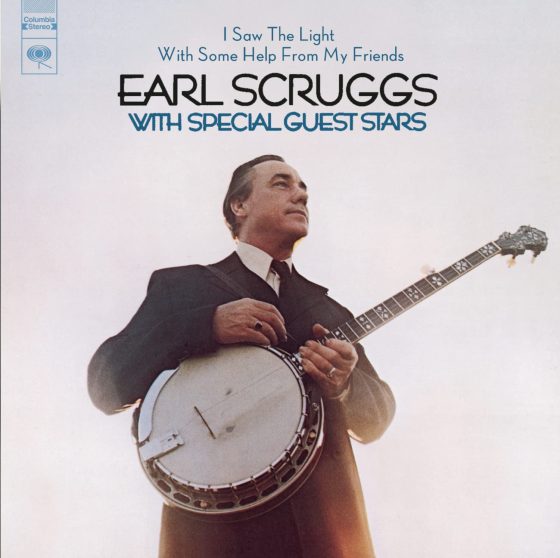
Earl was working on his next album, I Saw The Light With Some Help From My Friends: Earl Scruggs with Special Guest Stars. The back liners of the album (Columbia KC31354) described it as “Earl Scruggs and The Earl Scruggs Revue in performances with Linda Ronstadt/The Nitty Gritty Dirt Band/Stacey Belson and Arloff Boguslavaki.”

Stacey Belson was a pseudonym for blues singer Tracy Nelson, then with the band Mother Earth. Arloff Boguslavaki was Bob Dylan’s pseudonym.

Bill Williams’ liner notes describe the fabulous jam sessions that were happening at the Scruggs family house – hence the album’s concept:

Picture, if you will, the group sitting around together at the Scruggs home (although the actual locale was shifted to Columbia Studios) …

For this album, the studio became the living room and the producer was Don Law, the Nashville vet who’d worked in the ’30s with blues legend Robert Johnson and western swing pioneer Bob Wills and in the ’50s with Flatt & Scruggs.

At this Scruggs family jam session were Earl and sons along with their Madison High School contemporary, drummer Jody Maphis. Also in the room were fiddler Vassar Clements, in the process of moving from Hartford’s band to join the Revue, and several others who’d later join the Revue, including pianist Bob Wilson, a Detroit R&B musician who’d moved to Nashville and subsequently recorded with Bob Dylan.

Each of the featured star guests are heard in solo, sometimes singing in harmony with each other. Earl plays on every cut. Great to hear his backup work with all its nuances! Randy’s lead guitar and Vassar’s fiddling appear throughout.

It was as if these people had showed up at the Scruggs home one evening to play for and with each other – an old-fashioned domestic music session, with the host going around the room inviting each to perform and providing musical backups for all. The evening’s repertoire was the kind of stuff you might expect at such an event: mostly recent country, folk, blues and rock – things you might have heard on the radio lately in 1971.

The sound was that of contemporary popular music, suggesting that this was what you’d hear if the Earl Scruggs Revue came to your living room, festival, or auditorium.

The album’s first side opens with an LA country soul rock tune, Bonnie and Delaney’s “Lonesome and a Long Way From Home.” Gary is singing lead and playing bass; Nelson adds harmony. This is rocking R&B – Wilson’s piano opens the break and, with fiddle and drums, keeps it rocking to the end. Earl’s banjo is out front throughout.

Next comes Merle Haggard’s “Silver Wings,” sung by Linda Ronstadt with harmony by Nelson. The backup piano and Dobro are joined by a fiddle break. Straight-ahead Nashville country.

Track three features “Boguslavaki” (Dylan) singing Charles E. Baer’s 1896 hit, “It’s a Picture From Life’s Other Side,” a song that had gone into the folk tradition and been frequently recorded by hillbilly and gospel singers in the ’20s and ’30s. The laid-back fiddle, bass, and drums, along with Nelson’s harmony on the chorus, mark this as a parlor folksong.

It’s followed by Nelson’s performance of “Motherless Child Blues,” where accompanying musicians Earl, Norman Blake, Randy, and Vassar stretch out with some nice blues breaks.

This side closes with Mike Nesmith’s “Some of Shelley’s Blues,” performed with members of the Nitty Gritty Dirt Band, with Gary Scruggs and Jeff Hanna doing the singing and Earl and Randy both taking instrumental breaks.

The second side of the album opens with a vocal by Gary on another Bonnie and Delaney cover, “Never Ending Song of Love.” Ronstadt sings a county cover, Cash’s “Ring of Fire.”

Dylan brings out another pre-war country folk oldie, a great “Banks of the Ohio.” While Nelson is featured singing folksinger Bruce “Utah” Phillips’ “Rock Salt and Nails,” a song first recorded by Flatt & Scruggs in 1965, with Ronstadt adding harmony on the chorus.

The Nitty Gritty Dirt Band contributes another Nesmith song, “Propinquity.” The side closes with the album’s title track, a sing-along for everyone, “I Saw the Light.” The album was released in 1972.

Will the Circle Be Unbroken (1972)

Around the same time as I Saw The Light was made, banjoist John McEuen of the Nitty Gritty Dirt Band asked Earl to be on their new three-LP concept album, Will The Circle Be Unbroken. Scruggs was playing in Denver with the Revue when he and McEuen met. The Dirt Band’s sound, with McEuen’s skilled Scruggs-style banjo, appealed to him, as did their project to honor and make music with the earlier generation’s pioneers. That had been his own goal in bringing Maybelle Carter into the studio to record with Flatt & Scruggs back in 1961.

Earl, well-connected in Nashville as an Opry star with record, television, and movie hits, helped bring a number of his country music friends into the project. Both Gary and Randy were also involved, as were several of Hartford’s Aereo-Plain band members, notably fiddler Vassar Clements and Dobro player Norman Blake.

Unlike Earl’s Nashville’s Rock album, which covered recent rock and pop hits on the banjo with Nashville studio backing including electric instruments and, on several cuts, a soulful female vocal trio and a string section, this album had completely acoustic backup by the Dirt Band as they covered legacy hits by country, bluegrass and folk pioneers like Roy Acuff, Maybelle Carter, Doc Watson, and Jimmy Martin.

Earl played a pivotal role in the making of these recordings, playing guitar or banjo on sixteen tracks. The whole Scruggs family can be heard: Randy contributed guitar, autoharp, or voice on eleven tracks, Gary sang on eight, and Louise and Steve sang on one track.

Of the many interesting performances on this award-winning album, Randy Scruggs’ acoustic guitar version of “Both Sides Now” was perhaps the most remarkable; the final selection in the set, it followed a group sing-along of the title track, similar to the closing on the Earl’s I Saw The Light, in which all of the Scruggses sang. These recordings, released in 1972, were made in August 1971.

The Scruggs Brothers (1972)

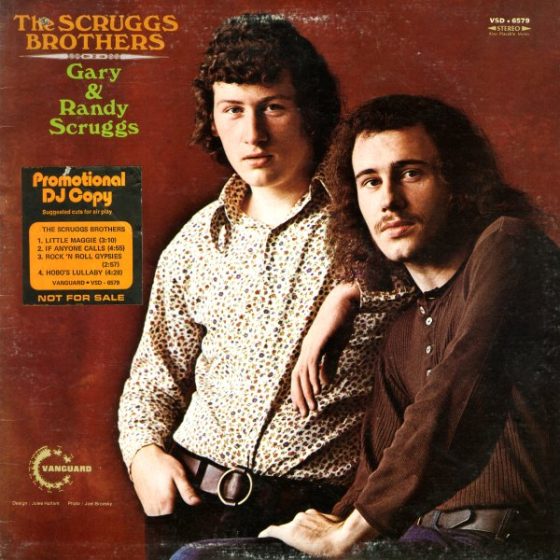
Also recorded in 1971 was Gary and Randy’s second Vanguard album, The Scruggs Brothers (Vanguard VSD 6579). Some of the same musicians who played on I Saw The Light performed here, like Tracy Nelson, the Dirt Band’s Jeff Hanna and John McEuen, pianist Bob Wilson, and drummer Karl Himmel; but the album had more of a country rock sound. It opened with “Little Maggie,” a song Flatt & Scruggs had recorded at Carnegie Hall in 1962. With Gary’s bass and Jody Maphis’ drums leading the way, it sounded something like the Nashville studio A-listers Area Code 615’s 1969 version.

Throughout the album, Randy played a majority of the solo breaks, some on acoustic guitar but most on electric, in a heavy metal style similar to what I heard him playing in Maine in 1975. Four tracks were their own compositions, two by Gary and two collaborations.

On one, the instrumental “Trousdale Ferry Rag,” Earl played banjo. This up-tempo, bluegrass-style piece has an unusual ending, shifting to a slow blues beat. Most notable is Gary’s “Lowlands,” a great ballad set to the tune of Earl’s “Sally Ann,” which both brothers had been hearing at home all of their lives (Flatt & Scruggs recorded it in 1960). Gary plays guitar, Randy picks banjo.

Covers of older (dare we say traditional?) material includes a rocking version of Jimmie Rodgers’ “T for Texas,” and the other cut on which Earl played banjo, “Hobo’s Lullaby,” which features a sing-along chorus similar to that on the closing of the I Saw The Light and Will The Circle Be Unbroken albums. Another older piece was “The Johnson Boys” (Flatt & Scruggs did it 1962) on which John McEuen’s frailed banjo created the album’s most old-timey sound.

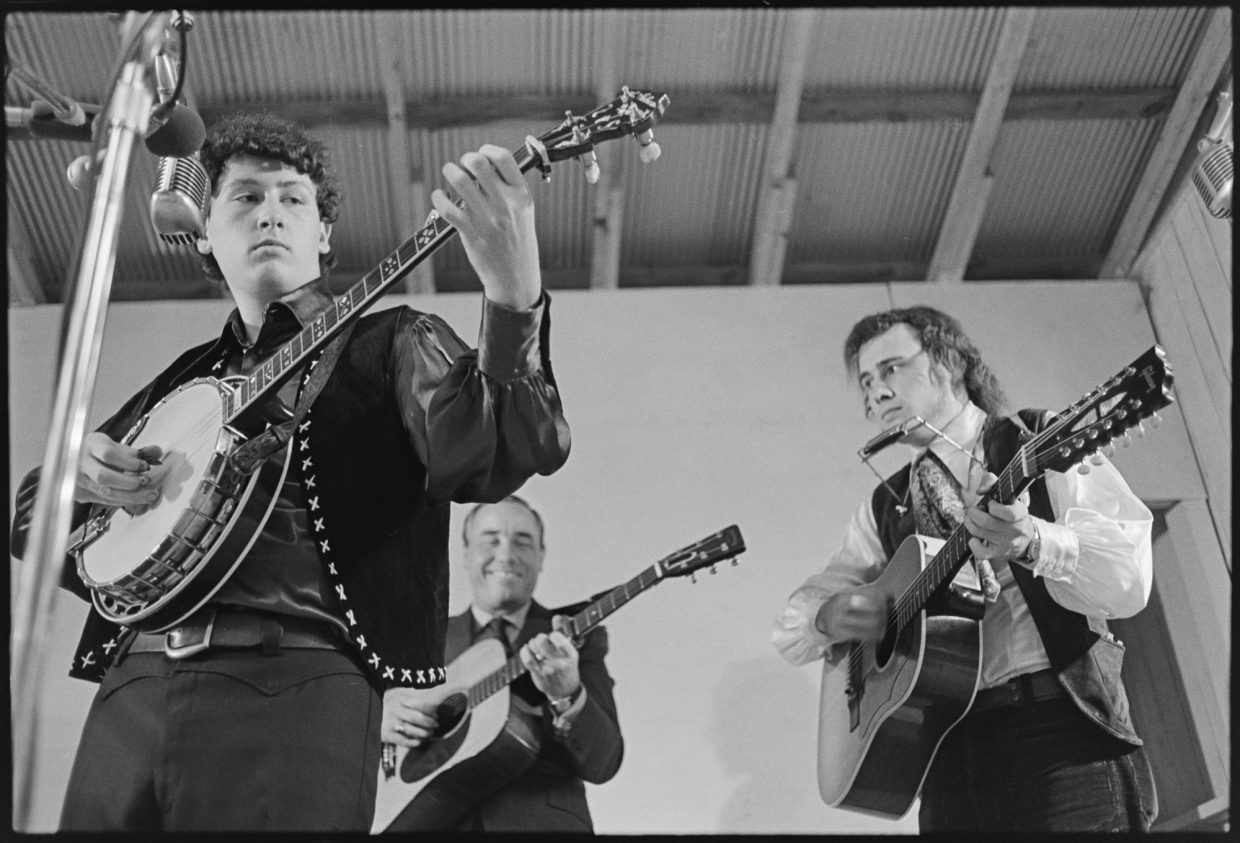
The Earl Scruggs Revue at Bill Monroe’s annual Bean Blossom festival, Bean Blossom, Indiana, June 1970. Randy Scruggs, Earl Scruggs, and Gary Scruggs. Photo by Carl Fleischhauer.

The boys’ continuing involvement with country rock is reflected in two songs that originated in 1967 with the LA band Hearts and Flowers. “Rock and Roll Gypsies,” which closes the first side of the album, seems to have been an attempt to garner radio play – it’s the only track on the record to include string section backup. The other Hearts and Flowers-connected track, “Bugler,” a sad song about the death of a dog, had recently been covered by Clarence White with the Byrds.

Live at Kansas State (1972)

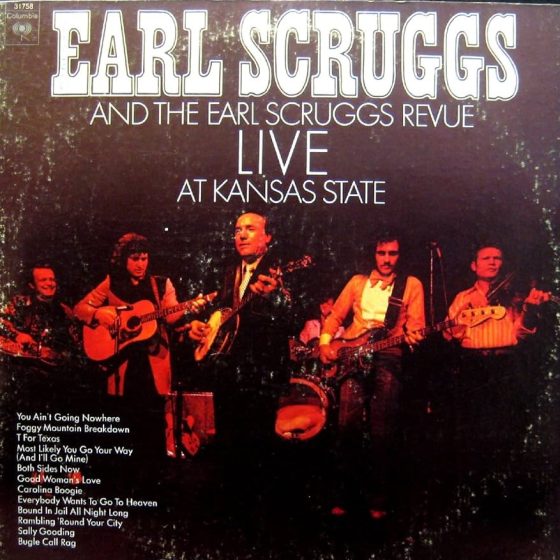
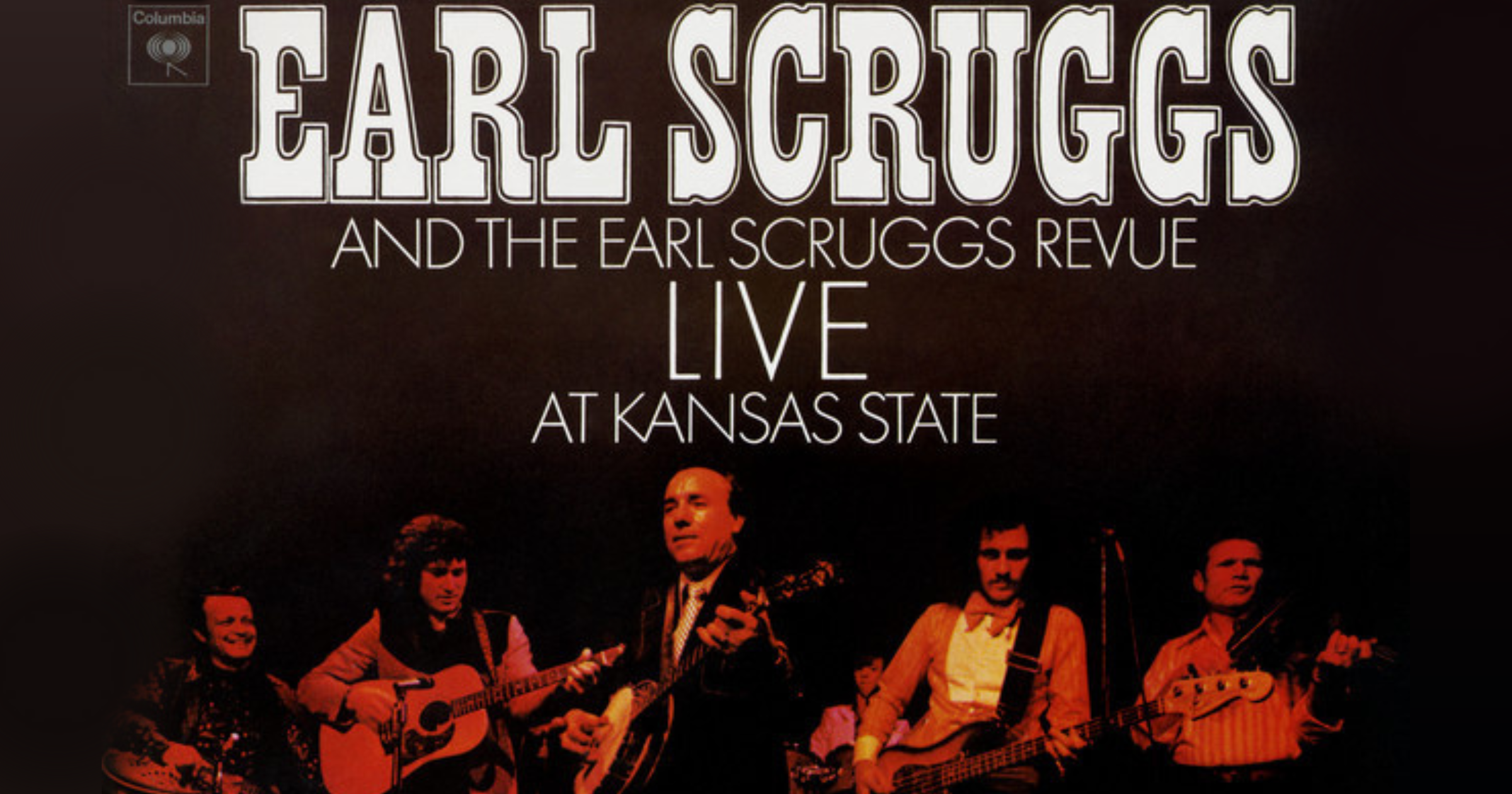
During this year of extensive studio recording, the Revue was also out playing on the road. Although Earl Scruggs: His Family and Friends included a few examples of the group in action outside the studio, Live at Kansas State (Columbia KC 31758) was their first full show album.

Many of the songs the Revue did at this 1972 concert remained in the band’s regular repertoire and showed up, for example, at the 1975 Maine concert, including “T for Texas,” “Paul and Silas” (they titled it “Bound in Jail All Night Long”), “Sally Goodin[g],” “Carolina Boogie,” “Everybody Wants to Go to Heaven,” and “Foggy Mountain Breakdown.”

Several were on their recent albums, like “You Ain’t Going Nowhere” and “Both Sides Now.” Bluegrass classics included “Good Woman’s Love” and “Bugle Call Rag.”

In 1998, a reviewer for No Depression wrote that Live at Kansas State was “probably their album most deserving of a full reissue … a surprisingly cohesive ‘bluegrass-rock’ blend, the likes of which has seldom been heard since.”

In 1972, the band included fiddler Vassar Clements and Dobroist Josh Graves, a bluegrass icon who’d just left Lester Flatt’s band. The album package has several photos of the band; these are notable in that they include everyone but pianist Bob Wilson, who is very much present in the album’s audio.

Wilson had moved to Nashville from Detroit’s R&B scene. His first years in Nashville were slow going, but that changed when Bob Dylan came to town to record Nashville Skyline and wanted “a funkier piano sound than the usual Nashville cat could produce.” The success of his work on Dylan’s album gave him plenty of studio work and he also found time to go on the road with Scruggs.

“When I was with the Earl Scruggs Revue,” he recalled, “Earl always introduced the band, and when he came to me, he always told the crowd, ‘And this is the man who played piano on Nashville Skyline, Bob Wilson.’ I must admit the applause felt really good.”

In his memoir, Bluegrass Bluesman, Graves spoke of the challenges he enjoyed while rocking with the Revue: “Earl and that bunch forced you to work up new licks. You had to come in there on the stuff they were playing. It was so loud I couldn’t hardly stand it, but I really enjoyed it. It opened a lot of doors for me. They were into a lot of things. …”

“Earl was doing the same old tunes with a little modern touch. Earl got bored with bluegrass – I’ll tell you that. He just didn’t want to play it anymore. They had that big beat, that sound behind it, and that’s what he liked.”

“He’d play ‘Foggy Mountain Breakdown’ with that band and people would go wild.”

I saw this, too, in Orono in 1975.

The Revue carried on into the early ‘80s, with albums that drew from contemporary pop music and brought younger country, folk, and rock stars in as guest artists. We’ll touch on a few of these next time.

(Editor’s Note: Read our prior Bluegrass Memoir on the Earl Scruggs Revue here.)


Neil V. Rosenberg is an author, scholar, historian, banjo player, Bluegrass Music Hall of Fame inductee, and co-chair of the IBMA Foundation’s Arnold Shultz Fund.

Photo of Rosenberg by Terri Thomson Rosenberg.
Inset black and white photos by Carl Fleischhauer, courtesy of Carl Fleischhauer.

Edited by Justin Hiltner.

Bluegrass Memoirs: The Earl Scruggs Revue Beginnings

Nearly 50 years after the Earl Scruggs Revue concert I saw at the University of Maine, an internet search led me to Jaime Michaels of the opening act, Beckett. He still has vivid memories from that night in Orono. I sent him a copy of my report. He wrote back, saying:

I have no idea about the song titles but it was nice that my ’63 Gibson J50 got a mention … I still have it.

He has vivid memories of his time backstage with Scruggs.

… at the very end of Earl’s set as he walked back out for his 3rd or 4th encore he stopped and said to me “If I’d just play the darned thing right, I wouldn’t have to keep going back out …”

A little later as we were all loading out Earl came up to us and said, “Do you guys want to see my new bus?” He took us for the grand tour. I was still pretty young and had never seen a real tour bus before.

He was such a sweet guy with this humble self-effacing humor.

Earl was proud of that bus, I reckon; he’d named an instrumental after it.

When I saw them in 1975, the Earl Scruggs Revue was a polished Nashville rock act that had been together since 1969. Debuting at a folk festival that May, not long after Scruggs split from Lester Flatt, it featured Earl’s sons.

The two oldest, Gary (then 20) and Randy (then 16) were already Nashville recording studio veterans. They’d been in the Columbia studios multiple times (Gary 11 sessions, Randy 15 sessions) since May 1967, helping on the last three albums Lester and Earl made before their split (Changin’ Times, The Story of Bonnie & Clyde, Nashville Airplane).

Also new to Flatt & Scruggs, in the fall of 1967, was Columbia producer Bob Johnston, then 35. Concerned about declining record sales, Columbia had replaced Frank Jones and Don Law, highly regarded Nashville veterans who’d been producing F&S since the fifties, with Johnston, who was producing Bob Dylan.

Dylan had stunned the folk world when he went electric at the Newport Folk Festival in 1965. He first recorded in Nashville in 1966, completing Blonde On Blonde there using mainly Nashville studio musicians. In the next two years he returned, making John Wesley Harding and Nashville Skyline.

Flatt & Scruggs’ final albums reflected their move to Johnston, a leading producer at forefront of Columbia’s move from acoustic folk into electric folk rock.

Later, when asked about what led to the split with Earl, Flatt spoke of his difficulty in singing the band’s new songs. “Johnston,” He said, “…also cut Bob Dylan and we would record what he would come up with, regardless of whether I liked it or not. I can’t sing Bob Dylan stuff. I mean, Columbia has got Bob Dylan, why did they want me?”

Of the final three F&S albums, both Changin’ Times and Nashville Airplane had folk-rock repertoires. At the very first session for Changin’ Times, four folk-rock favorites were cut, three Dylan hits, one by Ian Tyson: “Don’t Think Twice,” “Four Strong Winds,” “Blowin’ In the Wind,” and “It Ain’t Me Babe.” Here, Earl’s boys Gary (singing) and Randy (lead guitar) were together for the first time in the studio with Flatt & Scruggs and Johnston.

Imagine the dismay of Lester (who, soon after splitting with Earl, would record “I Can’t Tell The Boys from the Girls“) at this session! It seemed as if the young longhairs with their strange new music were taking over.

Released in January 1968, the back cover of Changin’ Times was filled with the image of a rock poster. Unsigned notes beside it read:

With their smash appearance at the Avalon Ballroom (a West Coast temple of rock and light-shows) when they turned on the whole of San Francisco, there are no new worlds left for Flatt and Scruggs to conquer. Flatt and Scruggs are for everyone.

One of the album’s 11 tracks was a remake of Earl’s “Foggy Mountain Breakdown,” which had just become a hit through the soundtrack of Bonnie and Clyde. Five tracks were by Dylan; the album closed with Woody Guthrie’s “This Land is Your Land.”

Gary and Randy Scruggs personified the Lovin’ Spoonful’s “Nashville Cats,” but also in the studio for that album were other, older, Nashville cats – Charlie Daniels, Grady Martin, Bob Moore, Charlie McCoy and other A-team studio musicians. Randy and Gary would come to know these men well as they built life-long careers in the Nashville studios. These careers were forged during their years (1969-82) with the Earl Scruggs Revue.

Fortunately, the Revue’s earliest days were chronicled in a television documentary. David Hoffman’s ninety-minute NET TV special, Earl Scruggs: The Bluegrass Legend – Family and Friends, was recorded in 1969-70. It has been issued on DVD several times since then and can be seen on YouTube.

It’s fascinating to watch Hoffman’s documentation of Scruggs as he narrates his past, voices his present, and sets out his future directions. Along the way, Hoffman captures Earl’s music-making with a wide variety of performers and audiences. By the end of those 90 minutes, Scruggs’ cultural and political perspectives are manifest; likewise the breadth of his musical tastes.

Hoffman filmed in New York, North Carolina, Nashville, Washington, D.C., and California. The documentary opens with a five-minute jam session: Earl, Gary, and Randy are in upstate New York visiting Bob Dylan at the home of illustrator and sculptor Tom Allen, who had done many Flatt & Scruggs album covers. After Bob sings “East Virginia Blues,” Earl asks him if he’d like to hear their version of “Nashville Skyline Rag,” the instrumental title track from Dylan’s most recent album. I don’t know when this jam took place, but in mid-August of 1969, when Earl was in the studio with Lester to record Final Fling: One Last Time (Just For Kicks), an album they’d agreed to make after their split, the first track they recorded was “Nashville Skyline Rag.”

The tune became a fixture in the Revue concert repertoire, used, for example, as the show opener at Orono in 1975 and in 1977 when they played PBS’s Austin City Limits. Earl had recorded it again in 1970 for his first solo album, Nashville’s Rock.

After the jam with Dylan, the film’s next twenty minutes take the viewer with Earl and the boys to his North Carolina home with visits to the Morris Brothers (the first group he’d worked with), Doc Watson, and Scruggs family and friends in the Flint Hill community. It closes with a shot in which Earl speaks of how he’d taken the banjo to different types of music: “Now it’s easy to blend with today’s music. It works very well. I’m really happy. I had dreams of this.”

The next five minutes come from a jam session with the Byrds at a ranch outside Nashville. It begins with them doing “Nothing To It” (the title Earl used for “I Don’t Love Nobody,” when he recorded this tune with Doc Watson) followed by “You Ain’t Goin’ Nowhere,” a Dylan tune that was on the Byrds’ Sweetheart of the Rodeo, the 1968 album that is often thought of as a foundational statement of country rock.

It’s followed by four minutes with electronic music pioneer and composer Gil Trythall, who plays along on Moog synthesizer with Earl and Randy doing “Foggy Mountain Breakdown.”

Then comes an interview with Charlie Daniels, at the time an associate of Bob Johnston, soon to become one of country rock’s leading figures. The focus shifts as he, Earl, and the Revue attend the second Moratorium to End the War in Vietnam, held in Washington, D.C. on November 15, 1969 – generally considered to be the largest demonstration ever in Washington. After performing “Foggy Mountain Breakdown” there, Earl speaks of his opposition to the war.

Back in Nashville, Daniels is co-producing (with Neil Wilburn) All The Way Home, the first Scruggs Brothers album, for the New England folk and classical label Vanguard. The film follows them into a Nashville studio.

Earl is also working on an album, his first post F&S solo project, Nashville’s Rock. After listening to a demo of one track at the Scruggs home, we see an old friend of Earl’s, Dr. Nat Winston, give testimony to his character, and then Earl demonstrates how he creates his music, explaining that he’s self-taught. Next, we meet Earl’s wife Louise, who’s worked as his manager for fifteen years. She points out that Earl was immersed in the music from age five and that their son Randy has had the same experience.

A shift of focus to Randy follows, as we see him picking “Black Mountain Rag” (a guitar performance reflecting the Scruggs affinity for Doc Watson), and then go with him to class at Madison High and have a chat with his principal, who talks about Randy’s “skipping school.”

After hearing from Louise about how she met Earl at the Grand Ole Opry, we drive on a spring afternoon (in 1970) with the Scruggs family from home to the Ryman Auditorium in downtown Nashville. Inside, Earl, with Randy, joins Bill Monroe and the Blue Grass Boys in a backstage dressing room for a jam and then we witness the Revue’s debut on the Opry stage.

In the center is Earl on banjo, flanked by Randy on guitar and Gary on bass and vocals. Also in the band is Jody Maphis, a contemporary of the Scruggs brothers and son of country stars Joe and Rose Maphis, on guitar. He would subsequently move to drums and remain in the Revue for about a decade. On piano and tambourine is Leah Jane Berinati. Except for Earl, this was a group of kids, dressed like young flower power types. They perform two very conservative old traditional songs, “Nine Pound Hammer” and “Reuben,” to an enthusiastically appreciative audience.

The last twenty-five minutes of the documentary follow the Scruggs family as they travel, early in 1970, to California’s Bay Area for a visit and a jam in Joan Baez’s home. Joan, with her young newborn son Gabriel nearby, chats with Earl about their 1959 meeting at the first Newport Folk Festival. She sings two songs (both are Dylan compositions) and then, while photos are shown of her husband – Gabriel’s father David Harris, whose Vietnam protests had led to federal imprisonment for draft refusal – she sings “If I Was A Carpenter” with Gary. A heady mix of politics and music.

The film closes with Earl back in North Carolina talking again about his musical aspirations:

Keep up with the times and make as much progress with the banjo along with other instruments as long as it blends in as possible.

As the credits roll, we hear Earl playing “Folsom Prison Blues” using his tuners.

This documentary, aired at the height of the Vietnam war, included a forthright statement of opposition from a leading figure in Nashville, where there was considerable support for the war. The documentary was also a carefully crafted showcase of the Revue’s folk/country rock repertoire, musical style, and cultural connections.

The albums that Earl and his two oldest sons were working on while Hoffman was making the documentary released before its broadcast and both contain songs and tunes that appear in the film. A couple of examples: “Train Number Forty-Five” (F&S’s radio theme in the early days), which is heard in Earl and Randy’s backstage jam with Bill Monroe, is also heard on Earl’s album Nashville’s Rock. Similarly, Randy’s version of “Black Mountain Rag,” an acoustic guitar solo in the documentary, is heard on the Scruggs Brothers’ album, All The Way Home, in an extended version with not only acoustic and electric guitar breaks but also a banjo break in his father’s style.

In the next Bluegrass Memoir we’ll see how, by 1971 and 1972 when this documentary was broadcast, the Earl Scruggs Revue was appearing on a series of albums that realized Earl’s aspirations and helped launch his touring.

(Editor’s Note: Read our prior Bluegrass Memoir on the Earl Scruggs Revue here.)


Neil V. Rosenberg is an author, scholar, historian, banjo player, Bluegrass Music Hall of Fame inductee, and co-chair of the IBMA Foundation’s Arnold Shultz Fund.

Photo of Rosenberg by Terri Thomson Rosenberg. 

Edited by Justin Hiltner.

Bluegrass Memoirs: The Earl Scruggs Revue in 1975

Soon after Earl Scruggs and Lester Flatt ended their partnership and their band The Foggy Mountain Boys in 1969, Earl created The Earl Scruggs Revue with his sons. They recorded for a major label, Columbia, and toured regularly until 1980, disbanding in 1982. This is the story of how I came to see, hear and take extensive notes about their 1975 concert at the University of Maine.

In 1969 I was living in St. John’s, Newfoundland, working at Memorial University’s folklore department where I taught a yearly course, Introduction to Folk Song. I knew that bluegrass drew from folk traditions in the U.S. Southeast, for I had been playing bluegrass and writing about it for a decade. But I could tell my students little about the Canadian milieu. So, in the early ‘70s I began research in Canada’s Maritime provinces of Nova Scotia, Prince Edward Island, and New Brunswick

In August 1974, I moved to New Brunswick for a year’s sabbatical. My research project was a study of regional and local relationships between country music and folk music traditions. I did extensive fieldwork – interviews and documenting events, collecting music.

That fall, I met a singer-collector of country records and song folios, a perfect example of the kind of folk-country connection I was studying. I recorded several hours of his songs and began contemplating publishing them in an album.

I thought at once of Rounder, a new record company that had been publishing innovative roots albums. I’d met the Rounders – Ken Irwin, Bill Nowlin and Marian Leighton, a music collective – at an American Folklore Society meeting. They knew me as a writer about and collector of bluegrass.

Early in the new year I arranged to visit them. In February 1975, I set out in the family pickup with my ten-year-old daughter Lisa from our farmhouse in Pleasant Villa, New Brunswick to Brooksville, Maine, where we visited relatives. Lisa stayed with them while I drove further south to Somerville, Massachusetts, to visit the Rounders.

David Menconi, in his new book, Oh, Didn’t They Ramble (U of NC Press), describes well the scene at the Rounder collective’s big old Somerville house, with their newly flourishing roots music record company. We discussed projects, they took me down to the basement to see their mail order records inventory, and I came back to Brooksville with a load of LPs and lots of news about the contemporary bluegrass world.

Brooksville is a little over an hour away from Orono, site of the University of Maine, where my friend, Edward D. “Sandy” Ives, lived. Sandy was a great writer, a folklorist who’d studied and published books about 19th century singer-songmakers in Maine and the Maritimes. I was looking forward to discussing my ongoing research with him. After I returned from visiting the Rounders, we drove up to Orono to see Sandy and his wife, Bobby.

When we got to Orono, a young friend and former student of mine at Memorial, Lisa Feldman, was staying with the Ives. It was she who alerted us about the Earl Scruggs Revue concert and went along with us to it.

In St. John’s, I regularly bought new bluegrass albums by mail order from County Sales. I don’t recall paying much attention to the Revue then. County didn’t carry their albums.

Revue albums were not easy to find in Newfoundland. Working on a Flatt & Scruggs discography and, admiring Scruggs’ banjo artistry, I wanted to hear his contemporary work. I bought all the Revue albums I could find. By the fall of 1974, when I moved to New Brunswick for the sabbatical, I’d gotten seven.

Those records were in storage back in Newfoundland for the year, but I’d brought my stereo set along and by December I’d found a new Revue album, Rocking Across the Country (Columbia KC 32943). There was nice Dobro on it by Josh Graves and one great instrumental composed by Earl, “Silver Eagle” – named, presumably, for the band’s bus.

During that year I was doing field research at music events and venues – bars, jamborees, concerts, jams – and had developed a system of documenting them. I carried a 3″ by 5″ notebook (spiral binding, ruled pages) and took notes. This was with me all the time and so it just seemed like an easy thing to take notes as usual at this concert.

What follows are my notes from that February 7, 1975, concert, written up from my notebook when I returned to Pleasant Villa the following week.

Friday, February 7, 1975
Orono, Maine
Report on Earl Scruggs Revue Concert at the University of Maine, Orono.

Tickets were $3.50. I went with Sandy Ives, and we were joined at the concert by Lisa Feldman and by [Sandy’s wife] Bobby and [their daughter] Sarah Ives and [my daughter] Lisa R., who had all gone to see a Robin Hood movie. The concert was sponsored by the student union and represented a slight departure from previous concerts of this type in that instead of bringing high-powered “name” outfits on which a lot of money had been lost, they were now trying slightly less expensive acts. The concert committee was dominated by frat boys who didn’t know about music, according to Lisa [F.].

Site of the event was the basketball gym. Folding chairs were placed on the court, and wooden bleachers were placed around the side (these might have been permanent, but seemed moveable… small point). There were balcony seats on both sides and at one end, the end over the doors through which we entered. At the other end a stage was set up. Dominated by big columns and horns on either side – your typical rock concert setup. Sandy and I took seats on the left side of the bleachers (as you face the stage), about three rows up and we were about 2/3 to 3/4 of the way back from the stage toward the entry doors. Directly ahead of us in the middle of the floor was a raised platform on which the controls for the sound were set, along with a chair or two for the operator(s?). Behind this, higher and close to the back, was another platform with the lights. During the concert the colors were constantly being changed and moved about from tune to tune by a light man who must have known something about the Scruggs show in advance.

The audience consisted of college students almost exclusively. I didn’t see any old-time Martha White fans or country music types. Dress was Levi’s and hippie mufti – knit caps, ragged but interesting coats, vests, long dresses, patches, etc. There was a lot of smoking going on and some drinking. Before the show a long-haired young man who represented the powers that be got up and told the audience that there was no smoking and no drinking and that if they were caught, they would be ejected from the show by the campus police. In addition he said that, if you must smoke, then don’t get caught. But also, he said, please don’t put out your butts on the floor of the basketball court – a lot were last time, and the University is threatening to not let them have concerts if this continues. Burden of the speech: Here are the ground rules, don’t get caught, play it cool.

The campus police were cruising up and down the aisles dressed in dark blue uniforms with dark blue shirts and black ties with dark blue Stetsons. Something like Civil War Union Army officers in movies. And they were looking very serious and hawk-like.

The warm-up act was introduced, as a group from Boston, “Beckett.” The group consisted of Phil B. (missed his last name, [Buller]), who came on playing a D28 guitar and a harmonica, Steve Delaney, playing an electric bass, and Jaime Michaels, who played a D18 Martin guitar and did the emcee and lead singing in the first few numbers. Later they all switched around, with each doing some lead singing and some emceeing. I took notes in the darkened auditorium with a fancy movie critic’s pen that [then wife] Ann had given me — lights up in the dark, illuminating one’s pad. As it were.

The first song was “CLEAR BLUE SKY.” There were a few catcalls from the balcony and a rather tentative feeling from the audience. A whiff of authentic marijuana smoke drifted my way during this (and subsequent songs), and I could see people lighting up in various places. Later, the folks next to me surreptitiously passed a bottle (beer, I think) around. At the end of the first song, the Beckett emcee made a sly crack about “Maine Mounties” and from there the show built — they had the audience with them.

Next song was “SOMETHING NEW.” As all this was going on, the cops were cruising up and down the aisles, occasionally throwing people out, but generally arriving on the scene after the cigarette had been extinguished. They were on the lookout for tell-tale lights, and one time one went by us while I was jotting down a note with my fancy pen. He gave me a hard look and some of the people around me had a good giggle about that.

Next song, [“WE ARE FREE”]. These guys weren’t musically bad, but I could not really get into their music. The harmony singing was kind of Crosby/Stills/Nash and actually a bit weak; the instrumental aspect of it was bland. A note here says “harelip,” but when you wait ten days before writing up your notes you forget the jokes, I guess. Next one of the boys took up an Ovation guitar – this was Phil B., and the song was “LAST TUESDAY MORNING.” Then Jaimie mentioned that they were from Virginia and that they considered it an honor to be appearing with the Earl Scruggs Revue. Then they did “TENNESSEE.” Next, “I’LL TRY IF YOU’LL TRY.” Most of their songs were their own compositions, I guess. I didn’t recognize any of the above; the names in brackets are ones they didn’t announce that I guessed at from the words. Now Phil took up the Ovation again Steve took an electric guitar and they did a song they had written while in Pittsburgh, [“STOLE AWAY”]. Using the same instrumentation, which, incidentally, sounded better than the acoustics – that is, the electric came over with much more tone – they did “PERFECT HONEY.”

Now another instrument switch with Phil taking up an old Gibson J50 guitar and Steve going back to the bass. The song was introduced as a “folk song” for reasons which eluded me at the time. It was “SEARCHING,” but not the Coasters’ smash hit. With the same instrumentation, they then launched into a song written either by or about some friends in Boston, “COUNTY LINE.” Then, as their final tune, a song they introduced as being by Joni Mitchell and needing no introduction (?). It was well received by the audience, and they got an encore.

They came on and did a song which they introduced as a real old one by that old bluesman Eric Von Schmidt (time flies – I remember Rolf Cahn telling me in 1959 that he’d been picking with a really good kid in Boston who even did some slide guitar, a kid named Rick Von Schmidt). Song was “AIN’T NOBODY’S BUSINESS BUT YOU OWN,” and they did it well. Kids in the front of the audience got up and started waving their hands in the air, literally surrendering to the music. For the second encore, it was another Von Schmidt tune, “GRIZZLY BEAR (SOLID GONE).”

Another intermission, punctuated by further entreaties by the same fellow. By this point, the cops were less in evidence although during the second half they did eject several people sitting around me.

Enter the Earl Scruggs Revue, who plug in and pick away at once on “NASHVILLE SKYLINE RAG.” Across the front of the stage are three microphones; at my left stands Stevie Scruggs, who plays rhythm guitar (a Gallagher) most of the evening, except for one banjo tune. Next to him is Randy, who is bent over his Gallagher guitar, doing the lead work. Characteristically I guess you never see his face when he’s picking, he’s looking at the fingers and anyhow is surrounded by hair. Later, in various numbers which I didn’t note, he plays a bright red Gibson electric with twin cutouts and a thin (hollow?) body, which has a very mellow tone.

Next to him, in stage center, is Earl. Earl’s Mastertone is electrified with some sort of pickup inside, a Barkus-Berry or FRAP of some kind I guess. This surprised me, as did the fact that he was wearing the instrument much lower than when he played with Flatt. He was not bopping around as much as the boys (who, in turn, were not bopping around as much as many or most rock groups), but he was looking very relaxed, had the old smile of yore, and did move when he played more than I remember from the Martha White days. On the right and, rather standing back was poker-faced Gary, who played bass and did the lead singing. When there was any part singing done, Earl and Randy took the center mic, Steve the left-hand one, and, behind them Jody Maphis took his vocal parts on a separate mike over the drums. To my right behind and to the right of Gary, was a piano where Jack Lee the pianist sat. This is the same guy on the cover of the Rockin’ Across the Country album. [This is not correct. The guy on the cover of Rockin’ is Shane Keister, who is listed on the album cover as “keyboard instruments.”]

My first impression was one of tightness, in the sense that the band was really together and tight. And although I can’t say I like Earl’s banjo sound as well with the volts surging through it, it was sounding like a banjo and Earl did get quite a few tonal nuances from it without the visible aid of a tone control. Randy was as good as the recordings led me to expect, however, he frequently seemed to be “grandstanding” it, by playing freak-out type rock licks way up the neck which were spectacular and, effective in terms of inciting the audience, but which were as far as I was concerned not as nice musically as the well thought out stuff he did or does on record. So I was a bit disappointed in Randy.

My reaction to Earl was just the opposite. He has sounded a bit stiff and mechanical on the records I have heard (and I got ‘em all, Jack), but tonight he was nicely in the groove and seemed to have some very interesting new ideas, especially rhythmic variations, which I hadn’t heard before. He really seemed to be enjoying himself, too. After this tune, the members were introduced and they went right into “I SHALL BE RELEASED,” following which, Earl introduced the next song as an old “shouting type number,” “PAUL AND SILAS.”

Gary’s singing is o.k., it fits the music and sells the songs to the rock programmed audience. Doesn’t bother me, doesn’t excite me; seems to be better in person than on record, and better on recent record than on older records. Earl next says this is an old number he used to play at square dances back when they only had one instrument, and he says, “We’ll show you what it was like to do it alone and then we’ll show you why I was so glad when someone else came by with their instruments to help me out.” He doesn’t announce it, but it’s “SALLY GOODIN.” Intro and arrangement are as on the Kansas State album. They really get rolling (and rocking) on this one, with Earl and Randy engaging in some nice banjo-guitar call-response stuff. The audience responds here as it does again and again later on to the faster tunes, by standing up and waving their hands, shouting, etc. Following this, Earl mentions the Kansas State album by saying that the next tune is on it, an old Jimmie Rodgers tune, “T FOR TEXAS.” Next, Randy is to pick a fiddle tune on the guitar, and it turns out to be “BLACK MOUNTAIN BLUES.”

The next tune, an instrumental, was a [Blues in F] and then, coming without an announcement was “MOST LIKELY YOU GO YOUR WAY (AND I’LL GO MINE),” which has a nice arrangement with some good banjo work by Earl. The next song is introduced by Gary as one which dad wrote about the place in North Carolina where he grew up, “FLINT HILL SPECIAL.” Gary takes a harmonica break on this one.

Then, a novelty item — Randy and Jody play a tune written by Elizabeth Cotten (Earl is talking – I was gassed that he gave the tune proper credit, this really shows the kind of considerate and thoughtful person I like to think he is), on one guitar! Here Jody gets up front, from behind his drums, and he & Randy stand near the center of the stage and Randy does the right hand (the guitar, a Gallagher is hung from around his neck) and Jody does the left. Then, while Jody does the simple left hand, Randy does some fancy up the neck left hand stuff too, making it into a very interesting and rather complex piece of music. They also gag it up a bit, swinging the guitar back and forth at the end, in time to a leg-swinging rock dance step thing. Nice job, boys. “FREIGHT TRAIN” was the tune, of course.

Now one of the boys (Gary?) introduces Earl doing an old Carter Family tune on the guitar. This is “YOU ARE MY FLOWER,” which Gary sings and my impression was that the sound not as nice and delicate as on the recordings of that that Earl did a few years back. Next it’s Stevie’s turn – he does “EARL’S BREAKDOWN” on Earl’s banjo and it’s very hard to hear, giving me the impression that he hasn’t mastered the tune that well or that in any case hasn’t worked out tone production and control on the electrified instrument the way his father has. The next tune I noted only as [“FATHER TOLD ME”] and I’m at a loss to identify it from their recordings. Then, of course, the song which “Daddy wrote for a television series,” “THE BALLAD OF JED CLAMPETT” done as an instrumental. Followed by Randy’s guitar version of “ORANGE BLOSSOM SPECIAL,” which is a crowd rouser/etc.

Next comes Gary’s interesting song “EVERYBODY WANTS TO GO TO HEAVEN (NOBODY WANTS TO DIE),” which features in this performance a slide banjo sequence by Earl, in which he’s picking along, then takes his left hand off the fingerboard, reaching into his pocket (I think, what?!) and pulling out a slide and doing a couple bars of that kinda stuff. Grandstanding, but fun, and the audience can’t miss it. “STEP IT UP AND GO” is next and then “one that Dad wrote in 1949 and in 1968 they used it for the theme to a movie called Bonnie and Clyde,” “FOGGY MOUNTAIN BREAKDOWN,”
which is the final number and leaves ‘em screaming for more so they do: “CAROLINA BOOGIE,” which has some nice call-response parts and leads to a second encore in which they do “BUGLE CALL RAG,” “LITTLE MAGGIE” (bless her soul).

The audience wants more but the lights are turned on.

(Editor’s Note: Neil Rosenberg’s Bluegrass Memoirs on the Earl Scruggs Revue will be continued.)


Author’s Note: For a contrasting review see Hub Nitchie, “Pull the Plug, Earl” in Banjo Newsletter II:6 (April 1975), p. 13.

Neil V. Rosenberg is an author, scholar, historian, banjo player, Bluegrass Music Hall of Fame inductee, and co-chair of the IBMA Foundation’s Arnold Shultz Fund.

Photo of Rosenberg by Terri Thomson Rosenberg. 

Edited by Justin Hiltner.

Earl Scruggs Music Festival to Pay Tribute to Iconic ‘Live at Kansas State’ Album

September can’t come soon enough, as we’re eagerly anticipating the long-awaited inaugural Earl Scruggs Music Festival in Mill Spring, North Carolina, to be held September 2-4, 2022!

BGS is thrilled to be partnering with the festival to present a tribute to one of the most iconic Earl Scruggs Revue albums, Live at Kansas State. The host band, bluegrass quintet Fireside Collective, will lead an all-star outfit in a revival of the 1972 recording with special guests Jerry Douglas, Darin & Brooke Aldridge, Balsam Range, Acoustic Syndicate, Bella White, and more to be announced – plus a slew of surprise cameos. This will all go down on Saturday afternoon (September 3) on the Foggy Mountain Stage. We can’t wait to join with these incredible artists to pay tribute to this landmark album!

In addition to the folks on this special tribute (who will be performing sets of their own throughout the weekend) the festival will feature the likes of the Earls of Leicester, Nitty Gritty Dirt Band, Béla Fleck’s My Bluegrass Heart, Molly Tuttle & Golden Highway, and so many more. Take a look at the full lineup below.

Purchase tickets and discover more about the Earl Scruggs Music Festival at earlscruggsmusicfestival.com

Carolina Calling, Shelby: Local Legends Breathe New Life Into Small Town

The image of bluegrass is mountain music played and heard at high altitudes and towns like Deep Gap and remote mountain hollers across the Appalachians. But the earliest form of the music originated at lower elevations, in textile towns across the North Carolina Piedmont. As far back as the 1920s, old-time string bands like Charlie Poole’s North Carolina Ramblers were playing an early form of the music in textile towns, like Gastonia, Spray, and Shelby – in Cleveland County west of Charlotte.

LISTEN: APPLE • SPOTIFY • STITCHERAMAZON • YOUTUBEMP3
 

In this second episode of Carolina Calling, a podcast exploring the history of North Carolina through its music and the musicians who made it, we visit the small town of Shelby: a seemingly quiet place, like most small Southern towns one might pass by in their travels. Until you see the signs for the likes of the Don Gibson Theatre and the Earl Scruggs Center, you wouldn’t guess that it was the town that raised two of the most influential musicians and songwriters in bluegrass and country music: Earl Scruggs, one of the most important musicians in the birth of bluegrass, whose banjo playing was so innovative that it still bears his name, “Scruggs style,” and Don Gibson, one of the greatest songwriters in the pop & country pantheon, who wrote “I Can’t Stop Loving You,” “Sweet Dreams,” and other songs you know by heart. For both Don Gibson and Earl Scruggs, Shelby is where it all began.

Subscribe to Carolina Calling on any and all podcast platforms to follow along as we journey across the Old North State, visiting towns like Greensboro, Durham, Wilmington, Asheville, and more.


Music featured in this episode:

Charlie Poole & The North Carolina Ramblers – “Take a Drink On Me”
Flatt & Scruggs – “Ground Speed”
Don Gibson – “I Can’t Stop Loving You”
Andrew Marlin – “Erie Fiddler” (Carolina Calling Theme)
Hedy West – “Cotton Mill Girl”
Blind Boy Fuller – “Rag Mama, Rag”
Don Gibson – “Sea Of Heartbreak”
Patsy Cline – “Sweet Dreams ”
Ray Charles – “I Can’t Stop Loving You”
Ronnie Milsap – “(I’d Be) A Legend In My Time”
Elvis Presley – “Crying In The Chapel”
Hank Snow – “Oh Lonesome Me”
Don Gibson – “Sweet Dreams”
Don Gibson – “Oh Lonesome Me”
Chet Atkins – “Oh Lonesome Me”
Johnny Cash – “Oh, Lonesome Me”
The Everly Brothers – “Oh Lonesome Me”
Neil Young – “Oh Lonesome Me”
Flatt & Scruggs – “Foggy Mountain Breakdown”
Bill Preston – “Holy, Holy, Holy”
Flat & Scruggs – “We’ll Meet Again Sweetheart”
Snuffy Jenkins – “Careless Love”
Bill Monroe – “Uncle Pen”
Bill Monroe – “It’s Mighty Dark To Travel”
The Earl Scruggs Revue – “I Shall Be Released”
The Band – “I Shall Be Released”
Nitty Gritty Dirt Band – “Will The Circle Be Unbroken”
The Country Gentlemen – “Fox On The Run”
Sonny Terry – “Whoopin’ The Blues”
Sonny Terry & Brownie McGee – “Born With The Blues (Live)”
Nina Simone – “I Wish I Knew How It Would Feel To Be Free”


BGS is proud to produce Carolina Calling in partnership with Come Hear NC, a campaign from the North Carolina Department of Natural & Cultural Resources designed to celebrate North Carolinians’ contribution to the canon of American music.

Darin & Brooke Aldridge’s ‘Inner Journey’ Always Leads Back to Bluegrass

The first time they ever sang together, Darin and Brooke Aldridge harmonized on “The Prettiest Flower,” an old hymn familiar to any Baptist church. They’ve scarcely stopped since then, with their latest album Inner Journey placing their stunning musical blend at its center on classics like “Teach Your Children Well” as well as songs written by the likes of Kasey Chambers, First Aid Kit, and Nanci Griffith.

“Brooke and I have always been trying to develop our sound. On this one, we stayed true to our bluegrass roots in some of the material,” Darin says. “We’re more of a vocal band. We can base things around Brooke’s singing and our duet style and harmonies, and we want our songs to send a message out that speaks to us.”

Versatile enough to sing a Louvin Brothers song one minute and a Bryan Adams song the next, the married couple commands a musical vocabulary that nonetheless lends itself to bluegrass. Darin Aldridge co-produced the project — their first for Rounder Records and sixth overall — with Mark Fain. And on the afternoon following this interview, Brooke Aldridge picked up her third consecutive IBMA female vocalist trophy, indicating that their audience is on this journey too.

BGS: This album begins with “I Found Love,” which has a tie to Earl Scruggs, right?

Darin: It does. I listened to that on a plane ride back from somewhere in New England and I had my iPod with me and the Earl Scruggs and Friends record was on there, with Vince Gill and Rosanne Cash singing it. I just thought, “Man, that would be a good grass-up number right there for us.” It’s a pretty good tempo and a duet and it speaks to what I was just saying – about what I want to get out there, in our life and in our history, and what we want to go forward with. Then I got to looking at the writing credits and it was Earl and Randy Scruggs and our buddy Vince. That was perfect. That’s all we needed.

Brooke: It’s one of those positive songs that we set out to do a long time ago when we first started making records. We talked about how we wanted to have a positive and uplifting message in most everything that we ever recorded. Some people have told us down through the years that we weren’t going to do very well doing that kind of thing. But I think that’s not the case at all! We’ve done very well sticking true to what we love and what we believe in, in each other.

But when you hear a good heartbreak song like “Every Time You Leave,” how do you respond?

Brooke: Oh, gosh, you just realize how true those words are. Because just like “Every Time You Leave,” we’ve all been through hard relationships or hard times in our families where we’ve lost loved ones or things haven’t worked out quite the way we wanted. I think that really speaks measures to me when we’re listening to songs like that and trying to decide what’s going to affect somebody out there listening.

Darin: The harmony speaks to us as well. We got to do that song with our buddy Jimmy Fortune. We got to tour a lot with Jimmy in the last couple of years and wanted to get a good song that represented that out there on the road for our singing together, and it just comes perfectly.

I want to ask you about “Your Lone Journey.” I learned that from a Doc Watson record.

Darin: Yeah, we did, too.

Why did you choose to include that song on here?

Darin: We got to visit Doc and become friends with him through MerleFest, through him being in North Carolina. A friend of mine took me up to visit him at his house about a year before he died. We’d been featured in Bluegrass Unlimited maybe a couple months before, and Rosa Lee brought the magazine to us when we got there. She said, “I’ve been reading about you all and glad that you all are here.”

She got to telling us the story of how she wrote that song. She was just sweeping in her kitchen, wasn’t she, Brooke?

Brooke: Yeah. And I think the words just came to her. She was sweeping and her and Doc arranged it, I guess, and made it theirs. What a great-sounding song.

Darin: Yeah, we sat there with them in the living room and talked about that, and he got to talking about Merle, and when he couldn’t wait to see him in heaven with his own eyes again. It is powerful, man. We just wanted to include that and it’s got an old-timey feel to it. Brooke’s got a really good mountain voice as well. It really fits.

Brooke: What Doc and Rosa Lee had brought to the music over the years and what they mean to us — we definitely wanted to include one by them. And it was funny because Doc kept saying that a lot of people title this song, “Your Long Journey.” And he’s like, “That’s not how Rosa Lee wrote it. It’s ‘Your Lone Journey.’” We made sure to get that right on this record.

Darin, have you been playing guitar your whole life?

Darin: I started probably 12, 13, something like that.

Never put it down?

Darin: Nah, I picked up the mandolin when I was 15 or 16. My brother and his baseball buddies had a little basement band. They’d all get around — he was a drummer – and pick on rock music and stuff like that, so I slowly learned that. I’d listen to the tunes after they’d quit playing and I’d start figuring them out, so I could sit in with them. Then the next week or two, I’d learned the tunes better than they had. Then their guitar player would ask me, “How’s that really go?”

Brooke: A little Van Halen? (laughs)

Darin: Yeah, all that stuff — ‘80s hair band stuff, I was big on [that]! Then I got to singing more in church as I grew and got into a gospel band through some buddies in the marching band. They went to church somewhere and said, “You play and sing — you got a banjo?” I actually had a banjo at the time but really hadn’t learned how to play it. I was like, “Oh, yeah, I can play banjo.” So I learned real quick, just so I could be in the band and start picking and singing. And I quickly moved to the mandolin after that. One of the guys could just play in a certain amount of keys, A and D maybe.

Ricky Skaggs has always been a huge influence and I wanted to do something I saw him do on the Opry, which was a quartet with a mandolin and guitar. Since we were singing in churches a lot, I wanted to do some of that material like Bill Monroe did. I recorded [the Opry] on a VHS tape, so I went upstairs with the mandolin and watched it. This song was in G, so I sat down and figured out the notes on the mandolin. I come down there to show it to him so he could play it, because I was the guitar player in the band. He said, “No, man, you just play mandolin.” [All laugh] So I just started playing mandolin from then on.

Brooke, did you start singing when you were around 12 or 13, too?

Brooke: Probably from the time I could talk, I started singing. My mom, my sisters and I used to sing in church. As I was getting a little bit older, my parents realized at an early age that I could pick up lyrics to a song just by hearing at one time. They started putting me in singing competitions. The school system where I was, in Avery County, used to have a yearly talent show. It would start out in the elementary schools, and if you placed first, second, or third you went onto the county-wide talent show and got to showcase your talent in front of everybody.

Those kinds of things, and doing community events and competitions all throughout my childhood, really prepared me for loving this more so when I got to adulthood. And so it’s been a neat journey. After Darin and I met, I had goals and dreams, of course, just like everybody in the music business does. We still talk about how we never imagined we’d get to do some of this stuff we’ve gotten to do. It’s been really cool to see those things become reality.

What are you looking forward to the most with this record coming out?

Darin: It’s been a few years since we put one out. I think we’ve grown a lot in those two years, and everything that’s followed, with what we’ve been doing, recording, trying to say as artists. We have grown maturely, too, in our music. And I think this record reflects that.

Brooke: I think that’s why we chose the title that we did, Inner Journey, because as kids, you imagine or dream about things that you can be when you grow up. And then, when you come into adulthood, you stop and think about where you came from, and what you’ve gotten to do, and if your heart really followed that path from a child to now. And I feel like ours definitely has. It’s been our inner journey. God has put us exactly where we needed to be at that exact moment.


LISTEN: Darin & Brooke Aldridge, “I Found Love”

Artist: Darin & Brooke Aldridge
Hometown: Shelby, North Carolina
Song: “I Found Love”
Album: Inner Journey
Release Date: October 18, 2019
Label: Rounder Records

In Their Words: “‘I Found Love’ is a wonderful Vince Gill, Randy Scruggs, and Earl Scruggs song that we first heard on Earl Scruggs’ Family and Friends album. Working closely with the great Earl Scruggs Center in Shelby, North Carolina, we were excited to stumble across this upbeat tune that Earl had a co-write on. It also takes us back to a memory of when Darin and I had the honor to open for the legendary Earl Scruggs in some of D&B’s first few years as a band. This well-written tune leads off our CD, describing perfectly what Darin and I found in each other 11 years ago…life, love and a career that’s taken us to places that we only once dreamed of.” — Brooke Aldridge


Photo credit: Patrick Sheehan