BGS 5+5: Frank Evans

Artist: Frank Evans
Hometown: Toronto, Ontario, Canada
Latest Album: Debut album is in the works

Which artist has influenced you the most – and how?

It’s always difficult to narrow that question down to one artist, but if it has to be one, I would say Alan O’Bryant of the Nashville Bluegrass Band. His ability to sing and play banjo at the same time, with so much dynamic intensity, still gives me chills whenever I hear it. When I was just starting out on the banjo, my teacher, Chris Coole, gave me a compilation CD of all these different banjo styles. “When I Get Where I’m Goin'” was on there and I must have listened to it on repeat ten thousand times. That band has really influenced how I arrange songs for a full bluegrass outfit. It was a huge honor to have Alan come into the studio to produce The Slocan Ramblers’ latest album. He was such a joy to work with.

What’s your favorite memory from being on stage?

All the guys in The Slocan Ramblers used to joke that if you’re a banjo player, you’re never safe from another banjo player appearing out of nowhere and asking you a very specific question about your instrument. I guarantee I’ve been that person.

A funny example of that happened back in 2015 when we were at MerleFest. They’d asked a few bands to do some early-morning TV interviews to help promote the festival. It was 5 a.m. and the gates were all closed. We had just gone live with the first interview when a guy popped out from behind a bush about 50 yards away and shouted, “Is that a Presto tailpiece on your Style 11?” How he knew what kind of banjo I was playing from that far away, I have no idea – but it was almost impossible to keep my composure after that.

What other art forms – literature, film, dance, painting, etc. – inform your music?

I’ve always been a fan of graphic novels and comic art. Growing up in Toronto, I was lucky to be surrounded by a healthy community of artists and great comic shops – especially my favorite, The Beguiling. Chester Brown, Harvey Pekar, and R. Crumb have always been some of my favorite artists.

Back in eighth grade, we had a year-long culminating project that could be on any topic and I decided to write a graphic novel about Edden Hammons, the old-time fiddler from West Virginia. It was a lot of fun and a ton of work, but I got to sell a few copies at The Beguiling, which was pretty cool. The last time this hobby came up was when The Slocan Ramblers asked me to come up with a cover for their Queen City Jubilee album. It’s a little out there, but I like how it turned out.

Does pineapple really belong on pizza?

Being born in Ontario — the birthplace of the Hawaiian pizza — I firmly believe that pineapple belongs on pizza. It actually took me a long time to come around to it, but a fresh Hawaiian slice from the right place is hard to beat. One of my favourites was a little spot called 2 for 1 Pizza in Kensington Market, Toronto. They’d pull a regular-sized slice from the oven, cut it in half, and hand you “two for one.”

What would a perfect day as an artist and creator look like to you?

I’ve really enjoyed the days I’ve spent in the studio since moving to Nashville. I feel very lucky to have been invited to be part of a number of projects here, ranging from experimental old-time records to working on the soundtrack for King of the Hill. If you’ve ever been unsure about what to practice, spending a day in the studio among amazing musicians will fix that. Recording has a way of putting everything under a microscope, which can sometimes feel crippling, but it’s also extremely rewarding when you notice tangible improvement from the last session.

I’ve also started working on my own solo record, which has been both rewarding and humbling. I plan to start releasing some of the tracks next year.


Photo Credit: Scott Simontacchi
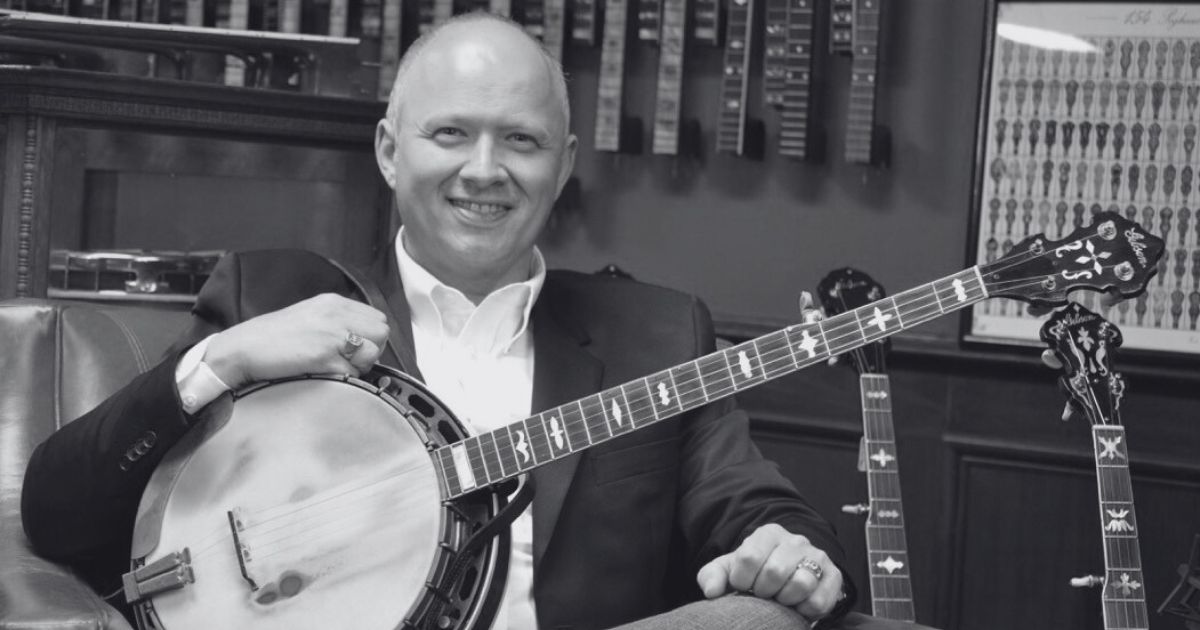
Jim Mills: A Remembrance – By Tim Stafford

(Editor’s Note: Below, Grammy award and IBMA award winner, guitarist, songwriter, and author Tim Stafford pays tribute to his friend, collaborator, and one-of-a-kind banjo picker and historian, Jim Mills, who passed away at the age of 57 on May 3.)

I started out as a banjo player, but switched to guitar early on; our little group got a better banjo player. But I’ve always loved the banjo, especially pile-driving, inventive players like Earl Scruggs, J.D. Crowe, Paul Silvius, Ron Stewart, Ron Block, Sammy Shelor, Jason Burleson, so many others. I especially like playing rhythm guitar with a great banjo player – it’s like a bluegrass drum track. I’ve not enjoyed that feeling any more than when I got to play with Jim Mills.

Jim was a force of nature on the banjo. He was such a fluid, powerful player and he could be very aggressive on the instrument, which stood in strict opposition to his demeanor – they didn’t call him “Smiling Jimmy Mills” by accident. He played things on record that I had to continually rewind. How did the banjo survive that?

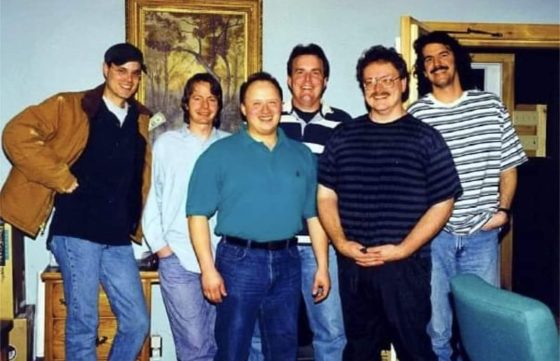
(L-R:) Barry Bales, Stuart Duncan, Jim Mills, Adam Steffey, Tim Stafford, and Brent Truitt, Nashville, TN 1998. Photo by Mike Kelly.

Once in the studio, I remember Jim breaking a string on the intro to “Bear Tracks,” a pretty hilarious outtake. It sounded like the world had exploded in the headphones. Jim just said, “What the ?!??!?” and Barry Bales let out a huge laugh – we had never heard anything like it.

It amazed me how eloquently Jim could talk in quiet rapid stretches and at length about everything related to old, Gibson flathead banjos. Like most vintage instrument topics, it’s a field of deep arcana, and the club sometimes seems too exclusive even if you truly love the sound of the things. But Jim never made it seem like anything but pure joy when he spoke, always returning to that million dollar smile. He was sharp, his collection of instruments was unrivaled, and he turned the basement of his house into a showroom.

And boy, did he know Earl Scruggs and his playing – inside out, all his instruments, all the bootleg recordings, even ephemera related to Flatt & Scruggs. He collected it and treasured it all, because it had never really gotten any better than Earl as far as Jim was concerned. The fact that Jim’s “desert island banjo” was Mack Crowe’s 1940 gold-plated RB-75 was validated for him by the fact that Scruggs himself mentioned Crowe as an influence on his playing in his 1968 book Earl Scruggs and the Five-String Banjo. Of course, Jim wrote his own definitive book, Gibson Mastertone: Flathead Five-String Banjos of the 1930s and 1940s.

Extremely intelligent, driven people are usually good at whatever they put their minds to. Tony Rice’s passion was restoring and repairing Bulova Accutron watches, and he was considered an authority in that area of expertise by people who had no idea he even played guitar. Ricky Skaggs told me that Mills was very involved in buying and trading antique shotguns as well as banjos and was just as well known in that arena.

It was all part of one cloth for Jim, though. A third-generation banjoist, a native son of North Carolina – the homeplace of the bluegrass banjo and a place so many great players still call home. When he joined Ricky Skaggs’s Kentucky Thunder, it was on one condition — he was staying in North Carolina.

We first met in the early ’90s when he was playing with Doyle Lawson and I was part of Alison Krauss and Union Station. He, Barry Bales, Adam Steffey, and I jammed for hours one day in Tulsa, Oklahoma as I recall. One of the songs he wanted to do repeatedly was “John Henry Blues.”

A few years later, the three of us played on Jim’s first solo record, Bound to Ride, for Barry Poss and Sugar Hill records. We tracked it at Brent Truitt’s Le Garage studio along with Stuart Duncan. Later Jerry Douglas overdubbed and Ricky Skaggs, Alan O’Bryant and Don Rigsby came in for guest vocals. And I sang “John Henry Blues.” It was such an honor to be on this record. Later on he did an instructional DVD for John Lawless and Acutab and I ended up backing him up on some tunes there.

I also played on a few records with Jim during this time, including Alan Bibey’s In the Blue Room. Near the end of a Patrick McDougal song called “County Fool,” after the last chorus, I knew Jim was going to come roaring in, taking us out to the end of the song. In anticipation, I hit a G-run that ended on the downbeat, on the bottom root note, a very unusual place for a G-run. I was sure engineer Tim Austin and producer Ronnie Bowman would want me to do it over, but they liked it so it stayed. Today I listen to that track and I’m the one who’s smiling – Jim could make you do things like that.

Jim wasn’t just a banjo player – he was a fine all-around musician and singer. His lead, fingerpicked guitar playing was superb and he was a fine songwriter. One year he came up to me at IBMA and said he had a demo of a song he’d written that he was sure Blue Highway could do. The demo was just him playing all the instruments and singing and it knocked my socks off. He had pitched it to Skaggs, but the boss man passed. The tune was based on a documentary Jim had seen and was called “Pikeville Flood.” We cut it on the Midnight Storm record and it remains one of our most popular live songs.

It was always a pleasure to see Jim and just get to hang out with him. Can’t believe I won’t get the chance to do that again. RIP buddy.


Photo Credit: Richie Dotson