Six of the Best: Protest Songs

It’s hard to pick my favorite protest songs. The Woody, the Dylan, the ’60s counterculture pop hits, the singularly chilling “Strange Fruit” — I love them all. The original “This Land Is Your Land” is an anarchist hymn, Dylan’s “Masters of War” is as scathing and righteous today as it was then, “Ohio” by CSNY was so poignant and cathartic in its time, and Billie Holiday laid bare the terrorism of whiteness, breaking the silence for a new generation to sing and speak their truth.

But I’ve opted to go toward the personal: the formative songs that revealed to me just how powerful songwriting could be in conveying a message. The ones that viscerally grabbed me, shook me and changed me; that still send a chill down my spine when they twist the knife. The songs that made me look up from the pages of my diary and want to write songs about the world and the way it could be.

In the past three years I have ramped up my commitment to learning to write this kind of song, and I have had plenty of inspiration. So much so that Front Country’s next record is almost entirely protest songs of one kind or another. Songs of meaning and truth and change. Here are six of the songs that made me the hopelessly idealistic and sanctimonious songwriter I am today. — Melody Walker, of the band Front Country.


“The Wagoner’s Lad” – Traditional

The old ballads are not known for being feminist anthems — far from it — but this one has to be my favorite. The first verse is one of the most honestly brutal accounts of what life was (and still is) like for women in most of the world living under Abrahamic religious rule: “Oh, hard is the fortune of all womankind / They’re always controlled, they’re always confined / Controlled by their parents until they are wives / Then slaves to their husbands the rest of their lives.” As well as the first known field recording sung by Buell Kazee, I recommend Joan Baez’s version because I love her interpretation of the lyrics, and my favorite modern version is by The Duhks. Interestingly, Doc Watson recorded it with a declawed first line “The heart is the fortune of all womankind,” as did several others after him, and I’d be ever so curious to know the story behind that change.


“Killing in the Name” – Rage Against the Machine

You know how parents in the latter half of the 20th century were convinced that music was radicalizing and warping the minds of their children? Well, I can safely say that Rage Against the Machine was my gateway drug into politics and protest, and I’ve never looked back. The raw angst and explosive energy drew me in, and the messages made me stay. Fox News themselves couldn’t write a more cliché tale of my descent into liberal madness: I went to my first RATM show at age 13 in Oakland, California, got a million pamphlets outside the show, read them all, and was immediately indoctrinated into progressive politics. Rare in the realm of protest music, this song, the performance, and the production still sound as fresh today as they did all the way back in 1991. This song was released in the wake of the Rodney King protests and it’s famous refrain sadly still rings true in America: “Some of those that work forces, are the same that burn crosses.”


“One Tin Soldier” – written by Dennis Lambert and Brian Potter

Cheesy as all get out, preachy as hell, but one of the most hard-hitting story songs with a pacifist moral out there. The one time I got to go to sleep-away summer camp at 10 years old, our cabin counselor would sing us to sleep with her favorite folk songs, and when she sang this one I was pretty sure it was the best songwriting I had ever heard in my life. What can I say? It never fails to turn me into a blubbering mess by the end. Truly great songs can stand up to any style or instrumentation, so take your pick of the original ’70s AM gold, punk rock, and pop reggae versions — or this legendary clip of the Bluegrass Alliance from the documentary Bluegrass Country Soul featuring baby Sam Bush and Tony Rice!


“Bury My Heart at Wounded Knee” – Buffy Sainte-Marie

I first heard this song on a live Indigo Girls album and it turned me on to Canadian-American First Nations singer-songwriter Buffy Sainte-Marie. Though she has had a long and successful career as a writer and performer since the early ’60s, including co-writing the inspirational “Up Where We Belong,” this song is from her ’90s comeback album and it pulls absolutely no punches in its accounting of ongoing terrorism against indigenous people in North America. One listen to this song is an invitation to learn more about the activists of the American Indian Movement and how corporations still collude with governments every day to displace and destroy native cultures around the world.


“My IQ” – Ani DiFranco

No one artist embodies the 3rd Wave Feminism of the 90s more than prolific and perpetually independent songwriter Ani DiFranco. Every song is a stream-of-consciousness integration of the personal and the political, redefining and queering the protest song in a polarizing performance style you either love or hate. She paved the way as a completely DIY artist with her own independent record label from the beginning, sending a message not just through her music, but also her entire business model. Each song is a subversive blend of breakup song, political manifesto, slam poetry piece and almost jazz-like playful vocal exploration, unwilling to be pinned-down as a singular statement. I finally settled on one that ends with my favorite of her famous zingers: “Every tool is a weapon… if you hold it right.” I love this well-worn, reimagined live version from 2002.


“If I Had A Hammer” – Pete Seeger & Lee Hays

Speaking of tools, it’s easy to see why this menacingly titled early hit of the “folk scare” put the fear of revolution in the hearts of the powerful. While it was debuted in 1949 by writers Pete Seeger and Lee Hays at a meeting of the Communist party, it became as mainstream as apple pie by the time Peter, Paul & Mary had a hit with it in 1962. Perhaps considered a children’s song today, it has a subversively empowering message in its simplicity. The night Trump got elected, Front Country had just flown to Seattle to start a tour, and there was a palpable sense of grief in the air at those West Coast shows. We closed every show of that run acoustic, on the floor, with a singalong of this song. It seemed to provide a much needed collective catharsis for ourselves and our fans. When one feels helpless, this song reminds the singer that we each have our own unique tools to bring to the work of dismantling systems of oppression and creating the world we want to see. There are a mind-bending number of recording of this song, so here are a few lovely ones.


Photo of Ani DiFranco: GMDThree

Rising Appalachia Tie Worlds Together with ‘Leylines’

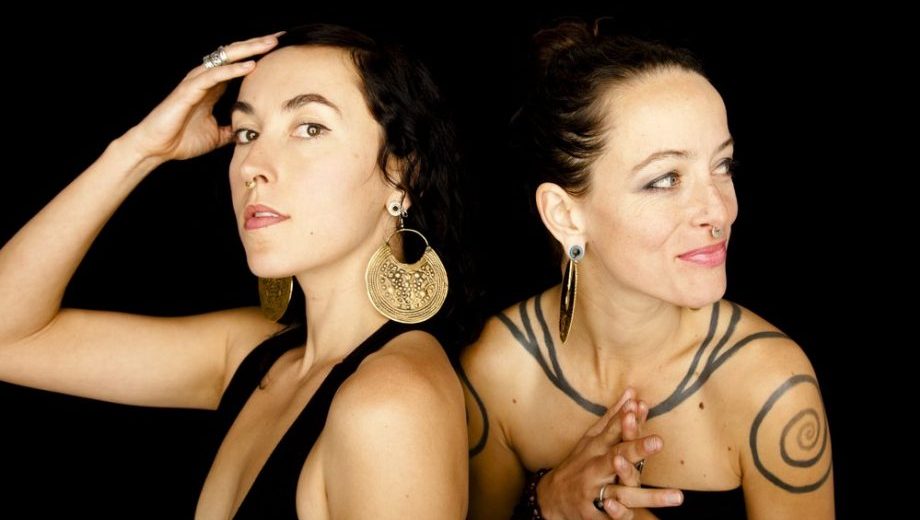
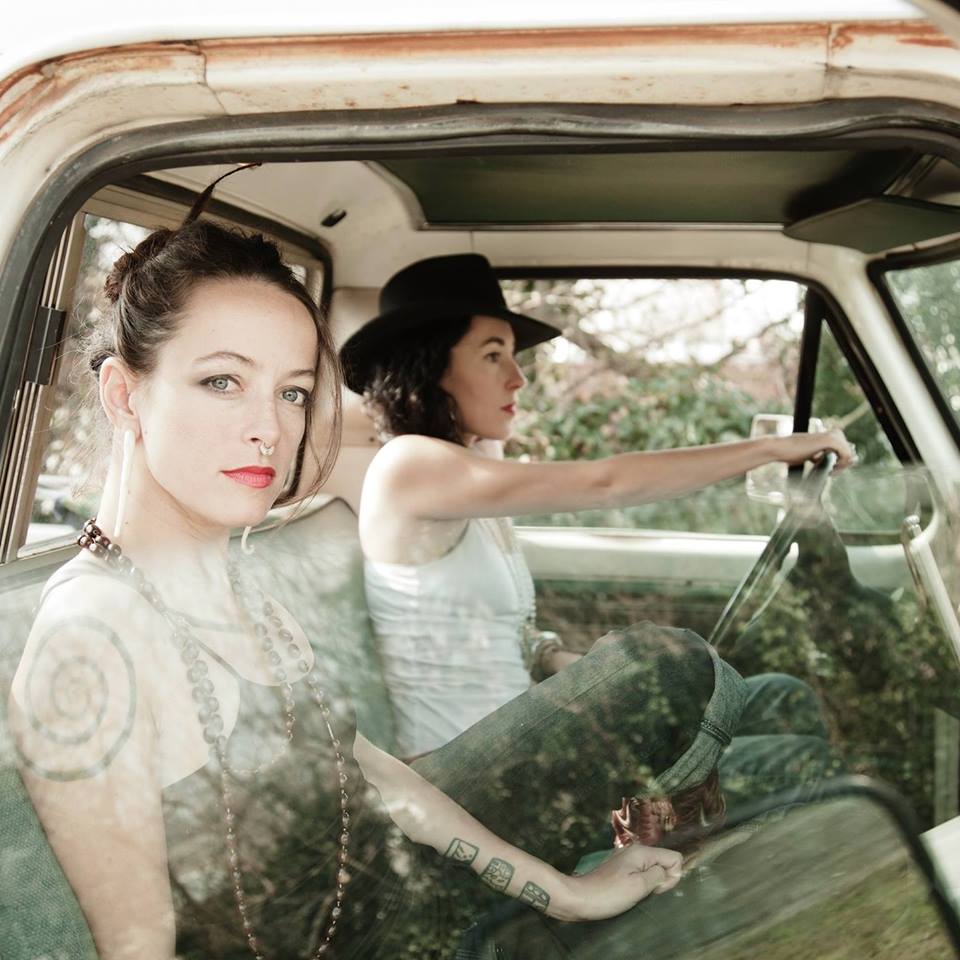
Just weeks ago Leah Smith of Rising Appalachia, the harmonizing duo with her sister Chloe, stood on a high peak and sang the old traditional tune “Across the Blue Ridge Mountains.” She was at the end of a stay in a remote village, and some local women surrounded her for a send-off.

“They circled us up and did traditional music with drums and flute,” she says.

Smith’s song was in appreciative answer, a thank-you for their hospitality. It was a perfect encapsulation of Rising Appalachia, connecting through music with people and the land that nourishes them.

This mountaintop, though, was in the Andes, not the Appalachians, perched above Peru’s Sacred Valley. Leah, Chloe and the four musicians of their band had just finished a six-week concert tour in South America. The others had gone back to the U.S., but Leah stayed behind for a little extra experience. And what an experience it was.

“To close my eyes and receive this absolutely magnificent mountain range in front of me, and these women who are community weavers and medicine keepers around me, and singing this song from my mountains to them in their mountains was a deep offering,” she says, speaking from the Atlanta house in which she and Chloe grew up.

This chat comes on the eve of the release of Rising Appalachia’s seventh album, Leylines. The title is a word for perceived connections and alignments of natural features around the globe, often used in a mystical sense. And that’s exactly what the album, and Rising Appalachia itself, are about.

Here they illuminate lines connecting gospel, fiddle tunes (some learned from their mom, Jan), African and Irish roots and interpolations of contemporary urban folk and soul. Joining the sisters are their regular colleagues David Brown (stand-up bass) and Biko Cassini (percussion and the West African stringed n’goni), plus two new members, West African native Arouna Diarra (also n’goni) and Irish musician Duncan Wickel (fiddle, cello).

The South America jaunt has already sparked “Agua de la Madre,” a new song that Leah wrote in Spanish, inspired by water-rights concerns of the region. But the focus now is on Leylines, made in a seaside studio in Northern California with producer Joe Henry. Leylines marks the first time the sisters have put their art in the trust of an outside producer, but it resulted in mutual appreciation.

“Leah and Chloe are fearless artists, as well as fierce activists,” he says. “They arrived with a sharp and committed point-of-view, yet were wildly open to what might otherwise transpire. I felt the same when I worked with Baez and [Harry] Belafonte — as well as when I produced their hero, Ani DiFranco, many years ago.”

In this BGS interview, Leah Smith explores a multitude of musical influences from around the globe and close to home.

BGS: Before we talk about the new album, tell us about South America.

Leah Smith: It was the band’s first time touring there. We’ve always preferred that our music is a vehicle of cultural exchanges. That’s the primary goal of Rising Appalachia. We’re building bridges and learning other people’s traditions and showcasing ours, and using that as a language. I lived for six years in Latin America — not consecutively. I moved to Mexico when I was 18. We have a really amazing fan base in South America and went to some places none of us had been. We learned about the music traditions and farming traditions, a lot of sustainability practices. We did our due diligence of what we think of as troubadours — musical ambassadors and students of the world.

Leylines was made before this trip, but will certainly impact your music to come, as other travels have before.

The name of the band really indicates what we do. It’s called Rising Appalachia. Appalachia is the foundations roots and culture we were born into. Rising out of it, using that foundation to grow wide branches. I always say about our work that we will never run out of material to study, to learn, to be influenced by. It’s impossible to run out. Every conversation on every trip adds to the fabric of our songwriting and goes into the lens that we view music through.

You start the album with traditional gospel in “I Believe in Being Ready.” Was that a big part of your musical life?

We grew up with so much of the Southern music in our home. Everything from jazz to gospel to old-time Appalachian roots music — and everything in between. This album is such a journey and departs in so many directions from the real simplicity that started our project 15 years ago. But we felt it was important for us to get the first breath of the album in the foundation of where our music came from. It’s got that old, archaic sound, very simple sister harmonies and a bit of the apocalyptic sense of the world coming to the end, in the gospel sense.

That’s a thread that runs through the rest of the album?

That’s what we wanted to do. I feel like every album is a chapter in our story, in a book of our lives. This to me is really exciting. Whether you’re remotely interested in the roots of music or not, this album holds all the roots of Appalachian music. We’ve always been influenced by that — the African roots of it, the Irish roots, the urban presence of Southern music, all the ways a very diverse and broad community has influenced Southern music. But we’ve never really presented it like this.

There are a couple of fiddle-tune pieces on this one, drawing on some of your first music experiences.

“Cuckoo” is one of my favorite songs on the album. We learned it from our mother and I just love that. Her version of this old traditional Appalachian song. I feel like we’ve probably known versions of “Cuckoo” since we were little kids. She has a beautiful trio, the Rosin Sisters. They recorded this version a few years ago and we said, “We’re gonna learn that version.”

Your dad is a musician too?

He’s primarily a [visual] folk artist, but also plays blues guitar.

Do you all still play and sing as a family?

We do all the time! Every now and then we get them up on stage, but they are reluctant. I don’t know why. I would love for them to join us more often. I think they don’t want to be assuming that it’s okay.

On the song “Sadjuna” you explore African sounds.

That’s a song that Arouna Diarra brought to us, a traditional West African song. We do several different songs that are Arouna’s. This one had an incredible surreal dreamlike state to it. The song in its origin is very much about people that leave the world too young — when families lose young people in war or strife, or when parents see the passing of their children. So Chloe and I wanted to write two verses to accompany it that held the same space. I don’t like to be over-literal. But we wanted to bring that to people, a balm for people who had that passing in their lives.

For “Make Magic” you cite Erykah Badu and André 3000 of Outkast as influences. It still sounds like folk music, though with some different aspects. How does their impact figure into it?

That is our folk tradition, as young women growing up in the ‘90s in downtown Atlanta, Georgia. That’s where the genre [labels] don’t serve us. Hip-hop and soul are urban folk music, storytelling music.

More expected is the influence of Ani DiFranco, particularly on “Speak Out,” on which she guests.

Ani had such a potent influence on me as a young woman from the urban South. My folk traditions were a lot of underground hip-hop and blues and soul, and the folk music our parents were playing felt very distant to me. Ani was a bridge, this young, folk-rock, righteous babe, but she was playing Woody Guthrie songs and had a banjo in her hands. I was so inspired to see a radical young woman carrying these traditions that I did not have access to. And to top that off, using the stage, using her platform to be talking about really important issues — voting, women’s rights — with no apologies. Wasn’t polite, wasn’t tidy, was in your face and made you think.

What would you consider your mission?

What’s our signature mission? We don’t have one, really. We believe our roles are as public servants. It’s a public service job. We are collecting the joys and sorrows and struggles of ours and of our community. We want to know what the community is talking about and that has to be part of our show. Different every night. Water rights and human rights. Our role is to provide the stage for the people who show up night after night. We have to listen. That is an important thing.


Photo credit: Chad Hess

Hangin’ & Sangin’: Ani DiFranco

From the Bluegrass Situation and WMOT Roots Radio, it’s Hangin’ & Sangin’ with your host, BGS editor Kelly McCartney. Every week Hangin’ & Sangin’ offers up casual conversation and acoustic performances by some of your favorite roots artists. From bluegrass to folk, country, blues, and Americana, we stand at the intersection of modern roots music and old time traditions bringing you roots culture — redefined.

With me today in the Writers’ Rooms at the Hutton … Ani DiFranco.

Hello!

Hello! So glad you’re here.

Nice to be here.

Your latest record, Binary … I want to get granular on some of the themes because you have recurring themes going on here. And I love your brain because your music makes me think and feel so much about the world around me. So let’s get into that.

Alright!

Connection with each other, with nature, with life in every possible manifestation… do you feel like advances in technology have helped or hindered all of that?

Yes. [Laughs]

[Laughs] Okay.

Yeah. I feel all of that and more. Yeah, see, this brings us right to my ongoing meditation of late in my life which is that everything is binary. And, by that, I mean not either/or. I mean both. Always. All the time. Everything is made of relationship. That’s my new way of looking at stuff. Ones and zeros … it brings us closer together. It increases our information. And, yet, it separates us and isolates us and makes us less conscious through that separation and isolation. So, it’s all happening.

Do you think it just enhances what was already there? So, like, if you’re, prone to connection, it enhances that; but if you’re someone who is prone to isolation, it enhances that. Potentially?

Possibly. Yeah. I don’t know. I’ll pontificate with you all day. Let’s go!

Yeah!

Seriously, who knows? I mean, it seems like we are being pushed to recognize that it does bring out something that is very dark, something that is latent, in terms of that disconnection — that sort of road rage that happens between two metal boxes that doesn’t happen between two faces.

When you’re up in someone’s countenance …

Conversing with their heart! BAM! [Laughs] Yeah. I think it has a propensity to draw that out of us. So I think there’s a danger in it. There really is. Of course. Anything that powerful of a tool is going to be dangerous.

Yeah. I’m assuming you’re familiar with Brené Brown’s work to a certain extent …

Yeah. Yeah.

That’s one of her ideas, that you can’t hate close up, so get close up with people.

Yeah. Get to know your neighbor who’s too loud.

If that’s what it takes.

Totally. Mr. Rogers. He rocked that stuff back in the day.

Which points to the premise of “Pacifist’s Lament”… which is, who among us is ready and willing to step fully onto the high road? You have to have a bigger vision and a lot of humility to know that winning at all costs isn’t winning at all. So, how do we get there?

Yeah. Yeah. This competitive advancement of the species. Yeah, maybe, to some degree. But, really, cooperating is how we succeed.

I guess that song, “Pacifist’s Lament,” comes right out of that moment of recognition when I’m sitting there watching the NRA lady say whatever the talking points are and I’m so full of anger that I just want to shout at her. Then I remember when that kid shot up that church in South Carolina and the families of the victims stood before him and spoke to him like a human being, said, “I forgive you.” They said just the most humbling solution to the world’s problems. They’re living and breathing and showing us the way. And I have so far to go, myself.

But I think, as a society, we’ve slipped so far from this idea. We can’t dismiss each other. We just can never give up on each other. We have to reach out and build bridges over even the most turbulent waters. So, I mean, it’s a daily struggle for me as much as anybody.

The idea in “Telepathic” of putting yourself in someone else’s shoes, that sort of deep empathy of trying to imagine what burdens they’re carrying, what fears they’re facing … is that something you do?

Yeah. And you don’t have to think about it at all. You just feel it. You just feel it in a moment sometimes with people. All the distance that can lie between you and someone on the other side of the counter. All of the walls. All of the veils. I guess, yeah, connected to what we’re talking about, I just want it to all go away. I want us to all be family, but we can’t because of so much in society and history. It’s that searching around — and not even intentionally — just when you feel what someone else feels, it can be overwhelming.

Watch all the episodes on YouTube, or download and subscribe to the Hangin’ & Sangin’ podcast and other BGS programs every week via iTunes, SpotifyPodbean, or your favorite podcast platform.

3×3: Rising Appalachia on Latin America, Lucky Ages, and Leonard Cohen

Artist: Rising Appalachia
Hometown: Atlanta, GA. The dirty South.
Latest Album: ALIVE
Personal Nicknames (or Rejected Band Names): The band considered the Grassy RootHeads, Squalor, RISE, but Rising Appalachia was the name of our first album and it stuck as the band name 12 years ago.
Leah: L-Dogg, Snake Eyes, Leo, Leah the Lip, Sito, Wakes Talking, chief meteorologist
Chloe: Chlo-Bo, Bo, Boskers, Trisket Biscuit, The Dark Queen, Sito, Pumkin, Pum Pum


Take me to your ocean. Take me to your sea… #FloydFest #risingappalachia #ilovemyfilthydirtysouth Photo @leahsongmusic

A post shared by Rising Appalachia (@risingappalachia) on

What song do you wish you had written?

Leah: “When Doves Cry” by Prince.

Chloe: “Hallelujah” by Leonard Cohen (Doesn’t everyone wish they wrote that damn song?!)

Who would be in your dream songwriter round?

Leah: Gillian Welch, Outkast, Bob Dylan, Sister Rosetta Tharpe, Ani Difranco, Robert Johnson, the Buena Vista Social Club, Lila Downs, Bonnie Rait, Prince.

Chloe: Ani Difranco, Hosier. Nahko. Mos Def. Erykah Badu. Bob Marley. Joni Mitchell.

If you could only listen to one artist’s discography for the rest of your life, whose would you choose?

Leah: Bruce Molsky. Makes me feel home.

Chloe: Ohhhhhhh. That’s a hard one! Probably Bob Marley.


As one of our elders put it last night, We want to put the U.S in a chair in the middle of the room Surrounded by healers, activists, grandmothers, lovers, and children And tell it how good it could be. How it could rise to the occasion of its full potential in the face of white supremacy, the dismantling of Standing Rock, of distasteful leaders and embarrassing media, of capitalism over culture. All these hard working people from all corners of the globe. This land and all its beauty. We have so much more work to do And I know folks are tired. What else is there to do but show up again and again and again and again ? In solidarity with the people of Charlottesville and all others whom work to uplift the story of the south (and this country) May love triumph. . . . #notmysouth #blacklivesmatter #notoursouth #standup #speakout #showup #solidarity #alternateroots

A post shared by Rising Appalachia (@risingappalachia) on

How often do you do laundry?

Leah: What a weird question. Um , whenever the duty is called for. Depends on the show night.

Chloe: All the time. Randomly on the road and we string it all up to dry in the back of the bus, which gets pretty intimate and funny.

What was the last movie that you really loved?

Leah: I almost NEVER watch movies. But I watched an amazing South American film on the plane the other day called Vengo Olviendo that was a beautifully filmed, slow and delicate story about the complexity of human migration. It was excellent.

Chloe: I loved the movie LION that just came out about the boy who got lost in India and found his way back home via Google Maps. Crazy wild true story. Reminded me that technology can be a good thing (I can get a little anti).

If you could re-live one year of your life, which would it be and why?

Leah: Hmmm, I would probably go back to my early 20s, when I was traveling out of a backpack across Latin America learning to play banjo and studying folk music from all over the place. It was such a free and inspired time in my life. Not nearly as weighted as this whole “professional musician” thing. 

Chloe: Year 7. Lucky number, lucky age, the mind is so open and spongey at that time. I’d go hang with my grandparents some more and pick their brains … especially my father’s mother who was a poet.

What’s your go-to comfort food?

Chloe: Thai food all day every day.

Kombucha — love it or hate it?

Leah and Chloe: LOVE ! Although once we got sponsored by a kombucha company and things got a little too fermenty in the van. It has to be handled in the right dosages.

Mustard or mayo?

Dijon

Ani DiFranco: Steady as She Goes

Two decades ago, 1996 was a leap year, a time before America had lost itself in iPhones and Instagram, before music was as much of a soundtrack to life and love as it was a 10-second signal that your mom was calling, and why weren’t you picking up? It was also the year that Ani DiFranco released Dilate, her seventh album, which began, about one minute in, like this:

“Fuck you, and your untouchable face,” she sang. “Fuck you, for existing in the first place.”

DiFranco fired those words with both tenderness and insurmountable fury. And when she did, she spoke for a generation of people who were sick of being polite and playing by the rules — who didn’t fit in with political norms, gender norms, sexual norms, norm norms. With her hair braided and her arms toned from hours upon hours of strumming the guitar, she smiled as she sang; venom dripped from her lips, sealed with a kiss. Her words often rolled out like poetry or magnificent chains of thought, and she didn’t sensor. She was both a political voice and slinger of love songs, a truth-teller and a vehement judge. She took artificial nails and attached them with electrical tape, so she could pluck the strings hard enough to ask the harder questions. It was certainly never what Lee Press-Ons had in mind.

Dilate was just over 20 years ago. And her new LP, Binary, is her 20th studio album. But anyone who expected DiFranco to look back retrospectively on any of those occasions is searching in the wrong place, for the wrong person.

“I’m not really about heralding numbers or time,” DiFranco says. “For me, it’s really all one long song. Other people have asked or presented the idea of looking back. On the anniversary of Dilate, it was, ‘Oh, you should go back on tour and play Dilate!’ I’m like, ‘No, no. That is never going to happen! Next idea?’ I’m into looking forward. What’s the next idea? What’s the uncharted territory?”

Binary is DiFranco taking stock of her present, our present, and, in her own sort of premonition-inclined mind, the future. Though the songs were written before Donald Trump was elected president, they feel as though they could be a reflection on the 2016 election cycle and the world at large, and that sort of preternatural sense is something that DiFranco has always possessed. “See how quickly shit gets absurd,” she sings on “Alrighty.” “You invented angels and then you ignore the birds.” Or, on “Play God”: “You don’t get to play God, man. I do.”

“That has happened to me my whole songwriting life. I’m like a Sunday scientist,” she says in the DiFranco chuckle, mischievous as it is. “I love quantum physics. I love the vanguard of scientific understanding, which has brought us full circle back to a very ancient understanding. I go into this subconscious place when I am writing. That shit, my consciousness sees it coming, even though I don’t know what I am writing about until it happens.”

Many have long-turned to DiFranco as a fearless feminist leader: An activist and outspoken voice against the patriarchy of politics, corporate America, and everything in between, she launched Righteous Babe Records in 1990 as a way of taking control over her own artistic property. She was always going to grow and change, but the morphing DiFranco was sometimes a difficult thing for her long-time fans to stomach. Getting married, having children … these choices occasionally were hard for those who saw DiFranco as belonging to only herself — up there on the stage, tank top tight with sweat and chinos that could have been worn by both a woman or a man — and to them. And though she has released albums since giving birth to her two babies, now 4 and 10, Binary is an album that explores how exercising our rights to belong to one another — be that a lover, a son, a daughter, a friend, or even our green earth — is one of the most feminist proclamations of all.

“I was trying to approach this concept of feminism without saying the word ‘feminism,’ and really get at it in an elemental way,” she says. “That the universe is born of relationships. And until we start holding that understanding as high as we do the individual and the hierarchy of individuals in competition, then I think we’re never gonna get to the right answer.”

The process of becoming a mother was a complex one for DiFranco. Though the act of raising a child “totally reinforces my feminism,” she says, some of the constructs of parenthood were more difficult to see through her enlightened lens.

“I remember the first time I had to push a stroller down the street,” she says. “I felt like such a fucking asshole. There was something about pushing a stroller down the street that didn’t fit with my sense of my own identity. I sort of remember in a humorous way trying to reconcile my identity as a mom with my life until then. But that’s surface, superfluous. Underneath it, the real situation for me was that becoming a mom really reinforced everything I thought I knew. Once I had actually lived the literal experience of ‘Your body is my body,’ I could stand there as tall as I ever did and say, ‘This idea of autonomy is a fallacy.’ The feminist idea is holding relationship higher than anything else. There is no separation between you and me.”

Indeed, Binary is about how our existence, our thoughts, our love, our presence, our fights are only in relationship to something else or someone else. So to celebrate that spirit, she decided to extend outward and invite some participation from special guests: violinist Jenny Scheinman, keyboard player Ivan Neville, Maceo Parker, David Bowie bassist Gail Ann Dorsey, and Justin Vernon of Bon Iver.

“My manager said, ‘You have a lot of amazing friends. You should call them. You should connect with people,'” she recalls. “A lot of my artistic life has been in isolation. I write songs alone. I play them alone. I develop a relationship with an audience alone. But I’ve always been jealous of people whose bands are beautiful communities, and I have been more solitary than I want to be in my art. Calling people up and connecting with them, that was just one of the oblique strategies in his record. How do you make album 20 new and fucking fun again?”

Binary is, well, fucking fun. It’s full of fire, horns, and funky riffs, and stacks of DiFranco couplets that feel as urgent as ever: “They got networks like insects with webs of deception,” she sings on the title track, both a manifesto for the album’s central themes and a call to put down our screens and look not into that white glare, but the white’s of each other’s eyes. And not just look, but listen. “Right from the beginning, I was like, ‘Fuck all that,'” she says. “‘Talk to me.'”

In 2016, DiFranco used her tour to encourage voter turnout: Called “Vote Dammit,” she registered fans in each city she passed through. And she will, of course, still stay political in a Trump era, letting the words of Binary lead the way. But she’s also paying attention to what lies beneath the dark side; and she has been following the shifts in the energy of the earth charted as the “Schumann Resonances.” Remember, she’s a Sunday scientist. Things had been pretty steady here on the planet, but then, just as Trump took office, that measure of energy plummeted.

“If you’re me, you could take this really far,” she says laughing. “What we see up there at the podium is the shadow side of an awakening. And this is the trigger. This is what it takes for us to wake the fuck up. And I feel so excited that there are people who want to talk about the things I want to talk about. And I feel less alone and more hopeful in many ways than I have in my whole life.”

Because consciousness, as she sings, is binary.


Lede illustration by Cat Ferraz.

Healing the Heartbreak: A Conversation with Chastity Brown

“All my life, I was afraid of everything, and I wouldn’t touch what was beautiful to me,” sings Chastity Brown on “Drive Slow,” the first track on her new LP, Silhouette of Sirens. Appropriately, it’s a song filled with motion: an automotive chug toward the horizon, a call to move on and leave our ashes behind. But, like Brown herself, it’s more complex than just that. There are moments to stop, plant your feet, and savor the stillness, a rearview mirror filled with memories both sweet and sinister.

But Brown likes to move, no doubt — right now, she’s just completed a run in Denver, where she’ll be singing in Ani DiFranco’s back-up band later in the night. She certainly likes to move on, too, and Silhouette of Sirens finds the Minnesota-residing, Tennessee-born artist pondering perseverance: how to overcome and heal a broken heart with an understanding of all the many ways one can be shattered in the first place.

Now signed to Red House Records, Brown crafted Silhouette of Sirens with her longtime writing partner, Robert Mulrennan, and the result is a set of songs that exist in the perfect sweet spot between roots inspiration and modern sensibilities. And with plenty of soul-bearing honesty, too. “I try to find a way to sing where I’m not having a therapy session,” says Brown. “But I think there is a lot of longing on this record.” These aren’t songs to be heard prone on the couch anyway. “Pouring Rain” has a soul-filled groove, and “Carried Away” is a delicate but sweeping mid-tempo ode to rising up and over what sets us adrift.

You just got back from a jog — does running help you think creatively?

It helps me calm down. I think I have such high anxiety that it clears out the cob webs. I don’t do it to be entirely healthy. I just have to have something to take the edge off.

It’s been quite a bit of time since 2012’s Back-Road Highways, your last release. So much has changed since then: You have a new label, you’re five years older, we have a new president. How do you reflect back on it all?

There are mile markers that I think are physical: a record label, for one. I finished the album two years ago and, at that point, I had taken two years to make it. That was the longest I had taken for anything. And, at that time, I was also turning 33. I’m not religious or anything, but I was like, “This is my Jesus Christ year. This is my Buddha year.” Thirty-three is where you go big or go home. And I gave myself permission to actually be ambitious and gave myself permission to get what they call in the music business a “team.” To make the album, I had emotionally gone through a really dark time without realizing it, and that influenced the work. I was separating all the dark shit going on in my head with these songs I was writing with my writing partner. It wasn’t until after I finished that I was like, “Holy shit, this actually digs deep into my subconscious and exercises some demons I wasn’t ready to acknowledge.”

How so?

The music reflected itself back to me and, in one part, let me know I was quite broken, and in another part of the album, let me know I wasn’t that way anymore. It’s a fucking therapy session, but I can’t say what it feels like to be different. Though I know I’m literally in a different place than when I was making it.

Was it difficult to give up your independence and sign to a label?

Yeah, I’m a little bit — and I think my band mates can vouch for the fact that — I am a little bit controlling. But at the same time, this isn’t really possible to do alone. I had to ask people for their gifts and talent. It was difficult to relinquish some of that, but we all work really well together. I’m a 34-year-old woman who is not going to be told what to do. Working with these people on collaboration, I don’t feel like it’s me telling them what to do or the opposite. But I do have clear goals, and it wasn’t just a spur-of-the-moment decision. It was thought out, and I have to trust them. And I do.

You mentioned the album was finished two years ago, so do these songs still feel fresh to you?

I was expecting them to be old by now, but they’re not old to me. Maybe it’s just my relationship with them. For 2016, I got the incredible opportunity to tour with Ani DiFranco, and that was the real test of these songs. And I feel like they can hold their own. I still love them. But after you create, and you go on the road, and you geek out, the songs are still evolving. All I did is capture where these songs were at the time. But now I’ve changed, shit’s changed. They augment with me.

Who were you then versus now?

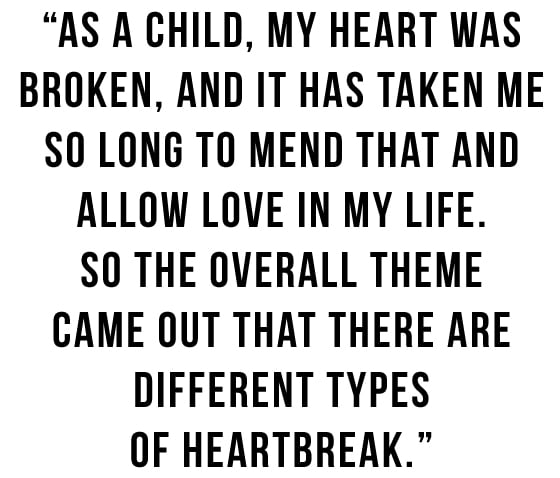
What I was experiencing during that dark time was having a really dark childhood. I think because of that — and the album is not about that at all — but I feel really sensitive to other people’s stories, and what I had realized is, that time period in my life broke my heart. As a child, my heart was broken, and it has taken me so long to mend that and allow love in my life. So the overall theme came out that there are different types of heartbreak. Of course there are love songs, but there are other things that break your heart. There is more to life than songs about coupled relationships — though I love those — but this is a little bit broader. A macro view of different types of heartbreak informed by my own personal heartbreak.

You’re singing with Ani tonight and you’ve opened for her in the past. That must have been an amazing, informative experience.

Yeah. Shit. I’ve said this before: It’s the most generous thing that any artist has done. She’s showed me how it’s done, in a different way. I’ve been touring for 10 years, but there are different things at her level, which you can only see from there. In the folk world, it’s generational, passing things down. It’s huge to me, how generous she’s been. And it’s a good affirmation that someone I respect gives me a thumbs up.

Did you have conversations with her about what it means to be a politically engaged artist?

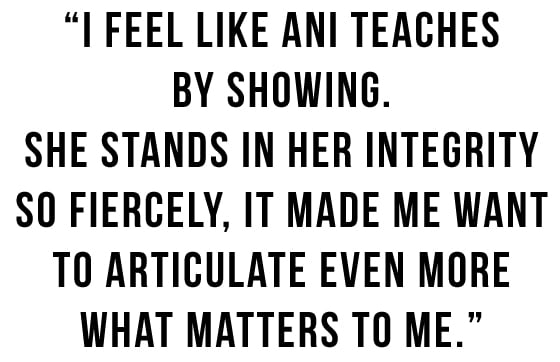
Well, I don’t think we talk in terms of what things mean. We were out on the road when Trump was elected president, and what we talked about was how to act, and in what capacity. We have such a privilege, all across the country: When you step on stage, you are the loudest person in the room. I feel like Ani teaches by showing. She stands in her integrity so fiercely, it made me want to articulate even more what matters to me. Like how Black Lives Matter has been a huge cornerstone in what I talk about from stage the past year-and-a-half, and it will be until I feel like folks get it. You’d be surprised how many “liberal” audiences have a rebuttal to that.

Really?

I remember in Utah, I was talking about this Nina Simone song and I said, “I play this because Black lives matter.” And this woman was like, “All lives matter!” I want to use compassion to educate people, but at the same time, God, that woman fucking infuriated me. But it wasn’t the time. Going back to what to do as an artist during these times, it’s to use your voice in the capacity of your life. I’m from Tennessee; I have family members who voted for Trump. And those are family members I love, and I can’t pretend that they are evil. But I can get down and dirty in a difficult conversation, trying to figure out where they are coming from.

Have you written any overtly political songs?

I have, but none that I would play out. One of the titles was like, “Fuck You Pieces of Shit!” An ongoing rant. I was like, maybe I can kind of hone it in! But I have been creating. A lot of people are saying, “What are artists going to say as a comeback to all this?” And I’ve heard some incredible work that’s going after how fucked up our government is, but there are other things to focus on. Like the beauty of being a brown woman and celebrating that. There was a time after so many police shootings, all the songs I was writing were really angry. But Solange [and her 2016 LP, A Seat at the Table] was a great reminder of “Yo, let’s talk about our beauty.” And we should.


Photo credit: Wale Agboola

Like Woody Guthrie Before Them, Roots Musicians Take on Trump through Song

If there are two American figures one would least expect to be connected, they may well be Woody Guthrie and Donald Trump. Guthrie, one of the most revered political songwriters ever to put pen to paper, has next to nothing in common with Republican presidential nominee Trump, a man who represents everything against which Guthrie fought as a folk singer and activist. But the two do have one connection: Trump’s father, the late New York real estate mogul Fred C. Trump. 

In the early 1950s, Guthrie was briefly a tenant of Trump’s Beach Haven apartment complex, a Brooklyn property the elder Trump developed using an FHA subsidy specifically designated for affordable public housing. Years after Guthrie moved out of Beach Haven, in 1964, Trump would be investigated for profiteering, having, as Will Kaufman wrote in a story on Guthrie and Trump for The Conversation earlier this year, “overestimat[ed] his Beach Haven building charges to the tune of $3.7 million.” And in 1973, six years after Guthrie’s death from Huntington’s disease at the age of 55, Trump was sued by the Justice Department for discriminating against Black people, eventually settling outside of court.

“In 1950, Woody and his family rented an apartment in the complex called Beach Haven that was owned by Fred Trump,” Deana McCloud, Executive Director of Tulsa’s Woody Guthrie Center, says. “After they moved in, it came to [Guthrie’s] attention that the elder Mr. Trump would not lease apartments to African-Americans, which did not sit very well with Woody, as an advocate for civil rights.”

It was the racism of “Old Man Trump” that stoked the most intense anger in Guthrie, inspiring him to write two sets of writing — the first being the better known “Beach Haven Ain’t My Home,” a re-working of an existing Guthrie song called “Ain’t Got No Home” and one that is often referred to as “Old Man Trump,” and the second, “Racial Hate at Beach Haven.” Both writings are available on view at the Guthrie Center and, since Kaufman’s piece was published, have been fodder for outlets as large as NPR and the New York Times, once again relevant in light of the 2016 election. As seen in the images provided by Kaufman, Guthrie punctuated his lyrics with exclamation points, a seemingly small detail that McCloud finds very telling.

“What’s really interesting for me is, I looked at the lyrics for ‘Beach Haven Ain’t My Home’ and — of course, we have thousands of examples of Woody’s handwriting and very seldom does he use exclamation points — in this particular lyric, every line is followed by an exclamation point,” she says with a slight laugh. “His emotions are very apparent in the lyrics. It was just an issue with him, the idea that people should be separated and kept apart in anything, but especially when it comes to allowing them to live together and learn together and cooperate with each other.” 

A reimagined “Old Man Trump,” recorded by Santa Barbara band U.S. Elevator, made its way into current headlines just a few days ago as part of the “30 Days, 30 Songs” project, an initiative spearheaded by acclaimed author Dave Eggers (famous for works like 2000’s A Heartbreaking Work of Staggering Genius and the more recent novel A Hologram for the King; he also documented his time at a Sacramento Trump rally for the Guardian) and Zeitgeist Artist Management’s Jordan Kurland, who is known for his integral role in the careers of artists like Death Cab for Cutie and Bob Mould. The project, which kicked off October 10, is a playlist of anti-Trump songs, proceeds from which will benefit the Center for Popular Democracy, written and/or performed by a diverse roster of artists that includes Aimee Mann, Jim James, R.E.M., and Adia Victoria. At press time, the initiative has grown to become “30 Days, 40 Songs,” and could continue to grow larger as Election Day draws nearer. “30 Days” follows the pair’s 2012 effort “90 Days, 90 Reasons,” a series of essays by figures like Roxane Gay and George Saunders that argued for the re-election of President Barack Obama. 

“One of the things that really struck [Eggers] about the rally was the music that was being played,” Kurland says. “It was so off-base from Trump’s message, you know? It was Elton John’s ‘Tiny Dancer’ or Bruce Springsteen or the Who — clearly just songs that didn’t make sense contextually, but also songs that there’s no way the artists would have approved. So Dave came back with the idea to get artists to write songs that should be played at Trump rallies, with that meaning they could be songs either directly about Donald Trump or songs that celebrate all the things that Donald Trump is against, like diversity and freedom of speech, etcetera, etcetera.” 

Nashville artist Adia Victoria — who speaks powerfully on race, class, and Southern culture in both her music and in interviews — contributed the sparse, sobering “Backwards Blues” to the playlist. When sharing the song on Facebook, she wrote, “Perhaps the greatest irony is how a campaign fueled by outright lies reveals a deep-seated kernel of truth of what far too many Americans hold up as sacred: massive wealth, the sway of celebrity, branding, power, and greed. I don’t want to say that he’s the president we deserve, yet here we are.”

Many other musicians outside of the “30 Days” project have found themselves getting political in recent months, too. Ani DiFranco recently released the song “Play God” which, while not overtly anti-Trump, champions women’s reproductive rights, a message that flies in the face of Trump’s endlessly mysognistic rhetoric and behavior. “As we prepare for our first woman president, isn’t this the perfect time for all of us to put women’s civil rights into law?” DiFranco asks. “Make reproductive freedom a Constitutional amendment. With the Supreme Court in flux, we cannot afford to leave our rights in the balance.”

Revered Nashville/Austin songwriter Radney Foster contributed to the conversation with “All That I Require” — what he describes as an “anti-fascism history lesson” that, to name only one example, feels especially chilling in light of Trump’s third debate comments about his reluctance to concede the election were Clinton to win the presidency. 

“The voices of extremism and fascism are ringing more loudly in our national debate than ever before in my lifetime,” Foster says. “Questioning the free press and the peaceful transition of power never ends well. All of the sloganeering in the song are taken from Stalin, Mussolini, Hitler, and Franco — demagogues from the right and the left. I hope the song is something that will make us all, Democrat or Republican, do some soul-searching about what kind of country we want to be.”

One of the most powerful, acclaimed albums of 2016, the Drive-By Truckers’ latest release American Band, was described by Slate‘s Carl Wilson as “the perfect album for the year of Trump.” DBT songwriters Patterson Hood and Mike Cooley address a number of difficult topics, including racism, immigration, and police brutality, on the LP, with songs like “Ramon Casiano” and “What It Means” two standouts (among a consistently stellar batch of songs) whose narratives have chilling parallels: The first describes the death of Mexican teenager Ramon Casiano at the hands of Harlon B. Carter; the second refers to the murder of Trayvon Martin by George Zimmerman, as well as cases like the police killing of Michael Brown. The album grapples with many of the very issues for which Trump stands, providing alternative viewpoints from, as Wilson describes, a group of men “embodying the stereotypical demographics of a Trump voter (white, male, middle-age, non–college-educated).”

Akron, Ohio, songwriter Joseph Arthur released his anti-Trump number, “The Campaign Song,” which juxtaposes audio and video of clips of Trump shouting catchphrases like “Build That Wall” with lyrics like “Trump is a chump,” earlier this month and invoked Guthrie’s legacy as a political songwriter, as well as his unfortunate connection to the Trump family. “Woody Guthrie wrote a protest song about Donald Trump’s grandfather,” Arthur wrote on his website. “So this is like carrying the torch for Woody. I used the lingo of a by-gone era to accentuate that aspect like ‘America really should boot bums like this out’ and ‘Old scratch’. I wanted to use the lingo of Trump’s elders as subtle form of linguistic manipulation designed to send him under his bed shivering like the whimpering maggot that he is.”

A particularly biting critique of Trump, his policies and his deeply flawed Trump University comes from folk singer/songwriter Anthony D’Amato, who released the song “If You’re Gonna Build a Wall” and its accompanying video via MoveOn’s Facebook page last week. D’Amato was inspired to write the song, which references Trump’s desire to build a wall between Mexico and the United States and includes lines like “Oh if you’re gonna build a wall / You better be ready the day it falls,” after covertly attending a Trump Rally in Long Island.

“I wrote this song last Summer during the primaries,” D’Amato says. “I was home from tour with a broken finger and bombarded by election news every day. The rhetoric was dark and divisive and ran counter to a lot of the ideals I always felt like this country was built on. Trump’s campaign was the initial spark, but the song touches on race and class and privilege, too. History doesn’t look kindly on those who build themselves up by excluding  and demonizing the less powerful. If you’re going to do that, you’d better be prepared for the consequences.”

Pioneer Valley band Parsonsfield also felt compelled to write about Trump’s hypothetical wall, expressing their frustration in the song “Barbed Wire,” a stirring track off their recently released album Blooming through the Black. “It’s funny how the loudest voices championing freedom are the ones who want to erect the clearest symbol of restrictiveness,” the band’s Chris Freeman says. “It will never happen, but the rhetoric is frightening enough. The song references the wall in the sense that they are often built as a mechanism to keep others out. The builder usually fails to see that they are also the ones being kept in.”

Like his father’s before him, Donald Trump’s policies seek to exclude rather than unite. And like Guthrie before them, today’s musicians are using their platforms to voice progressive platforms, the latest entrants into the long, continually evolving songbook of American protest music. Protest music is most commonly attributed to the 1960s — just look at this year’s somewhat unusual, certainly polarizing winner of the Nobel Prize for Literature — but it’s a tradition that’s been around in America for centuries. To name just two, non-’60s American milestones that birthed political music, the Civil War inspired a number of tunes, including “When Johnny Comes Marching Home” and “Song of the Abolitionist”; and the gay rights movement of the ’80s and ’90s brought us “Rebel Girl” by Bikini Kill and “True Colors” by Cyndi Lauper.

Trump is, of course, not the first politician to inspire musicians’ ire (and he certainly won’t be the last), although he has accomplished the not-so-desirable feat of doing so before the election results have even been tabulated. Bright Eyes, Radiohead, and, perhaps most famously, the Dixie Chicks were among the many artists who called out 43rd President George W. Bush through song. Ronald Reagan had the Ramones and Prince as detractors. And, in case you thought musicians only targeted Republicans, Democratic President Bill Clinton’s indiscretions have been documented by artists as high-profile as Beyoncé — though it’s important to note that Monica Lewinsky is often, problematically, the target, instead of Clinton himself. 

“The way that music makes a difference in society is still apparent today,” McCloud says. “You still have those people who are raging against injustice and we know that Woody’s work is as relevant today as it was whenever he was writing it. The specific names might have changed a little, some specific details may have changed. But when you look at the lyrics that Woody wrote, and that Pete Seeger wrote, and Phil Ochs wrote, we’re still struggling with this huge divide between the people who have so much and those who struggle just to get by every day.”

And while many artists choose to express political views through song, others take stances by withholding their music from candidates with whom they disagree. Just this year, the Trump campaign has received cease and desist letters (or, some cases, some very angry rhetoric) from the Rolling Stones, Adele, R.E.M. (who, along with Sleater-Kinney, just released their own “30 Days” tune), and several other artists regarding the usage of their songs at Trump rallies and events. 

“Music and protest, for a very long time, have gone hand in hand,” Kurland says. “For this particular project, it’s to get people inspired about the election or voting that have maybe been somewhat apathetic to it. Certainly Bernie Sanders captured a lot of people’s attention and imagination amongst younger voters and it just felt like, in May or June, there were people who were disappointed and people who weren’t really seeming like they were very engaged. So the idea of doing this is a way of getting people motivated by hearing a well-written song about an important topic. The goal with this project, and the other projects we’ve worked on in the past, is to appeal to younger voters who maybe don’t fully grasp the importance of this election or understand how different the two candidates really are. I get so sick of hearing, ‘Hillary is the lesser of two evils.’ That couldn’t be further from the truth.” 

While Guthrie isn’t alive to sing us through these last few weeks leading up to election day, many of the issues for which he fought are, unfortunately, still issues today. McCloud believes he would have been just as disappointed by Donald’s political rhetoric as he was by Fred’s housing practices. “I certainly don’t want to put my thoughts into Woody’s voice by any means, but based on my knowledge of what he wrote and his perspective of things, I think, like many of us, it would be deeply troubling to him to see the lack of civility and the divisive nature of today’s political climate,” she says. “This idea of getting together, walking together, talking together, solving problems is almost nonexistent in what we see today, and I think that would be deeply troubling to him.”

Though it appears as though Hillary Clinton has all but clinched the election, the work to heal from and evolve past the divisive, racist, bigoted rhetoric in which the United States became ensnarled throughout this election is only just beginning. It’s another chapter in a long, bloody story that is centuries long — one that Guthrie, like his modern counterparts, immortalized in song, offering small glimpses of hope, wisdom, and catharsis for all of us hoping for a better world. 

McCloud sums up Guthrie’s feelings — which were messy, uncomfortable, unresolved, but ultimately hopeful — when she recounts his writing “Racial Hate at Beach Haven.” “What I really love is the way he ends it,” she says. “The last paragraph — it’s so lyrical. It’s, ‘Let’s you and me shake hands together and get together and walk together and talk together and sing together and dance together and work together and play together and hold together and let’s get together and fight together and march together until we lick this goddamned racist hate together, what do you say?’ That’s Woody. He was upset. He was angry. But he still understood that this is a problem, and let’s sit down and talk about it and solve the problem instead of just being separate and having our own opinions. Let’s solve the problem.” 


Lede photo courtesy of U.S. Consulate General Munich from Germany and Joseph Arthur

LISTEN: Peter Mulvey, ‘The Last Song’

Artist: Peter Mulvey
Hometown: Milwaukee, WI
Song: “The Last Song”
Album: Are You Listening?
Release Date: March 24, 2017
Label: Righteous Babe

In Their Words: “We were circling the beast in Big Blue (Ani’s home studio) trying to find a way into this, when she suggested I play it on the guitar given to her by Michael Meldrum, an early mentor for her as an artist. Suddenly the song fell into place.” — Peter Mulvey


Photo credit: Elisabeth Witt

There Will Be Dancing: Erin McKeown in Conversation with Chastity Brown

It’s a wonder that we journalists ever get away with describing an artist as a singer/songwriter and leaving it at that, as though the meaning of the categorization is so simple, stable, and straightforward as to be universally self-evident. Singer/songwriters, themselves, conceive of what they do in vastly different and ever-evolving ways.

Chastity Brown and Erin McKeown exemplify just how dynamic the role can be. Last week, Brown announced her signing to the folk label Red House Records and McKeown recently released her EP, According to Us, but both are at least a decade into the process of responding to their changing understandings of themselves and the world around them through their music. Along the way, they’ve recalibrated how they want to communicate in, around, and between songs. They were both up for a bracingly honest conversation about what their work requires of them.

Have you two ever crossed paths before now?

Erin McKeown: We haven’t, no. I spent a little time this afternoon perusing Chastity’s website, listening to some music. And I see that you’re on the road with Ani DiFranco right now, which I’ve done before. So I’m surprised we haven’t crossed paths.

Chastity Brown: But I’m glad to cross paths today.

I didn’t consider the Ani overlap when I asked you both to do this interview.

CB: No pun at all, because that’s one of Ani’s songs — “Overlap.” People think that women are constantly trying to compete against each other. There have been several possible opportunities of me opening for other people — other women — and managers have been real quick to be like, “No, we don’t want two women on the bill.” Ani’s ethos is really about locking arms and supporting each other, even if we do such different shit [musically]. It makes sense that we would cross paths today, in my opinion. For me, and probably for the both of us, it’s really about locking arms. The music business is difficult enough without trying to compete with your comrades.

EM: I totally agree. Some number of years ago I was like, “I’m just going to play shows and make records with people that make me happy.” Just remove the, like, “Could this person advance my career?” Any of that stuff, in my experience, nine times out of 10, it doesn’t. And in the meantime, I would just rather have a more interesting experience that arouses my curiosity, rather than just punching a clock toward some goal that may or may not materialize.

It seems to me that both of you have evolved in how you think about a particular aspect of being singer/songwriters — whether, why, and how to say things of social and political significance in your music. Erin, you sort of poked at traditional notions of gender and relationships on your album Grand, but your writing on more recent projects, including your new EP, has a different sort of directness and urgency. Chastity, the sound of your music, in itself, makes a statement about how country, soul, and R&B traditions are intertwined, but up until recently, your lyric writing hasn’t been explicitly political in nature. Could you both speak to how your priorities have changed, in terms of what you seek to express?

EM: I appreciate you pointing to what was happening on Grand. Such a long time ago, by the way. At that time, I was definitely knee-deep in trying to advance my career, and I was working with a big — not huge — but big record label at the time. … I was trying to advance my career by a blueprint that was laid out by more or less the label and a more traditional path of the people that had come before me. It’s not that I didn’t know about Ani, of course, but I was sort of trying out this thing and hoping it would work for me. I was definitely exploring politics and relationships in my music, but it was quite cautiously. Some of that was my own personal journey about my internalized homophobia and my internalized misogyny. That’s been a long journey for me of becoming more accepting and open about myself for myself, and that naturally gets reflected in songs. But, at the time, I was very sure that, if I spoke out more clearly or openly or in a less coded way in my songs, there would be some sort of commercial consequence. … Now I’m just looking for an effective song to connect with people. For me, that has been more effective, if I have been more clear about stuff.

CB: I’ve always just sung whatever’s on my mind. And in the beginning, on stuff that wasn’t properly released, it was very hippie-dippy: I love the trees. And I still do — I still fuckin’ love trees.

[All Laugh]

CB: It centered around, “What is this song about? And how can I exhaust this story but not exhaust the listener — like, get the full story out?” It wasn’t ever specifically political. But 10 years later, what I’ve realized is that the personal is political. Just by me being a bi-racial, half-Black, half-white woman living in the world in America right now is political. My focus, as far as this last record, I guess it’s really been psychological. I’m really intrigued by the perseverance of the human spirit and the complexities and contradictions that we embody as human beings. At my live shows, I use the time between songs to dig a little deeper with the folks that are listening about where these things are coming from, whether it’s a blues song that I wrote about Detroit, Michigan, going bankrupt and people losing their retirement. That song is essentially about putting your trust in something that you later realize you shouldn’t have. But if someone doesn’t know that, they might just think it’s a love song, that I’m saying “Fuck you” to somebody.

That rang true for me — what you said, Erin, about trying to be as clear as possible. But because we’re making art, there’s this room, this ambiguity. What happens when you release art to the public is, no matter what narrative I give you, you still may extract pieces of that narrative. People will make it their own and make it applicable to their own spheres. But that’s one huge realization for me as a 34-year-old woman and what’s been happening in Minneapolis — Philando Castile’s murder and last year with Jamar Clark. Just being a person of color, a queer woman of color, for that matter, is freaking political. I don’t even have to say anything; I just leave my house, and that’s a statement. I practice good eating habits and I exercise; radically loving myself is also political. I see that now, and my hope is that that comes out in my work. There are other stories to tell other than just the specifics of politics or my stances on things.

It sounds like those are realizations you’ve come to and priorities you’ve embraced over time.

CB: An author I love, Octavia Butler, she’s freakin’ blowing my mind. Such imaginative writing. She was the first Black woman to write sci-fi. I was geeking out yesterday and watching these YouTube clips of interviews with her. The interviewer asked her about her stance on current politics, and she was just like, “There’s so much that Black people can write about other than just being hated.” There’s so much more to life experience other than just constantly defending your queer self and your queer and transgender brothers and sisters. I love the way that Octavia put it: There’s far more vast creativity within us.

EM: I love that. I also love the reminder that art gets at things in oblique ways that are often just as useful as clear ways.

Erin, on your new EP, you play with the power of a person claiming an identity for herself. You noted in an interview a few years ago that, when first you began to get attention for one aspect of your identity — being queer — it wasn’t because you’d decided that you wanted to start writing or talking about it, but because a blog labeled you that way. Once there was the expectation that you’d be speaking from that identity, what’d you do with that?

EM: Basically, what happened was, I did an interview with a lesbian website. Up to that point I had never come out, and that had been on purpose. We never talked about it in the interview. Then when the article was published, the headline was “lesbian singer/songwriter.”

CB: Oh, damn!

EM: I know! I started getting these emails from people that said, “Oh my God! You’re a lesbian! That’s so great! Thank you for coming out. That means so much to me.” Besides the functional piece of I wasn’t really ready and it wasn’t on my terms, I also felt the responsibility to those folks to say, “Right on! You’re okay as you are!” Because that’s the underlying message that I would hope to give anyone. I just felt like I didn’t have any choice but to just jump off the deep end and accept that it happened and try to work on my own fear about it and try to be a kind and loving example for other folks who could identify with me in that way. I don’t identify as lesbian; I’ve always identified as queer. But I think 10 years ago that was a conversation that wasn’t as nuanced as it is now, which I’m really glad to see.

I played on sports teams in high school — I still play on sports teams — but I always hate putting on the same shirt as somebody else. I think my journey has been to try to recognize that impulse in myself and put it aside and kind of work with the identities that get foisted on me, even though they’re not always my choice or the timing is not my choice.

Once that happened, how did you make creative use of it?

EM: I ignored it. I ignored it in my writing for a while. So much of this work happens, like Chastity said, in between songs. And I’ve always been someone that likes to go out and meet folks after the show and talk. So much of this work in those spaces, as well. I just found, in those interactions, that I could make better use of these identities, if I just gave people space to put their own into the conversation with me.

Chastity, in an interview you gave a few years back you reflected that making political music had become a more isolating practice than it might’ve been for previous generations. At that time, political songwriting didn’t really seem attached to a movement. So much has happened since then. Have your feelings about that changed? Do you feel musically connected to the Black Lives Matter movement?

CB: I’ve never been so specific on stage about current events than I have as of late, on these last few tours. I think it’s this realization that my personal life is political and that I have the fortune to be elevated and amplified night after night; I’m the loudest thing in the room. And what am I gonna do with that type of power?

I came home after the mass demonstration that we did for Jamar Clark through the streets of Minneapolis and wrote this song called “Hey You.” It’s very gentle. Initially, the song was more like, “Fuck you.” [Chuckles] But what I realized was that that changed the focus. If I’m saying, “Fuck you,” that means that I’m on such high guard that I’m also not celebrating. Alice Walker says, “Where there are tears, there will be dancing.” I wanted to write a song in solidarity that sets up these different scenes of brown folk culture and is celebrating it, and then give the listener an opportunity to think about that. The song closes with a bridge saying, “I was wanting you to see me to show you that I exist, but I put that down when I raised my fist.” I would’ve never written a song like that had I not participated in these protests where we’re all crying and then moments later thousands of us are jumping in the streets, dancing to Kendrick Lamar.

I just finished watching the Nina Simone documentary. She was doing her thing; she was rocking it; she was blowing up all over the world. And then the Civil Rights movement happened, and she couldn’t help herself. I felt a kinship to that feeling: I cannot help myself. I talk about Black Lives Matter at ever single concert, and I often will follow it with a Nina Simone song, because she’s such an eloquent woman. I lean on her in that moment, and say, “If I can’t be eloquent enough, let Nina Simone do it.”

Erin, I love what you were saying about the folks who come up to you, because I also have that, especially with little mixed girls. Those of us who grew up in a small town with an afro, you’re really, really aware. And I’m not even dark-skinned, you know? But there were all these nuances that I didn’t have a language for, until I started seeking out images of myself. And there’s nothing more powerful than that sentiment. Even if I’m playing a show in front of a thousand people and I sure as hell know there are only eight people of color there, those eight people of color are definitely gonna link up after the show and just be each other’s echo or be each other’s mirror.

Because I play Americana, it’s been interesting reminding even the Black community that the banjo is an African instrument: “We’re so diverse. We’re so capable of everything.” I end up, in certain ways, educating both sides of me, the white side of me and the white audience and the Black side of me and the Black audience.

I’m glad you brought up the Black banjo tradition. You said that your very existence is political — so is your musical imagination. You have a song called “Banjo Blues” on a recent album where you’re singing over an abstract programmed loop. You’ve incorporated loops in earlier tracks, too, like “House Been Burning.” That album, Back-Road Highways, opens with a very laid-back loop that could work just as well for you if you were a rapper rather than a singer.

CB: Oh, I wish I could rap.

You incorporate hip-hop production elements and myriad rooted musical traditions, including soul, gospel, and country, into what you do. What possibilities do you see for expanding our notions of rooted musical traditions to include hip-hop?

CB: One thing I’ve always said to my band is, “If I don’t feel the kick drum, it ain’t a fuckin’ song.” There’s just something with Black folk music — the beat is essential to everything. What I layer on top of the beat just so happens to be the acoustic guitar.

Since I’ve been playing publicly, people have always questioned me about my genre-blurring. I never had the language for it until this past year. It’s truly, I am both things; I am just as much one as the other. I love Dolly Parton just as much as I love Beyoncé, but for different reasons — or as much as I love Mavis Staples or Van Morrison or Ryan Adams. I grew up listening to Americana and old-school country, and I grew up listening to R&B and gospel, and Irish music. This is just me. If you can’t get it by now, I’m putting out my sixth album and I’ve been pretty consistent. I am soulful, and I’m country. That’s just what’s up. I feel like I’m better able to articulate that this whole duality that people are seeing is, in fact, me. It’s not a duality to me because it’s the life that I live.

EM: Chastity, I appreciate hearing your experience with the assumptions that people make and the way that you don’t even consider having to reconcile those things in yourself. There’s nothing to reconcile. It’s just you. … In the second or third season of Orange Is the New Black, it seemed like there was a tiny little theme running through the whole season where anything any of the characters had a chance to talk about what music they liked, it was never …

CB: … what the stereotype would suggest.

EM: The, I think, racist assumption that, if you’re Latina, you have to listen to Latin music, or if you’re African-American, you have to listen to soul music. I was thinking, “In what ways do I have my own version of answering these questions in my own work?” Obviously, as a white woman, I come with a different set of privileges to unpack and participate in this conversation in a different way than you do. Something that’s been important to me to do in my work is to notice these assumptions and to try to make a space to undo them with actual songs.

CB: I like that. Hell, yeah.

Musically speaking, Erin, you’ve created a lot of space for yourself to maneuver and experiment. In a previous interview, you said that rhythm is often the engine for your songwriting .

EM: Yeah. That’s always been my deal. I don’t know why or where that came from for me, but it’s always been rhythm is the most important thing to me. Then I found Garage Band 10 years ago; the premade loops in Garage Band are the canvas that I start everything on. Stuff evolves or takes left turns, but that’s been my main way of writing of for a long time now.

You’ve expanded into the producer role on your more recent projects. It has to be empowering to have the tools at your disposal to explore these rhythmic ideas and build tracks like you did for “Where Did I Go” and “Histories.”

EM: I could definitely relate to Chastity when you said, if you can’t feel the kick drum, it’s not a song. … For me, that sense of propulsion and directness and body has to be there for me to be interested in music.

I wanna throw something in here. This is something I’m thinking about for the first time as I’m listening to this conversation. It’s making me realize no one has ever asked me, as a white person, to reconcile the different types of genres that have been in my music. No one’s ever asked me that. And I think that there’s something there. There’s a dominant paradigm of “it’s not that interesting if a white person loves soul music.” People don’t question it. It sounds like, from the experience you’re talking about, Chastity, people ask you that question — "These genre that are unexpected from a person of color, why is that in your music?" People don’t ask me that.

CB: Almost every interview I’ve ever had. … That’s crazy that no one’s ever asked you. That blows my mind.

EM: They’ve never asked it to me in the context of me being white. I’ve been asked that in the context of, “Isn’t it unusual for jazz to sit next to rock in your songs?” But I think it actually is an explicitly racial question. No one’s asking me that because I’m white and there’s a long history of it being ”okay” for white people — I’m going to use this word on purpose — to dabble in the music of people who are not like them.

CB: I appreciate you recognizing that.

Erin, I’m surprised that no one’s asked you about some of your global sources, things like borrowing West African blues sounds for “The Jailer.” So that’s not a conversation you’ve ever had?

EM: I have spent lots of time with African music and love it, and it comes through in my writing because of my love of it. I always think about [the fact] that I’m a white person working with those texts, for lack of a better word. I think about that stuff and I try to be as responsible as I can. I certainly have conversations with other musicians about it. But my point was, I’ve never been asked that, in terms of people trying to make sense of my music. And I think that that’s relevant to what we’re talking about.


For more on race, politics, and community in music, read Jewly's conversation with Heather McEntire and Sweet Honey in the Rock.