Located inside the historic Wang Theatre and founded by the Boch Center, the Folk Americana Roots Hall of Fame is Boston’s premier cultural and educational initiative dedicated to celebrating America’s rich musical heritage. Since its launch in 2019, FARHOF has honored the artists, songs, and movements that have shaped folk, Americana, and roots music while creating immersive exhibits, educational programming, and live experiences that connect audiences to the stories behind the sound. Guided by iconic artists and industry leaders, the Hall exists to honor the past, celebrate the present, and nurture the future of these genres.
On March 24, 2026, FARHOF will host its 2026 Induction Celebration at the Wang Theatre, an unforgettable evening recognizing the artists and industry leaders who helped build the foundation of folk, Americana, and roots music. This year’s honorees, whose collective achievements include 30 GRAMMY Awards and countless other accolades, represent the influence and ongoing evolution of the genres we preserve.
Our playlist theme, Roots That Built the Hall, celebrates the legacy and influence of this year’s inductees. Each song reflects the innovation and cultural impact of the artists who shaped Folk and Roots music, reminding us why this music endures and continues to inspire. – Denise Arellano, The Boch Center
“(I’m Your) Hoochie Coochie Man” – Muddy Waters
Muddy Waters electrified the Delta blues and carried it into the urban North, shaping the sound of modern roots music. This track demonstrates that blues roots continue to inspire folk and Americana, exemplifying the music and legacy the Folk Americana Roots Hall of Fame celebrates.
“Chain of Fools” – Aretha Franklin
Aretha’s voice bridges gospel, soul, and rhythm & blues, reminding us that roots music is inseparable from the Black musical traditions that shaped America. Her artistry embodies FARHOF’s mission to celebrate music as both cultural expression and social force.
“Suzanne” – Leonard Cohen
With poetic lyricism and folk instrumentation, Cohen represents the storytelling tradition central to folk music. His work highlights how intimate songwriting can shape national culture and influence generations to come.
“Make Me A Pallet On Your Floor” – Mississippi John Hurt
Hurt’s fingerpicking style and oral storytelling roots in this country blues standard echo the preserved histories and rare artifacts celebrated within FARHOF’s exhibits.
“My Journey To The Sky” – Sister Rosetta Tharpe
Blending gospel and the electric guitar, Sister Rosetta Tharpe helped lay the groundwork for rock ‘n’ roll. Her inclusion reflects FARHOF’s commitment to honoring artists whose innovations continue to ripple across genres.
“Running on Empty” – Jackson Browne
A pillar of folk and Americana, Browne captures the restless spirit of life on the road. His songs blend roots traditions with raw, lived experience, shaping the sound and soul of a generation.
“Both Sides Now” – Judy Collins
A defining voice of the 1960s folk revival, Collins helped bring reflective and socially aware songwriting to the mainstream. Her work showcases the genre’s power to spark dialogue and deepen cultural understanding.
“Harvest Moon” – Neil Young
Young’s blending of folk intimacy and country influence illustrates the fluid evolution of roots music. Songs like this show how tradition can feel timeless while still speaking to contemporary audiences.
“The Last Thing on My Mind” – Tom Paxton
Paxton’s songwriting embodies the heart of the folk process, simple melodies carrying profound emotional truth. His legacy reinforces FARHOF’s mission to preserve the craft of storytelling through song.
“Urge for Going” – Tom Rush
Rush played a pivotal role in championing emerging songwriters and expanding the Boston folk scene. His work connects directly to FARHOF’s educational spirit by nurturing future generations while honoring those who paved the way.
“Go Down Sunshine” – Odetta
Odetta’s commanding voice became a soundtrack to the Civil Rights Movement, proving music’s power to inspire social change. Her artistry ties directly to FARHOF’s belief that folk and roots music are not just entertainment, but vessels for justice, unity, and cultural preservation.
“All I Want” – Joni Mitchell
Joni Mitchell’s intricate songwriting and emotional clarity helped redefine the possibilities of folk music in the 1970s. “All I Want” is built upon the deeply personal storytelling that continues to influence generations of artists, embodying FARHOF’s commitment to honoring innovation within tradition.
“Tear the Fascists Down” – Woody Guthrie
Woody Guthrie stands as one of the foundational voices of American folk music, using song as a vehicle for social conscience and collective resilience. This track underscores how roots music has amplified the voices of working people and movements for justice, a legacy FARHOF preserves.
“Black Betty” – Lead Belly
Lead Belly’s recordings carried traditional work songs and prison chants into the American mainstream, ensuring these stories were not lost to time. “Black Betty” represents the oral traditions and lived histories that form the foundation of roots music and the cultural preservation FARHOF continues to strive for.
“It Ain’t Me Babe” – Joan Baez
Joan Baez helped bring folk music into the national spotlight during a pivotal era of cultural change. Her interpretation of this song reflects the genre’s spirit of independence and social awareness, qualities that continue to shape the folk and Americana traditions celebrated within the Hall.
Graphics courtesy of the Folk Americana Roots Hall of Fame.
Yesterday, Wednesday, January 21, 2026, Folk Alliance International (FAI) – the world’s largest membership organization for the folk music industry and community – announced winners and recipients for their 2026 International Folk Music Awards. The awards show, held during FAI’s annual conference which just began in New Orleans, included handing out honors for the Best of 2025 nominees (which are nominated and voted for by FAI’s voting membership), plus presentations of the Lifetime Achievement Awards, the Spirit of Folk Awards, the People’s Voice Award, the Clearwater Award, the Rising Tide Award, and Folk Radio Hall of Fame inductions. The IFMAs were streamed live on YouTube, fans and viewers can watch the archived broadcast now below.
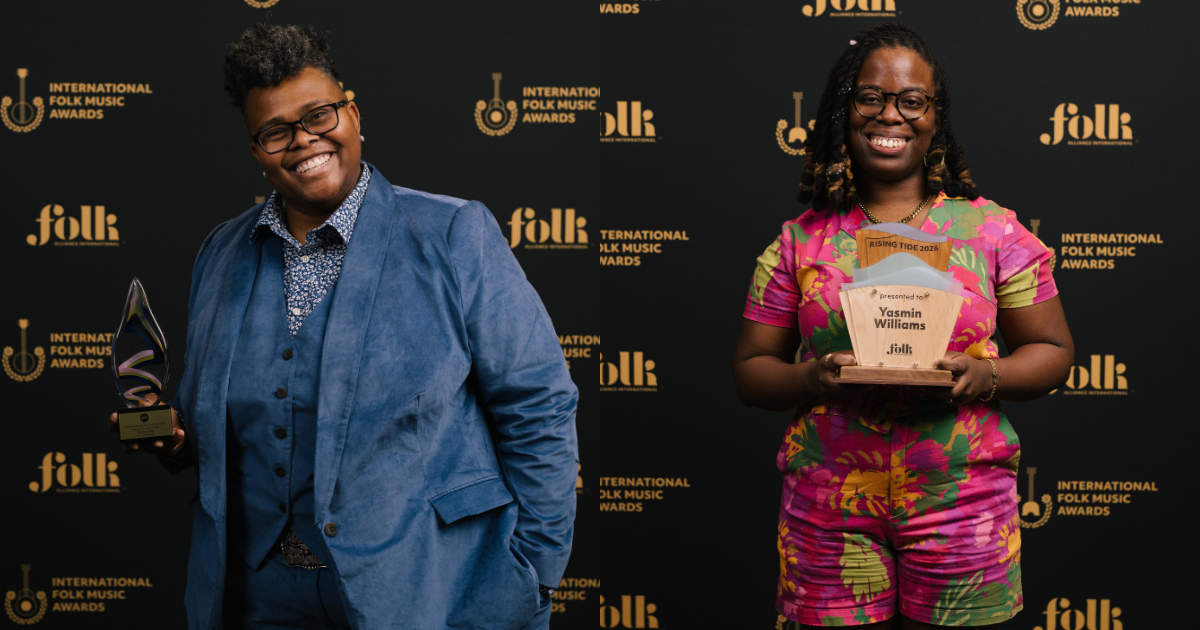
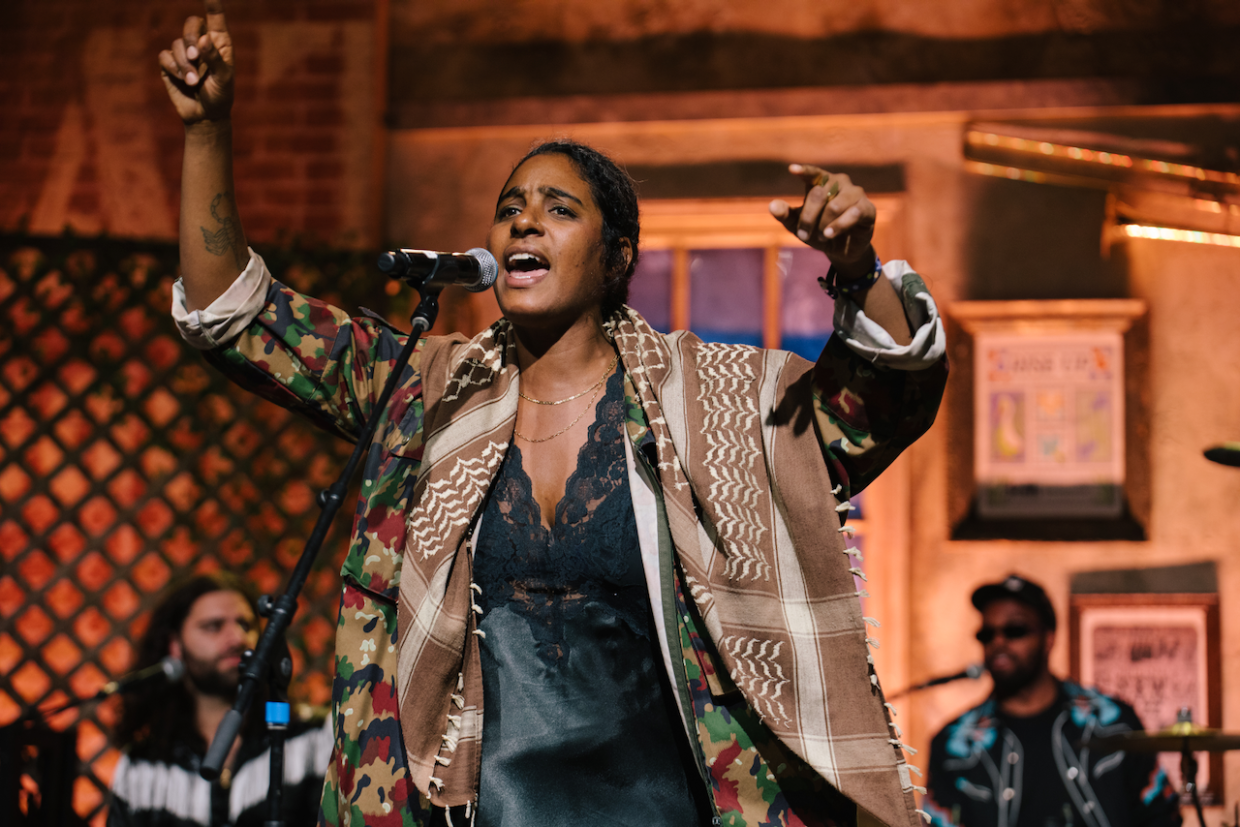
The awards show included stunning live performances by artists like Kyshona, Yasmin Williams, and Louisiana’s own artists and bands like Leyla McCalla, The Rumble, C.J. Chenier, and more. Taj Mahal, Clifton Chenier (father to C.J.), and Louisiana Folk Roots were each bestowed with Lifetime Achievement Awards. Meanwhile, the People’s Voice Award was handed out to Kyshona; the Rising Tide Award to Yasmin Williams; and the Clearwater Award to the Edmonton Folk Festival.
In the Best of 2025 categories, two acts tied for Artist of the Year: singer-songwriter, activist and protestor Carsie Blanton with folk and bluegrass supergroup I’m With Her. I’m With Her were also awarded Album of the Year.
The International Folk Music Awards show is always a highlight of each year’s Folk Alliance International conference. It’s a sort of kick-off on the first night of the event, a starting bell for showcases official and unofficial and for the next few days, all packed full of excellent folk music from all around the world – and a healthy helping from New Orleans, too.
Below, find the full list of winners (in bold) and awards recipients for the 2026 International Folk Music Awards.
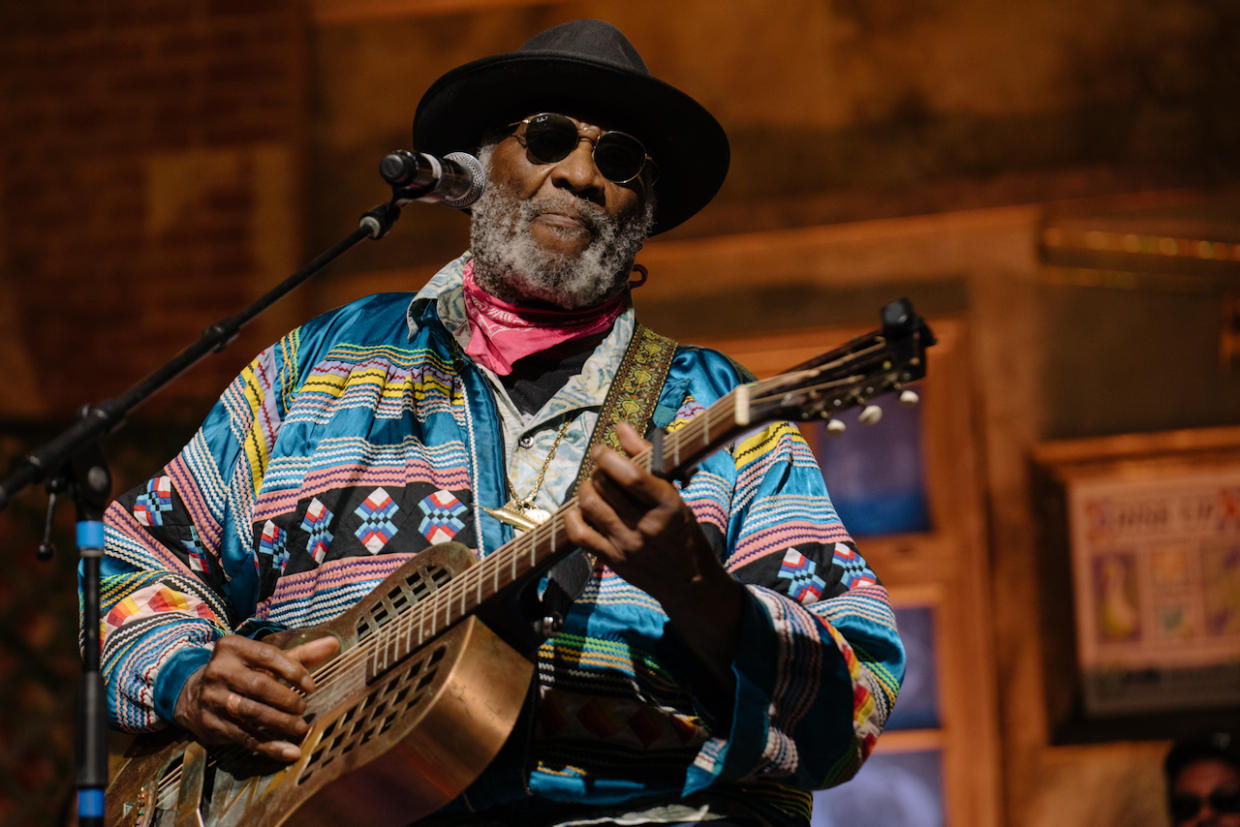
Taj Mahal, a Lifetime Achievement Award recipient, performs during the 2026 IFMAs. Photo by Shadow Scape Records.
Lifetime Achievement Awards
Taj Mahal Clifton Chenier Louisiana Folk Roots
Artist of the Year
Abbie Gardner Carsie Blanton (TIE) Crys Matthews I’m With Her (TIE) Ordinary Elephant Sam Robbins
Album of the Year
Arcadia, Alison Krauss & Union Station
CHURCH, Flamy Grant
Room On The Porch, Taj Mahal & Keb’ Mo’
Reclamation, Crys Matthews
Wild and Clear and Blue, I’m With Her
Woody At Home: Volumes 1 + 2, Woody Guthrie
Song of the Year
“Ain’t Afraid To Die” – Woody Guthrie (songwriter: Woody Guthrie)
“Crying In The Night” – Andrew Bird & Madison Cunningham (songwriter: Stevie Nicks)
“I BOUGHT ME A PRESIDENT” – Cathy Fink & Marcy Marxer (songwriters: Cathy Fink, Tom Paxton)
“Room On The Porch” – Taj Mahal, Keb’ Mo’, Ruby Amanfu (songwriters: Ahmen Mahal, Henry St. Claire Fredericks, Jr., Kevin R. Moore, Ruby Amanfu)
Today, Folk Alliance International (FAI) – the world’s largest membership organization for the folk music industry and community – announced the nominees and awardees for the 2026 International Folk Music Awards. The announcement includes Best of 2025 nominees, which are nominated and voted for by FAI’s voting membership, the Lifetime Achievement Awards, the Spirit of Folk Awards, the People’s Voice Award, the Clearwater Award, the Rising Tide Award, and Folk Radio Hall of Fame inductions.
The awards will be staged on the first night of FAI’s 38th annual conference, which will take place January 21-25, 2026 in New Orleans, Louisiana with a conference theme of “Rise Up.” Late last month ahead of the awards announcement, New Orleans icons Big Freedia and Tarriona “Tank” Ball (of Tank and the Bangas) were announced as keynote speakers for the conference.
Nominees for the Best of 2025 categories include artists from across many diverse folk genres like Alison Krauss & Union Station, Taj Mahal & Keb’ Mo’, I’m With Her, Carsie Blanton, Abbie Gardner, The Baltic Sisters, Flamy Grant, Woody Guthrie, Ordinary Elephant, Crys Matthews, and many more. Taj Mahal will also receive a Lifetime Achievement Award. Extraordinary guitarist Yasmin Williams was announced as the recipient of the Rising Tide Award, while singer-songwriter Kyshona has been tapped for the People’s Voice Award.
The International Folk Music Awards show is always a highlight of each year’s Folk Alliance International conference. It’s a sort of evening kick-off on the first night of the event, a starting bell for showcases official and unofficial and for the next few days, all packed full of excellent folk music from all around the world – and a healthy helping from New Orleans, too.
Below, find the full list of nominees and awards recipients for the 2026 International Folk Music Awards.
Lifetime Achievement Awards
Taj Mahal Clifton Chenier Louisiana Folk Roots
Artist of the Year
Abbie Gardner Carsie Blanton Crys Matthews I’m With Her Ordinary Elephant Sam Robbins
Album of the Year
Arcadia, Alison Krauss & Union Station
CHURCH, Flamy Grant
Room On The Porch, Taj Mahal & Keb’ Mo’
Reclamation, Crys Matthews
Wild and Clear and Blue, I’m With Her
Woody At Home: Volumes 1 + 2, Woody Guthrie
Song of the Year
“Ain’t Afraid To Die” – Woody Guthrie (songwriter: Woody Guthrie)
“Crying In The Night” – Andrew Bird & Madison Cunningham (songwriter: Stevie Nicks)
“I BOUGHT ME A PRESIDENT” – Cathy Fink & Marcy Marxer (songwriters: Cathy Fink, Tom Paxton)
“Room On The Porch” – Taj Mahal, Keb’ Mo’, Ruby Amanfu (songwriters: Ahmen Mahal, Henry St. Claire Fredericks, Jr., Kevin R. Moore, Ruby Amanfu)
“Sisters Of The Night Watch” – I’m With Her (songwriters: Aoife O’Donovan, Sara Watkins, Sarah Jarosz)
Global Folk Album Award
At the Feet of the Beloved, Rizwan-Muazzam Qawwali
Bagola, Trio Da Kali
Niepraudzivaya, Hajda Banda
Tales of Earth and Sun, Rastak
VÄRAV/VĀRTI/VARTAI, The Baltic Sisters
Vié Kaz, Votia
Spirit of Folk Awards
Laura Thomas, ComboPlate Booking
Rachel Ornelas, Cultural Heritage Manager, New Orleans Jazz & Heritage Festival
Alex Mallett, Deputy Director, Folk Alliance International
Cindy Cogbill, Overton Park Shell and Folk Alliance International
People’s Voice Award
Kyshona
Rising Tide Award
Yasmin Williams
Clearwater Award
Edmonton Folk Festival
Folk Radio Hall of Fame Inductees
Susan Forbes Hansen (WHUS) Kieran Hanrahan (RTE Radio 1) Ron Olesko (Folk Music Notebook) Michael Stock (WLRN)
Find out more about Folk Alliance International’s annual conference in New Orleans January 21-25, 2026 and make plans to attend the International Folk Music Awards here.
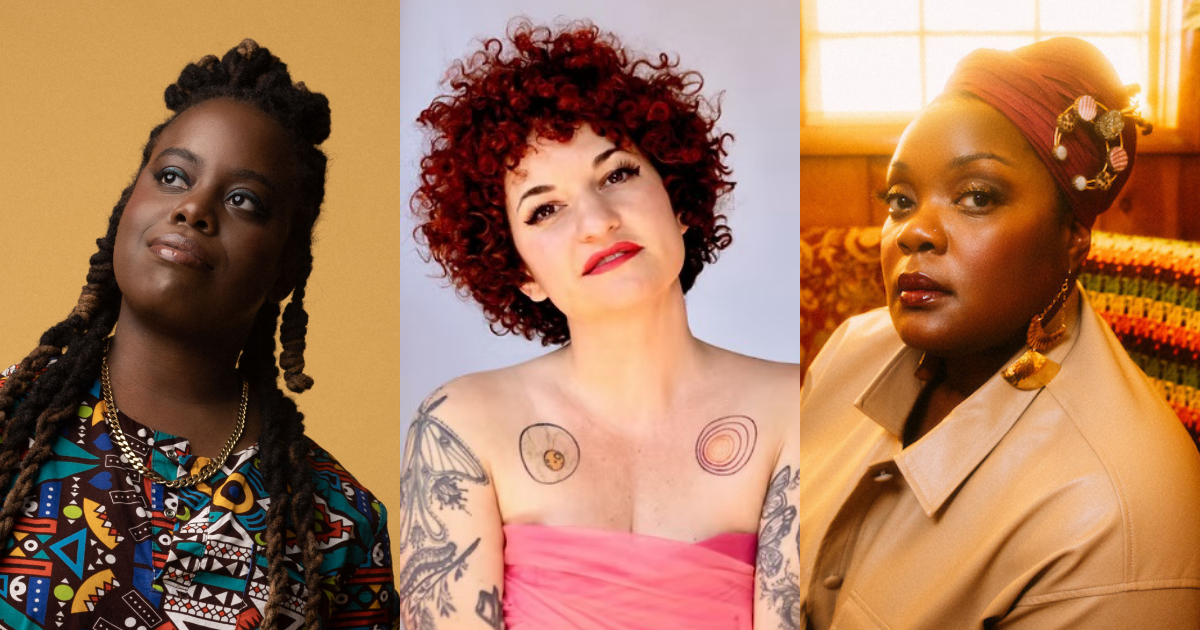
Photos courtesy of Folk Alliance International. Lead image (L to R): Yasmin Williams; Carsie Blanton; Kyshona.
Recently I was on the Outlaw Country Tour with Waxahatchee. Sheryl Crow had invited us all to join her on stage for the last night. Her production folks started passing out little percussion instruments, I think I traded the tambourine with Spencer (drummer) for something reasonable I could play. We all stepped up on the drum riser, me with a drumstick and a cowbell. Then Sheryl turned around and took her guitar off in one smooth motion. She passed it to me and whispered, “D.” Once I made it through the first chorus and got the nod from her guitar player that I was hearing the right chords, I knew this would be the peak of my entire life.
What’s the toughest time you ever had writing a song?
The next one. Not to be cliché, but it’s true. I’m constantly in fear of having written my last song. I always start from a place of “how the hell do you do this?” I’m on tour right now and I’ve been working on a song whenever I have a guitar in my hands. I oscillate between knowing exactly what I think should happen next and feeling like starting over. Both can be the right answer and that’s pretty par for the course. But every once in a while they fall out of you like a dime from your pocket. Wish I knew how to make that happen every time.
How often do you hide behind a character in a song or use “you” when it’s actually “me”?
Flaubert said, “Madame Bovary, c’est moi.”
It’s all me and none of it’s true. I don’t think I could avoid myself if I tried, but I also pull little visions and observations from the people around me all the time. I think you have to be curious about people to be a good writer.
What is a genre, album, artist, musician, or song that you adore that would surprise people?
I would say 50% of the music I listen to is instrumental. Jazz from the ’40s and ’50s in particular. Hard bop and big band music is a constant. Duke Ellington is my favorite American artist. Endlessly inspiring and a huge influence on my melodic sensibility.
Although, recently I have been listening to a lot of Romantic symphonies. Beautiful and mind-altering!
If you had to write a mission statement for your career, what would it be?
I think Woody Guthrie might have said it better than I ever could: take it easy, but take it.
Sam Shackleton is a good example of the successful contemporary songwriter – a Scottish traditional folk singer with some formal education in musicology. He posts excellent, moody clips online; he goes viral enough to open for bands and artists like the Mary Wallopers or Willi Carlisle; and he releases music on Bandcamp. Though he could easily slide into a minor but culturally significant record label, he released his new album Scottish Cowboy Ballads and Early American Folk Songs independently; when a writer emails him, the answers come back on a plain Hotmail account, his avatar a famous 19th century painting of Robbie Burns.
There is something telling in this amalgamation: the 200 years of cowboy songs, the move between America and Scotland, the slightly old-fashioned email address. Even Shackelton’s very contemporary distribution methods envelop other kinds of tradition, the busker as troubadour or a work song floating across oceans. For example, when he sings “The Butcher Boy,” his framing includes that Mary Wallopers’ cover from a couple of years ago, the Sinead O’Connor version before that, and the Tommy Makem version before that. And he also echoes those who sang before them. “The Butcher Boy” is not even a cowboy song, though. When he offers songs like “Chisholm Trail” or “I Ride an Auld Paint,” something shifts in how he sings them.
The cowboy song is muddled – it is the expression of poor, often Black, Hispanic, or Indigenous agricultural workers, telling explicit stories about their lives – but like a shanty, it is also a song that aids labor, in passing the time and moving the livestock along. These dual instincts of work and entertainment gathered into an oral tradition, which was translated into grand public spectacles. These spectacles were later depicted on radio, film, and television, abstracted and cleaned up. When a singer chooses to return to these songs, their versions are always paratextual – they are making choices of interpretation. When Shackleton sings the verses in “Chisholm Trail” about punching bosses or selling cowboy gear, he is foregrounding a kind of economic subtext, which might be less fun and seems more serious.
It reminds me a bit of growing up in Alberta (maybe because on “Roving Cowboy” Shackleton sings about crossing the Rockies and the “cold and distant plains”), or my relations in Calgary, that city mostly named after Scottish figures, romantic still for a set of cultures that doesn’t exist. How much easier it is to consider the romance of the West without considering the isolation of it all. Men would be sent from places like Scotland to the prairies as part of a great colonial project; the rascal sons of minor aristocracy, rampaging across the land. That roving grew into myths of grand cowboy narratives. The big rodeo turned into a banal bacchanal. When Shackleton sings in “Roving Cowboy” about leaving “his good old father” or “his friends and home there,” he refuses the grandeur and returns to the profound isolation. A kind of homecoming in place and in time that may never occur.
Talking to Shackleton via email for Good Country, I learned that an album I first thought was a small jape was really a sophisticated conversation with these traditions, lands, and desires.
I am curious about why cowboy ballads and also how you define a cowboy ballad – some of the songs seem very clearly part of that tradition, but some to be an extension of it. Is “Butcher Boy” a cowboy ballad?
Sam Shackelton: I’ve always been a fan of cowboy music since spending many hours watching old Westerns, when I’d go through and spend the weekends with my dad as a kid in a wee Scottish town called Bridge of Alan. For me, the best part about them was the music, singing, whistling, and yodeling. Even to this day I think it’s pretty hard to find anything cooler than Dean Martin singing “My Rifle, My Pony and Me” in Rio Bravo.
Much of my early musical influences were inspired by my father. I remember vividly the first time he showed me the excellent Woodstock: 3 Days of Peace & Music documentary of the 1969 festival, which first led me down the path of learning to play and wanting to be a musician – though at the time I didn’t think I’d ever be good enough to step on a stage. In regard to the album title, I originally was going to just call the album Scottish Cowboy Ballads, but decided to throw in the “Early American Folk Songs” to allow me to add a broader range of songs to the album such as “The Butcher Boy” or “O Death.”
Could you talk a little bit about the loops of influence which exist in folk music circles. The Scottish ballads which end up in Appalachia, from the 18th century onward, but also the dual folk revivals in the 1950s and 1960s? Where do you see your place in the ebb and flow of these revivals or these conversations?
Mainly through my own research and watching many hours of old music videos and documentaries on YouTube as a teenager, I discovered the American and Scottish folk revivals of the 1950s and ‘60s and knew I’d finally found my musical home, so to speak. I strongly believe that what you put in is what you get out, as a musician, when it comes to inspiration, so I deeply immersed myself in this music for many years. Still to this day only really listen to music from this period or those who can capture a similar sound today. I was deeply inspired by Woody Guthrie and also by his close friend, Cisco Houston, especially his album, Cowboy Ballads, which was a big influence on my latest album and much of my earlier music too.
I’ve always been drawn to less commercially popular musicians, such as Walt Robertson or Alex Campbell, those with incredible talent but whose work went generally under the radar in favor of bigger, more commercialised folk artists. People often talk of Guthrie when referring to the folk revival, but even his songs were greatly aided by Cisco’s harmonies and Sonny Terry’s whooping harmonica, another huge inspiration of mine.
I also had the great privilege of studying at the School of Scottish Studies at the University of Edinburgh for 5 years, where I got both my undergraduate and master’s degrees. The School of Scottish Studies was founded during the Scottish folk revival in the 1950s and was based on a vast collection of field recordings collected primarily by Calum MacLean – brother of the legendary Gaelic poet Sorley MacLean – and renowned ethnomusicologist and poet Hamish Henderson. [Henderson] made many of his early Scottish recordings with Alan Lomax during his time in Scotland in the ‘50s.
I focused primarily on Scottish/Celtic studies, Scots-American emigration and musical traditions, and ethnomusicology, with a specific focus on the work of Alan Lomax – and what I identified as the new “digital folk revival,” which is happening right now on social media. In my masters thesis, I argued that modern online digital communications technologies (such as social media platforms like YouTube) are facilitating multiple new folk revivals. Lomax prophetically identified this in his 1972 paper “Appeal for Cultural Equity,” where he identified both the risk of mass communication technologies to traditional folk cultures, but also their extraordinary ability to preserve and facilitate folk revivals by allowing everyone to share and participate in folk traditions on a vastly more even playing field. All you need now is a mobile phone and you can participate in the digital folk revival, sharing and listening to songs from every corner of the world.
In relation to your original question, it is indeed true that many of the songs that were sung during the folk revival in North America at that time (and throughout American history) also had a very close and deep connection to the mass emigration of people from Scotland, Ireland, England, and Wales during the 18th and 19th centuries and beyond. This is evident in songs such as “Pretty Saro,” which is also on the album. This was a song sung commonly in England but was lost to time, only to be rediscovered being sung in the mountains of Appalachia by early song collectors. And, as such, the song became popular again across the Atlantic. This is a perfect example of how these early folk revivals facilitated this full circle of cross-cultural transfer.
How was this album affected by the large-scale American touring you have done in the last few years?
My time spent touring in the USA and Canada was certainly a big influence on this album. I traveled all over the states, starting in Nashville, where I then traveled through Kentucky and Tennessee with my good friend and director of the YouTube channel GemsOnVHS, Anthony Simpkins – his channel being another great example of the digital folk revival in action. We recorded a bunch of amazing music in the hollers and I met many amazing musicians during my time there, such as Benjamin Tod and Ashley Mae from Lost Dog Street Band.
[They] kindly invited us to spend the night at their house in rural Kentucky along with Jason O’Dea to shoot some guns (my first time doing so in the USA) and play some songs around the campfire. I remember playing Benjamin Tod an old Scottish ballad called “Tramps and Hawkers” on the banjo by the fire, to which he then responded that he was also aware of versions of the same song that had been sung in the American folk tradition. Again, highlighting this close cross-cultural connection between the Scottish and American musical folk traditions. I then toured all across the East and West Coasts of the USA and Canada with my good pals, legendary Irish folk band the Mary Wallopers, before selling out a couple shows of my own on the East Coast.
I noticed that the album’s songs are mostly very short – some under two minutes. Can you talk a little bit about that? Is that related to busking? How else does busking appear in these kinds of recordings? How does busking online relate to busking in person?
Since this is the first ever album I will be releasing on 12” vinyl LPs, I decided to try and fit as many songs on it as possible. Obviously, due to the physical limitations of the vinyl medium, I had to make sure my album was within a certain length of time, hence why some of the songs may seem shorter. Although there are a good few short songs on there, you will indeed find a few longer ones such as “Old Rosin the Bow” or “The Blackest Crow.”
I know that the Mary Wallopers sing “Butcher Boy,” and it is often a touchstone for Irish singers (the Mary Wallopers, Lankum, Lisa O’Neil, Sinead O’Connor, the Clancy Brothers), but also the Irish diaspora. In fact, in a live recording from the Clancys, Tommy Makem calls it, “Well known in America.” What is your relationship to both the song and the people listening to it? How do you make songs thought commonly to be American or Irish to be Scottish?
“The Butcher Boy” is a class wee ballad and you are right in noting that it is indeed popular amongst Irish artists such as The Clancy Brothers, their version being my favorite. However, the history of this ballad and its origins are far more complex, as this ballad is actually derived from multiple old English broadside ballads such as “Sheffield Park,” “The Brisk Young Sailor,” and “The Squire’s Daughter,” to name but a few. Many versions of this song have been collected across England, Ireland, Scotland, and North America. It is perhaps one of the best examples of a cross-cultural folk ballad I can think of.
I had actually stopped singing this song for a long time after what happened with my dad, as the later verses were far too similar to what I had experienced with my father’s suicide. But, despite how hard it was for me to sing again, I felt it absolutely needed to be included on this album. If anything comes from people hearing that song in particular, I hope that they show some love to the people in their lives who may be struggling. It’s not easy being a human on this cruel old rock hurtling through space, so we all need all the love and support we can get.
I noticed that you dedicated this album to your father – what was your relationship to him?
Yes, I dedicated this album to my father, as it’s my first major release since he tragically took his own life in the summer of 2023. We also used to sing many of these songs from the album together when I was younger. As I mentioned at the start, my father has always been a huge influence on my music and I can say for certain that I wouldn’t be a musician today if it weren’t for him. From buying me my first guitar to constantly taking me on stage to perform with him as a child.
My mother and father actually used to be in a band together before I was born called Big Shacks. My mother, Kim, was the singer and my father, Norman, was the lead guitarist. I have many fond memories of busking with my dad on the streets of Edinburgh and Glasgow as a child, too. It was something that brought us very close together over the years. When he died, it really took a huge toll on me. I was actually down in England opening for Willi Carlisle when it happened and I was also in the process of getting my American O-1 visa at the time. I decided to still go ahead with the first American tour a few months later, regardless. However, afterwards I was in a really bad place mentally, so I decided to take a long break from performing until I finally felt ready to return. In that time, I recorded this album and as such I have dedicated it to his memory. I’ve now also returned to touring in the last few months and will be announcing a really big tour of my own in the very near future!
What makes a Scottish Cowboy different than other cowboys?
Scotland has a very long history of cattle droving, going back many hundreds if not thousands of years. There is indeed much to be said on the topic of Scottish cowboys and their influence on the conceptualization of the American cowboy and the Wild West. A good place to start, if you want to research this fascinating topic further, is the fantastic book by Rob Gibson called Highland Cowboys: From the Hills of Scotland to the American Wild West. In it, he details the links between the two cultures, as not only did the thousands of emigrants from the Scottish Highlands and Lowlands bring with them their musical culture and songs to the New World, they also brought with them their unique way of life and cattle-herding culture and practices. Not to mention the practice of cattle rustling, which although not unique to Scotland was a very common yet serious crime throughout Scottish history.
To further emphasise this connection, I included the song “Chisholm Trail,” as this song is sung about the historic cattle trail that runs from Texas to Kansas, which is named after the famous half-Scottish, half-Cherokee cowboy, Jesse Chisholm.
Tyler Childers has taken an unlikely path to the top via live performance, not radio singles. He’s become an improbable arena-level star by ignoring typical Nashville bromides – equal parts Patterson Hood’s working-class Southern blues, Chris Stapleton’s bluegrass bonafides, and Woody Guthrie’s progressive populism. After all, you’re not gonna call your touring band The Food Stamps unless you lean left, at least a little.
Like Billy Strings, Childers has become enough of a sensation for his appeal to extend beyond the Americana-adjacent world, too. Last year, he even turned up onstage for a live cameo with pop star Olivia Rodrigo in his Kentucky stomping grounds to do his song “All Your’n.” It went over like a house on fire.
Since country radio is finally, belatedly catching on with “Nose On The Grindstone,” lead single to Childers’ fine new Rick Rubin-produced LP Snipe Hunter, let’s take a look back to where he came from.
How’d this happen, anyway? Like this.
“Hard Times,” Bottles and Bibles (2011)
Going back to the beginning, “Hard Times” was the song that opened Childers’ full-length debut Bottles and Bibles. It’s an actual hillbilly elegy that definitely sets a tone, with finely detailed lyrics that unfold like a short story. Simultaneously stoic and emotional, Childers’ quavering vocal about a holdup gone wrong makes him sound like a protagonist who somehow regrets both everything and nothing at all: “And if the Lord wants to take me, I’m here for the taking/ ‘Cause Hell’s probably better than tryin’ to get by.”
“Long Violent History,” Long Violent History (2020)
Bluegrass roots and of-the-moment progressive activism makes for an unusual combination, but here we are. “Long Violent History” is the title track to a bluegrass album and it’s the only original and non-instrumental track on the record. Evoking “Faded Love” at the outset and “My Old Kentucky Home” on the outro, it’s a rural Southern score for the Black Lives Matter protests that swept America in 2020.
“It’s the worst that it’s been since the last time it happened,” Childers sighs at the outset, resigned to the inevitability of violence happening again. For good measure, Childers made a supplemental spoken-word video (below) explaining the necessity of BLM: “If we didn’t need to be reminded, there would be justice for Breonna Taylor, a Kentuckian like me, and countless others.”
“Jersey Giant” – Elle King (2022)
If Childers ever records his own version of “Jersey Giant,” he’ll have to hustle to top Elle King’s cover. As with the similarly themed “Me and Bobby McGee” (written by Kris Kristofferson, but owned for the ages by Janis Joplin), King just completely inhabits the song’s bittersweet, longing anguish. “I left town when we were over… Just didn’t feel the same” – the way she pauses a beat between lines is just chef’s-kiss perfection. There are numerous cover versions of “Jersey Giant” out there, but this is the one that’s going to linger.
“Luke 2:8-10,” Rustin’ In The Rain (2023)
Remember the big pivot-point moment of truth in the classic holiday cartoon A Charlie Brown Christmas – the “Lights, please” speech that his friend Linus makes? Childers must have grown up with that, too. Linus spoke these Bible verses, Luke 2:8-10, which Childers transposes to the key of honky-tonk in this song with his drawl in full effect. You can almost imagine the “Peanuts” dancers doing a two-step to it.
“Purgatory,” Can I Take My Hounds to Heaven? (2022)
Childers’ ambitiously wide-ranging 2022 album Can I Take My Hounds to Heaven? featured eight gospel songs, each done in three different versions dubbed Hallelujah, Jubilee, and Joyful Noise. The latter category tricked each tune up with samples and remixes, which might be the closest Childers has ever come to hip-hop electronica (at least so far!). In this guise, the title track from his 2017 project Purgatory cuts the sort of groove you’d expect to hear in New Orleans.
“The Heart You’ve Been Tending,” Harlan Road – NewTown (2016)
What does it mean that so many of the best covers of Childers’ songs are by women? Who’s to say, but here’s another great one, from the Kentucky band NewTown’s Harlan Road album. “The Heart You’ve Been Tending” is in waltz time, with fiddler/singer Kati Penn’s vocal shining bright as a lighthouse cutting through a foggy mountain breakdown.
“In Your Love,” Rustin’ in the Rain (2023)
Another multimedia project of sorts, this song from Childers’ Rustin’ in the Rain started out as a relatively conventional devotional love song. Then he enlisted collaborators including his fellow Kentuckian, author Silas House, to make a video that casts “In Your Love” as a sort of country music version of Brokeback Mountain set in coal-mining country. As beautiful as it is heartbreaking.
“Matthew,” Country Squire (2019)
Childers has always been wildly eclectic and this song from his Country Squire LP is a prime example. “Matthew” is yet another working-class waltz, with enough bluegrass savvy to drop bluegrass legend Clarence White’s name in the lyrics – plus an actual sitar as oddball sound-effect mood-setter at the beginning of the song. Somehow it makes perfect sense.
“Bottles and Bibles (Live),” Live on Red Barn Radio I & II (2018)
With or without a band, Childers has always been a riveting performer. This live version of the title track to his 2011 studio debut closed out 2018’s Live on Red Barn Radio I & II and it’s just voice and guitar. All the better to focus on the tale of a preacher as wayfaring stranger pondering the difficulties of keeping to the straight and narrow: “But they ain’t had to walk with the weight that you’ve hauled/ They don’t know you at all, but they think that they do.”
“Coal,” Bottles and Bibles (2011)
What might Bruce Springsteen have been like if he’d grown up in a Kentucky coal-mining family? You can imagine him turning out like the narrator of this song, which sounds way too timeless to have originated in this century. It’s pure working-class desperation: “We coulda made something of ourselves out there, if we’d listened to the folks/ That coal is gonna bury you.”
“Oneida,” Snipe Hunter (2025)
To be a Childers fan is to accept that he does have some idiosyncratic boundaries. There are songs from his live shows he’s never recorded, like the previously mentioned “Jersey Giant”; or popular recorded songs he has sworn off playing live, including the now-widely-seen-as-problematic “Feathered Indians.” For the better part of a decade, one of his unrecorded orphans was “Oneida,” a longtime fan favorite that’s like a Harold and Maude for the country set. Lo and behold, a recorded version finally surfaced as one of the best songs on Snipe Hunter. Dreams do come true.
Artist: Cole Quest and the City Pickers Hometown: Brooklyn, New York Latest Album: Homegrown Personal Nicknames (or rejected band names): CQCP, incorrectly called: Cole West and The City Slickers. Holding out for Cold Cuts and The City Pickles.
(Editor’s Note: Answers provided by Cole Quest.)
What’s your favorite memory from being on stage?
One of my favorite memories was from our inaugural tour to Germany in 2023. It was a 20+ day adventure and for many in the band it was their first time traveling internationally. I was beyond excited – and equally nervous – leading up to and during the trip, running through the millions of things that could go wrong along the way.
But as we traveled, we were met with packed venues, heartfelt appreciation, and as close to “fandom” as we’ve ever experienced. It was unforgettable.
We closed the tour with four days in the small German town of Rudolstadt, which had swelled to 90,000 visitors and over 20 stages for the Rudolstadt World Music Festival. We played several sets and gave a handful of radio interviews, each appearance building momentum as more fans and followers came out to support us. Our final performance was the big one. Right before we walked on, I gathered the band into a circle and shared a heartfelt moment to thank them for everything that led to us being there. With tear-filled eyes, I stepped on stage just as the emcee finished our introduction to a billowing applause and a spontaneous rendition of “Happy Birthday.” It was my birthday – and I couldn’t have imagined a better way to celebrate it.
What other art forms – literature, film, dance, painting, etc. – inform your music?
I often find it hard to tell where others’ art ends and mine begins. We’re all products of our surroundings and, in my case, those surroundings have always been steeped in art.
My parents had a modern dance company for many years. My grandmother was a founding member of the Martha Graham Dance Company. My grandfather was Woody Guthrie. My great-grandmother, Eliza Greenblatt, was a Yiddish poet. My late aunt Ann Cooper was a painter. The list goes on – and that’s just on my mother’s side.
In our house, many hours were spent discussing what creative expression looks like and the different forms it can take. Having these conversations growing up really pushed my creative boundaries and ways of thinking. I often attribute sounds to colors (chromesthesia) and wonder if that came from these open discussions. I believe all of the art forms influence everything about my life all the time, including my music.
How often do you hide behind a character in a song or use “you” when it’s actually “me”?
I find I actually do the opposite – and quite often. I find myself writing about “me,” putting myself in someone else’s shoes. I find I often use songwriting as an excuse to shift my own perspective – not necessarily to a “better” perspective – but more as exercise to deeper understand things from different angles. For example, “Plane Wreck At Los Gatos” or “Jolly Banker.”
I’m heavily influenced by my grandfather in that way. Growing up, it’s something I’ve always noticed about many of his writings and grew up understanding that to be the norm. It made sense to me, to use songwriting as a tool for greater understanding and gaining a broader perspective.
Since food and music go so well together, what is your dream pairing of a meal and a musician?
I’m not much of a food connoisseur, but I am a fan of good company and good conversation over a slice of cheesecake or a latke. My dream meal would be showing up to downtown Brooklyn’s famous cheesecake establishment, Junior’s, for a late night slice with Stevie Wonder.
To set the scene, Junior’s is basically a classic NYC diner including bright Broadway-style lighting outside, brown and orange vinyl booths, and your food order comes with the best-in-town complimentary beets, coleslaw, and pickles. The main difference is its exceptional desserts and historic presence. Because its location is a central hub of Brooklyn, it’s a true “mosaic of Brooklyn” according to the third-generation owner. The late-night crowd often includes folks coming in after seeing a concert nearby, locals looking to put a few back, families who missed “dinner time,” or the seasoned regulars appreciating a delicious milkshake.
I can’t think of a better spot to sit down and pick Stevie’s brain about all of his songwriting, his lyrical prowess, his thoughts on love, social issues, and anything part of the human experience.
If you didn’t work in music, what would you do instead?
I’ve spent many hours of my life as a computer programmer – and still do – but deep down, I’ve always wanted to drive what I call “the big square.” I want to drive big vehicles: coach buses, school buses, 18-wheelers, and RVs. It’s not that I crave the long hours behind the wheel, which is why I’ve never made it a profession; part of me wants to just spin the big steering wheel and navigate these oversized boxes in narrow and small spaces. I have no idea why.
Between other jobs, I’ve thought about getting my commercial license, but it just hasn’t happened yet. For now, I live vicariously through the 18 Wheeler: American Pro Trucker arcade game.
Okay but really, You Gotta Hear This! Our weekly premiere and new music roundup is simply packed with entirely legendary bluegrass in this edition of the column.
Kicking us off, award-winning husband-and-wife duo Benson – made up of Kristin Scott Benson and Wayne Benson – offer their rendition of a Harley Allen song, “Things Have Changed,” with Dustin Pyrtle lending a perfect lead vocal to the track. The Seldom Scene, an iconic bluegrass band for now more than 50 years, release their brand new album today. We’re celebrating Remains to Be Scene by highlighting “Hard Travelin’,” a Woody Guthrie-written number that you, like Ron Stewart, may recognize from Flatt & Scruggs’s discography.
Fiddle is represented in force this week, too, with fiddler and multi-instrumentalist Andy Leftwich racing through an original, “Highland Rim,” with Cody Kilby, Matt Menefee, and Byron House along for the ride. Jason Carter & Michael Cleveland are releasing their debut duo album today as well, so we’ve cued up “In the Middle of Middle Tennessee” from that stellar project. Written by Darrell Scott, it features Carter’s tasty baritone and country star Charlie Worsham (who has strong bluegrass roots) on harmony.
To round out our collection this week, Joe Mullins & the Radio Ramblers preview their new bluegrass gospel album, Thankful and Blessed, set for release next week on March 21. “He Sees the Little Sparrow Fall” is a superlative example of the gospel and sacred traditions in bluegrass, a little concentrated dose of Friday revival for the end of your work week.
Every single track herein is bluegrass of the highest quality, so you know what we’re going to say… You Gotta Hear This!
Benson, “Things Have Changed”
Artist:Benson Hometown: Boiling Springs, South Carolina Song: “Things Have Changed” Release Date: March 14, 2025 Label: Mountain Home Music Company
In Their Words: “We’re excited for this song to finally come out. We love the lead vocal by Dustin Pyrtle and the sentiment of ‘Things Have Changed’ is universal. It seems things do change so fast these days. Downtown Nashville is different every time I go! But even in small towns, you feel it, both physically and relationally with the people who live there. I love the line, ‘I’m sort of glad that Mom and Dad ain’t around.’ That melancholy embodies the mood of this guy who goes back home and feels an overall sense of loss. Wayne and I love to play this slower tempo on mandolin and banjo. He gets to tremolo and I get to play fun chord-based banjo. I always enjoy playing this kind of banjo backup.” – Kristin Scott Benson
“I’ve always loved Harley Allen and certainly do love this song. Dustin Pyrtle seemed like the perfect singer to reach out to and man did he ever deliver the goods on this one!” – Wayne Benson
Track Credits: Wayne Benson – Mandolin Kristin Scott Benson – Banjo Cody Kilby – Acoustic Tony Creasman – Drums Kevin McKinnon – Bass Dustin Pyrtle – Vocal
Carter & Cleveland, “In the Middle of Middle Tennessee”
Artist:Jason Carter & Michael Cleveland Hometown: Nashville, Tennessee (Jason); Charlestown, Indiana (Michael) Song: “In the Middle of Middle Tennessee” Album:Carter & Cleveland Release Date: March 14, 2025 Label: Fiddle Man Records
In Their Words: “This is a fun song that transports me to a place in my mind where I’d love to be – stuck in the middle of Middle Tennessee. Special thanks to Charlie Worsham for singing with me on this track. It’s one of the highlights of the entire record for me! I never had the chance to meet Darrell Scott’s cat, Bobtail, but somehow, I feel like I’ve seen him before. Thank you, Darrell, for writing this song about him!” – Jason Carter
Track Credits: Jason Carter – Lead vocal, fiddle Michael Cleveland – Fiddle Charlie Worsham – Harmony vocal Sam Bush – Mandolin Jerry Douglas – Dobro Bryan Sutton – Guitar Cory Walker – Banjo Alan Bartram – Bass
Andy Leftwich, “Highland Rim”
Artist:Andy Leftwich Hometown: Carthage, Tennessee Song: “Highland Rim” Release Date: March 14, 2025 Label: Mountain Home Music Company
In Their Words: “I’ve always loved the intensity of a fast-paced instrumental and we hold nothing back on this one. Named after a raceway close to home where I grew up, I thought this one perfectly described the rush that you get from going fast. I wanted a song on this new project where we can go absolutely bananas and I feel like we captured it on this one!” – Andy Leftwich
Track Credits: Andy Leftwich – Fiddle, mandolin Byron House – Upright bass Cody Kilby – Acoustic guitar Matt Menefee – Banjo
Joe Mullins & the Radio Ramblers, “He Sees the Little Sparrow Fall”
Artist:Joe Mullins & The Radio Ramblers Hometown: Xenia, Ohio Song: “He Sees The Little Sparrow Fall” Album:Thankful and Blessed Release Date: March 21, 2025 Label: Billy Blue Records
In Their Words: “It’s so easy to sing a song of gratitude and celebration when we consider the beauty of creation. Our friend, songwriter Conrad Fisher, lives in a gorgeous valley surrounded by the mountains of Pennsylvania. No matter where we look around the world, seeing God’s magnificent beauty in creation is easy and worthy of our praise. A new song with an old-time flavor and a universal message opens our new album, ‘He Sees the Little Sparrows Fall.’” – Joe Mullins
Track Credits: Joe Mullins – Vocal, banjo Adam McIntosh – Lead vocal, guitar Chris Davis – Vocal, mandolin Jason Barie – Fiddle Zach Collier – Bass
The Seldom Scene, “Hard Travelin'”
Artist:The Seldom Scene Hometown: Bethesda, Maryland Song: “Hard Travelin'” Album:Remains to be Scene Release Date: March 14, 2025 Label: Smithsonian Folkways
In Their Words: “This song comes from a Flatt & Scruggs album of the same title, circa 1963. Written by Woody Guthrie, the song was first recorded in 1947. Anyone who knows me knows how much I love Flatt & Scruggs and this is one of my favorites from the early 1960s when they were still plowing bluegrass, but using material from a broad range of writers.” – Ron Stewart
Photo Credit: Andy Leftwich by Erick Anderson; Carter & Cleveland by Emma McCoury.
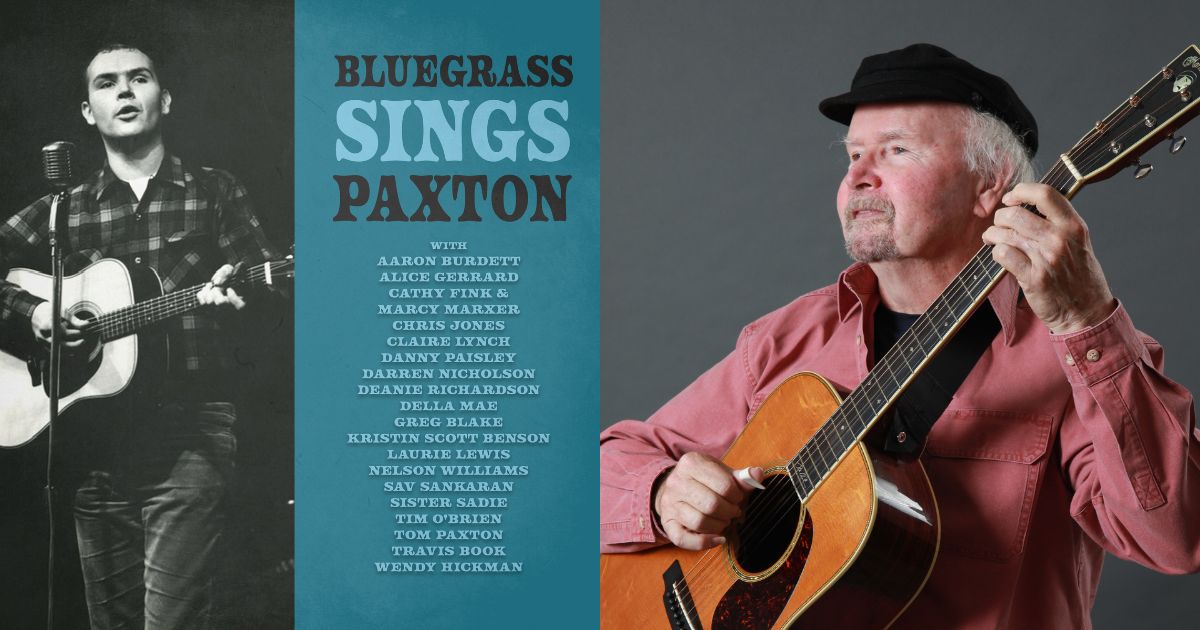
There is no disputing that Tom Paxton is a living music legend. In the early 1960s, he was a major player in the vibrant Greenwich Village folk scene, along with the likes of Bob Dylan, Phil Ochs, and Peter, Paul & Mary. The writer of such classic tunes as “Last Thing On My Mind,” “Bottle Of Wine,” “I Can’t Help To Wonder (Where I’m Bound),” and “Ramblin’ Boy,” Paxton has earned Lifetime Achievement Awards from the GRAMMYs, ASCAP, and the BBC. The beloved songwriter has had his tunes covered by a wide spectrum of acts, ranging from Harry Belafonte and Neil Diamond to the Pogues and Norah Jones. While several fellow singer-songwriters (notably Carolyn Hester and Anne Hills) have devoted entire albums to Paxton music, it took a group of admiring bluegrass musicians to deliver the first multi-artist tribute album of his songs.
Bluegrass Sings Paxton, which came out August 30 on Mountain Home Music Company, offers an impressive lineup of contributors that cuts across several generations of bluegrass musicians. Performers include celebrated acts, such as Alice Gerrard, Claire Lynch, Laurie Lewis, and Tim O’Brien along with younger stars, like Sister Sadie, Della Mae, Steep Canyon Rangers’ singer/guitarist Aaron Burdett, Unspoken Tradition’s Sav Sankaran, and current IBMA Male Vocalist of the Year Greg Blake.
Paxton, speaking to BGS from his home in Virginia, said that he had a mostly hands-off role in the making of Bluegrass Sings Paxton. “I just sat on the sidelines in amazement”; however, he confided, “I was just blown away” after listening to the entire album for the first time. The 86-year-old singer-songwriter was also being a little modest about his own contributions. This collection contains two new Paxton tunes, and he sings on a pair of tracks as well.
The genesis for Bluegrass Sings Paxton started with a conversation that GRAMMY-winning musician/producer Cathy Fink had some years ago with Paxton, who she has worked with since the early 1980s and has known even longer. “I know Tom’s catalog really well and have often thought there was great material there for bluegrass,” she shared with BGS. “I could hear this album before we even began.” The idea further evolved a while later when Fink brought up the idea to award-winning songwriter, producer, and Mountain Home executive Jon Weisberger at IBMA a few years back, and he immediately came aboard.
Several of Paxton’s tunes have been very popular in bluegrass circles over the years. A half century ago, Kentucky Mountain Boys covered “Ramblin Boy” while the Dillards and the Kentucky Colonels were among those who have recorded “The Last Thing On My Mind.” More recently, “I Can’t Help But Wonder (Where I’m Bound)” was a hit for Ashby Frank and “Leavin’ London” is a live staple of Billy Strings’ concerts. However, both Fink and Weisberger thought the project was a terrific way to get Paxton’s deep songbook better known in the bluegrass world. As Weisberger explained, “I had no doubt that there were more [songs] – both already written and yet to be written – that would work well within bluegrass, and that bringing them to light would encourage artists looking for songs to look to his catalog.”
Several acts came into the project with specific songs that they wanted to do. Blake, who fatefully was sitting at the same table with Weisberger and Fink at IBMA, quickly put dibs on “Leaving London.” Danny Paisley, who remembered his dad, ’80s bluegrass star Bob Paisley, taking him to the Philadelphia Folk Festival as a child and seeing Paxton play there, requested “Ramblin’ Boy,” because it was a song his father had performed. “I Can’t Help But Wonder (Where I’m Bound)” was already part of Della Mae’s live repertoire, so doing that tune was a natural fit for them.
When it came to what songs other acts took on, Fink gave the performers a lot of free rein to delve into Paxton’s vast treasury of tunes, a decision that worked out wonderfully. “Each artist made the song their own and it really worked,” she confided. Claire Lynch chose “I Give You The Morning” and Alice Gerrard selected “The Things I Notice Now” from Paxton’s 1969 The Things I Notice Now album. Chris Jones picked “The Last Hobo” from 1986’s And Loving You. Paxton’s 2002 album, Lookin’ for The Moon, was the source for both Aaron Burdett’s selection of and Sav Sankaran’s rendition of the title track. Laurie Lewis, meanwhile, found “Central Square” from 2015’s Redemption Road. In case you haven’t done the math, these songs alone cover nearly 50 years of Paxton’s recordings.
Paxton, too, was thrilled with the selections, proclaiming “I liked every one of the songs that they chose.” While he expected tunes like “Can’t Help But Wonder,” “Ramblin’ Boy,” and “The Last Thing On My Mind” would be part of the set, Paxton said he “was just tickled to death” over the inclusion of such lesser known numbers as “Central Square,” “The Same River Twice,” and “The Last Hobo.”
Chris Jones revealed to BGS that he picked “The Last Hobo” because the tune “felt like a classic Tom Paxton third-person story song, sort of in the spirit of ‘Ramblin’ Boy,’ in a way. It has a kind of tenderness that is so often present in Tom’s songs.”
Jones was also a member of the de facto “house band” that played on the majority of Bluegrass Sings Paxton’s tracks. A secret weapon behind the album, this team of bluegrass all-stars includes IBMA award-winners banjo player Kristin Scott Benson (the Grascals), fiddler Deanie Richardson (Sister Sadie), and Jones on guitar, along with mandolinist Darren Nicholson (formerly of Balsam Range), bassist Nelson Williams (Chris Jones & the Night Drivers, New Dangerfield) and harmony singers Travis Book (The Infamous Stringdusters) and Wendy Hickman.
Jones felt that everyone “clicked well together” and gave the music “a natural sound, which helped give the impression that these were bluegrass songs to begin with, even if they weren’t.” He also credited producers Weisberger and Fink for “coming up with arrangements that really fostered that feeling, too.”
Bluegrass Sings Paxton opens with one of the tunes that Paxton sings on. He was able to join Della Mae on “I Can’t Help But Wonder (Where I’m Bound)” as the band was recording in Maryland, not too far away from Paxton’s home base in Virginia.
“We did it live in the studio. No overdubs or anything,” he revealed. “I had a ball doing that track with them.” Paxton also sang with long-time collaborators Cathy Fink & Marcy Marxer – the three did a double album, All New, together in 2022 – on the up-tempo love tune, “All I Want,” which is also one of the two of new Paxton tunes on the project. The other new number, “You Took Me In” is a co-write with Tim O’Brien and his wife Jan Fabricius. One of the first tunes he wrote with the couple, Paxton said that “it had to be chosen. It’s such a good song.” He described it as “gospel without being gospel,” adding, “I took the literal gospel out of it and kept everything else.”
Fink & Marxer and O’Brien & Fabricius are among the handful of musicians that the still highly-active octogenarian collaborates with via Zoom each week. Folk luminary John McCutcheon, Colorado troubadour Jackson Emmer, and the rising Pittsburgh band Buffalo Rose are also among his regular online songwriting coterie. Paxton says he sometimes writes three to five songs a week. “Lots of folks would retire to the golf course at this point in their lives,” Fink marveled, “but Tom is driven by writing the next song.”
Over the years, Paxton has penned hundreds and hundreds of songs, and more than 60 albums bear his name, beginning with 1962’s I’m the Man That Built the Bridges that was recorded live at New York City’s fabled Gaslight Club. Even from the start, Paxton filled his records predominately with originals, which wasn’t typical at that time. Dylan’s 1962 debut, for example, contained only two originals. Dave Van Ronk, in fact, famously proclaimed in his memoir that it was Paxton who kicked off the folk scene’s “New Song Movement,” not Dylan as often credited.
The best-known songs from his debut, somewhat curiously, are three tunes that might best be described as children’s music: “My Dog Is Bigger Than Your Dog,” “Marvelous Toys,” and “Going To The Zoo.” Writing and performing kids songs was not an isolated occurrence for Paxton, who went on to release several children’s albums, including the GRAMMY-nominated Your Shoes, My Shoes, and to write books for kids. Paxton very much sees himself as continuing the legacy of his heroes, Woody Guthrie, Pete Seeger, and The Weavers – artists who performed all types of songs, from story songs and ballads to children’s tunes and political songs.
“Everything I do is really rooted in traditional music,” Paxton elaborated during his phone interview. “I’m always going back to that well of traditional folk music, Appalachian music, cowboy music. It’s a wonderful tradition – great, great songs, and I just keep trying to write songs that feel the way they felt.”
Paxton cites one specific musician – the late, great Doc Watson – to explains his “best route” to bluegrass music. He saw Watson when Ralph Rinzler first brought him to play in New York City and came away so impressed. “I was very fond of him and adored his music. I think he liked me, too. Doc recorded many of my songs over the years.” He also remembered sharing a bill with Watson once in Tampa and being brought out on stage to perform “Bottle Of Wine.” Paxton was rather intimidated over Watson’s and his guitarist Jack Lawrence’s virtuosity. “Why do I feel like I’m wearing painter’s gloves,” he recalled saying while admitting “it was a lot of fun.”
Weisberger describes Paxton’s place in American music as a unique one. “He was an integral part of the transition from wholly traditional folk music to the more modern conception of the field, with its inclusion of performing songwriters, but where a lot of his contemporaries moved on in one way or another, he went deep rather than broad… I think that’s what makes so many of his songs sound so natural and organic and almost effortless. That is an artistry that is really easy to overlook or under-appreciate, so I’m happy to have put together a collection that will, I hope, bring more attention and appreciation to that still ongoing legacy.”
When asked how his songwriting has changed over the years, Paxton replied that he hopes it’s deeper and more developed, adding rather humbly that “I’m still the same writer I was when I wrote ‘Last Thing On My Mind.’ It’s like a farmer who puts in the same crop every year. It’s the same farmer.”
Photo courtesy of Fleming Artists. Album cover courtesy of Crossroads Label Group.
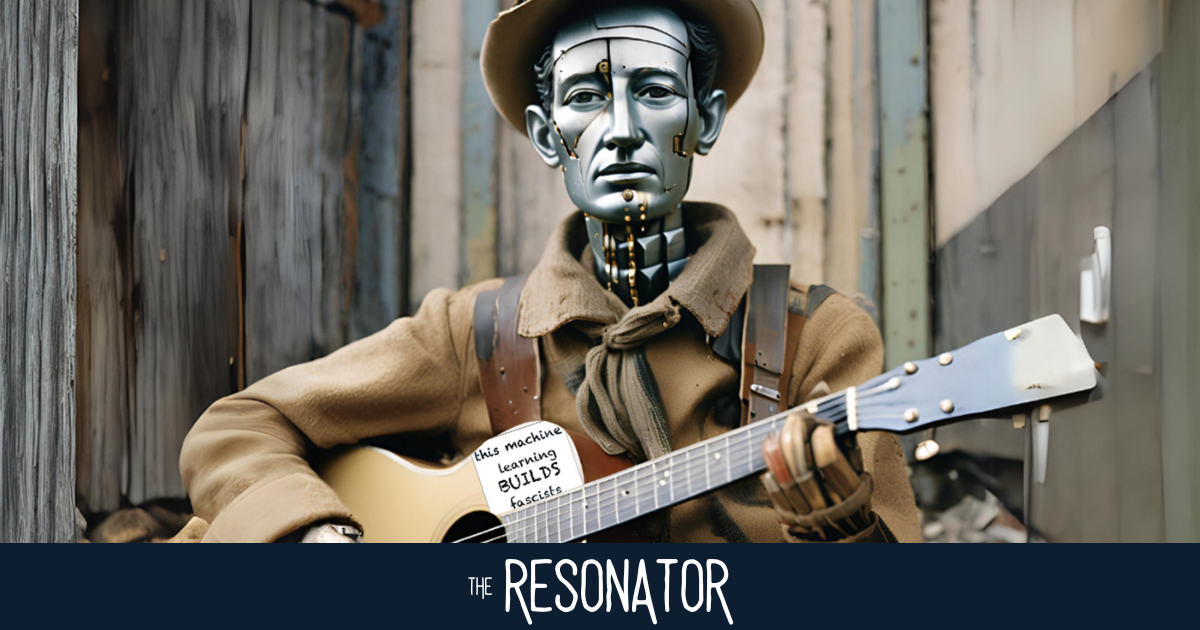
TULSA, OK – Generative AI company Altosphere released an album of “new” Woody Guthrie music, courtesy of their first artificially generated resurrection of the famous folk musician, who died in 1967.
“Artists like Woody Guthrie have been silent for years,” declared Altosphere CEO Blake Mundy. “So we thought, like, what if Woody dropped a new joint now? Wouldn’t that be sick?”
Guthrie, once a towering figure of American folk music, championed themes of equality, socialism, and anti-fascism and laid the groundwork for the socially conscious folk music later popularized by artists like Bob Dylan and Joan Baez. But apparently, AI Woody didn’t get the memo.
After initial testing returned some positive song outputs, researchers quickly discovered that their creation, dubbed “WoodyBot,” departed sharply from the views typically associated with Guthrie.
While the flesh-and-blood Guthrie was best known for “This Land is Your Land” and a guitar with the inscription “This machine kills fascists,” WoodyBot cranked out tunes praising corporate consolidation, touting a lower minimum wage, and lauding police militarization.
In one tune called “Good Guy with a Gun,” the bot crooned, “I’m a fella who ain’t yella/ This country’s headed down/ I’ll get my AR-15/ Run the leftists outta town!”
Attempts to course-correct the model with additional data from the Guthrie canon were not received well by WoodyBot. “I tried to give some feedback when it wrote ‘No Women in the Voting Booth,'” said AI researcher Pico Dhaliwal. “But WoodyBot called me a commie pinko and doxxed my whole family. From then on, I just let it do its thing.”
Other WoodyBot “hits” included “Take a Ride in the Cybertruck!,” “Jesus Was a Snowflake,” “Unions Make You Gay,” and “A Jar of Monster Energy (Makes Me Feel Alive!)”
“We still have some tweaking to do,” Mundy admitted, before adding with enthusiasm, “But actually, I think these songs slap way harder than the original stuff.”
Greg Hess is a comedy writer and performer in Los Angeles. His work has been featured in The American Bystander, The Onion, Shouts & Murmurs, Points in Case, and he cohosts the hit satirical podcast MEGA.
This website uses cookies to improve your experience. We'll assume you're ok with this, but you can opt-out if you wish.AcceptRejectRead More
Privacy & Cookies Policy
Privacy Overview
This website uses cookies to improve your experience while you navigate through the website. Out of these, the cookies that are categorized as necessary are stored on your browser as they are essential for the working of basic functionalities of the website. We also use third-party cookies that help us analyze and understand how you use this website. These cookies will be stored in your browser only with your consent. You also have the option to opt-out of these cookies. But opting out of some of these cookies may affect your browsing experience.
Necessary cookies are absolutely essential for the website to function properly. This category only includes cookies that ensures basic functionalities and security features of the website. These cookies do not store any personal information.
Any cookies that may not be particularly necessary for the website to function and is used specifically to collect user personal data via analytics, ads, other embedded contents are termed as non-necessary cookies. It is mandatory to procure user consent prior to running these cookies on your website.