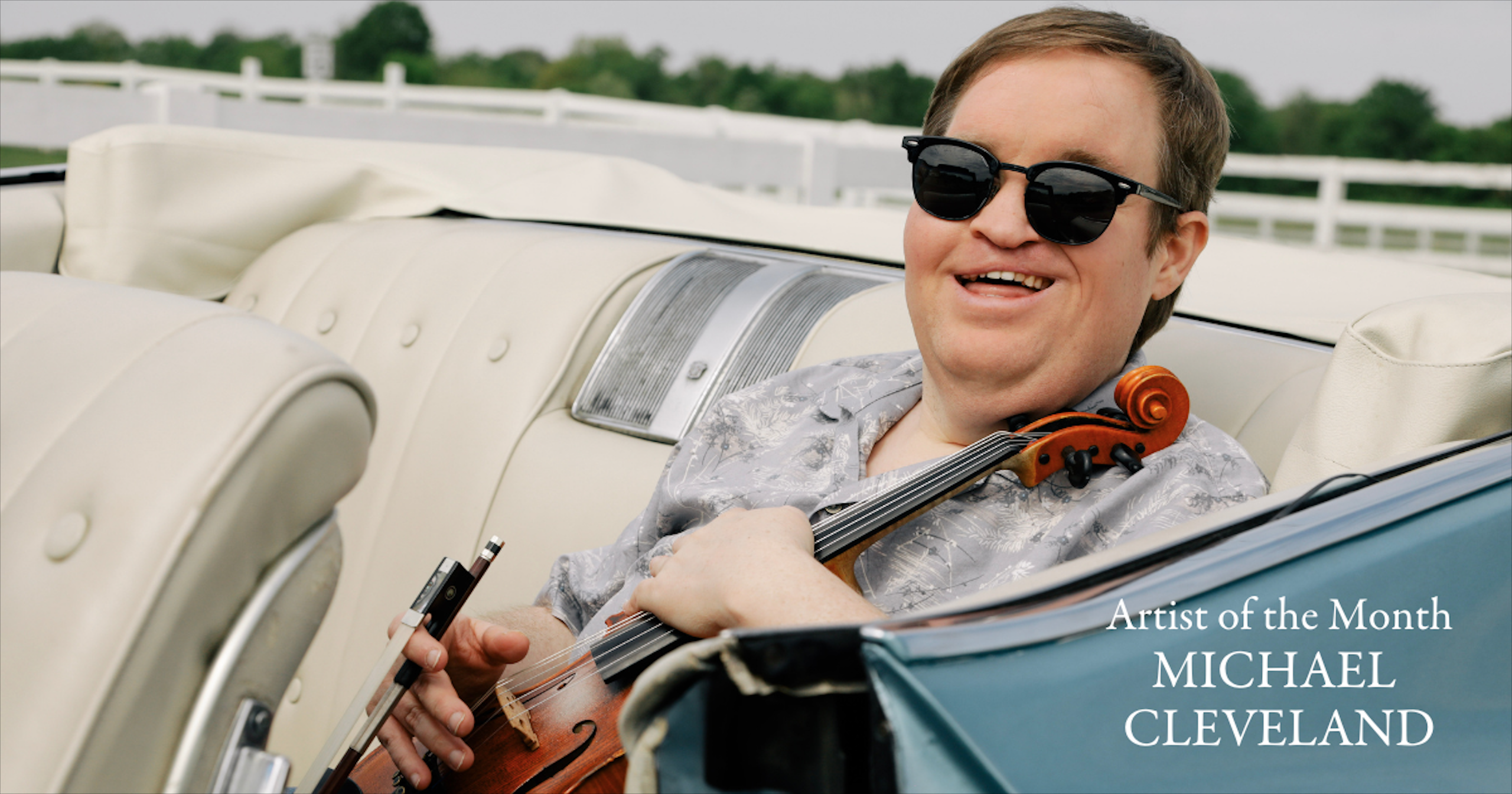
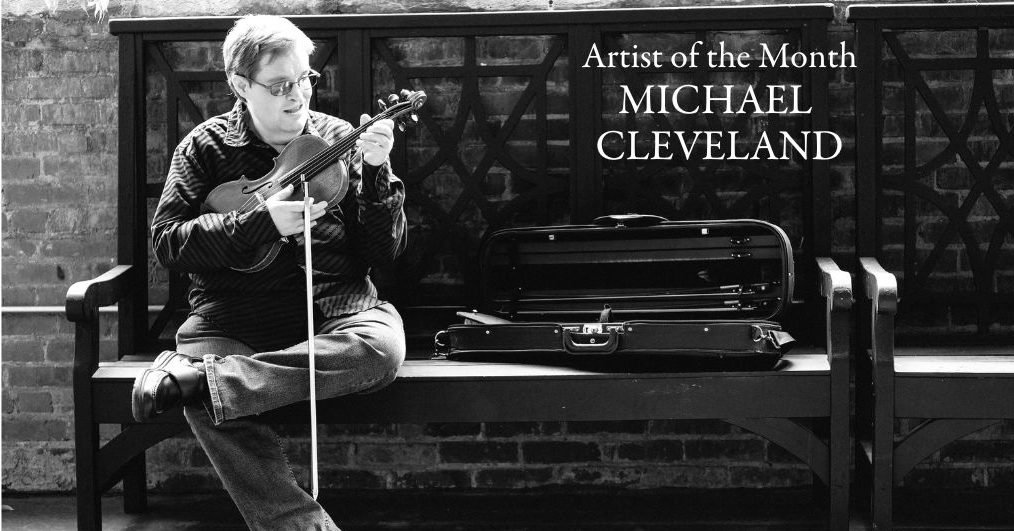
Artist of the Month: Michael Cleveland

Michael Cleveland is likely the most awarded fiddler of our era. Along with a Grammy for best bluegrass album and dozens of IBMA trophies, he’s also won our admiration and respect. You can hear the joy in his fiddling, while his friendly disposition helps him stay on the first-call list for bluegrass recording sessions. He’s gathered an impressive list of collaborators for his sixth studio album, Lovin’ of the Game, releasing this month on Compass Records. Guests range from Jerry Douglas and Béla Fleck, to Vince Gill and Charlie Starr of Blackberry Smoke.

Cleveland titled the new album after a Judy Collins classic that he recorded with his band, Flamekeeper. “The song is about prospectors and gamblers,” he has said, “but for me, the ‘loving of the game’ has always been loving being a part of the musical community and all that being a musician has brought to me.”

Beneath his calm demeanor, though, Cleveland is driven to create. Born completely blind, he’s also lost 80 percent of his hearing in the left year. Nonetheless, he’s been making albums for 25 years, toured with legends like Rhonda Vincent before stepping out with Flamekeeper, and collected all-star admirers like Billy Strings and Bryan Sutton. Vince Gill, who lends his voice to the true blue heartbreaker “I Wish I Knew Now What I Knew Then,” counts himself among a legion of fans. “He plays fearless and it’s intoxicating to play with him because he makes you play fearless,” Gill says. “He takes no prisoners but he plays with restraint and a soul. He plays without abandon.”

As we celebrate Michael Cleveland as our BGS Artist of the Month for March, we’ll unveil a brand new performance video filmed in Nashville, as well as exclusive career-spanning interview. Because we’ve been fans for a long time, we’ll also share some of our favorite moments from the Bluegrass Situation archive (like the time he picked his desert island fiddler for us.) Meanwhile, enjoy our BGS Essentials playlist with Michael Cleveland below.


Photo Credit: Amy Richmond

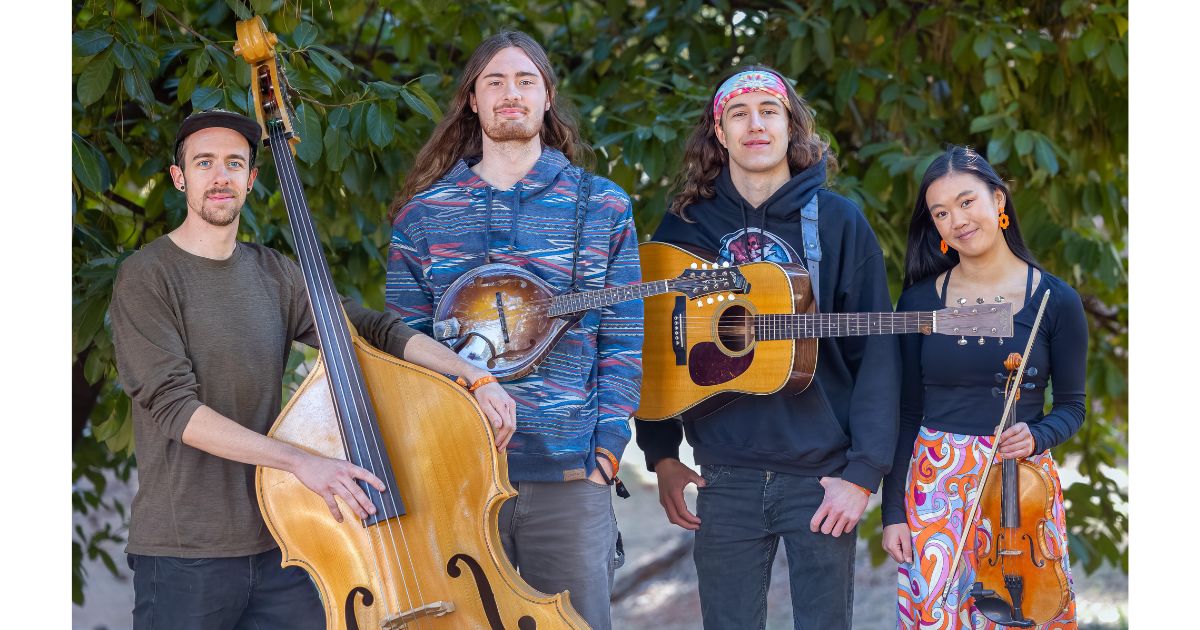
LISTEN: Chicken Wire Empire, “Friend of the Devil” (Grateful Dead Cover)

Artist: Chicken Wire Empire
Hometown: Milwaukee, Wisconsin
Song: “Friend of the Devil”
Album: Verry Garcia EP
Release Date: March 10, 2023

In Their Words: “The Midwest brings people to bluegrass from a variety of different angles, and we found that the Grateful Dead was a bridge between the different creative roads that ultimately brought our group together. David Grisman’s iconic descending mandolin riff at the top of the Dead’s 1970 recording ‘Friend of the Devil’ is a shining example of the way bluegrass music influenced the band’s sound. The riff is a theme that reminded us of the fiddle tune ‘Whiskey Before Breakfast,’ so we weaved a full pass of the tune into our cover to further explore that bridge between traditional roots music and the sound of the Grateful Dead.” — Carter Shilts, Chicken Wire Empire


Photo Credit: Stephanie Charpentier-Brusubardis

Tim Stafford & Thomm Jutz Excavate the Stories of Appalachia on ‘Lost Voices’

Tim Stafford’s 97-year-old mother, Bernice, still saves newspapers—big stacks of yellowing back issues, should she ever need to retrieve some scrap of local intel. She will clip the occasional notice from those aging pages and dispatch them to her son Tim Stafford, too. The Blue Highway cofounder and former member of Alison Krauss & Union Station now lives 40 miles south of his Kingsport, Tenn., hometown.

Late in 2021, Bernice didn’t even need to cut and post. Instead, she simply handed him a recent series from the Kingsport Times News and pointed at Kinnie Wagner. An Appalachian outlaw, Wagner ran off with the circus, ran moonshine for a sheriff, and repeatedly ran away from jail after killing multiple cops nearly a century earlier. The saga might be a song, Stafford thought, but Bernice just wanted her son to know he was also a dashing folk legend.

“He was this self-styled ladies man. Have you seen pictures of him, that Harry Houdini haircut?” Stafford, 62, says, laughing from his home outside of Greeneville, Tenn. “She wanted to let me know that her grandmother thought he was the stuff. He was a local hero.”

Despite a master’s degree in history from nearby East Tennessee State University and a lifelong enthusiasm for Appalachian lore, Stafford had never heard of Wagner. As he began to ponder the renegade, complexities emerged—his deification by disenchanted locals as a Robin Hood acolyte whose funeral was allegedly attended by 10,000, his vilification by locals who had lost family members to a murderer, the gray area in between. “In the ’20s, before mass media, it was easy to build up this myth,” Stafford says. “But good or bad, it’s the sort of thing that needs to be preserved. His story was definitely a lost voice.”

“The Ballad of Kinnie Wagner” is now an early standout on Lost Voices, an absorbing debut LP written and recorded alongside Nashville songwriter Thomm Jutz. Above darting banjo and pensive fiddle, the pair relay a first-person synopsis of Wagner’s deeds and misadventures, ending on twin notes of resignation and redemption.

That sense of sympathetic storytelling indeed shapes most of Lost Voice’s 14 tales, from a barnstorming Black baseball team in the Appalachian foothills to the region’s amateur physicians and midwives who healed with home remedies passed among generations and neighbors. Lost Voices is a thematically sprawling bluegrass record, reaching across multiple decades, disparate traditions, and far-flung regions to offer cautionary and sometimes complicated accounts alongside songs of hopeful redemption. Think of it as Howard Zinn’s hidden American histories meets Wilma Dykeman’s ethnographic Appalachian books, bound by an unfailingly poised melodies.

“Bluegrass is all about sad stories, morbid stories—murder ballads, you know?” Stafford says. “But one thing I have learned is that there are very few topics that can’t be songs. And some of the ones we have written are pretty far out.”

Jutz may, at first glance, seem like an unlikely writing partner for these songs of the rural South. Born in 1969 in Germany’s southwest corner, not far from the Swiss and French borders amid the Black Forest, he is a classically trained guitarist. But a 1981 television performance by Bobby Bare captivated him, prompting an obdurate interest in country and its kin.

“The allure of this music is that it lives in the past and present at the same time, but it’s almost easier to learn about it if you look to the past,” says Jutz, 53, between classes at Nashville’s Belmont University, where he teaches songwriting. “But I didn’t live in an environment where that was around me, so I had to find it in literature and music. So I’ve always been interested in American history.”

In 2002, Jutz landed a “diversity visa” and emigrated to Nashville a year later, soon pulling triple duty as a producer, touring guitarist, and songwriter. The tunes seemed to pour out. After meeting The SteelDrivers’ Tammy Rogers at a Music City industry soiree in 2016, for instance, their regular writing sessions yielded an astonishing 140 songs before the pair finally released a dozen last year.

He found an even faster rhythm with Stafford, especially after most cowriting sessions reverted to Zoom during pandemic lockdowns. Stafford had played on Jutz’s sharp 2016 solo debut, Volunteer Trail, but their work together first trickled in, with maybe five songs finished during Stafford’s occasional sojourns west to Nashville. During the pandemic, Jutz used the break from touring to earn a graduate degree in Appalachian Studies from Stafford’s alma mater. They’d meet several times a week online and talk about stories they’d recently learned, two regional history buffs swapping new finds. They’ve now finished more than 100 songs together, each an attempt to give volume to one of these so-called lost voices.

“We’d catch up a little bit first: What’s been happening since last week? What have you been reading? Guitars, whatever,” remembered Jutz. “But we had this running list of titles, concepts, and scenes we wanted to write about, all distinctly American. Our cowriting sessions are expensive—we always end up buying books because we talk so much about what we read.”

For his coursework, for instance, Jutz had to dive into The Dollmaker, the lauded 1954 novel by Kentucky writer Harriette Arnow, a tragic work that exposed the unstable underbelly of transitioning from tolerable rural penury to tempting urban prosperity. Stafford had already read it and even gotten to know the family, so discussions of its painful plot flowed. The pair reduced it into four graceful and heartsick minutes, a tender ballad for what’s left behind when you leave tradition in the rearview. On Lost Voices, Dale Ann Bradley delivers the resulting “Callie Lou” with lived-in sympathy, as if she too has shielded her eyes from bright city lights.

Stafford, on the other hand, recommended Where Dead Voices Gather, Nick Tosches’ fraught and freewheeling biography of Emmett Miller, a yodeling star of early 20th-century blackface minstrelsy. His commercial participation in that vile, racist system helped foster country music and all the pop that followed. How would Miller feel, they wonder aloud in “Vaudeville Blues,” to live on infamy and influence? He is neither a sympathetic figure nor abject villain here, just a person weighed down by his choices.

“He informed so many people, from Jimmie Rodgers to Hank Williams,” says Stafford. “But he’s this cat who was so misty that we don’t know much about him. I like that approach.”

Just then, Stafford brings up Jesus, zigging in a way that reflects not only his debut with Jutz but also the ecumenical approach to their partnership at large. As the world’s largest religion, Christianity doesn’t represent a lost voice, per se, but many of its core tenets—“turn the other cheek, do unto others, all very revolutionary stuff,” Stafford says—have been largely discarded in the commodified modern American iteration. The pair harmonizes sweetly during “Revolutionary Love,” more a non-denominational hymn of forgiveness and forbearance than some attempt to proselytize. It feels like a campfire hymn.

Lost Voices’ most disarming quality, though, might be how Stafford and Jutz sing about their subjects with the elan of students and not the stolid erudition of professors, which they have both been. There is a sense of delighted wonder as they deliver “The Blue Grays,” an admiring portrait of a Black baseball team in Elizabethton, Tenn., that proved a formidable foe for two decades. “Code Talker,” their ode to the indigenous Americans whose native languages became an indispensable cryptological tool during World War II, not only celebrates their accomplishments but lampoons their cross-generational oppression in the United States.

This isn’t a political record, Stafford says, but it’s hard not to feel its gentle push for inclusion, empathy, and appreciation, extended far beyond people who happen to look like you. “I know the bias against bluegrass, this music, and the region itself. Some of those stereotypes are based in reality,” offers Stafford. “But there is diversity here, mystery, and these stories are not that hard to find.”

Lost Voices is the public launch of the prolific Stafford-Jutz tandem, not at all the culmination. Jutz has already gone through his Civil War phase; the first song the pair wrote together was actually about it. He is now deeply invested in how the Roaring ’20s gave way to Whimpering ’30s and how those decades continue to shape culture a century later. Decades ago, Stafford gave up his doctoral pursuits (“the application of metaphor theory to the history of ideas,” he says with a bemused chuckle) to instead pursue bluegrass.

But he soon learned about the academic exploration of bluegrass, even getting to know the historian Neil V. Rosenberg. He’s now working on the follow-up to Rosenberg’s canonical Bluegrass: A History, trying to pull that epic forward 50 years. There will be, it seems, no dearth of new interests.

“Everything is interesting, and everything has to be interesting if you’re a writer of any kind—poets, novelists, songwriters, journalists, all first cousins,” Jutz says, his words rushing with excitement. “You look for meaning, living images, things that spark your creativity. That’s the job description.”


Photo Credit: Jefferson Ross

LISTEN: Starlett & Big John, “The Ties That Bind”

Artist: Starlett & Big John
Hometown: Danville, Virginia (Starlett Boswell Austin); Southampton County, Virginia (Big John Talley)
Song: “The Ties That Bind”
Album: Living in the South
Release Date: February 24, 2023
Label: Rebel Records

In Their Words: “The song came to mind one day after I left church where we sang ‘Blessed Be the Tie That Binds.’ As I was around the house humming it later that day I picked up the bass, started playing that traditional groove and thought ‘the ties that bind, they must have come loose’ and it went from there. I sang and played the first verse and chorus for Big John at our next practice, and the song was finished at our very next studio session!” — Starlett Boswell Austin

“The story behind this was that we wanted to write a traditional song with a ‘Larry Sparks feel’ to it, because we just love the feeling and delivery that only Larry can deliver. We worked on it at a songwriting session and finished it up while we were recording, the whole time continuing to ask ourselves, ‘What would Larry Sparks write and sing… if he was a girl?'” — Big John Talley

Rebel Records Bluegrass · The Ties That Bind

Photo Credit: Jeromie Stephens

LISTEN: The Infamous Stringdusters, “I’d Rather Be Alone”

Artist: The Infamous Stringdusters
Song: “I’d Rather Be Alone”
Album: A Tribute to Flatt & Scruggs
Release Date: April 21, 2023
Label: Americana Vibes

In Their Words: “The concept of paying tribute to the grandfathers or originators of bluegrass is one we bounced around for a while and after Bill Monroe, the most logical, I think any bluegrass musician would agree, is Flatt & Scruggs. They’re legendary and without Earl’s banjo, bluegrass just doesn’t exist the way we know it today. For the album, each of us brought a song to the table that we wanted to sing and that had meaning to us. I reached out to my friend Jon Weisberger and asked him if he’d suggest a song that he thought hadn’t been overdone and would suit my voice. I was thrilled when he suggested ‘I’d Rather Be Alone’ because I was familiar with it but hadn’t really played it much or learned the lyrics and it was a perfect fit. It’s a lament and it’s a sad song but it’s so beautiful. The way the melody hangs the line out there — ‘You say you’re sorry that you went awaaaaay’ — it’s just classic Flatt & Scruggs!” — Travis Book, The Infamous Stringdusters


Photo Credit: Greg Grogan

WATCH: Mo Pitney, “Old Home Place”

Artist: Mo Pitney
Hometown: Cherry Valley, Illinois (close to Rockford, Illinois)
Song: “Old Home Place”
Album: Ain’t Lookin’ Back
Label: Curb

In Their Words: “The opportunity to record this song, ‘Old Home Place,’ means a lot to me. The first time I ever heard this song was on a JD Crowe & The New South album when I was a young kid. It featured JD, Tony Rice, Ricky Skaggs, Jerry Douglas and Bobby Slone. I learned that version and would play that song with my dad and my brother when we were touring bluegrass festivals. When I was in the studio to record my current album, Ain’t Lookin’ Back, I stepped up to the mic to check it and I started playing ‘Old Home Place’ to warm up. My producer said, ‘Mo, let’s just play through that to get the jitters out and don’t freak out when the band comes in,’ and he recorded it. What was cool, about a week later my producer played it for Marty Stuart and he said he’d love to be on the track and then Ricky Skaggs agreed. We then wanted to recreate as much of the original project as possible and it became a compilation of my heroes playing bluegrass and country music. This track means the world to me and shows the evolution of the music that I want to make now, but also where I came from. I’m thankful for every opportunity I have to be able to do that.” — Mo Pitney


Photo Credit: Jeremy Cowart

LISTEN: Darren Nicholson, “Arkansas Without You”

Artist: Darren Nicholson
Hometown: Canton, North Carolina
Song: “Arkansas Without You”
Release Date: January 27, 2023
Label: Mountain Home Music Company

In Their Words: “’Arkansas Without You’ is our bluegrass story of romance, deception and when emotions overtake you. It’s our modern-day bluegrass murder ballad. I watch a lot of forensic files and true crime, and there are many tales like this that show the darker side of the human condition. Colby Laney on guitar and Zach Smith on bass provide a rhythmic groove that was so easy for Wes Corbett (banjo) and Billy Contreras (fiddle) to float over. The vocal tells the story, but the instruments are the props on the stage which are helping set the mood. I’m very excited this recording will be available in Dolby Atmos spatial audio. It’s a unique listening experience for sure. The tones and the clarity are just at a different level. This is my first time using Ferdinand, my 1923 Loar, as well as my first time having a song in Dolby Atmos. The new frontier of mixing!” — Darren Nicholson

Crossroads Label Group · Darren Nicholson – Arkansas Without You

Photo Credit: Reed Jones

Acoustic Guitarist (And Instagram Star) Jake Eddy Is Still Mesmerized by Music

Jake Eddy is among a new generation of bluegrass musicians who are making a name for themselves on social media. Jake’s videos on Instagram and other platforms garner thousands of likes and even more views thanks to his technical skill, wit, and charisma. But Jake is not a mere internet sensation. His bluegrass roots run deep through his family in Parkersburg, West Virginia, where he grew up playing with local traditional music legends. While touring with the Becky Buller Band, he made his debut on the Grand Ole Opry stage, which led to Jake and his brother Carter accompanying bluegrass/jazz/klezmer mandolin legend Andy Statman on the Opry. Jake stays busy with a full teaching schedule in addition to his time on the road with Andy, his own band, or as a solo act. BGS caught up with Jake to learn more about his early interest in bluegrass, his experiences in music school, and his upcoming Yamaha custom guitar.

How did you get into playing music?

Eddy: My grandpa was a picker, and my mom played, and I had two cousins that fiddled on the Opry back in the ‘70s on my dad’s side. So it was just kind of the usual thing for bluegrass people from my region. I was just surrounded by pickers and wanted to be one.


View this post on Instagram


A post shared by Jake B. Eddy (@thejakeeddy)

When did you start on the guitar?

Banjo was really my very first when I was a kid. I started working on guitar simultaneously. Because of the technique, or maybe the lack of technique, being taught by old-timers around here, playing the banjo became uncomfortable and a little bit painful, and I could feel like it just wasn’t the best fit for me in the long term. I still do play banjo on some sessions and stuff like that, but as far as touring, playing banjo, it’s not in the cards for me. I prefer to play guitar anyway, so it’s okay.

When did you decide to make a career out of music? Or did it just sort of happen?

Yeah, it was pretty natural. I did the family band thing a little bit when I was real young. And then I got a call to go play banjo for Melvin Goins when I was in middle school. That experience was awesome, like going to bluegrass school. It was really crazy and had some great and terrible things both going on. But it was really cool because my parents let me go on the road under the condition that I would bring an adult with me at all times. They had played music so they were hip to what it can be like on the road. The deal ended up being that my grandpa would chaperone me on the road. So he came with me, and on the first show, Melvin had this blowout with the bass player, and the bass player quit. And I tell Melvin, like, “Hey, my grandpa is a bass player.” And he filled in on one show with us and got offered the gig. So we actually were both in the band for two years together. It’s a great memory, and it grew me up really fast, but it was cool.

That’s a great story. It’s hard to explain to other people what that experience is like as a kid. All the good and bad and how much you learn.

You can imagine. You know, those old-timers. It’s a different lifestyle.

How long did you play with Melvin?

I think it was two years. I think I got hired when I was 14. I think I was in 7th or 8th grade and probably quit when I was in the 10th grade or something like that.

Did you end up going to music school?

Yeah, I did music school for a little bit, and I was a horrible student. The usual, playing a bunch and giggling a bunch, but not going to class a whole lot, and just decided that it seems silly to me that a lot of the really great players I knew at music school were not doing very well at school. And a lot of the so-so players were passing with flying colors. So it just started to seem silly.

It’s definitely funny to go to school to theoretically get a job that you already have.

Yeah, man, that was the thing. They would get on me about attendance, and I would be like, I’m playing gigs. And I get it that you can’t bend the rules but I figured it wasn’t a fit for me.


View this post on Instagram


A post shared by Jake B. Eddy (@thejakeeddy)

Where were you going?

I was going to Ohio University in Athens. It’s this little, cool, artsy, open-minded kind of bubble in Ohio. And OU Music School, in my eyes, was a place for a lot of your local music educator-type people, but it also had this population of disgraced jazz players from CCM, which is a bigger school in Cincinnati. So there were some good players floating around, but just a weird scene.

Were you studying jazz then?

Technically the degree was Guitar Performance, maybe? Or guitar something. But yeah, I was in the jazz track, so all my ensembles and all my instructors were jazz players, and I had played that music a bit before. I learned things in music school, but if given the opportunity again, I don’t know if I would have gone that way.

You’re playing with Andy Statman now, right?

Yeah, a bunch. Man, it’s cool. I assume you’re hip to Andy’s playing because, like, all the mandolin nerds love him. He’s the coolest. I hired him to cut a couple of tracks that I wrote, and we ended up really hitting it off and we hung out some and decided to do a couple of one-off shows. And it just snowballed into doing some tours. Andy is Orthodox Jewish, so he doesn’t work weekends, so our touring is limited in some ways. But we’ve gotten to play quite a bit and we’re about to go out again in the spring, it’s looking like, and we got a record coming out on his label, so, yeah, some things happening there for sure.

What’s the material you play like?

Andy’s a huge Monroe buff, so there’s a lot of nights where we’re playing things like “Evening Prayer Blues” or “Tombstone Junction” and all these Monroe tunes, but they can quickly take a musical turn and he’s a pretty deep musician. It’s definitely traditional material, but it’s through the lens of a pretty free approach, I think is the way I’d put it.

What was your practice regiment growing up? How do you think you got so technically good?

I’m sure in a lot of ways my brain is totally broken and that’s why this has worked out for me. I think a lot of musicians are that way. I think if I was completely normal, I’d probably just like music in a hobbyist, healthy way. When I was a kid, I hesitate to put a number on it, but I’d say when I was really into soaking up everything, I was probably playing eight or 10 hours a day. That’s before school, after school. I would try to skip a class here and there to play, or I would skip lunch or I would fake sick at a gym and go get the guitar. I was always working an angle to be playing more. And then after school, playing until bedtime and playing gigs with the family band on the weekend.

It was an extreme focus on picking. I think I was lucky just being exposed to music a bunch. I worked really hard at it, but my parents made it seem cool and made it seem accessible. And I think that plays a pretty big part as well, right? There are still some days where I’ll go in my studio for eight or 10 hours with the metronome on full blast just going crazy in there. And then when it’s done, you feel totally drained. I feel like my brain is melted. That’s not how I tell my students to practice. I tell them to do something that’s manageable and that’s part of their normal routine. But I’m certainly not following that advice.


View this post on Instagram


A post shared by Jake B. Eddy (@thejakeeddy)

I’ve always felt like if somebody wants to get that good, they’re going to do that regardless of what tools they have. You can’t really convince someone to be that obsessed with it.

Yeah, man, I think so. It’s a blessing and a curse kind of thing. But I still feel a ton of amazement and wonder by the guitar and by music. And that’s the secret thing you can’t teach anyone. I still think music is so mesmerizing and just so damn cool.

You’ve been working with the Yamaha custom shop on a guitar. Can you tell me about that?

Yeah, I don’t have it in my possession yet, but I have a prototype that’s really good. I played some of their prototypes at the Fretboard Journal Summit in Chicago last year. I thought it was a good guitar and one of the better ones I played there that weekend, which was really surprising because Yamaha doesn’t historically have a huge reputation in the bluegrass world. So they called me and sent one and then they had me come down and play at IBMA. It’s just one of those luck things. Bumped into the right guys and it kind of snowballed. I went out with Jordan Tice and filmed some promo stuff for a new model and demoed the guitars. I think my custom’s going to be done any day now. They’re cool, man. And they’re not cheap guitars — these are nicer models. They’re not trying to be old-sounding guitars by any means. It’s modernly voiced and it’s cool.


View this post on Instagram


A post shared by Jake B. Eddy (@thejakeeddy)

When you say these guitars are “modernly voiced,” what did you mean by that?

In one sense it sounds new. It doesn’t sound particularly dry and woody like an old guitar might, but it’s really slick and it’s loud and it’s balanced. It’s great up the neck. It has a little more sustain than something like my old D-18. Talking about guitars is kind of like talking about wine tasting or something. It’s hard to explain.

Yeah. I always find the word choice very funny and completely arbitrary.

It means nothing but you can hear the differences when you play them. They’re really fast. When you play the note, it’s right there. It has good attack. It’s super-even and balanced. Those are the main kinds of things I like out of my D-18. But it’s a different voice. I think when the demos and stuff come out, it’ll make more sense when people can hear it.

What did you go for in your custom model? I feel like people are always really specific with custom instruments and I have no idea what I would ask for on something like that.

Yeah, I went with things that I knew were good. I think a lot of people, when they get a custom build, they have the tendency to try to be cutting-edge or to be a smarty-pants about it and be like, “Oh, I want this certain type of wood from this certain type of tree with the grain like this.” I just went for a mahogany guitar, spruce top. It’s really simple and lightweight. I think you can get carried away wanting a special guitar more than you want a good guitar. There’s no inlay on it. And I really pushed them for a double pick guard. I don’t know if they’re going to go for it because a lot of the aesthetic stuff is controlled by the guys in Japan. But fingers crossed. I’m excited to get it in my hands. If it’s anything like the prototypes, it’s going to be pretty sweet.


Photo Credit: Madison Thorn

WATCH: Nickel Creek, “Strangers”

Artist: Nickel Creek
Song: “Strangers”
Album: Celebrants
Release Date: March 24, 2023
Label: Thirty Tigers

Editor’s Note: Recorded at Nashville’s RCA Studio A, Celebrants was produced by longtime collaborator Eric Valentine and features Mike Elizondo on bass. It’s the band’s first album of new material in nine years. Nickel Creek will perform three sold-out shows at the Ryman Auditorium in Nashville on April 27, 28, and 29.

In Their Words: “This song is an exploration of the ostensibly rewarding but often awkward, even excruciating act of catching up with an old friend. Can the connection be reforged? Should it be?” — Chris Thile

“This is a record about embracing the friction inherent in real human connection. We begin the record yearning for and pursuing harmonious connection. We end the record having realized that truly harmonious connection can only be achieved through the dissonance that we’ve spent our entire adult lives trying to avoid.” — Nickel Creek


Photo Credit: Josh Goleman

MIXTAPE: Mile Twelve’s Favorite Short Story Songs

Songs can be truly short short stories. There is so little time, so little space to convey a complete narrative. That challenge has always thrilled us when crafting our music. When we were asked to create a themed playlist for The Bluegrass Situation, I thought through our own songs that formed the new album Close Enough to Hear (out February 3) and wondered what common thread tied them together. Many of them really are conveying a story, something with a beginning, middle and end. We all went back to our favorite short story songs and marveled at the writers’ ability to forge a genuine drama, with a plot and characters, inciting events and climaxes, in just a few short minutes. It’s a high wire act, where every single word counts and nothing can be wasted. Here’s a list of our favorite short story songs. — Evan Murphy (acoustic guitar), Mile Twelve

Bruce Molsky (Molsky’s Mountain Drifters) – “Between the Wars”

This song makes me emotional every time I hear it. Bruce delivers this Billy Bragg song so powerfully and honestly, giving it a distinctly American flavor. – Nate Sabat (upright bass)

Bobbie Gentry – “Papa, Won’t You Let Me Go to Town With You”

I was recently turned on to Bobbie Gentry through the Cocaine and Rhinestones podcast by Tyler Mahan Coe (highly recommended) and stumbled on this song while checking out her catalog. She’s done such an incredible job painting a musical representation of that longing, wishing feeling of wanting to be included. And on a dorkier note, listen to how the phrasing of the hook is different on line one of the chorus than it is on line four. So, so good. — Nate

Cy Winstanley – “Little Richard Is Alive and Well in Nashville, TN”

Our good friends of the duo Tattletale Saints are excellent songwriters from New Zealand, now based in Nashville. This song about Little Richard has beautiful, clear imagery that pulls you right into the song. It’s a mellow performance, not trying too hard and resulting in a memorable story about a unique Nashville music legend. – BB Bowness (banjo)

Jean Ritchie – “West Virginia Mine Disaster”

This haunting a cappella song written by Jean Ritchie is sung from the wife’s point of view as she awaits news of her husband’s fate down in the mine. The song captures the anxiety and uncertainty she feels while she imagines a possible future without her husband. — BB

Jason Isbell – “Speed Trap Town”

A dozen cheap roses in a shopping cart, veins through the skin like a faded tattoo. Isbell’s tight, sparse images bloom into vignettes which form a complete story by the end of this song. A man has reached the limits of his patience with a stagnant life. His father lays dying in the ICU, he has no prospects, nothing to stay for. After long years, he finally decides to pack it up and break free. When I am in a period of writing I actually can’t listen to songs this good. They torment me with their lean, sinewy perfection. To use Isbell’s own language, there is no fat on these lyrics. Everybody knows you in a speed trap town. — Evan

Bruce Springsteen – “Highway Patrolman”

“My name’s Joe Roberts, I work for the state” might as well be “Call me Ishmael.” For me, this is the quintessential short story song. There are major motion pictures with plots less deep. It’s the struggle between two brothers, Joe and Frankie, one a state trooper and the other a struggling veteran who can’t seem to stay out of trouble. “I got a brother named Frankie, and Frankie ain’t no good,” sings Joe. Maybe it’s the fact that I have two older brothers, but when Joe watches Frankie’s taillights disappear across the border I cry, even after hundreds of listens. “I musta done a 110 through Michigan County that night.” How desperate was Joe to catch Frankie, to save him from himself? This song has taught me so much about musical storytelling. Springsteen is larger than life, for me and so many others. I wish I could open the back of his head and see how he does it. Thank God we have his music, it’s sacred. — Evan

Gillian Welch – “Caleb Meyer”

“Caleb Meyer, he lived alone in them hollerin’ pines” opens this exquisitely brutal ghost story. Gillian Welch has reshaped the very structure of modern folk songwriting. She and David Rawlings prove that when the song, the vocals and the playing are flawless you really don’t need anything more. “Caleb Meyer” is a haunting murder ballad. A woman fights for her life, finding a broken bottle to slash the throat of her would-be rapist. I am in that room with her when I listen to this, the hair standing up straight on the back of my neck. It’s a full-fledged Western, and she does it in three damn minutes. She is a force of nature. — Evan

John Prine – “Hello in There”

The lives of Prine’s characters are smaller and simpler than the legends of epic folk ballads. There’s no steam drill, no six shooters, no gallows at dawn. It’s just Loretta, Davie and Rudy, a back porch, a TV that plays the same old news. This is Prine’s genius, making the mundane transcendent in its beauty and its tragedy. It’s like watching modern human life itself dancing on top of his gorgeous finger-picked eighth notes. He was one of our great American prophets, observing, critiquing, reflecting, teaching. He is missed so dearly. — Evan

Josh Ritter – “The Temptation of Adam”

“‘If this was the Cold War, we could keep each other warm,’ I said on the first occasion that I met Marie.” Ritter is a favorite of novelist Stephen King. It’s not surprising, given the literary grandeur of his songwriting. The strange, post-apocalyptic tale of Marie and the missile silo transfixed me when I first heard it. It’s more mesmerizing with each repeat listen. How does someone create a world so fully realized, so convincing, with such simple tools at their disposal? What a gorgeously weird tale. — Evan

Cindy Walker, recorded by Bob Wills – “Dusty Skies”

When I was younger, I had four or five Bob Wills CDs that were pretty much on repeat for my whole childhood. This Cindy Walker song was on a couple of them, and every time I heard that fiddle intro, it would stop me in my tracks. I’d sit there completely absorbed in the stark, dusty imagery. This song is lyrically and musically as simple as it gets, but it packs a heavy emotional punch. When this song was recorded by Bob in 1941, the Dust Bowl was barely history, and I can feel the pain it caused in every beat. You don’t always need fancy chords and poetry to make a statement—sometimes you just need a semi-natural disaster. — Ella Jordan (fiddle)

Joni Mitchell – “The Last Time I Saw Richard”

How can you have a playlist without a Joni Mitchell song? The oppressively ordinary yet starkly evocative imagery in the second half (only Joni can put a dishwasher in a song) somehow reminds me a little of some of Lucia Berlin’s writing. This is one of those songs that if you had never heard anybody sing it and you just read the lyrics, it would still be a beautiful poem. One that takes you on a journey, and makes you feel things. One that makes you question your life choices. We all hope it’s only a phase, these dark café days…. – Ella

Randy Newman – “Dixie Flyer”

This is one of my favorite songs from Randy Newman. He sings about traveling around the United States as a child of a Jewish immigrant family in an attempt to find a home and live the American Dream. He deals with themes such as privilege and the issue of losing one’s culture while assimilating. This is the story of many families during the end of the 19th century and beginning of the 20th and continues to be a relatable topic today. – Korey Brodsky (mandolin)

Songwriter Unknown, Recorded by Hazel & Alice – “Two Soldiers”

The story of two Union soldiers during the Civil War who promise each other they will bring news back to their families if one of them does not make it through the battle. The imagery of war is vivid and the storytelling is masterful. Hazel & Alice bring this one to life in their incredible version. — Korey


Photo Credit: Dave Green Photography