Industrial Strength Bluegrass has a great thing going – in Southwestern Ohio and on social media, too. Awarded Event of the Year by IBMA in 2022 and 2024, the Xenia and Wilmington, Ohio-based festival – run by Joe Mullins, and his family and staff at Real Roots Radio – have amassed tens of thousands of followers on TikTok. Clips from their Summer Fest, indoor festivals, and the radio station have racked up millions of views on TikTok, YouTube, Instagram, and Facebook. And rightly so, their events and airwaves always boast the absolute best in bluegrass.
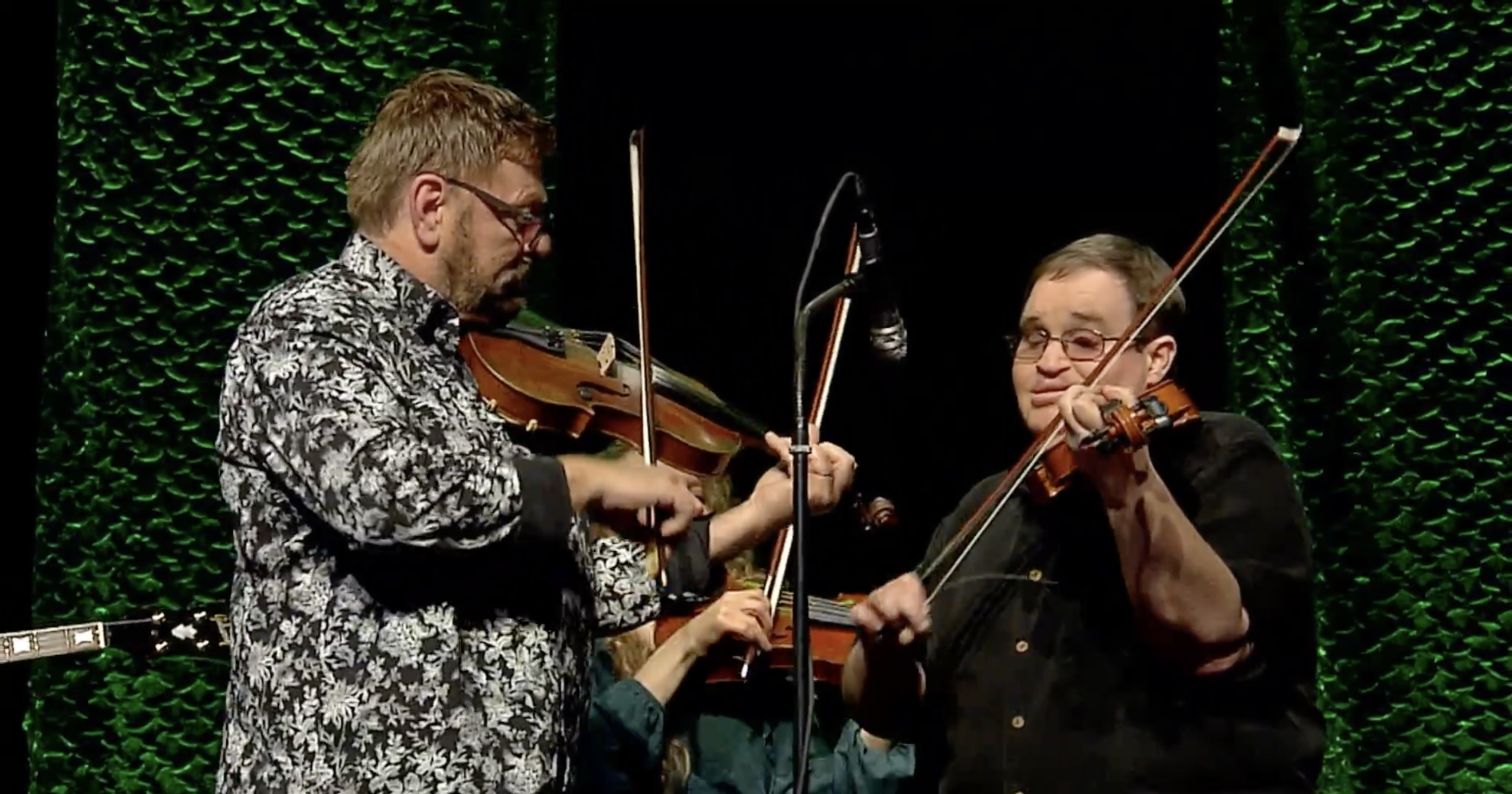
BGS has partnered with Industrial Strength Bluegrass over the years and this time we’re excited to bring you full-length videos of ISB’s most popular and veritably viral performances. First up, it’s a performance from Industrial Strength Bluegrass’s March 2024 edition indoors in Wilmington, Ohio at the Roberts Centre. In a rare duo appearance, fiddling phenomenons Michael Cleveland and Ron Stewart wowed the ISB crowd. In this video, the pair perform a rip-roaring rendition of “Roanoke” with Joe Mullins himself joining in on banjo, as well as IBMA Award winner Vickie Vaughn on bass, and members of High Fidelity including Jeremy Stephens, Corrina Logston Stephens, and Daniel Amick.
It’s easy to tell why this video was so popular in its shortened, vertical format! Stewart and Cleveland are two of the best, both having won IBMA’s Fiddle Player of the Year (Cleveland an unprecedented 12 times) and both beloved by legions of bluegrass fans, from jamgrass to mash and back again. For an impromptu sort of jam session on stage, it’s a magnetic and impressive performance of a classic fiddle tune. Since 2024, many snippets and clips from Cleveland and Stewart’s 3o-minute performance together at Industrial Strength Bluegrass have taken off on social media. We know we aren’t the only ones who appreciate ISB bringing bluegrass to the masses with their festival content.
Follow Industrial Strength Bluegrass on TikTok, Instagram, YouTube, and Facebook. Make plans to attend their Summer Fest held July 16-18, 2026 in Xenia, Ohio, and future indoor festivals, too. More information can be found here.
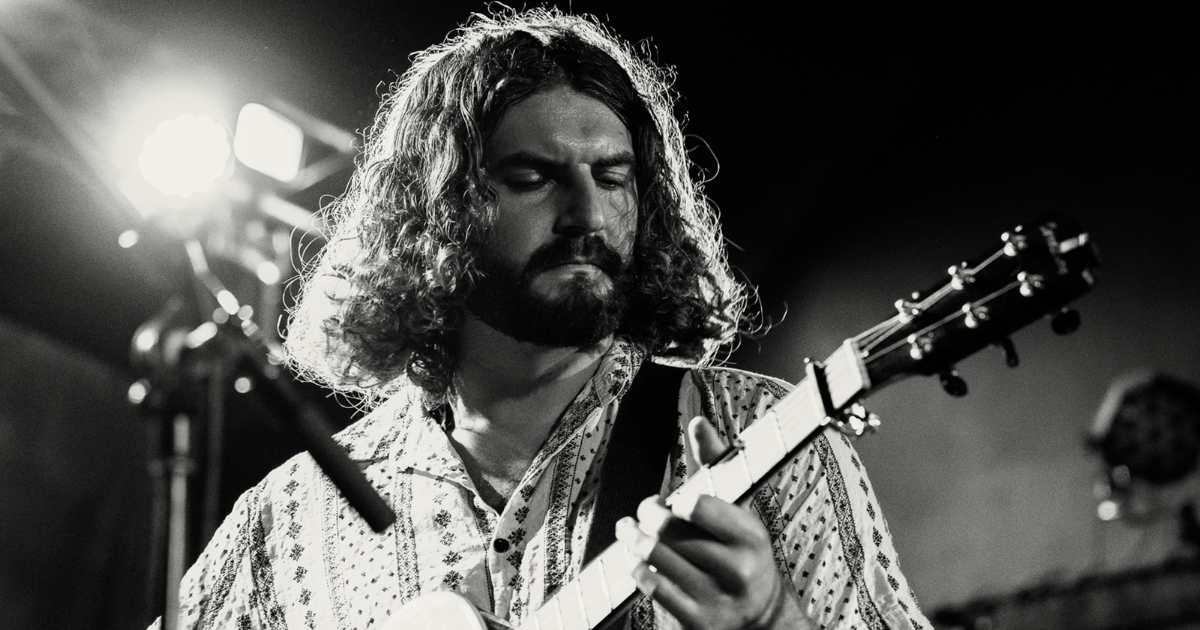
While many young talents, willingly or hesitantly, bow down to music industry boardroom suits who promise stardom if they’ll follow a professionally curated path, Cole Chaney takes a hard pass. He knows exactly who he is, what he does, and how he wants to get there. He creates songs, not content. He’s a career musician, not a brand. And the only thing he hopes to influence, maybe, is someone, somewhere, who wants to make music for all the right reasons.
Chaney grew up in Catlettsburg, Kentucky, surrounded by the legacies and storytelling of his elders. After graduating high school he worked as a welder, uncertain of his career path, but already fueled by his passion for music. Today, he keeps one musical foot in the bluegrass traditions of his Appalachian roots and the other in guitar-centric, amplified bands like Soundgarden, Nirvana, Alice In Chains, and Stone Temple Pilots.
His debut album Mercy and subsequent OurVinyl Sessions reflect his love of acoustic music and showcase his leanings toward introspection and melancholy. In the Shadow of the Mountain, released last fall, takes that darkness to a new place, balances it with moments of light and leans into the aforementioned rock influences, while never losing the origins of his sound. All of this shines at peak level onstage, captured by Western AF on a Live AF Session.
Sitting outside at home on an April morning, drinking coffee and surrounded by the sounds of birds and a breeze, Chaney spent a couple of hours on the phone with Good Country. He spoke candidly about his music, faith, values, mental health, and the intertwining of inner peace and inner turbulence that make all these things uniquely him.
When you were ready to do this professionally, you went to Lexington. Most songwriters would have chosen Nashville. Was yours a deliberate decision or a natural one?
Cole Chaney: To understand that decision, you have to look at who I was looking up to at the time – and still do – and what drove that decision. When I was in high school, probably around my freshman or sophomore year, 2014 or 2015, I started getting into this band called Sundy Best. They’re from Prestonsburg, Kentucky, which is just down the road from me. This was pre-Tyler Childers. At the time, in Eastern Kentucky, these guys were the biggest thing coming and going. They leaned heavily on being from Kentucky, the same way I do, and they moved to Lexington to get a foothold.
That was my early example, watching those guys. I knew they weren’t going about it the traditional way, which was to go to Nashville and pray somebody picks you up. They did it in Lexington. A couple years later, Tyler Childers comes along – another super-influential figure in my musical upbringing. Of course, he’s anti-Nashville – not the city, but the machine, if you will. I’m pretty sure he lived in Lexington, or at least around the area in the scene, for a while. So did Sturgill Simpson. The list goes on.
I was like, “What business model makes more sense to me? Do I go to the place where there’s more songwriters than the rest of the entire planet or somewhere where people will actually understand what I’m saying and I can maybe build myself a little bit of a foundation?”
The way I saw it is if I started building a sort of fan base or if I had enough ticket buyers, places like Nashville or Denver, these big music scene cities, what choice would they have other than to book us? That’s the way I looked at it.
And it worked.
It did work. It’s a simple business model, but the difference between that model and the other is you’re not sitting around waiting for something to happen. It’s on you to go out and make your own connections. It’s a very grassroots and organic way of doing it and that’s the way I like to do things. I’m anti-machine. Even though I work with some bigger companies, I keep it as limited as possible. That’s so I can play pretty much wherever I want, whenever I want, and they understand that.
On the Whiskey Riff Raff Podcast you said, “Music found me.” Would you mind expanding on that just a bit?
It did. I never would have dreamed at 16 years old that I would be doing this as my full-time job at 25. That was never on the horizon for me. I didn’t know what I was going to do. I knew I was going to weld for a little bit, see what happened, and maybe try to start my own business. And I did. But I really didn’t think it was going to end up like this.
I started realizing that people liked to hear me play and sing around the same time that COVID hit really hard. That gave me an opportunity to sit down, write some songs, and think about what I wanted to do with the rest of my life.
I’m very much a subscriber to the Bible, and I think the Lord has a mysterious way of working. He put me on a path without me even realizing it way back then and I do my best to stay on it now. I think my job while I’m here is to create as much good stuff as I can, stuff that means something, get it out to the people, and get out in front of them and play it for them. As somebody who enjoys going to shows in their free time and watching my favorite bands perform live, I know how that feels, and it’s truly a privilege to be able to offer that same service to other people.
There is music in your bloodlines, not professionally, but family members who played in church and at home. You obviously assimilated the sound of the area, and also this wider scope with bands like Alice In Chains and Stone Temple Pilots. When did all of that begin seeping into your songwriting?
We listened to the radio when I was growing up. I didn’t get educated on music or how to play until I started really getting into it. To this day, I’m still being educated and learning how to play on a daily basis. Part of what keeps it so fun to me is how much I don’t know and constantly learning about things.
Mercy was my first album, and I had access to what was around me. I had just moved to Lexington and I was really into bluegrass. There’s a band called the Wooks that, to this day, Glory Bound is one of my top three favorite records of all time. I was infatuated with that sound and that was what I wanted Mercy to sound like, or at least as close to it as I could get. A lot of the Wooks ended up playing on that album, plus Michael Cleveland. It was crazy.
Alice In Chains has been a mainstay in my musical taste since I was probably 15 or 16 years old. Since I first found them, I was very drawn in by the tone of Layne Staley’s voice and the weight of Jerry Cantrell’s guitar. It feels like you could bite it and chew on it. I don’t know how to describe it.
I’ve also always loved bluegrass, so it was [figuring out] how to bridge the gap of what I listen to and where I want to go with my writing without completely abandoning that sound. And bringing the alternative rock sound into the folk realm, where you have mandolin, upright bass, fiddle, acoustic guitars, and drums. The biggest change in the sound has been the addition of drums over the past two years, navigating that and seeing how it fits into the whole equation. It opened up a lot of avenues for me as a songwriter.
You began playing guitar at 13 or 14. Did you always play acoustic?
The thing about electric guitar, for me, is that it’s such a deep realm of gear and a deep dive. I’ve always been attracted to good-sounding acoustic guitars and players like Tony Rice, so I felt my effort was best spent getting really good at playing the acoustic guitar.
That will carry over whenever I decide to pick up an electric guitar, more so than if I only played electric guitar and tried to write some bluegrass-style acoustic lines. It would be a tougher transition to come over from light gauge strings on an electric guitar to .013s on a dreadnought and trying to play “Blue Railroad Train” or something like that.
Do you have an electric guitar?
I have several electric guitars. I’ve got a ’57 reboot Stratocaster, an American Professional Telecaster, my old Paul Reed Smith that I learned how to play electric on, and a nice Vox amp. I don’t know all that much about electric guitars. I still have a lot to learn.
Prior to this interview, you sent over your touring rig: a Gibson J-45 Banner in standard tuning with a K&K Pure Mini pickup, and a Breedlove sitka/rosewood Custom Dreadnought in drop D/double drop D, with an LR Baggs Element VTC pickup. Also two Grace BiX DI’s and a Lampifier Model 711 cardioid mic for lead vocals.
Those are my road guitars. They aren’t the ones I recorded everything with, but those are what you see at the shows.
In addition to the Gibson and Breedlove, do you have other acoustics?
I have two Gary Cotten guitars. [On] OurVinyl [Sessions, that] was my first Cotten I recorded with. On In the Shadow of the Mountain, many of those songs are my newer Cotten, which is sinker mahogany and an Adirondack top. “Alone?,” “In the Shadow of the Mountain,” “Into,” “Feels Like Rain,” and “Spirit” [were all recorded] on the Cotten.
That guitar sounds huge. It’s an outstanding guitar. I don’t tour with it because I’m scared something would happen to it and it’s too special to me. And Gary’s a great dude. He’s always taken really good care of me, and I want that guitar to stick around for a long time.
I don’t have any electronics in it, either. It’s a very traditional style, it’s a dovetail, and I want to keep it as traditional as I can and keep as much weight out of it as I can, because the more weight you add, sometimes it makes them sound worse.
What makes the Gibson and Breedlove right for touring?
They’re super-versatile and they both sound fantastic plugged in. That Breedlove is the longest-standing guitar I have that I’ve consistently played shows with. I got it in 2019 from 4 o’clock Rock Guitar Shop in Ashland [Kentucky]. It’s a custom dreadnought that they shop-ordered and it’s got the LR Baggs VTC Element in it. It has always sounded so good plugged in. I mean, all guitars sound bad plugged in, but it’s a matter of how much of the original sound can you actually preserve when you plug it in.
I’ve gotten to the point where I am almost starting to desire a little bit of that direct input texture. Maybe it’s because I’m listening to too much MTV Unplugged, but I’m starting to desire that kind of cardboard bad sound.
The Gibson, I put a K&K Pure Mini in and it sounds really close to what it sounds like not plugged in. Man, that Gibson is a beast. I love that guitar. It’s been to every show with me since I bought it last year.
I still have a Paul Reed Smith acoustic guitar and it’s a damned good little guitar. I’ll probably end up using it again on some stuff. It’s one of those that you plug in and it sounds great, too. But when I got into the whole bluegrass thing, I knew I needed something with a little more body.
Sometimes you use a pick, sometimes fingers. Either way, your attack is strong. How did your technique develop?
It’s one hundred percent out of necessity. I had a really bad injury in 2015 and I damn near cut my index finger completely off at the knuckle. I can’t wholly bend my index finger and I can’t feel the picking side of that finger. If you watch some of my older videos, my index finger is flailing around all the time. It’s because I’m picking with my thumb and middle finger, and that’s where I’m holding the pick. That took me long enough to learn how to do.
In recent years I’ve learned how to use my middle finger to lock my index in place and be able to hold a pick. It looks normal, but if you could see how the sausage is made, it’s not that pretty. I wish I had that dexterity in my finger. The takeaway message from that is, “Take care of your hands, y’all.”
Let’s talk about the through line from bluegrass to bands like Stone Temple Pilots and Alice In Chains. You blend the genres seamlessly and it all makes sense. Did you always feel that connection?
If you listen to any playlist I’ve had, I’ll go from Ralph Stanley to Chris Cornell in a heartbeat. Obviously the music is different, but there are common themes between the two. Mountain folk music, hard rock, and that era are very dark and brooding, and they can be heavy in their own ways too.
What is heavy? What makes a song heavy? You’ve got people drop-tuning their guitars, but it’s still not as heavy as Pantera or Black Sabbath or something like that. So it’s not necessarily the sound that makes it heavy. It’s the vibe of the song.
I feel like a salesman a little bit, trying to sell this idea that this stuff can be brought together and related in an authentic capacity. Let’s take [Stone Temple Pilots’] “Big Empty,” for example. To do a cover of that and be looked at as a folk artist or an Appalachian artist, or some people will even say country – which I disagree with, but whatever – it always seems like somebody will start into a cover of this great song, but then they’ll get hokey with it and it loses all its purity.
That’s not at all the intended purpose for me. It’s to say, “This is a fantastic song and it fits the vibe that we’re all going for in this realm.” A lot of people probably didn’t know that a mandolin or fiddle sounds great on “Big Empty,” but now they do, because it fits. That’s the way I listen to that kind of stuff. It’s just how to pull that off without being cheesy or coming off in a capitalistic way. More so in a way of, “I love this song and you guys should listen to it.”
Was it challenging to find musicians who understand going from bluegrass to Stone Temple Pilots and back again?
The band, I think through a lot of prayer/manifestation, has come together and, as you hear, they’re fantastic. They can play anything in any style. Ella [Webster] and Kyle [Kleinman] come from a more traditional folk music side of things. Kyle is a bluegrasser and Ella is an old-time fiddle player. Lars [Swanson] and James [Gooding] are jazz cats, so they have infinite vocabulary when it comes to music. If you can play jazz, then you’re going to be all right. If you can pull off that stuff, you don’t have anything to worry about when it comes to my type of music. Stone Temple Pilots is a walk in the park for you.
In our van, the most listened-to bands between us are Soundgarden, Pantera, whatever James’s choice of jazz is, and Alice In Chains MTV Unplugged. That’s a really good piece of music. But yeah, they’re a great band and they can play anything.
Did Lars and James know each other before they joined your band? To lock in a rhythm section…
No, they didn’t. Once you start playing with a jazz drummer, you need somebody who can comprehend the stuff he’s laying out and answer that on the bass. To have those two sit in a room and jam is really something to witness and listen to, because they speak a language to each other that I don’t understand. But I love when they do it, and it’s great to hear.
I’ll be playing onstage, singing and doing my thing, those guys are behind me and I’ll hear them back there, talking to each other while we’re doing this thing, and it’s awesome. They’re special. Those two dudes – they’re incredible. They’re the unsung heroes of music in general. That’s your metaphorical offensive line right there. If you don’t have a Lars and a James, then your quarterback’s getting sacked all the time.
This is you in 2025 on The Western Side, talking about Shadow: “a lot of darkness and an equal amount of joy in other songs. It’s a good depiction of where I’ve been for the past two years. A tumultuous and chaotic time period, but also great. And I’m still here.”
Then, In 2021, on With A View: “I load the pressure on. It’s how I operate. My brain lives in constant turmoil.” In 2020, talking about “Fever Dream,” “a song about trying to keep it all together. … the way I deal with this is isolation. And when you isolate yourself, you don’t have much of a choice but to hash some things out in your head.”
You are no stranger to the dark place.
Hearing those things, I look at that younger version of myself almost as I would look at a younger brother. Part of me wishes I could put an arm around that kid’s shoulders and be like, “You’re going to be all right, buddy.” Times got a little tough, as they probably should for anybody at points in their life. You can’t really enjoy the great parts of your life without having a little bit of adversity to overcome or deal with. The darkest part, for me, was maybe just growing up and gaining a new understanding of the way the world actually operates and how hopeless that can be at times, but also how beautiful it can be in the same stroke.
What I’ve realized is you get out of this world what you pay attention to, because whatever you want to find, you can find it. It’s there and it’s aplenty, whether you want to find the negativity and suffering, or whether you want to find the positive and the good. I don’t have the answer to where folks are supposed to operate and live, but I think it’s good to help people who are in that suffering side of things. But you can’t let that dominate your existence, and for a little while, I was maybe dominated by the darker side of life.
I try to be as empathetic as I can, but with that comes feeling a lot and also accidentally hurting people sometimes. That’s really tough, because then you have this cycle of guilt that you deal with trying to make it right in your head. As I’ve gotten a little older and maybe figured a couple things out, I try to have a lot more grace for myself. What I’ve learned about the pressure is that it’s really just perceived pressure and none of that exists, and you should just care less what people think.
Obviously, music is where you go during those times.
Absolutely. If something is eating at me that I’m having a hard time getting out in a linear fashion, a lot of times I find myself writing about it without even realizing it. My mom is an abstract painter, so I grew up with an understanding of what “abstract” means and abstract concepts. That’s how I materialize a lot of that stuff, because some of it is things I would never come right out and literally write down, for multitudes of reasons, but things you want to indirectly address. That’s when [abstraction] becomes a great tool for addressing those kinds of things. Metaphors.
It seems, when it comes to expressing those things, you’re in the balance between the emotionally open world of Cornell, Cobain, and others and the world of bluegrass, country, hunting, fishing, and those stereotypes of “manly men” – and not so much emotional transparency.
Not necessarily. I don’t know about the whole “alpha male” personality type. It’s always seemed to me that a lot of times the guys who are trying to be perceived as macho are probably the ones who need a hug the most. Now it’s everybody else’s problem because their dad didn’t do it, and that sucks.
As I’ve emotionally developed a little bit, I’ve really started to respect individuals like Chris Cornell. If you look into him as a person and watch some of his interviews, he’s intelligent and seemingly self-aware. I respect the way he conducted himself, especially in interviews, and the way he made sure to pay attention to people and make them feel seen. The only way you can empathize with people like that and make sure of those types of things is if you’ve been on the other end of that stuff and you’ve felt looked over and brushed off.
I may not be the best at answering Instagram DMs, and I definitely don’t stay on the internet because I think it sucks, but if I talk to somebody in person, I always try my best to give them that and be present in the moment. Somebody else that does a fantastic job of that is Nicholas Jamerson, the frontman of Sundy Best, who’s a mentor, friend, and hero of mine.
Have you ever felt any hesitation about publicly ripping off the mental health Band-Aids? Or, conversely, is there a feeling of opening the door to people having these conversations?
Sure, there’s hesitation about a lot of things. There’s a lot of decisions about, “How do you want to portray yourself in a public light?” But my main goal is and has been to just be as authentic as I can, as representative of how I feel about things as I can, and to be accepting of people and understand that they come from different places and have different perspectives.
With that hesitancy, there’s also much more in the way that when we were talking about 20-year-old Cole, the way I want to put my arm around that kid and comfort him, that’s what I want my music to do for people that feel the way I was feeling at that time.
Listening to you, I’m reminded of something Charlie Daniels said to me during an interview years ago: “Music is too precious for me to prostitute it.”
Oh, yeah. Absolutely. And, too, Charlie Daniels is one of the greatest country musicians ever. I want to go on record saying that.
The way I look at it is, could I see my heroes, people I look up to, going online and being like, “Comment what song you think I should release next”? No, I don’t think I could. When I see someone who has musical and artistic integrity, that’s how I’m going to operate. I’m going to try my hardest to uphold my integrity and not do the TikToks and the really cheap stuff.
You absolutely will suffer financially for not playing the game and if you don’t kiss the right ass, but, to me, that suffering is not negative suffering. I’m honored to be able to suffer like this, because if my options are suffer or have to watch Country Central’s “Hot Take Tuesday,” then give me suffering all day long, because I’m not paying attention to that bullshit. It’s ridiculous. I don’t care who’s beefing and I don’t care what dude is playing cowboy this week.
That’s why I’m trying to get out of the country scene. It’s becoming so fake and there’s so many people trying to be carbon copies of other people. There’s no authenticity. Everybody’s full of shit. We went through this period where people like Tyler [Childers] drove the spear through the heart of this mainstream country thing and it was akin to when Nirvana came on the scene and effectively killed hair bands for a while. But then the Nirvana copycats came along and garnered a lot of the same attention.
I’m not saying that just Tyler Childers is responsible for this. People like Sturgill, and a lot of smaller artists in their own scenes, are responsible for the turning over of the dirt, if you will. But it’s getting stale. It’s past getting stale. It is stale and it’s bad. There’s a lot of really shitty music being put out right now and I don’t want any part of that.
If I’ve got to step away and back off and be out of the internet eye, then fantastic. That doesn’t bother me one bit. If it means a few less people know who I am, then so be it. But I hold out hope that people will eventually realize how cheap and bad a lot of the music is that is being promoted right now, and there’ll be another turning of the dirt soon.
Yes, art is subjective, but art is subjective. Not this corporate bullshit that they’re trying to push. That’s not art. That’s six dudes in a room trying to come up with a song that’s going to sell on the radio or sell on the internet, or “We’re going to put thirty tracks on this album” so they can set streaming records. It’s like, “Man, y’all have lost the complete plot of the whole thing.” There’s nothing interesting about that to me. I’m all about authenticity. I want to believe the person on the other side of the microphone from me, and if I don’t believe you, then I’m out.
When it comes to fiddlers, we all know that more is more is more.
Lonesome fiddle? Great. Twin fiddle? Even better. Triple fiddle? (Who called Bob Wills?)
But with all this great fiddling, it’s hard to keep up with who is who. We are here to help. It turns out that for all the fiddlers that you may know and love, there are probably 10 more that you haven’t heard of – even if you’ve heard their playing!
Here are some fiddlers making big waves and sawin’ big figure eights who may be flying under your fiddle radar.
Ellie Hakanson
Originally from Portland, Oregon, Ellie Hakanson grew up playing music in her family band. Bluegrass fans will have heard her blazing solos as part of Jeff Scroggins & Colorado, with whom she toured and recorded for five years. She now lives in Nashville, where she plays with Missy Raines & Allegheny and Kristy Cox among many other artists.
Ellie’s fiddling is defined by its traditional bluegrass sound and deep study of the genre. The International Bluegrass Music Association agrees, as Ellie has been nominated for several IBMA Momentum Awards – in 2017 for Instrumentalist of the Year, in 2018 for Vocalist of the Year, and in 2019 for both Vocalist and Instrumentalist of the Year.
Here, she plays “Sally Goodin” with the incredible Michael Cleveland during a workshop at Cowichan Valley Bluegrass Festival in Lake Cowichan, British Columbia, in 2024.
Evan Snoey
Multi-instrumentalist Evan Snoey approaches music with a wide lens. Equally comfortable playing old-time fiddle and jazz saxophone, Snoey’s breadth of musical knowledge finds him playing with everyone from young shredders (like the Litch Brothers) to country artists (like Dylan Gossett). Originally from Seattle, Snoey’s stylistic interests include old-time, bluegrass, Scandinavian, Scottish, swing, jazz, and contemporary improvisational music.
In this video, he performs a medley of tunes – “Busta,” “Sjøvald,” and “Primrose Lass” – with Alex Wilder on piano for the Nashville Contra Dance.
Omar Ruiz-Lopez
Chapel Hill, North Carolina-based fiddler and multi-instrumentalist Omar Ruiz-Lopez may be best known for his work with folk duo Violet Bell. Ruiz-Lopez is currently making a name for himself as a sideman (playing cello, guitar, and fiddle) with artists such as the War and Treaty, Franklin Jonas, Lizzie No, and Langhorne Slim. And he has just announced a crowdfunding campaign for his first record of original music. Born in Panama and raised in Puerto Rico and Florida, Ruiz-Lopez is a bilingual singer-songwriter who brings a cross-cultural perspective to his music.
In the above video clip, Ruiz-Lopez performs “Panavueiro da Rabeca” and “Panariqueño,” an original fiddle tune, accompanied by Jamey Haddad and Clay Ross at Casey Driessen’s Blue Ridge Fiddle Camp in 2025.
Josie Toney
Soon after moving to Nashville, Josie Toney hit the road as part of Sierra Ferrell’s band, which went from a DIY van tour to a bus operation during her tenure. In 2022 she released her solo album, Extra, featuring her songwriting and guitar playing as well as extraordinary fiddle work. Originally from Olympia, Washington, Toney studied at Berklee College of Music before moving to Music City. She now tours with country star Hailey Whitters and appears often around Nashville fronting her own band and picking with others.
In 2022, she was a guest on Cameron DeWhitt’s podcast, Get Up in the Cool, performing a version of “Smith’s Reel” that perfectly shows her style.
Libby Weitnauer
Libby Weitnauer grew up in the shadows of the Great Smoky Mountains and studied classical violin in Chicago before returning to her roots in Tennessee to play old-time and country fiddle. An endlessly curious and evolving musician, she has played for Margo Price and Kelsey Waldon and has performed on Broadway in New York City, as well as founding indie band Dallas Ugly and fronting her own songwriting projects. A solo album is rumored to be on the way.
In this video, she performs “Swannanoa Waltz” for the YouTube channel The Old-Time Fiddler.
Amy Alvey
Old-time expert Amy Alvey is a fiddler from California who focuses on building community wherever she goes. In addition to recording and touring with her duo, Golden Shoals, and her indie solo project Mild Windago, she fronts the string band Hometeam Advantage, hosts a radio show on Middle Tennessee’s WMOT, and has cultivated a weekly old-time jam in Nashville. Amy is an encyclopedia of old-time tunes and sources with a wide range of stylistic ability.
Here, Hometeam Advantage includes George Guthrie (banjo), Charlie Fuertsch (guitar), and Ethan Hawkins (bass) performing “Tanner’s Farm.”
Jamie Fox
Montana-based fiddler (and pilot and aircraft mechanic) Jamie Fox grew up on the Fort Belknap Indian Reservation and is part of the Agniih and Nakoda tribes. Jamie, along with her brothers, learned Métis fiddle styles from traditional players on the reservation such as Old Fatty Morin, as well as Métis fiddlers like Jimmie LaRocque, Mike Page, and Johnny Arcand. She currently tours with her band The Fox Family Fiddlers, and as a solo performer.
This video, uploaded in 2019, showcases three reels in the Métis style performed in Denmark with Malene D. Beck accompanying on piano.
Katie McNally
Scottish fiddler Katie McNally grew up in the Boston area and was mentored by the legendary Hanneke Cassel. Her style is fierce and energetic, drawing inspiration from traditional Scottish and Cape Breton styles – as well as Scottish-American players. Katie records and tours her own music and is also a member of The Pine Tree Flyers with Emily Troll (accordion), Benjamin Foss (guitar), and Neil Pearlman (piano).
In 2024, the Pine Tree Flyers performed “Vidita” together for Seirm during Celtic Connections 2024, taped for BBC Alba. Watch above.
Austin Derryberry
As deeply rooted as they get, old-time fiddler and luthier Austin Derryberry plays with the groove of generations. Originally from Unionville, Tennessee, Derryberry’s duo album with Trenton “Tater” Caruthers focuses on the less well-known fiddling of the Middle Tennessee area. He apprenticed with legendary fiddle maker Jean Horner and now makes and plays fiddle in the region.
In this video, Derryberry is joined by his wife Courtney Derryberry and Greg Reish to perform an Ed Haley version of “Chinese Breakdown” in Ireland for the Westport Folk & Bluegrass Festival in 2023.
Connor Murray
Originally from the Chicago area, Connor Murray Ostrow polished his bluegrass chops studying with Michael Cleveland and he can currently be found gigging all over Nashville and around the country. Connor’s playing is clean and focused, with bluegrass drive and country sensibilities.
A graduate of Belmont University, for his senior recital in 2022 he performed a hot club jazz rendition of a Kenny Baker tune, “Bluegrass in the Backwoods,” illustrating the way his approach to the instrument has cross-pollinated with many styles.
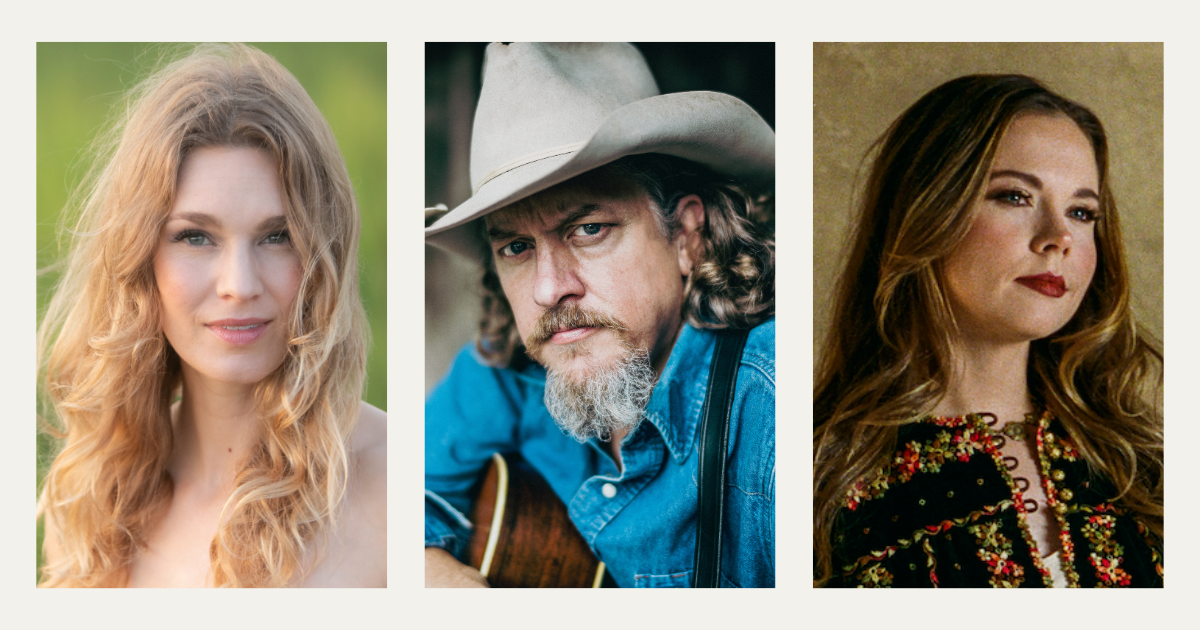
Photo Credits: Lead image (L to R): Ellie Hakanson by Nico Humby; Josie Toney by Natia Cinco; Omar Ruiz-Lopez by Phyllis B Dooney, PHOTOFARM. Alternate image: Ellie Hakanson by Nico Humby.
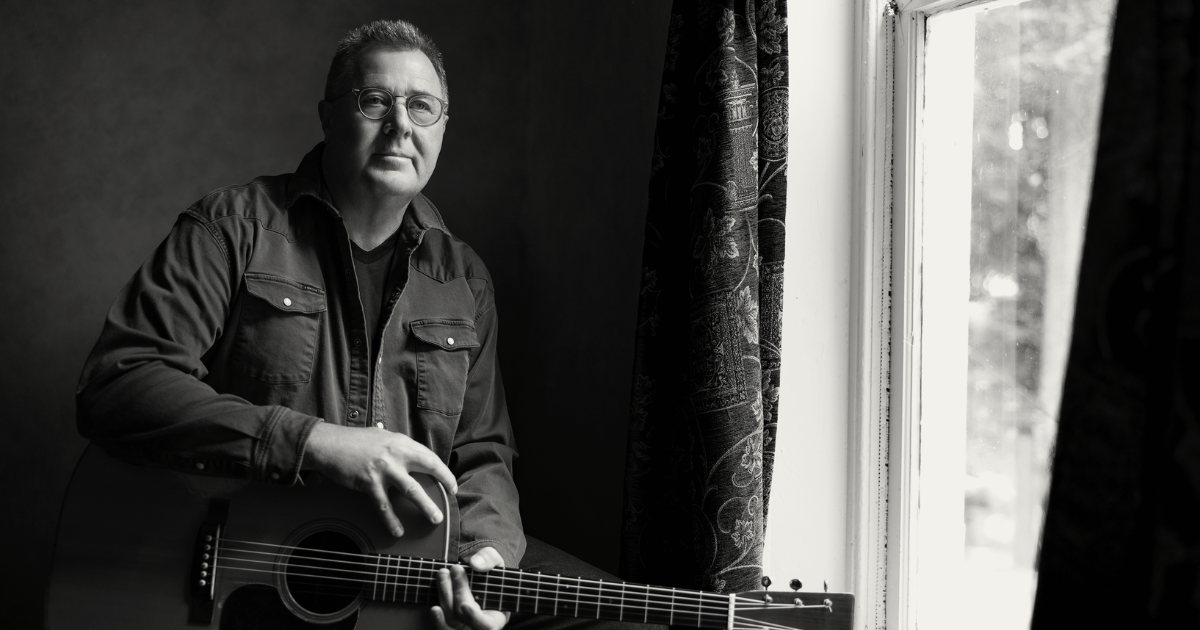
Vince Gill doesn’t give interviews; he gives conversations – lengthy, engaging conversations filled with the same reflection and storytelling that make his songwriting so relatable and successful. Factor in his enviable mastery of guitar and other instruments and the result is a well-rounded artist who has won 18 CMA awards, 22 GRAMMY awards, and eight Academy of Country Music Awards.
In 2025, he was presented with the CMA Willie Nelson Lifetime Achievement Award, and this year, on May 6, he will receive the Ken Burns American Heritage Prize. He’s been a member of the Grand Ole Opry since 1991 and in 2005 was entered into the Nashville Songwriters Hall of Fame. Two years later, he was inducted into the Country Music Hall of Fame.
Over the course of 21 albums his sales exceed thirty million with 45 chart singles. Coming up is a summer tour, which will wrap with a six-night residency at the Ryman Auditorium, while continuing his ongoing schedule with the Eagles. All of this is only a cursory glance at his many accolades.
Gill’s accomplishments, and the experiences that accompany them, are at the core of his latest project, 50 Years From Home, a yearlong series of monthly EPs marking the fiftieth anniversary of his leaving home to pursue a music career. Each collection features themed new songs and revisited classics, with photos of select guitars on the covers. The EPs are introduced via detailed conversations with friend and colleague Charlie Worsham – watch all episodes on Gill’s YouTube channel.
Down At The Borderline, released February 13, is the fourth and latest EP in the series, while the next installment, Lonely’s What I Do, already arrives this Friday, March 13. A few weeks prior to the release of Down At The Borderline, Gill made himself available for more interviews and conversations, including a talk with Good Country.
At this point, it’s difficult to imagine anything Vince Gill hasn’t done. In fact, there are two key things, neither of which he cares to pursue:
“I’ve never sent a text,” he says, “because I prefer talking to people. What you find out [with texts] is how many people really don’t want to talk to you!” And, “I’ve never posted anything on the internet,” although he does have a scrolling habit, which he gladly admitted to during this discussion.
As you move through endless interviews around these EPs, is there something you’ve always wanted to talk about but have never been asked? Now’s your chance to tell the world!
Vince Gill: I wouldn’t have a clue! I never was much of a planner. I think it’s a blessing that I just live in the moment. I don’t look ahead, I don’t look back much, and there’s not a lot of regrets in my life. I figure the mistakes I made were valuable to learn something. I never planned any of this. I didn’t sit down and have a diary that I’d go, “When I’m this age, I want to have done this and this.” I just answered the phone.
You should probably give classes on that, because this is an industry of nonstop worry: What’s going to happen? Will this work? Will this not work? To move from project to project, stage to stage of your career with that mindset is impressive.
I started out with absolutely not one dollar, so money has never been the reason for any of it. I bought a guitar when I was 18 years old and I moved away from home. It was an old pre-war Martin that was perfect for bluegrass. I spent every dime I had on it and I didn’t worry. I said, “My rent’s $15 a month, I’ll make a couple hundred bucks a week when we work, so I’ll be fine.”
Amazing.
Speaking of going from stage to stage of your career, the EPs are each a chapter told with collections of songs. Tell us more.
The majority of it is fairly new. From the time I started in 1975, there was no reason to have a publishing deal for a long time. Even after I had a record deal, I didn’t see the need because I had a place for my songs to land on my own records. I never partnered up with a publisher, to give away half the money, to give a monthly draw to help pay my rent or whatever. I was able to always pay the rent somehow – my house note, whatever it was – with playing and singing.
Three or four years ago, Jody Williams, who’s a lifelong publisher in Nashville and a friend of mine for 40-something years now, called me and said, “You’ve never had a publisher. Would you consider letting me manage your songwriting for a while? I think you still have a lot to say as a songwriter.” I said, “Yeah, I’ll try that out.”
He would call great songwriters and say, “Would you like to write a song with Vince?” I was never a very good self-promoter, so I would never do that on my own. I just let it unfold with people I would meet. So it started me down this path of writing a lot of music, and over the last three or four years I’ve written twice as many songs as I’ve recorded on this new 50 Years From Home project. I think I’m writing the best songs I’ve ever written. With time you should get better, and I think I have.
I don’t want to check out someday and have all these songs lost in a desk drawer somewhere, so I’ve started recording them all. It’s a different world now, a different way. If you want to release 75 songs, you can do it. You don’t have to have one album with 10 songs on it anymore. So I started thinking about what it would be. My first conception was to release two songs a week, like an A-side and B-side of a 45. “It’s Monday, it’s time for a couple new Vince songs.” The record company came up with the idea of, “Why don’t you do a series of EPs and have six or seven songs on each one?” I said, “That sounds cool. We’ll put one out a month.”
That’s where the whole thing started. I was trying to find a way to put all this out. I realize at this point in my life, I’m almost 69, I don’t have as much time left to be creative as I’ve had to this point, obviously. How much more it matters now is palpable. It really means something to me to be creative, and if I see myself improving, I want to nurture and foster that and continue, because it’s so dear to me, being musical, being creative, coming up with an idea, coming up with a story that could potentially move somebody, touch somebody. It’s unbelievable to be able to have that gift, to be able to do that. So I’m trying to take full advantage of it.
But 68 or 69 today is not the 68 or 69 of our parents’ years. When you’re a kid, your parents turn 50 and it seems ancient.
That’s true. My mom’s a hundred years old.
See? You have many more years to go, especially if you’re still 17 in your head, which happens in this business.
Yeah, and I am. I don’t feel any different than when I pulled out of the driveway and took off. I still have the same love and I’m so drawn to playing music. It’s such a huge part of me. I tell everybody, “My mom’s a hundred and I hope I’m really her son, so I have those genes! For all I know, she might have rented me out of a yard in southern Oklahoma somewhere!” But my dad checked out early. He died at 65 – and I was afraid of being 65. There’s so many instances of people passing at the same age as their parents and whatnot.
I’ve heard from others that it’s a strange feeling when you reach the age when a parent passed.
Absolutely. But my dad drank a lot, he smoked two packs a day, and he didn’t take very good care of himself. I don’t think I have too many of those qualities. I don’t smoke and I don’t drink. I eat bad, but that’s about it.
You’ve stated many times that your goal was always to be a recording musician. With reality shows and social media, do young players have that same goal, or is a lot of it about chasing clicks and stardom? Are you concerned about the future of musicianship?
No, because there are plenty of young kids out there that can play their brains out. There’s so many of them that you don’t worry about it. I tell people all the time, “If American Idol was on in 1948, Little Jimmy Dickens would’ve been on it.” I don’t really care for those shows – and not in a bad way, because a lot of talented people go on them – but sadly, you don’t see that really bear out with a lot of artists coming from those shows that have longevity. They have that moment, but we’re so ready to slide our thumb and move on to the next scrolling thing. It’s the same way with those shows: “The season’s over. Okay, who are the new ones?” And I never like seeing creativity be a contest.
But I don’t worry too much. You see someone like Sierra Hull, who can play better than anybody in the whole world, and Michael Cleveland, and so many that come along that can completely annihilate their instruments. It’s beautiful to watch. I don’t think that’ll ever go away.
Does AI-created “music” concern you?
Of course, but when I’m asked about it, I say, “The people who create it, deep down, they know they haven’t done anything. They know they’ve done nothing.”
As a recording and performing guitarist, singer, and songwriter over a lot of years, how has your approach changed? Your technique, your picking style, your ear, your tone?
It’s a combination of all of those things. I’ve spent the latter years realizing what I don’t need, what I don’t need to do, what I don’t need to play, what I don’t need to sing, what I don’t need to say in the lyrics. To me, the beauty of it is your willingness to try to say the most with the least.
I like my singing better now than I did when I had hits. I much prefer the way I sing and play my songs today. That’s motivation enough, that I feel like I’m better now than I ever was. My ears have never lied to me, and with that, if I feel like I’m making progress, that’s all the reason in the world to keep doing it. If I start wheezing like an old woman, I probably won’t wanna go out there and sing. But, thank God, that hasn’t happened yet,
With music, the more you do it, the more you learn. The point of it is not to impress, but to move people. If you can move people with what you play and sing and write, that’s the real gift. That’s when you really get something that matters out of it, rather than a big “Woo, that was incredible! That was impressive.” That’s fleeting in a way. I like the long haul.
I could have very easily stopped working on other people’s records and being a sideman and a harmony singer and guitar player and what have you. But I love doing that so much, because I always thought it was a harder job to complement somebody and what they’re doing, more so than doing what you want and having everybody follow you. It took more talent to do that – better ears, bigger ears, that kind of stuff. So I continue to do that. I’ve worked on over a thousand artists’ records in the last 50 years. The diversity of that, the willingness to go into any kind of world of music and try, and not just be shortsighted and only do this and only do that – I love all of it. I’ll find something good in any of it. If I can play a part in making something better that’s being done, then that’s a good feeling.
Can you draw a through line from your bluegrass roots to what you’ve done and what you do now?
“When I Call Your Name” wouldn’t have sounded like it did had I not played bluegrass. That high lonesome sound was totally taken out of my love and life of bluegrass. A song on one of my new records [Secondhand Smoke, EP 2] is called “Hill People,” with [harmony vocalist] John Meador – great singer, great player, it just blows my mind how good he is. That sounds the way it does, it was written the way it was, because of my history of bluegrass.
I was never one of those guys that [would say], “I can only play bluegrass and it has to be traditional.” I loved New Grass Revival. They were different than Bill Monroe and I loved it all. If you take whatever’s great about something and cast the rest aside, then you’ve done your job. I’m not critical of young people that don’t do it the way I did it, or the way my heroes did it. That doesn’t serve anybody any good, to be critical of stuff. I remember hearing Billy Strings talk about how he would go to jam sessions and felt unwelcomed, and that killed me. I felt so bad for him.
I experienced that once when I was 17. We were playing some bluegrass festival, a hardcore traditional-minded festival. We were up there playing “Rocky Road Blues,” which is a Bill Monroe song, but we were doing it real bluesy. The promoters kicked us out of the festival and said, “You can’t be playing that kind of music!”
As they were kicking us out, Jim & Jesse were playing Chuck Berry’s “Johnny B. Goode.” I said, “Now wait a minute. We’re playing a Bill Monroe song and we’re going to get kicked out, and they’re playing ‘Johnny B. Goode’ by Chuck Berry? What’s cool about that?” They go, “Their suits match. Get outta here!”
I’ve known Sam Bush for 50-something years. The story he tells about Monroe is that he said, “What is it you call that music you play?” Sam said, “We call it New Grass.” He goes, “Yeah, I hate that.” That kills me, but it didn’t impact Sam one bit. But that hardline thing – I don’t go for it.
You’ve said that the role of the artist is to speak for others. Are there songs that speak for you, or to you, in those moments?
I like the things that are the most honest, that are not trying to be something they’re not. I’m not a fan of singers that alter the sound of their voice to make it do something it doesn’t naturally do. I heard Merle Haggard say, “Man, just tell the truth.” That’s where I’m finding the biggest inspiration in songs is being truthful. I think the truth has always been the greatest thing you can lean on.
People talk about country music, and if you could point somebody to what you think country music is, I’d say Merle Haggard’s “Mama Tried.” How it starts– “I turned 21 in prison doing life without parole.” That’s pretty dark. That’s pretty sad. And then, “No one could steer me right, but Mama tried.” There’s your hope.
One thing they’ve never taken away from me is hope. Even though they quit playing my records on radio stations and I don’t have hits anymore, I’m always hopeful that something will slide through and move people. I had hope when I made my first record at 16 or 17 years old, and lo and behold, some radio station played it and I heard it in my pickup truck. That instilled a hope in me that’s never faded. They can pass on songs, they can not play them, they can do all that, but they have never dinged my hope in my heart for what it is that I want to try to do.
Where were you in your truck when you heard yourself on the radio for the first time?
I-40, Oklahoma City. I was driving and all of a sudden they started playing “July You’re a Woman.” It’s a John Stewart song and we’d done a bluegrass version of it. I was singing lead. I think some other bluegrassers had done that same song. I’m driving and all of a sudden they started playing it on the radio station and I get on the CB radio and start screaming, “You’re not going to believe it! They’re playing our record on the radio!” Truckers were coming back saying, “Hey, you sound good, kid! Hang in there.” Wow.
The first record I ever made, I heard on the radio. It put that dose of hope in me that has never faded.
Editor’s Note: Read part two of our Good Country conversation with Vince Gill here.
Want more Good Country? Sign up to receive our monthly email newsletter – and much more music! – direct to your inbox.
As our second year of Good Country comes to a close, we’re reflecting on another 12 months’ worth of the best in country music. Whether Americana, bluegrass, or string band, blues, outlaw, or Western swing – or any of the many styles of country we know and love – there’s been plenty of excellent picks from my ear buds directly to your inboxes and playlists.
We sampled post-modern Mississippian country from KIRBY, got funky and soulful with Memphis family band and GRAMMY nominees Southern Avenue. We celebrated Suzy Bogguss’ invitation to join the Grand Ole Opry and traveled to the remote center of the Pacific Ocean for Maoli’s particular twang.
Fiery twin fiddle by Jason Carter & Michael Cleveland had our jaws on the floor, while we were surprised – but not really – at how well Brooks & Dunn went together with the Earls of Leicester. Huge stars like Billy Strings, Warren Zeiders, Sabrina Carpenter, and Carín León were enjoyed alongside everyday working musicians like Jordan Tice, The Creekers, Nick Shoulders, Sunny War, and more.
That depth and breadth – of artists and styles, of notoriety, or approach – is exactly what we’re going for with Good Country.
Good Country isn’t any one thing. It’s a feeling. It’s a place. We’ll be chasing more Good Country feelings and places in 2026, and we’re so grateful to have you along for the ride. Look back at all of Ed’s Picks for 2025 with our master playlist.
Want more Good Country? Sign up to receive our monthly email newsletter – and much more music! – direct to your inbox.
If you’re looking for a definitive, qualitative, and deliberate ranking; a firm and scientific rubric; or an unbiased, sterile reckoning of the best albums made in bluegrass this year, this roundup may not be for you.
Truthfully, as someone who’s worked, been acquainted, and become friends with many of the artists on this list in various capacities – from bio writing to onstage performances to media coverage to pickin’ parties to recordings and beyond – objectivity isn’t something I, personally, could establish anyway. And such year-end or other merit-based lists and collections aren’t all that interesting, are they, if not just to argue with their curation and selections.
I would not even attempt such things, because to me – to many of us – that’s not what bluegrass is about anyway. Bluegrass is about a feeling. It’s about innovation. It’s about virtuosity. It’s about tradition, loving it or retooling it or coaxing it or turning it upside down. It’s about adrenaline and a high pulse – and passing a mason jar around. It’s about feeling downtrodden or alone, shedding tears into that very ‘shine, and wailing along with the high lonesome sound. It’s folk music as much as it’s abject commercial country in “poor people drag.” It’s endlessly interesting and complex, but pretty damn simple, too.
Anyone with even an ounce of sense knows and understands that bluegrass can’t ever be objective. So indeed, why try? Why not acknowledge that bluegrass is always a matter of taste, of preference, of whimsical or capricious or convicted opinion? Bluegrass is always debatable, because, after all, bluegrass is always in the eye of the beholder.
In the eyes – and especially ears – of this particular beholder, these albums released in 2025 were the best, the most memorable, the most engaging. These collections stick to ribs like ham hocks, or stick in your throat like the tastiest clod of emotional peanut butter. They each advance, subvert, perpetuate, or wrinkle our core ideas of what bluegrass is – and what it can be.
Are each and every one of these LPs the best in bluegrass from 2025? Perhaps not… But also definitely yes.
Big Richard, Girl Dinner
In January, we gobbled down a heaping helping of Big Richard energy with the nourishing and nutritious Girl Dinner. The project may have been the band’s album debut, but this Colorado all-women quartet had already been making remarkable waves in the bluegrass, jamgrass, and string band scenes – and each of the members had extensive and glitzy musical resumés before they even convened. With a new album, Pet, on the horizon for February 2026, a signing with Signature Sounds, and an upcoming co-bill tour with fellow femme outfit Della Mae, we can tell this Girl Dinner is set to become an ongoing traveling feast.
Shawn Camp, The Ghost of Sis Draper
I remember attending Station Inn shows in Nashville in the early 2010s and sitting with rapt attention – like Martha’s sister Mary at the feet of Jesus – as Shawn Camp performed his suite of Sis Draper songs with his star-studded bluegrass bands. Often you’d hear just “Magnolia Wind” or just “Sis Draper.” Sometimes he would perform a more complete handful of the tracks he had written, individually and with his hero and mentor Guy Clark, about the mythical roots music figure from his home state of Arkansas. Now, he’s collected the slate of material – what could easily become a musical or multi-disciplinary theatre work of some kind – into one commanding, lovely, and visceral album. These are timeless songs, written and rendered as only Camp could.
Jason Carter & Michael Cleveland, Carter & Cleveland
Every now and again a new collaborative duo album comes along and makes you think, “Oh! This must have been what it felt like when Skaggs & Rice was released.” Or Tone Poems. Or Ralph Stanley and Jimmy Martin’s First Time Together. A monumental occasion, captured for posterity’s sake in the studio. When fiddlers Jason Carter & Michael Cleveland released their duo debut, that was the feeling. History made in the present, a work that will be regarded as seminal ages into the future being enjoyed in real time. Carter and Cleveland have collaborated quite a bit over the decades they’ve known each other, but what a gift to have that musical friendship ensconced forever on this album. We hope there is more to come.
Wes Corbett, Drift
Look, if all modernist banjo players sounded like Béla Fleck and Noam Pikelny, that would certainly be great. But thankfully there are dozens of five-string pickers continuing to expand on the Fleck (and Pikelny and Munde and Keith and Trischka) school of Scruggs-style, each in their own veins. Corbett is one of the best. Though he blends effortlessly into Scott Vestal’s former role in Sam Bush’s band – or into any number of recordings and one-off pick-up bands that boast his playing in newgrass and bluegrass and beyond – Corbett is a true idiosyncratic banjo player and composer. Drift, his latest, often employs traditional techniques as tools for innovation and contemporary tunesmithing. He recalls the great melodic pickers while always sounding first and foremost like himself.
East Nash Grass, All God’s Children
A few years ago, if you had told me the ragamuffin band holding down Monday nights at Dee’s Country Cocktail Lounge in Madison, Tennessee, would in 2025 release an album you’d describe as “heartfelt, contemplative, and intentional,” I would have probably laughed. East Nash Grass were just as jaw-dropping good then as they are now, but with that down-home silliness and clumsy charm all the great bluegrass bands born of indentured residencies have had. All God’s Children finds the band all the way grown up (but not really), and they never forsake their banter-rich, never-know-what-you’re-gonna-get roots. That overlap – of silly and heartfelt and virtuosic and not too serious – is where most (if not all) of the best bluegrass is born, anyway.
Sierra Hull, A Tip Toe High Wire
Every single time Sierra Hull releases a new album, journalists and critics love to talk about how she’s now “found herself” and “found her sound.” This writer, however, disagrees. I first saw Hull perform when we were both in our mid-teens and then as now I knew, wholeheartedly, this is someone who knows who they are. Granted, Hull has done plenty of finding herself along the way, as we all do, but the songs and tunes of A Tip Toe High Wire were obviously not born of someone just locating her voice, musically or otherwise. They don’t feel experimental or out on a limb, they are each solidly in her wheelhouse. They do still push the envelope, though, and they all tell personal stories, draw on individual experiences, and chase those treasured Hull-ian melodies wherever they lead.
I’m With Her, Wild and Clear and Blue
Perhaps all future I’m With Her albums should be made while basking in the “Ancient Light” of a total solar eclipse, given the striking sonic successes of Wild and Clear and Blue. Is that cosmic magic why their second full-length release feels so distinct and metamorphosed from their debut? Is it all the years and personal growth in between recordings? It’s not like they reinvented the wheel, they’re the exact same band – but something feels different here. Whatever the special sauce may be, all of I’m With Her’s offerings over the course of the band’s lifespan have been stellar, but this latest full-length project stands apart. As long as Jarosz, O’Donovan, and Watkins are making music together, we will be unendingly grateful they offer us these recorded windows into their creativity.
Kissing Other ppl, Kissing Other ppl
Bluegrass and old-time birth new projects, bands, and collaborations all the time. Some are purposefully momentary, some are unintentional flashes in the pan, some are such long strings of last names ampersand-ed together you know there’s no future for them. We hope Kissing Other ppl are here to stay. Rachel Baiman and Viv & Riley joined forces on the album – and band – turning mainstream and pop songs into bluegrassy and old-timey string band arrangements that positively vibrate with passion and life. “Sad boi” covers these are not, though you may at times find them subdued or tender or mild. Long may this old-time Americana musical polycule reign.
Cameron Knowler, CRK
If you’ve been craving a contemporary storyteller and poet who utilizes the guitar as their medium – like Norman Blake or Doc Watson or Tony Rice or so many others – I am so pleased to step onto my soapbox to tell you about Cameron Knowler. Also a writer (at times for BGS), archivist, photographer, and visual artist, Knowler’s guitar-centered album, CRK, is almost anything but a “guitar album,” despite each and every composition centering on the instrument. The LP paints vivid and haunting musical portraits of a place Knowler loves, longs for – and despises or begrudges, too – Yuma, Arizona. Knowler wouldn’t even pretend to compare himself to Norman Blake or state that he’s deliberately taking up Blake’s heavy, heavy mantle in the 2020s, but I’m saying he is. Thank goodness.
Bryan McDowell, Bryan McDowell
You may recognize multi-instrumentalist Bryan McDowell from his time performing, recording, and touring with artists like Claire Lynch, Sierra Hull, Molly Tuttle, Alison Brown, and many, many more. He’s an incredibly talented sideman and session player, so when I first received his new self-titled solo album, I imagined the sort of formless instrumental project most pickers with similar resumés create. What a pleasant surprise to find a fully fledged, well-rounded, complete song sequence chocked full of original songs and McDowell’s lovely, honeyed singing voice. (I know Bryan and I didn’t know he sang like this!) It’s on me, really – I shouldn’t have been surprised at all – but McDowell’s skill set is clearly no longer just geared towards backing others up. I am looking forward to seeing what’s next.
Shelby Means, Shelby Means
Speaking of artists ready to step out of the role of sideperson or session musician. Bassist, singer, and songwriter Shelby Means’ debut solo album is fantastic. Since departing Molly Tuttle’s Golden Highway, Means has already built striking momentum as an artist unto herself, and the quick success of her album has played a huge role in that. With originals, tasteful (and surprising) covers, and a star-studded roster of pickers – Tuttle, Ron Block, Michael Cleveland, and more – the project certainly doesn’t feel like a debut. And it shouldn’t, Means has crisscrossed the country and the globe for decades, she’s more than ready to step to the center of the stage. She’s done it before, she’s doing it again – and now a lot more frequently, I’d bet.
The Onlies, You Climb the Mountain
All the best bluegrass is old-time these days. (I say that over and over again, here’s what it means.) While mainstream bluegrass sounds more like ‘90s country played by a bluegrass string band, or jamgrass, or “MASH” – all of which depart greatly from the 1945/1946 sound of its origin – modern old-time becomes more and more of an audio swatch of essential parts of what bluegrass used to sound like and used to include. One album this year that epitomizes this phenomenon is the Onlies’ You Climb the Mountain. Is it phenotypical bluegrass? Oh, no. It’s not. But it also has plenty of textures and tones endemic to original bluegrass that are becoming increasingly rare in its modern forms. I shouldn’t sell the Onlies short, though, they aren’t here because they’re “better bluegrass” than bluegrass, or more authentic, or more “real.” They’re here because this album is excellent, on its own terms.
Danny Paisley, Bluegrass State of Mind
Danny Paisley is celebrating 50 years of bluegrass with his latest album, Bluegrass State of Mind. Still looking for new challenges and trying to add fresh sparkle to his dyed-in-the-wool traditional sound, the new LP includes Dobro (for the first time), drums (sacrilege!), and a bit of an Americana lean. (Don’t you dare call it “grassicana.”) To BGS readers, the project will most likely sound like straight down the middle bluegrass of the highest order. Longtime fans of Paisley & the Southern Grass, though, may notice that very sparkle Danny has been chasing, as he targets new audiences and still sets new goals, five decades into his career as a bluegrass tradesman. It’s the family business.
Missy Raines & Allegheny, Love & Trouble
Missy Raines is one of the winningest musicians in the history of IBMA, amassing 10 Bass Player of the Year trophies over the years and and a handful of honors in other categories, as well. She may have won her biggest prize, though, when she landed on her latest band lineup, Missy Raines & Allegheny, a few years ago now. Her second album with the group, Love & Trouble, continues building upon the chemistry and collaboration that dripped from 2024’s Highlander. They often rise to the occasion of my preferred nickname for them, Mashy Raines & Allegheny, but they remain a consistently dynamic group capable of gritty, barn-burning bluegrass and contemplative and emotive slow burners, just the same.
Red Camel Collective, Red Camel Collective
They began as Junior Sisk’s backing band, and like many of the great “spinoff” bluegrass bands of yore – Quicksilver (Authentic Unlimited), the New South (American Drive), and many more – Red Camel Collective have quickly shown they’ve got the chops to take the same route. Their debut self-titled album was released earlier this year and was made at Sisk’s suggestion – and with his blessing. (He regularly steps off the stage at his own shows to spotlight the Collective and their music, as well.) This band of lifelong pickers have clocked so many miles playing bluegrass and executing the visions of others that, when charting their own course as Red Camel Collective, they’re able to sound exactly like themselves. It’s tough to sound singular in modern, radio-inclined bluegrass. But Red Camel Collective do. Is that why they won New Artist of the Year at the IBMA Awards this fall? It sure ain’t coincidence.
Sister Sadie, All Will Be Well
Sister Sadie’s All Will Be Well is like dropping the needle on a 45-minute bluegrass therapy session. I don’t say it flippantly or sarcastically; it is indeed shocking the level of earnest contemplation, processing, emoting, and growth evident in the songs on this album. At the same time, when you hear the tracks played down at a bustling bluegrass festival or a packed rock club or a subdued listening room, they never feel twee or try-hard or sodden with greeting-card level sentiments. They never feel heavy, actually – this is fun, often hilarious, party-ready music. Dance-along music. Shout-along songs. You’ll laugh, you’ll cry. (At the vocals alone.) These are real human ideas, thoughts, and feelings set to bluegrass. Imagine.
Larry Sparks, Way Back When
How does this album seem like it could have been pulled from any year, any decade of Bluegrass Hall of Famer Larry Spark’s sceptered career? Because it could have been, damnit. He’s Larry Sparks. Way Back When sounds warm and live, like listening to tape or vinyl over earbuds or cell phone speakers. Like being in the room with that resonant, vibrant, and patinated voice. The material is timeless, but never tired or lost in retrospection. Sparks is obviously making bluegrass in the present, as he always has. He just sounds exactly like this. And the way he talks about making music – as he did in a BGS interview set for publish in January 2026 – you can tell, for him, it’s essential to inhabit the present and inhabit the song. Bluegrass really is his calling, and we’re all all the better for it.
Billy Strings & Bryan Sutton, Live At The Legion
One of the best bluegrass albums of the year? Of course. One of the best live shows and tours of the year? Doubly, triply, quadruply of course. You’d think it would be brain-melting to listen to hours of two acoustic guitars and an electric bass pick through bluegrass, fiddle tunes, and Doc Watson classics, but it was divine. Trance-like – not with eyes glazed over, but on the edge of your seat. I wasn’t at that show at the Legion when they tracked the album, but was lucky enough to catch their show this fall at the Ryman in Nashville. If you weren’t so fortunate, don’t worry, ‘cause this isn’t an incredibly exclusive club. This record really does capture all that’s ineffable of being “in the room.” (No one is surprised.) Turns out, you can actually bottle and sell it, if you’re these two. Now if only you could buy the skillset, too…
Thompson the Fox, The Fox in Tiger’s Clothing, vol. 1 & vol. 2
Maybe once a year I trip over or into a new music discovery that gets me so excited I start getting annoyed with myself from having to hear me recommend them over and over again. With Thompson the Fox, it never got annoying (not to me, at least) and the excitement of turning folks onto their music still hasn’t worn off. So here we are, again. If this is your initiation, don’t thank me, thank the people who sent Thompson the Fox my way. Jazz, newgrass, bluegrass, bebop, ragtime, and oh-so-many more styles and textures combine in a completely fresh and distinctive form. I’ve never heard new acoustic music quite like this, yet it’s clearly rooted in that tradition. The simple math of xylophone, banjo, bass, and drums doesn’t quite math, but this group sounds resplendent, rich, and fascinating. Takumi Kodera on banjo is a revelation and Rie Koyama (xylophone), Akihide Teshima (bass), and Tomohito Yoshijima (drums) complete the Tokyo-based ensemble.
Cristina Vane, Hear My Call
Cristina Vane exists at an intersection of roots music that far too few inhabit, because very few can manage there. Vane can. She does blues, bluegrass, old-time, country, and Americana. Sometimes blended, sometimes compartmentalized. She’s got short-form, short-attention-span, vertical-video appeal for days, but her songs are never vapid or playing to any kind of commercial common denominator. Her instrumental skills and the passion for learning and song collection across roots and folk genres that she exhibits bring it all together. I’d not want to subject either woman to the corniness of comparing one to the other, but for folks who love Sierra Ferrell and are looking for more artists in a similar roots-meets-mainstream space, Cristina Vane can do it. She is doing it.
Vickie Vaughn, Travel On
Vickie Vaughn has won IBMA Bass Player of the Year for three years in a row and on the heels of that remarkable accomplishment, she’s released her debut full-length solo album, Travel On. Produced by Deanie Richardson of Sister Sadie, it’s Vaughn’s first recording under her own name released in 10 years. Original songs and covers are packaged in a sound that’s always trad bluegrass, but often infused with a dash of Osborne Brothers from the ‘80s or Jim & Jesse with a drum kit. It’s an Earl Scruggs Revue sort of flair, troubadour-steeped bluegrass-country. And it’s divine.
To conclude this long yet non-exhaustive and surely myopic list of the best bluegrass albums of 2025, let me leave you with this gentle reminder. What’s bluegrass and what’s best are always in the eye – and the ear – of the beholder.
What was your favorite bluegrass album of 2025? Let us know on social media. We hope you discover some new music to love in our BGS Class of 2025 and we can’t wait to make new discoveries with you, too.
BGS Staff contributed to this list.
Photo Credit: Shelby Means by Hunter McRae; Shawn Camp by Neilson Hubbard; Sierra Hull by Spencer Showalter.
Tonight, September 18, 2025, the International Bluegrass Music Association held their 36th Annual IBMA Bluegrass Music Awards at the Soldiers and Sailors Memorial Auditorium in Chattanooga, Tennessee – the organization’s first awards show presented in their new host city.
The IBMA Awards are designed to be peer-to-peer, voted on by the professional membership of the IBMA, performers, artists, industry professionals, broadcasters, and beyond. As a result, the show this year – which was hosted by the hilarious and talented duo of Steve Martin and Alison Brown – was an evening celebrating mutual admiration, mentorship, sharing, and the diverse ways all of this music’s creators celebrate tradition, and the innovation at its core. That phenomenon has been a hallmark of the IBMA Awards over all of their 36 years. Through the many categories there were a wide array of winners from across generations, styles, and levels of notoriety.
Bluegrass’s most prominent artist at the moment, Billy Strings, took home the night’s highest honor, Entertainer of the Year – his fourth such trophy. Alison Krauss, who recently returned to the road with a brand new album, Arcadia, for the first time in 14 years, received her fifth Female Vocalist of the Year award, her first since 1995. Jason Carter & Michael Cleveland received three awards for their superlative debut album together and its songs including Album of the Year, Song of the Year, and Collaborative Recording of the Year.
Women were represented in force across the many categories this year, remarkable given the sheer number of years where women nominees were absent entirely or merely counted in the single digits. Along with Krauss winning Female Vocalist women took home trophies in many more categories: Gospel Recording of the Year (Jaelee Roberts; writer, Kelsi Harrigill); Instrumental Recording of the Year (Kristin Scott Benson, Gena Britt, Alison Brown); Banjo Player of the Year (Kristin Scott Benson); Bass Player of the Year (Vickie Vaughn); Fiddle Player of the Year (Maddie Denton); and Mandolin Player of the Year (Sierra Hull).
During the IBMA Bluegrass Music Awards, the 2025 class of Bluegrass Music Hall of Fame inductees were honored with speeches, plaque presentations, and incredibly special musical performances. This year’s inductees include Hot Rize, The Bluegrass Cardinals, and Arnold Schultz, the first Black person to ever be elected to the hall, the association’s highest honor, since it was begun in 1991.
Alison Krauss & Union Station Appalachian Road Show Billy Strings East Nash Grass The Del McCoury Band
SONG OF THE YEAR
“5 Days Out, 2 Days Back” – Alison Brown, Steve Martin, Featuring Tim O’Brien Songwriters: Steve Martin, Alison Brown Producers: Alison Brown, Garry West Label: Compass Records
“Big Wheels” – Authentic Unlimited Songwriter: Jerry Cole Producer: Authentic Unlimited Label: Billy Blue Records
“Coal Dust Kisses” – The Grascals Songwriters: Susanne Mumpower, Jerry Salley Producer: The Grascals Label: Mountain Home Music Company
“My Favorite Picture of You” – Darin & Brooke Aldridge Songwriters: Darin Aldridge, Brooke Aldridge, Dennis Duff Producers: Darin Aldridge, Mark Fain Label: Billy Blue Records
“Outrun the Rain” – Jason Carter & Michael Cleveland Songwriters: Terry Herd, Jimmy Yeary Producers: Jason Carter, Michael Cleveland Label: Fiddle Man Records
ALBUM OF THE YEAR
Arcadia – Alison Krauss & Union Station Producer: Alison Krauss & Union Station Label: Down the Road Records
Carter & Cleveland – Jason Carter & Michael Cleveland Producers: Jason Carter, Michael Cleveland Label: Fiddle Man Records
Earl Jam – Tony Trischka Producers: Tony Trischka, Lawson White Label: Down the Road Records
Highway Prayers – Billy Strings Producers: Billy Strings, Jon Brion Label: Reprise Records
I Built a World – Bronwyn Keith-Hynes Producers: Brent Truitt, Bronwyn Keith-Hynes Label: Sugar Petunia Records
VOCAL GROUP OF THE YEAR
Alison Krauss & Union Station Authentic Unlimited Blue Highway Sister Sadie The Del McCoury Band
INSTRUMENTAL GROUP OF THE YEAR
Billy Strings East Nash Grass Michael Cleveland & Flamekeeper Molly Tuttle & Golden Highway The Travelin’ McCourys
GOSPEL RECORDING OF THE YEAR
“Blue Collar Gospel” – Jerry Salley Featuring The Oak Ridge Boys Songwriters: Rick Lang, Bill Whyte, Jerry Salley Producer: Jerry Salley Label: Billy Blue Records
“Dear Lord” – Darin & Brooke Aldridge Songwriter: Daniel Davis Producers: Darin Aldridge, Mark Fain Label: Billy Blue Records
“Even Better When You Listen” – Joe Mullins & The Radio Ramblers Songwriters: Rick Lang, Mark BonDurant Producer: Joe Mullins & The Radio Ramblers Label: Billy Blue Records
“He’s Gone” – Jaelee Roberts Songwriter: Kelsi Harrigill Producer: Byron House Label: Mountain Home Music Company
“Wings of Love” – Authentic Unlimited Songwriters: Jesse Brock, Stephen Burwell, Jerry Cole, Eli Johnston, John Meador Producer: Authentic Unlimited Label: Billy Blue Records
INSTRUMENTAL RECORDING OF THE YEAR
“Bluegrass in the Backwoods” – Jason Carter & Michael Cleveland Songwriter: Kenny Baker Producers: Jason Carter, Michael Cleveland Label: Fiddle Man Records
“The Drifter” – Danny Roberts Songwriter: Danny Roberts Producers: Danny Roberts, Andrea Roberts Label: Mountain Home Music Company
“A Drive at Dusk” – Authentic Unlimited Songwriter: Jesse Brock Producer: Authentic Unlimited Label: Billy Blue Records
“Kern County Breakdown” – Jason Carter & Michael Cleveland Songwriter: Buck Owens, Don Rich Producers: Jason Carter, Michael Cleveland Label: Fiddle Man Records
“Ralph’s Banjo Special” – Kristin Scott Benson, Gena Britt, Alison Brown Songwriter: Ralph Stanley Producer: Alison Brown Label: Compass Records
NEW ARTIST OF THE YEAR
AJ Lee & Blue Summit Bronwyn Keith-Hynes Jason Carter Red Camel Collective Wyatt Ellis
COLLABORATIVE RECORDING OF THE YEAR
“5 Days Out, 2 Days Back” – Alison Brown & Steve Martin Featuring Tim O’Brien Songwriters: Steve Martin, Alison Brown Producer: Alison Brown, Garry West Label: Compass Records
“A Million Memories (A Song for Byron)” – Darin & Brooke Aldridge Featuring Vince Gill Songwriter: Vince Gill Producers: Darin Aldridge, Mark Fain Label: Billy Blue Records
“Cora Is Gone” – Bobby Osborne & C.J. Lewandowski Featuring Rob McCoury, Billy Strings Songwriter: Mac Odell Producer: C.J. Lewandowski Label: Turnberry Records
“Outrun the Rain” – Jason Carter & Michael Cleveland, Jaelee Roberts, Vince Gill Songwriters: Terry Herd, Jimmy Yeary Producers: Jason Carter, Michael Cleveland Label: Fiddle Man Records
“Ralph’s Banjo Special” – Kristin Scott Benson, Gena Britt, Alison Brown Songwriter: Ralph Stanley Producer: Alison Brown Label: Compass Records
MALE VOCALIST OF THE YEAR
Billy Strings Dan Tyminski Del McCoury Greg Blake Russell Moore
FEMALE VOCALIST OF THE YEAR
AJ Lee Alison Krauss Brooke Aldridge Jaelee Roberts Sierra Hull
BANJO PLAYER OF THE YEAR
Alison Brown Gena Britt Kristin Scott Benson Ron Block Tony Trischka
BASS PLAYER OF THE YEAR
Barry Bales Mike Bub Missy Raines Todd Phillips Vickie Vaughn
FIDDLE PLAYER OF THE YEAR
Bronwyn Keith-Hynes Jason Carter Maddie Denton Michael Cleveland Stuart Duncan
RESOPHONIC GUITAR PLAYER OF THE YEAR
Andy Hall Jerry Douglas Justin Moses Matt Leadbetter Rob Ickes
GUITAR PLAYER OF THE YEAR
Billy Strings Bryan Sutton Cody Kilby Molly Tuttle Trey Hensley
MANDOLIN PLAYER OF THE YEAR
Alan Bibey Jesse Brock Ronnie McCoury Sam Bush Sierra Hull
MUSIC VIDEO OF THE YEAR
“5 Days Out, 2 Days Back” – Alison Brown & Steve Martin Featuring Tim O’Brien Songwriters: Steve Martin, Alison Brown Producer: Alison Brown, Garry West Videographer: Joseph Spence Label: Compass Records
“A Million Memories (A Song for Byron)” – Darin & Brooke Aldridge Featuring Vince Gill Songwriter: Vince Gill Producer: Jenny Gill Videographer: Travis Flynn Label: Billy Blue Records
“Big Wheels” – Authentic Unlimited Songwriter: Jerry Cole Producers: Bryce Free, Kyle Johnson Videographer: Bryce Free Label: Billy Blue Records
“Gallows Pole” – Appalachian Road Show Songwriter: Traditional, arr. Barry Abernathy, Jim VanCleve, Darrell Webb Producer: Steve Kinney Videographer: Steve Kinney Label: Billy Blue Records
“Tennessee Hound Dog” – The Grascals Songwriter: Felice Bryant, Boudleaux Bryant Producer: Ty Gilpin Videographer: Nate Shuppert Label: Mountain Home Music Company
“The Auctioneer” – The Kody Norris Show Songwriters: Leroy Van Dyke, Buddy Black Producer: James Gilley Videographer: Nate Wiles Label: Rebel Records
Photo Credit: Billy Strings by Dana Trippe; Jason Carter & Michael Cleveland by Emma McCoury.
Today, July 16, 2025, the nominees, inductees, and recipients of the 36th Annual IBMA Bluegrass Music Awards were announced in Nashville, Tennessee at a special live event broadcast from SiriusXM’s studios co-hosted by Sierra Hull and Bluegrass Junction radio host and programmer Joey Black. The announcement broadcast also featured live on-air performances by Hull and the Travelin’ McCourys.
Alison Krauss & Union Station lead the nominations following the release of their first album in over a decade, Arcadia. Between Krauss, and Union Station’s band members, the group have amassed nine nominations, including Entertainer of the Year – for which their last win was in 1995 – Album of the Year, and Vocal Group of the Year. Billy Strings, who last took home an Entertainer of the Year trophy in 2023, received five nominations – for Entertainer of the Year, Album of the Year, Instrumental Group of the Year, Male Vocalist of the Year, and Guitar Player of the Year.
Alison Brown & Steve Martin have racked up a handful of nominations between them this year, too, and Jason Carter & Michael Cleveland’s excellent new duo album – and the pair of fiddlers themselves – appear all across the nominees list, the duo collecting nine nominations together and separately.
And, for the first time in the nearly 40-year history of the IBMA, a Black person will be inducted into the Bluegrass Music Hall of Fame. Arnold Schultz, a seminal figure in bluegrass, blues, and old-time credited with greatly influencing the Father of Bluegrass, Bill Monroe, will be the first non-white member of the genre’s hall of honor.
“Our mission is to inspire innovation by recognizing the great work done by artists this past year and to honor tradition by inducting new members into the Bluegrass Music Hall of Fame,” said Ken White, executive director of IBMA, via press release. “The early influence of Arnold Shultz on Bill Monroe continues to shine through in the playing of even the youngest member of Kids on Bluegrass.”
Joining Schultz in this year’s class of Hall of Fame inductees are the Bluegrass Cardinals and Hot Rize. Additionally, IBMA announced 2025 recipients of their Distinguished Achievement Award, including Alan Arthur Knoth, Penny Parsons, Ron Thomason, Sidney Austin, LLP, and Missy Raines.
IBMA’s annual conference, World of Bluegrass, the IBMA Bluegrass Music Awards, and the organization’s annual festival, IBMA Bluegrass Live! will take place this year in a brand new host city, Chattanooga, Tennessee. The conference will run September 16-18 at the Chattanooga Convention Center; the IBMA Bluegrass Ramble, the event’s showcase series, will also run Sept. 16-18 in local venues. The 36th Annual IBMA Bluegrass Music Awards, where the winners, recipients, and inductees will be honored by their peers and fans, is scheduled for Thursday evening, Sept. 18; IBMA Bluegrass Live! will be heldSept. 19-20.
Find more information on IBMA and all of this year’s World of Bluegrass events in Chattanooga here and find the full list of nominees, recipients, and inductees below.
ENTERTAINER OF THE YEAR
Alison Krauss & Union Station Appalachian Road Show Billy Strings East Nash Grass The Del McCoury Band
SONG OF THE YEAR
“5 Days Out, 2 Days Back” – Alison Brown, Steve Martin, Featuring Tim O’Brien Songwriters: Steve Martin, Alison Brown Producers: Alison Brown, Garry West Label: Compass Records
“Big Wheels” – Authentic Unlimited Songwriter: Jerry Cole Producer: Authentic Unlimited Label: Billy Blue Records
“Coal Dust Kisses” – The Grascals Songwriters: Susanne Mumpower, Jerry Salley Producer: The Grascals Label: Mountain Home Music Company
“My Favorite Picture of You” – Darin & Brooke Aldridge Songwriters: Darin Aldridge, Brooke Aldridge, Dennis Duff Producers: Darin Aldridge, Mark Fain Label: Billy Blue Records
“Outrun the Rain” – Jason Carter & Michael Cleveland Songwriters: Terry Herd, Jimmy Yeary Producers: Jason Carter, Michael Cleveland Label: Fiddle Man Records
ALBUM OF THE YEAR
Arcadia – Alison Krauss & Union Station Producer: Alison Krauss & Union Station Label: Down the Road Records
Carter & Cleveland – Jason Carter & Michael Cleveland Producers: Jason Carter, Michael Cleveland Label: Fiddle Man Records
Earl Jam – Tony Trischka Producers: Tony Trischka, Lawson White Label: Down the Road Records
Highway Prayers – Billy Strings Producers: Billy Strings, Jon Brion Label: Reprise Records
I Built a World – Bronwyn Keith-Hynes Producers: Brent Truitt, Bronwyn Keith-Hynes Label: Sugar Petunia Records
VOCAL GROUP OF THE YEAR
Alison Krauss & Union Station Authentic Unlimited Blue Highway Sister Sadie The Del McCoury Band
INSTRUMENTAL GROUP OF THE YEAR
Billy Strings East Nash Grass Michael Cleveland & Flamekeeper Molly Tuttle & Golden Highway The Travelin’ McCourys
GOSPEL RECORDING OF THE YEAR
“Blue Collar Gospel” – Jerry Salley Featuring The Oak Ridge Boys Songwriters: Rick Lang, Bill Whyte, Jerry Salley Producer: Jerry Salley Label: Billy Blue Records
“Dear Lord” – Darin & Brooke Aldridge Songwriter: Daniel Davis Producers: Darin Aldridge, Mark Fain Label: Billy Blue Records
“Even Better When You Listen” – Joe Mullins & The Radio Ramblers Songwriters: Rick Lang, Mark BonDurant Producer: Joe Mullins & The Radio Ramblers Label: Billy Blue Records
“He’s Gone” – Jaelee Roberts Songwriter: Kelsi Harrigill Producer: Byron House Label: Mountain Home Music Company
“Wings of Love” – Authentic Unlimited Songwriters: Jesse Brock, Stephen Burwell, Jerry Cole, Eli Johnston, John Meador Producer: Authentic Unlimited Label: Billy Blue Records
INSTRUMENTAL RECORDING OF THE YEAR
“Bluegrass in the Backwoods” – Jason Carter & Michael Cleveland Songwriter: Kenny Baker Producers: Jason Carter, Michael Cleveland Label: Fiddle Man Records
“The Drifter” – Danny Roberts Songwriter: Danny Roberts Producers: Danny Roberts, Andrea Roberts Label: Mountain Home Music Company
“A Drive at Dusk” – Authentic Unlimited Songwriter: Jesse Brock Producer: Authentic Unlimited Label: Billy Blue Records
“Kern County Breakdown” – Jason Carter & Michael Cleveland Songwriter: Buck Owens, Don Rich Producers: Jason Carter, Michael Cleveland Label: Fiddle Man Records
“Ralph’s Banjo Special” – Kristin Scott Benson, Gena Britt, Alison Brown Songwriter: Ralph Stanley Producer: Alison Brown Label: Compass Records
NEW ARTIST OF THE YEAR
AJ Lee & Blue Summit Bronwyn Keith-Hynes Jason Carter Red Camel Collective Wyatt Ellis
COLLABORATIVE RECORDING OF THE YEAR
“5 Days Out, 2 Days Back” – Alison Brown & Steve Martin Featuring Tim O’Brien Songwriters: Steve Martin, Alison Brown Producer: Alison Brown, Garry West Label: Compass Records
“A Million Memories (A Song for Byron)” – Darin & Brooke Aldridge Featuring Vince Gill Songwriter: Vince Gill Producers: Darin Aldridge, Mark Fain Label: Billy Blue Records
“Cora Is Gone” – Bobby Osborne & C.J. Lewandowski Featuring Rob McCoury, Billy Strings Songwriter: Mac Odell Producer: C.J. Lewandowski Label: Turnberry Records
“Outrun the Rain” – Jason Carter & Michael Cleveland, Jaelee Roberts, Vince Gill Songwriters: Terry Herd, Jimmy Yeary Producers: Jason Carter, Michael Cleveland Label: Fiddle Man Records
“Ralph’s Banjo Special” – Kristin Scott Benson, Gena Britt, Alison Brown Songwriter: Ralph Stanley Producer: Alison Brown Label: Compass Records
MALE VOCALIST OF THE YEAR
Billy Strings Dan Tyminski Del McCoury Greg Blake Russell Moore
FEMALE VOCALIST OF THE YEAR
AJ Lee Alison Krauss Brooke Aldridge Jaelee Roberts Sierra Hull
BANJO PLAYER OF THE YEAR
Alison Brown Gena Britt Kristin Scott Benson Ron Block Tony Trischka
BASS PLAYER OF THE YEAR
Barry Bales Mike Bub Missy Raines Todd Phillips Vickie Vaughn
FIDDLE PLAYER OF THE YEAR
Bronwyn Keith-Hynes Jason Carter Maddie Denton Michael Cleveland Stuart Duncan
RESOPHONIC GUITAR PLAYER OF THE YEAR
Andy Hall Jerry Douglas Justin Moses Matt Leadbetter Rob Ickes
GUITAR PLAYER OF THE YEAR
Billy Strings Bryan Sutton Cody Kilby Molly Tuttle Trey Hensley
MANDOLIN PLAYER OF THE YEAR
Alan Bibey Jesse Brock Ronnie McCoury Sam Bush Sierra Hull
MUSIC VIDEO OF THE YEAR
“5 Days Out, 2 Days Back” – Alison Brown & Steve Martin Featuring Tim O’Brien Songwriters: Steve Martin, Alison Brown Producer: Alison Brown, Garry West Videographer: Joseph Spence Label: Compass Records
“A Million Memories (A Song for Byron)” – Darin & Brooke Aldridge Featuring Vince Gill Songwriter: Vince Gill Producer: Jenny Gill Videographer: Travis Flynn Label: Billy Blue Records
“Big Wheels” – Authentic Unlimited Songwriter: Jerry Cole Producers: Bryce Free, Kyle Johnson Videographer: Bryce Free Label: Billy Blue Records
“Gallows Pole” – Appalachian Road Show Songwriter: Traditional, arr. Barry Abernathy, Jim VanCleve, Darrell Webb Producer: Steve Kinney Videographer: Steve Kinney Label: Billy Blue Records
“Tennessee Hound Dog” – The Grascals Songwriter: Felice Bryant, Boudleaux Bryant Producer: Ty Gilpin Videographer: Nate Shuppert Label: Mountain Home Music Company
“The Auctioneer” – The Kody Norris Show Songwriters: Leroy Van Dyke, Buddy Black Producer: James Gilley Videographer: Nate Wiles Label: Rebel Records
HALL OF FAME INDUCTEES
Hot Rize The Bluegrass Cardinals Arnold Schultz
DISTINGUISHED ACHIEVEMENT AWARD RECIPIENTS
Alan Arthur Knoth Penny Parsons Ron Thomason Sidney Austin, LLP Missy Raines
The 36th Annual IBMA Bluegrass Music Awards will be held September 18, 2025 in Chattanooga, Tennessee. Tickets and more information here.
Photo Credit: Alison Krauss by Randee St. Nicholas; Billy Strings by Dana Trippe.
Following more than 30 years since first meeting and countless times sharing the stage during festivals, the two most accomplished fiddlers in International Bluegrass Music Association history have finally teamed up for their debut album together.
Released March 14 via Fiddle Man Records, the aptly titled Carter & Cleveland sees the combined 18-time IBMA Fiddle Players of the Year Jason Carter and Michael Cleveland flexing their bluegrass muscles on compositions from some of the most prolific songwriters around – like Darrell Scott, John Hartford, Tim O’Brien, and Del McCoury.
Coincidentally, it was with McCoury and his sons’ band, the Travelin’ McCourys, with whom Carter spent the last 33 years playing until the February announcement that he’d be stepping away from the groups to focus on his solo material and collaborative projects, like this one with Cleveland.
“I just thought it was time to start pursuing other things, like my own career,” explains Carter about his decision to leave the bands. “That being said, I never thought I’d be leaving the [Del McCoury] Band. I recently gave a fiddle lesson and the person I was teaching told me he was surprised I left the band and I remember telling him, ‘I’m kind of surprised too.’ [Laughs] But it’s so rewarding to be doing something new with my own band along with getting to play with Mike.
“I’m also really excited to see the McCourys play with their new mandolin player, Christian Ward,” he continues. “There’s no bigger fan of Del or the Travelin’ McCourys than me. This will be the first time since I was 18 years old that I’ll be able to sit out in the audience and watch his show. I can’t wait!”
It was also with McCoury where Cleveland, then 13, first met Carter back in the early ’90s during one of Carter’s (then 19) first gigs with him.
“[The Del McCoury Band] has always had the players that I aspire to be like,” says Cleveland. “I remember going to and recording the band’s shows from the soundboard when Jason was just starting out with them. Then I’d go home and try to play guitar over the recordings to best imitate each part. They quickly became some of my biggest influences in this music, and still are.”
Ahead of the album’s release, BGS spoke with Carter & Cleveland over the phone to discuss the duo’s years-long partnership, the process of bringing this record to life, and their thoughts on the history of duo records in bluegrass music.
You have tunes from Del McCoury, Darrell Scott, John Hartford, Bill Monroe, Buck Owens and other roots music legends on this project, but no originals. What was behind that decision?
Jason Carter: Well, for me, I didn’t have any original tunes at the time we started doing this, so I just started throwing out songs I liked. Then I called some songwriters – Tim O’Brien, Terry Herd, Darrell Scott, and others – and the songs I liked most of what they sent I then played for Mike. I’ve only written one fiddle tune so far, but actually have four or five writing sessions lined up this week, so maybe if there’s a Carter & Cleveland Volume II, I could have a cut on there.
Michael Cleveland: We’ve talked about needing to sit down and write together, it just hasn’t come to fruition yet. When I’ve sat in with Del or Jason in the past we never had time to rehearse, which is similar to how these songs came together. We were able to talk about material and send things back and forth, but we didn’t have much time to sit down and rehearse before recording because we’re both so busy. I hope we get to do that someday, but at the same time songwriting isn’t the main focus for me. I know folks that’ll write a tune every day, but for me that only happens once in a while; when it does I make sure to run with it.
What are some standout songs for y’all on this project?
JC: That’s tough, because I like all the songs on the record. At any given time I could have a different favorite. There’s also some that didn’t make the record we still have in the can and might put out later that could actually be my favorite songs. That being said, I really like the part of “With a Vamp in the Middle” where [Mike] finger picks the fiddle while I’m strumming…
MC: That was your idea!
JC: I heard you play something that sparked that. [Laughs] When you’re in the room as a fiddle player and you hear Michael Cleveland play, it’s all special. He [is] leagues above everyone else.
MC: It’s hardly ever a problem that you have too many good songs, but that was definitely the case when we went in to record. As soon as we put the word out about it we had a bunch of our musical heroes sending us songs to record and they were all great! When I first heard the demo of “Give It Away” from Tim O’Brien I liked the song immediately. Tim was playing old-time banjo on it in the key of D while singing, but once I heard Jason sing it in the key of B I knew it was meant to be a hard-driving bluegrass song.
I also really enjoy “Kern County Breakdown.” The only time I’d ever heard that – which made me want to record it – was from Alison Krauss. She used to play it as a fiddle instrumental and I always wish she recorded it. I don’t know if it’ll happen, but I’m still holding out hope that she’ll put out a fiddle album one day.
She does have her first album in 10 years dropping later this month, so you never know!
Throughout the history of bluegrass music there have been many timeless duo records from the likes of Ralph Stanley & Jimmy Martin to Ricky Skaggs & Tony Rice to Bill Monroe & Doc Watson. What are your thoughts on being the next chapter in that series of collaborations?
JC: I hadn’t really thought of it like that before…
MC: If this album is mentioned in the same breath as any of those, that would be great! We also talk a lot about our favorite twin fiddle albums, which this seems to be more of, and have tossed around the idea of doing this project for 15 years. There’s albums from Kenny Baker and Bobby Hicks, Buddy Spicher and Benny Martin, Buddy and Vassar Clements, and so many more, but there hasn’t been one for a long time now. That’s what originally inspired us to do this. In the last few years people have also finally figured out what a great singer Jason is, which afforded us a lot more room to experiment than if it were a twin fiddle instrumental album.
JC: Mike just has such a good ear. I remember sending him a couple versions of demos I played and sang on and he’d immediately get back to me with suggestions like adding a fiddle lick at the beginning, like on “Outrun The Rain.” He thought it would be great for a high harmony thing two above the lead. As soon as he heard this stuff he had ideas. It was really cool to see how that all came together.
Mike just mentioned the idea for this album has been floating around for 15 years. When did y’all eventually get to work on it?
JC: We started recording a couple years ago. The first session we recorded we actually did at [guitarist] Cody Kilby’s house during COVID, then it was another year or so after that until we got working on it again. Because we didn’t have any rehearsal time, I remember sending voice memos of myself playing fiddle, guitar, and/or singing to Mike to listen to and send suggestions back. I remember being at a show with Del tucked away in the dressing room by myself trying to record versions of these songs or trying to run through an arrangement before sending it to Mike through text message.
MC: I had a great run with the label I was previously involved with, Compass Records, but they weren’t really interested in collaboration albums. With all of my projects and Jason as busy as he is, we were always just in the middle of other things until Jason put out [2022’s Lowdown Hoedown] and I completed [2023’s Lovin’ Of The Game]. It was around that time we decided to take the leap and finally start working on this.
Speaking of taking a leap, I know y’all co-produced this record too. What was your motivation behind that?
MC: We had talked about bringing somebody in. I’ve worked with Jeff White for years on my albums. In a way he helped to produce this one too, which is fitting because I always felt like we co-produced my albums together. For this record there were people we’d send stuff to listen to, even down to the final mixes, just because we respect their opinions, but the final calls were all us.
JC: Even when you’ve got someone like Bryan Sutton in the studio for tracking, he may have an idea he throws out that becomes a big help as well. That could come from anyone involved in the session, even engineer Sean Sullivan, who we leaned on heavily as well because they do this every day. These people are here for a good reason, because they’re super talented and play some of our favorite music. And when it comes to Cleve, I’m all ears. He always has good advice.
MC: When you first start recording, you don’t always know what sounds good. It’s like with playing, singing, or anything else, the more you put yourself in those situations the more you understand what you want to hear and how to achieve it. Working with Jeff in the past, we’d be together during the day when all of the sudden he’d say, “Hey Mike, I gotta take off for a few hours, produce for a while.” It freaked me out the first time he did that, but it forced me to get comfortable in the situation and forced me to trust my ear more. Jeff having that faith in me also gave me a little more confidence in myself that I was making the correct decisions and to continue trusting my instincts.
JC: With the Travelin’ McCourys, all of those records were produced by the band along with most of the stuff we did with Del, too. I did produce my solo record, Lowdown Hoedown, though. But even on that, when we were recording Sam [Bush] and Jerry Douglas were there. I remember Jerry – who produced a lot of the McCourys’ stuff early on – always had great ideas on arrangements and different things to put in when he spoke up, which was a huge help. Getting to be in the studio with him is an education you can’t get anywhere else.
Jason, you briefly spoke of a few of the album’s players there. But they’re far from the only top-notch pickers you have on this record, with the likes of Vince Gill, Charlie Worsham, and Sierra Hull, among others. How’d y’all go about deciding who to bring into the fold?
JC: We just tried to think of who would best fit with the songs as we listened to demos for each.
MC: It also came down to who was available at certain times. Guys like Bryan Sutton, Cory Walker, and Alan Bartram played on most of it. I remember days where Sam Bush was available on mandolin and others where Harry Clark filled in. Some of the first sessions we did after the pandemic were with Cody Kilby and Casey Campbell followed by David Grier and Dominick [Leslie].
And going back to something Jason said earlier, I also leaned on Bryan a lot, specifically about what songs he thought it would be good to have Sam on, which led to his inclusion on “Middle of Middle Tennessee” and a few others.
What has music, specifically the process of bringing this record to life, taught you about yourselves?
MC: This was one of the first things I’ve done without a producer being there. Most of the time we would agree on decisions, but other times you don’t know what the right thing is and somebody has to make the call, because that’s typically something a producer would do. When it’s just you there’s no question, but when you’re working with somebody you want to make sure it’s a collaboration and not one person running the ship. Recording this album has taught me to be more aware of that.
JC: The singing part of this too, that’s still pretty new to me. I’ve sung on other people’s records, my solo album and with the Travelin’ McCourys, but being the lead singer throughout is a new venture for me and something I really enjoyed getting to do with Michael.
What do the two of you appreciate most about one another as both musicians and people?
JC: Everything about Mike’s playing, he’s just on another planet right now, and as a person he’s the same way. I recently got married and Mike was my best man, because no matter what he does he is the best man!
MC: Hearing Jason play with Del, he’s always been the fiddler I’ve wanted to be. We’re both into the same stuff, which is why I think we work together so well. It’s why we’re able to jump on stage and play twin fiddles without rehearsing, which is usually a mess when you do that. Getting to work with him on this album has been a dream come true for me.
Photo Credit: Lead image by Sam Wiseman. Square image by Emma McCoury.
Okay but really, You Gotta Hear This! Our weekly premiere and new music roundup is simply packed with entirely legendary bluegrass in this edition of the column.
Kicking us off, award-winning husband-and-wife duo Benson – made up of Kristin Scott Benson and Wayne Benson – offer their rendition of a Harley Allen song, “Things Have Changed,” with Dustin Pyrtle lending a perfect lead vocal to the track. The Seldom Scene, an iconic bluegrass band for now more than 50 years, release their brand new album today. We’re celebrating Remains to Be Scene by highlighting “Hard Travelin’,” a Woody Guthrie-written number that you, like Ron Stewart, may recognize from Flatt & Scruggs’s discography.
Fiddle is represented in force this week, too, with fiddler and multi-instrumentalist Andy Leftwich racing through an original, “Highland Rim,” with Cody Kilby, Matt Menefee, and Byron House along for the ride. Jason Carter & Michael Cleveland are releasing their debut duo album today as well, so we’ve cued up “In the Middle of Middle Tennessee” from that stellar project. Written by Darrell Scott, it features Carter’s tasty baritone and country star Charlie Worsham (who has strong bluegrass roots) on harmony.
To round out our collection this week, Joe Mullins & the Radio Ramblers preview their new bluegrass gospel album, Thankful and Blessed, set for release next week on March 21. “He Sees the Little Sparrow Fall” is a superlative example of the gospel and sacred traditions in bluegrass, a little concentrated dose of Friday revival for the end of your work week.
Every single track herein is bluegrass of the highest quality, so you know what we’re going to say… You Gotta Hear This!
Benson, “Things Have Changed”
Artist:Benson Hometown: Boiling Springs, South Carolina Song: “Things Have Changed” Release Date: March 14, 2025 Label: Mountain Home Music Company
In Their Words: “We’re excited for this song to finally come out. We love the lead vocal by Dustin Pyrtle and the sentiment of ‘Things Have Changed’ is universal. It seems things do change so fast these days. Downtown Nashville is different every time I go! But even in small towns, you feel it, both physically and relationally with the people who live there. I love the line, ‘I’m sort of glad that Mom and Dad ain’t around.’ That melancholy embodies the mood of this guy who goes back home and feels an overall sense of loss. Wayne and I love to play this slower tempo on mandolin and banjo. He gets to tremolo and I get to play fun chord-based banjo. I always enjoy playing this kind of banjo backup.” – Kristin Scott Benson
“I’ve always loved Harley Allen and certainly do love this song. Dustin Pyrtle seemed like the perfect singer to reach out to and man did he ever deliver the goods on this one!” – Wayne Benson
Track Credits: Wayne Benson – Mandolin Kristin Scott Benson – Banjo Cody Kilby – Acoustic Tony Creasman – Drums Kevin McKinnon – Bass Dustin Pyrtle – Vocal
Carter & Cleveland, “In the Middle of Middle Tennessee”
Artist:Jason Carter & Michael Cleveland Hometown: Nashville, Tennessee (Jason); Charlestown, Indiana (Michael) Song: “In the Middle of Middle Tennessee” Album:Carter & Cleveland Release Date: March 14, 2025 Label: Fiddle Man Records
In Their Words: “This is a fun song that transports me to a place in my mind where I’d love to be – stuck in the middle of Middle Tennessee. Special thanks to Charlie Worsham for singing with me on this track. It’s one of the highlights of the entire record for me! I never had the chance to meet Darrell Scott’s cat, Bobtail, but somehow, I feel like I’ve seen him before. Thank you, Darrell, for writing this song about him!” – Jason Carter
Track Credits: Jason Carter – Lead vocal, fiddle Michael Cleveland – Fiddle Charlie Worsham – Harmony vocal Sam Bush – Mandolin Jerry Douglas – Dobro Bryan Sutton – Guitar Cory Walker – Banjo Alan Bartram – Bass
Andy Leftwich, “Highland Rim”
Artist:Andy Leftwich Hometown: Carthage, Tennessee Song: “Highland Rim” Release Date: March 14, 2025 Label: Mountain Home Music Company
In Their Words: “I’ve always loved the intensity of a fast-paced instrumental and we hold nothing back on this one. Named after a raceway close to home where I grew up, I thought this one perfectly described the rush that you get from going fast. I wanted a song on this new project where we can go absolutely bananas and I feel like we captured it on this one!” – Andy Leftwich
Track Credits: Andy Leftwich – Fiddle, mandolin Byron House – Upright bass Cody Kilby – Acoustic guitar Matt Menefee – Banjo
Joe Mullins & the Radio Ramblers, “He Sees the Little Sparrow Fall”
Artist:Joe Mullins & The Radio Ramblers Hometown: Xenia, Ohio Song: “He Sees The Little Sparrow Fall” Album:Thankful and Blessed Release Date: March 21, 2025 Label: Billy Blue Records
In Their Words: “It’s so easy to sing a song of gratitude and celebration when we consider the beauty of creation. Our friend, songwriter Conrad Fisher, lives in a gorgeous valley surrounded by the mountains of Pennsylvania. No matter where we look around the world, seeing God’s magnificent beauty in creation is easy and worthy of our praise. A new song with an old-time flavor and a universal message opens our new album, ‘He Sees the Little Sparrows Fall.’” – Joe Mullins
Track Credits: Joe Mullins – Vocal, banjo Adam McIntosh – Lead vocal, guitar Chris Davis – Vocal, mandolin Jason Barie – Fiddle Zach Collier – Bass
The Seldom Scene, “Hard Travelin'”
Artist:The Seldom Scene Hometown: Bethesda, Maryland Song: “Hard Travelin'” Album:Remains to be Scene Release Date: March 14, 2025 Label: Smithsonian Folkways
In Their Words: “This song comes from a Flatt & Scruggs album of the same title, circa 1963. Written by Woody Guthrie, the song was first recorded in 1947. Anyone who knows me knows how much I love Flatt & Scruggs and this is one of my favorites from the early 1960s when they were still plowing bluegrass, but using material from a broad range of writers.” – Ron Stewart
Photo Credit: Andy Leftwich by Erick Anderson; Carter & Cleveland by Emma McCoury.
This website uses cookies to improve your experience. We'll assume you're ok with this, but you can opt-out if you wish.AcceptRejectRead More
Privacy & Cookies Policy
Privacy Overview
This website uses cookies to improve your experience while you navigate through the website. Out of these, the cookies that are categorized as necessary are stored on your browser as they are essential for the working of basic functionalities of the website. We also use third-party cookies that help us analyze and understand how you use this website. These cookies will be stored in your browser only with your consent. You also have the option to opt-out of these cookies. But opting out of some of these cookies may affect your browsing experience.
Necessary cookies are absolutely essential for the website to function properly. This category only includes cookies that ensures basic functionalities and security features of the website. These cookies do not store any personal information.
Any cookies that may not be particularly necessary for the website to function and is used specifically to collect user personal data via analytics, ads, other embedded contents are termed as non-necessary cookies. It is mandatory to procure user consent prior to running these cookies on your website.