New Alan Lomax Materials Now Available Online

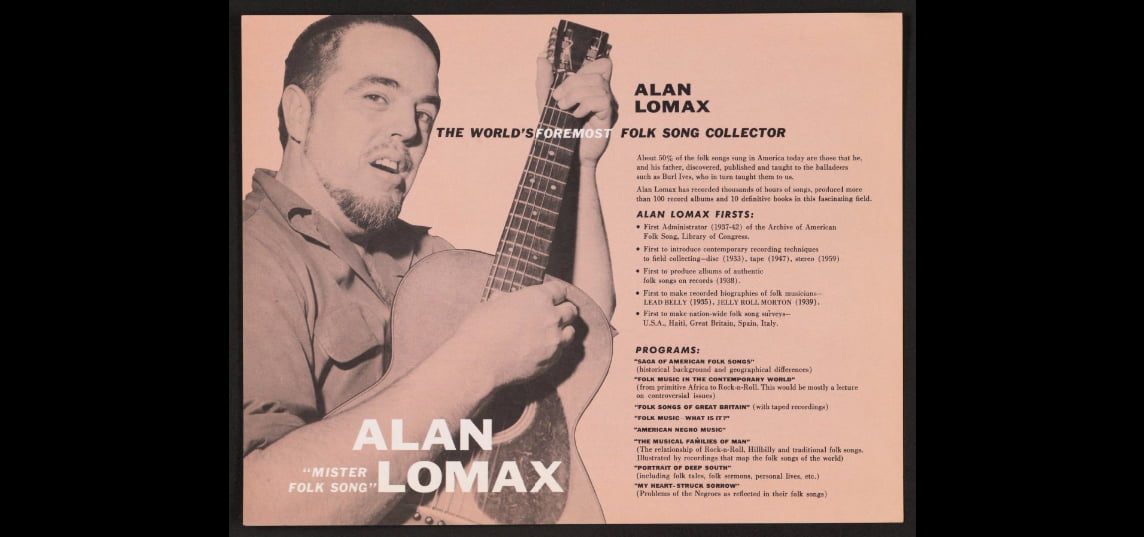
It’s no secret that Alan Lomax is a hero of ours here at the BGS. We’ve spoken with modern musicians like Sam Lee about the immense influence of the famed folklorist, as well as taken a trip or two through Lomax’s digital archives. That first foray into the digital world of Lomax yielded all kinds of goodies, like a Lead Belly concert poster from 1950 and an interactive map of Louisiana musicians playing and performing in 1934. 

We pulled those materials from a number of sources, including Lomax1934.com and the Association for Cultural Equity. We also spent a great deal of time surfing the Library of Congress’s online archives which, as of last month, just expanded its collection of Lomax-related content.

The new collection, which adds over 300,000 pieces to the Library’s Lomax archives, is culled from the Lomax family’s papers, so you can now feast your eyes on thousands more letters, writings, and research documents. The new material is housed in the same location as the some 25,000 pieces that were made available when we first began digging around in the digital Lomax realm. 

We’ve yet to make it through all 300,000 new additons, but we’ve already found some pretty cool pieces. Here are some of our favorite finds so far. Get to digging!

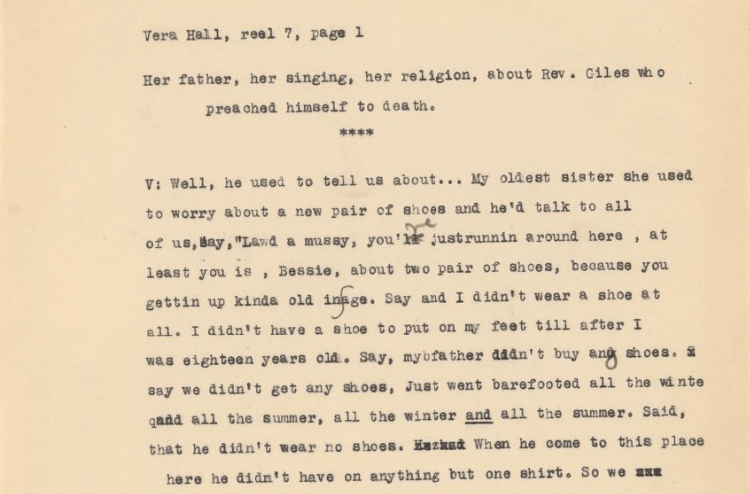
A transcript of Lomax’s interview with folk singer Vera Hall, conducted for The Rainbow Sign: A Southern Documentary in 1959. See the full transcript here.

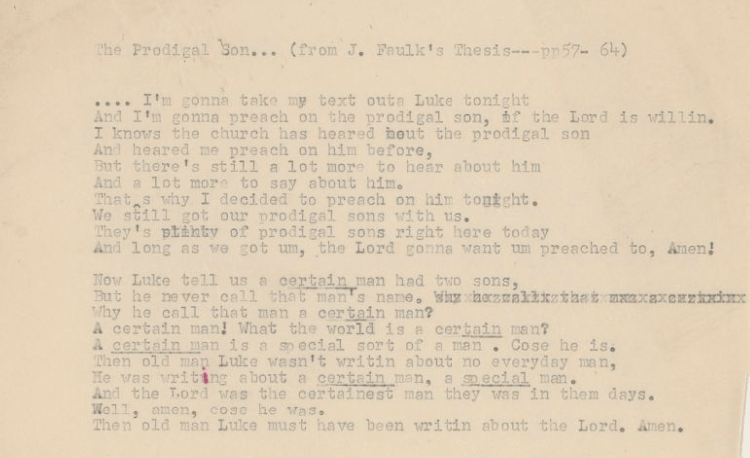
John Henry Faulk’s Master’s thesis, “The Negro Sermons,” circa 1940. See the full document here.

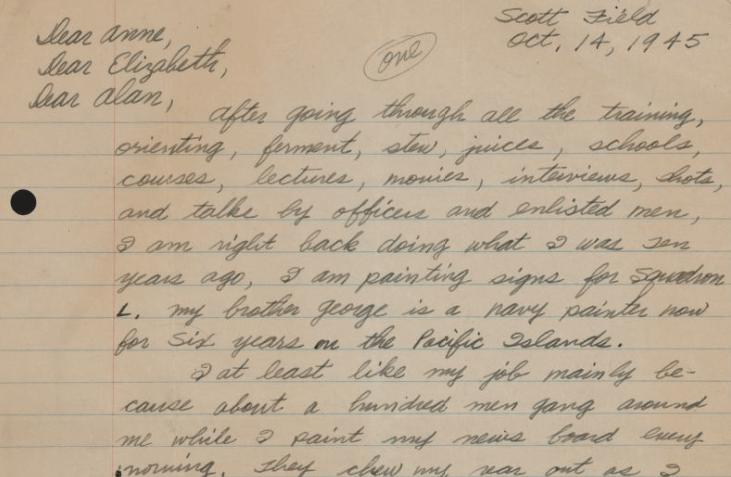
A 1945 letter from Woody Guthrie to the Lomax family. See the full letter here.

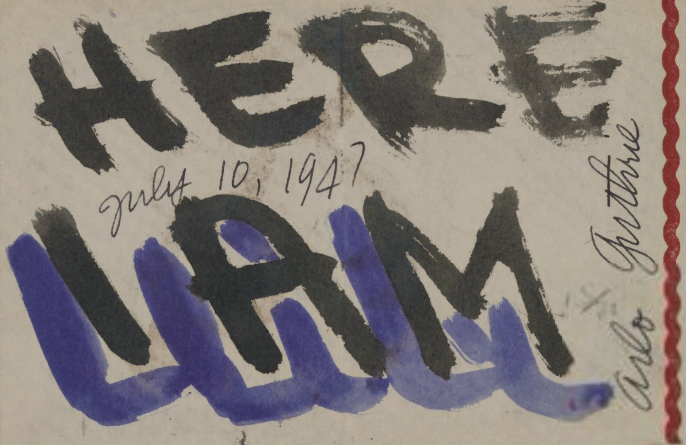
A birth announcement for Woody Guthrie’s son, Arlo, circa 1947. See the full announcement here.

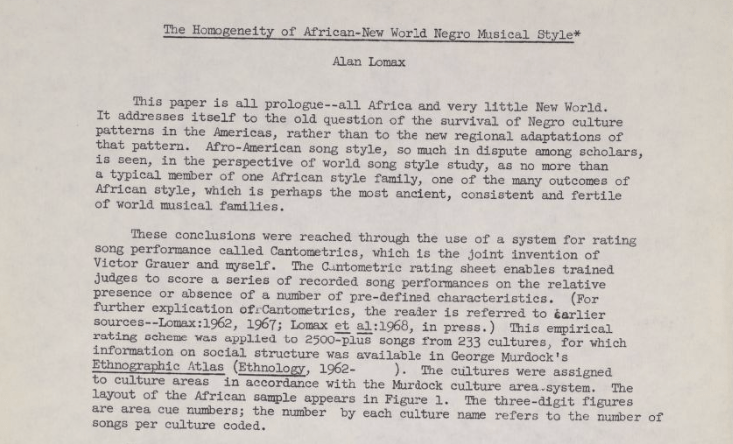
Transcript of a presentation, “The Homogeneity of African-New World Negro Musical Style,” by Lomax to American Anthropological Association in 1967. Read the full paper here.

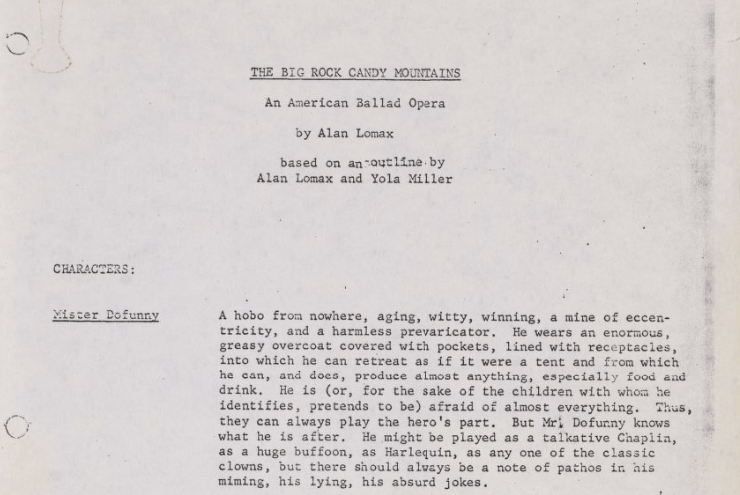
Script for Lomax’s 1953 play, The Big Rock Candy Mountain. Read the full script here.


All photos via Library of Congress

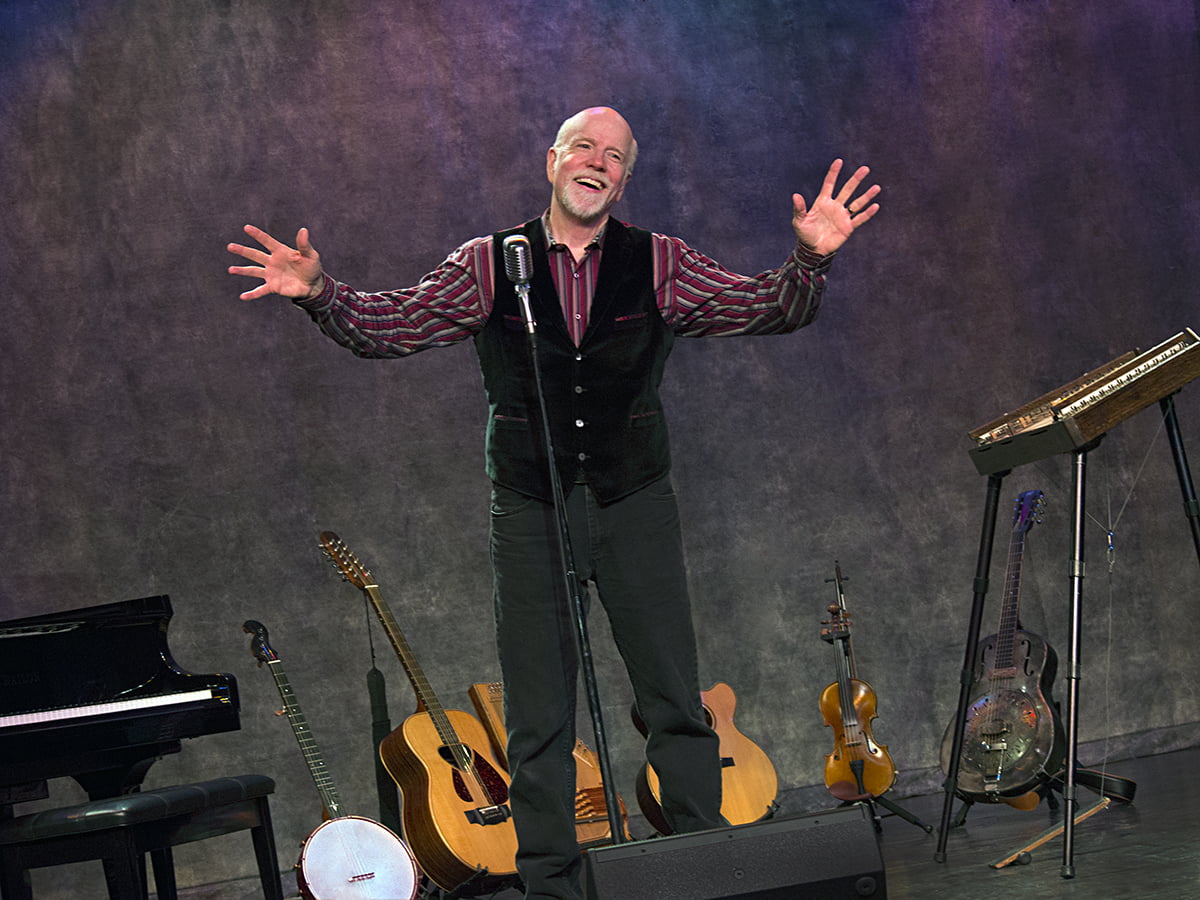
Counsel of Elders: John McCutcheon on Telling Powerful Stories

In late 2015, songwriter and multi-instrumentalist John McCutcheon received the kind of news capable of derailing any person, let alone a creative individual with lots left to say and the imagined time left to say it. Doctors found a lump in his lung and wanted to send him for a biopsy, but the discovery fell around Christmas and most services were, at best, delayed or, at worst, unavailable. McCutcheon eventually learned the lump wasn’t cancerous, as doctors initially believed, but the abscessed strep infection he did have required rest, so he cancelled the first two months of his tour in 2016 and followed doctors’ orders.

Like any storyteller who requires words to make sense of experiences and then lets those experiences out into the world as songs, McCutcheon spun his experience into music. He certainly had the time do it. “It afforded me lots of time to do writing and thinking and appreciating the fact that I get to do this amazing job,” McCutcheon says of recovering from the infection. McCutcheon gave himself over to writing and the result inevitably formed his 38th album, Trolling for Dreams. The songs encompass stories large and small, detailing everything from the epiphany he had after discovering a Bible at a garage sale to dancing with his wife in the kitchen as supper cooked on the stove. But amid those tales exist an incredibly personal tune — “This Ain’t Me.” In the song, McCutcheon details his cancer scare, describing with scalpel-like precision the way it forced him to reexamine the connection between his mind and his body. “I know people get news like this every day. Still, I gotta say, this ain’t me,” he sings in the chorus, sharing how the lump at first seemed something apart from him and eventually a part of him. It resonated in visceral ways with listeners, who saw the universality in his subjective experience. Stories, after all, exude that power.

You channeled your cancer scare into the song, “This Ain’t Me.” Has it made you appreciate music even more? That it, in some ways, gave you the form and the feeling to work through something so difficult?

Well, it’s same thing I did when I was a kid. I was working through the world, and music was a big part of it and it continues to be. Now I get to write, which is a completely cathartic experience. I never intended “This Ain’t Me” be anything but a private meditation, but I run a couple of songwriting camps, and there are good local people who have come to the camps numerous times. They have a songwriting group and they invited me one day, so I went over and they asked, “What have you been writing?” I sang them that song, and I said, “But this is just a way to write through what you’re going through.” I was trying to be the teacher. They said, “No, no. This is so universal. Remember what you taught us at camp that sometimes the most personal is unwittingly the most universal?” More than a lot of songs in recent years, when I sing that one in public, people come up to me and say, “That’s my story.”

That’s the sentiment I gathered from it. It’s something so many people deal with, but I found your articulation of the experience so compelling: This reckoning that some foreign body is a part of you, and, more than that, is hurting you.

I was pretty raw in those days. It was Christmas season; it was impossible to get a biopsy scheduled. My wife — God bless her; I wouldn’t be here if it wasn’t for her — she started hunting around branches of the hospital in little rural communities and that’s where we went. One of the things that may not seem quite as obvious, which is in the last verse of the song, is before they started the biopsy, they all prayed. It was the interesting juxtaposition of spirituality and science. I thought, “I’m so glad I’m in a place where there is that kind of submission to things you don’t know about,” because in some ways that’s what music is about.

All art is built on a foundation of discipline, but art is about abandon; it’s not about control. I’m doing a workshop these days called Holy Ground, which is the place where politics and spirituality meet, because that’s kind of where I came from as a kid. I think a lot of people dwell in that world, where you realize that you don’t know everything and there are things driving your life that you can’t put a finger on. To some, it’s Marxism or Ayn Rand or whatever; and to other people, it’s sort of how you grow up feeling that this is the right way to do things. And when you trace back its provenance, it probably goes back to you sitting in Sunday school or hearing your mother say something and it actually took.

It’s interesting that you say that people dwell within that space of politics and spirituality, because it strikes me how much those two concepts become almost antithetical, as you get older.

Well, I think we instinctively take big ideas to extremes, and things become really unnecessarily binary: You are liberal or conservative; you’re a Jew or Muslim. Everything is black and white.

Very either/or.

We love to think that the people in our group are deliciously diverse, are nuanced in every possible way, and the other is monolithic because we’re too lazy to get to know them. It’s one of the interesting things: The evolution of my thinking about political music. I grew up in a union movement and was really involved with the musician’s movement — still am — but I was a president of my local, which was formed to serve people in the traveling musicians world, so we got blues players, bluegrass bands, folk singers, gospel groups, and so on. I had to be involved in negotiating union contracts with presenters and festivals and stuff. I realized that I needed to know what the other side wanted, what was really important to them, so I knew what the parameters were. You’re just getting to know people. That’s the core of it. As we launch into this weird new world that seems to be so polarized, I’m not interested in playing into that anymore. I like political satire and I think humor proves that the emperor has no clothes, and here’s a guy who’s stark naked who would be really fun to write humorous, excoriating songs about, but that only plays into the disease that got us here.

That divisiveness.

Yes, we’re isolated and we’re insulated from each other. I know how to do that. I did that for a lot of years. Now, I think there’s a more creative way to move forward, and I’m interested in being part of that.

As someone who has taught songwriting, how do you keep from being too heavy-handed with a political message?

I have a number of credos that I adhere to and I teach. One of the most important is to remember that you just have the microphone, that doesn’t mean you have the answers. I remember the first time I stood up in front of a microphone, I thought, “Wow, this is an incredible privilege and, with that, comes responsibility.” Not many people get the microphone in this world, so how are you going to use it? [That development] was tempered by lots of things that happened in real life. I became a parent. What am I going to do to really parent them? Part of it is what I do with that microphone. The job of the artist is to ask interesting questions; just as important is “Don’t tell people what to do.” Give us a good idea.

How do you do that at a time when so many people seem to be shouting over one another to get their message across?

I think you can present ideas in all their messy glory. I’m interested in giving people new ideas — that’s what I’m searching for in the songs. In one respect, every song I write is a political song. You’re presenting your idea of what the world could be and, in some respects, you’re opening up the world to people. When I write songs based on my experience touring in Alaska, where I got to learn a lot about small commercial fisherman, that was opening up a world of the other to an audience that would otherwise have no experience in that.

It’s interesting that you say political, because I know the humanities continue to come under fire as being unnecessary, but I always viewed literature or music as being incredibly important because they taught empathy. And there’s a political aspect to understanding another person, another perspective.

Well, it was Kafka — and he talked about books, but substitute music, art, theatre — who said, “It is the axe for the frozen sea within us.”

I love that.

It’s beautiful. It does the best it can do, as far as creating compassion. Look, I’m a word nerd. My wife is a writer, and we have the entire 22-volume Oxford English Dictionary. I frequently go there and I look up words I feel I’ve overused or people tend to overuse, and one of the words was “compassion.” It is what every great religion, all the wisdom in literature, teaches us is a supreme virtue. I looked up “compassion,” which is really sharing in someone’s pain and, unless you are a participant, that is impossible. You’re not sharing directly in their pain. The closest you can come is empathy, and that’s one of the things that music is so powerfully able to do.

I write frequently in the first person, and I learned to do that from Woody Guthrie. “I’ll take you through a door and up a high stairs” … it’s so cinematic. Everybody in their own mind knows what that door looks like. If you ask four people, you’d get four different answers, but they were right there — they were invited in by the power of the first person and, all of a sudden, the magic can start. It was brilliant. I liberally steal from other good writers.

Well, that’s a creative trick. Or at least how you learn your craft at the beginning.

I don’t think you know that you’re doing it. I don’t think Woody would have taught a class in songwriting, saying, “Here’s how you do this.” He was just an instinctive genius, and had the ability to tell a story. And that’s what so many writers lack is the power of that connective tissue that is primal to human beings. We love stories. It’s what makes country music so popular into the 21st century. It’s the one kind of music that truly, consistently tells stories. It’s what makes Bruce Springsteen such a powerful songwriter. And it’s what drew me to folk music right away.

Is the power in the telling or is there more to it?

I’ve been a lifelong fan of the poet Pablo Neruda, and my friend took me to this place up the Pacific Coast in Chile six or seven years ago. I was walking through the courtyard and there was a boat there. The director of the Neruda Foundation said as we passed, “Oh, that’s a boat that Pablo built.” I stopped. I said, “Really? He was famously frightened of the sea.” He said, “Oh, he never put it into water and sailed it. He just built it. “ I said, “Well, then it’s not a boat.” He said, “Of course it’s a boat.” I said, “Until you put it in the water and it functions as a boat, it’s nothing more than sculpture.” And the same thing is true of the song. Until you take it out of the ivory tower of your imagination and turn it lose and let it be imbued with the meaning other people feel, then it’s just creative narcissism. I’m not an art-for-art’s-sake kind of guy. The song has to get out there; it has to do its work. And the people have to do their work on it.


Photo credit: Irene Young

LISTEN: Will Johnson, ‘Patient, Patient Man’

Artist: Will Johnson
Hometown: Austin, TX
Song: “Patient, Patient Man”
Album: Patient, Patient Man/Uinta
Release Date: February 24, 2017
Label: Different Folk Records

In Their Words: “Those first lines of ‘Patient, Patient Man’ kept rumbling around in my head on a trail run. I’d been kicking around some religious themes in my songs around that time, and was considering the idea of how a person can seem like a hopeless case to many faith-based people, and a prime candidate for forgiveness (and ultimately saving) to others. In the eye of the beholder, I guess. I took the narrative on first-person, and the melody unraveled from there. When I got home from the run, I recorded it in the middle bathroom of our house.” — Will Johnson


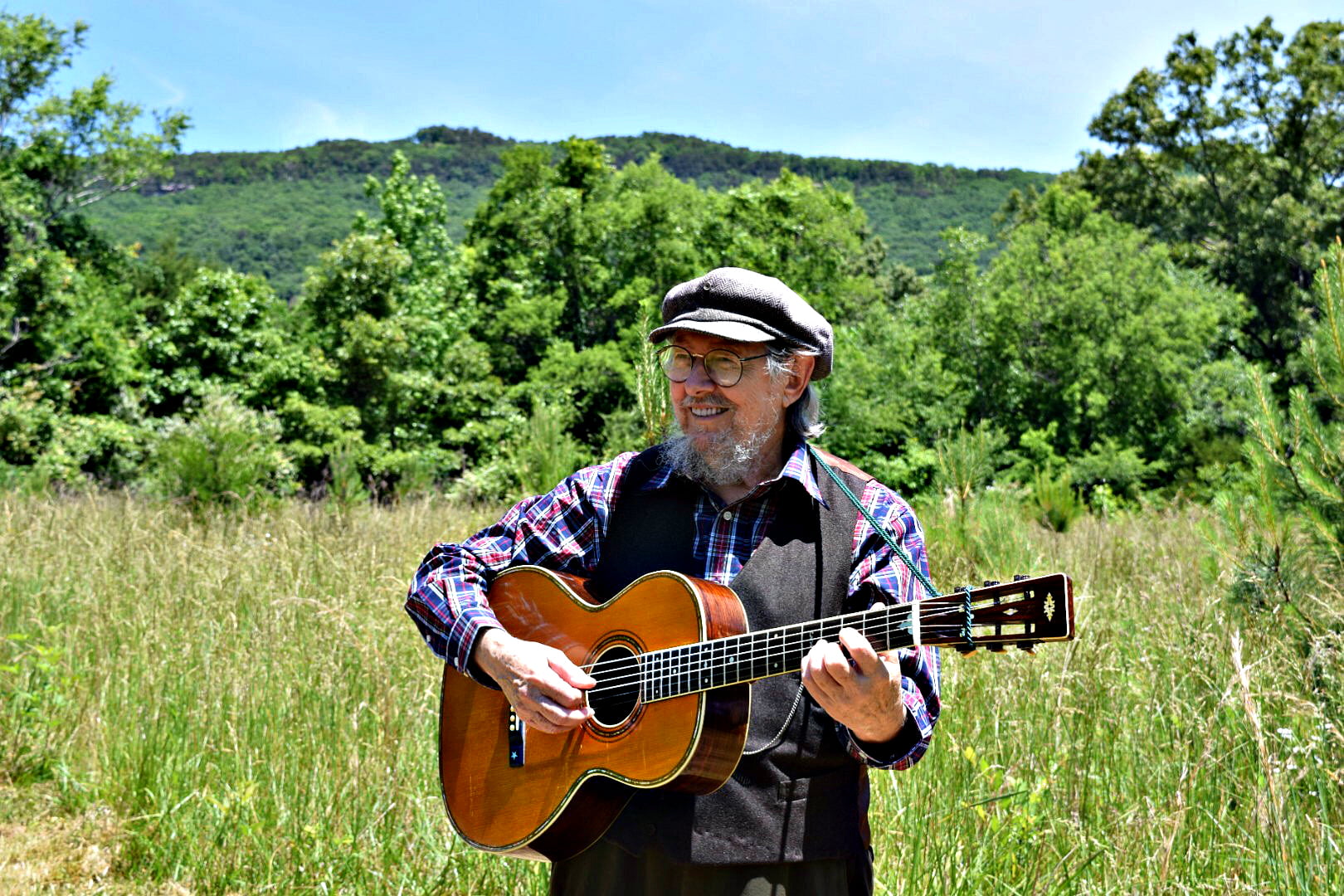
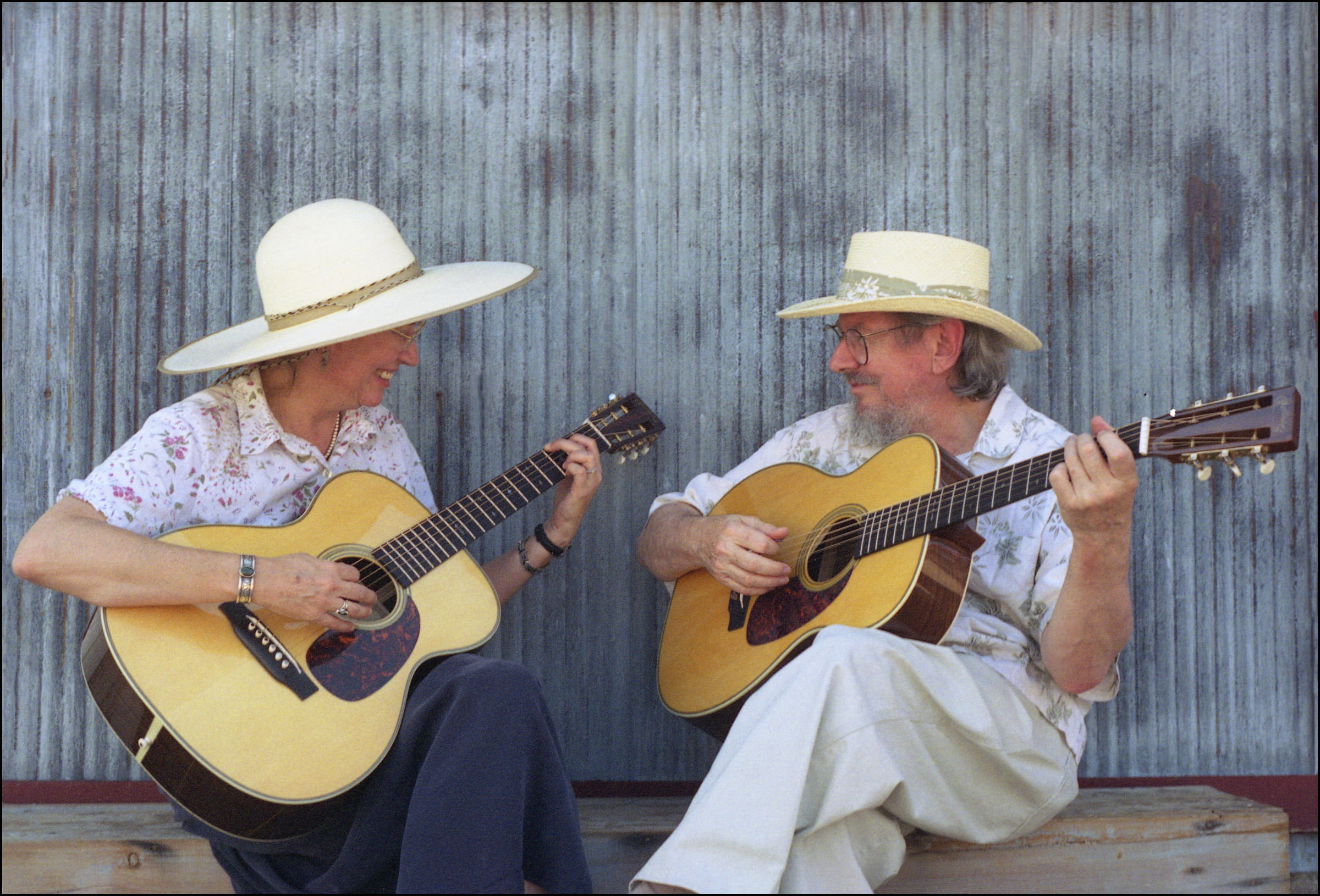
End of the Road: A Conversation with Norman Blake

Few would dispute Norman Blake’s place on the Mount Rushmore of acoustic guitarists. He’s spent 50 years defining a flat-picking style adopted by guitarists from Tony Rice to Dave Rawlings. He’s also been a translator of traditional ballads, an influential folk songwriter, and an A-list sideman for the likes of Johnny Cash, Bob Dylan, Joan Baez, and Kris Kristofferson.

But the bullet point version of his career misses what makes him fascinating: a stubborn integrity in his approach to making music — commercial pressures be damned — and a bizarre serendipity that’s led him right into the center of some of folk music’s most important moments of the past half-century. Now he’s capping off his long career with Brushwood (Songs & Stories), an album of beautiful, spare folk that is jarringly modern and political. The songs would sound timeless except that Blake is singing about social media and the Internet — and he often sounds righteously pissed off. It’s hard to explain Norman Blake briefly, but the back-story is worth it.

Born in 1938 on a farm near the Georgia-Alabama line, Blake grew up without electricity, learning songs from a radio jerry-rigged to an old car battery. He dropped out of school at 16 to play in bluegrass bands, made it to the Grand Ole Opry in his early 20s, then was drafted into the Army where he played mandolin in a bluegrass group voted “best band in the Caribbean Command.” Fresh out of the service, he ran into Johnny Cash at a recording session in Chattanooga. Cash asked him if he played the dobro, and 25-year-old Norman said, “Well, yeah.” Cash hired him on the spot.

Then, on the seminal, tide-turning albums of the era, he was right there. It’s hard not to notice the Forrest Gump-ian serendipity of it all.

Blake played guitar on Bob Dylan’s Nashville Skyline in 1968, one of the founding albums of country-rock; on John Hartford’s Aereo-Plain in 1971, which marked the beginning of Newgrass; and on the Nitty Gritty Dirt Band’s Will the Circle Be Unbroken in 1972, which sold approximately as many copies as there were college students in America and introduced old-time country and bluegrass to a longer-haired generation. Thirty years and dozens of albums later, Gillian Welch recommended Blake to producer T Bone Burnett as just the guy to help introduce classic American old-time and folk to another, slightly shorter-haired generation. The O Brother, Where Art Thou? soundtrack, in 2000, won a truckload of Grammys, sold eight million copies, and made enough money for Blake — along with his wife and frequent collaborator, Nancy — to start his retirement from the road.

Now, in true Norman Blake style, he’s adding an unexpected chapter to his idiosyncratic story. The sound of Brushwood (Songs & Stories) is classic Norman and Nancy: guitar and fiddle and voices in harmony. But its content is mostly no-holds-barred fire and brimstone of the modern, progressive variety — as well as some instrumental rags, a couple of train ballads, and a spoken word ghost story. In other words, this 79-year-old master of the craft just put out an album of traditional folk songs about climate change, old time religion, the Koch brothers, train wrecks, the NRA, and Wall Street greed. He predicts it will be his last album, and damn. What a way to tie a bow on it. God bless Norman Blake.

I know, in your music, you’ve never shied away from being political, but it seems like, on this record, there’s a lot more explicitly political songs.

Yeah, I somehow just felt like doing that. I don’t know why. It just came out that way, some of the stuff that I ended up writing.

On some of these songs, like “The Truth Will Stand (When This World’s on Fire),” you’re combining observations about modern life — climate change, the NRA, billionaires running the country — with the spiritual language you’ve been using in traditional songs for a long time. Did that feel like a new thing to do? Or did that come naturally?

Yeah, what I write is just the way it comes out. There’s nothing calculated there. It’s just how I write, yeah.

Well, maybe I’ll go back in time a little bit here. I’ve read that the success of the O Brother, Where Art Thou? soundtrack allowed you and Nancy to stop touring, and you felt that was a welcome relief. I’m wondering what your feelings about performing were earlier in your career. Was there a time when you enjoyed touring, when it was an important part of making music to you? Or did you want to stop earlier?

I had considered stopping earlier, yes — 2007 is when I actually quit touring, quit the road due to age and things like that. You know, just getting tired of the actual road itself at that point. Of course, we did everything on the ground, driving. Just got to where we couldn’t stomach that part of it anymore.

I guess what I’m getting at is, do you think if money hadn’t been a part of the equation, your career would’ve been very different? Would you have traveled less, written more?

Yeah, money was a factor in why we did it. I suppose so, yeah. I had the artistic inclination to want to do it, but the money — certainly making a living … we had a family and everything and had to do something. A lot of times, when we made records through the years, the reason we’d make the record was, we had so much money from the record company — they’d give us x amount of money to make a record — and what we had leftover then that we didn’t spend, we’d usually use that to pay our income tax every year. [Laughs] So we made a record about every year, in some ways, you might say, to pay the income taxes. But it was also artistic at the same time.

So why do you make records now?

More for an artistic sense, I think. The way the world is now, the record business is nothing like it was when we started. It’s a whole different thing. My records have never been huge sellers, so they had to be artistic on one level, I guess. Now they’re more artistic, certainly.

At the end of this record, particularly with “Nameless Photograph” and “Stay Down on the Farm,” I couldn’t help but think it sounded like a goodbye.

It’s trying to be. I think maybe this might be my last one — my last full record that I’ll make. I’ll be 79 years old here in less than two months. So I’m pushing 80 years old. I had a light stroke four years ago, had artery surgery on my neck, and that kind of thing. I never was a great singer, as far as having a great voice, but that’s left my voice pretty gravelly. I just wonder, how long do you inflict yourself on the public as you grow old? [Laughs]

It’s a lot of work to make a record, and I just don’t have the inclination. I have vowed this year — like I said, we quit the road in 2007, but we’ve played a few gigs around home — but this is the first year that I have said that I will not perform this year in public. And I will say this: I may never again perform in public, if possible, unless it’s a money consideration and I have to. I may never perform in public again. That’s what I’m thinking.

Do you still enjoy making music at home?

Oh, I play all the time. I play every day. Oh yeah, yeah. I’ll never quit that. I’m totally committed to playing. But not in public. As you grow older, for me, it takes a lot more practice to keep the playing and the voice and everything to where it’s passable to make records. As far as the performing, that’s also something that’s getting to be too much for me physically. All of the getting ready for it, and all of the traveling that you may have to do, even if it’s around home. I just don’t weather up that good. And I just don’t need the performance pressure, with these medical conditions and things. And I will say this, not to belabor the point, but we — speaking of Nancy and me, both — feel very much that with the climate of the country right now, the political climate and the attitude in the country in general, I don’t feel like I want to entertain some people. I don’t want to go out and put my music before some of them.

That’s interesting. I remember your song from the early 2000s during the Bush administration, “Don’t be Afraid of the Neo-Cons.” I guess the natural follow-up would be, do you think we should be afraid of Trump?

Yeah, I suppose so. But I don’t know that I would go and do that. I feel like there are enough people — obviously, as we saw this past weekend — there are enough people speaking out. I don’t know what the outcome is going to be. The political climate we don’t agree with at all. So we maybe just as well stay home. That’s, like I said, that’s one reason I said I don’t feel like trying to entertain some folks. I don’t feel like putting myself out in front of them when I know that I disagree with them and they disagree with me so radically. The way that people are nowadays, there’s so much weird stuff going on, I feel like some — excuse my French, but I feel like some son of a bitch is liable to shoot us or any of us for being freaks or for playing hillbilly music or singing the wrong song at the wrong time. Somebody is liable to shoot you up there on a big stage in front of a big crowd at a festival. You never know what the hell’s going on now.

Well, a lot of folks have compared the current political turmoil to what happened in the late ’60s. You lived through that, and you were a musician then. So are you optimistic at all about the country now? I think a listener to the new record would hear that you’re not.

Am I optimistic about the country? No, I’m not, in some ways. In other words, considering what’s just happened, how can you be? I understand why a lot of people might have elected him, voted for him, but he took them for a ride. He’s a con man. He conned a lot of these people. And I feel like a lot of them that put him where he is today, how can they look at what he’s doing … it should be painfully obvious, just from the time he got into office, that he’s doing exactly the opposite to what he told them, in a lot of ways. So, no, I’m not optimistic about it. I feel like they really got snookered. Just a minute …

[Nancy’s voice in the background: “Democracy doesn’t come with a guarantee!”]

Nancy says that democracy doesn’t come with a guarantee.

That’s a good reminder.

Yeah, she has some good ideas. She says some good things. In fact, some of the songs on there are inspired by her. She helped write them. I get some good ideas from her!

Speaking of writing, I’m really curious about how you became a songwriter, because it seems like — and you can correct my dates, if I’m slightly off — but you became a professional musician in the late ’50s, early ’60s, but you didn’t make your first solo recording until ’72.

That’s right.

Were you writing songs all along, or were you learning along the way from the great songwriters you were playing with?

No, what singing I did then was mostly just singing harmony parts or something on the chorus in bands, things like that. When I got ready to make that first record — people were saying, “You should make a record” — when it came about that I had the wherewith to do that, with Bruce Kaplan — he was with Rounder at that point, then it became Flying Fish, but it was still Rounder at that time … I thought to myself, “Well, I won’t make a record unless I have some original material.” So I said, “Well I need to write some stuff.” So I started writing then.

Wow. Just like that. For a while after that, you toured pretty hard, and it seems like you didn’t write as much. Is that because you lost interest in it?

Too busy. Too busy driving and performing. And competing in the bluegrass world, trying to survive in the bluegrass world knowing we were playing something that was completely off the beaten track and away from what they were playing. So we just took too much time being professional and performing and driving and getting to gigs and all that. We just didn’t have time to want to be that creative.

What do you mean by competing?

When you sent me and Nancy and James Bryan [The Rising Fawn String Ensemble] out on a bluegrass festival with a fiddle and a cello and a guitar, you know, out there in five-string banjo world, so to speak, we were kind of an oddity. We were fish in a tree.

How did it feel to be so different at those festivals?

Well, we did a lot of musical crusading to survive in that world. And we managed to. But that’s something else — we grew tired of crusading musically over the years.

It seems like you’ve influenced a lot of people over the years that have become very influential in their own right. Might even say you’ve influenced people even more than the folks in strictly five-string banjo world. I’m thinking of Gillian Welch and others. Do you feel like your crusading kind of won in the long run?

Oh, I don’t know. I never knew who I really influenced in the long run. I do relate a lot to Gillian and David. They’re some of my friends, and I respect what they do. They do some great things, and I admire their grit to do it. But I never thought about who I influenced or didn’t. I was never sure about that. I guess I’m never sure of my role in any of it. I just was too busy trying to survive and make a living in the music business, and it was hard enough for any of us. Playing acoustic music has always been a hard way to make a living.

Sure. It seems like, from the outside, at least, that it must’ve taken a lot of backbone to do what you did just because you felt like it’s what you should do, rather than because it was lucrative or because there was a successful niche for it.

We always did what we felt like doing artistically. We played what we knew to play and what we could play and felt like playing. We didn’t really tailor ourselves into any particular thing. We never tried to be commercial in any sense.

Just doing what you felt like you needed to do — is that what it felt like to drop out of school at 16 to become a musician? Was that a popular decision with your family?

I was always pretty well supported by my parents in what I did musically. But they were never quite up for me leaving home at the point that I did starting off on it. I think that worried them a little bit. But they encouraged me, musically, very much in what I did …they were surprised by some of it, you know, that I’d had as much success as I’d had. They didn’t expect that! I think they always considered it as something you couldn’t make a living out of.

After growing up listening to the Grand Ole Opry on the radio in the ’40s, what did it feel like to get up on the Opry stage in your early 20s? To play on that program you grew up on.

Oh, it was a big deal. It was a big deal for us to be on it in any way back in the day. That’s back when it was down at the Ryman. It was the world. It was it. In fact, when I was real young, we couldn’t think past the Opry, hardly. That was the pinnacle, the top of the heap.

I’m wondering about your early guitar education. On the Opry, when you were growing up in the ’40s, there wouldn’t have been many lead acoustic guitar players, right?

No, no, it was not a thing you heard featured very much. It was in the bands. But Sam McGee was playing guitar. He was on there. He was playing solo-type guitar, playing with his brother Kirk. So I heard him.

Sam McGee? I’ve never heard of Sam McGee.

You’ve never heard of Sam McGee!

Well … [Laughs] I’ve heard of a good number of guitar players from back then, I think, but I don’t know of him.

Well, the McGee brothers. Sam and Kirk McGee, the boys from sunny Tennessee, they were billed. They played with Uncle Dave Macon. Sam played a lot with Uncle Dave, made records with him, and then he and his brother Kirk also made records. And then they played with Fiddlin’ Arthur Smith, band called the Dixieliners.

What was his guitar style like?

Sam was a finger-style guitar player, played guitar-banjo and played guitar, kind of a ragtime style. They were extremely good, some of my favorite people. I used to hear them on the Opry when I was a kid.

Did you study his style, learn to play like him?

I never tried to play their stuff that early on. I’m sure I play in that style, that same old finger-style playing — similar songs and stuff. They were very good performers.

Who else was an early influence on your guitar playing?

Mother Maybelle [Carter] was a big influence. Very much so. On those early records of the Carter Family, then later on when I got to know her in Nashville.

What did Doc Watson mean to you when you first heard him?

After I came out of the army in ‘63, I was giving guitar lessons in Chattanooga. One of my students asked me had I ever heard of him, and I said no. I had never heard of Doc. They brought me some records, loaned me some of his records to hear. I was doing mostly finger-playing at that point. I always had played mandolin with a flat pick. I had picked the guitar a little bit that way, too. Then I heard him, and he was getting popular, getting a lot of notice at that point, so I thought to myself, “My goodness.” I thought this was a novelty to play the guitar this way! I had learned from the old way, the thumb and finger style, but then I thought, “Well, I can do this too. This is something I know how to do.” So I started working on it more at that point …

Then, when I got to Nashville, the whole thing opened up. I realized there was a whole word of this going on, so I got right in the middle of it quick as I could. I went through a phase that played both ways. I played with a flat pick part of the time — did that with John Hartford — then I also played alternate thumb and finger style, you know, single string stuff. Ended up finally just pretty well flat-picking.

It’s interesting to think — I mean, a lot of folks listened to the Skillet Lickers back in the ’20s and must’ve known Riley Puckett’s style, and then also were familiar with Maybelle Carter’s melodic guitar playing, but then you said people thought more modern pickers like Doc Watson sounded like a novelty. Why do you think that is? What was the difference?

Well, they just weren’t used to hearing that much played on the guitar with a pick like that. The guitar was more in the bands. When it started becoming a prominent lead instrument, it created a whole new thing. And we never called it flat-picking. That’s a term that came on later. We always referred to a pick like that as a “straight pick.”

Did Doc ever teach you or give you any advice?

Well, I’ve always said I learned from anybody I ever liked. We played gigs with Doc. I’ve had the good fortune to hang out some with him, had some good conversations and things. Got along pretty good.

Compared to learning from folks you’ve played with and folks you listened to and by going on the road, nowadays a lot of young musicians — even folk and bluegrass musicians — are going to conservatory programs to study. Do you think there’s a big difference between those learning styles?

Nowadays, people do everything in a different way. They have to. There’s so much going on. They’ve got access to so much that we didn’t have. I guess any way you can learn it is what you do. We were a lot more rural in our approach. Nowadays, rural life is a lot less involved with it. It’s become more of a fad, in a lot of ways. But they just don’t come from the same world that we did. They didn’t grow up down in the country. A radio to listen at is all we had, and a handful of records on a wind-up Victrola or something. Nowadays, they can access anything that’s out there.

Do you think that access to everything, that lack of common influences, is changing the way people make music? It seems like older generations of musicians always talk about these common touchstones, like listening to the Opry on the family radio or watching the Beatles on The Ed Sullivan Show

Yeah, I don’t know. I wouldn’t know. But when I first started hearing music, we just had the Opry on the radio and a few other radio programs — of course, it was live music on the radio, on our battery-powered radio. We didn’t have electricity, when I was a kid, so we had a battery radio, a phonograph, a few records, and whatever you heard people playing around the community. That’s all we had to draw on.

Why did you decide to incorporate storytelling onto this record — I mean, spoken stories?

Just stuff I’d written. I figured, “Well, if I’m not going to make another record, then these things are never going to get heard.” Whether they should or shouldn’t. They were just things I’d written that weren’t a song, so I said, “Well, I’ll put them on there.”

Do you think younger folk musicians have a responsibility to tell it like it is, like you do, to talk about the modern world or politics in their songs?

I don’t think they have a responsibility to, no. They just have to do what they feel like. It’s their own decision. If they feel like that, they should do it … I always felt that I didn’t want to overdo that aspect of things, I mean politically. If I was really trying to entertain people like years ago, out where people would expect me to play the guitar, I didn’t feel like going out and getting too political — just like a lot of performers get too religious on stage. I think it turns people off, if they didn’t go there for that. If it’s a political rally and you want to be political, then that’s a different thing. But just to go out in a general manner to entertain people, I think politics and religion are some things that should be avoided to some degree. That doesn’t mean you shouldn’t sing a religious song! We always did. But I mean, you shouldn’t go out and get on the stump, if people aren’t expecting it or didn’t go there to hear that.

So now that you don’t perform live, you feel free from those considerations?

Yeah, I put it on a record. I’ve always said I’ll use a record for any kind of soapbox I decided to get on. In public, I wouldn’t want to play this latest record. If I went out to play, I wouldn’t do that stuff!

Well, let me finish with one more question for you.

Go ahead.

I haven’t really heard anyone sing about social media or the Internet in a folk song before, and it was sort of … well, refreshing, I guess.

[Laughs] Well, thank you.

It strikes me as funny that most young folk musicians seem committed to using their parents’ and grandparents’ vocabulary and, as far as using modern words, you’ve beaten us to it.

Well, I feel like it’s all there, you know. The old stuff’s there and the new stuff’s there and it’s out in the world. It just fell out that way. It was not calculated, it just came out that way.


LISTEN: Gwyneth Moreland, ‘The California Zephyr’

Artist: Gwyneth Moreland
Hometown: Mendocino, CA
Song: “The California Zephyr”
Album: Cider
Release Date: April 21, 2017
Label: Blue Rose Music

In Their Words: “In 2008, I booked a 3,000-mile trip by bus and train from my hometown of Mendocino, California, through the Southwest. With a heavy heart, I began a journey of long rides on the Pacific Surfliner and Southwest Chief, with a return ride from Denver on the famous train, the California Zephyr. During this time, I began to realize that my relationship with my then-boyfriend/bandmate was dissolving. So, yeah: I was heartbroken, torn up, and in desperate need of an adventure.

So, when inspiration from the Carter Family’s “The Cannon Ball Blues” struck while aboard the California Zephyr, I went with it. What came out was not a biographical song, but one that was definitely shaped by the way my heart was feeling and all the tunes floating through my head on that 54-hour ride from Denver. A friend nailed it when he said, ‘You are singing about leaving behind your honey babe, but you’ve got a huge smile on your face!’ And yes, it’s true — I do … now. All those years of searching have led me here to this moment. The train keeps rolling.” — Gwyneth Moreland


Photo credit: Jay Blakesberg

LISTEN: Eric Saint Nicholas, ‘3:45’

Artist: Eric Saint Nicholas
Hometown: Corona Del Mar, CA
Song: “3:45”
Album: American Heartbreak Radio
Release Date: February 10, 2017

In Their Words: “’3:45′ is about late nights in New York City and dating the wrong person at the right time. Sometimes you roll with things that are no good for you just to see how it feels, to live a little. Maybe ‘3:45’ is doing a little bad so next time you know better.” — Eric Saint Nicholas


Photo credit: Erick Anderson

Jade Jackson, ‘Motorcycle’

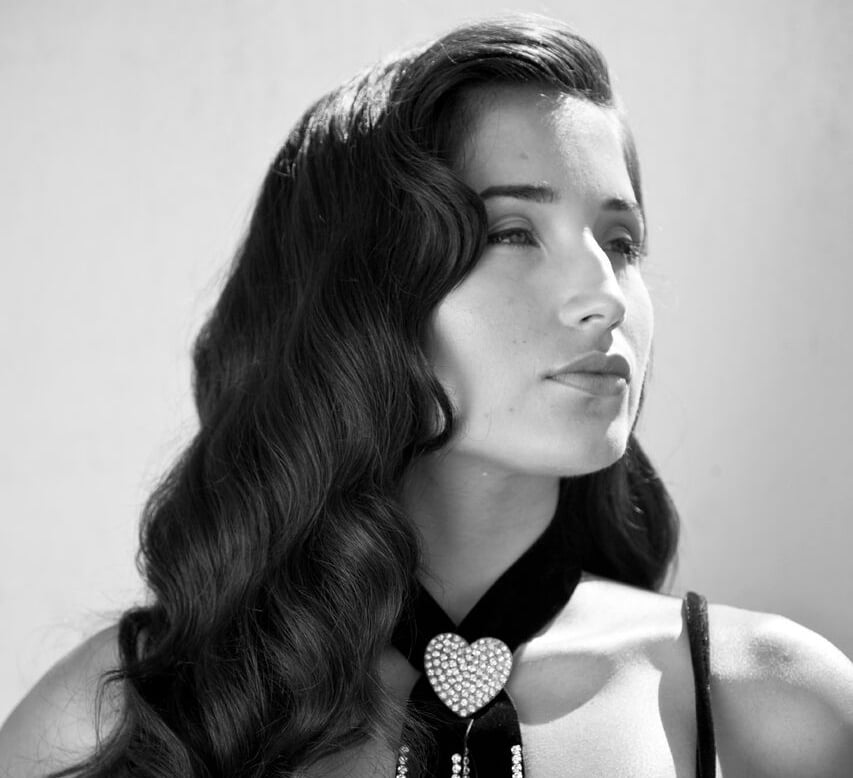
There’s just something about the art of the musical kiss-off: a song that doesn’t chase or proclaim love, but leaves it shaking its head, trying to trace back its steps to the moment where everything fell apart. For Jade Jackson, this is “Motorcycle,” a moody, sing-spoken minor-key proclamation in the form of a folk song, delivered in a message to a former lover. “My motorcycle only seats one,” she sings to a melody that’s part Western saloon, part Twin Peaks, before riding off confidently into the sunset. It’s this approach, both soothing and subversive, that caught the attention of Social Distortion’s Mike Ness, who produced her debut album. He knows a thing or two, after all, about applying a sort of scrappy punk ethos to a country palate — what we once called “cowpunk,” before the omnipresence of Americana took over. The raspy-voiced Jackson, who grew up in California (the place where that meeting of roots and rage first converged), started writing music at 13, and her taste — part Hank Williams, part the Smiths — comes through loud and clear in her unique combination of deadpan and delicate.

Watch the exclusive premiere of “Motorcycle” here, captured in emotive black and white. Jackson’s debut LP will be out this Spring on Anti-.

United Bible Studies, ‘Recruited Collier’

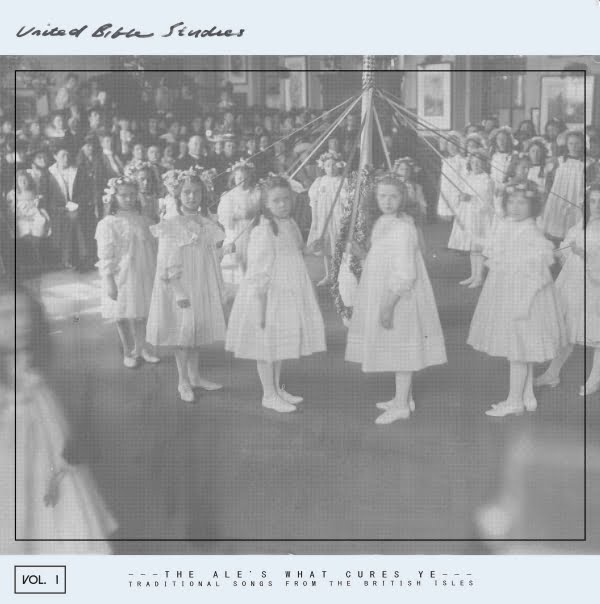
Though American music draws from dozens of different musical traditions, most of what people think of as purely "folk" music has its roots in the British Isles. Many old-time Appalachian ballads began in England or its neighbors hundreds of years ago, and reels and other fiddle tunes come from similar Celtic backgrounds. United Bible Studies — whose members spend most of their time in Ireland and England — are breathing new life into some of these old, old songs. The band's new record, The Ale's What Cures Ye, is a collection of reimaginings of some of these traditional songs from abroad. 

"Recruited Collier" is one of the album's nine tunes. The song is pretty but spooky — part of which can be attributed to the fact that it was recorded in the Mupe Bay Smugglers Cave in the English county of Dorset. "The tide was fast approaching, and in our haste, I sang 'take my heart' rather than 'break my heart'. Not only that, but I sang it twice, perhaps recalling Pavement's advice to repeat any mistakes you made so as to make them seem deliberate,"  David Colohan explains. "With no room for second takes, we made good our escape from the Smugglers Cave … and I swore to never haul a harmonium up and down a cliff face ever again."

"Recruited Collier" sounds distant as it begins, with a low drum, heart, and flute floating over sounds of rain. The troublesome harmonium comes in later, sounding almost otherworldly as it wheezes through the song. Let United Bible Studies enchant you with "Recruited Collier."

The Paycheck Is Blowin’ in the Wind: A Brief History of Bob Dylan in Commercials

When Bob Dylan began recording in 1962, he quickly became the poster boy for the "anti-establishment" — a totem around which disenchanted and disenfranchised baby boomers could rally their rebellion. His unadorned, unencumbered voice was the voice of every man. His poetry the rallying cry of political unrest, his songs simple but powerful, his personality both rebellious and thoughtful. He was, to put it simply, a sort of Woody Guthrie for the Age of Aquarius.

To this day, people young and old staunchly defend his legacy. Fans in their 50s and 60s stand up for him with vehemence (though his work may not always warrant such passion) while young people co-opt his style (though some may not understand exactly why). It’s all because, in the minds of many, Robert Allen Zimmerman remains an icon of the anti-establishment.

While Dylan's musical genius is undeniable — his singular dedication to his singular path admirable — the illusion that he’s some sort of icon of anti-corporate purity is a case of idealistic people whistling in the wind to scare away the wolves. The truth is: Bob Dylan's never hesitated to take payment from the very establishment against which he has railed. Back as far as '65, Dylan aligned himself with Albert Grossman, the bellicose ombudsman of Dylan's business affairs during the ‘60s and early ‘70s. He was the first of his sort to refer to his charges as "artists." In concert with that lofty definition, Grossman never hesitated to extract as much money as he could on behalf of his client’s “artistry.”

Dylan’s alliance with Grossman was dissolved in the early ‘70s, in an adversarial fashion, as Dylan accused his manager of “skimming the cream from the top of the milk can” (as Guthrie might have said). But, 40 years hence, Dylan still finds meaning in the capitalistic Gospel of Grossman. He’s chosen to be a somewhat peripatetic pitch man for a strangely disparate selection of products, from sexy underwear to luxury cars.

Witness Exhibit A, his recent appearance in IBM’s commercial for its Watson computer (an event journalist Paul Walsh charmingly referred to as “Tangled Up in Big Blue”).

According to IBM spokeswoman Laurie Friedman (as quoted by Walsh), the company actually did use the Watson computer to analyze 320 Dylan songs, adding an element of truth to the singer’s bemused “conversation” with the computer. What IBM didn’t do was listen to Dylan’s tragically horrific album of Sinatra covers or have another look at 2001: A Space Odyssey. Had they done so, they probably wouldn’t have outfitted Watson with a voice that sounds like HAL and programmed him to sing those mockingly Sinatra-esque doo-be-doo-be-doos.

“Let Asia build your phone and Switzerland make your watch,” Zimmy says in Exhibit B, a 60-second long ode to American ingenuity in the form of a 2004 Super Bowl commercial for Chrysler. Though less odd and unsettling than his IBM commercial, it leaves one markedly more dyspeptic. For IBM, Bob seemed distracted, but here he offers a poetic reading — presented as his own poetry — in the name of economic aspiration.

Chrysler was the first, but it wouldn’t prove to be the last car company who would pay Dylan to back down their driveway. In ‘07, Bob pimped for Cadillac, a markedly more bourgeoisie brand than Chrysler. Though more tight-lipped than he was with Chrysler, the message is essentially the same.

Dylan presaged his sit down with HAL (er, Watson) when he went to bat for Apple a few years prior. While it definitely hawks all the musical “i’s” the company could cram into 30 seconds, this one’s a touch more tolerable than the rest: He was, after all, pitching a new album in the process. (And Modern Times was easily one of his recent best.)

Like owning a lot of rental properties, Dylan made money while he was sleeping with his 2009 Pepsi deal. For those who cling to the fraying threads of his counterculture heroics, this one has to be the most appalling. Not only does he capitalize on his name, he does it by offering up imagery from the past — when he really was something of a rebel — and pinning it to a company that makes liquid candy.

Did we say the Pepsi commercial was the “most appalling”? We lied. His infamous appearance in a commercial for Victoria’s Secret ranks as Zimmy’s most appalling foray into commercials. It’s not that we have anything against Victoria’s Secret, in particular, or pretty girls, in general. But we do get creeped out by the sight of a grizzled 74-year-old grandfather leering at a 22-year old girl in her underwear. There’s no paycheck in the world that excuses such a bombastic exhibition of bad taste.

Even though this brief history of Dylan's relationship with advertising portrays the artist in question as a corporate shill, the end of the story is this: Dylan seemingly doesn't give a damn. His enigmatic career bends and curves at his will, and those of us who dissent simply don’t understand. Frank Sinatra cover songs? Check. Dyed blonde emo hair for a movie? Check. Fat paycheck from Chrysler? Check. Dylan does whatever the hell he pleases. So maybe he really is anti-establishment; he just has the luxury of paying for said lifestyle through the same means Don Draper did.


Photo: Bob Dylan as he appears in his Chrysler commercial

The Essential Dan Fogelberg Playlist

Contrary to what it sounds like on his records, Dan Fogelberg wasn’t born in Colorado. He was born in Peoria, IL, the son of a classically trained pianist mom and a high school band director dad (the person who inspired Fogelberg’s hit, “Leader of the Band”). As a teenager, Fogelberg played in the requisite Beatles cover bands before trying his hand at the folk music circuit around Chicago during the early '70s. It was there, at the famed Red Herring Café, that REO Speedwagon’s manager and future label exec, Irving Azoff, discovered him and signed him to a record deal.

Transplanted in Nashville, Fogelberg tracked his first record, Home Free, with Norbert Putnam behind the wheel. It pretty well tanked commercially (though has since gone platinum) but it encouraged Epic Records to stick with him and assign him a second session (with the strange bedfellow Joe Walsh as producer). Souvenirs — recorded with a cadre of L.A. session players plus Graham Nash and guys from both America and the Eagles — reached the Top 20, the single “Part of the Plan” made the Top 40, and Fogelberg’s career achieved liftoff.

Starting with Souvenirs, Fogelberg recorded five straight multi-platinum albums, wrapped up the '80s with a pair of platinum records, and became the unofficial voice of the Colorado snows (second only to John Denver). His 1985 album, High Country Snows, is a fine record of songs in the bluegrass tradition and, mixed in with his solo albums, he tracked two sets with jazz flautist Tim Weisberg, the first of which — Twin Sons from Different Mothers — is considered an acoustic classic.

Though some would categorize the late singer as nothing more than an MOR pablum pusher — which was true on a few occasions — Fogelberg was a well-loved performer, a respected songwriter among his peers, and a guy who made a melody sing. Herein, we offer an essential playlist of his best songs, a mix of those pop radio classics and some deep album cuts.


Photo courtesy of DanFogelberg.com