In an age of rampant anti-intellectualism, it’s imperative that we cling to the brainiacs among us, be they scholars or scientists, pundits or poets. One of the smartest of the songwriter smarty pants has long been Aimee Mann and, thankfully, she’s back with a new album to get us through 2017, the more-than-aptly titled Mental Illness. The set finds Mann pairing lyrical introspection with musical intimacy in a way she has never fully explored. By stripping away the pretense of production, her superlative songwriting shoulders the weight of the album, and easily so. On what is, perhaps, her finest release of the past 15 years, Mann wanders in and out of stories that revolve around the hub of dysfunction that is the experience of being human.
When I first heard the record a few weeks ago, I posted on Facebook about how great it is and people came out of the woodwork to declare their fandom for you.
[Laughs] Wow. That’s really nice!
There were folks I never would’ve pegged as Aimee Mann fans, but … right on. They earned a new level of respect in my book.
That’s very sweet, very encouraging.
Right? I go all the way back with you, music-wise, to the ‘Til Tuesday days. But it wasn’t “Voices Carry” that locked me in. It was “Coming Up Close.”
Is that right?
Yeah. I still remember watching that video on my tiny dorm room TV. I feel like it was one of the songs that helped form my musical tastes in college. When you look back to those early days, can you see the whole trajectory to where you are now in them?
I sort of can, honestly. When I first started playing music, I played in a band called the Young Snakes and it was a real clunky art-rock band. It was one of those bands when you’re 19 and you go, “I’m gonna break all the rules!” [Laughs] But mostly because you don’t know how to play and don’t know what you’re doing. But also because it’s fun. Then it’s funny to see what your idea of rules are. Our ideas of what the rules were was nothing melodic, nothing with a steady beat. [Laughs] We had no cymbals on the drum kit. I don’t know why. I don’t know why we came up with that rule. So that was my first band.
Then I had an equal and opposite reaction when I formed ‘Til Tuesday because I felt like that’s its own purity, where you can’t do anything melodic. You can’t write any songs about love. You can’t do anything that’s pretty. Then I was listening to a lot of dance-funk, like the Gap Band. So that was the influence of ‘Til Tuesday. But I feel like that wasn’t that natural to me, either. It was just what I was interested in.
I used to write all my songs on bass because that was my main instrument, but also that was more like the dance-funk stuff. That’s where that sprung from. Then I started writing songs on acoustic guitar and it was like, “Oh. This is really more my thing.” So I can totally see why “Coming Up Close,” which was probably one of the first — if not the first — songs I wrote on acoustic guitar … it was me starting out going, “I’m going to really try to write songs.”
And it stands up. I still love that song so much.
Well, thank you.
And I’m really grateful to be the age I am because it was artists like you, Crowded House, and the Story, who were at least somewhat mainstream when I was coming up. You guys all made — and continue to make — grown up music. Where do you think you’d fit if you were just starting out now?
I don’t know. I think that, once you get out of the loop in popular culture, it’s really hard to get back in. I think I got out of the loop in popular culture really early because, when you go on tour, you can’t really keep up with stuff. I remember going on tour in 1984 or 1985 and I missed the whole Morrissey thing. I missed the Pixies. I missed everything because I was in a van and that stuff wasn’t being played on the radio.
I think that, if you have more word of mouth from friends, you can keep up, but when you’re older, you don’t really have that. You don’t have people saying, “Hey, you gotta check out this band.” There’s a little bit, but not that much.
For this exact moment in history, Mental Illness is really a perfect album title. Though you drill down deeper in a few songs, the human condition is, all on its own, a mental illness. And that’s what you’re examining here, right? It’s the co-dependency, compulsive behaviors, bad habits, and poor decisions that everyone suffers, in one way or another.
There’s certainly that. There are a couple of songs that are written about someone my friends and I had intersected with who probably had a sort of sociopathic … I mean, I think scientists don’t yet know what that diagnosis is, exactly. I think it’s probably a combination of things. So, to have interactions with someone who probably is a sociopath … I know people who are bipolar. And I’m certainly no stranger to depression and anxiety. I think the role obsession plays in people’s lives is interesting. Everything you said — poor decision-making and all — it all comes under that umbrella.
Yeah. And having a potential sociopath, certainly a pathological liar, on such a huge stage for us all to witness right now … we can all say we suffer from the abuse that type of personality inflicts.
Well, yeah. That’s why half of us are filled with a paralytic fear because we recognize, when you are led by someone with no empathy, things can go very, very wrong for you. I think the other half feels, “I don’t care. He’s on my side.” Or, “I’m one of them.” But my experience tells me that no one gets out. No one escapes. You’re never on that guy’s side for long. You never cozy up to the bully for long. Eventually, he turns on you, too. So it’s very scary. We do depend on some amount of human compassion and understanding to protect us from people who are powerful.
Is your humor part of that? As anyone really paying attention knows, you have an incredibly sharp wit that, sure, doesn’t always get reflected in your songs, but it’s definitely in there. For every “Real Bad News,” there’s also a “Superball.” Is that part of how you stay strong — turning to that humor?
I think that helps. And thank you for saying that because my comedian friends are the ones I envy the most. The ability to be funny, the ability to choose exactly — and this is what I aspire to, as a songwriter — the ability to choose exactly the right word and the right phrasing to create a certain effect. It’s so impressive to me.
But, for me, humor turns on being able to accurately identify something, and there is an intersection where the accurate identification becomes funny. That was why calling this record Mental Illness is funny because it’s so blunt and sort of dumb, even. But it’s so accurate, it makes me laugh.

Otherwise, if you didn’t have that humorous part of you, the melancholy might be too overwhelming and Mental Illness might be too spot-on to be funny.
Yeah. Yeah. You have to lift yourself up somehow.
I also love that you fully embrace the narrative about yourself — as cliché or stereotyped as it might be — that you write depressing tunes … which you don’t. What do you think it would take to shake it off?
I don’t think my songs are depressing, but they are often sad and introspective. That doesn’t bother me. Happy songs are dull. I would defy you to play me … Well, there was that one song, “Happy,” that was good. [Laughs] But the reason it’s good, for me, is because it has chord changes that are a little melancholy and I like the contrast. There’s a little wistfulness in those chord changes and the contrast is very nice.
What you were saying before about choosing words … there are always a few lines on every record of yours that just slay me in the simplicity of their brilliance. On this album, there’s “It happens so fast, and then it happens forever” in “Stuck in the Past” or “I know the tumbleweed lexicon” in “You Never Loved Me.” When you land lines like that, do you know it in your bones right away? Or do they sneak up on you?
I think, when I’m writing, I’m just trying to explain the feeling. That sense of satisfaction comes when it’s, “Yeah. That’s really what it feels like.” Something happens and it feels like it happens fast, but it lasts forever. Then, in your mind, you just replay and replay and replay it, whatever that pivotal moment is for you or a variety of pivotal moments. And it’s brutal. That’s brutal, because everybody has those. I don’t know. There’s a satisfaction in feeling like, “YES! That explains it! There’s a really specific feeling and that explains it.”
The other line, the narrator is going, “Yeah, I get what you’re saying to me.” That’s one of the songs that’s about the friend who had the encounter with the sociopath. They had talked about getting married. She moved across the country to be with him, and he never showed up. There’s an element of real cruelty in that, like, “Oh, you’re actually trying to send me a message above and beyond breaking up with someone.” The person is just rolling out of your life. I know how those people talk and what they’re saying.
What’s the ratio in your writing of how much you’re writing to or for yourself versus to or for or about someone else? Or does it all just mish-mosh-mingle together?
That’s a really interesting question. It’s not as much as you might think. I have to say, it’s all stories I can relate to and, sometimes, getting inside someone else’s story is more relatable than my own story. Do you know what I mean? Sometimes my own story is kind of effuse with details that don’t necessarily make sense, that only have a significance to me. But, if I tell someone else’s story that I can relate to, I can make it more cogent so that it’s then relatable to you. In a sense, it’s both our stories, then it’s all our stories.
Right. Right. Because, your own story, sometimes you’re too close to it. You’re on the inside of it so it’s harder to, like you said, sort it out in a way that’s easily expressible, I would imagine.
Yeah. Yeah. I don’t know. I think, also, you can write about other people in the first person and it’s easier to have compassion for other people than yourself, even though you’re essentially in the same boat.
I love the fact that you were listening to Bread and [Dan] Fogelberg in the run up to recording this thing. That was my childhood soundtrack, all that ’70s-era folk-rock.
Yeah, totally.
Do you feel like placing these songs in a soft sonic setting helps smooth out some of the themes and lyrical edges a bit? Would they have worked in another setting, these songs?
I don’t know. It’s possible. I was just really in the mood for a record that, from beginning to end, had a real intimacy where you could really hear the acoustic guitar on its own. You can hear the fingers on the strings and the string noise. Hear the voice really closely. There are some other elements, but those are the two things coming through.
Superego Records aside … when critics call you “one of the top 10 living songwriters” and “one of the finest songwriters of [your] generation,” is that something you can get your head around? And does it complicate anything for you, in terms of internal or external pressure?
Well, I’ve never seen that in print, so I don’t know. [Laughs] I almost feel like it’s a trick question! “People say you’re the greatest ever songwriter alive!” Well, is it happening? Is that happening right now? Are you telling me I’m one of the greatest songwriters? In which case, I haven’t yet felt pressure, but maybe after this phone call, I will! [Laughs]
[Laughs] Damn it, Aimee Mann, I’ll say it: You’re the greatest ever!
You know what? I just love fucking writing songs. I love it. It is the most fun. It is so satisfying. I have ways to keep it from getting too ponderous. I have little tricks and games that I play to keep it fun, because it’s fun. And I don’t want it to not be fun.
I know a lot of songwriters who struggle and worry: “This song I’m working on is …” Or, “The song I just finished is the last good song I’ll ever write.” They tie themselves up in knots. It’s just so much fun. I just wrote this song for Julie Klausner for her show, Difficult People. It’s a funny song. It’s a duet she’s singing with herself and it’s meant to be funny. Of course, I wrote it, so it’s also sad. But it was just the most fun thing to do. It’s goofy, but it’s also unbelievably sad. And that is my favorite thing. I love it.
My last question was going to be … At this point, 30-some years on, what’s the goal with your music and has it shifted over the years? But I think you just answered what the goal is.
Yeah. Maybe. [Laughs] There are things I want to get better at, because I’m writing a musical … which is to say that, every three months, our writing team gets together to talk about what should happen next and then everybody goes and does their own thing and forgets about it until the next three-month meeting. So that’s been going on for years. But that is an ongoing, long-term project, and I would like to get better at writing for a really specific situation and specific characters and a specific voice. That’s harder than just writing for myself. When I can use a metaphorical shorthand, I know what I’m talking about. I don’t have to explain it to anybody else. It can be in the realm of this murky, dream-like image. But you have to be a lot more specific in musicals. I just think that’s a talent I would love to develop more.
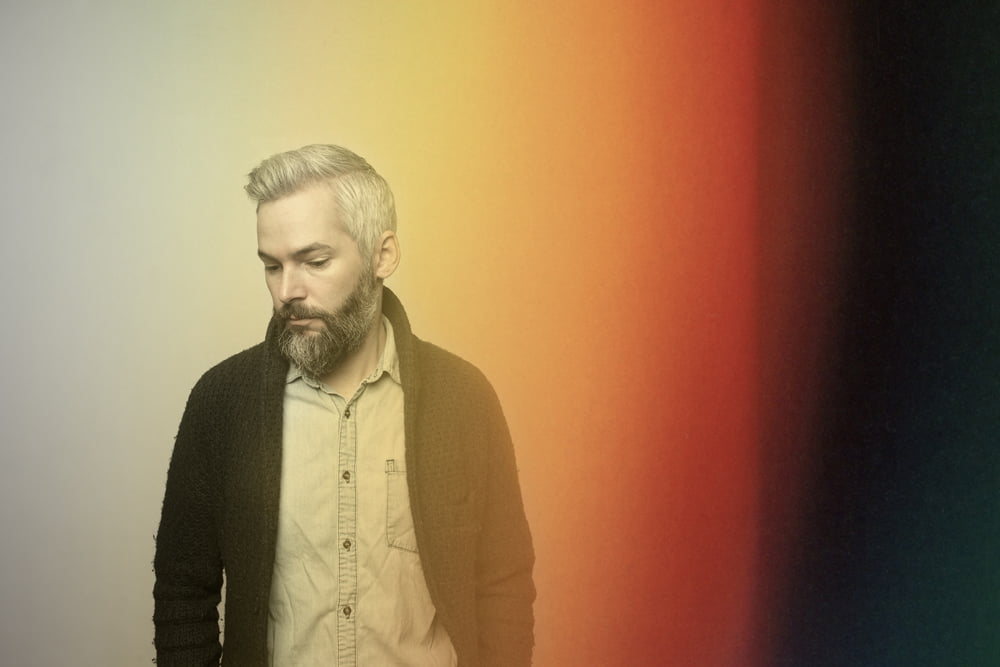
Photo credit: Sheryl Nields