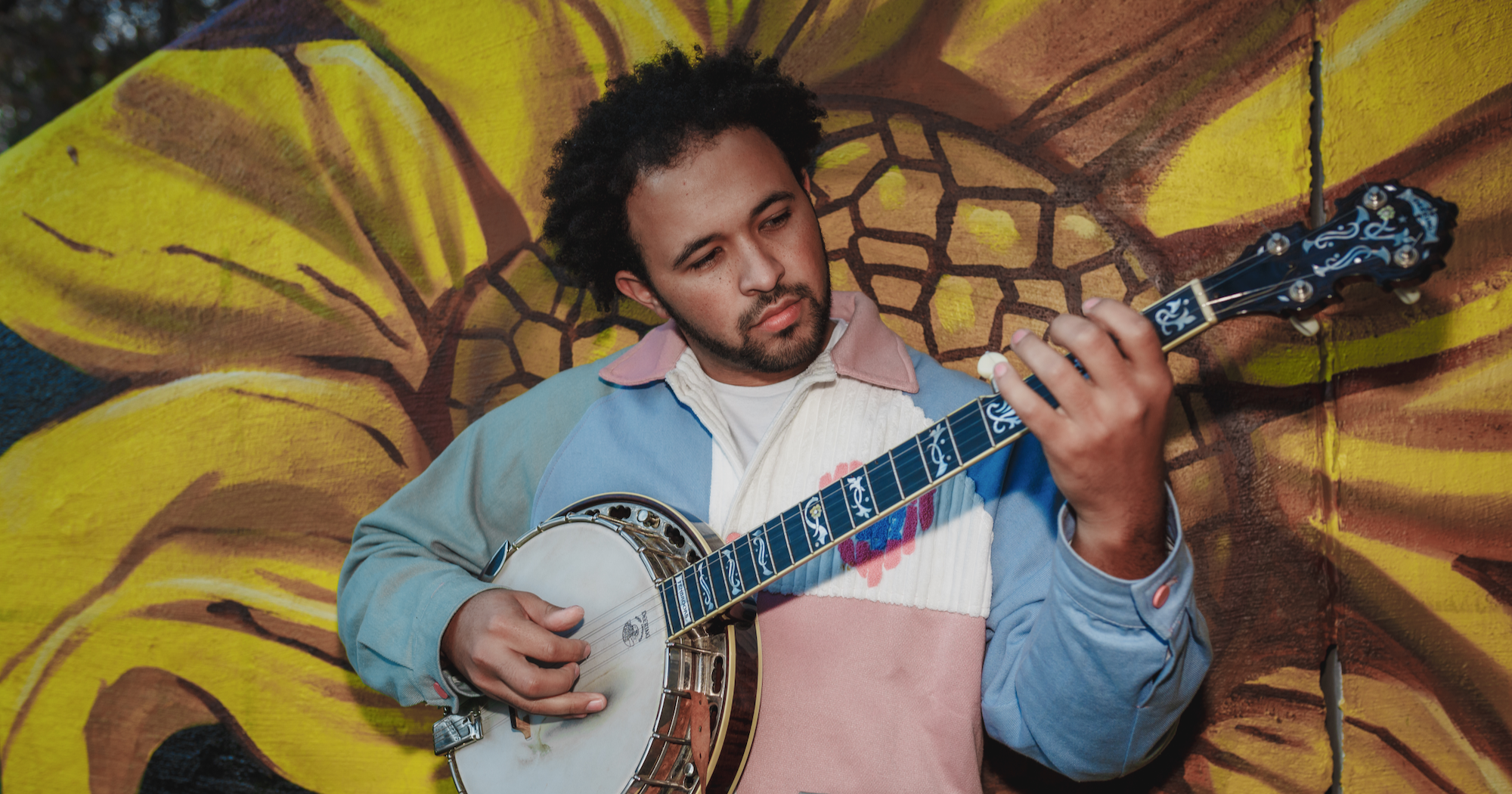
Tray Wellington: Black Banjo and Hip-hop/Folk Fusion

According to 20th century genius Louis Armstrong, “Man, all music is folk music. You ain’t never heard no horse sing a song, have you?”

Yet it is not universally accepted that hip-hop is folk music. The almost perfectly named folkhop derives from bhangra, not any rap/folk fusion – although DJs are involved. During the 1960s folk revival featured some cherished artists like Richie Havens addressed civil rights and the contemporary scene. As well as Bob Dylan presaging spoken word and folk with “Subterranean Homesick Blues,” while wise men in Black communities were signifyin’ on the streets. The 2000s saw acts Gangstagrass and Nappy Roots pioneer mixing bluegrass or other down-home sounds and themes with hip-hop.

This lineage notably continues in the current decade with Cleo Reed, whose music has been referred to as folk rap, and Greensboro, North Carolina artist/activist Justin “Demeanor” Harrington who combines 1990s hip-hop production and banjo samples, proclaiming, “I learned that it’s not that folk is separate from rap; folk music just means the music of the people. Rap is one of the illest folk music that’s ever existed.”

On his new album Heart On The Table, Tray Wellington – also from North Carolina – honors kinship to Harrington in pursuing hip-hop/folk fusion by featuring him on the fourth track “DEMEANOR // I’M WITH IT.” Wellington’s 2022 debut album Black Banjo infused traditional bluegrass with jazz styles while amplifying the Black Southeastern sources of roots music. He had already been lauded with the International Bluegrass Music Association Momentum Award in 2019 for Instrumentalist of the Year, before going on to earn the Steve Martin Banjo Prize in 2024 for innovation in bluegrass and on the five-string. In recent years, Wellington has also served in Black banjo supergroup and string band New Dangerfield (now on indefinite hiatus) alongside prominent roots artists Kaia Kater, Jake Blount, and Nelson Williams, taking the roots festival orbit by storm.

Wellington is a standout in the Black banjo movement of the past 20 years that seeks to reclaim the African-derived instrument and the lost world of Black American roots music created in the South at the crossroads of Scottish, Irish, and Indigenous styles. He has long been taking runs at bluegrass boundaries, covering songs like his reworking of Kid Cudi’s “Pursuit of Happiness.” New songs “INTERLUDE,” which features Sierra Hull, and title track “<3 On The Table,” featuring A.G. Sully, are the greatest on the new album.

BGS spoke to Wellington about his challenging journey.

What is it about North Carolina? Why do so many legendary musicians – from George Clinton and Chuck Brown to Elizabeth Cotten and Roberta Flack – hail from there?

Tray Wellington: You know, I think North Carolina, as a state, it’s just really cool, because it has so many different cultural identities. I think there’s so many different regions of the state that have their own unique musical identity, as well as personal identity and cultural identity. I think, because of that, where you have such a wide array of people in this one state, it just creates a bunch of natural vibrancy, you know, for the arts. And I think a lot of people just grasp onto that, and it just produces a lot of really amazing artists, because like, John Coltrane’s from there.

I used to live in Charlotte; moved there right after the original Black Banjo Gathering in Boone and met and got to know the embryonic Carolina Chocolate Drops and the legendary Joe Thompson. Where are you from in NC?

I’m originally from Ashe County, North Carolina, which is really close to Boone – 15 minutes away.

How did your journey with the banjo begin?

I was originally playing electric guitar for about a year, and when I was going through my grandpa’s CD collection one day I found a CD of Doc Watson. I remember when I found this CD, I remember listening to it. Doc Watson is a musician from Deep Gap, North Carolina. I was listening to this CD and I just got super invested in the sound of it, and just the overall vibe of the music. There was at the time a club at my middle school called the Mountain Music Club. I joined the Mountain Music Club to learn guitar, so I started doing some flatpicking there and in that class was when I heard banjo in person for the first time. It drew me in and I was like, “Whoa! What is this?” I just kind of became enamored with it.

I always loved banjo because I grew up watching Hee Haw. I’m likely much older than you.

What was it like winning the Steve Martin Banjo Prize?

That was super cool, I was super honored. I remember when I was like 14, 15 years old, when I was looking at my life goals, you know, one of the things I remember hearing about is the Steve Martin Prize. So, it happening was like a childhood dream come true, and I just think it was one of those moments that it’s so cool to be recognized by all these heroes of mine for my work. At first, I did the classic Southern thing like, “I don’t deserve it.” But I think I bring a unique perspective to the instrument and I was honored to have been recognized in that way.

To talk about the new album, Heart On The Table, what made you pursue bridging the gap between hip-hop and bluegrass?

Yeah, I think for me my biggest thing was when I was talking about storytelling. I looked at what my favorite storytelling was, it was hip-hop music. When I was first kind of conceptualizing this album, I didn’t even know what it was gonna be at first. I made all these tracks at home, because I’ve been doing hip-hop production for a few years now, too, and then also playing banjo. I remember I was making all these tracks with hip-hop stuff and I wasn’t putting banjo on it. I was hanging out with one of my friends and he was like, “Why don’t you add banjo to that?” And I was like, “What do you mean?” I had never thought of that. I never thought about mixing it. And then when I started doing it, I slowly started coming up with this collection of songs. “False Idols” was the first song on the album and I remember that was one of the early songs I did in that style. I found a way to make the banjo fit perfectly in there.

You’ve obviously been working with Kaia Kater, but how did you select the other artists feature on the new album?

Yeah, there’s a couple different ways. Some of them were old friends of mine, like Elora Dash, who was on “False Idols,” for instance. She was my vocal teacher in Raleigh when I was there and I’ve known her for a long time. I really, really respect her music. And then Demeanor, who’s on track [4]. I’ve worked with him before, we’ve done tracks. We have a release event together, we’ve done a few tracks together at his studio in Greensboro, and I was like, “He has to be on it.” And Lizzie No was a first-time collaborator for me.

The most riveting song of the collection is the title track featuring A.G. Sully. With its jazzy blend it reminds me of my brotha Gil Scott-Heron. What is the source of the song?

That was another song that I had made before we even recorded the album. And we didn’t know it was going to be the title track, actually. Then, when we were thinking about the new band, we were like, “How do we put this together?” I actually rewrote my verses for it after we re-recorded it, because I was like, “I need something that fits this vibe better.”

I remember the first thing I heard:

Is your heart on the table?
Did it fall?
How could I let you know?
Who could have seen the call?
Nothing to do at all.

It just kind of came to me naturally, and I remember I wrote it all down. When A.G. got it, I sent her all the lyrics and I was like, “I think this is kind of the vibe.” And she knocked it out of the park on the hook.

Since the Library of Congress Black Banjo Renaissance event featuring Demeanor is happening in July in D.C., do you see your work and his as parallel?

Yeah, I mean, for me, I have a lot of respect for what the brother does and I think we have two different approaches to [fusing folk and rap]. It was one of those things where definitely he’s an inspiration to me and we’ve been friends for a while now. I wouldn’t say we, either one of us, necessarily did it first or maybe around the same time, [we] just kind of naturally did it. I know he really likes my stuff, too, so it’s cool.

I am in the Black Banjo Reclamation Project NYC chapter. What would you like those folks coming up to know?

I would just say, don’t limit yourself. I think it’s the main thing I always tell people, because I think sometimes we can get caught up in people trying to sway our narrative. And as a community, the most important thing we can do is cultivate individuality. Ultimately, that should be the main message on the flight.

How do you challenge the consistent limitations for Black roots artists? Since we’re coming out of Black Music Month [June] and I noted that the War & Treaty were on the BET Awards as this lone roots outlier…

You look at the country music artists, for instance. You look at Morgan Wallen. He says the N-word, gets canceled, and then ends up becoming one of the best-selling artists of all time, because he said the N-word. And because all of his fans rallied around him and were defending him. Then he immediately took it back and said, “Well actually, I can be this controversial, because my fans will still buy my music.” White artists are gonna get away with a lot more.

I feel like the judgment is so much higher, you know? I feel like if you’re a Black artist and you release one bad song, people are gonna be [upset]. But a white artist could release a whole album of bad songs and people would still listen and not be as critical. I think sometimes, too, there can be an expectation of Black artists to always have to discuss certain issues. When ultimately you can talk about anything, and you should be allowed to talk about anything, and if you’re not touching on this one thing right now, it doesn’t mean you don’t like it. You know what I’m trying to say? Does that make sense?

A big thing I try to challenge is we shouldn’t have to always talk about racial issues in the world on every single song to be able to get traction, but sometimes that’s how it feels like it is.

What do you think accounts for the attraction of new Black players to roots music now?

I think one of the cool things we’ve seen in the last couple years is there’s been a big resurgence of it, and I think the Beyoncé album, surprisingly, was a big thing. There’s a whole lot of debate around that, because ultimately people can argue if it was country or not – that’s not my place to say. I remember there was a really good article that said don’t forget all the other people who have been putting in work for 20-plus years to try to get people [interested in Black roots music].

And all these artists who have been doing the work for the past 20 years should get that same recognition, Black people in roots music. That one of the biggest artists in the world that can highlight this thing that for so long made a lot of people feel like, “I don’t belong in this.” If they can help people jump over that barrier and see that all people do belong in this; it’s done a lot for the movement, that I’ve seen.


Photo courtesy of the artist.

This content brought to you in partnership with Preston Thompson Guitars.
This Fort Worth Music Festival Has a Niche Mission but Expansive Sounds

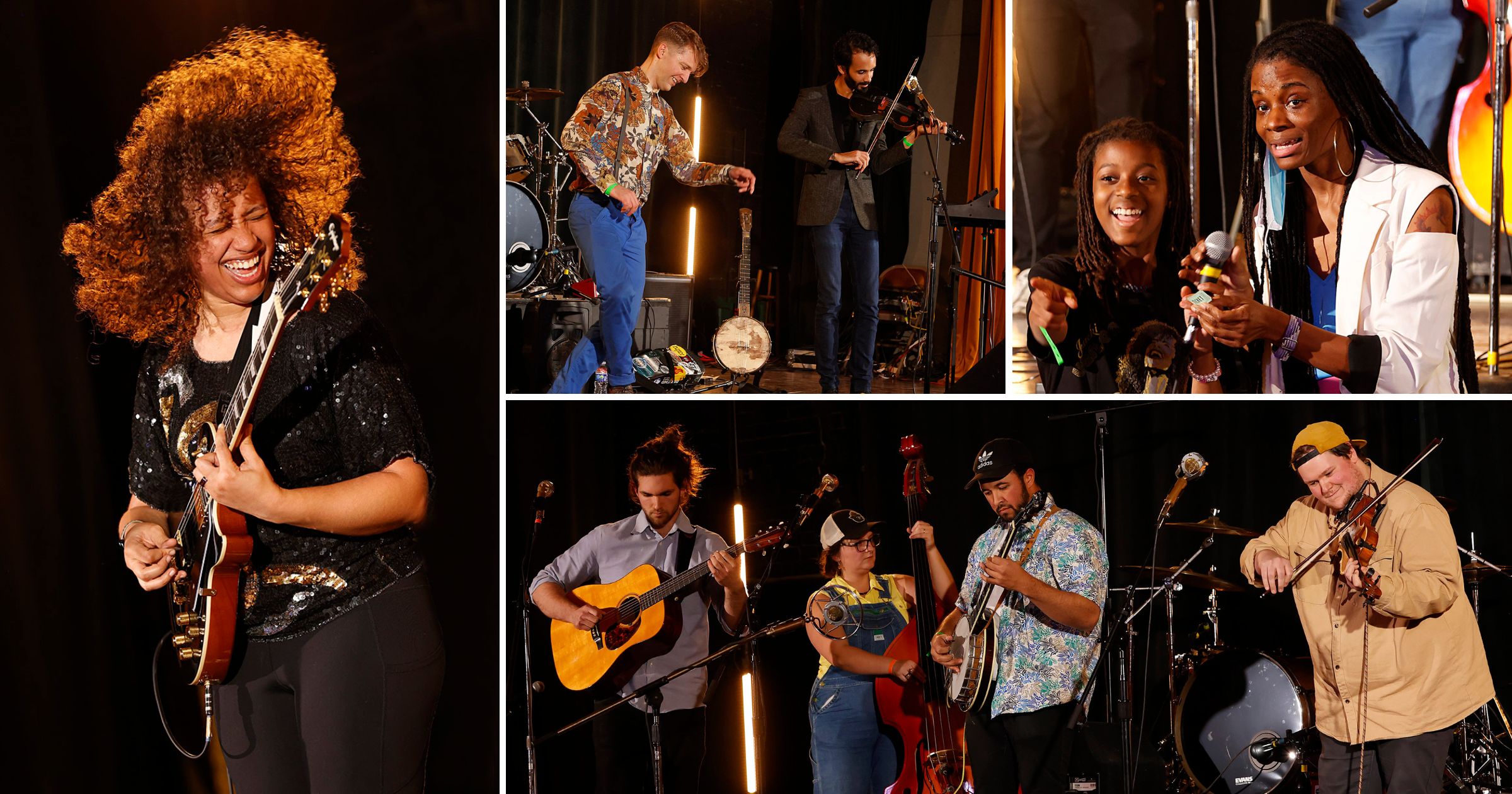
A small, enthusiastic audience of first arrivals chat in excited, hushed tones as they listen to Hubby Jenkins soundcheck into a pair of Ear Trumpet Labs microphones in the ballroom at Fort Worth, Texas’s Southside Preservation Hall. It’s an unseasonably cool Saturday afternoon in March, with crystal blue skies and wispy clouds backgrounding the historic Fairmount-Southside district. Over the next nine hours, ten musical acts will grace the stage. Many of them are already in the room, contributing to the light buzz and chatter; this already feels like a generative space. 

In its third year, the Fort Worth African American Roots Music Festival (known lovingly as FWAAMFest) has a very specific vision within the Americana/folk/old-time/bluegrass festival space: to highlight the depth and breadth of contemporary African American roots music and, by doing so, underscore the seminal, vital contributions of Black folks to every single roots genre in this country. Presented by Fort Worth-based non-profit Decolonizing the Music Room (who BGS has collaborated with on multiple occasions), the event carries forward the organization’s mission, explained artfully and succinctly by DTMR founder Brandi Waller-Pace as she kicks off the day introducing Hubby Jenkins: “To center Black, brown, Indigenous, and Asian voices in music and related fields.” 

“There are so many eyes and ears on culture and the arts in Fort Worth,” she continues. “And I want Fort Worth to be at the forefront of the conversation…” 

Hubby Jenkins began the day’s many conversations with a couple of banjo tunes, because, he admitted, “I’m a little nervous and [banjo tunes] make me feel cozy.” It was indeed a lovely, cozy easing into the day’s marathon lineup of music and presentations. During his set Jenkins picked guitar, banjo, bottleneck slide guitar, and played bones. And, he plays the festival’s first of many gospel numbers, “Jonah in the Wilderness,” inviting the audience to sing along, grounding his performance in the history of the Southside Preservation Hall space and these rootsy genres’ origins. 

Kicking off the day with a gospel-filled set in a historic former church made so much sense, calling each of us as listeners to be active participants in the day’s festivities and also in its mission: to recenter these community-based musics on the folks who gave rise to each of them, reminding us we each have a role to play in telling a fuller, more just history of these musics. 

Next up on the lineup is Justin Golden, who jokes that he and Hubby run into each other on gigs constantly and have the same repertoire, but from the outset his similar-seeming act couldn’t have felt more different. Working within the same vernacular and with such broad overlap, Golden and Jenkins are each still so distinct and unique – and illustrate the wide variety intrinsic to Black and African American roots musics, even within one form. Golden’s first number is an original, “I Hate When She Calls.” 

He peppers older, classic Texas blues numbers – though he admits this is his first time in Texas – throughout heartfelt, poetic, and direct originals. His music’s foundation is fingerstyle blues, but with modern crispness, timeless touches, and a crystalline, focused singing voice. 

Festival-runner and founder Brandi Waller-Pace stepped back on stage, this time as performer, for the next set of the day with songwriter, composer, and banjoist Kaïa Kater as the debut performance of their duo, Sable Sisters. They swap out banjos and guitars and a bass, singing folks songs and originals with nearly familial harmonies. A double clawhammer banjo cover of Stevie Wonder’s “Happier Than the Morning Sun” is their set’s highlight, with the legendary Justin Robinson’s guest appearance to play a set of old-time tunes ranking an honorable mention. Other festivals would be wise to consider booking Sable Sisters; if duo supergroups were a thing, this is one. Superduo? You get my meaning. 

Between each set of music, as the stage was changed over, representatives from partner organizations, sponsors, and community leaders spoke to the audience, which slowly grew from a couple dozen into a small-but-mighty one to two hundred attendees. Tables in the lobby featured literature, information, and calls to action for DTMR, FWAAMFest, and these partner orgs – and from the back of the ballroom wafted the tantalizing aromas of Lil Boy Blue BBQ. (If only all music festival barbeque offerings were this legit.)

After Sable Sisters’ set concluded, the next event was a live podcast taping featuring a collaboration between Rissi Palmer, of Color Me Country Radio on Apple Music, and Garrett McQueen of Trilloquy Podcast. The conversation was titled “Redefining ‘Classic’” and featured Palmer, McQueen, and their FWAAMFest lineup-mates Jake Blount, Demeanor, Hubby Jenkins, and Dr. Angela Wellman. Palmer and McQueen took turns prompting their panelists to consider ideas around canon, genre lines, what terms like “classical” really mean, and so much more. 

A theme that emerged throughout the taping was how often there aren’t hard, fast, concrete answers to these big, zoomed out questions about justice, representation, art, creation, space/placemaking, and community building. The panelists and hosts encouraged and challenged each other and themselves, reminding all of us that engaging in these kinds of conversations is part of the process and having the space – like FWAAMFest – to engage, build, and hold community like this is so important. 

It’s not lost on myself or perhaps anyone else in attendance just how much gratitude each of these participants have at being enabled to be in this FWAAMFest space. Each of the performers and speakers, in their own way and in their own words, effortlessly carried the event’s mission with them as they brought themselves to the space, wholly and vulnerably and powerfully. 

The podcast recording gear struck, rapper and banjo player Demeanor took the stage for his first ever full-band set – and it was revolutionary. During the Trilloquy x Color Me Country conversation Demeanor (given name Justin Harrington) stated so eloquently that “Rap is folk music, because hip-hop is an indigenous Black American art form… From the porch to the stoop.” 

He and his band immediately and indelibly illustrated his point with an energized, powerful set based on sometimes spitfire, other times free flowing rap lyrics with poppy, sung verses and choruses. It’s lyrical, content rich, witty and sharp. Demeanor’s writing and production style are full of forward motion, punctuated by arena rock guitar and Wooten-like bass lines. While often centered on banjo, the five-string is not the only way roots music oozes from these songs. Their lyrics and hooks are sharp and the vocals are strong – his singing isn’t an afterthought or simply in service of a hook. Several songs were from an upcoming unreleased album, including one stand-out track said to feature Rhiannon Giddens (his aunt) and Charly Lowry.  

The delight of Demeanor gave way to the delight of dance and musical dialogue, as longtime friends and jaw-dropping collaborators Jake Blount and Nic Gareiss took the stage. Blount began the set solo, accompanied starkly by low, droning synth sounds gently, languidly warbling through half tones as he sang, dirge-like, above the sound bed, commanding silence. Blount brings us back to gospel, again looking backward to look forward, and in just a couple numbers the droning synth gives way to droning fiddle. 

Gareiss and his singular approach to percussive dance and traditional step-dancing injects energy and joy into the crowd, who’ve been listening and engaging for almost six hours now. Audience members are on their feet, often with phones out, disbelieving the stunning musicality of Blount and Gareiss together, sixteenth notes perfectly, bafflingly in sync.

Nic dancing to Jake’s fiddle recalls the interconnectedness of Irish step dance and Black percussive dance traditions. Where cultures, practices, and folkways overlapped at the lowest of classes in America’s urban centers, dance flourished and Irish step dance cross pollinated with Black movement traditions and Appalachian and southern steps. Over the past century and more, movement and roots music have often been compartmentalized, privatized, and sequestered from each other. Bringing them back together in this intentional way is not just a radical act given the identities represented – in this duo and in this day of programming – but simply by existing together, with intention, Blount’s and Gareiss’s talents underline what these musics were initially created to do, say, and be. 

The vibe in the Southside Preservation Hall ballroom at this point was reaching “full blown party,” and when the first of the festival’s headliners, Tray Wellington Band, took the stage the energetic momentum was raised further still. For all intents and purposes a straight-ahead bluegrass band, Tray Wellington’s four-piece group demonstrated this IBMA Award winner has found his voice. His critically-acclaimed album Black Banjo certainly feels mature and fully-realized, but this was the first this writer had caught Wellington’s band since long before that record was released. The growth they’ve sustained, musically and as a unit, in the interim is remarkable. They execute chamber music level virtuosity, but with bluegrass bones. With Katelynn Bohn (bass), Josiah Nelson (mandolin), and Nick Fallon Weitzenfeld (guitar), Tray references Dawg, Béla, New Grass Revival and many more, but with an underpinning that feels as bluegrass as Appalachia – say Johnson City, TN, where he’s from.

They play a Kid Cudi cover, which is promised to be on an upcoming release, and the audience descends into mayhem as the melodic hook is slowly recognized in ripples throughout the crowd. Whether covering hip-hop or playing an old-time tune, these pickers demonstrate amazing soloing: modern, in-the-moment musical ideas without ego or self-absorption. And with Tray’s right hand anchoring all of the above, it reminds of Earl Scruggs in his Revue days – solidly bluegrass, but intimating musical ideas that come from so far afield, way beyond what we consider bluegrass territory.

Chambergrass, or whatever you want to call it, is seen as more “high-brow” or “intellectual” given its adjacency to conservatories and storied music schools, but this style of virtuosic playing is so well placed within the musical vocabularies of people from the region that birthed string band traditions. And in this context it can be executed with equal ease, aplomb, and athleticism, and with a much more grounded approach. 

A quiet, slightly exhausted euphoria tingles through the stalwarts of the crowd who remain for Jackie Venson’s no-holds-barred FWAAMFest finale. Waller-Pace returns to the stage one final time to introduce the night’s last headliner, with her daughter Sparrow (who waits patiently to get her Jackie t-shirt signed at the end of the night.) 

Venson is accompanied only by drummer Rodney Hydner – and her signature DJ sampler that allows her to play along with tracks, sound beds, background vocals, and play solos over loops. Even with just a two-person act, her trademark joy immediately washes over the entire room and re-energizes the crowd. Venson’s songs are soaring, anthemic, and huge, matched only by her broad grin as she smirks and laughs at herself and her own playing like it’s an inside joke. 

Perhaps the best guitarist of her generation, certainly the best rock-blues guitarist of the past thirty years, the internet is in a four to six week feedback loop of discovering and rediscovering Venson’s playing at the moment, with her Tweets and TikToks seemingly going wildly viral about once a month. She’s been retweeted and signal boosted by a who’s who of Twitter personalities and musicians, and it’s all because hers is a singular voice, perspective, and skill. 

Watching her improvise over each song recalls Nic Gareiss’s dancing from earlier in the evening. When you’re watching something so visceral and in the moment, you can’t help but inhabit that moment with them. And many of us do inhabit these moments with Venson by moving, standing, dancing, reveling in the ever-present joy of her music. 

Venson’s brand of modern blues is unconcerned with divorcing itself from the blues of the past (and of the present) that some feel is stoic, stuffy or dusty, and out of step with modernity. Her brand of blues, no matter how distant it has traveled from its roots, still honors the sounds of old-time and ragtime and down home blues, because it knows where it came from and to what it’s connected. Venson’s connections to Texas and Austin further reinforce this point – and help place Venson and her style of playing squarely within “guitar culture,” too.

At one point during her performance Venson marveled at how the FWAAMFest gathering was, in her words, “Pretty legendary!! You’re going to be talking about this in 10 years, telling people you saw everybody on this lineup here today.”

It was a feeling that began creeping up much earlier in the festival, that what we were present for wasn’t just a community music festival, it was so much more.

Black, Brown, Indigenous, Asian, and Disabled folks – artists and creators and movers and musicians – continue to offer and model ways to hold the past within ourselves while looking ahead to the future, a duality that modernity and westernism struggles to acknowledge or inhabit. What’s striking about this conglomeration of creators and musicmakers on this lineup at this festival is that they make it look easy. It seems effortless to understand, uplift, and uphold a mission like FWAAMFest’s. Partly because the participants all are stakeholders in that mission to begin with! With their music, their insights, and their storytelling these musicians and thinkers demonstrate the past is the future and the future is the past. Roots music – the kinds that center the experiences, stories, and seminal contributions of Black, Brown, and Indigenous folks – can spotlight and move through this dichotomy better than so many art forms, while remaining grounded firmly in the present. 

FWAAMFest’s success wasn’t simply because it’s a festival with a novel, substantive mission. It was a soaring, generative, forward-looking success because it focuses on what “the mainstream” perceives as a niche within a niche within a niche – African American roots music – and shows all of the possibilities, all of the many universes of artistic expression endemic to such a niche. The specificity here is not prohibitive or exclusive, it’s unfailingly, infinitely expansive. In sound, genre, content, tradition, and beyond.

As Jackie Venson said, we all will still be talking about 2023’s Fort Worth African American Roots Music Festival for many years into the future. 


Editor’s note: Follow Decolonizing the Music Room on social media to catch footage from FWAAMFest 2023 as it’s released and make sure to DONATE to support their mission and future FWAAMFests!

Photos by Ben Noey Jr.