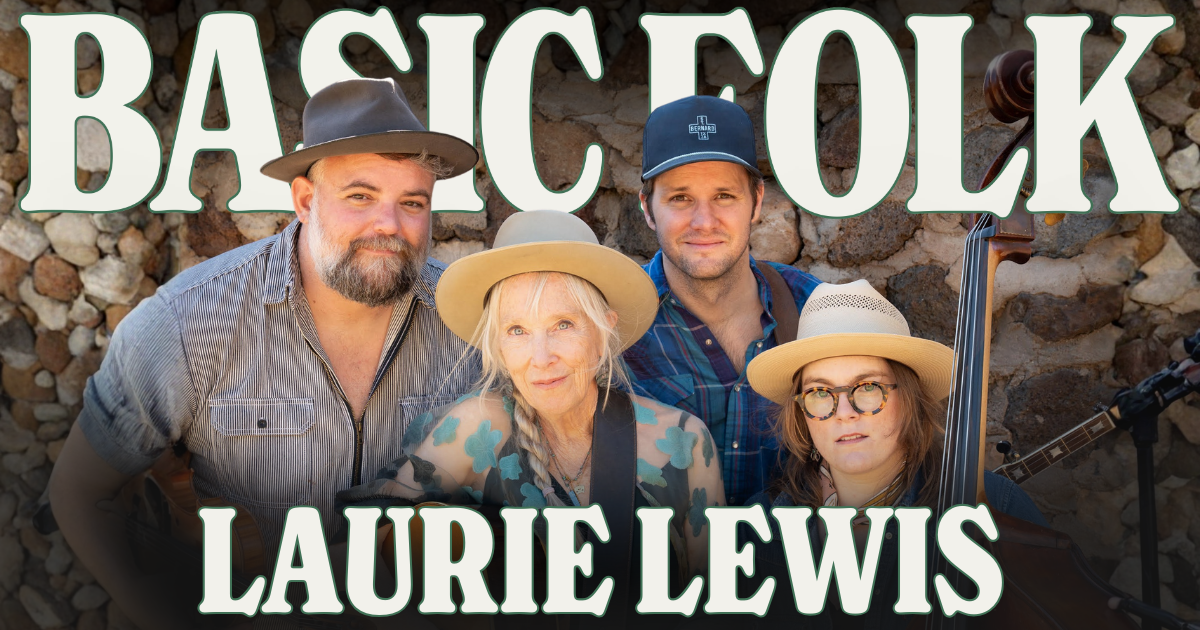
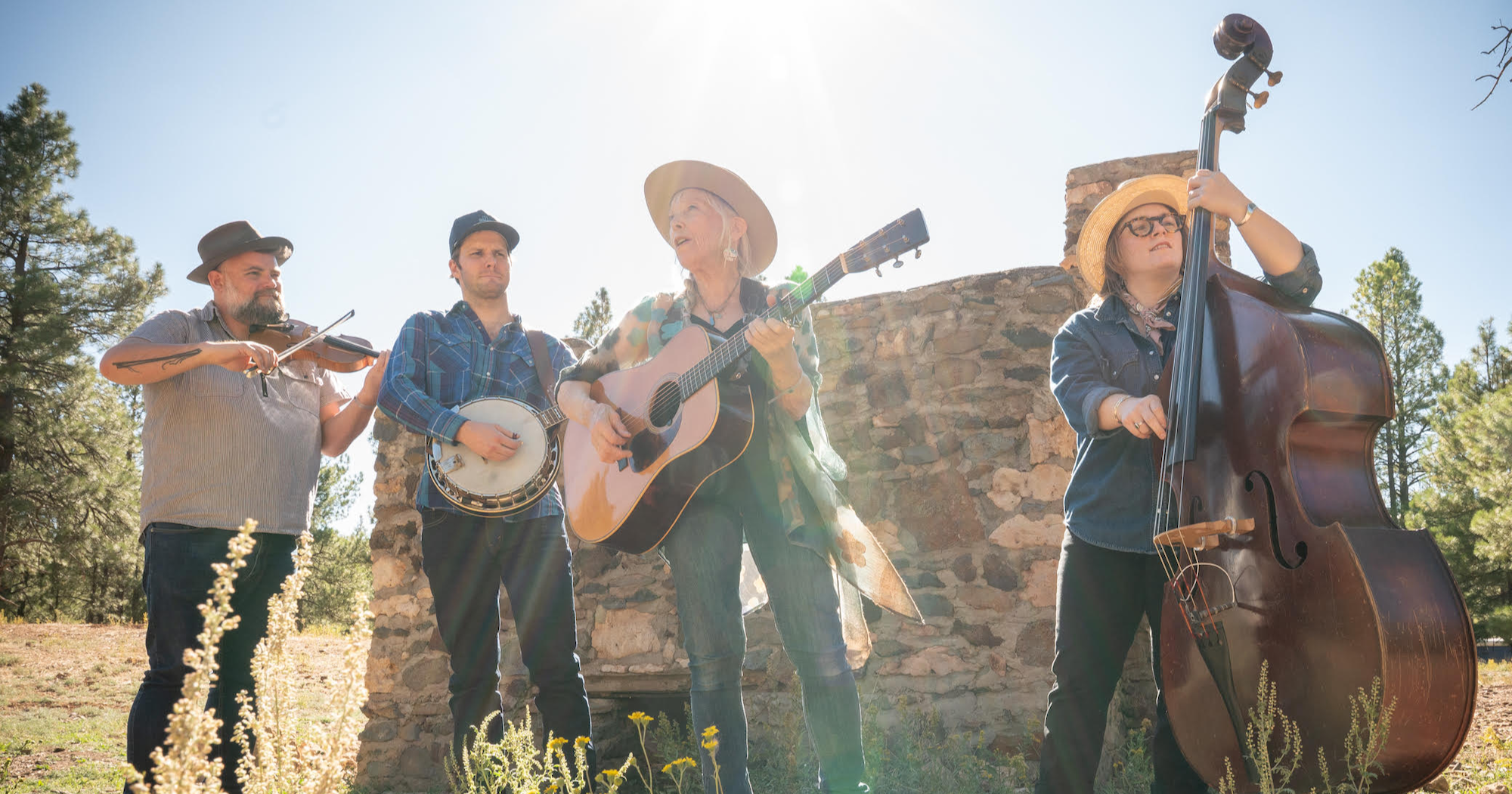
A foundational participant in the ’70s Bay Area bluegrass scene, Laurie Lewis knows the power of collaboration. She’s been a part of an ensemble in recent years that’s called Laurie Lewis & the Right Hands, with Laurie on fiddle, guitar, and vocals, Brandon Godman on fiddle, George Guthrie on banjo, and Hasee Ciaccio on bass. That group plays a huge part in her new album, O California!, a collection of songs that explore our own places in the natural world and in each other’s hearts. It also serves as a love letter to her home state. One standout track, the traditional “Fair and Tender Ladies,” is a duet with Ciaccio, which brings the song’s cautionary tale to life. In our Basic Folk conversation, Laurie talks about what it’s been like to learn traditional songs before actually catching their meaning, long after figuring out the tune.
Lewis emphasizes the communal and collaborative nature that defines her musicianship. She recounts her early exposure to music played socially when her father and his friends gathered at their home to play classical music when she was young. She credits that experience with solidifying her decision to learn to play, so she could have as much fun as they did. Laurie also opens up about her path to finding independence from her father’s expectations and her eventual return to music through modern dance and folk tradition. She touches on her passion for nature, recounting transformative hiking experiences, and reveals her thoughts on collaboration and mentorship within the music community.
Additionally, Lewis reflects on the profound impact of losing her voice in 2021 and the emotional journey of rediscovering her musical identity. We wrap up our conversation talking about her friend Alice Gerrard, whom she covers on the new album. After we hung up, Laurie emailed me an addendum about Alice that I wanted to share: “I forgot to say, when you asked me about Alice Gerrard, that I also greatly admire her community involvement in the music she loves, as evidenced by her starting and running the Old Time Herald for so many years. She’s a remarkable person. Plus, she trained her dog to fetch a beer out of the fridge for her and then put the empty can in the recycling!” Incredible.
It’s noon in the Bay Area, and singer-songwriter/multi-instrumentalist/producer Laurie Lewis is sitting in her backyard on what she describes as “a beautiful sunny day.” She spent her morning pulling up oxalis, and now she’s painting a railing she purchased at Urban Ore.
“It’s a good handrail for our front steps and along the walkway for my partner, Tom,” she says, “so I’ve been sanding it, wiping it down, and painting it.” Later during this interview, she’ll continue pulling up weeds, noting, “It’s very liberating for me, getting my hands in the dirt. It feels really good.”
The reason for today’s call is Lewis’s new album, O California! Like its predecessors, it’s an emotional palette of songs – five originals, five traditionals, and a cover of close friend Alice Gerrard’s “Sweet South Anna River” – that blend the many genres influencing her work, from bluegrass to country, jazz, and even a hint of rock. O California! features the stellar musicianship and vocals that define Laurie Lewis and her band, The Right Hands: Brandon Godman (fiddle), Hasee Ciaccio (bass), and George Guthrie (banjo, guitar).
A two-time IBMA Female Vocalist of the Year and a two-time GRAMMY nominee, Lewis is no stranger to BGS readers, as she’s been featured many times. Dedicated fans are also deeply familiar with her longtime partner, mandolinist Tom Rozum, and his Parkinson’s disease diagnosis. “He’s doing pretty well,” Lewis says. “He had spine surgery in November and he’s recovering very well from that. He had been living with intense sciatica pain for a year and a half, and the pain is gone, so that’s great.”
What would you like readers to know about O California!?
Laurie Lewis: Let’s see… all kinds of things. I wrote five of the songs on the album and they’re all over the map, so they’ll say, “She’s got a lot of different musical influences.” We’ve also drawn from the folk tradition and some great traditional songs and thrown that in the mix. It’s all done with the same four people and same four voices on beautiful acoustic instruments. Sonically, it’s really nice. You really hear the personalities of these particular four people working together. It’s what made me want to make the album.
This is album number 25 in your catalog. Artists often speak of albums as chapters in their lives. Which chapter is O California!?
This chapter is this band at this moment in time, these particular four people. I wanted to celebrate our working relationships together. It’s something that wouldn’t have happened at another time in my career, because I wasn’t working with these particular people for as long as I have been on this album. They are all on the previous album, but that was me calling all the shots. This is me settling in, listening to everybody, and trying to make a whole out of the four parts.
How did this approach make the creative process different?
Usually I come into a recording situation with more of an idea of what I want a song to sound like. This one, I came in with snippets and vague ideas for [the band] to have their way with it. We collaborated on arrangements and we listened to every idea. It’s not that I don’t listen to other people’s ideas at other times, but generally there might be more input than just three other people if I’m doing that.
I’m a collaborative artist. One of the reasons I play music is because it’s my best way of communicating in the world. And that is, for me, to an audience. But it’s also true for me to my bandmates and other musicians. It was fun to say, “We’re making a band album. This is what it’s going to be. We’re going to let people toss out songs.” “How does this sound?” “Oh yeah, great. Let’s do that.” It was, “How shall we do it?” “I’ve got an idea.” “How about if we do this?” It’s a very free and open feeling.
[The band are] all very open-eared and open-minded about the music. It doesn’t have to be the way Earl Scruggs did it, or the way Bill Monroe did it, or anything. It doesn’t have to fit into a neat bluegrass category. I’ve played with musicians in the past who have been more or less open, and all it takes is one more closed-off person to direct the band in a particular direction.
You’ve stated in the past, paraphrasing here, that writing is sometimes specific and sometimes spontaneous, sometimes it’s almost random, sometimes it’s unfinished. What was it this time, or was it some of each?
I’d say it was some of each. With the song “O California,” I was writing lyrics in the studio. I did a scratch vocal and changed the lyrics three times before I came home and overdubbed an actual vocal. That’s unusual for me, that it was in such an unformed state when I got into the studio, but it’s when we had the time and I knew the bones of it were good. Some vocal lines, some lyrics, just were not right yet, but I knew what it was about.
When did the songs start coming together as an obvious collection? Was there an intention in mind, a theme, when you all got together?
We started this project in a different way than I have other projects. We had little tours booked, so we would get together a day early before every tour, because we all live in different parts of the country. They would fly out here, we’d rehearse a song, get what we wanted down, figure it out, and then go on our tour and play it every night. We’d have a studio day booked on the day we got back from the tour, so we’d go in and record whatever we had worked out the week before and played on the tour. It was a fun way to approach a project and it spaced it out over a long period of time. It took close to a year.
When it’s spaced apart that way, how do you make it feel like a collection, rather than recording individual pieces of music?
Because it’s all us. It’s like an old friend – you can pick up the conversation right where it was. You haven’t changed your tone or your relationship with each other so drastically that it doesn’t fit together. It would be different if I were doing something like that over a year and just getting together with whoever I thought was the right person to play on a particular song. Then, the only thing that would hold it together would be my production values.
Do you still write ideas on notes, or have you tech-ed your way up to phone apps?
Oh, no. I write. I like to write with a good pen or a pencil on a piece of paper. I will make notes sometimes on voice memos, but mostly that’s it. I’m old-fashioned. I feel like there’s something that happens, the tactile feel of a writing utensil on the paper, that is easier for me to get a thought out than to sit at a keyboard. I’ve been known to still write letters, in fact.
We live in a world of texts, emojis, phone scrolling, and what’s being called “an epidemic of isolation.” Bluegrass is associated with festivals, musicians getting together and jamming, and community. Is this still true?
Oh, definitely. In fact, here in the Bay Area it’s having a real resurgence of community jamming culture. That’s always been at the basis of bluegrass. It’s what everybody wants to do – get together and let their instruments do the talking, let the songs do the talking. It’s a wonderful thing. I love it so much.
You mentor and teach at workshops and music camps, where you connect with younger and up-and-coming musicians. What do they want to know? What do they need to know?
One of the things that I try and impart to people is the importance of finding your own voice, because many young musicians have heroes they want to emulate. That’s how you learn, but at some point you have to find what you want to say with your voice and your instrument. That’s one of the things I try to emphasize and help people feel confident that they have something to say and their own way of saying it.
There is intergenerational connection at these camps and workshops, contrary to the ageism on both sides, that society seems to push: “What do those kids know?” or “What do those old people know?” What is your perspective?
There’s still a lot of that, but luckily there are enough people, young and old, paying attention and willing to listen to each other. It’s especially helpful when there are youth music camps and stuff like that, because then the kids have each other, but they also have their mentors there. They’re there because they want to learn, and it’s usually the older people who are teaching them, but then they get to be with their cohorts, their age group, and that helps a lot.
I certainly learned a lot from teaching at kids’ camps. When I first was asked to teach at a youth-oriented fiddle camp, I thought, “I can’t do that. I don’t know how to talk to kids. I don’t know anything about that stuff.” I said yes because I tend to say yes to things, and I found it to be so enlightening and so important in my life. It’s very enriching.
On a 2021 FolkWorks podcast, you talked about The Good Ol’ Persons playing a trade show luncheon years ago in front of a room full of drunk men. You described it as being “thrown to the wolves.” Many years later, how are we doing?
In terms of women musicians out in the world, there are so many more, and it is so great to see. And the technical abilities – you can’t fault it. You can put Molly Tuttle up against any guy. It’s been some huge steps forward in the time I have been in the music business, but it’s still very male-dominated from the top. It takes generations to change things like this, these ways of thinking, and now there’s a real cultural backlash happening and I don’t know how that’s going to play out. Women have made huge strides and maybe that’s just going to be taken away. Every generation has to fight the same fights, apparently.
Overall, how is bluegrass doing, to your eyes and ears?
That’s a really hard question for me to answer. Honestly, there’s a part of it that has gotten very entrenched in staying within a particular genre. I hear a lot of songs by people singing in a bluegrass style about bluegrass music, or their cabin home and I think it’s in danger of becoming a trope instead of a living, breathing art form.
Luckily, there are enough people out there creating in the art form and doing great stuff. There’s so much of everything happening all the time now that it’s going in all different directions at once. There’s good stuff and bad stuff, and it all depends on your point of view.
Who is making an important contribution, in your opinion?
I hear a few things now and again that I respond to and like a lot. I’m not very impressed with a lot of technical brilliance. I want to be made to laugh and cry, and if it doesn’t do one or the other or both, I’m not all that interested in it.
In terms of bands, Mighty Poplar can do it, and the duo Paper Wings, two young women, Emily Mann and Wila Frank, who I actually met at a fiddle camp when they were teenagers. They’re pretty wonderful. And I always like hearing what my old friends are coming up with in terms of songs and writing. I love hearing whatever 92-year-old Alice Gerrard is coming up with. She has a way of putting her finger on the pulse of what’s happening in the world and is pretty great.
In 1998, you recorded a song called “The Refugee.” Twenty-eight years later, here we are …
Oh, I know. I find it unfortunate that [that] song is still so incredibly relevant – or more relevant. I find it very unfortunate that song has not outlived its message. It’s terrible. I wrote it when Guatemala was in such bad shape, people were fleeing, and there was all this backlash. It’s an empathetic song. These days, empathy – there’s a whole movement, “empathy’s a bad thing.” It’s so crazy.
In a 2020 interview with BGS you said, “Music has a real way of being able to soothe and heal grief.” Could you talk about that healing power, not only as a songwriter, but also as a lover of music, a listener?
Oh, yeah, it’s true. I stand by that. There’s nothing like it. It’s such a direct conduit to the heart. A song can sneak in and express something for you that you had no words for. It can help you, as a songwriter, to figure out a way to express what you might be going through in a way that makes it universal. You put it out there in the world, everybody can feel it and relate to it, and it makes you feel a part of something greater than just your little dark cell that you might be stuck in, or your own personal grief.
It has helped me deal with things, with grief in my life, to be able to learn a song that makes me cry. Every time I hear it, I learn it, and it becomes part of me. It becomes part of my way of being able to express myself, or to write a song that every time I start trying to sing it, I’m in tears or something. You learn to work through your grief by embracing it musically. It’s an incremental way of dealing with things, and it’s really healing.
It’s a sense of support through the company of songs that speak to us.
Yeah. You are not alone. Especially with all the internet stuff, people spend a lot more time not with actual other humans, having conversations or whatever. To hear something, to listen and understand that other people are going through the same alienation or grief or loss, or whatever it is that you are experiencing, makes it easier to bear.
The French author Jean Giono, who wrote The Man Who Planted Trees – I wish I could find this quote – said in an essay that an artist’s duty is to express yourself for all the people who don’t have the words or the art to express themselves. It’s your duty in society, your job, to put it out there for everybody who can’t.
Photo Credit: Dawn Kish
This website uses cookies to improve your experience. We'll assume you're ok with this, but you can opt-out if you wish.AcceptRejectRead More
Privacy & Cookies Policy
Privacy Overview
This website uses cookies to improve your experience while you navigate through the website. Out of these, the cookies that are categorized as necessary are stored on your browser as they are essential for the working of basic functionalities of the website. We also use third-party cookies that help us analyze and understand how you use this website. These cookies will be stored in your browser only with your consent. You also have the option to opt-out of these cookies. But opting out of some of these cookies may affect your browsing experience.
Necessary cookies are absolutely essential for the website to function properly. This category only includes cookies that ensures basic functionalities and security features of the website. These cookies do not store any personal information.
Any cookies that may not be particularly necessary for the website to function and is used specifically to collect user personal data via analytics, ads, other embedded contents are termed as non-necessary cookies. It is mandatory to procure user consent prior to running these cookies on your website.