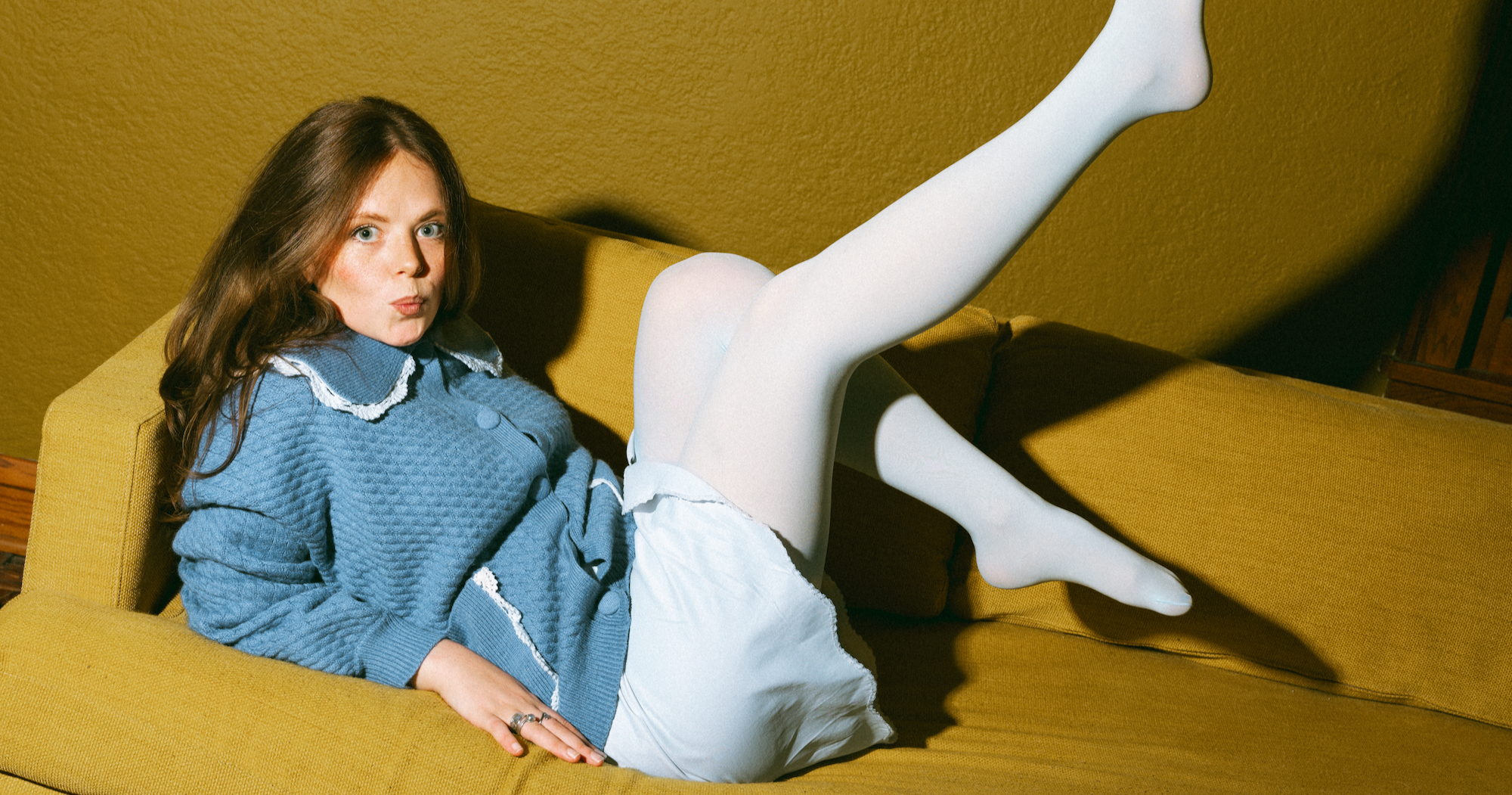
Ber Is No Longer Hiding Her Folk Elements

When you think of common musical touchpoints for young roots artists, the Shrek movies’ soundtracks likely don’t come to mind. But those compilations, beginning with the first film in 2001 and continuing through a handful of sequels in the aughts and ‘10s, feature an impressive if surprising roster of artists, including Rufus Wainwright, Tom Waits, Frou Frou, and David Bowie.

Quickly rising singer-songwriter Ber laughs as she reveals her penchant for those soundtracks, but her affection is sincere. On the Minnesota-born artist’s first full-length album – the newly released Good, Like It Should Be – she turns that winking sincerity inward, writing a dozen songs about opening up to love despite the real risk of heartbreak.

Ber wrote and recorded the bulk of the LP with close friends and collaborators Rob Milton, Austin Ward Sherman, and Bradley Hale, who joined her on a writing trip to Pepin, Wisconsin, and helped deepen both the record’s narrative vulnerability as well as its sonic range. The resulting songs are self-assured and lived-in, with an emphasis on melody and emotional tension that lets her agile, nuanced vocal shine.

Below, BGS catches up with Ber the day before Good, Like It Should Be releases, chatting about songwriting, a-ha moments and, yes, everyone’s favorite big green ogre.

Tomorrow – or in just a few hours, really – you’ll release your new album, Good, Like It Should Be. What are you feeling in this last stretch as you get ready for folks to listen to the project in its entirety?

Ber: It’s a little crazy. I think it’s actually out in Australia already. Maybe this slow burn of me realizing, all day, that it’s just gradually coming out will make it a little less overwhelming. But I would say overwhelming is the default nature of the last month. Coming up to this April 3 date has been challenging but also really exciting, and something I’ve tried to accept and just be really happy about, because it’s really crazy to be putting a whole album out. It feels really, really wild. I’ve never done that before. It’s new territory. We’ve been rolling out singles for six months, and I’ve been listening to the whole album for like a year, so really it’s not going to hit me that other people haven’t sat with it yet until tonight. I’ve been crying a lot, mostly happy tears. But it’s definitely a little bit of a release, emotionally, too. So, it’s a weird one to have to process.

To your point about living with this music for so long, do you feel like your relationship to the music has shifted in that time? Has any new meaning or insight been revealed to you?

It feels really solid. I don’t think it’s shifted so much outside of maybe me reaching for songs for the month of November, and then kind of getting sick of that one so then going for another one. I think I’ve sat with all of it in different ways. I haven’t been doing loads of writing in this period of releasing the album, so this is really the stuff that exists for me right now. And it is where I am still, which I think is really fun. We were pretty careful about choosing what the singles would be, so that there was still some magic in the unreleased tracks that people could hopefully discover when the whole album came out.

Let’s talk about the early days of the record. As you mentioned, this is your first full-length album. Did you originally set out to write a full LP?

Definitely. When I decided that it was going to be an album, there was a moment where I shocked myself that I even felt capable of that. But we definitely were like, “Okay, this is going to be a full-length record. We’re going to do 12 songs.” It was pretty concise in the planning that way, but I didn’t realize I was writing it at the time. The first songs from the album were just moments where I was pulling from things and writing for fun. I hadn’t really signed up to the task yet, so I think that’s really fun.

The first song that was written for the album is called “Smooth Ride.” I wrote that in my second EP cycle, in 2021 or 2022, with Rob Milton and Benjamin Francis Leftwich, who are just great. It was the first day we had all met and it was the first day I met Rob, who since then has been this really sturdy and really inspiring collaborator. We wrote that song and I didn’t like it then, so it got tabled. It’s something we revisited last summer, and I was like, “Oh, it lives on the album. It’s here. It’s time. I wasn’t ready for this yet, but now I am, and I love it now.” It’s one of my favorites…

The rest of it all came in a window of eight months of really intentional writing towards the album and trying things with different people, being in London or going back to Minnesota, going on this writing trip with my friends Brad and Austin [Ward Sherman] to this Airbnb in Pepin, Wisconsin. We wrote eight songs in three days and five of them shaped what the album ended up sounding like and feeling like and being about. It was the glue for all these other songs that I’d been working on in my own time with Brad. So, it was really like a puzzle to piece it all together and to choose the track list. There were probably 50 songs that we whittled down to 12.

To write eight songs in three days, you must have a special creative relationship with those friends. Do you know what it is about your working relationship that makes it so fruitful?

I just trust them implicitly. They both know so much about me and I think that trip really cemented our relationship as a collaborative team. We had been working together for a few years at this point, but Brad, who produced the record, is one of my dearest friends… It’s a really specific thing to be able to sit in the studio with someone and just make eye contact and go, “So that’s what this is.” Or, “Oh no, that’s not what you’re trying to say.” He could call my bluffs a lot and tell me to chase something, and I could follow that direction, because I trust him and I love him.

Then bringing Austin into that, too, was so fun, because he’s brilliant and he suggests things that I would never in a million years think of. He has a very band-y sensibility about his production and his vision for music and I really loved that… When you do a writing session with someone, you basically spill your guts for a few hours. You have to be really honest with yourself and with the people around you, otherwise the thing you make is gonna sound like trash. With the album, I really wanted to make something that felt true to where I was at the moment, and I was falling in love. I had to be really vulnerable with them about the things I was feeling and the way I would possibly describe it.

It is indeed a very personal record, so it makes sense to hear you are so close with your collaborators. When you write songs grounded in your own experience, do you end up understanding yourself or your place in those experiences better?

Absolutely. It’s a point of reflection for me, often. I used to journal a lot. I’ve been doing that a little bit less recently, which is something I want to pick back up. But when we were writing these songs, regardless of what we would walk into the room with, as you’re writing about it and sitting there with music around you, you’re thinking about how it actually feels. You’re putting down words onto paper and it is a very telling experience, because you find stuff and you write words in an order and it moves you, and you go, “Oh, my God. I didn’t even think that I felt this way about that.”

“Good, Like It Should Be,” I cried after writing that song. We all did. I’m tearing up thinking about that moment. That song was about getting out of your own way and letting something just be good, because it is good and you don’t have to question everything being good. At that point, I don’t think I even realized that I was suppressing so much.

There’s a line in there that’s like, “I know it’s a choice, I can be sturdy/ Let it be good, good, like it should be.” And I was like, “Oh, wow, that explained it to me. Actually, this new love, this letting something be good, this is actually a decision for me. Not only is it natural, but I have to also accept it and come to terms with this.” It was such a big moment that was like a light bulb for the entire album, and for what I had been writing about for a year at this point. Writing these songs revealed pieces of me that I didn’t really know were in there, and that’s such a treat. It’s exhausting emotionally, but in the good type of way where you feel like you walk out of it learning something new about yourself. It’s like tarot, getting you toward those subconscious things that need to come up.

The production is so lush and intricate, and really gives a fullness of emotion to the lyrics you wrote. Could you hear a fleshed-out version of a song in your head as you were writing it, or did they find that fullness in the studio?

Probably both in different situations. I’m so pleased with the production. It was really fun to sit with Brad and to sit with Rob, and not only watch them create magic but also be able to listen to it and partake and play these instruments. We played all of the guitars. I got to play tambourine on a lot of stuff. Brad took it upon himself to teach me how to engineer a little bit while he was recording all the drums in our basement, which was really fun. And it gave me the itch to get into more production.

But yeah, when we wrote them, there were some songs that just had to be the way they are. “Forget Me Not” was like, “Okay, we should essentially just do a demo. This is so touching and beautiful.” When we did that writing trip, we just brought this one Korg eight-track recorder and that was all we were allowed to use. So, we did a lot of in-the-room recordings of the six songs that ended up on the album from that trip. “Hey, Bluebird” and “Give It All Away” both have samples from those demo recordings in the final product. We wanted to hold on to the energy…

With other songs that are a little bit more produced, like “Cool, Boy,” I did that one with Rob and he had just gotten off of vacation. He was like, “I am only listening to Clairo and I absolutely love the beach, and I think we should do something beachy and flirty and fun.” And I was like, “Bet, that sounds cool. Let’s just see what’s up.”

In addition to Clairo, what were you listening to or feeling inspired by while you were making the record?

You might laugh, but I pretty much exclusively listened to the Shrek soundtrack. It’s brilliant. There’s just bangers on there. “I Need a Hero,” the Frou Frou version, is amazing. We were referencing Counting Crows. I also am a massive Kacey Musgraves fan. I grew up on Mumford & Sons, and the Decemberists, and Kings of Convenience, and some really rootsy stuff my parents turned me onto.

For a long time, at the start of me writing songs on my laptop and posting them and putting EPs out, I was really hiding from this folk element that I knew I had in me. But I wasn’t ready to touch it yet. I decided with the album we’d just really dive deep and let it be good. It’s some of the stuff I resonate with the most. But yeah, Clairo has been a huge indie inspiration. I love everything she does. And, again, it was Shrek that really did it.

You spent a lot of time figuring out the record’s sequence. How did you eventually settle on a final track list?

There were, like, 40 iterations of the track listing. It was the bane of my existence for a long time. And I actually really credit my manager for putting up with me for that window of time. Honestly, I love where it landed, but it was never my first choice. All I knew was that I wanted to sandwich the entire album between “Good, Real” and “Good, Like It Should Be,” that was my non-negotiable. So, it was like a deck of cards, sort of feeling it out.

I know a lot of people like to try and tell a story through the songs, but as I was listening to them, the story was just me. These are all things I felt and there wasn’t necessarily an order or a rhyme or a reason to it other than I made them. I would be remiss to say it was purely artistic.

My team was pretty heavy on the idea of most of the singles landing on side A of the record. And I hated that. I was so angry at the time, because what do you mean we’re gonna prioritize how an album feels on a streaming platform, of all things? It genuinely drove me over the edge for the longest time. But then I got to this point where I was like, “Maybe it’s not that deep.” … I wanted to have the journey of listening to the album feel like you land somewhere at the end, and it’s like a soft pillow. I think with where it’s landed, that’s the experience I at least have. You get to boogie a little bit in the first few and then I slowly go through the motions.

You’ve already been out playing shows around the record and you have more dates coming up later this month. What are you enjoying and looking forward to most about playing this new music?

These songs are where I feel I resonate the most at the minute anyway, so what a treat to be able to push these and to sit in them and sing them for people. I love my first three EPs and I have a lot of empathy for the girl who wrote them. I love those songs and how far they’ve reached people, and I definitely will never just let them go, but I think it’s going to be so special to be able to sit down and sing most of these songs at, like, First Avenue in Minneapolis. I’ll probably cry so much that day.

I’ve been testing the waters on these last two tours. I’ve been so lucky to fill the first quarter of my year with touring with SYML in the EU and then touring now with Callum Scott on the West Coast in America. It’s given me the opportunity to sing acoustic versions and the response I’ve gotten has been amazing… It’s really wild, I think artists are constantly releasing and performing behind themselves, in the sense that you grow so much in the time that it takes to put out an album. So often, that album and that album cycle exists in a year or two years before the person you are when you’re actually performing them and talking about it to people. But in this moment, it feels true to me and it feels really exciting to talk about still. It’s very cathartic.


Photo Credit: Tom Thornton
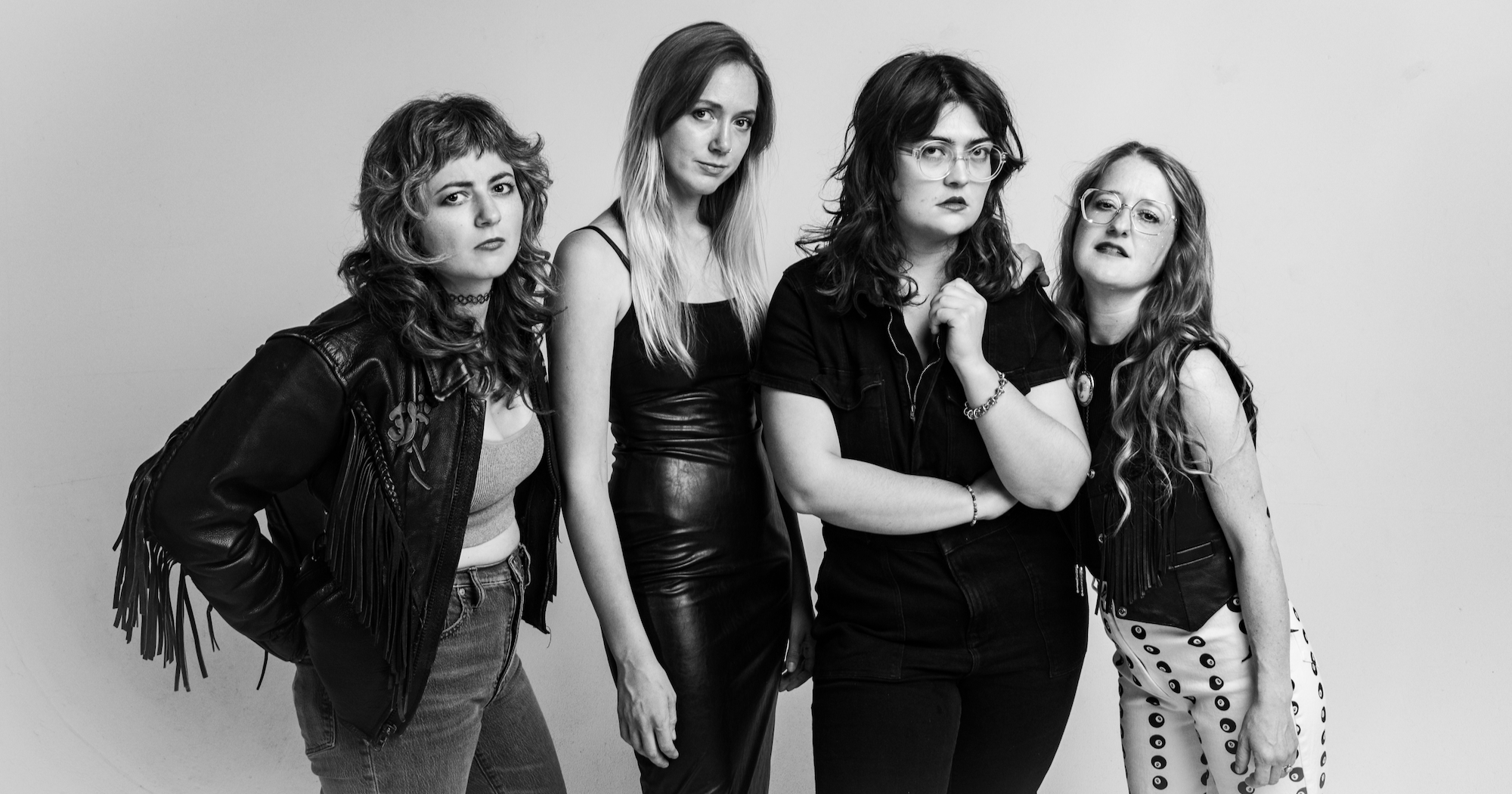
Big Richard Takes Big Strides

Big Richard is blowing up the bluegrass scene. Their cheeky moniker is a fitting introduction to their mischievous spirit – think four women, leaps and bounds of talent, political acuity, and unrivaled vibrancy. Their magnetism has garnered a true energetic match from their fan base, who are occasionally known to attend live shows with inflatable male genitalia in tow. Everything about Big Richard is its own micro revolution.

Joy Adams (cello), Eve Panning (fiddle), Hazel Royer (bass), and Bonnie Sims (mandolin, guitar) make up the fearsome foursome. Each woman has cultivated a slew of experience in her own right, amalgamating into a supergroup of pulsating passion and prowess. February 6, 2026, saw the release of the group’s sophomore studio album, Pet, via Signature Sounds. A ripe combination of fiddle tunes, originals, and an astute cover or two, Pet was recorded live in an effort to encapsulate Big Richard’s dynamic chemistry. Raw power seeps through every track, their topical lyrics and fiery dispositions bulldozing over patriarchal expectations so often affiliated with the bluegrass legacy.

Big Richard is fierce, loving, and unstoppable. When BGS sat down to ask a few questions regarding their new release, their affinity for one another beamed radiantly through the grainy Zoom screen. Joining from an early morning in the middle of tour, Big Richard arrived to our call piled onto a single hotel bed á la the grandparents from Charlie and the Chocolate Factory.

Their banter electric and punctuated by spurts of laughter, bassist Hazel even delivered a sardonic recitation of a poem from her bedside book before launching into the interview. What followed was a curious exploration of the inspirations and aspirations to which the band meticulously attends.

Congrats on Pet! Can you tell us a little bit about the narrative of Big Richard and why you’re all in the same bed? What brought you here?

Bonnie Sims: We started a band because a festival needed more ladies on their lineup. They called old Eve Panning on the fiddle over there and said, “Hey, you probably know other women, right?” So she took a call, and she called us.

Joy Adams: We were just supposed to play one show, and I remember having a rehearsal and everyone peeing their pants from laughing so hard. We played our festival set and half of it got rained out. So we had all these songs we still needed to play and decided to book another show so we could play them. We also got some hate at that festival – some people were very offended by our name. We were also handing out penis paraphernalia, and we made these puff-paint T-shirts that had a dick with hairy balls playing banjo.

Hazel Royer: People got mad enough that we were like, “Oh, we have to do this again. This is so funny.”

BS: We were like, “Are we rage-baiting middle-aged boomers? Could this be any more fun?” I grew up as a bluegrass kid, and I always had an aversion to some elements of the culture socially, especially towards women. I felt very stifled by it with my personality, so I always said if I was going to be in a bluegrass band, I wanted to feel like I was power-sliding in on my knees with both middle fingers up. I feel like Big Richard does that very well energetically. We are doing that constantly on the scene, on stage, to audiences, to other musicians, to promoters – we try to bring an unexpected vibe.

What is unique about collaborating with an all-femme outfit?

JA: Well when I get my period, they all get their periods. We’ll be halfway through tour and someone will be like, “Okay, when is it coming?”

BS: And I like that you said outfit. It’s mostly about our outfits. We share clothes, we encourage dressing up, we share beds, we like to theme – the chemistry is deep!

JA: We theme all of our outfits. Like last night, we’re staying at a Best Western, so our theme was “Breast Western.”

Eve Panning: I actually showed up dressed just like the drummer in the opening band. But yeah, I guess we’ve all played in bands with men before, and all sorts of other lineups. I personally have loved all of those bands, loved making music with them, and learned a lot. But there is something really special about being in a group with all ladies. There’s just something that I feel like is kind of unspoken and understood.

BS: And I feel like the reception of us often still has some sort of stigma attached to it. Like at gas stations, at venues, people will be like, “Oh, girls, are you traveling alone?” “Ladies, are you sure you’re okay?” And I get to be like, “Yeah, we are! Yeah, that’s right.” I feel like being in this band has fortified my personal independence bone.

Has being politically forward also impacted your reception?

HR: Yeah, definitely. This band has been pretty politically forward since its inception, so we’ve also curated a fan base that understands what to expect. For the most part, people come to our shows because they know that. Last year we had a few shows where people left in anger, but it’s not common.

BS: Even just the name Big Richard is a pretty good litmus test for whether or not you’re able to take a joke. If you get the joke, and if you’re willing to laugh, that’s a really good precursor to deciding if you want to be a part of this party.

What context, interpersonally or globally, informed the particular creation of your album, Pet?

HR: We wanted to create an album. There was Live from Telluride [2022] before I joined the band and then we had Girl Dinner [2025], which was an album we made in the studio. For Girl Dinner, we were all separated sonically, isolated and in booths with headphones so that we could edit things and overdub stuff. I was very new to the band at that point. Our sound was very informed by coming together and creating this new thing.

But for this new album, Pet, we recorded every song live. We wanted to emulate the live sound that we have on stage with each other, because that’s where we feel most confident and powerful as a group. I think it is where we are the most successful musically. And we recorded all live to tape, so everything is analog, which has been awesome.

BS: Big Richard is definitely an energy. A large part of our alchemy together is the energy that the four of us create. And that requires being in the room together, having our voices actually, physically interacting and coming together into things. We wanted to tap into the stuff that feels real. And for us, we’re a live band. We perform shows all the time, and so we’re trying to bring that element into the studio.

What is your process of composing and arranging like?

EP: We’ve done some co-writes, which have been really fun, but a lot of the time someone will bring a song of their own with an idea of where they want it to end up, though our arrangements are also pretty collaborative. Each of us has a distinct flavor that they bring to the band.

What would you say is the most distinctive difference in your respective musicianships?

BS: Eve and Joy were classical kids growing up, and Hazel and I both had dads who played the banjo.

What is it like to bridge that gap?

BS: When Eve writes out her fiddle tunes, I take the music, I go home, and I write every note, and then I practice it. And Joy just somehow immediately has it down – so she bridges it really fast, and I have to build a bridge, piece by piece.

EP: And then when Bonnie or Joy or Hazel is singing a song, and they’re like, “Eve, can you sing the harmony part?” I have to be like, “Guys, how do I make it sound better? How do I sing good?” And then they try and help me out there.

JA: We use our skillsets to fill in the gaps for each other.

BS: And we don’t expect people to know what we know. That’s not a fair thing to put on other musicians. We all come from different backgrounds.

Lots of dynamic abundance!

What did y’all each have on repeat while you were recording Pet?

JA: I was listening to Twain a lot. “The Fox (Yup Yup Yup)” or “The Sorcerer” from Twain.

HR: I was listening to Christian Lee Hutson a lot. “Tiger” is so good.

BS: Probably scream-singing Chappell Roan in my car on the way home.

EP: I had a bit of a phase with The Weepies this summer, because I hadn’t listened much, but then Hazel was putting them on in the van a lot.

HR: They’re so good, too.

Always a good bet. Now, if y’all were in an alternative universe where you were still connected as a group, but you weren’t a band or a musical group, what would you be?

JA: Probably a truck-driving outfit.

BS: Yeah, we’re Ray Bitcher, we’re a truck-driving outfit. Or– can we be the Golden Girls, too? I want to be old ladies with y’all. Oh, and a third thing. We are also a punk band called Hateful Hazel.

Incredible. Is there anything you feel like you’ve learned about yourselves or playing together throughout the process of putting out this album?

BS: This is a collaboration and a democratic process of a band. Putting together Pet, and Big Richard as a whole, is constantly an opportunity to compromise. It’s not about my singular creative vision for any song or any record. It’s about coming together and listening to each other and then having everybody’s input. It ends up being this amalgamation of everybody’s creative juju. Incorporating somebody else’s ideas is a great learning opportunity for any creative.

HR: We also learned that this live recording style works really well with this band. We’d always had a hunch that if we just got in a room together and set up a mic that it’d be the best way to capture our sound. Turns out it’s pretty true.

BS: We learned that we liked dressing up as clowns. Artistically fitting.

JA: Apocalypse clowns, specifically.

Oh yeah, the album art is impeccable. Beyond the clownage, what are y’all each proudest of on this album?

JA: I think we’re just proud that it finally sounds like us on stage. Girl Dinner was very clean, but the live recording on Pet really worked for us.

BS: I do love “Make the World Go Away” as the ending of the record. It’s always such a potent moment in live shows, because a lot of times we’ll go into the crowd and sing it acoustic. The music becomes so tangible – we’re literally standing a foot from somebody, you know, and their face is right by our face, and we’re singing and we’re looking at them. I feel like we can miss music in that realm with performing.

The stage amplifies what we’re doing, but it’s also a barrier. Which, at times, is great because it wouldn’t be successful on the ground in a crowd of 3,000 people, but in a club with 250 or 300 people, you can stand in the middle of it and ask everybody to be quiet while you sing an acoustic song. Those moments are so connected. And I feel like this is how music can reach out and touch everyone. It’s not just for performing and money and clapping and being on a stage. It’s about feeling as humans together. Music is a tool for that.

Was that philosophy a big influence for Pet as a whole?

BS: We’re definitely trying to apply music as medicine. Humanity is missing out on something right now, and music is a tool to help us access our higher selves.


Photo courtesy of the artist.

Laurie Lewis’ O California!
Was Made With Open Ears
and Open Minds

It’s noon in the Bay Area, and singer-songwriter/multi-instrumentalist/producer Laurie Lewis is sitting in her backyard on what she describes as “a beautiful sunny day.” She spent her morning pulling up oxalis, and now she’s painting a railing she purchased at Urban Ore.

“It’s a good handrail for our front steps and along the walkway for my partner, Tom,” she says, “so I’ve been sanding it, wiping it down, and painting it.” Later during this interview, she’ll continue pulling up weeds, noting, “It’s very liberating for me, getting my hands in the dirt. It feels really good.”

The reason for today’s call is Lewis’s new album, O California! Like its predecessors, it’s an emotional palette of songs – five originals, five traditionals, and a cover of close friend Alice Gerrard’s “Sweet South Anna River” – that blend the many genres influencing her work, from bluegrass to country, jazz, and even a hint of rock. O California! features the stellar musicianship and vocals that define Laurie Lewis and her band, The Right Hands: Brandon Godman (fiddle), Hasee Ciaccio (bass), and George Guthrie (banjo, guitar).

A two-time IBMA Female Vocalist of the Year and a two-time GRAMMY nominee, Lewis is no stranger to BGS readers, as she’s been featured many times. Dedicated fans are also deeply familiar with her longtime partner, mandolinist Tom Rozum, and his Parkinson’s disease diagnosis. “He’s doing pretty well,” Lewis says. “He had spine surgery in November and he’s recovering very well from that. He had been living with intense sciatica pain for a year and a half, and the pain is gone, so that’s great.”

What would you like readers to know about O California!?

Laurie Lewis: Let’s see… all kinds of things. I wrote five of the songs on the album and they’re all over the map, so they’ll say, “She’s got a lot of different musical influences.” We’ve also drawn from the folk tradition and some great traditional songs and thrown that in the mix. It’s all done with the same four people and same four voices on beautiful acoustic instruments. Sonically, it’s really nice. You really hear the personalities of these particular four people working together. It’s what made me want to make the album.

This is album number 25 in your catalog. Artists often speak of albums as chapters in their lives. Which chapter is O California!?

This chapter is this band at this moment in time, these particular four people. I wanted to celebrate our working relationships together. It’s something that wouldn’t have happened at another time in my career, because I wasn’t working with these particular people for as long as I have been on this album. They are all on the previous album, but that was me calling all the shots. This is me settling in, listening to everybody, and trying to make a whole out of the four parts.

How did this approach make the creative process different?

Usually I come into a recording situation with more of an idea of what I want a song to sound like. This one, I came in with snippets and vague ideas for [the band] to have their way with it. We collaborated on arrangements and we listened to every idea. It’s not that I don’t listen to other people’s ideas at other times, but generally there might be more input than just three other people if I’m doing that.

I’m a collaborative artist. One of the reasons I play music is because it’s my best way of communicating in the world. And that is, for me, to an audience. But it’s also true for me to my bandmates and other musicians. It was fun to say, “We’re making a band album. This is what it’s going to be. We’re going to let people toss out songs.” “How does this sound?” “Oh yeah, great. Let’s do that.” It was, “How shall we do it?” “I’ve got an idea.” “How about if we do this?” It’s a very free and open feeling.

[The band are] all very open-eared and open-minded about the music. It doesn’t have to be the way Earl Scruggs did it, or the way Bill Monroe did it, or anything. It doesn’t have to fit into a neat bluegrass category. I’ve played with musicians in the past who have been more or less open, and all it takes is one more closed-off person to direct the band in a particular direction.

You’ve stated in the past, paraphrasing here, that writing is sometimes specific and sometimes spontaneous, sometimes it’s almost random, sometimes it’s unfinished. What was it this time, or was it some of each?

I’d say it was some of each. With the song “O California,” I was writing lyrics in the studio. I did a scratch vocal and changed the lyrics three times before I came home and overdubbed an actual vocal. That’s unusual for me, that it was in such an unformed state when I got into the studio, but it’s when we had the time and I knew the bones of it were good. Some vocal lines, some lyrics, just were not right yet, but I knew what it was about.

When did the songs start coming together as an obvious collection? Was there an intention in mind, a theme, when you all got together?

We started this project in a different way than I have other projects. We had little tours booked, so we would get together a day early before every tour, because we all live in different parts of the country. They would fly out here, we’d rehearse a song, get what we wanted down, figure it out, and then go on our tour and play it every night. We’d have a studio day booked on the day we got back from the tour, so we’d go in and record whatever we had worked out the week before and played on the tour. It was a fun way to approach a project and it spaced it out over a long period of time. It took close to a year.

When it’s spaced apart that way, how do you make it feel like a collection, rather than recording individual pieces of music?

Because it’s all us. It’s like an old friend – you can pick up the conversation right where it was. You haven’t changed your tone or your relationship with each other so drastically that it doesn’t fit together. It would be different if I were doing something like that over a year and just getting together with whoever I thought was the right person to play on a particular song. Then, the only thing that would hold it together would be my production values.

Do you still write ideas on notes, or have you tech-ed your way up to phone apps?

Oh, no. I write. I like to write with a good pen or a pencil on a piece of paper. I will make notes sometimes on voice memos, but mostly that’s it. I’m old-fashioned. I feel like there’s something that happens, the tactile feel of a writing utensil on the paper, that is easier for me to get a thought out than to sit at a keyboard. I’ve been known to still write letters, in fact.

We live in a world of texts, emojis, phone scrolling, and what’s being called “an epidemic of isolation.” Bluegrass is associated with festivals, musicians getting together and jamming, and community. Is this still true?

Oh, definitely. In fact, here in the Bay Area it’s having a real resurgence of community jamming culture. That’s always been at the basis of bluegrass. It’s what everybody wants to do – get together and let their instruments do the talking, let the songs do the talking. It’s a wonderful thing. I love it so much.

You mentor and teach at workshops and music camps, where you connect with younger and up-and-coming musicians. What do they want to know? What do they need to know?

One of the things that I try and impart to people is the importance of finding your own voice, because many young musicians have heroes they want to emulate. That’s how you learn, but at some point you have to find what you want to say with your voice and your instrument. That’s one of the things I try to emphasize and help people feel confident that they have something to say and their own way of saying it.

There is intergenerational connection at these camps and workshops, contrary to the ageism on both sides, that society seems to push: “What do those kids know?” or “What do those old people know?” What is your perspective?

There’s still a lot of that, but luckily there are enough people, young and old, paying attention and willing to listen to each other. It’s especially helpful when there are youth music camps and stuff like that, because then the kids have each other, but they also have their mentors there. They’re there because they want to learn, and it’s usually the older people who are teaching them, but then they get to be with their cohorts, their age group, and that helps a lot.

I certainly learned a lot from teaching at kids’ camps. When I first was asked to teach at a youth-oriented fiddle camp, I thought, “I can’t do that. I don’t know how to talk to kids. I don’t know anything about that stuff.” I said yes because I tend to say yes to things, and I found it to be so enlightening and so important in my life. It’s very enriching.

On a 2021 FolkWorks podcast, you talked about The Good Ol’ Persons playing a trade show luncheon years ago in front of a room full of drunk men. You described it as being “thrown to the wolves.” Many years later, how are we doing?

In terms of women musicians out in the world, there are so many more, and it is so great to see. And the technical abilities – you can’t fault it. You can put Molly Tuttle up against any guy. It’s been some huge steps forward in the time I have been in the music business, but it’s still very male-dominated from the top. It takes generations to change things like this, these ways of thinking, and now there’s a real cultural backlash happening and I don’t know how that’s going to play out. Women have made huge strides and maybe that’s just going to be taken away. Every generation has to fight the same fights, apparently.

Overall, how is bluegrass doing, to your eyes and ears?

That’s a really hard question for me to answer. Honestly, there’s a part of it that has gotten very entrenched in staying within a particular genre. I hear a lot of songs by people singing in a bluegrass style about bluegrass music, or their cabin home and I think it’s in danger of becoming a trope instead of a living, breathing art form.

Luckily, there are enough people out there creating in the art form and doing great stuff. There’s so much of everything happening all the time now that it’s going in all different directions at once. There’s good stuff and bad stuff, and it all depends on your point of view.

Who is making an important contribution, in your opinion?

I hear a few things now and again that I respond to and like a lot. I’m not very impressed with a lot of technical brilliance. I want to be made to laugh and cry, and if it doesn’t do one or the other or both, I’m not all that interested in it.

In terms of bands, Mighty Poplar can do it, and the duo Paper Wings, two young women, Emily Mann and Wila Frank, who I actually met at a fiddle camp when they were teenagers. They’re pretty wonderful. And I always like hearing what my old friends are coming up with in terms of songs and writing. I love hearing whatever 92-year-old Alice Gerrard is coming up with. She has a way of putting her finger on the pulse of what’s happening in the world and is pretty great.

In 1998, you recorded a song called “The Refugee.” Twenty-eight years later, here we are …

Oh, I know. I find it unfortunate that [that] song is still so incredibly relevant – or more relevant. I find it very unfortunate that song has not outlived its message. It’s terrible. I wrote it when Guatemala was in such bad shape, people were fleeing, and there was all this backlash. It’s an empathetic song. These days, empathy – there’s a whole movement, “empathy’s a bad thing.” It’s so crazy.

In a 2020 interview with BGS you said, “Music has a real way of being able to soothe and heal grief.” Could you talk about that healing power, not only as a songwriter, but also as a lover of music, a listener?

Oh, yeah, it’s true. I stand by that. There’s nothing like it. It’s such a direct conduit to the heart. A song can sneak in and express something for you that you had no words for. It can help you, as a songwriter, to figure out a way to express what you might be going through in a way that makes it universal. You put it out there in the world, everybody can feel it and relate to it, and it makes you feel a part of something greater than just your little dark cell that you might be stuck in, or your own personal grief.

It has helped me deal with things, with grief in my life, to be able to learn a song that makes me cry. Every time I hear it, I learn it, and it becomes part of me. It becomes part of my way of being able to express myself, or to write a song that every time I start trying to sing it, I’m in tears or something. You learn to work through your grief by embracing it musically. It’s an incremental way of dealing with things, and it’s really healing.

It’s a sense of support through the company of songs that speak to us.

Yeah. You are not alone. Especially with all the internet stuff, people spend a lot more time not with actual other humans, having conversations or whatever. To hear something, to listen and understand that other people are going through the same alienation or grief or loss, or whatever it is that you are experiencing, makes it easier to bear.

The French author Jean Giono, who wrote The Man Who Planted Trees – I wish I could find this quote – said in an essay that an artist’s duty is to express yourself for all the people who don’t have the words or the art to express themselves. It’s your duty in society, your job, to put it out there for everybody who can’t.


Photo Credit: Dawn Kish

Langhorne Slim Takes Chances and Rocks Out

For more than 20 years, Langhorne Slim’s folk-leaning songs and rebellious nature have captivated crowds across the world. That trend continues on his ninth studio album, The Dreamin’ Kind, which takes a page out of Dolly Parton’s book and pivots toward rock ‘n’ roll in what’s arguably his most eye-opening collection of songs to date.

Out January 16 on Dualtone, the album is something Slim had long desired to make, finally coming to fruition after he had the opportunity to open for Greta Van Fleet at a show in Connecticut in 2021. The moment came mere months after having dropped what would be his debut on the Billboard Hot 200, Strawberry Mansion. But according to Greta’s bassist Sam F. Kiszka – who produced The Dreamin’ Kind – that wasn’t the band’s introduction to Slim. They’d been fans of his long before.

“I remember hearing Lost at Last, Volume 1 for the first time and it absolutely resonated with me,” Kiszka said in a press release. “[Slim] has the conviction of a hundred singers. He puts his entire body and soul into it. I listen to ‘The Way We Move’ and I think, ‘That’s a rock ‘n’ roll song, right there.’ Rock ‘n’ roll isn’t a sound, necessarily. It’s an energy, and he’s got it.”

Although the production takes on a strong Greta Van Fleet flavor on songs like “Haunted Man” and “Loyalty,” The Dreamin’ Kind also mixes in Slim’s folk-fueled identity as well, painting a sonic canvas that shows both where he’s come from and where he’s headed. Others, like “Strange Companion” and “Rickety Ol’ Bridge,” bring stylings together, with fuzzed out guitar licks and backbeats that portray a more folk-oriented stomp and clap mentality.

Ahead of the holiday season and a weekend run of shows opening for comedian Jordan Klepper (more on that below), Slim spoke with BGS about what inspired his foray into rock ‘n’ roll, how a letter inspired one of its songs, and how working with Greta Van Fleet’s Sam Kiszka and Daniel Wagner pushed him creatively.

What was your motivation for making the pivot to rock ‘n’ roll this deep into your career?

Langhorne Slim: It’s been a dream of mine for a long time. Some of the songs are definitely more of a departure from what I’ve previously done than others, but I don’t think that’ll come as a surprise to people who’ve been following me for a while now. Our live performances have always taken a page out of punk rock and rock ‘n’ roll, in addition to soul and folk music – genres be damned. Regardless of what it sounds like, most people just want to be moved by music.

When I first got started, I was playing a certain way, then a record deal followed and before you know it you’re forming an identity. But I eventually reached a point where I still loved my folky songs, but if I met new people or a fresh opportunity came about that would push me creatively, then let’s go for it! As I’ve grown older and built a family I think more and more about the identity I’ve built and what else is there when I start peeling back those layers – what else do I want to express? How might I want to use my voice or the instrument I play differently?

Rock ‘n’ roll was the natural progression of that, so when I became friends with Sam and Daniel from Greta Van Fleet, I think they saw that in me. From then on there was no pressure, we were just in it to have fun.

So this is something you’ve been wanting for a while, you just needed to find the right people to work with for everything to fall into place?

I’d been talking to a couple friends and people I admire about how when I made [2005’s When The Sun’s Gone Down] I wanted something at the crossroads of bluegrass and punk rock, like the Violent Femmes. I didn’t necessarily want to copy their sound, I just felt a kindred thing with their influences. So with [The Dreamin’ Kind], in my mind I was going for a garage rock meets gospel thing. I wouldn’t say that’s what the record actually became, but how I collaborated with Sam and everyone else for this record was so different from how I’ve worked in the past.

I liken it to a pitcher in baseball. As artists we sometimes focus too much on our strengths or “strong arm,” but I’ve only got so much time to live and I’m hungry to create. Before music my first thought ever about creating something had to do with building robots. With that in mind, the possibilities are endless when you think about all the people you could potentially collaborate with and the different creative bursts that could come from each.

That reminds me of something Ketch Secor told me in an interview a few months ago – “I am a container of multitudes.” It sounds like you’re the same way?

Ketch has been doing Old Crow for even longer than I’ve done my thing. I’m not somebody that says I don’t care if it lands, because I do, but most importantly I want my longtime supporters who’ve been so good to me to connect with this record. I’m not the first songwriter or creative person to say you can’t do the same stuff over and over, and I won’t be the last. At the end of the day, the power of music comes from the wonder and awe it provides us, so if what I’m doing doesn’t give me that same feeling then I’m not doing my job for the people, the energy and whatever else provides groove, melody and beauty in the form of music.

Another way you’ve pushed yourself outside your comfort zone lately has been on your gigs opening up shows for comedian Jordan Klepper. How did that connection come about and what have you learned from playing to a comedy show crowd?

I first met Jordan because my best friend Joel is a cameraman for The Daily Show. Jordan went on to officiate his wedding and through that Joel turned him onto my music. From there, we hit it off at the wedding and about a year later I got an email from Jordan about coming out and opening a few shows for him, which I was thrilled to do because, like you said, it’s out of my comfort zone. I knew there’d be a lot of people in the crowd not familiar with who I was.

That mix of excitement and fear reminds me of early in my career living in New York City, when I became friends with Eugene Mirman, a well-known comedian best known right now for his work as Gene Belcher on Bob’s Burgers. He had a comedy show on the Lower East Side that he’d invite me to be a regular musical guest on, so I did have experience playing comedy shows where nobody knew me. [Laughs] At one point Eugene invited me to play on a comedy tour that included him and a few other comedians who went on to make it big, like David Cross. They’d do their sets then I’d come out with my little hat and funny outfit and the entire crowd would start laughing thinking they were in for some musical comedy, but I was just playing my regular songs.

It was a tough place to break through at, but it taught me a lot. Jordan’s crowd is a little different though, because there’s people in the audience who actually know who I am, which is nice. I also try to cater the songs I play to his show to make them more topically relevant. It seems to be resonating so far – the reception I’ve received at the shows has been wonderful and beyond expectation.

It’s such a treat being on tour with a comedian, because when I’m on the road with another band I’ve found that I can’t watch them without analyzing and thinking how I could pull off what they’re doing. It’s hard to not put oneself in it, whereas watching a comedian it’s a lot easier to sit back, because it’s the same monologue and jokes. It’s how they’ve mastered the art of timing to add emphasis and help the joke land. It’s really fun to observe because I’ll just be sitting there laughing rather than wondering how I’d tell that same joke since it’s not the art form I do.

Sounds like a dream come true, which is also the name of one of the album’s songs. Is that a tune about manifesting the vision you have for your future, or are you unpacking something entirely different there?

You’re spot on. I wrote a letter to somebody, because my partner and I were thinking of moving out of the city and getting this country property, but it was way more than we could afford – I didn’t even know if they were gonna let our raggedy butts in there to take a look at it! So I wrote a letter to this woman and at the end I wrote, “It might be a long shot, but without a dream you can’t have a dream come true,” which also pulls a bit from Hammerstein’s “Happy Talk” (“If you don’t have a dream/ How you gonna have a dream come true?”).

On more general terms, it’s a song about casting aside your doubters and anything else in life that tells us to conform or dims the fire burning within us.

Like you said, you might not have gotten the house, but at least you got the song!

I look back now and there’s songs where I may not have gotten the girl (or in this case, house), but I did get the song, and that’s lasted longer than any relationship probably would. [Laughs]

Songs are like little miracles in that way.

While “Dream Come True” is all about looking ahead, you seem to be looking back on “Stealing Time” – which I’ve interpreted as a song about cherishing your moments with others and not taking them for granted. Is that the case?

There’s some reminiscing I’m doing on that one, too. Being a fairly new dad and sober man, I’ve noticed that being present and giving myself to and receiving somebody else’s time or energy is so rewarding. It’s so easy nowadays to run from our emotions and thoughts, which I used to do a lot with alcohol and drugs and all of us do now with our phones. There’s so many different ways that manifests and plays in my mind.

That song is also a phenomenon of love and infatuation and how one’s heart can be so on fire for somebody that closes theirs off to you. It’s like [Gotye’s] song “Somebody That I Used To Know” in that way.

Another song I wanted to ask about is “Haunted Man,” which to me comes off as the most Greta Van Fleet-sounding track on the album. What was the process for bringing it to life?

That song is the most collaborative that I did with those boys. It was also the tune that I fought Sam on the most, as far as not thinking it’d be a good fit [for the album]. Even after recording it, I didn’t think we’d include it as one of the dozen tracks, but Sam insisted I sit on it. Once all the songs were done I remember walking around my neighborhood pushing my son Silver in his stroller, listening to the songs, and making a mixtape of what stuff went well together. It was then when my perspective on the song changed and we decided to include it. Since then, the song has grown to become one of the most-liked tracks among our friends, which made me both happy and sad at first due to my ego. It’s easily the most different song on the record from what anybody’s heard me do before.

You just mentioned not thinking “Haunted Man” would make the cut onto the album. Does that mean you have extra material recorded we might hear more of sometime down the road?

For the basic tracks we spent nearly three weeks in the studio, with the first half with the Greta boys – me, Sam, Daniel, my dear friend Casey McAllister [who plays keys in my band], and multi-instrumentalist Cameron Neal [who mainly played electric guitar]. That portion was supposed to be the “rock” record, then for the second half I brought in my longtime band, The Law, to record a bunch of different stuff.

The plan was for them to be two separate records, but we wound up mix-matching a bit. Because of that, we have a bunch of leftover stuff we captured that I hope will be on my next record.

What has the experience of bringing this rock ‘n’ roll record to life taught you about yourself?

Do what scares you. See what else is there and burning inside you, don’t be afraid to take chances and rock out. I just want to keep making music that moves me and inspires other people. I never want to feel like I’m stagnant or compromising parts of myself.

I want to kiss the spirits in the way I feel they’ve kissed me so that I can give my all to the music.


Photo Credit: Kate LaMendola

How Courtney Hartman
Made With You

In the late summer of 2022, Courtney Hartman realized that the songs she had written for a new album were not the songs she needed to release. “I had found out I was pregnant a few months earlier, [and already] had a batch of material I was working on for a new record. I felt this quiet urging to set all of that aside and give my attention to what was happening in our life and in my body,” she says.

She discarded everything and began writing her third album, With You, a personal journey through motherhood set to music.

“What was happening in our life” refers to a tumultuous string of events that saw Hartman and her husband, John, through the best and worst of times. Best because the couple were expecting their first child, rebuilding their house in Eau Claire, Wisconsin, and Hartman was on tour; worst because her husband fell off a ladder, could not work for months, lost two jobs, she was dropped by her booking agent, and they totaled their car.

The cumulative effect left the couple in need emotionally, physically, and financially. They soon found themselves uplifted by their community – their immediate one and her music community at large. The experience left Hartman deeply grateful and dedicated to giving back even more than she received.

In September of that year, Hartman began writing “in earnest” the songs that became With You. She and her husband welcomed their daughter in February 2023 – more best of times followed by worst of times as Hartman struggled with postpartum depression.

“At the end of [2023] I had all this material and realized I wanted to invite in other voices and stories and perspectives, specifically those of other mothers,” she says.

Once again, she drew on her community, calling on a fellowship of songwriter mothers – Sarah Siskind, Dawn Landes, Ana Egge, Tift Merritt, Kristin Andreassen, and Emily Frantz Marlin of Watchhouse – to help take her deeply personal new songs to an even higher level.

“I spent another few months, December [2023] to February [2024], writing mostly over Zoom, finishing the material with those other writers,” she says. With You was recorded in June and July 2024, at The Hive studio in Eau Claire, with Hartman producing and Brian Joseph as co-producer and engineer.

As one might expect from Hartman, there are plenty of guitars on the album – her Lawrence Smart Archtop, Bourgeois Parlor,
PreWar (modeled after a Gibson J-45), Bischoff Dreadnought, Martin 00,
and a Telecaster – but if you’re looking for the lightning flatpicking work that makes her a bluegrass force to reckon with, you’ll be best served on YouTube. With You tells a story that calls for understated guitars as a palette for its songs.

“Things weren’t all bright and shiny in that season,” she says, “but the impetus to write and pay attention helped me pay attention to some of those lighter moments. Not all the songs on With You are about everything being light, because that’s just not how it is. But there was this extra attention to some of those details that do help buoy your spirit when things are a little more challenging.”

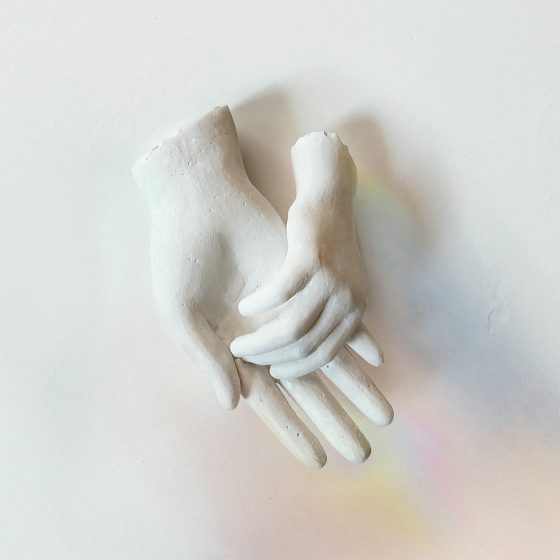
Courtney Hartman’s ‘With You’ album cover art, created by Claire Lindwall.

Completing the journey is With You’s striking cover art. The work of Hartman’s close friend Claire Lindwall captures the music’s delicate intimacy. “Claire is primarily a watercolor artist and illustrator,” says Hartman. “A special part of creating an album, for me, is giving the music to someone who then translates it into a visual piece of art. Every time, it’s surprising and expansive in a new way.”

Lindwall cast her own hand and that of her daughter’s, and positioned the casts so that one holds the other. “We experimented with drawings around it, then having just a splash of watercolor behind the piece,” says Hartman. “That’s all it needed.”

With this album now making its full debut, how do you feel about sharing so much vulnerability?

Courtney Hartman: The processing has happened in phases. I think it started just by saying yes to writing the material. There was an accepting of, “I’m writing about this thing that feels more vulnerable and more naked than anything I’ve written about before.” Bringing those songs to other writers, to collaborators, there was another level of vulnerability there.

A year ago I brought all of this material to my greater community and asked for support, because at that point I needed help putting the album out. Now, to give it to the rest of my community and listeners in the world, there’s a level of vulnerability, but I feel mostly excited. It feels like, “We made it.”

You’ve explained in other interviews that you had to use funding meant for the songs that came before these in order to get back on your feet. Needing financial assistance is also a vulnerable place and one that often brings publicly imposed shame and guilt. How did you process it?

You’re bringing up something that my husband and I have been talking about a lot, just with the news cycle and trying to get an understanding of what we can do for folks in our community. And having had small tastes of that in our life, because I know what we’ve experienced is so small compared to what so many people live through and are currently living through.

An important [word] that you touched on is shame – the shame of needing help; of not feeling like you can do it on your own or you can stand on your own two feet; of needing help for basic things like groceries. I think maybe accepting help and accepting care expands our capacity to feel compassion and to be able to then care for others.

In a podcast for Acoustic Guitar, you used the phrase “the intimacy of sound.” Could you talk more about what that means in the songwriting and guitar playing?

What I hear when you reflect that phrase back to me is the sound of the skin of your finger on the guitar string, or the sound of hands against a percussive instrument. When we went into the studio, I told the friends that were with me there on the first day, “Just as a guiding directive, whenever we imagine a sound that we want to create, let’s see if we can find something natural to create it with.”

Everyone took it in their own way, some on their instruments. Sean Carey was heavily involved on the record and he took that more literally in a lot of the percussion work. He found a nest outside when he was wandering around and that became the percussion on a track. Or even just the sound of skin on skin being a sound that we used as well; bringing in and magnifying some of these quieter sounds and allowing that to be a part of the soundscape [was part of the intimacy of sound].

Did you select the guitars around the songs or did some of the songs develop around your guitars?

Sometimes you think you know what a song wants before going into the studio and then you sit behind a mic and you’re like, “This isn’t serving it quite right.” And sometimes that experimentation takes a little longer than you think it will. Or sometimes you sit down with a first instinct and it’s totally right. That’s part of the reason it’s fun to have a good array of instruments in the studio.

Is the guitar as much a part of expressing your feelings as the lyrics?

It is. I think part of that comes from how long it’s been an instrument that feels like a voice to me. Songwriting came around the same time. I was about 12 when I started writing songs. Singing feels like something I still have so much exploration and learning to do.

How did working with other mothers, and their lived experiences, bring understanding to what you were going through?

What I was given [was the] shared experience and the acknowledgement of, “This is really hard. It’s really beautiful, but it’s also really challenging.”

So much of the caregiving that happens [as a mother], especially in that first year … so much of it is invisible. Maybe an aspect of that applies to all sorts of giving care – that it’s invisible other than to the one giving the care and the one receiving the care. When you feel invisible, it can also make you feel isolated and that can really feed into some of the struggles. A lot of folks have postpartum [depression] and societally we’re not set up to honor and support that season very well at all. It’s something I care a lot about, both from experiences with my family, but also as I’ve delved into work as a birth doula.

When you say, “Societally we’re not set up to honor and support that season very well at all,” what do we need to do?

We need to honor and uphold the importance of rest and nutrition and preparation. Parents are prepared for “Here’s what birth might look like,” but after that six-week checkup [traditional care usually ends]. Postpartum extends far longer than that.

A lot of [postpartum] mental health struggles won’t show up until maybe nine months or a year after a child is born. Better supporting [people postpartum] that would be the first thing I can think of. We live pretty isolated lives, as families in our insular homes, and so we’re not set up to receive support very well.

Or ask for it.

Yes, totally, [we need to be] preparing [people] to know that this is a time to accept and receive care. Preparing your heart for that is such a big piece of it, to know that we, as your village and your community, want to care for you in this time.

You’ve spoken openly about postpartum depression. What was that period of time like for you?

Moments of real happiness, but also moments of hitting my head against the wall … when I was struggling. [It was] hard to admit to myself and then to speak that [struggle] out loud to anybody. It wasn’t until afterwards that I could say, “That was hard.”

All depression is misunderstood and will often make people in your circle run away.

Let’s go back to your community, and the community of mothers, and how they lifted you.

I felt so cared for by our community in a way that was deeply humbling and in a way that somehow prepared me to do some of the caregiving that was going to be required of me. I was receiving so much love and support and meals and folks showing up. That kind of care is life-changing. It changes the way we see the world and our community around us.

My daughter was about nine months old or so when I started reaching out to other mothers, asking if they would collaborate on some songwriting. Having some tether creatively helped pull me through that season. It helped weave together the woman I was prior to having a child with the woman I was in that new space. … Sometimes it feels like … you almost can’t remember who you were before.

I was really afraid of [losing parts of myself]. I was afraid I wouldn’t create music again. There’s all these fears, irrational or not, that show up. Creating and being able to have these conversations that normalize what you’re experiencing. Having women who are [a] few years ahead of me be like, “It might be extra-challenging now, but it doesn’t stay that way forever.”

It’s almost 2026 and society still misunderstands and stigmatizes mental health, certainly PPD, and even some aspects of pre- and postpartum healthcare. Why are we uncomfortable talking about things that are so natural and important to discuss? Are we making progress or going backward?

I hope we’re making progress. It was a lot easier for me to ask, “Why don’t we talk about these things?” when I wasn’t part of the “we.” As soon as it was also part of my story to talk about and share, [I had to come] to terms with my own hesitancy. Why do I not want to talk about something as normal as pregnancy and motherhood in my songs? Why do I feel like if I put this music out, it will be discredited and potentially ignored, even though it may speak to so much of the population? …

I still don’t have an answer. Maybe it’s because there’s so many generations of women having to hide those things for fear of losing wages, or jobs, or discrimination, whatever it might be. For everybody’s sake, there’s so much we have to learn from mothers’ voices, and I hope we’re beginning to really listen.

On a podcast, The Other 22 Hours, you reflected on the period after Della Mae and the realization, at the time, that “Music was not a healing thing.” What role does music now play in your healing and mental health?

It has become healing again. Years ago, I was dealing with physical pain in my hands. That was magnified by touring all the time, being on the road so much, and the strain on my body. So I was speaking about it in a physical way. [Music] has become a lot more than just physically healing [for me]. I think this album exemplifies that.

You have worked with so many people. Who is your wish-list artist or artists?

Oh my gosh. The first person that came to mind – and maybe it’s because I’ve been listening to her record all week – I would love to play music in the same room as Brandi Carlile. She gives all of herself and it’s so good.

We had a listening party [for With You] and as I was listening to the album for the first time with a whole group of friends and collaborators, what I hear on it is my friends and heroes, which is such a joy. There are so many folks on this album that I look up to so much and who have been dream collaborators. So, in that way, a lot of it has been a dream list fulfilled.


Photo Credit: Michelle Bennett

Singer-Songwriter Madi Diaz is Metal as Hell

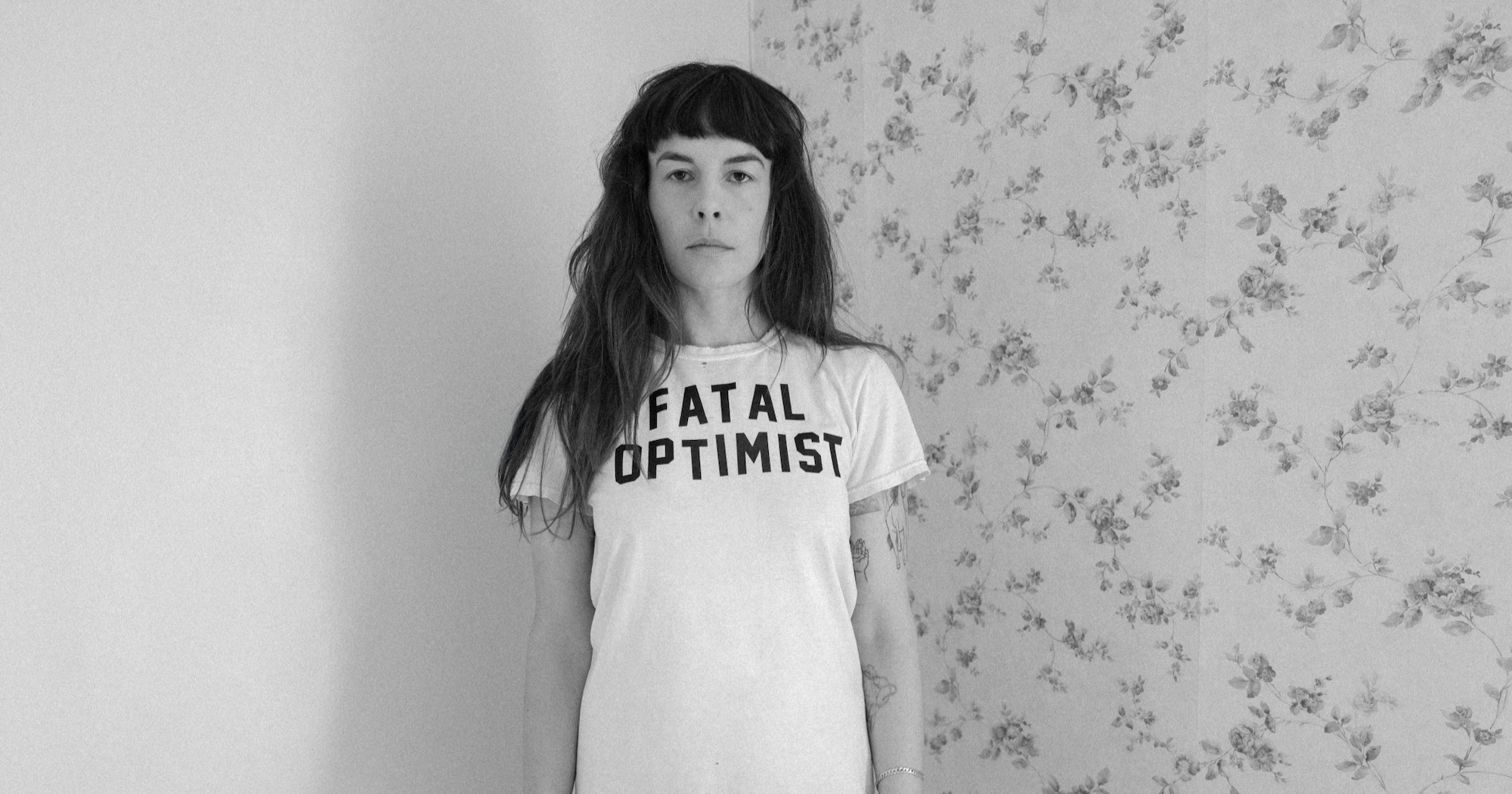
Hitting play on singer-songwriter Madi Diaz’s latest album, Fatal Optimist, one wouldn’t automatically identify her close-to-the-mic, chunky strums and anxious, confident vocals as “metal.” But keep listening and trust.

Fatal Optimist is heavy on numerous elements of metal – fantasy, humor, darkness, anger. For much of its runtime, it feels like the inside of a clenched fist, slowly but surely letting go. With songs that are, this time, centered around her solo voice and acoustic guitar, Diaz turns her liminal songwriting further inward than ever. This is saying a lot for an artist who’s no stranger to personal narrative. While her prior album, 2023’s Weird Faith, brushed up against hopeful optimism, this follow-up proves that earned optimism is perhaps the better version.

After all, Diaz chose to open the disc with the wordplay stunner “Hope Less,” a stiff shot of reality that reorients us to a heart at least as full of darkness as light. If the LP’s vibe is “clenched fist,” its songs play like spokes in a wheel rolling us toward the jubilant title track – a progression Diaz admitted in our recent BGS interview was equal parts intentional and inevitable.

This album starts out very quiet. It feels very close and very intimate, then it slowly opens up. Was that the intentional vibe and arc of the album for you?

Madi Diaz: It definitely ended up being a much more lean-in [kind of] record. The further I got down the road, the more it felt very obvious that was just what the song content needed. It’s kind of heavy stuff, I think. It was a lot of mining of the self, which I did a lot privately. So I felt like I wanted the songs to match that [vibe], in the end.

I was listening to it this morning, thinking about your song “Everything Almost” from the last record. Like, how optimistic and full of hope that song is and then this album starts off with a line like “hope less.” Obviously, when you’re writing about personal events in your own life, it’s easy to see connection in the rearview. But I’m wondering if there’s something more to what feels, to me, like a connection between that song and this project.

That’s funny. I was just talking about this. I do feel like a lot of the songs in the last record … are about following that gut intuition. That gut feeling. So a lot of the songs on Weird Faith are absolutely going like, “I think this is it. I think this is gonna work. I think we’re really gonna get there.”

There was a really funny moment I had recently. I was practicing for this tour and putting [together] the set list. I wrote this song called “This Is How a Woman Leaves” for my friend Maren Morris, her last record that she put out [Dreamsicle, 2025]. I am planning on releasing a version … at some point down the road a little bit. But I was practicing “Everything Almost” and then I wanted to go into “This Is How” because in “Everything Almost,” I’m packing the boxes and moving in. In “This Is How” I’m fucking moving out.

Like, “How it started, how it’s going.”

It’s the “fuck around and find out” journey right there, in a nutshell.

Nice. I was reading that you went to an island when you were writing the album. Can I ask what island you went to? And did you know that’s what you were going to do when you started your trip to that island, planning, like, “I’m gonna get it together.” Or was it just kind of like how life happens?

There were, actually, many islands. Physically, mentally. … I started off coming off of this European tour. We finished this tour in Italy, so I went to an island off the coast of Italy and was there by myself. I did a lot of journaling and walking – so much walking. I’m a big processor by walking and talking, so I would kind of record myself as I was processing things out loud. I really wanted to be in a space where I felt safe to do that. It felt like the safest thing was to just take myself away from everybody, so as to not barrage people with [my feelings].

I started off in Ischia and then I ended up, really wonderfully, being asked to be a part of this [songwriters’] colony in Nantucket. So I did that. I ended up going to Long Island with my dad, to Noyack, and just [did] a lot of journaling there.

Also, [I was] feeling very much like I couldn’t tell whether I was the island or the island was the island. It was just this very unescapable lonerism. Solo mission, you know. Like in a spacesuit, kind of feeling. I just couldn’t shake it, so I just took it with me everywhere I went.

Can you talk a little bit about the process of songwriting? Your songs are so personal, almost uncomfortably so. I wonder if that’s the result of writing in an actual journal on paper and if that’s a different kind of creative experience for you than voice memos on your phone, which so many people do now instead of journaling.

I definitely rely on journaling still. A lot. Sometimes, if I’m in a pinch, I’ll text myself an idea. Or, I have [the] Notes app open. A lot of Fatal Optimist was pulled from about a year’s worth of pretty serious journaling and going back over certain words that kind of stuck out. I love journaling. I think it’s like a life scrapbook, you know? There’s a funny thing that happens. Sometimes I’ll open a journal and I don’t even know what year it’s from, because some of the issues [are] so consistent. … But it’s kind of like a sweet reminder, of survival, I guess.

Totally. Do you remember writing the couplet at the beginning of “Lone Wolf”? “Lamb’s gotta lamb, god planned it/ Wolf’s gotta wolf, goddamn it.” It’s such a perfect little song, but it doesn’t feel trope-y. It feels, really, like a strike of inspiration.

Well, I remember it was dead of winter. I was sitting on my couch with Stephen Wilson Jr. and I was going through my journal. I was talking about what was on my heart that felt so difficult, about reaching this person who chose to be a loner. I mean, he literally said to me, “I’m a loner. I’m a lone wolf kind of guy.” And I [thought,] “You just said that. That’s ridiculous.” Like, have you not seen the Pee-wee Herman movie where he’s like, “I’m a loner, Dottie. A rebel!”

But it was this thing, you know, that I almost didn’t take seriously, because it was such a crazy thing to say. And I should have [believed him], obviously, because here we are. I was talking to Stephen about it and we were laughing about this wolf character and the lines just fell out. In the aftermath of it, it’s funny.

You know, when you push somebody that wants to be alone away, they tend to want to be less alone. They feel very confronted. I mean, I’ve been there. All of a sudden, you’re confronted with your loneliness and wishing that you actually had that connection. So, when I pushed him away initially, he would just kind of show up and stick around. I really wanted him to leave me alone. Damn it. “Goddamn it” definitely came from that.

The lyric on that song is so simple. You don’t go into a lot of poetry, you don’t go into a lot of storytelling. The wolf keeps showing back up, looking good, trying to get back in. Can you talk a little bit about trusting yourself to keep it so simple? Does that come from editing or did it just feel like that’s what the song was?

I try to say it in a way like we were just talking about it sitting in the bar. I’m trying to not be misunderstood. I’m trying not to feel misunderstood even to myself. So I think I try to keep it clear and cutting, and [the way] it comes out. If it’s possible to get even closer to it, I’ll edit, but I don’t really edit a lot.

Oh wow. So it just comes out that way. That’s impressive.

Sometimes it does just come out that way. Not all the time, but sometimes it mostly does.

The other line on this album that I really wanted to unpack is in “Heavy Metal.” The line is, “In some religions, repetition is spiritual.” I wanted to unpack it a little bit, because music is often a place where people will repeat words or phrases, for a whole bunch of reasons.

But that line made me really listen to the words and phrases you were repeating elsewhere on this album: “Whose move is it to move on.” “I always love you.” “God knows how long.” “Ambivalence.” Can you tell me a little bit about how you decide what to repeat? Is it a conscious choice or just part of the process?

I think when I’m repeating something, it’s because it feels different on every lap. I’ll repeat something when the feeling is lingering in a way that– maybe if I say it enough, some magic spell will break and I’ll be released by this thing. Sometimes I feel like the repetition of it comes from a bit of a desperate [place] like, “Just get it out of me.” Maybe if I do this ten times, I’ll never have to do this ever again, which is why the [line,] “In some religions, repetition is spiritual.” …

You’re always going to carry it with you. You can learn how to hold this. I can learn how to learn from it differently every time, you know.

I guess that’s why repeating “ambivalence” is really interesting to me, because it seems like repeating that particular word is a contradiction.

I guess that’s true. Ambivalence means “caught in the middle.” Feeling in so many different directions. For me, ambivalence feels like a very desperate feeling. It almost feels like it should come with a bit of an alarm bell. Like, “Oh God. I’m feeling all of the feelings at the same time and I don’t know which one to choose.”

That makes sense. The other thing in the song “Heavy Metal” – I wanted to ask about your mom. I feel like you have mentioned your parents in other songs on other albums. But this made me wonder about your relationship with your parents. Somehow, I don’t think people talk about their parents much in music. I can’t figure out why. Do you have any thoughts on that?

I think it’s scary. It’s so scary. When I know a song is about me, I definitely tend to listen with a microscope. No one is trying to hurt anyone, but we’re all really trying our best to process love, pain, joy. I don’t know. Our effect on each other. What’s mine, what’s yours. So yeah, it’s not an easy thing to write about. …

I feel like I’ve felt the most loved and I’ve felt the most hurt by both of my parents. I think that that’s pretty normal. Or maybe not? Maybe it’s not normal.

I think it’s pretty universal.

It always kind of ends up that way. The people closest to you hurt you the most, which is why you really have to trust the people closest to you. So that when they do hurt you, you can [heal].

I think “Heavy Metal” felt right to start you talking about my mom, because she’s kind of a badass and kind of a hardass. In all the best ways and all of the hardest ways. There are some things about being tough and resilient that I wouldn’t trade for the world. It helps me survive in so many corners of my life. But also, I’ve had to really undo some of the damage that being tough does. You start to weaponize that toughness against yourself and others in a way that I didn’t even know I was doing for a long time.

Then [again,] you just don’t want to piss them off because you also want to be able to go home for Thanksgiving and stuff.

Right. That’s what makes it such a metal move, you know, to comment on your mother in this way. I’m assuming she’s still alive. Has she heard the song? Does she have any feedback for you?

I haven’t heard [feedback] yet. I really don’t know. But I’m so grateful to my mom for raising me the way that she did and giving me and my brother the lives that she gave us. I feel so lucky that she’s my mom. It’s hard to have a song like this. … But that’s just fucking art, man. It’s so hard, at the end of the day. You know, we can make it as personal as it is or as just-about-me as it is.

The last thing I want to ask about is the song “Fatal Optimist,” which is sort of a sonic departure from the rest of the album even though it’s obviously very on-topic. As a listener, it feels like we just went on this long, arduous, emotional journey, and now we’re suddenly above the tree line and the drums are here and everybody’s in the room. Not to get too nerdy about sequencing and stuff, but was there any world in which that song could have been anywhere else on the album?

It would have been a nice break, wouldn’t it have been? I just couldn’t do that. I couldn’t interrupt the intensity of this record.

I do know that optimism is a soothing balm. When it hits you, it just hits you. There’s no explanation for it. And I knew that, for me, I want a reason to listen to a record again. … This whole record feels like one step after the other. It’s like my attempt at a gift or something [for] going through it. Hopefully, these [songs] can all be like little lights on the path that lead the way to this finish line of fatal optimism. Then we can run it all back again.


Photo Credit: Allister Ann

Fruit Bats’ Eric D. Johnson
Loves a Left Turn

The road less traveled is always the road most traveled by singer-songwriter Eric D. Johnson, better known under the performing name of Fruit Bats. Johnson thrives in a world of creative dichotomy: he loves deadlines as much as he cherishes random twists and turns in his process.

He’s been making music this way for years, since time spent on the Chicago music scene, through his days with Califone, The Shins, and the creation and continuation of Fruit Bats. There’s also Bonny Light Horseman, the indie trio where he partners with renowned musicians and songwriters Josh Kaufman and Anaïs Mitchell. Their most recent album, Keep Me on Your Mind/See You Free, was released last year.

Johnson’s latest Fruit Bats project is Baby Man, a full-length album recorded earlier this year with longtime producer and friend Thom Monahan. The album is a reunion of sorts, after Johnson self-produced 2023’s A River Running To Your Heart.

Baby Man, which is his voice, guitar, piano, and little else, was an unexpected project – another deviation from original blueprint onto the less-traveled road. And one that called for Monahan’s expertise and sonic touch. The outcome, says Johnson, is “intimate and yet big. There wasn’t a lot of fuss over arrangements. Everything you hear came out of my hands or mouth earlier that day or the day before.”

It was early morning on the West Coast when Eric D. Johnson settled in to speak with BGS. “This is my second interview on this,” he noted about Baby Man, “so you’re hearing me work this out in real time in my brain.”

You have detailed this many times: iPhone voice memos, demoing, writing, the studio as a writing tool. You like a deadline, you like mistakes, you like left turns. Was this album true to method?

Eric D. Johnson: Yes. This was the leftiest of all left turns you could possibly take, because the original plan was a very lo-fi hair-metal covers album. [It was] basically a midterm project between album cycles.

During the pandemic I had done this full album cover of Smashing Pumpkins’ Siamese Dream. I had no real expectation for it other than a pandemic exercise/fun sort of bedroom thing and it hit a little bit. Everything I do is ambitious in some way, but this was a “throw something at the wall” idea originally and not a big deal.

I was talking to Thom Monahan, my producer/mentor. We hadn’t worked together in a few albums, although we’re still dear friends. I always talk to him before I make something, which is like, “What microphone do I put on this?” I’m asking all these questions, we ended up chatting for an hour and by the end of the conversation I was like, “I think you should do this record.”

This was all over the course of a very short amount of time in February. I started writing songs and I realized I was starting to do what I do, which is write a diary. Most of my records, songwriter-wise, are what’s happening now.

This record turned into something that was me and Thom working for probably a week and a half. It wasn’t a mandate I laid down, but the whole record was written and recorded in that space, which I almost never do. It’s usually fragments of things I’ve been putting together from notebooks or demos or sketches that are a year or more than a year old. So everything you hear is a week in the life.

When we delivered it to the record label [Merge], again thinking it was a midterm project, they were like, “This is really good. This is a real album.” So the hair-metal covers record will happen someday, but instead you get Baby Man.

How has your working relationship with Thom grown and developed?

If I had a breakthrough album, it’s probably Gold Past Life [2019], which was my last thing with Thom before this. I think that was us at the height of our language with each other in some ways.

I’ve learned everything from him. When we were first starting to work together, on Tripper [2011], I was just learning how to use Pro Tools and how to use the studio as a tool for writing. I would make demos and Thom would come in with a blowtorch on them, because I didn’t really know what I was doing yet.

We made a couple more records, and by the time you hear the stuff on Absolute Loser [2016] and Gold Past Life, if you went back and listened to the original demos, they’re surprisingly not that different. That’s Thom trusting me more, being like, “This sounds pretty good.” Obviously he adds an incredible boost to them. There are songs on that record, too, where Thom completely dismantled them and was like, “This sucks,” because he’s not afraid to tell me he thinks something sucks. Which is good. You need the extra pair of ears. So we kind of have a shared mind when we’re working together.

What have you learned from Thom that applies to your own production work? For example, Sarah Klang’s Beautiful Woman album.

I don’t do tons of it, but when I produce other artists, it comes from that demoing process I learned from Thom, where you go from skeleton of song, to demo, to studio project, to finished product. With Sarah, we worked together as writers first. When you write with me, and this has happened a couple times, we’re making demos and we realize, “We’re making a record now.”

That was what happened with Sarah. It was very similar to what Thom and I do together, which is me building a demo and then giving it to him. But in this case, you build a demo, you keep building it, go into a nice, big studio, and all that. So that was what that was about. It started off as a writing session and it snowballed into a record.

You’re taking Baby Man on the road. Alone. Could you strip it down any more than that?

It’s terrifying. I have no idea what to expect. Fruit Bats concerts have become big, rollicking rock shows. The audiences have grown and people have a good time. I think of it as a very intimate experience, but as much as we’re in the folk-rock realm, they’re big rock shows.

I’m nervous about this. I’ve obviously played solo shows, and I think I know how to do it, but there is a certain contract you have to have with the audience for that. You can’t just close your eyes and push through it. You have an extra responsibility to connect.

I’m always concerned with that, and not in a bad way. But if I’m playing to 1800 people, in my mind I still want to make eye contact with every single one of them, even though I know that’s not possible. So with the solo show, where it’s a little more intimate, you probably are going to make eye contact with however many people are there. It’s going to be very exposing and I don’t know what to expect.

You’ve said before that Fruit Bats is half your life and each album is like a chapter, a piece of an autobiography. Which chapter is this?

This chapter is … I am hesitant to say midlife, because I don’t know. My cliché answer is, “I’ve gotten better at making myself understood, but I care less about ma king myself understood.” When you’re a younger writer, you’re like, “You don’t get this!” Now I’m like, “You’ll get it, or if you don’t, that’s cool.”

I think I’m writing really well now. The very early Fruit Bats records are enigmatic because I didn’t know how to write yet. I came from indie rock. I came from Pavement. I loved Stephen Malkmus, and he wasn’t writing about feelings. And I had played in Califone, and those are impressionistic lyrics, very visual, so I was doing that.

When I accidentally wrote a love song with “When U Love Somebody” [Mouthfuls], in 2003, it kind of hit. I was never emo. Even though I’m from the emo generation and from Illinois, where all the emo dudes came from, I wasn’t doing emo. Maybe this is my emo period, I guess you could say. With Baby Man, there is that kind of feel. I’m writing some pretty direct stuff, but I still have my impressionistic side that gets smeared in.

Where does Bonny Light Horseman fit into that?

My work with them is not unlike my work with Thom, which is to say, it’s been an education. Josh Kaufman, as a producer, has been influential on my production and the way I approach albums, too, because he’s totally different from Thom.

Of course Anaïs, as a writer, has had a massive effect on me because she’s meticulous. She makes you be like, “What did you mean by this line?” So I’ve learned writing from her, and production and writing from Josh because he writes as well. Like with everything, you take things from it as you move along. I’m definitely “the guy in a band” in that band, the professional guy in a band.

On “Creature From The Wild,” you address pet loss and grief, which is too often met with “Just get another one,” as if the can opener stopped working, so just buy a replacement. Tell us about Pinto and the song.

Pinto was my first dog and, obviously, once you get a dog, the joys, the familiarity of it, and the relationship is really special. And Pinto was a unique dog. He was sort of a person, sort of a cat, but also a dog.

You raise pets and it’s such a foolish endeavor for us; it’s such a horrible thing that we do to ourselves, because we raise them like our children, but they have a lifespan of 15 years and so you have to understand that. You’re right – some people are like, “Get another one,” but I do think a lot of people get it, if they get it.

That was a song I wrote completely while on a run, into a voice memo, at about 10 a.m. The recording you hear is at 1 p.m., three hours later. The notion that they save you, the “for a while” part, is that these love relationships are destined to be fleeting.

I also wanted to write directly about him. He was a Mexican street dog, so I wanted to write a hero story and think of him as a little heroic hobo and it was a little bit of a hero’s journey for him. I was just trying to write what I know. It’s a love song. Grief really is love. My publicist Colette and I had a Zoom call over it and we both cried.

A portion of sales from the track and pre-orders are going to the Baja Street Dogs rescue.

Yeah. Pinto was a Baja street dog, not from that rescue, but there’s tons down there. This guy, this rescue, is like a shepherd. He has a flock of dogs. He rescues so many; the breadth of his work is really impressive. It’s his life’s work, which is fascinating to see somebody do something like that.

We have a lot of big problems in the world right now, which I totally get, and there’s probably bigger fish to fry in some ways than rescuing dogs. But there’s a certain eye-level universality to loving a dog, for me. They help us. There’s always the cliché of “We don’t deserve dogs.” And I’m like, “Fuck no, we don’t.”

You have spoken about music and mental health in the past. You’ve said that while you find your music riddled with anxiety, people say they find it comforting.

In the press materials, quoting, “Again and again, Baby Man sees Johnson ask a central question: Is any of this worth it? The album is the answer, a resounding ‘yes.’” But some of the lyrics … in “Let You People Down, ” it’s “days that I’ve wished that I cease to exist.”

I can say, with all honesty, that’s not suicidal ideation I’m writing about necessarily, even though it sounds like it might be butting up right against that and I’m trying to speak to it. If someone wanted to take that as that, I would allow it, but that’s not… my other publicist, Jim, really loved the record, but his first question was, “Are you okay?”

I’ve lost friends who ended their lives – Neal Casal and Richard Swift, who died from alcohol. In many ways it was a slow suicide, when you drink yourself to death in that way. So it’s some big, grownup shit, but that specific line isn’t about that per se. It’s “This world is hard.” It’s more like, “I wish I’d never been born,” but that’s not a direct nod to ending one’s life, either. It’s about the burden of living, which, like I said, certainly could butt up against something like that. I’ll let people take what they want from it. It’s a song about wanting to love and be loved.

Then there’s “That’s why I’m trying so hard not to die.” [“Moon’s Too Bright”]

Yeah. Again, the line, “I’ve never been good with goodbyes,” and death is the biggest goodbye, so I’m not singing about killing oneself. I’m saying, “Wouldn’t it be sad to leave? Isn’t it sad to leave? Isn’t it sad to say goodbye?”

I’ve always written a little bit about this stuff, but usually there’s a disco beat, which I love. I love the happy/sad nexus, like “A Lingering Love” [Gold Past Life], which has become this kind of pop hit. It’s really sad, but it’s got the “Dancing Queen” beat behind it. It’s the total cliché of “I’m laying myself bare lyrically.” I always have, but I think because of the production, you’re hearing it more.

I’m not afraid to answer you on those [questions], nor am I denying that I’m talking about some pretty heavy stuff in there. People can hear what they want to hear from it, but the central song of the record in some ways is “Baby Man,” which is some sort of Buddhist notion where I wasn’t alive before 1976. I was gone. I was dead before 1976. “Where were you during the Renaissance?” Those types of questions. “Baby Man” is this cyclical kind of Buddhist song – not to get too heady about it.

So my sad stuff always has an undercurrent of hope, and this record there’s a little bit of that in there, too. But the hope is sometimes buoyed by disco beats, and this one doesn’t have that.

Let’s end on a high note with a lightning round on a topic that comes up in many of your interviews: The Beatles. A Beatles song that always makes you feel good.

Ooh, this is real lightning round! I’m circling back on early Beatles, so “Please Please Me.” I probably would’ve said a Paul song from the White Album, if you’d asked me that not long ago, but I’m into older Beatles. Smash Hits has been my jam lately.

Most underrated Beatles album.

Is there an underrated one? Once again, I’ll say probably the early ones, like Help, but I don’t know if there’s an underrated one, because people who don’t like The Beatles will say they’re overrated, so you can’t say there’s an underrated one, but probably the early ones. Let’s say Help.

Beatles album you most would have liked to be a fly on the wall in the studio while they recorded it.

I probably would’ve said Let It Be, but then we got to be with that movie, which was one of the most astounding pieces of documentary filmmaking I’ve ever seen in my life. I couldn’t believe it. It was like finding the Dead Sea Scrolls. So I’m going to say White Album, because that’s the one that sounds the most like four solo records and I know it was a really fraught process, too. For a long time, in high school and stuff, that was my most influential Beatles record, so I’m going to say White Album.

The throughline from bluegrass to The Beatles.

Oh, that’s easy! A lot of people don’t realize how young bluegrass is of a genre, but the throughline from early American folk and country music to early rock and roll to The Beatles seems pretty simple to me – bluegrass obviously being its own little split-off in the 1950s… not to get all ethnomusicology on it!


Photo Credit: Chantal Anderson

Molly Tuttle Always Leaves a Mark

Fresh off two back-to-back GRAMMY-winning albums, guitar virtuoso, songwriter, and artist Molly Tuttle is heading in bold new directions with her fifth solo release, So Long Little Miss Sunshine. A California native now based in Nashville, Tuttle embodies many sides of herself while staying rooted in where she comes from – both musically and geographically.

Already highly decorated as an instrumentalist (including two International Bluegrass Music Association awards for Guitar Player of the Year and the Americana Music Association’s Instrumentalist of the Year), Tuttle continues to captivate with her signature tone while stretching the boundaries of the genre that launched her. And she does it all with reverence and a playful sense of self-exploration.

From the scorching opener “Everything Burns” to the crush-worthy pop bop “That’s Gonna Leave a Mark” (co-written with Better Than Ezra frontman Kevin Griffin), the album weaves together personal reflections and observations of the world around her. It’s a colorful puzzle that reveals the many pieces of Tuttle.

When BGS sat down with her to discuss the album via Zoom, it was clear that her boundless curiosity about life and what’s next musically fuels everything she does. She spoke about her songwriting process, her reverence for her roots, the inspiration behind the album’s visual aesthetic, and how she’s already working on her next project.

You’ve called this record a departure, but to me it also feels like a distillation of all the people you’ve been, all the places you’ve gone, and all of who you are. Even though you’re experimenting with different genres, it feels cohesive—like you’re telling a story about yourself over a really diverse musical bed. Almost as diverse as the wigs on the cover of the record. Was there a lightbulb moment when this project came to life for you, or was it more of a gradual process?

Molly Tuttle: It was kind of a gradual idea. About a year ago, I was finishing the songs for this record. The first one I wrote was “Golden State of Mind,” a few years back, but for a long time, I just had this big batch of songs that didn’t feel like a cohesive grouping. Then last year, there was a light bulb moment where suddenly the songs really started flowing again, and it felt like I’d found this new voice – though it still connected to earlier songs like “Golden State of Mind” and “Everything Burns.” I reworked those older ones and then wrote about two-thirds of the record in the last year.

Making Crooked Tree and City of Gold helped me gain the confidence to do something different this time and not feel tethered to any particular style or genre. Those bluegrass records were me paying tribute to the music I grew up with, and once I did that, I felt free to branch out—try something bold and ambitious sonically while still tying it back to where I came from. I wanted to tie it to my past work but also really spring forward and try something new.

Did you have any trepidation about that shift?

I wasn’t really nervous, but we did have a lot of conversations about it – mainly between me and Jay Joyce, who produced the record. He first saw me play at the Ryman with Golden Highway, which was a bluegrass show, though we always stretched the boundaries a bit. The next day, he called me and said, “I think we should still incorporate your banjo playing and some acoustic elements.” That’s when we brought in Ketch [Secor] to play fiddle, banjo, and mandolin.

We wanted to make sure it didn’t feel like too far of a departure and that it still sounded like me. So we decided to make this a guitar record. Every song has guitar solos and I’m the only soloist on the album. That was new for me, and really exciting.

How did you end up working with Jay? Did you seek him out? Were you a fan of his work?

I actually wasn’t super familiar with him at first. I’d heard music he’d produced, but hadn’t connected it to him by name. During the pandemic, my manager, Ken Levitan, suggested I meet with Jay. Ken thought we’d work well together since Jay’s not only a producer, but also a great guitarist.

I played him some songs and liked his vibe, but at the time, I felt pulled to make Crooked Tree because I had those songs ready to go. Still, I always kept Jay in the back of my mind and really wanted to work with him eventually. Last year it fell into place: I sent him my new songs, we met again, and then started pre-production in the fall. I’m glad that I’d had that rapport with him for the last few years rather than just meeting him when we started making the record.

What was the studio experience like? Did it feel different from your past records?

Very different. We spent so much time on pre-production – more than I ever had before. We worked on arrangements, added solos, and rewrote bridges. By the time we brought in the band for a week of tracking, we already had these really fleshed-out demos. I’d played and sung a lot of my parts. Jay had been programming and I think Ketch had even played some of his parts already. We had a ton of tracks ready to go when we went into record.

Some of my demo takes even made it onto the final record, because I was just so relaxed, not feeling the pressure of having a set number of days to get it all done.

Much of this album was co-written with your partner, Ketch. What does writing with someone who knows you so well unlock for you?

Over time, we’ve developed a shared voice that feels like both of us. Earlier songs sometimes sounded more like his voice or mine, but now it feels like ours. He sees my daily life, so he can suggest ideas I might not have thought of, and that keeps the process flowing and honest.

Are you approaching the tour for this record differently than past tours?

It is going to be a little different. We’ve got some amazing special guests and openers joining us, and I’m excited to collaborate with them onstage.

The band is also super versatile: Ellen Angelico plays pedal steel, Dobro, banjo, and more, and Mary Meyer plays fiddle, mandolin, keys, and guitar. That range allows us to move between full-on rock moments and stripped-down acoustic sets, which fits perfectly with the mix of songs from this new record and my older ones.

The visual aesthetics of this record are striking. How did you land on the album cover concept?

Honestly, I didn’t have an idea at first. I was brainstorming on Pinterest and even asked a friend to pull tarot cards about it. She told me, “I think you already know the cover in your mind – you just need to uncover it.” Around that time, my friend Fletcher Moore sent me this grid of women with different hairstyles, and I was also looking at Let It Be by the Beatles. I thought, “What if I did something like that?”

This is the first time I’ve appeared without a wig on an album cover. I’ve worn wigs on all my past covers, but I wanted this one to feel more personal, like, “Hey, this is the real me.” At the same time, wigs are still a part of who I am. I wear them often, sometimes multiple in a day if I’m going to different things. What once felt like a source of insecurity when I was a kid now feels like a source of creativity.

So that inspired the cover, along with my song “Old Me, New Wig.” We had fun tying different hairstyles to songs – like a hippie look for “Summer of Love,” a goth look for “The Arsonist,” and even a Dolly Parton-inspired one. It was really fun but at the same time, I’m always nervous. I don’t want to distract from the music by making it all about the hair, but I like to have fun and experiment with it. It is something that feels unique to who I am.

That’s amazing. What inspired you musically and otherwise while making this record?

Playing with people like Sheryl Crow and Dave Matthews over the past few years has been hugely inspiring. I think you can hear echoes of artists like them.

As for books, I love California literature and that ends up inspiring some of the songs on the record. Angle of Repose [by Wallace Stegner] inspired some of this record and City of Gold. Joan Didion is another big one for me – her writing about California is just gorgeous.

You’re clearly prolific. Are you already working on what’s next?

After I finish a record, I usually take a little break from writing, just to focus on preparing the new music for live shows. But now I’m back at it – I’ve got about two-thirds of another record written already. I love being in the studio and I’m always chasing that feeling of making an even better record than the last. Touring slows down my writing a bit, but when I’m home, I’m already dreaming about what’s next.

Last question: from what I can tell, some fans feel a sense of ownership over your bluegrass identity. How has the reaction been to this new music?

Mostly supportive and loving, especially when I play the songs live. But yeah, when I released the first single, “That’s Gonna Leave a Mark,” probably the poppiest track on the record, some people online were like, “Oh my God, Taylor Swift!”

And it is not like I am never playing bluegrass again. Our shows are still half, if not more, bluegrass! I’ve stopped looking at online comments, because it’s not a real snapshot of what people are thinking and feeling.

But this is what I wanted to do. I wanted to shake things up. I feel like this record is full of little surprises. And if people are talking, that means they are paying attention. It means they care. If nobody said anything, I would be worried.


All photos by Ebru Yildiz.

The Wood Brothers Appreciate Their “Slow Rise to the Middle”

Raised by a creative writing teacher and a music-playing biology professor who occasionally picked with Joan Baez, Oliver and Chris Wood were both destined for careers making music. Following time apart in the ‘90s – Oliver in Atlanta playing with King Johnson and Chris in New England staying busy with Medeski Martin & Wood – the Wood Brothers came together in the early 2000s during a co-bill between their bands in Winston-Salem, North Carolina.

And they haven’t looked back.

In 2004 the Wood Brothers – their trio rounded out by multi-instrumentalist Jano Rix – officially arrived. Two years later came their debut record, Ways Not To Lose, and with it signature hits like “Luckiest Man” that over two decades later continue to stand the test of time, even as the trio’s sound shapeshifts. That sonic evolution is front and center throughout the band’s latest effort, Puff of Smoke, which features everything from boisterous horns to slippery synths and a bevy of world influences stretching across multiple continents.

Wrapped up in the 11 songs’ American-rooted and globally influenced aesthetic is a feeling of mindfulness that ranges from serious (“The Trick”) to comedic (“Pray God Listens”) and borderline cynical (“Money Song”). A prime example also lies within “Slow Rise (To The Middle),” an autobiographical ballad about the band’s methodical rise to making and maintaining a stable living from their music – as opposed to an overnight rise to stardom that oftentimes fizzles out in the most dramatic fashion.

“The lyrics are pretty abstract, but they’re pretty specifically about all the people who had the meteoric rise and died because of a plane or motorcycle crash or even an assassination – as was the case with John Lennon,” explains Oliver. “We were thinking of very specific people in rock ‘n’ roll who burned out and died young when they were at the top of their game. With that in mind, it’s almost a song of real gratitude that that didn’t happen to us.”

Ahead of the release of Puff of Smoke Chris and Oliver caught up with BGS to discuss the band’s roots, trajectory, experimental nature, mindfulness, and more.

(Writer’s Note: The following includes two separate conversations combined into one and edited for clarity and brevity.)

What was it that brought [Oliver and Chris] back together after over a decade apart to first form the Wood Brothers?

Oliver Wood: Having lived apart so long and played in different musical circles we were somewhat disconnected – both musically and and just as brothers – but we did stay in touch. In Medeski Martin & Wood’s early days they used to come to Atlanta and sleep on my floor before they blew up. I was always interested in the music [Chris] was making and he was interested in music I was making, but we just weren’t close.

At one point, it just happened that we played a show together where my band, King Johnson, opened for them – I believe it was at a place called Ziggy’s in Winston-Salem, North Carolina. We ended up having the best time and then they asked me to sit in with them on guitar on a few songs. [Medeski Martin & Wood] didn’t have a guitar player and I wound up fitting right in with what was going on [that] night. During it we stood next to each other and felt like we could just read each other’s minds, like we had this uncanny psychic (and obviously genetic) connection, musically.

In spite of the differences in the music that we were playing there was a lot of overlap. Both bands were really into traditional American music like blues and funk and jazz. It was like a musical conversation that went really well, so from then on Chris and I made efforts to play and write music together when we visited our family or had gatherings purely out of joy.

We had this thing in common, were all grown up, and had shed some of that brotherly baggage that family bands who’ve been playing together since they were kids sometimes have a harder time shaking, because they don’t never get a chance to form their own identities and feel like they’re their own person. It made it especially exciting to join forces and see what kind of recipe we could come up with everything we’ve learned over the years.

Chris Wood: One thing that’s not obvious looking from the outside in is how much overlap there was with [Medeski Martin & Wood] and what [Oliver] was doing with King Johnson. MMW formed in New York City in the early ‘90s in a very particular music scene where we were always trying new things and mashing together genres and finding new ways to play instruments. We operated with a fringe set of influences that included field recordings from West Africa and all kinds of other weird things that were out there compared to contemporary classical music, but when King Johnson opened for us in the early 2000s and Oliver sat in with us there was an immediate connection. In a way, it almost felt like I was watching myself playing because I could relate so well to his musical choices and approach to playing. He was a natural fit, leading to a moment that sparked the thought about doing something together that has lasted for over 20 years now.

It sounds like the time you guys spent apart has been critical to the bond you have, both as brothers and as bandmates, now over 20 years into the band’s life.

OW: Exactly! And I would say it also contributed to the unique sound that we were able to create because we were bringing some pretty different things to the table. I was really into blues and roots music and Chris went more of the jazz route, but he always said, “Well, what if you mixed Charles Mingus with Robert Johnson or Willie Nelson?” So the idea was to fuse together some things that you haven’t heard yet.

I feel like Puff of Smoke, with its barrage of horns and synth-heavy moments, is a prime example of that fusing together you speak of. What led you to incorporating more of those sounds on this album?

OW: Well, I think that’s always our goal, trying things we haven’t done yet. And a lot of times the metaphor for me is that we’re just trying different recipes. I’m still going to play guitar, Chris is still going to play bass, Jano is still going to play drums and keyboards. There’s going to be singing, there’s going to be familiar sounds, but we think of all these ingredients. There’s Calypso and African music and Chicago blues and gospel and a bunch of other things. These ingredients aren’t uncommon, so what makes artists unique is what they come up with from those sounds.

Oftentimes when we go in to make a record, it’s not conscious like, “Oh, we’re gonna make this kind of record.” We just know that we’re not going to do what we did last time or what somebody else is already doing, if we can help it. We’re trying to find something new that excites us and what that looks like is sometimes having a song written and ready to play, but going into the studio and saying, “I’m going to use this weird guitar that kind of sucks and see what it does.”

There’s an infinite number of combinations and ideas you can apply in the early stages of recording that really influence how different it ends up being. Our philosophy is to create a new recipe each time, which is why it’s so hard to pigeonhole us. That’s not good for business sometimes, but at the same time that’s what we’re going for because we’re trying not to fit in.

CW: We never know what we’re gonna do. What we end up doing is always based on what we’ve done in the past, which is wanting to push boundaries by continuing to evolve and try things we haven’t done before. Over the years we’ve surrendered to the fact that good things happen with the music when we’re not in control and we’re just paying attention to what’s happening and following each other’s lead instead of having a hardened idea of what things should look like. Usually that’s what kills the creative spirit, so relinquishing that control has always been a big theme for us.

We all have a lot of respect for each other and our opinions. Creating artistic things can be a rabbit hole that you get lost in quickly, so being around people you trust can prevent you from doing that in favor of encouraging you when something is really working that you couldn’t even see yourself. When we bring a song we’ve written into the studio, we have absolutely no idea how it’s going to turn out because even though there’s lyrics (and maybe even a key) we make a lot of very spontaneous decisions about what kind of guitar to use or which drum set should there be. Every little decision like that leads to a new spontaneous reaction to how that instrument is sounding. That in turn makes us play a certain way, then by the time the songs are on tape we’re all blown away at how differently it turned out than we would have ever thought.

A big theme throughout these new songs is mindfulness. Can you tell me about how y’all practice that, both in your daily lives and your musical pursuits?

OW: For any artist, whatever’s going on in your life or the world around you makes appearances when you’re writing music – it just seeps in there and gets baked in you. Over the years, all of us in the band have been trying to live a certain way by learning methods and tricks to finding peace and fighting depression and the scary changes going on in the world while continuing to stay connected with people. I’ve always written like a cheerleader for myself, like “The trick is not to give a damn,” but by no means am I a master of any of that stuff. It’s a reminder to myself and others to always keep that on your radar. But on “The Trick” I follow that line with “Good luck,” so there’s a little bit of cynicism there too. Another song, “Pray God Listens,” is meant to be a little humorous and a little cynical of God, but also hopeful. It’s also about wanting to believe that God is listening and that I’m skeptical, but haven’t given up.

CW: [Mindfulness is] a constant recurring theme for us, even going back to [2023’s Heart Is A Hero] and the idea of remembering to remember. I think the hardest thing about presence and mindfulness and being an agent of your own emotions is just remembering it’s even an option. We get so carried away by the constant churning of our minds that you forget it’s even an option to not take that stuff seriously. There’s lots of references in our music about that – this weird storytelling device that we have between our ears that never shuts up and how to live with it – and the idea of control and surrendering to the fact that the only thing we can control is to be present. A lot of our anxiety stems from not knowing what to do, but if you just pay attention to your environment it tells you what to do.

This becomes really useful for us when we’re on stage in front of a bunch of people and the part of your mind that takes credit for and wants to be good doesn’t want a slow rise to the middle but instead wants a meteoric rise to the top and will start fixating on how to be great at something to the detriment of not paying attention to what’s happening around you. For me to play a good bass line I don’t need to listen to myself, I listen to the drums and guitar and those tell me how to play. That’s what presence is for us – it’s allowing our environment to tell us what to do, not trying to figure it out alone.

Another way of describing the themes on this record is impermanence. Things happen and then they’re gone. We have very little control over most aspects of what happens in the universe, so really all you can do is just sort of pay attention, trust that you’re going to know how to react to all that craziness and surrender to the moment.

What about this record stands out to y’all from the rest of your catalog?

OW: For me personally, I feel like there’s more and more freedom to just do whatever the hell I want. We have our own label, so we’re doing things quite independently without the structure of a label or A&R or anything like that and we’ve been doing that for a long time. We’ve always joked that the band’s career trajectory has been a slow rise to the middle as opposed to a meteoric rise to the top. There’s a song by that name on the record that’s a bit tongue-in-cheek as we make fun of ourselves and how it took us years to land at a sweet spot in our careers where we play to around 1,000 people a night – which isn’t a lot compared to Phish or Springsteen – but enough to feel like we can make a living and be a little weird in what we do rather than always taking the conventional route. We can be a little more subtle and aren’t beholden to any one thing, freeing us up to experiment without the worry of needing to write another hit.

As far as this album goes … we really tried to combine our creative visions to see what we could make and we’re all really proud of the result. It was a very organic thing that took over 20 years of experience to make happen.

CW: Between the three of us, we have a lot of influences. When you first begin as a band you’re trying to find out who you are and what your sound is. With both the Wood Brothers and Medeski Martin & Wood we waited to introduce electric bass to the mix even though I play both because the electric bass signifies certain sounds.

For instance, with MMW in the early ‘90s having electric bass with instrumental music that was danceable made you think of jazz fusion, which wasn’t a category we wanted our music to fall into even though it was instrumental music that was sometimes danceable. Once we established our voice as a band we began to branch out, which is the same thing happening with the Wood Brothers.

We have so many influences that don’t fit into the genre boxes that a lot of people put us in in our early days, which was Americana and roots music. We have influences from all over the world, especially on this record. On this record we explored more of the Caribbean, Cuban, and Latin influences we have. Oliver and I are also into these great African guitar players that there’s a lot of overlap with in his fingerpickin’ blues. Throughout we try to find different ways to introduce those influences to the Great American Songbook-like material on this record. Jano is a very good salsa dancer and obsessed with Latin music of all kinds, and I’ve always been into that music as well. One of my favorite bass players is Cachao, who is like the Duke Ellington of Cuba and invented “the mambo.”

There’s things like that that you’re sometimes hesitant to put into the music you’re putting out, but over time as you establish your voice it’s like “why not?” Let’s have fun using those influences even if it’s not “American,” per se. This is the melting pot – we’re supposed to be able to use it all here.

What’s your biggest joy of getting to make music together?

OW: Both Chris and Jano are like titans of music. They’re both virtuoso musicians who are not only monster players, but very creative too. Medeski Martin & Wood was a very experimental band that made great efforts to do what we’ve been talking about, which is to not sound like anything else and really be themselves and allow their musical identities to come through without trying to. Sometimes in instrumental music and in the jazz world, it’s about technique and technical prowess and those guys were just pure artists. They were really trying to make beautiful sounds and odd sounds and dissonance. Sometimes you could dance to it and sometimes you just had to take it in because it was real trippy. And so Chris brings that spirit of virtuosity and creativity, as well as Jano. We first hired him as a drummer because he was such an amazing drummer and percussionist and had no idea he could play keyboards just as well. He’s like two guys at once.

No matter what I throw at them, they can throw something cool back at me, enhance it and make it better. We’ve been talking about the sort of mindfulness theme in some of the music, and it really is a way that we try to operate as a band and as players. It’s about staying connected with yourself and with other people. If we have a musical disconnect it’s because we’re not listening to each other. Music is always a conversation where you listen and you respond or you hear something and you react to it, so if you’re only listening to yourself you’re missing the point. It’s detrimental to the music, so we make sure that we’re listening to each other, and in doing so, we get into this mindful, sort of meditative trance where we’re just listening and having a conversation and not trying to fill all the spaces. It makes us a very cohesive unit and able to be ourselves.

CW: Learning how to be present – as cliché as it sounds – that’s where the joy is. The joy is finally learning that it’s not me, it’s everything else that tells me what to do. Every time we play music it’s amazing, even a song that we play night after night with that approach feels like it might as well be the first time. The hardest part about this idea is remembering to remember, so my way of practicing that is trying to remember throughout the day to ask myself a simple question.

It’s like a challenge – can you enjoy yourself right now? And sometimes it’s easy, because things are fine and you’re not in pain or there’s no drama going on, but it’s the most fruitful moments when there’s something difficult or boring like doing the dishes and I ask if I can enjoy myself? Do I have the ability? What does it even mean to enjoy myself right now? And the practice is that if I can do it enough in those times, then I should be able to remember to remember to do that on stage too. From that point on everything is obvious – I’m able to relax and listen to the drums play me. All the pressure just goes away because you realize you trust yourself to react to the environment, and that never gets old. It’s useful for both your daily life as well as on stage or in the studio or any time we’re creating music together. We’re always trying to make every experience joyful, which isn’t always easy but can be done with practice. It’s like a game, it’s playful – even if you don’t always have a smile on your face.


Photo Credit: Laura E. Partain

Tim O’Brien & Jan Fabricius Pick ‘Paper Flowers’ As Their First Album Together

Tim O’Brien & Jan Fabricius‘ new album, Paper Flowers, represents something of a double collaboration. While O’Brien has achieved many accomplishments in his long career, Paper Flowers stands as his first official album collaboration with his wife, Jan, although she has written and performed with him over the past decade.

Secondly, Paper Flowers is the result of the couple’s ongoing collaboration with the legendary singer-songwriter Tom Paxton. Twelve of the album’s 15 songs are the product of these regular Zoom sessions. Paxton had known the couple for years from traveling in similar musical circles, but their virtual songwriting dates arose after mutual friends Cathy Fink and Jon Weisberger asked O’Brien and Fabricius if they would consider co-writing a song with Paxton for the Bluegrass Sings Paxton project that they were then just getting off the ground.

The first song the three of them wrote together, “You Took Me In,” wound up on that 2024 release. “We wrote the song really quickly and we’re really happy about it,” O’Brien shared on a phone call between concerts with Fabricius in New Mexico. “It did jump start the process.”

O’Brien has found this collaborative process particularly productive. “Writing songs on your own, for me, sometimes I labor over them for months,” he elaborates. “But with a co-write, it seems like your time is precious. The idea that you’re together in the same space…and you want to get to the crux really as quickly as possible. And in general, it’s a liberating process. It’s like fishing. You’re pulling these things out of the water and you see, ‘Oh, there’s a good one. Here’s a good, good size one.’”

You can easily sense the musical liberation on Paper Flowers. The album stands as perhaps O’Brien’s most musically diverse work across his celebrated career. While still securely rooted in an acoustic foundation, the record contains a variety of music styles, including the boogie-woogie jaunt “Blacktop Rag Top,” the gospel-tinged “Back To Eden,” and the New Wave-y rocker “Down to Burn.” Fabricius discovered that these songwriting sessions can lead to some interesting results.

“It amazes me how we’ll have an idea and then by the time the whole song’s molded and done, it may be totally different, take you down a different path than you thought you were going,” she says. One example of this twisty path of songwriting came when the couple shared with Paxton the story of an armadillo that they were battling in the yard of their Nashville home – including the animal’s miraculous escape from a raccoon trap. Paxton, who was at a laundromat at the time, immediately saw it as a song premise. The highly comical “Lonesome Armadillo” relates the misadventures of an armadillo that’s stranded in a laundromat. It’s trying to bum a quarter to get back to Amarillo after failed attempts to become a Nashville music star, including getting kicked out of the Ernest Tubb Record Shop and not getting to meet award-winning bassist (and longtime O’Brien collaborator) Mike Bub.

Fabricius also credits Paxton for coming up with a key lyrical detail – a peanut butter sandwich – in “Covenant,” a heartbreaking song about parents losing a child in a school shooting that was inspired by the 2023 Covenant School tragedy in Nashville. She recalls, “When he said, ‘Well, let’s say this kid has got a peanut butter sandwich in the backpack,’ at first I thought: ‘Huh?’ And then I thought, ‘Oh boy, that really does bring the reality to it.’ We’re just putting ourselves into the parents’ shoes a little bit, you know, and what can you say? It’s hard to put the words to it, so less was more.” O’Brien adds that these “visual references and physical details are sometimes better than trying to moralize or anything.” He also drew a parallel to the subtleties involved in cooking: “If you make cornbread, you don’t want to stir it up too much. It doesn’t work as well if you stir it up too much.”

Detailed lyric writing is something Paxton very much believes in. “It’s not just a tree; it’s an oak tree,” Paxton believes. “It’s not just a street, it’s Cornwall Street. You get them closer to life when you notice the particulars of life and the sandwich in the kid’s backpack is a given and it’s up to you to see it.”

The importance of details also was central in the creation of the track, “Yellow Hat.” Paxton came to one session stating that he wanted to write a song about a hat. Not just any hat, but a yellow hat. This sense of specificity certainly lent an air of realism to the tune, which deals with a couple aging gracefully. The lyrics come off as being so relatable and authentic that people think it is about O’Brien and Fabricius. O’Brien says that he has alerted audiences that it is not them in the song by announcing: “This is about an old couple, not us; (they’re) moving out of their house, not our house.”

“He hasn’t bought me a yellow hat!” Fabricius chimes in.

Paxton, in fact, often arrives to the Zoom with a premise or a phrase that he is eager to work on. Fabricius recalls him saying: “’This idea has been driving me nuts all week. It’s about a guy who really loves his wife but all he does is complain about her.’ And we were off and running.” After coming up with lyrics for this premise, O’Brien and Fabricius realized the next day that the song was very husband-sided, so they wrote a verse from the wife’s perspective. “And (Tom) was really happy with it,” Fabricius reveals. And well, he should be. The tune, “This Gal Of Mine” sits nicely with Tennessee Ernie Ford/Kay Starr’s “You’re My Sugar” and John Prine/Iris Dement’s “In Spite Of Ourselves” as a classic battling couples country tune.

There are times too when ideas come out of nowhere – or close to nowhere. At one of their virtual meetups, O’Brien was sitting around riffing on the guitar and, as he recalls, “Tom says, ‘Boy, the more you play that, the more it sounds like you’re playing ‘fat pile of puppies.’” And thus, the song “Fat Pile of Puppies” was born. While the tune may initially sound like a light romp simply about adorable little dogs, “Fat Pile of Puppies” (at one time considered for the album’s title) holds a deceptive depth to it. The crucial lyric “Falling in love is what I fear” could easily be describing the emotions for another human as much as for a dog.

“It’s kind of a love song in a way,” Fabricius confides. The writing of this song also came as O’Brien and she were still mourning the loss of their 17-year-old dog; however, they have since acquired a new pup named Nellie Kane (yes, after the O’Brien-penned Hot Rize track).

Real-life inspirations serve as the source for several other songs on this album. “Father of the Bride,” for example, was written for Fabricius’ son when his daughter was getting married. The humorous “Atchison” was inspired by a trip the couple took to Kansas, where Fabricius is from. She has a cousin who actually lives in Atchison, and during the visit, O’Brien exclaimed: “I have never been to Atchison.” The phrase stuck in their heads, giving rise to the album’s catchy lead-off track, which not only references the great train tune “On the Atchison, Topeka and the Santa Fe,” but also affords O’Brien the opportunity to break out a Jimmie Rodgers-like yodel.

It’s not surprising, however, that the couple wound up choosing “Paper Flowers” as their title track, because it serves as something like their courting song. The tune came about after they came across O’Brien’s old notebooks (the “little $2 notebooks you could put in your shirt pocket,” as he described them) in which he had written his early love notes to her. Fabricius saved the postcards and paper flowers that he had sent her. One of the notes contained the sentence: “one for you and one for me and one for the miles in between,” which got transformed into one of the song’s key lines.

“We still have the paper flowers on the mantle,” Fabricius shares. “And they made for good cover art.”

The tracks that the couple wrote without Paxton, “I Look Good in Blue” and “Down to Burn,” are both true stories, although not drawn from their own lives. “I Look Good in Blue” is a gin-soaked portrait of a honky-tonk piano player whose family told O’Brien and Fabricius about this woman whose wish was to “save that (Bombay) Sapphire bottle and pour my ashes in.” Another song drenched in alcohol, “Down to Burn” was written after the couple encountered a quintet of drunk women on a “girlfriends’ getaway.” The tune, which exudes an ’80s New Wave party vibe, provided O’Brien the chance to dust off his electric guitars. “The great part is seeing Tim in our music room putting electric guitar on (the song). He had more fun with that,” Fabricius shares. O’Brien admits, “I sweated over it more than I had fun. I did enjoy that. I have several electric guitars, and I don’t know how to operate them, and it made me try to learn more. I kind of got a couple of them working pretty good.”

O’Brien has won two GRAMMYs and made a lot of music in his over 50 years as a professional musician. Toward the end of our conversation, he shared some of his thoughts about the role of music and musicians in society. “The music is, in a broader sense, like the human song. It’s like creative force, like a tree growing or grass growing. It’s going to happen and we’re the vehicles – the musicians – the people who play music and we just organize it in some way to let it be there…

“The human race could not function without music,” he continues. “It’s used for various things. It’s used for ceremony. It’s used for dancing. It’s used for entertainment. It’s used for communication… I mean Bob Dylan, he wrote ‘Blowing in the Wind.’ He was writing what he saw, what was already going on. It wasn’t like he invented that. He’s the channel.” O’Brien then paused before adding, “It’s a nice thing to be in the channel and kind of push it along.”


Photo Credit: Scott Simontacchi