May is Mental Health Awareness Month, but for those with lived experience, every day is about mental health awareness. During the most difficult times, many creators and listeners turn to music. It’s where we connect through lyrics and melodies that express the things we so often cannot, will not, dare not say.
The intersection of music and mental health is nothing new. Long before memes and catchphrases about “break the stigma,” Hank Williams did just that with “I’m So Lonesome I Could Cry.” Years later, Porter Wagoner exposed the ugly unspoken truth about “The Rubber Room.”
Thankfully, through incremental steps, times have changed – although not enough – in terms of media portrayal and public discourse. With great courage, more and more artists are coming forward about their struggles. Dozens of artists and musicians have spoken openly with BGS and Good Country about how mental health challenges move them to create songs and albums that make us all feel a little bit less alone. (Scroll to find our playlist of roots songs all about mental health below.)
Artists and bands like Becky Buller, Courtney Marie Andrews, Sister Sadie, and Tenille Townes give us glimpses at how mental health and self-care inform their creative processes and how they craft their songs, albums, and sets. Groups like Southern Avenue and the Band Loula – who make music built on the sonic and storytelling traditions of the South – subvert regional expectations about what’s “allowed” to be spoken about in the light of day with their approaches to infusing mental health awareness into their songs. Still more conversations with artists like Fruit Bats, Cole Chaney, Emily Scott Robinson, and Chely Wright reinforce that mental health in roots music isn’t a fad or passing trend, it’s an intentional through line. Songwriting and roots music are perfect vehicles for this sort of vulnerability and these once forbidden topics.
The proliferation of YouTube and democratization of music videos in the 2000s and 2010s opened up new dimensions for artists, giving them more formats in which to express themselves, depict their work, and consider mental health. Additionally, of course, it offers live performances that go beyond anything a studio recording can capture.
“I Think It’s Going to Rain Today” – Randy Newman
Randy Newman’s masterpiece has been covered many times, and the internet is full of those recordings – as well as his. This performance, however, at his induction into the Rock and Roll Hall of Fame, may very well surpass them all.
“God, Can You Hear Me?” – Dax
Dax is fearless in addressing the most difficult and “taboo” topics. “God, Can You Hear Me?” asks the unspoken question within the context of a subject that far too many people refuse to address: suicidal ideation. (Content warning: graphic.)
“Let the Circle Be Broken” – Sister Sadie
In genres predicated upon generational legacies and “handing down” tradition, Sister Sadie’s song of release, letting go, and stepping out from underneath the long shadow of generational traumas is more than powerful. By the same token, that it was written and is sung and performed by a band of all women makes it a truly transcendent message. Some circles are meant to remain unbroken, others must be demolished.
“Bench Seat” – Chase Rice
Chase Rice broke down walls and stereotypes and opened doors to discussions about suicide with this multiple-award-winning video. Country needed this. Country needs more of this. (Content warning: graphic.)
“Hurt” – Johnny Cash
Johnny Cash. Enough said.
“I’m Gonna Be the Wind” – Laurie Lewis
Bluegrass legend Laurie Lewis has penned many a fine song tackling issues of mental health, but this is the song for when you’re ready to stride out anew again. It’s a song of strength, resilience, of realizing that often one of the primary forces keeping us down is our own mindset. Tired of being a blade of grass, bent and bruised by the wind? Be the wind!
“Sunday Morning Coming Down” – The Highwaymen
Mickey Raphael described them as “like Mount Rushmore onstage” and called Kris Kristofferson “the Shakespeare of our time.” This is why.
“Will the Sun Ever Shine Again” – Bonnie Raitt
One of the best songs Bonnie Raitt has ever sung and released was recorded for the 2004 animated film Home on the Range. Devastating, endlessly relatable, but ultimately hopeful, the film cut of “Will the Sun Ever Shine Again” is hard to track down on streaming services and online, but it’s truly lovely. A gem of a soundtrack find from an often overlooked Disney children’s movie from the aughts.
“Alone Again (Naturally)” – Gilbert O’Sullivan
In 1971, Gilbert O’Sullivan bravely addressed loss, grief, heartbreak, loneliness, depression, suicidal thoughts, and questions of faith, wrapped them up in a lovely melody, set them to a catchy beat, and rode to the top of the charts with one of the most gutting, most accurate depictions of mental health challenges ever put to song. Decades and numerous cover versions later, stripped down to keyboard and guitar, his voice aged like fine wine, “Alone Again (Naturally)” remains poignantly accurate and relatable.
“Bad Mind” – Erin Rae
A song so perfect in its illustration of how we project and ascribe mental health, onto ourselves and others. We all may know, somewhere inside ourselves, that there is no such thing as a “Bad Mind,” but stigma and internalized expectations leave so many of us feeling broken and “incorrect.” Listening to Erin Rae sing this lovely, devastating song brings an immediate feeling of needing to reassure the singer that there really aren’t bad minds… and thereby the realization we should also apply that grace to ourselves.
Below, you’ll find our full playlist of nearly 8 hours of roots music created by the teams at BGS and Good Country that features some of the many excellent songs that address mental health. For Mental Health Awareness Month and beyond.
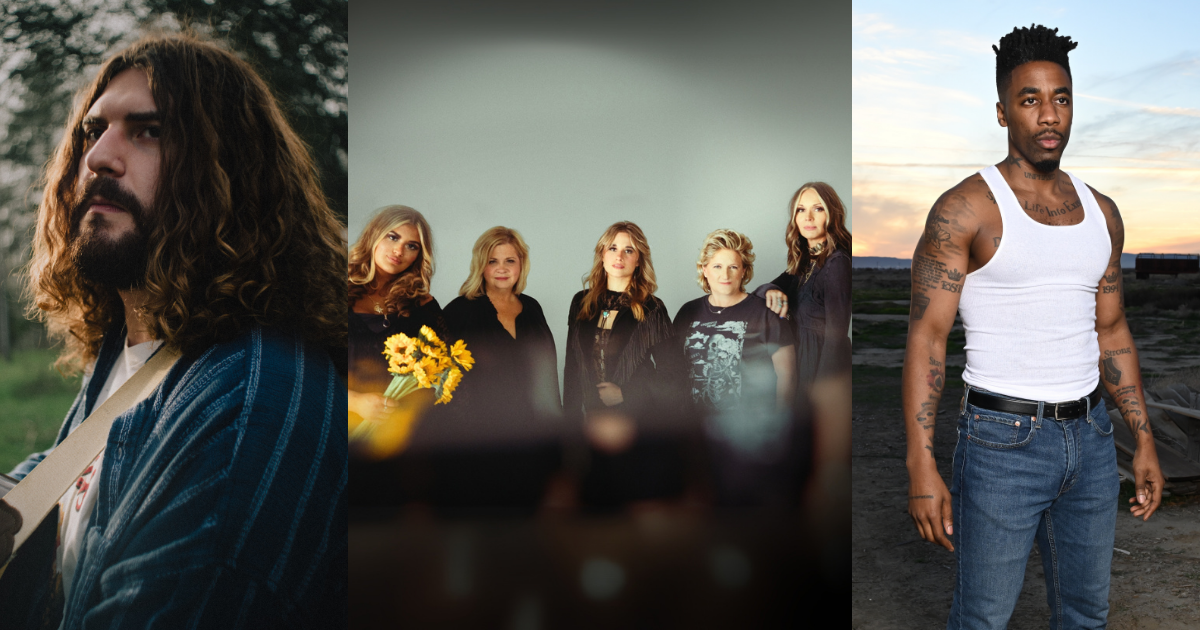
Photo Credit: (L to R) Cole Chaney by Anthony Simpkins; Sister Sadie courtesy of the artist; Dax by Annie Devine.
Additional curation and contributions by Shelby Williamson and Justin Hiltner.
In 2025, at their inaugural event, the Carrboro Bluegrass Festival attracted bluegrass fans from 13 states to an iconic venue, Cat’s Cradle, in the roots music rich area of North Carolina’s “Triangle.” Attendees enjoyed performances from artists like Jim Lauderdale, the Po’ Ramblin’ Boys, Woody Platt & the Bluegrass Gentlemen, Brownyn Keith-Hynes, Graham Sharp & Friends, Max Wareham & the National Bluegrass Team, and more.
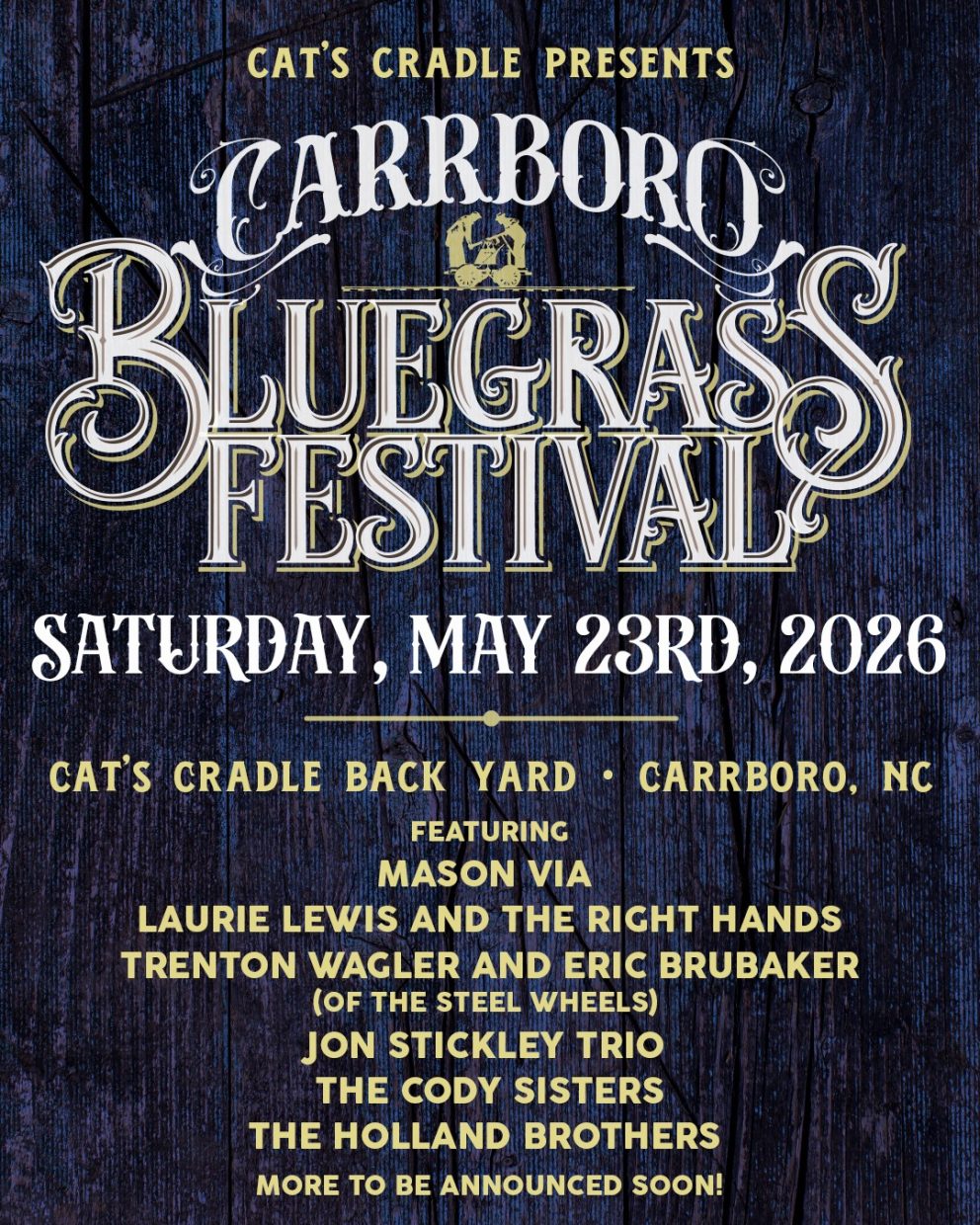
On May 23, 2026, the festival returns once again to the Cat’s Cradle Back Yard for their second annual edition of the tremendously successful event. Tickets are on sale now. This year, the lineup includes string band and bluegrass luminaries like Mason Via, Laurie Lewis & the Right Hands, Trenton Wagler and Eric Brubaker (of the Steel Wheels), Jon Stickley Trio, and more. And, for the first time in 2026, the Carrboro Bluegrass Festival is partnering with the UNC Bluegrass Initiative to support live bluegrass music in the greater Chapel Hill and Carrboro area. Plus, student members of the Carolina Bluegrass Band will open the festival.
As with all roots music events held in the fertile, artful lands of North Carolina, the very first Carrboro Bluegrass Festival wasn’t just about the performers, it was about the spirit of Carrboro itself. Connecting music, place, and communities together with intention and pride. Carrboro is full of great restaurants, shops, art, and community spaces – it’s no wonder the little town is referred to as “one of the most progressive communities in the South.”
To spotlight the town – and the music – last year the festival captured a series of exclusive, stripped-back performances at some of the town’s most historic landmarks. BGS has been proud to partner with Carrboro Bluegrass Festival since its inception, so while we look ahead to this year’s event, we’re sharing a series of four videos shot by the festival, the city of Carrboro, and the Orange County Visitor’s Bureau last year during the proceedings. Enjoy exclusive performances by Jim Lauderdale & the Po’ Ramblin’ Boys, Bronwyn Keith-Hynes, Woody Platt, and Max Wareham below.
Make your plans now to attend the Carrboro Bluegrass Festival at the Cat’s Cradle in Carrboro, North Carolina on May 23, 2026. Tickets available here.
Jim Lauderdale & the Po’ Ramblin’ Boys
Roots music renaissance man Jim Lauderdale has collaborated with hit bluegrass group the Po’ Ramblin’ Boys quite a bit over the last few years and together they’re releasing another album on April 24, 2026, entitled The Birds Know. (We recently premiered the lead single of that project, check it out here.) Last year during the Carrboro Bluegrass Festival, Lauderdale and the Boys performed “Long and Lonesome Letting Go” under an old, shady tree outside of Carrboro Town Hall, just down the street from Cat’s Cradle.
Max Wareham & the National Bluegrass Team
For our second video, Connecticut-based banjo player and singer-songwriter Max Wareham assembles his band, the National Bluegrass Team, just out front of the Cat’s Cradle to perform an original song, “Highway to Your Heart.” You may recognize Wareham from performing in Peter Rowan’s band or from his most recent album, DAGGOMIT!, released in 2025. His approach is modern but rooted deeply in traditional bluegrass, as you can tell from the energy and feel of the song.
Woody Platt & the Bluegrass Gentlemen
A godfather of bluegrass and jamgrass in North Carolina, Woody Platt brought his Bluegrass Gentlemen down from the mountains to Carrboro for last year’s festival. With them they carried along “Like the Rain Does,” the lead track off Platt’s 2024 solo release, Far Away With You. Its minor chords offer a melancholy tinge to match the rain falling in the song’s hook, but the energy and tempo of the track – especially in this live performance captured from the band’s green room trailer – give that cheery bluegrass sheen to the lyrics. Whether local, regional, or national acts the talent on display at the Carrboro Bluegrass Festival is first rate.
Bronwyn Keith-Hynes
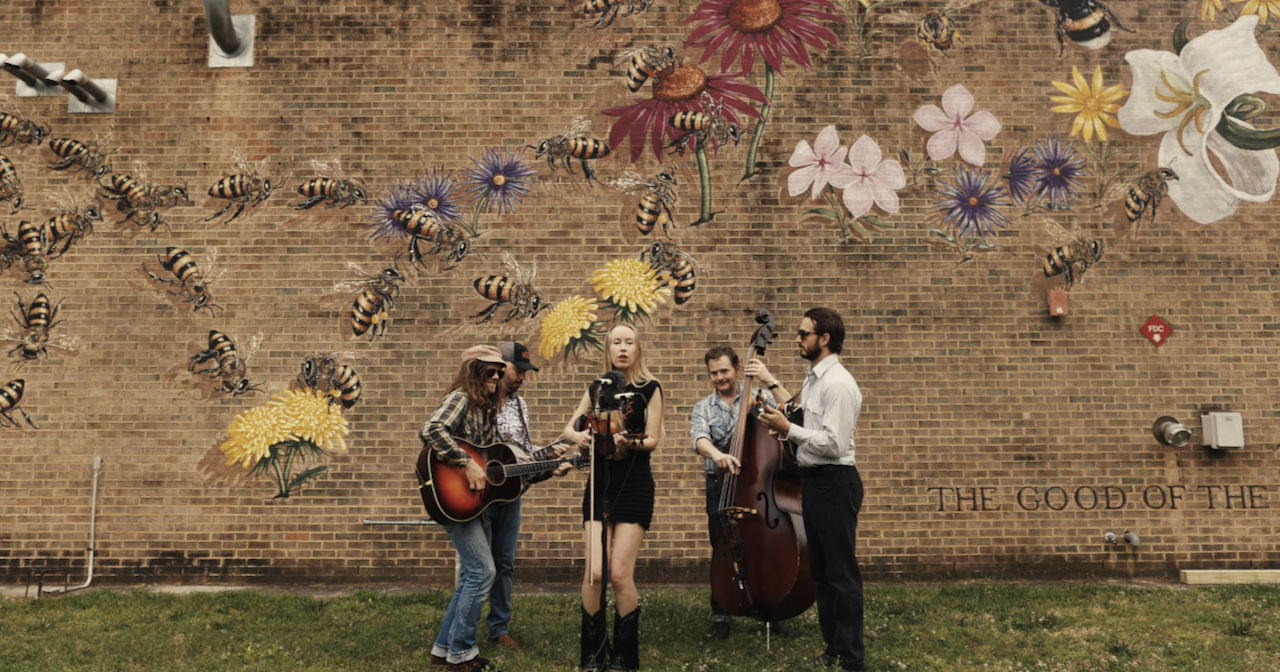
Fiddler and singer-songwriter Bronwyn Keith-Hynes has been building an impressive résumé for herself, especially since departing Molly Tuttle’s Golden Highway. Her 2024 album, I Built A World, was nominated for a GRAMMY for Best Bluegrass Album and if you’ve not had a chance to catch her live touring band recently, you’re missing out. Her groups always boast the best and brightest of young bluegrass pickers – and her lineup at the Carrboro Bluegrass Festival last year was no exception. Backgrounded by a stunning Good for the Hive mural by Matt Willey on the side of the Carrboro Fire Station, Keith-Hynes and her band are certainly impressive as they render “Virginia Gal, She’s Up and Gone” for our final video captured at last year’s festival.
If you’re in the mood for even more excellent bluegrass served up in one of the cutest and most dynamic little towns in North Carolina, don’t miss the second Carrboro Bluegrass Festival on Saturday, May 23, 2026. More information here.
This content brought to you in partnership with the Carrboro Bluegrass Festival.
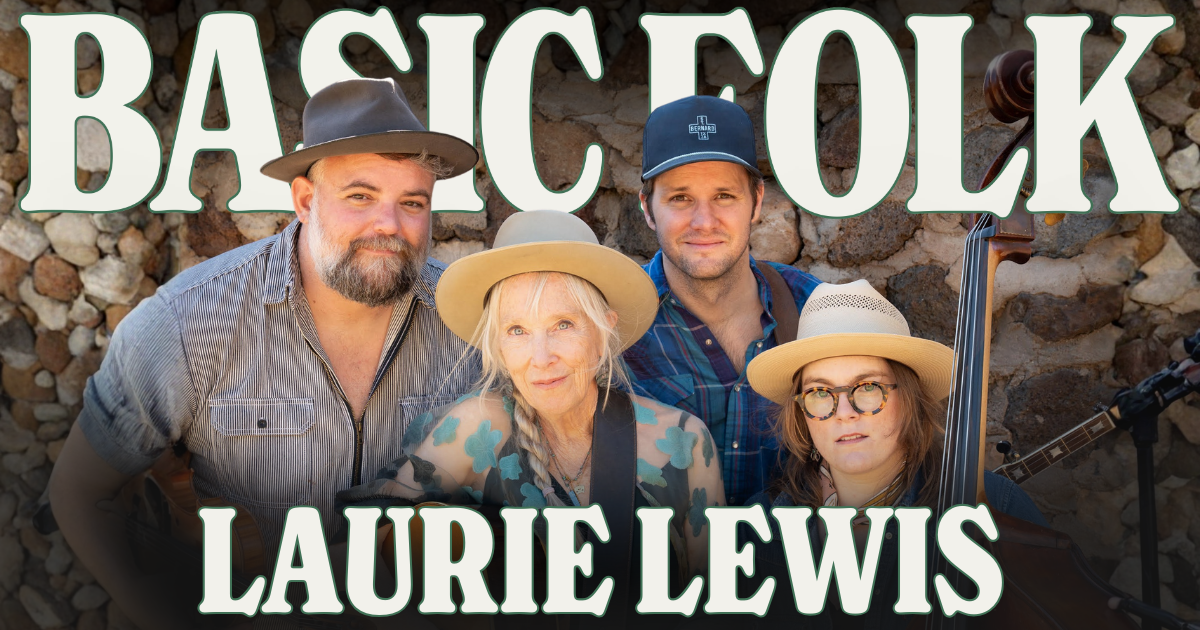
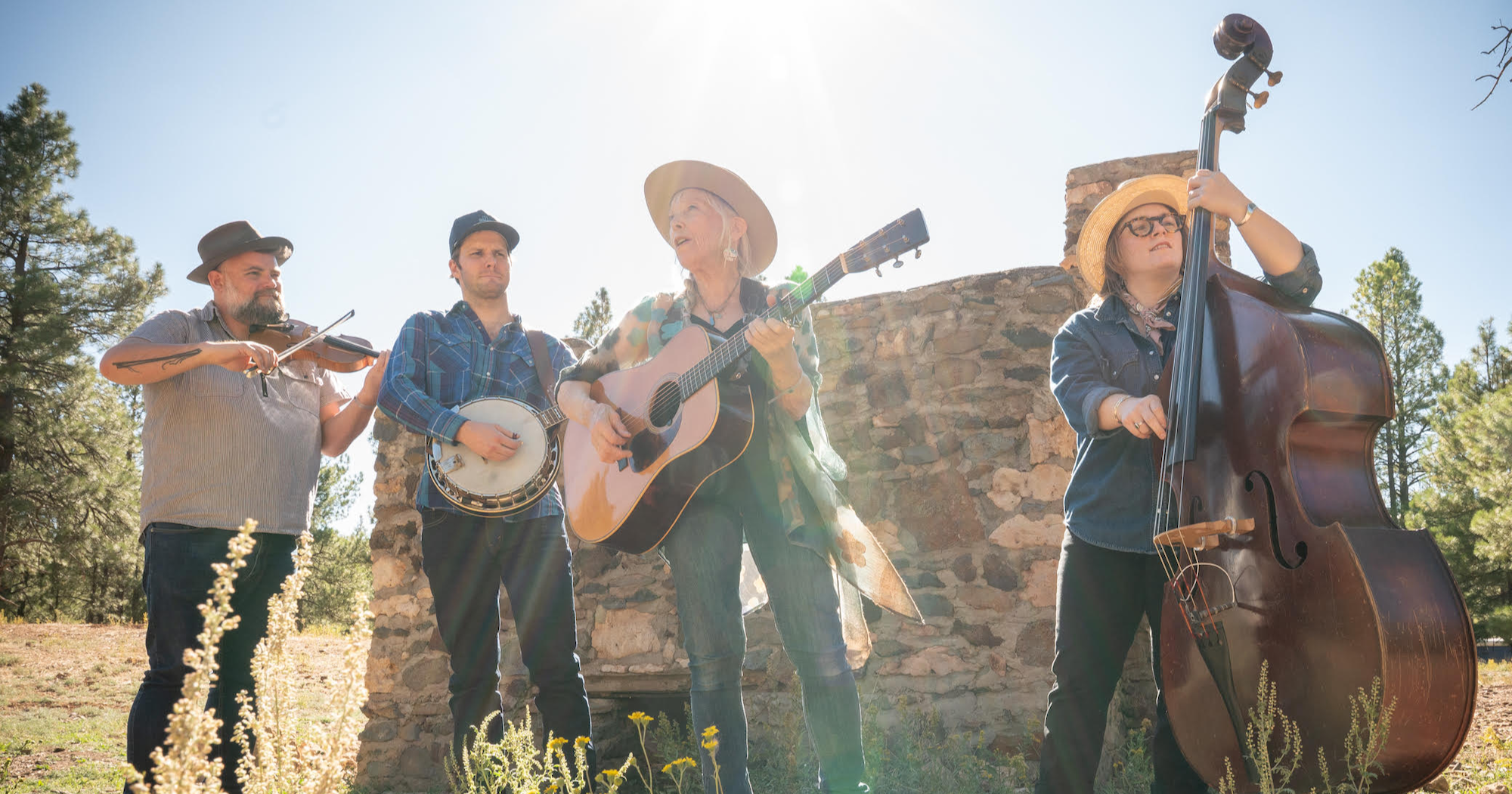
A foundational participant in the ’70s Bay Area bluegrass scene, Laurie Lewis knows the power of collaboration. She’s been a part of an ensemble in recent years that’s called Laurie Lewis & the Right Hands, with Laurie on fiddle, guitar, and vocals, Brandon Godman on fiddle, George Guthrie on banjo, and Hasee Ciaccio on bass. That group plays a huge part in her new album, O California!, a collection of songs that explore our own places in the natural world and in each other’s hearts. It also serves as a love letter to her home state. One standout track, the traditional “Fair and Tender Ladies,” is a duet with Ciaccio, which brings the song’s cautionary tale to life. In our Basic Folk conversation, Laurie talks about what it’s been like to learn traditional songs before actually catching their meaning, long after figuring out the tune.
Lewis emphasizes the communal and collaborative nature that defines her musicianship. She recounts her early exposure to music played socially when her father and his friends gathered at their home to play classical music when she was young. She credits that experience with solidifying her decision to learn to play, so she could have as much fun as they did. Laurie also opens up about her path to finding independence from her father’s expectations and her eventual return to music through modern dance and folk tradition. She touches on her passion for nature, recounting transformative hiking experiences, and reveals her thoughts on collaboration and mentorship within the music community.
Additionally, Lewis reflects on the profound impact of losing her voice in 2021 and the emotional journey of rediscovering her musical identity. We wrap up our conversation talking about her friend Alice Gerrard, whom she covers on the new album. After we hung up, Laurie emailed me an addendum about Alice that I wanted to share: “I forgot to say, when you asked me about Alice Gerrard, that I also greatly admire her community involvement in the music she loves, as evidenced by her starting and running the Old Time Herald for so many years. She’s a remarkable person. Plus, she trained her dog to fetch a beer out of the fridge for her and then put the empty can in the recycling!” Incredible.
It’s noon in the Bay Area, and singer-songwriter/multi-instrumentalist/producer Laurie Lewis is sitting in her backyard on what she describes as “a beautiful sunny day.” She spent her morning pulling up oxalis, and now she’s painting a railing she purchased at Urban Ore.
“It’s a good handrail for our front steps and along the walkway for my partner, Tom,” she says, “so I’ve been sanding it, wiping it down, and painting it.” Later during this interview, she’ll continue pulling up weeds, noting, “It’s very liberating for me, getting my hands in the dirt. It feels really good.”
The reason for today’s call is Lewis’s new album, O California! Like its predecessors, it’s an emotional palette of songs – five originals, five traditionals, and a cover of close friend Alice Gerrard’s “Sweet South Anna River” – that blend the many genres influencing her work, from bluegrass to country, jazz, and even a hint of rock. O California! features the stellar musicianship and vocals that define Laurie Lewis and her band, The Right Hands: Brandon Godman (fiddle), Hasee Ciaccio (bass), and George Guthrie (banjo, guitar).
A two-time IBMA Female Vocalist of the Year and a two-time GRAMMY nominee, Lewis is no stranger to BGS readers, as she’s been featured many times. Dedicated fans are also deeply familiar with her longtime partner, mandolinist Tom Rozum, and his Parkinson’s disease diagnosis. “He’s doing pretty well,” Lewis says. “He had spine surgery in November and he’s recovering very well from that. He had been living with intense sciatica pain for a year and a half, and the pain is gone, so that’s great.”
What would you like readers to know about O California!?
Laurie Lewis: Let’s see… all kinds of things. I wrote five of the songs on the album and they’re all over the map, so they’ll say, “She’s got a lot of different musical influences.” We’ve also drawn from the folk tradition and some great traditional songs and thrown that in the mix. It’s all done with the same four people and same four voices on beautiful acoustic instruments. Sonically, it’s really nice. You really hear the personalities of these particular four people working together. It’s what made me want to make the album.
This is album number 25 in your catalog. Artists often speak of albums as chapters in their lives. Which chapter is O California!?
This chapter is this band at this moment in time, these particular four people. I wanted to celebrate our working relationships together. It’s something that wouldn’t have happened at another time in my career, because I wasn’t working with these particular people for as long as I have been on this album. They are all on the previous album, but that was me calling all the shots. This is me settling in, listening to everybody, and trying to make a whole out of the four parts.
How did this approach make the creative process different?
Usually I come into a recording situation with more of an idea of what I want a song to sound like. This one, I came in with snippets and vague ideas for [the band] to have their way with it. We collaborated on arrangements and we listened to every idea. It’s not that I don’t listen to other people’s ideas at other times, but generally there might be more input than just three other people if I’m doing that.
I’m a collaborative artist. One of the reasons I play music is because it’s my best way of communicating in the world. And that is, for me, to an audience. But it’s also true for me to my bandmates and other musicians. It was fun to say, “We’re making a band album. This is what it’s going to be. We’re going to let people toss out songs.” “How does this sound?” “Oh yeah, great. Let’s do that.” It was, “How shall we do it?” “I’ve got an idea.” “How about if we do this?” It’s a very free and open feeling.
[The band are] all very open-eared and open-minded about the music. It doesn’t have to be the way Earl Scruggs did it, or the way Bill Monroe did it, or anything. It doesn’t have to fit into a neat bluegrass category. I’ve played with musicians in the past who have been more or less open, and all it takes is one more closed-off person to direct the band in a particular direction.
You’ve stated in the past, paraphrasing here, that writing is sometimes specific and sometimes spontaneous, sometimes it’s almost random, sometimes it’s unfinished. What was it this time, or was it some of each?
I’d say it was some of each. With the song “O California,” I was writing lyrics in the studio. I did a scratch vocal and changed the lyrics three times before I came home and overdubbed an actual vocal. That’s unusual for me, that it was in such an unformed state when I got into the studio, but it’s when we had the time and I knew the bones of it were good. Some vocal lines, some lyrics, just were not right yet, but I knew what it was about.
When did the songs start coming together as an obvious collection? Was there an intention in mind, a theme, when you all got together?
We started this project in a different way than I have other projects. We had little tours booked, so we would get together a day early before every tour, because we all live in different parts of the country. They would fly out here, we’d rehearse a song, get what we wanted down, figure it out, and then go on our tour and play it every night. We’d have a studio day booked on the day we got back from the tour, so we’d go in and record whatever we had worked out the week before and played on the tour. It was a fun way to approach a project and it spaced it out over a long period of time. It took close to a year.
When it’s spaced apart that way, how do you make it feel like a collection, rather than recording individual pieces of music?
Because it’s all us. It’s like an old friend – you can pick up the conversation right where it was. You haven’t changed your tone or your relationship with each other so drastically that it doesn’t fit together. It would be different if I were doing something like that over a year and just getting together with whoever I thought was the right person to play on a particular song. Then, the only thing that would hold it together would be my production values.
Do you still write ideas on notes, or have you tech-ed your way up to phone apps?
Oh, no. I write. I like to write with a good pen or a pencil on a piece of paper. I will make notes sometimes on voice memos, but mostly that’s it. I’m old-fashioned. I feel like there’s something that happens, the tactile feel of a writing utensil on the paper, that is easier for me to get a thought out than to sit at a keyboard. I’ve been known to still write letters, in fact.
We live in a world of texts, emojis, phone scrolling, and what’s being called “an epidemic of isolation.” Bluegrass is associated with festivals, musicians getting together and jamming, and community. Is this still true?
Oh, definitely. In fact, here in the Bay Area it’s having a real resurgence of community jamming culture. That’s always been at the basis of bluegrass. It’s what everybody wants to do – get together and let their instruments do the talking, let the songs do the talking. It’s a wonderful thing. I love it so much.
You mentor and teach at workshops and music camps, where you connect with younger and up-and-coming musicians. What do they want to know? What do they need to know?
One of the things that I try and impart to people is the importance of finding your own voice, because many young musicians have heroes they want to emulate. That’s how you learn, but at some point you have to find what you want to say with your voice and your instrument. That’s one of the things I try to emphasize and help people feel confident that they have something to say and their own way of saying it.
There is intergenerational connection at these camps and workshops, contrary to the ageism on both sides, that society seems to push: “What do those kids know?” or “What do those old people know?” What is your perspective?
There’s still a lot of that, but luckily there are enough people, young and old, paying attention and willing to listen to each other. It’s especially helpful when there are youth music camps and stuff like that, because then the kids have each other, but they also have their mentors there. They’re there because they want to learn, and it’s usually the older people who are teaching them, but then they get to be with their cohorts, their age group, and that helps a lot.
I certainly learned a lot from teaching at kids’ camps. When I first was asked to teach at a youth-oriented fiddle camp, I thought, “I can’t do that. I don’t know how to talk to kids. I don’t know anything about that stuff.” I said yes because I tend to say yes to things, and I found it to be so enlightening and so important in my life. It’s very enriching.
On a 2021 FolkWorks podcast, you talked about The Good Ol’ Persons playing a trade show luncheon years ago in front of a room full of drunk men. You described it as being “thrown to the wolves.” Many years later, how are we doing?
In terms of women musicians out in the world, there are so many more, and it is so great to see. And the technical abilities – you can’t fault it. You can put Molly Tuttle up against any guy. It’s been some huge steps forward in the time I have been in the music business, but it’s still very male-dominated from the top. It takes generations to change things like this, these ways of thinking, and now there’s a real cultural backlash happening and I don’t know how that’s going to play out. Women have made huge strides and maybe that’s just going to be taken away. Every generation has to fight the same fights, apparently.
Overall, how is bluegrass doing, to your eyes and ears?
That’s a really hard question for me to answer. Honestly, there’s a part of it that has gotten very entrenched in staying within a particular genre. I hear a lot of songs by people singing in a bluegrass style about bluegrass music, or their cabin home and I think it’s in danger of becoming a trope instead of a living, breathing art form.
Luckily, there are enough people out there creating in the art form and doing great stuff. There’s so much of everything happening all the time now that it’s going in all different directions at once. There’s good stuff and bad stuff, and it all depends on your point of view.
Who is making an important contribution, in your opinion?
I hear a few things now and again that I respond to and like a lot. I’m not very impressed with a lot of technical brilliance. I want to be made to laugh and cry, and if it doesn’t do one or the other or both, I’m not all that interested in it.
In terms of bands, Mighty Poplar can do it, and the duo Paper Wings, two young women, Emily Mann and Wila Frank, who I actually met at a fiddle camp when they were teenagers. They’re pretty wonderful. And I always like hearing what my old friends are coming up with in terms of songs and writing. I love hearing whatever 92-year-old Alice Gerrard is coming up with. She has a way of putting her finger on the pulse of what’s happening in the world and is pretty great.
In 1998, you recorded a song called “The Refugee.” Twenty-eight years later, here we are …
Oh, I know. I find it unfortunate that [that] song is still so incredibly relevant – or more relevant. I find it very unfortunate that song has not outlived its message. It’s terrible. I wrote it when Guatemala was in such bad shape, people were fleeing, and there was all this backlash. It’s an empathetic song. These days, empathy – there’s a whole movement, “empathy’s a bad thing.” It’s so crazy.
In a 2020 interview with BGS you said, “Music has a real way of being able to soothe and heal grief.” Could you talk about that healing power, not only as a songwriter, but also as a lover of music, a listener?
Oh, yeah, it’s true. I stand by that. There’s nothing like it. It’s such a direct conduit to the heart. A song can sneak in and express something for you that you had no words for. It can help you, as a songwriter, to figure out a way to express what you might be going through in a way that makes it universal. You put it out there in the world, everybody can feel it and relate to it, and it makes you feel a part of something greater than just your little dark cell that you might be stuck in, or your own personal grief.
It has helped me deal with things, with grief in my life, to be able to learn a song that makes me cry. Every time I hear it, I learn it, and it becomes part of me. It becomes part of my way of being able to express myself, or to write a song that every time I start trying to sing it, I’m in tears or something. You learn to work through your grief by embracing it musically. It’s an incremental way of dealing with things, and it’s really healing.
It’s a sense of support through the company of songs that speak to us.
Yeah. You are not alone. Especially with all the internet stuff, people spend a lot more time not with actual other humans, having conversations or whatever. To hear something, to listen and understand that other people are going through the same alienation or grief or loss, or whatever it is that you are experiencing, makes it easier to bear.
The French author Jean Giono, who wrote The Man Who Planted Trees – I wish I could find this quote – said in an essay that an artist’s duty is to express yourself for all the people who don’t have the words or the art to express themselves. It’s your duty in society, your job, to put it out there for everybody who can’t.
Ready for another batch of new songs and videos? Great! ‘Cause You Gotta Hear This.
It’s a roundup full of friendship and interpersonal connections this week. First up, Americana rockers Chamomile & Whiskey bring a new video for “Friends Are Falling Out.” In the vein of classic, folky alt-rock sounds, the track and video explore the fragility of relationships with a deep groove, distortion, and fiddle and banjo. But keep scrolling, as you’ll also find singer-songwriter Kim Moberg’s testament to the all-too-rare true friend with her new track, “I’ll Always Be A Friend.” The jangly modern folk number was born from Moberg’s desire to communicate to her old and new friends how important they are to her. The paeans to friendship continue with a new video from old-time/folk duo Paper Wings, who debuted their new single “Fumblin” earlier this week. It’s a double-guitar track about awkwardness, eagerness, and how we all stumble through life and through relationships.
There’s still more to enjoy elsewhere in our collection, too. Bluegrass icon Laurie Lewis has announced her upcoming 2026 album, O California! with a new video for “Look Down That Lonesome Road.” Lewis took the mournful ballad, wrote new verses, and set the lyric to a jammy, driving bluegrass tune that drips with her signature sounds. Plus, fiddler Andy Leftwich calls on his pal, guitarist Cody Kilby, to trade licks on a new original fiddle tune he’s just released called “Old Hickory.” You might never guess he first wrote the melody on guitar.
You won’t want to miss “The Doldrums” from New York Americana string band The Mammals. They’ve just dropped an animated video for the track from their recent project, Touch Grass, Vol. 1. The song might just be a cure for its own namesake; it’s a perfect selection to take with us into the often doldrums-heavy winter months. Finally, don’t miss a brand new single from iconic folk trio The Lone Bellow. Today they announced their upcoming record, which will release in February 2026 and was recorded in Muscle Shoals, Alabama. “You Were Living” finds the band with an expansive, resplendent sound that certainly sounds like The Lone Bellow, but steeped in the Shoals.
There’s plenty to find and enjoy in our conglomeration of new music. Scroll on for more. You Gotta Hear This!
Chamomile & Whiskey, “Friends Are Falling Out”
Artist:Chamomile & Whiskey Hometown: Charlottesville, Virginia Song: “Friends Are Falling Out” Release Date: November 19, 2025
In Their Words: “I wrote the line ‘that broken heart might just catch a break’ after meeting up with a friend of mine. She had regaled me with her latest story in a long line of bad relationships. I live in Charlottesville, which isn’t very big, and we’ve got plenty of small-town drama. The song kind of came out of some of that and the fragility of friendships. I finished writing it just before we celebrated 1,000 shows as a band.
“In preparation for the show, Marie and I did an in-studio performance at WNRN, a station we’ve long had a good relationship with. I thought it would be fun to try a brand new song. A few days later they told me that NPR Music had shared the video as their live song of the day. We felt like it must have some juice and we decided to record it ASAP. We all liked the mysterious, Southern Gothic aesthetic that we felt in the studio. Critter added the banjo on top of fiddles before laying down a glass slide part on the guitar. Marie and I grew up in Nelson County and that first Old Crow Medicine Show record, O.C.M.S., was huge in our circles and reminds me of driving around those beautiful backroads as a teenager. To have Critter put his signature sound on one of our songs was special and felt full circle.” – Koda Kerl
Track Credits: Koda Kerl – Guitar, lead vocals, songwriter Marie Borgman – Fiddle, backing vocals Bobby St. Ours – Fiddle, backing vocals Brian Gregory – Bass, backing vocals Critter Fuqua – Banjo, slide guitar, backing vocals Jesse Fiske – Baritone guitar, backing vocals Drew Kimball – Electric guitar Stuart Gunter – Drums
Video Credits: Directed by Johnny Saint Ours and Jenny Carhartt. Filmed at Dürty Nelly’s Pub
Andy Leftwich, “Old Hickory”
Artist:Andy Leftwich Hometown: Carthage, Tennessee Song: “Old Hickory” Release Date: November 21, 2025 Label: Mountain Home Music Company
In Their Words: “Every once in a while, you sit down with your instrument, a melody just falls out, and within a few minutes you have a fun, catchy melody! This is exactly what happened to me with this song. Even though it’s a fiddle tune, I actually wrote it on my guitar. After a few small changes to the melody, I finally landed on something that flowed well under the fingers – not only for the fiddle, but the lead guitar part as well. I was honored to have my good friend, Cody Kilby, take the lead guitar on this one! It’s so much fun to play and was named after ‘Old Hickory,’ a town near where I live.” – Andy Leftwich
Track Credits: Andy Leftwich – Fiddle, mandolin Byron House – Upright bass Cody Kilby – Acoustic guitar Matt Menefee – Banjo
Laurie Lewis, “Look Down That Lonesome Road”
Artist:Laurie Lewis Hometown: Berkeley, California Song: “Look Down That Lonesome Road” Album:O California! Release Date: November 21, 2026 (single/video); February 13, 2026 (album)
In Their Words: “I have been playing around with this song since I heard Gaither Carlton sing it decades ago as a mournful ballad. I love it that way, but it seemed to me that sometimes parting needn’t be so sad, if you know you get to meet again (maybe at a festival next year). I started writing verses for it and when I got up to about eight or ten, I decided it was time to get serious. I love the loose arc of the story and the way the band responds to it. We winnowed down the verses to the essentials, leaving the others for the extended jam version.” – Laurie Lewis
Track Credits: Laurie Lewis – Lead vocals, acoustic guitar Brandon Godman – Fiddle George Guthrie – Banjo, harmony vocal Hasee Ciaccio – Double bass, harmony vocal
Video Credits: Produced and directed by Bria Light. Recorded at the Strawberry Music Festival in Grass Valley, CA.
The Lone Bellow, “You Were Leaving”
Artist:The Lone Bellow Hometown: Nashville, Tennessee Song: “You Were Leaving” Album:What a Time to Be Alive Release Date: November 21, 2025 (single); February 13, 2026 (album) Label: Thirty Tigers
In Their Words: “‘You Were Leaving’ is a song about the fleeting, transient nature of life. For us, the song is deeply personal, but it also feels universal. It invites people to find their own story in it, what it means to say goodbye, and what stays with us long after the leaving.” – The Lone Bellow
The Mammals, “The Doldrums”
Artist:The Mammals Hometown: West Hurley, New York Song: “The Doldrums” Album:Touch Grass, Vol 1 Release Date: November 1, 2025 Label: Humble Abode Music
In Their Words: “I wrote ‘The Doldrums’ during a stretch of isolation when joy felt out of reach and time moved so strangely. ‘Why do the good times go so fast? Why do the doldrums linger and last?’ We tend to remember the hardest part of the day when we lay down to sleep, but this song reminds me to appreciate every amazing moment. I’m grateful this recording sounds triumphant and energized – like an anthem to shake out of a low vibration and shine a bright light into the future. For all who listen, may music and friendship help carry you through the next windless day. The Mammals have your back.” – Ruth Ungar
Track Credits: Ruth Ungar – Vocals, guitar, songwriter Mike Merenda – Guitars, banjo, vocals Brandon Morrison – Bass, vocals Will Bryant – Keys, vocals Tim Morrison – Drums
Video Credits: Animated and Directed by Anne Beal.
Kim Moberg, “I’ll Always Be A Friend”
Artist:Kim Moberg Hometown: Cape Cod, Massachusetts, the traditional territory of the Indigenous Nauset and Wampanoag Nations Song: “I’ll Always Be A Friend” Album:All That Really Matters Release Date: January 30, 2026 (album)
In Their Words: “As an artist who grew up listening to the amazing singer-songwriters of the 1970s, Carole King’s ‘You’ve Got A Friend’ is embedded in my heart. I love that her song and its message about connection, support, and loyalty have endured all of these many years. I was a military ‘brat’ who attended 10 different schools in 12 years, so growing up I never lived in one place long enough to be part of a friend group or a clique. I was always ‘the new kid’ who was never included. The rare true friend meant more than gold to me.
“‘I’ll Always Be A Friend’ was born from my desire to share how important the friends in my life have been and how equally important the new friends I get to connect with through performing are to me. In these uncertain and trying times, community and friendship are paramount. (And Libra loyalty lives strong in this song!)” – Kim Moberg
Track Credits: Kim Moberg – Lead vocal, acoustic guitar Jon Evans – Bass, tenor guitar, drums, percussion, Fender Rhodes, harmony vocals
In Their Words: “‘Fumblin’ is about friendship and watching one another stumble and fumble through the joys and trials of life. We wrote this one together in the backyard in a sort of trance state, describing scenes from our lives. It’s definitely a romanticization of awkwardness and our eagerness to connect as a species despite inevitable failure at times. We played double guitars on this one which we’ve been having fun doing lately. It’s the first track in the world of ours that I recorded and mixed in my studio in Nashville, so that’s quite exciting as well. We have a lot more music coming from this space, so look out!” – Wila Frank
Video Credits: Filmed by Sami Braman, edited by Wila Frank.
Photo Credit: The Lone Bellow by Debbie Ewing; Laurie Lewis and band by Dawn Kish.
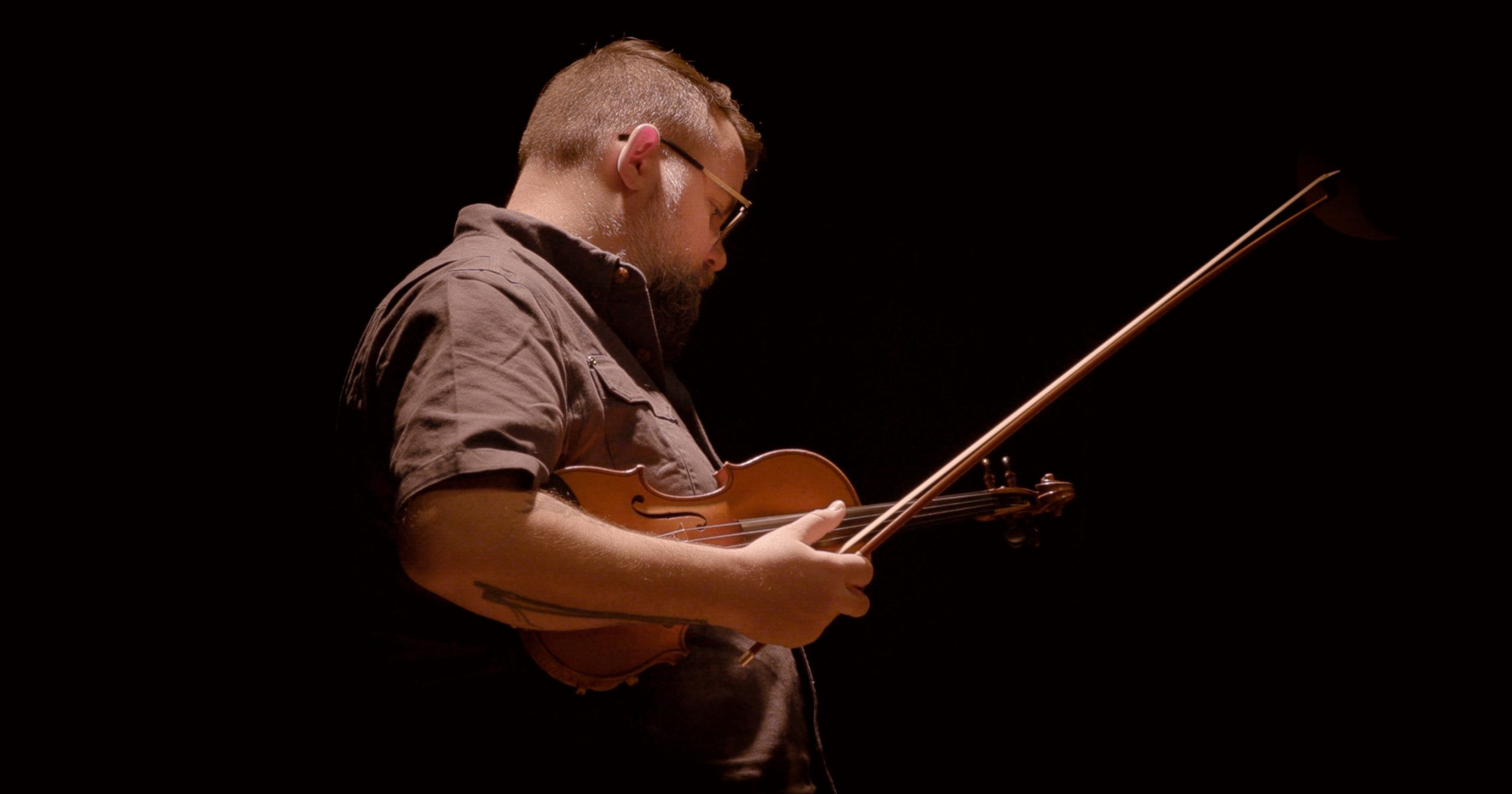
Bluegrass and country fans may recognize Kentucky-born, San Francisco-based fiddler Brandon Godman from touring, recording, and performing with folks like Dale Ann Bradley, Laurie Lewis, Jon Pardi, the Band Perry, the Music City Doughboys, and many more. He’s also an accomplished business owner and luthier, helming two fiddle repair and retail shops based in Nashville (The Violin Shop) and the Bay Area (The Fiddle Mercantile.) In addition, Godman helped found Bluegrass Pride and was instrumental in organizing the non-profit association’s float and marching contingent that won the coveted “Best Overall” ribbon from the 2017 SF Pride Parade.
Godman has played fiddle his entire life, beginning on the instrument as a young child in Northern Kentucky. His skills span old-time, bluegrass, western swing, country, contest fiddle, and beyond, and his career, by necessity often, has been remarkably varied, boasting stories of success, trials, tribulations, and highs and lows beyond his years. Now, filmmaker Bria Light has crafted a remarkable, heartfelt, and stunning documentary short all about Godman and his journey on and with the fiddle.
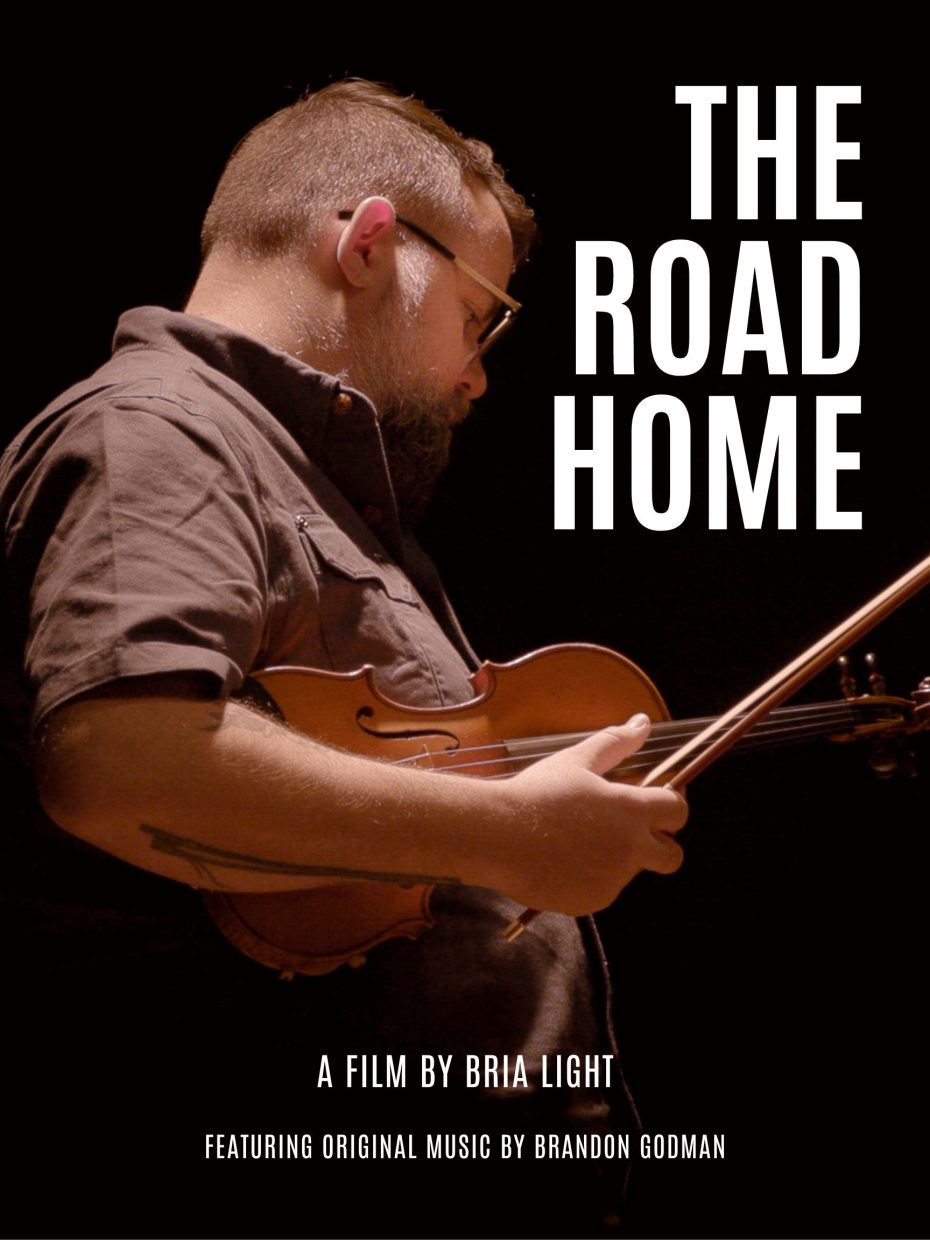
Shot and crafted in 2022 and 2023 as Light’s thesis film at UC Berkeley’s Graduate School of Journalism, The Road Home is an intimate and gorgeous look at Godman and his relationship with his instrument, his career path, and his rural home in Kentucky. The film includes lovely original music – much drawn from Godman’s acclaimed 2024 solo album, I Heard the Morgan Bell – that offers many varied samples of his expansive skillset on fiddle throughout, a perfect score and soundtrack for the 20 minute-plus documentary. Together, Light and Godman travel from California to Kentucky, visit with Godman’s family, share old memories and stories, and examine the complications and intricacies of family and community, the transient, intangible nature of “home,” and the pains and reliefs of leaving and returning.
Now, for the first time, The Road Home is available to screen online, right here on BGS and on YouTube. (Watch below.)
Light has a deft and artful touch as a filmmaker and director, utilizing the fiddle and Godman’s original compositions as an enormous character in these narratives, propelling the story forward and entrancing viewers with the sights, sounds, textures, and mythos of Northern Kentucky – as could only be delivered by a musician and creative like Godman. The end result is moving and illuminating, subverting expectations of the region, the instrument, the genres we associate with the fiddle, and the communities we expect – or don’t expect – to love these traditions and the people who keep them alive.
We spoke to Light via email about the film, its conception and making, and the twists and turns along the way that led Light and Godman to this stellar piece of visual, aural, and narrative storytelling.
Let’s begin by going back to the beginning. Can you tell us a bit of the story of how this film project came to be? What inspired you and how did you get connected with Brandon?
Bria Light: I made this film for my thesis film in the documentary film program at UC Berkeley’s Graduate School of Journalism and when it came time to look for a story that I would be spending all year working on, I knew I wanted a story that was music-related. But I also wanted to find a story that revealed something deeper about how music can help us find our way through the sometimes fraught path of being human. I eventually got connected with Brandon, who agreed to let me into his life and tell me this slice of his story.
This film tells such an expansive story in a relatively short amount of time. What was it like trying to condense such an interesting and often complicated narrative into this short film “package”?
I’ve sometimes used the metaphor that making a film feels like having the vast expanse and depth of the ocean stretching out before you and your job is to chart the best course from continent to continent. It can feel overwhelming! At every turn there are not only creative decisions to be made (What part of this person’s complex life do I focus on? Do I shoot this scene? Do I interview that person?), but also ethical ones (Who is affected by telling this story and how? Should I or should I not reveal someone’s identity? What impact am I hoping for this film to have and how is that best served?).
While you’re finding and crafting the story, it’s not always self-evident what the best, most meaningful storyline is and you want to explore a million different possible paths. You end up with hours and hours of footage (the ocean) that you have to fully explore to find the best course. And the thing is, you have to try things out to see if they work in a movie and until that golden moment where something works, it, well, doesn’t work. So it is a process of months – or years for feature docs – of trial and error, during much of which you suspect you might be terribly lost at sea and had no business becoming a sailor in the first place, to follow the metaphor… until one fine day you’re like, “Land ho!” and things start coming together and you can sleep again at night. [Laughs]
I feel like you let the music itself, and the tradition of fiddle music and roots music, do a lot of the storytelling here. What is it like translating music to a visual media like film in this way and leveraging it to help advance your narrative?
Absolutely. One of the key elements of my vision of the film from the beginning was to leverage the richness of this musical tradition and Brandon’s music within that to assist in telling his personal story. In fact, I pictured the music almost as a character itself. Music, of course, is a storyteller, even when it doesn’t have lyrics. So thinking of the music almost like the narrator of the story felt very natural.
Of course, Brandon creating his album of original tunes, I Heard The Morgan Bell, is part of the film’s narrative as well, so it all tied together organically. Additionally, since part of the film delves into the past and the creation of the album was the part of the story that was unfolding in the present, it helped provide a narrative thread to follow and to tie Brandon’s musical and personal evolution together from his past to his present.
Can you tell us a bit about what it was like traveling to Kentucky with Brandon?
It was very, very cold! Our trip to Kentucky took place over Christmas week and it just so happened to be during a cold snap that swept the entire country. It was in the single digits temperature-wise, in the negatives with wind chill, and the roads were covered in thick ice. I had envisioned going there and shooting scenes on the family farm with golden winter light sparkling in the crisp air, etc., and instead there was roaring wind so bitterly cold that you could barely be outside for two minutes before your fingers were completely numb. At one point, my camera was having some issues because it was so cold! But of course we filmed mostly inside and Brandon’s family was so warm and welcoming. I ate a copious amount of Mamaw’s famous chocolate peanut butter squares!
The music of the film is so stunning, and some of the selections went on to be included on Brandon’s 2024 album, which you mentioned already, I Heard the Morgan Bell – it was one of our favorite bluegrass albums of last year. Was there a “music supervision” process for the film? Did you leave it up to Brandon? What was it like collaborating on what would become the soundtrack and soundbed for your visuals?
Brandon was so generous in granting me permission to select music from his album, which was still in process, to use for the film. Through the course of our many hours of conversation over the year, he told me many of the stories behind the songs, of the inspiration and ideas that led to their creation. So I used that, along with the general feel and mood of the tune, to inform my choices as to which pieces to include where. Normally, you’re right, there would be a music supervision process, but in this case I had the privilege of working directly with Brandon, who was essentially also the film’s composer!
Do you have a favorite moment in the film? Or from the process of crafting it?
Hmm, there are so many memories attached to the creation of this film! I loved filming and editing the “Morgan Bell” scene in the church. The music is so gorgeous and I knew I would love filming in low light with stained glass church windows as the container for that wordless song that expresses so much emotion.
I also loved the moment in the editing process where I found the old footage of Brandon as a young teen on a local TV show. In Kentucky, his parents had given me a paper bag full of photo albums and old VHS tapes of Brandon at fiddling contests and other things to go through and see what I could use. Late one night, after a full day on campus, I headed back to the edit rooms in the journalism school to continue digitizing and going through the old VHS tapes. I got to one tape, began watching it, and it seemed to be all recorded re-runs of Days of Our Lives. After fast-fowarding through so many episodes of Days of Our Lives, I was wondering if that tape had been mistakenly included. I was about to stop when suddenly it cut to the footage of Brandon on the local TV station. It ended up becoming of my favorite scenes in the film, thanks to the very enthusiastic TV show host and a young, guileless Brandon.
Another favorite part of making the film was simply working with Brandon and getting to know him throughout our many conversations together. He’s such an old soul was a joy to work with, which is of course not always the case when making a film about someone’s real life. He was always open and willing to go along for the ride, despite the vulnerability required.
Filmmaker Bria Light, creator and director of ‘The Road Home.’
Maybe it’s an obvious question to ask, but what’s your goal? Making such an incredible and involved piece of art is goal enough, but where do you hope to take this film? How are you thinking about getting it in front of audiences? What’s next for the project?
I had several goals: I hoped some people might see a bit of themselves in the story and feel that they, too – despite having been made to feel othered in the past – belong in bluegrass and country music, that this music can be a home for everyone.
I also hoped that people would see Brandon’s story and say, “Wow, I didn’t realize there were still folks facing this type of persecution in the music industry.” This wasn’t so long ago. And unfortunately, as we all know, we are seeing today the continuation and resurgence of anti-LGBTQ laws and bigotry all over the country and the world. Another hope I have for the film is that by sharing stories that elevate the depth and humanness of the characters onscreen, folks from all sides of the political spectrum might, over time, begin to think about these issues in a new light.
What’s next? Recently the film screened to lovely and engaged audiences at the Sebastopol Documentary Film Festival and next it will play a bit farther from home at the Sound on Screen Film Festival in South Africa. I’m also hoping to show the film at music events or conferences, to continue to share Brandon’s story with audiences around the country.
What did you learn during the making of The Road Home that was unexpected? What will you take with you into future projects – whether in a similar vein or in another space entirely?
I learned so much! I learned the importance of finding that balance of pre-planning and knowing what the story is about while at the same time going with the flow of real-life, nonfiction storytelling – that is to say, you can’t actually predict how life is going to unfold, so you have to hold your preconceived ideas in one hand, while leaving room for the story to reveal itself to you as it unfolds in real time in the other. One thing I “learned” (in quotation marks because I’m still learning it…!) is to trust the creative process, with its highs and lows, self-doubts, rewarding moments, and ultimately, you find that you have gotten to the end of your creative process and survived! There are really too many things I’ve learned that I’ll be taking with me into future projects, so I’ll just leave it there for now.
Our partnership with our friends at Real Roots Radio in Southwestern Ohio concludes as we wind down our weekly celebration of Women’s History Month. We’re proud to have brought you four collections of a variety of powerful women in bluegrass, country, Americana, folk, and elsewhere who have been featured on Real Roots Radio’s airwaves each weekday in March, highlighting the outsized impact women have on American roots music. You can listen to Real Roots Radio online 24/7 or via their FREE app for smartphones or tablets. If you’re based in Ohio, tune in via 100.3 (Xenia, Dayton, Springfield), 106.7 (Wilmington), or 105.5 (Eaton).
American roots music, historically and currently, has often been regarded as a male-dominated space. It’s certainly true of the music industry in general and these more down-home musics are no exception. Thankfully, American roots music and its many offshoots, branches, and associated folkways include hundreds and thousands of women who have greatly impacted these art forms, altering the courses of roots music history. Some are relatively unknown – or underappreciated or unsung – and others are global phenomena or household names.
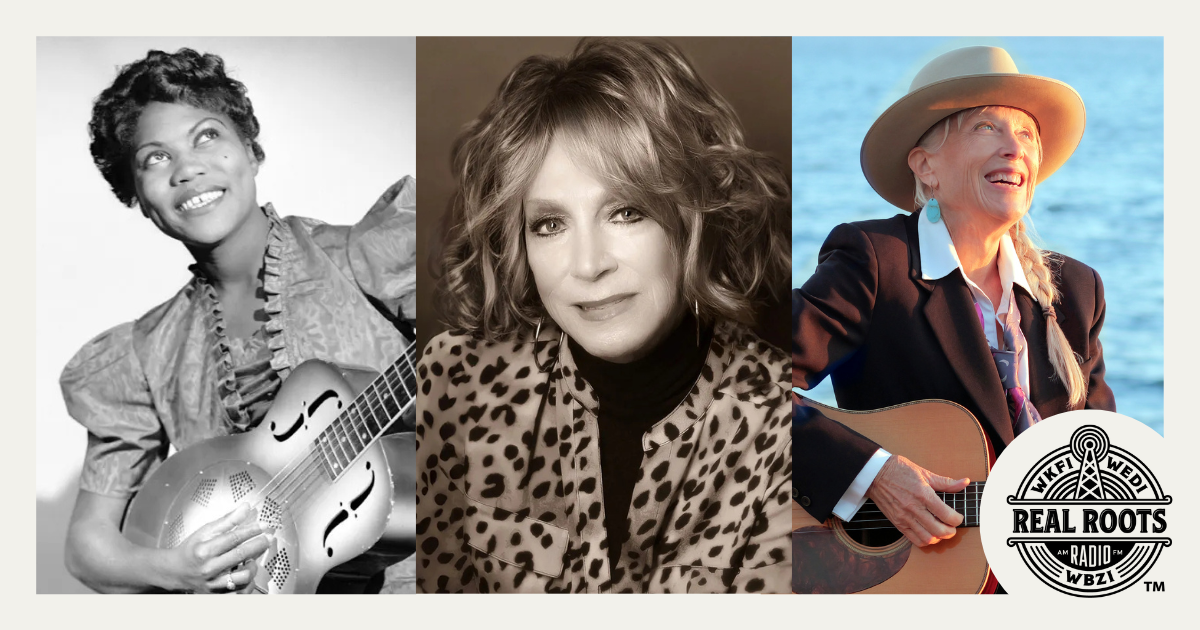
Over the last few weeks, radio host Daniel Mullins, who together with BGS and Good Country staff has curated the series, has brought you just a few examples of women in roots music from all levels of notoriety and stature. Week one featured Dottie West, Gail Davies, and more. Week two shone a spotlight on Big Mama Thornton, Crystal Gayle, Rose Maddox, and more. Week three, paid tribute to Emmylou Harris, Wild Rose, Mother Maybelle, and more. This final installment of the series celebrates Laurie Lewis, the Coon Creek Girls, Amanda Smith, Sister Rosetta Tharpe, Petticoat Junction, and Jeannie Seely.
Plus, you can find two playlists below – one centered on bluegrass, the other on country – with dozens of songs from countless women artists, performers, songwriters, and instrumentalists who effortlessly demonstrate how none of these roots genres would exist without women.
Laurie Lewis (b. 1950)
A GRAMMY-winning singer, songwriter, and fiddler, Laurie Lewis is a California native who has been blazing trails in bluegrass for over four decades. She became enamored with folk music after attending the Berkeley Folk Festival in her youth – she has since made an indelible mark on American roots music with her work in bluegrass and beyond!
Whether leading her band, Laurie Lewis & The Right Hands, performing solo, or collaborating with her pal Kathy Kallick – with whom she helped found the Good Ol’ Persons in 1970s, pushing norms in the process – Laurie’s soulful vocals and skilled fiddle work have made her a standout in bluegrass for a lifetime. Her songwriting paints vivid pictures of love, loss, and the land, while her honest voice pulls at the heartstrings, earning her two IBMA Female Vocalist of the Year awards.
Her recording of “Who Will Watch the Home Place” was named IBMA’s Song of the Year in 1994 and has touched hearts for generations. It’s a certified bluegrass classic and is still a staple on bluegrass radio programs. Another beloved composition, “Love Chooses You,” has been recorded by Laurie, Jeannie Kendall, Kathy Mattea, and more.
Laurie Lewis isn’t just a performer – she’s a mentor, a producer, and a keeper of the bluegrass flame, not only by encouraging the next generation of bluegrass music makers, but also by shining a light on significant voices of the past like Vern & Ray and Hazel & Alice. This West Coast bluegrass leader was honored by the IBMA with their Distinguished Achievement Award in 2024.
We’re heading back to the 1930s with an all-female string band that made history, the one and only Coon Creek Girls! It was 1937 when talent scout and radio pioneer John Lair formed the Coon Creek Girls for the Renfro Valley Barn Dance radio show on the airwaves of Cincinnati’s WLW. Led by the talented Lily May Ledford on banjo alongside her sister Rosie, Esther Koehler, and Evelyn Lange, these ladies brought high-energy mountain music to the masses.
Their popularity on radio brought opportunities to tour around the Midwest and even record in Chicago. They didn’t just play, they broke barriers! In 1939, First Lady Eleanor Roosevelt selected the Coon Creek Girls to perform at the White House for President Franklin D. Roosevelt and the King and Queen of England. A hillbilly band of women? Unheard of at the time! But they proved talent knows no boundaries.
The Coon Creek Girls would be an influence on folks like Cathy Fink, Suzanne Edmondson (of The Hot Mud Family and Dry Branch Fire Squad), and even Pete Seeger. While the historic group would disband in the 1950s, John Lair would revive their legacy decades later by helping pull together another all-female bluegrass band to again perform at the Renfro Valley Barn Dance (which had relocated to Mount Vernon, Kentucky, becoming a popular country music tourist destination for decades). With the blessing of Lily May Ledford, this new act was called The New Coon Creek Girls and would make music consistently for nearly twenty years, helping springboard the careers of Pam Perry and Pamela Gadd (of Wild Rose), Wanda Barnett, Vicki Simmons, Deanie Richardson, Dale Ann Bradley, and more.
The Coon Creek Girls inspired generations, proving women belonged in country and bluegrass. Their legacy lives on in every banjo-pickin’ girl who follows in their footsteps!
Amanda Smith’s voice soars like the mountains of West Virginia from which she comes. She has been a force in the bluegrass world for years. Amanda met her husband Kenny in the mid ’90s at a Lonesome River Band concert (he was playing guitar with LRB at the time). Not only did Kenny fall in love with Amanda, but he fell in love with her voice as well.
Kenny would leave LRB at the turn-of-the-century and he and Amanda would form the renowned Kenny & Amanda Smith Band, a duo celebrated for their tight harmonies and masterful musicianship. They were named Emerging Artist of the Year by the IBMA in 2003 and they haven’t slowed down since. With a sound built on Amanda’s gripping vocals and Kenny’s exquisite guitar work, they have been a staple of the bluegrass world for nearly twenty-five years, racking up many #1 hits on bluegrass radio and frequently seen on stages across the country – both as a duo and with the Kenny & Amanda Smith Band.
Their band has also introduced bluegrass audiences to some of the top pickers of today’s generation, including Jason Davis, Zachary McLamb, Cory Piatt, and Alan Bartram (Amanda’s brother-in-law). Whether delivering beautiful ballads or bluegrass barnburners, Amanda’s voice is one of the most beloved in the genre today, leading to multiple awards, including the IBMA Female Vocalist of the Year honor in 2014. From festival stages to radio waves, Amanda Smith continues to leave a lasting mark on bluegrass.
The Godmother of Rock ‘n’ Roll, Sister Rosetta Tharpe was one of the most influential artists of the 20th century. Born in 1915, Tharpe was shredding on an electric guitar before rock even had a name! With a gospel heart and a rock and roll soul, she fused spirituals with electrifying riffs, paving the way for Chuck Berry, Elvis, and even Jimi Hendrix. Her hit, “Strange Things Happening Every Day,” was one of the first gospel songs to cross over to mainstream charts and is pointed to by many as the first rock and roll record, proving that faith and fiery licks could share the stage.
The juxtaposition of performing her powerful gospel songs in smoky barrooms is the stuff of legend. Her gospel hits like “This Train,” “Down by the Riverside,” “Up Above My Head,” and “The Lonesome Road” are still revered and helped shape the musical identity of artists as diverse as Johnny Cash, Elvis Presley, Tina Turner, Jerry Lee Lewis, Rhiannon Giddens, and more. Despite being a woman in a male-dominated industry, she didn’t just break barriers – she smashed them! Sister Rosetta Tharpe was posthumously inducted into the Rock and Roll Hall of Fame in 2018.
A bluegrass festival mainstay of the ’80s and ’90s, Petticoat Junction was a popular all-female traditional bluegrass band that helped open doors for some of today’s “girl groups” like Della Mae and Sister Sadie. In fact, there are several direct connections between Sister Sadie and Petticoat Junction. Not only was Sadie banjoist Gena Britt a member of Petticoat Junction (primarily playing bass), but reigning IBMA Female Vocalist of the Year Jaelee Roberts has followed in her mother’s footsteps. Andrea Mullins Roberts was an anchor of Petticoat Junction’s sound with her rich, traditional voice and strong guitar playing before becoming a respected booking agent, manager, and behind-the-scenes businessperson in today’s bluegrass industry.
One of the most celebrated lineups of Petticoat Junction featured Robin Roller (banjo) and Gail Rudisill-Johnson (fiddle) alongside the aforementioned Andrea and Gena. This particular four-piece ensemble released a pair of great albums for Pinecastle Records in the early ’90s, in addition to touring heavily at festivals from coast-to-coast. Deriving their name from the popular ’60s sitcom (whose theme song would be a hit for Flatt & Scruggs), their heartfelt vocals and instrumental prowess shone brightly, whether on original songs or on material from the likes of Jimmy Martin, Reno & Smiley, Flatt & Scruggs, and more.
In addition to continuing to open avenues for other all-women bands, Petticoat Junction’s influence is still being felt in the 21st century as they’ve influenced acts like Flatt Lonesome and Starlett & Big John.
From the bright lights of the Grand Ole Opry to the heart of country music, today we’re tipping our hats to “Miss Country Soul,” Jeannie Seely! Born in Pennsylvania, but a Nashville star through and through, Jeannie Seely made history in 1966 with her Grammy-winning hit “Don’t Touch Me,” an envelope-pushing and controversial song due to its featuring a woman expressing sexual desires. With her bold style, unmistakable voice, and trailblazing spirit, she became a beloved icon in country music.
Seely shattered barriers, becoming the first performer to wear a miniskirt on the Opry stage (among other fashion trends she helped bring to country music), being the first woman to host an Opry segment, and fiercely advocating for women in country. Jeannie’s also a respected country music songwriter, writing hits like “Leavin’ and Sayin’ Goodbye” (Faron Young), “He’s All I Need” (Dottie West), “Enough to Lie” (Ray Price), and more; folks like Merle Haggard, Rhonda Vincent, Connie Smith, Ernest Tubb, and Little Jimmy Dickens have recorded her songs over the years.
More than 50 years later, Jeannie is still gracing the Grand Ole Opry stage, holding the record for the most Opry performances ever – 5,200+ appearances and counting! Just as Dottie West encouraged her when she was a young country artist, Jeannie is constantly investing in the future of country as a dear friend and mentor to her Opry sisters, like Carly Pearce and Rhonda Vincent, and even to the young bluegrass band, Cutter & Cash and The Kentucky Grass. She proves that true country never fades. So here’s to Jeannie Seely – an icon, a trailblazer, and a country legend who continues to shine!
When you wake up in a world where hatred and fascism have been resoundingly endorsed by so many of your neighbors and fellow citizens, how do you proceed? That question becomes even more daunting at its second or third or umpteenth asking.
Yes, music will play a vital role over the next handful of years, as we continue the fight for justice, self-determination, and agency for all people, in the U.S. and around the world. But music, the arts, and creativity won’t be enough to save us. They won’t be an end-all, be-all solution to the political and cultural hurdles we will have to clear in the near future.
This is a moment that calls for so much more. Solidarity, first and foremost – the idea that, at the beginning or end of the day, all we have is each other – and community, organizing, and advocating for each other will be essential. Mutual aid will be more necessary than ever. Putting our own privilege on the line in order to protect and ensure safety for those more marginalized than ourselves is the task immediately at hand. Showing up – yes, for our country, but more importantly, for our friends and neighbors – is the very next step. Literally and figuratively.
Still, the soundtrack we will all write, that we will all curate, that we will all partake in while opposing the craven and hateful policies being proffered by our would-be dictator will be a powerful tool. Music – especially roots music, country and bluegrass, blues and old-time, folk with a lowercase and capital F, and more – are traditions steeped in populism, in worker’s rights, in justice, in standing up for the downtrodden and beleaguered. There are no better genres for this exact moment. There are no betters artists, musicians, and songs than those in and made by our very community.
BGS and Good Country include in our mission a commitment to intentionally crafting a roots music space, a bluegrass- and country-centered universe, where everyone is welcome, regardless of identity, background, nationality, ethnicity, disability, class, or belief system. We are determined to continue that work, to be a place where – hopefully – anyone and everyone can feel seen, heard, safe, and valid in their love for and appreciation of all things roots music.
As we summon courage for the work ahead and lean on our community, here are eight songs perfect for this exact moment in history, to hold up as we remind ourselves our goals are the same at the end of this week as they were at the beginning: liberty, agency, and self-determination for all. – TheBGS & Good Country Team
“Mercy Now” – Mary Gauthier
A modern Americana classic, singer-songwriter Mary Gauthier shared “Mercy Now” on social media very early on Wednesday morning, after the news broke that Trump had won another term. It spread quickly on social media with many a repost and reshare. The message here, of mercy applied broadly, universally, and without qualification, is more than timely. It’s evergreen.
“Crisis” – Aoife O’Donovan
Connecting our current struggle to those of past generations is exactly how we continue to put one foot in front of the other, despite setbacks and losses and despair. Aoife O’Donovan’s latest record, All My Friends, is a perfect intergenerational connecting of the dots, centering women, girls, and femmes, and shines a light on the non-linear track that leads to victory. We know we will continue to return to this music over and over in the future, as a balm and a catalyst for progress.
And, as our friends at Basic Folk reminded us yesterday, Aoife’s and Dawn Landes’ episode of the podcast – which focuses on their similar albums centering women, feminism, and women’s issues – is an incredibly timely re-listen. Find that episode here.
“Sun to Sun” – Alice Gerrard
Looking to our roots music elders in this moment is exactly what we all need! Alice Gerrard’s most recent album, Sun to Sun, and certainly its title track, indicate a kind of perseverance and long view that we all could take on as we face the uncertain future.
With a loping, almost marching rhythm, there’s a grounded, realistic, and convicting approach here on “Sun to Sun.” While we all talk, and talk, and talk, and talk, the problems we face continue unabated and unchallenged. What will we do besides talk?
While we talk another fool goes and buys a gun…
“Listen” – Kyshona
Speaking of talking… why don’t we take a turn at listening? The challenge has been set by Kyshona, a powerful and restorative singer-songwriter and activist who channels her ancestors, connects generations, and builds community with every note and every word sung. Originally released in 2020, “Listen” is just as encouraging now as it was then, and just as indelible in its striving for a better, more compassionate world. Media, social media, and the internet all incentivize us to speak, to center ourselves, to prefer “me” and “I” over “us” and “we.” Let’s maybe listen more, instead. Especially right now.
“Beautiful” – Sam Gleaves
Appalachian singer-songwriter and multi-instrumentalist Sam Gleaves – who was raised in southwest Virginia but now lives in eastern Kentucky – released one of the most quietly and emphatically radical queer country and old-time albums of this year, Honest. “Beautiful” is the collection’s stunner, a track about how there’s endless beauty, mystique, and life lessons to be drawn from the ways we’re all different from each other. Through the lyrics, you see the world from the eyes of a young Gleaves, singing about sights and sounds unfamiliar and foreign to a boy from the mountains, loved and cherished by his family and shown that love without question.
Seeing beauty in our differences? What a way to live…
“The Numbers” – Mipso
THE ECONOMY! THE ECONOMY! THE ECONOMY!
What about those of us for whom this economy has never worked well or fully functioned? What about the millions who can’t make ends meet right now, under blue or red presidents? From their 2023 album, Book of Fools, Mipso turn over this very question, examining how and why “The Numbers” could be soaring – hiring numbers, the stock market, crypto values, Tesla market cap – while so many are still struggling day to day.
“Put No Walls Around Your Garden” – New Dangerfield
From Black string band supergroup New Dangerfield – which features Jake Blount, Kaia Kater, Tray Wellington, and Nelson Williams – “Put No Walls Around Your Garden” is an Americana-tinged old-time number, written by Kater, with a collectivist stance and a solidarity through line. There may be instincts in the near future to revert to an “every man for himself” sort of survival strategy, but the only way we’ll get through is together. Rather than hoarding, walling ourselves off, retreating, or recoiling, now is the time to throw open our garden gates and welcome each other in. Share our abundance, work through our scarcity and lack, and care for each other’s needs – big or small.
“Trees” – Laurie Lewis
Consider the trees. Consider the birds, the rivers, the oceans, the saguaro, the pikas, the whooping cranes. Did their realities change between Tuesday and Wednesday? Is the world any less or more likely to burn, to flood, to be blown away by hurricanes and tornadoes now than on Monday? Sadly, no. The march towards climate apartheid continues entirely unfettered, regardless of who holds the White House.
Laurie Lewis, a bluegrass forebear who has carried the mantle of climate justice for her entire life, embodies trees in the title track of her latest album. She and her band show how the fight for justice – climate justice, racial justice, gender equality, LGBTQ+ rights, immigrant rights – is a fight not measured by human lifespans and human time, but against earth’s clock. The trees will continue to watch, waiting, for us to either figure it all out or to fail at our mission.
We must not fail. The work continues and we’ll be working – and singing – alongside you all, the entire way.
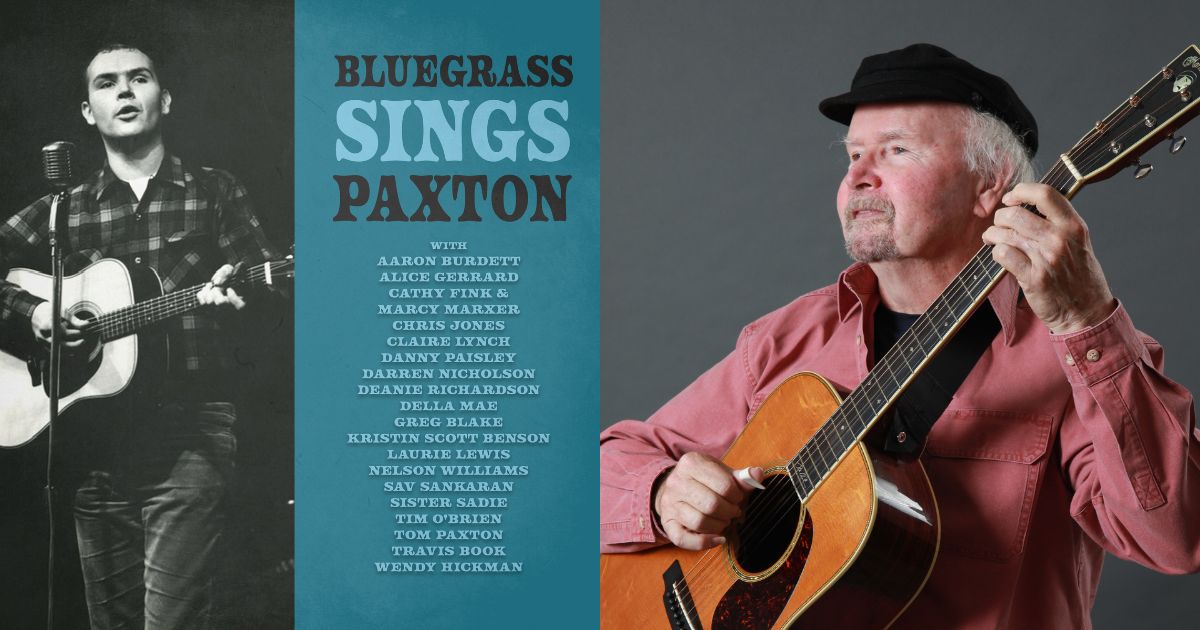
There is no disputing that Tom Paxton is a living music legend. In the early 1960s, he was a major player in the vibrant Greenwich Village folk scene, along with the likes of Bob Dylan, Phil Ochs, and Peter, Paul & Mary. The writer of such classic tunes as “Last Thing On My Mind,” “Bottle Of Wine,” “I Can’t Help To Wonder (Where I’m Bound),” and “Ramblin’ Boy,” Paxton has earned Lifetime Achievement Awards from the GRAMMYs, ASCAP, and the BBC. The beloved songwriter has had his tunes covered by a wide spectrum of acts, ranging from Harry Belafonte and Neil Diamond to the Pogues and Norah Jones. While several fellow singer-songwriters (notably Carolyn Hester and Anne Hills) have devoted entire albums to Paxton music, it took a group of admiring bluegrass musicians to deliver the first multi-artist tribute album of his songs.
Bluegrass Sings Paxton, which came out August 30 on Mountain Home Music Company, offers an impressive lineup of contributors that cuts across several generations of bluegrass musicians. Performers include celebrated acts, such as Alice Gerrard, Claire Lynch, Laurie Lewis, and Tim O’Brien along with younger stars, like Sister Sadie, Della Mae, Steep Canyon Rangers’ singer/guitarist Aaron Burdett, Unspoken Tradition’s Sav Sankaran, and current IBMA Male Vocalist of the Year Greg Blake.
Paxton, speaking to BGS from his home in Virginia, said that he had a mostly hands-off role in the making of Bluegrass Sings Paxton. “I just sat on the sidelines in amazement”; however, he confided, “I was just blown away” after listening to the entire album for the first time. The 86-year-old singer-songwriter was also being a little modest about his own contributions. This collection contains two new Paxton tunes, and he sings on a pair of tracks as well.
The genesis for Bluegrass Sings Paxton started with a conversation that GRAMMY-winning musician/producer Cathy Fink had some years ago with Paxton, who she has worked with since the early 1980s and has known even longer. “I know Tom’s catalog really well and have often thought there was great material there for bluegrass,” she shared with BGS. “I could hear this album before we even began.” The idea further evolved a while later when Fink brought up the idea to award-winning songwriter, producer, and Mountain Home executive Jon Weisberger at IBMA a few years back, and he immediately came aboard.
Several of Paxton’s tunes have been very popular in bluegrass circles over the years. A half century ago, Kentucky Mountain Boys covered “Ramblin Boy” while the Dillards and the Kentucky Colonels were among those who have recorded “The Last Thing On My Mind.” More recently, “I Can’t Help But Wonder (Where I’m Bound)” was a hit for Ashby Frank and “Leavin’ London” is a live staple of Billy Strings’ concerts. However, both Fink and Weisberger thought the project was a terrific way to get Paxton’s deep songbook better known in the bluegrass world. As Weisberger explained, “I had no doubt that there were more [songs] – both already written and yet to be written – that would work well within bluegrass, and that bringing them to light would encourage artists looking for songs to look to his catalog.”
Several acts came into the project with specific songs that they wanted to do. Blake, who fatefully was sitting at the same table with Weisberger and Fink at IBMA, quickly put dibs on “Leaving London.” Danny Paisley, who remembered his dad, ’80s bluegrass star Bob Paisley, taking him to the Philadelphia Folk Festival as a child and seeing Paxton play there, requested “Ramblin’ Boy,” because it was a song his father had performed. “I Can’t Help But Wonder (Where I’m Bound)” was already part of Della Mae’s live repertoire, so doing that tune was a natural fit for them.
When it came to what songs other acts took on, Fink gave the performers a lot of free rein to delve into Paxton’s vast treasury of tunes, a decision that worked out wonderfully. “Each artist made the song their own and it really worked,” she confided. Claire Lynch chose “I Give You The Morning” and Alice Gerrard selected “The Things I Notice Now” from Paxton’s 1969 The Things I Notice Now album. Chris Jones picked “The Last Hobo” from 1986’s And Loving You. Paxton’s 2002 album, Lookin’ for The Moon, was the source for both Aaron Burdett’s selection of and Sav Sankaran’s rendition of the title track. Laurie Lewis, meanwhile, found “Central Square” from 2015’s Redemption Road. In case you haven’t done the math, these songs alone cover nearly 50 years of Paxton’s recordings.
Paxton, too, was thrilled with the selections, proclaiming “I liked every one of the songs that they chose.” While he expected tunes like “Can’t Help But Wonder,” “Ramblin’ Boy,” and “The Last Thing On My Mind” would be part of the set, Paxton said he “was just tickled to death” over the inclusion of such lesser known numbers as “Central Square,” “The Same River Twice,” and “The Last Hobo.”
Chris Jones revealed to BGS that he picked “The Last Hobo” because the tune “felt like a classic Tom Paxton third-person story song, sort of in the spirit of ‘Ramblin’ Boy,’ in a way. It has a kind of tenderness that is so often present in Tom’s songs.”
Jones was also a member of the de facto “house band” that played on the majority of Bluegrass Sings Paxton’s tracks. A secret weapon behind the album, this team of bluegrass all-stars includes IBMA award-winners banjo player Kristin Scott Benson (the Grascals), fiddler Deanie Richardson (Sister Sadie), and Jones on guitar, along with mandolinist Darren Nicholson (formerly of Balsam Range), bassist Nelson Williams (Chris Jones & the Night Drivers, New Dangerfield) and harmony singers Travis Book (The Infamous Stringdusters) and Wendy Hickman.
Jones felt that everyone “clicked well together” and gave the music “a natural sound, which helped give the impression that these were bluegrass songs to begin with, even if they weren’t.” He also credited producers Weisberger and Fink for “coming up with arrangements that really fostered that feeling, too.”
Bluegrass Sings Paxton opens with one of the tunes that Paxton sings on. He was able to join Della Mae on “I Can’t Help But Wonder (Where I’m Bound)” as the band was recording in Maryland, not too far away from Paxton’s home base in Virginia.
“We did it live in the studio. No overdubs or anything,” he revealed. “I had a ball doing that track with them.” Paxton also sang with long-time collaborators Cathy Fink & Marcy Marxer – the three did a double album, All New, together in 2022 – on the up-tempo love tune, “All I Want,” which is also one of the two of new Paxton tunes on the project. The other new number, “You Took Me In” is a co-write with Tim O’Brien and his wife Jan Fabricius. One of the first tunes he wrote with the couple, Paxton said that “it had to be chosen. It’s such a good song.” He described it as “gospel without being gospel,” adding, “I took the literal gospel out of it and kept everything else.”
Fink & Marxer and O’Brien & Fabricius are among the handful of musicians that the still highly-active octogenarian collaborates with via Zoom each week. Folk luminary John McCutcheon, Colorado troubadour Jackson Emmer, and the rising Pittsburgh band Buffalo Rose are also among his regular online songwriting coterie. Paxton says he sometimes writes three to five songs a week. “Lots of folks would retire to the golf course at this point in their lives,” Fink marveled, “but Tom is driven by writing the next song.”
Over the years, Paxton has penned hundreds and hundreds of songs, and more than 60 albums bear his name, beginning with 1962’s I’m the Man That Built the Bridges that was recorded live at New York City’s fabled Gaslight Club. Even from the start, Paxton filled his records predominately with originals, which wasn’t typical at that time. Dylan’s 1962 debut, for example, contained only two originals. Dave Van Ronk, in fact, famously proclaimed in his memoir that it was Paxton who kicked off the folk scene’s “New Song Movement,” not Dylan as often credited.
The best-known songs from his debut, somewhat curiously, are three tunes that might best be described as children’s music: “My Dog Is Bigger Than Your Dog,” “Marvelous Toys,” and “Going To The Zoo.” Writing and performing kids songs was not an isolated occurrence for Paxton, who went on to release several children’s albums, including the GRAMMY-nominated Your Shoes, My Shoes, and to write books for kids. Paxton very much sees himself as continuing the legacy of his heroes, Woody Guthrie, Pete Seeger, and The Weavers – artists who performed all types of songs, from story songs and ballads to children’s tunes and political songs.
“Everything I do is really rooted in traditional music,” Paxton elaborated during his phone interview. “I’m always going back to that well of traditional folk music, Appalachian music, cowboy music. It’s a wonderful tradition – great, great songs, and I just keep trying to write songs that feel the way they felt.”
Paxton cites one specific musician – the late, great Doc Watson – to explains his “best route” to bluegrass music. He saw Watson when Ralph Rinzler first brought him to play in New York City and came away so impressed. “I was very fond of him and adored his music. I think he liked me, too. Doc recorded many of my songs over the years.” He also remembered sharing a bill with Watson once in Tampa and being brought out on stage to perform “Bottle Of Wine.” Paxton was rather intimidated over Watson’s and his guitarist Jack Lawrence’s virtuosity. “Why do I feel like I’m wearing painter’s gloves,” he recalled saying while admitting “it was a lot of fun.”
Weisberger describes Paxton’s place in American music as a unique one. “He was an integral part of the transition from wholly traditional folk music to the more modern conception of the field, with its inclusion of performing songwriters, but where a lot of his contemporaries moved on in one way or another, he went deep rather than broad… I think that’s what makes so many of his songs sound so natural and organic and almost effortless. That is an artistry that is really easy to overlook or under-appreciate, so I’m happy to have put together a collection that will, I hope, bring more attention and appreciation to that still ongoing legacy.”
When asked how his songwriting has changed over the years, Paxton replied that he hopes it’s deeper and more developed, adding rather humbly that “I’m still the same writer I was when I wrote ‘Last Thing On My Mind.’ It’s like a farmer who puts in the same crop every year. It’s the same farmer.”
Photo courtesy of Fleming Artists. Album cover courtesy of Crossroads Label Group.
It’s seven months into the year and music and media outlets are looking back while looking forward, pondering and collating all of the incredible music that’s been released in 2024… so far. From Beyoncé to Zach Bryan to “brat summer,” there’s certainly been no shortage of seismic album drops – and in our bluegrass corner of the roots music world, the same holds true.
So far this year, there have been stellar releases by the biggest names in the genre, like Béla Fleck, Billy Strings, Tony Trischka, Laurie Lewis, and the Del McCoury Band. Country singer-songwriter Brit Taylor and roots-soul legend Swamp Dogg both released bluegrass titles this year as well, demonstrating how the age-old tradition of various styles and sounds cross-pollinating with bluegrass continues in the present day.
Supergroups like Sister Sadie, Greensky Bluegrass, and Gangstagrass have all unleashed critically-acclaimed projects in 2024, too, while newcomers like Wyatt Ellis and Jack McKeon impressed with records that sound mature and fully-realized for debut releases. And of course there’s plenty yet to come, as anticipation builds for long-awaited albums from bluegrass stalwarts and heroes like Jerry Douglas – who was just unveiled as a 2024 Bluegrass Hall of Fame inductee – and Gillian Welch & David Rawlings, who recently announced a new project, Woodland, their tenth studio album and first release in four years.
No matter how you cut it, 2024 has been a banner year for superlative bluegrass albums – and there is still so much more to come! Take a minute to amble through our favorite bluegrass releases of the year so far (in approximate chronological order), plus a few honorable mentions that pull heavily from bluegrass traditions and inspirations, and we’ll set the table for the albums we can’t wait to arrive later this year, too.
Cary Morin, Innocent Allies
A jaw-dropping acoustic guitarist who toggles between flatpicking, fingerstyle, blues, and many other styles, Cary Morin released a gorgeous visual art-inspired album earlier this year entitled Innocent Allies. The entire project oozes images of the West done up in bluegrass textures and tones, especially so in Morin’s rendition of “Whiskey Before Breakfast.” Read our feature on the album here.
Sister Sadie, No Fear
For a band that boasts alumni like Dale Ann Bradley and Tina Adair, it’s saying quite a lot to make the statement that this may be the best lineup of Sister Sadie yet. Their latest offering, No Fear, brings striking Nashville vibes together with a dash of the Chicks and features collaborations with country stars like Cam and Ashley McBryde. It’s no surprise this supergroup and their newest album are all over this year’s IBMA Awards nominations. Read our March Cover Story on No Fear here.
Wyatt Ellis, Happy Valley
A mere 15 years old, mandolin picker Wyatt Ellis certainly deserves the “bluegrass prodigy” designation he often receives, but dare not sell this young virtuoso short with such a moniker. There’s musicality, touch, and taste evident across his debut album, Happy Valley, well beyond his teenaged years. That’s just part of the reason behind why he’s able to attract such notable collaborators and guests as Marty Stuart, Sierra Hull, Mike Compton, and more. Keep an eye on this one, ‘cause there’s no telling just how far he will go in music, but it’s sure to be way up there!
Brit Taylor, Kentucky Bluegrassed
Pulling a page out of the bluegrass playbook of the ‘60s through ‘90s, country singer-songwriter Brit Taylor demonstrates the inseparable interconnectedness of country and bluegrass with Kentucky Bluegrassed, a reimagination of her 2023 country album, Kentucky Blue, played by a cracking bluegrass band. There are touches of Alan Jackson, Vince Gill, Patty Loveless, and so many more through the project. It certainly reminds of those eras, in which bluegrass artists and bands were just as likely to identify simply as “country” as they were “bluegrass.” The lines between these genres used to be much more blurry; we’re happy to see folks like Taylor – and many others – smear, complicate, and dirty up those genre demarcations once again. Kentucky Bluegrassed is a “don’t miss” album that may not be on every diehard grasser’s radar.
Missy Raines & Allegheny, Highlander
Missy Raines never left bluegrass, but Highlander feels like something of a return by this trophied and exalted bassist, singer, and songwriter after her last few more experimental and Americana-geared outings. This is her first recording with her “new” backing band, Allegheny, who have performed with her now for a handful of years. It’s a rollicking, up-tempo, dynamo of an album, but it’s never one note or stolid – or trying to pander to digital radio. There are calm moments, songs that will bring a tear to your eye, and political tones, too, all bolstering the tightness of the band and the trad-tastic, meta-mash energy herein. “Who Needs a Mine,” the stand out track in a superlative song sequence, will most likely go down in history as one of the best issues-oriented bluegrass songs ever written. Every bit as biting and timely as Hazel Dickens, Jean Ritchie, and so many other activist artists from the regions Raines grew up in. Read our recent feature interview here.
Béla Fleck, Rhapsody in Blue
The most traditional aspect of Béla Fleck’s music-making across his lifelong career is his constant and effortless innovation. As a community, we lose sight so easily of the fact that every first generation bluegrass star was an innovator, so many consummate musicians just “making it up as they go along.” Referring to Fleck’s Rhapsody in Blue as “making it up as he goes along” might raise an eyebrow at first, but one of the most fascinating threads throughout Fleck’s countless albums is his ability to ground whatever musical vocabulary he chooses within the traditions, styles, and physicality of bluegrass banjo. He doesn’t so much care what “does” or “doesn’t” fit on the banjo, he follows his whims, fancies, and inspirations and always makes it work. Perhaps only he could do so with Gerswhin! (And we are so glad that he did.)
Kyle Tuttle, Labor of Lust
Banjo player Kyle Tuttle released his second studio album, Labor of Lust, in February. You may know him from Molly Tuttle’s band, Golden Highway, or from his ubiquitous presence in jamgrass scenes over the past decade or so. The new album demonstrates his particular approach to newgrass, jamgrass, and engaging and exciting improvisational picking. His voice on the instrument is indelible. A modernist banjo player with endless panache, a strong sense of humor, and buckets of stamina and drive. We spoke to Tuttle about the project earlier this year.
Barnstar!, Furious Kindness
New Englander and Northeastern-based bluegrassers will be more than familiar with this raucous outfit, but the national bluegrass scene may need to be put onto the singular sounds of Barnstar! Made up of Mark Erelli, Zachariah Hickman, Charlie Rose, and Taylor and Jake Armerding, Barnstar! started as a side project for these in-demand musicians and songwriters and quickly blossomed into a chaotic, bombastic, and hilarious group that can just as easily go earnest, emotive, and touching. Furious Kindness is another selection here that you may not have yet encountered – and we’re here to rectify that. Need more? We hosted Erelli and Hickman on Basic Folk to chat about the project.
Cris Jacobs, One of These Days
If your first introduction to Cris Jacobs was the above song – “Poor Davey,” featuring Billy Strings – fed to you by the algorithm or a roots DJ or found via the “appears on” section of Strings’ streaming profiles, you certainly aren’t alone. A well-known musician in alt-country, rock and roll, and the often nebulous regions between these genres, Americana, and bluegrass, Jacobs may read as a newcomer in bluegrass, but his Jerry Douglas-produced album, One of These Days, is anything but a one-off or novelty project or ‘grassy interloping. This is deep and broad bluegrass that feels straight ahead and genre-expansive at the same time, drawing on guests like Lindsay Lou, the McCrary Sisters, Sam Bush, and more. The Strings track may be what first grabs you, but this album deserves a deep dive follow-up, immediately.
Greensky Bluegrass, The Iceland Sessions(featuring Holly Bowling)
An EP we loved so much it just had to be included on our Best Bluegrass Albums list. Pianist and keys player Holly Bowling joins illustrious jamgrass group Greensky Bluegrass to revive the often latent, near extinct, and severely underrated tradition of bluegrass piano. Over four tracks recorded in remote northern Iceland in 2023, the band and Bowling have curated a vibe that hinges on the present, focusing in on the exact moments in time wherein they captured these sounds and songs. It’s why we love jamgrass to begin with, right? The way the music calls all of us to be grounded in the present. That’s the exact spirit in which these recordings were made and the translation of that intention is more than just successful, it’s deeply resonant.
Bronwyn Keith-Hynes, I Built A World
Fiddler Bronwyn Keith-Hynes has found her voice – literally and figuratively. While her last studio release, Fiddler’s Pastime (2020), was more instrumental-focused, her latest project, I Built A World, finds her stepping up to the vocal mic with confidence. Her voice is strong and well-practiced while homey and down to earth, too. The song selections are bold, her collaborators are glitzy and first-rate, but each feature, guest, and musician serves the track they’re on and the album as a whole first and foremost. Keith-Hynes has certainly found her groove and her creative community, and we’re all reaping the benefits of her commitment to challenging herself and looking ahead to the future. We recently chatted with Bronwyn and her pal Brenna MacMillan about their respective solo projects – check it out here.
Swamp Dogg, Blackgrass: From West Virginia to 125th St
When the initial announcement of Swamp Dogg’s latest album, Blackgrass, reached the BGS team, electricity and excitement shot through our ranks. Here’s a project that speaks deeply to one of our highest-priority missions in bluegrass: to showcase the multi-ethnic, melting pot, diverse roots of our favorite genre of music. Bluegrass has never been a music for white folks only, no matter how prevalent that narrative is today, and this legendary multi-hyphenate musician, creator, and producer, Swamp Dogg, demonstrates that fact part and parcel over the course of this impeccable collection of music – with a backing band that includes many of the best pickers around today. There are countless remarkable aspects of this album, too many to include in this simple blurb, so head to Lizzie No’s feature on the project to learn more about why this project is purposefully rebellious and revolutionary.
Laurie Lewis, TREES
California bluegrass keystone Laurie Lewis was just announced as one recipient of this year’s IBMA Distinguished Achievement Awards. For decades she has been a center of gravity around which the California and West Coast bluegrass scenes orbit, like a perseverant mother tree from which so many young shoots and saplings have sprung. Her brand new album, TREES, draws upon her wellspring of through-hiking and naturalist knowledge to encounter, process, and challenge so many modern day realities – health issues, the ever-quickening climate crisis, personal and professional life hurdles, and much more. The result is touching, emotional, encouraging, and inspiring, wrapped in traditional bluegrass trappings that feel more in service to the songs than to legalistic genre criteria. Lewis is one of the best to ever make bluegrass and TREES is one of the best releases in her lauded and superlative catalog. We recently published our exclusive interview, which you won’t want to miss.
Tony Trischka, Earl Jam
One of the greatest banjo players today, our current Artist of the Month Tony Trischka has made a career trailblazing on melodic-style three-finger banjo, writing, composing, and recording music that only he could’ve made. For his latest album, Earl Jam, though, he instead leans on the timeless bluegrass task of emulating the greats – namely, Earl Scruggs. The track list is pulled from recordings of casual, at-home jam sessions between Earl, John Hartford, and others, and with his all-star band and fabulous guests, Trischka reiterates Earl’s idiosyncratic playing from these previously unheard recordings. It’s a fascinating context in which to rediscover the limitless intricacies behind Trischka’s playing and the way he synthesizes others’ influences into his own musical vocabulary. Whether stepping into the role – or, shall we say, roll – of Scruggs or making modern banjo compositions out on his own creative limbs, Tony Trischka makes it look effortless and executes everything he does at the highest level. Don’t miss our Artist of the Month feature and our discography deep dive.
Gangstagrass, The Blackest Thing on the Menu
With a band as incisive and forward-looking as Gangstagrass, there will always be countless reasons naysayers will attempt to use to disqualify their music as “bluegrass.” But when viewing this now 15-year-old group through an objective lens, you can see many more bluegrass qualities than not. Innovation (the oldest bluegrass tradition), improvisation, virtuosity, conversational lyrics, a blending of styles, genres, and textures, and the bringing together of creators and inspirations from a variety of backgrounds – that all sounds like bluegrass to us! Gangstagrass’s latest opus, The Blackest Thing on the Menu, finds the critically-acclaimed group at their strongest yet, with a Jerry Douglas track feature (“The Only Way Out is Through”) and plenty of hip-hop-meets-bluegrass excellence. In the present, folks may errantly write off this band as a novelty or an aberration, but in the future we will all view Gangstagrass as they have always been: one of the firsts in the quickly-developing tradition of roots hip-hop, rap string bands, and postmodern bluegrass re-interpreters.
Jack McKeon, Talking to Strangers
In the vein of country songwriters with bluegrass careers – or bluegrass songwriters with country careers (think Shawn Camp, Tom T. Hall, John Prine, Darrell Scott) – Jack McKeon’s debut album, Talking To Strangers, isn’t just bluegrass, but it certainly tracks as first class ‘grassy, down home, front porch music. These thoughtful, introspective lyrics are perfectly set, to a straight ahead bluegrass band like Ashby Frank, Justin Moses, Christian Sedelmeyer, and Vickie Vaughn. McKeon is inaugurating his catalog of recorded works demonstrating that his songs and his voice can be shapeshifters, at home on Music Row and on bluegrass stages and radio, both.
The Del McCoury Band, Songs of Love and Life
Del McCoury is one of the most-awarded personalities in the history of bluegrass and it’s truly no wonder why. He’s spent his entire life honing the family trade: the highest quality bluegrass around. At 85 years-old, every album, concert, performance, and festival we enjoy from Del and the boys is a gift that we’re determined to cherish and savor. His latest full length album, Songs of Love and Life, is sure to be shortlisted for the highest honors handed out by the Grammys and IBMA. This particular track, “Only the Lonely,” is a Roy Orbison cover that showcases Del’s lifelong penchant for not worrying about what is or isn’t bluegrass and instead doing his utmost to serve the song – hence the tasty, honky-tonkin’ bluegrass piano. (Bluegrass piano? Twice in one list??) The record includes a few more charming covers, plenty of brand new tracks, and a Molly Tuttle feature, too.
Brandon Godman, I Heard the Morgan Bell
A killer fiddler from Kentucky who’s performed with Laurie Lewis, Dale Ann Bradley, Jon Pardi, and many, many more, Brandon Godman recently released his first studio album as a solo artist since he was a teenager. Based in San Francisco, Godman is a touring fiddler turned luthier who remains an expert in so many musical styles from his home turf in northern Kentucky. From contest fiddling to western swing to pop country to bluegrass breakdowns and transatlantic hornpipes, Godman’s playing has grit, drive, and aggression, sure, but what stands out the most on I Heard the Morgan Bell, his album of all original compositions, is his emotional range, lyricism, and heartfelt tenderness. Throw in guests like Darol Anger, Patrick Sauber, Sam Reider, and more and you’ve got what will end up being one of the best fiddle-centric albums of this decade.
Tray Wellington, Detour to the Moon
Carrying the banjo innovation banner for millennial cuspers and Gen Z, Tray Wellington is anything but a traditional bluegrass banjo player – and that fact alone is what will always land him in the “solidly bluegrass” camp, by our reckoning. Like fellow listees Trischka, Tuttle, and Fleck, Wellington has found a voice of his very own on the five-string banjo and in recent years his musical offerings – which were already top-notch – have become exponentially more fascinating, fun, and entrancing as a result. His new EP, Detour to the Moon, includes seemingly through-composed, instrumental new acoustic music a la Punch Brothers alongside more straightforward original banjo tunes and a Kid Cudi cover that may just be the best bluegrass cover of a non-bluegrass hit in recent memory. Watching the excited recognition of “Pursuit of Happiness” ripple through the audience at a bluegrass festival while Tray Wellington Band is on stage kicking off the number will certainly never get old.
Billy Strings, Billy Strings Live Vol. 1
The People’s Bluegrass President, Billy Strings, is out with his first live album, Billy Strings Live Vol. 1. No one is doing it like Billy; selling out arenas, coliseums, and gigantic amphitheaters with what’s actually just a five-piece bluegrass band will always be remarkable and noteworthy. Plus, the way he and his team bring his audience into the creative process, feeding their insatiable appetites for content, for music, for four-hour-long tribute shows, is not simply to sell tickets, fill seats, and move product. Strings, at the beginning of the day and at the end of the day, is just a big ol’ bluegrass and guitar nerd. We love that about him. There’s almost no one else in the history of this music from whom we’d tolerate a 13 minute track. (By the way, that’s not the longest runtime on the album!) Keep doing it like only you do it, Billy, and we’ll all stick with you the whole entire way.
AJ Lee & Blue Summit, City of Glass
The last time we had a bluegrass artist take off on our website and socials like AJ Lee & Blue Summit are taking off now, it was Billy Strings playing “Meet Me at the Creek.” We’ve been following this Santa Cruz, California-based string band – featuring AJ Lee, Jan Purat, Scott Gates, and Sully Tuttle – for years, so it’s no surprise to us that the greater bluegrass audience is catching onto the special sound and style of Blue Summit and their brand new album, City of Glass. This is pointedly Californian bluegrass, meaning it is effortlessly traditional and organically inventive and generative. High lonesome harmonies and fiery pickin’ skills combine with soul, groove, emotion, and thoughtful writing. There are country moments, there are barn burners, but overall, it’s clear this young band have hit their stride and know who they are. We aren’t here to tell you the best of the best, per se, but if we were City of Glass would be at the very top.
Andrew Marlin, how dare you surprise release this divine album!? (Seriously, thank you, it was indeed a wonderful surprise.) Out last week with hardly more fanfare than a handful of social media posts, Marlin’s brand new collection, Phthalo Blue, has already charmed its way onto our “Best So Far” list. Featuring Stephanie Coleman, Allison de Groot, Clint Mullican, Josh Oliver, and Nat Smith, this is the perfect kind of bluegrass to put on while you work, tidy the house, or tend to your garden. You’ll find the healing effects herein don’t just come from rabbit tobacco.
Near-Bluegrass Honorable Mentions
Whatever you think about our list so far – and whether or not the albums on it qualify as bluegrass to you – here are just a handful of albums we would have regretted not including, but may have more tangential relationships to the genre than their fellows in this piece. Still, each of these fine records has obvious bluegrass bones, however subtle or overt they may be.
Willi Carlisle, Critterland
Many an old-time troubadour/poet such as Willi Carlisle has been a bluegrass musician, but perhaps Carlisle himself wouldn’t identify in that way. Still, there’s bluegrass throughout the critters and characters on this critically-acclaimed album, Critterland. We did a feature on the project, read that here.
Sierra Ferrell, Trail of Flowers
Her new album is markedly post-genre, but those in the know are already well aware that Sierra Ferrell came up through bluegrass circles. From her patinaed West Virginia voice – that brings Hazel Dickens to mind – to her cutting fiddle bowings, wherever she may roam musically, Ferrell will always have a home in bluegrass.
Rachel Sumner, Heartless Things
Rachel Sumner (formerly of Twisted Pine) is decidedly bluegrass, but somehow that seems too simplistic an umbrella for the nuanced music she creates and the special tones she strikes. She infuses so much of the Northeastern bluegrass, folk, Celtic, and jazz scenes and their respective vocabularies into her songs – they may not be exactly bluegrass, but they certainly don’t fall entirely outside that umbrella, either.
Zach Top, Cold Beer & Country Music
Now, this ain’t no bluegrass album – it’s Good Country, that’s for sure – but there’s a bluegrass story embedded within Zach Top’s hugely popular debut, Cold Beer & Country Music, that we’re determined to tell. Once a winner of SPBGMA’s band contest, Top grew up idolizing Tony Rice and Keith Whitley and playing in a bluegrass family band on the weekends. You can see bluegrass touches throughout this mainstream country record, just like when Ricky Skaggs, Whitley, the Osborne Brothers, and more targeted country radio with their songs and sound. Our Good Country feature interview explores all the ways bluegrass filters into his music.
Kaia Kater, Strange Medicine
Kaia Kater is another genre expander who hasn’t ever quite made bluegrass music, but has never been too far from that sonic space, either. She pulls more readily from indie and old-time and folk traditions, but her new album, Strange Medicine, feels like she’s developed an entirely new thing, where genre is a third space, something liminal, or purposefully transitional. Perhaps the most bluegrass thing about this stunning collection is groove, an ever present character through these gorgeous and intricate songs. Kater was our Artist of the Month in May.
Anticipated Albums Still to Come This Year
There’s plenty more where all that came from! Here are just a few of the as yet unreleased recordings we’re sure will be on our “Best Of” lists when we reach the end of the year. It’s not as far off as you think! Luckily, we’ll have a stellar soundtrack to get us there.
Alison Brown, Simple Pleasures (reissue) – available August 9
Rhonda Vincent, Destinations And Fun Places – available August 9
Bella White, Five For Silver– available August 16
Po’ Ramblin’ Boys, Wanderers Like Me – available August 16
Dan Tyminski, Whiskey Drinking Man – available August 16
Fruition, How to Make Mistakes – available August 23
Gillian Welch & David Rawlings, Woodland – available August 23
Caleb Caudle, Sweet Critters – available August 30
Various Artists, Bluegrass Sings Paxton – available August 30
Willie Watson, Willie Watson – available September 13
Jerry Douglas, The Set – available September 20
Twisted Pine, Love Your Mind– available October 18
Brenna MacMillan, Title TBA – release date TBA
BGS Staff also contributed to and assisted curating this list.
This website uses cookies to improve your experience. We'll assume you're ok with this, but you can opt-out if you wish.AcceptRejectRead More
Privacy & Cookies Policy
Privacy Overview
This website uses cookies to improve your experience while you navigate through the website. Out of these, the cookies that are categorized as necessary are stored on your browser as they are essential for the working of basic functionalities of the website. We also use third-party cookies that help us analyze and understand how you use this website. These cookies will be stored in your browser only with your consent. You also have the option to opt-out of these cookies. But opting out of some of these cookies may affect your browsing experience.
Necessary cookies are absolutely essential for the website to function properly. This category only includes cookies that ensures basic functionalities and security features of the website. These cookies do not store any personal information.
Any cookies that may not be particularly necessary for the website to function and is used specifically to collect user personal data via analytics, ads, other embedded contents are termed as non-necessary cookies. It is mandatory to procure user consent prior to running these cookies on your website.