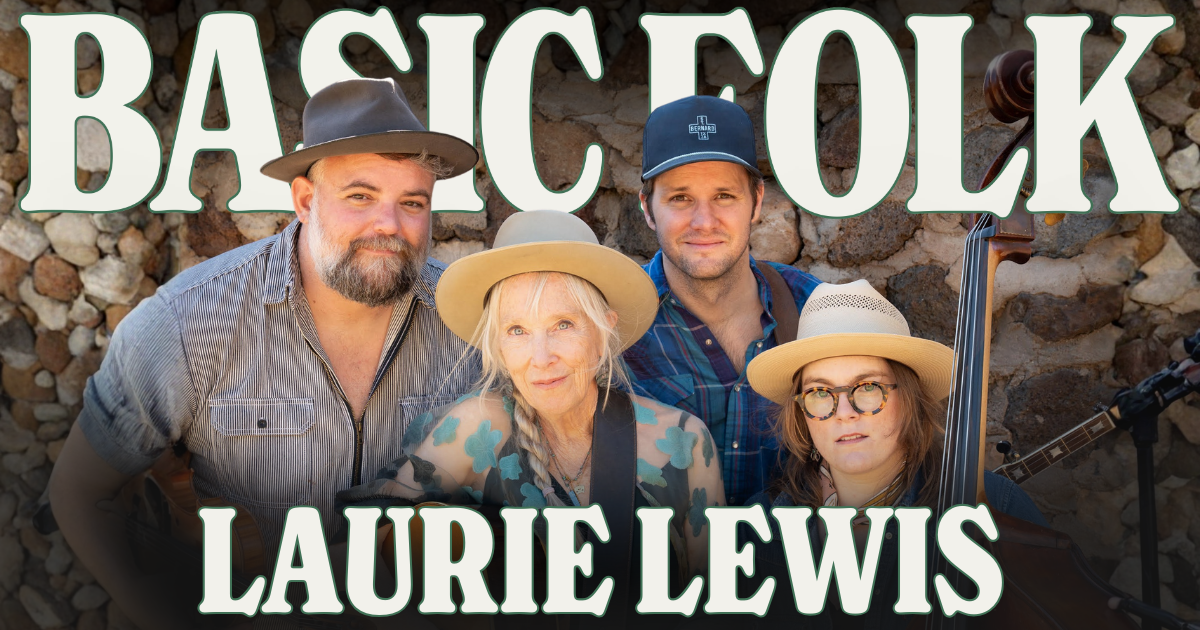
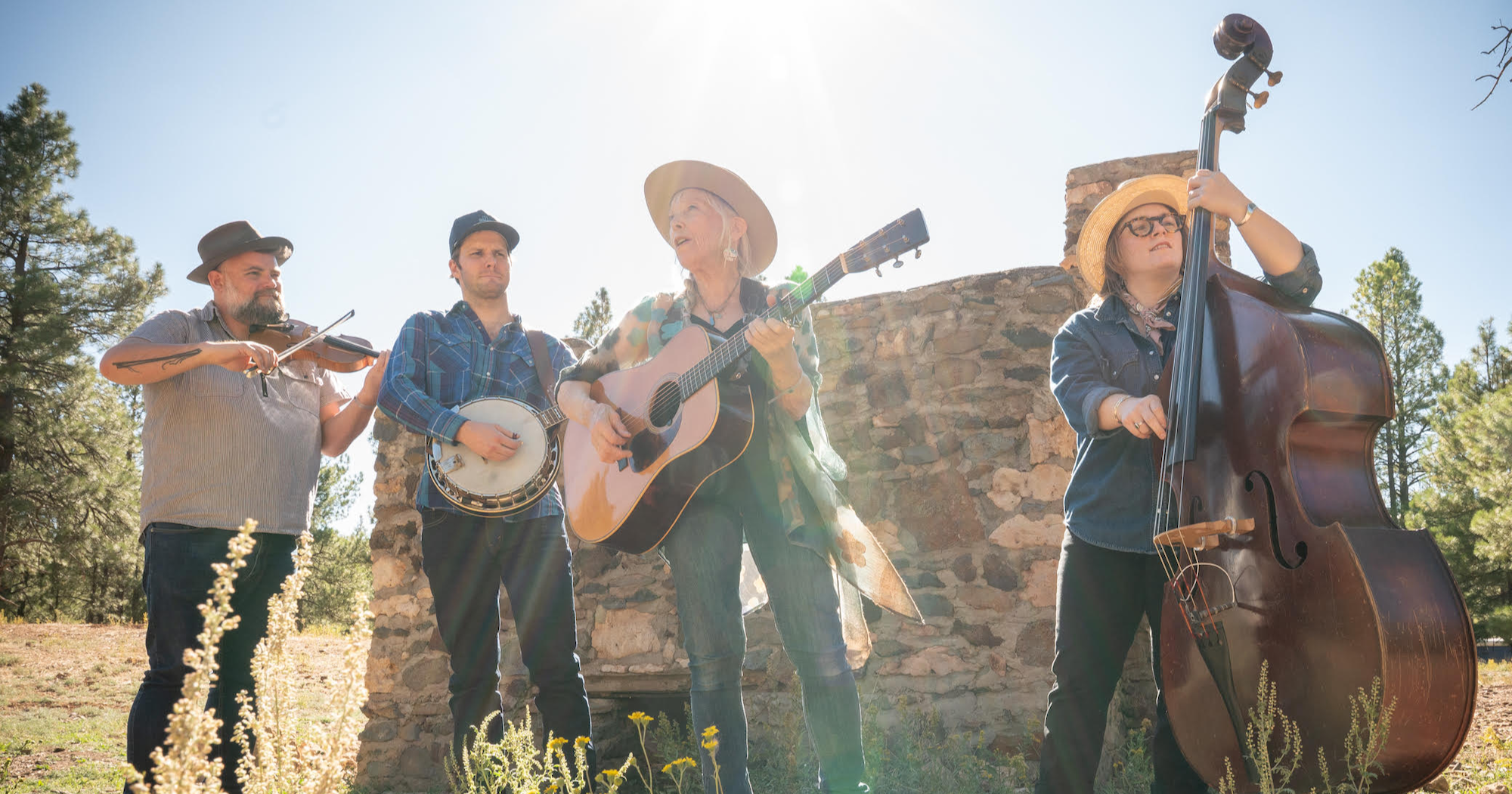
A foundational participant in the ’70s Bay Area bluegrass scene, Laurie Lewis knows the power of collaboration. She’s been a part of an ensemble in recent years that’s called Laurie Lewis & the Right Hands, with Laurie on fiddle, guitar, and vocals, Brandon Godman on fiddle, George Guthrie on banjo, and Hasee Ciaccio on bass. That group plays a huge part in her new album, O California!, a collection of songs that explore our own places in the natural world and in each other’s hearts. It also serves as a love letter to her home state. One standout track, the traditional “Fair and Tender Ladies,” is a duet with Ciaccio, which brings the song’s cautionary tale to life. In our Basic Folk conversation, Laurie talks about what it’s been like to learn traditional songs before actually catching their meaning, long after figuring out the tune.
Lewis emphasizes the communal and collaborative nature that defines her musicianship. She recounts her early exposure to music played socially when her father and his friends gathered at their home to play classical music when she was young. She credits that experience with solidifying her decision to learn to play, so she could have as much fun as they did. Laurie also opens up about her path to finding independence from her father’s expectations and her eventual return to music through modern dance and folk tradition. She touches on her passion for nature, recounting transformative hiking experiences, and reveals her thoughts on collaboration and mentorship within the music community.
Additionally, Lewis reflects on the profound impact of losing her voice in 2021 and the emotional journey of rediscovering her musical identity. We wrap up our conversation talking about her friend Alice Gerrard, whom she covers on the new album. After we hung up, Laurie emailed me an addendum about Alice that I wanted to share: “I forgot to say, when you asked me about Alice Gerrard, that I also greatly admire her community involvement in the music she loves, as evidenced by her starting and running the Old Time Herald for so many years. She’s a remarkable person. Plus, she trained her dog to fetch a beer out of the fridge for her and then put the empty can in the recycling!” Incredible.
It’s noon in the Bay Area, and singer-songwriter/multi-instrumentalist/producer Laurie Lewis is sitting in her backyard on what she describes as “a beautiful sunny day.” She spent her morning pulling up oxalis, and now she’s painting a railing she purchased at Urban Ore.
“It’s a good handrail for our front steps and along the walkway for my partner, Tom,” she says, “so I’ve been sanding it, wiping it down, and painting it.” Later during this interview, she’ll continue pulling up weeds, noting, “It’s very liberating for me, getting my hands in the dirt. It feels really good.”
The reason for today’s call is Lewis’s new album, O California! Like its predecessors, it’s an emotional palette of songs – five originals, five traditionals, and a cover of close friend Alice Gerrard’s “Sweet South Anna River” – that blend the many genres influencing her work, from bluegrass to country, jazz, and even a hint of rock. O California! features the stellar musicianship and vocals that define Laurie Lewis and her band, The Right Hands: Brandon Godman (fiddle), Hasee Ciaccio (bass), and George Guthrie (banjo, guitar).
A two-time IBMA Female Vocalist of the Year and a two-time GRAMMY nominee, Lewis is no stranger to BGS readers, as she’s been featured many times. Dedicated fans are also deeply familiar with her longtime partner, mandolinist Tom Rozum, and his Parkinson’s disease diagnosis. “He’s doing pretty well,” Lewis says. “He had spine surgery in November and he’s recovering very well from that. He had been living with intense sciatica pain for a year and a half, and the pain is gone, so that’s great.”
What would you like readers to know about O California!?
Laurie Lewis: Let’s see… all kinds of things. I wrote five of the songs on the album and they’re all over the map, so they’ll say, “She’s got a lot of different musical influences.” We’ve also drawn from the folk tradition and some great traditional songs and thrown that in the mix. It’s all done with the same four people and same four voices on beautiful acoustic instruments. Sonically, it’s really nice. You really hear the personalities of these particular four people working together. It’s what made me want to make the album.
This is album number 25 in your catalog. Artists often speak of albums as chapters in their lives. Which chapter is O California!?
This chapter is this band at this moment in time, these particular four people. I wanted to celebrate our working relationships together. It’s something that wouldn’t have happened at another time in my career, because I wasn’t working with these particular people for as long as I have been on this album. They are all on the previous album, but that was me calling all the shots. This is me settling in, listening to everybody, and trying to make a whole out of the four parts.
How did this approach make the creative process different?
Usually I come into a recording situation with more of an idea of what I want a song to sound like. This one, I came in with snippets and vague ideas for [the band] to have their way with it. We collaborated on arrangements and we listened to every idea. It’s not that I don’t listen to other people’s ideas at other times, but generally there might be more input than just three other people if I’m doing that.
I’m a collaborative artist. One of the reasons I play music is because it’s my best way of communicating in the world. And that is, for me, to an audience. But it’s also true for me to my bandmates and other musicians. It was fun to say, “We’re making a band album. This is what it’s going to be. We’re going to let people toss out songs.” “How does this sound?” “Oh yeah, great. Let’s do that.” It was, “How shall we do it?” “I’ve got an idea.” “How about if we do this?” It’s a very free and open feeling.
[The band are] all very open-eared and open-minded about the music. It doesn’t have to be the way Earl Scruggs did it, or the way Bill Monroe did it, or anything. It doesn’t have to fit into a neat bluegrass category. I’ve played with musicians in the past who have been more or less open, and all it takes is one more closed-off person to direct the band in a particular direction.
You’ve stated in the past, paraphrasing here, that writing is sometimes specific and sometimes spontaneous, sometimes it’s almost random, sometimes it’s unfinished. What was it this time, or was it some of each?
I’d say it was some of each. With the song “O California,” I was writing lyrics in the studio. I did a scratch vocal and changed the lyrics three times before I came home and overdubbed an actual vocal. That’s unusual for me, that it was in such an unformed state when I got into the studio, but it’s when we had the time and I knew the bones of it were good. Some vocal lines, some lyrics, just were not right yet, but I knew what it was about.
When did the songs start coming together as an obvious collection? Was there an intention in mind, a theme, when you all got together?
We started this project in a different way than I have other projects. We had little tours booked, so we would get together a day early before every tour, because we all live in different parts of the country. They would fly out here, we’d rehearse a song, get what we wanted down, figure it out, and then go on our tour and play it every night. We’d have a studio day booked on the day we got back from the tour, so we’d go in and record whatever we had worked out the week before and played on the tour. It was a fun way to approach a project and it spaced it out over a long period of time. It took close to a year.
When it’s spaced apart that way, how do you make it feel like a collection, rather than recording individual pieces of music?
Because it’s all us. It’s like an old friend – you can pick up the conversation right where it was. You haven’t changed your tone or your relationship with each other so drastically that it doesn’t fit together. It would be different if I were doing something like that over a year and just getting together with whoever I thought was the right person to play on a particular song. Then, the only thing that would hold it together would be my production values.
Do you still write ideas on notes, or have you tech-ed your way up to phone apps?
Oh, no. I write. I like to write with a good pen or a pencil on a piece of paper. I will make notes sometimes on voice memos, but mostly that’s it. I’m old-fashioned. I feel like there’s something that happens, the tactile feel of a writing utensil on the paper, that is easier for me to get a thought out than to sit at a keyboard. I’ve been known to still write letters, in fact.
We live in a world of texts, emojis, phone scrolling, and what’s being called “an epidemic of isolation.” Bluegrass is associated with festivals, musicians getting together and jamming, and community. Is this still true?
Oh, definitely. In fact, here in the Bay Area it’s having a real resurgence of community jamming culture. That’s always been at the basis of bluegrass. It’s what everybody wants to do – get together and let their instruments do the talking, let the songs do the talking. It’s a wonderful thing. I love it so much.
You mentor and teach at workshops and music camps, where you connect with younger and up-and-coming musicians. What do they want to know? What do they need to know?
One of the things that I try and impart to people is the importance of finding your own voice, because many young musicians have heroes they want to emulate. That’s how you learn, but at some point you have to find what you want to say with your voice and your instrument. That’s one of the things I try to emphasize and help people feel confident that they have something to say and their own way of saying it.
There is intergenerational connection at these camps and workshops, contrary to the ageism on both sides, that society seems to push: “What do those kids know?” or “What do those old people know?” What is your perspective?
There’s still a lot of that, but luckily there are enough people, young and old, paying attention and willing to listen to each other. It’s especially helpful when there are youth music camps and stuff like that, because then the kids have each other, but they also have their mentors there. They’re there because they want to learn, and it’s usually the older people who are teaching them, but then they get to be with their cohorts, their age group, and that helps a lot.
I certainly learned a lot from teaching at kids’ camps. When I first was asked to teach at a youth-oriented fiddle camp, I thought, “I can’t do that. I don’t know how to talk to kids. I don’t know anything about that stuff.” I said yes because I tend to say yes to things, and I found it to be so enlightening and so important in my life. It’s very enriching.
On a 2021 FolkWorks podcast, you talked about The Good Ol’ Persons playing a trade show luncheon years ago in front of a room full of drunk men. You described it as being “thrown to the wolves.” Many years later, how are we doing?
In terms of women musicians out in the world, there are so many more, and it is so great to see. And the technical abilities – you can’t fault it. You can put Molly Tuttle up against any guy. It’s been some huge steps forward in the time I have been in the music business, but it’s still very male-dominated from the top. It takes generations to change things like this, these ways of thinking, and now there’s a real cultural backlash happening and I don’t know how that’s going to play out. Women have made huge strides and maybe that’s just going to be taken away. Every generation has to fight the same fights, apparently.
Overall, how is bluegrass doing, to your eyes and ears?
That’s a really hard question for me to answer. Honestly, there’s a part of it that has gotten very entrenched in staying within a particular genre. I hear a lot of songs by people singing in a bluegrass style about bluegrass music, or their cabin home and I think it’s in danger of becoming a trope instead of a living, breathing art form.
Luckily, there are enough people out there creating in the art form and doing great stuff. There’s so much of everything happening all the time now that it’s going in all different directions at once. There’s good stuff and bad stuff, and it all depends on your point of view.
Who is making an important contribution, in your opinion?
I hear a few things now and again that I respond to and like a lot. I’m not very impressed with a lot of technical brilliance. I want to be made to laugh and cry, and if it doesn’t do one or the other or both, I’m not all that interested in it.
In terms of bands, Mighty Poplar can do it, and the duo Paper Wings, two young women, Emily Mann and Wila Frank, who I actually met at a fiddle camp when they were teenagers. They’re pretty wonderful. And I always like hearing what my old friends are coming up with in terms of songs and writing. I love hearing whatever 92-year-old Alice Gerrard is coming up with. She has a way of putting her finger on the pulse of what’s happening in the world and is pretty great.
In 1998, you recorded a song called “The Refugee.” Twenty-eight years later, here we are …
Oh, I know. I find it unfortunate that [that] song is still so incredibly relevant – or more relevant. I find it very unfortunate that song has not outlived its message. It’s terrible. I wrote it when Guatemala was in such bad shape, people were fleeing, and there was all this backlash. It’s an empathetic song. These days, empathy – there’s a whole movement, “empathy’s a bad thing.” It’s so crazy.
In a 2020 interview with BGS you said, “Music has a real way of being able to soothe and heal grief.” Could you talk about that healing power, not only as a songwriter, but also as a lover of music, a listener?
Oh, yeah, it’s true. I stand by that. There’s nothing like it. It’s such a direct conduit to the heart. A song can sneak in and express something for you that you had no words for. It can help you, as a songwriter, to figure out a way to express what you might be going through in a way that makes it universal. You put it out there in the world, everybody can feel it and relate to it, and it makes you feel a part of something greater than just your little dark cell that you might be stuck in, or your own personal grief.
It has helped me deal with things, with grief in my life, to be able to learn a song that makes me cry. Every time I hear it, I learn it, and it becomes part of me. It becomes part of my way of being able to express myself, or to write a song that every time I start trying to sing it, I’m in tears or something. You learn to work through your grief by embracing it musically. It’s an incremental way of dealing with things, and it’s really healing.
It’s a sense of support through the company of songs that speak to us.
Yeah. You are not alone. Especially with all the internet stuff, people spend a lot more time not with actual other humans, having conversations or whatever. To hear something, to listen and understand that other people are going through the same alienation or grief or loss, or whatever it is that you are experiencing, makes it easier to bear.
The French author Jean Giono, who wrote The Man Who Planted Trees – I wish I could find this quote – said in an essay that an artist’s duty is to express yourself for all the people who don’t have the words or the art to express themselves. It’s your duty in society, your job, to put it out there for everybody who can’t.
Counting John Prine, Linda Ronstadt, and Wendell Berry among her fans, Laurie Lewis is arguably one of the most diversely influential figures in American roots music culture. She’s a songwriter, fiddler, frontwoman, performer, producer, teacher, and mentor. She’s been nominated for multiple Grammy awards and graced the stage at the Grand Ole Opry. The International Bluegrass Music Association has twice named Lewis Female Vocalist of the Year, and the association’s former executive director, Dan Hays, once called her “one of the preeminent bluegrass and Americana artists of our time and one of the top five female artists of the last 30 years.”
Lewis’s latest release — her 24th full-length record — pairs the artist’s musical mastery with her willingness and courage to face the full spectrum of life’s experiences. From personal grief to environmental despair, Lewis does not shield her eyes from difficult truths. In many ways, the album pays homage to its namesake, trees. When asked why, Lewis notes their tenacity. When something is tenacious, it grips firmly, with determination and persistence. Even in the face of immense challenge and uncertainty, trees abide in their purpose and work — and so does Laurie Lewis.
TREES is a long-play collection of songs that tenderly, earnestly, and sometimes joyfully explore what it means to exist on a vulnerable planet through times of loss and love. Supported by a band of masterful collaborators — Haselden Ciaccio (bass, vocals), Brandon Godman (fiddle, vocals), Patrick Sauber (banjo, vocals), George Guthrie (banjo, vocals, guitar), Tom Rozum (vocals, cover art), Andrew Marlin (mandolin), Sam Reider (accordion), and Nina Gerber (guitar) — Lewis dives into the deep end of sorrow and change with tenderness, authenticity, and Americana storytelling prowess.
In the album’s liner notes, Lewis shares that TREES is the first project she’s made in nearly 30 years without the mandolin accompaniment of her partner Tom Rozum, who recently developed Parkinson’s disease. “This collection represents a difficult transition in my musical life,” Lewis shares. “Think of it as ‘Music Minus One.’”
From bright bluegrass tracks like “Just a Little Ways Down the Road” to the somber invocations of “Enough” and “The Banks Are Covered in Blue,” this album is intricate and complex, much like a healthy forest. The album brings us “Quaking Aspen,” showcasing Lewis’s characteristic lyrical fiddle style, and title track “Trees,” an a cappella bluegrass-gospel ballad that gently yet hauntingly denounces the violence of industrial civilization.
Always looking to the natural world for strength and guidance, TREES is about love — for life, for land, and for people. But love isn’t a purely hopeful or romantic thing; it encompasses both loss and pain, and Lewis gracefully and vulnerably reckons with both on this album.
You just returned from a string of shows playing songs from the new album. Where did you go?
Laurie Lewis: My string of shows was actually mostly a river trip. So I did play every night, but I was mostly spending the days in the canyons… On the Yampa River, which starts in Colorado and goes into Utah and flows into the Green River. It’s a really, really beautiful canyon.
I love that. When you were playing shows, how did it feel to share these new songs with the world?
I’ve been doing a lot of songs from the new album, yeah, and I’m really enjoying that. But also, in any of our sets with my band, we pull out the old ones, too.
Speaking of the older stuff, I listened to your first solo record, Restless Rambling Heart, directly after listening to your newest record from start to finish. The first thing I noticed was that the tempo has downshifted quite a bit from that first release. Does TREES feel more introspective to you than other records you’ve made?
Oh yeah, it definitely does — especially compared to Restless Rambling Heart.
You’ve collaborated with the great poet, writer, and activist Wendell Berry — he asked you to set some of his poems to music. What was that experience like?
It was really fantastic. I’m such a fan of Wendell Berry’s writing. It came about because I was putting out a songbook and the publisher said, “Well, you need to get some blurbs for the back.” I happened to be at a writing workshop and one of the writers there said, “Hey, do you know Wendell Berry?” And I said no, and he said, “Well, he’s a big fan of yours.” [He had been] at a writing conference with Wendell and Wendell asked if he knew me and, you know, small world sort of thing.
So I thought, Well, how do I get in touch with him? Maybe he could write me a blurb, who knows? But [Wendell] famously doesn’t do e-mail or anything like that, so I got his mailing address and wrote him a long-hand letter on one of those yellow legal pads, you know, and I sent it off to him. And lo and behold, he wrote back. He said, “Well, I really don’t know anything about music, and my wife says I can’t carry a tune in a bucket, so hadn’t I better say no to writing a blurb?” And I thought, Well… that’s a question, so it deserves to be answered. So I wrote back and said, “Of course you should say yes, because really, the only prerequisite for saying you like something is that you actually like it. It doesn’t matter that you don’t have a background in music. It’s a personal response.”
And he said, “Well yeah, okay. I’ve been telling people I’m not writing blurbs anymore because too many people ask me, but didn’t I write something in that first letter that you could take out [and use]?” And there was this really nice thing…
So we just ended up having this back-and-forth conversation. He sent me some books. I sent him some CDs. I finally got a chance to meet him, but eventually I just felt like this is a person who is so conscientious, he’s going to respond to whatever I write. And he’s so busy, and he’s got so much stuff to do, I don’t want to bother him anymore. So I kind of dropped the correspondence. I wish I hadn’t, but it felt like the right thing to do. I just didn’t want to be that pestering voice that he felt he had to write back to.
Did he get back in touch with you at some point? Is that how his request came to light?
In the midst of all our back and forth, he sent me a poem in the mail and asked if I wouldn’t mind terribly trying to put it to music. So I did. That was “Burley Coulter’s Song for Kate Helen Branch.” It was quite a puzzle, because it’s not a standard rhyme scheme or anything. I had to make it loop around like a little crooked fiddle tune to make it really work.
Trees aren’t just the theme of this album — they’re growing all over your creative imprint. Your label is called Spruce and Maple Music, for example. What is it about trees specifically that inspires you?
I love the tenacity of trees — the way they just wait ‘til you get out of the way and then come back. … There are too many humans on the earth. We take up way too much space and way too many resources and we’re crowding everybody else out. And by “everybody else” I mean all the animals and plants and everything that also shares our earth. I just feel that, you know, trees are these beneficent beings that just wait and take their time and come back whenever they’re given a chance. They’re responsible for the oxygen we breathe and for taking in the CO2 we release. They’re sort of purifying everything. So it makes me feel very hopeful… If we just get out of the way a little bit, trees can come in and help set the planet right again.
Speaking of trees, the title track on this album is written from such a unique perspective. You literally embody the voice of the trees. How did this idea come about? Had you written from the perspective of the natural world before?
Well actually, “The Maple’s Lament” … I think that was the first time I tried to embody a tree. But I’ve done a few songs like that since. “American Chestnuts,” from my Skippin’ and Flyin’ album is from the voice of the American chestnut trees, which were the main tree along the Appalachian Mountains before the Chinese chestnut blight.
You know, I have, and I thought, Well, this is my song! [Laughs] But I wasn’t inspired by the book.
I personally take comfort in the knowledge that the world will go on spinning without us, despite how powerful we imagine ourselves to be. What sustains you as a sensitive person who feels the weight of what’s happening in and to the world? What carries you through?
Well, that’s that hope – [in] the other beings on the earth, their ability to repair the damage we’re doing. But I don’t hold out a lot of hope for human beings to rein in our excesses. I just don’t. I unfortunately do not see that happening in a timely enough manner to prevent, for instance, desertification of much of the earth’s crust. I’ve never said this stuff in an interview before, but yeah– I do not hold out a lot of hope.
I really appreciate you saying that. I feel like we’re often pressured to feel hopeful, but sometimes it feels more important to just be present with our grief about what’s happening to the world. Where did your deep relationship with and love for the natural world begin?
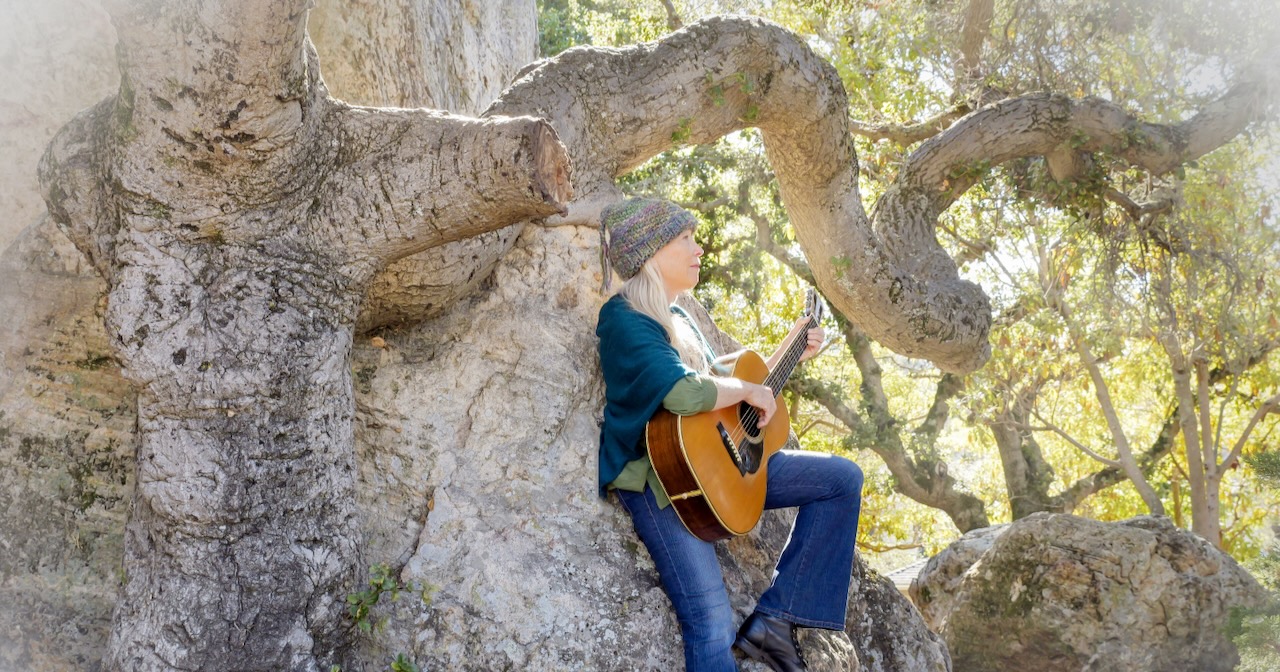
Oh boy, well, lots and lots of places. From ages three to eight, I lived in Ann Arbor, Michigan, in this new subdivision a block from the country. I loved to ramble in the woods and just see the farms and stuff like that. When my family [moved to] Berkeley, California, it was really a shock for me, and I have to say, Tilden Park probably saved my life. It’s a big regional park that’s up over at the top of the Berkeley Hills. It’s a huge park — you could get lost in it for days. Being able to take the bus to the top of the hill and disappear into Tilden Park when I was a kid was the best thing ever, and it really helped me through a lot. So I would say Tilden was maybe the first place where I really sought refuge in the natural world.
In addition to environmental grief, you’ve spoken about the role personal grief played in the creation of this album, and the presence of these feelings is very tangible throughout. Has some part of you had to practice becoming more vulnerable as an artist over time, or did the process of sharing your pain through your songwriting come naturally?
I have been accused throughout my career of writing songs that are a little bit too easy to figure out, you know, where they’re from. They’re personal songs — people have noted that. [But] maybe they’re putting stuff in them that’s not actually there, and I believe that to be the case on some of the stuff. Writing has always been my best source of communication with the world and I think I’ve always just written from an emotional place. If my songs are deeper now, it’s because events in life are a lot harder when you’re 73 than when you’re 23 or 33 or 43.
One of the more uncommon forms of grief is the grief over the loss of one’s own voice. A few years ago, you lost your singing voice for six months. What was that experience like for you, as someone who’s spent so much of your life using your voice to connect with the world?
It was terrible. It was paresis, [so] the right side of my neck muscles were paralyzed, and I couldn’t move my larynx on the right side. It made singing very, very difficult, until it got to a point where my voice just quit. And I thought, I’m not gonna sing anymore. It took about six months to recover, and it hasn’t completely recovered. My voice is different now.
It was a very difficult time. I went to many doctors, and one said, “Well, you have about a 50/50 chance of getting your voice back.” And I’m going, “Those odds are just not good, you know? It could happen or not — it’s a coin toss.” That freaked me out.
But some amazing things happened in that time. I have an annual gig, the concert I do at the Freight & Salvage here in Berkeley, my hometown, over Thanksgiving weekend. When I had no voice, I didn’t want to give up my night, so I asked my friends to come and sing my songs. I put together a folder of tons of songs and nobody picked the same song. It was amazing. It was the most incredible healing night of music for me. I mean, it was really the best Laurie Lewis show ever and I never opened my mouth except to speak a little bit. It was really lovely. Out of anything, I think that helped me get my voice back.
I’m honestly tearing up a little hearing you talk about that. It really speaks to the power of community. Speaking of community and audiences, who do you write music for? When you’re writing a song or recording an album, do you have a particular listener or audience in mind?
Just myself, really. It’s very selfish. [Laughs] I mean, I just write for myself, what I’m feeling or what I’m observing. … That’s always the starting point. If I think up a story, it’s because I want to tell the story, you know? I want to hear the story. If it’s an emotional thing, it’s because it’s something I’m dealing with or going through. But after the initial thought, I try and use my craft to make the songs better so that somebody can actually understand what I’m singing about and talking about in my music. And that’s really the most gratifying thing, when a listener really responds. It’s just great.
You’ve described your music, particularly on this album, as a way of interpreting the voices of the landscapes you adore. How do you experience or receive the voices of the natural world? How did you learn to listen for these much-needed voices?
I’ve always been a fairly quiet person. I listen more than I speak. I’ve had to actually learn to speak, you know, out loud. But I think I just have an observational approach to the world. I would rather listen and observe people talking to me than jump in and add my own spin or make a lot of noise myself. The same thing is true in my relationship with the natural world. I’m an avid walker and I find that walking and listening and looking in the natural world is my favorite thing to do.
Do you have a favorite song on the album?
I like a lot of them actually. You know, they’re different moods. Speaking of walking, “Just a Little Ways Down the Road” I find to be just so fun to sing and play. And of course, “Enough.” It’s heart-wrenching for me. It’s still hard for me to play that song in public. It requires a really different audience. It’s not a festival song. It’s much quieter, so I hold it back a lot. I just love the sound of the instruments on that cut. But I really like them all, from “Just a Little Ways Down the Road” to “Rock the Pain Away.”
It depends on the mood too. If I talk about John Prine and I sing that song [“Why’d You Have to Break My Heart?”], that really goes over well with audiences. I truly appreciate that people connect with that song.
Do you have a favorite tree?
[Laughs] No. I do not have a favorite tree.
Fair enough. [Laughs]
The California buckeye – I think it’s the prettiest little tree ever. But then I see another, you know? I was just out in Colorado among the junipers. That was the main tree alongside the river, junipers and cottonwoods. Every one of those trees was astoundingly beautiful – and so tenacious.
Is there somewhere special close to home where you’ve been going recently to be with the trees?
Well, yes. I stick around home quite a bit, because I have a lot of caregiving to do with my partner. We had to cut down a tree in our yard a couple of years ago and I was very, very sad about cutting down this great big old blackwood acacia. But we had to do it – it was gonna fall over and wreak havoc. But it cleared the way for me to view these two enormous birch trees that are like four-stories high in the neighbors’ yard. Those two trees are just remarkable, through all the seasons. They’re so graceful, and they change so much. I’ve been enjoying those trees a lot from the kitchen.
And Tilden Park is still my go-to. It’s five minutes up the road, so I can get out and walk amongst the oaks and the laurels and, unfortunately, eucalyptus, which is an invasive fire-hazard tree around here, but they’re still beautiful.
It’s so special that you still get to spend time in the same place that meant so much to you as a kid. There’s really so much we could talk about, but is there anything else you’d like to share about the album?
I did it mostly with a very small group of fantastic musicians – my bandmates Hasee Ciaccio on bass, Brandon Godman on fiddle, Patrick Sauber on banjo, and then George Guthrie also on banjo and some guitar. It’s just been really great working with these wonderful people. What they bring to the songs and how they help shape the music, they really are part of the fabric of what makes this album what it is, and it feels important to me to share that.
Artist:Joshua Rilko Hometown: Nashville, Tennessee Song: “New Way to Fly” Album:Lost Soul / Rock & Roll Release Date: December 2021
In Their Words: “I needed another song for the bluegrass side of the album, and this trad-sounding chorus was floating around in my head shortly before the recording session. The verses are new takes on old bluegrass themes with a nod to the John Hartford song, ‘Learning to Smile.’ This track is the most straight-ahead bluegrass song of the bunch, with a few minor chords in there to keep it interesting. Jed Clark provided the relentlessly driving rhythm guitar and tenor vocals, Geoff Saunders laid down bass, George Guthrie dug the ditch with the five-string and sang baritone, and Bronwyn Keith-Hynes glued it all together on the fiddle.” — Joshua Rilko
Photo Credit: Scott Simontacchi
This website uses cookies to improve your experience. We'll assume you're ok with this, but you can opt-out if you wish.AcceptRejectRead More
Privacy & Cookies Policy
Privacy Overview
This website uses cookies to improve your experience while you navigate through the website. Out of these, the cookies that are categorized as necessary are stored on your browser as they are essential for the working of basic functionalities of the website. We also use third-party cookies that help us analyze and understand how you use this website. These cookies will be stored in your browser only with your consent. You also have the option to opt-out of these cookies. But opting out of some of these cookies may affect your browsing experience.
Necessary cookies are absolutely essential for the website to function properly. This category only includes cookies that ensures basic functionalities and security features of the website. These cookies do not store any personal information.
Any cookies that may not be particularly necessary for the website to function and is used specifically to collect user personal data via analytics, ads, other embedded contents are termed as non-necessary cookies. It is mandatory to procure user consent prior to running these cookies on your website.