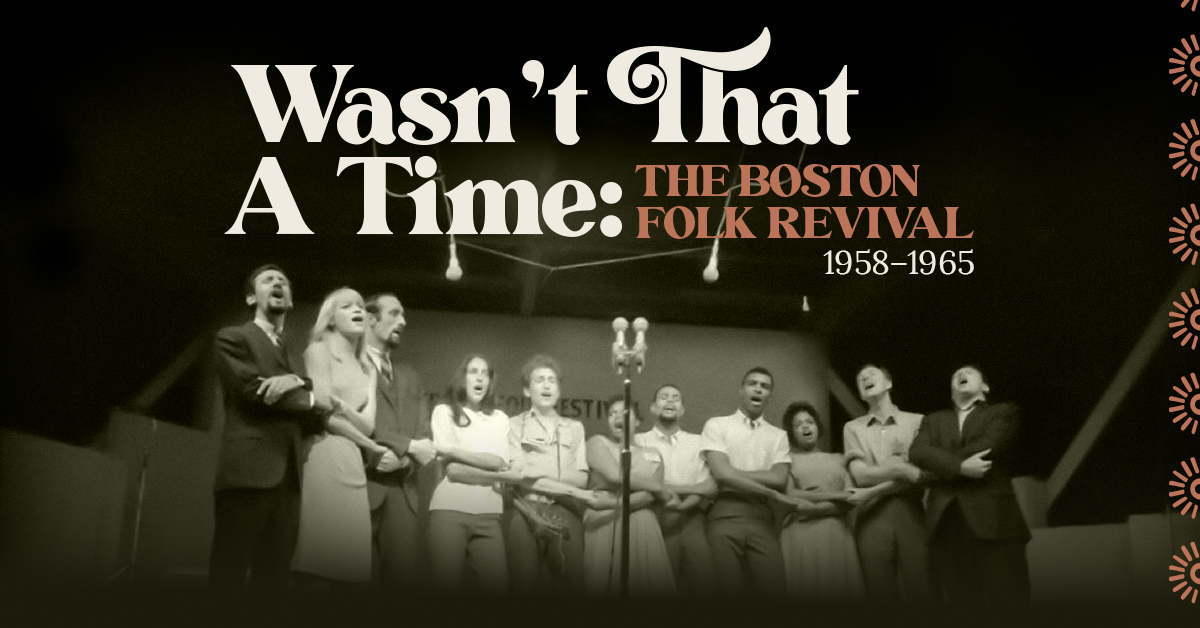
Editor’s Note: On September 27, 2025, the Folk Americana Roots Hall of Fame in partnership with the Bruce Springsteen Archives and Center for American Music held a collaborative symposium entitled Wasn’t That A Time: The Boston Folk Revival 1958-1965. Over the course of the day, attendees at the Arrow Street Arts Center in Cambridge, Massachusetts, enjoyed sessions and panels on such subjects as Club 47, Joan Baez, Bob Dylan at Newport Folk Fest, a conversation with Peter Wolf, and much more. The symposium programming was captured and filmed, and over the last few weeks we’ve shared select sessions with our audience right here on BGS. We hope you’ve enjoyed learning more about how Boston was at the epicenter of the folk revival in the ’50s and ’60s.
Speakers: Deana McCloud (moderator), Tom Paxton, Ralph Jaccodine, Ellis Paul, Jim Brown
About the Video: After the Folk Revival era, how has “folk” changed? What were the pivotal moments and artists who influenced these changes, while continuing the traditions of folk? What do you see as today’s folk scene and why is it still relevant?
“… Sadly, this is our last panel of the day. I say ‘sadly,’ because I’ve enjoyed and learned so much today and I hope all of you have, too. I hope that if we do this again that you all will come again, because it’s been such a great day for this community.
“Our final session today is on ‘Post-Revival Folk’ and it will be moderated by Deana McCloud and she’ll be speaking with Ralph Jaccodine, Ellis Paul, Tom Paxton, and Jim Brown. Enjoy!” – Casey Soward, President and CEO of the Boch Center
Editor’s Note: On September 27, 2025, the Folk Americana Roots Hall of Fame in partnership with the Bruce Springsteen Archives and Center for American Music held a collaborative symposium entitled Wasn’t That A Time: The Boston Folk Revival 1958-1965. Over the course of the day, attendees at the Arrow Street Arts Center in Cambridge, Massachusetts, enjoyed sessions and panels on such subjects as Club 47, Joan Baez, Bob Dylan at Newport Folk Fest, a conversation with Peter Wolf, and much more. The symposium programming was captured and filmed, and over the course of the next few weeks we’ll be sharing select sessions with our audience right here on BGS. Tune in and enjoy learning more about how Boston was at the epicenter of the folk revival in the ’50s and ’60s.
Speakers: Bob Santelli (moderator), Elijah Wald, Douglas Brinkley, Jeannie Brand, Court Carney.
About the Video: When Bob Dylan traded his acoustic guitar for electric at the 1965 Newport Folk Festival, he ushered in a shift to the traditional folk scene. How did the audience and his fellow performers respond, and why? How did this change folk at the time and continue to influence the genre?
“Continuing the series from our Symposium, we tackle one of folk music’s defining moments: Dylan going electric at Newport ’65. What followed changed everything. This panel brings clarity, context, and insight to a moment that continues to shape American music.” – Casey Soward, President and CEO of the Boch Center
Editor’s Note: On September 27, 2025, the Folk Americana Roots Hall of Fame in partnership with the Bruce Springsteen Archives and Center for American Music held a collaborative symposium entitled Wasn’t That A Time: The Boston Folk Revival 1958-1965. Over the course of the day, attendees at the Arrow Street Arts Center in Cambridge, Massachusetts, enjoyed sessions and panels on such subjects as Club 47, Joan Baez, Bob Dylan at Newport Folk Fest, a conversation with Peter Wolf, and much more. The symposium programming was captured and filmed, and over the course of the next few weeks we’ll be sharing select sessions with our audience right here on BGS. Tune in and enjoy learning more about how Boston was at the epicenter of the folk revival in the ’50s and ’60s.
About the Video: Joan Baez first played Club 47 when she was 17 and performed there every Tuesday night until her career took off at Newport Folk Festival. How did this shift from local coffeehouse performer occur, who and what were the pivotal influences on Joan and her career, and how do music archaeologists study her career?
“This panel on Joan Baez is one of the richest conversations we hosted at our September Symposium – a panel that captures Joan Baez’s artistic legacy through the voices of people who’ve both lived and studied her story up close. It’s smart, emotional, and full of perspective you won’t hear anywhere else. We’re excited to share it with BGS readers.” – Casey Soward, President and CEO of the Boch Center
Editor’s Note: On September 27, 2025, the Folk Americana Roots Hall of Fame in partnership with the Bruce Springsteen Archives and Center for American Music held a collaborative symposium entitled Wasn’t That A Time: The Boston Folk Revival 1958-1965. Over the course of the day, attendees at the Arrow Street Arts Center in Cambridge, Massachusetts, enjoyed sessions and panels on such subjects as Club 47, Joan Baez, Bob Dylan at Newport Folk Fest, a conversation with Peter Wolf, and much more. The symposium programming was captured and filmed, and over the course of the next few weeks we’ll be sharing select sessions with our audience right here on BGS. Tune in and enjoy learning more about how Boston was at the epicenter of the folk revival in the ’50s and ’60s.
Our first installment focuses on the origins of the folks scenes in Boston and Greenwich. Watch above, learn more below.
“Origins of Boston and Greenwich Folk Scenes”
Speakers: Melissa Ziobro (moderator), Mitch Greenhill, Jim Brown, Jim Rooney, Tom Paxton
About the Video: “Recorded at the Wasn’t That A Time: The Boston Folk Revival 1958-1965 symposium presented by the Folk Americana Roots Hall of Fame, ‘Origins of Boston and Greenwich Folk Scenes’ traces the beginnings of the American folk revival through the voices of those who lived it. Moderated by Melissa Ziobro, curator at the Bruce Springsteen Archives and Center for American Music, the panel features Jim Brown, Jim Rooney, Mitch Greenhill, and Tom Paxton in a wide-ranging conversation about the artists, venues, and cultural currents that gave rise to one of the most influential movements in American music.” – Casey Soward, President and CEO of the Boch Center
(Editor’s Note: BGS contributor, picker, and singer-songwriter Rachel Baiman brings us into the production process for her new album, Common Nation of Sorrow — her first recording on which she’s credited as sole producer — for this op-ed feature.)
Take a look at the credits for your favorite records by artists of any gender, and you may notice that there are very few women listed. Maybe there’s a female singer, photographer, or graphic designer – possibly a violinist in a string section, but it probably stops there.
While great strides have been made in the last decade with more women on festival bills, in radio programming, and even as instrumentalists in live bands, when you look behind the scenes, you rarely see women involved in making records, unless they are the featured artist or part of the featured band. That’s because the studio is invisible to the audience.
Societal pressure is driving folks to do better when they are working in public lineups, but in recording studios, there’s nobody watching, and no face on the sounds that come out of the box. The audience sees a diverse band playing a live show, yet none of those musicians are featured on the record.
For example, I was thrilled to see Sarah Jones absolutely slaying the drums for Harry Styles live, but when I looked at the record credits, they had a male drummer listed. Why? It’s as if the industry is saying “We love to have you on stage, but when it comes to the real work, let the men get down to business.”
To Harry’s credit, there are a couple of female instrumentalists (violin and keys, and a conga player) and assistant engineers (“Move that microphone for me please!”) featured on his albums (which is huge progress, believe it or not), but I would have loved to see Jones included as a true backbone of the sound, especially when she’s such a fundamental part of the live show, and clearly more than capable. That kind of record credit is a career maker – not that Jones needs it, she’s doing great anyway – but why couldn’t she have that?
I’ve had a dream for a few years now of being a producer. Over the last decade of working in the studio in various roles, I’ve fallen in love with the production process: Starting with the songs, honing and editing until you’re left with only the meat, selecting the perfect musical voices to bring the song to life, and working with amazing engineers to get the sonic pallet perfect. I can’t get enough of it, and I want to do more.
According to a 2018 study by the University of Southern California, and reported on by GRAMMY.com, only 2% of music producers and 3% of engineers/mixers in popular music are women. These are roles that require real trust, as they are roles of power. There’s no turning down, editing, tuning, or washing out a producer or lead engineer. The project is in their hands.
Typically, male artists (as opposed to engineers, another role that leads to producing jobs) are asked to be producers when other musicians like the records that they’ve made or been a part of. It’s a role of mentorship and guidance, as well as artistic influence. I started to realize, though, that because I am a woman, nobody was going to naturally think of me for that role, even if they liked my music. People fit people into the molds that we’ve been shown, and people trust people who others trust. Everyone wants to make the right decisions, and it’s hard to be the first one to believe in somebody – I know this trap because I’m guilty of it myself! If I wanted to be thought of as a potential producer, I was going to have to build my own platform and show people that I could do it.
When it came time to make Common Nation of Sorrow, I saw it as an opportunity to take a bet on myself. Although it’s terrifying to produce one’s own music (you have to be both the speaker and the listener at the same time), I knew that if I could produce something great under my own name, perhaps others would start to see me in that role outside of my own music. After all, if you can’t trust yourself with your own work, how can you ask others to trust you with theirs?
With the support of my awesome label, Signature Sounds, I was able to record this project exactly the way I wanted to. I had a variety of musicians in mind for the rhythm section, both male and female. I hypothesized that when considering the sessions, I needed to make sure that there was a feeling of social balance in the room, for my own sake as well as for my fellow musicians’ sake. Something that was interesting to me about this theory is the stark difference between “including” women on a project because you feel that you should, and believing that empowering women and asking for their contributions will actually result in the best art.
When I get called for sessions to play fiddle or banjo, I am usually the only woman in the room. I walk in feeling like I have to be better than good in order to counteract the assumption that I will be sub-par, that I don’t know what I’m doing, that I won’t know how to read a chart, that I can’t solo, that I won’t know anything about sound or gear. Working from a position of insecurity, or “trying to prove something,” is a terrible way to make music. I might overplay, or underplay, or try to play the way I think men want me to play, not in my own voice. I might be trying to tamp down rage at a comment that somebody has just made about their wife being retired from music because, “She’s a mom now.”
Contrastingly, when you’re suddenly the producer, the only one you have to impress is yourself. Everyone in the room has been hired by you, and therefore, it’s in their best interest to support your vision. Nobody has incentive to diminish your work. Suddenly, I’m able to work from a place of confidence and artistic integrity. In a position of power, it’s not as likely that I’ll overplay, or change my sound based on others, or second guess my abilities. I’ve taken the bet, and now I have to come through for myself. That’s the difference between token inclusion and empowerment. You’re going to be able to hear it in the album made this way, too.
Recently, I was asked by a male musician who I love and admire to produce his next record. It was completely unexpected, and it took a minute for me to realize that my bet on myself was actually paying off. I’m starting to believe now that this could be a real career path for me. I think most people want to believe in, and support each other, but we, as women, have to have the courage to take those first steps and put ourselves out there for consideration. From my standpoint, it can work.
I’m thrilled to see so many incredible women working as producers and engineers these days in Nashville. Mary Bragg, Rachael Moore, Clare Reynolds, Shani Ghandi, and of course Alison Brown at Compass Records, who has been leading the charge for years. I look forward to one day having the opportunity to work in a studio environment inhabited by only women, completely by chance. The more we can show each other what’s possible, the more likely that will become.
(Editor’s Note: Rachel Baiman’s latest album, Common Nation of Sorrow, is available now wherever you stream or purchase music.)
Photo Credit: Natia Cinco
This website uses cookies to improve your experience. We'll assume you're ok with this, but you can opt-out if you wish.AcceptRejectRead More
Privacy & Cookies Policy
Privacy Overview
This website uses cookies to improve your experience while you navigate through the website. Out of these, the cookies that are categorized as necessary are stored on your browser as they are essential for the working of basic functionalities of the website. We also use third-party cookies that help us analyze and understand how you use this website. These cookies will be stored in your browser only with your consent. You also have the option to opt-out of these cookies. But opting out of some of these cookies may affect your browsing experience.
Necessary cookies are absolutely essential for the website to function properly. This category only includes cookies that ensures basic functionalities and security features of the website. These cookies do not store any personal information.
Any cookies that may not be particularly necessary for the website to function and is used specifically to collect user personal data via analytics, ads, other embedded contents are termed as non-necessary cookies. It is mandatory to procure user consent prior to running these cookies on your website.