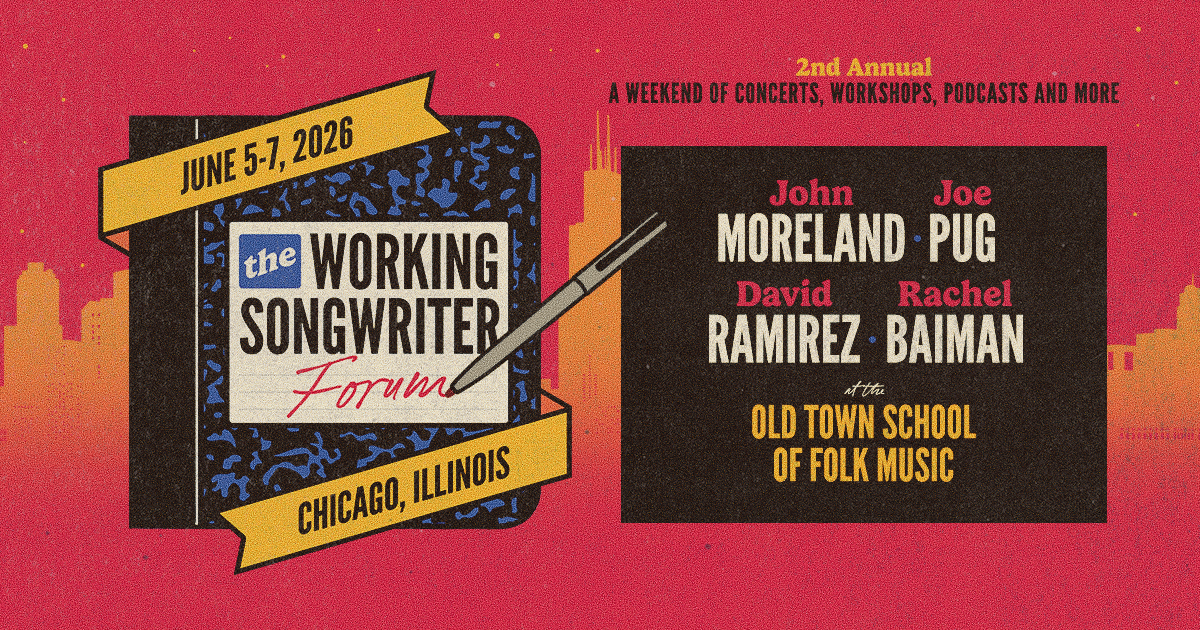
The BGS Podcast Network, the Working Songwriter, and podcast host/creator Joe Pug are excited to invite you to attend the 2nd Annual Working Songwriter Forum. Set for June 5-7, 2026, at the Old Town School of Folk Music in Chicago, Illinois, the event will include concerts, workshops, podcasts, open mics, and more. Space is limited, but 3-day passes are still available. Get more information and purchase tickets here.
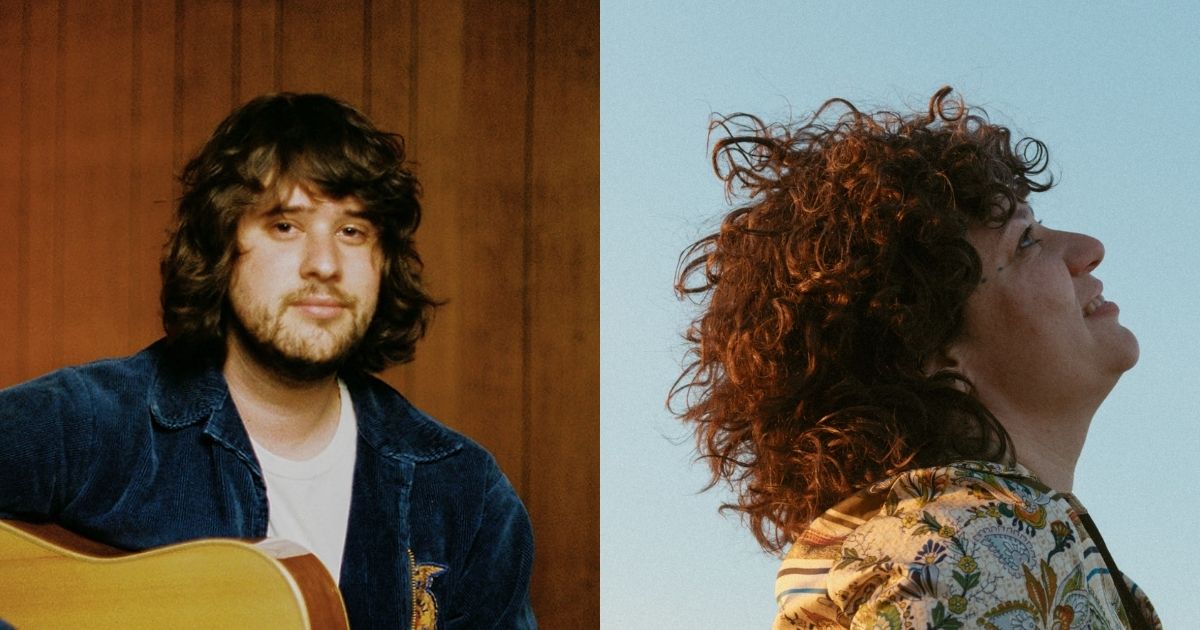
Each night of the Forum will feature a full concert by songwriters and musicians on the Forum lineup. David Ramirez and Rachel Baiman will take the stage on Friday, June 5, and John Moreland and TWS creator and host Joe Pug will headline Saturday, June 6.
“Last year’s event featured Craig Finn and Courtney Hartman,” Pug tells BGS via email. “It went better than I could have ever expected. And the Old Town School’s campus in Chicago is such a natural home for the event. I can’t wait to see our returning attendees again and to meet those joining us for the first time.”
The heart of the weekend is a slate of intensive workshops from both Old Town School’s master educators – like Jonas Friddle – as well as Q&As with the Forum’s guest artists. Attendees will also have the opportunity to play scheduled open mics on each day of the event. (See a full schedule below.)
Whether a veteran songwriter or a novice just starting your creative journey, there’s something for everyone on the slate for the 2nd Annual Working Songwriter Forum. We hope you’ll join us and TWS in Chicago at the Old Town School of Folk Music next month! Get more information about the Forum and purchase your tickets here.
Unable to attend the full Forum? Limited concert tickets are available for the evening performances by Ramirez and Baiman and Moreland and Pug.
The Working Songwriter Forum Schedule
Friday, June 5, 2026 4pm – Welcome to The Working Songwriter Forum 5pm – Rachel Baiman teaches Poetry versus Rhetoric in Songwriting 6pm – Dinner Break 8pm – Rachel Baiman Live in Szold Hall 9pm – David Ramirez Live in Szold Hall
Saturday, June 6, 2026 10:30am – Jonas Friddle teaches Something from Nothing 11:45am – David Ramirez presents The Misunderstanding in Wanting to be Understood 1pm – Lunch break 2pm – Open Mic 3:15pm – The Working Songwriter taping with John Moreland and Joe Pug 6pm – Dinner Break 8pm – Joe Pug Live in Maurer Hall 9pm – John Moreland Live in Maurer Hall
Sunday, June 7, 2026 11am – Open Mic: Songs Written at The Working Songwriter Forum 12pm – Lunch break 1pm – Open Mic: Songs Written at The Working Songwriter Forum and a Farewell
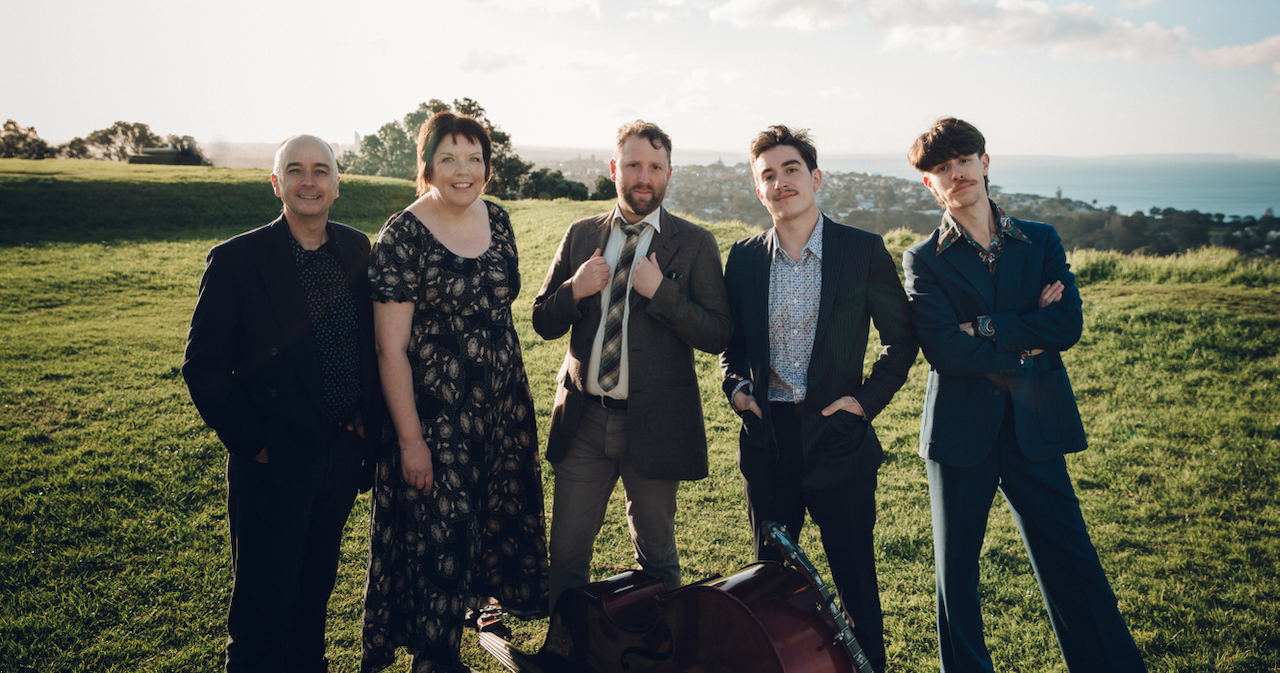
Aotearoa (New Zealand) doesn’t have a strong history of bluegrass bands – except one. If you mention bluegrass to New Zealanders, some will have at least heard of the Hamilton County Bluegrass Band. New Zealand has produced some great players, notably fiddle player George Jackson, banjo player BB Bowness, guitarist/singer Cy Winstanley, and bassist/singer Vanessa McGowan. (Now that we write this, these four would make a great NZ bluegrass band!) But while these names are well known in American bluegrass circles, it is fair to say they aren’t known (outside of folk circles) in Aotearoa.
Many of the songs on our new album, Midnight (out January 30, 2026), are situated within a day, or feature characters who are sitting at the cusp of who they have been before delving into something new. That sense of “in-between” also reflects our place within Aotearoa’s musical landscape, where bluegrass arrives without a long local history, but can be shaped in ways that feel natural to how we live and create here.
“Our Kiwi fans know bluegrass from traditional songs and contemporary artists such as Alison Krauss & Union Station, and Billy Strings. But they are more familiar with the other genres that bluegrass sits alongside. We’re also collectively members of the New Zealand folk, country, and jazz communities,” says our bassist, Rob Henderson.
Midnight starts with bluegrass at its core, but gently widens scope, bringing in different genres with their rhythms, broader chord progressions, and influences drawn from our own environment and lives lived in Aotearoa.
Here are the songs and tunes that anchor us in tradition and inspire us to find our own path as the clock strikes twelve. – You, Me, Everybody
“Ain’t No Grave” – Crooked Still
I love groove and the forward motion in all music, so when I heard this tune for the first time I was naturally inspired by the push of the cello part. This feel was a factor in my own bass playing across the album, especially for up-tempo tunes such as “Misdirection.” – Rob Henderson
“Dorrigo” – George Jackson
George Jackson’s tune “Dorrigo” feels friendly and familiar. It’s one of those tunes that will just keep going around and around the jam circle. When the Dorrigo Challenge did the rounds on the internet a couple years ago, it was a reminder of how a tune can bring people together. I had this in mind while writing “Sam’s Tune” on our album. – Sam Frangos-Rhodes
“Wildfire” – Watchhouse
I find when I sit down to write a song, I usually follow the same template or theme. Of course, there is variation in a lot of my songwriting, but I find rhythmically it’s always much of the same thing. A while back I wanted to break that cycle and try to write a more chilled out, slower tempo song, so I wrote “Heart of Stone,” which leads to “Wildfire” by Watchhouse. I enjoy this song because I think it has a very similar vibe to “Heart of Stone.” For me, it captures the same emotion and feeling I was looking for. I find it’s always nice to find what I was looking for in other people’s writing and relate that back to my own music. – LaurenceFrangos-Rhodes
“Heart of Stone” – You, Me, Everybody
Laurence originally wrote this while we were producing our previous album, Southern Sky. I love the backbeat to it, but he also writes great chord progressions; they feel natural and authentic to the song and surprising at the same time. I’ve known Sam and Laurence since they were in their early teens and while our audience love our instrumentation, singing harmonies with them feels like home to me. “Heart of Stone” gives us an opportunity to showcase our vocal blend and milk those beautiful chords Laurence gifts to his songs. – Kim Bonnington
“Railroad” – Béla Fleck & Abigail Washburn
When I try to serve the song with three-finger banjo, I frequently look to Béla Fleck’s work with Abigail Washburn. He plays parts and the two of them fill out the texture of a song so well! Ironically, when we arranged “Silver Spoon,” I was hearing Abigail-like clawhammer behind it, so I did my best to provide that kind of sound with three fingers. – Nat Torkington
“A Hundred and Sixty Acres” – Marty Robbins
Our track, “The Ballad of Bubs and Beautiful,” started when I overheard a conversation between two women shearers in a camp ground in Waipukarau. I knew that I wanted to capture their relationship to each other and their working life, all framed within a day. My Dad’s vinyl collection is 50% Marty Robbins and I remembered the picture that “A Hundred and Sixty Acres” colored of a life well lived. That’s why the first line in “Bubs and Beautiful” is, “Up ‘fore dawn to greet the sun.” There’s a tendency for NZ songwriters to still write about American experiences and places due to an inability to describe ourselves that has been labelled “cultural cringe.” But I knew the description of the women was genuine when I heard someone go, “Oh” as we played the last line live for the first time. – KB
“Orphan Annie” – Tony Rice
As a guitarist, I’ve been heavily influenced by Tony Rice – who hasn’t!? Whenever I listen to the Church Street Blues album it leaves me feeling creative and inspired. I love the minimalism; stripped back to one guitar and vocals telling a story. A lot of the songs on Midnight started in this exact same way, guitar and vocals alone. So it only feels appropriate to give credit to Church Street Blues where credit is due. I cannot pick one track from the album as a favorite because they are all great, but here is “Orphan Annie.” – LFR
“Was It You” – Joy Kills Sorrow
“Was It You” is a song I love for how it drives. That rapid mando chop over a fast rolling banjo held down by a thumping bass is a sure way to make a foot stomper. I took a lot of inspiration from Jacob Jolliff’s mandolin playing in “Was It You” when I put together my part for our song, “Busy Without Me.” – SFR
“Busy Without Me” – You, Me, Everybody
Kim writes wonderful slice-of-life songs. The Midnight album has everything from the plight of an unwed mother to mother/daughter sheep-shearers. “Busy Without Me” is perhaps more #relatable, though: we have a short life with ample temptation for busyness, it says, but it’s important to take moments to “sit and breathe and let the breeze wash over me with nothing in my way.” I love the way the busy-ness of the music reflects the lyrics. – NT
“Caleb Meyer” – Gillian Welch
Country/folk/bluegrass songwriters have always done a great job of writing songs about things we won’t talk about, but make us happy to sing about them. Our song “Silver Spoon” was initially written to an Irish jig. But the joyfulness didn’t eclipse the bleakness of the lyrics. At different times when we were arranging it, different band members would say, “What would Caleb Meyer do?” and our producer Rachel Baiman asked exactly the same question when she arrived for our sessions before we recorded. It’s become the quintessential modern murder ballad. – KB
“Distant Sun” – Crowded House
I grew up in ’90s New Zealand with parents who would play in a country band at the local barn dance while my brother was DJing at the rugby club rooms. So while Marty and Merle would be in one ear, Crowded House was in the other. If you think of great bridges in songwriting, “Distant Sun” has one of them. It also has my favorite line ever in a song: “I don’t pretend to know what you want, but I offer love.” The melody lines in our own track, “The Rest of Us,” hark back to years of admiring Neil Finn as a songwriter. – KB
“The Rest of Us” – You, Me, Everybody
When Kim first brought the concept of “The Rest of Us” to the band I was immediately a fan, and thought it would a great fit on the album. Before we went into the studio we all spent some time together to arrange the new material. As a band I feel like we work uniquely well when it comes to putting a song together and it’s one of our biggest strengths. I think “The Rest of Us” is a great example of Kim’s songwriting and a great example of how we function as a band. – LFR
“Natchez Trace” – Béla Fleck
In my mind, this is the classic G minor banjo instrumental, from Béla Fleck’s landmark album, Drive. Recorded with his B string tuned down to B flat, Fleck often plays it live out without the re-tuning. That was the inspiration for me to write my own Gm instrumental for a banjo tuned to open G major. – NT
“What a Fool Believes” – The Doobie Brothers
I wrote “She’s Alright With Me” a few years ago before I joined You, Me, Everybody. At the time, I had been deep diving into a lot of Doobie Brothers music and the moving parts within their songs. When “She’s Alright With Me” was born, it was originally a heavy keyboard driving tune – having written it on an old 1960s Wurlitizer Piano and styled it on some of the Doobies’ keyboard parts. It’s safe to say it’s transitioned a lot as we don’t have a keyboard part, but you can hear the rhythm now being driven in the same way by Laurence’s guitar. – RH
“Old Train” – Tony Rice Unit
Laurence’s epic album-opening “Misdirection” is a straight-ahead driving bluegrass song, which nonetheless has a few surprise chords in it. For some reason that reminds me of this epic Tony Rice track. – NT
“Misdirection” – You, Me, Everybody
“Misdirection” fits nicely as the opener on our album. It’s a fun example of progressive bluegrass while still staying true to its roots. “Misdirection” is my favorite track on the album and I would like to think the amount of fun we had recording this song is reflected in the final result. – SFR
If you’re looking for a definitive, qualitative, and deliberate ranking; a firm and scientific rubric; or an unbiased, sterile reckoning of the best albums made in bluegrass this year, this roundup may not be for you.
Truthfully, as someone who’s worked, been acquainted, and become friends with many of the artists on this list in various capacities – from bio writing to onstage performances to media coverage to pickin’ parties to recordings and beyond – objectivity isn’t something I, personally, could establish anyway. And such year-end or other merit-based lists and collections aren’t all that interesting, are they, if not just to argue with their curation and selections.
I would not even attempt such things, because to me – to many of us – that’s not what bluegrass is about anyway. Bluegrass is about a feeling. It’s about innovation. It’s about virtuosity. It’s about tradition, loving it or retooling it or coaxing it or turning it upside down. It’s about adrenaline and a high pulse – and passing a mason jar around. It’s about feeling downtrodden or alone, shedding tears into that very ‘shine, and wailing along with the high lonesome sound. It’s folk music as much as it’s abject commercial country in “poor people drag.” It’s endlessly interesting and complex, but pretty damn simple, too.
Anyone with even an ounce of sense knows and understands that bluegrass can’t ever be objective. So indeed, why try? Why not acknowledge that bluegrass is always a matter of taste, of preference, of whimsical or capricious or convicted opinion? Bluegrass is always debatable, because, after all, bluegrass is always in the eye of the beholder.
In the eyes – and especially ears – of this particular beholder, these albums released in 2025 were the best, the most memorable, the most engaging. These collections stick to ribs like ham hocks, or stick in your throat like the tastiest clod of emotional peanut butter. They each advance, subvert, perpetuate, or wrinkle our core ideas of what bluegrass is – and what it can be.
Are each and every one of these LPs the best in bluegrass from 2025? Perhaps not… But also definitely yes.
Big Richard, Girl Dinner
In January, we gobbled down a heaping helping of Big Richard energy with the nourishing and nutritious Girl Dinner. The project may have been the band’s album debut, but this Colorado all-women quartet had already been making remarkable waves in the bluegrass, jamgrass, and string band scenes – and each of the members had extensive and glitzy musical resumés before they even convened. With a new album, Pet, on the horizon for February 2026, a signing with Signature Sounds, and an upcoming co-bill tour with fellow femme outfit Della Mae, we can tell this Girl Dinner is set to become an ongoing traveling feast.
Shawn Camp, The Ghost of Sis Draper
I remember attending Station Inn shows in Nashville in the early 2010s and sitting with rapt attention – like Martha’s sister Mary at the feet of Jesus – as Shawn Camp performed his suite of Sis Draper songs with his star-studded bluegrass bands. Often you’d hear just “Magnolia Wind” or just “Sis Draper.” Sometimes he would perform a more complete handful of the tracks he had written, individually and with his hero and mentor Guy Clark, about the mythical roots music figure from his home state of Arkansas. Now, he’s collected the slate of material – what could easily become a musical or multi-disciplinary theatre work of some kind – into one commanding, lovely, and visceral album. These are timeless songs, written and rendered as only Camp could.
Jason Carter & Michael Cleveland, Carter & Cleveland
Every now and again a new collaborative duo album comes along and makes you think, “Oh! This must have been what it felt like when Skaggs & Rice was released.” Or Tone Poems. Or Ralph Stanley and Jimmy Martin’s First Time Together. A monumental occasion, captured for posterity’s sake in the studio. When fiddlers Jason Carter & Michael Cleveland released their duo debut, that was the feeling. History made in the present, a work that will be regarded as seminal ages into the future being enjoyed in real time. Carter and Cleveland have collaborated quite a bit over the decades they’ve known each other, but what a gift to have that musical friendship ensconced forever on this album. We hope there is more to come.
Wes Corbett, Drift
Look, if all modernist banjo players sounded like Béla Fleck and Noam Pikelny, that would certainly be great. But thankfully there are dozens of five-string pickers continuing to expand on the Fleck (and Pikelny and Munde and Keith and Trischka) school of Scruggs-style, each in their own veins. Corbett is one of the best. Though he blends effortlessly into Scott Vestal’s former role in Sam Bush’s band – or into any number of recordings and one-off pick-up bands that boast his playing in newgrass and bluegrass and beyond – Corbett is a true idiosyncratic banjo player and composer. Drift, his latest, often employs traditional techniques as tools for innovation and contemporary tunesmithing. He recalls the great melodic pickers while always sounding first and foremost like himself.
East Nash Grass, All God’s Children
A few years ago, if you had told me the ragamuffin band holding down Monday nights at Dee’s Country Cocktail Lounge in Madison, Tennessee, would in 2025 release an album you’d describe as “heartfelt, contemplative, and intentional,” I would have probably laughed. East Nash Grass were just as jaw-dropping good then as they are now, but with that down-home silliness and clumsy charm all the great bluegrass bands born of indentured residencies have had. All God’s Children finds the band all the way grown up (but not really), and they never forsake their banter-rich, never-know-what-you’re-gonna-get roots. That overlap – of silly and heartfelt and virtuosic and not too serious – is where most (if not all) of the best bluegrass is born, anyway.
Sierra Hull, A Tip Toe High Wire
Every single time Sierra Hull releases a new album, journalists and critics love to talk about how she’s now “found herself” and “found her sound.” This writer, however, disagrees. I first saw Hull perform when we were both in our mid-teens and then as now I knew, wholeheartedly, this is someone who knows who they are. Granted, Hull has done plenty of finding herself along the way, as we all do, but the songs and tunes of A Tip Toe High Wire were obviously not born of someone just locating her voice, musically or otherwise. They don’t feel experimental or out on a limb, they are each solidly in her wheelhouse. They do still push the envelope, though, and they all tell personal stories, draw on individual experiences, and chase those treasured Hull-ian melodies wherever they lead.
I’m With Her, Wild and Clear and Blue
Perhaps all future I’m With Her albums should be made while basking in the “Ancient Light” of a total solar eclipse, given the striking sonic successes of Wild and Clear and Blue. Is that cosmic magic why their second full-length release feels so distinct and metamorphosed from their debut? Is it all the years and personal growth in between recordings? It’s not like they reinvented the wheel, they’re the exact same band – but something feels different here. Whatever the special sauce may be, all of I’m With Her’s offerings over the course of the band’s lifespan have been stellar, but this latest full-length project stands apart. As long as Jarosz, O’Donovan, and Watkins are making music together, we will be unendingly grateful they offer us these recorded windows into their creativity.
Kissing Other ppl, Kissing Other ppl
Bluegrass and old-time birth new projects, bands, and collaborations all the time. Some are purposefully momentary, some are unintentional flashes in the pan, some are such long strings of last names ampersand-ed together you know there’s no future for them. We hope Kissing Other ppl are here to stay. Rachel Baiman and Viv & Riley joined forces on the album – and band – turning mainstream and pop songs into bluegrassy and old-timey string band arrangements that positively vibrate with passion and life. “Sad boi” covers these are not, though you may at times find them subdued or tender or mild. Long may this old-time Americana musical polycule reign.
Cameron Knowler, CRK
If you’ve been craving a contemporary storyteller and poet who utilizes the guitar as their medium – like Norman Blake or Doc Watson or Tony Rice or so many others – I am so pleased to step onto my soapbox to tell you about Cameron Knowler. Also a writer (at times for BGS), archivist, photographer, and visual artist, Knowler’s guitar-centered album, CRK, is almost anything but a “guitar album,” despite each and every composition centering on the instrument. The LP paints vivid and haunting musical portraits of a place Knowler loves, longs for – and despises or begrudges, too – Yuma, Arizona. Knowler wouldn’t even pretend to compare himself to Norman Blake or state that he’s deliberately taking up Blake’s heavy, heavy mantle in the 2020s, but I’m saying he is. Thank goodness.
Bryan McDowell, Bryan McDowell
You may recognize multi-instrumentalist Bryan McDowell from his time performing, recording, and touring with artists like Claire Lynch, Sierra Hull, Molly Tuttle, Alison Brown, and many, many more. He’s an incredibly talented sideman and session player, so when I first received his new self-titled solo album, I imagined the sort of formless instrumental project most pickers with similar resumés create. What a pleasant surprise to find a fully fledged, well-rounded, complete song sequence chocked full of original songs and McDowell’s lovely, honeyed singing voice. (I know Bryan and I didn’t know he sang like this!) It’s on me, really – I shouldn’t have been surprised at all – but McDowell’s skill set is clearly no longer just geared towards backing others up. I am looking forward to seeing what’s next.
Shelby Means, Shelby Means
Speaking of artists ready to step out of the role of sideperson or session musician. Bassist, singer, and songwriter Shelby Means’ debut solo album is fantastic. Since departing Molly Tuttle’s Golden Highway, Means has already built striking momentum as an artist unto herself, and the quick success of her album has played a huge role in that. With originals, tasteful (and surprising) covers, and a star-studded roster of pickers – Tuttle, Ron Block, Michael Cleveland, and more – the project certainly doesn’t feel like a debut. And it shouldn’t, Means has crisscrossed the country and the globe for decades, she’s more than ready to step to the center of the stage. She’s done it before, she’s doing it again – and now a lot more frequently, I’d bet.
The Onlies, You Climb the Mountain
All the best bluegrass is old-time these days. (I say that over and over again, here’s what it means.) While mainstream bluegrass sounds more like ‘90s country played by a bluegrass string band, or jamgrass, or “MASH” – all of which depart greatly from the 1945/1946 sound of its origin – modern old-time becomes more and more of an audio swatch of essential parts of what bluegrass used to sound like and used to include. One album this year that epitomizes this phenomenon is the Onlies’ You Climb the Mountain. Is it phenotypical bluegrass? Oh, no. It’s not. But it also has plenty of textures and tones endemic to original bluegrass that are becoming increasingly rare in its modern forms. I shouldn’t sell the Onlies short, though, they aren’t here because they’re “better bluegrass” than bluegrass, or more authentic, or more “real.” They’re here because this album is excellent, on its own terms.
Danny Paisley, Bluegrass State of Mind
Danny Paisley is celebrating 50 years of bluegrass with his latest album, Bluegrass State of Mind. Still looking for new challenges and trying to add fresh sparkle to his dyed-in-the-wool traditional sound, the new LP includes Dobro (for the first time), drums (sacrilege!), and a bit of an Americana lean. (Don’t you dare call it “grassicana.”) To BGS readers, the project will most likely sound like straight down the middle bluegrass of the highest order. Longtime fans of Paisley & the Southern Grass, though, may notice that very sparkle Danny has been chasing, as he targets new audiences and still sets new goals, five decades into his career as a bluegrass tradesman. It’s the family business.
Missy Raines & Allegheny, Love & Trouble
Missy Raines is one of the winningest musicians in the history of IBMA, amassing 10 Bass Player of the Year trophies over the years and and a handful of honors in other categories, as well. She may have won her biggest prize, though, when she landed on her latest band lineup, Missy Raines & Allegheny, a few years ago now. Her second album with the group, Love & Trouble, continues building upon the chemistry and collaboration that dripped from 2024’s Highlander. They often rise to the occasion of my preferred nickname for them, Mashy Raines & Allegheny, but they remain a consistently dynamic group capable of gritty, barn-burning bluegrass and contemplative and emotive slow burners, just the same.
Red Camel Collective, Red Camel Collective
They began as Junior Sisk’s backing band, and like many of the great “spinoff” bluegrass bands of yore – Quicksilver (Authentic Unlimited), the New South (American Drive), and many more – Red Camel Collective have quickly shown they’ve got the chops to take the same route. Their debut self-titled album was released earlier this year and was made at Sisk’s suggestion – and with his blessing. (He regularly steps off the stage at his own shows to spotlight the Collective and their music, as well.) This band of lifelong pickers have clocked so many miles playing bluegrass and executing the visions of others that, when charting their own course as Red Camel Collective, they’re able to sound exactly like themselves. It’s tough to sound singular in modern, radio-inclined bluegrass. But Red Camel Collective do. Is that why they won New Artist of the Year at the IBMA Awards this fall? It sure ain’t coincidence.
Sister Sadie, All Will Be Well
Sister Sadie’s All Will Be Well is like dropping the needle on a 45-minute bluegrass therapy session. I don’t say it flippantly or sarcastically; it is indeed shocking the level of earnest contemplation, processing, emoting, and growth evident in the songs on this album. At the same time, when you hear the tracks played down at a bustling bluegrass festival or a packed rock club or a subdued listening room, they never feel twee or try-hard or sodden with greeting-card level sentiments. They never feel heavy, actually – this is fun, often hilarious, party-ready music. Dance-along music. Shout-along songs. You’ll laugh, you’ll cry. (At the vocals alone.) These are real human ideas, thoughts, and feelings set to bluegrass. Imagine.
Larry Sparks, Way Back When
How does this album seem like it could have been pulled from any year, any decade of Bluegrass Hall of Famer Larry Spark’s sceptered career? Because it could have been, damnit. He’s Larry Sparks. Way Back When sounds warm and live, like listening to tape or vinyl over earbuds or cell phone speakers. Like being in the room with that resonant, vibrant, and patinated voice. The material is timeless, but never tired or lost in retrospection. Sparks is obviously making bluegrass in the present, as he always has. He just sounds exactly like this. And the way he talks about making music – as he did in a BGS interview set for publish in January 2026 – you can tell, for him, it’s essential to inhabit the present and inhabit the song. Bluegrass really is his calling, and we’re all all the better for it.
Billy Strings & Bryan Sutton, Live At The Legion
One of the best bluegrass albums of the year? Of course. One of the best live shows and tours of the year? Doubly, triply, quadruply of course. You’d think it would be brain-melting to listen to hours of two acoustic guitars and an electric bass pick through bluegrass, fiddle tunes, and Doc Watson classics, but it was divine. Trance-like – not with eyes glazed over, but on the edge of your seat. I wasn’t at that show at the Legion when they tracked the album, but was lucky enough to catch their show this fall at the Ryman in Nashville. If you weren’t so fortunate, don’t worry, ‘cause this isn’t an incredibly exclusive club. This record really does capture all that’s ineffable of being “in the room.” (No one is surprised.) Turns out, you can actually bottle and sell it, if you’re these two. Now if only you could buy the skillset, too…
Thompson the Fox, The Fox in Tiger’s Clothing, vol. 1 & vol. 2
Maybe once a year I trip over or into a new music discovery that gets me so excited I start getting annoyed with myself from having to hear me recommend them over and over again. With Thompson the Fox, it never got annoying (not to me, at least) and the excitement of turning folks onto their music still hasn’t worn off. So here we are, again. If this is your initiation, don’t thank me, thank the people who sent Thompson the Fox my way. Jazz, newgrass, bluegrass, bebop, ragtime, and oh-so-many more styles and textures combine in a completely fresh and distinctive form. I’ve never heard new acoustic music quite like this, yet it’s clearly rooted in that tradition. The simple math of xylophone, banjo, bass, and drums doesn’t quite math, but this group sounds resplendent, rich, and fascinating. Takumi Kodera on banjo is a revelation and Rie Koyama (xylophone), Akihide Teshima (bass), and Tomohito Yoshijima (drums) complete the Tokyo-based ensemble.
Cristina Vane, Hear My Call
Cristina Vane exists at an intersection of roots music that far too few inhabit, because very few can manage there. Vane can. She does blues, bluegrass, old-time, country, and Americana. Sometimes blended, sometimes compartmentalized. She’s got short-form, short-attention-span, vertical-video appeal for days, but her songs are never vapid or playing to any kind of commercial common denominator. Her instrumental skills and the passion for learning and song collection across roots and folk genres that she exhibits bring it all together. I’d not want to subject either woman to the corniness of comparing one to the other, but for folks who love Sierra Ferrell and are looking for more artists in a similar roots-meets-mainstream space, Cristina Vane can do it. She is doing it.
Vickie Vaughn, Travel On
Vickie Vaughn has won IBMA Bass Player of the Year for three years in a row and on the heels of that remarkable accomplishment, she’s released her debut full-length solo album, Travel On. Produced by Deanie Richardson of Sister Sadie, it’s Vaughn’s first recording under her own name released in 10 years. Original songs and covers are packaged in a sound that’s always trad bluegrass, but often infused with a dash of Osborne Brothers from the ‘80s or Jim & Jesse with a drum kit. It’s an Earl Scruggs Revue sort of flair, troubadour-steeped bluegrass-country. And it’s divine.
To conclude this long yet non-exhaustive and surely myopic list of the best bluegrass albums of 2025, let me leave you with this gentle reminder. What’s bluegrass and what’s best are always in the eye – and the ear – of the beholder.
What was your favorite bluegrass album of 2025? Let us know on social media. We hope you discover some new music to love in our BGS Class of 2025 and we can’t wait to make new discoveries with you, too.
BGS Staff contributed to this list.
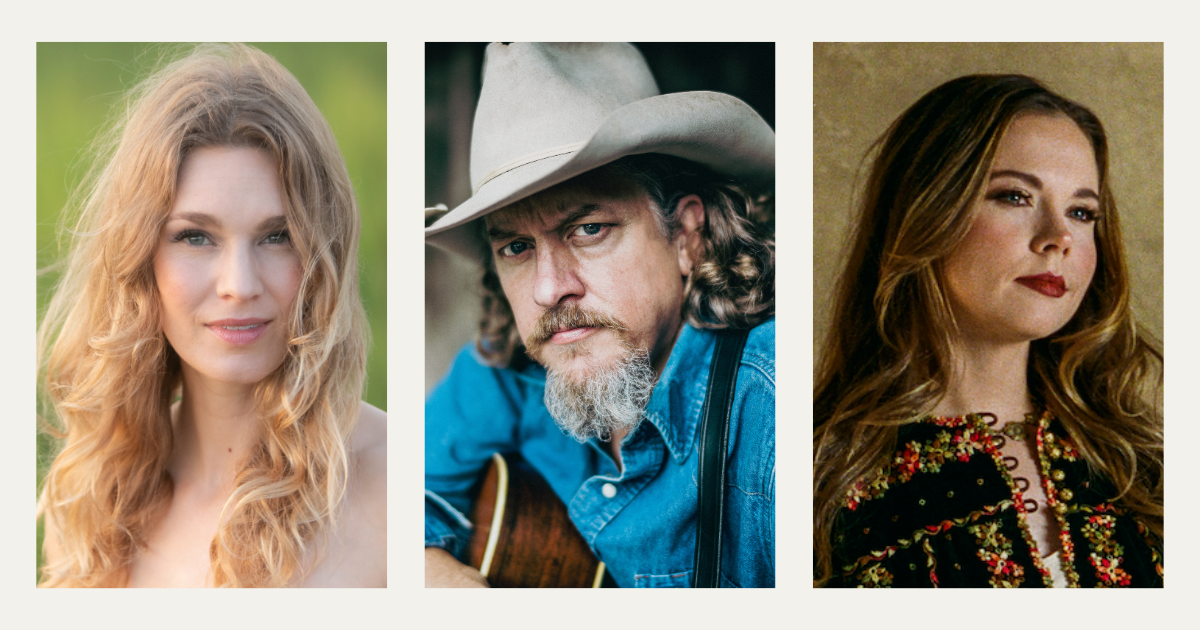
Photo Credit: Shelby Means by Hunter McRae; Shawn Camp by Neilson Hubbard; Sierra Hull by Spencer Showalter.
At times frowned upon or occasionally slandered, covers are as deep-rooted as the songs and the emerald valleys that have produced them.
Indeed, covers stir discussion, spark research, and add another patch to the great heart-sewn embroidery of music. Fashioned in a similar vein to the original – that’s flattery. When a song circles across genre divides, well, that’s an enriching voyage.
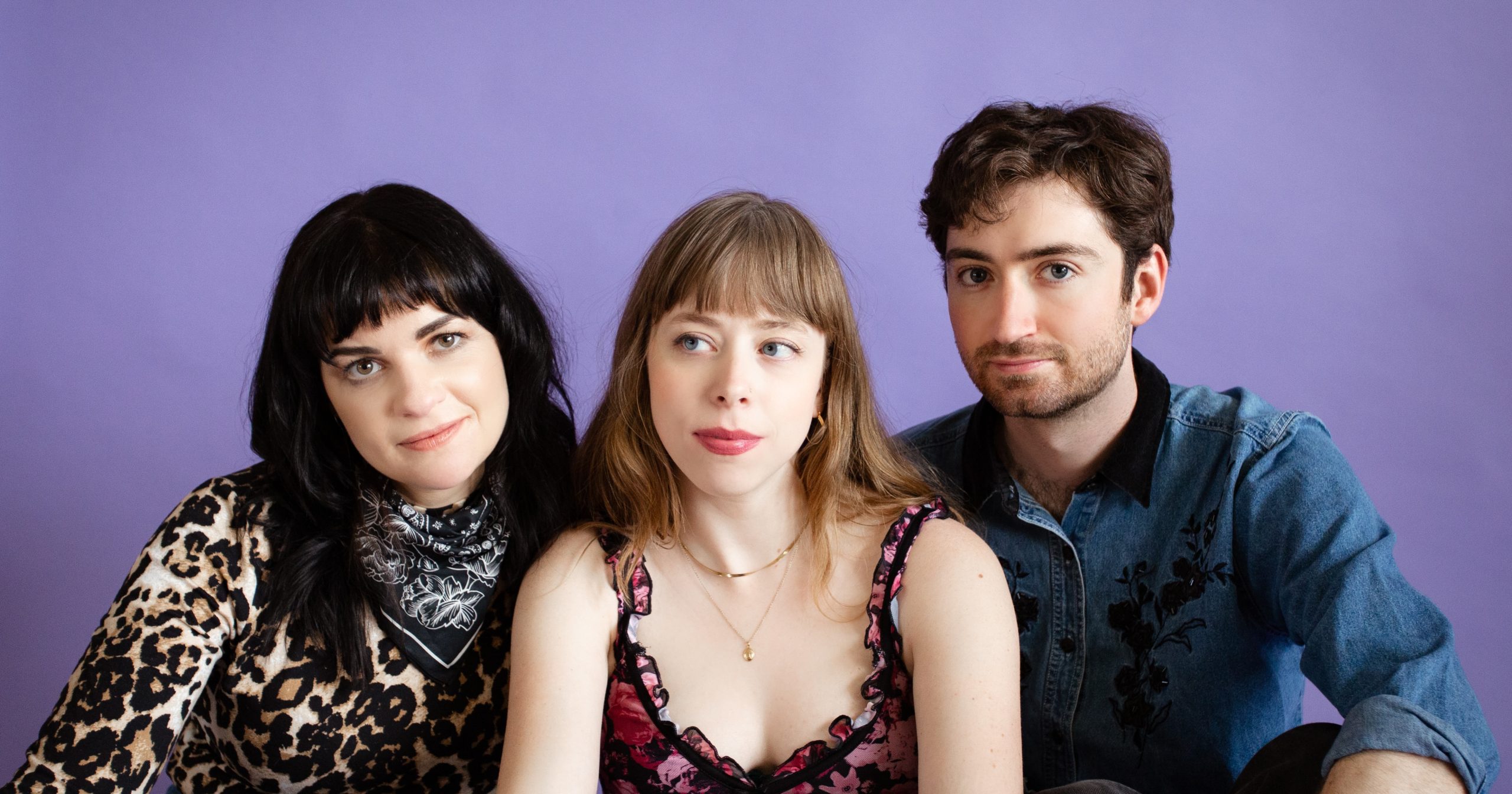
The members of Kissing Other ppl – Rachel Baiman and folk duo Viv & Riley – see their endeavor not just as an individual artistic sojourn but as a larger opportunity to establish a collective conversation. Here, they’ve taken a handful of mostly rock and pop songs and blended, marinated, and sautéed them in unfamiliar flavors. The end results turned out nearer to their own identities.
“I grew up playing traditional Appalachian style,” said Riley. “This is not that!”
Baiman is a sincere and dogged lyricist, with a harmonious ear and a top contender’s punch. She grew up in Chicago, with a factory-made violin in her hands and an insatiable curiosity for why and how music could conform and contort to her swiftly evolving moods. Somewhere along the line, she started getting serious about music and purchased a John Silakowski five-string fiddle on a lengthy installment plan. She arrived in Nashville at age 18, riding fragile finances. Slogging on foot, lugging her fiddle in a hard, cumbersome case, she lacked the extra dollars to hail a taxi. Her odd jobs were many: dog walking; catering; reading novels and writing summaries for a sociology professor; she once even held a job organizing a comedy contest. But a fearless, tenacious sense of purpose compelled her to stick with music.
Pondering all of these circumstances in her heart, Baiman released several persuasive projects, including Shame (2017) and Common Nation of Sorrow (2023). Riley Calcagno, one half of the contemplative folk duo Viv & Riley, added stringed support and pre-production assets to one of Rachel’s albums.
Subsequently, Baiman asked Riley and Vivian Leva (the other half of the duo) if they’d be willing to join her on tour, where long hours on the road were spent in between gigs consuming, swapping, and contemplating music. Baiman’s traditional background taught her how to fully perceive a recording – whether an old fiddle tune or multi-generational, passed down ballad, or even a contemporary pop song – to not only hear it superficially, but to visualize its promise. Through prolonged stretches of asphalt and expressway, she’d oftentimes wonder what she, if given the opportunity, could bring to a certain song.
“The idea stems from Rachel’s musical generosity and curiosity and the extended times in those van rides,” said Riley. “Eventually, the songs included were the ones that we’d all individually had been listening to and were moved by. Songs that had stopped us in our tracks at different realms of our lives. Songs that hit us emotionally or otherwise… spontaneously contributed in the week that we recorded them.”
Some of Riley’s earliest memories are of his father’s fondness of traditional music. His father played the guitar, fiddle, mandolin, and banjo. At age 3, the younger Calcagno expressed interest in the fiddle. Though he was raised in an unrelentingly urban environment in the heart of Seattle he was never far from the folksy hospitality of music: square dances, jams, and potlucks. At the Wintergrass Music Festival in Bellevue, Washington, he formed connections with musicians originating from the sparsest, most countrified swaths of the state.
“I discovered an authentic-feeling bluegrass scene in the state and an old-time rural music scene on the West Coast that was kept going by people living in cities,” he explained, “and I don’t see that at all as contradictory.”
Like many other kids his age who grew up in Seattle, beginning in middle school, Riley burned liberal hours listening to local indie rock, though the attachment he had made with traditional music would override all else. He met Vivian Leva at a music camp in the Seattle area which emphasized the cultural importance of preserving long-standing traditions.
“I was a fan of Viv’s parents’ music,” said Riley. “We started playing music right away. Viv is a gifted songwriter. We started passing ideas back and forth. That was eight years ago.”
Vivian Leva was born and raised in Lexington, Virginia, in the Shenandoah Valley close to the abounding cultural and geographical influences of Charlottesville, Roanoke, and the Blue Ridge Mountains. It’s a small town with a deep worship of bluegrass and old-time narratives.
“Before I was born, it was a big hub of old-time traditional music,” said Viv. “Young people moved here for the rich, blossoming scene. My dad came here at 18 and stayed forever.”
Viv’s father, too, took a particular interest in the fiddle, traveling to neighboring counties and states to observe and jam. Her mother sang and guitar-picked, emulating and scrutinizing the local and regional ballads she had fallen in love with. They attended old-time fiddler’s conventions as a family. And when her parents formed a duo and headed out on the highway, sometimes she would share in such jaunts first-hand.
“When I was little I went on tour with them for a bit,” said Viv. “As a teenager, I was playing in my dad’s bands. As a kid he would bring me up to sing a song on stage.”
Certainly, music has long filled the souls of Rachel, Viv, and Riley with good things – and Kissing Other ppl is a remembrance of affection as much as it is a representation of impression. Indeed, Baiman said that Kissing Other ppl is a natural extension of her – and her counterparts’ – inquisitiveness, their attempt to understand the mysterious processes of expression, meaning, and memory.
“In reality,” said Rachel, “I don’t think any band or musical project should attempt monogamy, because you miss out on so many opportunities to learn and grow and bring new inspiration back to your main role.”
Similar to Rachel, Viv finds original songwriting to be a sacred, mysterious place to dwell. But she also believes that covers are a part of the whole process of an artist’s maturity, the recognition of the music of one’s friends, mentors, neighbors, and across-the-board community.
“There can be a stigma about covers,” she said. “You can’t make it your own. You are not creative enough to make your own music. It’s a shortcut. It’s a cop out. But as someone who has written a lot of songs and released a lot of records of original music, and plans to do so in the future, I don’t see it that way. It is an acknowledgment of how being inspired by other people’s music is such an important part of creating your own music. You can’t make your own music in a vacuum.”
“Anytime that you are playing a song, you are creating it again in the moment, and re-interpreting in your own way,” added Riley. “Whether it is a cover or an old traditional song, you still have the power to sing it and do it in a way that really moves someone.”
Baiman said the intuitive, empathetic nature of the type of music she plays requires that she be an attentive observer as well as a cordial, broad-minded learner – prerequisites for a collaboration of this sort.
“I think that having a background in old-time and fiddle music in general really prepares you to be a musician who listens,” said Rachel. “If you approach any musical situation with the mindset of, ‘Can I do something to help support the group musically here?’, that goes a long way.
“Old-time really prepares you for the idea that your best contribution might be not to play at all. The bar is really high for joining in, you have to make sure you’re adding something that isn’t already there, and you’re not dragging down the groove. That’s part of the etiquette of informal jamming and it translates to professional playing.”
A fine cover such as the group’s rendition of Wilco’s “Ashes of American Flags” not only illuminates a previous desire, elevating or enriching it with brand new urgency, but in some fashion it obliges the total re-evaluation of the original.
“There are people who are not able to handle ‘Ashes of American Flags’ because of the context, or they come from a different generation, or they don’t like Jeff Tweedy singing it,” said Riley. “Why not give a song like that another chance or give it another life? If you have a song that’s fun, or one that hits hard, emotionally, lyrically, or harmonically, maybe you can add to it, instead of just burying it on a playlist.”
Riley notes that many of the greatest records and biggest chart sellers are in fact cover-centric productions, though they might not have been advertised or promoted as such at the time. Many great albums are rife with songs written by others, sometimes entire roomfuls of songwriters on Music Row. Many memorable albums, such as Bob Dylan’s 1962 self-titled debut, only have a small number of originals; among the traditional folk and blues arrangements, Dylan’s had but two.
Indeed, Kissing Other ppl simply builds on a long tradition of artists rearranging songs that they like and then reinserting them back into the public sphere of approval.
“We seem to be obsessed with originality in our current moment and society,” said Riley. “But we are also at a time when art and – the pursuit of it – is less funded and less valued monetarily than ever. So many of the great records that we love are cover records. Ours isn’t heavy-handed.”
Perhaps one sterling example of a cover album that marvelously nudged old material into fresh fields was Tim O’Brien’s Red on Blonde, on which O’Brien grabbed a handful of Dylan songs, tinkered with their framework, and dragged them into bluegrass brightness. Many of these songs have stuck around since the album’s release in 1996 and bluegrass buffs routinely call out titles such as “Señor (Tales of Yankee Power)” and “Farewell Angelina.”
One of the record’s most memorable tracks is a rendition of Jason Molina’s “Hold On Magnolia,” which draws out the spookily and eerily beautiful essence of the inscrutable artist’s mystifying original. Rachel’s fiddle punctuates the abstract stylishness with characteristic splendor and aplomb.
“Jason Molina [1973-2013] was one of the greatest songwriters,” said Riley. “He grew up in Lorain, Ohio, and he went to Oberlin College, where I went. He had a rough life and died of alcohol-related complications. He left so much amazing music behind… if even one person hears our version and goes and listens to his records then it is a job well done.”
Alluding to Molina, Viv noted the deferential nature of covers and their special reward.
“That’s the cool element of doing a record of covers,” she said. “You can inspire people with that special song that resonates and if they haven’t heard of that artist, they can go back and listen to their work.”
On both “Hold On Magnolia” and “Ashes of American Flags,” Viv found herself in the new position of playing the drums. She sensed the two songs required the presence of drums and their inclusion was inspired by her simple desire to test the unfamiliar.
“One of the incentives I had to go to guitar lessons when I was younger was that my teacher would let me play drums for the last ten minutes of the lesson,” said Viv. “During COVID, Riley surprised me with a drum kit. He got an electric guitar. We were having fun during the lockdown in our basement. We were doing less folk music, and experimenting with instruments outside of the immediate folk genre. So, I took a crack at it.”
“I think it is a testament to the spirit of making the record that we felt comfortable putting her on the drums,” added Riley. “[Producer] Greg D. Griffith made the snare drums sound huge and awesome, adding a big element to the tracks.”
One song that Viv introduced to the project was “Born to Lose” by Waylon Payne, and the diversity in these respective arrangements is startling: Payne’s original was supported by a complete country band; the new offering is sagaciously stripped down, extracting every syllable of bitterness, sorrow, self-loathing, and private turmoil from the lyrics.
“I had been particularly into this artist, Waylon Payne,” said Viv. “His vocals are really fascinating to me. His ornamentation is really incredible. I spent a lot of time trying to figure out what he was doing. I was definitely interested in trying to get his vocal ornaments similar, because I think that they are really beautiful.”
The spacey, moody “Where’d All the Time Go?” by Doctor Dog was another one of Rachel’s proposals.
“That is a fun song to do as a trio, because of its echoing harmony parts,” said Viv. “I would have never picked that song for myself to learn. That’s what made it challenging. It took me outside of my vocal comfort zone, and that was a fun challenge for me.”
The name of the band, Kissing Other ppl, is a teasing affirmation of one of the pop songs covered on the album, a soft, mischievous Lennon Stella song released in 2020.
“It has a fun and flirty vibe,” said Riley, “but it also gets to something funny and true about relationships. It captures the lightness of the experience of playing music and hanging out, and not taking yourself too seriously. It was Rachel’s idea and she stuck with it. It is awkward and funny, and why not? Life is short.”
Baiman said the namesake reveals a good-natured admittance of the diversionary quality of art.
“Coming from two different projects that are based in original music and collaborating on cover songs,” said Rachel, “we chose the band name as a playful nod to the idea that we were cheating on our own projects by trying something different and new.”
The trio intends to take their reincarnated versions on the road. Beyond that they have no fixed plans to continue – or, for that matter, discontinue – sewing and hemming their skills and interests together.
Indeed, sustained in its own special love and humility, kissing other ppl expresses not just innovative lyricism and beautiful buzzes, but a powerful sense of understanding. What Rachel, Viv, and Riley all agree on is that the genre or style of its communication is less important than the nourishing energy and want that necessitated its assembly.
“In the end, a lot of the songs are ambiguous,” said Viv. “It is hard to say exactly what some of the songs are about. We are not spelling out what you should be thinking or feeling. It’s just cool to see how other people are able to communicate things in totally different ways than how you would communicate them. But somehow it still hits you.”
Bluegrass and folk, Americana and country – it’s another excellent serving of new music in our weekly roundup!
Beloved long-running bluegrass group Lonesome River Band have a new single out today, “Square Dance Friday Night,” which you can hear below. Written by LRB member and artist-songwriter Jesse Smathers, it’s the perfect track for New Music Friday whether or not a square dance is in your future – and of course, one should be. You’ll also find a preview of an upcoming track from singer-songwriter Elexa Dawson, “Roots Grow,” in our collection. Drawing on connections to land and ecology, it’s a string-Americana examination of the cycles of life; it readily shows how and why Dawson can often be found on the folk charts.
Don’t miss Kentucky’s Nicholas Jamerson joined by Rachel Baiman on his new song, which drops today. “How Sunday Feels” is more than apt in its vibey, grooving observations of toxicity and duplicity in religion and belief systems. Impeccable guitarist, singer, and songwriter Jack Schneider, who’s a delightful collapser and combiner of genres and eras, also debuted a new single this week as well. Check out”Stone’s Throw Away,” a Barbara Keith cover that fits Schneider – and his upcoming album, Streets Of September –downright perfectly, shining with an indie-folk gilt.
We also have a special video treat this week, as we’re picking up and sharing a few performance videos from singer-songwriter Rachel McIntyre Smith from her Honeysuckle Friend Sessions series, which has been running on her social media and YouTube channel since October. Starting today and continuing over the next several weeks, we’ll share a series of three Honeysuckle Friend Sessions by McIntyre Smith and her musical friends and collaborators celebrating her recent EP. This edition features Smith in duet with Rebecca Lee Daniels offering a lovely rendition of Dolly Parton’s “Coat of Many Colors.”
Wherever you like your roots music to grow, there’s always a superb song just a stone’s throw away in our weekly roundup. You Gotta Hear This!
Elexa Dawson, “Roots Grow”
(Click to listen)
Artist:Elexa Dawson Hometown: Emporia, Kansas Song: “Roots Grow” Album:Stay Put Release Date: August 15, 2025 (single); September 12, 2025 (album) Label: Turns Out Records
In Their Words: “‘Roots Grow’ is a celebration of the cycles of life. It can’t be all ‘love and light’ all the time. When times get hard, I look to the world around me, to the trees and animals, and I see lots of things that thrive in darkness. I think we can channel that energy and get through the dark times facing us with the help of the tree folk, who are a lot older and smarter than we are.” – Elexa Dawson
Nicholas Jamerson, “How Sunday Feels” featuring Rachel Baiman
Artist:Nicholas Jamerson Hometown: Prestonsburg, Kentucky Song: “How Sunday Feels” featuring Rachel Baiman Album:The Narrow Way Release Date: August 8, 2025 (single); September 12, 2025 (album) Label: Cloverdale
In Their Words: “This song was inspired by some keyboard warriors who use religion as a weapon of condemnation, rather than a tool of liberation from their own ego. Universally, I hope anyone who’s using their beliefs, whether religious, political, or philosophical, as a shield to judge and harm others will hear this song and maybe stop and think before speaking so critically about others.” – Nicholas Jamerson
Track Credits: Nicholas Jamerson – Vocals, acoustic guitar, songwriter Rachel Baiman – Fiddle, vocals, songwriter Josh Oliver – Electric guitar, organ Steve Haan – Bass Mark Raudabaugh – Drums
Lonesome River Band, “Square Dance Friday Night”
Artist:Lonesome River Band Hometown: Floyd, Virginia Song: “Square Dance Friday Night” Release Date: August 8, 2025 Label: Mountain Home Music Company
In Their Words: “‘Square Dance Friday Night,’ written by our bandmate Jesse Smathers, is a story of years gone by in rural America. Growing up in the 1970s, I played so many square dances and gatherings attended by the unique characters described in this song. So many friendships were built in the VFW halls and community centers that lasted forever. Music and dancing was the main source of entertainment for working class folks and it was the way to end the week with celebration!” – Sammy Shelor
“The tie between playing music and dancing is a huge part of the culture along the Appalachian mountains. Growing up, I remember cutting my teeth playing music for dancers at local venues along the North Carolina/Virginia line. It has always been a beautiful community event. ‘Square Dance Friday Night’ is your invitation to a night full of fun and tells of some of the interesting characters you may meet while there.” – Jesse Smathers
Track Credits: Sammy Shelor – Banjo Jesse Smathers – Acoustic guitar, lead vocal, songwriter Mike Hartgrove – Fiddle Adam Miller – Mandolin, harmony vocal Kameron Keller – Upright bass Rod Riley – Electric guitar
Rachel McIntyre Smith, “Coat of Many Colors” featuring Rebecca Lee Daniels (Honeysuckle Friend Sessions)
Artist:Rachel McIntyre Smith with Rebecca Lee Daniels Hometown: Oliver Springs, Tennessee Song: “Coat of Many Colors” Latest Album: Honeysuckle Friend (Deluxe) Release Date: August 13, 2025 (video); June 27, 2025 (deluxe EP)
In Their Words: “Rebecca Lee Daniels is one of my favorite singer-songwriters, so I was thrilled when she agreed to be part of my series, the Honeysuckle Friend Sessions. Since moving to Nashville, she has become one of my closest friends in the music scene. We chose this song because we are both East Tennessee girls who love Dolly Parton. I think we recorded this in just one or two takes, because it’s such a go-to song for both of us. I’m so excited for BGS to partner with me on three sessions in this series. Keep an eye out in two weeks for another Honeysuckle Friend Session right here on BGS as part of ‘You Gotta Hear This.'” – Rachel McIntyre Smith
“It’s so meaningful to sing with one of my closest friends and collaborators – on my favorite Dolly Parton song, no less! Rachel and I share a common thread with Dolly in that we’re all three Appalachian women raised in the foothills of East Tennessee. As an artist who writes and releases Appalachian- and bluegrass-centric music, being featured in BGS is more meaningful than I can put into words and I’m so grateful to Rachel for the opportunity!” – Rebecca Lee Daniels
Track Credits: Rebecca Lee Daniels – Guitar, vocals Rachel McIntyre Smith – Vocals
Video Credit: Filmed and edited by Rachel McIntyre Smith.
Jack Schneider, “Stone’s Throw Away”
Artist:Jack Schneider Hometown: Atlanta, Georgia Song: “Stone’s Throw Away” Album:Streets Of September Release Date: August 6, 2025 (single); September 19, 2025 (album)
In Their Words: “My mission as a singer-songwriter is not to just perform my own compositions, but to preserve the music that inspires me, especially the hidden gems that deserve to find their way out into the world.
“Discovering Barbara Keith, who wrote and originally performed ‘Stone’s Throw Away,’ was serendipitous. I was in New York record-shopping with guitar historian Maple Byrne and it was he who stumbled upon a copy of Barbara Keith’s self-titled record. He insisted that I check it out, so I bought it at his recommendation. When I listened, it was almost spiritual how deeply Barbara’s songs moved me, specifically ‘Stone’s Throw Away,’ because of the line, ‘Georgia never looked so good as it does in Tennessee.’ Every now and then someone else’s words align with your own lived experience and this song is a perfect example of that for me.
“Recording it on my new record was also serendipitous. I had made a 4-track cassette demo of this song at one point, purely for my own amusement, and when my producer Matt Andrews (Gillian Welch, Dawes) came across the demo in a folder, we put it in the mix. Matt, never having heard the original version, liked how well it connected to the narrative theme of the other songs we’d selected. I am thrilled with how it turned out. Above all I am just hopeful to be able to draw more people’s attention to the music of Barbara Keith. She is incredible and I hope this version of her song does it the justice that it deserves.” – Jack Schneider
Track Credits: Jack Schneider – Electric guitar, lead vocal Camille Thornton – Electric guitar, vocal harmony Wendy Moten – Vocal harmony Dominic Billett – Drums Jared Manzo – Bass Matt Andrews – Organ
Photo Credit: Jack Schneider by Annie Loughead; Elexa Dawson by Lifeleak Visuals.
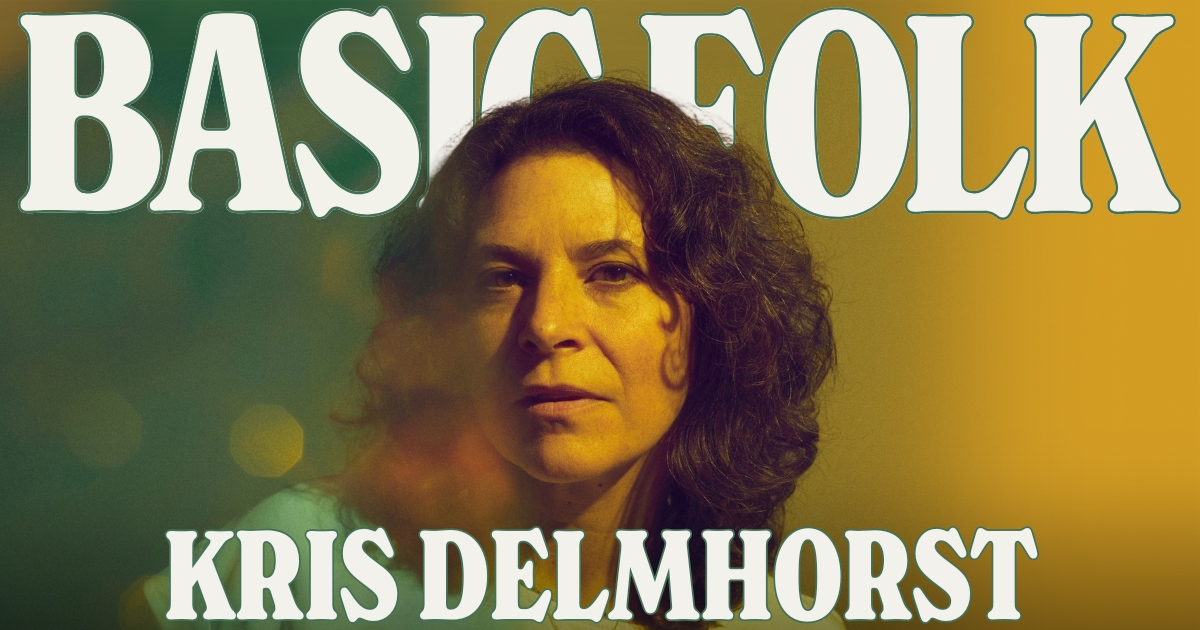
Kris Delmhorst is not a good sleeper. The Western Massachusetts songwriter is usually awake from 2 or 3 a.m. to about 4 or 5 a.m. Sometimes it feels nice and floaty, but other times she is wide awake worrying about anything her brain can get a hold of. This is similar to a feeling with which she ended her tenth record, Ghosts in the Garden, with the song “Something to Show.” Thankfully, she set us straight and explained that, indeed, the track is a hopeful prayer that she will have something to show for all the questioning, trying, pushing through, and general work that she and fellow humans are doing. Too bad it can’t happen in the daylight hours. In our conversation for Basic Folk, we talk about this and the other themes and songs on the new album, like the unbearable emotional density of summer ending, ambient restlessness during destruction, carrying unresolved loves, and, of course, death.
Kris experienced a great loss in 2021 with the death of her dear friend and collaborator Billy Conway. Her husband, Jeffrey Foucault, memorialized Billy in his 2024 album, The Universal Fire, which he called “a working wake” for their friend. He appeared on Basic Folk and spoke at length about Billy and what he meant to the Boston music community. I encourage you to listen to that conversation and Jeff’s record. Kris had known Billy for many decades; he produced a couple of her early albums and had been a huge presence in her life. The title track, “Ghosts in the Garden,” addresses Billy’s death, which sounds like it was a beautiful one, something that not very many people experience. He was surrounded by a houseful of friends and family celebrating and keeping him company up until the moment he passed.
There are many types of ghosts on the album: lost loves and past mistakes, roads not taken, and our possible futures, too. It was recorded in rural Maine at Great Northern Sound, which is inside an 1800s farmhouse that must keep its own ghosts. Kris, a great lover of collaboration, brings in many guest vocalists like Rose Cousins, Anaïs Mitchell, Ana Egge, Taylor Ashton, Rachel Baiman, Anna Tivel, and her husband, Jeffrey. I was surprised to learn that she had not actually planned for any guest vocalists. She made the decision, recorded some reference mixes in Maine, and listened on the drive home. She was startled to discover that she heard each guest vocalist on the track with her in the car, which prompted her to write some emails and get them all on the record. The songs want what the songs want, so you better give it to them or else… more ghosts?
A quarter century removed from his passing, John Hartford’s music and overarching legacy may have a stronger hold on bluegrass and American roots music than ever before.
From modern-day stars like Billy Strings and Sam Bush playing his songs in front of thousands each night, to popping up in books, old-time jams, workshops, films, and other functions, Hartford’s songs are officially a part of the Americana zeitgeist.
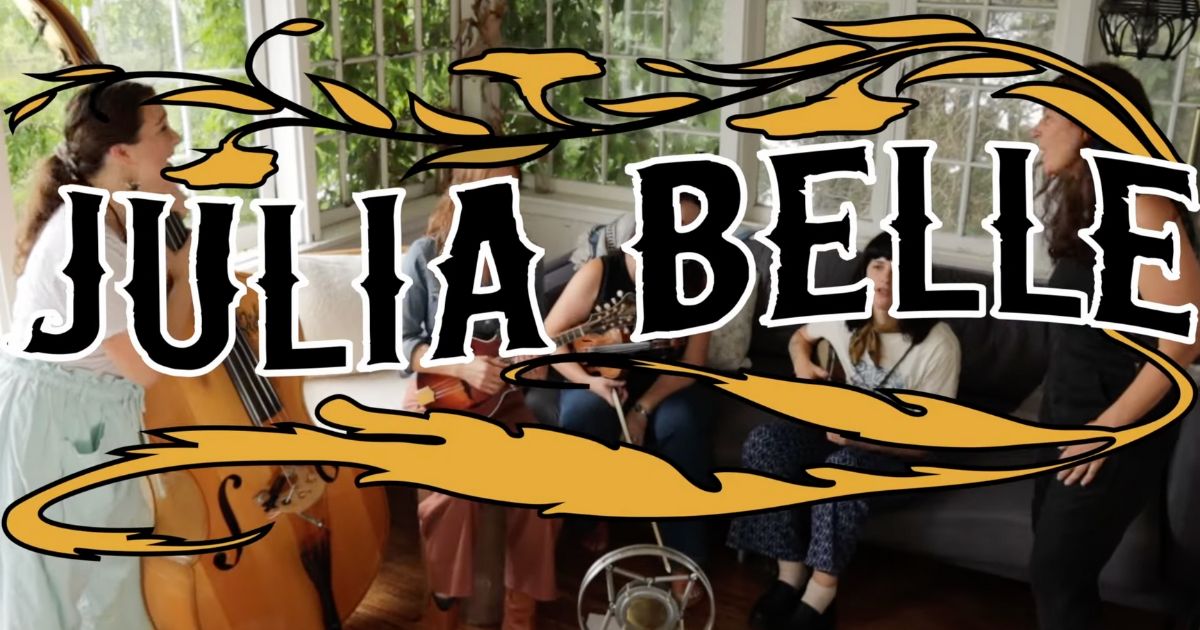
This trend continues on Julia Belle: The John Hartford Fiddle Tune Project Volume 2. Released February 28, the follow-up to 2020’s inaugural installment of the Fiddle Tune Project features another 17 songs from the always grinnin’, GRAMMY award-winning, steamboat-loving singer – this time performed entirely by women. Nearly 50 artists, musicians, and singers feature throughout, ranging from Rachel Baiman, Phoebe Hunt, Ginger Boatwright, Brittany Haas, and Deanie Richardson, to Allison de Groot, Della Mae, The Price Sisters, Uncle Earl, Kathy Mattea, Alison Brown, and Sierra Hull.
According to Julia Belle co-producer Megan Lynch Chowning (who was joined in that role by Sharon Gilchrist and Katie Harford Hogue, John’s daughter), once the decision was made to move forward with an all-women cast it came time to narrow down who to include on it–something that was as much of a dilemma as it was “an incredibly cool revelation.”
“We decided about halfway through to just make it a reality rather than a selling point,” she jokes. “It’s in the same spirit of whenever you open up a record from the Bluegrass Album Band, nobody says, ‘Wow, what a great all-male band that is!'”
Ahead of Julia Belle‘s release, Harford Hogue, Lynch Chowning, and Gilchrist spoke with BGS about their involvement in the project, preserving John Hartford’s legacy, and favorite moments from recording.
(Editor’s Note: Thefollowingare three separate conversations combined into one and edited for brevity.)
Nearly 50 artists are involved in Julia Belle. How did you go about deciding who to include on the project and which songs they’d play on?
Sharon Gilchrist: It was really important for us to have a multi-generational presence on this record. One of Katie’s personal wishes for the album was that every artist on the record have some personal connection to Hartford. With it being an all-female record, I was also curious to find women who had actually worked with or had some kind of rapport with him. For example, Laurie Lewis, Kathy Kallick, and Suzy Thompson are all on “Champagne Blues” and were all peers of Hartford’s back in the day. Ginger Boatwright actually inspired the song that John wrote which she sings on, “Learning to Smile All Over Again.”
In addition to the sheer number of people involved, I love how you also really allowed them to lean into their own creative tendencies while at the same time staying true to the style and spirit of John Hartford.
Katie Harford Hogue: Since Volume I the whole premise of this album series has been to choose artists that play this vein of music or consider my dad a mentor or someone they look up to. We hand them the book [John Hartford’s Mammoth Collection of Fiddle Tunes] and tell them to choose the tunes that speak to you, then come to the studio and put them through your filter.
For me to tell an artist how to do art – why would I do that? The whole point of being an artist is that you’re putting yourself into it and are using your own expressions, your own metaphors, and your own way of relating to the music. So we wanted their expression in it and the really cool thing is that Dad comes through no matter what we do. His DNA is in these tunes and there’s no way to get them out, not that we would ever want to. Having people come in and just go for it was risky, but an incredibly fun way to make an album.
Megan Lynch Chowning: A lot of the tones, audio, and overall vibe check comes from Sharon, who has been a John Hartford fan her entire musical life and is somebody who is so incredibly in tune with the sounds and feel that comes from his songs. She worked tirelessly listening to everybody’s work before they came in to record to get an idea of what’s going to help each person be the best possible version of themselves while they’re here.
Then there’s the issue of none of these songs – at least the fiddle tunes – having any chords assigned to them. When John wrote them there were no chord progressions, so every artist had to write their own. That in itself was a big part of people getting to take each song in their own directions. It was amazing to watch over and over again, and Sharon handled it all like an absolute rock star.
While some people’s legacy fades over time, it seems like John Hartford’s only grows stronger. What are your thoughts on that and how this project aims to further propel that legacy forward?
KHH: I’ve heard it said before that the way he communicated wasn’t limited to a particular generation. I don’t know if it was the way he thought about things or if some of the ways he did things were more universal. … You can go back to the masters of music and art – da Vinci, Bach – and their methods of creativity are still very valid now, they simply don’t go out of style.
When you hone into the foundation of it the relevancy goes with it, because everyone’s just going back to what’s real, which is what I think my dad also did. He was very true to the way he made music and the way he thought. A lot of people trying to make a career might stop and think, “What does the public want?” or “What do the masses want and how can I provide for them?” There’s nothing wrong with that, but there is another way to do it, making the music you want to make and not worrying whether or not it’s commercially viable.
That being said, “Gentle On My Mind” [Hartford’s most successful song, written in 1966] was very helpful in allowing him to do that full-time. Most everyone else has to get a full-time job and do the music on the side to stay true to themselves, but he got the best of both worlds in that way. He was able to take the success of that song and then go do his art with his heart and soul in it. I mean, who else writes about steamboats? Who else would write about the things that he wrote about and try the things he did on stage or just go out on a limb? And it all worked! In a way, everything aligned for him. That’s why I think he continues to be so relevant – he took a big risk and it paid off.
MLC: In the very first meeting the three of us had to discuss Volume II, preserving and carrying on the Hartford legacy was the focus of what we were trying to accomplish. On any given day you’ve got Billy Strings and Sam Bush playing John Hartford songs in their live shows. The biggest takeaway I have from this whole thing is John Hartford’s unceasing dedication to learning. He started transcribing and learned to write standard notation after he was diagnosed with cancer and instead of saying, “Oh no, I’m sick and this is going to slow me down,” he took it as a sign to move forward and learn a bunch of new things. That’s what led to him becoming obsessed with the fiddle, traditional styles and all that. That to me is the whole message behind these albums, that there’s so much more to do and so much more to write, play and learn. That’s been the most inspiring thing about being a part of this project.
SG: He was both a student and innovator of traditional music who forged his way forward by not sounding anything like anybody else. John is one of the largest beacons shining the way forward on how you do that.
What were your favorite moments from recording these songs? I personally can’t get enough of “Spirit of the South.”
KHH: What was so fun for me about these sessions was that even in rehearsals everyone was shredding. Upon walking in the room you’re hit with this energy and you just want to jump in. It was so exciting talking with everyone and feeling their joy around each song. Then there were the stories from Ginger Boatwright and Kathy Chiavola – both good friends of my dad – and Alison Brown telling me about his influence over her on the banjo.
Not being a musician, that all fed me, because that was a part of my dad’s life that I wasn’t necessarily connected with very much when he was alive. But now I can hear his music and I can see what he was doing and it just has a whole different impact on me. I’ve now had my own kids, raised them, done some things, and can relate more to what he was doing, so every time someone comes back to the studio and records a song, tells a story or talks about his influence, it feel like there’s a drawing of Dad and everyone’s going in and adding details that I hadn’t known about before or that just flesh out the picture that little bit more.
MLC: One favorite was getting Katie’s mom and John’s first wife, Betty, to sing on “No End of Love,” which is a song that John wrote for her. She is an incredible musician who first met John when they were both up for a radio show slot in the St. Louis area. After they got married Betty put her singing career on hold to manage the family, so being able to get her in the studio to sing that song with Katie and her granddaughter Natalie [Hogue] on guitar and hearing her voice – which has been on hold for a long time as she lives other aspects of her life – gave me chills. To me, stuff like that is the essence of folk music and why we do what we do in terms of keeping these songs and traditions alive.
Megan, didn’t you play John’s Tambovsky & Krutz violin on “No End 0f Love”? What was that experience like?
MLC: I actually have John’s fiddle here at my house and play it in the John Hartford Fiddle Tune Project live show, so I’ve been handling it for a while now. Talk about chills – it’s the fiddle he used the last five or so years of his life. It was his main fiddle for the “Down From the Mountain” shows and The Speed of the Old Long Bow record. It’s actually the fiddle on the cover of that album. Katie called me last year out of the blue and said she was moving houses and had taken the fiddle from one closet to another before questioning why it was there in the first place and not in my hands being played at these shows.
To play it on [“No End of Love”] was funny, because it sounds a lot different than my fiddle even though both were set up by the same person. It always felt comfortable to play, but the first few months I had it it was kind of dead from sitting in a closet for two decades. Since I’ve been playing it regularly it’s really come to life. Just the metaphorical part of this fiddle coming to life at the same moment these tunes are being brought into the world is special. It’s how I believe everybody who has the opportunity to be involved in traditional music should be thinking about it. We should constantly be honoring the stuff that came before us while also bringing it into new spaces.
Katie, you mentioned not being too connected to your father’s music when he was still alive, but what do you remember most about those times?
KHH: People saw his stage persona when he was out, but even when he was home he was still playing. He didn’t go home and just say, “Oh, I’m tired of that.” He played some more. “Obsessive” is not too strong a word to use when it came to the way his brain worked about music or art. It would be Thanksgiving or Christmas and he’d be working out melodies in the living room with Benny Martin simply because they enjoyed it.
Later on, my wedding reception was held at my dad’s house and we had originally set up music on a sound system so as not to burden him, but he, my brother, and my uncle ended up all grabbing their instruments and playing as a trio for it. He wasn’t a musician because he was trying to be famous; he was a musician because he couldn’t not be one. As much as his right hand was a part of him, his fiddle and his banjo were a part of him too.
What has working on TheJohn Hartford Fiddle Tune Project taught you about yourself?
MLC: These experiences have taught me that I’m capable at parts of this job that I previously shied away from. I grew up as a contest fiddler; that was my background. Because of that I was very good at learning specific arrangements of things and then executing them with precision. While that’s all great and fine – one: it’s not a very good living, and two: it’s not all that great for having a very broad musical vision or sense of yourself. That’s why I started playing bluegrass and working for country artists. My skills and musicianship both expanded, but working on these albums – both as a player on Volume I and as a producer/player on Volume II – I’ve learned much more about my internal ability to hear things I didn’t know that I could hear and to make decisions I didn’t know I could make.
It reminds me of this exercise that John Hartford used to do with people at his jams or in his band – called the “window exercise” – where everybody who’s playing has to do something different than everybody else and then has to change that thing every eight bars. If you’ve got five or six people sitting around in a circle, one person can be chopping, one person can be playing longbows, melody, harmony, shuffle pattern… but only for eight bars. It requires you to not only come up with new things, but also be aware of what everyone else is doing simultaneously.
It was a musical brain exercise he invented that we teach at our workshops and sometimes even at the live show. To me, working on these albums has been like a real-life window exercise. It feels like even from beyond the grave John Hartford is challenging me to go bigger, be more creative, and more aware all the time. He’s just expanded who I am as a musician and what I now know that I’m capable of that I didn’t know I was capable of before. It’s weird to be grateful to someone who’s been dead for 25 years, but that’s how I feel because I’m a different person and a different player than I was before I started this.
SG: It showed me the importance of being hands-off with other people’s musicianship and to give them every opportunity to bring as much of themselves to any project as possible. That’s when you’re going to get the best music out of somebody. This project was a lesson in learning to do that, but also knowing when to jump in and direct or provide guidance when necessary.
Katie did a great job of that as well. This whole project is her brainchild and was a huge undertaking and the coolest part is the way she’s doing it. She’s doing it just like her dad. He would be so honored and pleased to see her fostering that in his own tunes and giving others the opportunity to share in and carry on that tradition.
KHH: I was a stay-at-home mom when my kids were born and poured a lot into them growing up, but once my youngest got to high school I began backing off and looking to do some of the things I’d been putting off. Coincidentally, the fiddle tune project was coming to fruition around the same time.
It was like walking out on a limb – especially as an older woman – to go out and start on some of these things not having been in the industry or corporate world in quite a while, but I did it. I have learned so much about not just the music industry, but things like how to use computer software like Photoshop and Illustrator and doing video for social media. It’s a lot of fun and something I’m very proud to be able to say that I did. I want to encourage other women to do the same. Don’t worry about what other people are saying, what you’ve done before, how old you are or what stage of life you’re in – don’t let anyone devalue your experience. If you’ve got an idea, go do it!
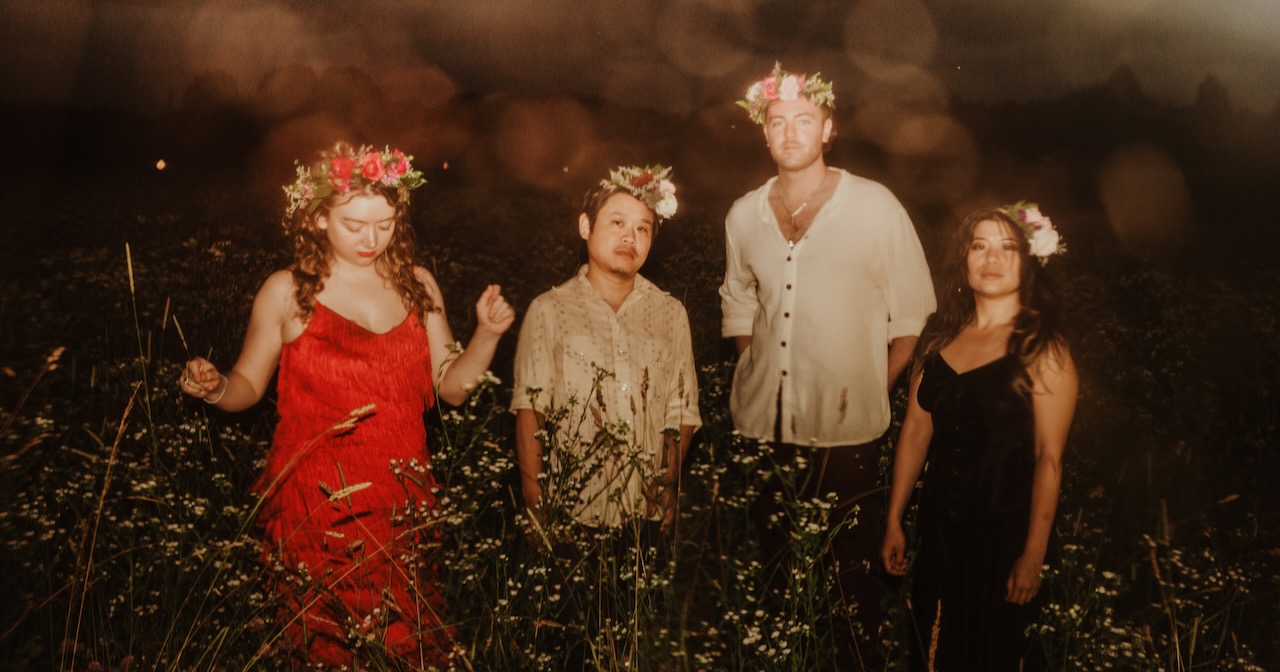
Love Your Mind, the new album from Boston/Toronto-based band Twisted Pine, is a delicious exploration of joy, growth, and self-love, packaged into tight grooves and soulful vocals. The quartet – which features Dan Bui, Kathleen Parks, Anh Phung, and Chris Sartori – is beloved for its genre-bending approach to acoustic music; they continue to defy expectations with their mandolin, fiddle, flute, and bass instrumentation.
What I noticed most about this new record, besides its refreshing positivity (in this economy?!), was the seamlessly collaborative sound. In discussing this in a BGS interview with the entire band, they explained that they’ve taken these past years to hone their collective voice as a group. With this new album, they felt that they had found that voice.
Together, we all agreed that the name “Twisted Mind(s)” might be more appropriate for the band at this point. Below is our conversation, where we cover Love Your Mind and the joy within it, the inspirations found in jamming, how flute fits in at bluegrass festivals, and so much more.
I love the amount of joy and uplift that comes through this album; it’s rare among Americana albums in this day and age. Is that feeling something that the band gravitates to organically? Or was it a choice you made specifically about this project?
Kathleen Parks: I think that happened pretty organically. Some of the songs started coming out of the post-COVID era. “After Midnight,” for example, was written after the first Ossipee [Valley Music] Festival in person after the pandemic and I tried to capture the joyful feeling of being around each other again. … Some of the album started in that appreciative state.
Dan Bui: I would add that throughout the album some subjects are a little bit more somber – there’s a theme of personal growth and learning through hardship and dealing with things like anxiety, making mistakes, and learning from them – but it’s always viewed through a positive lens, and musically, certainly, it is more of an upbeat fun vibe. That’s what we try to put out into the world and bring to our shows in general.
I love that song, “After Midnight (Nothing Good Happens).” Can you tell me more about that one?
KP: I was deciding not to party one night and [was] walking to my tent … listening to the roar of fiddle tunes and good times being had. I was like, “Oh my god that sounds so fun, but I also have two sets to play tomorrow.” My dad used to say that title phrase to me as a kid. He was also a musician who toured a lot so I always thought, “Cool people stay up super late.” My dad was like, “No, nothing good happens after midnight.”
Your fans have been starving for a new Twisted Pine record. What have you all been working on in the four years since your last release?
DB: Releasing our last record [Right Now] in 2020 was a huge challenge. We had to pivot and we weren’t able to do what we wanted to do, performance-wise, for a couple of years. So by the time we were able to get out there, we kind of went “all in” on touring and working on our live show. Before the pandemic, we had only really been playing with Anh for a short time, about six months. Since she lives in Canada, it was impossible to get together in person for a very long time.
Chris Sartori: Even getting into the studio with Anh for Right Now, it felt like we were just starting to figure out how that might work. These past couple of years have been really about ironing out the sound we had envisioned as a quartet and getting it to a place where we could write for that sound.
Anh Phung: It felt like with the 2020 record I was injected into a band that already existed, but Love Your Mind came from a place of more foundational collaboration. I was truly a part of the band before we got in there and recorded.
KP: I also feel like on this new album we had more time to discuss, “How do we want this song to sound?” We brought in players like Ethan Robbins, Ali McGuirk – just because we could. We had time and space and we weren’t being rushed into anything.
I also wanted to ask you about the “A Beautiful Phase (90’s Song).” Is it a ’90s song to you? Or is it just referencing nostalgia for the ’90s as “a beautiful phase”?
KP: For some reason, it ended up in the voice memos with that title. For me sonically, it very much has a “Bitter Sweet Symphony” vibe and I always see chrome when I sing it – that really, really specific blue chrome color, which I remember as a child.
Yes! I had that nail polish!
KP: Yep. It’s kind of looking back on a younger self, talking to a younger self. … For me, it’s about the missed opportunities with being a musician. You miss a lot of time with your family or family events [and] the song is almost apologizing for that.
DB: That song was one of the more collaborative ones. We had these early writing sessions at Kathleen’s where we got together and just jammed to see what came out. … There was this one section that turned into the chorus of that song. At one point, Chris and I were sitting around and decided, “Let’s just build this around this moody section.” We worked with that and kind of introduced a verse and this idea of having it modulate to a bunch of different keys. We roughed out a structure and that was what the lyrics were written over. When we went into the studio it was fresh – a lot of choices were happening in real time. It was cool to have it just come together like that.
Do you write a lot from jamming?
KP: It is a mix of jamming and melodic ideas. The final product is usually the outcome of playing the song down with a lot of different grooves and ideas, seeing what fits, and what we can pull off.
DB: One example is “Green Flash.” Kathleen was playing this 12-string electric guitar and this melodic idea kind of popped out and we decided to make something out of that sound.
That song also features Jerry Douglas. How did that happen?
KP: We had seen him at Earl Scruggs Music Festival and he said, “If there’s any way I can help, just let me know…” So, when that song started coming together, we were like, “We should ask Jerry to be on this!” In the studio we made this video asking if he would play on this song and sent it to him – and he said sure!
AP: Jerry has the exact style for it. I feel like the tune has the vibe of Strength In Numbers, so he fits perfectly.
OK, this question is specifically for Anh: What has your experience been like being the “flutist at the bluegrass festival?”
AP: Honestly, by the time I was playing with Twisted Pine, it was a pretty soft landing, because a lot of the work building my credibility in the scene came before that. Even going to IBMA, I was expecting a lot of pushback, but it has been pretty shocking how welcoming people have been. I think the initial expectation was pretty low. People were skeptical of how I, playing a flute, would work within this band, so when they hear it and it’s going well, it has even more of an effect!
Can you tell me about the actual recording of the album?
DB: I think a big part of the sound of the record should be credited to our co-producer, Dan Cardinal. We have worked with Dan on every record that we’ve done and he’s just someone who understands what we’re going for. He does a great job at capturing the organic sound of our instruments, but is also very creative and able to augment the sounds of our band … subtly and sometimes not so subtly. His choices make the recording sound a little bit bigger, wider and deeper. He was really valuable in that way. A lot of the songs were new, still being worked out, and he had some great third party observations.
KP: He’s good at placing sounds so that you feel them, but you’re not suddenly met with this random out-of-place soundscape in an otherwise acoustic recording.
That’s something I loved about the record. Even though you’re genre-bending, the sound is still so acoustic, where I imagine it would have been easy to add drums and synths, etc. Were there specific records you were referencing for production?
CS: I think each track has its own inspiration. Like “Start/Stop” is very Motown, “Chanel Perfume” is going more for an Aretha “Rock Steady” thing; each track we approached as kind of its own world.
Okay, last question, what does the title, Love Your Mind, mean to you?
CS: That sort of reared its head after we were finished recording and [after] looking back at what themes had emerged. We kind of identified that as a common thread that ties the record together, even though sonically it goes in all of these directions.
KP: For me, it means that whatever state you’re in – dark or frantic – you have to just try to look at yourself from someone else’s point of view and love yourself completely through all the stages.
AP: This is kind of riffing on a different idea, but I also think of Love Your Mind as – it’s common knowledge that our band has been hard to identify genre-wise, and I think that even though this album has a mixture of genres the sound that came out of this album is kind of unified in the way that the four of us play together. Twisted Pine is the four of our minds together, so the magical chemistry is loving our minds.
(Editor’s Note: Want more Twisted Pine? Check out our Basic Folk episode on the group featuring an exclusive interview with fiddler Kathleen Parks. Listen and subscribe here.)
Over the past decade, The Po’ Ramblin’ Boys have established themselves as a modern voice in traditional bluegrass. They are equal parts researchers, archivists, and artists, continually reframing what it means to be “traditional” – with a particular focus on the ways that bluegrass and roots music have always been progressive and boundary breaking.
For BGS, I spoke via video call to mandolinist CJ Lewandowski and fiddler Laura Orshaw around the release of their new album, Wanderers Like Me. We talked about their unique approach and mission for the group, we covered a lot of ground, and I left the conversation feeling inspired to put more thought behind my own mission in music making.
I see that you are coming up on 10 years as a band. Many years ago I had the pleasure of writing a bio for The Po’ Ramblin’ Boys, and I’d love to know a bit about the way the band has developed and changed over the years?
CJ Lewandowski: I think we are all ten years older than when we started, for one, and that’s a lot. It started as four guys working at a distillery, you know, working a day job. … There was no traveling, no planning, no pushing to be something. And it naturally progressed. There were videos coming out and promoters started calling and asking us to come out and play.
A lot of people plan for stuff, and they push and push, and everything we’ve been involved with before this band was like that, plowing through clay. You push and you push and never get anywhere. Then this band just happened. We didn’t think we’d be traveling in a bus and going all over the world, but here we are!
Laura Orshaw: The coolest thing for me is seeing the material and the message of the band start to come together. Everybody is really interested in super regional groups from around where they grew up, or maybe just bands they got interested in, so the members have interesting and diverse listening palates.
For several years, the band was doing a lot of covers that people hadn’t heard before, drawing on that research. Then, for the past five years, we’ve been doing a majority of original material and I think that the conversations that it brings up within the band are new … like, “How did you come up with this?”
For example, a lot of the more recent songs are about traveling. … For me, I spin that from the women’s perspective, a lot of them are about mom or a woman waiting back home and I like to think about, “What if a woman sings this song?” I think a lot about those classic themes but making sure they’re relevant to the modern days.
You’re one of the few bands that has never changed their commitment to traditional bluegrass over the years. Tell me about that interest in maintaining your style and how to you resist the temptation to move in more commercial directions?
CL: We had a manager at one point and we were talking about different material we could cover, and I said, “I don’t know if that’s gonna fit us…” And he said, “Well whatever you play, you’re gonna play it the way you play, so it’s gonna sound like you.” I think about that a lot, because I think he’s right.
I try to stray from the word “traditional” and think more about “authentic.” It’s just the way we play, and the way we learned to play from the mentors in our home regions. Anything we do is going to sound like that. We just play and sing true to ourselves, it’s not a plan or an act, we kind of let it go with the flow
There has been pressure sometimes– maybe the band should push this way or that way, but all in all, it’s like, “Well, if it ain’t broke don’t fix it…” We are all just true to the way we play
LO: What CJ said, “whatever you do is gonna sound like you” – with the current album coming out, it’s the first time we’ve had a really heavily involved producer, Woody Platt (formerly of the Steep Canyon Rangers), working with us from pre- to post-production. I think five people are going to have their own opinion about every suggestion that comes up, but because of Woody we did try a lot of things that I don’t think we would have individually gone for. And after we all did them, we usually liked them.
CL: Woody had our sound in mind, and he said, “The main thing is, I want you guys to be you.” We spread our wings, we got a little more vulnerable. There’s a natural progression to all of this and this record is a great next step.
LO: It was just really refreshing to work with a producer and have that level of focus and excitement, having that external voice that studied and focused is huge.
Since the time I wrote your bio, Laura has formally joined the band, tell me about what she’s added to the group and how that came about? I think it’s such a magical fit, and really rounds out the sound of the band.
CL: Her first show with us was in December 2017 at the Station Inn and after that she did some sporadic shows with us and played on our next couple records. In January 2020, she joined full time and she has officially been with us for four/four and a half years now. We tried a lot of different fiddle players on the road and nothing fit quite like what she had on the table; the attitude, the drive, and the musicianship
I’m a huge fan of triple-stacked harmonies, like Jimmy Martin and Osborne Brothers, so she brought a completely different vocal opportunity to the group. There was us three guys, and we could do some three-part harmonies, but with her we could move to different keys and had a lot more flexibility. … And of course, her fiddle playing is sassy and full of energy.
A lot of people ask about the name, The Po’ Ramblin “Boys,” but there’s a tradition of that in bluegrass, with Bessie Lee playing with The Blue Grass Boys, and Gloria Belle with The Sunny Mountain Boys. I like playing into that. But it’s also the band saying, “Hey we aren’t limiting.” Like, whoever can cut the gig, we love you! We’re very open and try to be as inclusive as possible. There are a lot of demographics in the group and she just added another one. …
Bluegrass Unlimited dubbed us as being “progressively traditional,” and it’s true in that everything that is traditional now, once was progressive. I don’t try to stand on a soapbox, and it took me a long time to figure it out, but I’m a queer artist, and I didn’t have anyone to go to when I was figuring that out and I didn’t feel I had a place. So, a lot of the stuff we do today has an open mind to it. [I’m included in] an exhibit in American Currents at the Country Music Hall of Fame and I put a rainbow guitar strap in there just to say, “Hey we’re out here, and holler at me if you need something.” Because I didn’t have anyone to look up to in that way.
Can you tell me a little bit about the album art for this new record, Wanderers Like Me?
CL: The cover photo is a painting of a cowboy. It plays into the title and many of the songs on the record and goes back to the story of wandering all over the country. But that piece of art was painted by our bass player Jasper’s great-grandfather, who was a North Dakota scene painter born in 1900 who painted all the way until his passing. His artwork is in governors’ mansions, he was a very prominent artist and to include something like that for our album art is also another way of honoring tradition.
LO: The way I see bluegrass, it’s a truly American art form. just like painting scenes, it reflects the culture and the time that it was painted in. In a lot of traditional art forms, there’s a kind of preservationist stance, but I think as a band we don’t like to have that mindset as a way to hold up barriers, or to say we don’t like modern or progressive music. A lot of what is told about American and bluegrass history is through a very particular lens; it’s very easy to see a fuller picture when you start digging. We travel and meet a lot of people, we live in modern society, we all have a lot broader perspectives than the people creating music years ago. So, we just see this mindset as a way to make the music reach its full potential. Preserve and broaden it by being aware of what’s going on around us, thinking about language and thinking about American art forms.
CJ: “Being you” is it’s own art form as well… There’s a lot to just making sure that you’re being yourself.
The people that we learned from, it’s amazing to learn at the knee or the foot of these incredible people, but it’s not a boundary. It’s something that you take and grow from and learn from. Not everyone is perfect or mindful… I learned good and bad from some of these folks. You learn what to do and sometimes you learn what not to do. You take it from spades and grow from that. We want to honor people, but also make this a better realm for everyone. Just because you play traditional music doesn’t mean you have to have a traditional mindset.
I think the fact that this record is coming out on Smithsonian Folkways says a lot about the timeless nature of the music you are creating. What do you hope that folks will get from your music now and also in the future?
LO: I think that one of the most neat things is knowing [Smithsonian’s] mandate around preserving music, knowing that everything that they have and archive will be there for ever. It will always be available.
CL: there’s a lot of good material out there that’s been overlooked. I call listening through it “digging for gems.” As an artist, I hope that one day when we’re gone… someone might find our music like that. I don’t have any kids, so I really think about how my music might be left behind for the next generation. With Smithsonian, we could be dead and gone and someone’s great-grandniece could ask for a copy of our record from the label and even if it’s out of print, they will print one copy and send it to them.
You have a lot of songs about the hardships and joys of travel and touring, do you guys see yourself touring for another 10 years?
CL: There’s a lot of different factors, I think we’d all like to go as long as we can, but within this 10 years we have fiancés, marriages, children, people living in different states. In 2018, when we got Emerging Artist of the Year [award] at IBMA, I looked at everybody and I said, “OK, if you want out, get out now.” And we all put our hands in and said, “We got this.” We all got together about how if one of us going leave, then we’d all let it go.
We never really felt like there was a place for us for a long long time, so when we found success we felt like, “Wow, we did this together…” I think the future is bright, especially with this new album.
“Nobody tells it like it is,” Anna Tivel sings on “Disposable Camera,” the first single from her new album, Living Thing. The song radiates with the joy and pain of reality, climaxing with the lines:
That big black train is rolling And that deep down scream is growing A hurricane come howling A shot heard from the mountain A blessing and a burden I swear this will be worth it…
Which are followed by a melodic and cathartic yell. I don’t know how I first came across Tivel’s music, but when I found the song “Blue World,” I got stuck on it. I listened to it over and over, trying to take in every aspect of it, break it into pieces, open it up like a watch so that I could understand how this perfect song ticked. It is still the most beautiful meditation on dying that I’ve ever heard. “You come to the heavy gate and you open it all alone…” is a line I think about often. To me, it sounded like she herself was telling it like it is.
A few weeks after discovering “Blue World,” I was on tour with Kris Drever, who is one of my favorite folk musicians from Scotland. We were trading new music discoveries and I played him that song, after which he became obsessed with it. We traveled around listening to “Blue World” and talking about death for the rest of the tour. Giving someone a new song to love is a special kind of transaction. It’s a gift for the new listener, but also a point of pride to have found something that someone else also finds meaning in – especially when the recipient of said gift is a musician you admire. New song discoveries are an unmatchable currency, a communication beyond words.
“Blue World” sent me on a journey through Tivel’s catalogue, with hours spent listening to Small Believer, The Question, and Outsiders, before the release of her latest record on March 31. With Tivel’s latest collection, I have to come to the conclusion that someone does tell it like it is and that person is Anna Tivel. I spoke with her over the phone for BGS about the inspiration behind her songs and the unique circumstances that led to her production choices on Living Thing.
I’ve been a fan of your work for a long time and I’m curious to know what feels new and different about this record than your past work?
Anna Tivel: I think there are two main things. I’ve worked with Shane Leonard before [who produced Outsiders and The Question], but this is the deepest collaboration we’ve ever done. There is so much of his heart and his sonic experimentation in these songs.
We made this squarely in the pandemic years, so there was no way to call upon a band for live tracking. It was just me and him in his studio. He went insane trying all kinds of sounds, playing all different instruments, and I scribbled extra verses on napkins as I heard what he was coming up with. We worked all day, every day and I slept on his couch for a month. I tried to say yes to everything and I learned so much. I really feel like the sounds feel different than what we’ve worked on before.
The other thing is that going through that year, I was craving soaring choruses… more melody and rise and rhythmic happenings that I normally do. Maybe it was a result of just sitting and looking at the same window for so long. I usually write long and dark monotonous stories with no chorus at all, but I think I craved a little more hope and joy. In general I feel like less people died on this album than usually die my albums… it’s still melancholy as fuck though.
Knowing that these songs were written and recorded during that very existential time, and now that they are being released into a different time, do these songs feel different to you than they once did?
Yeah, it’s interesting, the whole process of putting out a record. I really got stuck in the machine for a little while so it took quite a long time for this album to come out.
They are older songs now in my soul, but the project still feels really fresh. I think because Shane drew them into this more alive, sonic world. It was really exciting and fun to explore joy and rhythm and movement, especially in that isolated time. It felt good to have some hope and just wiggle around and try to feel the good parts of being a human.
So coming back to it now, it feels new and exciting to take them out on the road with a band. It’s making me realize it’s fun to have some songs that we can really move into, rather than building up from the ground.
One of my favorite tracks from your new record is “Desperation” – “Real life is far from fair, you tried and tried and got nowhere/ It’s like somebody rigged the whole damn thing/ Bloody knuckles, empty hands, you want to fight, but all you ever had/ Is desperation.” Can you tell me a little about what led to that song?
I think that one came out of the heart of that pandemic time, watching people, and having an awareness of how close many folks are to the edge, simultaneously knowing how the people pulling the strings aren’t the ones close to the edge.
Maybe your kid gets sick, and you miss work, and then that’s that, you’re evicted, and into the car. You don’t choose what you’re born into and if you’re born with the short end of the stick, it’s so hard to imagine anything but that reality.
You can see getting stuck, because that imagination isn’t generously shared by the people that own it. But if people that are living in a different world reach out to help it can really change the situation. Sometimes that means helping people believe that a different reality is possible. You have to go into your mind to create what you need. It’s sort of the same idea as representation, in the sense that if you’ve seen people that feel like you in very different situations than you, you can imagine yourself into a different situation.
I want to work on making that imagination more widely available.
That’s an amazing point, and a great one to keep in mind especially for artists. Artists can and have played that role for people, I believe. Does this same idea carry through for the song, “Disposable Camera?”
I like songwriting because you’re sort of always looking inward… You think you’re reflecting the world, but so much of yourself gets in there and the things that you’re learning into. A lot of this album is about getting free, getting loose of the way that you’ve taken in that it “should be,” the way that you should express yourself or the way you should move…
A lot of friends in the pandemic were having kids or trying to have kids and I was thinking about how, when we were all born, our parents were these people. [I was] realizing that everyone making babies has no idea what is going [to happen] and it’s kind of beautiful that it’s this big wheel of nobody knowing what they’re doing. Everyone is kinda hoping that someone else will be like “this is what it is,” but maybe the not knowing is actually a freedom. It feels scary to think you’re supposed to be certain, but you aren’t yet. The freedom is that nobody actually is certain and that’s not going to change.
I was listening to your song “Kindness of a Liar” and thinking about how important escapism was in 2020 and 2021. How badly I needed books and TV shows to get lost in so that I could come back to the present and have energy to cope with what was happening. Is that what this song is about to you?
In this batch of songs I was thinking a lot about what is truth, what is honest, what is listening, and what is being able to have nuance in all of those realms. You don’t just stay certain. To be able to move and shift and read situations and try to be learning in real time, messily, is very different from saying, “This is a fact and I’m going to hit everyone over the head with it until I’m proven wrong, and then I’m going to pretend I never said it.”
To try and tell stories to one another that are compassionate and messy – sometimes telling a story that might not be true is the most gentle and kind thing you can do while something hard is happening.
I think it’s about recognizing how much we crave each other’s stories and being really aware of how we paint the world for each other. The more artfully and more compassionately we tell each other’s stories the more we connect, and it’s not about trying to prove our point.
The most loving thing you can do is to share your mind and heart with people in the most nuanced way. And maybe there’s some fiction and lore in that.
Photo Credit: Kale Chesney
This website uses cookies to improve your experience. We'll assume you're ok with this, but you can opt-out if you wish.AcceptRejectRead More
Privacy & Cookies Policy
Privacy Overview
This website uses cookies to improve your experience while you navigate through the website. Out of these, the cookies that are categorized as necessary are stored on your browser as they are essential for the working of basic functionalities of the website. We also use third-party cookies that help us analyze and understand how you use this website. These cookies will be stored in your browser only with your consent. You also have the option to opt-out of these cookies. But opting out of some of these cookies may affect your browsing experience.
Necessary cookies are absolutely essential for the website to function properly. This category only includes cookies that ensures basic functionalities and security features of the website. These cookies do not store any personal information.
Any cookies that may not be particularly necessary for the website to function and is used specifically to collect user personal data via analytics, ads, other embedded contents are termed as non-necessary cookies. It is mandatory to procure user consent prior to running these cookies on your website.