A Sadness and a Sweetness: Hiss Golden Messenger in Conversation with the Weather Station

North Carolina figures prominently into the music that Tamara Lindeman and M.C. Taylor make as the Weather Station and Hiss Golden Messenger, respectively. Its musical traditions as well as its current scene have shaped their songs …

Taylor moved to North Carolina about 10 years ago, following the demise of his band, the Court & Spark. Music became more than a hobby but less than a full-time job, and he wasn’t necessarily thinking about a career in the industry when he started making music with a few friends as Hiss Golden Messenger. But then he made an album whose failure ensured his success.

“I made an album called Poor Moon at the request of a small record label in London, and they didn’t like it!” Taylor says with a laugh. “That was a blow to my ego, and I thought, ‘What am I gonna do now?’” Full of lively country-folk songs with imaginative arrangements and hard insights on the nature of faith, the album was finally released by a North Carolina indie label called Paradise of Bachelors. “When Poor Moon came out, it was a surprise to a lot people that I even lived in North Carolina. I had lived there for a couple of years, but nobody really knew who I was.”

The record left a big impression on Lindeman, whose own music career was just getting started. “I was invited down to Raleigh to play the Hopscotch Festival around that time,” she says. “I was shocked to be invited. It was the first time anyone had asked me to play a show outside Canada. I was only there for a couple of days, but basically all anyone talked about was Poor Moon. I went to a radio station to do an interview, and they were playing that record. I went somewhere else, and it was playing there, too. It was the talk of the town.”

Lindeman had never played outside of Canada before. “I played a show with Hiss Golden Messenger and the Mountain Goats, and that’s when I met all these musicians. They were like, ‘Come down and make a record with us!’ They were very convincing.” While in town, she recorded songs for an EP with Taylor and other regional musicians. Eventually, she. likewise, signed with Paradise of Bachelors.

Both found the region a warm and inviting place to make music, and both have spent the ensuing years touring and recording almost nonstop. As the center around which Hiss Golden Messenger revolves, Taylor writes incisively and movingly about the joys of music and family, the South as its exists and the South as he imagines it. His latest, Hallelujah Anyhow, finds reasons for celebration amid the wreckage of America in the late 2010s. Similarly, Lindeman’s new album, simply titled The Weather Station, is a vivid account of a year in her life; it’s a collection of songs that burst at the seams with words and ideas. The pair remain avid fans of each other’s work.

I always hate the word “autobiographical” or even something as vague as “personal,” but these two records do feel like they’re from very fixed perspectives.

Tamara Lindeman: For sure. My record was all finished, and I was thinking a lot about what it meant to me. This record is my way of expressing an understanding that things will not be okay. It’s my way of realizing that, somehow, you figure out how to be okay when things are not okay. It was funny: When I saw your record announcement and saw that the title was Hallelujah Anyhow, I was like, “Oh man, that’s a perfect title! I wish I’d thought of that title myself for my record!” That gets at something that I was trying to express.

M.C. Taylor: Yeah, I have a handful of people in my life who were like, “Damn, that’s a good album title!” [Laughs] Let me say, I think your record is so brilliant. I am just like totally in love with it. It has a sadness and sweetness, at the same time. Anyone that can figure out how to speak sadly and sweetly at the same time is always going to have my heart. That’s a language I am so curious about, and it’s a realm that I’m trying to work in. That has almost been my entire mission with Hiss Golden Messenger — how to convey light and dark at the same time, how to encompass as much richness of emotion in three to five minutes. And your record does that so, so well. There’s a certain propulsive, almost breathless feeling to some of the songs, like you’re trying to get more emotion in than the song can quite allow, which I find really, really moving. How did you make this record? How long did it take you to make this, and what was your process with it?

TL: It was actually pretty simple, in a way, because it was the first time in a long time that I just had a plan and a vision. I came home from my first tour in Europe and I just started writing songs. They were totally different from anything I’d ever done. And I was like, “Alright. This is going to be a record, and it’s going to have this kind of bass playing, it’s going to have this kind of drums. It’s going to have strings. So we’re going to have to write string arrangements.” I just had to go through all of these studios until I found one that felt right and picked the musicians.

We recorded in Montreal at a studio called Hotel2Tango, which is a classic — all the Godspeed You Black Emperor! and the early Arcade Fire stuff was done there. It was honestly quite simple: I just went in and recorded it as a trio, and then we did overdubs and strings and mixed it and mastered it. It wasn’t really a wild scenario of recording.

MT: It’s nice when it works that way.

TL: Totally. That hadn’t happened in so long, where I just knew the vocal sound I wanted, I knew the guitar sound I wanted. It was a matter of learning to not listen to all the other voices around me. I had to tell myself, “Alright, this is what it’s gotta be.” And that’s not something that I’ve ever known how to do before, so it was a funny battle. It was like, “Great idea, but I’m not gonna listen to it.” That kind of thing. How was your record made? You seemed to make it really quickly.

MT: It was the same, pretty much. We set aside a week to do the main recording and as many of the overdubs as we could, and then we had a couple more days to add all the minute stuff we didn’t realize we were gonna want in the first week. Then we mixed it in three days and mastered it. The whole thing didn’t take more than two weeks. Fortunately, various versions of the band had played most of the songs a bunch of times. We had been on a bunch of tours and were starting to creep new songs in, because we knew we wanted to make this new record. Honestly, by the second day of that first week, all of the basic tracks were done, which I was surprised by. I think it’s a testament to the people in the band — and also a testament to Brad Cook, who produced this record with me. He had a very optimistic vision — more so than me, I would say — about how much we could accomplish. And we did it!

TL: Amazing.
MT: There’s really something huge to be said for making a record quickly, following your first thought, and living with the moments you put to tape. I’ve watched friends and peers struggle to make the “perfect record,” and they’ll take anywhere from three to five years to do it. That really has a detrimental effect, I think. I wanted a different feeling. Because you just can’t make a perfect record! That’s not even something that should even cross your mind. But the options are so unlimited now that it gives us the illusion that we can put everything in its right place.

TL: Absolutely. If you listen to any of the records that we all love, especially when you’re in mixing mode, you’re like, “Oh, man, if I was given the track, I’d bring down the backing vocals, change the drum sound.” That sort of thing. The records you love, they’re always so imperfect.

MT: Totally. What we really changed, when we went into the studio, was that we tried to really understand the sound each person was making. We knew what those sounds were at the front end of the process: I knew what guitar was going to work on which song; we knew what Darren Jessee’s drums sounded like. I think that’s why we were able to mix the record in two or three days: We didn’t do anything other than mess with levels. There are definitely some moving parts and some arrangement things that we did on the record, but all of it was meant to serve the song. So it’s transparent in that way.

That’s how I feel about your record, too. When I really started listening to arrangements on your record, I realized there’s a bunch of stuff on there — string arrangements, piano lines — but when I am just listening with my unconscious mind, it’s a super straight-ahead record. Everything the band is doing on your record is following the lead vocal melody. It’s almost like the rhythm section is chasing your voice around, which I love. Your rhythm section is so fucking good! Is that Ian Kehoe playing drums?

TL: Ian plays with me and is my favorite drummer, but because he’s my partner, I was really anxious about having to be the boss. I’d never been the boss of a band and not screwed it up. But I knew I had to be the boss. We wound up talking it through, and I told him I didn’t think I could have him be the drummer because it’s too much emotion in the room. It’s too many feelings because he’s my partner. I just needed to go in with this different way of being as a person that’s uncommon to the way I am in life. So I wound up using a fellow named Don Kerr, who is amazing. He’s in his 50s and he’s been around every block there is to go around. He’s produced records, he’s written records, he’s played on records, toured. So he wound up being a really great presence in the room with the maturity to be patient with me, when I was making a mistake or forcing us to play a song for the 30th time. That wound up being the right decision and, since then, Ian and I have gotten to a place where I think we could make a record together. We weren’t ready then.

MT: It sounds like maybe he has listened to your other records to get that sort of galloping thing that you’re very good at. It’s a very specific type of drumming.

TL: It is, yeah. We talked about this a lot, too. I did play with a few different drummers, but I realized I didn’t want modern drums. I didn’t want a modern drumming style or sound. When we were making the record, I was obsessed with this Impressions record and I kept thinking, “More tom fills!” I became obsessed with tom fills. In the ‘60s, people played tom fills constantly. If you listen to a Bob Dylan record, the drummer is literally just constantly playing fills and barely playing cymbals.

MT: No cymbals! That’s definitely a big thing with us, too. We don’t play any cymbals. There are some times when we take the cymbals out of the room entirely. Everybody that plays in Hiss is very no cymbals. It’s a thing. Too much cymbals can really destroy a record.

TL: And it’s hard to record them, too, and get them to sound good without them taking over the rest of the band. Something I was thinking about: Rhythm is so important in your music. It feels like it’s almost more rhythm over melody.

MT: I don’t know exactly where that came from. I always thought of my dad as someone that had really good time, and I was always just really fascinated with rhythmic music. When I was a kid, there was this moment when my friends had to pledge allegiance to either heavy metal or rap, both of which were kind of new at the time. “Are you into rap or into heavy metal?” It never occurred to my friend group to just be into both. All of my friends got into metal, and I was like, “You guys are crazy! Rap is clearly so much better! Metal is lame! There’s no rhythm to metal.” This is what I was thinking when I was like 10 or 11 and, if I’m being totally honest, I still sort of feel that way. It was something important to me, just that backbeat.

TL: Listening to your music, of course it would be rap and not heavy metal. The groove is there, for sure.

MT: It feels very clear to me. I’ve grown and changed and all kinds of stuff, but there’s still a clear connection to the early backbeats I heard when I was a kid. That’s still stuff I love, and that’s the foundation of my musical brain. If I hear a record, no matter how brilliant the writing or the melodic content is, if it doesn’t have a clear rhythmic identity, then it’s almost guaranteed that I’m not gonna connect with it. I always feel like a rhythm section has to have a purpose. They can’t just be in a band because bands have bass players and drummers. To my thinking, the rhythm section is the most important part of the band, so they have to carry something really integral.

TL: Right. Lots of music is very rhythmic without drums or bass. But it’s funny you like my music because, as a musician, I have terrible rhythm. It’s something that I’m working on and thinking about a lot, and I have so much respect for rhythm. My rhythm is very strange. What I hear as being straight is totally not straight. And, to me, if the song doesn’t speed up or slow down, it sounds wrong.

MT: That’s not really what I’m thinking about when I’m thinking about rhythm, though.

TL: You said purpose.

MT: Purpose, yes. There’s a confidence to the way a song steps that is rhythmic to me. And that’s why I would maybe push back on you thinking that you don’t have good rhythm, because I don’t know that we would be talking, if you didn’t have good rhythm, honestly. I’ve always thought that your records have incredible rhythm.

I’ll second that. I was listening to “Thirty” today, and it made me feel like I was seeing a magic trick. I kept wondering, “How did she do that?”

TL: Well, that song starts out at around 100 beats per minute and it ends up at 120. It speeds up so much. That was the take where we went in and weren’t really sure of the song yet, so we just played it too fast. But it felt like it had this great spirit of discovery. The other takes just didn’t have that.

I want to double back to something that was said a minute ago about sweetness and sadness. I think that contrast applies to both of these albums, but I wonder how that affects the song and how you live with it over a long period of time. Does that mean that there are still things to discover about a song, even after you’ve toured it for a few years?

MT: Definitely. I don’t think I’ve ever put a song on a record that I knew everything about. I’m only really interested in ongoing work on songs that I don’t fully understand. Part of that might be feeling like the lyrics are a little unfinished, but I can’t quite think of the exact thing. Over time, it’s that ambiguity that leads to new understandings. The relationship with a song has to be an interesting and an ongoing one, in order to sing it every night in a way that feels genuine. And I need an emotional richness to a song to be interested in singing it every night.

TL: Sometimes, if I look back, I can see that I’m always trying to out-run myself in writing, because there’s a part of me that’s a perfectionist and wants to write a perfect song. But if I wrote a perfect song, I know I would hate it. I need the mystery, like you’re saying. The songs that stick with me are the ones that I don’t fully understand, or they speak to something in my life that I don’t fully understand, so they have this mystery about them. Those are the ones that pull me in.

MT: I agree.

TL: And in further answer to your question, I was thinking yesterday about ambivalence — about how I don’t even know that it’s my worldview, but my song view tends to be ambivalent in that I like to present sadness, joy, or whatever is happening and put equal weight on everything about the situation. I’m trying to present everything equally. In my lyrics, I never really make value judgments. It’s the opposite of a protest song, where you’re presenting some ideas and you’re also presenting how to feel about them. There’s a part of me that is just so drawn to a different perspective: “Here is darkness and here is sweetness and here is everything in between, so you can make up your own mind about how you feel.”

MT: I hear what you’re saying. It’s complicated because, sometimes, I can understand your personal perspective in the way you sing the words. Maybe that’s something that you do intentionally, or maybe it’s something you don’t realize you’re doing. But with a song like “Thirty,” I feel like I have a read on the character who’s singing the song, if that character is not you. I feel like I actually do have a slight read on your position about being a woman and being older and everything that comes with that. That makes it more interesting to me, because there is this rub between you trying to present all the facts and the way that you sing it. “Complicit” is another one that works in the same way.

TL: Maybe what it is, too, is that, in presenting all the facets of something, I’m often trying to get at the truth of something that I might not know. I might not know the truth of how I feel about something, and it’s in writing the song that maybe I do come to understand it. Maybe by embracing the aspects of something that I don’t know or feel ashamed about or afraid to express, you come to a truth about it.

It’s like writing to find a question as opposed to writing to find an answer.

TL: Or not writing about how I wish felt. Writing trying to figure out what it is you feel under all the layers of what you wish you were and the way you wish the world was. Which, to me, is uplifting. When I hear your music, it’s uplifting to me because there is a darkness to it. I don’t feel uplifted by music without a bit of sand in it.

MT: As I’ve become an adult and realized that I’m gonna carry these songs with me, I’ve realized that the songs have to be durable enough that I don’t mind singing them. Maybe that’s the weird, backhanded benefit of always flying under the radar: I’ve never had a song that I had to sing. I’ve never disappointed a crowd by not singing a song, I don’t think. And I do sing these songs differently — I mean, you have to, because you change as a person.

TL: That was the lesson I learned when I was playing shows for All That Was Mine, because there was just no way to play the shows other than to play them alone. So I was trapped in my biggest fear, which was to be alone in front of an audience with an acoustic guitar. I’m not a very good guitar player, so I would only play that half-hour of material, those 10 songs, and I wouldn’t play any other songs. So I was just sort of trapped inside this box of this one record. I realized right away I only had myself and my songs to rely on. If I was in a bar and people were talking and it sucked, then I needed to find a way to connect to that feeling of annoyance and then connect to the songs in that reality. Then maybe I could find something very real every night. Those songs had enough complexity to them that I could do that, and I could find how that song was true for that day. And that was how I started to know that they were good songs, because they had enough breadth to hold up.


Photo credit: Rui Oliviera (The Weather Station)
A Minute In Wilkesboro with the Kruger Brothers

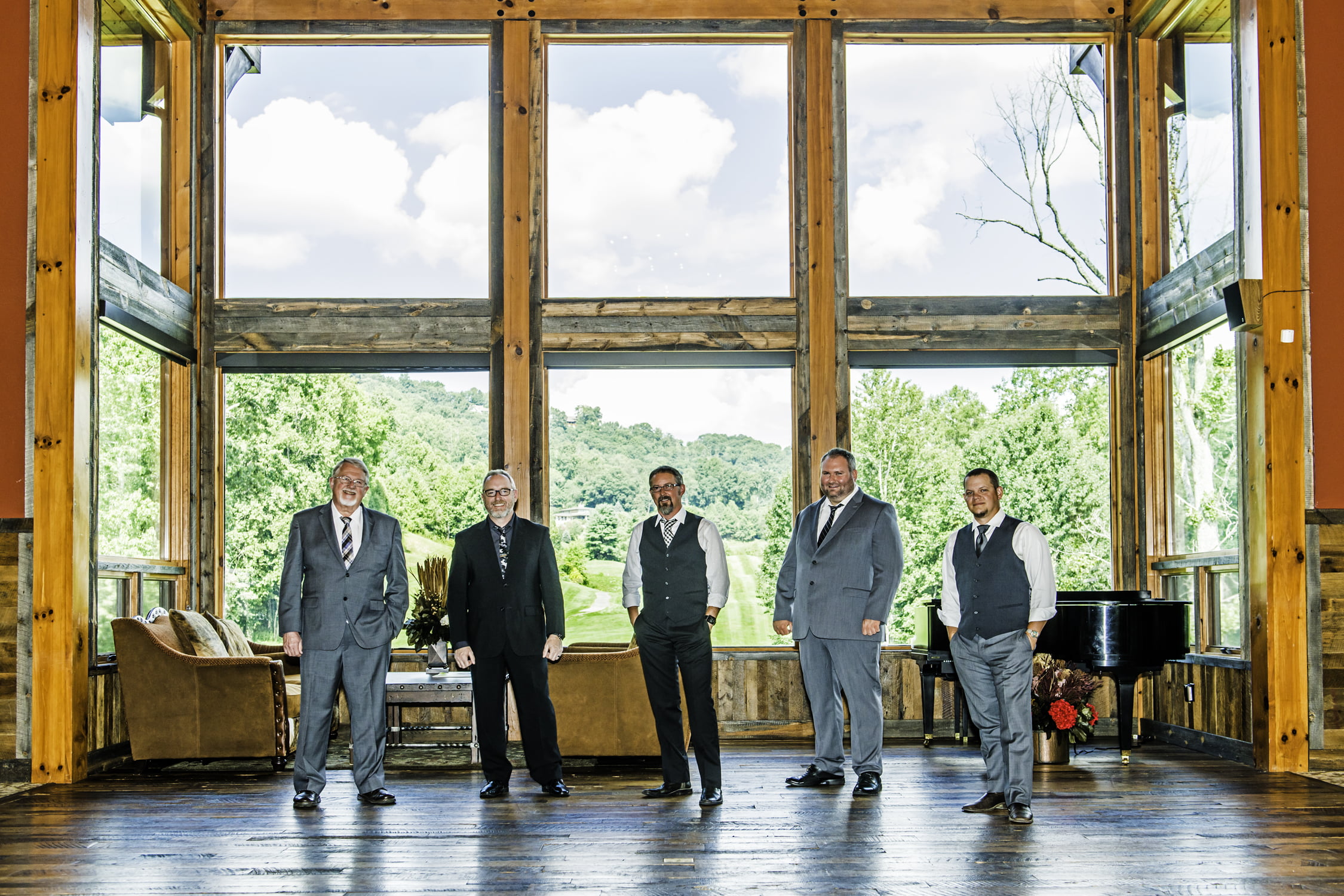
Welcome to “A Minute In …” — a BGS feature that turns our favorite artists into hometown reporters. In our latest column, the Kruger Brothers take us on a tour of Wilkesboro, North Carolina, from a courthouse to a courtyard.

We make our home in Wilkesboro, the county seat of Wilkes County, North Carolina. This county is known as “the heart of American folk music.” Wilkes County lies the northern area of the Yadkin Valley, on the eastern slope of the Blue Ridge Mountains. We were drawn here by the music, and then fell in love with the people and the beautiful landscape.

Blue Ridge Parkway. Photo credit: RD Hill Photography

BLUE RIDGE PARKWAY: This is a very diverse region of the Blue Ridge. Of course, we love the sounds of roots music and the many festivals in the area. When we’re not playing music, we enjoy the apple orchards and vineyards in the area. There are so many recreational opportunities, such as W. Kerr Scott Reservoir’s camping, boating, bird watching, hiking, and mountain biking trails. The Yadkin River runs between the towns of Wilkesboro and North Wilkesboro, offering miles of rippling water for kayaking and canoeing. This area is also popular for trout fishing.

Carolina in the Fall. Photo credit: Wilkes Chamber of Commerce

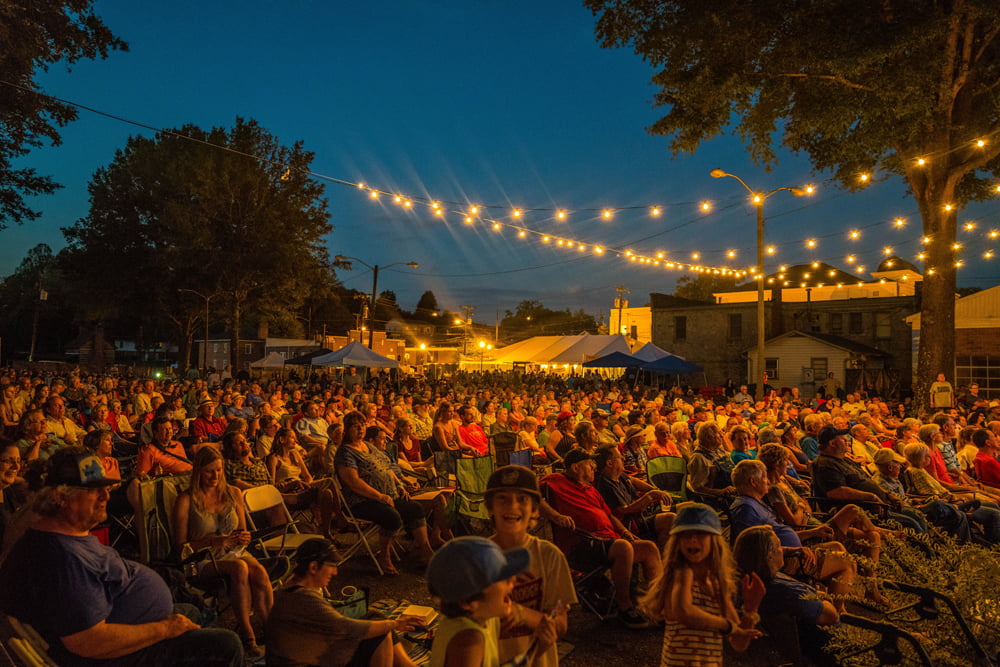
CAROLINA IN THE FALL MUSIC AND FOOD FESTIVAL: We are proud to host this annual event which features some of the world’s best folk, bluegrass, and roots artists. As Uwe sings in his song, “… in the hills of Carolina, folks have opened up the door and, for the first time in my life, I’m not a stranger anymore.” There are no strangers here as we get together for two days of food, music, and more. Food trucks from around the region bring their unique offerings and compete for the Food Truck Championship trophy. Regional vineyards and craft breweries provide a taste of the area’s best beverages. Also included are the North Carolina Banjo Championship (a favorite for Jens, of course), the Chad Lovetts Memorial Trail Run and Ride which supports the American Cancer Society, and a silent auction supporting an afterschool music program. The festival also includes Contra and clogging dance classes, artist workshops, and nightly jam sessions at the Yadkin Valley Event Center.

Doc Watson Mural. Photo credit: Kruger Brothers

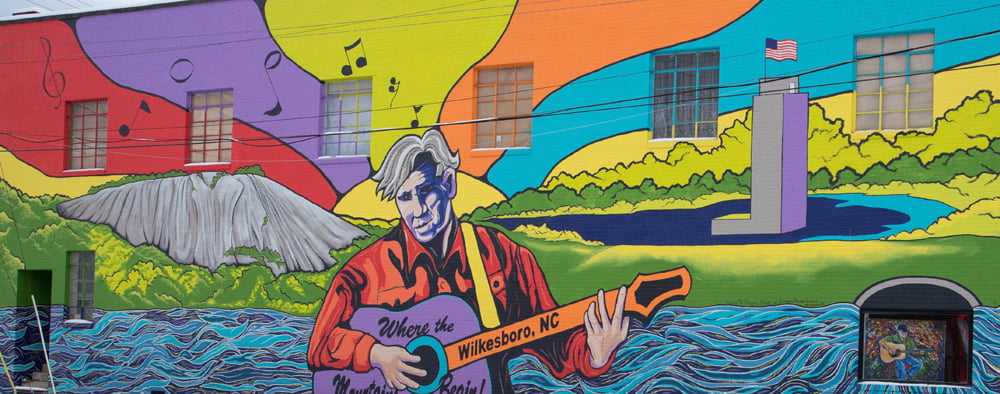
DOC WATSON MURAL: When Doc Watson passed unexpectedly in 2012, the world lost an amazing and inspiring talent, our community lost a hero, and we lost a treasured personal friend. We were pleased when students in the Wilkes Art Gallery’s annual Summer Honors Art Program participated in the creation of this mural depicting Doc along with Stone Mountain, the Yadkin River, and W. Kerr Scott Lake. Doc would’ve loved this program which pairs professional artists with talented, local high school students to create works of public art. The brightly colored mural was designed by local artist Wes Gregory and covers the entire east façade of Royall Custom Framing, a building located at the corner of Main and Bridge Streets.

Early morning MerleFest main stage. Photo credit: Kruger Brothers

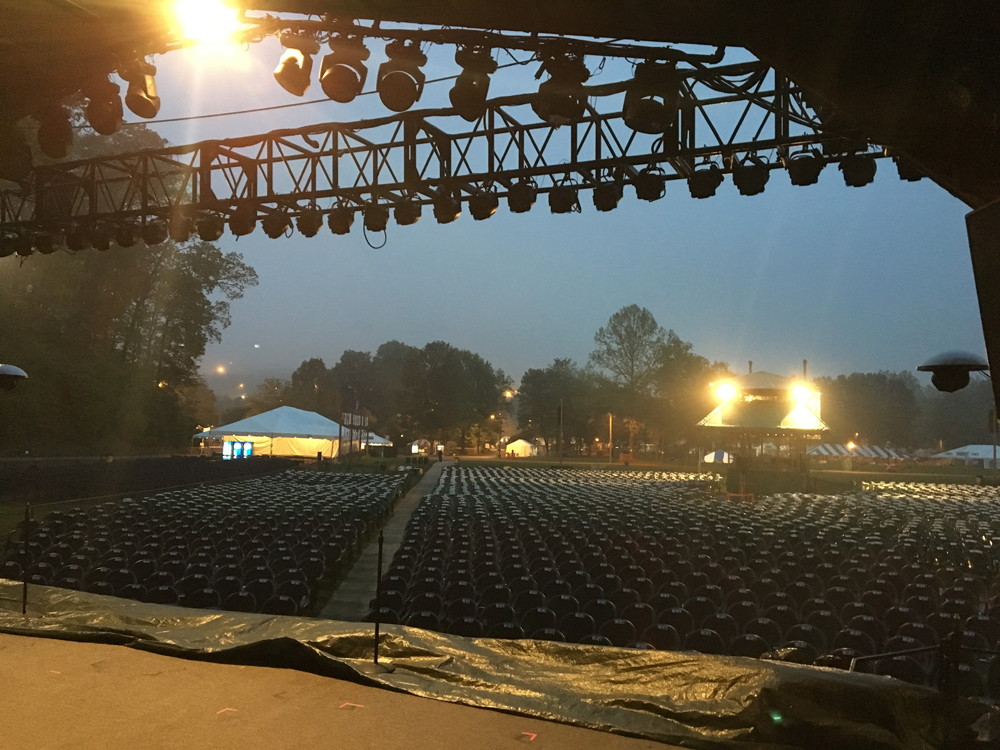
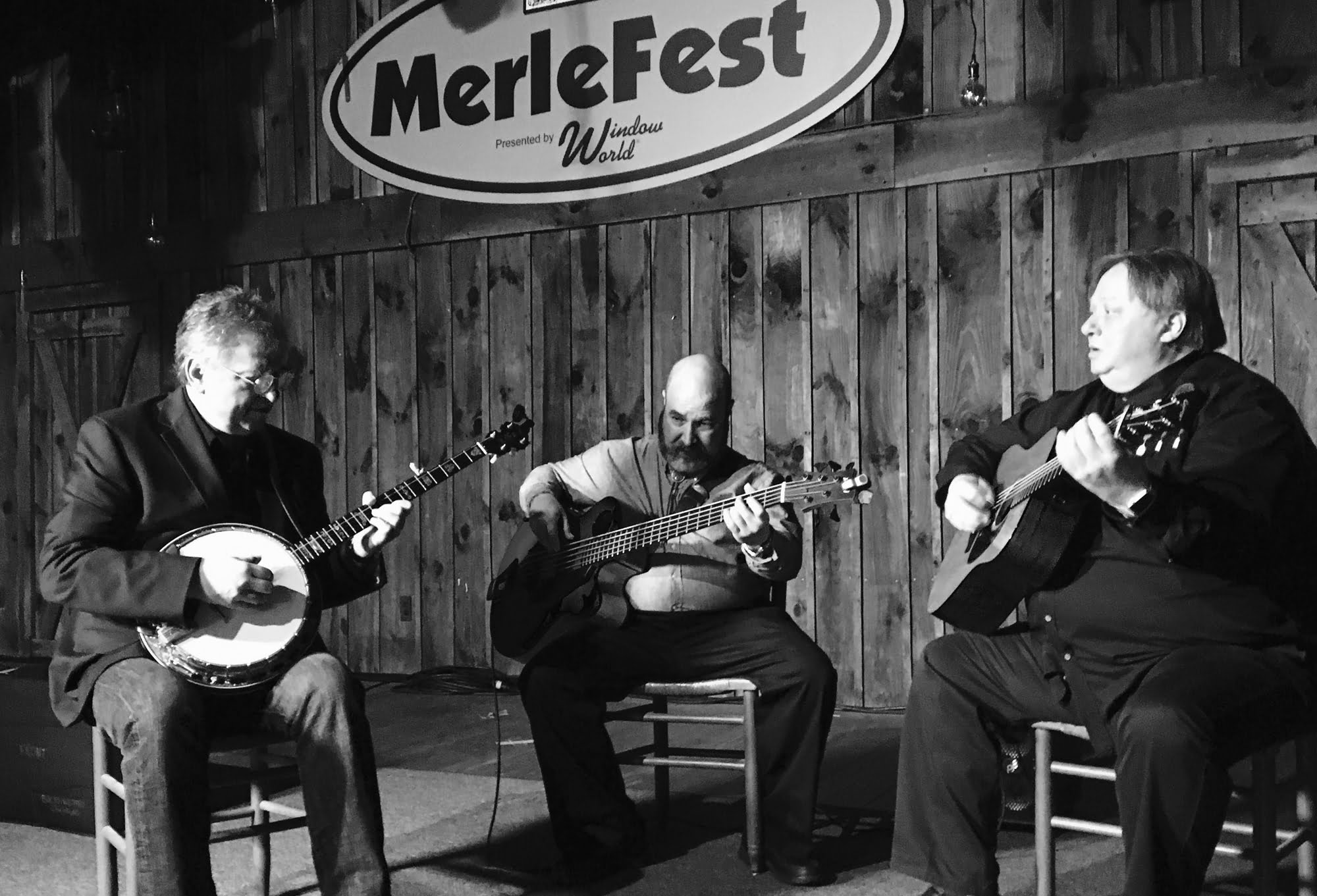
MERLEFEST: And speaking of Doc … ! Our friend continues to be honored annually on the last weekend of April at the festival created to remember Doc’s son, Merle. The four-day MerleFest, on the campus of Wilkes Community College, features music from all over the world, and we are always honored to play this special festival. It was, after all, playing MerleFest that first introduced us to this town that we now so proudly call home. The history of performers since 1988 reads like a “who’s who” of the entire world of music. Uwe took the early morning photo on the first day of MerleFest this year, hours before the gates opened. There was an air of anticipation in the misty morning light, with rows of chairs so neatly placed in expectation of the crowds to come. It is one of the premier music festivals in the country, yet MerleFest still retains that special feeling of a family reunion for fans and for those of us who perform.

Wilkes Heritage Museum. Photo credit: Kruger Brothers

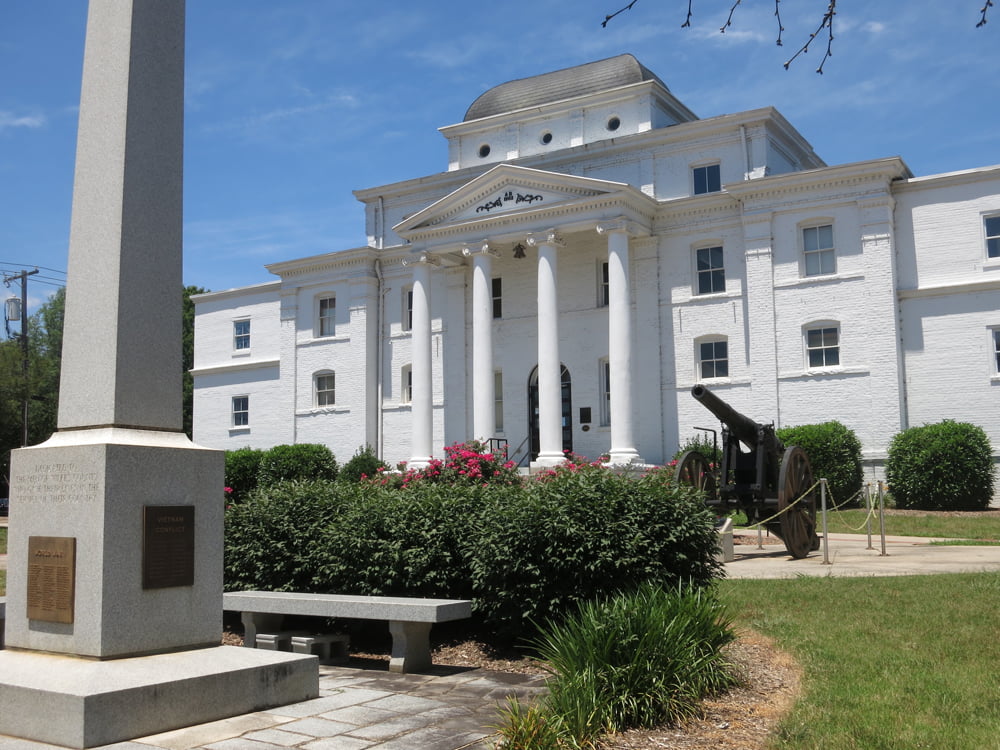
WILKES HERITAGE MUSEUM: The Old Wilkes County Courthouse, built in 1902, has been restored and houses the Heritage Museum for Wilkes County History. It is a beautiful example of classical revival structures. Inside is a rare collection of artifacts and images that tell stories of early settlers, military history, industry, agriculture, and so much more about the history of our town and county. Behind this building is the old Wilkes County Jail, now a museum, as well. It is one of the few remaining mid-19th century jails. One of its inmates was Tom Dula or Dooley, famous for the 1866 murder of Laura Foster, and made more famous by the old North Carolina folk song “Tom Dooley.”

Open air market. Photo credit: Kruger Brothers

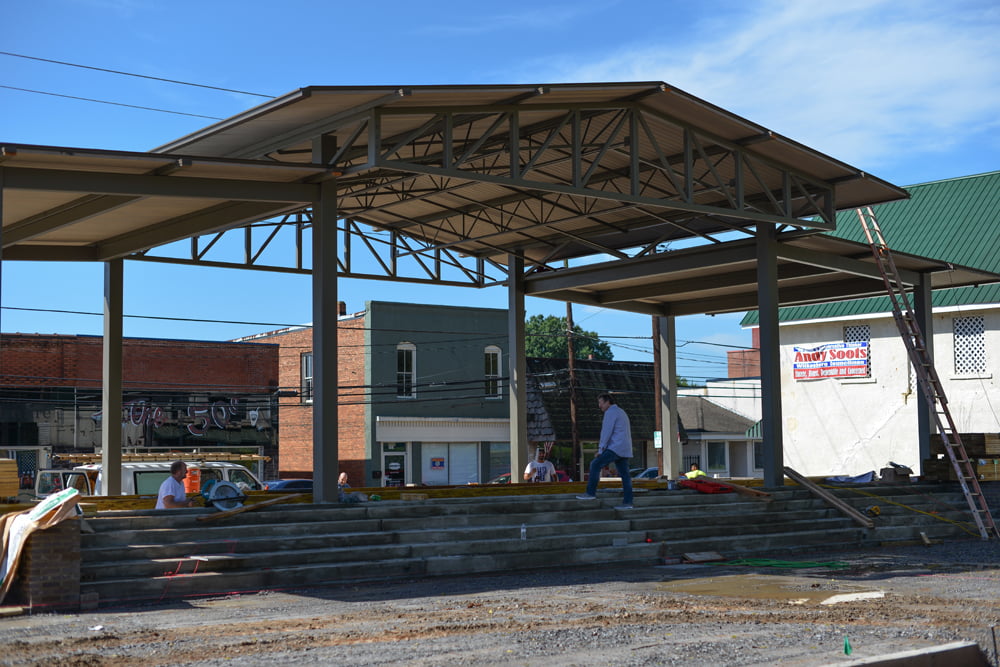
OPEN AIR MARKET: Downtown Wilkesboro is enjoying a revitalization project that includes a new performance stage in the Open Air Market. The Wilkesboro Open Air Market is held on Fridays, from May through September, providing local and regional farmers and artisans the opportunity to sell fresh farm products and handcrafted items. There is also live music throughout the market season. The stage will be used for many of the festivals and events in town, and we’re looking forward to playing here.

Raffaldini Vineyards. Photo credit: Wilkes Chamber of Commerce

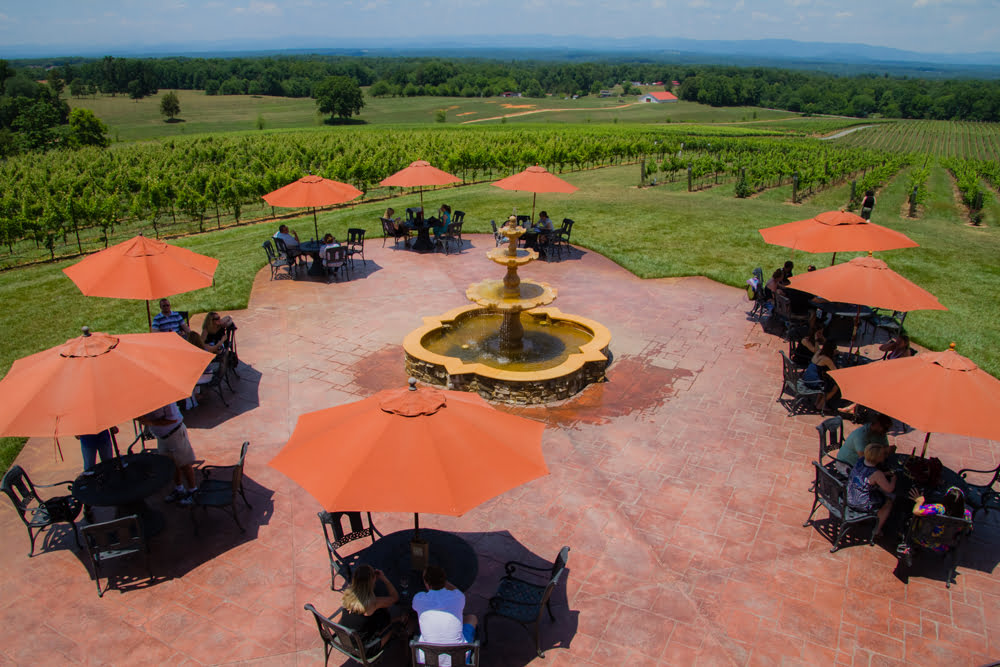
RAFFALDINI VINEYARDS: This is a favorite escape just outside of Wilkesboro in Rondo, North Carolina. Raffaldini Vineyards & Winery is a surprising winery that will make you feel as if you’ve stepped out of the Yadkin Valley and right into Tuscany. They have delicious wines made from authentic Italian varietals. The 102-acre estate is surrounded by the serenity of the Yadkin Valley and the Blue Ridge Mountains. The patio is a perfect place to enjoy lunch, a glass of wine, and the picturesque countryside. It is also an ideal place to relax and reconnect with our lovely wives when we are not on the road.

LISTEN: David Childers, ‘Collar and Bell’

Artist: David Childers
Hometown: Mount Holly, NC
Song: “Collar and Bell”
Album: Run Skelton Run
Street Date: May 5, 2017

In Their Words: “Shannon Mayes, a school teacher from Gallipolis, Ohio, sent me some lyrics he had written a while back — those lyrics pretty much told the story in this song. I had trouble finding a way to convey what I wanted the listener to feel from the story, but after a couple of years of trying different approaches and re-writing a lot of the words, I found an enjoyable way to play and sing it. It’s about a man and a dog going hunting in a deep snow. Shannon is a hunter and he brought elements and details into the story that I would not have known to use.” — David Childers

Counsel of Elders: Lee Fields on Walking the Positive Line

Singer and incontrovertible soul man Lee Fields can’t help but emanate positivity. It’s not the annoying kind, the sickeningly sweet — almost naïve — approach to life that willfully ignores the world’s more deleterious moments in order to pretend everything’s hunky dory. Fields’ positivity exhibits a greater degree of realism. It’s a choice to recognize the bad while finding ways to work against it. To lead, in other words, with love.

Music helps do much of that leading. Since putting out his first album in 1969, the North Carolinian has dedicated himself to writing and recording songs tasked with spreading a little light. Arriving last November, his latest album, Special Night, co-written and recorded with his band the Expressions, offers an array of feel good songs at a time when that very purpose has become as necessary as ever. But Fields doesn’t pen escapist fare. “I’m trying to say what people do,” he says. “I’m trying to write what people actually do.” On the titular track, Fields found inspiration in his 47-year marriage and, specifically, how he and his wife make time to appreciate one another, thereby making every night a special night. It could edge toward mawkish territory, but Fields isn’t being blasé about his relationship. It takes work and mindfulness and gratitude. With that underlying sentiment informing the lyrics, “Special Night” takes on an edifying note.

I’ve heard you talk about your intention to spread positivity with music, which seems like something we need now more than ever. But how do you stay positive?

Through prayer. I truly believe that my spiritual self is more important than my physical self because I think the spirit continues on and everything else is temporary. My spiritual beliefs keep me intact, keep me going.

It’s so easy to get bogged down in the daily grind and forget there could be something more beyond this existence.

And thinking that way keeps me grounded because, as they say in the Bible, “What good is a man if he gains the whole world and loses his soul?” The spirit is the most important thing a person has.

On “Make the World,” you say people can improve the world by working together, but the country seems more divided than ever. What’s your take on how people can overcome that division?

If we love the spirit of God with all our heart and soul and mind, and if we love our neighbor as ourselves — in other words, do to people exactly how we would want to be treated — those two things right there. If we did that, we’d be promoting the product of love. When you have concerns about others, you’re not selfish. “Make the World” came to me in a dream. Actually, it was a nightmare dream. I dreamed I took a trip in the future. In the nightmare part, I saw so much pollution: The water, the air, the fish were dying and there was anarchy. The air was so polluted, it was like a fog. I woke up out of that nightmare gasping and then, when I realized it was a dream, I went back to sleep. In that dream, I was going down the same road that I went over before in the nightmare, but this time, it was green and pretty, the water was clear and pristine, people were getting along, helping each other, and everything was just absolutely beautiful. Matter of fact, I could’ve stayed there.

I don’t blame you. I would’ve wanted to, as well.

Yeah. [Laughs] When I did awake, it came to me that those two roads were what we could take. We could take the bad road with the pollution and the anarchy, or we could take the good road. We could do things to prevent that bad situation. With love, that can be achieved. If we love and care about mankind, we’ll find a way out to solve the problems.

But caring about mankind means first recognizing everyone as equal, and that has been a hard point to make across history. How do you encourage humanity and kindness when some people look down on those who are different?

Well, people who don’t see things the way I just described. They’re very materialistic. A person has to be materialistic to a certain point in reality, but being totally materialistic brings out the beast in us. You see a dog with a bone and another dog comes along and starts growling. It makes people hostile. We need to have faith in a higher power and we should encourage the young ones to be more humane. See, what it is, as long as we worry about ourselves — being selfish — that breeds hate. Everything that you feel gets taken away from you. You hate it. Love is the panacea, and we are born in a time where we can actually make the world better. We can do that.

There was a sign recently outside a Quebec church that read, “If you have more than you need, build a longer table not a bigger wall,” which speaks to your point. It strikes me that you’re doing more than spreading positivity through your music — you’re almost being prophetic.

Yes, it’s a bit. But that dream, I felt, came to me for a reason, so I put it in music and hopefully somebody hears it and can be a catalyst to make the world better. So I pray that that will be the consequence of the song, more so than even profits for me. I pray it will put people in more of a loving state of mind. I’m hoping, through music, that I can give some sort of relief. That’s the reason I write the songs I write, like “Special Night.” My wife and I have been together for 47 years…

Congratulations!

Oh, thank you. That song was based upon the way I see things between my wife and myself. Every night can be special. Everybody is changing as time unfolds; we’re changing physically and we’re changing mentally, and that’s because of what we learn. You’re not the same person you were five years ago because you know more than you knew five years ago. And you’re not the same person that you were five years ago because you’ve changed physically. But every night can be a special night of appreciating these changes of your better half. Every night is special because, although you’re with the same person, you’re with a better model of the person you first met because the person is growing.

That’s how you grow together instead of apart? Appreciation?

Yeah, that’s what I’m talking about exactly. So that song came about trying to give that message. We have another song, “Coming Home,” and, you know, everybody works hard and some people have extremely demanding days and, matter of fact, I’m quite sure everybody has said at one time or another: “Oh man, the boss nearly worked me to death today.” So you get home to your soul mate and now you’re away from that place and you’re so glad to be home in the company of that person.

Okay, on that note, you say at the end of ‘Special Night” that, essentially, listeners should go find someone special if they’re lonely. But it seems harder than ever to make a special connection, especially with dating apps providing people with endless options. What’s your take on successfully enacting what you say at the end of the song? I guess I’m asking for dating advice.

[Laughs] I think, nowadays, when you meet someone of interest, I think you have to allow things to be natural. A lot of people today are so … it’s probably more difficult today because you have more people into the “me, me, me” thing. Show really genuine concern about that person that you may have interest in, but if that person is all about the “me me me” thing, then you got to count your losses.

Walk away, in other words.

“Let me move on.”

That is smart.

But I do believe that love is out there today, true genuine love, and I think a person should always keep that in mind. Stay positive.

I like that. Well, lastly, is there anything that still surprises you about your drive and ambition?

Well, my drive is still what it is because I enjoy when people tell me, “Oh, I really love this song” or “My wife and I met over your music.” Those stories like that. That is the icing on the cake; that makes me feel so wonderful to hear. In Spain, we had three people on one tour propose onstage.

Oh my goodness! You’re like a love ambassador.

Well, I don’t know, that kind of puts things up there, but it makes me feel good that my music is a positive thing.

I think it all comes back to appreciation. You’re spreading appreciation through your music and it comes back to you.

Oh, I never thought about it that way, but that was beautifully said.

Well, let’s end on that note then.


Photo credit: Sesse Lind

Hillbilly Soul: An Interview with Darren Nicholson of Balsam Range

For some reason, North Carolina has long been the cradle of the Americana vanguard. In 1945, Earl Scruggs’ banjo sound created a rip-roaring hot rod of a genre called “bluegrass” (with Bill Monroe’s help, of course). In the ’60s, Doc Watson popularized a new guitar style while giving the folk revival a welcome dose of Southern authenticity. The “newgrass” boom of the 1970s owed a lot to a North Carolinian named Tony Rice, who became his era’s most important acoustic guitarist and, in turn, influenced a younger generation of fans, including Béla Fleck and Alison Krauss. Now fast forward to the 2010s and consider a Carolina string band called Balsam Range from a small mountain community in Haywood County, North Carolina.

If you approach Balsam Range with a discerning ear for key bluegrass ingredients, you won’t be disappointed. Great vocal harmony? Check. Killer instrumentalists? Check. Southern themes of home and hearth, with an accent to match? Check and check. But they also have something — a very important something — that an academic understanding of the genre tends to miss: They’re groovy. Balsam Range reminds us that bluegrass can be dancing music, hip-swinging music, backbeat music, as rhythmically hypnotic as all the plugged-in genres that formed in its wake. “It’s hillbilly soul!” says mandolin player Darren Nicholson. “It’s hillbilly funk and it’s hillbilly rock ‘n’ roll.” Not what you’d expect from the hills and hollers of Haywood County.

But Haywood County is just a stone’s throw from Asheville, after all, and maybe it’s not as culturally distant from that bohemian mecca as you’d think. Like so many hipster bourbon joints, whether in Asheville or Brooklyn, Balsam Range is playing with intriguing questions: How does Southern heritage fit into the present day? What can we learn from Appalachian traditions, and how can we carry them forward? Unlike these predictable bacon- and mason jar-themed bars, however, their approach to these questions shows some real originality, not to mention a deep knowledge of Southern music and a reverence for the richness of Appalachian culture as a whole — something they call Mountain Voodoo.

So y’all just put out Mountain Voodoo. I’ve been listening in the car. It’s a great record.

Yeah, it’s hot off the press. We’re really proud of it. I really feel like it’s the best thing we’ve ever done.

It’s clear right off the bat that you have your own style, your own sound. But I thought it was interesting that the description of Mountain Voodoo on your website mentions specific songs as if they’re different genres. It says there’s a “Tony Rice-style vocal song,” a gospel song, a honky-tonk tune, and others. How do you stay conscious of all those different styles and genres, but also just make something that sounds like Balsam Range?

Well, when you’re fan, when you truly love music, it’s like ice cream: You don’t like just one flavor of ice cream. So we can do a honky-tonk country song, we can do straight-ahead bluegrass, we can do a gospel tune, but the reality is that it’s always the five of us. You’ve got to get comfortable enough in your own skin to realize that, no matter what song you approach, it’s still us five.

I think that’s true. The whole thing sounds like one cohesive band.

Well, I hope so. We like traditional bluegrass and progressive bluegrass. We love the Americana stuff. We love playing to different crowds. We love playing to not just hippie crowds, but to any young crowd that has an open mind to music. And we try to express ourselves through different styles of music, but the reality is it’s going to sound like us. You could get George Jones to sing a Merle Haggard song, and it’ll be a Merle song, but he still sounds like George Jones! So, once you get comfortable doing your own thing — that’s the awesome part — it’s always going to sound like us.

So that’s what Balsam Range is doing, right? Focusing on having your own thing, not trying to be pigeonholed?

You’ll hear elements of all of our influences, of course. You’ll hear elements of Tony Rice or traditional stuff, but it’s about making the best music you can and being yourself. Bluegrass is like a curriculum. When you grow up playing bluegrass, it’s like learning your ABCs. You learn all that stuff, so it’s a part of you and it comes out sometimes, but that’s not what dictates who you are. You can show your roots, but you also have to do something that’s uniquely your own. Learning how … that’s a maturity thing. Once you realize how to blend that together, it can be a lot of fun.

That must be one of the hardest things to do in any style of music. You can learn the licks, you can learn other people’s songs, but how do you learn to sound like yourself?

I think that’s a problem with a lot of young musicians. Same as the problem with mainstream radio. They go with whatever is trending. You know, Frank Sinatra or Elvis Presley or the Beatles didn’t just go along with whatever was trending. They stayed true to what they did. George Jones, Bill Monroe, Flatt and Scruggs … they did their own thing. If you believe in it, then you keep hammering it out. It may take 20 years, it may take 50 years, but you have to stick with your thing.

It seems like some people treat bluegrass as a collection of licks that are supposed to be memorized and played in a certain way.

Well, the early generation really got it. Some of the newer bluegrass guys don’t — they’re trying to copy Tony Rice or J.D. Crowe. The first generation — Bill Monroe, Flatt and Scruggs, Jim and Jesse, the Osborne Brothers, the Stanley Brothers — they all wanted to sound different. Then, if you’re doing your own thing, you’re not in competition with anybody else, even within your own genre. That’s what we’re trying to do in the modern day. We find songs that we like, a sound that is identifiable as us. And people like that.

People who really know bluegrass are aware of the history, about Monroe, Flatt and Scruggs, and the Stanley Brothers, like you’re saying. But when you’re playing mandolin, are you thinking, “This is a bit of what Bill would do?” Are you conscious of drawing from the history while you’re doing it?

There are elements of that, but, you know, I try to play what fits the song. If it’s a traditional-sounding song, I may put a Monroe twist on it. If it’s a modern, edgy kind of song, I may let the rock ‘n’ roll side of me come out. If you try to back up the singer and play to the song, you can never go wrong. If you get stuck in “I only play this style” or “I only play traditional bluegrass” or “I only play progressive bluegrass,” then you’re really limiting yourself. You’ve got to have an open mind.

So there shouldn’t be any problem combining Bill Monroe with rock ‘n’ roll energy?

He’s in the Rock and Roll Hall of Fame! People forget this. He was an innovator. He was playing rock ‘n’ roll 20 years before Elvis. He influenced Chuck Berry. So he was part of the mountain music thing, the old timey fiddle music, but there was also a Black blues guitar player he grew up listening to named Arnold Shultz. That’s what makes bluegrass great. That’s what makes it uniquely American. Nothing was off limits to him.

People who are die-hard traditional Bill Monroe fans, they want to manipulate him into representing what their beliefs are. The reality is that he was open-minded. He’s the only guy in the Country Music Hall of Fame, the Rock and Roll Hall of Fame, and the Bluegrass Hall of Fame. That was the cool thing about the old generation: Whether it was Frank Sinatra or the Beatles or Bill Monroe, they all realized they had to do their own thing. Now, when there’s a hit, they try to make 10 others that sound just like that hit. They conform to whatever is trending. Those guys didn’t give a damn about trending. They wanted to be unique.

You mentioned all the influences that combined to form bluegrass music in the early days. Taken all together, how would you sum up what bluegrass is? What is it that you love about it?

It’s soul music. It’s hillbilly soul music! It’s hillbilly funk and it’s hillbilly rock ‘n’ roll. The things that I love about a great funk band or a great rock band or a great country singer are the energy and the heart, when somebody really makes you feel something. When a great bluegrass band hits the stage and melts your face off and makes you say “WOW,” it isn’t just a bunch of guys busking with a washboard — it’s the real damn deal. It high-octane music with some real substance behind it. And when there’s substance there, that overtakes everything else. Great bluegrass gets down to the raw power of music.

I’ve heard other musicians say that, when they watch a killer funk band, they’re watching the bassist. Or when they see a tight rock band, even when there’s a great vocalist, they’re watching the drummer. When you’re listening to a great bluegrass band, what are you listening for?

It depends on the band. There are some bands I like because they’re not polished. It’s that raw thing that I love. There’s other bands I appreciate because it’s so clean, so polished. Our band tries to bridge the gap. The way I see it, whatever the band, if someone is truly good, you feel something when you hear the music.

My son is a huge Beatles fan. I mean obsessed. And that’s awesome. I love the Beatles. So, this Summer, we went on vacation and stopped off in Cleveland and took him to the Rock and Roll Hall of Fame. Bill Monroe is in there and Hank Williams is in there, as well as a lot of Black blues musicians. You can see the roots of where it all comes from. Monroe is in there all over the place. If you listen to his early stuff — there’s a song called “Bluegrass Stomp” — you can hear it, man! It’s like Chuck Berry 20 years before Chuck Berry. It’s clearly rock ‘n’ roll. So I was thinking, you know, you can’t move forward unless you can look backward at the early guys.

You think something’s different now? You think we’ve lost some of that early spirit or energy or whatever it was?

Yeah, it’s seems too commercial now, too focused on repetition. If Miley Cyrus has a hit, they want the next 10 singers to have a hit that sounds just like her hit. They don’t realize that competition is what makes it great.

I love that we’re covering ground from Bill Monroe to the Beatles to Miley Cyrus.

There you go! You know, American music from the ’30s to the ’70s, I just don’t think we’re ever going to see a period of creativity like that again. The machine of selling stuff has now gotten away from that.


How old were you when you got into bluegrass?

I’ve got pictures of me on stage at 18 months old. I’ve been around it all my life. My dad played old-timey music, country music. The people who grew up in Western North Carolina, Eastern Kentucky, Tennessee, we’re very fortunate to be a part of that Appalachian music tradition. Mountain Voodoo — that’s not just the title of our record; it’s what happens when you’re exposed to it. There’s a magic in this music that gets passed down from generation to generation. That’s what we hope to carry on. I can’t remember not being into music and I can’t imagine doing anything else.

I started learning guitar, including a lot of old folk tunes, Doc Watson tunes, when I was about 10. I have other friends who discovered bluegrass when they were 25. And then there’s your story — on stage at 18 months. Is there something different between growing up on it and learning about it later? What do you think it gives you when you’re really reared on it from a baby’s age?

Well, we all end up getting to the same watering hole. But how you appreciate it or respect it, that’s a different thing. It becomes a part of your blood. It’s not just something you do when you get off work on Friday — “Oh, I think I’ll go see a show at the Orange Peel.” Those folks enjoy it, but we wake up every day thinking about it, getting the instrument out of the case, and working at getting better, rather than something you do for fun on the weekends. It’s in the fiber of our being, a part of us. For some folks, it’s an outlet, and they enjoy it on that level, but it’s a question of what level you take it to. It’s like throwing a baseball in the yard versus working hard enough to be Greg Maddux. We all love and appreciate it. The question is, “Is music a part of your life or is it your life?”

Do you have a particular memory of being moved by music as a child and realizing you wanted to pursue it?

I remember getting a Louvin Brothers record — Charlie and Ira Louvin, early country music — and I would sit in my room when I was 10 years old and listen to these records. They were singing about dying, about working in the cotton fields, losing loved ones — nothing that I’d experienced — but I would just sit there and cry. I was just emotionally overtaken. They were singing so good, they were playing so good, and they were being genuine about what they were singing. That’s why I can’t get fired up about what’s trending in L.A. or Nashville. It feels forced.

Y’all are from the mountains of North Carolina, and it seems like that’s a big part of who you are. I’d love for this interview to help explain to people who don’t know tons about bluegrass how to place Balsam Range within the genre. Does being from North Carolina, or from the mountains, affect the way you play bluegrass, the way you relate to the music?

Sure, what we play is Carolina music. Also it’s mountain music. Bill Monroe, of course, was from Kentucky, but it didn’t sound like bluegrass until Earl Scruggs came into the picture. He was from Shelby, North Carolina. And there is a magic that happens here in the mountains. That’s the voodoo. It grows here, you know? So when we make music, we’re paying homage to the people who came before us. There’s a sense of nostalgia, sure. But, from our perspective, we’re just keeping in mind all those who influenced us and just trying to keep the bar high.

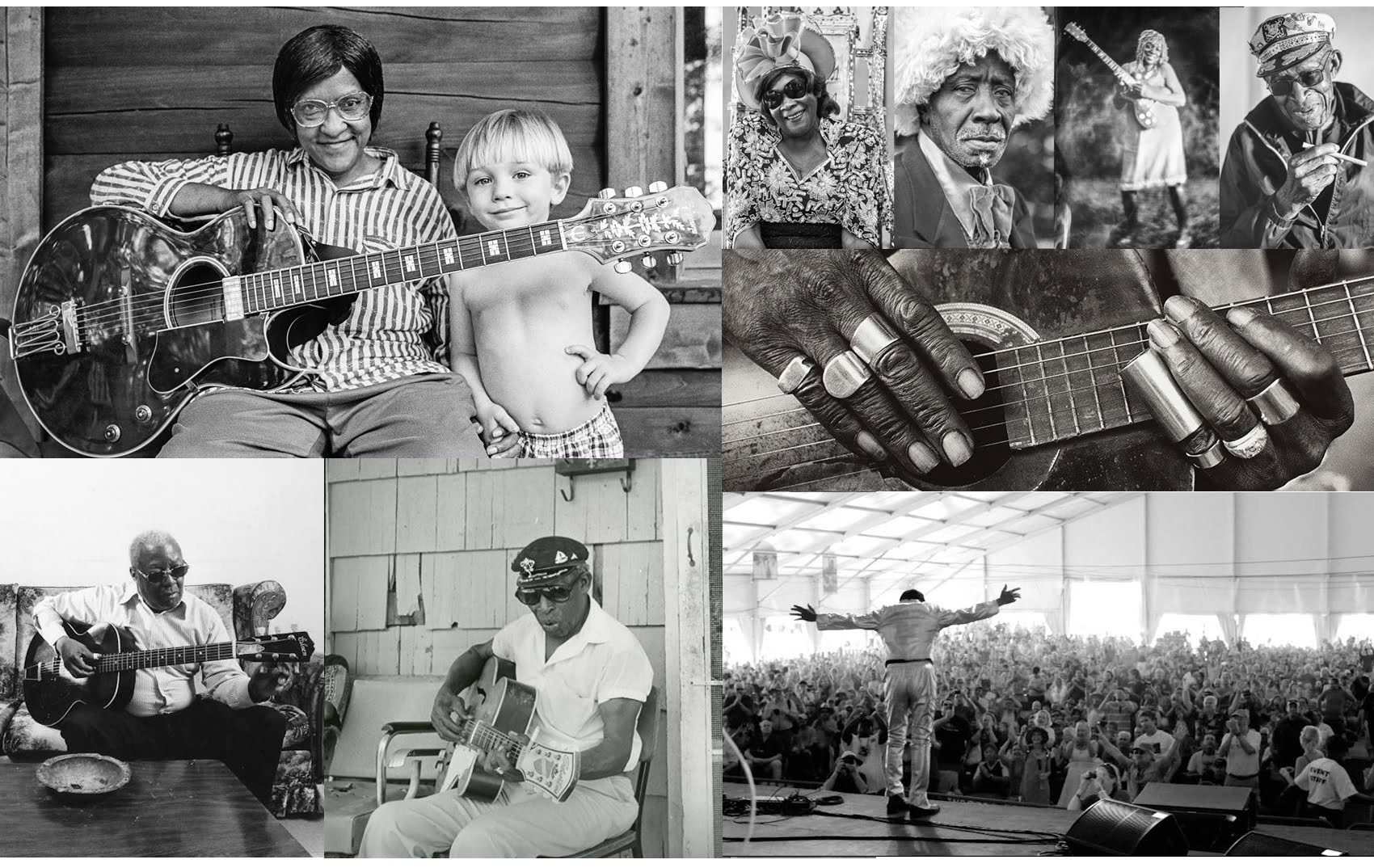
MIXTAPE: Music Maker’s Deep Blues

The blues, man. The blues. Perhaps more than most genres, the blues harbors far too many hidden heroes. That’s why the work our friends at the Music Maker Relief Foundation do is so very important. We’ve profiled that work before, so we thought it was the music’s turn for a moment in the spotlight and Music Maker’s founder, Tim Duffy, to cull a batch of blues tunes that everyone should hear.

Guitar Gabriel — “I Came So Far”

Gabriel composed “I Came So Far” during a recording session we did soon after returning from our first trip to Holland. Like so many of his performances, they are sung for the moment, and are rarely repeated.

Preston Fulp — “Careless Love” & “Farther Along”


Preston was a rural-based musician influenced by both Black and white traditions of the early 1900s. He died in December of 1993. He was the last of the generation that played in and around Winston-Salem’s tobacco warehouses.

Captain Luke — “Old Black Buck”

Captain Luke (Luther Mayer) — a wonderful bass singer, comedian, jaw harp player, and folk artist — moved to Winston-Salem, North Carolina, in 1940. It was Luther who taught me how to act and work within the stormy and sometimes violent world of East Winston-Salem. When the Captain passed away in late 2015, the Music Maker family was devastated. He was a dear friend.

Big Boy Henry — “Big Bill”

Big Boy Henry is the Carolinas’ premier blues shouter. He was born in 1921 in Beaufort, a small fishing village on the North Carolina coast. He has worked as a fisherman, preacher, and blues singer since the early 1940s. He specializes in the type of blues that was created by Blind Boy Fuller and the musicians surrounding him in Durham, North Carolina.

Willa Mae Buckner — “Peter Rumpkin”

Willa Mae Buckner has been known professionally since the 1930s as “The World’s Only Black Gypsy,” “The Princess of Ejo,” “The Wild Enchantress,” “Snake Lady,” and “Billie Raye Buckner.” She has worked as a chorus girl, blues singer, exotic dancer, contortionist, guitarist, and bassist, and she has operated a traveling snake show. In 1973, she moved to Winston-Salem and was a public transit bus driver for 10 years. At 71, Buckner lives in her own home with a 17-foot python named Big Jim.

Macavine Hayes — “Snatch That Thang”

Macavine Hayes is a younger musician, at 52. Influenced as a child by Guitar Gabriel, Hayes migrated from Florida to North Carolina, where he and Gabriel ran a drink house together in the early ’60s, selling drinks, running craps games, and playing the blues.

Samuel Turner Stevens — “Railroadin’ and Gamblin'”

I met Sam Stevens in 1982 in Asheville, North Carolina, where I was attending college. He is a mountain man who makes banjos, fiddles, dulcimers, mandolins, and guitars. The fretless banjo was introduced to whites by Blacks, but no Black fretless banjo players are known of today.

Lee Gates — “Cool’s Groove”

There is not one guitarist that rips like Lee Gates. Lee’s roots run deep into the electric blues tradition — his cousin was legend Albert Collins. This tune was inspired by another guitar legend that is part of the Music Maker fold, Cool John Ferguson.

Guitar Gabriel and Lucille Lindsey — “Do You Know What It Means to Have a Friend?”

I asked Gabriel one day if he had any brothers or sisters. He mentioned that he had a sister, but he had not seen her in eight years. He gave me her married name, and I found her, blind from diabetes, in an awful nursing home. When I reunited this pair the next day, they immediately broke into song. I scrambled to put up my recording equipment as they sang. Gabriel had written this spiritual the day their mother passed away. Their emotions were so intense, they both began crying and their tears soaked the front of their shirts.

Robert Finley — “Age Don’t Mean a Thing”

Robert is a recent partner artist with Music Maker. I met Robert just under two years ago on the streets of Helena, Arkansas. He was busking at the King Biscuit Blues Festival. When I heard his voice, I knew that he was special. This track is from his debut album … just the tip of the iceberg in terms of what Robert is doing with his career!

Sam Frazier, Jr. — “Cabbage Man”

Sam Frazier is another new addition to the Music Maker family. For years, he performed in Vegas as a Charley Pride impersonator. “Cabbage Man” is written by Frazier and tells the story of his love for cabbage sandwiches. While the song is cheery, it reflects the deep poverty that Sam grew up in outside of Birmingham, Alabama.

Adolphus Bell — “The One Man Band”

When I first met Adolphus, he was homeless, living out of his van, doing everything he could just to scrape up gigs to eat. When I saw him perform, he blew me away with his stage presence. Adolphus and I ended up touring the world together. He was always so grateful that the gigs he got from Music Maker allowed him to get a home.  


Photos courtesy of the Music Maker Relief Foundation

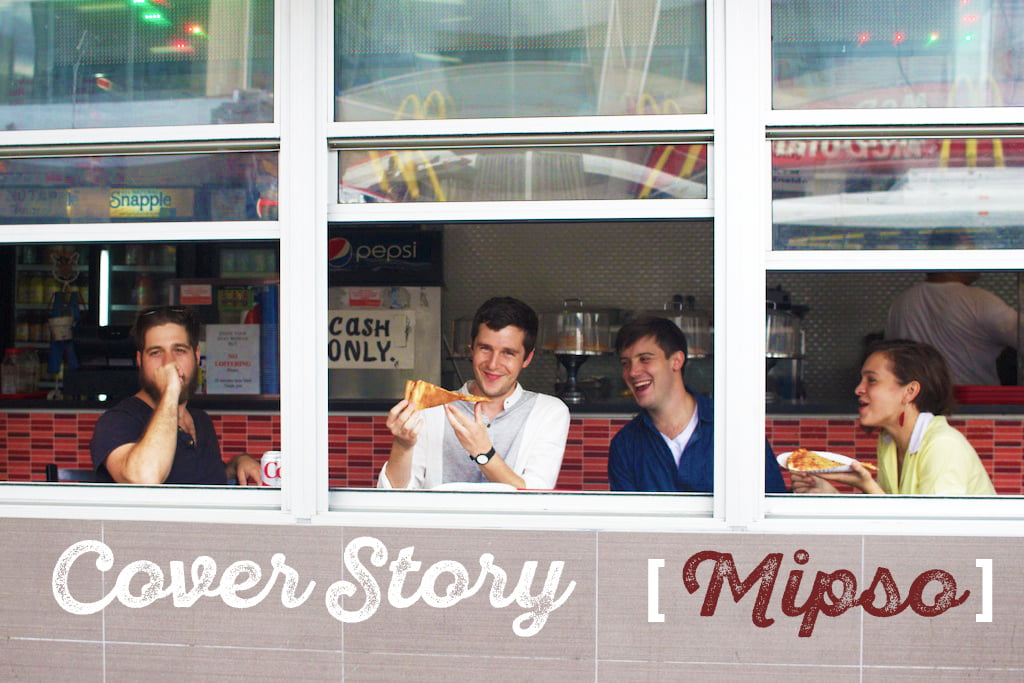
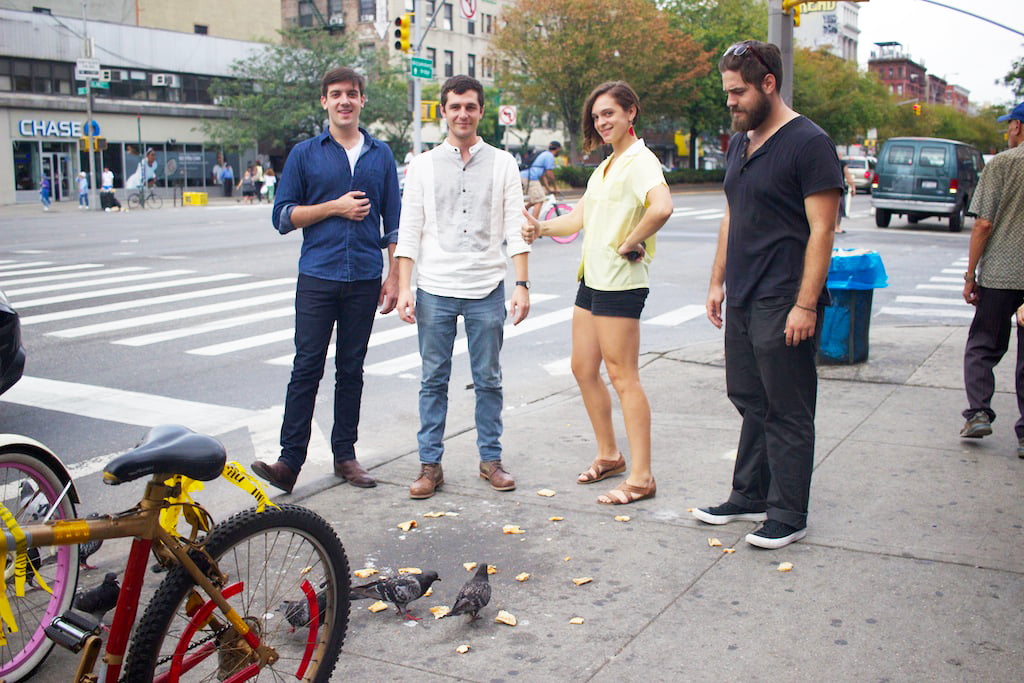
Feeding Pigeons and Eating Pizza with Mipso

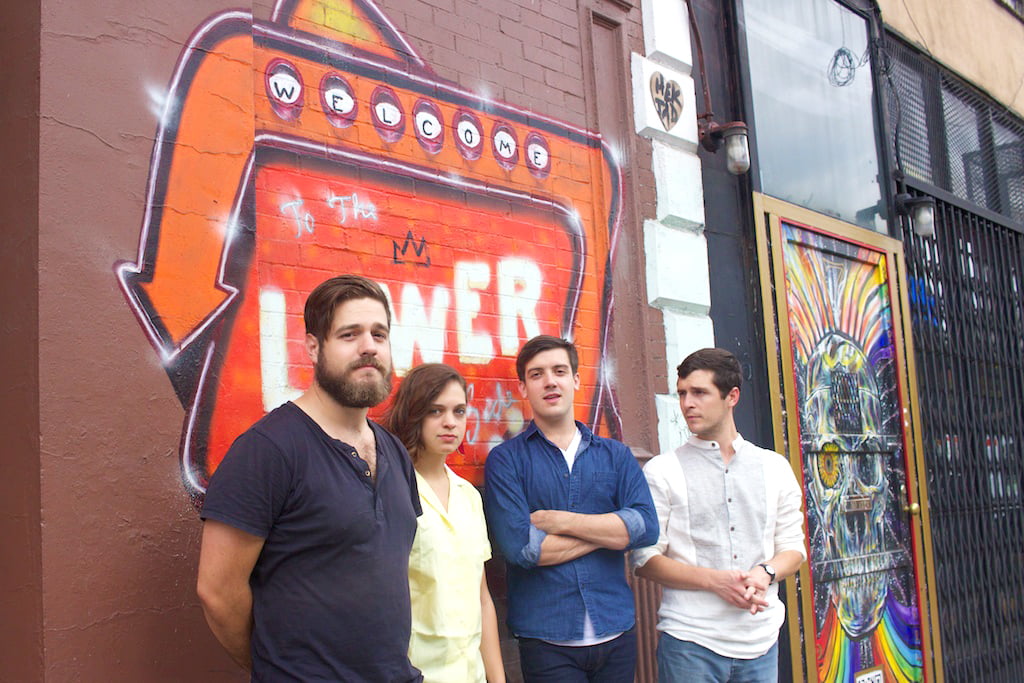
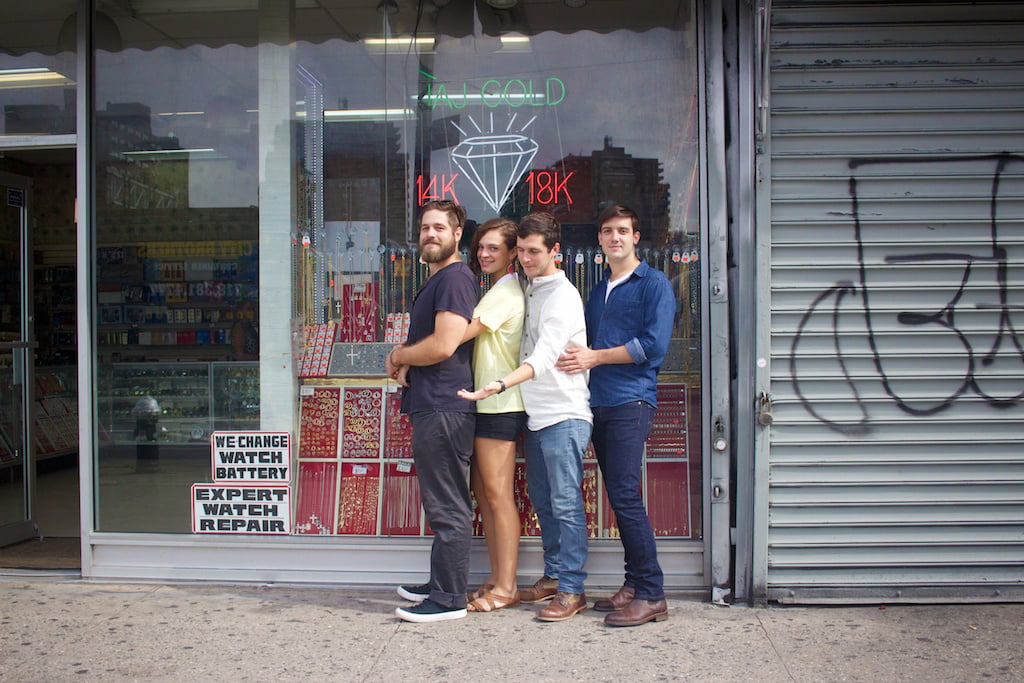
It’s a mellow Fall afternoon in Carrboro, NC, shortly before the early-evening hustle to get home. A lot of students make up the little town’s population thanks to the adjacent town of Chapel Hill and the University of North Carolina, but Carrboro is also a home to artists and other creatives — its cheap living, easy-going attitude, and compact layout make it an attractive spot to set up camp.

The roots music upstarts in Mipso call Chapel Hill home, though they hang out more in Carrboro. Singer/mandolin player Jacob Sharp sits in a small brewery downtown, as the band’s new record, Old Time Reverie, pours out of the speakers. Sharp is quick to admit it’s weird, but that’s one of the perils of the area’s tight-knit music community — it’s as common to hear locals’ tunes playing on shop stereos as anything else.

But this is hardly the most exciting thing going on for Sharp and his cohorts at the time: The day before, the newly released Billboard charts featured Old Time Reverie at the top of its bluegrass listing, at number 20 on its folk chart, and number 23 on its Heatseekers chart. The band spent the previous 24 hours fielding dozens of phone calls about the feat, but they didn’t see it as a big deal. For Mipso, the chart numbers were merely a passing recognition of something the band has already put years of hard work into, and its members hope that Old Time Reverie will help push them along even further toward a sustainable, long-term music career together. Guitarist Joseph Terrell, bassist Wood Robinson, and fiddler Libby Rodenbough join Sharp to discuss the band’s work up to this point and what they hope lies down the road.

Joseph, you mentioned in another interview that bluegrass was a big tent, and I think we’ve all talked about that together, at some point. Could you talk about that a little more and how y’all fit into that?

Joseph Terrell: I think there are a lot of great young artists that we’ve gotten to know, touring over the last couple of years. We have great respect for some of the early bluegrass guys like Bill Monroe and the Bluegrass Boys, Flatt & Scruggs, and the Stanley Brothers, but don’t feel like loving them and respecting them and playing music that feels informed by them necessarily means playing music that sounds exactly note-for-note like them.

Jacob Sharp: Within the context of the charts, it’s funny, because we’re also on the folk one, which is probably how I think more people would understand this album if they hadn’t seen the tags beforehand. I would think it’s a little more naturally under that point. I think it’s cool for Billboard to put it up on a couple, and I think it’s good for bluegrass that — as a genre and as a home — it’s become broad enough to sneak over there because, previously, that probably wasn’t as much the case. There were enough bands that pulled heavily enough from bluegrass to get cross-catch, but I don’t think any of us would really say this is a bluegrass album or that we’re a bluegrass band. But we’ll totally take being on the charts, and we love learning from that place and being a part of that community.

JT: I think it’s interesting from the charts' perspective, too, because the folk charts have Jason Isbell and Ryan Adams’ 1989 album. And that’s rock ‘n’ roll. They’re all a bit blurry, I think, right now. And I can imagine traditional bluegrass people saying, “Wait a second: If you’re not going to use this as a bluegrass chart, then why have it? If you’re going to broaden it to be acoustic music, then call it acoustic music, not bluegrass.” So I can understand how the terms get frustrating when you try to really understand what they mean.

You’ve spent a lot of the last year on the road. How has that been? Do you feel like you've gotten into the swing of it now?

JT: It’s definitely been a big adjustment. We live in Chapel Hill, but to say we live anywhere is kind of a stretch. At some point in a touring musician’s life, when you’ve been a musician for a long time and traveling a lot — for example, like we were talking about earlier, when you wake up on a Tuesday in the middle of Iowa in February, you have that sense of, “How did I get here? Where am I going? What am I doing?”

JS: That question of “How did I get here, where am I going” is in both senses — like, “Where was I yesterday? How did I actually arrive in this location? And what happened over the last two-and-a-half years of my life that I thought this was rational? What major glitches in logic have I found?”

JT: There are great things, too. We’re all grateful for having gotten to know so much of the country. I think that sounds like you’re trying to find a way to make it sound good, but genuinely, it’s been super cool.

Before you hit the road, how much of the Old Time Reverie was done? How did you fit recording and writing into your touring schedule?

Wood Robinson: The songs were pretty much written before we got in the studio in December of last year. We had a week there, and another week in early January, and a final week in early February between the Northeast run and the Midwest run. It was basically all done before the breadth of the year happened.

JS: When we were touring in 2014 — Summer and Fall — that was really our transition into full-time touring. We had carved out time. We wanted to understand the motions of touring before getting into the studio.

Libby Rodenbough: There were very discrete sections. We had to very intentionally set aside time for recording, and it was very scheduled. I know some people who record as they’re on the road, and they do a few days here and leave for a few weeks, and do a few days here. For us it was like, “This is now studio time,” and then back to the road again after that.

Many contemporary folksy bands style themselves to be sort of old-timey looking, and y’all definitely don’t do that. Has that been a really conscious choice?

LR: It is not really that important, and I don’t think that we spend so much time thinking about it. But it is kind of tricky to negotiate that. I find myself wondering sometimes if I’m playing too much into a stereotype. I think, even though we dress in regular 21st-century clothing, it’s also kind of influenced by our general aesthetic tastes. It’s not a mistake that we’re all from this area, and we all listen to some acoustic music, and we like leather boots. We like rural-influenced-type clothing — it’s not like we’re dressing up like cowboys all the time, but we have those inclinations.

 I think it has to do with family history, but also, in our lives, we’re drawn to many things like that. I studied a lot of folklore in school, and I’m drawn to the traditions of the South — musically and culturally, generally, and also aesthetically. So I think that’s part of the way we dress, for sure. But you don’t want to be too thematized in a band in a certain genre. And I think that has to do, too, with the fact that we don’t want to be pigeonholed as playing a particular type of music exclusively. And if we were to dress a certain way and have a banjo in our band — there are certain cues you can give your audience, and we don’t want to give them those cues.

JS: I think style, like everything else you do from day to day, the more you do it, the more you think about it in more nuanced and critical ways. Going into this album process, we were thinking about the imagery of the cover and the clothes we were wearing in a different way than we had previously. Libby thinks about that stuff a lot, individually, and we thought about that stuff, collectively. This time, we worked with Dear Hearts, from Durham.

LR: I think it is worth noting for someone like me — who spends way too much time and way too much money on clothing anyway — I would be doing this regardless of whether or not I was a performer. It’s just a passion of mine. But when you get to be onstage and wear some of this stuff, there is some semblance of justification for it, which makes me feel better about myself. I would say it’s one of the perks of being a performer that, if I buy, for example, gold sequin pants, I can be like, “Well, this is for the stage! This is just a business purchase.” I don’t write it off, but I do buy some things like that with a very slight sense of justification, and I appreciate that.

JT: An example for me is, I recently saw a band performing with a microphone that was as big as a dinner plate. I said to the other guys that I thought that it was a real failure of the microphone that it amplified the voice well, but it distracted from the performance completely. If I wore gold sequin pants, and someone left the concert and all they thought about was my gold sequin pants, I think that would be a failure of my style. I want people to leave our concerts thinking about music and thinking about our songs. That being said, it starts to make sense to be thinking about how your clothes play a role in what people think about you. I don’t think it’s wrong to wear something you think is cool, but we’re not David Bowie exactly.

LR: We are the David Bowie of bluegrass.

What do you see for yourselves in the next year-plus?

LR: I think a lot of what we see is the same … but more. The same … but better. Probably hitting a lot of the same areas and doing a similar level of touring, in terms of how many days on the road, but hopefully better gigs and better attendance and cooler venues. The things that we see happening already — the people that we’re meeting, the bands we’re getting to play with and stuff — leads me to believe that that will happen. It feels like we’re headed in the right direction.

JS: It’s a funny thing to be learning about. You start to understand it in these cycles that are, like, 16 months in the future. This album was done in January, the songs are just now new to the stage but they’re old songs to us. We’re excited to get into the studio, but we understand that when that happens sometime later next year, there’s no way it can come out before February of 2017. You start to understand stuff in a weird world, these chapters that kind of have a slow roll.

LR: Somebody asked me recently, “Is it full-time?” I thought, it’s way more than full-time. It’s full life. It’s what I think about all the time. When we’re on the road, it’s pretty hard to fit anything else into your brain that isn’t band-related. I would love to have the time and, thus, the brain space to remember the other parts of who I am. I love being invested in the band, but I think it can get a little too much and, if we’re looking at longevity as a group, I think that actually depends on having some individual focuses that are far afield.

WR: There are only so many years you can tour 180 shows, which translates to, like, 220 days a year. You just can’t. You physically reach a wall, and we’re young enough to maybe prolong that wall a little bit further down the road. But it feels good to be consciously making changes in that regard.

Do you find it difficult having to balance thinking about all these long-term things with being present in everyday life?

WR: The one thing that catches up with me — it is my life, so it’s relevant and it isn’t just business. But, often times, when I call a friend, I don’t want to talk about music. And that’s impossible if that person is in music. It feels fake or something like that, sometimes, when you’re talking about your career, because it feels like you’re having a business talk about your hopes and dreams and stuff like that when you’re talking to a friend you’ve had for years. It subconsciously happens. You’re not actively trying to push your career on other people, but that is basically everything we do, so that is what’s been going on.

LR: And you get used to conversations that are kind of about you, and they’re uncomfortable, a lot of the times. There are a lot of conversations after shows, where you’re trying to learn how to gracefully reply to a lot of compliments that start to feel kind of meaningless. I find that when I return to talking to a friend who doesn’t give a shit that I play shows, it’s refreshing but also kind of disconcerting. I sort of snap out of a fog I’ve been in on tour. And, when you have those moments, you realize a certain kind of unreality or different reality that you’re in when you’re on tour. But sometimes it’s not other people imposing it on you. You can’t get yourself to stop talking about work. I’m in my own head, fighting with myself, like, “Stop talking about the band,” but I can’t think of anything else, because it’s all I do and think about most of the time.


Photos by Katie Chow for BGS

Mount Moriah, ‘Cardinal Cross’

Beginning with their 2010 EP, The Letting Go, North Carolina's Mount Moriah has been a steady, subversive force in the state. The band's members have backgrounds in punk and heavy metal, but deliver sharp, twang-tinged rock music together as a unit. Heather McEntire, who fronts the outfit and writes the band's lyrics, pens moving songs that ache and soothe as she sings about heartache and redemption. A crucial part of Mount Moriah's songs has been the idea of a conflicting Southern identity: loving the place you call home, but sometimes clashing with dominant cultural politics or mindsets. The band transforms those sometimes ugly skirmishes into utterly stunning songs.

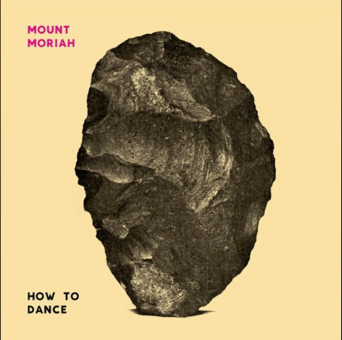
The band delivered two excellent records with 2011's Mount Moriah and 2013's Miracle Temple and, in February, their third LP will arrive via Merge Records. "Cardinal Cross," the first single from the forthcoming How to Dance, is a strong, scorching tune that ponders supernatural and astrological elements. Jenks Miller, who crafts most of Mount Moriah's intricate and intriguing guitar licks, explains that the song's theme is based on an astrological phenomenon called the Grand (or Cardinal) Cross, which represents the intersection of personality traits that seem to conflict with one another.

"There is a kind of pregnant tension in this pattern: What is experienced as a frustrating mental block or a grinding of gears can suddenly give way to a rush of insight, growth, or accomplishment. A semiotic study of the cross as a universal symbol positions human drama at the intersection of the physical and the spiritual; in light of this, the Cardinal Cross metaphor functions as a key that unlocks the meaning of our new record as a whole," he says.

"Previous Mount Moriah records have recounted personal challenges in resisting the repressive aspects of a conservative South that threaten unique identities. How to Dance adjusts the scale of this struggle from an individual/personal level to a universal/cosmological one. When we recognize our own pain in other individuals — in the shared history of humanity or in the mechanics of the universe as a whole — we can harness that insight and put it to work as a creative engine."

It's a lot to swallow for a song that clocks in just under three minutes, but bask in the band's chugging licks and ponder it all as you listen through it over and over again.

Traveler: Your Guide to Raleigh

Coined the "Research Triangle," the Raleigh-Durham-Chapel Hill area is a hotbed of creativity and invention located in the northeast central region of North Carolina. As one giant “college town” encompassing North Carolina State University, Duke University, and the University of North Carolina at Chapel Hill, the Triangle has nurtured indie rock, punk, hip-hop, metal, and, of course, roots music. Historically, North Carolina has played a key role in the long-standing tradition of bluegrass and old-time, which makes it the perfect setting for the World of Bluegrass homecoming.

Getting There

Just 20 minutes from downtown Raleigh, the Raleigh-Durham International Airport is the main airport serving the Triangle. Ground transportation is provided by the airport tax service, the Triangle Transit Authority, and local shuttle companies. Cab fare is an estimated $30, but hotels typically offer their own shuttle services to and from the airport. For non-flight options, try Amtrak or Megabus.

Lodging

Outdoor lounge area at the Umstead Hotel and Spa

The Umstead Hotel and Spa is technically in Cary, North Carolina, just five minutes from the Raleigh-Durham International Airport. Set on 12 acres of land with a lake and wooded gardens, this is a luxury option for travelers looking for some R&R in their down time. For something more affordable, an Airbnb search pulls up over 300 listings in the Raleigh area, ranging from historic homes to downtown condos.

Coffee

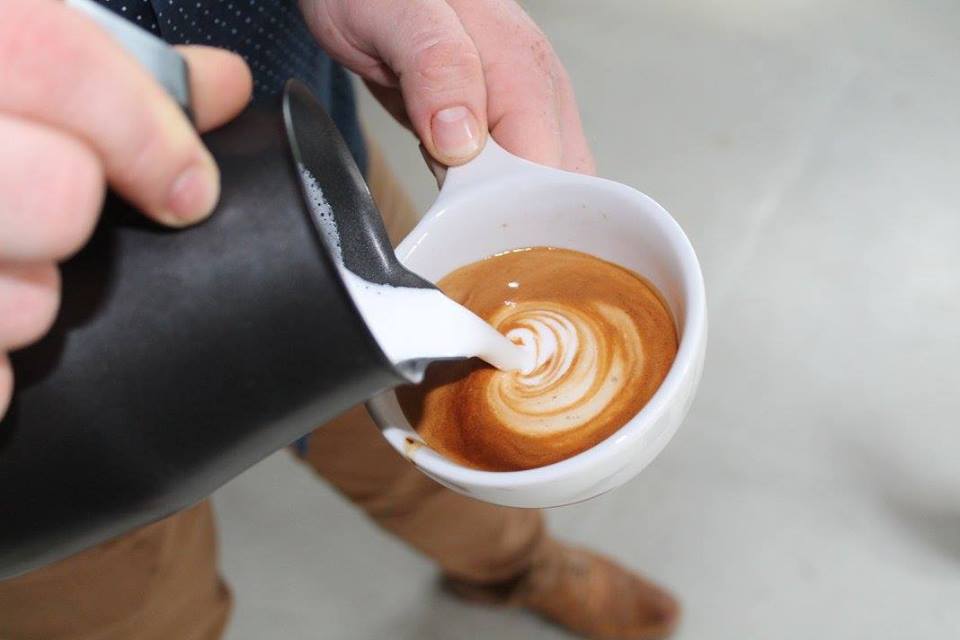
A delicate pour at 42 & Lawrence

Located in the new Skyhouse building in downtown Raleigh, organic coffee bar 42 & Lawrence is a must. This inventive coffeehouse comes complete with a row of taps and a juice rail for pressed juice on-site. Some of the tap offerings include kombucha, cold brew coffee, nitro cold brew, and experiments like the “draft latte” (a mixture of cold brew coffee, Jersey cow milk, and housemade vanilla syrup) and a “Black and Tan” (cold brew coffee combined with the draft latte).

Food

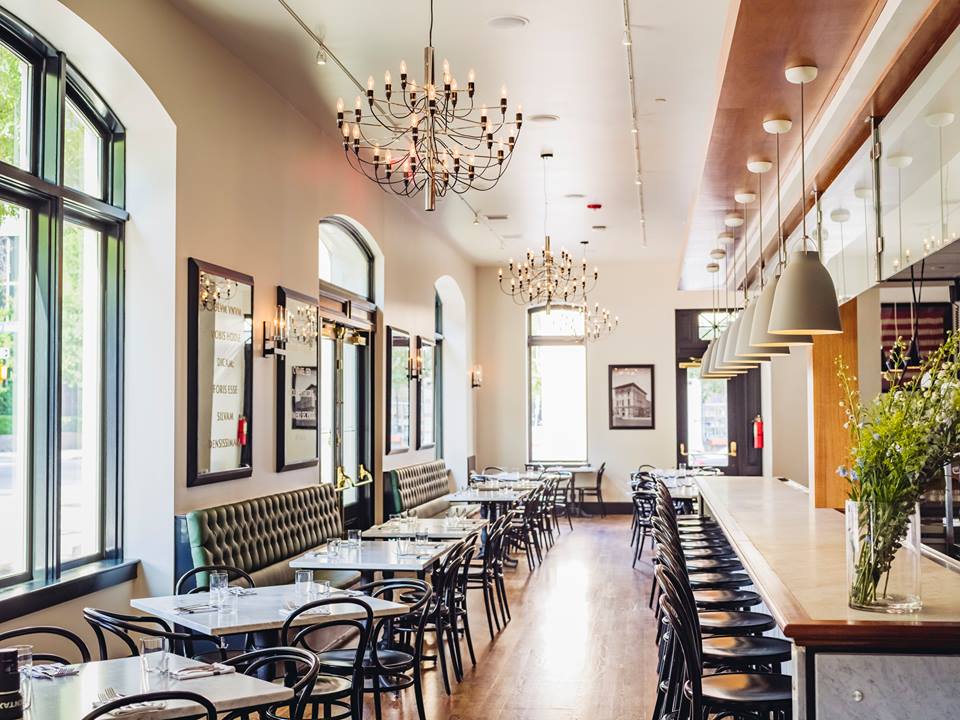
Dining room at Death + Taxes restaurant

Since moving to Raleigh, Chef Ashley Christensen has carved out a niche refining Southern comfort food. Each new venture she opens is even more anticipated than the last, so it’s worth stopping by any of her establishments while you’re in town. Opened back in 2007, Poole’s Diner was one of downtown Raleigh’s first restaurants, while Joule Coffee + Table combines Durham-based Counter Culture coffee with moderately priced Southern fare. If you’re looking for a fine dining option, one of the latest offerings from AC Restaurants, Death + Taxes, is your go-to. It’s a culinary playground where octopus is an appetizer and “foraged and ‘fought for’ mushrooms” soaked in sherry and brown sugar is an entree.

Drink

Front room at the Raleigh Beer Garden

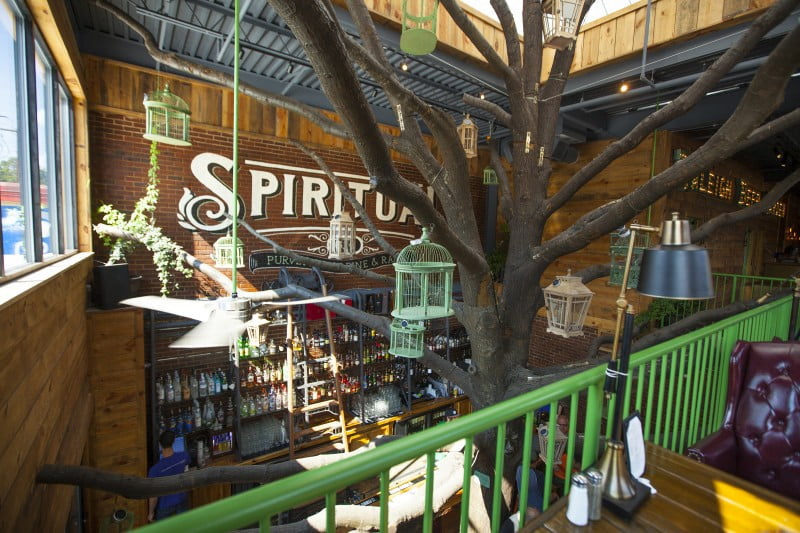
The aptly named Raleigh Beer Garden is three stories high and boasts the world’s largest draft beer selection in one restaurant. With over 350 beers on tap, there’s a sizable amount of North Carolina craft beers. A large tree extends to the ceiling in the front room, so you get that natural feel even from indoors. But it wouldn’t be a beer garden without an outdoor space and, with a patio and rooftop, there’s plenty to go around.

The brand new Whiskey Kitchen in downtown Raleigh’s Nash Square specializes in — you guessed it — whiskey. But there are beer and wine offerings, too, along with a dinner menu. The site of an old automotive shop, the bar has large garage doors and an open kitchen. Exposed brick walls and ceiling pipes, along with a wall-spanning mural by local artist Taylor White, lends the space an air that’s one part industrial and one part Southern comfort.

Shopping

Mid-century seats at Father & Son Antiques

Whether you’re on the hunt for designer steals or kitsch novelty, Father & Son Antiques has you covered. The West Hargett Street shop has become a destination for locals and out-of-towners alike, notorious for its stock of highly coveted mid-century modern furniture and accessories at moderate prices. It’s chock full of other goodies, too: vintage clothing, books, and, most importantly, records.

Music Venues

Koka Booth Amphitheater in Cary

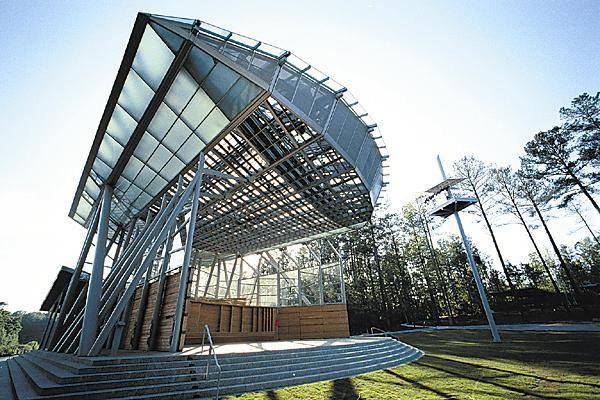
While North Carolina is a breeding ground for roots music, it’s also home to a wider array of genres from hip-hop to punk to metal. In order to accommodate all of this diversity, the Triangle is equipped with venues of all shapes and sizes. As far as larger, outdoor venues, there’s Red Hat Amphitheater in downtown Raleigh, Walnut Creek Amphitheater, and the picturesque Koka Booth Amphitheater in Cary. For a more local vibe, check out the Pour House Music Hall in Moore Square Art District in downtown Raleigh, Cat’s Cradle in Carrboro, or the Pinhook in Durham.

Local Flavor

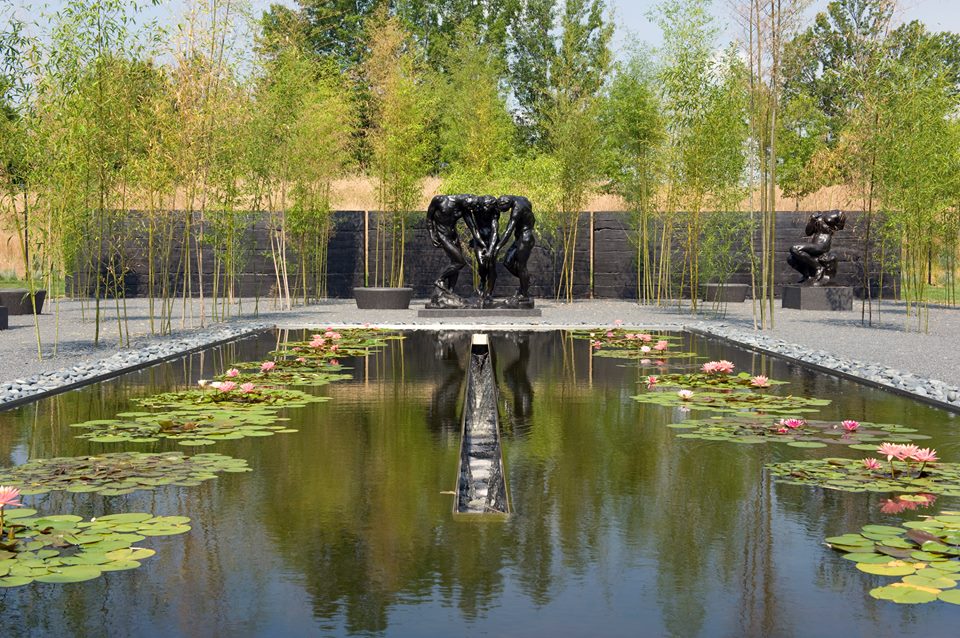
The pools at NCMA

The North Carolina Museum of Art (NCMA) is a behemoth of artistic innovation in itself. This month, it was selected as one of the top 125 most important works of architecture built since 1891 by Architectural Record. This free admission museum is home to contemporary art, works from the European Renaissance, Greek and Roman vases, and American art from the 18th through the 20th centuries. It also hosts concerts, films, classes, and performances. In the midst of a $13 million expansion, the museum’s outdoor park boasts 164 acres and is accentuated by landscaped sculpture gardens, courtyards, and reflecting pools.


Lede photo: Durant Nature Preserve. Photo credit: rharrison via Foter.com / CC BY-SA.

WATCH: Yarn, ‘This Is the Year’

Artist: Yarn
Hometown: New York City, NY
Song: "This Is the Year"
Album: This Is the Year
Release Date: May 27
Label: Ardsley Music/Red Bush Records

In Their Words: "'This Is The Year' is the title track off our new record. It sums up where the band has gotten to in the past year, the future that lies ahead, and at the same time, leaves the past in the past. The video captures how we're all feeling and relays that message even more clearly. This IS the year, and so is next year, and the year after that. We shot this at the Visulite Theatre in Charlotte, North Carolina. It was a damn good time." — Blake Christiana


Credit: Robert Pettus