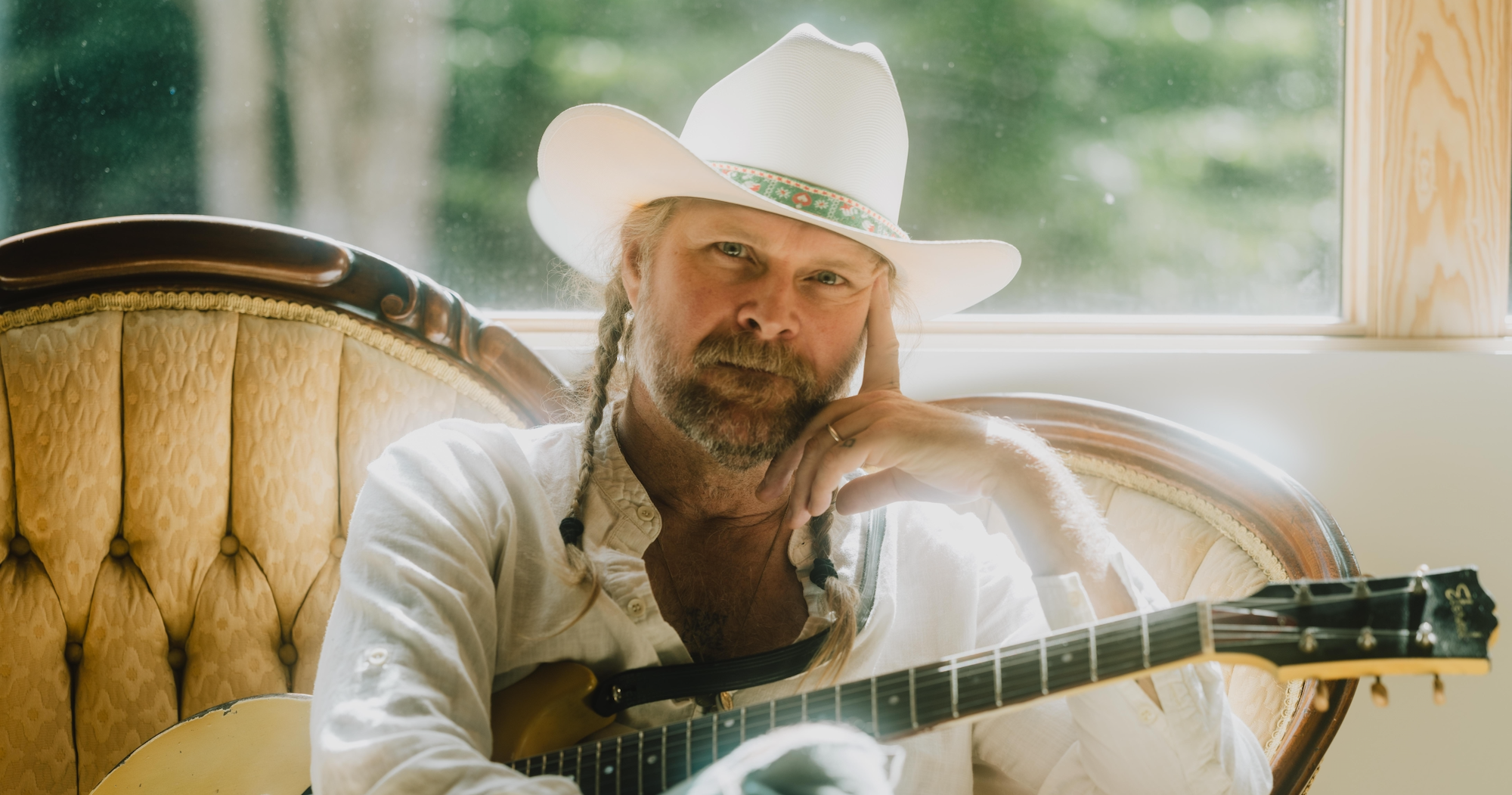
The Expansive Universe of Hiss Golden Messenger

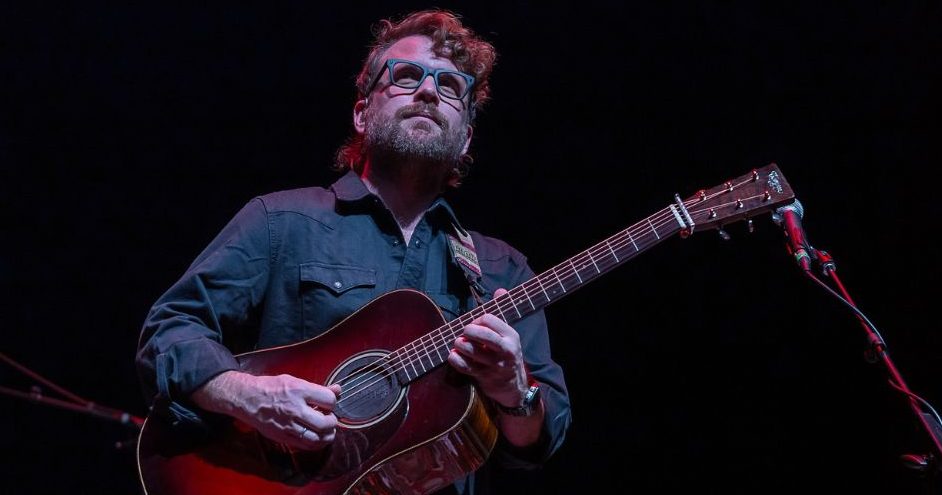
Next year, singer and songwriter MC Taylor will have been leading Hiss Golden Messenger for two decades. For most of that time, critics and listeners have relied on a few familiar narratives about Taylor: that he is a singular figure, for example; or that his move from California to Durham, North Carolina, marked a formal shift from punk to Americana; or even that he thinks slightly more than he feels. Talking to Taylor, from his home in Durham (well, there was a Zoom call involved), I found these cliches about his practices were limiting, factually accurate but emotionally untrue.

Instead of laser-focusing on one narrative, on telling the same stories over and over again, listening to Taylor speak, I encountered a new understanding of his practice, one which placed Taylor in the background and moved his bandmates and genre-play into the foreground – shifting from the centrality of a singular figure to a greater emphasis on generosity and expansiveness.

That the new album is called I’m People is the first clue that Taylor wants to expand the perception of his music; it’s a title that considers mutuality as central to the enterprise of musicmaking. So, how does one expand this thinking – one could consider him geographically or complicate these tales of origin, or think about who is playing on this record, or even refuse the standard narratives of genre.

Instead of focusing on the fact that Taylor began playing in hardcore bands in California, think about the other influences: that he played in a band named after Joni Mitchell’s Court and Spark, an album marked by an urbane distrust of other people’s desires. Or that, around the time he was carefully listening to Mitchell, he was also following that most American portable utopia, the Grateful Dead. Or think about his move to Durham, not strictly to play in a band, but to study folk music academically.

Or, consider how this album was recorded – at least partially – in upstate New York. A more cynical writer would note that Taylor borrows from Dylan’s Nashville Skyline, and that album itself was the foundation of a more isolated, lonely understanding of tradition after abandoning folk music, seeking a slightly more commercial understanding. Recording this in the Hudson Valley could be considered a pilgrimage or homecoming.

I don’t think that it is a homecoming just for Taylor; the record sounds lush, expansive formally, too. Perhaps because the people who sing or play on this record play in a collective of other bands, including Rhett Miller, the Mountain Goats, Bonny Light Horseman, and the Hold Steady.

The expansive nature of the band is not only connected to the history of music they listen to, or the other bands that they play in, but also more unexpected influences like Sade. The idea that Taylor is the band is false, and it is not even that Hiss is the band. Taylor expands the possibility of Hiss, but Hiss itself pushes the possibilities – because of where they come from, their other projects, and even the possibility of geography. Not because Durham is magically a place where music coalesces, but because for a long time it was a college town where rent was relatively cheap and lots of people liked playing music together.

When addressing genres, the promotional material calls the album Americana – but Americana is a useless category, one which might be country or folk or something else entirely. I’m People has a kind of intense richness that is neither of these genres. Listening to the LP, something happens where the expansion or fracturing of those playing on this record becomes its own kind of post-genre.

There are a lot of reasons not to love America right now, but emphasizing the American instead of Americana allows us to consider this album as a consequence of the totality of American music – Taylor addresses the improv nature of jazz as part of this, or traditional folk music, or even 1970s easy-listening. He speaks fondly of the detective novels of Elmore Leonard, and on at least one of his early albums the photography of William Gedney became a powerful totem.

I think of I’m People as a kind of ebbing and flowing for and against tradition, part of that decades-long wrestling with aesthetics and history. Consider the last song, “Depends on the River,” is another of his great songs about waterways. In a 2016 profile of Hiss, New Yorker critic Amanda Petrusich wrote about Hiss’s long tradition of river songs and how it fits into a century of metaphors from blues singer Geeshie Wiley to Joni Mitchell, working this tradition. Petrusich writes: “Taylor frequently evokes river imagery in his work; the river, of course, can be understood as its own kind of road, a direct line to somewhere else, far away.”

I don’t know if that’s wrong, but I also think about rivers as they turn into oxbow lakes, rivers which flow into swamps – literally bogged down – rivers that flow into oceans, and rivers that dry up depending on the season. Hiss’s meandering, deepening quality depends on that river, both the direct line that Petrusich talks about and the larger metaphor, one where Taylor literally talks about whether he dares to cross it. On I’m People, he not only crosses it and crosses it again, but brings along a whole community of other performers. And, an audience who is hungry for the difficulty and ambivalence of so much time playing – and thinking – with him, to the other side.

I know you have a degree in folklore studies, I also noticed that in the last few years there has been a cluster of second- or third-generation performers who have some academic training in folk traditions (see also: Jake Blount, Jake Xerxes Fussell, Willi Carlisle, etc.). Can you talk a little bit about the kind of intersection of formal and informal folk studies and also about your relationship to people who are making this kind of work? I’m thinking about the line on the song “Mercy Avenue” where you talk about the “boys on the corner knowing more than those with PhDs.”

MC Taylor: Well, it’s been a really long time since I was in the academics here. And that universe was one that I feel like I passed through briefly. I wasn’t destined to be in that realm forever. So, I’m not sure that I can totally speak to [that]. Like the place of academic/creative work.

I will say that my time in that space was a really good time for me, when I was restarting my brain and re-centering myself. School was a good way for me to step away from whatever I had been doing previously. I did a lot of field work at that time. I interviewed a lot of people, and I think that it made me a much better listener.

I think that, more than anything else, [that] is what I came away with, this feeling that people really, really like to be heard. So I think I just really tried to develop my listening skills.

Can you talk a little bit about working with a band – especially this band – and about how the bandmates are part of their own creative worlds? Is there a kind of politics there, or a kind of community making?

The basic tracking of the album was done with JT Bates playing drums and percussion, Cameron Ralston playing bass – both electric and upright – and Josh Kaufman, who was producing the record with me, playing guitars, mandolin, piano. My friend Chris Boerner was engineering the record. He plays guitar.

The road version of Hiss Golden Messenger, you know, [are] involved in a whole variety of things. JT, Cameron, and Josh play in Bonny Light Horseman. All three of them have also at various times been members of Hiss and have toured with Hiss. And in fact, that’s where those guys met – playing in Hiss. All of us have known each other for many, many years, so I consider those guys really good friends.

But we’ve never made a Hiss Golden Messenger record before. … They’ve worked on [other] records [together], but we never came together to create a Hiss Golden Messenger record together. It was this funny and unique situation in which we were already old friends, doing something that felt new and fresh. It didn’t feel like a complicated record to make for me. I think Josh Kaufman maybe would say the same thing, but Josh was performing sort of a different task than I was in the situation. It was a complicated record to write, but that was something of the solitary endeavor that took place over probably a year or a year and a half.

I really love those guys and I am delighted that they could be there to play on the record. I think of them as absolute top-tier musicians, every one of them. Cameron is currently playing with the Mountain Goats, he plays all kinds of jazz, he plays in the Spacebomb House Band. JT Bates plays drums with Big Red Machine, which is Aaron Dessner and Justin Vernon. And [he’s] just a legendary drummer in Minneapolis. Josh Galvin plays with everybody.

There are some songs on this album about hope and I wondered about making work about hope in this specific social and political moment? “Shaky Eyes” or “Heavy Worlds,” for example.

[I am interested] in how we [have] the energy to get through the messiness of life. And not only this particular time that we’re living through – although that is the most depressing. But just like life in general. I don’t think that we can do – or I don’t think I can do – life alone. So, in a way this record is me writing to myself. Maybe now [about] how important other people are.

I think I realized that the most important part is moving through, and needs to involve being around [other people]. Over the past few years, just speaking personally, the idea of community has felt like a more and more important part of it.

Thinking about that – and how dense/lush the production here is – though you are marketed as “Americana,” I wonder about how you view genre. And also how your band does – I’m thinking about background vocalist Annie Nero’s bio for radio: “She loves to find the common thread between musical ideas and genres…but also break free of genres because life’s too short to limit ourselves based on perceived taste!”

I listen to lots of different stuff. I think all of that stuff finds its way into what I’m doing. It’s a little tricky. I used to have a stronger stay-in-your-lane [attitude] about the term “Americana,” but I just don’t think that I care very much anymore. It’s not a word that I generally use. But I understand why it exists. Many of my favorite songwriters exist in that world.

What would you call your genre then?

I mean, I wouldn’t. I guess that’s what I’m saying.

Like, if I was at the dog park and I was talking to a stranger, and they said, “Oh, you’re a musician? What kind of music do you play?” I’d probably say, “Kind of rock and roll.” I generally am not describing my music in terms of genre, I guess. If I told someone that I played rock and roll, and they asked me to extrapolate on that, I would say something like, “Rock and roll that’s really swinging.” I try and concentrate on the rhythmic elements. I love singer-songwriter type music from the ’60s and ’70s. I like really oddball stuff. I love Bruce Ruffin reggae; I love free jazz. There’s a lot of music that I have inside of me. There’s a lot of music that Josh, Cameron and Chris – [that] we all have inside of us. I think it’s just a question of how we get it out and put it into use in a way that feels genuine and not forced. …

Thinking about the tension on this album between distinct geographical spaces and a more universal emotions – for example on “Seneca (Time is a Mother, Baby)” or “Mercy Avenue.” And also that becomes a larger theme of your work, thinking about how Amanda Petrusich writes about your decades-long commitment to writing about rivers. There’s even the river song on this album. What do you think your relationship is to the land, to rivers – especially. when you sing “Depends on the River.” Or is there specifically one river?

On previous Hiss records there are specific geographical places like city names mentioned. And not only are those places part of the fabric of the story that I’m trying to tell, but they sort of served as poles, maybe? What I’m trying to accomplish is sort of like a poetic travelog of my life growing up in America. I’ve been traveling as a musician since I was 18. I have been, it seems like, everywhere in this country – more than once or some places 10 times. I’ve been all over every highway. So, maybe the dimension of place names throughout is sort of like carving my name on a tree or something. It’s just kind of like, “I was here.” “This is where we are in this song right now.” “This is where we are in my life.” And then, “Now we’re over here.”

In terms of rivers, a river is always flowing, always changing. A river can kill you if you’re not careful. It can keep you alive and get you to the next place if you treat it with respect and understand its rules. The coda on that song, [“Depends on the River”], the last thing that we hear on the record is “the line depends on the river exactly.” I guess the meaning depends on what river of life we’re talking about. It depends how lucky we get.

I’ve always been impressed by the wide range of your reading, listening, and looking. For example, your careful thoughts on the photos of Gedney. What are you reading, what are you listening to, what are you looking at these days?

Well, you know what I’m reading right now? I’m like about 200 pages into this Gary Stewart biography. Gary Stewart, the country singer. It’s called I Am From the Honky-Tonks. Gary Stewart actually was someone that Chris Smith from [record label] Paradise of Bachelors turned me onto like 15 to 16 years ago. Those of us that are obsessive about him all knew that this book was coming. It’s finally out and yeah, if you’re Gary Stewart fan, it’s kind of like you can’t believe it exists. I’ve been waiting for it.

In terms of what I’m listening to, I’m always listening to all kinds of stuff. I just bought this record [that’s] The Sun Ra Arkestra doing Disney themes. It’s so beautiful, really makes you think about those compositions in a different way, [about] actually how deep they are. I’ve been revisiting some Ted Lucas. I’ve really been liking this McCoy Tyner record called Asante. It’s a 1974 record; might be my current favorite. It’s very deep in the zone with like Alice Coltrane and Pharoah Sanders – that era. Oh, it’s beautiful. [I’ve been listening to] some Paul Brady from ‘78. He’s amazing! I’ve been listening to Welcome Here Kind Stranger. [Also] a record that I was checking out for a while [was] by the Universal Liberation Orchestra. It’s kind of this weird, very minimal– I guess it would be jazz.


Photo Credit: Graham Tolbert
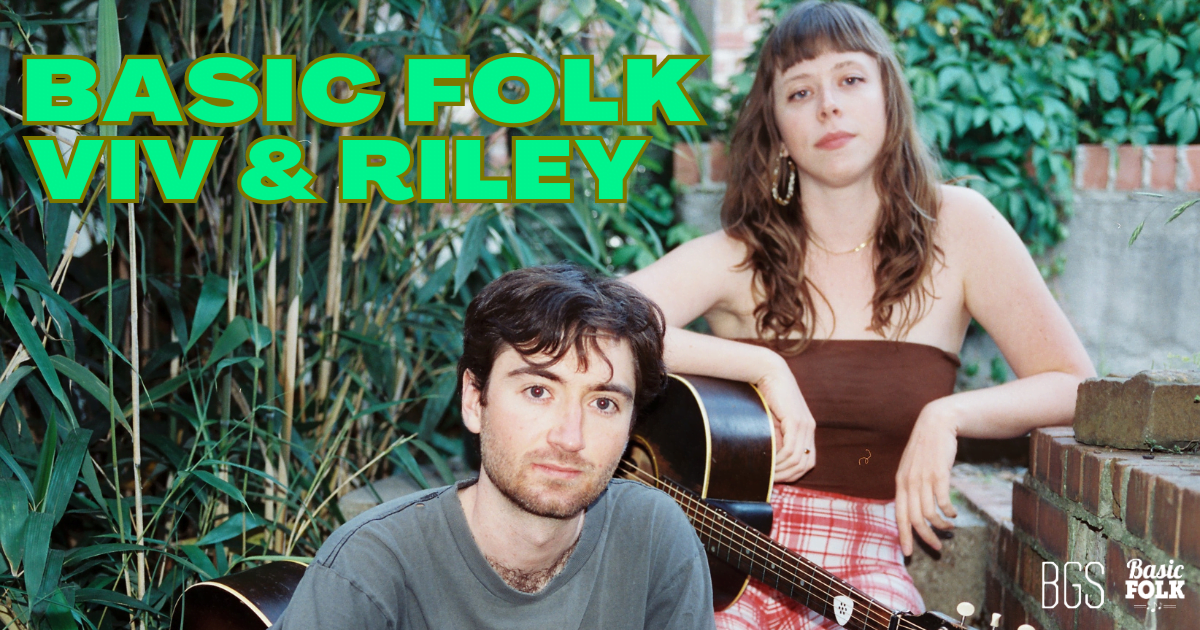
Viv & Riley’s Tradition and Innovation on Basic Folk

Vivian Leva and Riley Calcagno, known as Viv & Riley, dive deep into the nuances of old-time music, their folk influences, and the process behind their album, Imaginary People. The duo, who ​met ​at ​a ​music ​camp ​in ​Port ​Townsend, ​Washington, trace their roots from Riley’s disciplined musical practice to Viv’s intuitive approach. The two found inspiration from growing up in the Seattle area listening to KEXP to living in Portland, Oregon, to their current home in Durham, North Carolina. Drawing on their experiences at fiddlers conventions and music camps, Viv & Riley reflect on the transformative power of collaboration and the vibrant community that has shaped their unique sound in their duo as well as their other band, The Onlies.

LISTEN: APPLE • SPOTIFY • STITCHERAMAZON • MP3

As they share insights into their songwriting process, the episode unravels the intricate layers of Imaginary People, delving into the harmonious blend of indie roots and experimental production that defines their latest release. With a nod to their eclectic influences, including the supportive atmosphere of Durham, North Carolina, the duo discusses the evolution of their sound under the guidance of producer Alex Bingham from Hiss Golden Messenger, who produced their latest album.


Photo Credit: Libby Rodenbough

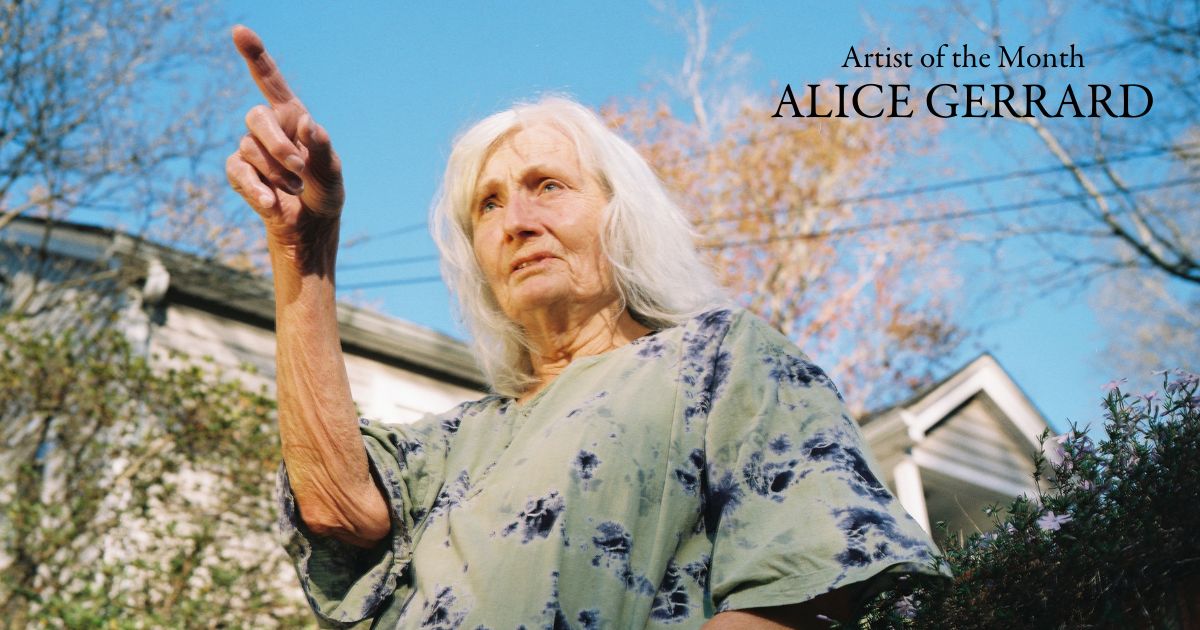
Artist of the Month: Folk Hero Alice Gerrard Is Unafraid to Be a Real Person

(Editor’s Note: Fiddler, songwriter, and creator Libby Rodenbough writes this personal essay on her friendship with and admiration for BGS Artist of the Month, Alice Gerrard, accompanied by her original photos taken for Gerrard’s new album, Sun to Sun.)

I remember first hearing Ola Belle Reed’s “Undone in Sorrow” when I was 19 or 20. I felt like a portal had been opened unto a world that had existed around me my whole life, unseen and unheard. I grew up in North Carolina going to visit my mom’s family in Madison County, along the Blue Ridge, where any of the graveyards on the mountain sides with their little mounds of clay outside my backseat window might have been the one from Ola Belle’s song.

That portal didn’t open for me in the mountains of North Carolina, though – it was in Chicago, at the Old Town School of Folk Music, an institution that had come out of the ‘50s folk revival. I was big on Pete Seeger and John Prine at that time in my life, and had found out my dad had a cousin with a spare room in Chicago, so I went on a little pilgrimage during a recess from college.

It was there that I learned my first old time fiddle tunes, belting the refrain “down in North Carolina” from “Waterbound” at the school’s open jam while the Chicago winter dumped three feet of snow outside. It was there I first learned the rudiments – very rude in my case – of clawhammer banjo. It was also there that I first heard a left hook of a song called “A Few Old Memories” by Hazel Dickens, which appeared on her 1973 duo record with Alice Gerrard, Hazel & Alice.

I went home from Chicago with new eyes and ears. Places I’d known forever became newly populated with epic figures, recast in the light of 200-year-old narratives. My first semester back in school, I was in an introductory folklore course taught by Mike Taylor (of Hiss Golden Messenger) and he started talking about his friend Alice Gerrard, who lived a town over in Durham. I was fairly well tangled up in time and place at that point – even the deceased people I’d been learning about were brand new to me – so I had to blink a few times to digest that she was the same person singing harmony on “A Few Old Memories.”

Today, 10-ish years later, I sit with Alice in preparation for writing this piece and she tells me about driving Ola Belle Reed in her Dodge van on tours through the South in the late ‘60s. She’s my oldest friend (nearly 90), and all competition lags behind her years pretty pathetically. She also makes a lot of the people I talk to seem boring. We’re in the same business: We sing songs and play shows and make records. She’s been doing it a lot longer, and I think she knows about five times as many songs.

Hanging out with Alice helps me understand why she wanted to be friends with people like Elizabeth Cotten and Luther Davis, who were elderly when she met them. She heard the way they played and sang and had to talk to them about their lives. “They knew exactly who they were,” she says. For a young person who had moved across the country from Oregon to Washington, D.C., without maintaining much contact with home, dropped out of college, and had four children, that self-knowledge was aspirational. Though their rootedness in their communities was part of what drew her to them, she didn’t think of them as avatars of bygone primitive ways of life, or as characters in a play – they were people. Elizabeth Cotten was somewhat guarded, but over years traveling and playing together, she told Alice about indignities she had suffered as a domestic worker and as a Black female folk performer, and about subtle acts of defiance she had worked into both vocations. Luther Davis talked about how lonely it was to get old and run out of witnesses to your own life.

Alice is likewise unafraid of being a person. She’ll tell you straightforwardly that she was unprepared to be a mother, that it was essentially impossible to pursue a music career – which was something she knew she wanted for herself – and still give adequate time to her kids. We commiserate about music industry bullshit and engage in light shit-talking about the idea of showmanship.

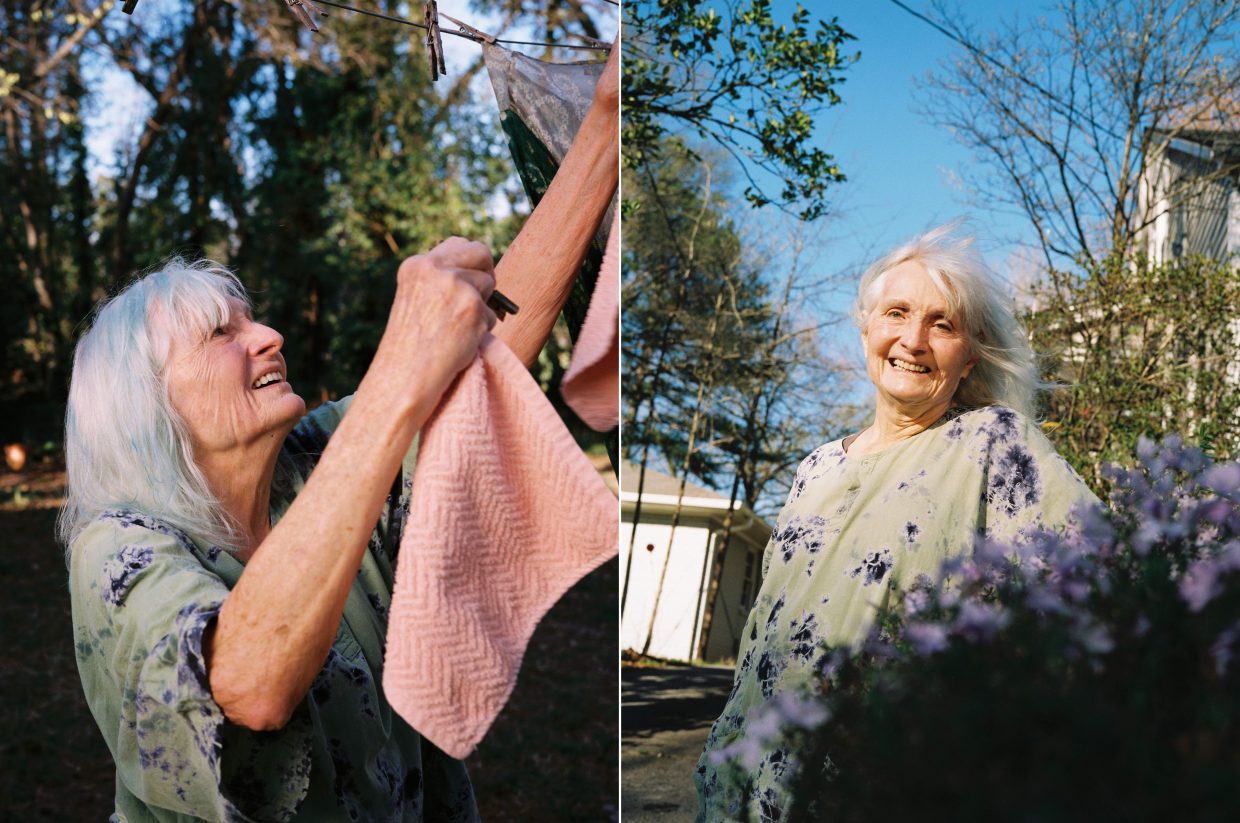
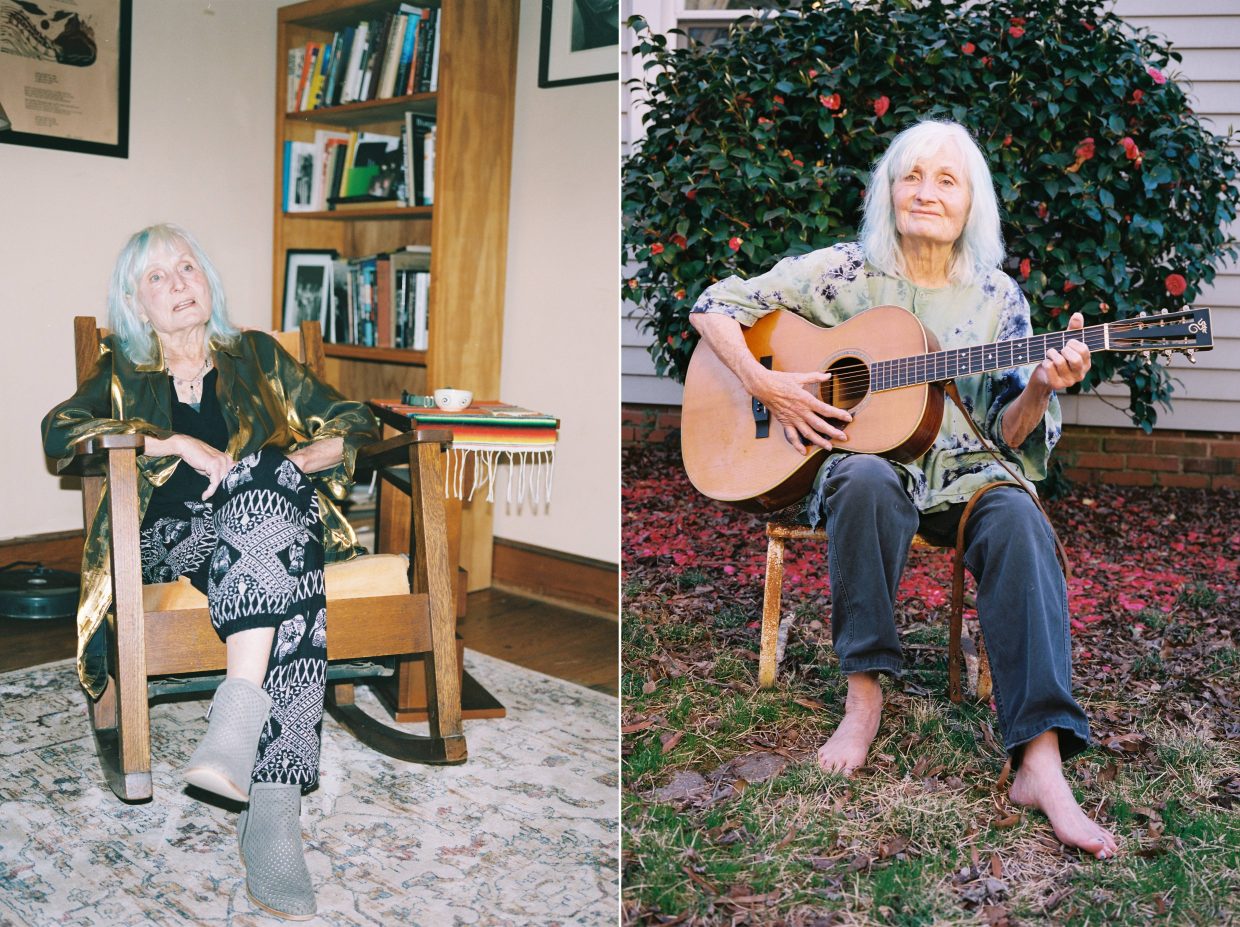
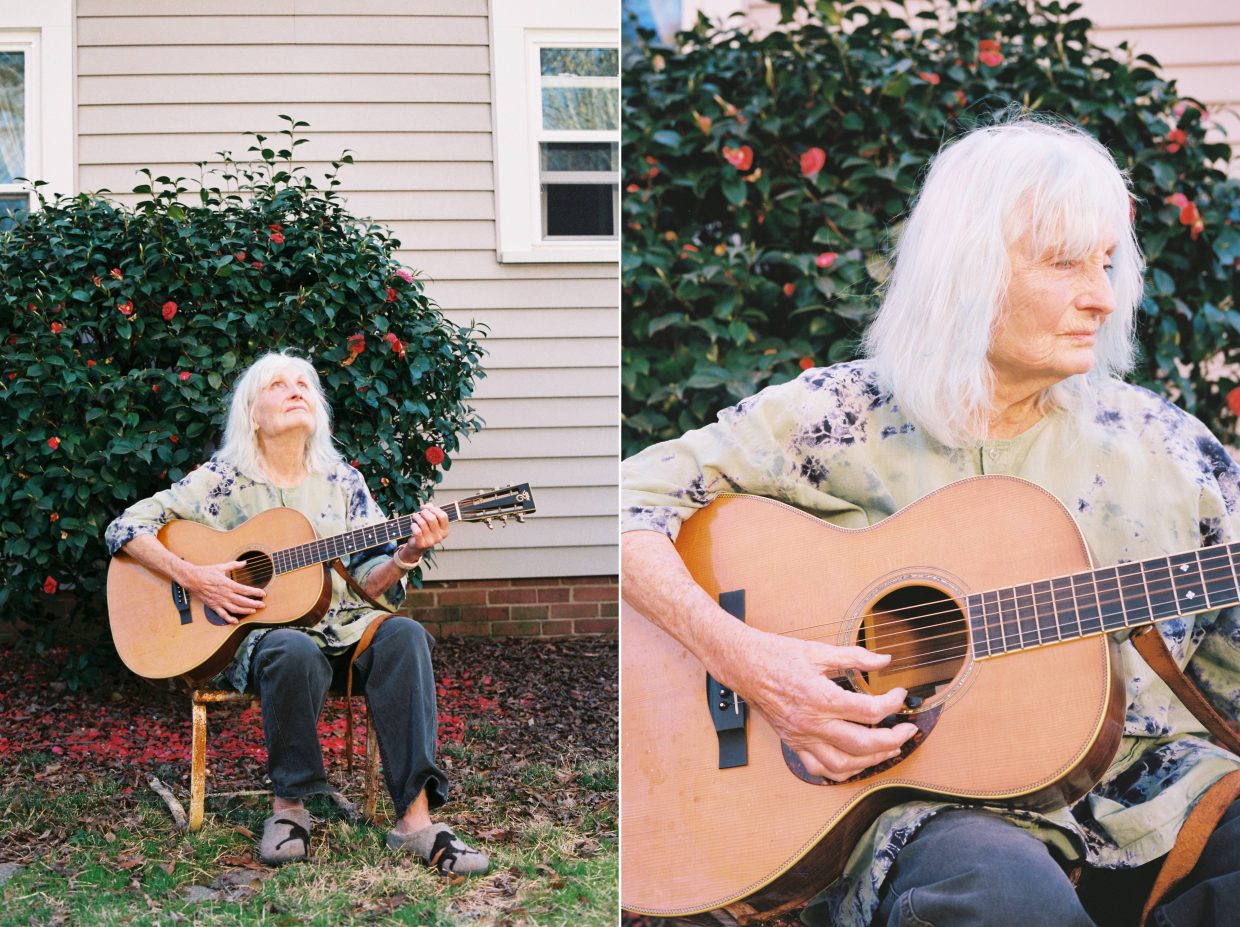
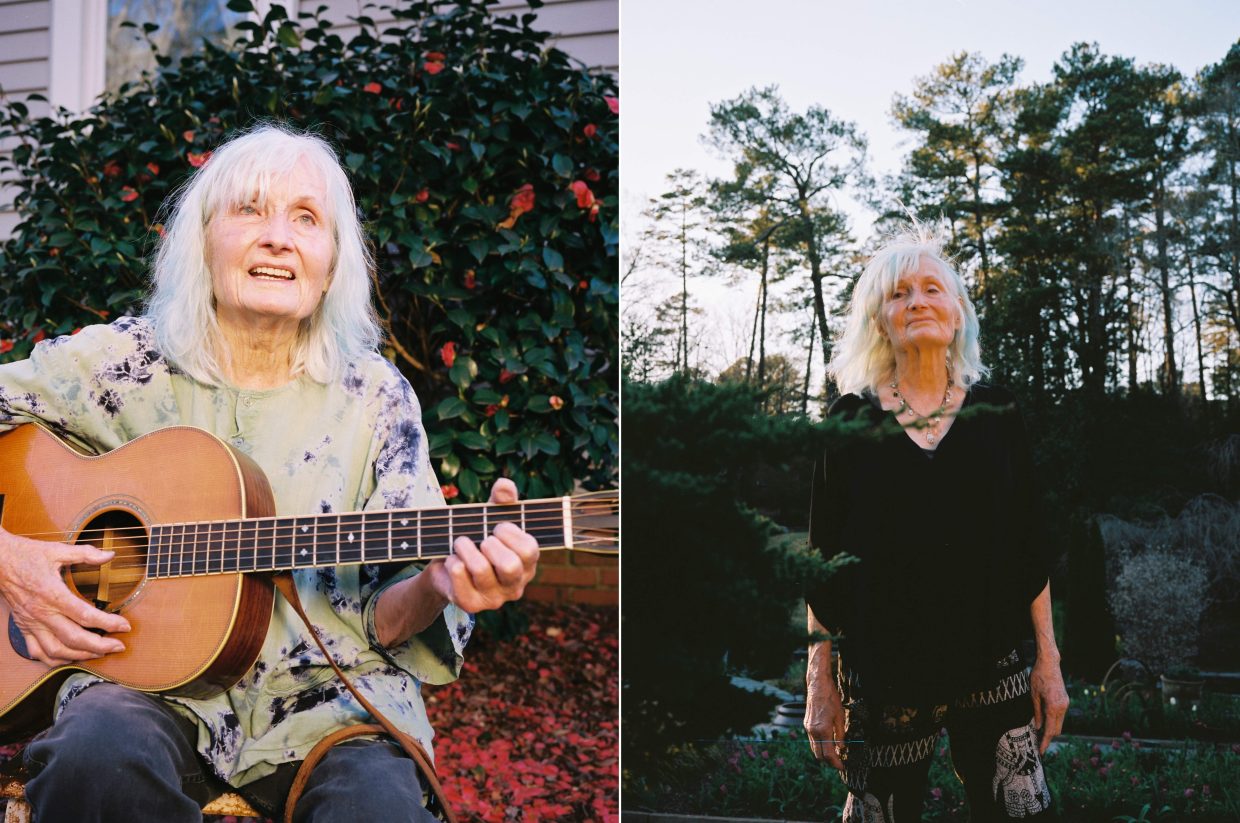
She’s usually wearing one of her collection of t-shirts that pertain to her dog Polly’s agility training facility (“Fast and Furryous”). This past March, when I took these photos of her to use for promotion of her new album, Sun to Sun, we went through her closet together and dug out some gems, including a bedazzled commemorative t-shirt from Obama’s inauguration.

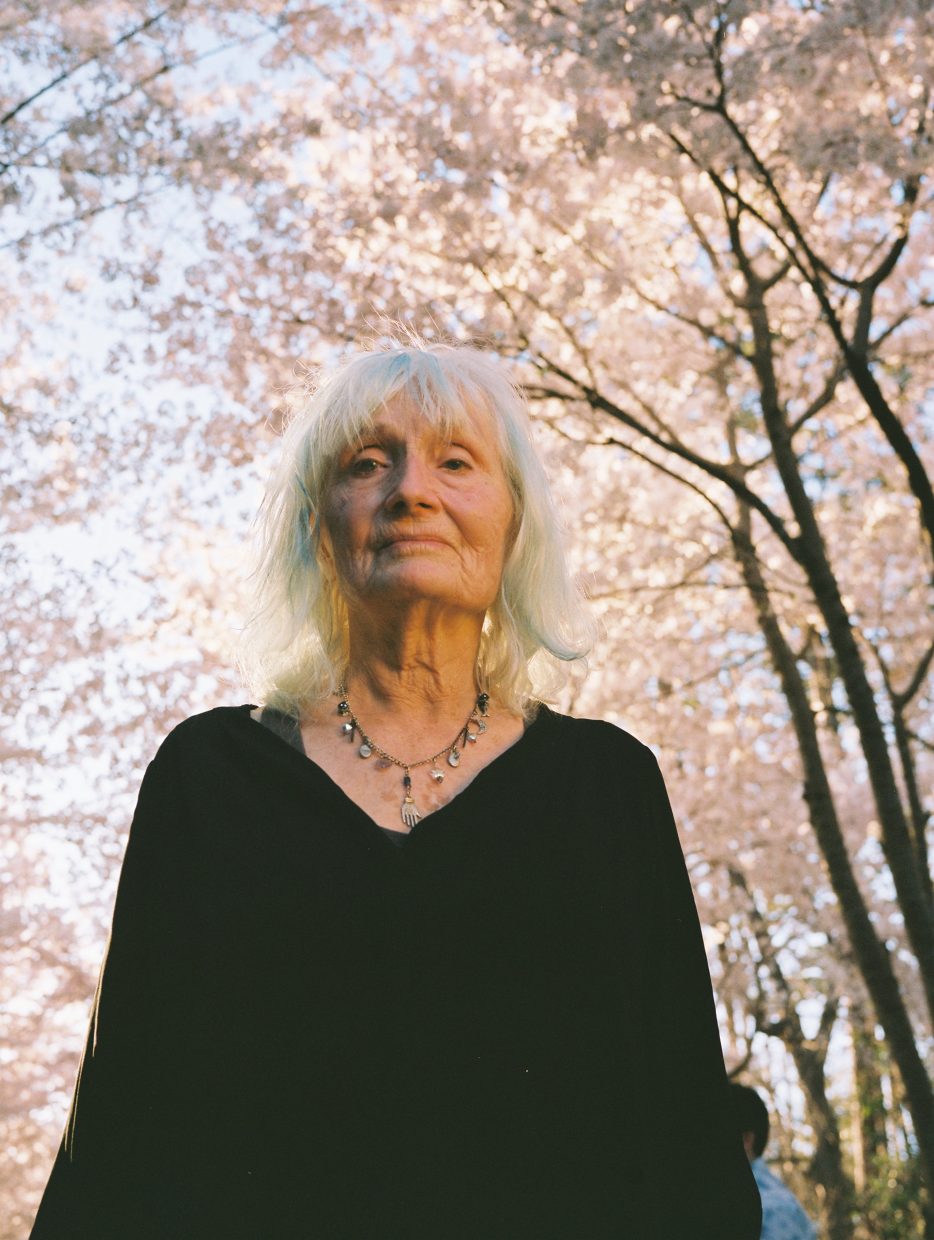
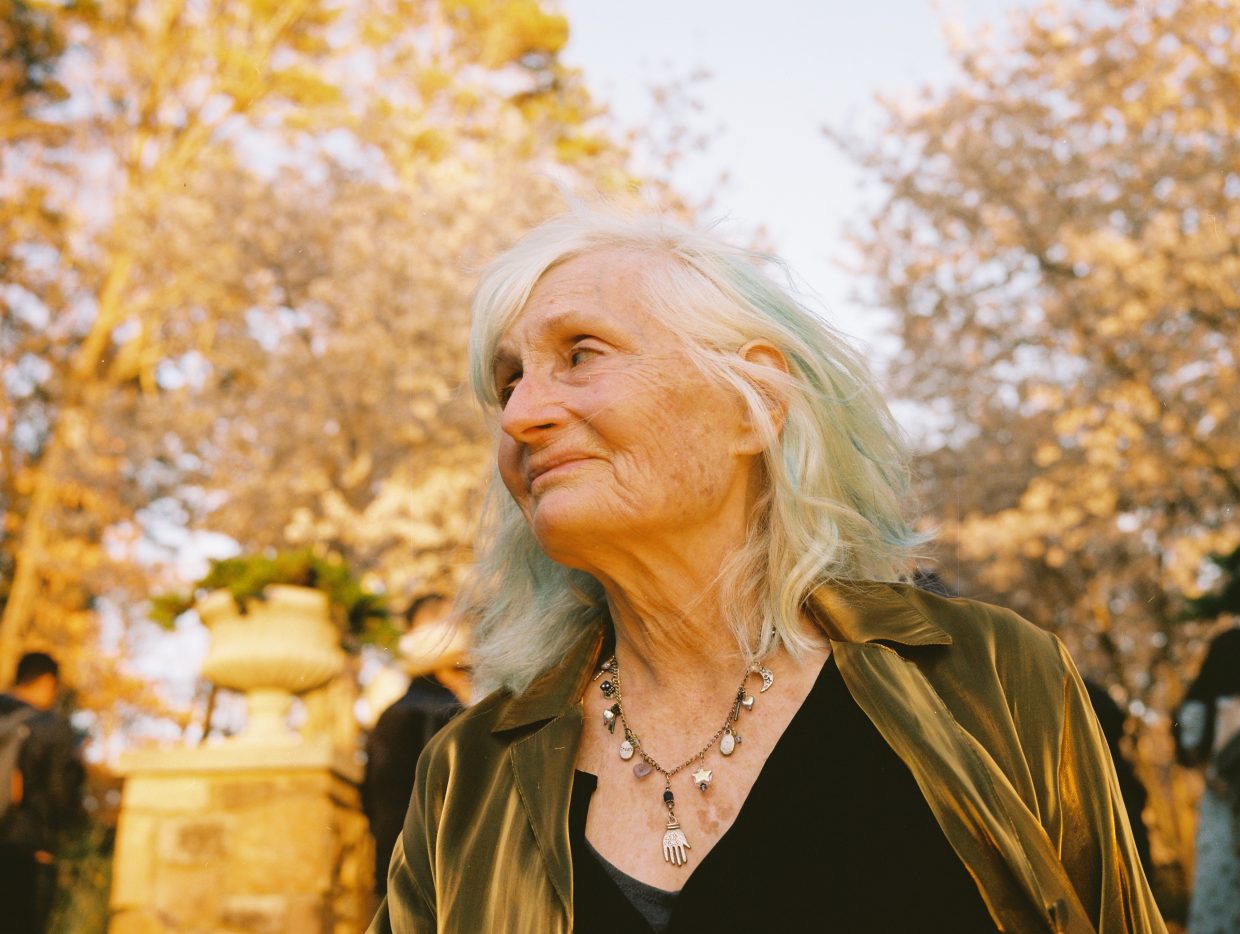
I have no training in photography – I shoot film because I enjoy the feeling of not really knowing how it works. We went to Duke Gardens in Durham, where we both live, on a week when the cherry trees had popcorned into glory. Alice looks radiant in the halo of those glowing blooms. But I also love the photos where she’s at home, standing in front of the brick retaining wall around her front yard, before she realized she still had her Apple Watch on. The sky was so blue that day, her white hair incandescent. She looks like she knows something you don’t, but in a warm way, like she knows you’ll get it eventually.

Alice is unafraid to treat a song like it can handle a little handling. She knows that songs are alive and she’s interested in being a part of their lives, not their memorialization. She smiles talking about how, in an old John Cohen film, the Madison County ballad singer Dillard Chandler starts a song in a key around here (she holds her hand at her waistline) and ends it here (she raises her hand up level with her temple). She’s delighted by the particularity of the human touch. She prefers singing voices with a bit of weirdness over purely pretty ones. Talking about Carter Stanley’s high whine, she says, “Whatever was eating on him from the inside, it was showing up in the way he sang. Nina Simone, the same way.” She tells me what a struggle it is to teach that kind of feeling to people accustomed to singing prettily. “If you’re trying to get somebody out of the soft, breathy voice, you say, ‘Look, your kid is running out into the street and you have to call your kid back.’ You don’t say,” — she coos — “‘Heyyyyy Brian, get back here.’ You say, ‘BRIAN! GET BACK HERE!’”

Whenever I’ve played music with her, Alice seems to lean into what people at the Old Town School liked – actually, loved – to call “the folk process;” she lets arrangements evolve as the spirit of the universe sees fit. I’m lucky she’s not a stickler for tradition, even traditions she could write encyclopedias about, because my fiddling style is distinctly unmoored. I was a half-rate Suzuki classical violin student growing up and then at the Old Town School I learned how to accompany folk singers on songs with three or fewer chords. I came home and started going to the old-time jam at Nightlight Bar & Club in Chapel Hill, where the jam leaders were American Studies PhD candidates who also grew up learning fiddle tunes from their hometown octogenarians. Some of my friends started a band called Mipso that was flirtatious with bluegrass and asked me to join, but I told them up front I didn’t know any licks. (They didn’t seem bothered by that.) I’ve since learned a few licks, and I would rather play an old time tune any day of the week than do almost anything else, but I never could sit still long enough to do what Alice calls “holding the line” — keeping and caring for the tradition.

I’m indebted to, and grateful in my heart for, people who do that work. I may roll my eyes at gatekeeping, but it’s more than wide-eyed would-be fiddle players at the gate; it’s the whole monster of monolithic, capitalist cultural imperialism, chomping down on everything small or strange. Songs can, and do, disappear, like cultures and forests, and not just by inertia but by clear-cutting. A lot of days I feel self-conscious about whatever it is I’m doing instead of holding that line. When I listen to Alice tell stories about the many singers and players she’s known over the years, though, I remind myself that they each have a distinct relationship with tradition – and with what it means to be an artist.

For a long time there’s been a divide, rhetorical and sometimes actual, between “the folk” and “the folkies,” which maybe means country people versus city people, or maybe people who grew up in a given musical tradition versus those who came to it later. Alice and I both fall into the latter category, though she’s had considerably sharper focus since her initiation. I’d rather replay a 10-second clip of a Mark O’Connor fiddle solo at one-quarter speed forty-seven times in a row than try to examine that dichotomy in any more detail at this moment, but I did spend a lot of my undergraduate days thinking about authenticity and who’s entitled to do what with old songs. Alice has often found herself among people who look at it from an academic angle – her ex-husband, Mike Seeger, came from a folklorist family – but her view remains that the compulsion to define and categorize is basically academia trying to justify itself. I don’t take that as bitter or glib, I just think she hasn’t found it necessary, in her personal relationship with the music she loves, to try to determine who gets to claim it. Or maybe, for Alice, the claim is in the singing. Talking about what makes a voice “authentic” (a word that sends a chill down my spine), she paraphrases Supreme Court Justice Potter Stewart from 1967 in his definition of pornography: “I know it when I see it.”

As we clink the ice around our $7 decaf specialty iced lattes, Alice tells me about a song she’d just heard, a haunting falsetto voice with nylon string guitar, in the opening scene of Pedro Almodóvar’s new short film, Strange Way of Life. After some Google sleuthing, she identified it as a recording by the Brazilian artist Caetano Veloso (in fact, the movie is named for it – “Estranha Forma de Vida.”) She’s head over heels for this song, itching to go home and dig into Veloso’s catalog. If they ever meet, I know she will have great questions for him, the type of questions that make a person believe songs must do real work in this world.

I ask her if she thinks of her music as having “a purpose.” “Not really,” she says. But she goes on, “I want people to hear what I hear in this music.”

In my view, that’s an altruistic goal, because it’s clear that whatever it is Alice hears in the music, it gives her life its very marrow. I admire the decades she has devoted to learning and documenting traditional music, but what I aspire to most is the way she still loves a song — viscerally, instinctively, with gusto. That’s what makes a line worth holding.

“There was something about the music, the quality of the voices,” she says, recalling first hearing Harry Smith’s Anthology of American Folk Music. “There’s so much beauty in it, it’s like, God, yeah.”

I had that “yeah” moment when I heard “Undone in Sorrow” and “A Few Old Memories” – and now, Sun to Sun. I hope to be saying “yeah” like that about songs for the rest of my life.


All photos: Libby Rodenbough

One to Watch: Viv & Riley Are Much More Than Just Old-Time or Americana

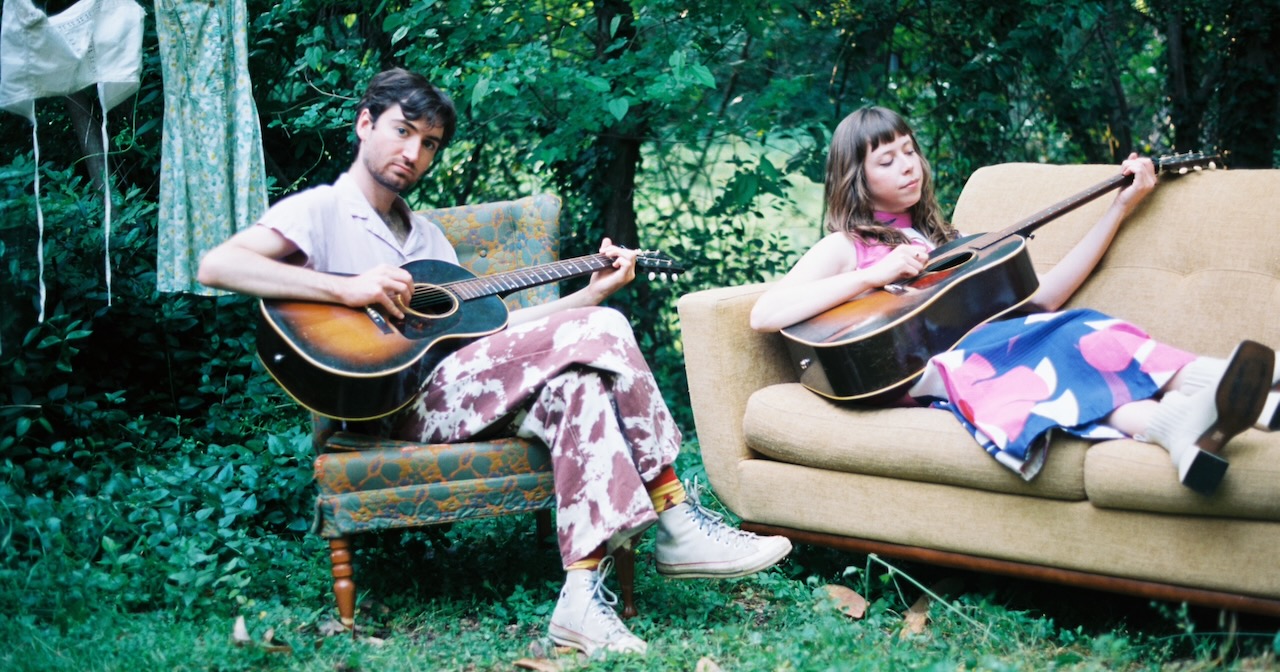
Comprised of singer-songwriters and instrumentalists Vivian Leva and Riley Calcagno, Viv & Riley are an up-and-coming musical duo that defy definition. Their new album, Imaginary People, is a masterful blend that weaves together their shared reverence for traditional Appalachian music alongside indie-folk, pop-leaning adornments. The result is an emotionally potent 10-track album that covers a vibrant range of personal and universal truths — from the bittersweet nostalgia of visiting a beloved childhood hideaway decades later, to the poignant curiosities that accompany reckoning with climate grief.

Based out of the dynamic music scene in Durham, North Carolina, this duo is currently on tour across North America. With their insightful explorations of the past and creative probings of the future, Viv & Riley uncover rich and complicated explorations of what it means to be alive in this precise moment.

So how did the two of you first start making music together?

Vivian Leva: Well, we first started making music together when we first met in 2016, the summer after we both graduated high school. I grew up in Lexington, Virginia, and Riley grew up in Seattle, Washington, and we just happened to meet at a camp in Port Townsend, Washington. It’s one of those camps that has weeks back to back — there was a vocal week that I was teaching with my mom, and then Riley came to teach fiddle the following week. We happened to overlap by a few days, and Riley was there with his band The Onlies. The first night we met, we played music together all night! After that, I joined the band, and we also started playing together as a duo and writing songs.

Riley Calcagno: The origin of our sort of band, our duo, came later that year, in the fall. We had been communicating and texting some music back and forth, and then Viv invited me down to Asheville to play a gig with her and her dad. I was a fan of her dad, James Leva, for his fiddle and singing, so we did that gig. But we thought it’d be also fun to try out some duo material while we were down in the same place, even though we had never played songs just the two of us. We emailed a venue in Asheville called Isis Music Hall, which was a prominent venue there at the time. Somehow they slotted us in, on a Wednesday night, into this big hall that they had — 200-person capacity, maybe bigger. We had never played music together going into that, but we put together some material and we enlisted some friends to play with us. It was a bold move! Talk about faking it until you make it. Only about 15 people came out to the show, and I’m sure it sounded terrible. But it was fun!

That sounds amazing. So how would you describe your musical chemistry? What is it like playing together?

VL: ​​Well, I think our initial musical chemistry initially came from our shared background in old time music and traditional music. That first night that we met, we played a lot of fiddle tunes, old music, and traditional songs. So it kind of began from a place of excitement about being exactly the same age, having never before met, and somehow both being raised around this same music that we have a shared respect and love for. So that was the initial spark of actually finding another young person who’s into the same niche genre and community. But since then it’s totally stretched into other realms. We are both so open to other kinds of music, and we have very similar tastes and aesthetics. It’s very easy to create music together because we come to it from a similar place.

RC: One of our dynamics in making music together has also been sharing our individual strengths with the other person. When we first started playing together, I couldn’t really sing harmony or find a harmony part. Vivian was very patient with me and helped me learn, and I still feel like I’m getting better all the time. That’s exciting!

VL: I just play guitar, and Riley plays every other instrument. He’s a great fiddler, guitar player, banjo player, mandolin player— instrumentally he brings so much to the table. And I feel I bring a lot of singing and songwriting-focused material to the table. We stretch each other, fill in the gaps for each other, and learn from each other.

What a beautiful thing! So what do you each feel like the biggest difference in your respective musicianships is?

RC: Viv is a very natural musician. She grew up traveling around with her parents as they toured, sitting in on harmonica at her dad’s gigs when she was only three or four. I also was born and raised around music, but it was a bit more formalized, whereas Viv’s music just comes very naturally and it’s not forced in any way. She does what she does super well and consistently and steadily, and I’m a bit more erratic. I take chances and get obsessed with things and take big leaps that sometimes fall flat. Every time she steps on stage, Viv can knock out a great performance, and I feel more streaky.

VL: But he tries lots of different things! And like he mentioned, Riley has a more formal background in music. He took lessons, he learned how to read music, he knows music theory, he did classical violin. So I think a big difference is that he technically knows what’s going on, whereas I don’t have the language or skills that he has. I’m definitely more intuition based than technically based.

You really balance each other out! So your new album, Imaginary People, just came out on September 15, and I’m wondering how your songwriting, as it appears on this album, has shifted since you first began as a duo.

RC: Well, in the past, before we started writing music for this record, we were living in different places so it was a lot of collaboration from afar. A lot of the songs on our last record came from texting voice memos back and forth. And you know, it’s not utterly different to work on them in person, but some of these new songs came out playing them together in the moment.

VL: Another big difference is Riley has started writing way more. So I think there’s more of an equal voicing on this record than in the past. There’s more of his perspective in it. And I think now that we’re living in the same place it’s also allowed us to write about a more diverse range of things. We’ve written a lot of intense emotional, romantic songs in the past, but in this recent past couple of years, we’re more interested in other things, like our shared experiences about other parts of life.

RC: And it’s also partly stylistic. Our last record was pretty much a country record. During that time, I was listening to a lot of classic country music, and this time we were listening to a wider range of things. Having a broader array of influences definitely helped us push the narrative forward.

What are you each proudest of on the album?

VL: I think what I am most proud of isn’t a specific track or anything — mostly it’s this feeling that I unlocked something. I think I let go of some fears in the process of making this record. I felt more free to just say yes to trying new things and became less concerned with things like what genre it was going to be considered, or if the people who liked our last record would like this record… and so on. I stopped worrying about categories like, “This doesn’t sound traditional enough,” or “This isn’t country enough,” or “That’s too rocker or indie.” Instead, I was able to adopt the mentality of “Hmm, that sounds interesting, let’s try and just do what feels fun!” I think I’m most proud that I was able to do that. It felt amazing to take things a little lighter and to roll with ideas that felt a little outside of the mold.

RC: When you start making music, being young musicians, you get immediately labeled. It’s not something that I think either of us necessarily anticipated, but when that first record got classified, people said it was Appalachian and classic country. And then the next one was classic country and Americana. Like “Hits-the-Spot Americana,” whatever that means. And I think there’s an urge for musicians, when you get labeled as something, to keep reproducing it. There’s this toothlessness to the modern Americana music label— it’s the creation of music that is literally meant to sound like other music under a category. I don’t have a problem with genre or specifications, I think it’s oftentimes useful, but it’s [useful] when you’re trying to reproduce sounds so that you can cater to an audience, it’s like you’re trying to sell something in a market that’s already been created. I think that can be the “dampification” of art. And while I think there’s been so many amazing things created within the Americana industry, I also think it often leads to less creativity and less interesting music.

Coming out of our last record, we had some buzz in the Americana world, and it would have been easy for us to make another “Hits-the-Spot Americana” record. But I don’t think that we did that, and I feel proud of that. Like Viv was saying, we didn’t just do what we were supposed to do. You know, there’s synthesizers, but there’s also a fiddle track, and personally, I think it all works together. So maybe if you’re an Americana devotee, you’re not going to love this album, but that’s okay with me. I think there’s a power in making an album that the machine doesn’t really know what to do with. The machine can make up albums and spit them out, but I feel proud that this one isn’t something that can just be spit out because of how we combine traditional and non-traditional music. For example, there were super organic moments where we all stood around one mic and sang together, coupled with other moments where we had things locked in, produced, and added synths because a particular song called for it. Making those two things coexist in the same ecosystem was definitely a challenge, but listening to the record, I think it all makes sense together.

It’s an album full of teeth! Now, before we wrap up, I have to ask: you’re our One to Watch, but who are you watching right now? Any creatives, musical artists, or otherwise that are inspiring you right now?

RC: One is our neighbor in Durham, North Carolina, Alice Gerrard. She’s almost 90, and she’s putting out a record on this indie label from the area called Sleepy Cat. She’s collaborating with a bunch of young people and their art for the record, like making these amazing videos. It’s a really cool thing! People around here are really conscious and thoughtful about aesthetics and sound and ethos. Everything is done with integrity, so it’s a cool scene around here in that way. Alice makes amazing music, I’m really excited for her upcoming record — I think we’ll all be glued to it once it comes out. Another one is our friend who we wrote two songs with on our previous record, “Love and Chains” and “Time Is Everything”— often people’s favorite songs of ours. I just had the honor of producing his upcoming record under his band’s name, Preacher & Daisy. I love the music, so I definitely want to give them a bump! The fun thing is that all this music is sourced locally from the Durham, North Carolina area, where we’re based.

VL: Some folks I’m enjoying listening to right now, not that they’re not already being watched, are: KC Jones, Canary Room, Dori Freeman, Alexa Rose.


Photo Credit: Libby Rodenbough

BGS 5+5: Jon Stickley

Artist: Jon Stickley
Hometown: Durham, North Carolina
Latest album: Jon Stickley Trio, Meantime’s Up
Personal Nicknames: Stick, Sticky, Stickers, Sticky-Poo, J. P. Poo, Stickles, Stickles McGee, JP Stickles, Stickman

Which artist has influenced you the most … and how?

David Grisman, who at the time was already a monster Bill Monroe-style bluegrass mandolin player, took a huge step forward and created Dawg music, an amalgamation of many different styles with a reverence for the bluegrass music that was at the root of his sound. I take the same approach with the Trio. Every composition is an exploration of some new idea that we are experimenting with, but we do it all through the lens of, and according to the standards of, the traditional bluegrass music of Bill Monroe.

What was the first moment that you knew you wanted to be a musician?

I guess I knew I was going to be a musician as long as I can remember! An early memory is being in children’s choir in church. I distinctly remember my friends not wanting to be there, and thinking it was odd because I was just having a blast following the notes along the page. Later in life, I was in an entomology class in college thinking about what to do with my upcoming summer. I had two opportunities: a summer missionary program, or joining the band Broke Mountain in Durango, Colorado. I joined the band, and now here I am!

What’s the toughest time you ever had writing a song?

I’ve always had to sit down and work on songs. They don’t often come to me out of thin air. Over the course of writing and recording our new album, my two sons were born, so time to sit and work on music suddenly became virtually nonexistent! We had a session around the corner and I needed one more tune. I decided to get my old Martin D-18 out and see if it brought me some inspiration. I started noodling around on a little metal lick just getting some frustration out when it started turning into something. I called the song “Triumph in Between” because I actually couldn’t believe I was able to put something together in time with so much LIFE going on.

What has been the best advice you’ve received in your career so far?

I got a lot of good advice and just overall inspiration from working with Dave King, the drummer for The Bad Plus who produced a couple of albums for us. He said, “Be the most YOU that you can be. No one else can do that. It will make you stand out, and ultimately get the gig! It is a superpower.” Every time I remember to follow that advice, I stop stressing about comparing myself to others.

Since food and music go so well together, what is your dream pairing of a meal and a musician?

Haha, the first thing that came to mind was cheeseburgers with Jerry Garcia. He was such a deep guitarist and I always love listening to interviews where he talks about his approach and practice routine and whatnot. He was just such a dedicated student of the guitar. Pretty sure we both share a fondness for cheeseburgers!


Photo Credit: Tom Farr

LISTEN: Chessa Rich, “Mary”

Artist: Chessa Rich
Hometown: Durham, North Carolina
Song: “Mary”
Album: Deeper Sleeper
Release Date: April 7, 2023
Label: Sleepy Cat Records

In Their Words: “My grandma Mary was a painter, but not the kind who ever sold a painting or did it for anyone but herself, and managed to amass a collection of work despite raising nine kids with my grandpa in a small house in rural Eastern North Carolina. Her paintings are mostly zoomed-in landscapes and still-lifes that I grew up staring at on the walls of my grandparents’ house. One showed a lake with a bass jumping out and sat right beside the deer head mounted above my grandaddy’s recliner. Their house, the one my mom grew up in, shows up in my dreams quite frequently.

“I had the great privilege of knowing my Grandma Mary for most of my life, but she passed away while I was living in Spain after college so I missed her funeral. It was only after she was gone that I began taking my own art more seriously, and I started having all these questions for her. As kids, we rarely think about our parents and grandparents as real people with unique thoughts and lives before we existed. They often don’t get acknowledged as the wise teachers they are until it’s too late. When I started writing songs, I found myself wanting to ask her about her own art-making and to chat with her about leaning into creative work in the midst of a busy life. I was experiencing a real spiritual transformation triggered by the work I was creating and felt a deep kinship with her. ‘Mary’ is a kind of letter to her, artist to artist, grand-daughter to grandmother, and person to person.” — Chessa Rich


Photo Credit: Chris Frisina

LISTEN: Spencer Thomas Smith, “Gas Station Blue”

Artist: Spencer Thomas Smith
Hometown: Tennessee-raised. Currently in Durham, N.C.
Song: “Gas Station Blue”
Release Date: March 10, 2023

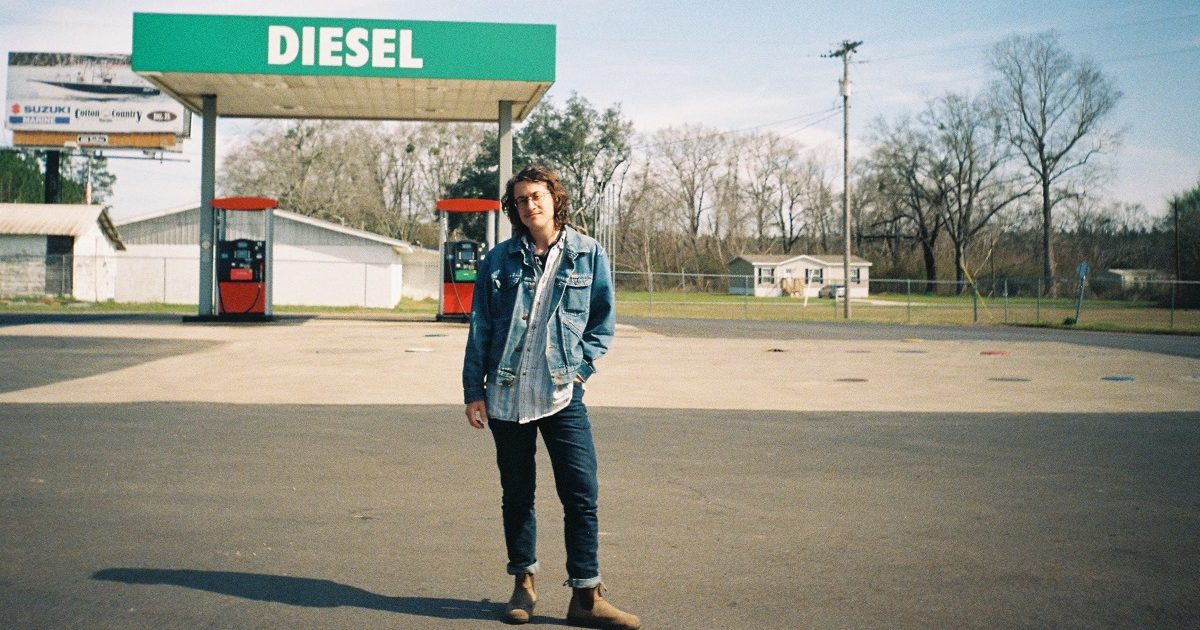
In Their Words: “It came out of a feeling I kept getting. A longing and a joy. ‘Gas Station Blue’ took me the longest to write off the album, working and reworking it. I actually named the album Gas Station Blue before I wrote the song. That feeling kept nagging at me and I just couldn’t put it into words. I was trying to find a way to reconnect to the world around me and take in life as it passed me by. And wrap that feeling in the freedom of the road and a drive in the dark and the underlying loneliness and of that pure joy you get picking up your favorite snack after filling your tank with some regular 87. So the song had to feel like the breeze in your hair or the sun on your chest laying in the grass. A loved one beside you trying to make things better. ‘Let’s make up, Let’s make love, all we can do is make love up.'” — Spencer Thomas Smith


Photo Credit: Maddie Walczak

LISTEN: Libby Rodenbough, “Easier to Run”

Artist: Libby Rodenbough
Hometown: Durham, North Carolina
Song: “Easier to Run”
Album: Between the Blades
Release Date: May 12, 2023
Label: Sleepy Cat Records

In Their Words: “I’ve been what I’d loosely call ‘grown-up’ for a decade-plus now, long enough for the early days of that period to come into relief. 22 has an intensity that would be impossible to bear for the rest of your life. On the other hand, isn’t it sad when things don’t cut as deep? I used to feel a longing for someone so fervent I was afraid it would use me all up if I couldn’t shake it off. To my surprise, it’s still with me, but duller these days, like an old heartbeat. I’m starting to think you remember everything, only increasingly pastel. This is a good thing for survival, but it makes me want to cry. Even the crying’s softer now.” — Libby Rodenbough


Photo Credit: Chris Frisina

WATCH: H.C. McEntire, “Soft Crook”

Artist: H.C. McEntire
Hometown: Durham, North Carolina
Song: “Soft Crook”
Release Date: October 4, 2022
Label: Merge Records

In Their Words: “‘Soft Crook’ was an exercise in vulnerability and trust. At its narrative core, the lyrics expose my struggle with depression through an unfiltered lens — calling it what it is, shaking hands with it, unapologetically honoring the power of its grip. It’s a mysterious and unpredictable companion that can make walking this world feel like slogging through unforgiving fields of mud. Navigating the nuances of pandemic isolation while under a debilitating depression fog was the most alone I have ever felt. To embody grief honestly, to embrace its clumsy and unhinged corners — to survive — required efforts and elixirs of self-preservation. The chorus became an anthem, of sorts; a mantra for letting go of guilt in needing these things — whether medication or TV shows or other vices — to offer myself some grace.

“I also wanted to capture a moment in time last fall when I’d opened myself back up to love; a way to summon the feeling of resting deeply in my girlfriend’s arms — that safety in hold, that transfer of both white-hot surrender and soft certainty, being touched strong and gentle at the same time; when guards are down and there is peace, if only for a moment, in the quiet consent of joy. So I walked to the front porch and snapped a photo of the late afternoon sky as proof, a reminder that there is much to feel, and much to lose. That love needs to be nurtured, even if stacked with unknowns. And we need to nurture ourselves as best we can, with whatever it takes to move towards another dawn.” — H.C. McEntire


Photo Credit: Heather Evans Smith

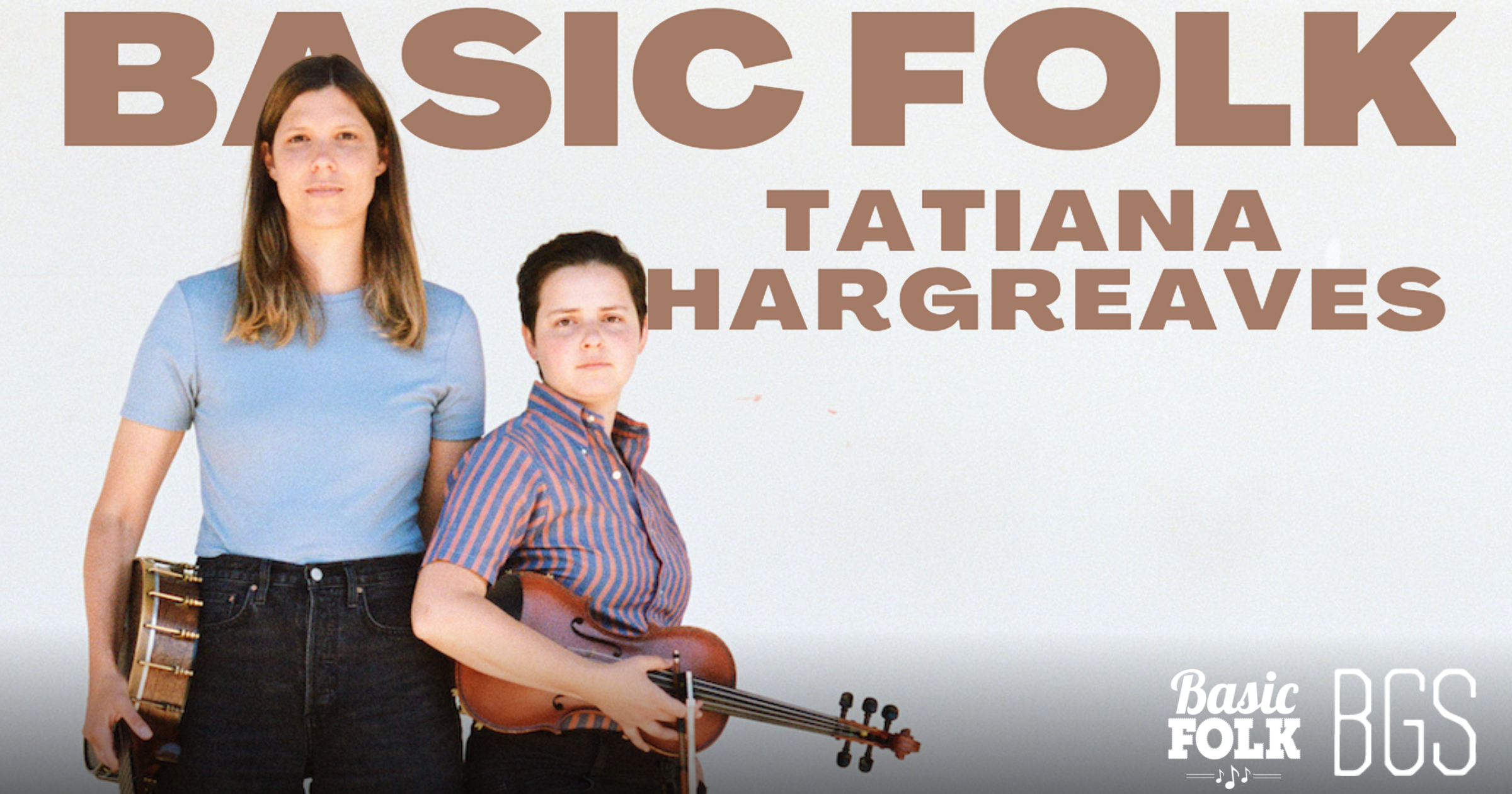
Basic Folk – Tatiana Hargreaves

When Tatiana Hargreaves was younger, she was a shit-hot fiddle player; recording her debut album at age 14, a first prize winner at the Clifftop Appalachian Stringband Festival Fiddle Contest that same year and gaining all sorts of accolades before even graduating high school. After some thought, she went after a degree in ethnomusicology and performance at Hampshire College in Amherst, MA, where she continued to play fiddle like a maniac. Her time in college allowed her to reconnect with her friend, the equally impressive banjo player, Allison de Groot. She reflects on one summer where she and Allison kept finding each other and jamming at various events and festivals. They decided to record their debut album and tour. The duo are back again with the new record Hurricane Clarice, using traditional stringband music as a way to interpret our uncertain times.

Powered by RedCircle


LISTEN: APPLE • SPOTIFY • STITCHERAMAZON • MP3
 

Our conversation leads into topics like the negative impact of music as competition. Tati has spoken before of her experience competing on the Texas Fiddle circuit that’s pretty popular on the West Coast. Also, after college, she moved to Durham, NC, to be closer to and work with old-time legend Alice Gerrard. Since 2017, she’s been soaking up Alice’s influence and knowledge through being her fiddle player and digitizing her old photos. This has led to a vast amount of inspiration, from recording songs on the new record that Alice had introduced to her to going back to school to study library science. I am fascinated by this person and her work. Tatiana keeps it close to the chest, but I’m grateful for what she shared in conversation.


Photo Credit: Tasha Miller