The Mighty Résumés of
Dan Penn and Spooner Oldham

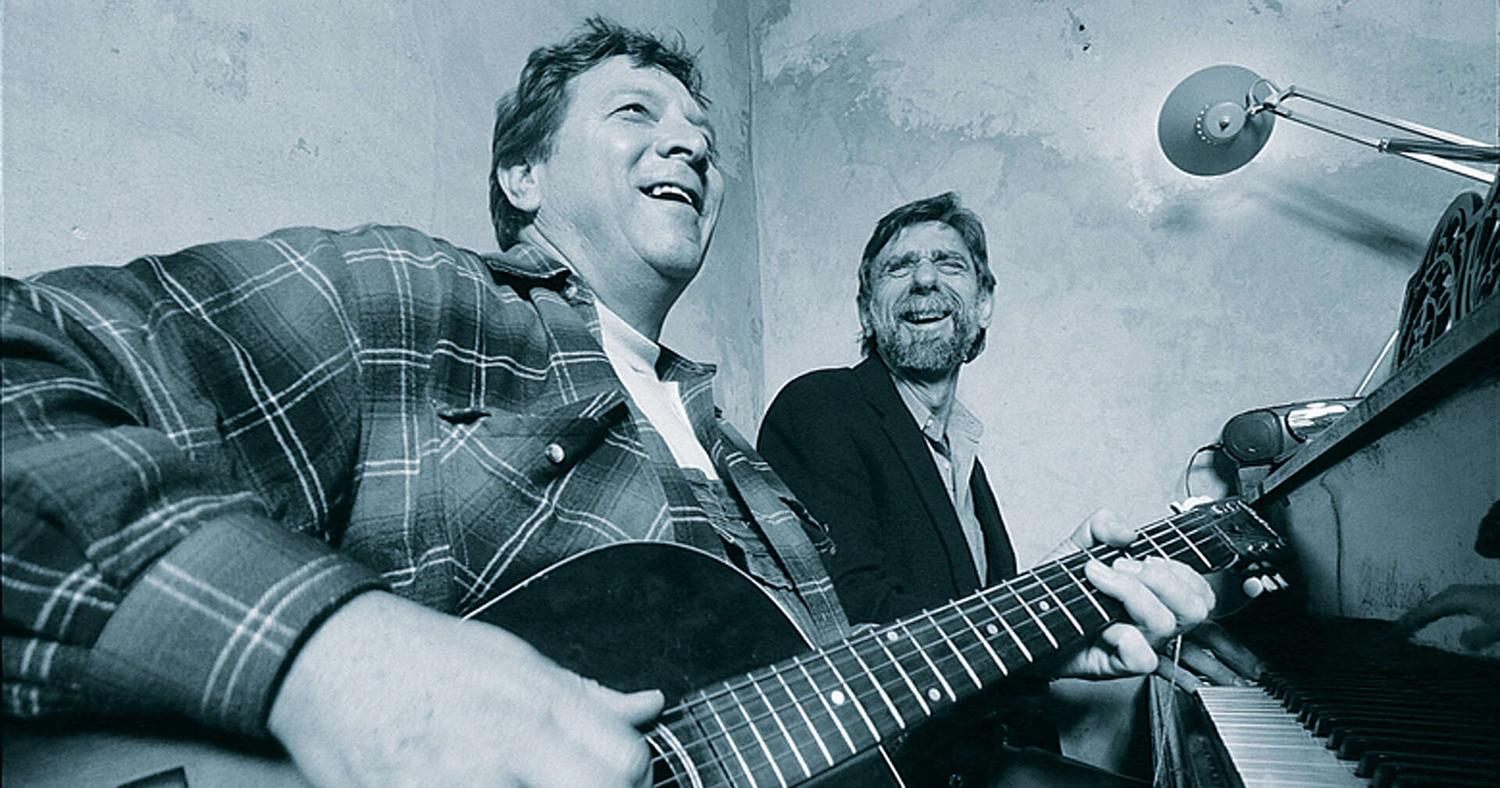
The duo of Dan Penn and Spooner Oldham have amassed an astonishing set of credentials, not only as exceptional soul, pop, rock, and country songwriters, but also as vocalists, producer (Penn), and session musician/sideman (Oldham). Both Alabama natives, they’ve maintained a successful professional relationship and close personal friendship since meeting in the late ’50s as teens. They’ve always characterized themselves as “country boys who love Black music.”

Penn initially viewed himself primarily as a singer. He was the lead vocalist for two local Alabama bands, the R&B group the Mark V Combo and a later one, Dan Penn and the Pallbearers. But he began to shift his focus in 1960, after his tune “Is A Bluebird Blue?” became an early hit for Conway Twitty. That song also reflected the joint musical influences that have always permeated the tunes co-written by Penn and Oldham. It’s country’s powerful storytelling edge combined with soul’s passionate energy and quest for personal salvation. Once the Twitty tune made it big, things changed in Penn’s mind. “That’s when I first decided that maybe this songwriting thing might work out,” he added. “After I saw some of the checks that were coming in, I decided to just keep going with it.”

Penn had already been working at SPAR Music studio, a place co-founded by Rick Hall and Billy Sherrill above a drugstore in Florence, Alabama. When Hall decided to open his own studio titled FAME (Florence Alabama Music Enterprises), Penn became their first resident songwriter. He and Oldham began writing together at FAME, and both say they had a chemistry from the very beginning.

“Back in those days, co-writing wasn’t quite what it is today,” Penn continued. “But just from hanging out with Spooner and getting to know him, we had real good rapport from the beginning. I got to know and like him, and then things just kind of took off from there.”

“What Dan says is pretty much how it happened,” Oldham added. “We got a rhythm going and it’s never been one of those things where we’ve had any problems or issues.”

Interestingly, Oldham views himself as a musician first, then a songwriter. A prolific organist and keyboardist, he got his start playing in a traditional jazz band while in high school. The extensive list of top musicians he’s played with over the years includes Arlo Guthrie, Jim Croce, Gram Parsons, The Everly Brothers, Jackson Browne, Linda Ronstadt, Gene Clark, Ry Cooder, The Flying Burrito Brothers, Delaney and Bonnie Bramlett, Bob Seger, Maria Muldaur, Rita Coolidge, Bobby Womack, Albert King, Helen Reddy, Harry Nilsson, Stephen Stills, J.J. Cale, and Neil Young. But in his earlier days, he also made his way to the FAME studios and had the first of many collaborations with Penn. Among their notable FAME triumphs were Percy Sledge’s “It Tears Me Up,” James and Bobby Purify’s “I’m Your Puppet,” and Joe Simon’s “Let’s Do It Over.”

But Penn wanted to produce as well as write and he left FAME for Memphis in the late ’60s, moving to Chips Moman’s American Studios. Oldham would later follow him there. Penn and Moman would craft their own set of soul classics, notably “Dark End of the Street” for James Carr, and “Do Right Woman, Do Right Man” for Aretha Franklin. Penn got his first major production opportunity in 1967, with the Box Tops and then 16-year-old lead vocalist Alex Chilton. Penn produced their number one hit “The Letter,” then joined forces with Oldham to co-write the group’s second smash “Cry Like A Baby,” and the Sweet Inspirations’ “Sweet Inspiration.”

Oldham would eventually depart for Los Angeles and a prolific career as a session musician and sideman. He played keyboards on Young’s 1978 album Comes a Time, and continued to work with him on such other albums as Old Ways, Harvest Moon, Silver & Gold, and Prairie Wind. Oldham joined Bob Dylan during his Christian era, contributing to Dylan’s Saved album, the Saved Tour and the Shot of Love Tour. With Dylan, he played 79 shows, appeared on Saturday Night Live, and on the GRAMMY Awards telecast. Oldham also partnered with John Prine for the 1984 album Aimless Love and appeared on the 1994 release, A John Prine Christmas.

When Crosby, Stills, Nash & Young reunited for their Freedom of Speech Tour, Oldham played keyboards. He also worked as a sideman and collaborated with Steve Wariner through the ’80s. They teamed on the song “Lonely Women Make Good Lovers.” During the ’90s, Oldham was featured on Jewel’s album Pieces of You, which produced the hit “Who Will Save Your Soul.” In the 2000s, he appeared on a pair of Frank Black albums, joined the Drive-By Truckers for their 2007 The Dirt Underneath tour, and played with Amos Lee, Aaron Neville, Bettye LaVette and Cat Power in 2008. He contributed to Keith Richards’ 2015 album Crosseyed Heart and Sheryl Crow’s Threads in 2019, as well as the Mountain Goats Dark In Here in 2021.

Penn established his own Memphis studio, then subsequently relocated to Nashville in the ’70s. He would have some country success with songs written for Ronnie Milsap and Johnny Rodriguez, and he’d also produce a pair of Milsap LPs – his debut album Ronnie Milsap, and co-producing A Rose By Any Other Name with Moman. He contributed the song “A Woman Left Lonely” to Janis Joplin’s album Pearl (later covered by Charlie Rich) and he’d cut an acclaimed solo album, Nobody’s Fool.

Penn and Oldham had another reunion in 1991 at New York’s Bottom Line, appearing in the songwriter series “In Their Own Words.” They also contributed to Arthur Alexander’s 1993 album Lonely Just Like Me. Later the duo made an acoustic tour throughout parts of the U.S., Europe, Australia, and Japan. It yielded the live album, Moments From This Theater, that was released in 1999. Penn also made another critically praised solo LP, Do Right Man, in 1994. Both Penn and Oldham are members of the Alabama Music Hall of Fame. Oldham is also in the Rock and Roll Hall of Fame as a sideman, as well as the Musicians Hall of Fame in Nashville and the Birmingham Record Collectors Hall of Fame.

Both men currently remain busy. Penn’s Christmas tune “One Blue Light” was released last November and it was a message of “remembrance and hope” to highlight the holiday season. It’s the first single from Penn’s upcoming album, Smoke Filled Room, which is scheduled for release later this year. “There’s a song on there that I worked on for 20 years and I finally got it right this time,” he said in discussing the upcoming album. “Billy Lawson mixed it and we finally got it sounding the way that we wanted.”

Smoke Filled Room was recorded at Penn’s home studio and will be available on various streaming sites. “When I started out as a singer in the studios I’d always pay attention to what they were doing on the boards, the engineering, mixing, all of it,” Penn added. “So it wasn’t that much of a shift for me to go to production.”

Besides playing dates last year with Neil Young, Oldham also played with the Scottish band Texas on the 2024 release The Muscle Shoals Sessions, a collection of soul covers that the group recorded at FAME studios. He will be playing on an upcoming Robert Cray LP, with the sessions set to begin the week after our interview. Together, Penn and Oldham are doing some select dates this year in both the United States and United Kingdom.

Unfortunately, Oldham suffered an injury early in his recent appearances with Young. “The first week out I fell playing basketball and just tore myself up,” Oldham said. “But I’ve moved from a wheelchair to a walker to a cane, so I’m doing alright.”

Neither man will commit to claiming any one of their classics as their favorite, nor will they cite any one artist as the greatest that has covered their songs. But Penn mentions some names he was particularly happy he worked with as either a producer or songwriter. “Alex Chilton, Aretha Franklin, Joe Simon – so many I can’t really name them all.”

“I’ll just say I’m grateful to all the wonderful singers that did our songs,” Oldham added. “I really saw myself starting out – and still do – as a musician first, and I approached songwriting from that perspective. Dan would work on getting the words right, if there was a problem, and I’d work on fixing the music if anything went wrong on that end.”

Penn added the name of one singer who’s not recorded one of his songs that he’d enjoy having cut one: “Tom Jones,” Penn said. “I doubt if that’s ever going to happen, but I’d love for him to do one of them. He’s got a hell of a voice.”

Their opinions on the phenomenon of streaming aren’t as tinged with anger as some of their contemporaries, though they acknowledge that the compensation end has its problems. “Well, this generation has really gotten accustomed to getting its music that way, and you’ve got to be willing to adjust to that reality,” Penn said. “I don’t really have anything against it, but really, as a songwriter, [you] aren’t going to make a lot of money off it.”

“They definitely need to address the payment side of it,” Oldham said. “It’s definitely a way to get the music out to the public, but the musicians themselves aren’t really getting the benefits from it. That’s the area that they need to address.”


The exploits of Dan Penn and Spooner Oldham are chronicled as part of the “Muscle Shoals: Low Rhythm Rising” exhibit at the Country Music Hall of Fame and Museum in Nashville. They will be appearing in concert at City Winery Nashville on January 18, 2026.

Photo Credit: Richard G. Mann

MIXTAPE: Shoals Gold with Mike Farris

Playlists are the new Mixtape – and who doesn’t love a good Mixtape? With the release of my brand new album, The Sound of Muscle Shoals, recorded at legendary FAME Studios in Muscle Shoals, Alabama, I thought it would be cool to highlight not only a few of the most important – albeit ubiquitous – classic songs, but more importantly some of the rare gems from the legendary Muscle Shoals canon. For a nerd like me, to be able to have personal access to reach out to guys like Norbert Putnam and David Hood and ask, “Where was this recorded?” is a surreal and cherished thing. I had no idea that Leon Russell’s “Stranger in a Stranger Land” was recorded down there– just amazing.

For this list, I didn’t want to put just the usual suspects on it, but how could you do a Muscle Shoals playlist and not include the song that launched Aretha’s career, “I Never Loved a Man”? For me, everybody on this list is owed some more attention, but the big three that jump out to me that should be way more well known, in my opinion, are Candi Staton, George Jackson, and Arthur Conley. Enjoy! – Mike Farris

“You Left the Water Running” – Otis Redding

Written by the great Dan Penn along with Rick Hall and Oscar Franks. I believe this may be the only record the Big O recorded at FAME – Rick Hall had merely asked Otis to sing the demo for an upcoming Wilson Pickett session – as this predates Otis’ ascension the King of Soul. This is one of the many great songs Dan Penn had a hand in, by the way.

“I Never Loved a Man (The Way I Love You)” – Aretha Franklin

A must for any Shoals playlist. The song that launched the Queen of Soul!

“Stranger in a Strange Land” – Leon Russell

I actually had no idea “Stranger” was recorded with the Swamper crew. There was a lot of confusion online about this one, but in the sometimes surreal nature of the music business, I realized that I could just text the great David Hood and simply ask him about it, which is nice. And he did, in fact, confirm it was recorded at Muscle Shoals Sound.

“Mustang Sally” – Wilson Pickett

Another must-have. I always imagined being in the studio watching everyone’s expressions on their faces while WP sang. It had to have been unreal. Also, this groove is DEEEP!

“Ease On” – Mike Farris

I tried to demo this song a few times, but it never came close to what I was hearing. From the moment we stepped out on the floor with all the FAME guys in FAME Studios’ legendary Studio A, I knew this song was being delivered to the right guys. It’s everything I imagined it to be and then some…

“You Better Move On” – Arthur Alexander

Arthur Alexander gave Rick Hall and FAME Studios their first hit record with “You Better Move On” and he was just getting started.

“Heart on a String” – Candi Staton 

Candi is one of the greatest R&B singers, period. I could literally fill this playlist with all of the great Candi Staton songs.

“You Got a Lot to Like” – George Jackson

George Jackson was one of the most prolific and important writers in the Southern R&B and rock and roll world, make no mistake, but he was also a great artist in my opinion. This one highlights his great vocal ability.

“I’m Your Puppet” – James & Bobby Purify

A great song by the great Dan Penn and Spooner Oldham. In addition to being an all-around damn fine composition, “I’m Your Puppet” has to be one of the hardest hittin’ mid-tempo grooves of all time.

“When a Man Loves a Woman” – Percy Sledge

I once asked Spooner Oldham and the late Jimmie Johnson why they chose to use a Farfisa instead of a Hammond organ on “When a Man Loves a Woman.” I would actually throw these questions out knowing full well that it would spark a long, meandering, completely engaging conversation with them that could and would take you all over town and back before finally coming back around to what would typically be a simple answer. This question was no different. The answer, given by Jimmie and agreed upon by Spooner was, “We used the Farfisa because that was all we had.”

“I’ll Take You There” – The Staples Singers

Produced by Al Bell, possibly the biggest hit by The Staples features an iconic shoutout by Mavis to the legendary “Swamper,” David Hood, on bass. Jimbo Hart pays homage to his hero, David, on “Learning to Love,” from my new album, The Sound Of Muscle Shoals, which I am forever grateful for.

“Loves Me Like a Rock” – Paul Simon

One of my favorite songs growing up. I clearly remember hearing this song play over WCDT 1510-AM radio station in my hometown as a kid and being completely taken with the backing vocals of the great gospel group, The Dixie Hummingbirds.

“Sweet Soul Music” – Arthur Conley

Classic soul swing-dance groove with one of the most explosive and iconic horn intros of all time! Soon as they heard that intro in the control room, you just know that they knew they had a hit on their hands.

“I Worship the Ground You Walk On” – Jimmy Hughes

Jimmy Hughes at his best with a very underrated classic

“This Love of Mine” – Arthur Conley

Incredible number with an amazing arrangement by the one of the greatest soul singers of all time, Arthur Conley.

“Before There Was You & I” – Mike Farris

I had the verses and chorus when I showed up at FAME. What I didn’t have was the B section for the solo break and the outro, which the great Will McFarlane came up with. It made the song

“Lovin’ the Easy Way” – Candi Staton

This has to be one of the steamiest, sexiest songs ever.


Photo Credit: Ed Rodes

Counsel of Elders: Pegi Young

There’s no more apt summary for Pegi Young’s newest album, Raw, than the title itself. An honest songwriter through and through, she didn’t pull any punches when she faced grief head-on following the life-altering news she received in 2014: Her husband Neil was filing for divorce. The 12 songs that resulted from that kind of hurt — recorded with her band, the Survivors — move from the accusatory “Why’d You Have to Ruin My Life?” to the bare “A Thousand Years.” An electric blues guitar accentuating the latter reflects her bruise, still purple and tender, while she tries to parse out what reasons might exist for this change of heart. “Took a sip of her leftover tea. Thought about her new reality. He’s in her children’s faces. He’s in her heart and soul,” she sings, her voice edging near despondency.

But while Young allows herself to linger in the hurt, anger, and shock that defines the first half of the album, she doesn’t stay there. This is no bitter pill, but a reflection gazing outward and inward. And for all the clichés about strength that follow from such tragedies, there’s something to be said about finding the fortitude to simply get up, get out of bed, and begin the act of self-discovery once again. On “You Won’t Take My Laugh from Me,” the way Young pronounces “laugh” comes close to making a larger proclamation: “You won’t take my life from me.” While 2014 left her with different endings than she anticipated, she’s found ways to forge new beginnings. Raw ends with two covers, Nancy Sinatra’s “These Boots Were Made for Walking” and Don Henley’s “Heart of the Matter,” notes of independence and forgiveness, both of which Young applies to herself, as well as to her situation. There’s a reason she runs with a band called Survivors and, with her newest work, listeners can see why.

When did you realize you needed to write your way through this hurt?

I’ve always written, so I started writing pretty quickly. That was about all I could do for a while. I was pretty frozen. Thank goodness I had that — and have that — as an outlet.

But, from a creative standpoint, tragedy can affect output since our drive to create is so often so tied energy, motivation, etc.

I didn’t have songs per se, but I had loads of words. We went on a little tour, and then we lost our bass player, Rick Rosas. A lot of losses in 2014; it was pretty rough. Spooner Oldham and Kelvin Holly and I went back to L.A., and we holed up in a hotel room. That was in early 2014, and that’s when my words started to take the shape of songs. It was a real collaborative process. I’d never done that specifically before. I usually came into the studio to present what I wanted to try, but I’d have a skeleton of a melody. In this case, I didn’t have anything. I just had these words. I didn’t play a note on this record. I went into a depression so I didn’t play — I didn’t do a lot of things that I previously enjoyed doing — I had to climb my way out of a pretty significant depression.

That actually reminds me of what British folk singer Shirley Collins experienced after her husband left her — she lost her voice. Have you managed to find your way back to your instruments again?

I have. Yeah. We just came off a tour, and I played guitar on some songs. I have a couple of pianos here in my house. I took piano as a little girl, so I understand the keyboard in ways that I don’t really understand the guitar neck, even still. I know chords, but if I don’t know, I fish around and find something that sounds good, and bring it to Kelvin and say, “I don’t know what this is …” and he translates it for the rest of the band. My chords are a little odd, you know. [Laughs]

How lovely that you have a translator!

Oh, he’s terrific. He, in many ways, is our bandleader. Everybody’s got their niche. Our newest Survivor is Shonna Tucker.

I was so excited to hear you’d brought her into the mix.

A dynamic bass player, just really cool. Rick Rosas left some really big shoes to fill, and she stepped in, and I think he would be pleased. Plus, she’s got a beautiful voice, so her harmony vocals with me are just terrific.

What has it been like playing these songs live? Has it felt empowering?

I cherry-picked which ones I do live. Some of them are dated to me now. I liken the record to the stages of grief, but I didn’t think about that when I was writing. It takes you through — at least I believe, and I hope it translates that way to others — the journey with me. And it’s not just my journey. A lot of people go through loss and grief, whether it be from divorce or death. It’s part of the human condition; the Buddha says suffering is the first noble truth. It starts off with what may appear to be an angry song, but I look at anger as a very secondary emotion to deep hurt, so that’s where that one came from, and we don’t do that one live anymore. That feeling has gone so far into the past that I have trouble conjuring that one up. We stick with some of the other ones on the record that are more reflective. I think the record ends on a note of forgiveness.

When you talk about some of the earlier songs being angry, were you ever concerned or aware about playing into the stereotype of the scorned woman?

Well, I think that goes back to what other people think about me as being none of my business. It’s music, you know? I can’t control how people receive what I put out. I just put out what feels honest and true to me, and then how people interpret that is completely out of my control.

And the album title so perfectly summarizes your perspective anyway.

Yeah, we were pushing around for a title, and hadn’t come up with one yet. I was listening to the work we had done on a drive today — I love to listen to music in my car — and it just came to me. This record is very raw. There’s no sugar coating how I feel in this record.

I appreciate that you don’t shy away from being candid.

It took over a year to make the record. Luckily, when I was stuck and in the depression that I talked about earlier, it didn’t last. Ultimately, I believe — for me — I had to get up out of bed. I had to stop saying, as soon as I opened my eyes, “Oh, when will this day be over?”

How did you begin discovering your own strength again?

We are in control of our own happiness. Ultimately, with the help of my family, my kids, my professional support team, my friends, my siblings, everybody was there rooting for me and that really helped a lot. I had to get back up and start putting one foot in front of the other and get on with it, and ultimately accept what’s happened. Maybe not understand why … or understand fully why, I should say. In a long-term marriage, there’s always bumps. I was looking at this couple, they were in their 90s (it was an online thing), and it was “What’s the secret to your long marriage?” The man said, “A sense of humor,” which I’ve heard many many times and I agree with that, and forgiveness.

I know, but this is something no one expects to have to forgive when they get married.

Well, look, I’ve focused on forgiving myself, because there are always two parts. It’s never one person’s fault that a marriage doesn’t make it. There are things that happen in the course of a marriage, and there’s equal opportunity to take responsibility for not making it. Well, we made it to a finish line. I’m not blameless. I have to work on my own part and, in doing so, I think by forgiving myself it will definitely help in general with forgiveness all around.

It reminds me of a line you have in “Obsession” off your last album, Lonely in a Crowded Room: “It takes patience with yourself.” I’ve always appreciated that sentiment.

Yeah, that’s something I’m learning still. [Laughs]

Does it get easier?

It might be a life-long work in progress. We can all be kinda hard on ourselves. I know I tend to be really hard on myself. I strive for perfection, perhaps, but I know I’m just a human being, and we make mistakes, and we try to correct the course, and we try to do better, and that’s all we can ask of ourselves, I think.

Absolutely. You have to be kind to yourself because there’s so much expected of everyone.

And maybe women more than men, I’m not sure, because I’ve only inhabited a woman’s body, but I think maybe it’s just part of societal expectations. I’m almost in my mid-60s, and there were certain expectations placed on us. My daughter, for instance, I think she’s fairly representative of this newer generation — she’s in her early 30s — and there’s not the same expectations placed on her, in terms of roles and who does what, and how we’re supposed to be the nurturers and the caretakers. That’s a lot of work trying to take care of everybody else’s happiness! [Laughs] We really have no control over it.

Right, mothers tend to sacrifice their happiness for the sake of others.

Yeah. And not worrying about pursuing your own dreams, in terms of that being selfish. The happier a person I am, the better I am for everybody around me.

No kidding. Well, on that note, thank you for what you’ve shared on this latest album.

Thank you. I’ve been receiving really positive comments from people, when we were out playing shows. The primary feedback I was getting was that, rather than the victim or the woman scorned or whatever, it was more a message of empowerment. That’s all I could hope for: to be able to share with others my journey and that you can survive it. Speaking of: The Survivors! What a name. Who knew?

You picked it before it became necessary.

We are indeed Survivors.