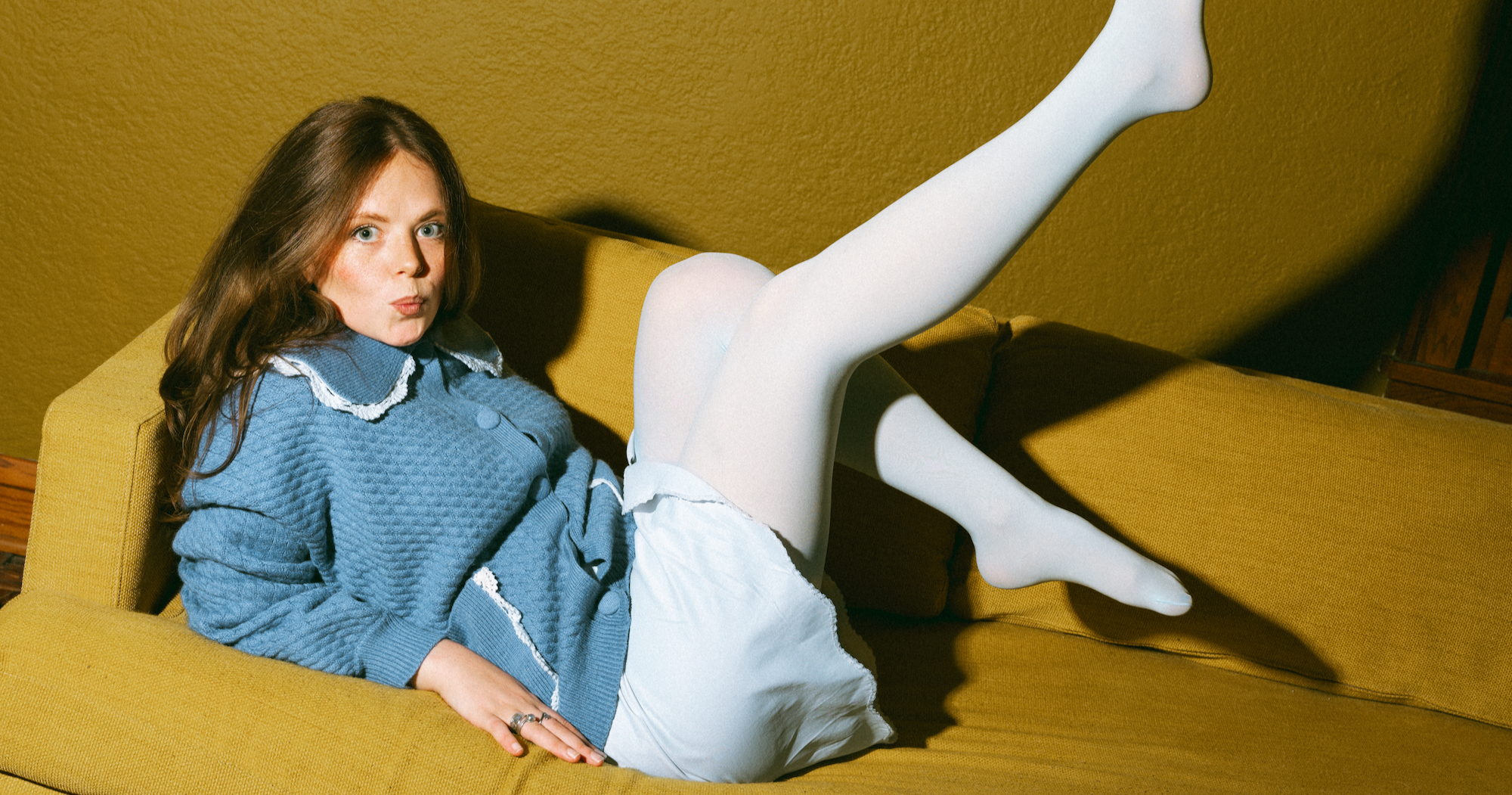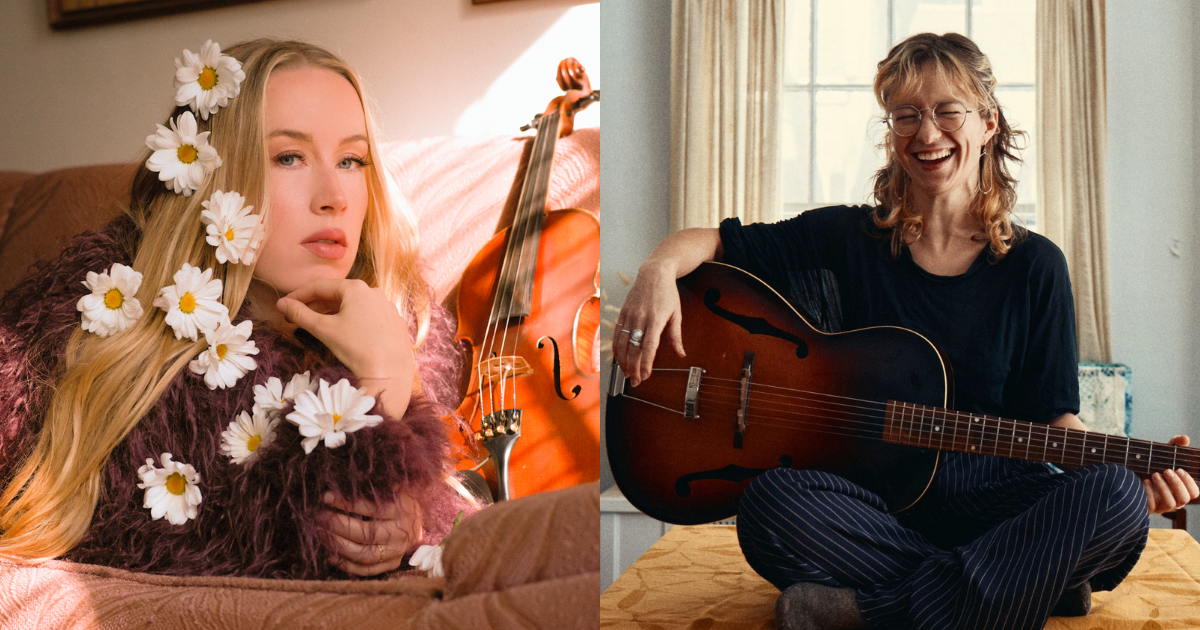
Ber Is No Longer Hiding Her Folk Elements

When you think of common musical touchpoints for young roots artists, the Shrek movies’ soundtracks likely don’t come to mind. But those compilations, beginning with the first film in 2001 and continuing through a handful of sequels in the aughts and ‘10s, feature an impressive if surprising roster of artists, including Rufus Wainwright, Tom Waits, Frou Frou, and David Bowie.

Quickly rising singer-songwriter Ber laughs as she reveals her penchant for those soundtracks, but her affection is sincere. On the Minnesota-born artist’s first full-length album – the newly released Good, Like It Should Be – she turns that winking sincerity inward, writing a dozen songs about opening up to love despite the real risk of heartbreak.

Ber wrote and recorded the bulk of the LP with close friends and collaborators Rob Milton, Austin Ward Sherman, and Bradley Hale, who joined her on a writing trip to Pepin, Wisconsin, and helped deepen both the record’s narrative vulnerability as well as its sonic range. The resulting songs are self-assured and lived-in, with an emphasis on melody and emotional tension that lets her agile, nuanced vocal shine.

Below, BGS catches up with Ber the day before Good, Like It Should Be releases, chatting about songwriting, a-ha moments and, yes, everyone’s favorite big green ogre.

Tomorrow – or in just a few hours, really – you’ll release your new album, Good, Like It Should Be. What are you feeling in this last stretch as you get ready for folks to listen to the project in its entirety?

Ber: It’s a little crazy. I think it’s actually out in Australia already. Maybe this slow burn of me realizing, all day, that it’s just gradually coming out will make it a little less overwhelming. But I would say overwhelming is the default nature of the last month. Coming up to this April 3 date has been challenging but also really exciting, and something I’ve tried to accept and just be really happy about, because it’s really crazy to be putting a whole album out. It feels really, really wild. I’ve never done that before. It’s new territory. We’ve been rolling out singles for six months, and I’ve been listening to the whole album for like a year, so really it’s not going to hit me that other people haven’t sat with it yet until tonight. I’ve been crying a lot, mostly happy tears. But it’s definitely a little bit of a release, emotionally, too. So, it’s a weird one to have to process.

To your point about living with this music for so long, do you feel like your relationship to the music has shifted in that time? Has any new meaning or insight been revealed to you?

It feels really solid. I don’t think it’s shifted so much outside of maybe me reaching for songs for the month of November, and then kind of getting sick of that one so then going for another one. I think I’ve sat with all of it in different ways. I haven’t been doing loads of writing in this period of releasing the album, so this is really the stuff that exists for me right now. And it is where I am still, which I think is really fun. We were pretty careful about choosing what the singles would be, so that there was still some magic in the unreleased tracks that people could hopefully discover when the whole album came out.

Let’s talk about the early days of the record. As you mentioned, this is your first full-length album. Did you originally set out to write a full LP?

Definitely. When I decided that it was going to be an album, there was a moment where I shocked myself that I even felt capable of that. But we definitely were like, “Okay, this is going to be a full-length record. We’re going to do 12 songs.” It was pretty concise in the planning that way, but I didn’t realize I was writing it at the time. The first songs from the album were just moments where I was pulling from things and writing for fun. I hadn’t really signed up to the task yet, so I think that’s really fun.

The first song that was written for the album is called “Smooth Ride.” I wrote that in my second EP cycle, in 2021 or 2022, with Rob Milton and Benjamin Francis Leftwich, who are just great. It was the first day we had all met and it was the first day I met Rob, who since then has been this really sturdy and really inspiring collaborator. We wrote that song and I didn’t like it then, so it got tabled. It’s something we revisited last summer, and I was like, “Oh, it lives on the album. It’s here. It’s time. I wasn’t ready for this yet, but now I am, and I love it now.” It’s one of my favorites…

The rest of it all came in a window of eight months of really intentional writing towards the album and trying things with different people, being in London or going back to Minnesota, going on this writing trip with my friends Brad and Austin [Ward Sherman] to this Airbnb in Pepin, Wisconsin. We wrote eight songs in three days and five of them shaped what the album ended up sounding like and feeling like and being about. It was the glue for all these other songs that I’d been working on in my own time with Brad. So, it was really like a puzzle to piece it all together and to choose the track list. There were probably 50 songs that we whittled down to 12.

To write eight songs in three days, you must have a special creative relationship with those friends. Do you know what it is about your working relationship that makes it so fruitful?

I just trust them implicitly. They both know so much about me and I think that trip really cemented our relationship as a collaborative team. We had been working together for a few years at this point, but Brad, who produced the record, is one of my dearest friends… It’s a really specific thing to be able to sit in the studio with someone and just make eye contact and go, “So that’s what this is.” Or, “Oh no, that’s not what you’re trying to say.” He could call my bluffs a lot and tell me to chase something, and I could follow that direction, because I trust him and I love him.

Then bringing Austin into that, too, was so fun, because he’s brilliant and he suggests things that I would never in a million years think of. He has a very band-y sensibility about his production and his vision for music and I really loved that… When you do a writing session with someone, you basically spill your guts for a few hours. You have to be really honest with yourself and with the people around you, otherwise the thing you make is gonna sound like trash. With the album, I really wanted to make something that felt true to where I was at the moment, and I was falling in love. I had to be really vulnerable with them about the things I was feeling and the way I would possibly describe it.

It is indeed a very personal record, so it makes sense to hear you are so close with your collaborators. When you write songs grounded in your own experience, do you end up understanding yourself or your place in those experiences better?

Absolutely. It’s a point of reflection for me, often. I used to journal a lot. I’ve been doing that a little bit less recently, which is something I want to pick back up. But when we were writing these songs, regardless of what we would walk into the room with, as you’re writing about it and sitting there with music around you, you’re thinking about how it actually feels. You’re putting down words onto paper and it is a very telling experience, because you find stuff and you write words in an order and it moves you, and you go, “Oh, my God. I didn’t even think that I felt this way about that.”

“Good, Like It Should Be,” I cried after writing that song. We all did. I’m tearing up thinking about that moment. That song was about getting out of your own way and letting something just be good, because it is good and you don’t have to question everything being good. At that point, I don’t think I even realized that I was suppressing so much.

There’s a line in there that’s like, “I know it’s a choice, I can be sturdy/ Let it be good, good, like it should be.” And I was like, “Oh, wow, that explained it to me. Actually, this new love, this letting something be good, this is actually a decision for me. Not only is it natural, but I have to also accept it and come to terms with this.” It was such a big moment that was like a light bulb for the entire album, and for what I had been writing about for a year at this point. Writing these songs revealed pieces of me that I didn’t really know were in there, and that’s such a treat. It’s exhausting emotionally, but in the good type of way where you feel like you walk out of it learning something new about yourself. It’s like tarot, getting you toward those subconscious things that need to come up.

The production is so lush and intricate, and really gives a fullness of emotion to the lyrics you wrote. Could you hear a fleshed-out version of a song in your head as you were writing it, or did they find that fullness in the studio?

Probably both in different situations. I’m so pleased with the production. It was really fun to sit with Brad and to sit with Rob, and not only watch them create magic but also be able to listen to it and partake and play these instruments. We played all of the guitars. I got to play tambourine on a lot of stuff. Brad took it upon himself to teach me how to engineer a little bit while he was recording all the drums in our basement, which was really fun. And it gave me the itch to get into more production.

But yeah, when we wrote them, there were some songs that just had to be the way they are. “Forget Me Not” was like, “Okay, we should essentially just do a demo. This is so touching and beautiful.” When we did that writing trip, we just brought this one Korg eight-track recorder and that was all we were allowed to use. So, we did a lot of in-the-room recordings of the six songs that ended up on the album from that trip. “Hey, Bluebird” and “Give It All Away” both have samples from those demo recordings in the final product. We wanted to hold on to the energy…

With other songs that are a little bit more produced, like “Cool, Boy,” I did that one with Rob and he had just gotten off of vacation. He was like, “I am only listening to Clairo and I absolutely love the beach, and I think we should do something beachy and flirty and fun.” And I was like, “Bet, that sounds cool. Let’s just see what’s up.”

In addition to Clairo, what were you listening to or feeling inspired by while you were making the record?

You might laugh, but I pretty much exclusively listened to the Shrek soundtrack. It’s brilliant. There’s just bangers on there. “I Need a Hero,” the Frou Frou version, is amazing. We were referencing Counting Crows. I also am a massive Kacey Musgraves fan. I grew up on Mumford & Sons, and the Decemberists, and Kings of Convenience, and some really rootsy stuff my parents turned me onto.

For a long time, at the start of me writing songs on my laptop and posting them and putting EPs out, I was really hiding from this folk element that I knew I had in me. But I wasn’t ready to touch it yet. I decided with the album we’d just really dive deep and let it be good. It’s some of the stuff I resonate with the most. But yeah, Clairo has been a huge indie inspiration. I love everything she does. And, again, it was Shrek that really did it.

You spent a lot of time figuring out the record’s sequence. How did you eventually settle on a final track list?

There were, like, 40 iterations of the track listing. It was the bane of my existence for a long time. And I actually really credit my manager for putting up with me for that window of time. Honestly, I love where it landed, but it was never my first choice. All I knew was that I wanted to sandwich the entire album between “Good, Real” and “Good, Like It Should Be,” that was my non-negotiable. So, it was like a deck of cards, sort of feeling it out.

I know a lot of people like to try and tell a story through the songs, but as I was listening to them, the story was just me. These are all things I felt and there wasn’t necessarily an order or a rhyme or a reason to it other than I made them. I would be remiss to say it was purely artistic.

My team was pretty heavy on the idea of most of the singles landing on side A of the record. And I hated that. I was so angry at the time, because what do you mean we’re gonna prioritize how an album feels on a streaming platform, of all things? It genuinely drove me over the edge for the longest time. But then I got to this point where I was like, “Maybe it’s not that deep.” … I wanted to have the journey of listening to the album feel like you land somewhere at the end, and it’s like a soft pillow. I think with where it’s landed, that’s the experience I at least have. You get to boogie a little bit in the first few and then I slowly go through the motions.

You’ve already been out playing shows around the record and you have more dates coming up later this month. What are you enjoying and looking forward to most about playing this new music?

These songs are where I feel I resonate the most at the minute anyway, so what a treat to be able to push these and to sit in them and sing them for people. I love my first three EPs and I have a lot of empathy for the girl who wrote them. I love those songs and how far they’ve reached people, and I definitely will never just let them go, but I think it’s going to be so special to be able to sit down and sing most of these songs at, like, First Avenue in Minneapolis. I’ll probably cry so much that day.

I’ve been testing the waters on these last two tours. I’ve been so lucky to fill the first quarter of my year with touring with SYML in the EU and then touring now with Callum Scott on the West Coast in America. It’s given me the opportunity to sing acoustic versions and the response I’ve gotten has been amazing… It’s really wild, I think artists are constantly releasing and performing behind themselves, in the sense that you grow so much in the time that it takes to put out an album. So often, that album and that album cycle exists in a year or two years before the person you are when you’re actually performing them and talking about it to people. But in this moment, it feels true to me and it feels really exciting to talk about still. It’s very cathartic.


Photo Credit: Tom Thornton

The Steel Wheels’ Songs for Humans, by Humans

It’s common these days to wring hands over the many ways powerful tech companies have meddled, without permission, in how we discover and listen to music (among other things). It’s just as common to fearfully declare that music’s good old days are past and gone. But after 20 years as a working band, we know that the strength of community through music is much more enduring; and we see it all the time.

There is no greater force than a group of people who are ready to share a joyful experience. It doesn’t matter if they’re gathering to jam, attend a concert, or anything else. People in community can create strong connections in a heartbeat, under almost any circumstances, and music is a powerful vehicle for it. Some days it feels harder than others to find that spark, but it’s always there if we come together and dig for it. Every day the pressure grows to strip the things we all have made and love for parts, but collectively we can raise our voices and push back. As a band, we’re choosing to resist that force and to keep building things. Together.

This playlist features artists that we feel musical and professional kinship with, bands that have been around and are well into their careers. The songs we chose come from albums that are worth spending time with over and over again. These folks have played lots and lots of gigs and revel in the energy of a great show as much as we do. You’ll also find some music from our 9th studio album, The Steel Wheels, too. Music that we made together in a room. – The Steel Wheels

“Easy” – The Steel Wheels

A breezy song with a swirling fiddle intro and a big question at its heart. We live in the future now, with the entire world available to us on the other side of our screens. So why are we lonelier than ever? If everything is supposed to be easy, why does it all feel so hard?

“Talk Is Cheap” – Dr. Dog

Because they inspired me with one incredible Bristol Rhythm & Roots Reunion set probably 15 years ago. Their old amps, their confident trailblazing of their sound that was clearly referential and respectful – but not chasing what a lot of other bands were chasing.

“Los Angeles” – Big Thief

An artist’s job is to remain open and soft to the world and to distill all that pain and joy into work that transmits emotion across space and time. Somehow, Big Thief seems to only become less jaded with time, maintaining curiosity and exploration as part of their creative process.

“Go Back” – The Steel Wheels

All deep relationships come with joy and with pain. To be rid of one you would also lose the other. It’s part of lived experience, this is a reminder to embrace all of it. True connection is worth it.

“Waiting For The Sun” – The Jayhawks

The Jayhawks are a band that prove you can continue to forge your own way and make it through the highs and lows. I was still really just a kid when I discovered them through some older cats I was playing with at the time. Son Volt and Wilco were very much in the alt-country scene and the Jayhawks just had something a bit different going on.

“Worried About The Weather” – Greensky Bluegrass

I love the way this song pivots between the anxiety of pushing forward through uncertainty and the breezy delight of taking a moment to enjoy the journey. There’s momentum to both things and “Weather” has tons of it.

“Keep On Dancing” – The Steel Wheels

Let’s take a break from responsibilities to just see ourselves and each other. Don’t forget to breathe and to appreciate the unadorned peace that can fill the spaces between us.

“I And Love And You” – The Avett Brothers

Even a track like this, one full of solitary stillness, shows the Avetts’ songs are packed with other people. They always remind me that I’m not as alone as I often feel. You can sense the presence of old partners and family throughout this song even though the speaker is alone in their car.

“Valerie” – The Brothers Comatose

These guys are everybody’s friends. Maybe the acoustic Dawes? I don’t know. We’ve known them a long time and they keep bringing joy and fun with warmth and grounded songs that don’t rely too heavily on bluegrass tropes.

“Sway / Endless Highway (Pt. 2)” – Watchhouse

Watchhouse invest deep thought into every lyric and intention into every note without ever seeming to overthink their process or get held back by previous work. “Sway / Endless Highway (Pt. 2)” demonstrates how the band is constantly in conversation, transitioning between tempos and driving down into a deep groove with a breeziness that belies the technical mastery of their acoustic instruments. At a Watchhouse show, the crowd will hang on every note and every silence, sharing a reverence for the song with the band.

“Slow Rise (to the middle)” – The Wood Brothers

Oliver, Chris, and Jano seem to be propelled forward by some groove force that penetrates everything they do and they invite listeners to join in on the funky joy. Their track “Slow Rise (to the middle)” tips a hat to their musical journey. To be in an audience is to get lost in the moment, only to occasionally remind yourself how wild it is that all the sounds coming from the stage emanate from just three musicians.

“Way Down Yonder ” – Chatham County Line

I first heard Chatham County Line when I opened for them at The Livery in Benton Harbor, Michigan, with a jamgrass band I was in, probably 20 years ago. They were tight and had their act together. I was blown away by their professionalism and it made a big impact on me. I will never forget that moment and I’m still inspired by their creativity and longevity as a band.


Photo Credit: Monik Geisel

BGS 5+5: Frank Viele

Artist: Frank Viele
Hometown: New Haven, Connecticut
Latest Album: The Silo (EP)
Personal Nicknames (or rejected band names): I have no personal nicknames. Really.

Which artist has influenced you the most – and how?

In my formative years, it was Dave Matthews Band. I saw them live 137 times before I graduated college and basically learned how to play guitar in the parking lots of those shows. That constant-strum acoustic style Dave is known for shaped my right hand as a player from day one and still guides the way I play.

Beyond that, I’ve studied all the great songwriters, but I always lean toward heart-on-the-sleeve emotion – that raw, unfiltered passion you hear in Bruce Springsteen or in old soul records like Percy Sledge and Otis Redding. The kind of singing where it feels like the person might crack open mid-line. That honesty is what I chase every time I write or step up to a mic.

What’s your favorite memory from being on stage?

Almost a decade ago, I got to open for Blues Traveler in front of nearly 5,000 people at a festival in my childhood hometown – on the same field I used to play tee ball on. That was a full-circle, surreal kind of moment.

The only things that might top it are the first time Zach Myers from Shinedown pulled me on stage to sing “The Weight” with his Americana project, Allen Mack Myers Moore. Or when John Waite invited me up on stage in the Boston area to sing backup and play guitar with his band on Led Zeppelin’s “Whole Lotta Love.” Those moments as a growing indie artist where one of the greats treats you like a peer… that stuff sticks with you forever.

What has been the best advice you’ve received in your career so far?

My first run of shows opening for Lee DeWyze back in 2015 had me pretty nervous — I mean, that guy can really sing. I think he could sense it. Before the last show of the run, he came into my green room just to hang out.

He said, “I’m going to give you some advice Joe Cocker gave me before we sang together on American Idol. Remember, everyone out there is rooting for you to be great.” That completely changed how I see a stage. I had an incredible show that night, and I carry that with me every time I walk out.

A close second came from Christine Ohlman, who I perform with each year at the Rhode Island Rhythm & Roots Festival. I was nervous before a set because the crowd kept growing, and she just smiled and said, “Just take ’em to church, Frank.”

So now that’s the mission every time – remember they’re rooting for me, and always take ’em to church.

Does pineapple really belong on pizza?

Being from New Haven, Connecticut – the pizza capital of the world – I feel obligated to answer this one sternly. I respect the idea of using pizza crust as an edible plate and experimenting, but pizza basically reached perfection when Pepe’s put clams on a pie. After that, we were done. We nailed it.

If you want pineapple, call it something else. Flatbread. Dessert bread. A tropical situation.

But the word pizza needs boundaries. As I say this, I also want to stress that I’m joking. And as much as I love pizza my way, I love chefs that treat their meals like art, and art can assuredly be experimental.

Since food and music go so well together, what is your dream pairing of a meal and a musician?

After that last question, you’ve got me in a full Italian food headspace. So give me my mom’s pasta e fagioli, an arugula salad with fresh tomatoes and my dad’s homemade lemon vinaigrette, and a basket of garlic knots from Salerno’s in Stuart, Florida.

All of that on the table, a bottle of red open, and Sinatra’s Songs for Swingin’ Lovers! spinning on the turntable.

That’s home.


Photo Credit: Lisa Sanchez Gonzalez

The Lone Bellow’s Latest Album is a Communal Singalong

The Lone Bellow are far from alone with the launch of their new album, What a Time to Be Alive.

Released on their own label, the collection conveys a shared vision, even beyond the founding members of Zach Williams, Kanene Pipkin, and Brian Elmquist. Williams wanted to factor in the ideas from their touring bandmates – namely, multi-instrumentalist Tyler James (formerly of Escondido) and drummer Julian Doro (formerly of the Whigs), ensuring everybody felt like they had a say. The group prepared the bulk of the material in a formerly abandoned firehouse in Henderson, Kentucky and polished the project in Muscle Shoals, Alabama, with Elmquist serving as producer.

When the album was in the mixing phase, the hard drive storing the new music was stolen during a van break-in while the group were on tour in Chicago. The band turned to GoFundMe, hoping to recoup some of the costs of rerecording. They were surprised to wind up with nearly $25,000 in donations, arguably making their fans just as invested in the project as everyone else in the band.

Not unlike the Lone Bellow’s full-throttle live shows, the new music practically begs the listener to sing or shout along. Indeed, What a Time to Be Alive does feel communal.

“This is what our hope was with this one,” Williams says. “You know, this is our sixth record, and this is definitely a way of life for us, and we’re very, very grateful for it. But it was also the record where we were like, you know what? We don’t have to try to write some hit radio single. We don’t have to play some ambiguous game. We can just make the beautiful record that we want to make, and we’ll just release it in the way we want to release it.”

Zach Williams caught up with BGS by phone on a sunny afternoon in Nashville, where the group relocated from Brooklyn in 2016.

What was the energy in the studio like as this record was taking shape?

Zach Williams: We did this one a bit different than we’ve done other records. One of the main things that I love that we did with this one is, usually somebody writes a song, and they come in and that intellectual property belongs to the songwriter. That’s it. And I wanted to make a record where everything was just split evenly between all five members of the band, no matter what. We decided to do that and that really created a very different atmosphere to work in.

It alleviated a bit of the quiet little murmurs. … You know, when you’re making something with somebody, and you don’t have any ownership in the song, sometimes you can just show up and be like, “All right, I play the drums. Here’s me playing the drums. Bye.” But when it was like, “Hey, you’re going to have an actual piece of this thing,” everybody just showed up, ready to pour their whole selves into it.

One of the most fun songs on here is “Honeysuckle.” I haven’t heard The Lone Bellow do something with that kind of old-time vibe. How did it feel to put that song together?

George Jones and Willie and a few of the old guys, they would have these murder ballads, is what I call them. They would just be singing their little heart out about burying a guy. And I was like, “I want to write a murder ballad.” So that’s our murder ballad. I did change the last verse. The original last verse was talking about how the trash man didn’t know that he was carrying out dead bodies to a truck. I was like, “You know what? I’ll fix that. I’ll clean that up just a little bit.”

Personally, I usually don’t get to play guitar on records, because I’m not a technically savvy guitar player. The guitar is basically a means to an end for me to try to write a melody or lyrics. And on that one, Brian was like, “Hey, you have this way of playing this riff that you wrote that has a sense of humor to it, and I can’t do it.” So, I play my thing and then he doubles up and plays with me. And they decided to keep the little laughs that were in the microphone, where I’m literally laughing at myself because of how bad I think it sounds. Brian was like, “No, we’re keeping all the laughter.”

That’s a big thing that we did with this record. We kept a lot of the human nature of it. …We made this record a while back. We started our own little record label to release it. That took about a year to put that whole thing together, with Thirty Tigers and distribution and all that. So, we’ve been sitting on this record for a second, and this was before AI started dropping hits. Now I’m so glad that all of that human nature is captured in this record, because there’s no denying that it’s absolutely as real as it can get. And I hope that that will just ease some souls out there.

I like the line in “I’m Here for You” about slipping down the water slide. I could picture that exactly where you are in that scene.

That’s literally how I met my wife. I was 12 years old at summer camp. In the late ‘80s, early ‘90s, there was this couple called Jim and Tammy Faye Bakker and they had a strange Christian-themed theme park in South Carolina. After the poo hit the fan, they shut the theme park down, and then these other people opened it back up and called it New Heritage USA. The week that they opened it up was the week that I went there for summer camp.

At the turn of the century, [the Associated Press] collected the top 100 most influential pictures taken of the century. One of the top 100 pictures is of a man named Jerry Falwell in a suit sliding down that slide. It’s because of the story of how he corralled his way into taking over that whole establishment. … So, that’s literally the slide that that song mentions, and that’s just the memory of how I fell in love as a little boy, as a 12-year-old idiot, maybe even younger.

Are you a bluegrass fan? Or did you grow up listening to bluegrass?

Man, I’m a huge bluegrass fan. Being in a van with Kanene, who grew up in Fredericksburg, Virginia, she knows bluegrass! I grew up like white trash. So, if there’s like a white trash bluegrass…

I grew up in a family where you’d sit around in the basement and play music together. I think that’s a base level for bluegrass. And I grew up thinking that was totally normal and now I know it was not. So I’m really grateful for bluegrass.

How old were you when you picked up the guitar?

I picked up the guitar at, like, 13, but I didn’t have any guitar lessons or anything. I had a sweet Charvel, which was like Jackson Charvel. It was super heavy metal. I think someone gave it to me, but I didn’t know that you needed a guitar amp for the first several years. [Laughs] A scary amount of time passed where I was like, “I guess this is just how a guitar is supposed to sound.”

But you held on. There’s something about the guitar sound, I guess, that you loved.

Yeah, my grandpa played the guitar, and I would go and live with him in the summers. He would play old hymns at night. I’d fall asleep listening to him playing the old spirituals.

That makes a lot of sense, because one thing your band does as well as any band, it has that dynamic. It has that rise and fall of the voice and in the arrangements. I hadn’t thought about that being based in spirituals and gospel. Did that influence the way you write?

One hundred percent, man. For good and for bad, it’s there. All the baggage is there, and there were beautiful parts of growing up in that kind of culture, too. I don’t want to throw the baby out with the bathwater, but it was also pretty weird. … I grew up in a church where the pastor would run all the way around the room and jump up and down on the couches and scream and holler. It was wild. It was like big tent revival kind of stuff. We didn’t ever go down to snake handling or anything. But there was some wild stuff. And it wasn’t until probably college, and then living in New York, where I was like, “I don’t know if all that stuff was good for everybody.”

But the core of a human being, wanting to feel the beauty, wanting to feel the presence of God, if you want to call it God or energy, I believe that’s very real. That’s what I love about especially live shows is everybody literally invests in the night. They buy tickets and they show up, and we’re facing each other, and it’s like, we’re going to try to create something memorable here. I think, especially right now, it’s such an important moment to just feel alive and connect with other humans, face to face.

How would you personally describe that feeling of being on stage? What’s that energy like from your perspective?

Jim James gave an interview a couple months ago and he nailed it. Like, every night, I have a pretty bad wrestling match in my own mind of, “Am I doing this to try to entertain? Is there a competitive spirit in me where I want to try to sing better than other people?” And the best nights are when I can just be, and let go, and just be alive and a part of the moment. And it doesn’t happen a terrible amount.

What usually happens is, I’m in my head battling thoughts of impostor syndrome on stage in front of 2000 people, night after night, which is really annoying. You would think by now that I would be like, “It’s cool, everything’s fine.” But that’s just not how it works for me. So, on the nights when I can let go of that impostor syndrome and just be another spoke in the wheel, those are the nights where we all ascend to a different place in our souls. I love those nights.


Photo Credit: Emily Dorio

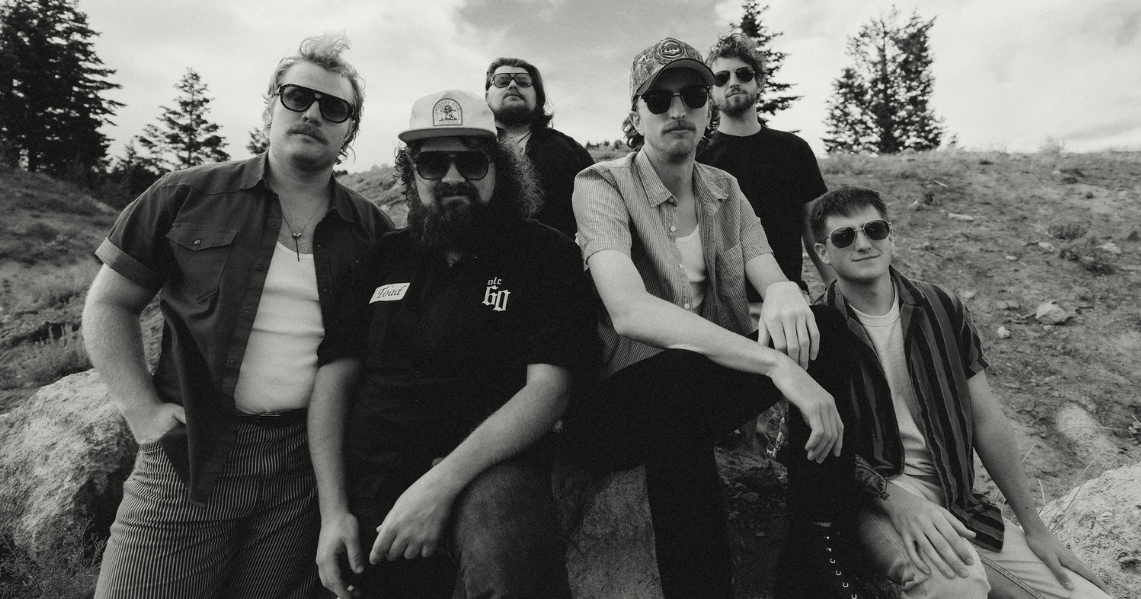
Ole 60 Bring Their Smokestack Town to the World

Pairing the slouchy charm of indie grunge with roots-rocking, small-town punk energy, Ole 60 spent 2025 becoming one of the most intriguing new acts in Americana.

With their debut album Smokestack Town – plus some fun-loving video content, huge opening-act performances with Zach Bryan, and first-time trips to Lollapalooza, the Ryman, the Grand Ole Opry, and more – the six-piece band came a long way from their blue-collar hometown of Hawesville, Kentucky. They even finished off the year with their biggest show yet, selling out their first-ever arena gig with an Owensboro homecoming. But there’s still more to do.

Inspired by a world of shift work and shitty luck, and powered by a rusty Toyota rolling on four bald tires, frontman and primary songwriter Jacob Ty Young fills his songs with vividly conflicted characters. Soaring garage-pop singalongs stand alongside sucker-punch ballads of screwing up and flaming out, each one struggling with the urge to get the hell out while still loving where you’re from. It’s a feeling anyone nursing big dreams in a small town will recognize, and Ole 60 shares it with a fresh voice.

In late January, Young told Good Country about the band’s quick rise and biggest year yet, while looking ahead to what comes next. There’s already a level-up tour underway and new music in the works. But Young pledges not to forget where they got their start – a pizza shop game room in a Smokestack Town.

In 2025, Ole 60 was out on tour, did big shows with Zach Bryan, made an Opry debut and released your first album. What’s it been like processing all that in the last month or so?

Jacob Ty Young: You try to take it in as it’s happening, but it’s a lot easier once you have some time to think. … I think it was definitely the best year we’ve had and now that we’ve had some time off, I’m eager to get back out and start touring again.

And I’ve been writing a lot. After putting out that first record, it was something that we’d never really done before. It was our first time making an album and we learned a lot of things and I think that everybody’s in the headspace that this next one’s going to be even better, so we’re working hard.

What was the common bond that brought you all together musically? You blend influences all the way from Smashing Pumpkins and Metallica to John Prine, right?

Five of the six of us are all from the same little small town in Kentucky, or bordering towns within about 30 minutes of each other. I kind of knew everybody before we started the band. We just got together and started jamming. I’m a huge Smashing Pumpkins fan. Most of the guys are big metalheads. They love Metallica, Black Sabbath, Primus, all that stuff. I think everybody bonded over just our love for rock music. There is obviously some country influence, but I never really considered it that. We were just a garage band, and it’s hard to not bond when you’re sitting there in a garage playing cover songs. The Pumpkins, Stone Temple Pilots, Black Crowes. It was that kind of grunge stuff that really glued us all together.

You can hear that still, and then there’s a rootsy folk side to it, too. When did you start writing songs?

I’ve been writing songs my whole life, but nothing ever really serious. I would write funny songs when I was in high school and I wrote a song about our basketball team one time, just as a parody thing. And I always really enjoyed playing guitar and being creative. I was into visual art and graphic design for a while. Then I kind of went through some stuff in my personal life and decided I wanted to sit down and write some songs about it. That ended up being the first EP [three twenty four]. That would’ve been 2023, I think. I always loved guys like John Prine and Bob Dylan and even Billy Corgan of the Pumpkins, just the uniqueness of the songwriting. I think for lyrics, I look to those guys, and then for the music we kind of look all over the place.

I hear there’s a pizza shop in there somewhere, right? We keep seeing pizza references in the socials and songs. Is the shop like an easter egg for you?

Yeah, I think so. I worked at a pizza restaurant in Hawesville, Kentucky, for about four years when I would come home from school. And then there’s another guy in the band, Ryan, his brother owned the pizza restaurant, so he worked there as well for years. When we first started practicing, rehearsing, and getting ready to go around playing bar gigs, we would rehearse in the back of Galaxy Pizza after close. We’d set up all our equipment back in the arcade section and jam until one in the morning. And then we got our bass player, Colby, and he had a garage, so we moved to his garage. But yeah, I grew up right next to Galaxy and it’s kind of a staple in our hometown, so we just try to let that side of us show through our content and all the visual side of stuff.

Tell me about putting the album together. Smokestack Town was one of my favorites of the year, so congratulations on how it came out. What did you want? I mean, creating a debut album is a pretty big moment. It might seem like an overwhelming task, so what were you going for?

We didn’t have a hardcore plan. I was just writing songs and I got six of ’em that I was really proud of. We went recorded and I was like, “Okay, I think this could be an album.” So I was writing as we were recording the album, and then the last song that I wrote was “Smokestack Town.” I was like, “That seems like a good name.”

I just wanted to push ourselves and try to do something different sonically than we had before. We got together with Jacquire King who produced it, and he’s one of the best of the best. He took my vision and ran with it and we’re very happy. We just wanted to put ourselves out there and let people in, see what kind of music we listen to.

That’s interesting, because it’s been presented as a concept album. But it sounds like you were building the concept as you went.

If it’s a concept album, it’s more so on the visual content side of things, because we’ve been putting out these little short videos of character acting. Taking the lead from the Foo Fighters.

Totally!

But there were just a lot of overarching themes in the record about home. Missing home, being homesick, being young. Plus that idea of small town, kind of dystopian … but not really.

Right, you wrote all these characters who are definitely small town people, with small town stories. But the thing I appreciate was they’re not stereotypical tailgate anthems or “I’m so country.” Nothing like that. Where were you coming from?

After I left Galaxy, I worked in an aluminum mill for a year and a half, and my dad works at the paper mill. Hawesville is a very industry-driven town. I think it’s different from your typical country town because it’s so labor-driven and everybody’s proud to be union and blue-collar. It’s less sitting on tailgates and drinking beer and more going to work a 16-hour shift and coming home and sleeping.

I wanted that to come through, because in country music it is a lot of sitting out in the boonies, drinking beer, and sitting on a tailgate. But I wanted to write my experience growing up in my little country town. There’s nothing to do, so we just ran around all the time and went to all these different places and got into trouble there. I wanted to write about that side of stuff, and less about the country stuff.

Being a new band coming into the indie and roots music scene, did it feel like there’s a lot of opportunity and energy out there?

Everything’s been so great. We kind of blew up on social media and I don’t know if any of us were ready for that to happen, but it did. I think that the reception’s been great. We went out and started headlining shows fairly early and we were selling them out. That’s a great feeling, because when you do blow up like that on social media, it’s hard to really put a gauge on what that means – until you go out and play a headline show and you see the crowd and they’re singing, and you go play a festival with all these big names and it’s your first time out there, and the crowd’s into it. And that’s kind of how it was.

True, and you finished last year with a huge statement in Owensboro, right? Hometown show, New Year’s Eve. Your first arena show and you sold it out. What was the feeling like on stage?

It was weird because it was both the most nervous I’ve ever been and the most comfortable I’ve ever been. You look out in the crowd, you see people you know, and you don’t get that a whole lot when you’re touring. It was just super cool. I got to sleep at the house I grew up in. The whole day just felt good. It was nice to be home and have family coming in and out and friends. Just the perfect way to end the year.

Y’all cleaned up nicely in the tuxedos. Did you put some extra polish on the performance, too?

Yeah, I thought it was New Year’s, we might as well get some tuxedos. I thought everybody looked nice. I want to do it more often. I dunno how the other guys feel about it. We’ll see.

@ole60music🗣️ said it don’t hurt and I called your bluff♬ original sound – Ole 60

You’re getting back on the road for the Smokestack Town Tour this winter. What’s everybody looking forward to? What’s the vibe?

The new year feels like a fresh start to change the show and really put a lot of thought into what we want to do with it. We’ve got some new production stuff, new lighting, and I’m really excited for everybody to see it. I think everybody just wants to go out there and every night needs to be the best show we’ve ever played. We’re playing bigger shows this year and we’re super excited, super grateful.

Earlier you said you’ve been writing, can you give us a hint about what’s been inspiring lately?

Yeah, I’ve been listening to a lot to indie rock, and what I listen to comes through in what I write. So definitely it sounds like Ole 60, but it’s new, and I’m still kind of figuring it out. But I’m really excited that the direction everything’s headed. I don’t have any idea about timelines for new music, but I have been writing a lot and I’m really excited about all of it.

Jacob, thank you for the time. I’ll leave you with the big picture – I always ask people what they hope listeners take away from their work. So what’s that look like to you?

I just hope that our story can be inspiring to others through the fact that we came from a town where after you graduate, you either go to college, you go to the military, or work in a factory, and that’s your options. And there’s always other options out there. You just got to put your head down, work hard and good things will come.


Photo Credit: Wales Toney

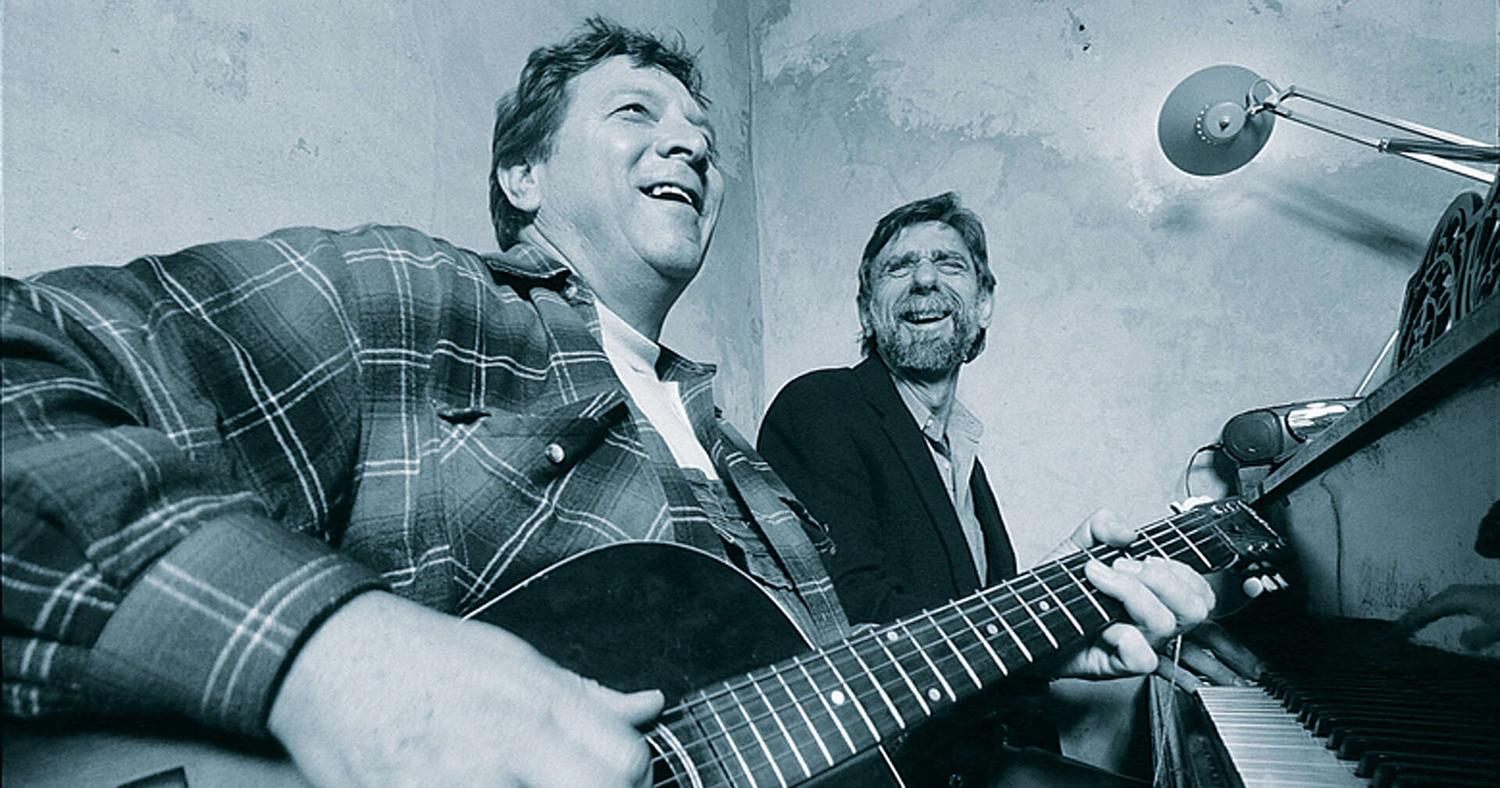
The Mighty Résumés of
Dan Penn and Spooner Oldham

The duo of Dan Penn and Spooner Oldham have amassed an astonishing set of credentials, not only as exceptional soul, pop, rock, and country songwriters, but also as vocalists, producer (Penn), and session musician/sideman (Oldham). Both Alabama natives, they’ve maintained a successful professional relationship and close personal friendship since meeting in the late ’50s as teens. They’ve always characterized themselves as “country boys who love Black music.”

Penn initially viewed himself primarily as a singer. He was the lead vocalist for two local Alabama bands, the R&B group the Mark V Combo and a later one, Dan Penn and the Pallbearers. But he began to shift his focus in 1960, after his tune “Is A Bluebird Blue?” became an early hit for Conway Twitty. That song also reflected the joint musical influences that have always permeated the tunes co-written by Penn and Oldham. It’s country’s powerful storytelling edge combined with soul’s passionate energy and quest for personal salvation. Once the Twitty tune made it big, things changed in Penn’s mind. “That’s when I first decided that maybe this songwriting thing might work out,” he added. “After I saw some of the checks that were coming in, I decided to just keep going with it.”

Penn had already been working at SPAR Music studio, a place co-founded by Rick Hall and Billy Sherrill above a drugstore in Florence, Alabama. When Hall decided to open his own studio titled FAME (Florence Alabama Music Enterprises), Penn became their first resident songwriter. He and Oldham began writing together at FAME, and both say they had a chemistry from the very beginning.

“Back in those days, co-writing wasn’t quite what it is today,” Penn continued. “But just from hanging out with Spooner and getting to know him, we had real good rapport from the beginning. I got to know and like him, and then things just kind of took off from there.”

“What Dan says is pretty much how it happened,” Oldham added. “We got a rhythm going and it’s never been one of those things where we’ve had any problems or issues.”

Interestingly, Oldham views himself as a musician first, then a songwriter. A prolific organist and keyboardist, he got his start playing in a traditional jazz band while in high school. The extensive list of top musicians he’s played with over the years includes Arlo Guthrie, Jim Croce, Gram Parsons, The Everly Brothers, Jackson Browne, Linda Ronstadt, Gene Clark, Ry Cooder, The Flying Burrito Brothers, Delaney and Bonnie Bramlett, Bob Seger, Maria Muldaur, Rita Coolidge, Bobby Womack, Albert King, Helen Reddy, Harry Nilsson, Stephen Stills, J.J. Cale, and Neil Young. But in his earlier days, he also made his way to the FAME studios and had the first of many collaborations with Penn. Among their notable FAME triumphs were Percy Sledge’s “It Tears Me Up,” James and Bobby Purify’s “I’m Your Puppet,” and Joe Simon’s “Let’s Do It Over.”

But Penn wanted to produce as well as write and he left FAME for Memphis in the late ’60s, moving to Chips Moman’s American Studios. Oldham would later follow him there. Penn and Moman would craft their own set of soul classics, notably “Dark End of the Street” for James Carr, and “Do Right Woman, Do Right Man” for Aretha Franklin. Penn got his first major production opportunity in 1967, with the Box Tops and then 16-year-old lead vocalist Alex Chilton. Penn produced their number one hit “The Letter,” then joined forces with Oldham to co-write the group’s second smash “Cry Like A Baby,” and the Sweet Inspirations’ “Sweet Inspiration.”

Oldham would eventually depart for Los Angeles and a prolific career as a session musician and sideman. He played keyboards on Young’s 1978 album Comes a Time, and continued to work with him on such other albums as Old Ways, Harvest Moon, Silver & Gold, and Prairie Wind. Oldham joined Bob Dylan during his Christian era, contributing to Dylan’s Saved album, the Saved Tour and the Shot of Love Tour. With Dylan, he played 79 shows, appeared on Saturday Night Live, and on the GRAMMY Awards telecast. Oldham also partnered with John Prine for the 1984 album Aimless Love and appeared on the 1994 release, A John Prine Christmas.

When Crosby, Stills, Nash & Young reunited for their Freedom of Speech Tour, Oldham played keyboards. He also worked as a sideman and collaborated with Steve Wariner through the ’80s. They teamed on the song “Lonely Women Make Good Lovers.” During the ’90s, Oldham was featured on Jewel’s album Pieces of You, which produced the hit “Who Will Save Your Soul.” In the 2000s, he appeared on a pair of Frank Black albums, joined the Drive-By Truckers for their 2007 The Dirt Underneath tour, and played with Amos Lee, Aaron Neville, Bettye LaVette and Cat Power in 2008. He contributed to Keith Richards’ 2015 album Crosseyed Heart and Sheryl Crow’s Threads in 2019, as well as the Mountain Goats Dark In Here in 2021.

Penn established his own Memphis studio, then subsequently relocated to Nashville in the ’70s. He would have some country success with songs written for Ronnie Milsap and Johnny Rodriguez, and he’d also produce a pair of Milsap LPs – his debut album Ronnie Milsap, and co-producing A Rose By Any Other Name with Moman. He contributed the song “A Woman Left Lonely” to Janis Joplin’s album Pearl (later covered by Charlie Rich) and he’d cut an acclaimed solo album, Nobody’s Fool.

Penn and Oldham had another reunion in 1991 at New York’s Bottom Line, appearing in the songwriter series “In Their Own Words.” They also contributed to Arthur Alexander’s 1993 album Lonely Just Like Me. Later the duo made an acoustic tour throughout parts of the U.S., Europe, Australia, and Japan. It yielded the live album, Moments From This Theater, that was released in 1999. Penn also made another critically praised solo LP, Do Right Man, in 1994. Both Penn and Oldham are members of the Alabama Music Hall of Fame. Oldham is also in the Rock and Roll Hall of Fame as a sideman, as well as the Musicians Hall of Fame in Nashville and the Birmingham Record Collectors Hall of Fame.

Both men currently remain busy. Penn’s Christmas tune “One Blue Light” was released last November and it was a message of “remembrance and hope” to highlight the holiday season. It’s the first single from Penn’s upcoming album, Smoke Filled Room, which is scheduled for release later this year. “There’s a song on there that I worked on for 20 years and I finally got it right this time,” he said in discussing the upcoming album. “Billy Lawson mixed it and we finally got it sounding the way that we wanted.”

Smoke Filled Room was recorded at Penn’s home studio and will be available on various streaming sites. “When I started out as a singer in the studios I’d always pay attention to what they were doing on the boards, the engineering, mixing, all of it,” Penn added. “So it wasn’t that much of a shift for me to go to production.”

Besides playing dates last year with Neil Young, Oldham also played with the Scottish band Texas on the 2024 release The Muscle Shoals Sessions, a collection of soul covers that the group recorded at FAME studios. He will be playing on an upcoming Robert Cray LP, with the sessions set to begin the week after our interview. Together, Penn and Oldham are doing some select dates this year in both the United States and United Kingdom.

Unfortunately, Oldham suffered an injury early in his recent appearances with Young. “The first week out I fell playing basketball and just tore myself up,” Oldham said. “But I’ve moved from a wheelchair to a walker to a cane, so I’m doing alright.”

Neither man will commit to claiming any one of their classics as their favorite, nor will they cite any one artist as the greatest that has covered their songs. But Penn mentions some names he was particularly happy he worked with as either a producer or songwriter. “Alex Chilton, Aretha Franklin, Joe Simon – so many I can’t really name them all.”

“I’ll just say I’m grateful to all the wonderful singers that did our songs,” Oldham added. “I really saw myself starting out – and still do – as a musician first, and I approached songwriting from that perspective. Dan would work on getting the words right, if there was a problem, and I’d work on fixing the music if anything went wrong on that end.”

Penn added the name of one singer who’s not recorded one of his songs that he’d enjoy having cut one: “Tom Jones,” Penn said. “I doubt if that’s ever going to happen, but I’d love for him to do one of them. He’s got a hell of a voice.”

Their opinions on the phenomenon of streaming aren’t as tinged with anger as some of their contemporaries, though they acknowledge that the compensation end has its problems. “Well, this generation has really gotten accustomed to getting its music that way, and you’ve got to be willing to adjust to that reality,” Penn said. “I don’t really have anything against it, but really, as a songwriter, [you] aren’t going to make a lot of money off it.”

“They definitely need to address the payment side of it,” Oldham said. “It’s definitely a way to get the music out to the public, but the musicians themselves aren’t really getting the benefits from it. That’s the area that they need to address.”


The exploits of Dan Penn and Spooner Oldham are chronicled as part of the “Muscle Shoals: Low Rhythm Rising” exhibit at the Country Music Hall of Fame and Museum in Nashville. They will be appearing in concert at City Winery Nashville on January 18, 2026.

Photo Credit: Richard G. Mann

Paul Burch’s Songs for Absence and Guarding Space

The songs for my album Cry Love came like automatic writing, as if exhaled after too long at a high altitude. And they were recorded as if my band, the WPA Ballclub, had known them for a long time.

A common theme thematically and lyrically is absence. Absence can be volatile. The songs that inspired Cry Love have much in common, particularly a sense of space. Bedrock instruments such as bass or drums are absent or played as loops. Sometimes there’s hardly instruments at all.

Our decade since 2020 has been a slow developing picture of things absent or out of focus. First place. Then time. Then people. Then, this year, the absence for me and my family became the loss of a person. Earth, air, sky, salty sea, and sand were thrown amuck. Cry Love and these songs guard that space – that absence – with music. – Paul Burch


A while back, if I remember right, my life was one long party where all hearts were open wide, where all wines kept flowing.

I ran away. O witches, O misery, O hatred, my treasure’s been turned over to you!

I managed to make every trace of human hope vanish from my mind. I pounced on every joy like a ferocious animal eager to strangle it.

So…it dawned on me to look again for the key to that ancient party where I might find my appetite once more.

A. Rimbaud, A Season in Hell


“Paris” – Moondog

The Viking of 6th Avenue, who lost his sight as a boy, spent most of his life performing on the corners between 52nd and 55th street. His compositions and collages made him friends like Charlie Parker, Benny Goodman, and Arturo Toscanini, who testified in court on Moondog’s behalf in his suit against DJ Alan Freed for co-opting “Moondog” for his radio show in Cleveland. Freed lost and apologized on air. This is Moondog’s late in life collaboration with the London Saxophonic. Beautiful.

“If I Lived in a Picture” – The Green Pajamas

The Green Pajamas are from Seattle and, like me, have never been on a major label. But that’s never stopped them from making gorgeous tunes like this one that upon first listen instantly vaulted them to one of my favorites ever.

“Telephone Blues” – Snoozer Quinn

My dear friend, supersonic guitarist and producer Richard Bennett, turned me on to Snoozer Quinn, the lost jazz pioneer who in the ’20s and ’30s scared the wits out of contemporaries Lonnie Johnson and Eddie Lang with his out of this world sound. There are stories of musicians filling hotel rooms and hallways to gander at a Snoozer jam session. Louis Armstrong was a great fan, as well.

Snoozer left the cutthroat NYC scene and went home to Louisiana where he died young from tuberculosis – but not before a musician pal captured him literally in his deathbed. The best part of this story is I turned Tim O’Brien onto Snoozer and Tim turned on his ole pal Bill Frisell. My good deed.

“How Much I Owe” – The Radio Four

All of the Nashboro gospel recordings are beautiful, but I’m especially drawn to the urgency of the Radio Four. Thanks to Jonathan Marx of Lambchop for the introduction. Featuring the great country bassist Lightning Chance, whose credits include Hank Williams and the Everly Brothers – and suggesting the Jordanaires’ “number system” for vocal parts be applied to Nashville sessions.

“Poinciana” – Ahmad Jamal Trio

Recorded live at the Pershing Hotel in Chicago. I especially love “Poinciana” for drummer Vernel Fournier, who reminds me of Nashville great and WPA batteur Justin Amaral. Bassist Israel played on Charlie Christian’s “Profoundly Blue.” Recorded by Chess Records engineer Malcolm Chisholm, who probably cut a session for Muddy Waters the next day.

“Sun Rays,” “Last of My Kind” – Pony Hunt

Jessie Antonick, who performs as Pony Hunt, is a musical gem. I love this live performance of “Sun Rays.” The finger snaps just send me.

I also dig their lovely version of my tune, “Last of My Kind,” which sounds like an alternative version of the WPA Ballclub.

“So Sweet You Are” – Dog On Fleas

I’m sure these lyrics got into my head for songs like “I Won’t Miss My Baby Anymore” and “Braggin'” which share the Willie Dixon “left is right, I may I might” school of playful revelation.

“Ready to Leave” – Emahoy Tsege Mariam Gebru

For me, all of Ethiopian composer and pianist Emahoy Tsege Mariam Gebru’s works are enchanting. But I especially love the album Souvenirs, her first vocal collection. Mississippi Records describes it as “songs of wisdom, loss, mourning, and exile sung directly into a boombox,” which aptly describes my feelings writing Cry Love.

“The Whale Has Swallowed Me” – J.B. Lenoir

Both John Lee Hooker and Mr. Lenoir excelled at sparse blues storying around a hypnotic, looping beat. And a whale of a story it is. The great Fred Below, on drums, powered hundreds of classics at Chess.

(Watch a great live video of J.B. Lenoir performing the song on YouTube.)

“Misery” – Barrett Strong

A hypnotic, menacing tune in which melancholy carries a blade and a broken bottle. Sung from the heart of misery itself by Motown’s first hit artist (“Money”). I love the looping carousel bass line. Los Lobos did a beautiful version, too.

“I Need Somebody to Lean On” – Elvis Presley

Elvis was having a hard time musically and spiritually in the early ’60s but still made some beautiful records. By Doc Pomus and Mort Shuman (“Save the Last Dance for Me”). Elvis sounds inspired and committed with phrasing that evokes a bit of Chet Baker.

“Complex” – Tristen

I’ve been crazy for Tristen’s music since I first heard her perform with a trio in front of Whole Foods (of all places) over a dozen years ago. That was the old Nashville. We both play Epiphone Casinos, which makes us siblings of sorts – members of an exclusive club. I’d like to think so, anyway. “You can have your way until you get in my way.”

“Blow Wind Blow” – Muddy Waters

A great era for Muddy on stage with fiercely driving rhythm courtesy three guitarists and Pinetop Perkins.


Photo Credit: Jim Herrington. Pictured: Paul Burch (L) and Fats Kaplin (R). 

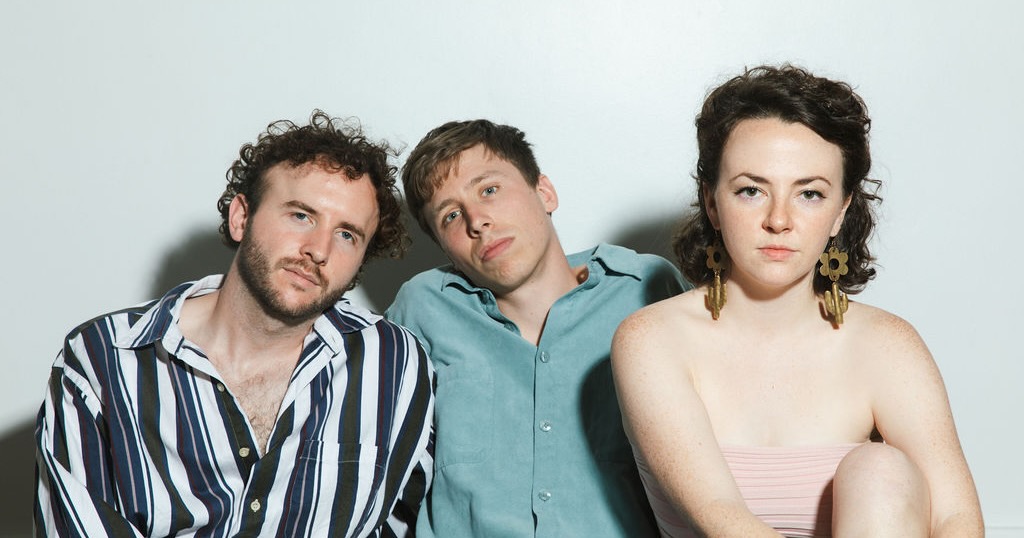
Dallas Ugly’s New Album Is Downright Beautiful

Dallas Ugly is not a country band. Except that they are?

More than a decade ago now, college classmates Eli Broxham, Owen Burton, and Libby Weitnauer began playing together as a new acoustic band, bluegrass and old-time chops combined with jazz and jammy virtuosity. Eventually, via COVID pandemic cloistering together, they crafted a collective identity as Dallas Ugly, a vibey and tight alt-country group built around original songs that made a splash with their 2022 debut, Watch Me Learn.

On that album you can hear bluegrass grit, the tenderness of folk and indie songwriting, influences of Southern rock and pop, and dashes of Texas twang – perhaps supplied by confirmation bias thanks to their moniker. On their latest album, See Me Now (released in April), the trio are abandoning any and all claims to Americana and country. But this collection – one of the best roots albums of the year – still listens like so many classic artists and albums at the intersection of indie, country, and the vast musical horizon.

When you ask the Nashville-based band how they’ve landed in this new, borderless, agnostic genre territory, they seem as surprised by their own chosen style markers and aesthetic vocabulary as their audiences. “It’s an accident,” says Weitnauer – with delight. “We don’t know why we sound this way. We’ve been able to loosen up more, build on the experience we’ve gotten just as musicians. … With this iteration, I feel like it shows a full development of our sound.”

In truth, however See Me Now and Dallas Ugly strike your ears, it’s quite a straightforward task to trace their journey through genres. (Though it’s not the most straightforward to discuss!) The trio simply follows each song down their own individual creative rabbit holes, trusting the music and each other to find or carve out sounds that encapsulate the feelings, textures, and stories that they craft together. They don’t lead the songs, the songs lead them. As a result, Dallas Ugly alchemically transform barn burning old-time fiddle, endless country twang, deep honky-tonkin’ pocket, earnest, sentimental songwriting, and pop-informed sweet tooths into smooth, artful, endlessly interesting indie rock.

Dallas Ugly’s brand of roots music – if you can call it that – is downright beautiful. We spoke to the group via phone between tours in May about making the album, claiming genre (or not), and the sometimes passive, sometimes overwrought process of shepherding these songs into the world.

I wanted to start with getting the genre conversation out of the way, as it were. Y’all have been very forward with communicating that this isn’t really a country album; that you don’t really see yourselves as a country band. You call it indie, indie-pop-rock. I hear you as decidedly Americana and country, personally. Obviously you have those indie-pop touches – plus, we know you have string band bones as well – but can you talk a little bit about your relationship to genre and how you intentionally stepped into this much more free, borderless sonic space with this project?

Libby Weitnauer: It’s funny, because as I’ve had more conversations with people since the album’s come out I’m like, we definitely marketed it wrong. [Laughs] The other way we could’ve gone – everyone is like, “Do you ever listen to Sunbelt?” “Do you ever listen to Wilco?” “What about like The Breeders?”

Everyone says it’s ‘90s alt-country. It’s like, “Damnit… you’re right.” [Laughs]

But you asked what were the intentional steps that we made – and I would say there have been no intentional steps towards any genre. Which is why we are having trouble pinning it down, because I think we decided to market it the indie route. Honestly, the Americana world seemingly wants to have nothing to do with our music. [Laughs] So we were like, “Okay, then, I guess it’s not Americana, I guess it’s not country.” Every time we bring it to those people they turn it away.

I would say our relationship with genre is very passive. When we’re making decisions and writing songs, genre isn’t a consideration. It’s always been that way. When we started playing together as the very goofy band that we were before this band, that was a sort of attempt at new acoustic music. It was the same thing, we just make decisions [based on] things that we like, or think we’re supposed to do sometimes, or sound good. Then it comes through this Dallas Ugly Eli-Libby-Owen filter, no matter what.

We’ve honestly tried so hard to fit into a genre. Where we’re like, “Okay! We’ve done it this time. You guys, we made a song that sounds like something else that exists.” Which is a funny thing to aspire to. Just trying to create stuff that we like and then it’s, “Oh, nope, nevermind. There it is. Just as weird as ever.”

Do you feel like the songs are what’s guiding you in that passive way? That you’re just trying to give the songs the treatment they each want or are asking for or deserve? Do you feel like it’s taste? Or is it just how it ends up is how it ends up? What do you think is the process for how it ends up being borderless and amorphous and not quite any one thing?

Owen Burton: Yeah, I think those are all in there. I think it isn’t as if we’re striving when we’re writing, it’s not like we’re intentionally pointing to a specific genre. There’s just things that we don’t realize are so genre-coded that are kind of inescapable about our musical voices. When we are asking how to start a song it’s, “Let’s do a fiddle kick.” It’s not, “Let’s do a country thing.” It’s just, “I feel like a fiddle kick would make sense.” And then, on the other end of that is people being like, “This is a country record now!”

It’s fair enough. But I think with this record, too, [as] I’ve learned with our first album – which we were like, this is a country record – I feel like we learned, in how it was received, how actually regimented the Americana style is. And how we weren’t within certain signifiers that are pretty regimented. Indie rock is way more broad, in terms of what it tolerates stylistically.

So the next one, this one, certainly can fit in that big tent. Now, the way it’s been perceived that way too, [I’ve realized] indie rock’s pretty regimented in ways that I didn’t understand, too. Mostly about singing. I think just none of us sing like indie boys. [Laughs]

LW: Or country voice. That’s the thing, I think what it comes down to is if different people were singing our songs, maybe it would be clearer. But I think, especially Owen and I, we have acquired taste, stinky cheese voices. [Laughs] It’s definitely not for everybody. Eli, obviously he doesn’t sing quite as much, but weirdly I would say Eli has the most familiar voice.

I happen to love stinky cheese.

LW: Exactly! Me too.

How does Justin Francis play into the genre paradigm here as your producer, as somebody who effortlessly walks between those sonic worlds? Can you talk a little bit about working with him and having him in the control room?

OB: He understood what we were going for. When we started, we intentionally controlled less variables going into the studio for this one. It’s not as if we had a strategy meeting about what kind of album this was gonna be before we started, making creative decisions on it. The songs were vaguely written before we went into the studio, but not arranged and not figured out like across the band ahead of time.

I feel like even just that process– I guess that’s a bit of a question, is that more of an Americana process or more of an indie rock process? I see that as more of a rock process; I feel like rock bands often go into the studio with songs not even written and they just write it in the studio. With [Justin] on board, he had all kinds of ideas when we were writing in the studio, little bits of studio vocab that we don’t have ourselves. [He] pushed and pulled in different genre directions, for sure.

LW: Part of the reason that we worked with him is we did these two singles with him, “Big Signs” and “Born Crying” just to try working with another producer and see what happens. I don’t even know that we were really [thinking] we could make an album with him, because honestly, he’s the real deal! We were like, “He’s famous, so he probably won’t make an album with us, but let’s just see what these things will sound like.” It was so effortless and he let us do our thing on those two. I feel like those [songs] are just as unhinged as anything else that we’ve made and he was right there with us with the ideas.

I would say, generally, working with him was really effortless. That’s the word I would use. The whole time, even the pre-production meetings.

Let’s talk about some of the music. My favorite is “Bad Feeling.” I know the lyric may say, “It’s a bad feeling, I don’t like it at all…” but I do like it. I like “Bad Feeling” a lot. I heard you guys play this song live a bunch before the album, too, but can you talk about the origin of it, its writing, how it came together in the studio?

LW: That’s the one song I think on the whole album that we had been performing [before recording]. Maybe “You Can Leave,” but it changed a lot. “Bad Feeling” we had been performing pretty much as it is, for the most part. I’m glad that you like it, because that was the song I was like… not disappointed in, but I had so much trouble breaking out of the live arrangement that we had. We had played it so much that I felt like the track suffered a little bit from how attached we were to the live arrangement.

But the making and the writing of that song, I feel like I wrote it [because] I’d been listening to a lot of Judee Sill. I guess I was inspired by that and was trying to capture how some of her songs, the chords move with the lyrics a lot. I didn’t end up really sounding like her at all, but some of the original harmonies we had for that song, played [off of] some of the harmonies in her music.

I feel like that song is like the epitome of my writing style, which is pretty autobiographical. Every time I try to write like feathery stuff, it sounds really goofy. And so with lyrics, I just try to find the most straightforward way I can say something. Usually that ends up being the most poetic, from my voice.

How do you know when you have a hook or you have the bit of the song that’s gonna be what everybody shouts along with? To me, it doesn’t feel like any of you are writing songs because you think they’re gonna be a hit. But at the same time, when I hear a really hooky song or a really catchy song – like basically this whole album – whether it’s “Bad Feeling” or “Sugar Crash” or “Circumstances” or “See Me Now,” I can picture a “light bulb moment” when you find that hook or line that ends up being the sing along.

LW: When I’m writing, I don’t really consciously think about hooks like this. That being said, a lot of my songs start with either a phrase or a melody. I’ll be on a walk or doing something in the kitchen just singing little thing. Like “Circumstances” – “I put a letter in the mail…” – that just happened in my brain when I was doing something. Then usually I’ll grab onto that and write the song around whatever little melody piece comes to me. I guess what ends up being the hook, a lot of the time, is what comes to me. And then I find myself singing it and I let it take off and do what it’s gonna do.

Eli Broxham: I feel like something that comes up, a question we end up asking ourselves that I’ve heard Libby ask a bunch of times is, “Is this super cheesy?” [All laugh] Which, we definitely ride the line of cheesiness, but at some point, you have to just be like, “I don’t know. I like it. And that’s good enough.” If it’s borderline to me, maybe it’ll be over the line for somebody else, but clearly, within bounds for another listener.

At some point, trust your instincts and be like, “It might be cheesy, but that’s okay.” And yeah, I think melodically is where I have my surest footing [writing hooks]. I still feel as a songwriter, if I hit the mark, it’s maybe by chance or something.

I also want to talk about “See Me Now,” because it’s the title track, because it’s a great song, but also because I feel like it epitomizes the journey y’all have been on, from Watch Me Learn to this album. Not just musically and creatively, but also genre, and also politically and socially. This song is “of the moment” in a really interesting way, because you can listen to it down and it’s a love song and it’s a song about seeing and being seen, but it’s also about perception and, “Is my existence valid?”

All of that is really deeply resonant, but if you zoom out and view the song in the context of the band, it changes its meaning. If you zoom out yet again and you view it in the context of y’all really coming together during COVID to do this project as Dallas Ugly, being friends for more than a decade, it changes the meaning of the song again. It’s a tesseract of a track where you guys are writing in four dimensions – it’s not too intellectual or conceptual, but it has endless depth. How!?

OB: I actually wrote that very quickly, because Elise Leavy was having like a songwriting circle. I hadn’t written a song terribly recently, so I was just gonna write something real quick for this. That was the song I wrote and at the time – this is years ago – I was very into that Kacey Musgraves album, Golden Hour, and the lead track, [“Slow Burn”]. That acoustic intro thing, I was messing around with that, because the chords are really simple, but the voicings are so interesting.

Those two things – “hurry up and write a song” and the somewhat new vocab I had just learned – came together. That first draft of it was soft, crummy – plus those lyrics, it’s hard to say what they’re about, because I wrote them very quick. Sometimes this spiel I give on stage is:

It’s three people meeting each other after some kind of apocalypse. In the universe of the apocalypse, because nobody has anything anymore, it’s very hard to [determine] what status anyone was before the apocalypse. It’s three different kinds of people with different former social status, wishing that people they interacted with could tell what status they used to have.
People are very comfortable in their status, I feel like whether it’s high status or low status, people find comfort in both. Personal comfort in your own status and the comfort in feeling like you know how to treat people once you derive their status.

I feel like audiences never understand that spiel and it’s maybe too heady to be worth anything. [Laughs] Maybe that’s also why it feels like there’s so many different reads you could have of that song.

I think the most interesting thing about it – and maybe I’m projecting y’all – is the sentiment, “Can’t you see me now? I want you to see me.” Maybe that’s just the millennial condition. All of us having nostalgia for something that never existed, generationally, and being like, “I need you to see me. I need you to perceive me. But also I’d rather you perceive me from the golden era, from the before times. From when things were right.”

Also the “Can you hear me now?” reference of it all feels very millennial, very of the 2000s in a great way. Again, is this cheesy? No, of course not. Listen to it! But also, yes it is.

OB: Yeah, that’s where we live.

LW: That’s where we live! And I would say, before this, before the version that’s on the album, it had a very different flavor. I can’t even remember how it sounded exactly, but it was definitely more country – almost like country rock – and that was over the line. I’m glad we found [this style] and Justin helped us find that. Just pulling it back to the other side a little bit, because yeah, lyrically and melodically, it’s so solid and awesome. But we had to go to the drawing board a few times to get the setting right for it.


@dallasuglymusic Woops! We turned our indie pop song “Circumstances” into an acoustic one 🙊 #bigthief #adriennelenker #mjlenderman #mjlenderman #fiddle #acoustic #uprightbass #arcadianwild #indierock #fleetwoomac #acousticguitar #folkmusic #indierock ♬ original sound – Dallas Ugly

EB: That one is like the musical ideas are blocks that are put in place. I remember when we were doing this – after some of the drawing board stuff that Libby was talking about – but I was listening to that Mac Miller album, Circles – which I think is maybe the best Mac Miller album. I was listening to how the elements didn’t change, they just turned on and off to make the song, which I feel like is pretty common in pop and rap production. But often, especially in this band or in Americana and rock, things tend to sneak in and out and evolve.

But for that song in particular, the bass line just turns on, then turns off for a little part. It turns on and turns off. There’s different parts of different sections, but they are like binary, which I think is an interesting approach – and a first for us, in that sense. Somehow, that takes it out of the realm of cheesy country and accentuates the lyrics in a nice way. Even that final chorus, where it’s just a big pause and then the chorus turns on.

LW: That’s interesting that you say that, ’cause I feel like for my fiddling, that was the approach I took on this whole album. Honestly, until we got to the pre-production meetings I was like, “I don’t even think I’m gonna play fiddle on this album.”

I took more of [an approach like] I’m a sample of a thing, rather than being a fiddle in a band. Like even on “You Can Leave,” which is the more fiddle-y of the tracks, in the verses I’m not doing traditional fills. I’m doing this one rhythmic hook every time this comes around and that’s what I’m playing on this song.

It was the idea of turning things on and off rather than trying to be part of the whole song. And I let myself punctuate things and not feel like I need to play the whole time.


Photos courtesy of the artist.

BGS 5+5: The Wildmans

Artist: The Wildmans
Hometown:
Floyd, Virginia
Latest Album: Longtime Friend (out July 11, 2025)

Which elements of nature do you spend the most time with and how do those impact your work?

Growing up in the rich and vibrant region of the Appalachian mountains, nature has always been extremely influential to everything we do. Hearing the frogs sing in the evening or when the cicadas come out and fill the air with their hypnotic mantra every few years. Nature perseveres out here and if you want to live in it you are always battling one element or another. We don’t have AC, so in the summer all of our instruments are inundated with humidity, of course bringing them outside adds to this which we do often too. Dehumidifiers help. But it’s that soft humid atmosphere that makes the forest so lush and dense out here. I think it has always taught us a lot too living in such a rural area. And I would say the musical culture of these mountains and this region of America is possibly the most impactful aspect in our work today.

What’s your favorite memory from being on stage?

Every year as kids we got to attend the local music festival in our home town, Floydfest. We discovered so much music throughout those years and specifically it was an experience we shared at Jon Lohman’s workshop porch stage when this band The Boston Boys, along with Danny Knicely and Nate Leath, invited us up to play a couple tunes on stage. It was our first time being on stage in front of a real audience and it’s one of those quintessential moments in our lives that is significant to where we are and what we are pursuing today. I think that the relaxed and inviting atmosphere that both the musicians and the audience gave to us in that moment is something that we take with us into every show we play now.

What is a genre, album, artist, musician, or song that you adore that would surprise people?

Ever since Mk.gee dropped Two Star & The Dream Police in the beginning of 2024, it has stayed on rotation. Whether in the tour van, headphones, or home stereo. I also have a serious soft spot for 90s R&B like SWV and Soul For Real. And D’angelo always. – Aila

Since food and music go so well together, what is your dream pairing of a meal and a musician?

This is such a great question and immediately it makes me think of this scene of Leon Russell playing “Jambalaya on the Bayou” in 1972 filmed by Les Blank for his film, A Poem Is A Naked Person. This is the dream pairing right here, Leon is onstage with a plate of what appears to be half-eaten ribs sitting in front of him on his piano, full of soul and groove singing this old Hank Williams song. I mean did he wipe his hands before starting the song? It’s rock and roll, it’s Leon Russell with southern bbq. – Eli

What would a perfect day as an artist and creator look like to you?

Waking up in the morning and having a hot beverage of some sort. Tea or coffee. This is a good time to write freely, reflect. Even sing a new song. Then going outside to sit in the sun for a half hour before making a really good breakfast. We are serious about breakfast as a band, sometimes all other meals can feel like a failure while on tour, especially with dietary restrictions and what not. But we always make sure breakfast is accomplished and done right.

After breakfast, we might play some music by ourselves or with each other. Giving time and space into the day for creativity and practice. Exercise is also really important to us, this would come next as we are easing into the afternoon. Into the evening we love to have friends over to share music and food, cooking together or grilling out. Good food, good people, and good music make the world go round. All of these things are what make up a “perfect day as an artist” to us. General simplicity and grounding.


Photo Credit: Magnolia Ellenburg

10 of Our Favorite Roots Cellists

Though an uncommon encounter in the roots music scene, the BGS team will always applaud a roots, folk, bluegrass, or old-time cello moment. With velvety, rich tones and a unique percussive capacity, the cello deepens the flavor of every tune it encounters. While not considered a traditional bluegrass instrument, it carries an ancestry boasting many folk interweavings – and its proximity to both the upright bass and fiddle grant it a certain amount of creative leverage while integrating into roots music.

The cello’s undefined yet familiar positionality allows cellists an unconventional playing ground for innovation; without the same distinctly canonized roots traditions as say, the fiddle or the banjo, cellists can access a broadened range of textures and styles.

This list, though it is by no means comprehensive and is curated in no particular order, pays tribute to some of our favorite cellists in a variety of roots music contexts.

Leyla McCalla

A prolific multi-instrumentalist and multilingual singer, Leyla McCalla’s impact on the roots music scene continues to be nothing short of profound. An alumna of the GRAMMY-winning Black string band the Carolina Chocolate Drops and founding member of Our Native Daughters (alongside Allison Russell, Rhiannon Giddens, and Amythyst Kiah), McCalla also has five solo releases under her belt. She is the daughter of two Haitian immigrants and activists and her work is widely informed by Afrofuturist thinkers and Afro-diasporic musical influences. The 2022 recipient of the People’s Voice Award by Folk Alliance international, McCalla’s work has been recognized time and again for her deep commitment to ancestral study and social change.

More Leyla McCalla content here.

Mike Block

Ever seen a cellist perform standing up? If you have, they’ve probably heard of Mike Block. Among the inaugural wave of cellists to perform using a strap, Block was the first cellist to ever perform standing at Carnegie Hall and he did so using his own patented creation, the Block Strap.

Sonically, Block has also explored an expanded range of motion, as he is well known for his cross-cultural collaborations. While BGS fans may know him best from the Mike Block trio, his acoustic string band with Joe K. Walsh and Zachariah Hickman, Block also tours with an electric trio called Biribà Union, a duo with Indian tabla player Sandeep Das, a six-piece American/African fusion band, and the Silk Road Ensemble, a collective formerly spearheaded by fellow cello luminary Yo-Yo Ma. Block, astoundingly, has also released 20 albums of his own music, in addition to recording, performing, and arranging for other musical giants such as Miley Cyrus, Elton John, Raffi, and more.

Yo-Yo Ma

Perhaps one of the most renowned cello players of all time, Yo-Yo Ma is widely recognized for his feats in classical music. His discography includes over 120 albums (19 of which earned GRAMMYs), both paying tribute to the classical Western canon and forging revolutionary cross-cultural connections. One of our personal favorite examples here at BGS is Ma’s participation in the Goat Rodeo Sessions, a stellar 2011 collection of classical and Appalachian entwinements featuring Ma, Stuart Duncan, Edgar Meyer, and Chris Thile, with vocals from Aoife O’Donovan showcased as well. The result is nothing short of breathtaking – truly an original fusion of soundscapes that remained unparalleled until the supergroup’s release of their sequel album, Not Our First Goat Rodeo (2020).

Read our exclusive 2020 interview with Yo-Yo Ma on Not Our First Goat Rodeo.

Monique Ross

Hailing from Milwaukee, Wisconsin and now based in Nashville, cellist Monique Ross is one half of the dynamic sibling duo SistaStrings. She and her sister, Chauntee Ross (violin), blend their classical training with gospel, R&B, and folk influences to yield music that once again proves the age-old wisdom that there is nothing quite like sibling synastry. The pair’s vocal and instrumental prowess enrapture with both distinctive emotive execution and precise relationality. Both also perform as members of Brandi Carlile’s touring band and Carlile will serve as the producer for their upcoming project currently in the works.

Find more Monique Ross and SistaStrings here and here.

Larissa Maestro

Larissa Maestro is a Filipinx multi-hyphenate talent based out of Nashville, Tennessee. Named “Instrumentalist of the Year” at the 2022 Americana Music Awards, Maestro was the first cellist and the first member of the AAPI community to receive that honor. A composer and activist as well as a musician, Maestro arranges chamber music, co-founded a community orchestra (The Nashville Concerto Orchestra), and often fundraises for non-profit organizations through their craft.

Maestro’s ability to weave lush string arrangements into a vast array of genres positions them as a highly coveted collaborator, having worked alongside the likes of Hozier, Margo Price, Gillian Welch & David Rawlings, Ms. Lauryn Hill, John Legend, Allison Russell, and more as well as fronting and collaborating with various projects and bands.

Natalie Haas

Known for her impeccable traditional cello playing, Natalie Haas keeps centuries of Celtic traditions ablaze. She and Scottish fiddler Alasdair Fraser have toured together for twenty-three years, reviving and reimagining the tradition of cello/fiddle duets, popular in 18th and 19th century Scottish dance music. Though historically these duets featured a droning cello and melodic fiddle, Haas’s curiosity coupled with her virtuosity explore the cello as a dynamic instrument, capable of harmony, melody, percussion, and every blended iteration thereof. As Peter Winter once said, “Natalie basically wrote the book on the cello’s place in Celtic music.”

Read more about Natalie Haas and her collaboration with her sister, Brittany, here.

Ben Sollee

Ben Sollee is a Kentucky-based cellist and activist whose interdisciplinary work seeks to connect and elevate his communities. His most recent solo album, The Long Haul, interpolates both American influences and inspirations from the global south to deliver a dynamic album that, in part, processes the many griefs he faced during COVID’s inaugural years while maintaining a buoyant sense of resilience and growth. In addition to his innovative cello playing, Sollee works as a composer, having scored several films and the podcast “Unreformed.” Sollee has also recently helped spearhead a non-profit called Canopy to support local Kentucky businesses mindful of having a positive social and environmental impact on their community.

Read more about Sollee and The Long Haul here.

Nancy Blake

A pioneer for glimmers of cello in the modern American roots landscape, Nancy Blake is a cross-genre hero. Nancy began her relationship to the instrument at age 12 and grew up playing cello in the Nashville Youth Symphony. On a fortuitous day in 1972, her band Natchez Trace opened up for prolific picker Norman Blake. The two eventually married, and Nancy aptly fused her cello playing into Norman’s musical landscape. She also picked up several other more traditional roots instruments, such as guitar, fiddle, and upright bass, appearing on many of Norman’s releases throughout his career.

Joy Adams

Dr. Joy Adams is a versatile multi-instrumentalist, vocalist, composer, songwriter, and educator from Washington state who currently resides in Denver. While you may know her best from her extensive touring with Nataniel Rateliff, Darol Anger, and the all-women powerhouse group Big Richard, she has accrued a sprawling list of collaborators throughout her career. From recording on the Emmy award-winning soundtrack of The Queen’s Gambit to performing with the likes of Chick Corea, Kenny Loggins, Ben Folds, Waxahatchee, and more, Adams weaves energetic innovations into each of her collaborations.

Read our recent interview with Big Richard on their brand new album, Girl Dinner.

Casey Murray

Like many of our favorite cellists, Casey Murray is a talented educator in addition to their performance and compositional ventures. A Berklee grad based in the luscious roots scene of Boston, Murray finds much inspiration in blending Celtic, old-time, folk, classical, and improvisational sensibilities – like in their work with forward-looking string band Corner House. They particularly enjoy providing musical accompaniment for contra dances around the New England area, an exercise of their keen attunement to the rhythmic possibilities the cello has to offer.

Of course, even with ten incredible entries, our list of roots cellists barely scratches the surface of this vibrant community in folk, bluegrass, and beyond. With plenty of examples – like Rushad Eggleston, Nathaniel Smith, Kaitlyn Raitz, and many more – still to pull from, we’re already prepping a Part II to our roots cello exploration. Who would you include?


Photo Credit: Ben Sollee courtesy of Big Hassle; Leyla McCalla by Noé Cugny; Yo-Yo Ma by Austin Mann.