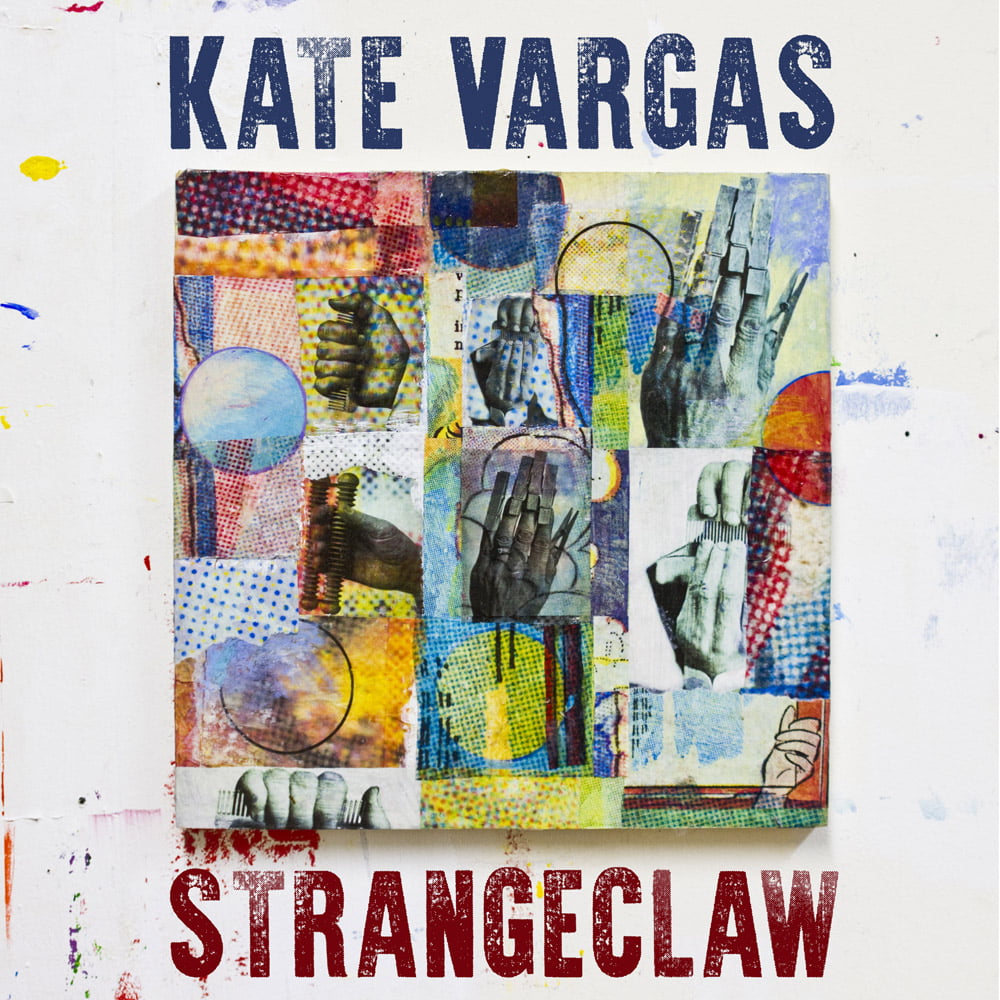
STREAM: Kate Vargas, ‘Strangeclaw’

Artist: Kate Vargas
Hometown: New York City
Album: Strangeclaw
Release Date: September 13

In Their Words: "Picture yourself walking through the desert, miles and miles of dirt and tumbleweeds that stretch straight out to what looks like the edge of the earth. You’re ambling along and you spot something there, sticking out of the dry ground. You pick it up and dust it off. It’s a strange claw of some sort. Where did it come from? Why is it here? Your mind creates curious, sinuous scenarios, so delightfully odd that you can’t help but lean into them. That’s the goal of this album." — Kate Vargas


LISTEN: Kingsley Flood, ‘Try’

Artist: Kingsley Flood
Hometown: Boston & DC
Song: "Try"
Album: Another Other
Release Date: October 14

In Their Words: "I spent this album talking about my own identity, and the politics defining it. I keep coming back to this idea that change – on the political level – is hard to come by. For 'Try,' I brought that idea to the personal level, and this fear I have of complacency. I wrote this tune after seeing an older couple in a restaurant not say a word to each other their entire dinner. And I got freaked out that age would lead to complacency and suck any excitement out of life. I swore in that moment that if I ever realized I was that set in my ways, I would find a way to change and inject some life into my life." — Naseem Khuri


With Headphones on the Floor: A Conversation with Chely Wright

Though singer/songwriter Chely Wright made her name on the country charts back in the ’90s, her new album’s quiet confidence showcases what is probably the truest side of her: a conscious and caring, creative and compassionate woman rooted in faith and family above all else. Produced by Joe Henry, I Am the Rain features 12 tunes written by Wright, along with one Bob Dylan cover that feels right at home in the set. It also continues the artistic recalibration Wright began with her 2010 Rodney Crowell-produced release, Lifted Off the Ground.

Congratulations on a hell of a decade you’re having. Can I just say that?

[Laughs] Yeah. It’s been pretty crazy. I’ve been really contemplative in the past few weeks as I’ve been doing some press about, “Gosh, what has happened in the past decade?” It’s been pretty action-packed.

Check my timeline. I was just putting it together. In 2010, you came out publicly, Like Me was published, Lifted Off the Ground was released, and the LikeMe Foundation was established.

Yeah.

In 2011, you got married … happy anniversary, by the way.

Thank you! Yep.

And the Wish Me Away documentary … which, kudos. That was so brave.

Thank you. I’m really happy with it.

Then 2013, the boys.

Yeah. Wait. Hold on. Got knocked up in 2012.

Okay. We’ll put that in. [Laughs]

Well, I mean, being a lesbian, it’s a little bit more than a back-seat of a Pontiac and tequila. It takes some getting done. [Laughs] So that’s important for the timeline.

Indeed. Then, 2014 was your huge Kickstarter campaign. So did you make the record last year or this year?

We made it in 2015 — 2014 was Kickstarter and my mother died in May. That really was a seminal moment in the process of the itch. You’re a creative person, you know. If you’re thinking about a piece you want to write, you write a lot of it in your head, I’m sure: “What am I going to say? What does it mean? What’s the point? What’s the art?” Then you get an itch when you know to sit down and start typing. My mom’s death in May of 2014 was the itch that caused me to go to my pile of songs and start taking inventory of what I had.

Got it. That Kickstarter campaign must’ve made you feel REALLY great. Did you write the songs and plot the record after that? It probably directed a lot of how you went about things, yeah?

I’ll answer both questions: Did it make me feel great, the Kickstarter? It made me feel things I didn’t know I needed to feel. When my managers and I discussed crowd-funding, at first, I was like, “That sounds like something other people do. I don’t really think I want to do that.” But Russell [Carter] was like, “You have to pay attention to the way history is changing. It’s not begging for money. It’s, essentially, a pre-sale.” He said, “More importantly, it re-engages you with your fans.”

I didn’t really hear that, when he said it. So, in my mind, when we kicked the whole thing off, my thinking was that a successful campaign would be to get funded. I quickly understood that the success of it, for me, was to reconnect with fans that had been following me for 20 years and new fans that I could connect with. More sentimentally, I was reminded that I didn’t lose all of my fans. I didn’t even lose half. Maybe I lost 30 percent of my fans because there were people saying, “You don’t know my name, but I love your records.” Or, “I saw you in Bagdad.” Or, “I saw you at the Nebraska State Fair in 1996.” It was emotional for me, in that regard.

But you probably picked up just as many from the documentary and all the other stuff, I would assume.

Here’s the thing about those new fans coming aboard: More people, in other demographics, became aware of me because I’m the new lesbian on the street, right? And they would go to my Facebook page and hit “Like,” I think, out of support for my coming out. But there’s a big chasm between somebody who doesn’t typically like what we think of as country music and their clicking “Like” on Facebook. They’re like, “I’m going to click ‘Like’ because I like what she did, but I’m not going to buy a country record.” So, a lot of those new people aware of who I am because of coming out — it doesn’t necessarily translate into record-buying, concert-going fans. In some cases it did, though. And that’s great. I love it.

And, to answer your second question: Did I write the songs before or after the Kickstarter? I think 70 percent of the songs that ended up on the record, I wrote before. And 30 percent after.

This record, it’s polished and pretty, but it’s not slick, I guess.

Ding, ding, ding! [Laughs]

[Laughs] Yeah, yeah. It continues to stake your ground in the more roughly hewn Americana world, which may be surprising to people who only know you from the way-back radio hits. What would be your message to those folks, in terms of getting them to keep listening, or re-listen, or start listening?

I love that you say that it continues to stake a claim there in the Americana world. It’s not slick. When you make a record with Joe Henry, if you want to make a slick record, you might as well put your guitar back in the case and leave.

And go on home.

[Laughs] And go on. Because Joe Henry … I mean, I learned a lot on my last record with Rodney Crowell, and I learned a lot with Joe. It was terrifying, frankly, the notion of working with Joe because I know what he does. And what he does is, he brings in everybody and demands that they bring their A-game for every second that they’re in there. There’s no going back and fixing. There’s not a “We’ll do this, then put a real guitar overdub on later and you can tidy up your vocals.” You have to get it when the band gets it. That’s scary for a person who’s made 20+ years of records that you can make them slick.

Punch-ins and vocal comps galore, right?

Yeah. Yeah. I had to unlearn a lot. I wanted to unlearn a lot of that stuff. You know when you go play golf and everyone’s watching you hit the ball? You don’t want to use your new grip, you just want to go back to that old one you know you can hit it with. But, if you want to change your game, you really have to go out there and swing with your new grip.

[Laughs] Ummm … a golf reference?!

[Laughs] I know, right? That’s how I equate it. There’s that temptation to use your old grip. But I went in fully trusting Joe and, frankly, fully trusting myself that this was worth being courageous. For that, I feel like we have a record that sounds like somebody hit record at a really good live show.

Working with Joe and some of my favorite players ever … plus your voice … other than the nerves, that’s a recipe for success, right there — that combination.

Well, one would hope. Our intention, with this record, was that it’s a narrative. It’s not meant to be listened to on your computer speakers while you’re emailing. You put your phone down. You put your favorite headphones on. You lie flat on the floor. You hit play. And you take in … I don’t even know how many minutes the record is. Do you know?

Let’s see … 13 x four-and-a-half …

I’ve got some long songs on there, friend.

Yeah, you have that fiver at the end, but you have some fours and three-and-a-halfs …

Alright. Yeah. Well, what we intended and hoped for people to do is put their favorite headphones on and hit play and follow along and absorb it. I’m guilty, even these days … I bought somebody’s record the other day and had the nerve to listen to it on my iPhone speaker. Halfway through the second song, I was like, “Shame on me! What am I thinking?!” [Laughs] Isn’t that awful?

Headphones on the floor … with maybe a little wine or … something … that’s my favorite way to listen to a record. It just is.

[Laughs] That’s how you do it! That’s what I want. If you glean anything from our discussion today, please pass along that that’s what I really want is for people to take a moment and absorb it in the spirit it was intended. Because Joe and I are really proud of it and we hope people find something in it that moves them.

How did those groovy little cameos come about with Emmy, Rodney, and the Milk Carton boys?

Well, first of all, Rodney … I call him Shep because he’s my shepherd and he has been for a long time. He and I co-wrote one song on the record called “At the Heart of Me.” It’s a song I had written and I brought Rodney in on. It was completely finished and we decided to let Joe join us. We never shared with him the actual music of it. We gave him the lyric, and he helped re-shape the lyric and the new melody. So Rodney was on the record, but it didn’t seem like that was a song to put him on.

But Joe and I had written a song called “Holy War” and Joe called me about five days after I got home from the sessions and said, “Hey, I called Rodney. I’m going to have him come in and see what he can render on ‘Holy War.’” I said, “Of course! Why not?! That makes sense.” What I love about Rodney on the record, it really does sound like … Rodney and I have done a lot of shows together and we end up around one microphone in the middle just singing … and it really sounds to me like a live take of a show.

What’s funny is that I get press releases all the time claiming “This record features Emmylou Harris,” “This one has Rodney Crowell,” and “This one has Milk Carton Kids.” You got the trifecta!

[Laughs] I did! I’m telling you: I’ve always been the luckiest person I know. I don’t know why, but I’m like Forrest Gump. I walk into these really great situations.

So Joe called me, again, about a week or so after I got back, and said, “’Pain’ is really raising its hand. It’s really standing up for itself, wanting to be seen. I think I’d really like to get somebody special.” We did some talking and who doesn’t agree that Emmylou Harris is just about as special as it gets. What made me so happy about her vocal is that she said, “I just want to match where you are. I just want to match the emotion of what you’re singing.” Hearing Emmy’s heartbreaking voice, her haunting voice, on a record of mine … not to mention a song I authored … I made up these lyrics and SHE’S SINGING THEM! What?! [Laughs]

[Laughs] Yep!

And it gets better when you know that, shortly after I moved to Nashville in 1989, I chased her around a Kroger at midnight one night. [Laughs] I came from a place where we didn’t have 24-hour grocery stores. When I got to Nashville, I worked at Opryland, and I got off my shift and needed groceries, so I went to Kroger. I’m buying my stuff and I see this beautiful woman that looks a lot like Emmylou Harris, so I start trailing her a little bit — like eight cart lengths behind her. Chased her down a couple of aisles and finally she turned around and said, “Yes. It’s me.”

[Laughs] Perfect.

[Laughs] I just nodded and turned around and ran the other way. So … 27 years later that she’s singing on a song I wrote … Isn’t that the American dream? Isn’t that what everyone wants?

I read in a Rolling Stone interview where you said, “Who doesn’t want to grow up to be Emmy or Loretta?”

Well, that’s true.

Did she pass along any advice to get you there?

Not directly. But one only has to watch what she’s done. That’s the perfect advice. When Rodney and I made Lifted Off the Ground, that was part of the discussion: I want to be a 55-year-old, 60-year-old woman sitting on a stool with 200 people showing up wherever I decide to play singing songs that I can believably sing. And say something. And feel good about saying something. She’s the gold standard — she and Loretta and Dolly. That’s as good as you get.

And then those crazy Milk Carton Kids … Joe Henry has a relationship with them. It was his idea to make the Bob Dylan song really jump off the page and I think they did magical work on it.

Speaking of … watch what I do here: Same Rolling Stone piece, you talked about how the pronouns in your songs wouldn’t suddenly go gay. But on the Dylan song — “Tomorrow Is a Long Time” — you sang it like he wrote it, which I always appreciate. I hate it when singers flip it so they don’t come off as … whatever. The beauty of storytelling is setting yourself aside and allowing space for listeners to insert themselves into the story. Is that your thinking, too?

First of all, I just love the craft in that sentence. That was really beautiful, a really great couple of sentences that you just spoke there. [Laughs] That is, I think, the beauty of storytelling. If you listen to my last record, there’s nothing on there, except for the song “Like Me,” where it’s clear I’m talking about a woman with whom I’m having a relationship. It’s not clear, in the other songs, if I’m singing as a straight woman or a gay woman. For this record, I’m singing a song called “Mexico” and I’m not singing as me. I’m the waitress in the song.

But, as far as the Bob Dylan song, I didn’t want to change it … for a couple of reasons. Bob Dylan is perfect and how dare I alter anything. But I really loved … it’s so intimate and it’s so truthful for me to say, “If only she was lying next to me, I could lie in my bed once again.” To me, it would’ve felt too cheeky to change it.

It’s interesting, though, isn’t it? Like, Patty Griffin, her pronouns are all over the place and nobody ever brings anything up. But as soon as you or Brandy Clark sing something either way …

The thing about Patty Griffin — which, by the way, when I say her name, I sign the cross on my chest — she was never part of the commercial machine that would dare question something so trivial and small. … Patty is the ultimate … she is the character singer. We don’t know anything about Patty Griffin, the person, really.

No. And she won’t give it up in an interview, either. I can tell you that.

She won’t. That, to me, is just a different way of approaching her art. And, boy, it’s paying dividends for her listeners. We love it, right?

We really do. Talk to me about the difference in feeling you get from impacting someone’s life with your activism or your charitable endeavors versus your music.

That’s another … you’re on fire today!

Thank you!

Without a doubt, receiving a letter or speaking to somebody … I got a beautiful letter today from somebody in Washington state, a young person, that said my book saved their life and my film helped start a repair with their parents. There’s no comparison. That’s it. That’s the most gratifying, the most heart-warming, the most invigorating, humbling thing I can experience.

And you wouldn’t have that platform without the music, so they are really kind of inseparable, in a lot of ways.

That’s a great point. That’s a really great point. There was criticism, when I first came out. I remember seeing a few things. People’s rants about “She did this for attention” … which is ridiculous. I don’t know of anyone … that’s obviously spoken from a straight person. Or people who say, “I didn’t get an award for coming out as straight!”

Yeah, because did their family disown them for that? Did they contemplate suicide for that? Really, guys?!

Right. Yes. When people have been critical, and I don’t hear it so much anymore, but when people have been critical about my coming out publicly the way I did, my feeling is, “I’ll tell you what: You go move to a city, from a podunk Kansas town, with thousands of other people who want the job that you want. You get the publishing deal. You get the record deal. You go on all the radio tours. You do all it takes and work with the record label and bust your tail end and you get a couple of hit records and then you decide what you’re going to do with that.”

I made my decision and it was the best thing I ever did — not just to come out, but to come out the way that I did. I look at my life now … my wife and I are celebrating five years and I just know I wouldn’t be alive, had I stayed in the closet. So, life is good.


For more on country singers going Americana, read Kelly’s interview with Wynonna Judd.
Past Perfected: Carrie Rodriguez in Conversation with Paul Burch

On paper, the concepts behind new projects by Carrie Rodriguez and Paul Burch might sound a bit formalistic — hers, a cross-cultural translation of generations-old Mexican ranchera songs and appreciation of her great-aunt Eva Garza’s overlooked recordings; his, a fictionalized musical memoir of pre-electrified pop star Jimmie Rodgers detailing, among other things, Rodgers's final, tuberculosis-hobbled trip to record in New York City. But, in reality, Rodriguez’s Lola and Burch’s Meridian Rising are truly dynamic albums, animated by the imaginative work of Rodriguez and Burch mastering nuances of musical style and cultural context, then allowing themselves ample room to play.

The seeds of both song cycles were planted years ago. Early in her fiddle-playing career, before she’d established herself as a duet partner to Chip Taylor or ventured out as a solo singer/songwriter, Rodriguez received a package of CDs burned from her great-aunt’s hard-to-find vinyl records and found herself transfixed. As for Burch, one of the driving forces behind a vintage country revival that overtook Nashville honky-tonks two decades ago and a standard-setter for roots smarts ever since, he was quite taken, too, when he came across an obscure recording of Rodgers and blues guitarist Clifford Gibson.

Have you two crossed paths before?

Paul Burch: Well, we actually did a long time ago. I think I opened for you, or we played a double show, at the Borderline.

Carrie Rodriguez: Yeah! With Chip [Taylor], right?

PB: Yes. Ages ago.

CR: I do remember that.

So you’re talking a number of years ago.

PB: Yeah. I’d say 10 or more. Does that sound right?

CR: Uh huh. Yeah. Because I was playing with Chip in my early 20s up through maybe 2006 or something. So it had to be before that. Whoa. Old.

PB. No, no. You’re not old.

It occurred to me that it might not seem immediately clear why I’d want you two to get on the phone together.

[Both laugh]

From my perspective, you’ve both released remarkable new albums that conjure long-gone musical figures in fascinating ways, but your approaches to doing that are very different. I thought it would be illuminating to put your ideas in conversation.

CR: Okay.

PB: I love it.

You both work in contemporary roots music, which often gestures backward in very general ways. But, with these projects, you’ve each brought such specificity to the act of engaging the past. Did you think of what you were doing as upping the ante?

PB: Hmmm. I’ll let you go first, Carrie. Ha!

CR: [Laughs] I was really hoping you’d go first!

PB: Okay, alright, alright. I’ll go first. For me, I don’t think of what I’m doing as reviving anything, or even revisiting anything old, because it all feels contemporary to me as long as it speaks to me. And I don’t mean that defensively at all. I think that’s part of my sort of cuckoo clock sense of time. I understand that it can be seen as old or revisiting an old style.

The record that you’re talking about is based on the life of Jimmie Rodgers. So I thought, “Why not fill the songs with the sounds of his contemporary life?” which is everything from the Mississippi Sheiks, which was the African-American fiddle group, to early Duke Ellington or early songs of Hoagy Carmichael. But to me, that was fun. Because as much as I love the Mississippi Sheiks, I had never sat down to try to write something with their rhythm and chord changes in mind. Hoagy Carmichael and Johnny Mercer and those guys, they all had a real interesting way of writing melodies, you know? And as much as I like it, I had never thought [of trying it]. This album, though, sort of gave me license to stay in that world; whereas, typically, when I wrote songs, I don’t know where the inspiration’s gonna come from. You know, I can be in a great mood and I’ll write a bunch of dark things.

Typically, when I go into the studio, as much as I love a lot of old music, I want what everybody wants — I want to make something that’s loud and energetic and all that kind of stuff. I guessed it upped the ante for me. … In a way it was kind of harder. Previous times, when I’ve written, I’ve tried to be sneaky. I’ve tried to be contemporary but find a way to put something in it that was part of my personal roots. And this was kind of the opposite. Even though this record has a lot of nods to older music, it ended up sounding kind of contemporary. I don’t know how that happened.

CR: I like this. This is a lot more interesting than doing an interview one-on-one. Getting to hear another artist answer a question, that’s really fun.

It’s been such a journey making this record. I mean, my initial idea was that I wanted to take a group of Mexican songs — ranchera songs, classic songs — and reinvent them for my time, for my era of music, for my tastes. I wanted a mariachi band that was not your typical mariachi band. So I thought [revered jazz guitarist] Bill Frisell was a great guitar player for the project. I put together this band, and that was the initial idea. But, as I started researching my favorite songwriters from the ‘40s, ‘50s, ‘60s — Mexican songwriters — and learning songs, I became so inspired to write, that the album ended up being half classic ranchera tunes, half originals. And the originals mostly came out in Spanglish.

PB: [Laughs]

CR: Not really on purpose. That’s just how they came out. So I think my original idea was that it was going to be kind of an album of classic music reinvented a little bit, but in the end, I don’t know. I think it is something new. Even the classic ranchera tunes … I mean, with the band we put together, they’re pretty different than any versions I’ve ever heard of them.

PB: I think it’s great that you chose Bill, because I think of him as being the kind of guitarist who would love to learn something, if he didn’t already learn it as it was written. But then his natural inclination as a songwriter and arranger would be to accent things that appealed to him. Was that sort of how it worked out with him?

CR: Yeah, in some ways. I didn’t wanna send anybody in the band too much advance music. I think I sent a few tracks by my great-aunt, Eva Garza. Part of the initial inspiration for this project was my great-aunt and her music. She started recording in the late 1930s. So I wanted them to hear her music, but I didn’t want to send the band too much, because I wanted them to hear these songs for the first time in the way that I was bringing [the material] to them. So for example, Luke and I — Luke Jacobs is my partner. Well, I call him my husband. We’re not married, but he’s like my husband. Musical partner, as well. We came up with sort of the grooves and feels for all of these ranchera tunes. And they are very different. But those are the only demos I sent to the band. … I wanted these tunes to be fresh, for the most part. We did an instrumental of a Cuco Sanchez song called “Si No Te Vas,” and I think I did send maybe my favorite version — which was Chavela Vargas singing that song — to Bill, but that one was an instrumental. So I knew he would listen to the way that [Vargas] sang it. He often will take a melody that’s sung and transcribe the whole thing and be able to play the melody exactly the way someone sang it. And then, of course, from there, he turns it into his own odyssey.

PB: [Laughs] I had a similar experience in that the group of musicians I used I’ve worked with for a long time, but not all of them are that well-versed in, say, the era of blues and the era of jazz that Jimmie Rodgers was working in, which was nice because they just heard it as music. Their reference was rhythm. Also, another nice thing about working that way was that we didn’t have any contemporary rock ‘n’ roll sounds that we could lean on. If we’re recording a kind of contemporary record, whatever records have been in circulation over the last few years, it’s gonna show up a little bit, no matter how hard you try — unless you play with musicians that are kind of out of the western world.

Carrie, you mentioned your great-aunt, Eva Garza. You recorded a song for the album that she’d recorded and you also have some originals depicting both the atmosphere that she recorded in and what it’s like for you now on the road. I hear you drawing connections between her experiences and your own as a professional performer and Latina woman. Do you feel like you’re staking your claim to a personal and musical heritage?

CR: Hmmm. That’s a nice way of putting it. I do really feel like this record is maybe more representative of me than anything I’ve done before. I never thought about it that much, but being a Chicana fiddle player is still a little unusual in this country. I don’t know how many there are of us. But thinking about my great-aunt’s music and my heritage got me thinking about my place in the Americana music scene. Really, there aren’t that many Latinas in that scene yet. I mean, there are a few. It definitely made me think about that being a unique part of who I am. Just, for example, with the sound of the record, I didn’t want to shy away from it sounding like country music, because that’s such a part of me, even when I’m singing the songs in Spanish. We had pedal steel all over the ranchera tunes. I do feel like it’s very representative of me in a whole way, whereas my records in the past, of course they’re often very autobiographical, but there was this one element that was maybe missing. And I think singing in Spanish, too, just naturally helps bring that to the surface. That’s the language of half my family.

And it’s something that’s you’ve very gradually woven into your live shows leading up to this point, right?

CR: Yeah. I was pretty chicken to make a whole album in Spanish. I thought about it for a long time. Frankly, I don’t think I was ready to record much in Spanish until now. It’s better if you’ve lived a few years and had some serious heartache, I think. It’s better for singing ranchera.

While Carrie has a strong personal and cultural connection to these songs, Paul, it occurs to me that your connection to Jimmie Rodgers is also about musical identity, but in a different way. You’ve talked about your fascination with how Jimmie Rodgers fashioned himself into a popular entertainer using any kind of music that struck his fancy. What is attractive to you about that?

PB: I think one element of it is that I’ve never felt like what small abilities I have are the kind of things that … my sense of music, I feel very confident about, but I’m not the kind of singer that will stop people in their tracks with anything that I sing. And I’m not such a superlative guitar player — or the other instruments that I play — that I can make an impactful entertainment kind of impression on people. So I think I’ve had to kind of make a personal style.

First, I find something I love and I think that I can sing. But I also have to sort of find a way to sing it, because many of the singers I admire, I don’t have the voice that they do. … In a way, that’s been helpful, because I haven’t felt like I had to be one kind of a singer. I know not everyone will like what I do, but I’d like to give everyone the chance to like it. So many of the performers I liked growing up, they played every kind of music. Jimmie has never been my number one person I’ve listened to, but it’s a very usable kind of model because he was very generous with the musicians he played with. He’d see people on the street. He’d meet people in the studio. And he would say, “Come record with me.” That’s a really healthy thing to do as a musician. A lot of musicians find it really hard to gather a combination of friends and strangers in the studio to make something. They either keep it kind of impersonal, or they keep it with the same crew. Neither of those situations are always ideal. Jimmie seemed to be someone who, he liked his own work. … In the same way that Louis Armstrong seemed to be a very generous musician, [Jimmie] loved to play. I relate to that. For all my many shortcomings as a musician, I always want to get better, and I think the only way to do that is to reach out to people you admire and say, “I love what you do. Could you come? I think you would be perfect to help me make this song really good.” I don’t know if that shows up in the record, but that’s the feeling that I was trying to imbue Jimmie with.

Carrie, you mentioned your awareness that you’re one of the few Chicana performers in the Americana scene. And Paul, you’re zeroing in on how Jimmie Rodgers was way more interested in incorporating an array of popular, current sounds than much of Americana is now. I could see both of your projects making people think a little differently about what’s possible in contemporary roots music — what it looks, sounds, and feels like. Are you finding that to be the case?

CR: I sure hope so.

PB: I hope millions and millions feel that way.

[Both laugh]

CR: Young ones that’ll keep coming to shows for a long time.

PB: Right.

CR: I wrote that song “Z” as a song for young women, honestly. I mean, it’s my story and it talks about being a Chicana fiddle player. The chorus is about showing up to a gig and my name is misspelled on the marquee, which has happened. And, you know, “Rodriguez” is kind of like the “Smith” of Mexicans; it’s pretty common. So it felt pretty good to tell country music where to put the Z. But honestly I’m waiting for the next big Latina — well, I haven’t seen one. I’m waiting for that Latina country superstar. I haven’t seen her. Where is she? Because, if you look at the demographics of our country, I just can’t believe that country music doesn’t have one yet. It doesn’t make any sense to me. So I was hoping with this song I might inspire some young girls to get into songwriting or whatever.

Paul, how about your tendency to take a little more stylistically promiscuous approach to roots music?

PB: Well, that’s Jimmie Rodgers in a nutshell. I don’t think I’ve ever heard it described that way, but that’s a beautiful description. I hope people think so. What I’ve most enjoyed now that I’ve performed these songs live is that they become contemporary feeling very easily. … When your ammunition is a song, you’re asking a lot of that song to really get through to people. When you’re telling a story, there’s always the chance that it could just get swallowed up. Luckily, these songs are not typically narrative. I tried to give them what Jimmie does, which is a sense of conversation, telling a story in a way that is a little bit cut off sometimes, is clipped, where you have to suggest intention without words somehow, almost in the rhythm and the beat.

It seems to be working. People seem to like it. I’m a very practical guy. If people like it, that makes me happy. Of course, I have high expectations, but I’m also glad to have music that I want to play that just seems different to me. … It doesn’t feel as conventional a rocker as I’ve written before or a ballad where there’s kind of a lot of signposts that people might recognize. This doesn’t feel like that. Hopefully, it’s new to the audience and it’s still new to me, too.

It says something about the audiences you’ve both built over the years that they respond to albums with some pretty involved musical concepts.

PB: I hope so. Whoever they are, bless their hearts.

CR: So far, so good.

PB: There was one part of me thinking that there could be no less commercial thing for me to do than to make a record about Jimmie Rodgers. It was so uncommercial and so not the kind of thing that anybody wanted to sell that it seemed to come completely around to the kind of thing that might work. I think the punk rocker in me just kind of enjoyed doing something so different, even if it didn’t work.

It’s so punk of you.

PB: Yeah, that’s me. Mr. Punk.

Thanks very much to both of you for being up for this.

PB: Oh, thank you! I can’t wait to hear your record, Carrie. It’s lovely to talk to you again.

CR: Yeah. Ditto, Paul. I’m gonna have to get online and get that record as soon as I get home. Now I’m completely curious and fascinated.


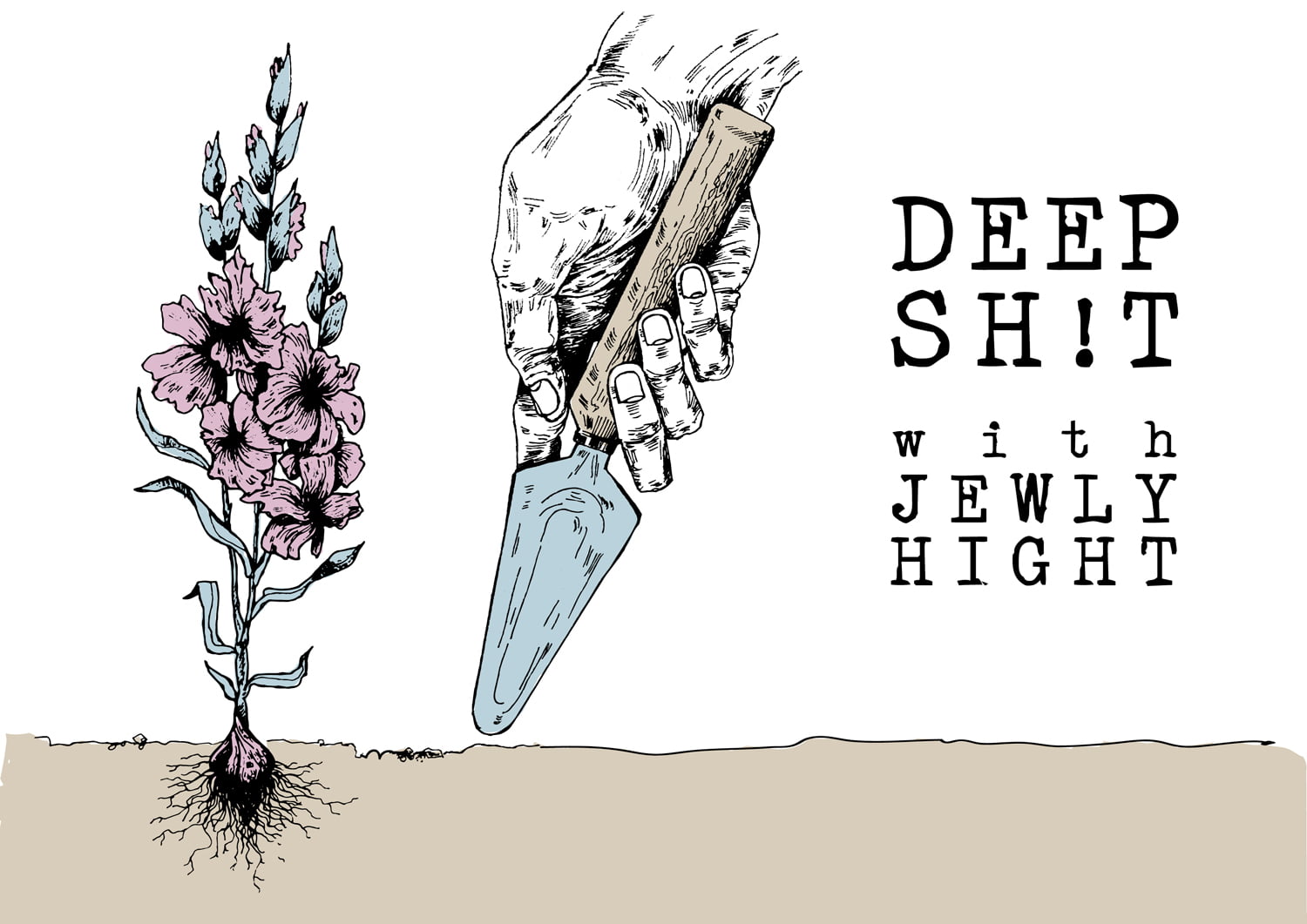
Illustration by Abby McMillen. Carrie Rodriguez photo courtesy of the artist. Paul Burch photo by Emily Beaver.

3X3: The Misty Mountain String Band on Superheroes, Baristas, and a Musical Take on the Seasons

Artist: The Misty Mountain String Band 
Hometown: Louisville, KY
Latest Album: Red Horizon
Rejected Band Names: Paul rejected all names in favor of one too long for the Internet.

Your house is burning down and you can grab only one thing — what would you save? 
Brian: I don’t care, I don’t know, what would I save?  Just put anything. My cargo shorts.
Derek: My Magic the Gathering collection.  Wait, no my D&D collection.
Neal: I’m home so rarely, it would be months before I found the ashes.
Paul: My movie ticket stub collection from high school — 400 tickets to see Lord of the Rings.

If you weren't a musician, what would you be? 
Brian: It’s not a good day for me to answer questions like this.
Derek: Banjo player.
Neal: Professional caddie.
Paul: An artist … by that, I mean a barista.

If a song started playing every time you entered the room, what would you want it to be?
Brian: Stevie Wonder, "Superstition"
Derek: John Cage’s "4’33”"
Neal: "Throne Room" and "End Title", John Williams (Star Wars)
Paul: Metallica, "Master of Puppets"

What is the one thing you can’t survive without on tour? 
Brian: A constant barrage of insults from my band mates.
Derek: A theology book I mostly disagree with.
Neal: Meals every 20 minutes.
Paul: A cold pop: Dr. Pepper.

If you were a car, what car would you be?
Brian: El Camino.
Derek: A ’57.
Neal: Golf Cart.
Paul: Datsun.

Who is your favorite superhero?
Brian: The Silver Surfer. He surfs the universe looking for answers.
Derek: Dr. Manhattan. 
Neal: Robin, he’s the caddie of superheroes. The assistant to the superhero.
Paul: Batman. Because Neal said Robin.

Vinyl or digital?
Brian: Digital. I own four records, but no record player.
Derek: Digital. 
Neal: Digital.
Paul: Wax cylinder.

Dylan or Townes?
Brian: 
Townes.
Derek: Townes.
Neal: Who?
Paul: Townes.

Summer or Winter?
Brian: Donna.
Derek: Edgar.
Neal: Donna.
Paul: Summer.

The Avett Brothers: A Truth That Soars Above the Bickering

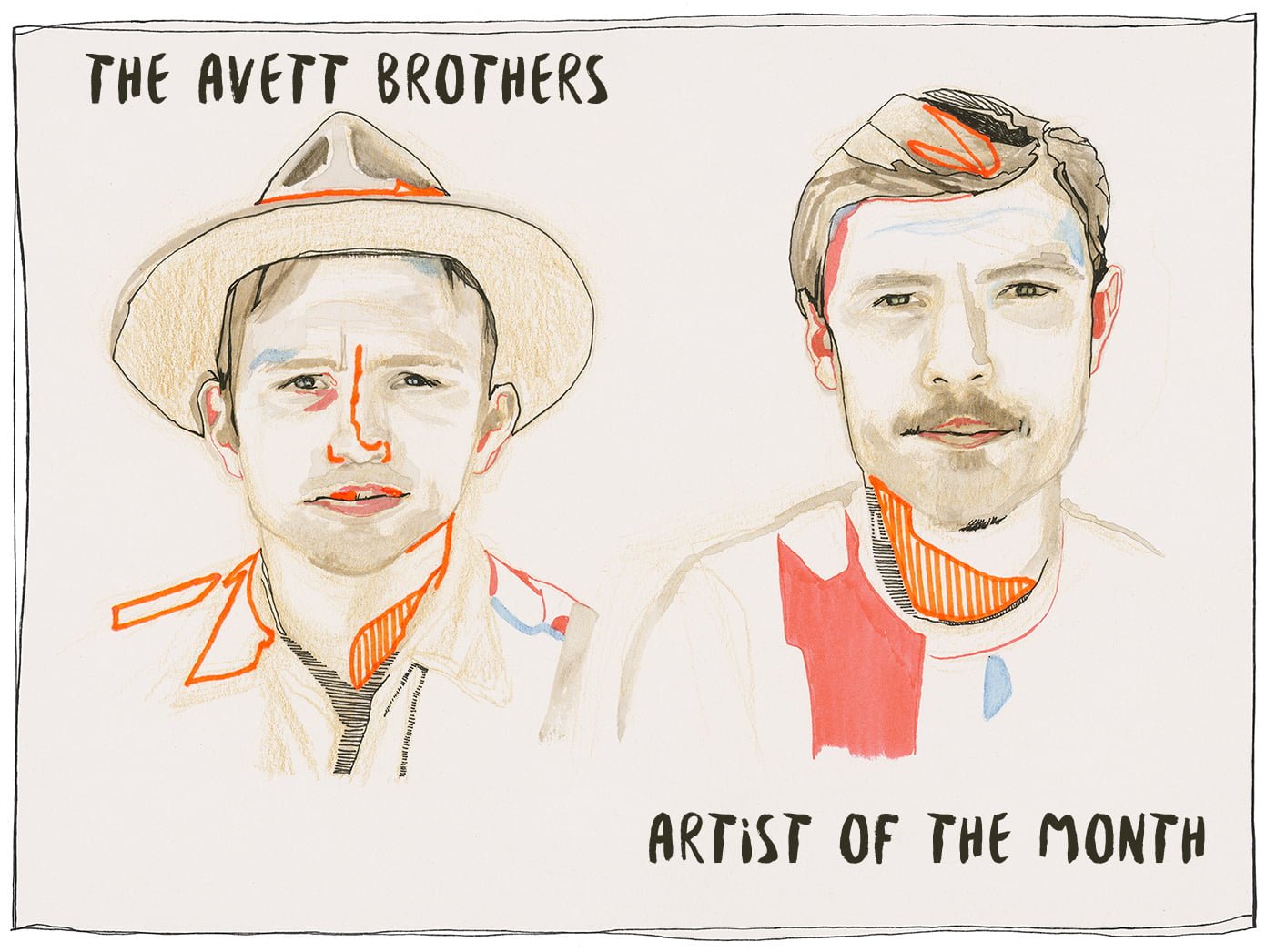
True Sadness is an album about duality. It would have to be, really, for the boys behind the big-smiled, unbridled, foot-stomping joy on-stage at an Avett Brothers show to be naming a record something that sounds like such a drag. From lyrical jabs at the aging process to a well-rounded foray into new instrumentation, the Avett Brothers' effort catapults the listener and its authors into a sort of maturity where sadness isn’t a monumental event, but rather an underlying part of everyday life.

“It’s not necessarily this ongoing bummer,” Seth Avett says. “True sadness isn’t about becoming this dark thing, where you’re just giving up and realizing, ‘You know what? Screw it. Everything sucks.’ It’s more about just sort of accepting, as Bob [Crawford], our bass player, has very eloquently put it many times, that the human heart is fully capable of experiencing great joy and great sadness simultaneously.”

For True Sadness, the band’s fourth consecutive full-length working with producer Rick Rubin, every song began with a bare-bones recording using only the core trio of Seth, Scott Avett, and Crawford. Then, the songs were recorded with the full seven-piece band all live in the same room — a studio setup they hadn’t pursued since 2007’s breakout record, Emotionalism. They didn’t stop there: With Rubin’s assistance, a third step brought the final tracks well outside of their boundaries, instrumentally.

“We worked with another engineer who took the raw tracks and sort of re-imagined them with all these different samples and synths — just all these crazy sounds,” says Seth. Then they re-performed every song with the added depth of the tape sounds and synths, with certain tracks maintaining more of the new territory than others.

“What we ended up with was about four versions of every song,” Seth offers. “’You Are Mine’ ended up being one of those that was in, like, that third stage … third or fourth stage … it’s kind of everything mixed up in one.”

While this experimental, synth-stained streak reveals itself most clearly on tracks like “You Are Mine” and “Satan Pulls the Strings,” the energy behind the songs is unmistakably created by the same band that came up screaming and stomping their way through Southern stages.

“The simple answer here is that we do our best to just follow the song. Whichever way the song is represented best, that’s the way we leave it. We try not to get too caught up in how we’re perceived,” Seth says. “Like, ‘Well, we’re an American Roots band or and Americana band, so every song has to have only acoustic instruments’ and all that. We’ve never really felt any kind of allegiance toward that. [If] one song was kind of an oddball, [it’s because] it felt right like that.”

While the band is tapping into new sounds for True Sadness, they continue to thrive thematically with material that can be continuously re-interpreted by the listener: On standout track “Smithsonian,” the narrator rails through universal truths about aging like they’re breaking news. The song zeroes in on the strange quality of certain lessons or life changes that you have to experience yourself to truly understand, keeping pace with the album’s overall perspective.

“It’s a lot about resolve,” says Seth. “Just coming to a resolution about breaking down, and how that is completely, 100 percent natural — 100 percent normal — and it’s all good. It’s fine!”

A scroll back through the Avetts’ catalog almost feels prescient. Lyrics like the forlorn mention of elections on “Head Full of Doubt, Road Full of Promise” feel almost political today, where they may have once felt coming-of-age. The Avetts’ songs evolve with the listener in a way that’s given them a timeless quality, and True Sadness expands upon that facet of their music admirably.

“The truth remains the truth,” Seth muses. You won’t hear the Avetts proselytizing about current events — despite the ongoing controversy in their home state of North Carolina — but that’s not to say there aren’t takeaways that feel bigger than heartbreak or personal strife. “If you have your heart in the right place and you’re making your comments about humanity from the right place,” he says, “I think that it soars above the bickering within the political landscape.”

Lead single “Ain’t No Man” makes a strong argument to that point:Ain't no man or men that can change the shape my soul is in / There ain't nobody here who can cause me pain or raise my fear.” You can take it as a personal pick-me-up, a nod to religion, or a knowing wink at current events, but you certainly won’t come away from the song feeling weighed down.

“It’s meant to be self-motivating — a little bit of currency to buy yourself a little confidence when you’re not feeling so confident,” he says. “We don’t always wake up in the morning thinking, ‘All right! Now I’m gonna knock it out today. I’m going to be joyful and I’m gonna be confident, but I’m also gonna contribute!’ Some days, you’re stepping into ‘em feeling just like a wounded animal. It just takes everything you’ve got to act civilized, in a way. So I think the song is a little like just giving yourself a motivational speech, and just getting solid and getting centered and kind of squaring your shoulders up, picking your head up, and just getting into it.”

True Sadness was announced to the world in an open letter about the ways that the Avetts’ music has become intertwined with their real lives, pointing from the very beginning to the heightened thematic complexity in each number.

"It does occur to me now, that in some regard, before any professional success, we were perhaps paradoxically more self-aware. The songs would show mere versions of ourselves — the heartbroken introvert, the frantic worker, the forlorn traveler, the philosopher, the romantic, the loner — all somehow imbued with the meaningful sheepishness of a James Dean character. We used to hope and vie for that attention, that perceived personality, that coolness."

If their previous work was about compartmentalizing the parts of themselves that feel, True Sadness abandons the pursuit of cool in favor of a pursuit of the optimistic and honest. “You have to come to a place of resolution within the tragedies that are always happening,” says Seth. “You don’t ever get to a point in your life, regardless of how well things are going, where everything is good — where it’s all good. There’s always going to be a duality, and I think we are all more aware of it than ever.”

Leave it to the Avett Brothers to serve up True Sadness and leave us mostly with real, gritty, imperfect joy.


Lede illustration by Cat Ferraz.

Frankie Lee, ‘High and Dry’

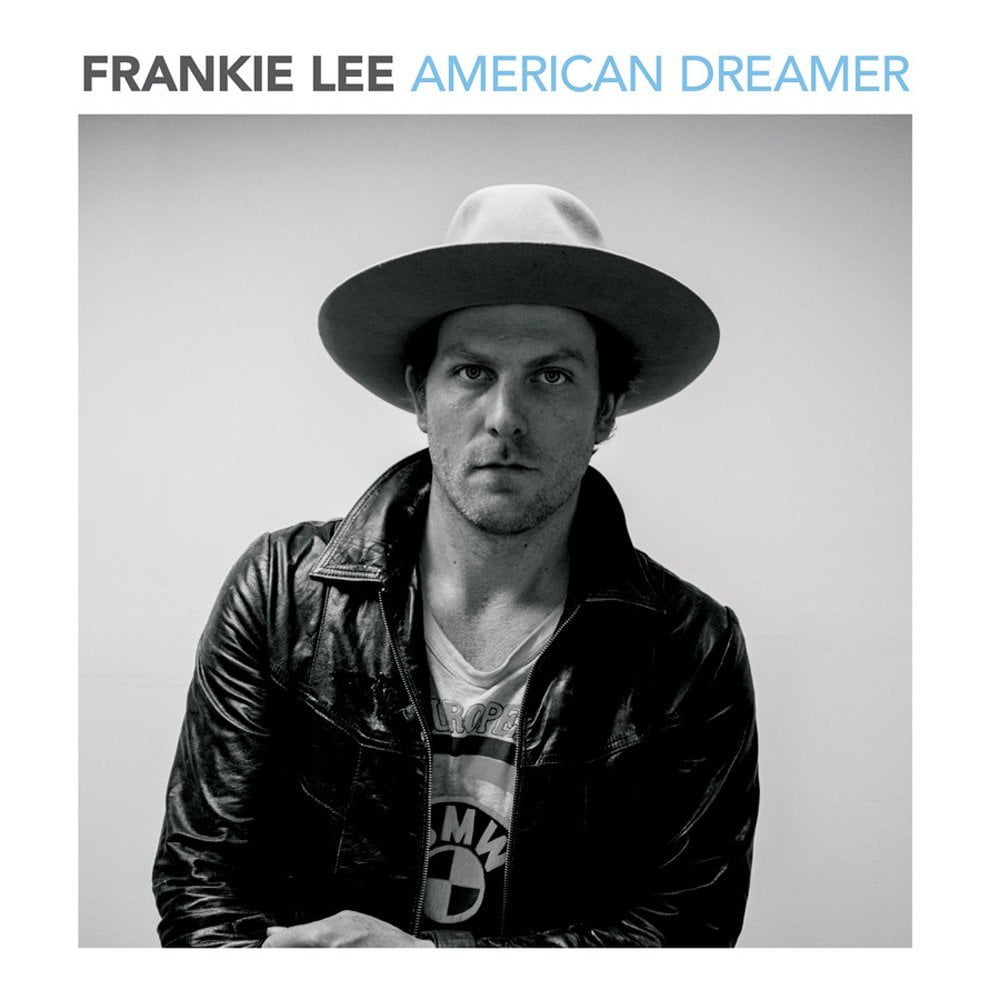
Frankie Lee doesn't care if anyone thinks that his new song, "High and Dry," is about smoking weed — with lyrics like "grow your own," which is presented as more of a proclamation and mantra than anything else, it's easy to make that mistake. But Lee, who hails from the Midwest and knows very well how important it is to be connected to our truest traditions, is actually praising something a little more fundamental than just lighting a joint: and that's the struggle of the American farmer, who often has a harder time surviving in a General Mills world than your neighborhood weed dealer.

With a soft, lightly rasped voice set to warm acoustic strums and tasteful, twangy embellishments touched by a polished sheen, Lee isn’t your everyday interpreter of heartland roots-rock: "High and Dry," like much of his debut LP, American Dreamer, doesn't just fall back on a cascade of guitars and hard denim, shouting his feelings to buck-the-man percussion. Instead, he channels his youth growing up in the small town struggle into songs where atmosphere is just as important as aggression, if not more so — it's a gentler call to arms, which, with his lyrical power and a keen craftsmanship that doesn't always rest on simple Americana tropes, is often far more effective.

"It's the same old story just a different time / there ain't no yours, and there ain't no mine," he sings. "And if you want to live, you got to build a home / And if you want to give, you got to grow your own." It's a lesson from a singer smart enough to know that sometimes you have to stop complaining and start planting. And if you want take a puff of grass before mowing it, well, that's cool, too.

Darrell Scott, ‘Down by the River’

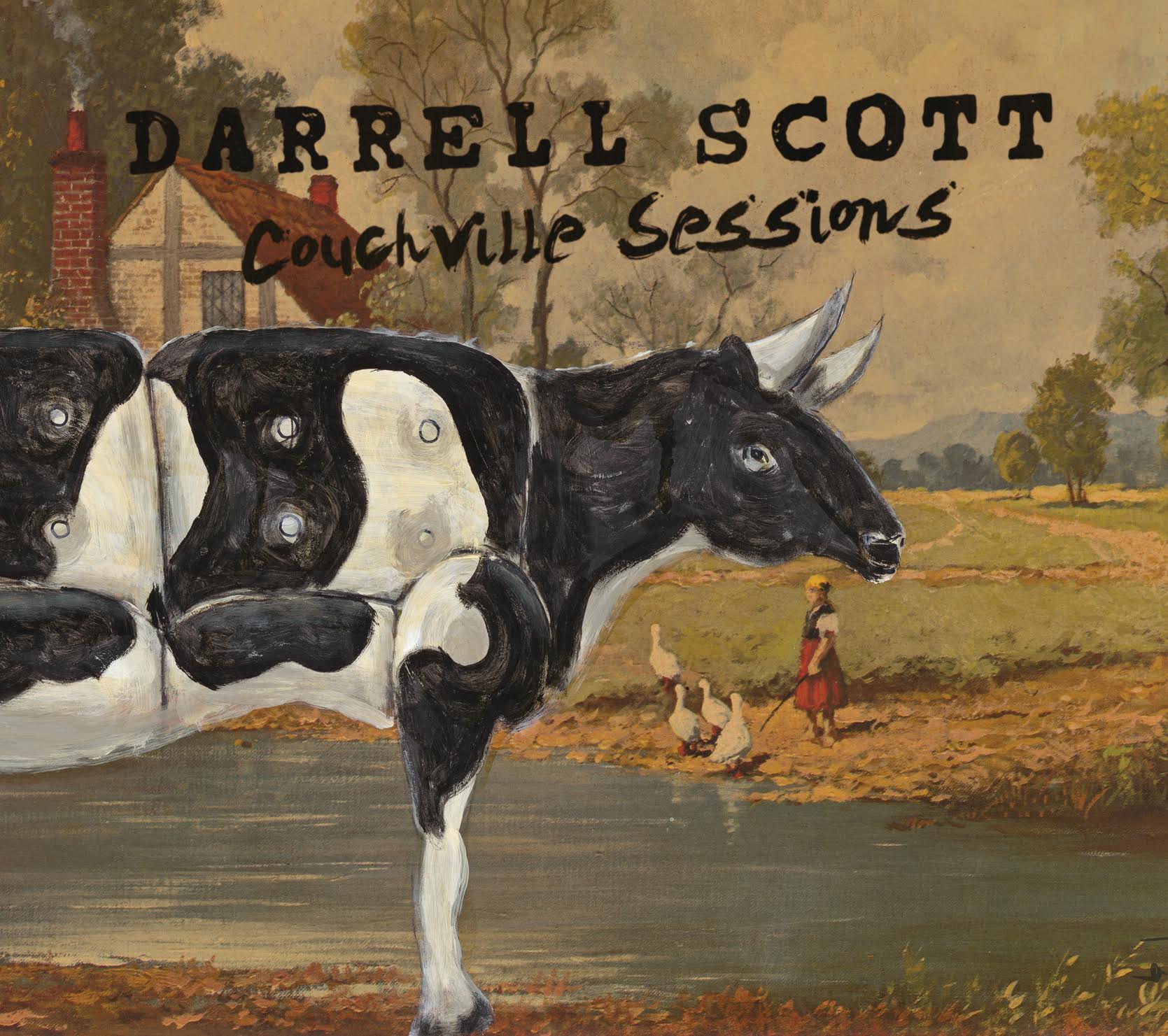
"We won't give a damn, if it's rock, folk, country, or blues," sings Darrell Scott on "Down by the River," a gloriously rollicking tune that's maybe all four of those things. And, really, who cares which? Writing, performing, and recording in Nashville for well over two decades, Scott was Americana before it was a trend and country before it bro'd, managing to exist in that glorious middle ground where he can both flirt with Music Row and give it a hefty, hearty middle finger.

"Down by the River," from his upcoming LP, Couchville Sessions, is mostly the latter. A locomotive folk waltz through the tumultuous journey of trying to keep your integrity in an industry often more concerned with sales figures and clever marketing campaigns than artistic freedom, it boasts a cascade of instrumentals, a howling gospel chorus, and even a little annotation by the one and only Guy Clark … and, if you listen closely enough, a lesson or two on just how to stay haunted by the mysterious, elusive muse in a world where even the simplest slight (or pushy A&R executive) can spook it away for ever.

"I have lived in Nashville for 24 years," says Scott. "I love the musical and cultural diversity here. This is a song about finding and then keeping your unique voice as an artist in an industry town that could attempt to talk you out of it."

… whether it's rock, folk, country, or blues.

On Love and Loss: An Interview with Tami Neilson

The Venn diagram crossing "traditional musicians poised for breakout in 2016" and "based in New Zealand" yields, unsurprisingly, only one name: Tami Neilson. Gifted with a voice that summons Patsy Cline's ghost, hair high enough to make Dolly proud, and a style lifted straight from the Saturday night stage at the Grand Ole Opry, Neilson's most recent records — the just-released-in-Canada Dynamite and New Zealand-only Don't Be Afraid — time machine back to the era of classic country with a few sidesteps into Sun Records-style rock 'n' roll, blues, and soul.

If this all seems unlikely from a nation whose biggest musical exports have been Lorde, Crowded House, and, er, Flight of the Conchords, that's because it is. But Neilson, who has won multiple New Zealand Music Awards, as well as the prestigious APRA Silver Scroll for songwriting (in 2014, the year after Lorde won), has paid her dues on the long, dusty trail.

Born in Canada, Neilson spent most of her tweens and teens touring relentlessly across North America as part of the Neilson Family, an old-fashioned gospel family band featuring her late father Ron, her mother Betty, herself, and two younger brothers — Jay and Todd. Having moved to New Zealand in 2007 for love and marriage, and, eventually two young sons, it's only now that Neilson is making her first steps to plug back in to her past life.

I want to start with an "Origins of Tami Neilson" question. From a young age, you were part of the Neilson Family, a touring family band. Would it be fair to say you had a nomadic youth?

We were just a pack of gypsies, really, the Neilsons. I look back now as a parent, I think, by taking their kids on the road full-time, my parents were either the bravest people I know or the craziest. But we definitely grew up on the road full-time and that was normal to me. Being in the same house with a dog and a white picket fence and the same friends your whole life, that was just so exotic to me.

Did you used to play in prisons with your family?

We did. That was when we were quite young. Mom and dad would bring us in, and Todd, my youngest brother, was probably four or five. I would have been about nine or 10. We would go in and dad would do his comedy, and he and mum would do a talk in the prison, and then we would get up and sing gospel songs as a family. I can remember my mom saying to my little brother, "Todd, when mommy and daddy are on stage, you stay with …" the Salvation Army lady or whoever had brought us in. "You don't go anywhere by yourself." And without fail they'd be onstage singing, and mom would see him get up and go up to a prisoner: "I need to go potty." She'd be mortified. So there were some heart-stopping moments on the prison performances.

Is it true there was a point where you and your brothers had to busk to earn money to survive?

Yep. In Midland, Ontario. On the main street. To make money to eat.

I know the town of Midland. It's not a music-friendly cultural hotbed. I can't see that being a gainful experience.

No, it was not gainful. But it did the trick for what we needed, at the time. At that time, we had just come off the road after a really bad management experience — we had basically lost everything due to our management and went back to my mom's hometown to lick our wounds, as a family. My dad plunged into a deep depression because he held the full weight of responsibility on his shoulders, and we all started looking for jobs. At that time, he didn't want to pick up a guitar; he didn't want to be anywhere near music because he felt that he'd failed us so abysmally. So my brothers and I went out on the main street every day and busked. Fifty bucks was a good day. We'd put it on the kitchen table and give it to mom and we'd get groceries until we could all find jobs.

If that isn't an authentic country music tale of woe, I don't know what is.

That's country. It doesn't get more country than that.

Do you have a band because of an earthquake?

That's actually not too far from the truth. I hadn't thought of it that way, but yes, I definitely have a producer [Delaney Davidson, Dynamite co-producer and part of the duo Delaney Davidson & Marlon Williams]. I was on tour when the earthquake in Christchurch hit. I knew the Eastern, who are a band from Lyttelton, and the venue we were supposed to play at was flattened. It had crumbled and caved in. There were just bits still standing and my poster was still in the window.

A few days later, I called Adam [McGrath] from the Eastern and said, "I'm supposed to be doing a show there" — of course, nobody's going to shows across the entire country because everybody's devastated by this news — and they were doing these pop-up acoustic shows. There was no power at all in the city. They're doing shows in parks around the city to boost the morale and lift the spirits of all the people who were living in mud and crumbled ruins. So I got in touch with him and said, "We're going to be in town, we've got instruments, let us know where you're playing and we'll come play with you." He texted me the details of the park they were going to be playing in, so we rolled up and I'm like, "Are we in the right place?" and then I saw this tall, skinny beautiful man with a white cowboy hat on looking like the ghost of Hank Williams. It was Marlon Williams (who has guitar and vocal credits on Dynamite), and next to him was a very serious, grumpy-looking guy with piercing blue eyes, and that was Delaney Davidson. We went to a barbecue after the show and really connected there. It's one of those things that's really burned on to your memory when it's in the midst of something so surreal.

To do the music you do in the style you do it, it's a very conscious decision. You've got a very traditional image, but it feels very authentic. How do you define the music you make?

The music side of it, it's Americana. It's not just country, it's not just blues, it's not just soul. But so many of those artists weren't. Johnny Cash, Elvis, the Staples … all of these people were just a hotbed of all of those genres.

Speaking of Johnny Cash, did you tour with him?

We opened for him at the Merritt Mountain Music Festival.

Did you get to talk to him or anything?

There's a story to that: The night before the gig, we had had a fire in our motorhome. Our motorhome caught on fire when we were driving to the gig. We had finished a gig in Kelowna, British Columbia, and got in the car to drive to the festival the next morning, so we were going to drive to Merritt that night. After a gig, if we were driving in evening, I would always change into my jammies in the motorhome to be comfy.

So we're on the road and these people are signaling to roll down the window, and we all thought that they had seen the show so we're waving back like this big happy family in the window. Dad rolls down the window and they're like, "You're on fire!" And dad's like, "Thank you, thank you." "No, you are on FIRE!" And we looked out and there was black smoke just billowing out the back of the motorhome. So we all got out and all of our clothes were ruined. Our instruments were stored underneath so there was smoke damage — they stunk, but they were still playable. All I had was my pajamas.

We rolled up to the festival the next morning, they gave us all festival t-shirts, and I opened for Johnny Cash in my pajamas and a t-shirt. So, yeah, my dad and my brother chatted with him, but I was too completely humiliated by the fact I was wearing my pajamas to talk to him. I was a teenager and you're just so concerned about being cool. I was just totally mortified. Of course now you're like, "Who cares?! Go back!" But when you're 18 and you're mortified, nothing matters except the fact I was wearing pajamas.

Is it true Roy Orbison held you as a baby?

Yes, and it actually makes me cry that I don't have the photo of it. That would be the cover of not just one album, but of every album I've ever put out. My dad was playing in the same venue as Roy and dad said, "Can I please get a photo of you with my daughter Tami?" Dad said Roy just lit up holding me. I can still remember the photos in our photo album. I was in this little white dress and this little bonnet. Then I took them to school for show-and-tell when I was a kid and stupidly lost them. I can still see them in my mind but it breaks my heart.

Dynamite has some songs specifically inspired by the birth of your children, whereas your newest album, Don't Be Afraid, revolves around the death of your father. In the last few years, you've experienced a really heavy, really full cycle of life.

It's definitely a lot of living in just a couple years. So I think that impacts so deeply on you as a person that you're never the same, so my music will never be the same. It will always be colored by, not necessarily grief, but the experiences of the death, of parenthood, and all those things. But love and loss are what country music is about, right?

And earthquakes and prisons and motorhome fires?

Oh my God. When you put it that way, I'm going to be writing about it 'til the day I die. I've got so much material. It's always a little bit daunting to think about what's next, especially because the latest album is something that's so deeply me and exposes me and it's the most vulnerable I've ever been. So you can't think about that too much and, when it's the next step, then you just take it. Otherwise, you get sucked up by earthquakes and fires and prisons.


Photo credit: Justyn Denney Strother

This Is What We Love: A Conversation with Lucie Silvas & John Osborne

It felt like a lucky break to catch singer/songwriter Lucie Silvas and her husband, Brothers Osborne’s John Osborne, while they were in the same room. After all, 2015 saw the independent release of Silvas’s first full-length since 2007, Letters to Ghosts, and all of the promotion whirlwind and touring that came with it. Meanwhile, Osborne had been touring, recording, and working toward the January release of Pawn Shop, Brothers Osborne’s debut full-length, while watching their single “Stay a Little Longer” climb the country charts. (The duo even nabbed a Grammy nomination for “Stay a Little Longer.”)

Even with their individual pursuits and shared influences, it's clear just how intertwined the couple's successes have become. It was difficult for either musician to get a word in edgewise as they poured praise upon one another, remembering the way their relationship began and running over the influences, creative environments and shared passions that allowed the last 12 months to be some of their most eventful.

Since I’ve got you both, let’s start with the way you first wrote together and got to know each other. I know you met when Lucie was first in Nashville in 2007. Can you tell me a little bit about that?

Lucie Silvas: Well, you know the first time we wrote together I think we were both — well, I’ll speak for myself — I was nervous. I was in a new place, and I was excited. I was trying to impress in lots of ways and just keep my cool. We just had fun collaborating. We did it a lot over the years; sometimes it was something we’d be put into, like a co-write with a third person. But sometimes we’d just sit there in the house. We’ve written a couple of songs I’m really proud of, over the years, and it always seemed easy. I don’t think all couples find it that easy to write together, but we seem to.

John Osborne: I wasn’t there to write a song as much as I was there to meet Lucie and somehow not make a complete ass out of myself. I kind of can’t even remember what the song was about …

LS: I can’t remember the song.

JO: It wasn’t even about the song. I had ulterior motives. [Laughs] But, since then, we’ve always had an amazing working relationship. There’s such a mutual admiration there. Lucie’s such a powerful singer and songwriter. I come from more of a musical, instrumental side of things. It’s great — her strengths support where my strengths are, and they don’t necessarily overlap. They really complement each other very well.

Letters to Ghosts is definitely a great example of that, what with John working on the record as a producer.

JO: Lucie needed to put out music. Anyone that’s as gifted as she is, at singing and conveying a song, needs to be heard. It would be criminal for her not to be heard, for anyone at her level to be silent. I kind of got the ball rolling: “Let’s just do this. We’ll worry about the rest later.”

We just did it piece by piece. We didn’t over-think it. As a producer, it’s really difficult if the artist isn’t great. It’s almost impossible if the artist isn’t good. But, with Lucie, she’s so amazing as a vocalist and as a conveyer and as a songwriter that it makes your job kind of easy. You let the songs steer you in the right direction. You let the singer steer you in the right direction. All I was hoping for was to not screw it up. It was so much fun because her music is quite different than the music that I play with Brothers Osborne. It was a lot of experimentation and a lot of work. We did it over the course of months, so we were able to really experiment with sounds and get some cool stuff and re-record a lot of things.

LS: John has always been really encouraging to me, just as a friend — let alone somebody who I was with in a couple. The creative process can’t be anything but exciting and inspiring when you’ve got someone with such enormous musical ability and such a laid-back nature. It makes it very easy to be fun. We also had no constraints on it. We were just sitting there having a blast in the studio. It’s nice to know we’re there for the right reasons and we’re having fun with it. John was doing all of this around a crazy schedule. He’d come home and he’d have no time to himself whatsoever, but he loves music so much that it just is a joy to him.

Every time I’d get frustrated and say, “How are we going to do this? How are we going to pay for this?” He’d be like, “Let’s just get resourceful — let’s just get our heads down and get our heads in the right place.”

JO: Sometimes not having a huge budget forces you to be creative. It doesn’t let you be lazy. It doesn’t let you rely on money. That, a lot of times, leads to really cool, new fresh things. It certainly did with this record.

Lucie, you’ve talked a lot about your interest in learning the mandolin and how that came through on Letters to Ghosts. John, you’ve got a lengthy guitar solo in “Stay a Little Longer,” and your reputation precedes you as a player in Nashville. Tell me a little bit about how instrumentals can change a song.

JO: I love playing long-winded solos. It’s fun for me. It’s exciting. But, at the end of the day, you have to service the song — that’s the most important thing. You have the melody and you have the lyric. And then you have the person that is singing them. That’s the most important part. Everything around them needs to complement that. I believe the long solo on “Stay a Little Longer” works; it has this kind of emotional thing. It’s this drawn-out moment between a man and a woman — or, like in our video, a man and a man — that seems to last forever. You’re not sure if you’re in love or out of love or what’s happening. It works within the context of that song.

LS: It really does.

JO: I f you listen to the rest of the songs on our record, there aren’t a lot of solos like that. On “Pawn Shop,” specifically, there’s kind of a hooky, licky part … I don’t think guitar solos should be gratuitous. They should support the song. A session guitar player told me, when I moved to Nashville, that the end goal is to be able to mute the lyrics and mute the vocal of the song and still kind of know what the song is about.

LS: That’s a really interesting question, though. It’s got my brain ticking. In “Stay a Little Longer” [the guitar solo] is the climax — it’s where the song is ending up. The frustration in the lyrics, the temptation that the song is talking about: you hear that. It goes and it goes and it goes, until you reach this sort of euphoric, heavenly moment with the guitar solo. That’s how love is; you get yourself into that headspace and you just acclimate from there. I think a lot of the songs on Pawn Shop do that. You get the feeling that the guitar is the song. John’s very good at, stylistically, adding what he does to make the song supported even more.

I think back to a lot of the Motown songs that I love — some of the Marvin Gaye stuff or Otis Redding or Stevie Wonder. Some of those musical riffs are the songs. They are the most identifiable moments in a song, regardless of the lyrics or even the voice, which is always phenomenal. They created the sound of the song, and that musical part of the song is also really important.

Brothers Osborne has a bluesy, rock edge that you don’t see in as many mainstream country songs. Lucie, your music has been embraced by some country stations, despite it not necessarily being bound to a particular genre. What do you think about the state of country and Americana music right now? Are the boundaries changing?

JO: It’s a really interesting time for music, in general. People don’t necessarily subscribe to one genre anymore. The iPod generation started that with the ability to shuffle the songs and make a playlist. The line immediately got deleted. On the one hand, it’s a slippery slope because it can muddy the waters of what makes a genre distinct. On the other hand, it has led to a lot of opportunity for artists that might be in the grey area like Brothers Osborne and Lucie.

It’s actually a really good time for music — especially country music — because people seem to be a lot more open-minded and willing to hear new sounds and new styles and new songs and new singers. They’re hungry for something fresh and original and genuine. Country music goes in and out of being genuine, but when it is genuine, it’s the most genuine genre of music, I think, that there is.

LS: And it’s exciting, because country music is on a world stage like it’s, possibly, dare I say it, not been in the same way before. It’s not kept separate like it might have been in the past. There’s room for good music and not necessarily these very tightly wound compartments or genres that can’t be broken. Music isn’t supposed to be about that. Music is supposed to be about feelings and emotions, making you feel something. I don’t care what genre something is; I just want to hear something good that touches me. I feel like things are becoming that way, and that’s extremely exciting to me.

Definitely. John, I’ve seen you say in interviews that Brothers Osborne was able to release Pawn Shop at the perfect time, and that makes sense, especially with what you guys are saying now. Let’s talk about that record.

LS: Oh my God, there’s so much. I’ve seen it take shape over a long period of time. They’ve been on this crazy, crazy ride, just traveling all the time and writing every chance they get and making this album. Like every album, it’s a challenge because you try not to feel … it’s not pressure from the outside. We put ourselves under so much pressure. It’s not that it’s not fun, because we have an absolute blast, but we just … it’s an amazing thing to be making an album, and we just want it to be great.

I got to sing on some of the album, which was a brilliant moment for me, just because I genuinely love the songs. John is very spontaneous when he does things, but he also takes a lot of care. He really does not do anything by half — he will sit there and do it until it’s a thousand percent finished. Somehow doing it like that, being very patient and methodical, has not gotten in the way of the passion you hear in his playing and on the album and in TJ’s singing and the whole thing. It’s very inspiring for me to watch and to witness them doing what is, I think, an exceptional album. It’s very exciting.

Okay, you go, John. [Laughs] We’re actually eating garlic bread, and we just reached for the same bit.

JO: We’re so in sync! [Laughs]

LS: John, did you want to add to that?

JO: I mean, our album definitely comes from a place of honesty and originality, the same place that Lucie’s album comes from. We never had a conversation about what was working on the radio. We never had a conversation about what songs were successful. We never had a conversation about what the masses would like. All we did was make music that we like. And it’s the same for Letters to Ghosts; it’s the same for Pawn Shop. When you listen to those records, even back-to-back, you’re going to hear a collection of songs and sounds that are unique to us. There’s no reason why any artist should put out something that’s already been done. As a listener, I wouldn’t want that. I want to listen to Thriller because I can only get those sounds on Thriller from Michael Jackson. I want to listen to a Willie Nelson record because I only get songs and sounds like that from Willie Nelson. A lot of artists, lately, copy what’s successful. You’re not going to find anything like that on Pawn Shop or Letters to Ghosts.

LS: You have your influences. There’s gonna be stuff you’re inspired by, and you can hear that in the music. Brothers Osborne, even though they’re signed to a major label, they have this thing where they’re thinking, “This is scary, because we might not fit in anywhere.” And we think that’s a good thing. But, in music — in the music industry — that can be a real challenge for artists. Because, if you don’t fit in, the chances are that you might not be put in any category.

Luckily, we’d rather do nothing or do something else than ruin the integrity of what we’re doing. It’s pretty much, “This is what we love, and we can’t compromise that.” We’ve both taken a long time to get to this point in our lives, and there’s a reason behind that. There’s a reason behind not releasing music just for the sake of being out there. We waited and we worked hard because it meant something to do something that was completely genuine, and didn’t worry about what was going to happen to it.

You talk about influences — tell me about those. Do you share a lot of the same heroes and influences, musically?

LS: We love something when we know it’s genuine. For me, growing up, that was Motown. It was Jackie Wilson and the Jackson 5 and, in some cases, the Eagles and Fleetwood Mac. As I got a bit older and was a teenager, it was all about Prince and Sheryl Crow. It was always these really strong characters. Whether it was their music or their personalities, some sort of power came from them and it was very inspiring. When I met John and saw him play, you could see there was a bond there over soul and blues. At times when we weren’t actually making music, we’d sit in the house and he’d play and I’d sing. We definitely had a connection there, in the type of music we gravitated toward. It’s just a coincidence that we had feelings for each other and we also had so much in common musically.

JO: The first time I heard Lucie sing, I heard so much soul and passion behind it. That’s one of the things that I deem most important, when it comes to singing and performing and playing instruments, is soul — that’s where it all came from. If you listen to rock music and soul music and R&B, it’s all stemmed from the blues. I feel like, in some cases, that the soul and the passion is missing; people are just singing or performing.

There are a lot of great singers out there, but that doesn’t make them great artists. I grew up playing a lot of blues music — I loved B.B. King and Albert King and Stevie Ray Vaughn and bands like the Allman Brothers, with Duane Allman and Dickie Betts. That just all are 100 percent heart in their playing. So that’s what I’m used to hearing, and the second Lucie opened her mouth and started singing I knew — I was like, “Yes, that’s exactly what singing should sound like. That’s what music should sound like.” Music should come entirely from the heart — only access the brain when needed. But it should start from the heart. That’s what my favorite music is like and that’s what Lucie’s favorite music is like.


I love this woman more than blueberry pancakes. @luciesilvas (photo: @tjosborne)

A photo posted by John Osborne (@jinglejohnosborne) on

What about the reverse? Is there a song that one of you really likes and the other really hates? What do you disagree on,musically?

LS: Um, I’m trying to think … We usually agree on many things, but we also have a lot of … we’ll tend to think the same thing about the song, and there’s a reason why we don’t like it. I’m trying to …

JO: We disagree on 1990s alternative rock music.

LS: Oh my God. Yes.

JO: When I was in middle school and high school, all I listened to was grunge and Seattle rock stuff — all the popular stuff, but like Nirvana, Pearl Jam, Sound Garden, Stone Temple Pilots. The list goes on and on. I love that music — still, to this day, I absolutely love that music. Scott Weiland dying was a big heartbreaker for me, because I was such a big fan of STP. That’s the only thing we disagree on.

LS: Hey, I love Nirvana, and there are a few things I really love about Stone Temple Pilots. But it is a general genre that I think missed me. [Laughs]

JO: At that time, we were listening to such different things.

LS: Yeah. I think I went through my Prince phase at that time. I’m also older than John. So I guess there were certain things I was listening to in school … I was really into Prince, really into Michael Jackson, really into Motown still. And I definitely got on the Nirvana thing. If John and my sister had met at that time, they would have been best friends, because she had the exact same taste in music.

But, you know what? Even if we disagree on that, I think it’s good. You can’t agree on everything, or there’s no challenge there. When we disagree on something and I hear him speak about stuff that he either passionately loves or passionately hates, it gives me more insight into how his brain works. That’s pretty cool. Then we’ll just agree to disagree [Laughs] Or, I’ll go away thinking I’m right.

Is there anything you feel like you’ve learned recently?

JO: Every time you’re in the studio, you learn something. You learn something about yourself. You should always be evolving, you should always be willing to try new things. If you’re a creative person, that’s what you do best, is to search and to create and find something new that hasn’t been done before. I guess that’s art in general — it doesn’t matter if you’re a painter or a guitar player, that’s what you’re trying to do. In the studio, you’ve gotta have an open mind. You have a blank canvas, and you have yourself and the people around you that are helping you play. You have a vocalist and you have musicians and you have the engineer and all that stuff and, as a team, you work together to create a piece of art. You have to be willing to be open-minded about it. There’s no reason to surround yourself with yes-people. You want to surround yourself with people who challenge you and bring up ideas that you’d never thought of. When you put all those things together, you create something original … hopefully. Every time I’m in the studio, I learn something. I learn a lot about myself. I learn about my strengths; I learn about my weaknesses. It’s a very eye-opening experience, I think. By the end of the record, it’s emotionally draining. I think it should be. The process is always … it should be that way. By the end of it, you’ve learned a lot. Almost too much, sometimes, but it’s always a good thing.

LS: Yeah, it is. I think that’s a good point: Every time you do anything, or even start a day in your life, you’ve got to hope that you can start at a very neutral place — start from zero. You never know how you’re going to surprise yourself. There have been many times where maybe I’ve had a bad day and I’ve gone into the studio thinking that, really, all the songs in the world must have been written already. [Laughs] I mean, there are only so many notes on the piano, so many notes in the world. And yet, you go in and you just think, "Well, I know the things I can do, but I’ve got no idea how many more things I can or can’t do. I’m just going to see."

Hopefully, you’re in a room with a person who helps to teach you that, to teach you something. John and I are both people’s people. We love meeting people, we love being around people. Because, you know, it’s always a fascinating experience — everyone’s got a point of view. Everyone’s got something to give and something you can learn from them. I absolutely believe that all people have to be equal in any collaborative situation or any musical situation. You go in and you respect the people around you, because you just never know what they’re going to teach you. You have to all be open-minded. If one person isn’t like that, it changes the course of the day. It changes everything about what you’re doing. You really can’t learn anything, if you’ve already decided something.