Technology and Tradition Combine on Sierra Hull’s Signature Gibson Mandolins

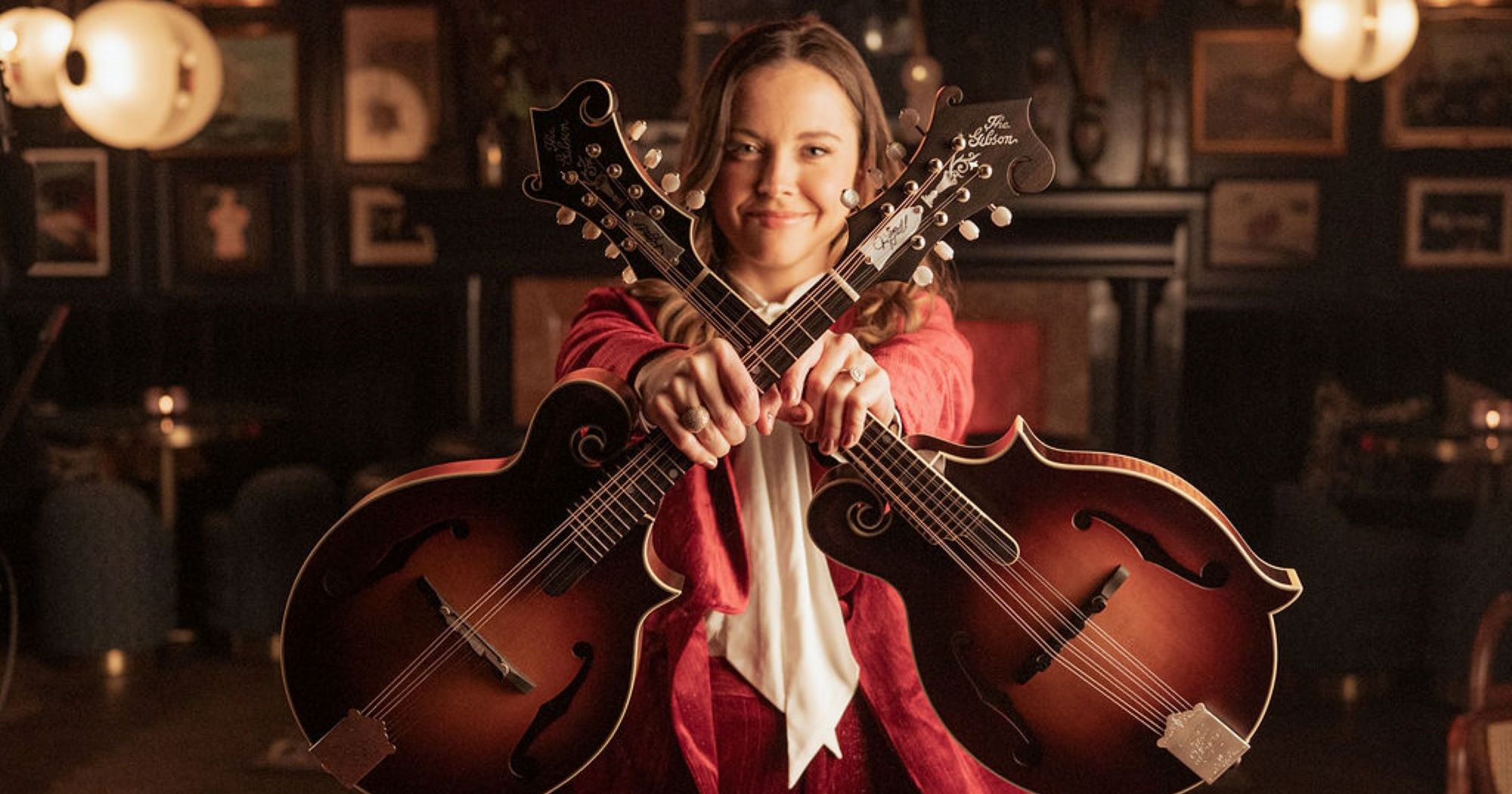
Eyes on the future, heart in the past – it’s the cornerstone of how award-winning mandolin player, guitarist, singer, and songwriter Sierra Hull crafts her music, and how Gibson Master Luthier David Harvey and the Gibson Custom Shop crafted her new signature mandolins: the F-5 Master Model and F-5G.

The F-5 Master Model boasts a red spruce top, eastern curly maple back and custom narrow neck, and ebony fretboard, while the F-5G offers a red maple neck and body, Sitka spruce top, and ebony fretboard. Both models feature the Sierra Burst VOS Varnish finish and come with certificates of authenticity, Sierra Hull/Gibson BlueChip pick, and mandolin cases – vintage replica for the Master Model and hardshell case for the F-5G.

The instruments are the result of Hull’s many years of dedication, hard work, and talent, alongside a working relationship with Gibson that began when she was 12 years old and already a four-year veteran on her instrument. Growing up in Byrdstown, Tennessee, with few if any resources for musicians, the slightest instrument repairs required a two-hour drive to Nashville, where, at the time, Gibson had a shop in the Opry Mills Mall.

Hull had graduated from her first F-style mandolin, “a starter-model Epiphone that was so cool because it said ‘Gibson’ on the truss rod cover,” she says, to a flatiron mandolin she bought used from a local player and still has in her collection. In need of new frets, and in Nashville with family, they went to the mall in hopes of a walk-in or referral. Hull had recently played the Opry with Alison Krauss and upon entering the Gibson Showcase shop, Grascals mandolin player and Gibson staffer Danny Roberts recognized her and put a new, limited edition Adam Steffey signature model in her hands.

“My dad remembers them saying, ‘How would you like to have one of these?’ He’s thinking, ‘Yeah, buddy, I bet she would, but we ain’t got that kind of money to spend on a mandolin,’” Hull recalls. “They gave me that mandolin and it was such an unbelievable moment, as a 12-year-old, to be given this incredible instrument. That was the beginning of my relationship with Gibson. I’ve mostly played a Gibson mandolin ever since.”

Fast-forward to 2009 and Sierra Hull’s main instrument: her Gibson Master Model, built by Gibson Master Luthier David Harvey. “The 2009 was brand new at the time,” she says. “Dave made some modifications to it to suit what I was looking for and it has become my voice.”

That mandolin eventually became the springboard for her signature Master Model and F-5G, in line with her original specifications for the 2009. “I have small hands, so Dave took the neck down a little bit for me,” she says. “We put an aged varnish on it instead of the normal gloss, which makes it a little more unique than one right off the line.

“I’ve always preferred that thin, matte varnish type finish, so we decided to recreate that with the signature line. So many people often ask me about my mandolin; they think I’m playing a Lloyd Loar most of the time. I’ve put a lot of miles on this mandolin since 2009. I’ve played it as my primary instrument since then. When I got it, it didn’t look anything like it does now in terms of being so worn, but it didn’t look brand new and shiny, either. I always loved that about it, that there was a certain aged vibe to it already because of the finish.”

In addition to the aesthetics, the Master Model parallels Hull’s unique sense of blending her deep bluegrass roots with contemporary sounds. It is, she says, the perfect instrument for that mix of past and present. “When I think about the kind of music I play, both these days and throughout my career, I’m so rooted in traditional bluegrass,” she says. “I grew up going to bluegrass jams on the weekends, sitting in a circle – you need a mandolin with volume, something you can dig into, like the Master Model.”

“Part of the reason we all want to play F-5 mandolins is because Bill Monroe, the Father of Bluegrass, played an F-5,” she continues. “I love an A-style mandolin as well, but there’s something that makes you feel legit about playing bluegrass on an F-5 mandolin, because it just feels right – the feel, the look, the sound, the pointedness that those F-style mandolins have. The idea of having a mandolin that you can really channel that traditional thing that as mandolin players we’re born to love in bluegrass music – Gibson is the gold standard for what we think of in terms of every F-style mandolin that you see.

“There’s a lot of great builders out there, so many talented luthiers building beautiful mandolins, so it’s no slight to any of them. But nobody would be doing that if Gibson didn’t exist and build these F-5 mandolins with Lloyd Loar’s stamp of approval on them. When I pick up my Master Model, it feels like the connection to that legacy.

“Even though I tend to think my sound is more progressive and modern – way more so than what you think of when you think of Bill Monroe – that’s the world I come from, so I want a mandolin that feels connected to those roots. But the clarity, the top end, the sparkle that these mandolins have, too – they have a large span on what they can bring to the table. No matter what musical direction I go in, I never find myself lacking from the side of what the instrument can do. It really shows up in all those situations.”

Bringing the Sierra Hull Master Model and F-5G from concept to showroom was a two-year process. Hull, David Harvey, and Gibson worked closely, taking time and care to not rush the work, but instead building the mandolins to her exact specifications.

“As a youngster I couldn’t have dreamed of having my own signature line with Gibson, so it was wild to get the call,” she says. “I’ve learned so much in this process over the past couple of years. Getting to go up-close, help pick out the wood, and see it go from a chunk of wood to mandolins that have my name on them is such an experience. To see it all come to life is a full-circle moment that takes me back to sitting in the Gibson Showcase at 12 years old and playing one of my heroes’ signature lines. To see these mandolins with my name on them is overwhelming. It’s such an honor.”

Mat Koehler, Vice President of Product at Gibson, joined the company almost ten years ago. He says bringing the vision of Sierra Hull signature mandolins to fruition was, in fact, over a decade in the making, beginning with conversations and leading up to the present.

“Even ten years ago, Sierra was one of the best, if not the best, mandolin players in the world,” he says. “When I got here, I was like, ‘Why don’t we have a Sierra signature model?’ The answer, of course, is very complicated. I think everybody’s intention was to make that happen, but we had a restructuring of the company, change of leadership, change of management, a lot of things, a lot of obstacles. So this is really the culmination of a long time spent both ideating what a Sierra signature model would be and then executing it, finally. I am very happy and proud to be involved in some small way. But this is all Sierra and speaks to her incredible talents.

“Her impact [on the instrument] has been huge,” says Koehler. “She represents the next generation of players. She really refreshed the mandolin and offered a completely fresh take. Mandolins are a little bit similar to banjos in that with bluegrass music in the mainstream, if it’s not Mumford & Sons or Nickel Creek, it’s almost ‘out of sight, out of mind.’ Sierra has done an amazing job of taking mandolins into the mainstream in both her music and her collaborations with other amazing musicians. I see a recharging of the bluegrass world right now and Sierra is one of the many leading the charge.”

At the intersection of tradition meets technology, precise replication of Hull’s Master Model in order to build her signature mandolins was done by 3D scanning of the 2009 Master Model, a process Hull describes as “kind of like an ultrasound of your instrument. They run it over the whole instrument, you see it on the screen, and they capture all the specs in a detailed way.

“It gave us a good, strong starting point to mimic the Master Model that I love so much. From there, I got to pick out the wood and watch the process in real time. Essentially they made a replica of my mandolin that Dave Harvey, for fun, distressed to look like my mandolin, and they nailed it on the first try. We used those scans to build the signature line.”

True to her preferences, she selected a thin matte varnish finish on the models, a custom look that Gibson titled “Sierra Burst.” She also opted for the traditional Loar nut width and flat, scalloped fingerboards. “It’s much like I feel my career tries to do – lean into traditional while having some progressive new things as well,” she says.

“We did a custom tailpiece design. I didn’t want a lot of flair on the instrument. I didn’t want crazy inlays or my name spread across the fretboard. But I’m so honored to be the first woman to do a signature mandolin line with Gibson, so part of me did want a little touch of feminine something on there. If you look closely, there’s a little heart dotting the i on my signature on the truss rod. On the tailpiece, the traditional script says ‘The Gibson,’ but where the tailpiece has a curve up top, you’ll see a little heart built into the design, and a little bit of a heart at the bottom and my initials.”

“Sierra has played dozens of original Lloyd Loar 1923 F-5s, so we couldn’t cut any corners with her,” says Koehler. “We wanted to make sure her instrument was on par with any of the amazing mandolins she has played, because she would know right away what looks right, feels right, and sounds right. There are lots of different ways you can spec mandolins, but hers is true to the 2009, which would have been, at the time, a core Master Model F-5.

“That mandolin is her number one instrument to this day, so obviously we had the recipe. … Sierra’s took the very same path as our historic reissue 1923 F-5, which was we scanned her mandolin, we detailed it down to every tiny little nick and ding on it, just so we had a record of the current state of that mandolin, how it looked. The feel of the neck is really unique on hers because it was handmade by Dave Harvey at Custom.

“[3D] scanning has been a complete game-changer for us. Not only has it opened the door to be able to recreate instruments more accurately, it’s rekindled relationships with artists. Customers and fans of Gibson who want the most accurate now can finally have it, knowing it’s mapped identically from the original instrument. … Now, in a matter of maybe twenty minutes, you can do an entire mandolin, just waving a wand over it. That wand is capturing thousands and thousands of points…”

When the mandolins were ready, Hull – still a bit incredulous about having her own signature line – made a special trip to the Gibson shop to test each Master Model. “I guess it’s rare for someone to ask to do that, but I was like, ‘Can I come in and play all these?’” she says. “So we just made a fun day of it. The consistency of the sound, the build, and the playability is all at an insanely high level. All this stuff is done by hand and it’s no small feat to accomplish that. Dave sets them all up. He is the only one to set up my Master Model since 2009, so he knows what I want. Not that I expected anything less, but it was comforting and confirming that this is something I could be proud of.”

“We were overjoyed that she wanted to do it,” says Koehler. “That’s going over and above. She wanted to support this every way she could and obviously she was really excited about it, which makes us really excited. … For her to go the extra mile with us – we were very appreciative. … The fact that the endorsing artist would go to that length of playing it to test it out is amazing.”

It’s been a long, remarkable journey from Opry Mills Mall to seven-time IBMA Mandolin Player of the Year and two GRAMMY nominations, but Sierra Hull hasn’t forgotten the early days. Cognizant that signature edition mandolins are beyond the financial grasp of most players, her next collaboration with Gibson is an Epiphone model, bringing her back to her first instrument.

“I want this to be something that doesn’t price everybody out,” she says. “We’re going to work on an Epiphone model that will be a little bit more affordable for young players and people who are just starting on mandolin, the same way I was when I was a kid. It’s important to me not to have those people feel forgotten. I’m excited to work on it with Gibson as the next part of this story.”


Photo Credit: Courtesy of Gibson Custom Shop.
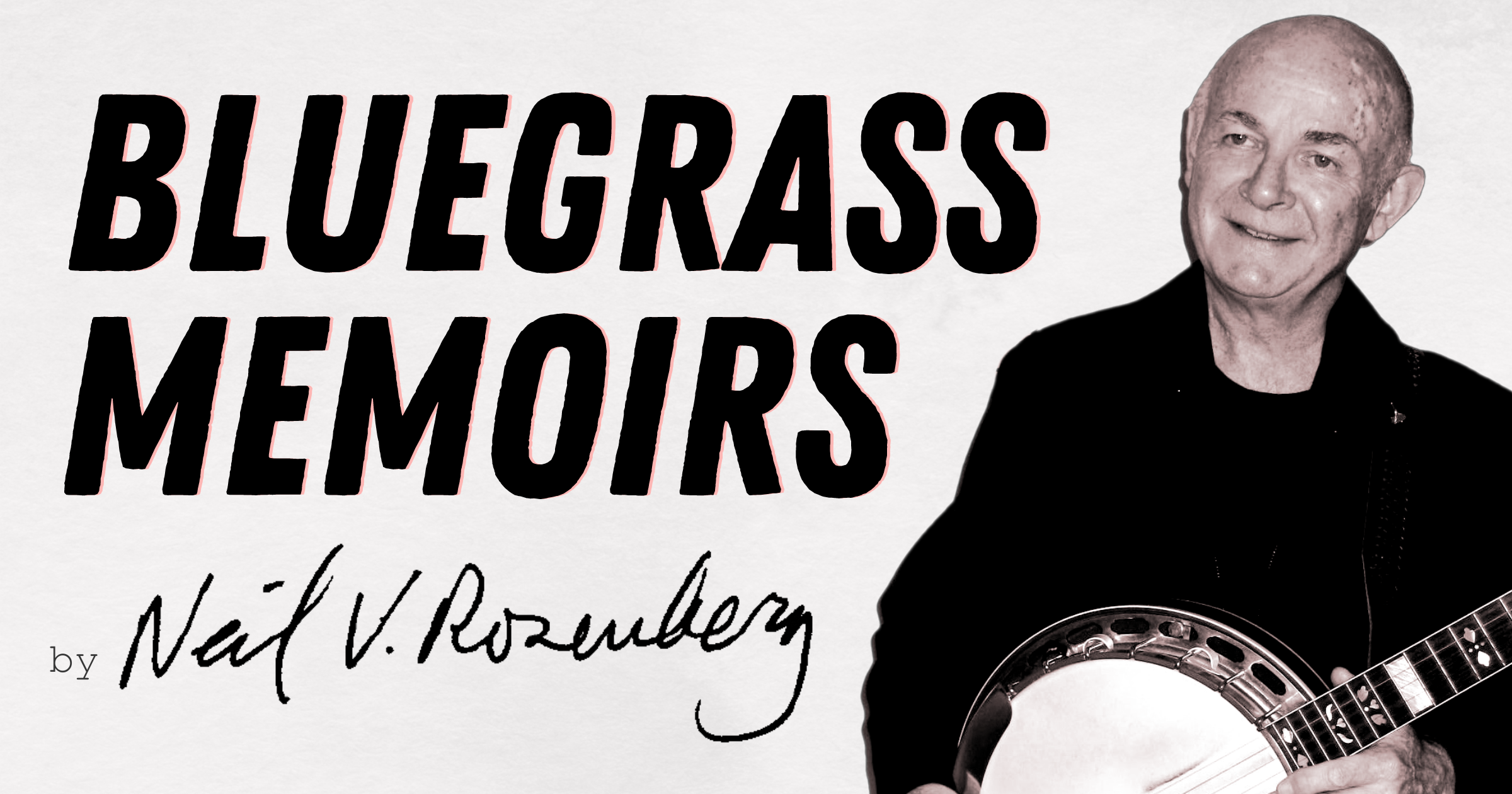
Bluegrass Memoirs: ‘Industrial Strength Bluegrass’ and the Dayton Bluegrass Reunion (Part 4)

(Editor’s Note: Read part one of our series on the Dayton Bluegrass Reunion hereRead part two here. Read part three here.)

My series of memoirs on the Dayton Bluegrass Reunion closes with a gallery of snapshots taken during the day’s proceedings. I had a new Japanese automatic camera of the type then described as “point and shoot,” an Olympus Quick Shooter Zoom. 

I returned home with a 25-shot 35mm film roll and immediately sent it to a budget speed processing outfit in Seattle. The prints returned (along with a new roll of film and a mailer) a few weeks later. 

Unlike today, when you can monitor photos on your digital camera after every snap, in 1989 you had to wait for the prints to arrive to see what came out and what didn’t. Here’s what came out. 

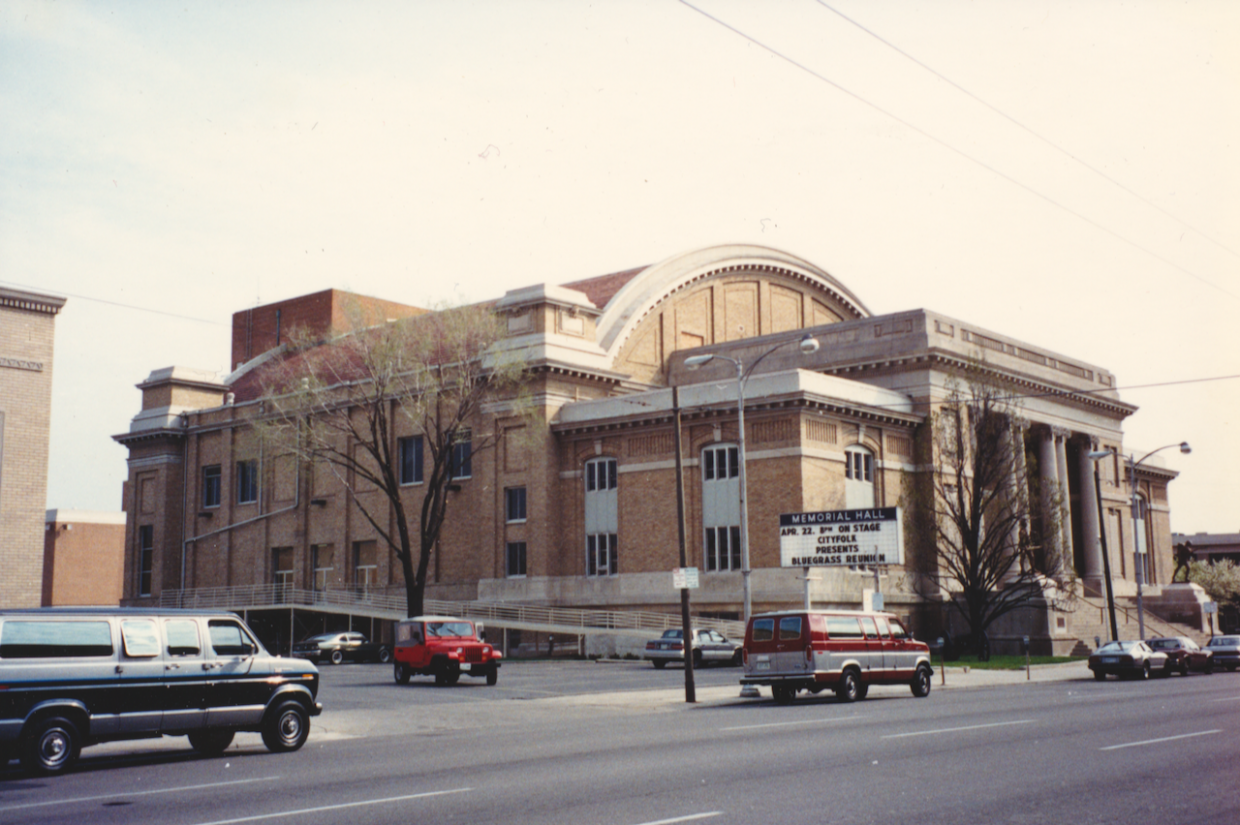
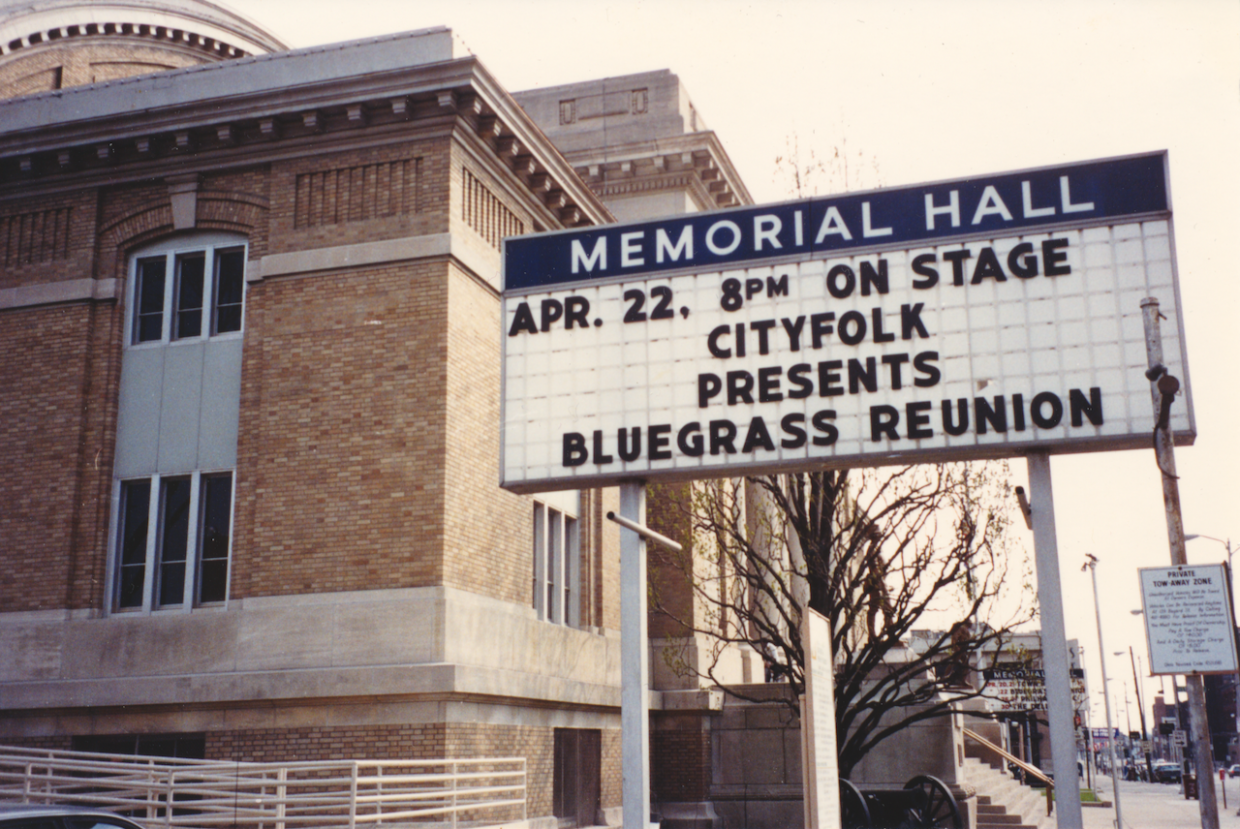
I started outside the concert site, Memorial Hall, in the afternoon before the concert — sound checks were going on inside — taking care to get a close shot of the Hall’s sign on one of Dayton’s busiest streets. 

Inside the hall that day, the stage was being set. Working as a stagehand, I helped handle communications between director Don Baker and the evening’s performers. Moon Mullins and The Traditional Grass and the Osborne Brothers were parked outside in their own vehicles. I first visited Moon and the band in an RV with the name, “The Cabin,” on the door. He introduced me to the band members, including his son Joe. Then I visited the Osbornes. 

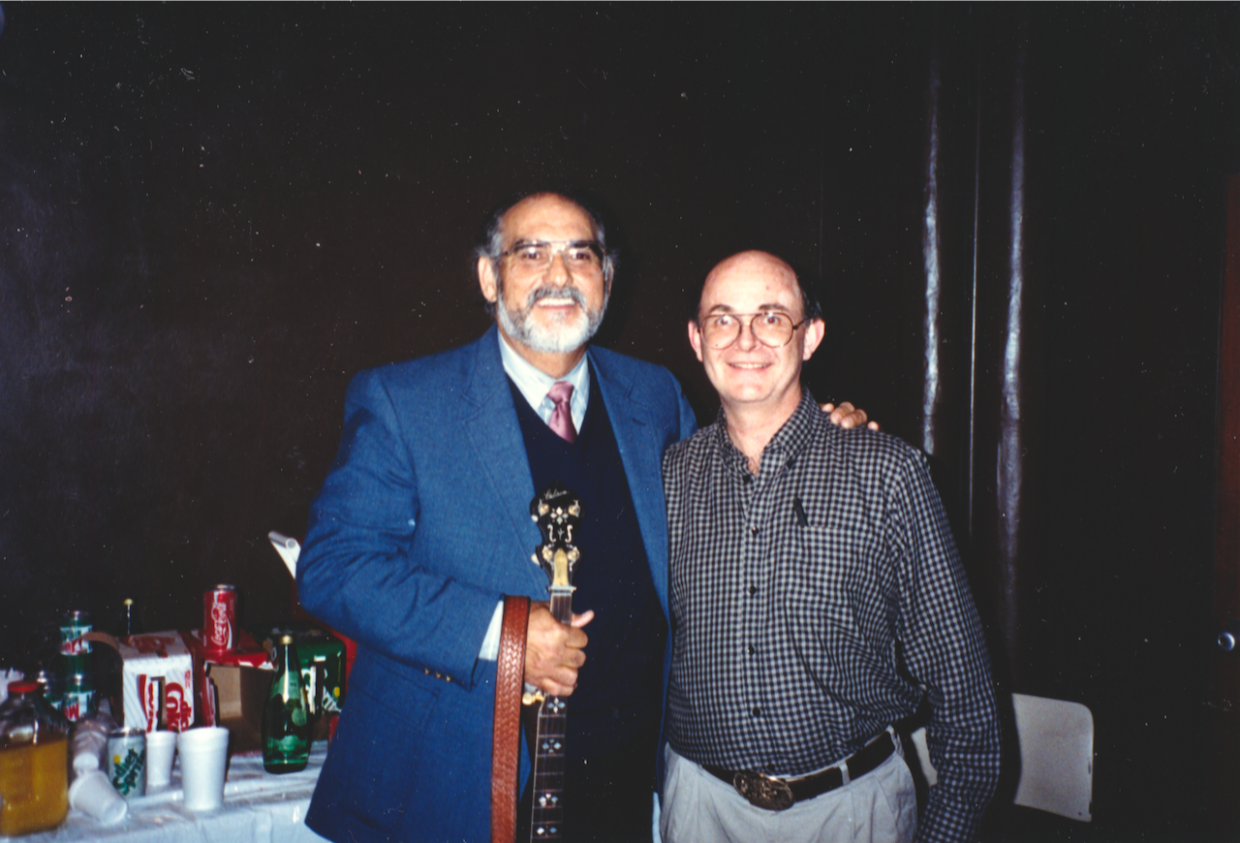
I hadn’t seen the Osborne Brothers since a Saturday night three years before when I was in Nashville to promote my new book, Bluegrass: A History. They’d invited me to be their guest backstage at the Grand Ole Opry, where Sonny brought me onstage, introduced me and spoke about the book — a very generous act. During the concert I asked a fellow backstage bystander to take our photo. Born in 1937, Sonny passed away last fall; he is sadly missed.

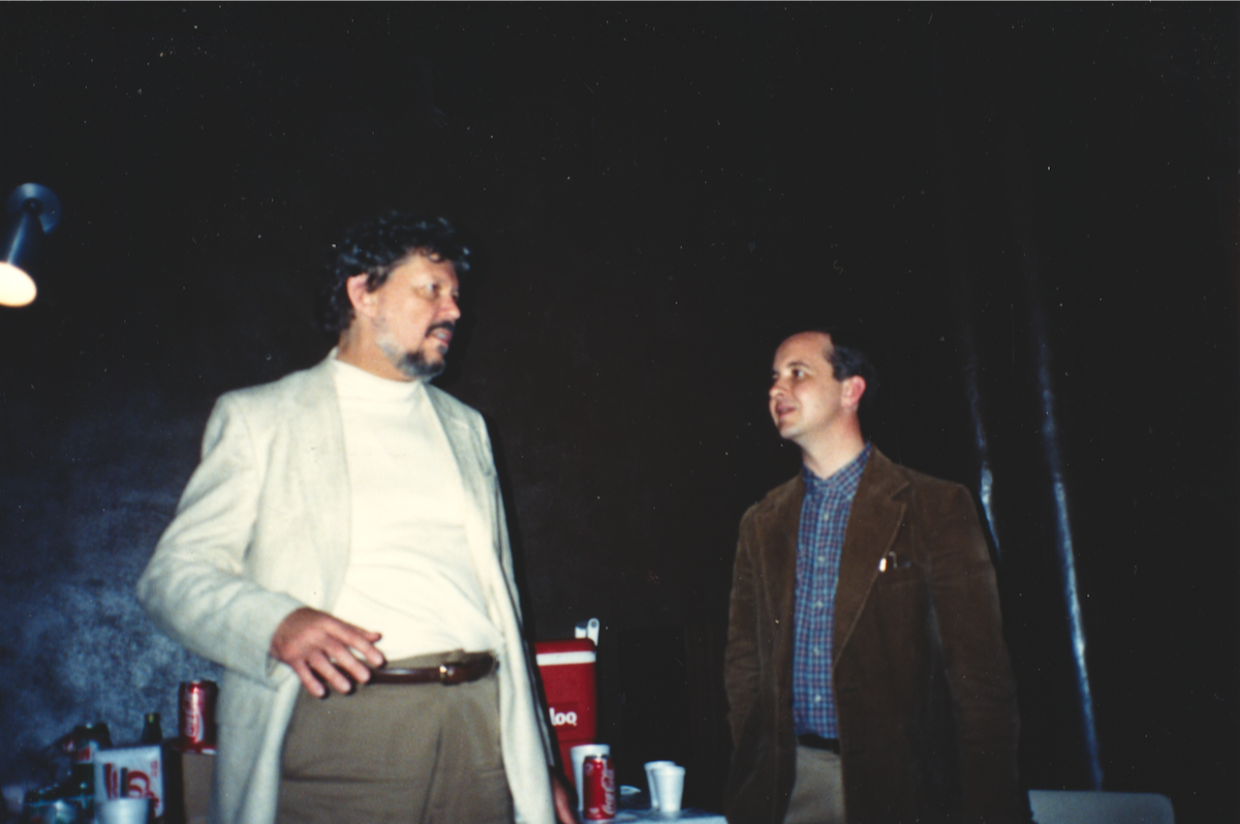
At about the same time I noticed Fred Bartenstein and Tom Teepen nearby and asked them to pose for me. They were important figures in the discovery and revival of Dayton’s bluegrass scene. Recently, I sent this photo to Fred (original editor of Muleskinner News) and asked him for a caption: 

National editorial correspondent Tom Teepen (1935-2017, left) wrote an evocative memoir in the concert program about his days as a Dayton bluegrass fan. Here he meets backstage with Fred Bartenstein, who helped plan and organize the event.

The rest of my photos were taken at the Canal Street Tavern after the concert.

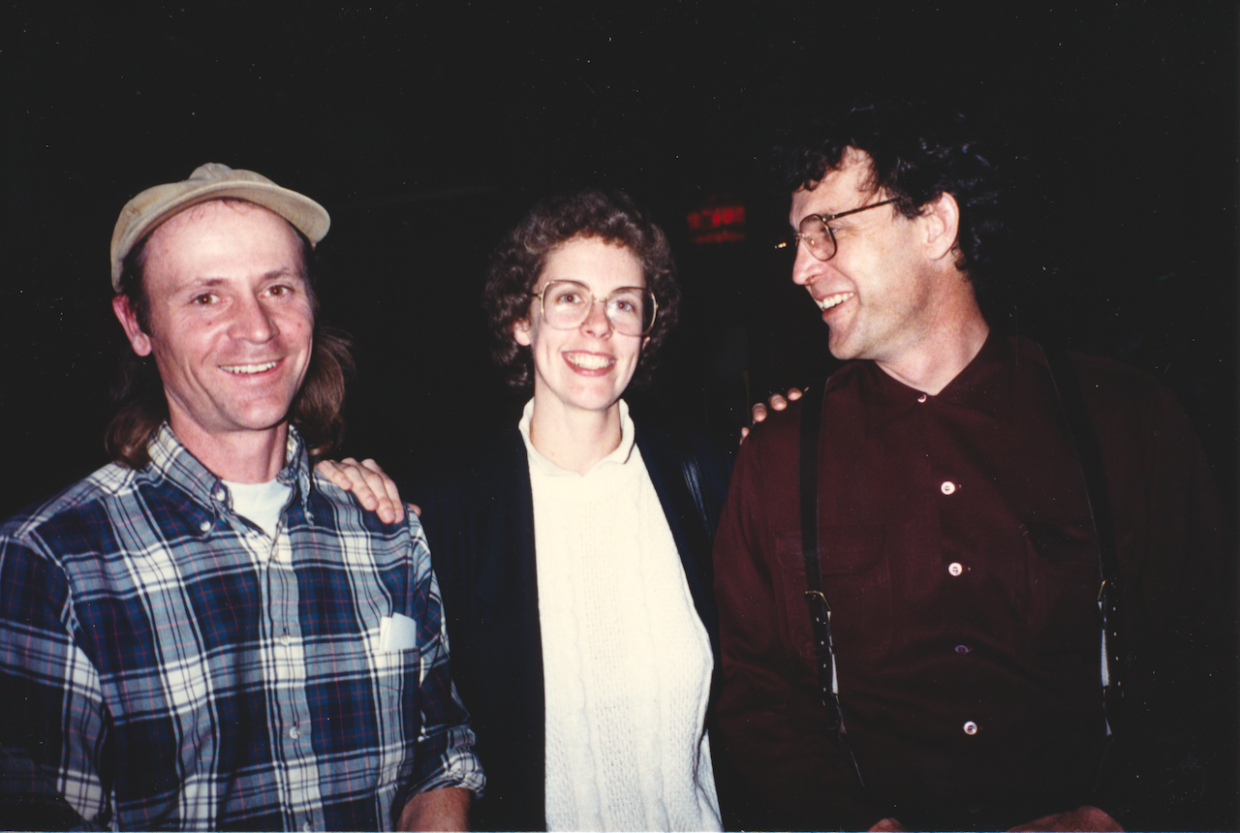
The executive producer of the event, Phyllis Brzozowska ran CityFolk from the start until its end about ten years ago. Behind her on the left is Greg Allen of the Allen Brothers. The individual on the right was one of the crew that director Don Baker enlisted from his Lime Kiln Theater troupe to help backstage.

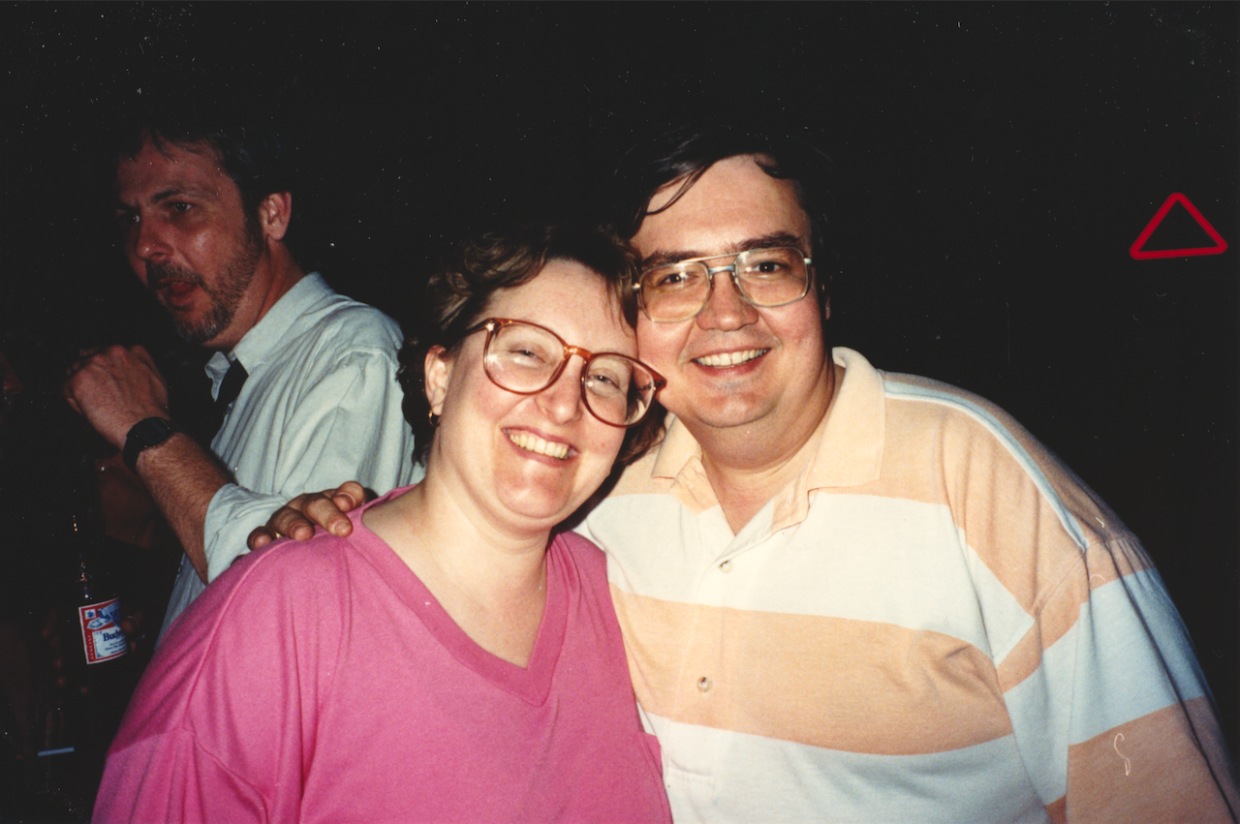
Doug Smith and his wife, Dayton Bluegrass Reunion researcher and writer Barb Kuhns (both members of The Corndrinkers, an old-time band still active today) posed with Don Baker, concert director and emcee. 

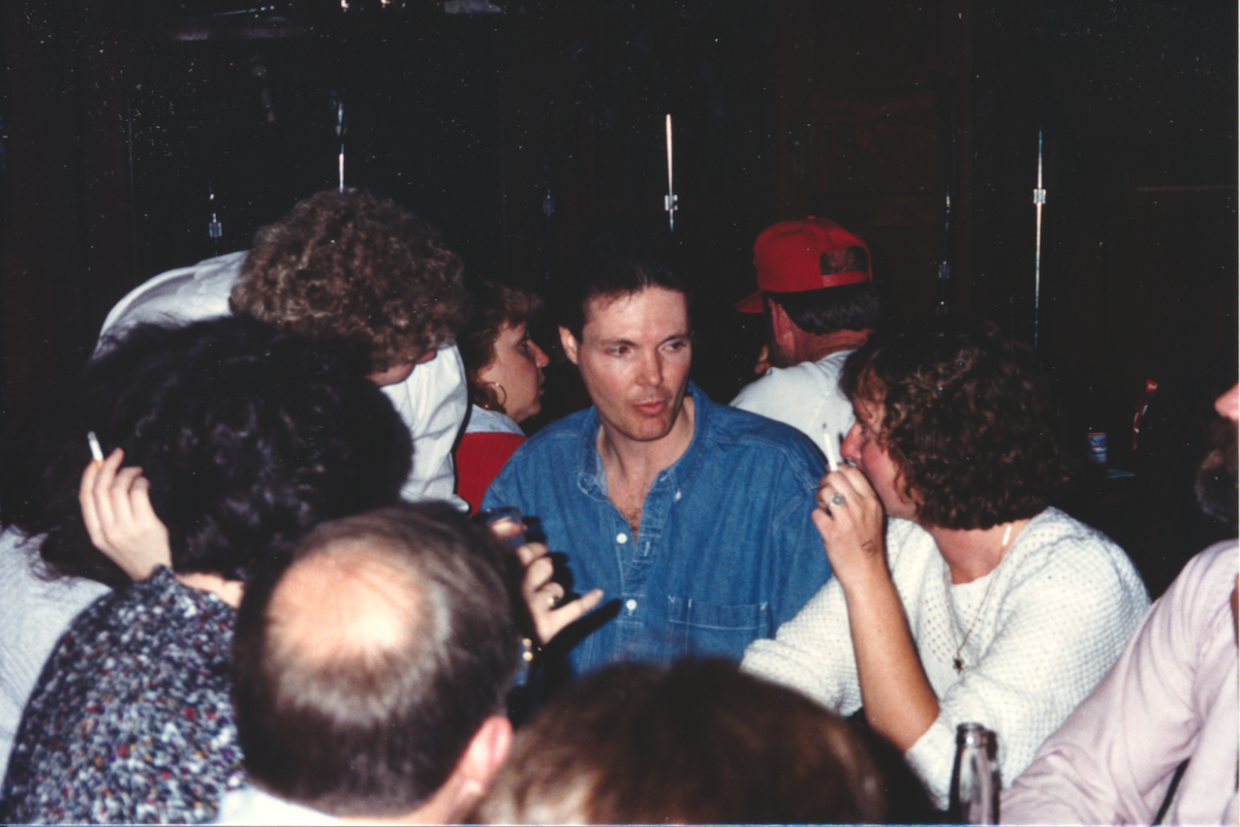
Harley Allen, a veteran star of several bands, had performed in the concert with his brothers. At the center of Canal Street’s evening’s activities, he’s seen here surrounded by friends. 

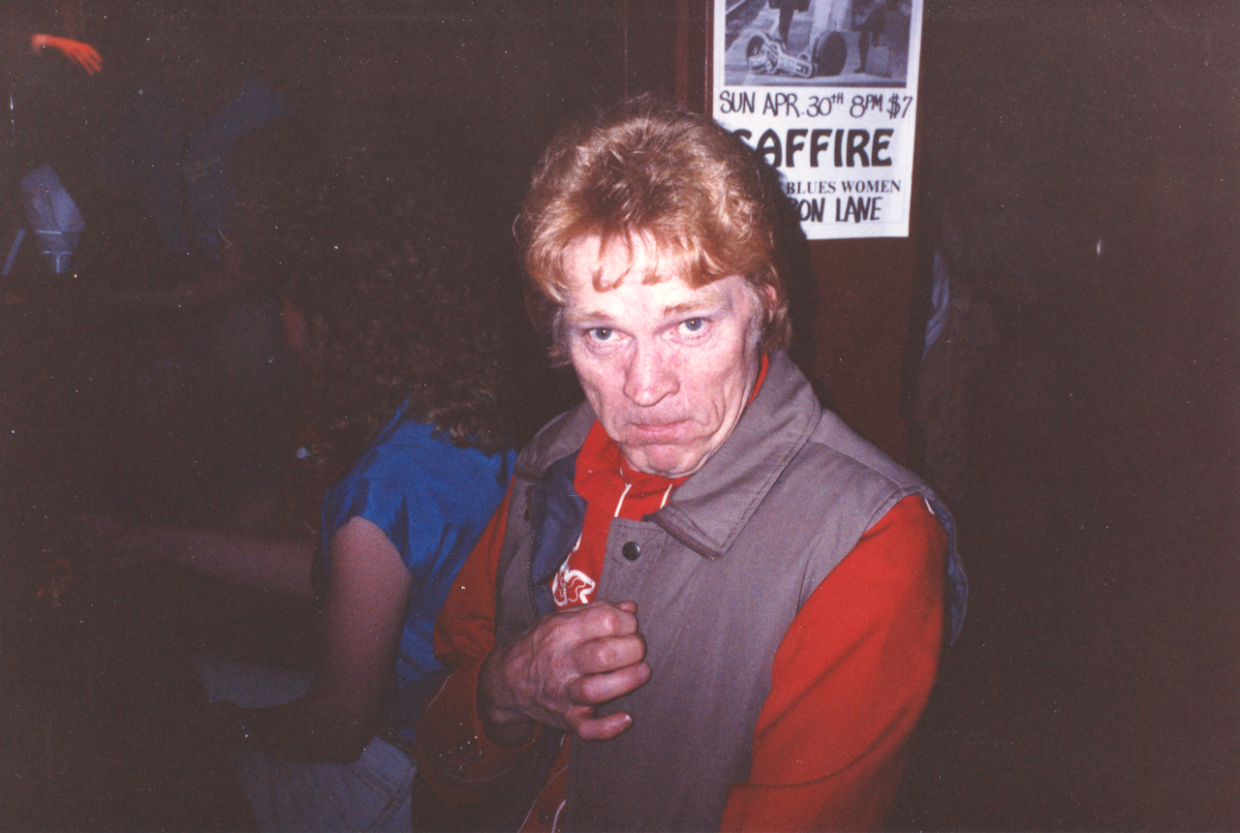
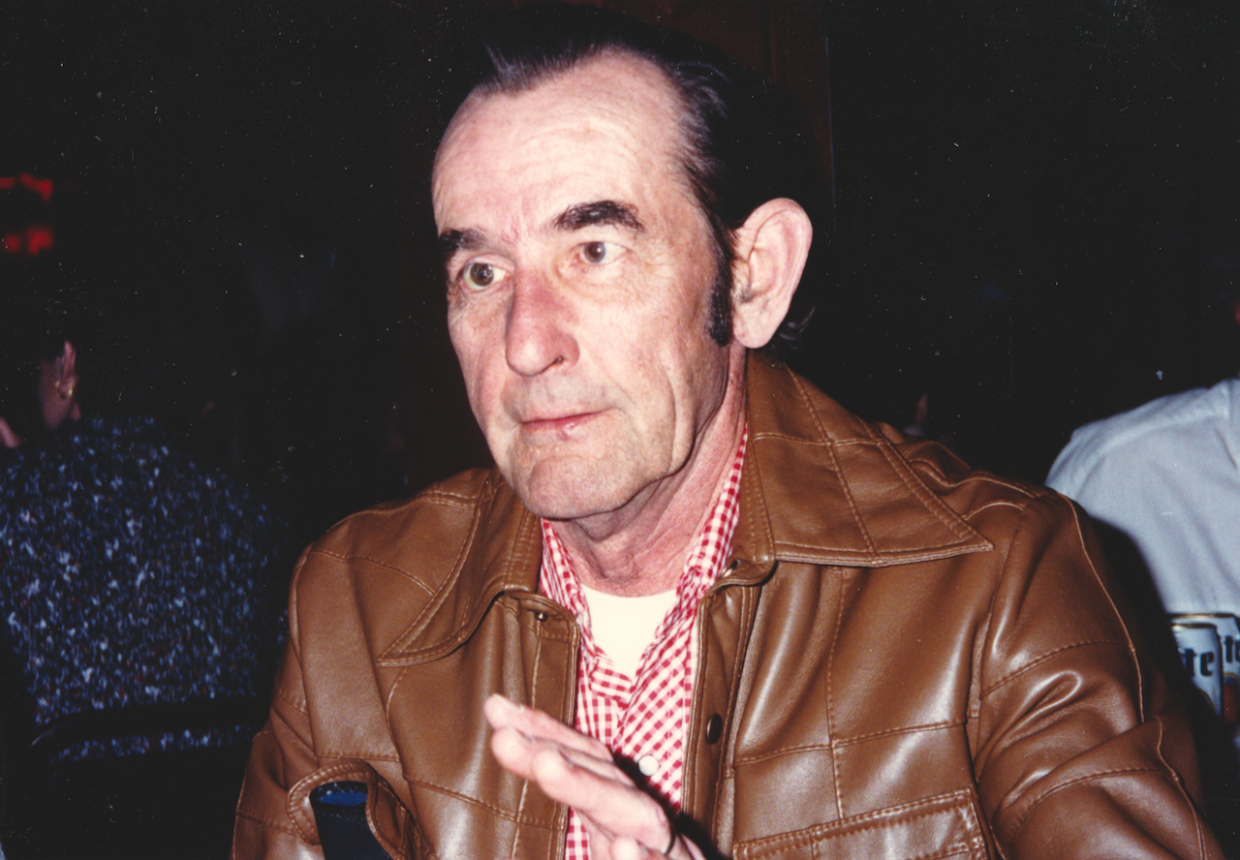
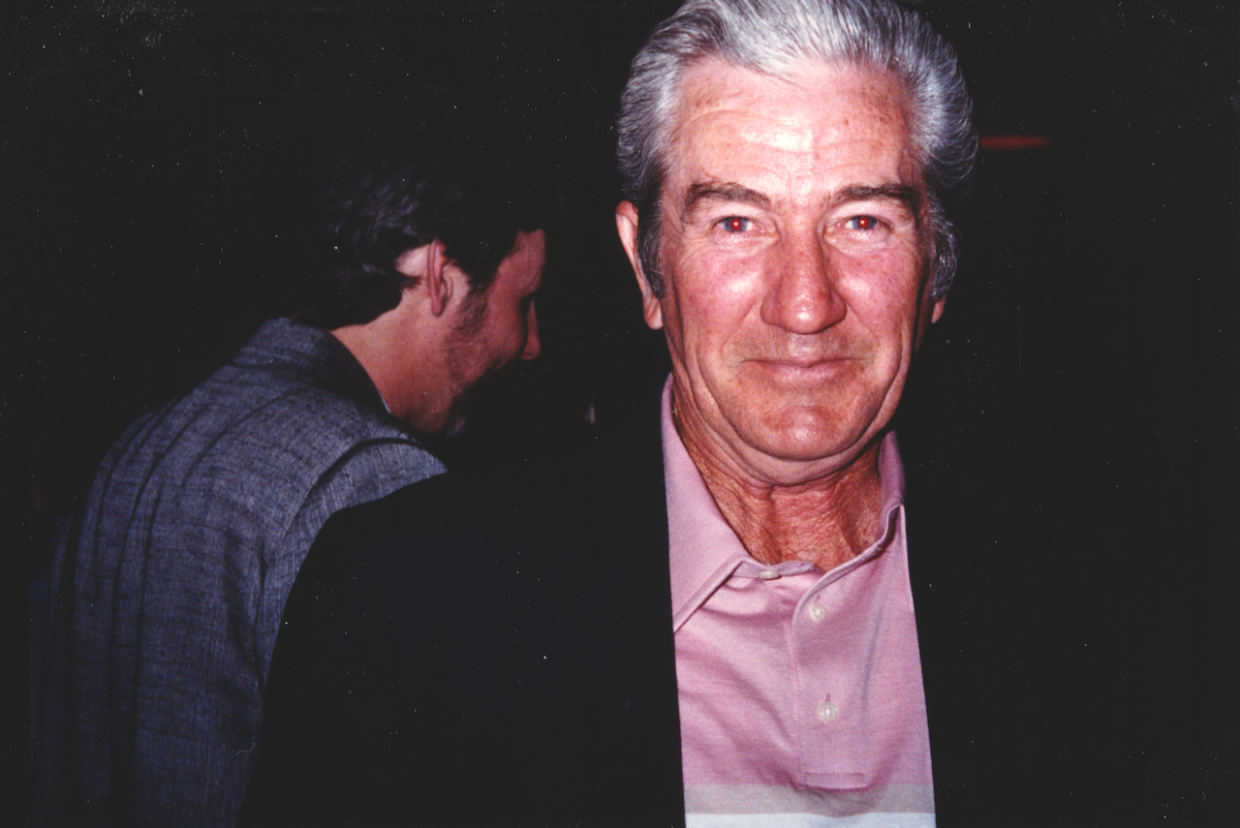
The peripatetic mandolin virtuoso, Frank Wakefield, then living in Saratoga Springs, New York, and working with a Cleveland-based bluegrass/swing outfit, was bouncing around the room. I’d first seen him in action onstage in 1962 (Bluegrass Generation, 124-25); he was still up to his onstage hijinks. 

Meeting Noah Crase was a special treat. I’d first heard his music in the late ’50s on an obscure 45 record by Dave Woolum. The evening’s program included a picture of him playing with Bill Monroe along with two men I’d played with in Indiana myself, Roger Smith and Vernon McQueen. We swapped Blue Grass Boys stories.

Another special treat. I first ran across Porter Church’s recordings on Red Allen’s County LPs from the mid-’60s. He was well-known in the D.C./Baltimore area, but I didn’t get a chance to see him in action until the Reunion.

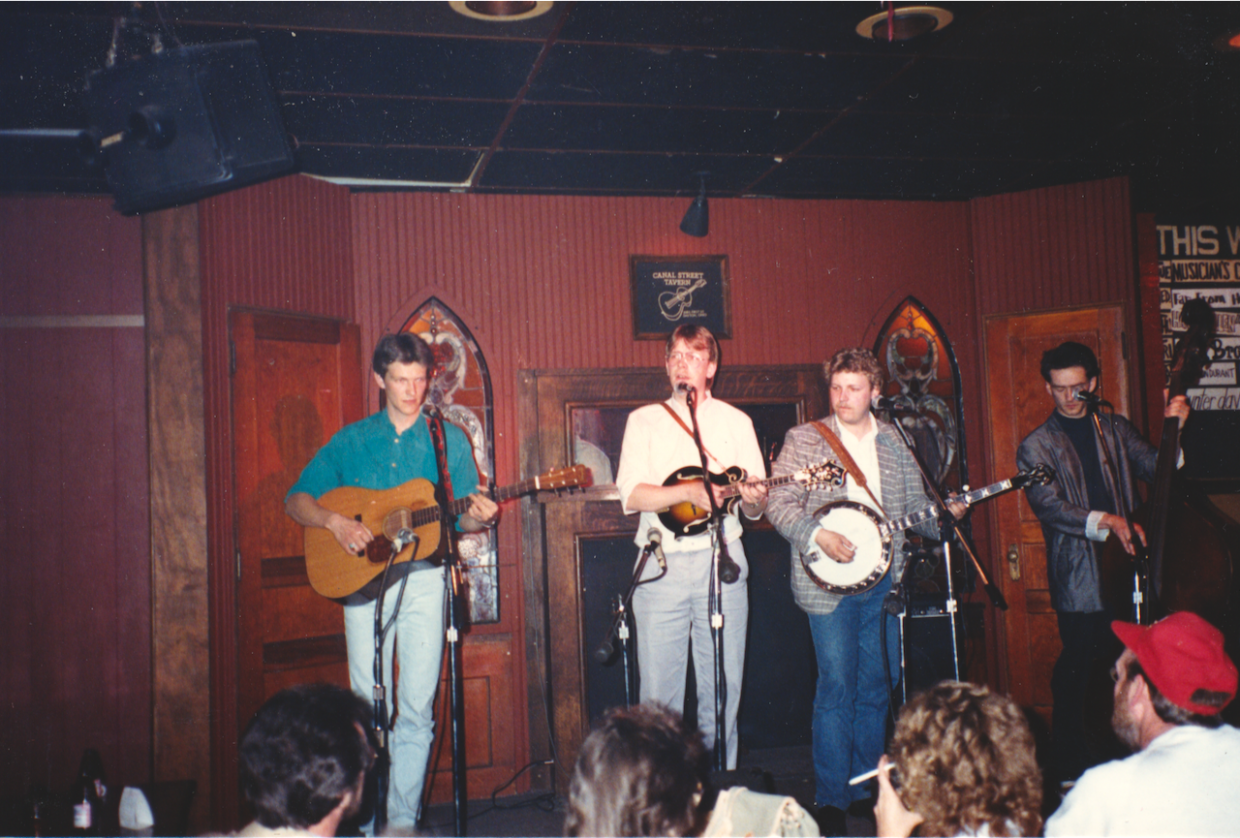
The Sacred Sounds of Grass (Norbert Dengler, guitar; Sam Hain, mandolin; Thilo Hain, banjo; Alfred Bonk, bass)

I didn’t take notes about my snapshots — all that remained in my memory of this group was that these young men were from Germany, played bluegrass gospel, and were on their first American tour. I sent a copy to Mark Stoffel, mandolin player with Chris Jones and the Night Drivers, who’s from Germany. He told me he “knew them well,” and sent the band’s name and contact information.

I wrote to banjoist Thilo Hain and asked him to describe the circumstances that brought the band to Dayton that evening, and their experiences at the concert and the reception. He explained:

In 1988 his brother Sam Hain saw an ad in New York instrument dealer Harry West‘s sales list for a 1922 Gibson Lloyd Loar once owned by Pee Wee Lambert and now owned by Frank Wakefield. Sam, interested, “rang Frank Wakefield up to ask him more details about this instrument.” Wakefield told Sam, “Better get that mandolin, before anybody else gets it.” 

Sam then asked Frank if he was planning a reunion with Red Allen and his band. Wakefield told him about the Dayton Bluegrass Reunion scheduled for April 1989. Thilo remembered, “Frank finished with the words, ‘You better be there!'”

Sam missed out on getting the mandolin, but the band was there in Dayton for the concert. Red Allen arranged for their free admittance and took them backstage to “a meet and greet with all the musicians,” and suggested they perform at Canal Street. “Dee Sparks,” said Thilo, “was so kind to let Alfred play his bass for the show. Throughout our first U.S. tour we earned so many friendly comments, felt heartwarming hospitality from all the great musicians we visited at their homes and went back to Germany with a huge bag full of new impressions and experiences.”

A Google translation of the band’s history on their Facebook page reads: “Sacred Sounds Of Grass is the oldest active Bluegrass Band in Germany, founded in 1979. With their classic Bluegrass Sound the group is also considered the most authentic bluegrass band outside of the USA.”

Thirty-two years after their Canal Street Tavern performance, the same band lineup appears in a photo, also posted at their Facebook page, of them performing in a church in Adelberg, Germany this past August. Here’s a recording from a 2019 festival. 

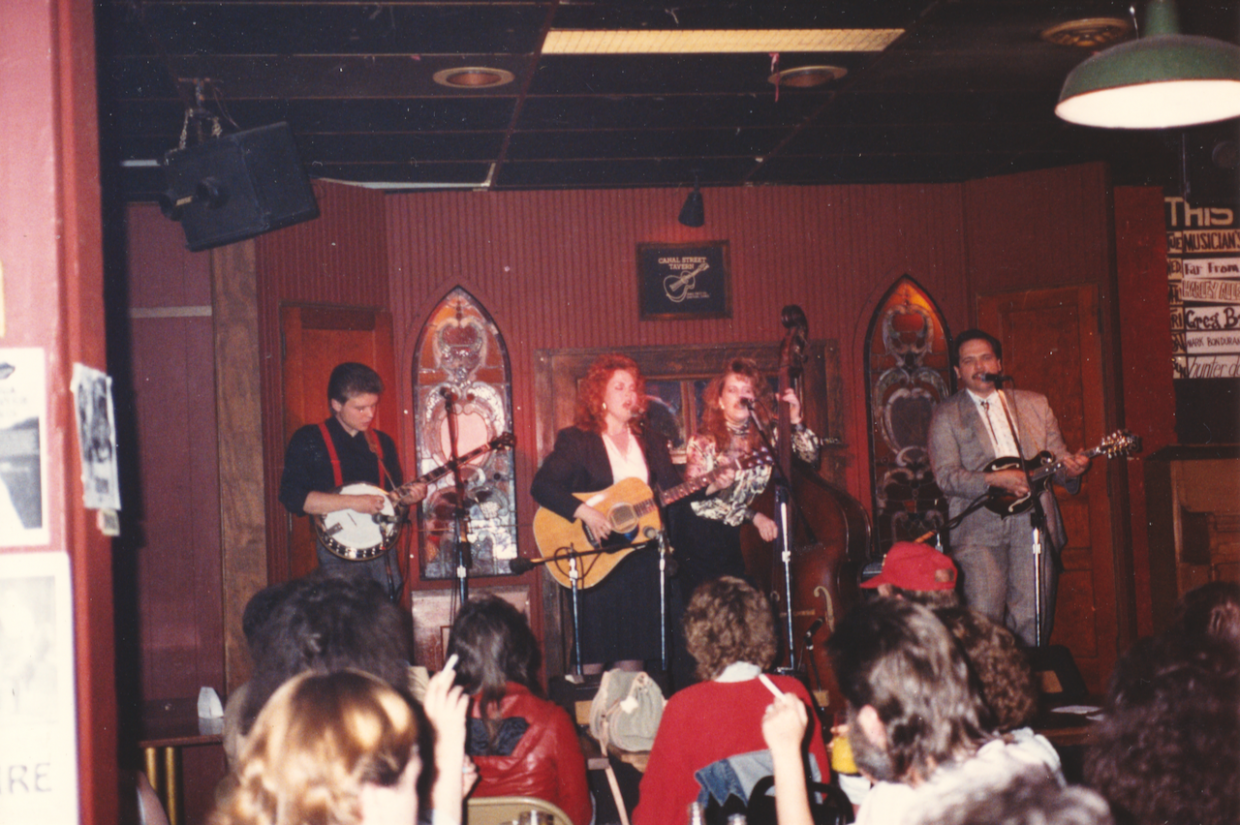
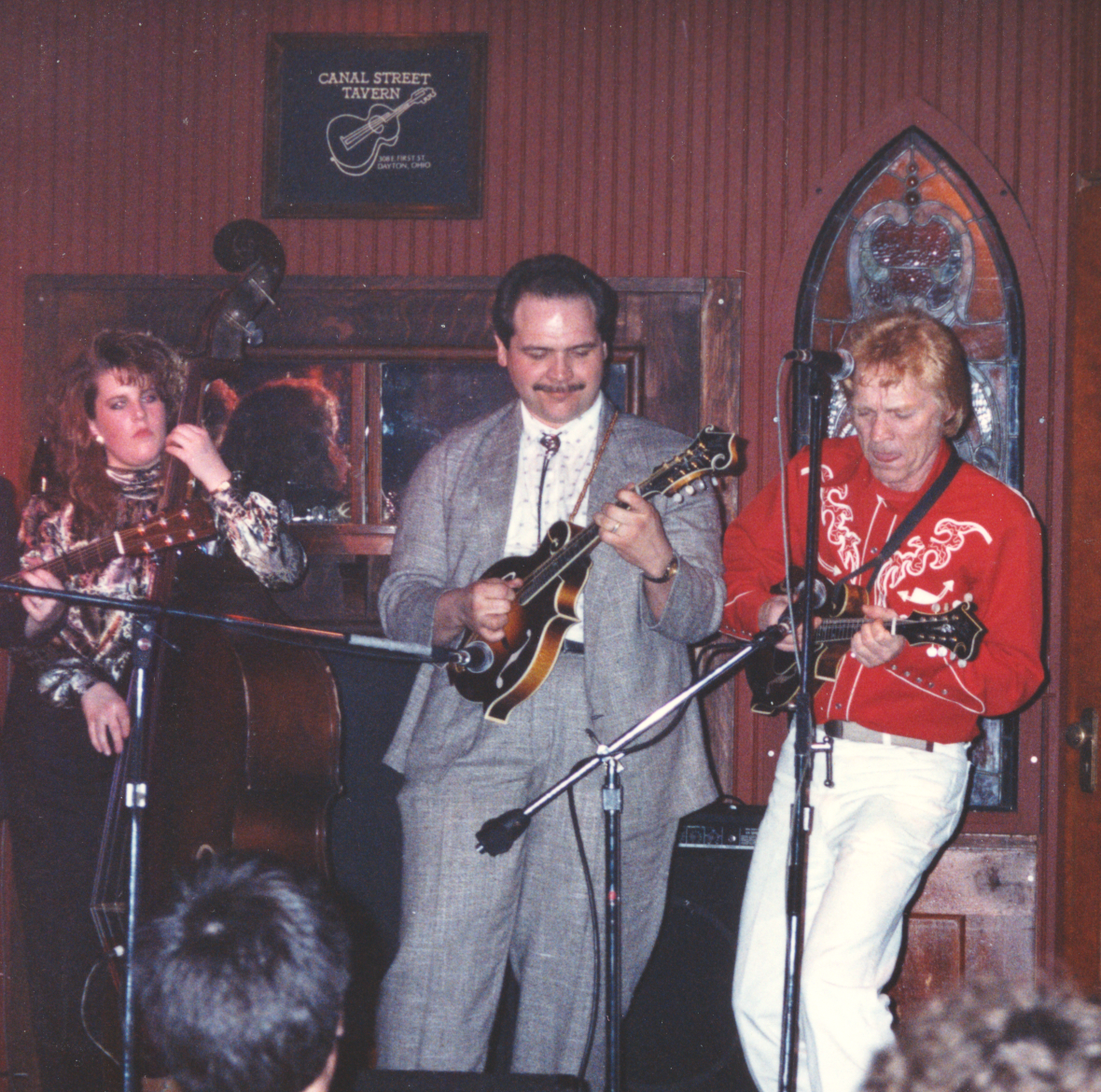
Wild & Blue (below) was mandolinist and fiddler David Harvey’s new band, formed November 1988. On this night, when they came onto the Canal Street stage, David had already played with the Allen Brothers. Born 1958 in Dayton and son of famous mandolin player Dorsey Harvey (1935-1988; see Industrial Strength Bluegrass pp. 150, 183), he’d grown up in Parkside, a postwar housing development, together with Red Allen‘s four sons as neighbors. Their fathers both played in bluegrass bands — they all learned at home, jamming together after school as teens. By summer 1972 David was playing festivals with Red Allen.

In 1974, at 17, Harvey dropped out of high school to help support the family as a professional musician, joining the Falls City Ramblers. Parkside was a decaying, crime-ridden, rustbelt housing project; David saw music as a way to a better life. 

A Louisville-based band that played a lot in Southwest Ohio, the Ramblers were local favorites with the same crowds who listened to the Hotmud Family’s eclectic blend of bluegrass, old-time, blues and early county. The chapter “Beck Gentry” in Murphy Hicks Henry’s Pretty Good for a Girl: Women In Bluegrass (pp. 186-191) gives a good history of the band. David was with them, playing fiddle and mandolin, for five years. In 1977 Kentucky Educational Television aired one of their shows:

In 1979 Harvey moved to Colorado Springs, where his musical career continued in a group called The Reasonable Band. He entered and won several mandolin contests, establishing an enduring reputation for his skill and creativity. He also began working as a luthier.

He moved to Indianapolis in 1983 and for the next four and a half years he played on the road and recorded with Larry Sparks. His career as a luthier grew. In 1986 he met Jan Snider, who, with her younger sister Jill, had been playing bluegrass. Jan and David soon wed. 

Wild & Blue brought lead singer Jan’s voice to the forefront, solo and in duets with Jill’s high harmonies. They began around the same time as a number of other bluegrass bands with female lead singers were coming on the scene like Alison Krauss, Lynn Morris, and Laurie Lewis. The band had a lot of energy, with David’s suave mandolin work and its female-dominated trios. They won the band contest at SPBGMA 1992 and moved to Nashville in 1995. By then they’d recorded albums for Vetco and Pinecastle. Wild & Blue lasted until 1999.

Harvey then worked with Larry Cordle (1999-2001), Claire Lynch (2002-07), and Harley Allen (2008-11). Meanwhile his luthier work in Nashville blossomed. He joined Gibson in 2004 and today as Master Luthier heads Gibson’s Original Acoustic Instruments division. Here’s a video (above) in which Dave introduces one of the mandolins he’s building and illustrates it with a tune he co-wrote with his dad, “Cruising Timber.”

As a small boy Harvey had watched and listened to his father and Frank Wakefield as they wrung out mandolin ideas at his home. He clearly enjoyed himself with Frank this evening.

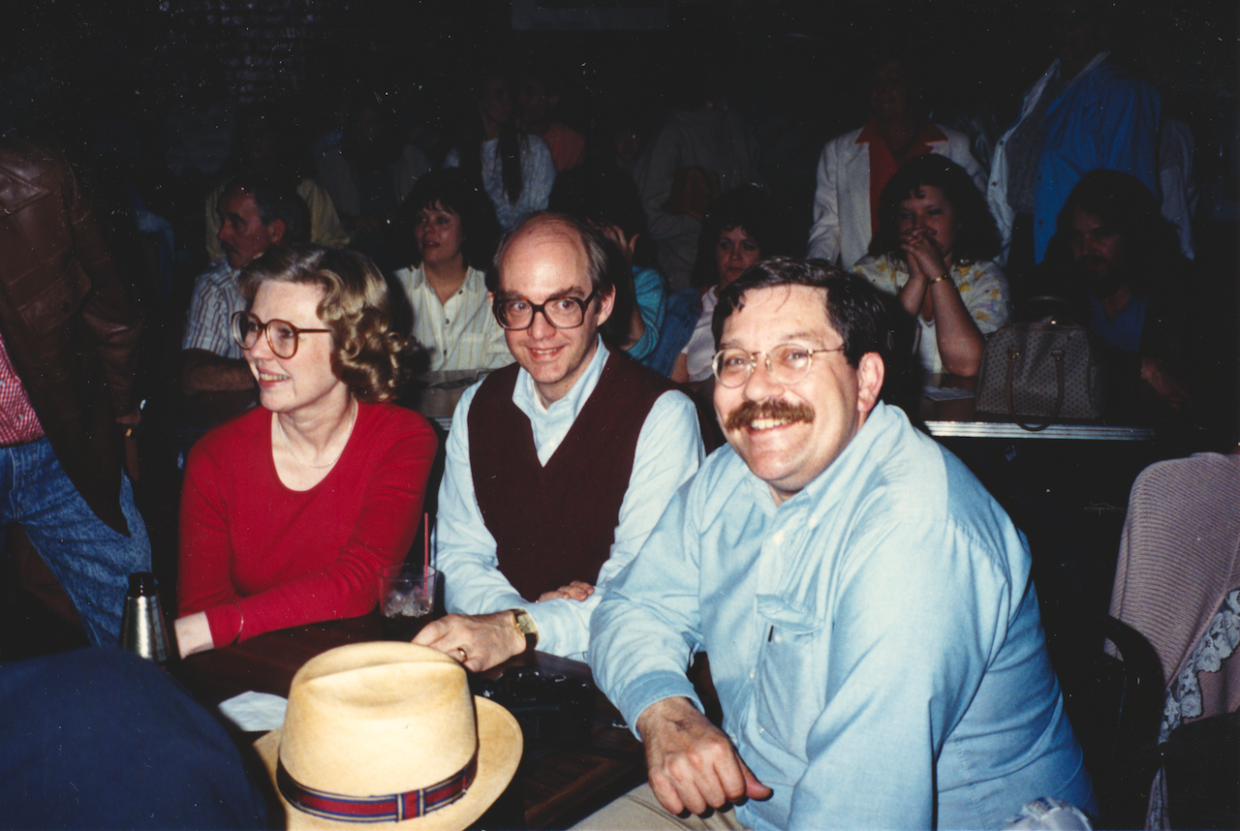
I had watched the evening’s afterparty at Canal Street with old friends from Lexington, Kentucky: the late Marty Godbey, author of Crowe On The Banjo: The Musical Life of J.D. Crowe. Next to her, husband, writer, photographer and musician Frank Godbey, creator of two influential bluegrass digital lists, BGRASS-L and IBMA-L. Next to Frank is Tom Adler, folklorist, banjoist and author of Bean Blossom: The Brown County Jamboree and Bill Monroe’s Bluegrass Festivals. And that’s my hat on the table.

(Editor’s Note: Read part one of our series on the Dayton Bluegrass Reunion hereRead part two here. Read part three here.)


Neil V. Rosenberg would like to thank: Fred Bartenstein, Phyllis Brzozowska, Nancy Cardwell, Frank Godbey, Thilo Hain, David Hedrick, and Mark Stoffel.

Rosenberg is an author, scholar, historian, banjo player, Bluegrass Music Hall of Fame inductee, and co-chair of the IBMA Foundation’s Arnold Shultz Fund.

Photo of Neil V. Rosenberg by Terri Thomson Rosenberg, all other photos by Neil V. Rosenberg. 

Edited by Justin Hiltner

IBMA 2019: The Top 5 Reasons to Go

It’s September. Festival season is going strong — music conference season, too! — and it seems, just about everywhere you turn, roots music is being made and enjoyed.

On September 24, the International Bluegrass Music Association’s business conference and festival will begin in Raleigh, North Carolina. Last year more than 230,000 attendees descended upon the Triangle area to take in the bluegrassy spectacle. We’ll be there once again this year. Here are the top five reasons we think you should be, too:

1. World of Bluegrass

Starting on Tuesday, the World of Bluegrass business conference kicks off the entire week of programming in Raleigh with panels and seminars, a keynote speech by Alison Brown, IBMA constituency meetings, a gig fair, a health fair, showcases, and focused business tracks for songwriters, broadcasters, talent buyers, and more. Learn about the Music Modernization Act, engage in one-on-one songwriting mentor sessions, and don’t miss the exhibit hall! It’s not just a place to stock up on strings ‘n’ Shubbs, you’ll almost undoubtedly bump elbows with the genre’s greatest pickers and artists, too. Like this moment at the Gibson booth when luthiers and musicians Dave Harvey and Brian Christianson share an impromptu tune.

2. Bluegrass Ramble

Did we mention showcases? This year, IBMA’s showcase extravaganza, the Bluegrass Ramble, will include more than 200 sets from over 30 bands all around downtown Raleigh. Don’t miss the World of Bluegrass Kickoff Party with Special Consensus at the Lincoln Theater on Tuesday night.

Need another couple suggestions to help narrow down your options? We’re excited to see acts like California bluegrass band AJ Lee & Blue Summit, banjoist Gina Furtado’s solo effort, the Gina Furtado Project, and newcomer Jaelee Roberts. Set aside time for a new band from Clinch Mountain Boys alumnus, banjo player Alex Leach, and High Fidelity, perhaps the best truly traditional bluegrass band on the scene right now, too.

3. The Awards

The 30th Annual IBMA Awards Show will be held Thursday, September 26 at the Duke Energy Center for the Performing Arts just down the block from the Raleigh Convention Center. Hosted by Del McCoury and Jim Lauderdale, bluegrass’s biggest night will see awards handed out for Gospel Performance, Collaborative Recording, Entertainer of the Year, and more — including three inductions into the Bluegrass Music Hall of Fame.

But, this is not the only awards event during the week! BGS is proud to sponsor the Momentum Awards luncheon the day before the “big” awards show, where young, up-and-coming, and just-getting-started musicians, events, and professionals are recognized for their contributions to the bluegrass community writ large. The lunchtime presentations are peppered with showcase bands, as seen here in 2016 with Loose Strings.

The IBMA Industry Awards (formerly the Special Awards), for categories such as Event of the Year, Sound Engineer of the Year, and Broadcaster of the Year — and more — will be announced during a luncheon on Thursday, as well. It’s an awards-packed week!

4. Wide Open Bluegrass

For the first time, the entirety of IBMA’s “fan fest,” Wide Open Bluegrass, is free! Yes, you can even get into the main stage at Raleigh’s Red Hat Amphitheatre for free. (Tickets for reserved seating are still available!) This year’s lineup at the main stage includes a special tribute to Hazel Dickens and Alice Gerrard and a celebration of Bluegrass Hall of Famer Del McCoury.

Don’t miss the StreetFest, too! Vendors line Fayetteville St. from the capitol to the Duke Energy Center with more than a handful of stages and a world-class lineup of bluegrass, string bands, old-time, folk, and Americana. Wide Open Bluegrass is the biggest bluegrass festival east of the Mississippi, and if you’ve been you understand why.

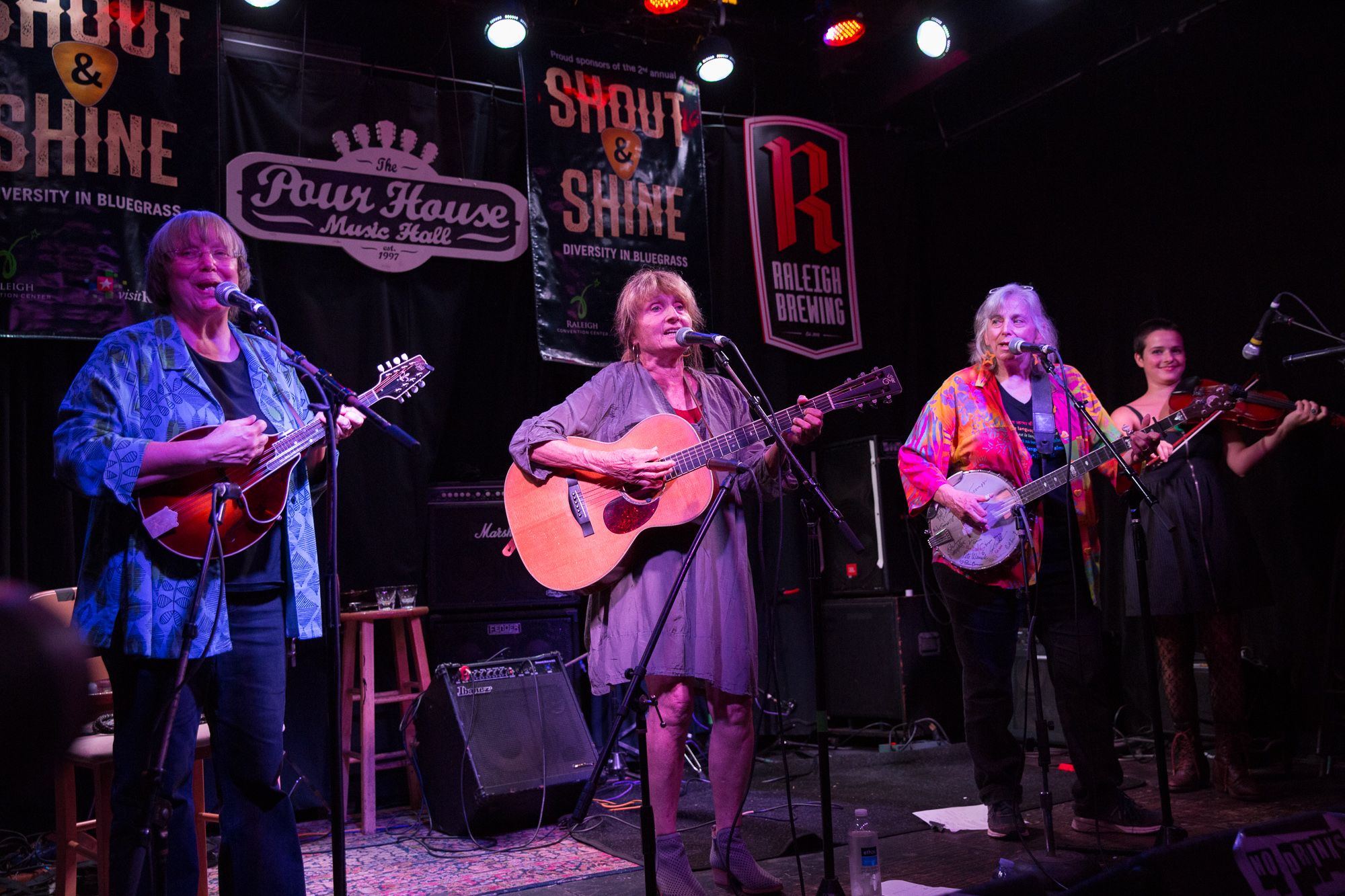
Also, make plans to join us for our Fourth Annual Shout & Shine: A Celebration of Diversity in Bluegrass on Friday, September 27! With our friends at PineCone we’re taking over the StreetFest’s dance tent for an entire day of dance, music, and celebrating the vast array of diverse voices and creators who love bluegrass. Music starts at noon and goes til 11:00 pm! Did we mention there’s going to be a Shout & Shine Square Dance Party?

5. THE JAMMING

If you don’t spend at LEAST two to three nights out of the week staying up ‘til dawn camped out in a hallway or a hotel room enjoying some of the best off-the-cuff music the world has to offer, you just aren’t doing IBMA right. We recommend the whole enchilada, going to the business conference, the Bluegrass Ramble, the main stage at the Red Hat — but if there’s just one thing you can muster during the week of bluegrass events at World of/Wide Open Bluegrass, it should be a mosey through the Marriott for a little bit of jamming. A lotta bit of jamming. Who knows who you’ll run into on the elevator or around the corner…


Photo of Marcy Marxer, Alice Gerrard, Cathy Fink, and Tatiana Hargreaves at Shout & Shine 2017: Willa Stein