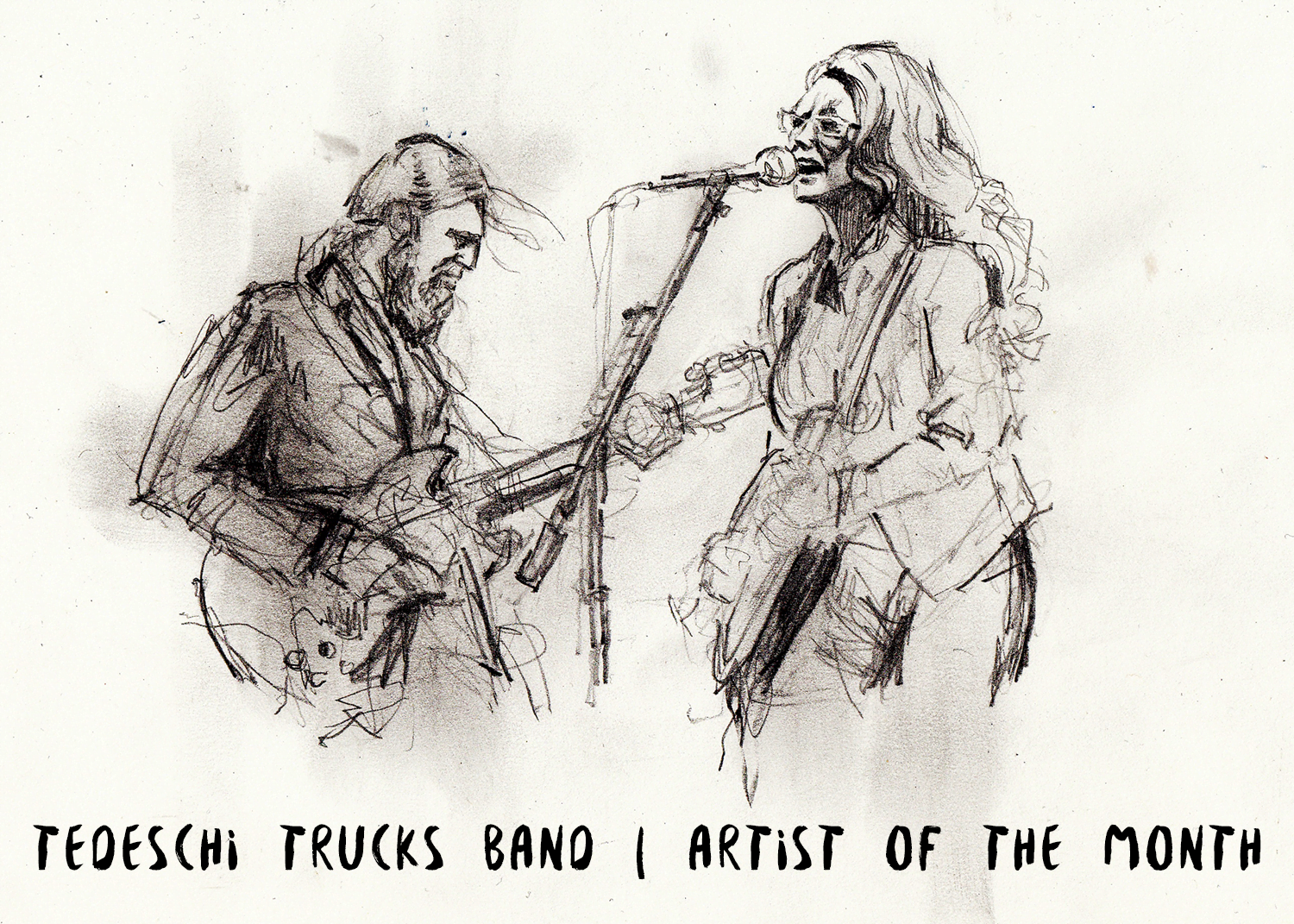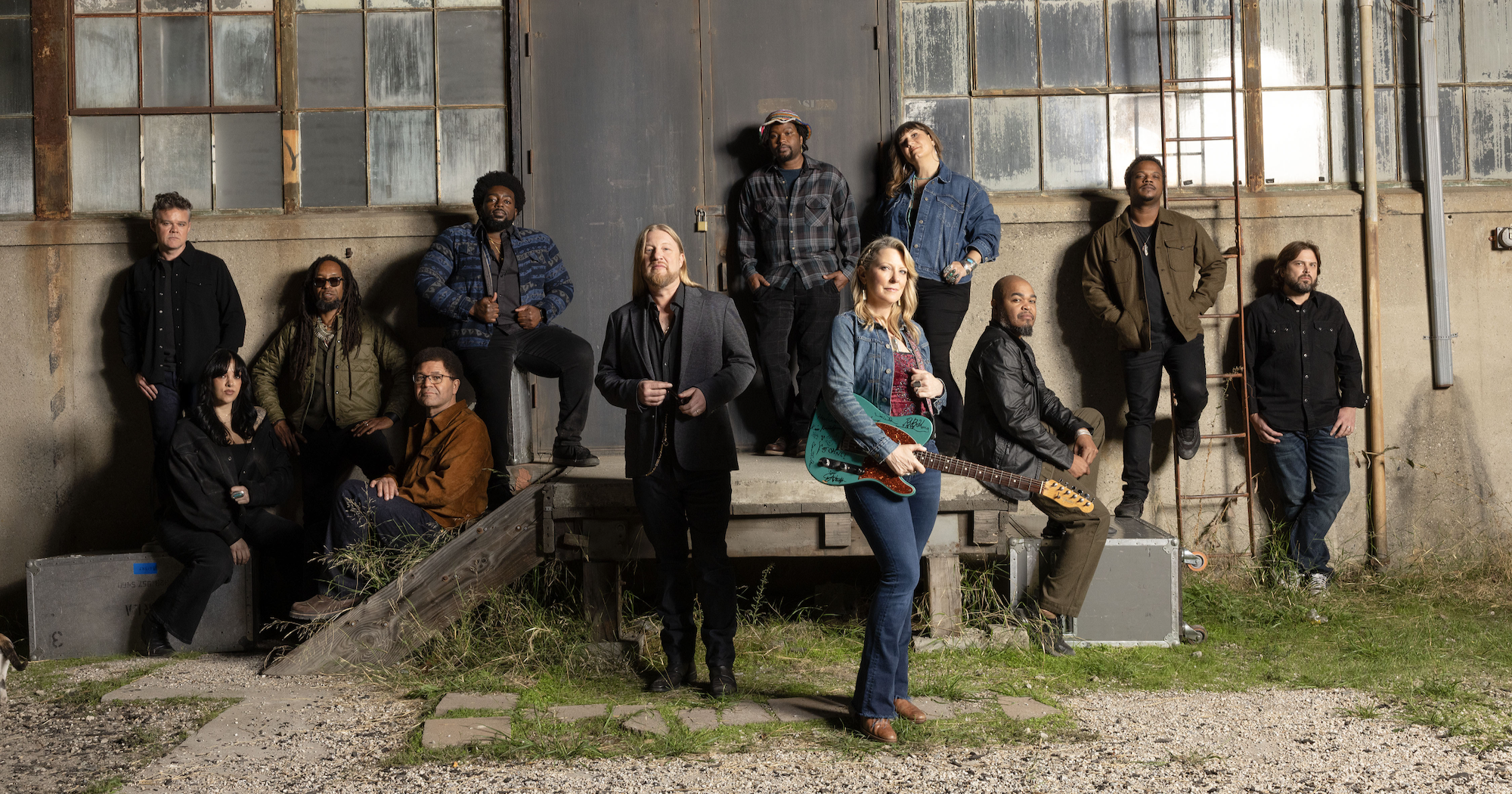
When it comes to entirely enjoyable, technically exquisite modern blues, Southern rock, and jam-band soul albums, Tedeschi Trucks Band have a statistically impossible batting average. Their new LP, Future Soul (released March 20 via Fantasy Records), is yet another “no skips” collection from the megalithic 12-person Americana group fronted by husband-and-wife guitarist Derek Trucks and guitarist-vocalist Susan Tedeschi.
On that strength of their catalog – and their ensemble – TTB have amassed hundreds of millions of streams, won eight Blues Music Awards and one GRAMMY, and a handful of their songs have become regarded as modern standards in the Americana and American roots music songbook.
Future Soul simultaneously feels like a surprising departure and familiar, essential territory for the band. With Mike Elizondo producing and songs and creative input sourced from across the group’s lineup, the set ends up sounding and feeling more acoustic than “usual,” while still reaching roaring crescendos and building it all on dank, wide open grooves. Perhaps those acoustic moments are a substantial contributing factor as well, but the cozy, plush pocket of the album is what gives it a laid-back, relaxed, and floating vibe no matter the track’s genre construction.
Screaming slide, no-holds-barred vocals, and wall-of-sound climaxes can all be found herein, as well. But the collection never thrashes or flails, it’s precise and exacting – as Tedeschi and Trucks are both known to be on their instruments, whether guitar or voice – but it’s certainly not sterile or gated or homogenized, either. It’s another remarkable feat for a group so large that you would almost have to assume, live or in studio, musical mud would be an inevitable byproduct.
But no, TTB seem to have no misses, at least not on Future Soul. It’s clear this group works together in harmony not just because of the down-to-earth and collaborative leadership of Tedeschi and Trucks, but because the artistic and musical responsibilities and ownership – of the songs themselves, of the album, of the makings of each, of “success” for the band – are decentralized and distributed throughout the group. The band has a sound, an art, that is consistently collective in the way it’s received by audiences and listeners because, forgive the obviousness, Tedeschi Trucks Band always work as a collective.
In our BGS conversation with Derek Trucks, the magic and unlikelihood of this creative dynamic and the processes by which the band continues to rack up success after success were on full display. We spoke about how they put together Future Soul as a group effort, the many inputs that went into Trucks fashioning his lyrical guitar style, and what bluegrass means to him personally, to Tedeschi, and the band as a whole. It was a joy-filled, passion-led conversation that again reinforced how this wailin’, rockin’, rollin’ band continues to flout and subvert expectations – and thereby has become so beloved.
Something that jumped out at me from the bio about the new album is that you say, “There’s just not a weak spot on this record.” I have to say, I totally agree. I think it’s remarkable that with a 12-person band and such a diverse catalog of recordings and releases, it really doesn’t seem like there’s any “fat” to trim or any duds to cull.
I have to ask, does it feel as magical on the inside of that process as it seems from the outside? It seems unlikely that y’all would work so well together towards a common goal, artistically, and be able to deliver again and again and again. And I don’t just mean commercially, awards-wise, or for audiences alone. Clearly you’re delivering artistically for yourselves and by your own standards, as well. So, does it feel as unlikely on the inside of that process as it maybe does to us on the outside looking in? [Both laugh]
Derek Trucks: That’s awesome. But it does, man! I mean, not every record you do feels the same way. They’re all their own beasts. For I Am The Moon, it was in a time of great uncertainty. We did four records and it was just kind of a heavy, heavy time – and that record feels like that.
This one felt completely different. The band felt much more confident [and] had been touring for two years straight. We had been playing so much together that when we finally got the core of the group up to our farm in Georgia to do some writing, there were a few songs right out of the gate. Like “Future Soul” and “Who Am I,” where immediately, Sue started singing, Gabe [Dixon] started singing these melodies. I got chills and I was like, “Oh, this is gonna be good.”
You’re always kind of worried about running out of ideas, or running out of runway – like a thing in the back of your head. But I feel like we’re incredibly fortunate where, when we’re together, everyone puts everything they have into it. Then, when we’re not on the road together, everyone’s all doing their own things musically. So, when we come back together, there’s a lot to talk about and a lot of music to remember together.
I think it keeps it really fresh and it keeps it moving forward. I feel like everyone’s out honing their craft when they’re away from this. When they come back, there’s a lot of new ground to cover. So far, we’ve been really, really lucky that way. And there’s a handful of just incredible songwriters in the band, so everybody comes in with two or three ideas. You’ve got a pretty strong record right out of the gate. That’s been something that I think me and Sue are just realizing – we’ve known how amazing that is but, you know, Gabe and Mike [Mattison], they show up with some serious ideas.
Then having Mike [Elizondo, the album’s producer] down, just some outside ears – I think that was really important. Sonically, he was trying some different things that I think inspired the band and made everybody play a little differently. That was exciting.
I was struck by the range of styles and the different genre infusions that y’all have put into this collection. What really stuck out to me, listening down to the project in one fell swoop, is there are still those really big energetic moments – and there are still those “wall of sound” moments that y’all are really known for. But I felt like this album is chill and laid-back in a way; it feels deep in the pocket. Can you talk about capturing those seemingly disconnected energies together?
I think one of the things is that with a band or an artist, I think if you’re maturing properly – we learn sometimes slowly – that you don’t have to force the issue all the time. You can trust things around you a little bit more, and sometimes the groove is enough. Sometimes the chord changes are enough, sometimes the melodies are enough. It doesn’t have to be these epic moments at all times. So when they do come, you’re excited about it and wrings you out. Then you lay them back down, and then you go on another little trip.
I think the band, having played together so much, we’re in a different place that way, where we realize that you don’t have to force the issue on every song. You can go to different spaces, different places. And then, again, having some outside ears – Elizondo really helps with that, too. He helps guide you to places that maybe you wouldn’t have gone naturally, so that’s a fun thing. Then you learn things about yourself musically in the band that you didn’t know before. That’s always a good place to be.
One thing that I’ve been obsessed with about your playing, specifically, ever since I discovered you as a teenager, is how lyrical of a guitar player you are. It jumped out at me from the bio, as well, when you’re talking about “I Got You” and how you’re doing a guitar-voice dialogue instead of guitar-guitar. I think of you as one of the most lyrical guitarists out there. You’re so present and so grounded. So I’ve always wanted to ask you how you’ve cultivated that style – as well as being able to have those moments of pure shreddy, lick-y wailing.
Then hearing that you really wanted to make that connection between voice and guitar on this album made so much sense to me, because I’m always thinking about how you’re a lyrical player. And Susan is, too, and you both dialogue with your instruments, and her voice, often.
Pretty early on I had a few musical epiphanies. One was Allen Woody, who played with Gov’t Mule and the Allman Brothers. When we toured with my solo band, opening for a Gov’t Mule in the early days, he would always turn me on to records. He gave me this CD by this guy named Aubrey Ghent, who was a gospel [steel] player. I put on “Amazing Grace” and I was like, “Wow, what an amazing voice.” And then I heard the pick and I realized that it was this guy playing lap steel! But it sounded like a woman singing. I got chills [over] my whole body, and I was like, “That’s it, that’s the thing.”
I had been listening to a lot of Indian classical music – a lot of vocalists and sarod players. Me and our old [Derek Trucks Band] bass player, Todd Smallie, went to Ali Akbar College of Music in San Rafael, [California] and they would let us sit in on classes. I realized he [Ali Akbar Khan] made all the instrumentalists take vocal classes, because his whole thing was that you should be singing through your instrument. So that made it just really obvious.
Those were a few of the things, and then there was a long time where I just stopped listening to any guitar player. It was only singers and horn players. That was kind of the idea [that] musical ideas can come from anywhere, but you really should be singing the thing. There’s time for all of it, but the stuff that moves me the most is, you know – even hearing Duane Allman on “Blue Sky” or something. It sounds like somebody’s singing, like somebody is walking down the road whistling. I think those are probably the touchstones for me.
Maybe I am projecting a little bit, because I’ve been a bluegrass banjo player my whole life – I started playing when I was seven. But when I think of guitarists, especially who end up reaching the pinnacle – whatever that is – or especially in flatpicking and in bluegrass, there tends to be this homogeneity of style. The people who get to the “very top” end up all sounding like each other. Then you have those folks that really stand out, and it tends to be because they’re using space and using air as much as they’re using 16th notes and 32nd notes. I think, being used to really shreddy flatpicking, that hearing steel or slide or blues guitar or jazz or acoustic jazz, anything plays with sustain and plays with space, I just drink it up.
Beautiful, man. I remember the first time I heard the Stanley Brothers, or Ralph Stanley, and I just remember it hit me in that place where those early blues guys hit me. There was just something about it. That kind of cracked that whole world open for me. I mean, I was always a Tony Rice fan. We have the same birthday, so I thought that was cool.
No way, I didn’t know that.
And I remember being at a MerleFest years ago, I think it was one of the last ones that Doc played. I remember seeing this old Oldsmobile or Cadillac – I don’t know, it seemed like an 1980s or ‘90s car – it pulled up to the stage and I see Tony Rice get out, just dressed to the nines. He pops the trunk, gets his guitar, hits the stage, and then right when that set was over, he was back in that car! I was over there thinking, “What a boss.” It was incredible, man. He went up and just annihilated everybody and got back in his car and drove his ass home. Pretty incredible.
So funny.
The last time we talked to you for the site, you were Artist of the Month in 2019 and you talked about Del McCoury and Jerry Douglas. I know you’ve played DelFest a bunch, you’ve collaborated with Billy Strings – oh, and I was super excited to see Molly Tuttle supporting on a couple dates of your TTB tour in April, too.
Yeah, we’re excited for that. That’s gonna be great.
What does bluegrass mean to you? Obviously, there’s Ralph Stanley, Tony Rice – there are pickers and makers in bluegrass that are infused into what you do, but what does the genre mean to you more broadly? And who in the space right now inspires you, or your musical vocabulary, or what you guys are doing in the band?
When I think of American music, I think of blues, I think of bluegrass, and I think of jazz. I think [those are] the things that we’ve really contributed to the world. To me, those are the cornerstones of it.
We’ve become good friends with Sturgill [Simpson] over the years, and he’s dipped into that [bluegrass] place. When I hear him sing it I’m like, “Oh yep, that’s because he’s from there.” He’s from the heart of it, and it makes me feel the way Ralph Stanley does at times. Even guys like Tyler Childers – and Sue’s a big Sierra Ferrell fan. She loves all those records.
That music, even the current guys, it’s always playing around here. I don’t know, it just feels inspiring to hear. People just get on an acoustic instrument and rip one. You’re like, “Oh yeah! There’s still people that know how to do things!” [Laughs]
That’s the big inspiration I take from it. Because [in the music industry] there’s a lot of cutting corners, and that’s a music that there’s no cutting corners. You gotta put your time in and take your licks or you’re just not gonna get on stage. I appreciate not just the dexterity, but the vocabulary and the heart that goes into it.
And there’s just something about seeing a group around one microphone just doing the dance that I think is always inspiring. We’ve done some shows recently with Sam Grisman, we did a benefit [for Camp Winnarainbow] out in San Francisco. Peter Rowan was on it, and me and Sue, and it was all acoustics. I had an old National, and just getting to play with that group – just the way that group felt. Sitting on a stool with a Dobro, and they were coming and going around the microphone. And then, getting to hang after the show with Peter Rowan and him telling these stories, man. It was just incredibly inspiring. Some of the songs that we got to play with them – that dude [David “Dawg” Grisman] has written some incredible music. That was one of the highlights of last year. It was pretty damn incredible.
There’s a lot of acoustics on this new album, too. I did find myself wondering, and maybe I’m biased, but does the world need a 12-piece bluegrass band? It might! It might! [Laughs]
Man, that sounds pretty fun to me. I mean, it would be a lot less gear to carry on the road! Which would make it more plausible.[Laughs]
If you wanted to speedrun pissing off a fan base, this might be the way to do it.
[Laughs] Yes, alright, we will be thinking about this! I’m gonna go talk to Sue.
This next one is kind of for me, so I thank you in advance for humoring me. But I wanted to talk to you about Jack Pearson. When I first moved to town, I just met this guy out jamming on mandolin at these bluegrass jams. I’d be like, “Man, this guy’s so nice.” He’s a great picker. He’s a great singer. I got a lot of practice playing swing with him at jams in town. Then folks started being like, “Hey, do you know who that is?” Oh my god, I did not know who it was. He was just my bluegrass jam pal. Then I worked at the Station Inn for a few years and I got to work a bunch of his trio shows. I’d die for the solo acoustic sets he’d do on the set break.
Incredible.
If I were to list maybe my top 5 favorite guitarists of all time, I feel like you and Jack would both be on that list. So I wanted to have a little nerdy moment to talk about Jack. [Laughs] Can you talk about his playing and your guys’ friendship? Of course, I see so many connections between your musical vocabularies and that lyrical style we were talking about.
Yeah, man I need to check up on him. It’s been a minute. I need to check in on old Jackie P.
He’s a monster, man. He’s one of the few people that can actually go play in a straight-ahead jazz band, in a bluegrass band, and then the Allman Brothers. I mean, maybe the only person that can actually do it.
I totally agree.
I mean, he played with Jimmy Smith. This dude is like, he’s an absolute monster. And a sweet fella! You can’t say enough good things. When I joined the Allman Brothers, Jack was just leaving. So all the tapes I got, like learning the new versions of the tunes, were Jack Pearson tapes. At the time, Bud Snyder was the sound man. He would mix these tapes for me with Jack really boosted in the mix. I could hear exactly what he was doing to learn these things. I got an intimate take on the way Jack was approaching these Allman tunes. It was so unique.
There’s no one [that] plays like him, and [his playing is] about as smooth as it gets. Sometimes, you watch him play – and I know he plays really light strings and he plays low action – and the way his hands move, I’ve never seen anyone play quite like that. Then he busts out a slide and you’re like, “Holy shit! This dude can do anything!” [Laughs]
I know!
He’s one of the unsung heroes. There’s no doubt about it.
He does this thing – and you do this as well – where you’re able to leverage that really gritty, aggressive, absolutely on-the-razor’s-edge style that comes with blues and Southern rock and Americana. Then at the same time, like you’re saying, with light strings and low action, still has such a deft touch. Yet he has such great attack and precision and cleanliness. He is a great lesson in taste. His taste is impeccable.
Yeah, I think that’s exactly it. I think we forget a lot of the time that most of what we love about music is the musician’s taste. I mean, you got to put in the work – and Jack has obviously done that, that dude is a master. But his taste is really as good as anybody.
I think he’s probably a bigger influence on me than I even realized. Probably because of that early Allman Brothers time for me. I was jumping in at 20 years old, 21 years old. And all of a sudden it’s, “Here’s 60 songs to learn, and rehearsal/tryout is in a few weeks. I was like, “Well, give me those dates.”
I’m stressed just hearing about that.
I mean, luckily most of that music I had listened to my whole life, but I had never bothered to learn any of them. I mean, I knew “One Way Out” and “Statesboro [Blues],” that doesn’t take long. It was all the other shit!
Photo Credit: Chapman Baehler