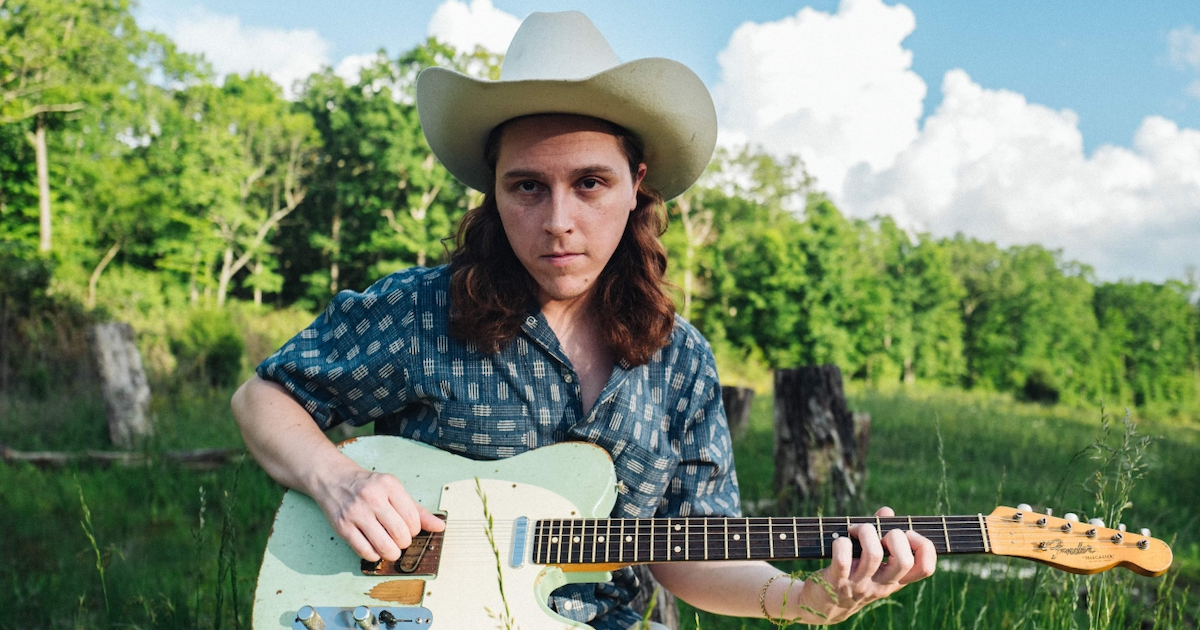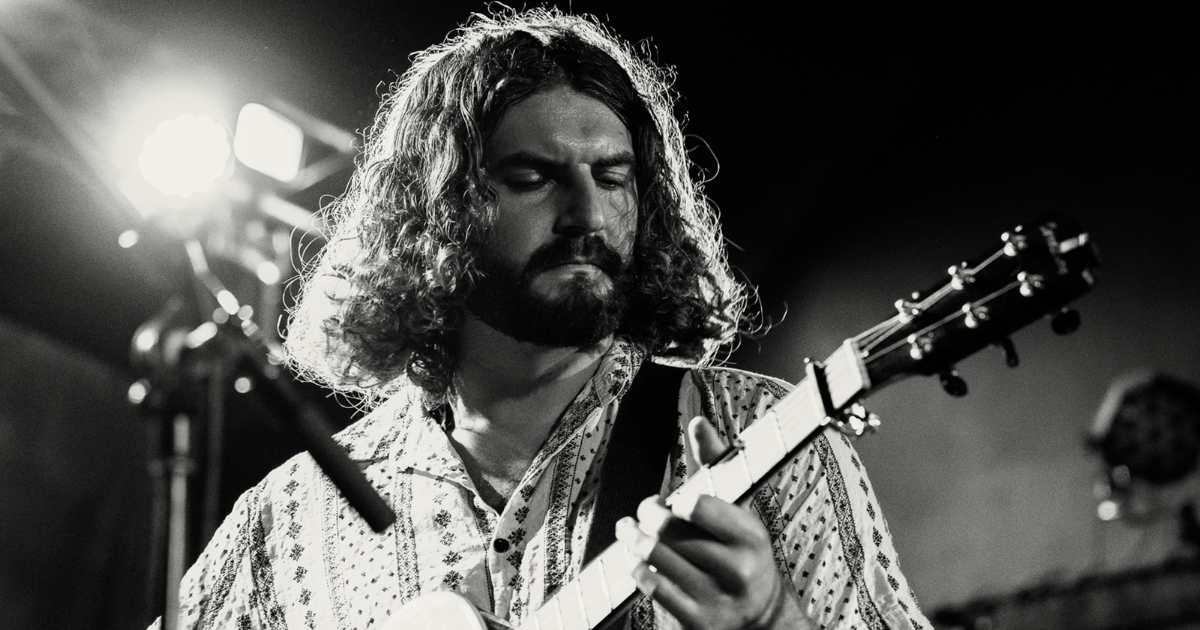
Cole Chaney is
“Anti-Machine”

While many young talents, willingly or hesitantly, bow down to music industry boardroom suits who promise stardom if they’ll follow a professionally curated path, Cole Chaney takes a hard pass. He knows exactly who he is, what he does, and how he wants to get there. He creates songs, not content. He’s a career musician, not a brand. And the only thing he hopes to influence, maybe, is someone, somewhere, who wants to make music for all the right reasons.

Chaney grew up in Catlettsburg, Kentucky, surrounded by the legacies and storytelling of his elders. After graduating high school he worked as a welder, uncertain of his career path, but already fueled by his passion for music. Today, he keeps one musical foot in the bluegrass traditions of his Appalachian roots and the other in guitar-centric, amplified bands like Soundgarden, Nirvana, Alice In Chains, and Stone Temple Pilots.

His debut album Mercy and subsequent OurVinyl Sessions reflect his love of acoustic music and showcase his leanings toward introspection and melancholy. In the Shadow of the Mountain, released last fall, takes that darkness to a new place, balances it with moments of light and leans into the aforementioned rock influences, while never losing the origins of his sound. All of this shines at peak level onstage, captured by Western AF on a Live AF Session.

Sitting outside at home on an April morning, drinking coffee and surrounded by the sounds of birds and a breeze, Chaney spent a couple of hours on the phone with Good Country. He spoke candidly about his music, faith, values, mental health, and the intertwining of inner peace and inner turbulence that make all these things uniquely him.

When you were ready to do this professionally, you went to Lexington. Most songwriters would have chosen Nashville. Was yours a deliberate decision or a natural one?

Cole Chaney: To understand that decision, you have to look at who I was looking up to at the time – and still do – and what drove that decision. When I was in high school, probably around my freshman or sophomore year, 2014 or 2015, I started getting into this band called Sundy Best. They’re from Prestonsburg, Kentucky, which is just down the road from me. This was pre-Tyler Childers. At the time, in Eastern Kentucky, these guys were the biggest thing coming and going. They leaned heavily on being from Kentucky, the same way I do, and they moved to Lexington to get a foothold.

That was my early example, watching those guys. I knew they weren’t going about it the traditional way, which was to go to Nashville and pray somebody picks you up. They did it in Lexington. A couple years later, Tyler Childers comes along – another super-influential figure in my musical upbringing. Of course, he’s anti-Nashville – not the city, but the machine, if you will. I’m pretty sure he lived in Lexington, or at least around the area in the scene, for a while. So did Sturgill Simpson. The list goes on.

I was like, “What business model makes more sense to me? Do I go to the place where there’s more songwriters than the rest of the entire planet or somewhere where people will actually understand what I’m saying and I can maybe build myself a little bit of a foundation?”

The way I saw it is if I started building a sort of fan base or if I had enough ticket buyers, places like Nashville or Denver, these big music scene cities, what choice would they have other than to book us? That’s the way I looked at it.

And it worked.

It did work. It’s a simple business model, but the difference between that model and the other is you’re not sitting around waiting for something to happen. It’s on you to go out and make your own connections. It’s a very grassroots and organic way of doing it and that’s the way I like to do things. I’m anti-machine. Even though I work with some bigger companies, I keep it as limited as possible. That’s so I can play pretty much wherever I want, whenever I want, and they understand that.

On the Whiskey Riff Raff Podcast you said, “Music found me.” Would you mind expanding on that just a bit?

It did. I never would have dreamed at 16 years old that I would be doing this as my full-time job at 25. That was never on the horizon for me. I didn’t know what I was going to do. I knew I was going to weld for a little bit, see what happened, and maybe try to start my own business. And I did. But I really didn’t think it was going to end up like this.

I started realizing that people liked to hear me play and sing around the same time that COVID hit really hard. That gave me an opportunity to sit down, write some songs, and think about what I wanted to do with the rest of my life.

I’m very much a subscriber to the Bible, and I think the Lord has a mysterious way of working. He put me on a path without me even realizing it way back then and I do my best to stay on it now. I think my job while I’m here is to create as much good stuff as I can, stuff that means something, get it out to the people, and get out in front of them and play it for them. As somebody who enjoys going to shows in their free time and watching my favorite bands perform live, I know how that feels, and it’s truly a privilege to be able to offer that same service to other people.

There is music in your bloodlines, not professionally, but family members who played in church and at home. You obviously assimilated the sound of the area, and also this wider scope with bands like Alice In Chains and Stone Temple Pilots. When did all of that begin seeping into your songwriting?

We listened to the radio when I was growing up. I didn’t get educated on music or how to play until I started really getting into it. To this day, I’m still being educated and learning how to play on a daily basis. Part of what keeps it so fun to me is how much I don’t know and constantly learning about things.

Mercy was my first album, and I had access to what was around me. I had just moved to Lexington and I was really into bluegrass. There’s a band called the Wooks that, to this day, Glory Bound is one of my top three favorite records of all time. I was infatuated with that sound and that was what I wanted Mercy to sound like, or at least as close to it as I could get. A lot of the Wooks ended up playing on that album, plus Michael Cleveland. It was crazy.

Alice In Chains has been a mainstay in my musical taste since I was probably 15 or 16 years old. Since I first found them, I was very drawn in by the tone of Layne Staley’s voice and the weight of Jerry Cantrell’s guitar. It feels like you could bite it and chew on it. I don’t know how to describe it.

I’ve also always loved bluegrass, so it was [figuring out] how to bridge the gap of what I listen to and where I want to go with my writing without completely abandoning that sound. And bringing the alternative rock sound into the folk realm, where you have mandolin, upright bass, fiddle, acoustic guitars, and drums. The biggest change in the sound has been the addition of drums over the past two years, navigating that and seeing how it fits into the whole equation. It opened up a lot of avenues for me as a songwriter.

You began playing guitar at 13 or 14. Did you always play acoustic?

The thing about electric guitar, for me, is that it’s such a deep realm of gear and a deep dive. I’ve always been attracted to good-sounding acoustic guitars and players like Tony Rice, so I felt my effort was best spent getting really good at playing the acoustic guitar.

That will carry over whenever I decide to pick up an electric guitar, more so than if I only played electric guitar and tried to write some bluegrass-style acoustic lines. It would be a tougher transition to come over from light gauge strings on an electric guitar to .013s on a dreadnought and trying to play “Blue Railroad Train” or something like that.

Do you have an electric guitar?

I have several electric guitars. I’ve got a ’57 reboot Stratocaster, an American Professional Telecaster, my old Paul Reed Smith that I learned how to play electric on, and a nice Vox amp. I don’t know all that much about electric guitars. I still have a lot to learn.

Prior to this interview, you sent over your touring rig: a Gibson J-45 Banner in standard tuning with a K&K Pure Mini pickup, and a Breedlove sitka/rosewood Custom Dreadnought in drop D/double drop D, with an LR Baggs Element VTC pickup. Also two Grace BiX DI’s and a Lampifier Model 711 cardioid mic for lead vocals.

Those are my road guitars. They aren’t the ones I recorded everything with, but those are what you see at the shows.

In addition to the Gibson and Breedlove, do you have other acoustics?

I have two Gary Cotten guitars. [On] OurVinyl [Sessions, that] was my first Cotten I recorded with. On In the Shadow of the Mountain, many of those songs are my newer Cotten, which is sinker mahogany and an Adirondack top. “Alone?,” “In the Shadow of the Mountain,” “Into,” “Feels Like Rain,” and “Spirit” [were all recorded] on the Cotten.

That guitar sounds huge. It’s an outstanding guitar. I don’t tour with it because I’m scared something would happen to it and it’s too special to me. And Gary’s a great dude. He’s always taken really good care of me, and I want that guitar to stick around for a long time.

I don’t have any electronics in it, either. It’s a very traditional style, it’s a dovetail, and I want to keep it as traditional as I can and keep as much weight out of it as I can, because the more weight you add, sometimes it makes them sound worse.

What makes the Gibson and Breedlove right for touring?

They’re super-versatile and they both sound fantastic plugged in. That Breedlove is the longest-standing guitar I have that I’ve consistently played shows with. I got it in 2019 from 4 o’clock Rock Guitar Shop in Ashland [Kentucky]. It’s a custom dreadnought that they shop-ordered and it’s got the LR Baggs VTC Element in it. It has always sounded so good plugged in. I mean, all guitars sound bad plugged in, but it’s a matter of how much of the original sound can you actually preserve when you plug it in.

I’ve gotten to the point where I am almost starting to desire a little bit of that direct input texture. Maybe it’s because I’m listening to too much MTV Unplugged, but I’m starting to desire that kind of cardboard bad sound.

The Gibson, I put a K&K Pure Mini in and it sounds really close to what it sounds like not plugged in. Man, that Gibson is a beast. I love that guitar. It’s been to every show with me since I bought it last year.

I still have a Paul Reed Smith acoustic guitar and it’s a damned good little guitar. I’ll probably end up using it again on some stuff. It’s one of those that you plug in and it sounds great, too. But when I got into the whole bluegrass thing, I knew I needed something with a little more body.

Sometimes you use a pick, sometimes fingers. Either way, your attack is strong. How did your technique develop?

It’s one hundred percent out of necessity. I had a really bad injury in 2015 and I damn near cut my index finger completely off at the knuckle. I can’t wholly bend my index finger and I can’t feel the picking side of that finger. If you watch some of my older videos, my index finger is flailing around all the time. It’s because I’m picking with my thumb and middle finger, and that’s where I’m holding the pick. That took me long enough to learn how to do.

In recent years I’ve learned how to use my middle finger to lock my index in place and be able to hold a pick. It looks normal, but if you could see how the sausage is made, it’s not that pretty. I wish I had that dexterity in my finger. The takeaway message from that is, “Take care of your hands, y’all.”

Let’s talk about the through line from bluegrass to bands like Stone Temple Pilots and Alice In Chains. You blend the genres seamlessly and it all makes sense. Did you always feel that connection?

If you listen to any playlist I’ve had, I’ll go from Ralph Stanley to Chris Cornell in a heartbeat. Obviously the music is different, but there are common themes between the two. Mountain folk music, hard rock, and that era are very dark and brooding, and they can be heavy in their own ways too.

What is heavy? What makes a song heavy? You’ve got people drop-tuning their guitars, but it’s still not as heavy as Pantera or Black Sabbath or something like that. So it’s not necessarily the sound that makes it heavy. It’s the vibe of the song.

I feel like a salesman a little bit, trying to sell this idea that this stuff can be brought together and related in an authentic capacity. Let’s take [Stone Temple Pilots’] “Big Empty,” for example. To do a cover of that and be looked at as a folk artist or an Appalachian artist, or some people will even say country – which I disagree with, but whatever – it always seems like somebody will start into a cover of this great song, but then they’ll get hokey with it and it loses all its purity.

That’s not at all the intended purpose for me. It’s to say, “This is a fantastic song and it fits the vibe that we’re all going for in this realm.” A lot of people probably didn’t know that a mandolin or fiddle sounds great on “Big Empty,” but now they do, because it fits. That’s the way I listen to that kind of stuff. It’s just how to pull that off without being cheesy or coming off in a capitalistic way. More so in a way of, “I love this song and you guys should listen to it.”

Was it challenging to find musicians who understand going from bluegrass to Stone Temple Pilots and back again?

The band, I think through a lot of prayer/manifestation, has come together and, as you hear, they’re fantastic. They can play anything in any style. Ella [Webster] and Kyle [Kleinman] come from a more traditional folk music side of things. Kyle is a bluegrasser and Ella is an old-time fiddle player. Lars [Swanson] and James [Gooding] are jazz cats, so they have infinite vocabulary when it comes to music. If you can play jazz, then you’re going to be all right. If you can pull off that stuff, you don’t have anything to worry about when it comes to my type of music. Stone Temple Pilots is a walk in the park for you.

In our van, the most listened-to bands between us are Soundgarden, Pantera, whatever James’s choice of jazz is, and Alice In Chains MTV Unplugged. That’s a really good piece of music. But yeah, they’re a great band and they can play anything.

Did Lars and James know each other before they joined your band? To lock in a rhythm section…

No, they didn’t. Once you start playing with a jazz drummer, you need somebody who can comprehend the stuff he’s laying out and answer that on the bass. To have those two sit in a room and jam is really something to witness and listen to, because they speak a language to each other that I don’t understand. But I love when they do it, and it’s great to hear.

I’ll be playing onstage, singing and doing my thing, those guys are behind me and I’ll hear them back there, talking to each other while we’re doing this thing, and it’s awesome. They’re special. Those two dudes – they’re incredible. They’re the unsung heroes of music in general. That’s your metaphorical offensive line right there. If you don’t have a Lars and a James, then your quarterback’s getting sacked all the time.

This is you in 2025 on The Western Side, talking about Shadow: “a lot of darkness and an equal amount of joy in other songs. It’s a good depiction of where I’ve been for the past two years. A tumultuous and chaotic time period, but also great. And I’m still here.”

Then, In 2021, on With A View: “I load the pressure on. It’s how I operate. My brain lives in constant turmoil.” In 2020, talking about “Fever Dream,” “a song about trying to keep it all together. … the way I deal with this is isolation. And when you isolate yourself, you don’t have much of a choice but to hash some things out in your head.”

You are no stranger to the dark place.

Hearing those things, I look at that younger version of myself almost as I would look at a younger brother. Part of me wishes I could put an arm around that kid’s shoulders and be like, “You’re going to be all right, buddy.” Times got a little tough, as they probably should for anybody at points in their life. You can’t really enjoy the great parts of your life without having a little bit of adversity to overcome or deal with. The darkest part, for me, was maybe just growing up and gaining a new understanding of the way the world actually operates and how hopeless that can be at times, but also how beautiful it can be in the same stroke.

What I’ve realized is you get out of this world what you pay attention to, because whatever you want to find, you can find it. It’s there and it’s aplenty, whether you want to find the negativity and suffering, or whether you want to find the positive and the good. I don’t have the answer to where folks are supposed to operate and live, but I think it’s good to help people who are in that suffering side of things. But you can’t let that dominate your existence, and for a little while, I was maybe dominated by the darker side of life.

I try to be as empathetic as I can, but with that comes feeling a lot and also accidentally hurting people sometimes. That’s really tough, because then you have this cycle of guilt that you deal with trying to make it right in your head. As I’ve gotten a little older and maybe figured a couple things out, I try to have a lot more grace for myself. What I’ve learned about the pressure is that it’s really just perceived pressure and none of that exists, and you should just care less what people think.

Obviously, music is where you go during those times.

Absolutely. If something is eating at me that I’m having a hard time getting out in a linear fashion, a lot of times I find myself writing about it without even realizing it. My mom is an abstract painter, so I grew up with an understanding of what “abstract” means and abstract concepts. That’s how I materialize a lot of that stuff, because some of it is things I would never come right out and literally write down, for multitudes of reasons, but things you want to indirectly address. That’s when [abstraction] becomes a great tool for addressing those kinds of things. Metaphors.

It seems, when it comes to expressing those things, you’re in the balance between the emotionally open world of Cornell, Cobain, and others and the world of bluegrass, country, hunting, fishing, and those stereotypes of “manly men” – and not so much emotional transparency.

Not necessarily. I don’t know about the whole “alpha male” personality type. It’s always seemed to me that a lot of times the guys who are trying to be perceived as macho are probably the ones who need a hug the most. Now it’s everybody else’s problem because their dad didn’t do it, and that sucks.

As I’ve emotionally developed a little bit, I’ve really started to respect individuals like Chris Cornell. If you look into him as a person and watch some of his interviews, he’s intelligent and seemingly self-aware. I respect the way he conducted himself, especially in interviews, and the way he made sure to pay attention to people and make them feel seen. The only way you can empathize with people like that and make sure of those types of things is if you’ve been on the other end of that stuff and you’ve felt looked over and brushed off.

I may not be the best at answering Instagram DMs, and I definitely don’t stay on the internet because I think it sucks, but if I talk to somebody in person, I always try my best to give them that and be present in the moment. Somebody else that does a fantastic job of that is Nicholas Jamerson, the frontman of Sundy Best, who’s a mentor, friend, and hero of mine.

Have you ever felt any hesitation about publicly ripping off the mental health Band-Aids? Or, conversely, is there a feeling of opening the door to people having these conversations?

Sure, there’s hesitation about a lot of things. There’s a lot of decisions about, “How do you want to portray yourself in a public light?” But my main goal is and has been to just be as authentic as I can, as representative of how I feel about things as I can, and to be accepting of people and understand that they come from different places and have different perspectives.

With that hesitancy, there’s also much more in the way that when we were talking about 20-year-old Cole, the way I want to put my arm around that kid and comfort him, that’s what I want my music to do for people that feel the way I was feeling at that time.

Listening to you, I’m reminded of something Charlie Daniels said to me during an interview years ago: “Music is too precious for me to prostitute it.”

Oh, yeah. Absolutely. And, too, Charlie Daniels is one of the greatest country musicians ever. I want to go on record saying that.

The way I look at it is, could I see my heroes, people I look up to, going online and being like, “Comment what song you think I should release next”? No, I don’t think I could. When I see someone who has musical and artistic integrity, that’s how I’m going to operate. I’m going to try my hardest to uphold my integrity and not do the TikToks and the really cheap stuff.

You absolutely will suffer financially for not playing the game and if you don’t kiss the right ass, but, to me, that suffering is not negative suffering. I’m honored to be able to suffer like this, because if my options are suffer or have to watch Country Central’s “Hot Take Tuesday,” then give me suffering all day long, because I’m not paying attention to that bullshit. It’s ridiculous. I don’t care who’s beefing and I don’t care what dude is playing cowboy this week.

That’s why I’m trying to get out of the country scene. It’s becoming so fake and there’s so many people trying to be carbon copies of other people. There’s no authenticity. Everybody’s full of shit. We went through this period where people like Tyler [Childers] drove the spear through the heart of this mainstream country thing and it was akin to when Nirvana came on the scene and effectively killed hair bands for a while. But then the Nirvana copycats came along and garnered a lot of the same attention.

I’m not saying that just Tyler Childers is responsible for this. People like Sturgill, and a lot of smaller artists in their own scenes, are responsible for the turning over of the dirt, if you will. But it’s getting stale. It’s past getting stale. It is stale and it’s bad. There’s a lot of really shitty music being put out right now and I don’t want any part of that.

If I’ve got to step away and back off and be out of the internet eye, then fantastic. That doesn’t bother me one bit. If it means a few less people know who I am, then so be it. But I hold out hope that people will eventually realize how cheap and bad a lot of the music is that is being promoted right now, and there’ll be another turning of the dirt soon.

Yes, art is subjective, but art is subjective. Not this corporate bullshit that they’re trying to push. That’s not art. That’s six dudes in a room trying to come up with a song that’s going to sell on the radio or sell on the internet, or “We’re going to put thirty tracks on this album” so they can set streaming records. It’s like, “Man, y’all have lost the complete plot of the whole thing.” There’s nothing interesting about that to me. I’m all about authenticity. I want to believe the person on the other side of the microphone from me, and if I don’t believe you, then I’m out.


Photo Credit: David McClister
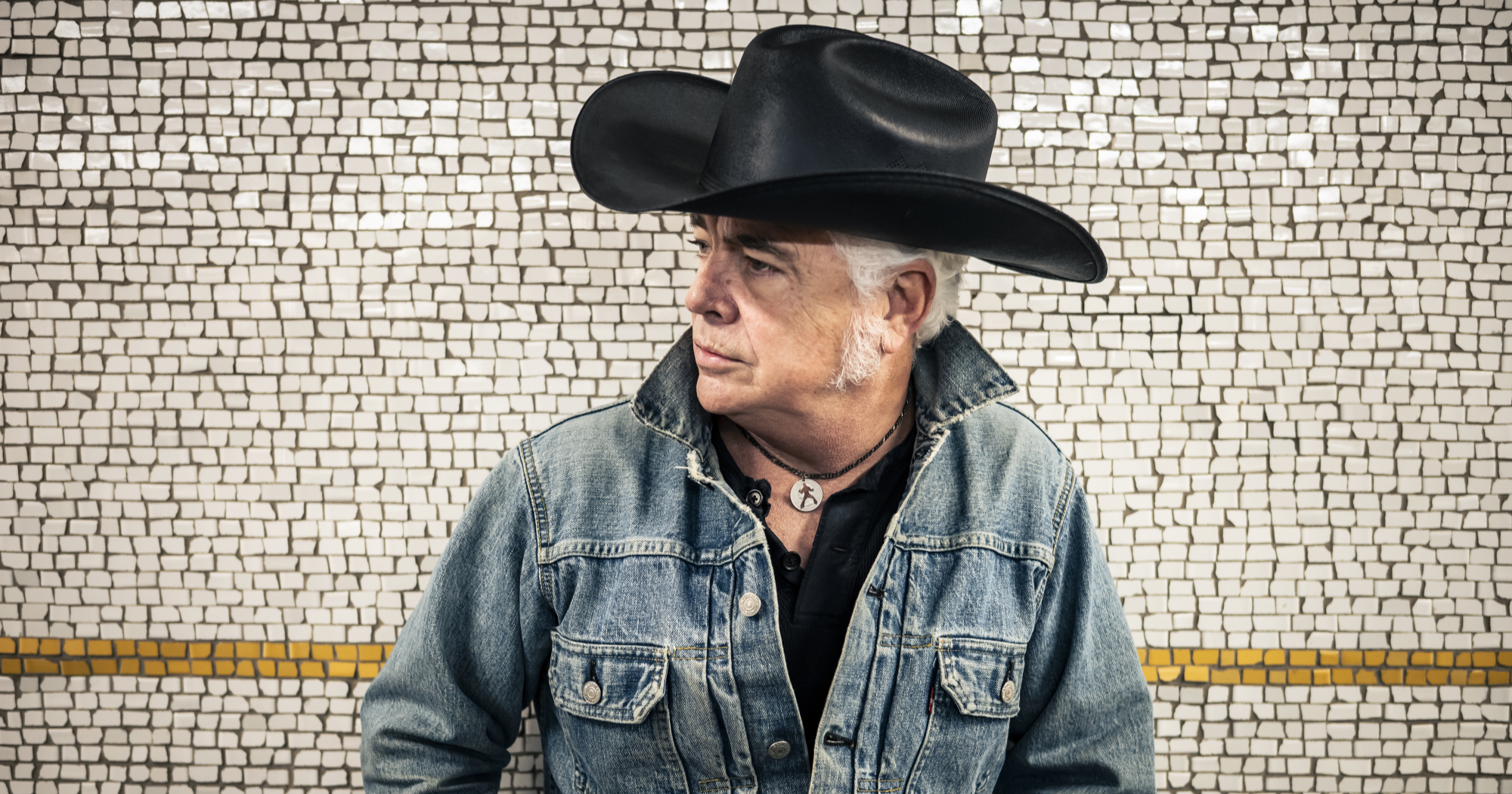
Dale Watson’s Ameripolitan Today Playlist

Ameripolitan music can be best defined as original music with prominent roots influence, and it has four categories: honky tonk, Western swing, rockabilly, and outlaw. My Mixtape features a song by an artist that represents the roots and then I’ll play a new artist that directly was influenced by them. You can hear the natural growth of country music when you listen to Lefty Frizzell and Merle Haggard or Kitty Wells and Loretta Lynn back to back. (Many of the roots artists had nicknames, I miss that.)

While some may hear an artist’s influence and say they are copying them, I’m of the opinion that John Lennon shared when asked about The Beatles’ influences. He said, and I paraphrase here, “One’s originality comes out in their inability to imitate their influences.” Very well said. – Dale Watson

“Who’s Gonna Take The Garbage Out” – Loretta Lynn, Ernest Tubb

Ernest Tubb had a distinctive voice as you hear on this song he sings with Loretta Lynn. Here’s the Texas Troubadour with the Coal Miner’s Daughter.

“My Wife Thinks You’re Dead” – Junior Brown

And no one is more evidently influenced by him than Junior Brown.

“Undo the Right” – Johnny Bush

Johnny Bush, otherwise known as the “Country Caruso,” was a drummer for Ray Price, the Cherokee Cowboy, before going out on his own. You would definitely hear that influence if you back-to-back Ray Price to Johnny Bush. Both are huge influences to every singer that grew up in Texas.

“Texas Honky Tonk” – Justin Trevino

This young man from Texas is carrying the Bush torch.

“D-I-V-O-R-C-E” – Tammy Wynette

The First Lady of Country Music, Tammy Wynette was married to the Possum, George Jones. She is easily at the top of women that influenced the newer singers.

“Houston Belongs To Me” – Sunny Sweeney

Singing her own divorce song, here’s Sunny Sweeney!

“Big Balls in Cowtown” – Bob Wills & His Texas Playboys

In the Western swing category this is the master, Bob Wills & His Texas Playboys.

“Riding High in Texas” – Asleep at the Wheel, Billy Strings

Though they’ve been around a while, they still burn up the road and proudly wear Bob Wills as their biggest influence. Ian Stewart sings as guest picker Billy Strings shines.

“Here in Frisco” – Merle Haggard

The Hag has influenced generations and even in death he still does. He once told me he forgot he wrote this song and was glad I brought it up so he can add it to his playlist again.

“This Highway” – Zephaniah OHora

Zephaniah OHora is now based in Nashville and he’s got a lot of great original songs. On this song you can hear the Hag in him.

“Bob Wills Is Still the King” – Waylon Jennings

In the outlaw world there is none more influential than Waylon, and in Texas we were all influenced by Bob Wills.

“Long White Line” – Sturgill Simpson

This particular song draws heavily on Waylon’s influence. And I like it.

“Ramblin’ Man” – Hank Williams

Hank Williams’ voice is one of the most recognizable in music. His songs are timeless and still inspire singers and songwriters alike.

“Thunderstorms and Neon Signs” – Wayne Hancock

You can definitely hear Hank in Wayne Hancock, but his own voice is definitely original, too – as well as his great songwriting.

“Guitars, Cadillacs” – Dwight Yoakam

Dwight Yoakam has influenced many a newcomer. Just as he was obviously influenced by Buck Owens. He came along when Nashville needed reminded of its roots.

“Lost in the City Lights” – Johnny Falstaff

Though not well known as of yet, Johnny Falstaff is picking up Dwight’s hat.

“Blue Kentucky Girl” – Loretta Lynn

The Coal Miner’s Daughter definitely left big shoes to fill, but her sassy songs inspired many women artists.

“Don’t You Ever Give Up On Love” – Brennen Leigh

That inspiration can be traced right to Brennen Leigh.

“Good Hearted Woman” – Waylon Jennings, Willie Nelson

Here’s the quintessential outlaw song by the most famously influential artists, the Red Headed Stranger, Willie Nelson, and Waymore, sometimes called Wautawsha, Waylon Jennings.

“Willie Waylon and Whiskey” – Dale Watson

The last song I’ll put in here’s is mine, because with pride I will state, yes, I am heavily influenced by Willie and Waylon. And sometimes whiskey.


Photo Credit: Jacob Blinkenstaff

Tedeschi Trucks Band Have Done It Again

When it comes to entirely enjoyable, technically exquisite modern blues, Southern rock, and jam-band soul albums, Tedeschi Trucks Band have a statistically impossible batting average. Their new LP, Future Soul (released March 20 via Fantasy Records), is yet another “no skips” collection from the megalithic 12-person Americana group fronted by husband-and-wife guitarist Derek Trucks and guitarist-vocalist Susan Tedeschi.

On that strength of their catalog – and their ensemble – TTB have amassed hundreds of millions of streams, won eight Blues Music Awards and one GRAMMY, and a handful of their songs have become regarded as modern standards in the Americana and American roots music songbook.

Future Soul simultaneously feels like a surprising departure and familiar, essential territory for the band. With Mike Elizondo producing and songs and creative input sourced from across the group’s lineup, the set ends up sounding and feeling more acoustic than “usual,” while still reaching roaring crescendos and building it all on dank, wide open grooves. Perhaps those acoustic moments are a substantial contributing factor as well, but the cozy, plush pocket of the album is what gives it a laid-back, relaxed, and floating vibe no matter the track’s genre construction.

Screaming slide, no-holds-barred vocals, and wall-of-sound climaxes can all be found herein, as well. But the collection never thrashes or flails, it’s precise and exacting – as Tedeschi and Trucks are both known to be on their instruments, whether guitar or voice – but it’s certainly not sterile or gated or homogenized, either. It’s another remarkable feat for a group so large that you would almost have to assume, live or in studio, musical mud would be an inevitable byproduct.

But no, TTB seem to have no misses, at least not on Future Soul. It’s clear this group works together in harmony not just because of the down-to-earth and collaborative leadership of Tedeschi and Trucks, but because the artistic and musical responsibilities and ownership – of the songs themselves, of the album, of the makings of each, of “success” for the band – are decentralized and distributed throughout the group. The band has a sound, an art, that is consistently collective in the way it’s received by audiences and listeners because, forgive the obviousness, Tedeschi Trucks Band always work as a collective.

In our BGS conversation with Derek Trucks, the magic and unlikelihood of this creative dynamic and the processes by which the band continues to rack up success after success were on full display. We spoke about how they put together Future Soul as a group effort, the many inputs that went into Trucks fashioning his lyrical guitar style, and what bluegrass means to him personally, to Tedeschi, and the band as a whole. It was a joy-filled, passion-led conversation that again reinforced how this wailin’, rockin’, rollin’ band continues to flout and subvert expectations – and thereby has become so beloved.

Something that jumped out at me from the bio about the new album is that you say, “There’s just not a weak spot on this record.” I have to say, I totally agree. I think it’s remarkable that with a 12-person band and such a diverse catalog of recordings and releases, it really doesn’t seem like there’s any “fat” to trim or any duds to cull.

I have to ask, does it feel as magical on the inside of that process as it seems from the outside? It seems unlikely that y’all would work so well together towards a common goal, artistically, and be able to deliver again and again and again. And I don’t just mean commercially, awards-wise, or for audiences alone. Clearly you’re delivering artistically for yourselves and by your own standards, as well. So, does it feel as unlikely on the inside of that process as it maybe does to us on the outside looking in? [Both laugh]

Derek Trucks: That’s awesome. But it does, man! I mean, not every record you do feels the same way. They’re all their own beasts. For I Am The Moon, it was in a time of great uncertainty. We did four records and it was just kind of a heavy, heavy time – and that record feels like that.

This one felt completely different. The band felt much more confident [and] had been touring for two years straight. We had been playing so much together that when we finally got the core of the group up to our farm in Georgia to do some writing, there were a few songs right out of the gate. Like “Future Soul” and “Who Am I,” where immediately, Sue started singing, Gabe [Dixon] started singing these melodies. I got chills and I was like, “Oh, this is gonna be good.”

You’re always kind of worried about running out of ideas, or running out of runway – like a thing in the back of your head. But I feel like we’re incredibly fortunate where, when we’re together, everyone puts everything they have into it. Then, when we’re not on the road together, everyone’s all doing their own things musically. So, when we come back together, there’s a lot to talk about and a lot of music to remember together.

I think it keeps it really fresh and it keeps it moving forward. I feel like everyone’s out honing their craft when they’re away from this. When they come back, there’s a lot of new ground to cover. So far, we’ve been really, really lucky that way. And there’s a handful of just incredible songwriters in the band, so everybody comes in with two or three ideas. You’ve got a pretty strong record right out of the gate. That’s been something that I think me and Sue are just realizing – we’ve known how amazing that is but, you know, Gabe and Mike [Mattison], they show up with some serious ideas.

Then having Mike [Elizondo, the album’s producer] down, just some outside ears – I think that was really important. Sonically, he was trying some different things that I think inspired the band and made everybody play a little differently. That was exciting.

I was struck by the range of styles and the different genre infusions that y’all have put into this collection. What really stuck out to me, listening down to the project in one fell swoop, is there are still those really big energetic moments – and there are still those “wall of sound” moments that y’all are really known for. But I felt like this album is chill and laid-back in a way; it feels deep in the pocket. Can you talk about capturing those seemingly disconnected energies together?

I think one of the things is that with a band or an artist, I think if you’re maturing properly – we learn sometimes slowly – that you don’t have to force the issue all the time. You can trust things around you a little bit more, and sometimes the groove is enough. Sometimes the chord changes are enough, sometimes the melodies are enough. It doesn’t have to be these epic moments at all times. So when they do come, you’re excited about it and wrings you out. Then you lay them back down, and then you go on another little trip.

I think the band, having played together so much, we’re in a different place that way, where we realize that you don’t have to force the issue on every song. You can go to different spaces, different places. And then, again, having some outside ears – Elizondo really helps with that, too. He helps guide you to places that maybe you wouldn’t have gone naturally, so that’s a fun thing. Then you learn things about yourself musically in the band that you didn’t know before. That’s always a good place to be.

One thing that I’ve been obsessed with about your playing, specifically, ever since I discovered you as a teenager, is how lyrical of a guitar player you are. It jumped out at me from the bio, as well, when you’re talking about “I Got You” and how you’re doing a guitar-voice dialogue instead of guitar-guitar. I think of you as one of the most lyrical guitarists out there. You’re so present and so grounded. So I’ve always wanted to ask you how you’ve cultivated that style – as well as being able to have those moments of pure shreddy, lick-y wailing.

Then hearing that you really wanted to make that connection between voice and guitar on this album made so much sense to me, because I’m always thinking about how you’re a lyrical player. And Susan is, too, and you both dialogue with your instruments, and her voice, often.

Pretty early on I had a few musical epiphanies. One was Allen Woody, who played with Gov’t Mule and the Allman Brothers. When we toured with my solo band, opening for a Gov’t Mule in the early days, he would always turn me on to records. He gave me this CD by this guy named Aubrey Ghent, who was a gospel [steel] player. I put on “Amazing Grace” and I was like, “Wow, what an amazing voice.” And then I heard the pick and I realized that it was this guy playing lap steel! But it sounded like a woman singing. I got chills [over] my whole body, and I was like, “That’s it, that’s the thing.”

I had been listening to a lot of Indian classical music – a lot of vocalists and sarod players. Me and our old [Derek Trucks Band] bass player, Todd Smallie, went to Ali Akbar College of Music in San Rafael, [California] and they would let us sit in on classes. I realized he [Ali Akbar Khan] made all the instrumentalists take vocal classes, because his whole thing was that you should be singing through your instrument. So that made it just really obvious.

Those were a few of the things, and then there was a long time where I just stopped listening to any guitar player. It was only singers and horn players. That was kind of the idea [that] musical ideas can come from anywhere, but you really should be singing the thing. There’s time for all of it, but the stuff that moves me the most is, you know – even hearing Duane Allman on “Blue Sky” or something. It sounds like somebody’s singing, like somebody is walking down the road whistling. I think those are probably the touchstones for me.

Maybe I am projecting a little bit, because I’ve been a bluegrass banjo player my whole life – I started playing when I was seven. But when I think of guitarists, especially who end up reaching the pinnacle – whatever that is – or especially in flatpicking and in bluegrass, there tends to be this homogeneity of style. The people who get to the “very top” end up all sounding like each other. Then you have those folks that really stand out, and it tends to be because they’re using space and using air as much as they’re using 16th notes and 32nd notes. I think, being used to really shreddy flatpicking, that hearing steel or slide or blues guitar or jazz or acoustic jazz, anything plays with sustain and plays with space, I just drink it up.

Beautiful, man. I remember the first time I heard the Stanley Brothers, or Ralph Stanley, and I just remember it hit me in that place where those early blues guys hit me. There was just something about it. That kind of cracked that whole world open for me. I mean, I was always a Tony Rice fan. We have the same birthday, so I thought that was cool.

No way, I didn’t know that.

And I remember being at a MerleFest years ago, I think it was one of the last ones that Doc played. I remember seeing this old Oldsmobile or Cadillac – I don’t know, it seemed like an 1980s or ‘90s car – it pulled up to the stage and I see Tony Rice get out, just dressed to the nines. He pops the trunk, gets his guitar, hits the stage, and then right when that set was over, he was back in that car! I was over there thinking, “What a boss.” It was incredible, man. He went up and just annihilated everybody and got back in his car and drove his ass home. Pretty incredible.

So funny.

The last time we talked to you for the site, you were Artist of the Month in 2019 and you talked about Del McCoury and Jerry Douglas. I know you’ve played DelFest a bunch, you’ve collaborated with Billy Strings – oh, and I was super excited to see Molly Tuttle supporting on a couple dates of your TTB tour in April, too.

Yeah, we’re excited for that. That’s gonna be great.

What does bluegrass mean to you? Obviously, there’s Ralph Stanley, Tony Rice – there are pickers and makers in bluegrass that are infused into what you do, but what does the genre mean to you more broadly? And who in the space right now inspires you, or your musical vocabulary, or what you guys are doing in the band?

When I think of American music, I think of blues, I think of bluegrass, and I think of jazz. I think [those are] the things that we’ve really contributed to the world. To me, those are the cornerstones of it.

We’ve become good friends with Sturgill [Simpson] over the years, and he’s dipped into that [bluegrass] place. When I hear him sing it I’m like, “Oh yep, that’s because he’s from there.” He’s from the heart of it, and it makes me feel the way Ralph Stanley does at times. Even guys like Tyler Childers – and Sue’s a big Sierra Ferrell fan. She loves all those records.

That music, even the current guys, it’s always playing around here. I don’t know, it just feels inspiring to hear. People just get on an acoustic instrument and rip one. You’re like, “Oh yeah! There’s still people that know how to do things!” [Laughs]

That’s the big inspiration I take from it. Because [in the music industry] there’s a lot of cutting corners, and that’s a music that there’s no cutting corners. You gotta put your time in and take your licks or you’re just not gonna get on stage. I appreciate not just the dexterity, but the vocabulary and the heart that goes into it.

And there’s just something about seeing a group around one microphone just doing the dance that I think is always inspiring. We’ve done some shows recently with Sam Grisman, we did a benefit [for Camp Winnarainbow] out in San Francisco. Peter Rowan was on it, and me and Sue, and it was all acoustics. I had an old National, and just getting to play with that group – just the way that group felt. Sitting on a stool with a Dobro, and they were coming and going around the microphone. And then, getting to hang after the show with Peter Rowan and him telling these stories, man. It was just incredibly inspiring. Some of the songs that we got to play with them – that dude [David “Dawg” Grisman] has written some incredible music. That was one of the highlights of last year. It was pretty damn incredible.

There’s a lot of acoustics on this new album, too. I did find myself wondering, and maybe I’m biased, but does the world need a 12-piece bluegrass band? It might! It might! [Laughs]

Man, that sounds pretty fun to me. I mean, it would be a lot less gear to carry on the road! Which would make it more plausible.[Laughs]

If you wanted to speedrun pissing off a fan base, this might be the way to do it.

[Laughs] Yes, alright, we will be thinking about this! I’m gonna go talk to Sue.

This next one is kind of for me, so I thank you in advance for humoring me. But I wanted to talk to you about Jack Pearson. When I first moved to town, I just met this guy out jamming on mandolin at these bluegrass jams. I’d be like, “Man, this guy’s so nice.” He’s a great picker. He’s a great singer. I got a lot of practice playing swing with him at jams in town. Then folks started being like, “Hey, do you know who that is?” Oh my god, I did not know who it was. He was just my bluegrass jam pal. Then I worked at the Station Inn for a few years and I got to work a bunch of his trio shows. I’d die for the solo acoustic sets he’d do on the set break.

Incredible.

If I were to list maybe my top 5 favorite guitarists of all time, I feel like you and Jack would both be on that list. So I wanted to have a little nerdy moment to talk about Jack. [Laughs] Can you talk about his playing and your guys’ friendship? Of course, I see so many connections between your musical vocabularies and that lyrical style we were talking about.

Yeah, man I need to check up on him. It’s been a minute. I need to check in on old Jackie P.

He’s a monster, man. He’s one of the few people that can actually go play in a straight-ahead jazz band, in a bluegrass band, and then the Allman Brothers. I mean, maybe the only person that can actually do it.

I totally agree.

I mean, he played with Jimmy Smith. This dude is like, he’s an absolute monster. And a sweet fella! You can’t say enough good things. When I joined the Allman Brothers, Jack was just leaving. So all the tapes I got, like learning the new versions of the tunes, were Jack Pearson tapes. At the time, Bud Snyder was the sound man. He would mix these tapes for me with Jack really boosted in the mix. I could hear exactly what he was doing to learn these things. I got an intimate take on the way Jack was approaching these Allman tunes. It was so unique.

There’s no one [that] plays like him, and [his playing is] about as smooth as it gets. Sometimes, you watch him play – and I know he plays really light strings and he plays low action – and the way his hands move, I’ve never seen anyone play quite like that. Then he busts out a slide and you’re like, “Holy shit! This dude can do anything!” [Laughs]

I know!

He’s one of the unsung heroes. There’s no doubt about it.

He does this thing – and you do this as well – where you’re able to leverage that really gritty, aggressive, absolutely on-the-razor’s-edge style that comes with blues and Southern rock and Americana. Then at the same time, like you’re saying, with light strings and low action, still has such a deft touch. Yet he has such great attack and precision and cleanliness. He is a great lesson in taste. His taste is impeccable.

Yeah, I think that’s exactly it. I think we forget a lot of the time that most of what we love about music is the musician’s taste. I mean, you got to put in the work – and Jack has obviously done that, that dude is a master. But his taste is really as good as anybody.

I think he’s probably a bigger influence on me than I even realized. Probably because of that early Allman Brothers time for me. I was jumping in at 20 years old, 21 years old. And all of a sudden it’s, “Here’s 60 songs to learn, and rehearsal/tryout is in a few weeks. I was like, “Well, give me those dates.”

I’m stressed just hearing about that.

I mean, luckily most of that music I had listened to my whole life, but I had never bothered to learn any of them. I mean, I knew “One Way Out” and “Statesboro [Blues],” that doesn’t take long. It was all the other shit!


Photo Credit: Chapman Baehler

Daniel Donato Has Many Horizons in Sight, Literal and Metaphorical

Although names like Billy Strings and Sturgill Simpson currently corner the market at the intersection of country, jam bands, and bluegrass, rising star Daniel Donato has emerged in recent years with an out-of-this-world sound – and his newest project may be his best yet.

On Horizons (which released in August) the prodigy who as a child honed his skills on Guitar Hero and Nashville’s Lower Broadway turns a new page with an 11-song, hour-long compilation that brings his live and studio sounds together with drawn-out jams conjured up by his longtime bandmates from Cosmic Country – a moniker that describes both the group’s sonic and spiritual ethos.

“I want there to be a Cosmic Country sound where you can hear it right away, you can hear the first eight bars of any song and say, ‘That’s it!'” says Donato.

“Some of it is technical, like using the same microphones and the same studio as the last record. And some of it’s just in the way we approach it – and that’s something we get better at every time.”

Sitting on the back of his month-old tour bus affectionately referred to as “The Snowman” prior to a recent show in Lexington, Kentucky, Donato spoke to BGS about his Lower Broadway roots, creative freedom and restraints, and the catalysts for Cosmic Country.

We already touched upon your similarities with Billy Strings, but what about your parents’ influence – I know they played a big role in your musical foundation as well?

Daniel Donato: Everything when I was younger came from my parents. My father had a certain disposition for great rock and roll music like Pink Floyd, Stevie Ray Vaughan, and Led Zeppelin. But to be honest, I really don’t know where all of it comes from, because if you and I listen to a record we’re both going to hear it in different ways. For that reason I think a lot of this just comes from something that’s already dwelling within us and we’re just expressing from within that place.

For example, when I first heard Marty Robbins, I loved all the great guitar on it. And when I heard the Grateful Dead play “Big River” and make it eight minutes long in a really artistic and authentic way, I love that too. They’re all influences, but they start externally and creep inside you to the point that you take them with you everywhere you go and create from that place of soul, which is a combination of the body, the mind and the spirit.

Ever since I started playing guitar, I’ve always felt like I sounded like me and that “me” is constantly changing and revealing itself more and more. It’s like what Bob Dylan said – “I contain multitudes” – and it’s true. There are multitudes of self that just keep getting revealed through this authentic expression.

Was there a specific moment that served as the catalyst for you picking up the guitar and pursuing a career in music?

There have been many, but arguably the biggest was when I first saw the Don Kelley Band at Robert’s Western World and was in a state of shock – I’m getting goosebumps just thinking about it. That moment of hearing them and seeing how they interacted was amazing and was a big motivator in me wanting to do that too. It was a call to adventure and a reminder to believe I’m capable of anything, which is what ties all of these moments together.

That is not a self-assertive belief, that is a belief grounded in an authentic desire to make something beautiful so I can be of service. It was a big turning point in my life when I first started conceptualizing and receiving that, because then you can give it and then it turns into the cosmic circle of all things.

Some might perceive it as arrogance, but I think there’s a lot to be said for having the confidence to know what you’re doing is worthwhile and constantly chipping away to get better and reach your goals, whether that’s in a musical sense or wherever else life takes you.

I had already tried other forms of expression in my life before it, like sports. I also tried skateboarding and really loved video games like RuneScape, World of Warcraft, and chess. Even so, there were so many things I was bad at and I didn’t have beliefs that I could do them. But with music and the guitar, I could intuitively feel the potential I had with it and immediately locked in.

Artistry nowadays is parasocial on a lot of levels because of this immense amount of connectivity that we have on the various social platforms. [They] make it so anyone can get into the business of needing the world to give them permission to say something or express something real, when in reality the world does not need to give you permission for any of that. I’m not saying you should participate in any of the unspeakable, ungodly things we see happening to humans around the world, but if you want to express something artistically and you feel it’s true to you, then why should you need to get someone else’s approval to do that?

That idea to the mind is [like a] letter to the Pony Express – it needs to be delivered and it needs us to exist in flesh so we can externalize these internal values and expressions. It doesn’t need other people, it needs you, but at the same time it does bring people together – it’s so strange. It’s the thing that comes from most within an individual, but it’s also the thing that is the most unifying to an external community. It’s this weird “as above, so below” reflection that is purely righteous, so as I get older I feel I have more grace in relation to that particular part of existence.

The communal element seems to be a huge driving force behind not only your live show and fans, but this new record as well. Whereas some artists opt for a more straightforward studio approach, what made you want to emulate the energy from a gig on Horizons?

Cosmic Country records, to me, are like movies. The most enduring elements of certain movies that I love are the really long ones that have a very dynamic and rich storyline with a lot of drama and comedy in an attempt to scale the human experience. Like in A Fistful of Dollars, Django Unchained, or The Hateful Eight. The art is asking a lot of you during these three hour-long films, but it’ll give you a lot, too. There’s reciprocity there and our community is always willing to take the trip, which is equal parts liberating and terrifying. [Laughs]

If you were asked to write the score for a film, what would you want it to look like?

It would have to be a very truthful opportunity for me. I have always wanted to do that, even when I was really young. I always wondered where music and movies came from. But for now, we put out our records, and we play a lot of shows.

Speaking of the new album, you’ve been playing most of the songs on it live for a while now. What kept you from holding some or all of these songs back until the project’s official release, which it seems more and more singers are doing nowadays?

I like to look at our music as living music. It’s liberating in potential, but it’s also liberating because it gives you a framework to operate and create within. Every day of your life is different, so why wouldn’t the music that accommodates your life every day be different? These new songs are no different than a young child – they do better when they get to go out and be around people so they can grow spiritually.

That’s why it’s also important to share stories that everyone knows, which is why we incorporate a lot of covers into our shows and even recorded a volume called Cosmic Country & Western Songs in 2021. It gives people context and I love doing that. My favorite part of playing at Robert’s was we only played covers all those years so I’ve always loved making other’s songs my own – because if a song is good enough, you can play it with an original feeling.

But with Horizons every song I had my hand to the pen, even “Hangman’s Reel” – a traditional Celtic fiddle tune that the band and I fit into the Cosmic Country framework.

You’ve mentioned Robert’s Western World a couple times now. A couple weeks ago you returned there after making your headlining debut at the Ryman. What was that like?

We’ve done what’s never been done down on Broadway – going from cutting your teeth on the street corners and at places like Robert’s to topping a bill at the Ryman. It’s a common storyline for folks in Nashville to get their starts down here. Some go on to become songwriters, others become singers on stage and some become session musicians, but it all starts down on Broadway.

What I learned down there led me to getting in the door at Robert’s and leaving my blood and sweat on that floor there – like a dojo – before carrying us all the way to the Ryman. It was incredible getting to do a full headlining set up there and then going back home to where it all began at Robert’s and doing another set of music for their fans. We’re actually planning to release both soon as live recordings, so stay tuned!

With Horizons you placed parameters on how many times you’d go back to record and work on each song. With how open-ended so much of your creative process seems to be, what made you opt to place constraints there?

If your personality has a disposition for conscientiousness and open mindedness, it becomes that individual’s responsibility to see the trends of that because it can help optimize the way you engage with human relationships when creating projects. When we went and did Reflector we spent a lot of time on things we didn’t need to because I didn’t know better at the time.

When it came time to record Horizons I knew we could take half the amount of time to make it because we play it every night and shouldn’t need a bunch of tries to get it right. So I decided we’d just aim for three takes of a song to be more efficient. There’s a liberating faith that comes with knowing that’s good enough. If you know you have seven chances, you’re probably going to take seven – but we’re trying to work to ensure it only takes one.

You were talking earlier about creating living music, and stuff like this seems like it helps to keep what you do in the studio just as fresh as what you’re doing out on the road.

They’re two very different things. One’s a picture of a person and the other one’s a person. A picture can do a lot, but it’s not that person, especially when it comes to thinking about a picture of someone that you love who is no longer alive. Even then it’s not the same as them being in the room with you again to hug you.

For instance, I know that there will be a day where I have a gig and I won’t be able to call my dad to debrief – that’s gonna be a tough one. So the live thing is almost like a conveyor belt trying to make it an exact replica of what’s going on on the albums. There are people I see do that and I really respect how they do it because it’s authentic to them, but it was never for me.

How did your approach to bringing Horizons to life differ from how you tackled Reflector and other projects previously?

We had two years of intense experience constantly working on these songs between albums. It made me a different person on some level because I had a better idea of what to aim for and what not to aim that really allowed us to hit the bullseye this time compared to Reflector. And I’ll probably be saying the same thing again when the next record comes around, which will be a lot different than Horizons.

You just alluded to going a different direction with your next album. Someone else known for that who I know has heavily impacted your musical trajectory is Sturgill Simpson. How’d you get sent down the rabbit hole of his music?

Man, I remember when Sturgill Simpson worked at the Turnip Truck in the Gulch in Nashville, I would always see him there and thought nothing of it until one night when I was at The 5 Spot and heard him on stage singing for the first time. Then when Metamodern Sounds In Country Music came out I was in my friend Harrison’s basement. We had gone to Grimey’s to buy the record, we smoked some weed, turned it on, and listened with headphones on. It was and still is a defining moment in my listening experience of music – that record is so special.

Looking back I can see why Sturgill wanted to make a bunch of 180s, because from SOUND & FURY to Sailor’s Guide each album is its own thing. Most successful artists have one signature piece of work, like Tyler Childers’ Purgatory, Chris Stapleton’s Traveller, Tom Petty’s Wildflowers, the Grateful Dead’s Workingman’s Dead, or Neil Young’s Harvest. Unless you’re someone like Bob Dylan or Willie Nelson where you have over 100 albums out. There’s usually one record where you’re like, “that’s the one.” With cosmic country we don’t have that album yet, but I think Horizons could be it.

What has the process of bringing Horizons to life taught you about yourself?

The concept of a Horizons is two-fold. There’s a literal, geographical, physical, material horizon where the land meets the heavens. Then there’s the metaphorical one, and we’re always pushing the cosmic country horizon. But there’s also a psychological horizon where you’re meeting your potential that the sky is symbolic of.

As Alan Watts would say, “there’s a dance to those things,” and I feel that since we put out Horizons that the band and I are on the verge of new horizons. It truly is the dawn of a new day.


Photo Credit: Jason Stoltzfus

Is Tyler Childers’
Snipe Hunter a Prank?
Yes and No

I remember my very first snipe hunt. I was a teenager and my family, along with a handful of others, had recently left our former congregation, deciding to spend each Sunday alternating between our various houses to hold “home church” instead. This particular Sunday afternoon, we had already finished our DIY service, had enjoyed our shared meal, and were sitting scattered in lawn chairs and on the front porch of a humble little brick home in the foothills of southeastern Ohio.

A few of the more mischievous, prank-minded adults had begun gathering as many of the kids as possible, from toddlers to teens like me to young adults, with empty plastic grocery bags spanning the distance between our arms as we tramped off from the porch to the surrounding trees and woods. We were taught to shout, to bang sticks together or against tree trunks, and to keep those grocery bags open and ready, as the snipe were hiding above and – when correctly startled using these certified methods – would fall directly and immediately into our waiting plastic sacks.

We made attempts, we marched around, we laughed and shrieked and ran about. No, we didn’t catch a single snipe that day, but that’s not how I determined it was a prank. It was my very first snipe hunt – we weren’t a Scouts or summer camp sort of family – and still, as soon as they began passing around grocery bags, I knew a joke was being played. I wasn’t on the inside of it yet, but I knew what was happening – even though I really had no clue.

As a young teen, I had at that point spent my entire life obsessed with two things: banjo and birds. So when the jokester adults began spinning their yarn about how we were going to all catch snipe together, I knew we most certainly were not. After all, I knew Wilson’s Snipe were the only snipe species native to North America and that they preferred grasslands, marshes, beaver ponds, shorelines, and flooded meadows to lush hardwood forests in the foothills. Plus, at that time of year they would have already migrated back to their summer grounds in the north.

I had also already passed my Ohio Department of Natural Resources Hunter Safety Course – incredibly proud that I had scored 100% and hadn’t missed a single question – and knew that Wilson’s Snipe were hunted across the U.S. as upland game birds. I hadn’t hunted or bagged any, but having already spent countless hours across multiple seasons tracking down pheasant, partridge, and grouse, I knew that a grocery bag wouldn’t be our first choice if taking home snipe were really our aim.

Though I had never before been initiated into the lore or ritual of such a snipe hunt, I immediately knew what was happening, why it was happening, and – somehow, despite the odds – I overcame my primary instinct as a know-it-all bird nerd and didn’t “Um, actually…” obnoxiously and ruin the joke for everyone. I stretched out that Kroger bag and ran alongside all my home church friends as we hunted for snipe.

On July 25, Kentuckian country megalith Tyler Childers released Snipe Hunter, a Rick Rubin-produced Appalachian fever dream of an album that has had a remarkably polarizing effect across the diverse and disparate swathes of folks who profess to be Childers fans. Drawing from grunge and garage rock as often as old-time fiddle and bluegrassy mountain music, the 13 songs of Snipe Hunter are impeccable, harlequin, and mystifying. This is a fantastic collection – superlative yes, but even moreso, these songs are pure fantasy.

Being a snipe huntin’ veteran myself, as I first listened through the LP, I was floored. As each unpredictable, unhinged, unparalleled song ended and the next began I was all at once shocked and surprised, but still knew exactly what was coming next – and why. (Even though, as for that first snipe hunt as a kid, I actually had no idea what was going on. How could any of us?)

It’s just, I was already on the inside of this joke, too. While the internet (especially TikTok and Instagram Reels) quickly became swallowed up in wall-to-wall speculative videos about the album – claiming it was a prank, a litmus test, a Rorschach inkblot, a middle finger to the red hat-wearing fans who blow capillaries in their eyes screaming for “Feathered Indians” at every show – a host of folks pushed back on their front porch gliders and smiled to themselves. Because, if you’re Appalachian, or a lifelong folk musician, or even just an ardent and committed fan of true country, Americana, and bluegrass, you know exactly what this album is – and you know without a single shred of doubt that it’s not a prank.

It’s clear that many listeners feel challenged and excluded by Snipe Hunter. Many folks think it must be a joke purely because the thing is downright silly, or because Childers forsook the Sturgill Simpson or Zach Bryan trajectory he could have taken quite a few records ago and they’re still grieving what could have been. Other listeners seem to think the album is unserious not because it’s hilarious, but because they don’t hear the country in it. Or the Appalachia in it. Or the homespun, DIY, front-porch, hay-barn-recording-studio, rural-East-Kentucky-VFW-hall of it all throughout the sequence.

But to folks from inside the scenes Childers paints, to folks who’ve lived their lives in or touching on the regions he tributes with these poetic (and ugly and greasy) songs, to folks who still have grounded, everyday relationships with this type of rural mountain creativity and the folkways he draws on, this is just a standard phenotypic Appalachian country record. With more than a dash of Childers panache, of course.

There are eye-widening and jaw-dropping tales of far-off and exotic places (“Down Under,” “Tirtha Yatra”); there are eyebrow-raising retellings of hunting trips that seem just a bit too good or too successful or too chaotic to be true (“Dirty Ought Trill,” “Poachers,” “Snipe Hunt”); there are songs about sticking it to the man, sticking up for the working class, and sticking out your wrist to clown your not-as-rich neighbors (“Eatin’ Big Time,” “Nose On The Grindstone,” “Getting to the Bottom”); there are tributes to the true, multi-ethnic reality of Appalachia and the Southeast (“Tirtha Yatra,” “Dirty Ought Trill”); and of course, there’s “transatlantic” “Scotch/Irish” present, too (“Tomcat and a Dandy”). In short, it’s a country album. It’s an Appalachian album. Rick Rubin be damned.

For a record that has been regarded by thousands and thousands of listeners as a “prank,” it’s striking how grounded in Kentucky, Appalachia, and the Southeast this set of songs really is. Though you may need to be viewing it from the inside of the kaleidoscope to hold onto this fact.

This is a traditional album; it might even be Childers’ most regional and culturally anchored project yet – which is saying something, given the terroir of Long Violent History, the Can I Take My Hounds to Heaven? trilogy, and well, you know, his entire remaining catalog of country and bluegrass. Plus, he tracked the thing in Hawai’i. Quite a different set of mountains than East Kentucky.

Snipe Hunter is only a joke if you see Appalachia as a joke. And, my, how so many folks are telling on themselves in this moment. Luckily, Appalachians are used to being the butt of the joke. (And Childers is, too, as he writes himself into that role over and over again – on Snipe Hunter for sure, and beyond.)

The area grew its regional and cultural identity that we all still venerate today from being the first “wild west” of the New World. An ancient mountain range – the bedrock older than trees, older than our current continents, and older than bones themselves – with its hidden hollers, switchbacks, and impenetrable forests and hills, it was the perfect hiding spot for hardscrabble working class folks of all backgrounds and ethnicities fleeing civilization on a continent that didn’t have a lot of that to go around anyway. Villages and towns were often multi-ethnic (white, Black, Asian, Native American) and, by necessity, were remarkably communitarian as, until the advent of the railroad, survival, getting anything done, and getting anywhere in the Appalachians was a tall task that required insider knowledge and a host of help. Back then “it took a village” to survive in Appalachia, and it does to this day.

Alongside the trend of speculating about the intrinsic prank of Snipe Hunter online you’re just as likely to encounter dozens and dozens of vertical videos explaining and hyping up Appalachian folklore about cryptids, ghosts, and paranormal activity. Never before in the history of the region have skinwalkers and unexplained whistling in the middle of the night and beings like Mothman held such cultural power outside of the mountains themselves. You can make an entire career off of explaining creepy Appalachian myths without ever having been there yourself – and with an accent so passé you could be from anywhere.

You wouldn’t think these brands of videos – “Tyler Childers made Sniper Hunter to piss off the fans he doesn’t like” vs. “Here’s what to do when you hear a voice call your name in the middle of the night in rural Appalachia” – would be so analogous, but they really and truly are.

With these kinds of Appalachian myths, of monsters and cryptids and spirits and ghosts, their validity is entirely based upon their contexts, right? Appalachians know there’s no easier way to spot an outsider, a city slicker, or a poverty tourist in their midst than by letting someone who thinks they know what they’re talking about do just that with all the unearned confidence of a person who actually doesn’t know what they mean. These myths, while in many communities and families are held up as true in particular contexts or shared as knowledge – an amalgam of legend, myth, truth, science, and spirituality – their purpose has always largely been to determine one thing: Who’s an insider and who’s an outsider?

If you hear a stranger on TikTok explain to you that you should: 1) never go outside in Appalachia at night and 2) if you do, and you hear a voice you recognize call your name, you should 3) not do that and go back from where you came and thank your lucky stars that you respected this magical place enough to learn your lesson in advance – that person is not an insider. And, if you believe that video as truth or as cultural knowledge, you may not be an insider, either.

And that’s where we land. Tyler Childers’ Snipe Hunter is not a prank, except it most certainly is. It’s a cryptid. A litmus test to show who is on the inside of what he’s making and who’s on the outside. It’s artful, stunning, and resplendent because he makes his musical test such that anyone can pass, anyone can enjoy the product, and anyone can be a part of this wild, ridiculous, and joyous reality. But will you be inside the joke, or outside of it? Will you be shuddering in your car, doors locked, afraid of skinwalkers? Or will you be out under the stars on a ridgetop listening to the hounds bray as Dirty Ought Trill chases the dogs who are chasing raccoons down the holler?

Either way, the music will still hit, but wherever you start or end up here will change how the snipe hunt goes for you – and will determine whether or not you take anything home with you in that crinkled-up grocery bag.


Explore more of our Artist of the Month content on Tyler Childers here.

Photo Credit: Emma Delevante

Artist of the Month:
Tyler Childers

Next to fellow Kentuckians Sturgill Simpson and Chris Stapleton, you’ll be hard pressed to find a singer more influential on the Commonwealth – or on all of Appalachian music – than Tyler Childers.

The Lawrence County-born artist first began cutting his teeth on dark corner stages inside diners across Eastern Kentucky and in grainy YouTube videos prior to laying the foundation for the cult-like following that’s been enamored with him since with 2011’s Bottles & Bibles and 2016’s Live On Red Barn Radio I & II. The following year he burst onto the national scene with his Simpson-produced studio debut, Purgatory.

From a voice as gritty and raw as the black gold he sings about on songs like “Nose On The Grindstone” and “Coal” to lyrics that shatter stereotypes and perceptions cast down on his home region by those outside of it, it’s easy to see why Childers’ music has become a soundtrack for not just part but all of Appalachia.

Whether it be the combination of humility and holler-bred antics within Purgatory, the intimate honky-tonk vignettes of Country Squire, the fiddle tunes of Long Violent History, the gospel-fueled experimentation of Can I Take My Hounds To Heaven? or the spiritual embodiment of Elvis on Rustin’ In The Rain, Childers has found success by shaking expectations at every turn, keeping old fans on their toes and bringing new ones in along the way.

When violence perpetrated by police was front and center during the aftermath of George Floyd’s death in 2020, Childers opted to cap off that fiddle album with its only vocal track, the protest anthem “Long Violent History.” During a heated societal moment, he approached the tune from an angle of empathy rather than pretentiousness as he tried contextualizing everything going on with past events like the Battle of Blair Mountain. Then in 2023 he had his first hit on country radio with “In Your Love,” an epic love tale that he recast as a gay one with the help of then Kentucky Poet Laureate Silas House in 2023.

While some fans have been turned off by his “political” statements, his viewpoints ultimately led to more people going down the rabbit hole of Childers’ catalog than ever before. This growth has culminated in sold-out shows at fabled venues like New York City’s Madison Square Garden, Lexington’s Kroger Field, London’s O2 Arena and the Los Angeles’ Hollywood Bowl. It also resulted in recording a track for last year’s TWISTERS soundtrack, collaborating with Olivia Rodrigo for a cover of “All Your’n” during a GUTS tour stop in Kentucky, and performing during The White House’s Fourth of July celebrations in 2024. Close to 10 years removed from his breakthrough moment, the singer is as popular and influential as ever.

That influence is sure to grow with the release of his latest studio album, Snipe Hunter. Recorded with and produced by Rick Rubin in Hawaii in early 2024, the 13-song compilation charts the red-headed stranger’s creative and spiritual coming of age with stories of the band’s success. The project is sprinkled with a bit of anti-capitalistic sentiment (“Eatin’ Big Time”), a yearning to escape on a trek to India (“Tirtha Yatra”), his fear of Koalas (“Down Under”) and hunting for whitetail deer (“Dirty Ought Trill”).

Much like its predecessors, Snipe Hunter captures Childers signature sound while also sounding like nothing he’s released before it, a fact no doubt aided by Rubin’s knack for crafting material that sticks to the cultural zeitgeist like superglue. Songs like “Nose On The Grindstone” and “Oneida” – a story about falling for an older woman – have been in Childers’ performance rotation, on YouTube playlists for years, and traded as coveted bootlegs, but the versions captured for Snipe Hunter, with their additions of organ, synths, and other studio toys, has each feeling reborn and completely new again.

Collectively, the album feels rooted in country funk bands of old like Goose Creek Symphony just as much as it incorporates more modern influences like Charlie Brown Superstar (whose remixes for Can I Take My Hounds To Heaven? are sublime) and Eric Church, serving up the perfect combination of past, present and future sounds in the process while sticking to the deeply personal Appalachian flavoring that has long highlighted his grand storytelling.

To celebrate the release of Snipe Hunter, we’ve named Childers our Good Country and BGS Artist Of The Month for August. Throughout the month, we’ll celebrate Childers by going back into our archives for all-things-Tyler, plus we put together a retrospective look at his catalog of songs and recordings here, have shared a thoughtful examination of whether or not Snipe Hunter was created as a musical “prank,” and of course, don’t miss our Essential Tyler Childers Playlist, below.


Photo Credit: Sam Waxman

With Each and Every Album, Extraordinary Mandolinist Sierra Hull Finds Herself

The traditional path of a musician’s career would say that gaining a record label’s approval reflects a certain level of accomplishment and stature. That’s a good thing, right? It can be, but what makes for the right fit to a musician’s career – whether with a label or as an independent artist – largely depends on how a person wants to navigate the ebbs and flows that come with making music for a living.

Enter Sierra Hull.

Just over five years removed from her fourth full-length album, 25 Trips, the aforementioned fork in the road is exactly the juncture at which Hull recently found herself. Now bearing her fifth full-length album, A Tip Toe High Wire, the Nashville-based mandolinist and songwriter decided that the extra work of an independent release didn’t scare her.

In fact, Hull is someone who keeps busy – “I’m not good with time off,” she says – and A Tip Toe High Wire may turn out to be her most true-to-form album to date. From her collaborators – Béla Fleck, Tim O’Brien, Aoife O’Donovan, Lindsay Lou, Ronnie Bowman, Justin Moses, Ethan Jodziewicz, Geoff Saunders and more – to her co-writers, to production, arrangements, and underlying theme, every aspect of the record evokes Hull’s concentrated instincts as a musician, composer, and experienced public artist.

These songs let the rest of us know just a little more about the “who,” “how,” and “why” behind the music and how it fits into Hull’s life and of the lives of those she holds dear. It’s a multifaceted expression of individualism and independence while also being nowhere near a display of isolated work – truly a balancing act of coexisting contrasts.

BGS spoke with Sierra Hull by phone ahead of a packed tour, about the significance of going independent, embracing new ways of songwriting, how her perspective of making music has changed, and more.

How would you describe where you were creatively, between the release of 25 Trips and leading into this new independent recording?

Sierra Hull: Part of it is that I didn’t really have the opportunity to go out and tour 25 Trips. When things were starting to open up [after the pandemic shutdown], I put together this band that I’m touring with and was able to think about what I wanted the music to feel like on the heels of [COVID]. I tried to think about songs that would would feel fun to stand on a stage and perform, you know? And I think some of the context of moving into [A Tip Toe High Wire] was thinking about that.

[25 Trips] was also my last record as part of my Rounder Records contract. A Tip Toe High Wire just felt like this new chapter. And having fresh songs that I had started to write, having been inspired by the time off the road to write music, I kind of leaned into that. I was loving playing with this band and I felt like I had the freedom to not necessarily have outside chatter in my ear about what the next thing needed to be. It felt like an opportunity to just make music that I felt excited by and capture it. At first I wasn’t sure if it was going to become a record, or a single, or what it might be. But the further we got into it, I would just continue to book sessions that we could get in the studio and record in between all the touring.

I feel like [being independent] gives me more of an opportunity to have a direct offering and connection to my fans in a way that maybe I couldn’t have in another scenario, and it feels really important for me to have that in this moment.

How has your perspective of the music and album making process changed? What kind of goals did you set for yourself in this new career chapter?

I don’t know if my goals felt different, because the goal for me has never been to try to chase a particular thing or to please a certain kind of entity. But at the same time, when you’re independent, you get to call all the shots, you know? You decide when you’re recording, how you’re recording, when the music gets released, how it gets released, all that kind of stuff. It’s kind of like a difference of me deciding what’s on the puzzle pieces and then figuring out how to put the puzzle together, rather than just somebody handing you a puzzle and the picture is there already.

I often say, “If I was only making music for me, I could do that anytime I want.” I can sit at home in a room by myself and enjoy music that way. But I think that we as artists and performers, we create and we make stuff because we want to be able to share with people. We want to be able to share a common emotional experience with people. It’s the struggle between trusting yourself, and being vulnerable enough to receive the good things and knowledge that other people around me have to offer.

In deciding, “I’m going to do what I want to do,” it almost prompts the question, “Wouldn’t she have that figured out already?” It’s a nice reminder that there’s no timeline to connecting with self-discovery.

It’s funny, because I feel like it’s one of those things with every album I’ve made. [People say,] “She’s finally coming into her own” – it’s like that every chapter! But the truth is, that’s the human story at any level. You can be coming into your own your entire life. you know? It looks different at 16, and it looks different at 20, it looks different at 25, and it looks different now in my 30s.

There is a certain amount of weird calm that I feel about more things in my life and I think part of that is when you work hard throughout your 20s and there’s such a grind taking place. For me, I love the grind. I live for the work part of all this. Like I said, I’m not really good at just sitting around doing nothing so I’d rather be working than not. But at the same time, I need to not clench my hands too tightly around the thing that is my art and my career. So much of this is out of my control. People will like it or they they won’t and it’s about trying to find some peace and asking myself, “Do I feel like I’ve done my best?” And how much that really matters, instead of being as validated by the praise one receives. We all long for that – I’d be lying if I said I didn’t, too. But I think there’s just a little bit less worry about that. It kind of feels like age gives you that.

What about your songwriting approach did you change for A Tip Toe High Wire?

I think songwriting is always such a journey. This was the first record that has been primarily made up of my touring band. Some of the songs were written and then performed live before we even recorded them in the studio – not all of them – but a good chunk of them have been road-tested, which is an interesting way of [developing a song]. “Lord, That’s a Long Way,” I wrote that tune because I literally was imagining in my mind the way it would feel to play this live with this band. It’s a different kind of approach when you’re thinking that way. I imagine one instrument kicking it off and then another one joining in on that same riff and kind of building the opening. In this way, sometimes you can almost hear it and feel it in a live experience before you’re even finished writing a song.

“Muddy Water” is a beautiful song with an equally beautiful sentiment about staying true to oneself. How does this mentality applies to your experience as an artist?

I think part of it is about trying to not become jaded by [the life of a musician]. If you’re doing something over and over and it kind of becomes your world, it’s easy to get burned out. I’m always trying to make sure that I don’t get burned out and am finding ways to be inspired. So much of that is about keeping a positive mindset and trying to keep an open mindset to the inspiration around us. The other thing that I’ll say is, I’ve gotten to do so much collaborating over the last few years. That’s been a big part of my musical world and I feel like it’s been really broad-reaching too, in ways that I’m inspired.

Stepping out on tour with Cory Wong – that’s a fun time. It’s way different than what I do, but it’s a fun time. Going to make music with Béla Fleck – that’s about really getting in the weeds and rehearsing and working hard on incredibly complex instrumental music. Getting to go join Sturgill Simpson on something, it’s about not over-rehearsing the songs and making sure there’s something about the freshness of maybe one or two takes in the recording studio. That’s why I love collaboration. Being part of something that’s not yours, but you’re kind of part of it so you’re getting to learn and grow and experience and have that excitement rub off on you.

Several of the songs on A Tip Toe High Wire – “Red Bird,” “Haven Hill,” “Spitfire,” “Lord, That’s a Long Way” – nod to the matriarchs of your family. How would you describe where and how music fit into their lives and shaped each of their relationships with you and how you remember them?

Music was part of everyday life. My whole family is very much rooted in the backwoods of Appalachia, the boonies of Tennessee, as far back as I know. Not a lot of money, no college degrees, but such smart, strong characters and people with a wealth of knowledge and grit and toughness and all that. I think music was a way that they were able to cope and have it be part of their way to pass the time. More a way of life than trying to dream of being a performer.

I remember my Granny singing when I was a kid, hearing her sing in church, and I know [my husband Justin Moses’s] family background was much the same. So certainly a different kind of musical experience. But music has always been a big part of both my family story and Justin’s family story. And I was lucky enough to get to know all of his grandparents – he’s since lost three of them – but I was lucky to get to know them and my grandparents too. Not everybody gets that. So I feel super lucky. And yeah, I think inevitably those stories kind of wind up weaving their way into my songwriting.

How do you balance so many different but interconnected objectives – especially finding space to let out parts of yourself through your music?

I’ve been able to say yes to a lot of things, because [I’ve chosen] to say no to some other things and that feels rewarding because normally I’d be stressing out. So trying to think ahead and find the balance as a human, asking, “How can I be focused in the moment, not stack too many things on top of each other, and instead carve out the balance where I do have time to write, I do have time to record, and I do have time to tour?” Because I love all those things. In a perfect world, you make them exist in a cohesive way and that can inform what the art becomes on the other side of it, because I’ve given myself space to enjoy all these things in their own way, instead of just the constant chaos of trying to do five things at once.


Photo Credit: Bethany Brook Showalter & Spencer Showalter

Hurricane Helene: How to Help Roots Musicians and Appalachia

Hurricane Helene tore through Florida, Georgia, the Carolinas, Tennessee, Virginia, and beyond in late September, 2024, leaving a wide wake of devastation and destruction from her high winds, record rainfall, and historic flooding. Central and Southern Appalachia and the Blue Ridge Mountains of Western North Carolina, Southwest Virginia, and East Tennessee were hit especially hard, experiencing what some experts have called a 1,000-year weather event. Due to the particular nature of the geography and topography in the mountains, communities of all sizes – from Boone and Asheville, NC to tiny Chimney Rock and Lansing, NC to Erwin, TN and Damascus, VA – were hit especially hard by flash floods, downed trees, landslides and mudslides, impassable roads, and utility outages.

Slowly but surely over the last ten days, as cell service, power, and communication are restored in a slow trickle to the hard-hit and hard-to-access area, more stories, photos and videos, and first-hand accounts have been disseminated from survivors of Helene’s fury. Their accounts are truly harrowing. The damage nearly unparalleled in recent memory.

Central and Southern Appalachia are a region rich in musical and cultural heritage, with so many of America’s quintessential roots music forms being hugely influenced by these mountains and their neighboring locales. Asheville and Boone are two gems in the American roots music scene and so many smaller towns in the tri-state area have their own bustling arts economies, as well. Musicians, songwriters, and creators from all corners of the BGS family reside in this part of the country; watching from afar as they recover their destroyed lives and livelihoods, build community, support each other, clean up the mud and debris, and act in pure solidarity has been both encouraging and heart-wrenching.

For those of us who adore the Blue Ridge, Appalachia, North Carolina, Tennessee, and Virginia but live elsewhere, it’s been a nearly constant questioning of, “What can we do to help?” since the storm hit. Especially, what can we do to aid our fellow roots musicians in Helene’s track as they rebuild their lives? Gratefully, resources, tips, donation links, volunteer oppportunities, and more have been pouring in as the mountains and neighboring areas come back online.

Below, we gather a few events, donation links, GoFundMes, resources, and more – for folks in and outside of the region – to lend their support to our friends and neighbors whose lives have been forever altered. While we hasten to rebuild and recover, we also hold immense love, care, and grief for all of those who are still missing, unaccounted for, and presumed deceased in the aftermath of Hurricane Helene.

The road to a “new normal” across the southeast, from Florida’s Big Bend to Virginia’s Crooked Trail, will span months and years, if not decades. The only way we’ll get there is by supporting and caring for each other – and that support starts now.

Sturgill Simpson’s North Carolina Benefit Show

Mainstream country outlaw Sturgill Simpson has just announced his Why Not? tour – featuring his new project and persona, Johnny Blue Skies – will hold a special North Carolina Benefit Show on October 21 in Cary, North Carolina at the Booth Amphitheatre with all proceeds benefitting the North Carolina Disaster Relief Fund. Tickets go on sale this Friday, October 11 at this link. As explained in a press release announcing the event, Simpson was originally scheduled to perform at Asheville’s ExploreAsheville.com Arena on the same date, but due to the devastating impact of the storm, that show has been canceled. This quick-pivot rescheduled benefit show is just another indicator of how important North Carolina is to country and roots musicians.

Help Musicians Hasee Ciaccio and Abby Huggins Rebuild

Hasee Ciaccio is a bluegrass bassist who has toured and performed with Molly Tuttle, Sister Sadie, Laurie Lewis, Alice Gerrard, AJ Lee & Blue Summit, and many, many more bands and acts in bluegrass, old-time, and string band music. She and her spouse Abby Huggins, a community builder, dancer, and artist, lost their home to Hurricane Helene-caused tree falls and mudslides.

The California Bluegrass Association has begun a fundraiser to help Hasee and Abby rebuild, as they must continue paying a mortgage on a home that became unlivable in an instant. The outpouring of generosity has been overwhelming, with 60% of their goal already being reached in the short time since the hurricane struck on September 27. Visit the CBA here in order to read more and donate to support Hasee & Abby.

Mandolinist Darren Nicholson and Band Pitch In

Darren Nicholson is a mandolinist, songwriter, and Western North Carolina native who knows first hand how floods of this nature can uproot entire lives and communities. In 2021, his home turf, Haywood County, was devastated by flooding from a tropical depression. He led recovery efforts then, and he’s pitching in again now – with his entire band pulling their weight to bring GoFundMe donations, supplies, and resources to their own communities in Western NC and East TN.

“The entire band is out serving their communities at this time,” Nicholson shares in the GoFundMe description. “Avery is a first responder doing search and rescue;  Aynsley is distributing supplies in Unicoi, TN; Kevin is distributing water and fuel; Darren is cutting trees and distributing supplies in Haywood County, NC.”

If you’re able, you can give directly via GoFundMe to support Darren Nicholson and his band bringing glimmers of hope to their impacted communities. They’ve already exceeded their fundraising “goal” – and the dollars raised back in 2021 – but there is still much work to be done, so consider donating if you can.

BGS Contributor and Music Journalist Garrett Woodward Reports From on the Ground

Frequent BGS contributor and freelance music journalist extraordinaire Garrett Woodward has been reporting – for RollingStone and others – from on the ground in the region about the impact on Asheville, North Carolina’s musicians and beyond. Despite dealing with power and internet outages himself, Woodward has been shining a light on the experiences of those dealing with the immense fall out of this storm.

Here, he describes the impact on venues and music presenters in what has become a hotbed for indie and DIY music of all genres and styles, but especially roots.

Here, he details how musicians and artists have been pitching in – whether from nearby or far away – to help this incredible area of the world recover and rebuild.

You can also find his reporting for Smoky Mountain News on Hurricane Helene efforts and impacts here.

We so appreciate Garrett keeping all of us in the loop with what’s happening on the ground, while spreading the word about relief efforts, resources, and donation pages. All of his stories above include many ways to give and to show up for North Carolina, so dig in and get involved.

Donate to the IBMA Trust Fund

Hurricane Helene hit during IBMA’s World of Bluegrass business conference and IBMA Bluegrass Live! festival held in Raleigh, North Carolina. While the disruption to the event was not insignificant, the organization immediately began messaging more broadly about the impacts to the region and the destruction just down I-40, in the western parts of the state, in Tennessee, and Virginia.

Before the festival had even concluded, IBMA began fundraising through their Trust Fund, which supports bluegrass musicians and professionals facing hardships – whether financial, medical, disasters, etc. Members of the IBMA and its staff and board even already held a benefit livestream show. You can watch that performance here, and donate to the Trust Fund at any time as it supports bluegrass community members in need.

Help Ola Belle Reed’s Hometown Rebuild

Ola Belle Reed’s hometown of Lansing, North Carolina is nestled in the mountains of Ashe County alongside Big Horse Creek. As you drive into the tiny village from the south, you’ll encounter a brightly colored mural of Reed on a local store’s brick wall, a bright barn quilt accenting a gorgeous portrait of this iconic old-time and bluegrass legend. Unfortunately, Helene took its toll on Lansing’s adorable little downtown too, flooding nearly every business and destroying homes, bridges, and livelihoods.

The Old Orchard Creek General Store, a newer business that had become an important community keystone and gathering place in its few short years of business, was almost entirely destroyed. The store is known for hosting nearby and regional musicians – like Cathy Fink & Marcy Marxer, Martha Spencer, Trevor McKenzie & Jackson Cunningham, and many more – on their porch and in their cute cafe, supporting dozens of area artists with a quality local gig. You can donate to support the general store’s rebuild here.

In addition, Lansing and the Ashe County area surrounding it are criss-crossed with mountain creeks and streams, many of which burst their banks and washed out bridges, driveways, and crossings that were critical for folks’ daily lives and safety. As a result, the citizens are banding together to rebuild this critical infrastructure for their neighbors. Give to help rebuild their roads, bridges, and driveways here.

Woody Platt’s Album Release Becomes Rescue Carolina

Many folks are synonymous with the Western North Carolina music scene, but perhaps no single person epitomizes what it means to be a musical community member in Western NC like Woody Platt does. With a new album, Far Away with You, dropping this Friday, October 11, Platt has re-tooled his album release show to be a benefit for Rescue Carolina, raising money for local relief efforts in Brevard, NC and nearby. A bastion venue in the area, 185 King Street, will host the show – and they’ve been pitching in quite a bit with recovery themselves, too. Everyone is pitching in!

Not in the region? You can purchase a livestream ticket and still show up for Woody Platt and for Rescue North Carolina. Give directly to their GoFundMe here.

Star-Studded Concert for Carolina

Announced yesterday, October 7, with tickets going on sale Thursday, October 10, Charlotte, NC’s Bank of America Stadium will be taken over on October 26 by Luke Combs, Eric Church, Billy Strings, James Taylor, Keith Urban, Sheryl Crow, and more for a star-studded benefit show. Proceeds will support relief efforts in the Carolinas. The event will be hosted by ESPN’s Marty Smith and Barstool Sports’ Caleb Pressley and will feature additional artists still to be announced. It’s sure to be a sell out – and for good reason!

Get more information and purchase tickets here.

Hiss Golden Messenger Dedicates Sanctuary Songs: Live in Omaha, NE to Western North Carolina

North Carolina-based indie, folk, and Americana artist Hiss Golden Messenger (AKA M.C. Taylor) has announced his upcoming live album, Sanctuary Songs: Live in Omaha, NE, will benefit BeLoved Asheville, a local organization raising funds for relief efforts. The 18-song project is available for purchase now exclusively via Bandcamp.

“Western North Carolina is really, really hurting, y’all,” Taylor noted on Instagram. “We don’t even know the half yet, and I’m glad to be able to help.”

Safe Water for Hurricane Helene Survivors Via LifeStraw

LifeStraw is a brand all about safe, clean water for all. Their products are popular with hikers, campers, outdoors people, and folks with limited access to clean water around the world. After Helene, the company activated their Safe Water Fund and their disaster response teams to bring their filtration products to those who’ve lost access to clean water. Donating directly to the fund helps bring their large purifier systems like the LifeStraw Community and LifeStraw 8L to the region as well as their LifeStraw Home pitchers and dispensers for use in homes and personal bottle and straw filters for individual use. Get more info and donate here.

Appalachian Aid Music Festival

On October 19 in Wilkesboro, North Carolina, the Appalachian Aid Music Festival will feature performances by host Alex Key, John PayCheck (son of Johnny PayCheck), local great Wayne Henderson, and many more. The event will benefit Musicians Mission of Mercy, a non-profit embedded in rural Western North Carolina, specifically in Ashe County. Tickets are available now via Eventbrite, but first responders – nurses, doctors, firefighters, linemen, EMS, etc. – should know they’ll be admitted for free with their work IDs.

Cardinals At The Window Compilation Album

Released on October 9, Cardinals At the Window is a gargantuan compilation album of 136 tracks – yes, you read that right, 136 – submitted from various artists from across the roots music landscape. The project will benefit three non-profits based in Western North Carolina administering hurricane relief, Community Foundation of Western North Carolina, Rural Organizing and Resilience, and BeLoved Asheville. Compiled by Libby Rodenbough, David Walker, and Grayson Haver Currin, the album is available exclusively via Bandcamp and features tracks from amazing artists like Gillian Welch & David Rawlings, Hiss Golden Messenger, Watchhouse, Calexico, the Decemberists, Iron & Wine, MJ Lenderman, Mipso, Jason Isbell, Tyler Childer, Waxahatchee, Yasmin Williams, and many, many more.

Purchase the project and support the cause here.

Appalachian Allies

On October 27 at the Bijou Theatre in Knoxville, Tennessee an impeccable lineup of roots musicians will gather to raise funds for the East Tennessee Foundation, a non-profit committed to supporting flood victims and flood relief programs in the mountains of East Tennessee. Hosted by bassist Daniel Kimbro and singer-songwriter Sam Lewis, the event will feature performances by Adeem the Artist, Darrell Scott, Jerry Douglas, Larkin Poe, Sarah Jarosz, and more. Tickets are on sale now. Make plans to support Tennesseans by showing up and showing out for Appalachian Allies on October 27.

“Hell in High Water” – Mike Thomas

Singer-songwriter Mike Thomas grew up in East Tennessee. After Helene tore through his home state, the Carolinas, and Virginia, he began writing “Hell in High Water” in early October.

“For generations, my family has called East Tennessee home, and although I have lived in Nashville for 20 years, I will always be an East Tennessean. Watching the aftermath of Helene unfold affected me deeply…” Thomas said via press release. “I couldn’t get those heartbreaking stories and images out of my mind.”

So, he wrote “Hell in High Water,” recorded it in record time, and released the track with all proceeds going to Mountain Ways, a non-profit committed to providing ongoing hurricane relief and assistance in the region. “I started writing ‘Hell in High Water’ on October 4th and finished it on October 6th,” Thomas continues. “I played it for some close friends and family who urged me to record and release it as soon as possible. I sent it to my producer, Tres Sasser, and my bandmates. Everyone dropped what they had planned to record the track on October 17th. There was a sense of urgency and purpose to get the song done and to get it done right.”

The song is now available to stream via Spotify, Apple, and more. Listen to the track below. All proceeds will go to hurricane relief. Listeners and fans can also donate to Mountain Ways directly here.

Our Co-Founder, Ed Helms, Agrees


View this post on Instagram


A post shared by Ed Helms (@edhelms)

Even our co-founder himself, Ed Helms, took to social media to point out how special and important this region of the country is to all of us – BGS and beyond. Like many of us, Ed has had a lifelong relationship with the mountains of Western North Carolina and he understands personally how difficult this recovery process will be. You can find all of the links he mentions in this clip and more below.

Whatever you have to give and contribute to rebuilding after this storm, nothing is too small or insignificant. It will take all of us to rebuild Central and Southern Appalachia and the entire Southeast post-Helene.

Give to the Appalachian Funder’s Network here.

Give to World Central Kitchen here.

Support Operation Airdrop, Concord, NC

Give to BeLoved Asheville

Arts Organizations: Get plugged in with Hurricane Helene resources via the National Coalition for Arts Preparedness and Emergency Response.

For more donations to local, vetted organizations, Blue Ridge Public Radio has compiled this list.

(Editor’s Note: Have a fundraiser, link, benefit concert, or similar hurricane recovery resource you’d like us to share here? Email us at [email protected].)


Photo Credit: Courtesy of NASA Image and Video Library. Sept. 25, 2024 – Hurricane Helene is pictured from the International Space Station as it orbited 257 [miles] above the Gulf of Mexico off the coast of Mississippi.

MIXTAPE: Brit Taylor’s ‘Kentucky Bluegrassed’ Inspirations

I grew up deep in the hills of the Appalachian Mountains in Eastern Kentucky where, I’m pretty sure, that on a quiet, cool, foggy morning after the rooster crows, you can hear the faint strumming of a mandolin or banjo echoing through the hollers. My home was near the famed Country Music Highway, Route 23, and that set the bar high for me, even at an early age. With local artists such as Patty Loveless, Loretta Lynn, Dwight Yoakum, The Judds, Ricky Skaggs and Keith Whitley and songwriters like Larry Cordle, later joined by artists like Chris Stapleton and Tyler Childers, there was always an incredible standard of music and songwriting to strive for. It also encouraged me, because if it could happen for their hillbilly asses, then why not mine?

Kentucky Bluegrassed is a sister record to my sophomore album produced by Sturgill Simpson and David Ferguson. My husband Adam Chaffins and I, along with an incredible crew of pickers (Rob Ikes, Stuart Duncan, Seth Taylor, Matt Menefee, Dominick Leslie) reimagined five songs from the Kentucky Blue album and added three new songs, to boot. Although Kentucky Blue and Kentucky Bluegrassed are kin, they have their own unique personalities and can stand separately as two distinct independent projects. Kentucky Bluegrassed is exactly what the title implies. It is “grassed” versions of some songs from the Kentucky Blue record.

I’ve never claimed to be a grasser, but I’ve always loved the genre. A lot of my favorite country acts growing up either started with bluegrass music and went to country or started in country music and went to bluegrass. My favorite country artists always drew from bluegrass inspiration and instrumentation and blurred the lines of country and bluegrass music. This Mixtape is comprised of songs that I grew up listening to and that inspired the sounds and writing on Kentucky Bluegrassed. Brit Taylor

“Pretty Little Miss” –  Patty Loveless
(Songwriters: Traditional, additional lyrics by Emory Gordy Jr. and Patty Loveless)

It’s 2006 in Prestonsburg, Kentucky, and I’m standing side stage at the Mountain Arts Center waiting for my cue to prance out on stage in an old, ugly vintage dress, silly hat, and no shoes. I always picked Patty songs to sing, whether they were bluegrass or country. I loved them all. During this particular summer show season of the Kentucky Opry Junior Pros, I chose to sing Patty Loveless’ “Pretty Little Miss.” There’s something raw and painfully beautiful about the way that Patty Loveless sings. She feels every note and you feel it with her.

Patty is a wonderful songwriter and a hell of a song hound. She surely knew how to sniff good songs out, and Patty and Emory (husband/producer) knew exactly what to do with them when they found them. Whether she writes the song or finds a great song to sing, she knows how to empathize with the song’s character and you can hear it. Unlike some of her more heart-wrenching songs (like my personal favorite, “You Don’t Even Know Who I Am,” written by Gretchen Peters), “Pretty Little Miss” is funny and fun, plus she wrote it! And she sings the shit out of it. Patty Loveless, like Dolly Parton, knows how to get into character and have fun.

“Busted” – Patty Loveless (Songwriter: Harlan Howard)

Written in 1962 by one of my favorite songwriters of all time, Harlan Howard, this song has been recorded and re-recorded. From Johnny Cash and the Carter Family to Waylon Jennings to Ray Charles and more, this song has been done again and again for good reason. In 2009, my queen Patty Loveless comes along and grasses the hell out of it. Each interpretation of this song is different from the last in pretty drastic ways. That’s one of the things I love about music and production. Music is like water, it can literally fit into whatever mold you want to pour it into. You just have to have some imagination. It’s songs like this that inspired me to write and record my song, “Rich Little Girls.” And it is artists like Patty Loveless and producers like her husband Emory Gordy who inspire me to not be afraid to reimagine a song completely different from its original presentation.

“Truth No. 2” – The Chicks (Songwriter: Patty Griffin)

This entire album is an inspiration for Kentucky Bluegrassed. The songwriting is impeccable as are the production and the playing. The album is full of incredible songs by writers like Darrell Scott, Tim O’Brien, Marty Stuart, Patty Griffin, and others. The tracks could have easily been recorded on a Chicks traditional country record, but I love that they decided to do them this way. I love the melody of this particular song and the extended intro with the fiddle hook. I also love the space in this song. They didn’t fill every “hole” with a lick. They let the song breathe. These are definitely concepts we were mindful of when recording Kentucky Bluegrassed. Where can we let it breathe? What’s the signature lick here and who’s playing it? Heavy on the dobro and fiddle, please.

“I’m Gone” – Dolly Parton (Songwriter: Dolly Parton)

No one can tell a story quite like Dolly. This whole record – Halos & Horns – is a lesson in storytelling. Dolly is always an inspiration. Her ability to connect with her audience through her lyrics, honest stories, and light-heartedness will always be something I strive to do in my own music. This is one of those records that I remember begging my mom to take me to the Walmart in Prestonsburg to buy!

“Big Chance” – Patty Loveless (Songwriters: Emory Gordy Jr. and Patty Loveless)

Lyrics in Patty’s “Big Chance” such as, “Looka here mama, looka here daddy/ This is my true love, we’re gonna get married/ Ain’t a gonna hem-haw, ain’t a gonna tarry/ This is my big chance, we’re gonna get married/” are what inspired me to be confident in my own Appalachian dialect, enough so that I put words like “sworpin’” in my song “Saint Anthony,” regardless of if other people were going to understand it.

“Marry Me” – Dolly Parton (Songwriter: Dolly Parton)

I love the perspectives and simplicity in songwriting on both “Big Chance” by Patty and “Marry Me” by Dolly. The character in Dolly’s song sounds like she might be 13-years-old, hollering to her folks about how she’s gonna run off and marry this new feller! I love that the character sounds so young and also like she just met the boy yesterday. It just lends itself to sweetness and innocence with a light-hearted humor.

I wanted a song about getting married on my bluegrass record simply because my heroes had them on theirs. I love the personality and the very matter-of-fact, bossy lyrics of these songs – and that’s what Adam Wright and I were going for when we wrote my own song, “Married.”

“A Handful of Dust” – Patty Loveless (Songwriter: Tony Arata)

This is another one of those songs that has been recorded again and again by multiple artists and for good reason. It was first recorded by Dolly Parton, Linda Ronstadt, and Emmylou Harris in 1993 and then by Patty Loveless on her 1994 country album. Then she cut it again on Mountain Soul II where she grassed it! Charley Worsham and Lainey Wilson also just released their own version of the song. I honestly couldn’t pick a favorite version if I tried. It’s hard to mess up a song this great. I chose this version for the playlist because it’s grassed and very much an inspiration for grassing several of my own songs.

I realize I have a lot of Patty Loveless songs on this playlist, but that’s because she is honestly who inspired Kentucky Bluegrassed the most. I listened to her songs on repeat growing up and still find myself doing so today. If you have heard Kentucky Bluegrassed and are now listening to these Patty songs from the Mountain Soul records, you will definitely hear some similarities. Rob Ickes, who plays Dobro, and Stuart Duncan, who plays fiddle, who were on both Mountain Soul records also play on my Kentucky Bluegrassed album.

“Don’t Cheat In Our Home Town” – Keith Whitley, Ricky Skaggs
(Songwriters: Ray Pennington and Roy E. Marcum)

Both Ricky Skaggs and Keith Whitley are from near the Country Music Highway in East Kentucky, and you can hear the hillbilly twang in their voices, especially when they’d sing together. This song is wonderful. The harmonies just kill me. If you want a lesson in singing bluegrass harmonies – hell, any harmonies for that matter – this is the record to listen to and learn from. When people tell me they don’t like bluegrass, I always tell them they just haven’t listened to the right records yet. This is one of the first albums I send them to. The self-deprecating lyrics along with the simplicity of the music with its quirky upbeat instrumentation might seem to be a contradictory songwriting and production combo, but that’s just one of the unique and beautiful things about bluegrass music that I love so much.

“Rank Strangers” –The Stanley Brothers (Songwriter: Albert E. Brumley)

My Papaw Hillard Anderson introduced me to bluegrass music when I was just a kid. Truth be told, he liked to put on a Stanley Brothers 8-track tape, drink a little too much Crown Royal and have himself a good cry – or maybe just raise some hell. One of the two. Man, I miss him. When I turned 16 and got my driver’s license, I got us tickets to go see Ralph Stanley at the Mountain Arts Center in Prestonsburg. I picked him up over on Beaver Creek in my little red Mustang and off we went. I think my driving scared him to death. But it was all worth it when we got to see Ralph sing and play. I was able to charm my way backstage because the volunteer door people already knew me from my singing at the Kentucky Opry. I got my Papaw a picture signed by Ralph Stanley himself.

Papaw passed in 2009. I sang to him and strummed my guitar as he died. I wish he could have been here to hear this record more than any record I’ve ever made. But I know he’s got a front seat in Heaven. When I recorded Kentucky Bluegrassed, I took two of my Papaw’s old, scuffed-up Stanley Brothers 8-tracks tapes with me. I set up a little hillbilly altar with the two tapes, some tigers eye, Kentucky agate, clear quartz, and other crystals, a rabbit’s foot, some incense, and a glass of bourbon. I wanted to make sure he knew he was welcome there with us. He was there. I could feel it.

“You’ll Never Leave Harlan Alive” – Patty Loveless (Songwriter: Darrell Scott)

I’ll probably spend the rest of my life trying to write a song this good. Nothing captures where I’m from as much as this one does. It just sounds like East Kentucky. It sounds like the coal mines. It feels like home. The first version of this song that I heard was by Patty Loveless on her first Mountain Soul record. I try to sing it sometimes, but it hits pretty close to home. By the last verse I’m normally in tears. My Papaw was a coal miner, and my husband’s father was a miner, too. Growing up, coal mining was about all there was to do for work around home. So hearing this song just always hits hard.

I hope you enjoy this playlist of tunes that inspired Kentucky Bluegrassed, from the songwriting down to the instrumentation. Songs like these will never grow old or sound dated because they’re too original. They don’t chase any trends of the times. They just are what they are.


Photo Credit: Natia Cinco

LISTEN: Angel Olsen & Sturgill Simpson, “Big Time”

Artists: Angel Olsen & Sturgill Simpson
Hometown: Asheville, North Carolina & Nashville, Tennessee
Song: “Big Time”
Release Date: September 13, 2022
Record Label: Jagjaguwar

In Their Words: “It’s crazy to write a song and then watch someone else you really admire sing your words, kinda turns the whole thing on its head. I loved the song already but hearing Sturgill’s take on ‘Big Time’ made me smile ear to ear, he made it come alive on a different level.” — Angel Olsen


Photo Credit: Angela Ricciardi – Angel Olsen, Semi Song – Sturgill Simpson