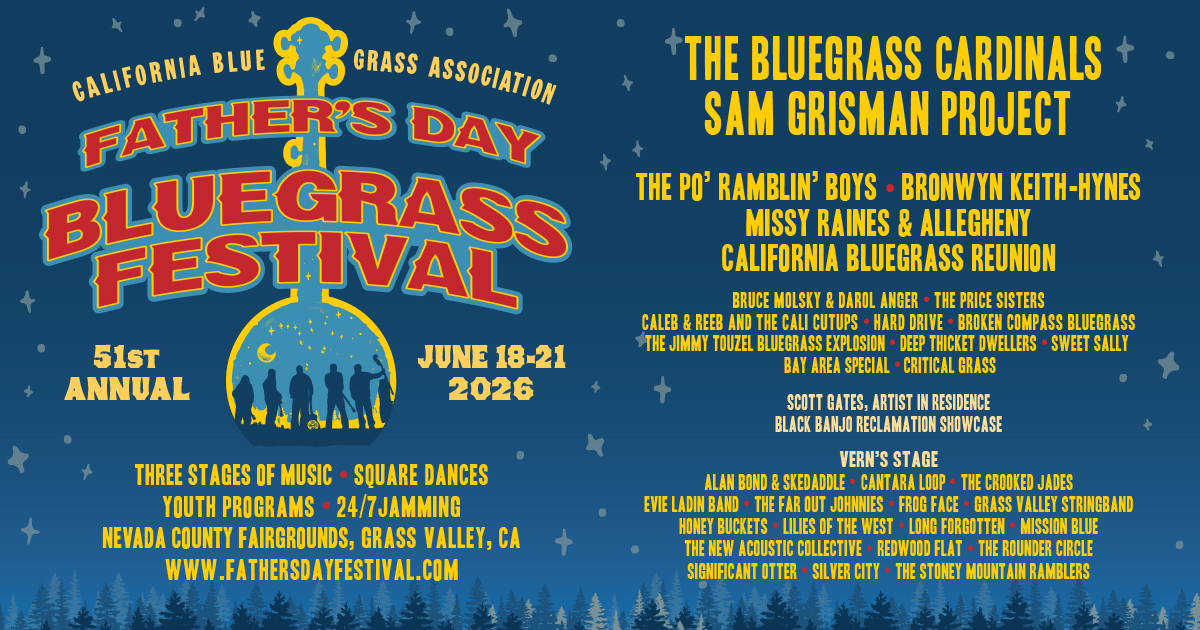
Tag: Sam Grisman
Tedeschi Trucks Band Have Done It Again
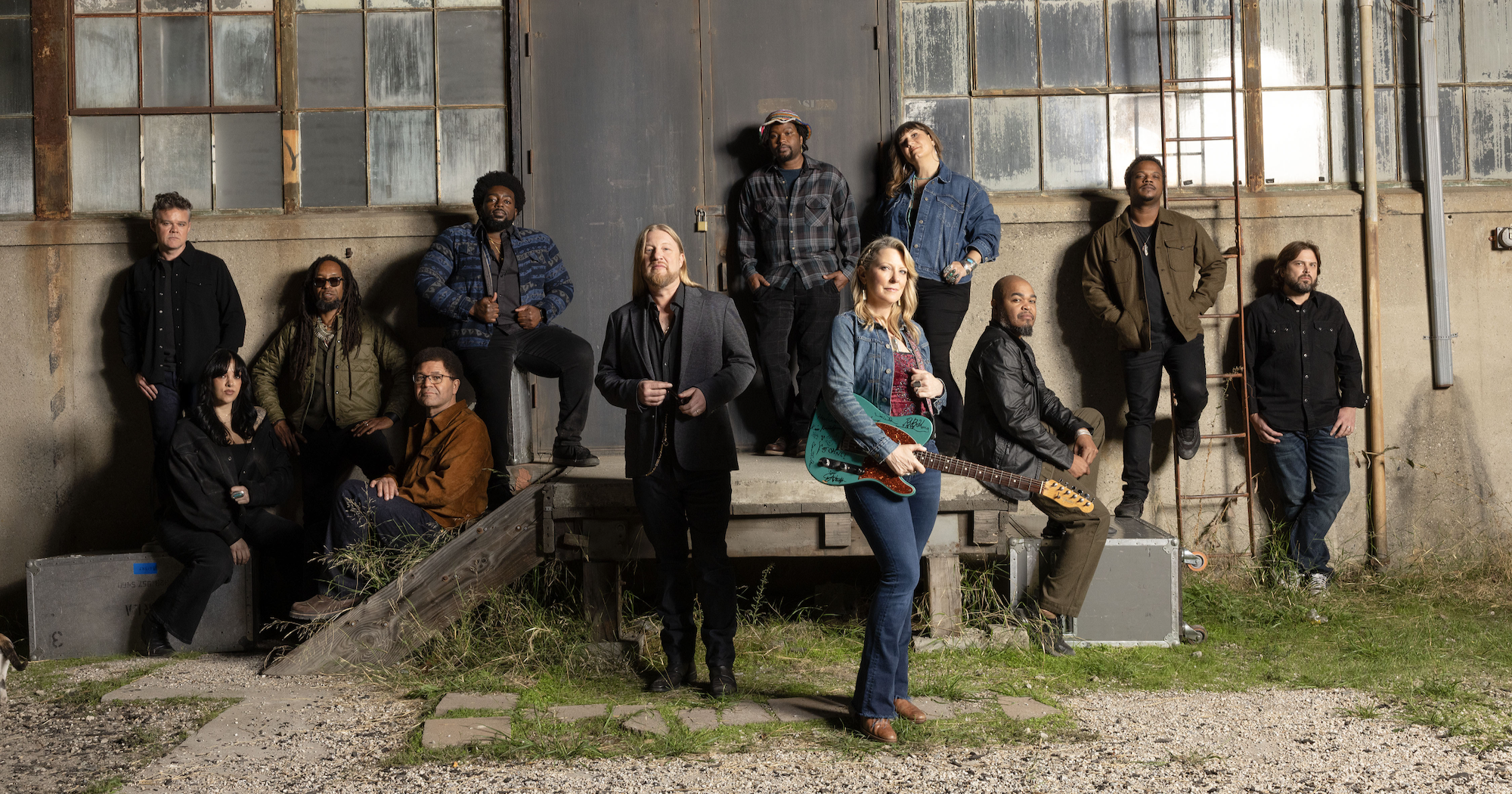
When it comes to entirely enjoyable, technically exquisite modern blues, Southern rock, and jam-band soul albums, Tedeschi Trucks Band have a statistically impossible batting average. Their new LP, Future Soul (released March 20 via Fantasy Records), is yet another “no skips” collection from the megalithic 12-person Americana group fronted by husband-and-wife guitarist Derek Trucks and guitarist-vocalist Susan Tedeschi.
On that strength of their catalog – and their ensemble – TTB have amassed hundreds of millions of streams, won eight Blues Music Awards and one GRAMMY, and a handful of their songs have become regarded as modern standards in the Americana and American roots music songbook.
Future Soul simultaneously feels like a surprising departure and familiar, essential territory for the band. With Mike Elizondo producing and songs and creative input sourced from across the group’s lineup, the set ends up sounding and feeling more acoustic than “usual,” while still reaching roaring crescendos and building it all on dank, wide open grooves. Perhaps those acoustic moments are a substantial contributing factor as well, but the cozy, plush pocket of the album is what gives it a laid-back, relaxed, and floating vibe no matter the track’s genre construction.
Screaming slide, no-holds-barred vocals, and wall-of-sound climaxes can all be found herein, as well. But the collection never thrashes or flails, it’s precise and exacting – as Tedeschi and Trucks are both known to be on their instruments, whether guitar or voice – but it’s certainly not sterile or gated or homogenized, either. It’s another remarkable feat for a group so large that you would almost have to assume, live or in studio, musical mud would be an inevitable byproduct.
But no, TTB seem to have no misses, at least not on Future Soul. It’s clear this group works together in harmony not just because of the down-to-earth and collaborative leadership of Tedeschi and Trucks, but because the artistic and musical responsibilities and ownership – of the songs themselves, of the album, of the makings of each, of “success” for the band – are decentralized and distributed throughout the group. The band has a sound, an art, that is consistently collective in the way it’s received by audiences and listeners because, forgive the obviousness, Tedeschi Trucks Band always work as a collective.
In our BGS conversation with Derek Trucks, the magic and unlikelihood of this creative dynamic and the processes by which the band continues to rack up success after success were on full display. We spoke about how they put together Future Soul as a group effort, the many inputs that went into Trucks fashioning his lyrical guitar style, and what bluegrass means to him personally, to Tedeschi, and the band as a whole. It was a joy-filled, passion-led conversation that again reinforced how this wailin’, rockin’, rollin’ band continues to flout and subvert expectations – and thereby has become so beloved.
Something that jumped out at me from the bio about the new album is that you say, “There’s just not a weak spot on this record.” I have to say, I totally agree. I think it’s remarkable that with a 12-person band and such a diverse catalog of recordings and releases, it really doesn’t seem like there’s any “fat” to trim or any duds to cull.
I have to ask, does it feel as magical on the inside of that process as it seems from the outside? It seems unlikely that y’all would work so well together towards a common goal, artistically, and be able to deliver again and again and again. And I don’t just mean commercially, awards-wise, or for audiences alone. Clearly you’re delivering artistically for yourselves and by your own standards, as well. So, does it feel as unlikely on the inside of that process as it maybe does to us on the outside looking in? [Both laugh]
Derek Trucks: That’s awesome. But it does, man! I mean, not every record you do feels the same way. They’re all their own beasts. For I Am The Moon, it was in a time of great uncertainty. We did four records and it was just kind of a heavy, heavy time – and that record feels like that.
This one felt completely different. The band felt much more confident [and] had been touring for two years straight. We had been playing so much together that when we finally got the core of the group up to our farm in Georgia to do some writing, there were a few songs right out of the gate. Like “Future Soul” and “Who Am I,” where immediately, Sue started singing, Gabe [Dixon] started singing these melodies. I got chills and I was like, “Oh, this is gonna be good.”
You’re always kind of worried about running out of ideas, or running out of runway – like a thing in the back of your head. But I feel like we’re incredibly fortunate where, when we’re together, everyone puts everything they have into it. Then, when we’re not on the road together, everyone’s all doing their own things musically. So, when we come back together, there’s a lot to talk about and a lot of music to remember together.
I think it keeps it really fresh and it keeps it moving forward. I feel like everyone’s out honing their craft when they’re away from this. When they come back, there’s a lot of new ground to cover. So far, we’ve been really, really lucky that way. And there’s a handful of just incredible songwriters in the band, so everybody comes in with two or three ideas. You’ve got a pretty strong record right out of the gate. That’s been something that I think me and Sue are just realizing – we’ve known how amazing that is but, you know, Gabe and Mike [Mattison], they show up with some serious ideas.
Then having Mike [Elizondo, the album’s producer] down, just some outside ears – I think that was really important. Sonically, he was trying some different things that I think inspired the band and made everybody play a little differently. That was exciting.
I was struck by the range of styles and the different genre infusions that y’all have put into this collection. What really stuck out to me, listening down to the project in one fell swoop, is there are still those really big energetic moments – and there are still those “wall of sound” moments that y’all are really known for. But I felt like this album is chill and laid-back in a way; it feels deep in the pocket. Can you talk about capturing those seemingly disconnected energies together?
I think one of the things is that with a band or an artist, I think if you’re maturing properly – we learn sometimes slowly – that you don’t have to force the issue all the time. You can trust things around you a little bit more, and sometimes the groove is enough. Sometimes the chord changes are enough, sometimes the melodies are enough. It doesn’t have to be these epic moments at all times. So when they do come, you’re excited about it and wrings you out. Then you lay them back down, and then you go on another little trip.
I think the band, having played together so much, we’re in a different place that way, where we realize that you don’t have to force the issue on every song. You can go to different spaces, different places. And then, again, having some outside ears – Elizondo really helps with that, too. He helps guide you to places that maybe you wouldn’t have gone naturally, so that’s a fun thing. Then you learn things about yourself musically in the band that you didn’t know before. That’s always a good place to be.
One thing that I’ve been obsessed with about your playing, specifically, ever since I discovered you as a teenager, is how lyrical of a guitar player you are. It jumped out at me from the bio, as well, when you’re talking about “I Got You” and how you’re doing a guitar-voice dialogue instead of guitar-guitar. I think of you as one of the most lyrical guitarists out there. You’re so present and so grounded. So I’ve always wanted to ask you how you’ve cultivated that style – as well as being able to have those moments of pure shreddy, lick-y wailing.
Then hearing that you really wanted to make that connection between voice and guitar on this album made so much sense to me, because I’m always thinking about how you’re a lyrical player. And Susan is, too, and you both dialogue with your instruments, and her voice, often.
Pretty early on I had a few musical epiphanies. One was Allen Woody, who played with Gov’t Mule and the Allman Brothers. When we toured with my solo band, opening for a Gov’t Mule in the early days, he would always turn me on to records. He gave me this CD by this guy named Aubrey Ghent, who was a gospel [steel] player. I put on “Amazing Grace” and I was like, “Wow, what an amazing voice.” And then I heard the pick and I realized that it was this guy playing lap steel! But it sounded like a woman singing. I got chills [over] my whole body, and I was like, “That’s it, that’s the thing.”
I had been listening to a lot of Indian classical music – a lot of vocalists and sarod players. Me and our old [Derek Trucks Band] bass player, Todd Smallie, went to Ali Akbar College of Music in San Rafael, [California] and they would let us sit in on classes. I realized he [Ali Akbar Khan] made all the instrumentalists take vocal classes, because his whole thing was that you should be singing through your instrument. So that made it just really obvious.
Those were a few of the things, and then there was a long time where I just stopped listening to any guitar player. It was only singers and horn players. That was kind of the idea [that] musical ideas can come from anywhere, but you really should be singing the thing. There’s time for all of it, but the stuff that moves me the most is, you know – even hearing Duane Allman on “Blue Sky” or something. It sounds like somebody’s singing, like somebody is walking down the road whistling. I think those are probably the touchstones for me.
Maybe I am projecting a little bit, because I’ve been a bluegrass banjo player my whole life – I started playing when I was seven. But when I think of guitarists, especially who end up reaching the pinnacle – whatever that is – or especially in flatpicking and in bluegrass, there tends to be this homogeneity of style. The people who get to the “very top” end up all sounding like each other. Then you have those folks that really stand out, and it tends to be because they’re using space and using air as much as they’re using 16th notes and 32nd notes. I think, being used to really shreddy flatpicking, that hearing steel or slide or blues guitar or jazz or acoustic jazz, anything plays with sustain and plays with space, I just drink it up.
Beautiful, man. I remember the first time I heard the Stanley Brothers, or Ralph Stanley, and I just remember it hit me in that place where those early blues guys hit me. There was just something about it. That kind of cracked that whole world open for me. I mean, I was always a Tony Rice fan. We have the same birthday, so I thought that was cool.
No way, I didn’t know that.
And I remember being at a MerleFest years ago, I think it was one of the last ones that Doc played. I remember seeing this old Oldsmobile or Cadillac – I don’t know, it seemed like an 1980s or ‘90s car – it pulled up to the stage and I see Tony Rice get out, just dressed to the nines. He pops the trunk, gets his guitar, hits the stage, and then right when that set was over, he was back in that car! I was over there thinking, “What a boss.” It was incredible, man. He went up and just annihilated everybody and got back in his car and drove his ass home. Pretty incredible.
So funny.
The last time we talked to you for the site, you were Artist of the Month in 2019 and you talked about Del McCoury and Jerry Douglas. I know you’ve played DelFest a bunch, you’ve collaborated with Billy Strings – oh, and I was super excited to see Molly Tuttle supporting on a couple dates of your TTB tour in April, too.
Yeah, we’re excited for that. That’s gonna be great.
What does bluegrass mean to you? Obviously, there’s Ralph Stanley, Tony Rice – there are pickers and makers in bluegrass that are infused into what you do, but what does the genre mean to you more broadly? And who in the space right now inspires you, or your musical vocabulary, or what you guys are doing in the band?
When I think of American music, I think of blues, I think of bluegrass, and I think of jazz. I think [those are] the things that we’ve really contributed to the world. To me, those are the cornerstones of it.
We’ve become good friends with Sturgill [Simpson] over the years, and he’s dipped into that [bluegrass] place. When I hear him sing it I’m like, “Oh yep, that’s because he’s from there.” He’s from the heart of it, and it makes me feel the way Ralph Stanley does at times. Even guys like Tyler Childers – and Sue’s a big Sierra Ferrell fan. She loves all those records.
That music, even the current guys, it’s always playing around here. I don’t know, it just feels inspiring to hear. People just get on an acoustic instrument and rip one. You’re like, “Oh yeah! There’s still people that know how to do things!” [Laughs]
That’s the big inspiration I take from it. Because [in the music industry] there’s a lot of cutting corners, and that’s a music that there’s no cutting corners. You gotta put your time in and take your licks or you’re just not gonna get on stage. I appreciate not just the dexterity, but the vocabulary and the heart that goes into it.
And there’s just something about seeing a group around one microphone just doing the dance that I think is always inspiring. We’ve done some shows recently with Sam Grisman, we did a benefit [for Camp Winnarainbow] out in San Francisco. Peter Rowan was on it, and me and Sue, and it was all acoustics. I had an old National, and just getting to play with that group – just the way that group felt. Sitting on a stool with a Dobro, and they were coming and going around the microphone. And then, getting to hang after the show with Peter Rowan and him telling these stories, man. It was just incredibly inspiring. Some of the songs that we got to play with them – that dude [David “Dawg” Grisman] has written some incredible music. That was one of the highlights of last year. It was pretty damn incredible.
There’s a lot of acoustics on this new album, too. I did find myself wondering, and maybe I’m biased, but does the world need a 12-piece bluegrass band? It might! It might! [Laughs]
Man, that sounds pretty fun to me. I mean, it would be a lot less gear to carry on the road! Which would make it more plausible.[Laughs]
If you wanted to speedrun pissing off a fan base, this might be the way to do it.
[Laughs] Yes, alright, we will be thinking about this! I’m gonna go talk to Sue.
This next one is kind of for me, so I thank you in advance for humoring me. But I wanted to talk to you about Jack Pearson. When I first moved to town, I just met this guy out jamming on mandolin at these bluegrass jams. I’d be like, “Man, this guy’s so nice.” He’s a great picker. He’s a great singer. I got a lot of practice playing swing with him at jams in town. Then folks started being like, “Hey, do you know who that is?” Oh my god, I did not know who it was. He was just my bluegrass jam pal. Then I worked at the Station Inn for a few years and I got to work a bunch of his trio shows. I’d die for the solo acoustic sets he’d do on the set break.
Incredible.
If I were to list maybe my top 5 favorite guitarists of all time, I feel like you and Jack would both be on that list. So I wanted to have a little nerdy moment to talk about Jack. [Laughs] Can you talk about his playing and your guys’ friendship? Of course, I see so many connections between your musical vocabularies and that lyrical style we were talking about.
Yeah, man I need to check up on him. It’s been a minute. I need to check in on old Jackie P.
He’s a monster, man. He’s one of the few people that can actually go play in a straight-ahead jazz band, in a bluegrass band, and then the Allman Brothers. I mean, maybe the only person that can actually do it.
I totally agree.
I mean, he played with Jimmy Smith. This dude is like, he’s an absolute monster. And a sweet fella! You can’t say enough good things. When I joined the Allman Brothers, Jack was just leaving. So all the tapes I got, like learning the new versions of the tunes, were Jack Pearson tapes. At the time, Bud Snyder was the sound man. He would mix these tapes for me with Jack really boosted in the mix. I could hear exactly what he was doing to learn these things. I got an intimate take on the way Jack was approaching these Allman tunes. It was so unique.
There’s no one [that] plays like him, and [his playing is] about as smooth as it gets. Sometimes, you watch him play – and I know he plays really light strings and he plays low action – and the way his hands move, I’ve never seen anyone play quite like that. Then he busts out a slide and you’re like, “Holy shit! This dude can do anything!” [Laughs]
I know!
He’s one of the unsung heroes. There’s no doubt about it.
He does this thing – and you do this as well – where you’re able to leverage that really gritty, aggressive, absolutely on-the-razor’s-edge style that comes with blues and Southern rock and Americana. Then at the same time, like you’re saying, with light strings and low action, still has such a deft touch. Yet he has such great attack and precision and cleanliness. He is a great lesson in taste. His taste is impeccable.
Yeah, I think that’s exactly it. I think we forget a lot of the time that most of what we love about music is the musician’s taste. I mean, you got to put in the work – and Jack has obviously done that, that dude is a master. But his taste is really as good as anybody.
I think he’s probably a bigger influence on me than I even realized. Probably because of that early Allman Brothers time for me. I was jumping in at 20 years old, 21 years old. And all of a sudden it’s, “Here’s 60 songs to learn, and rehearsal/tryout is in a few weeks. I was like, “Well, give me those dates.”
I’m stressed just hearing about that.
I mean, luckily most of that music I had listened to my whole life, but I had never bothered to learn any of them. I mean, I knew “One Way Out” and “Statesboro [Blues],” that doesn’t take long. It was all the other shit!
Photo Credit: Chapman Baehler
Basic Folk: Peter Rowan
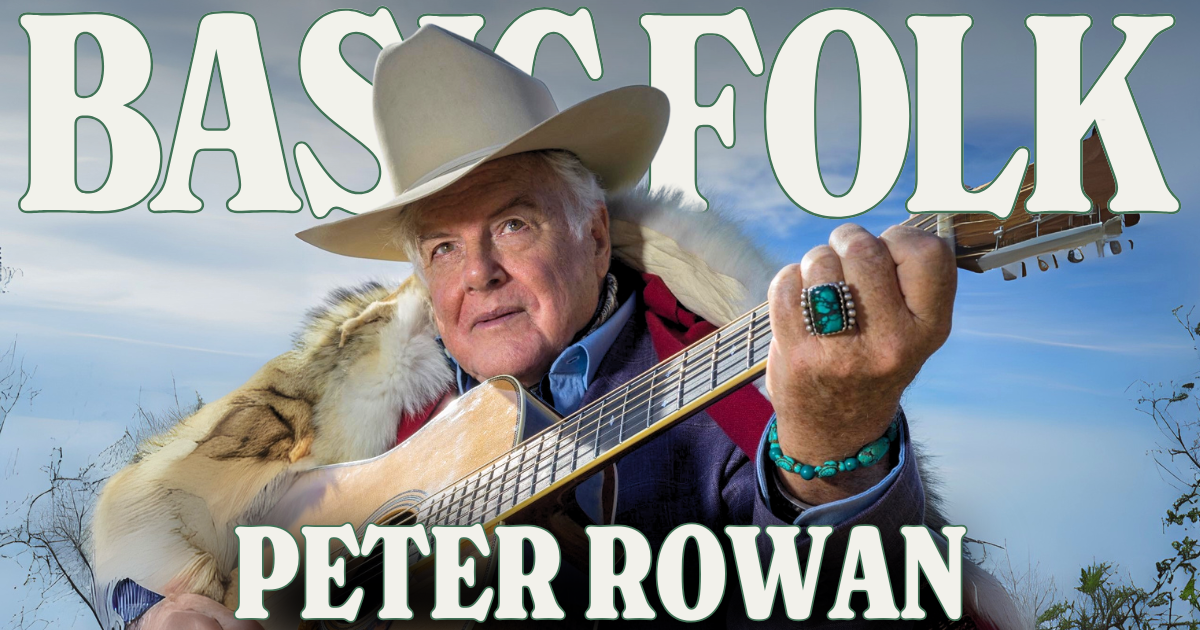
Legendary Massachusetts-born, California-based musician Peter Rowan is best known for his bluegrass roots. A practicing Buddhist, he did time in Bill Monroe’s Blue Grass Boys as well as in the short-lived and epically important Old & In the Way with Jerry Garcia and David Grisman. However, his latest album, Tales of the Free Mexican Airforce, celebrates the music of the Southwest and draws a throughline from Tex-Mex to bluegrass. Rowan has a long history with this music from his very first solo record, which includes the original recording of “The Free Mexican Airforce” as well as “Midnight-Moonlight.” Both of those classic Rowan compositions got re-recorded for the new record and feature the late great Flaco Jiménez (as did the original 1978 recordings), who passed away in July 2025.
LISTEN: APPLE • SPOTIFY • AMAZON • MP3
In our Basic Folk conversation, we talk about Flaco’s enthusiasm for Peter’s music, the many collaborations they recorded, and why he included a recording of Flaco speaking on the album. Peter speaks about how immigrants and musical culture from Latin America are constantly inspiring him and keeping him patriotic. He also spoke about what keeps him aging well, what his energy and enthusiasm look like at 83 years old, and, of course, Bill Monroe’s baseball team.
Photo Credit: Amanda Rowan
Peter Rowan and Sam Grisman Project Will Bring Old & In the Way to the Ryman
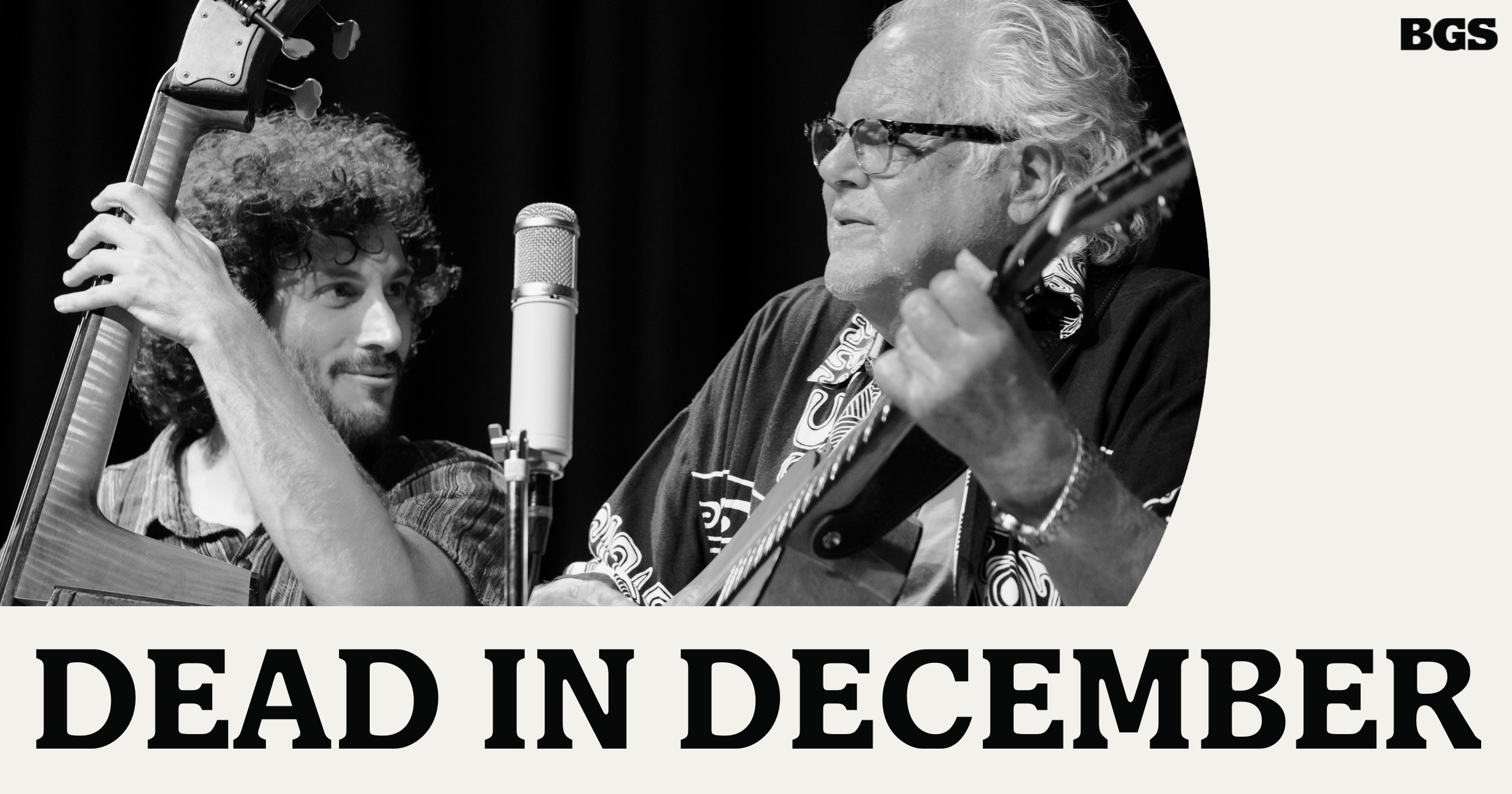
On January 9, 2025, there will be a special performance – more so a once-in-a-lifetime celebration – of the groundbreaking music of Old & In the Way at Nashville’s famed Ryman Auditorium.
Led by the “Bluegrass Buddha” himself, Peter Rowan, the legendary singer-songwriter and founding member of the group will be backed by the Sam Grisman Project. The gathering will also feature a murderers’ row of talent: Sam Bush, Tim O’Brien, Lindsay Lou, Ronnie & Rob McCoury, and more.
“In bluegrass, you just do the beautiful grace of presenting the music, being good neighbors and all that stuff,” Rowan told BGS in an exclusive 2022 interview. “But you could hear us in the band going, ‘go, man, go.’ Go for it, that’s where we came from. That’s what Old & In the Way was – the ‘go for it’ signal to everybody.”
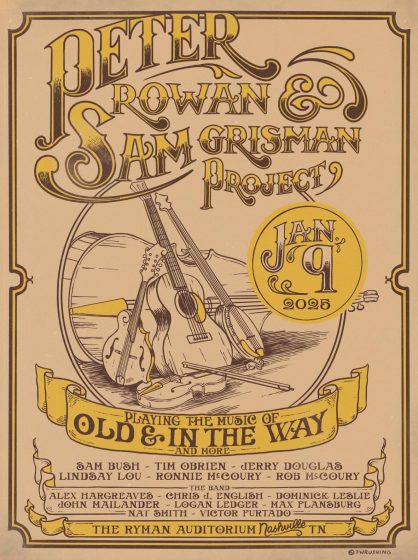
To preface, Old & In the Way started as impromptu pickin’-n-grinnin’ sessions in the early 1970s between Rowan, his longtime friend, mandolin guru David Grisman, and Jerry Garcia, iconic guitarist for the Grateful Dead, who reached for his trusty banjo during the gatherings at Garcia’s home in Stinson Beach, California.
“We started picking every night after supper [at Jerry’s],” Rowan remembers. “We went through old song books and learned a bunch of material.”
At the time, Garcia was searching for new avenues of creative exploration, seeing as the Dead were in the midst of taking a much-needed hiatus after years of relentless touring and recording. He was also, perhaps subconsciously, trying to tap back into his roots before the Dead, this landscape of the late 1950s/early 1960s where Garcia was heavily involved in the San Francisco Bay Area folk scene.
“And you realized that Jerry was an intergalactic traveler, just dropping in on the Earth scene for a little while, but he was totally at home,” Rowan says of Garcia’s restless penchant and lifelong thirst for acoustic music.
When Old & In the Way formed in 1973, the trio recruited bassist John Kahn, as well as a revolving cast of fiddlers (Richard Greene, John Hartford, Vassar Clements). Sporadic gigs were booked around the Bay Area, with the vibe of the whole affair casual in nature – the ethos one of camaraderie and collaboration, but without expectations or boundaries.
“I remember singing the ending of ‘Land of the Navajo’ at the first rehearsal and I looked over at Jerry,” Rowan recalls. “He kept nodding his head like, ‘go.’ It was like Jack Kerouac at Allen Ginsberg’s poetry reading at City Lights Bookstore – ‘go, man, go.’ Encouragement, encouragement.”
By 1974, Old & In the Way simply vanished into the cosmic ether, but not before capturing a handful of live performances that have become melodic sacred texts of a crucial crossroads for acoustic music. To note, Old & In the Way’s 1975 self-titled debut album went on to become the bestselling bluegrass album of all-time – until it was dethroned by the O Brother, Where Art Thou? soundtrack released in 2000.
As it stands today, Rowan, now 82 years old, is the only remaining member of Old & In the Way still actively performing. Garcia, Clements, Kahn, and Hartford have all sadly passed on, with the elder Grisman and Greene retired from touring. Grisman’s son, standup bassist Sam Grisman, is now carrying his father’s bright torch.
And although the tenure of the Old & In the Way was short-lived, the ripple effects of the band’s ongoing influence and enduring legacy remains as vibrant and vital as it was those many years ago, when a handful of shaggy music freaks kicked off a jam that will perpetuate for eternity.
In preparation for the upcoming Old & In the Way showcase at the Ryman on January 9, BGS recently spoke with Sam Grisman, who talked at-length not only about his continued work with Peter Rowan and the intricacies of Jerry Garcia, but also why a band Grisman’s father started over a half-century ago still captivates the hearts and minds of music lovers the world over.
You were five years old when Jerry Garcia passed away. You were really young, but do you remember anything that you hold onto?
Sam Grisman: Yeah, I have a very vivid memory of what our house felt like, smelled like, and just what the energy was like when Jerry was around. And I remember that sort of ease, just the way that he made people feel. It seemed like my parents were at ease when he was around.
And he probably felt at ease being around them. It was probably a safe haven at that house.
Definitely. And, you know, my parents smoked weed in the house. But, my mom was pretty strict about cigarettes. [She] wouldn’t let anybody smoke cigarettes in the house. But, when Jerry was around, he smoked cigarettes in the house. So, part of this smell in my blurry five-year-old memory is the smell of cigarettes. And Jerry would sometimes wear a leather jacket, maybe the smell of leather.
I remember the sound of his laugh. I remember all that music, and some of it I remember so vividly that I just know that part of that memory is reinforced by being there as a little toddler when they were working up [music]. Because they would often work on tunes upstairs in the living room and then take them down to the studio, put them on the mics and pull them.
You just wanted to be around it all and soak it all in.
I was a really curious kid.
With the Ryman show coming up, there’s been a lot of celebration of Old & In the Way as of late, especially with you touring with Peter Rowan and the current Jerry Garcia exhibit at the Bluegrass Hall of Fame & Museum. You’ve been around those songs your whole life. But, when you think about the context of Old & In the Way, and what you’re doing at the Ryman, what really sticks out with why that was such a special time in not only bluegrass, but in the lives of those people?
I mean, what a lightning-in-the-bottle chapter of all those people’s lives, you know? I think 1973, ’73/’74, was a particularly fertile time for Jerry. He was playing a full schedule with the Dead. He had Jerry Garcia Band stuff. He was playing in Old & In the Way. He was playing pedal steel with the New Riders of the Purple Sage. It seemed like he really had an itch to go back to where his roots were, especially when you look at [the Grateful Dead album] Workingman’s Dead [that was released a] couple years prior.
For all of us, who are looking back on it 50 years in the future, it seems like this momentous, heady time that was just meant to be. But, for those guys in the moment, it was just total serendipity. And the quintessence of just going with the flow – Stinson Beach, California, vibes. They just kind of stumbled into this reality.
“Y’all wanna play?” “Sure, why not.”
Yeah, where it would just be really fun to have this bluegrass band that they didn’t take super seriously, which I think really comes across in the recordings, you know? Because there’s all this joy in that music that might not necessarily have been there if those guys were taking it super seriously or if they needed it to pay their bills. It was a very interesting circumstance.
And for them to call their hero Vassar Clements into the mix, on a sort of whim because Peter found his number on a card in his wallet. It was sort of like a fantasy camp for these guys. Like a bunch of hippies sitting around on the beach, smoking a joint, thinking: “Wouldn’t it be great if we had the world’s greatest fiddle player just show up?” “I bet you we could book a gig.” “Hey Jerry, you got these legions of people following you around, you could probably get us a gig, right?”
And that’s kind of how it happened. Those gigs were so magical, because they happened mostly for all of these Deadheads in Marin [County, California], for like 16 months or something.
So, if you really had your finger on the pulse of it and you were going to the Keystone [music club in Berkeley, California], to see [the Jerry Garcia Band] and you loved what the Dead were doing, you knew that they were going to take this time off, but you just saw Jerry the week before and he never took his guitar off. He just finished the [Jerry Garcia Band] set and walked backstage with his guitar on and was smoking a cigarette, and then you saw him 30 minutes later talking to somebody off the side of stage, still had his guitar on — you’re thinking, “Gee, this guy’s not going to stop playing music this year, so I better keep my eyes peeled for what’s next.” And they played all these little gigs mostly around the Bay Area — they kind of captured some lightning in a bottle.
With playing these Old & In the Way melodies not only throughout your life, but also extensively nowadays with Peter Rowan, what’s been your biggest takeaway on what makes those songs and the ethos/history behind them so special to you? What about in terms of musicality, technique, and approach?
It’s hard to articulate how special it is to be exploring these beloved songs that mean so much to so many folks, myself included, with Peter and a cast of some of my best friends and favorite musicians. It’s a catalog that’s got a lot of depth.
Old & In the Way would play anything from songs by bluegrass heroes like Bill Monroe, The Stanley Brothers, Reno & Smiley, and Jim & Jesse to Vassar [Clements], Jerry [Garcia], and my pop’s instrumentals, to the tunes that Peter was writing at the time, which are some of my absolute favorite songs ever written.
Songs like “Midnight Moonlight,” “High Lonesome Sound,” and “Panama Red.” Playing these tunes with Uncle Peter makes me feel connected to the times he spent with David and Jerry in Stinson Beach in the early ’70s.
I grew up in Mill Valley and loved going to Stinson Beach with my friends, so I have a pretty vivid image in my mind’s eye. They played tunes, hung out, relaxed, took in the sea breeze, smoked a bunch of great weed, and developed a highly individuated “West Coast” approach to playing and singing this bluegrass music that they all loved and respected so much.
And then, they called one of my bass heroes, John Kahn, and their fiddle hero, the inimitable Vassar Clements and gave the world about one glorious year – I think around 50 shows – of a rare and lovable breed of bluegrass.
So much of everyone’s personality comes through in the music, and you can hear their camaraderie in the recordings. I guess my biggest take away from getting to play this music with Peter is how important it is to bring your own approach to these timeless songs that we love, while still honoring what it is that makes us love them in the first place.
You’ve known Peter Rowan since you were born. But, what has this latest endeavor together meant to you, to play the Old & In the Way catalog to not only lifelong fans, but also a whole new generation of acoustic music fans and bluegrass freaks?
It means the world to me to get to spend some time out on the road sharing space and time in service of this music with Uncle Peter. Getting to meet all of these folks who care so much about this music and feeling their appreciation and gratitude for Pete has been truly special.
There are so many people from so many different ages and different walks of life for whom this music has been the soundtrack to many fond memories, and I’m honored to be one of them. It’s also been a joy to see fresh faces in the audience and some folks taking in this music with a new perspective.
In your honest opinion, what is the legacy of Old & In the Way when you place it through the prism of the history of bluegrass and the road to the here and now, especially this current juncture where the torchbearers are selling out arenas and creating this high-water mark for acoustic, traditional and bluegrass music?
For many folks who know and love the music of Jerry Garcia and the Grateful Dead, Old & In the Way has been their first exposure to bluegrass. So many people over the years have told me how listening to Old & In the Way led them to further explore bluegrass music and its roots and branches. And others have told me how it inspired them to become pickers and start bands of their own.
I think Old & In the Way has been pivotal in bringing a wider audience with a more adventurous musical palette into the bluegrass universe. The legacy of Old & In the Way is one of exploration and preservation, and they certainly paved the way for many of us to walk a similar path — honoring the music that we love, while exploring its boundaries and finding our own voices and approaches.
It’s wonderful to see my friend Billy Strings out there playing for so many folks on such a big scale simply being himself, playing his own songs with a great group of friends, and also honoring the material that made him the musician that he is — maybe that’s a part of the legacy of Old & In the Way.
Photo Credit: Elliot Siff
Poster Credit: Taylor Rushing
Sam Grisman Project Honor “Dawg Music” In Their Own Way
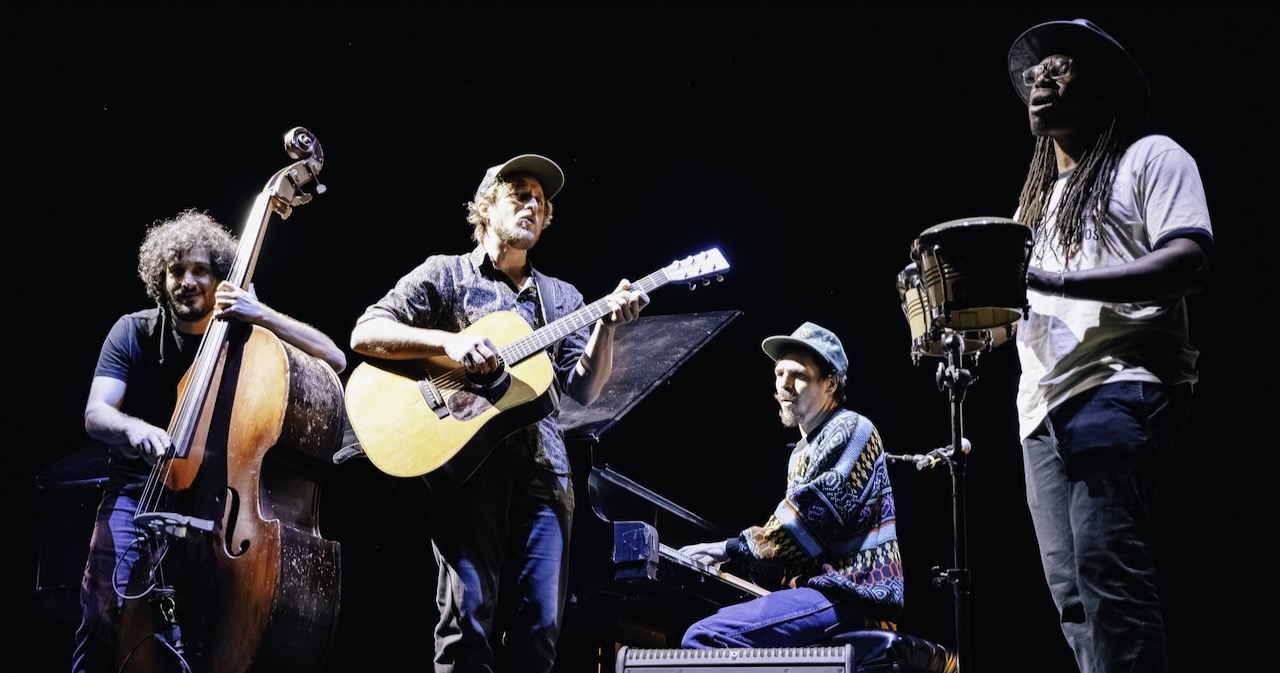
There’s something special that occurs when music is rooted in friendship and a shared mission. Perhaps no one exemplifies this better than Sam Grisman Project, founded by the youngest son of “Dawg music” pioneer David Grisman. Seeking to honor the likes of his father, Jerry Garcia & the Grateful Dead, and other musical heroes, SGP maintains a singular style and groove.
With its core iteration featuring seasoned multi-instrumentalists and songwriters Ric Robertson, Chris “Hollywood” English, and Aaron Lipp – and often featuring a host of other guests who run the musical gamut – SGP is bringing fresh authenticity, originality, and passion to the roots music and jam band scenes.
BGS spoke with Sam Grisman in early February 2024 about the origins of, inspirations, and plans for this remarkable and rising group.
What are the origins of Sam Grisman Project?
Sam Grisman: Ever since rekindling my musical friendship with the great Ric Robertson, who I’ve known since I was 14, I’ve been wanting to start a band that showcases the impact that the legacy of my dad and Jerry’s music has had on me. Ric and I started scheming on ways to make some music together and what that might look like. I figured we might have a good opportunity to play out in the live touring landscape if we paid tribute to the catalog of music that my dad and Jerry recorded together; that it could create the space for us to really do whatever we might want musically. We’re not limiting ourselves to the catalog of music that my dad and Jerry played together or individually, but we are honoring the spirit of what they did together, which was to dive into great songs that they had a shared love of.
I’ve always had a talented group of friends, going back to the time that I spent growing up at bluegrass festivals, fiddle camps, and the Mandolin Symposium. We have chemistry, and that is irreplaceable. Ric started playing music with Aaron Lipp around the time we turned 20 and he has been a part of my musical reality since then. He and Ric have developed strong chemistry, where they’ve been finishing each other’s musical sentences for years now. Aaron is from Naples, New York, about an hour away from Rochester, New York, which is where the great Chris English hails from. When Ric started making some music with Chris and telling me about what an amazing drummer and human being he is, I knew he would fit into the core of this band perfectly.
Who are you honoring with this project and why?
We’re honoring the musical heroes who influenced us the most. For me, because they provided the soundtrack to most of my earliest musical memories, that’s my dad and a lot of his friends who came through our house in Mill Valley to record. The friend who came around the most was Jerry [Garcia], but also John Hartford, Mike Seeger, Doc Watson, Tony Rice, Del McCoury and Ralph Stanley.
We honor our heroes, not just my dad and Jerry. We play lots of John Hartford music and Townes Van Zandt songs. Lots of Bob Dylan’s music, some Alan Toussaint, Dr. John, John Prine, Warren Zevon, Randy Newman, and Peter Rowan.
Can you describe what Dawg music is and what you’ve learned from your father?
Dawg music is a highly evolved form of acoustic music that is a synthesis of many different genres including old-time, bluegrass, hot club swing, jazz, and funk, with elements of classical music. It’s really a sort of genre-less genre pioneered by my father. It showcases – but is not limited to showcasing – the sound of the mandolin. The instrumentation in his quintet has traditionally been one or two mandolins, guitar, upright bass, and violin, but that’s expanded over the years to include percussion and drums.
That instrumentation of percussion, mandolin, guitar and bass is what I modeled the core of this band after. I’ve learned so much from my father about music and the music business – how to treat your friends and how to honor your elders. I am profoundly grateful to have been born to my particular set of parents and I’m grateful that there are other folks who have a deep appreciation for my dad’s impact on the musical landscape. I’d like for people to also appreciate how wonderful a human he is, so this is a small way that I get to share my dad with other people. He loves everybody, he’s grateful for the support, and he can feel it.
Who are some of the musical guests that have performed with SGP, and what does that mean to SGP?
It means a lot. It’s a representation of the community that we’re a part of. We’ve brought in some of our heroes as guests including dear family friends like Lowell Levenger “Banana” from the Youngbloods, Maria Muldaur, Eric Thompson, and Peter Rowan. We’ve had my dad sit in three times, which has been an absolute honor, and we’ve had a whole slew of our guests who bring different insights and a similar passion to the project: Dominick Leslie, Alex Hargreaves, Roy Williams, Bennett Sullivan, Nathaniel Smith, Phoebe Hunt, Lindsay Lou, my dear friend Tod Patrick Livingston, Mike Witcher, Chad Manning, Wyatt Ellis, Matt Eakle (the great flute alumnus from my dad’s quintet), and more. Eddie Barbash came and played a set with us in New York. Max Flansburg, who has a similar passion for this material and highlights a different corner of the Garcia/Hunter catalog than we do, played two of our New Year’s shows with us. We also had our old-time banjo hero, Richie Stearns, on all of those gigs that weekend. We’re going to have Logan Ledger on some shows coming up, and we’ll have Victor Furtado and Nathaniel Smith in the band.
When did SGP start touring in its current iteration, and how is the experience of touring with your best friends?
We had our first run as a band in January 2023. This conversation with you comes at the end of our longest break as a band, where we’ve had the entire month of January off. We’re starting back up on February 4th in Tucson, at a festival called Gem and Jam. It’s an absolute treat to travel the country with the people I care the most about, and to make great music and memories and friends everywhere we go. It’s important to anchor ourselves and ground ourselves in the music, because there’s a lot of work that goes into being out on the road that can make you lose perspective on how special it is to be doing something that you love for a living and to be able to do it for people who love what you’re doing.
SGP is obviously celebrating and continuing a particular musical legacy, but doing so with your own flavor. What makes SGP unique?
Our branding is our individuality and our honesty. I grew up in the house where my dad and Jerry recorded all of this music and I really do enjoy playing that music with my best friends. It gives me a sense of purpose to be able to play some of that music for folks who are passionate about it. There’s definitely room in the live music space for bands who take a preservationist approach to carrying on the musical traditions and catalogs of artists that came before them. A lot of musicians try to sound like their musical heroes, but that’s not our approach. I hired my friends to participate because I love their individuality and how they play, sing, and write music. I wouldn’t want to steer them towards sounding more like Jerry Garcia or my father.
We have been influenced by listening to tons of great music our entire lives, but we try to stay true to ourselves when we’re playing, so nobody is reaching for a sound that isn’t theirs. We all enjoy injecting our individuality into this music and having the flexibility to take the material in different directions depending on how we’re feeling. It’s amazing to have such versatile friends to work with.
How does original material fit into the broader vibe of SGP?
All three of the core guys – Ric Robertson, Aaron Lipp, and Chris English – are amazing songwriters. All the time I’ve known Ric, since we were teenagers, he’s been writing great songs. He was always a great singer, but he’s become one of my absolute favorite singers on the planet. There’s a lot of his music that lends itself incredibly well to looser, more long-form arrangements, which is something that SGP has become comfortable with.
Aaron Lipp is also an amazing songwriter who writes incredibly poignant music and aphoristic lyrics. Chris English writes amazing, feel-good music – not always overtly happy, but always with a strong message. His tunes add a lot of depth to our sets and take us to a more groove or bassline-oriented place, which is really refreshing for us and our audiences. I think there’s always going to be room for original music in SGP. As much as these guys are inspired to play their own tunes, I want to play them.
You released a great EP in 2023. Is there anything else currently in the works?
We’re gonna make a full length album at some point in 2024. Over the course of the last hundred or so gigs we’ve developed a pretty good repertoire and a strong rapport with each other. I don’t think it would take very long to put some of these tunes down in the studio, but we also multitrack most of our shows and we have an archive of live music to sort through. We’re going to be putting some shows up on Nugs.net pretty soon. We have a pro-taping policy to encourage folks to come and tape the show. I share Jerry [Garcia]’s philosophy that if you bought a ticket to the show, the performance is really yours as long as you’re not charging anybody else for it. Some of those shows have made it to archive.org, which is a free internet resource where folks can listen to live music. At some point we’ll probably put together some compilations of live material and put them up on the streaming services. I think our live show is always going to be the emphasis of what we do, so it’s important to have some recorded examples out there for people to check out.
What’s in store for SGP in 2024, and what does pursuing that mean to you?
We’ve got another solid year shaping up. We played about a hundred gigs in 2023 and we’ll probably make it pretty close to that in 2024. I’m going to expand the cast of characters a little bit in 2024 and bring some other friends into the fold. I’m looking forward to introducing my new friends and audiences to my dear musical compatriots who care about this music as much as I do. I’m grateful and humbled to get to do it. It means a lot to get to honor my father every night by playing his music. We take out the mandola that he gave me for my 21st birthday, the mandola he recorded “Opus 38” on. We get to play “Opus 38” on that very same mandola for people who appreciate what’s happening, and I feel like he and Uncle Jerry are with us every night. It’s a big blessing all around.
Photo courtesy of the artist.