Industrial Strength Bluegrass has a great thing going – in Southwestern Ohio and on social media, too. Awarded Event of the Year by IBMA in 2022 and 2024, the Xenia and Wilmington, Ohio-based festival – run by Joe Mullins, and his family and staff at Real Roots Radio – have amassed tens of thousands of followers on TikTok. Clips from their Summer Fest, indoor festivals, and the radio station have racked up millions of views on TikTok, YouTube, Instagram, and Facebook. And rightly so, their events and airwaves always boast the absolute best in bluegrass.
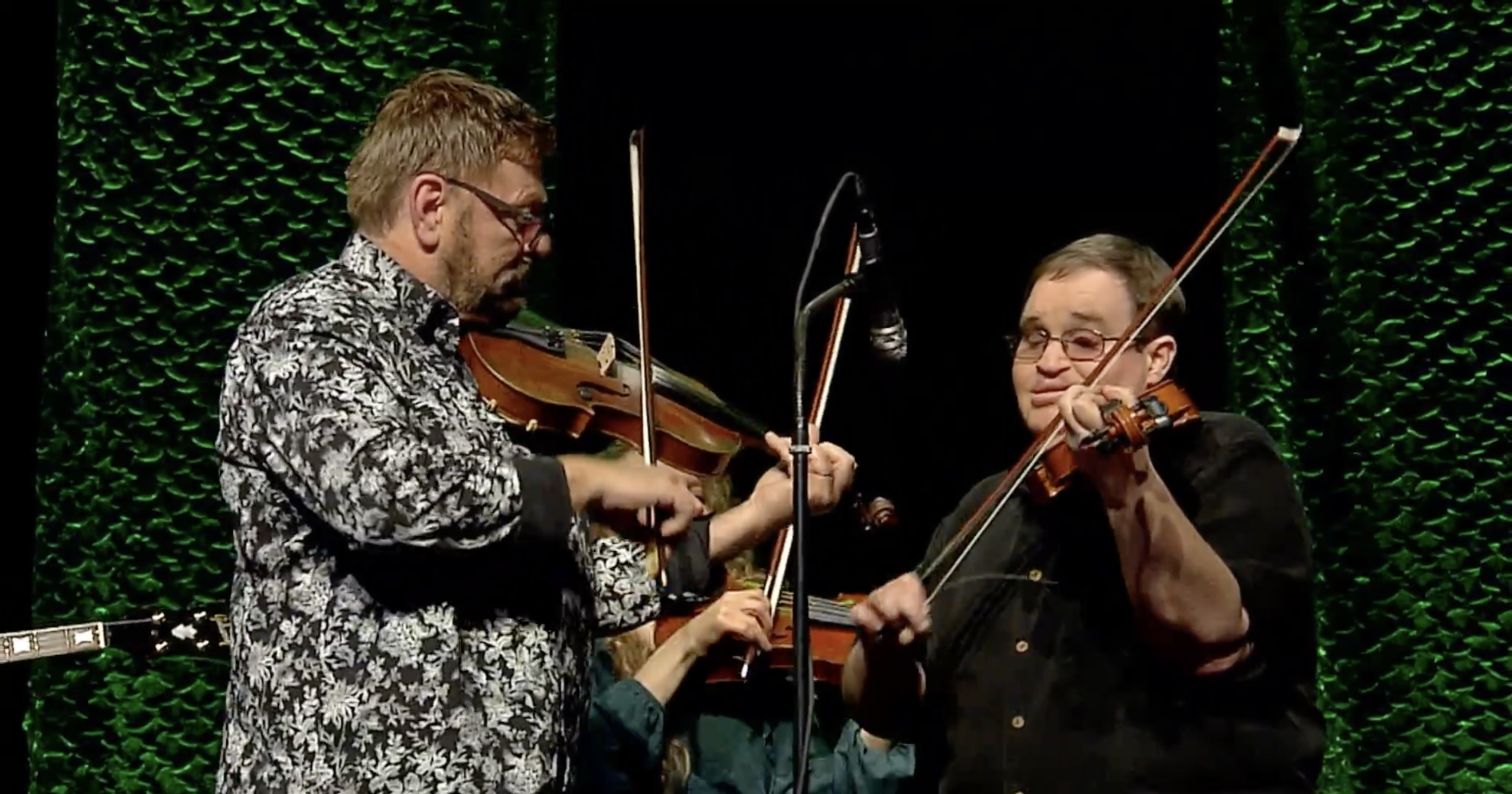
BGS has partnered with Industrial Strength Bluegrass over the years and this time we’re excited to bring you full-length videos of ISB’s most popular and veritably viral performances. First up, it’s a performance from Industrial Strength Bluegrass’s March 2024 edition indoors in Wilmington, Ohio at the Roberts Centre. In a rare duo appearance, fiddling phenomenons Michael Cleveland and Ron Stewart wowed the ISB crowd. In this video, the pair perform a rip-roaring rendition of “Roanoke” with Joe Mullins himself joining in on banjo, as well as IBMA Award winner Vickie Vaughn on bass, and members of High Fidelity including Jeremy Stephens, Corrina Logston Stephens, and Daniel Amick.
It’s easy to tell why this video was so popular in its shortened, vertical format! Stewart and Cleveland are two of the best, both having won IBMA’s Fiddle Player of the Year (Cleveland an unprecedented 12 times) and both beloved by legions of bluegrass fans, from jamgrass to mash and back again. For an impromptu sort of jam session on stage, it’s a magnetic and impressive performance of a classic fiddle tune. Since 2024, many snippets and clips from Cleveland and Stewart’s 3o-minute performance together at Industrial Strength Bluegrass have taken off on social media. We know we aren’t the only ones who appreciate ISB bringing bluegrass to the masses with their festival content.
Follow Industrial Strength Bluegrass on TikTok, Instagram, YouTube, and Facebook. Make plans to attend their Summer Fest held July 16-18, 2026 in Xenia, Ohio, and future indoor festivals, too. More information can be found here.
If you’ve listened to bluegrass made in the last decade, odds are you’re not only familiar with but absolutely enamored by the utter powerhouse that is Vickie Vaughn. Named the IBMA Bass Player of the Year thrice in a row (2023, 2024, & 2025), Vaughn has established herself as more than a class act – she’s an integral anchor of today’s bluegrass scene and beyond. Presently touring with the acclaimed all-women supergroup Della Mae, Vickie has a slew of accolades under her belt, having sung background vocals with Patty Loveless, toured with High Fidelity, and collaborated with just about every esteemed bluegrass musician under the sun.
November 21, 2025 saw Vaughn set sail unto uncharted waters with the release of her debut full-length solo album, Travel On. Released by Mountain Home Music Company, Vaughn deploys an all-star cast to bring her dynamic compositions to light. The record features guest vocals from Ronnie McCoury, Casey Campell on mandolin, Wes Corbett on banjo, Cody Kilby on guitar, Dave Racine on drums, harmony vocals from Justin Hiltner, Lillie Mae, and Frank Rische, and fiddle from Deanie Richardson, who also serves as the record’s producer.
Travel On champions Vaughn as its frontwoman, a role she hasn’t chronicled in studio since her six-song EP came out a decade ago. Her songwriting is full of dynamic abundance, from the deeply stirring gospel song “The Pilot,” to the absolutely raging “Sleepin’ in the Rain” to the emotive and heartfelt “Mama Took Her Ring off Yesterday.” Vaughn manages to strike a full range of emotions throughout the album’s thoughtful arc, a narrative bound by her buoyant relationship to both rhythm and melody alike.
Ahead of the album’s release, BGS had the unmatched pleasure of sitting down with Vickie Vaughn for a chat about Travel On, music, machinations, musicianship, and more.
Congratulations on the album release! I want to hear all about Travel On, but I’m wondering if you’d be able to take us back to the start for a bit and tell us about your personal musical history.
Vickie Vaughn: Oh golly! I started really early because of my cousins, who I adored growing up. I really looked up to them and they were just great singers who sang all the time and could play piano and guitar. I grew up in a Baptist church. When I was little, maybe six years old, the preacher’s wife found out that I could sing, so she asked me to come sing in the choir. I grew up singing in church and then when I was nine years old, back in Kentucky where I’m from, I got hired as a background vocalist. I know it sounds insane – I’m so normal now, but I was like a freak kid! I could hear harmony and sing every part. When the guy running the Kentucky Opry found that out, I was hired as a kind of novelty act at nine years old. I was there every weekend from when I was nine to when I moved out at 17 as a resident female vocalist and background vocalist.
As for the instrument side of things, my parents had me play classical piano and I hated it so much. I honestly got into bluegrass kind of late for a bluegrass musician – around 14. You know, Sierra Hull, Kimber Ludiker – they started when they couldn’t speak words, but I was a little late to the game. I would go to these bluegrass jams and there would be a bass there, but nobody would be playing bass. So I would pick it up, and I could add decent rhythm, stay on beat, learn the open chords. But then I started taking lessons from this guy named Scottie Henson. He traveled with the Grand Ole Opry touring band back when that was a thing. He was a banjo player, but he taught me how to play bass, which is incredible.
When I was 17, I moved to Nashville to go to Belmont and I was a classical vocalist there. I moved to commercial vocals my junior year and bass was a hobby. I got involved in the bluegrass ensemble and that’s kind of how I got known as a bass player in school. And then I got hired by a touring band from a girl I knew from bluegrass ensemble. The rest is history!
As you were growing up drenched in music, do you recall any songs that particularly sparked inspiration or curiosity for you as a child?
I remember when I was in the car with my dad, I used to love the music he listened to. Mama would always listen to Southern gospel and that was just not my jam. I remember telling Dad, “I hate the stuff that mom listens to.” And he was like, “Oh god, me too.” And I just remember thinking, “You’re so cool, Dad.” Once, we were listening to a classic rock station and the freaking “Wreck of the Edmund Fitzgerald” came on – I know there are all these memes about it now. But I remember having a moment with him in the truck where I was just like, “What is this?” And he was like, “Oh yeah, it’s a true story.” And I was like, “Get out!” That one really struck me.
Another one, which isn’t really a song, but there was this radio station, the local country station – 93.3 WKYQ. On the weekends, starting at 10 p.m. on Fridays and Saturdays, there was a radio program called the Outlaw Hours, and they would play stuff like Waylon Jennings, Merle, Steve Earle, Charlie Robison. It was outlaw music, edgier rootsy stuff, even some edgier bluegrass stuff. I remember riding in the car back from the Kentucky Opry and I’m just like, “Daddy, let’s listen to Outlaw Hours.” He was like, “You like that stuff??” Because I was little, and you know, a lot of that was not appropriate for a child to listen to, but I just loved it.
I can totally see how that influence carries through into your music today.
Well, I liked the subject matter. It wasn’t all about love. I don’t really like to write songs about love. There are already a lot of songs about love. I don’t have anything unique to say about love. I have something unique to say about the way I process a hangover. Or my faith! My faith is so individualistic and personal. If I feel like I don’t have a new idea, I’m not gonna write it or sing about it.
What is the songwriting process like for you? How did you go about selecting the songs on this album?
This might sound silly too, but do you ever walk around the house and just sing about what you see? So many of my songs come out that way. Like with “Bottle of Wine” – I collect wine, so I always have some on hand. Then it was the day after a breakup and I was super hungover, because I had decided to just drink about it. I walked out of my bedroom and I saw all these empty bottles of wine on the coffee table. And I thought, “I don’t want to see another bottle of wine. Maybe I’ll write that into a song when I’m feeling better.” That’s how most of my songs come out, the hook will come to me and then I’ll just expand on it. Sometimes I like to co-write, like with Thomm Jutz, we co-wrote “Bottle of Wine.” But then “The Pilot,” a song about my faith, I wrote by myself. Faith is so, so personal. Even if a person of faith and I could agree on some fundamental levels, my faith and my walk are so different than literally anyone else’s. So I had to write my own unique faith-based song.
Then “Mama Took Her Ring Off Yesterday” I co-wrote with Deanie Richardson. I brought that idea to her because my dad passed and he was one of my best friends in the world. He hated sappy sad songs, so I didn’t want to write that. I knew I needed to write a song, then I went to visit my mom about three months after he passed. We went to a Mexican restaurant and she slid her left hand over past the chips and salsa, showing me that she took her ring off. I support her and everybody grieves differently, but I still told her I thought it was early for that. But she’s bootstrap Kentucky and she was like, “We have to move on. Life doesn’t stop.” I was just left thinking, “Wow, Mama took her ring off yesterday. That’s the moment I need to write about.” I took it to Deanie because she knew my dad and knows my mom and she really walked with me through my grieving process.
That one turned out so beautifully! I’m curious – you’ve had an extremely successful bluegrass career for a number of years. What made now feel like the right time to put out a solo album?
The awards. Women always apologize for winning and here I am, apologizing for saying “my awards,” but that’s really what it was. People are paying attention. If I’m gonna write a song, I don’t want it to hit deaf ears. Making a record is such an expensive and painstaking process and your heart and soul go into it. After my dad died – well, he was such a cheerleader for me. And an inspiration – he just inspired me. If I was feeling bad about something, I felt like if he believed in me, then I could do it, you know? I didn’t believe in myself without him for a long time, so I couldn’t do it. Especially in the music industry, you can’t do shit if you don’t believe in yourself. It’s too hard. So I waited a while until I felt like there were enough people who believed in me and then I believed in myself. That’s when I felt like I had the energy and the belief to make a record that people would actually hear.
That makes a ton of sense. How do you feel like your relationship to music has changed now that you’ve taken on the role as captain of a project?
This is the first time I’ve ever made a full-length record that’s my own and not just playing on somebody else’s. And of course, Deanie is producing it, but being in control of the material and the direction of the record – it’s funny that you ask, because I almost didn’t realize the direction of the record until it was done. I realized after I heard it all in one setting. The concept is vulnerable joy.
Working on anybody else’s record and supporting them in that way – especially with the bass, which is such a big vibe creator as an instrument – I never felt like I could choose, or was confident enough to choose, the direction. But finally, here I am in my mid-30s, and I’m ready. It was so fun taking the reins artistically, getting to sign off on every bit of it. Every choice I felt in my heart. I was able to say, “If this doesn’t scream Vickie as fuck Vaughn, then I don’t want it!” I would rather not make a record [any other way]. Because when I was younger, I made EPs that I thought other people would like. That was the point for me. But now I’ve traveled around and I know what works. I know what an audience likes to hear; that base is covered. The process of just having to make it totally “me” – that was my favorite part.
How did you go about choosing the community to help you out with bringing this record to life?
So the engineer, Sean Sullivan, I’ve worked with him for a long time on other people’s records, and then I did a small project with him that never got released. This might sound nitpicky, but I feel like the sound engineer in a recording process makes one of the biggest differences. It’s hard when there’s too much input – that’s the producer’s job. But I wanted to work with Sean because he’s so efficient, he’s quick and he has such a calm spirit. He gives direction or a suggestion so seldom that when he does I really take it to heart.
And then, as for Deanie Richardson, my producer, I always knew that she was an amazing musician, but this is the first time that I have really been enamored with her production abilities. It’s the first time I’ve worked with her as a producer. She has taken each song and made it into my record. I would come to her with just bass and vocals, and she would just shape each song and make them each sound different. She’s a freaking genius! And she’s totally unafraid to just be herself. She’s an unashamed woman and that’s the energy I wanted in my record.
The band on the record is all folks that I’ve known and played with here in town. I didn’t want there to be anybody on the record I hadn’t played with or loved or traveled with. Because it’s my first record and I know me, and I know that I would be self-conscious if there was a stranger in the room. And then Justin, my best friend, he just matched my freak so hard on there. We have such a beautiful community.
It’s so beautiful how y’all uplift and support each other! How is it feeling for you to finally have this piece coming out into the world?
I’m terrified, but I don’t know – I kind of like that! I like a challenge. If I’m not scared, then I don’t care. I’m really excited to hear what folks think about it. I want to see what songs touch people and learn from that. And I’m really excited for Deanie to be introduced as a producer, and for everybody to see her talents in that area. I’m really excited to learn from the release. I’ve learned so much in the process already, because there’s so many firsts, and I’m excited for the reception of this record to influence my next. That one will be even more me. I never want to stop growing!
While playing music in a bar, Tammy Rogers of The SteelDrivers learned a lesson that would guide her life choices. After Rogers graduated from college, she was happily earning her living as a musician. But she wondered if it was enough.
“I felt like it was all about me, rather than what I could give back and put into the world.” She had considered teaching or studying music therapy, thinking that, “Maybe I needed to be actively doing something to help.”
Here’s where the bar band comes in.
“I remember this like it was yesterday. I sang a gospel song.” Rogers said. “And after the set, a couple came up to me and said, ‘Thank you so much for singing that song. It meant so much to us.’ And it was like a light bulb came on – answering the question, ‘What should I be doing with my life?’”
For Rogers, the interaction with that couple in the bar was God giving her the message that she was doing what she was meant to do.
“The music that you write, the music that you play can touch people and help them, whether it’s in happiness or sorrow.”
Bluegrass musicians often incorporate old and new gospel songs into their performances. Whether it’s the melodies, the spine-tingling harmonies, the familiarity, or the content, gospel music has an enduring appeal to the full spectrum of bluegrass fans, regardless of culture or religion.
Last year, The SteelDrivers, as well as the young band High Fidelity, produced gospel albums – Tougher Than Nails and Music In My Soul, respectively – and Chris Jones released a gospel track, “Step Out in the Sunshine.” For them, the music is personal. They all come from a place of faith and sincere connection to the good news of the gospel, as well as loving the music itself.
In the rural communities where bluegrass began, life often centered around church, as a place of prayer, music, and friendship. Eventually, Southern gospel music also took on a life independent of worship.
Wayne Erbsen wrote in his charming book, Rural Roots of Bluegrass, “By the 1850s, songwriters were composing new gospel songs to appeal to the thousands who flocked to the rapidly growing number of shape-note singing conventions throughout the south.”
These lucrative gatherings – possibly more entertainment than spiritual – continued well into the 20th century. Erbsen told BGS that people would bring the books they already owned, but when they arrived, “they had to buy more books” to learn the new songs. The publishers hired excellent performers to attend the conventions and inspire the singers.
Erbsen wrote, “The songs and styles that were part of this shape-note singing convention tradition eventually merged with bluegrass instrumental and vocal styles to create a new genre now known as bluegrass gospel.”
Bill Monroe, like others of his generation, was exposed to religious-themed music. While performing with brother Charlie, Monroe’s first hit record was “What Would You Give in Exchange for Your Soul?” And just as he learned the blues from Black fiddler Arnold Shultz, he was “fascinated by the music of the Black churches,” Chris Jones said. That’s where Monroe learned “Walking in Jerusalem,” popular today for its rich harmonies.
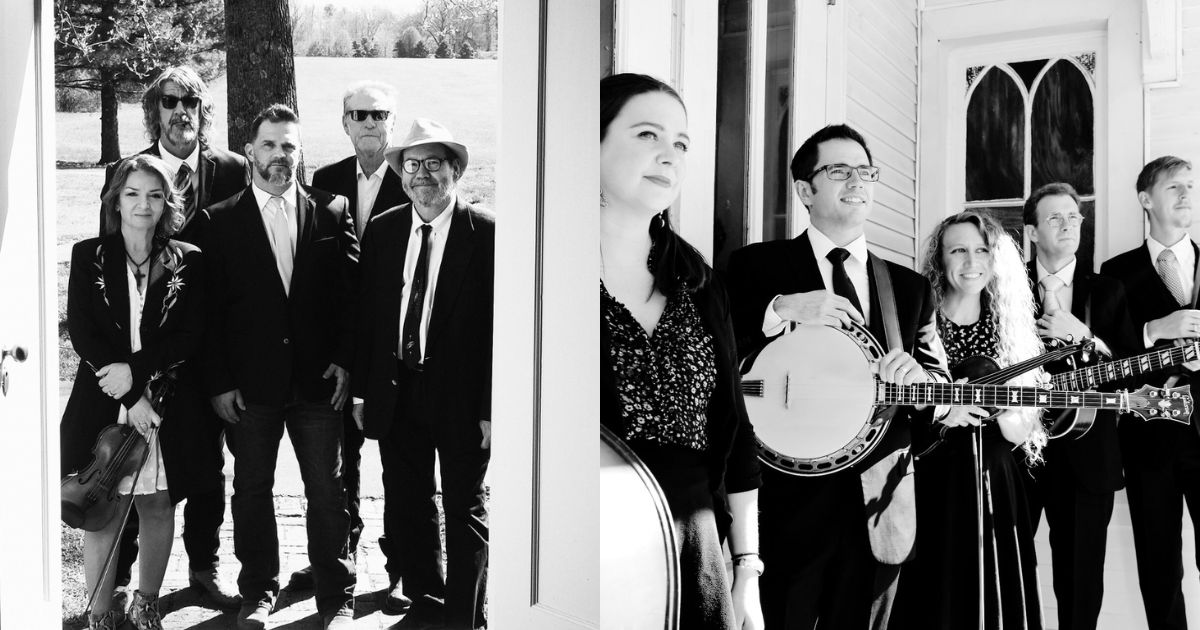
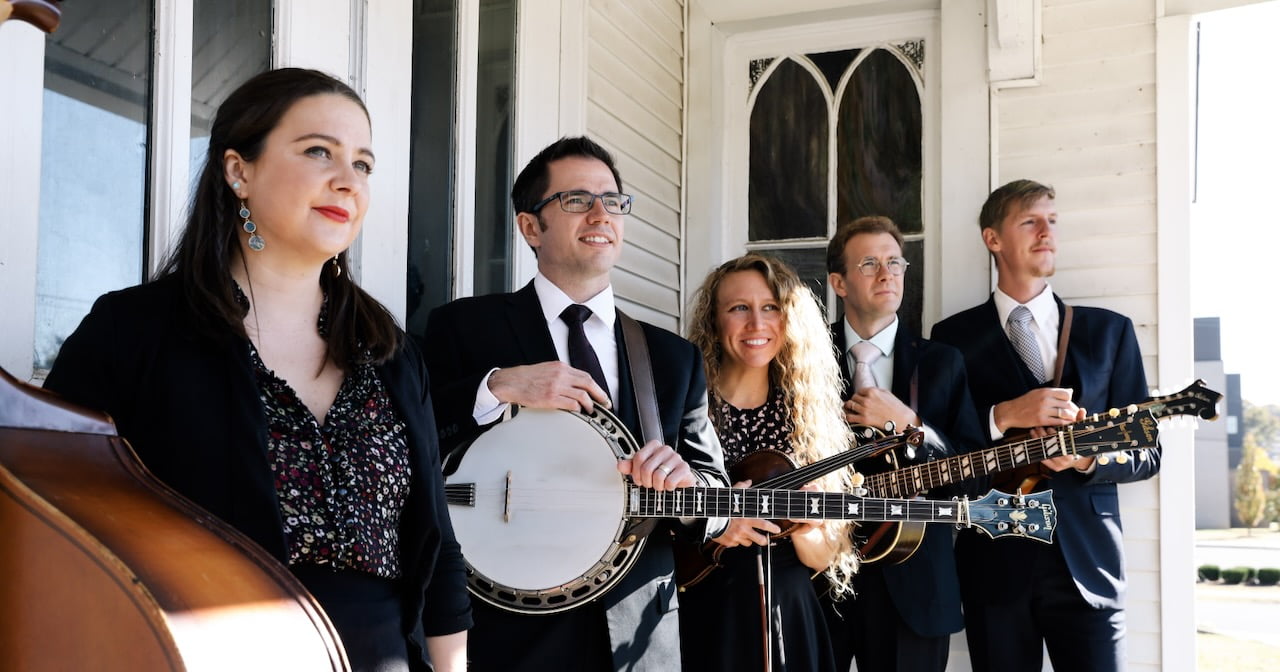
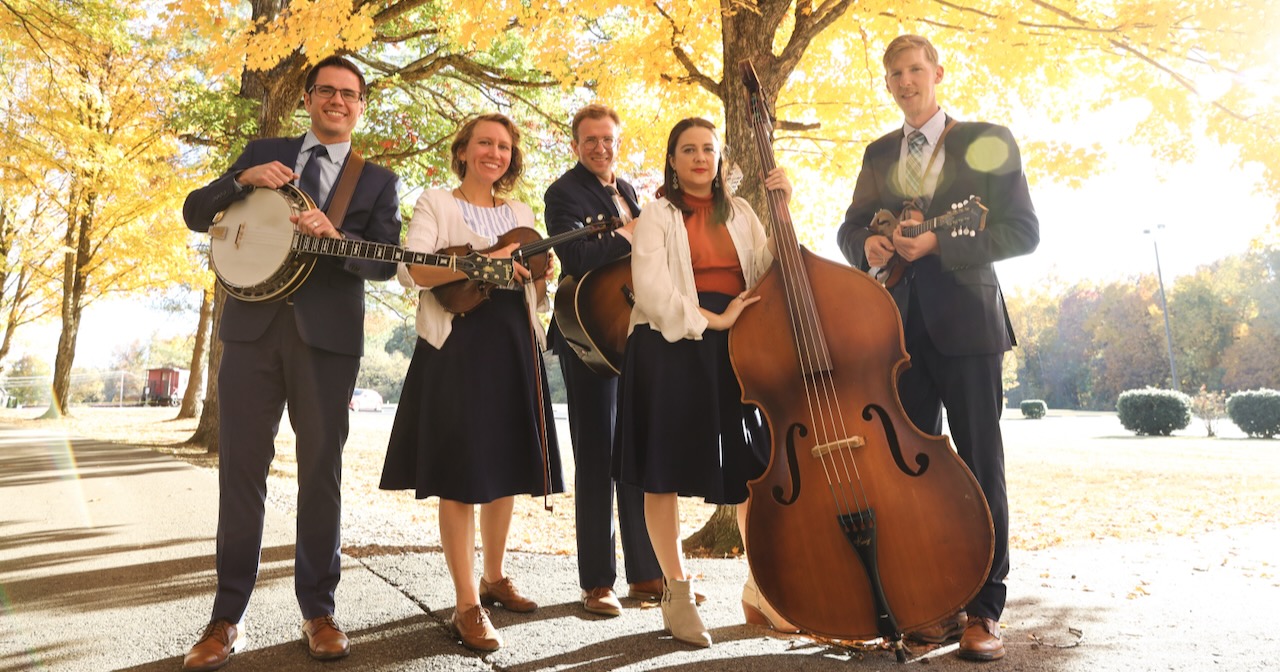
High Fidelity – Jeremy Stephens, Corrina Rose Logston Stephens, Kurt Stephenson, Daniel Amick, and Vickie Vaughn – is steeped in traditional bluegrass. Corrina’s parents got hooked on Reno & Smiley and the Stanley Brothers looking through department store record bins – and Corrina has stayed close to the traditional fold ever since. “It feels like it’s in my blood,” she said.
Jeremy learned to sing harmony from his grandfather. After he picked up the fiddle, a school bus driver made him a cassette tape of classic bluegrass. “And that tape was transformative to me,” he shared.
All of High Fidelity’s music is infused with the harmonies, instrumentation, and themes of early bluegrass performers. The friends who make up High Fidelity (the name comes from the words often on labels of early bluegrass records) came together as a band to compete in the SPBGMA band contest. They never imagined they would take first place. So, “It was this overwhelming gift that we won,” Corinna said. “It almost felt like divine intervention.”
“And everyone in High Fidelity is spiritual,” she continues. “We’re all Christian folks. We all identify with the songs that we’re singing.” So, from the earliest days, she said, they felt a gospel album was in their future, to “honor the Lord and thank him for giving us this gift.”
During a long period of illness that Corinna later learned was caused by toxic mold in their home (they since have moved out, and she feels a lot better), she received another gift from God, she said. She woke in the early hours of the morning with a song in her head that was so compelling, she had to get out of bed to record it. “And almost all of the verses just came out, bypassing my conscious brain.”
That song is “The Mighty Name of Jesus.” It is a centerpiece of, and the only original on, their recording, Music In My Soul. Corinna said, “We wanted [the project] to feel like a quintessential High Fidelity record, very bluegrassy.”
She wanted to emulate another early hero, Carl Story. When listening to Story, she said, “It wouldn’t even register that I was listening to a gospel record. It was just such good bluegrass… I wanted Carl Story’s vibes.”
Their recording successfully and joyously channels the spirit and musicality of the earliest bluegrass stars. High Fidelity worked hard to find little-known gospel songs from a variety of sources, performing them with the same enthusiastic vigor that they bring to their secular music. Listeners will recognize classic banjo introductions and harmony variations that have been passed through generations since bluegrass hit the radio.
And just as Music in the Soul is undoubtedly High Fidelity, nobody but The SteelDrivers could have created Tougher Than Nails. It is gritty, bluesy and achingly human.
Rogers said that for years, The SteelDrivers’ most requested song has been “Where Rainbows Never Die,” from the 2010 recording Reckless.
“We’ve gotten so many emails, messages, people come up to us at shows, telling us how they’ve played the song at their dad’s funeral or for grandpa or whomever and how much it’s meant to them.
“It doesn’t say the word God. It doesn’t say the word Jesus. It doesn’t even use the term heaven. But it is a gospel song, a spiritual song. It’s about passing on to the next life. To me, it is such a powerful, beautiful way of sharing,” Rogers said.
In the same way, she said, a SteelDrivers’ gospel collection wouldn’t be “preaching at people or using even the language they’re familiar with. But if the message is the same, why not?”
On Tougher Than Nails, expect the same gutsy, no-holds-barred, gorgeous vocals that we love from The SteelDrivers. Their original gospel songs are as much about the dangers, choices, and blessings of humanity as their songs about liquor, guns, guitars, and heartache.
They ask us to think about Mary Magdalene, and how she balanced love for the man with love for the divine. They wonder if Judas’ heart broke as he fulfilled his destiny of betrayal. And they celebrate the victory of love over the cruelty of crucifixion.
Even “Amazing Grace” is uniquely SteelDrivers – starting with a primitive drone that weaves into the blues-driven rhythms we associate with Black Baptist church choirs.
Chris Jones is one of the most enduring and admired singers in modern bluegrass. He also is a SiriusXM radio host and writer, and a respected commentator on all things bluegrass.
Jones recently recorded “Step Out In the Sunshine.” Jones learned the song from listening to Ralph Stanley on Jones’ “all-time favorite gospel album.” It’s a song of hope and joy.
“I think the feeling and sincerity of gospel music touches all different kinds of people. It has a broad appeal, whether you’re a believer or not,” Jones said.
He noted that many bluegrass fans relate to melodies and arrangements and often overlook the lyrics. He referred to a listener who loved the song, “Julie Ann,” because it was so happy. (It’s up-tempo, but sung by a man begging his wife not to leave him.) But lyrics do matter to the musicians who sing them.
Jones echoed a sentiment reflected in the gospel choices of High Fidelity and The SteelDrivers. A religious commitment “makes you a little more selective of what you’re willing to sing. Is this a message I really want to send to people?” Jones chooses gospel songs that are welcoming and inclusive.
High Fidelity’s Jeremy Stephens said they avoided lyrics that sounded like condemnation, the ones that say, “You’re bad because you do this and you’re bad because you do that.” He said Music In My Soul “is our hearts talking to your hearts… the Lord said, ‘Come to me as you are.’ There’s so much peace and love and acceptance in him.”
Award-winning singer and guitar player Greg Blake currently performs with his own band as well as with Special Consensus. Blake had a ministry for 30 years before becoming a full-time musician. He said he has learned a lot over the years about judgement, love, and being open-hearted. And his insights inform his choice of spiritually-oriented songs.
“When I was younger, and probably more zealous and less informed, I felt like I needed to be ‘right.’ But as I got older and looked at the teachings of Jesus, I saw that his message was more about right relationships,” rather than proper dogma or theology.
So today, Blake says, “I like to bring into gospel even songs that may not have a strong Christian element, but are just good, positive songs… that leave one with a sense of hope and love and care for one another. I think that’s the message that people of the world need to hear today.”
Photo Credit: Photo of the SteelDrivers courtesy of the artist; photo of High Fidelity by Amy Richmond.
Artist:High Fidelity Hometown: Nashville, Tennessee Song: “Are You Lost in Sin?” Album:Music In My Soul Release Date: September 15, 2023 Label: Rebel Records
In Their Words: “‘Are You Lost in Sin?’ is one that Kurt Stephenson brought to the table. Collectively, we have a special affinity for the early Jim & Jesse Capitol recordings, and High Fidelity has recorded several selections from that era over the years. Here, Jeremy and Kurt even emulate Jesse’s mandolin breaks on the guitar and banjo respectively!
“Incorporating material and stylistic choices from Jim & Jesse has always been a core part of what we do in High Fidelity, and every time we have recorded one of their songs, Jeremy and I couldn’t wait to share it with Jesse McReynolds. Jesse was so supportive of us, and through the years that Jeremy and I were blessed to work with him in the Virginia Boys, he even featured us singing the Jim & Jesse songs we’d recorded on the Opry and beyond!
“This song holds extra special meaning to us as the last Jim & Jesse song we recorded while Jesse was still with us on Earth. We hope this video serves to bring to remembrance Jesse and his amazing legacy while bringing to focus the striking message behind this beautiful Jim & Jesse composition.” – Corrina Rose Logston Stephens
Track Credits: Written by Jim & Jesse McReynolds
Jeremy Stephens – Guitar and Lead Vocal Corrina Rose Logston Stephens – Fiddle and Harmony Vocal Kurt Stephenson – Banjo and Harmony Vocal Daniel Amick – Mandolin Vickie Vaughn – Bass
Photo Credit: Amy Richmond Video Credit: Produced and filmed by Warren Swann
Artist:High Fidelity Hometown: Nashville, Tennessee Song: “The Mighty Name of Jesus” Album:Music In My Soul Release Date: September 15, 2023 Label: Rebel Records
In Their Words: “‘The Mighty Name of Jesus’ is an incredibly special song to me. It came to me at a time in my life when I was struggling with mysterious health issues, and all I had to get me through was my faith in the Lord. Early one morning, I woke up with it playing in my head like a recording. I knew I could easily fall right back asleep, and I actually started to, but I thought, ‘I better just grab my phone to record this.’ I was so sleepy that I actually forgot that it existed for a few days! When I finally remembered something about it and listened to the voice memo, I was a bit in shock. It was like listening to a song for the first time, only it was me singing it! I had gotten three verses and two distinct choruses that morning. As I wrote out the words, the fourth verse came to me, so I wrote it out, too. I could talk on and on about the amazing things with this song. I hope it is an incredible blessing to everyone who hears it!
“Much like the making of this song, there are so many special things I could talk about in the making of this video! Location after location fell through right up until the morning of the video shoot when the weather threatened to rain on our only day available for shooting. Love Circle was a location that came to me while desperately praying for ideas and direction, and it turned out to be absolutely amazing. The unique weather that day combined with our videographer Warren Swann’s artistic touch created an indescribable texture quality to this video that almost feels like Technicolor. It’s hard to believe that this is the first video High Fidelity has shot in our hometown of Nashville proper. The city has changed so much through the years, but we still love and care deeply for it. To be able to perform this song of healing and deliverance right there in our hometown with our beautiful city skyline behind us was beyond special. As the ‘songwriter,’ I feel so incredibly blessed to have received a song like this and to get to perform it with High Fidelity — I hope it can be a blessing and encouragement!” ̶ Corrina Rose Logston Stephens
Welcome to the BGS Radio Hour! For the past five years, this weekly radio show and podcast has been a recap of all the great music, new and old, featured on the digital pages of BGS. And this week, we say a bittersweet goodbye to the airwaves with our final episode. We want to give a special thank you to our partner station, WMOT Roots Radio 89.5 FM in Murfreesboro / Nashville, and all the stations that have aired our show over the years! And of course, a huge thank you to our readers and listeners for following along as well.
For this final week of the BGS Radio Hour, we have a recap of last week’s IBMA Awards, brand new music from our Artist of the Month — and newly crowned IBMA Entertainer and Guitar Player of the Year — Billy Strings, and much more.
With a brand new album, Renewal, and his win this past week of IBMA’s highest honor, Entertainer of the Year, there’s no one else we’d rather have as our October Artist of the Month than Billy Strings. Check out our Essential Billy Strings playlist and stay tuned for more Billy content all month long.
Oklahoma-based RC & the Ambers spoke on their biggest musical influence, watching The Golden Girls as a pre-show ritual, kayaking on the Illinois River, and more in a recent edition of 5+5.
On the latest episode of The Show on the Road, we bring you a conversation with Ray Benson: ringleader of the Grammy-winning, half-century-spanning group, and one of American roots music’s most durable and iconic bands, Asleep at the Wheel.
This song from traditional bluegrass group High Fidelity was nominated for Song of the Year at last week’s IBMA Awards. Hard to have the “Banjo Player’s Blues” when you have news like that to share!
Americana duo Haunted Like Human wrote “Ohio” inspired by a true story, and the end result is a tale told through letters of a man wanting to do right by his family while also wanting to get back home to them.
Single Girl, Married Girl has always loved torch songs and big weepy ballads — especially country ones! “Wreck Cut Loose” is placed in a more modern aesthetic and setting, but the lineage — and ties to the likes of Patsy Cline — should be obvious.
The title track for Patrick Dethlefs’ brand new album explores the idea of still feeling connected to loved ones who have passed on. Patrick tells us, “[It’s] maybe even asking the question, ‘Is this person with me now more than they have ever been?'”
Balsam Range, hailing from Haywood County, North Carolina, are no strangers to the IBMA Awards, having won the 2014 and 2018 award for Entertainer of the Year, among other accolades and awards over the years. And now in 2021, they’ve won Song of the Year for “Richest Man.”
Asheville bluegrass band Fireside Collective wrote “And the Rain Came Down” inspired by the many “storms” of COVID and the Great Flood tale from the Old Testament. But, despite the song’s somber overtones and the uncertainty of the story, there is still a message of hope.
Alt-folk singer-songwriter Kris Gruen wrote “Pictures Of” about his daughter, as a tribute to her maturation and readiness for the world. In different words “Pictures Of” says, “Be excited for and in love with the world! Regardless of our collective fear in the unknown…”
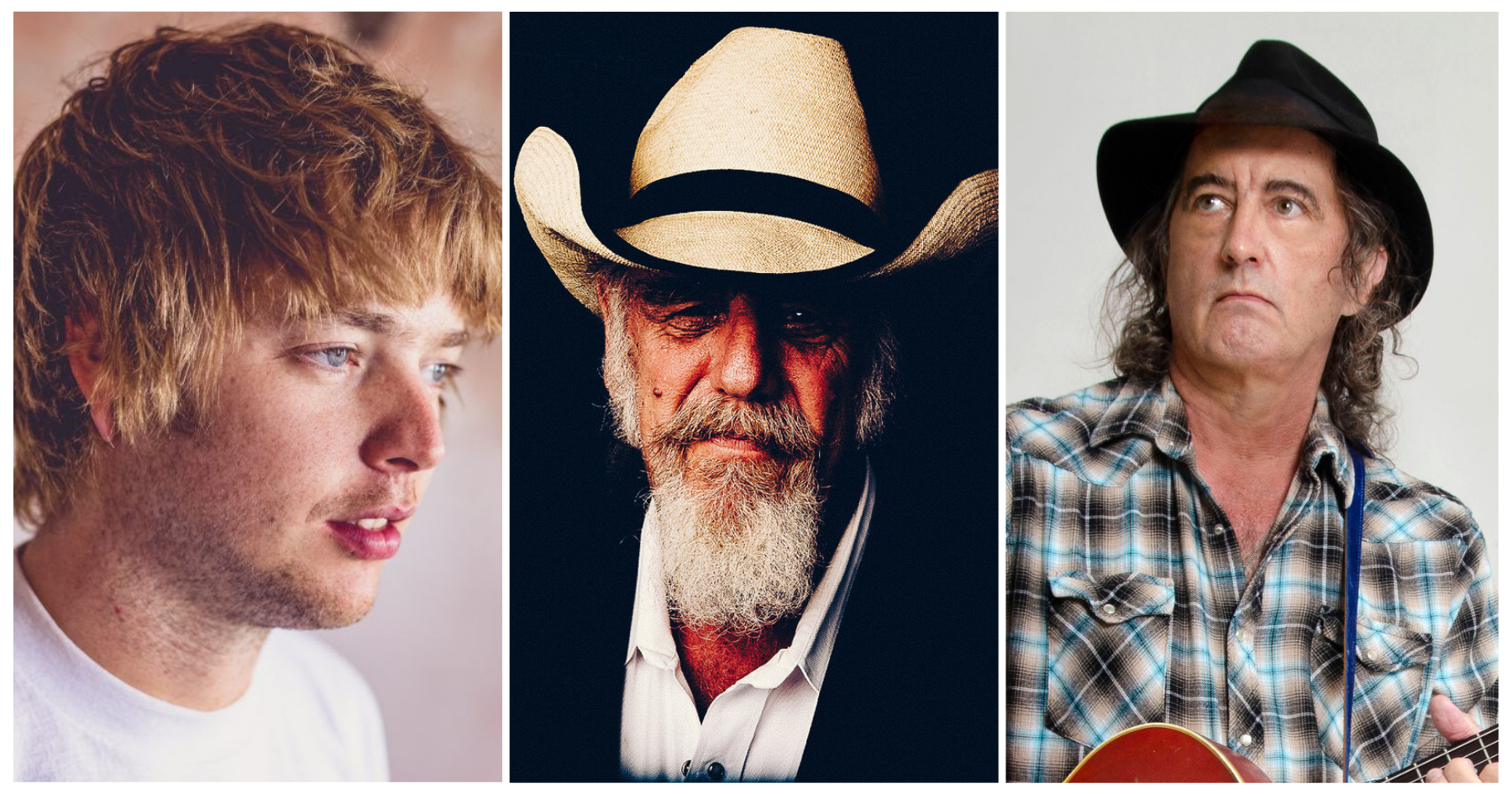
Holding a conversation with James McMurtry is similar to experiencing his music. He is frank, eloquent, and gets to the heart of the matter with few words. On The Horses and the Hounds, his first album of new material in nearly seven years, he tells sometimes complicated emotional stories through his fictional characters, crafted within the limits of rhyme and meter. His deft chronicling of human nature woven with descriptions of place and scene give the listener context beyond the experience, almost like each song is the essence of a short story or novel. Listen to “Canola Fields” and read our conversation with McMurtry.
At this year’s IBMA Awards, Appalachian Road Show was the second most nominated group, and they were awarded the honors of Instrumental Group of the Year and New Artist of the Year. On top of those wins, this tune, “The Appalachian Road,” was nominated for Instrumental Recording of the Year.
Old-time musician Clinton Davis has recorded his own version of “Curly Headed Woman,” a rare rendition of one of the most common American folk songs: “The Hesitation Blues” or “If the River Was Whisky” as most people call it.
Sideline reminisces on how they became a band, the importance of teamwork, prioritizing having fun every time they step out on stage, and more in a recent 5+5.
Photos: (L to R) Billy Strings by Jesse Faatz; Ray Benson by Mike Shore; James McMurtry by Mary Keating-Bruton
Jeremy Stephens might be the most-featured musician in the history of this column. We’ve featured his band High Fidelity, IBMA Best New Artist nominees once again in 2021, twice over the past few years. Now he’s released a solo project entitled How I Hear It on Rebel Records.
How he hears it is how he plays it. Stephens’ banjo playing – and for that matter, his flattop guitar, archtop guitar, mandolin, bass, and beyond – is all at once effortlessly timeless and firmly grounded in the present. With acts like High Fidelity (which he founded with his wife and musical collaborator Corrina Rose Logston), the Chuck Wagon Gang, Jesse McReynolds, the Lilly Brothers, and others Stephens continually demonstrates a commitment to traditional bluegrass from long before the Bluegrass Album Band, Tony Rice, the Country Gentlemen, and other second- and third-generation groups began to eclipse their more old-timey, homespun, and gritty forebears. He has a penchant for Don Reno’s outside-the-box pickin’, and the chord-based licks, steel guitar phrases, and electric guitar back-up that were Reno’s signatures.
Even with this perspective on the music — the earliest days of bluegrass being the string band aesthetic that resonates with him the most — his playing is neither antiquated nor backwards. At times, the most striking quality of his approach to the instrument is how in-the-moment it is. His techniques and musical vocabulary are couched so firmly in the past, yet never feel as if he isn’t expressing himself wholly in each and every musical and creative decision he makes. This fact remains true whether he’s playing something well-rehearsed, replicable, and measured or something purely improvisational.
Though this column does focus on instrumental music — there are several astounding, hoot-worthy, slapdash, and gorgeous tunes on How I Hear It — it should be noted that Stephens can be just as present and in-the-moment with his banjo playing and improvisation instrumentally as when he’s singing harmony or lead, often a rare skill in banjo players. Anyone who’s enjoyed a performance by Stephens, the duo with his wife (billed tongue-in-cheek as The Stephens Brothers), High Fidelity, or any of the many bands that have featured Stephens as a sideman, will know just how jaw-dropping this talent of his can be. Acrobatic, nearly impossible Don Reno licks spat out rapid fire from his fingers while singing or playing syncopated against himself – it’s a sight and sound to behold.
How I Hear It tracks “Sockeye,” “Lady Hamilton,” “The Old Spinning Wheel,” and “The Bells of St. Mary’s” perfectly capture the energy and ethereal quality of Stephens’ live playing in a way many more sterile bluegrass albums, and purposefully more modern sounding records, can only aspire to. With backing musicians such as Logston, David Grier, Mike Bub, Hunter Berry, and more, the entire project is the perfect vehicle to highlight and showcase this truly idiosyncratic — yet diversely and expertly pedigreed — style of banjo playing that’s all at both unapologetically old school and well-suited for a long, long lifespan into the future.
Nominees for the 32nd Annual IBMA Bluegrass Music Awards presented by Yamaha were announced today, with Balsam Range, Billy Strings, Doyle Lawson & Quicksilver, Del McCoury Band, and The Po’ Ramblin’ Boys landing in the top category of Entertainer of the Year. Alison Krauss, Lynn Morris, and the Stoneman Family will be inducted into the Bluegrass Music Hall of Fame during the show as well.
Five people who have made significant contributions to bluegrass music were named as recipients of the IBMA Distinguished Achievement Award: industry leader Nancy Cardwell Webster, broadcaster Lee Michael Demsey, Czech luthier/performer Jaroslav Prucha, musician/performer Cliff Waldron, and Boston Bluegrass Union’s Stan Zdonik.
The IBMA Bluegrass Music Awards on Thursday, September 30, at the Duke Energy Center for the Performing Arts in Raleigh, North Carolina. Awards are voted on by the professional membership of the International Bluegrass Music Association (IBMA), the professional nonprofit association for the bluegrass music industry.
ENTERTAINER OF THE YEAR
Balsam Range Billy Strings Doyle Lawson & Quicksilver The Del McCoury Band The Po’ Ramblin’ Boys
MALE VOCALIST OF THE YEAR
Ronnie Bowman Del McCoury Danny Paisley Junior Sisk Larry Sparks
FEMALE VOCALIST OF THE YEAR
Brooke Aldridge Dale Ann Bradley Sierra Hull Molly Tuttle Rhonda Vincent
VOCAL GROUP OF THE YEAR
Darin & Brooke Aldridge Balsam Range Blue Highway Doyle Lawson & Quicksilver Sister Sadie
INSTRUMENTAL GROUP OF THE YEAR
Appalachian Road Show Billy Strings Michael Cleveland & Flamekeeper The Infamous Stringdusters The Travelin’ McCourys
NEW ARTIST OF THE YEAR sponsored by Ron & Nancy McFarlane
Appalachian Road Show Carolina Blue Gina Furtado Project High Fidelity Merle Monroe
SONG OF THE YEAR
“Banjo Player’s Blues” Artist: High Fidelity Songwriter: Charlie Monroe Producers: Jeremy Stephens, Brad Benge Label: Rebel Records
“Hitchhiking to California” Artist: Alan Bibey & Grasstowne Songwriters: Wes Golding/Alan Bibey/Jerry Salley Producers: Jerry Salley, Ron Stewart, Dottie Leonard Miller Label: Billy Blue Records
“Just Load the Wagon” Artist: Junior Sisk Songwriter: J.R. Satterwhite Producers: Amanda Cook, Junior Sisk, Mark Hodges Label: Mountain Fever Records
“Leaving on Her Mind” Artist: Doyle Lawson & Quicksilver Songwriter: Jack Clement Producer: Rosta Capek Label: Billy Blue Records
“Richest Man” Artist: Balsam Range Songwriters: Jim Beavers/Jimmy Yeary/Connie Harrington Producer: Balsam Range Label: Mountain Home Music Company
ALBUM OF THE YEAR (Tie)
Bluegrass 2020 Artist: Scott Vestal, Patrick McAvinue, Cody Kilby, Dominick Leslie, Curtis Vestal Producers: Scott Vestal, Ethan Burkhardt, Lonnie Lassiter Label: Pinecastle Records
Distance and Time Artist: Becky Buller Producer: Stephen Mougin Label: Dark Shadow Recording
Fall Like Rain Artist: Justin Moses Producer: Justin Moses Label: Mountain Fever Records
Industrial Strength Bluegrass: Southwestern Ohio’s Musical Legacy Artist: Various Artists Producer: Joe Mullins Label: Smithsonian Folkways Recordings
Load the Wagon Artist: Junior Sisk Producers: Amanda Cook, Junior Sisk, Mark Hodges Label: Mountain Fever Records
Still Here Artist: Steve Gulley & Tim Stafford Producers: Steve Gulley, Tim Stafford Label: Mountain Home Music Company
BANJO PLAYER OF THE YEAR
Gena Britt Gina Furtado Rob McCoury Kristin Scott Benson Scott Vestal
BASS PLAYER OF THE YEAR
Mike Bub Todd Phillips Missy Raines Mark Schatz Marshall Wilborn
FIDDLE PLAYER OF THE YEAR
Jason Carter Michael Cleveland Stuart Duncan Bronwyn Keith-Hynes Deanie Richardson
RESOPHONIC GUITAR PLAYER OF THE YEAR
Jerry Douglas Andy Hall Rob Ickes Phil Leadbetter Justin Moses
GUITAR PLAYER OF THE YEAR sponsored by Yamaha
Trey Hensley Billy Strings Bryan Sutton Molly Tuttle Jake Workman
MANDOLIN PLAYER OF THE YEAR
Jesse Brock Sam Bush Sierra Hull Ronnie McCoury Tristan Scroggins
COLLABORATIVE RECORDING OF THE YEAR
“Birmingham Jail” Artists: Barry Abernathy with Vince Gill Songwriter: Traditional Producers: Barry Abernathy, Jim VanCleve, Dottie Leonard Miller Label: Billy Blue Records
“In the Resurrection Morning” Artists: Sacred Reunion featuring Doyle Lawson, Vince Gill, Barry Abernathy, Tim Stafford, Mark Wheeler, Jim VanCleve, Phil Leadbetter, Jason Moore Songwriter: Mark Wheeler Producers: Barry Abernathy, Jim VanCleve, Dottie Leonard Miller Label: Billy Blue Records
“My Baby’s Gone” Artists: Justin Moses with Del McCoury Songwriter: Dennis Linde Producer: Justin Moses Label: Mountain Fever Records
“Tears of Regret” Artists: High Fidelity with Jesse McReynolds Songwriters: Jesse McReynolds/Lucille Hutton Producers: Jeremy Stephens, Corrina Rose Logston, Brad Benge Label: Rebel Records
“White Line Fever” Artists: Bobby Osborne with Tim O’Brien, Trey Hensley, Sierra Hull, Stuart Duncan, Todd Phillips, Alison Brown Songwriters: Merle Haggard/Jeff Tweedy Producers: Alison Brown, Garry West Label: Compass Records
INSTRUMENTAL RECORDING OF THE YEAR
“The Appalachian Road” Artist: Appalachian Road Show Songwriter: Jim VanCleve Producers: Jim VanCleve, Barry Abernathy, Appalachian Road Show, Dottie Leonard Miller Label: Billy Blue Records
“Foggy Mountain Chimes” Artists: Scott Vestal, Patrick McAvinue, Cody Kilby, Dominick Leslie, Curtis Vestal Songwriter: Earl Scruggs Producer: Scott Vestal Label: Pinecastle Records
“Ground Speed” Artists: Kristin Scott Benson, Skip Cherryholmes, Jeremy Garrett, Kevin Kehrberg, Darren Nicholson Songwriter: Earl Scruggs Producer: Jon Weisberger Label: Mountain Home Music Company
“Mountain Strings” Artist: Sierra Hull Songwriters: Frank Wakefield/Red Allen Producer: Joe Mullins Label: Smithsonian Folkways Recordings
“Taxland” Artist: Justin Moses with Sierra Hull Songwriter: Justin Moses Producer: Justin Moses Label: Mountain Fever Records
GOSPEL RECORDING OF THE YEAR
“After Awhile” Artist: Dale Ann Bradley Songwriter: Public Domain Producer: Dale Ann Bradley Label: Pinecastle Records
“Grit and Grace” Artist: Balsam Range Songwriters: Ann Melton/Milan Miller/Beth Husband Producer: Balsam Range Label: Mountain Home Music Company
“Hear Jerusalem Calling” Artist: Joe Mullins & The Radio Ramblers Songwriters: Marty Stuart/Jerry Sullivan Producers: Joe Mullins, Dottie Leonard Miller Label: Billy Blue Records
“In the Resurrection Morning” Artists: Sacred Reunion featuring Doyle Lawson, Vince Gill, Barry Abernathy, Tim Stafford, Mark Wheeler, Jim VanCleve, Phil Leadbetter, Jason Moore Songwriter: Mark Wheeler Producers: Barry Abernathy, Jim VanCleve, Dottie Leonard Miller Label: Billy Blue Records
“When He Calls My Name” Artist: Alan Bibey & Grasstowne Songwriters: Alan Bibey/Ronnie Bowman Producers: Alan Bibey & Grasstowne, Ron Stewart, Jerry Salley, Dottie Leonard Miller Label: Billy Blue Records
Photo of Billy Strings: Jesse Faatz Photo of Alison Krauss: Capitol Records Photo of Molly Tuttle: Zach Pigg & Chelsea Rochelle
Twin fiddles are the bluegrass instrumental duo that get all the attention, but double banjos are really where it’s at. (Is this writer a banjo player? Why, yes. Is this writer biased? Why, of course!) It makes sense that twin or triple fiddling would end up more popular than double or triple banjos, given that fiddles are sounded by bows, so the melodic contours are more like vocal harmony, often longer phrases and bow strokes languidly and charismatically laced together. Banjos, with their rapid-fire sixteenth notes and syncopated, idiosyncratic rolls, are just more difficult to sync up. Hundreds – if not thousands – of banjo jokes devoted to rhythm and timing will certainly back that claim up.
But double banjo is an art form as old as bluegrass itself – and older, by quite a few dozen decades, if you count early American popular music, banjo orchestras, minstrel and vaudeville songs that all centered banjos before and during the turn of the 19th to 20th century.
In bluegrass, twin five-strings are at their most astounding in jaw-dropping and acrobatic contexts such as High Fidelity’s incredible rendition of the Don Reno classic instrumental, “Follow the Leader.” Famous for his steel guitar and chicken-pickin’ Telecaster licks transferred to banjo, Reno’s harebrained and wonky turns of phrase might seem like the last musical context in which one should attempt perfect synchronization, especially on banjo, but Jeremy Stephens and Kurt Stephenson defy reason, logic, and surely physics with their buttery, seamless, double banjo blend. The track perfectly encapsulates the “WHAT IS THAT!?” quality of five-string, three-finger banjo – raised to the second power.
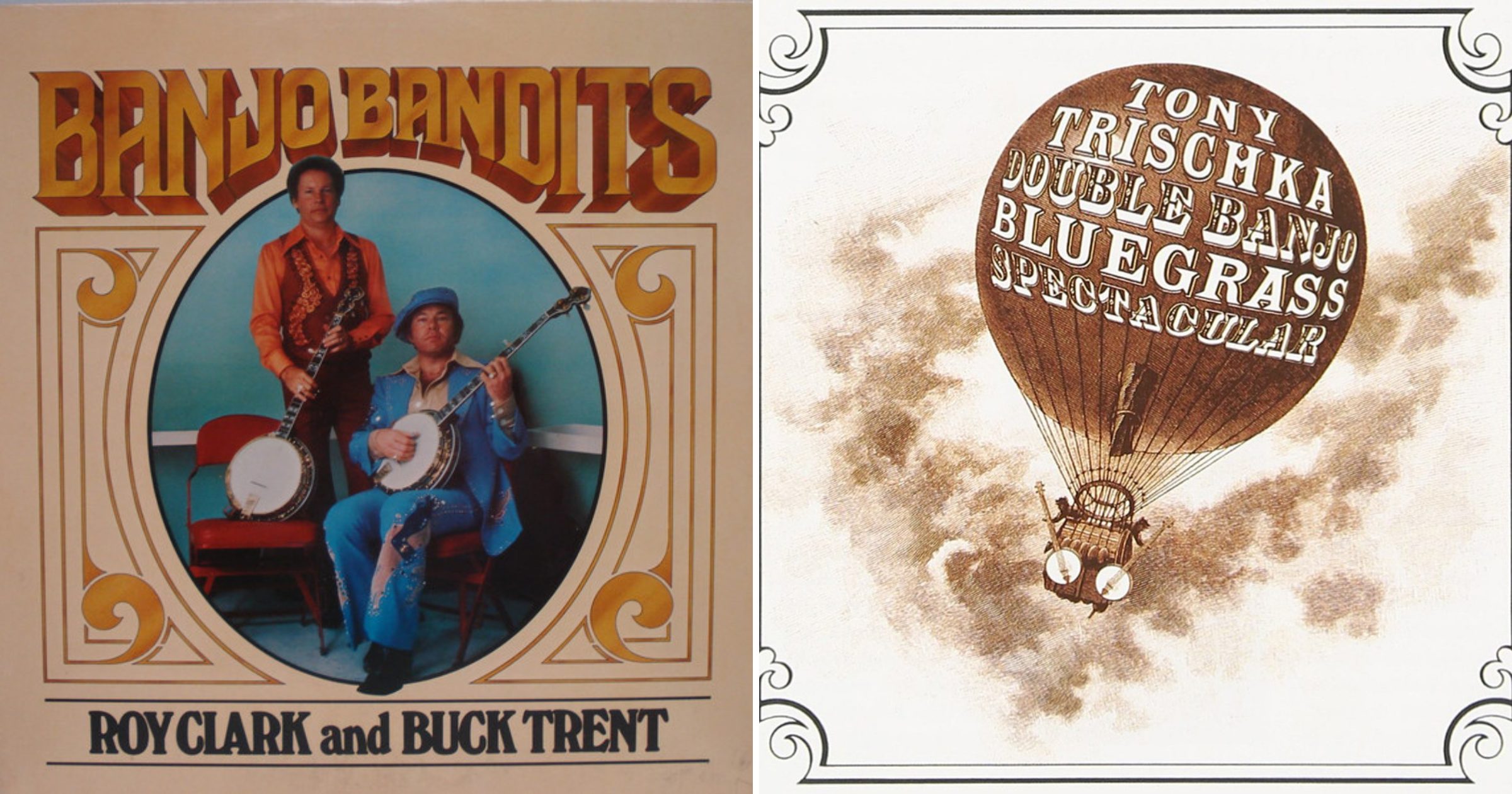
Anyone who grew up tuning in to or has ever binge-watched reruns of Hee Haw knows the beauty of a good double, triple, quadruple, quintuple banjo number, a common feature of the homespun country, comedy, and pickin’ variety show. Roy Clark, the Hee Haw host who could tear through almost any instrument in any style, released an entire album of double banjo music with regular Hee Haw guest Buck Trent in 1978 called Banjo Bandits. “Down Yonder” kicks with all-too-rare (and certainly delicious) bluegrass piano, a delightful intro to a bluegrass, old-time, and American songbook standard that almost sounds like a carnival merry-go-round thanks to the effect of the banjos “in stereo.” Banjo Bandits is something like a bluegrass and country double banjo primer, every track a stunning example of the form.
Like twin fiddling, double banjo lends itself so intuitively to the collaborative, community quality of bluegrass music. Through many a duo album and “featured artist” slot pickers have been using double banjo tunes to bring in their favorites, their mentors, their heroes, and their peers to swap licks, rising and falling, rolling and tumbling in breakneck unison. Alison Brown’s first Grammy Award was won for “Leaving Cottondale,” her double banjo instrumental with Béla Fleck from her also-nominated 2000 record, Fair Weather. In 2007, modern banjo hero Tony Trischka released a 14-track album of all twin banjo tunes entitled Double Banjo Bluegrass Spectacular. Its roster included Earl Scruggs, Brown, Fleck, Noam Pikelny, Steve Martin, and more. On “Doggy Salt,” a silly, winking instrumental that reconfigures the classic chord progression of “Salty Dog,” Scott Vestal joins Trischka, leaning into the humorous, comedic quality of these sorts of duets — a quality we see in Banjo Bandits and “Follow the Leader,” too.
Do not be mistaken, though, putting together a banjo duet isn’t just a comedic or intra-bluegrass activity! Cross-genre double banjo forays are certainly just as delightful, if not rarer and even more difficult to lock into rhythmic synchronization. Those that can mesh together three-finger’s rolling right hand with clawhammer and frailing’s loping, looser right hand are true virtuosos, defying not one but two genre’s expectations that banjos are intrinsically arhythmic and constantly rushing. Old-time players like Allison de Groot, Cathy Fink, Mark Johnson, Victor Furtado, and others all make it look and sound easy, matching their bluegrass compatriots’ rhythms and syncopations with ease and not just blending in, but counterpointing tastefully as well. One such recording, “Cluck Old Hen” from Pikelny’s Beat the Devil and Carry a Rail project, features Steve Martin, once again, on clawhammer. A less traditional approach, the two play with textures and senses, not striving for perfect unison, but rather exploring what an old-time-and-bluegrass dialogue can look and sound like, expanding our ideas of what twin banjo can be.
No matter the context, genre, roster of pickers, or style of playing, this fact remains true: more banjos equals more fun. (To this writer, at least.)
BGS is excited to announce the IBMA Bluegrass Music Awards Pre-Show, produced and presented in partnership with IBMA and highlighting this year’s Emerging Artist Award nominees. WATCH HERE.
The half-hour-long special will be hosted by Sean & Sara Watkins (winners of the Emerging Artist award as part of Nickel Creek in 2000) and features performances from all five 2020 nominees: Appalachian Road Show, Carolina Blue, High Fidelity, Mile Twelve, and Merle Monroe.
“In a year of firsts, we’re excited to launch a new collaborative tradition for BGS and IBMA,” says Amy Reitnouer Jacobs, BGS co-founder and Executive Director. “The Pre-Show is an opportunity to kick off the biggest night in bluegrass and highlight the future of the genre.”
The IBMA Bluegrass Music Awards Pre-Show starts at 7:30pm ET/4:30pm PT on Thursday, October 1 — just before the IBMA Bluegrass Music Awards — and will air on our YouTube channel as well as IBMA’s conference and festival platform, Swapcard. (Free music pass registration is available here.) Immediately following the event, viewers can click through to Swapcard, or IBMA’s Facebook page, to stream the full awards show. The Pre-Show is presented in partnership with BGS sponsor, Preston Thompson Guitars.
IBMA World of Bluegrass 2020 is a virtual music homecoming and convention, taking place September 28-October 3; the event includes the IBMA Business Conference; IBMA Bluegrass Ramble presented by Count On Me NC, an innovative series of band showcases; the 31st Annual IBMA Bluegrass Music Awards presented by Count On Me NC, and IBMA Bluegrass Live! powered by PNC.
(Editor’s note: A previous version of this announcement listed the air time for the show as 7pm ET / 4pm PT. The correct airtime is 7:30pm ET / 4:30pm PT.)
This website uses cookies to improve your experience. We'll assume you're ok with this, but you can opt-out if you wish.AcceptRejectRead More
Privacy & Cookies Policy
Privacy Overview
This website uses cookies to improve your experience while you navigate through the website. Out of these, the cookies that are categorized as necessary are stored on your browser as they are essential for the working of basic functionalities of the website. We also use third-party cookies that help us analyze and understand how you use this website. These cookies will be stored in your browser only with your consent. You also have the option to opt-out of these cookies. But opting out of some of these cookies may affect your browsing experience.
Necessary cookies are absolutely essential for the website to function properly. This category only includes cookies that ensures basic functionalities and security features of the website. These cookies do not store any personal information.
Any cookies that may not be particularly necessary for the website to function and is used specifically to collect user personal data via analytics, ads, other embedded contents are termed as non-necessary cookies. It is mandatory to procure user consent prior to running these cookies on your website.