Lucinda Williams: A Folk Singer’s Heart and A Rock Star’s Swagger

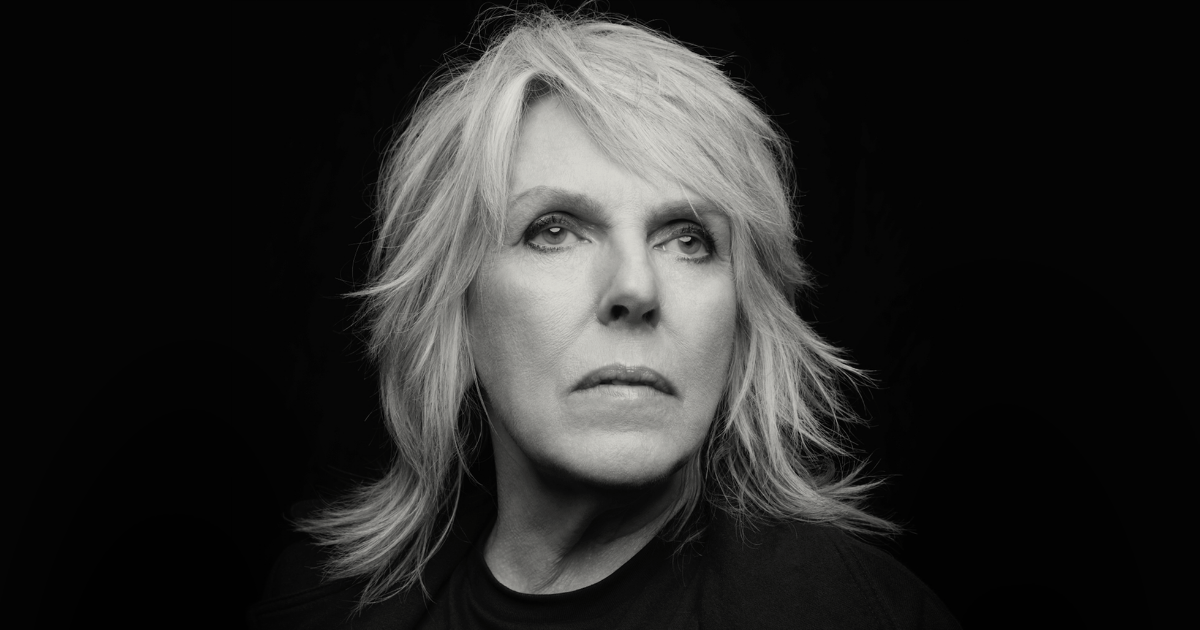
With a folk singer’s heart and a rock star’s swagger, Lucinda Williams gets it right on World’s Gone Wrong. Produced by Ray Kennedy and Tom Overby and released January 23, 2026, the topical album shows no love for the current president; instead, Williams turns to the musicians in her band, R&B legend Mavis Staples, and even a Bob Marley classic to put her own beliefs front and center.

As protesters take to the streets across America, Williams is reaching people where they live by maintaining an impressive tour schedule, just as she’s done for the last four or five decades.

BGS caught up with Williams for an Artist of the Month interview by phone, in motion and outspoken.

First off, I just want to say I love the electric guitar on this record.

Lucinda Williams: Yeah, I’ve got two of the best in my band, Doug Pettibone and Marc Ford. Marc was in the Black Crowes before and Doug’s been with me for a while. The two of them just play off of each other. They’re really great when you see the band live.

Thanks for saying that. I’ll pass that on! I’ve always managed to find really good guitar players to work with me. It’s important to me, having a good guitar sound in the band, both live and on the record.

This record’s got that live energy, which is hard to capture on an album. What were the sessions like putting this album together?

Wow! You’ve said all the right stuff that I want to hear! I love you! [Laughs] But like you said, it’s hard to get the recording to reflect that. That’s why I’m so excited that came across, but I always record live for the most part. … We’re all situated in that part of the studio where we’re recording, but the vocals are isolated, just for the sake of convenience, so we don’t have to worry about the [tracking band] bleeding in, in case there’s a mistake. But it has that live feel, because we’re not putting down certain things and then coming in later. The drummer is not coming in separately and putting the drum track down, that kind of thing. We’re putting down the basic track all at the same time, together.

I would be playing guitar normally, but since I had my stroke about five years ago, I’m struggling with it. That hasn’t come back all the way yet, unfortunately. Which makes it even more challenging, because normally I would set up the vibe and the feel on acoustic rhythm guitar, and then the guys would follow me and fall in behind me. So, now one of the other guitar players has to fill in for me. And even though they’re both great guitar players, nobody’s going to do a rhythm thing exactly like I do. That’s a little bit of a challenge right now, but we managed to pull it off somehow.

You’ve had so many musicians that have worked with you over the years. When it’s time to hire somebody in the studio or in your band, what qualities are you looking for?

Probably just being aware of different styles of music. I can’t read or write music, so for me to have to discuss something to another musician, I usually use a reference of another artist. And I might say, “I want to play this song kind of like Clifton Chenier,” like a zydeco thing. And if they don’t know who that is, it’s hard for me to describe it musically. So, the easiest and best way is just [bringing up] the sound of another style of music and using an artist to describe that.

What was on your mind as you were writing the song, “The World’s Gone Wrong”?

Well, what do you think? What’s going on right now, every single damn day. There’s some other crazy piece of news surrounding the so-called King of the United States. Or he wants to be king. He wants to name the Kennedy Center after himself. That stuff builds up in your mind, and after a while it’s therapeutic to sit down and write a song about it. Just get it out of your system. … I just remember, every single day there’d be something on the news, in the newspaper, on TV or somewhere online. You couldn’t get away from it. It was pervasive. It was just on my mind a lot, of course, and still is.

This might be venturing out a little bit, but it seemed like a love song too, because these two people in the song are leaning on each other.

Yeah, I’m glad you brought that up. I’m glad you saw that in there. I think it’s an interesting way of dealing with the political unrest, by painting a picture of a regular, everyday couple and what they’re going through. So you can express it that way.

I’ll shift it over to “Low Life,” because I feel like I’m sitting at that bar with you when I listen to that song. And I also like those bars where you can be anonymous and no one really knows you. When you’re out on tour, do you look for places like that?

Yeah, the guys and me will look for a cool little place to maybe go hang out after the show. It’s hard to find one, though, where they won’t know who we are, because then they’ll want to come up and talk and stuff. A lot of times the guys will go somewhere and I’ll be like, “I want to go! Take me! Take me!” And they’ll go, “Lu, you’re not going to want to go, because it’s going to be swamped with fans and everybody’s going to want to talk to you,” and all that. Then I get all disappointed because I can’t go. [Laughs] So I’d just stay on the bus.

We end up hanging out on the bus more often than not. That becomes our little bar. I like to fraternize with the band guys after we do a show. I like to bond with them a little bit on the tour bus.

I noticed you’re going on the road with the band Heart in March. When that offer came through, what made you think, “Yeah, I’ll do that.”

Well, turns out they were fans of my music, which I wasn’t aware of, and I guess their people reached out to my people… or my person [laughs] and wanted to take me out with them. Ann and Nancy Wilson are just two of the nicest people ever, real down to earth. We went out and already did some shows with them not too long ago. It seemed like with their fans and my fans, there was kind of an overlap there. It seemed to work musically as a bill.

I don’t think enough has been said about Nancy’s playing. I caught a documentary a while back on the music scene in Seattle back in the day, and with Heart a lot of people don’t realize they were there then, right when Nirvana was around. They were a little bit different, but I hadn’t realized how proficient Nancy was on the electric guitar and I was just sitting there watching it like, “Oh my God!” And Ann’s voice – they’ve got what it takes, that’s for sure.

You’re back out on the road, you’ve got this new album, and I’m sure there are a lot of other things in the works. What are you enjoying most about this stage of your career?

Being able to go out and do shows with artists like Heart. I got to go out and do shows with a tour featuring Bob Dylan and Van Morrison. I got to go out and do shows with the Allman Brothers. I’ve met so many fantastic, legendary artists over the years who like my music. And some might be a surprise. I was surprised, actually.

Like, Joey Ramone was a fan. David Byrne is a fan. Robert Plant is a big fan and I’ve done quite a few shows with him. So that’s been a big boost. Those probably have been the highlights of my career, being able to connect with those kinds of artists. The people I listened to when I was starting out and looked up to.

It was interesting to hear you include “So Much Trouble in the World” on this record. What did you like most about Bob Marley’s original version of that song?

First of all, I feel like that song was ahead of his time and it still rings true today. It’s still so fresh and could have been written yesterday. It’s still relevant. People still love the song. It’s got a great melody. Nobody can do it like Bob Marley did, though. I was a little self-conscious about that when we cut that song, because I was thinking, “What are people going to think? Me covering a Bob Marley song?” Like, “What does she think she’s doing?” But it’s a great song to play live. And like I said, it’s so much about what’s going on right now.

Having Mavis Staples on that recording is such a treat. What did she bring to the track?

She just added a whole extra level of soul, and thought, and everything. And we didn’t tell her what to sing or how to do anything. We didn’t give her parts to do or anything like that. We just showed her where the vocal booth was. You know, “Here’s the microphone,” turn it on, and she just let it rip. We’re so grateful to have her on there. And every single person I’ve done an interview with has mentioned her. Like, “What’s this about Mavis Staples on the record? How did you get her in the studio?” and all this. Everybody’s so excited to hear her on there.

I also wanted to ask you about “Too Far to Turn Around.” It feels like something we could sing at a protest march, but it’s kind of like a meditation, too.

Yeah. Thank you so much. I love hearing you say that, because that’s what I had in mind when I was writing it. Exactly that. I was thinking about songs like “We Shall Overcome” and everybody singing it together and holding hands. Because I experienced that myself back in the ‘60s. When I was a teenager, I used to go to all these marches and demonstrations. And music was the thing that kind of brought people together back then.

Those kinds of songs like “We Shall Overcome” were being sung and Bob Dylan was writing all those amazing protest songs like “Masters of War,” which I used to sing. I’d get my guitar, go to these things, and sometimes they’d ask me to sing. I’d do those kinds of songs, like Joan Baez and all. I mean, there was just a gamut of great folk singers. That’s what they used to call us! I kind of wish that would come back. Just call it folk music. The people’s music.


Continue exploring our Artist of the Month coverage of Lucinda Williams here.

Photo Credit: Mark Seliger
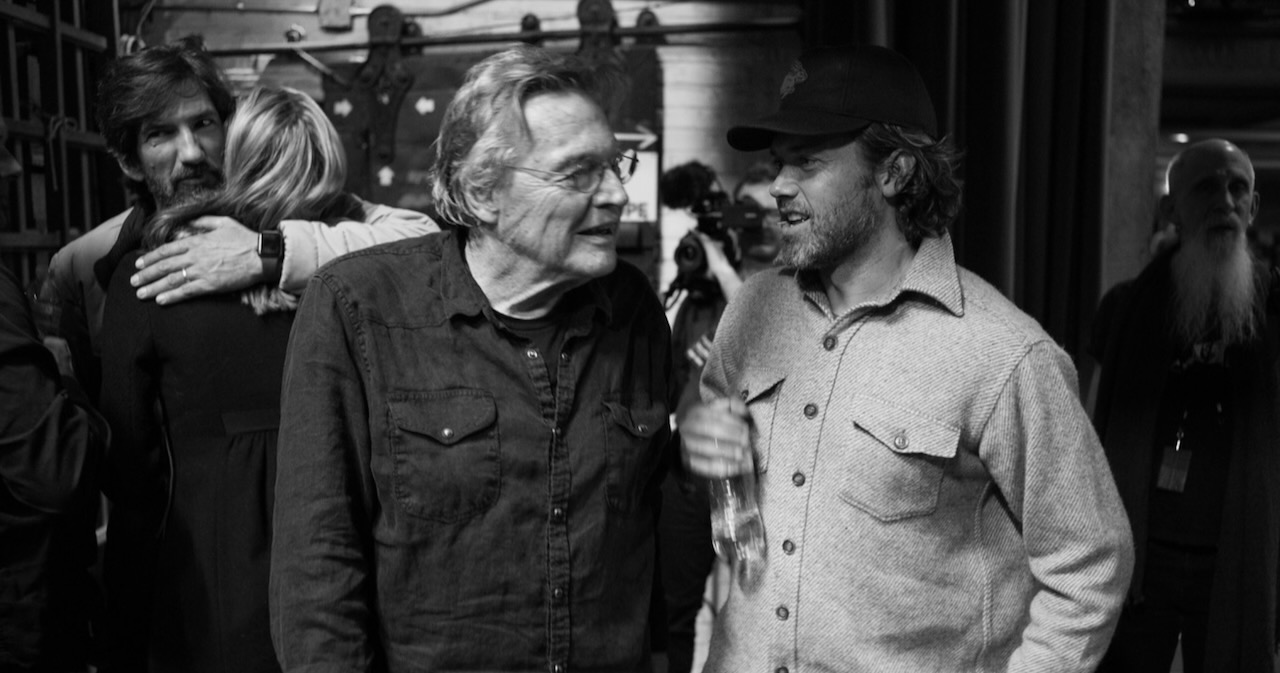
Terry Allen, For All Reasons

(Editor’s Note: Below, singer-songwriter and filmmaker Scott Ballew reflects on his relationship with legendary Texan musician Terry Allen for an exclusive BGS op-ed. Ballew, who directed a 2019 documentary about Allen’s life and music, Everything For All Reasons, will release a brand new album, Rio Bravo, on March 29 via La Honda Records.)

I moved back to my hometown of Austin, Texas in 2016 after 10 years of treading water in LA. California never felt like a permanent home to me, but over the course of a decade out there I was finally able to become ME. Part of that process was accepting that I was, in fact, a Texan and learning how to celebrate that.

Terry Allen’s cult album, Juarez, was reissued in 2016 around the same time I crossed state lines. It was given to me by a friend as a welcome home present. At the time, I embarrassingly only knew of Terry as the man who wrote “Amarillo Highway” as covered by Robert Earl Keen. Juarez was the first record I put on my turntable once I finally set everything up in my new south-Austin house, and it stayed there for four years. I was doing a lot of traveling back then making documentaries, and Terry’s voice traveled with me as “Cortez Sail” and “Dogwood” blared through my rental car speakers while driving through New Mexico, Colorado, Montana, and beyond.

Where had this been all my life? Was this written specifically for me? Who is Terry Allen? And how can I find him?

After a few years being back in Austin, I started a songwriting documentary series with Ryan Bingham. As the format started to take shape, we began talking about potential guests and Ryan casually mentioned he was very close with Terry and that he might be a great option. Holy shit. There wasn’t another name on the planet he could have mentioned that would have made me more excited than Terry’s.

Making The Midnight Hour was the first time the adage “don’t meet your heroes” proved to be false for me. Terry was kind, genuine, and funny. Terry reminded me that it’s ok to be Texan. And it’s ok to be creative.

Other things I’ve picked up from Terry along the way are:

  • The audience is irrelevant.
  • You have to fight for love.
  • Take care of your Art and your Art will take care of you.
  • You can have more than one calling.
  • Be kind.

I went on to make a longer documentary about Terry called Everything For All Reasons. I learned more about him during that process and came out liking him even more (not the case with most film projects). I tried to get David Byrne to address how unique and creative Terry was and David chose instead to focus on Terry’s family life, as that seemed more unique to him than anything else these days. He was right, and that ended up being the heartbeat of the entire film. 

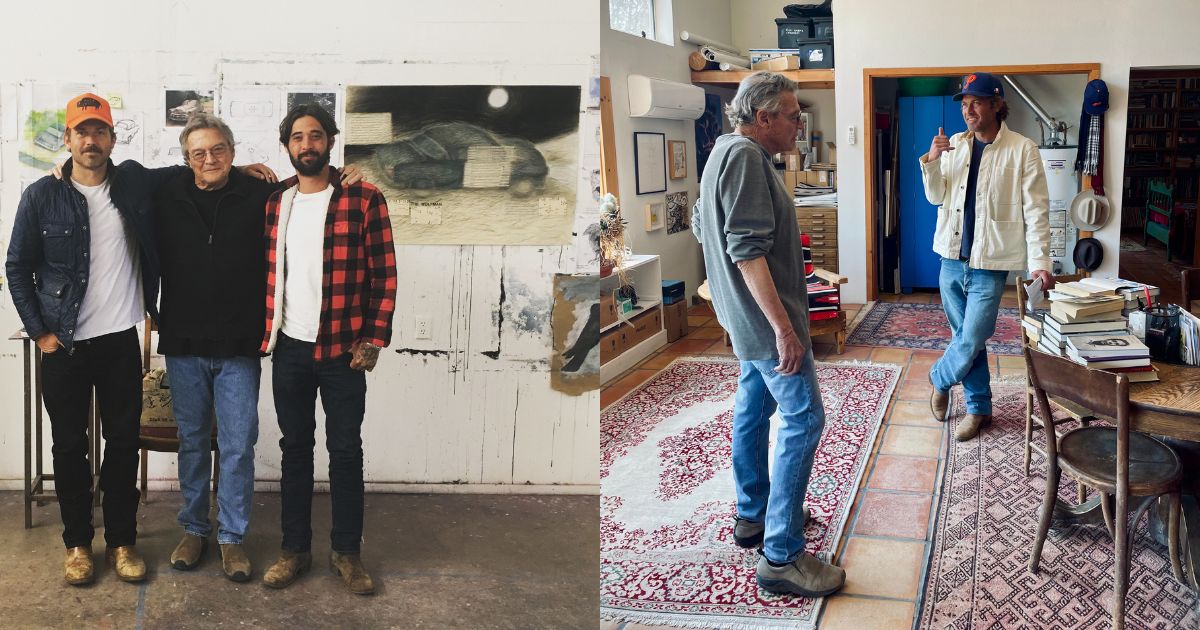
L: Scott Ballew, Terry Allen, and Ryan Bingham. R: Terry Allen with Scott Ballew.

At this point I like to think of Terry as my creative Godfather and someone I can always reach out to when I need a nudge to have some guts and do the right thing. He is the sole reason I started writing songs and why I had the naïve confidence to follow through and actually record them. Thank you Terry, for everything.


All photos courtesy of Scott Ballew. Lead image by Greg Giannukos.

BGS 5+5: David Wax Museum

Artist: David Wax Museum
Hometown: Charlottesville, Virginia (David is originally from Columbia, Missouri, and the band formed in Boston)
Latest Album: You Must Change Your Life
Personal nicknames or rejected band names: Honestly, the name David Wax Museum started off as a tossed off joke, but it’s stuck around for 16 years. The name was suggested by a friend Anna Henchman who supposedly gave Evan Dando the band name idea Lemonheads.

What other art forms — literature, film, dance, painting, etc. — inform your music?

My songs are constantly in dialogue with literature, specifically novels and poetry. I keep a stack of poetry by my side whenever I’m writing — Pablo Neruda, Denis Johnson, James Wright, to name a few — and I’m often making random word lists as I thumb through the pages. The title track of the record “You Must Change Your Life” is based on a line from Rilke. His exhortation has always moved me quite powerfully. In the poem, “Archaic Torso of Apollo,” a headless sculpture “sees” inside the poet and stirs him so deeply that he cannot go on living like he was before. While the phrase captures the change that can come through witnessing art, I realized I needed to bring this lofty idea down to earth through a specific character at a specific moment in time. Literature often serves as this type of springboard for me.

While writing the songs on You Must Change Your Life, I was deeply immersed in Karl Ove Knausgaard’s My Struggle. This Norwegian author’s six-part series explores his life (from the most mundane to the most profound aspects) with such searing honesty that it gave me the courage to write these songs, to shine such an unsparing light on my heart and the questions of desire that animate this record.

Which artist has influenced you the most … and how?

Paul Simon. He’s had the most consistently inspiring career, and his lyrics, his phrasing, and his musical curiosity have sent me down so many fruitful paths as a songwriter. Graceland remains a musical north star for me, and I return to it again and again for ideas and sustenance. He showed what was possible, as a musician unconstrained by genre and as a lover of folk music from all over the globe. There are definitely other artists (David Byrne comes to mind) who have likewise continually evolved and challenged themselves as artists, but no one else has so consistently made music that resonates for me personally. Paul Simon has masterfully explored his inner world but has done it in a way that bridges musical cultures, places his introspection within this broad, rhythmic canvas of the world, and all the while held up the artistry and craft of the song.

For me, a deep exploration of traditional Latin folk music, specifically son mexicano, has informed much of my songwriting and the development of the band’s sound. While living in Mexico studying folk music I began to write songs that used Mexican rhythms and song structures but were clearly not Mexican folk songs. I started to envision a way to bridge these two musical influences — the one of my upbringing and the one of my passion. This current doesn’t run through every song of ours, but it pulses through the records and the live shows and continues to inspire me. The instruments and rhythms are a deep well I return to time and time again. And through this exploration, I found my voice and discovered a way to be a part of a larger conversation.

What’s your favorite memory from being on stage?

We were once invited to perform in the Czech Republic at the Colours of Ostrava festival. It’s a wild setting for an event, tucked in under the looming towers of an old steel factory. It remains one of my favorite memories from being on stage because the audience was so welcoming and emotive. The thousand or so Czechs who had gathered under the tent with us had never heard of our band, but it’s as if the whole crowd collectively decided they were going to embrace us for who we were and have a transformative, magical experience together. They learned the songs as we went and started singing along. They improvised group responses. They danced. They cheered. It felt like the perfect gig.

It was made all the more meaningful because Suz’s father was with us to take care of our 9-month-old daughter. It had been a formidable trip to get five musicians, a grandparent, and a baby to this distant town, but when Suz and I were first falling in love on tour, we imagined a future of traveling the world with a family, and it was so gratifying to be actually doing it all those years later.

And now, looking back, I can appreciate the creative moment that the show represented for us as a band. It was the last hurrah of a particular line-up, one that had been honed for years and that was communicating on such a deep musical level with one another. Suz and Greg Glassman, the bassist, had been singing together for years in bands. And my cousin Jordan Wax, who I grew up making music with, was playing accordion and keyboard with us. We’re practically brothers. Additionally, Jordan and Greg had begun a new band together in New Mexico (Lone Piñon). So there were so many deep musical ties amongst the group, and it translated into this beautiful cohesive musical family.

If you had to write a mission statement for your career, what would it be?

To carve an authentic path with integrity and vitality. When we got started as a band, it seemed like there were these very clear steps to take to become serious, professional musicians. And, to a degree, that felt true for the first five years as a band. But at a certain point, there stops being a template or a model to copy. At least for a band like us, it became apparent that we needed to create our own version of a successful career that was true to ourselves. Initially that meant figuring out a way to tour sustainably as a family. We needed to build and nurture a wide community of support to pull this off.

As hard and disheartening as it can be at times, we’ve created our own model for DIY, family-oriented touring that we can do between record cycles. And the relationships we’ve cultivated with our fans by doing it this way eventually enabled us to raise the money to build this unbelievable music studio in our backyard (read more). This unique path has also led to creative projects that don’t fit within the traditional music industry. One of our favorites is a blindfolded, meditative concert experience called Golden Hour that we’ve created with our dear friends Lowland Hum.

Since food and music go so well together, what is your dream pairing of a meal and a musician?

I would love to share an Ethiopian meal with Jeff Tweedy. I don’t know if he even likes Ethiopian food, but it’s our go-to meal on tour. We usually order a large vegetarian combo plate to share with our kids and bandmates. And if anything is left over, it even tastes great as a cold, post-show snack. As for the company, Jeff Tweedy is one of my musical heroes. I first started listening to his first band Uncle Tupelo in junior high when someone gave me a cassette tape at jazz camp. It blew my mind, particularly hearing someone from my part of the world (just outside the St. Louis orbit) making a gritty, earnest Midwestern sound, steeped in country, punk, and rock ‘n’ roll. It helped me find my own voice and validated my own instincts and intuitions. My dream is to make a record with Jeff in Wilco’s Loft, so I like to imagine this meal would be a pre-production meeting over Ethiopian food, discussing songs and sounds and instruments.


Photo Credit: Tristan Williams