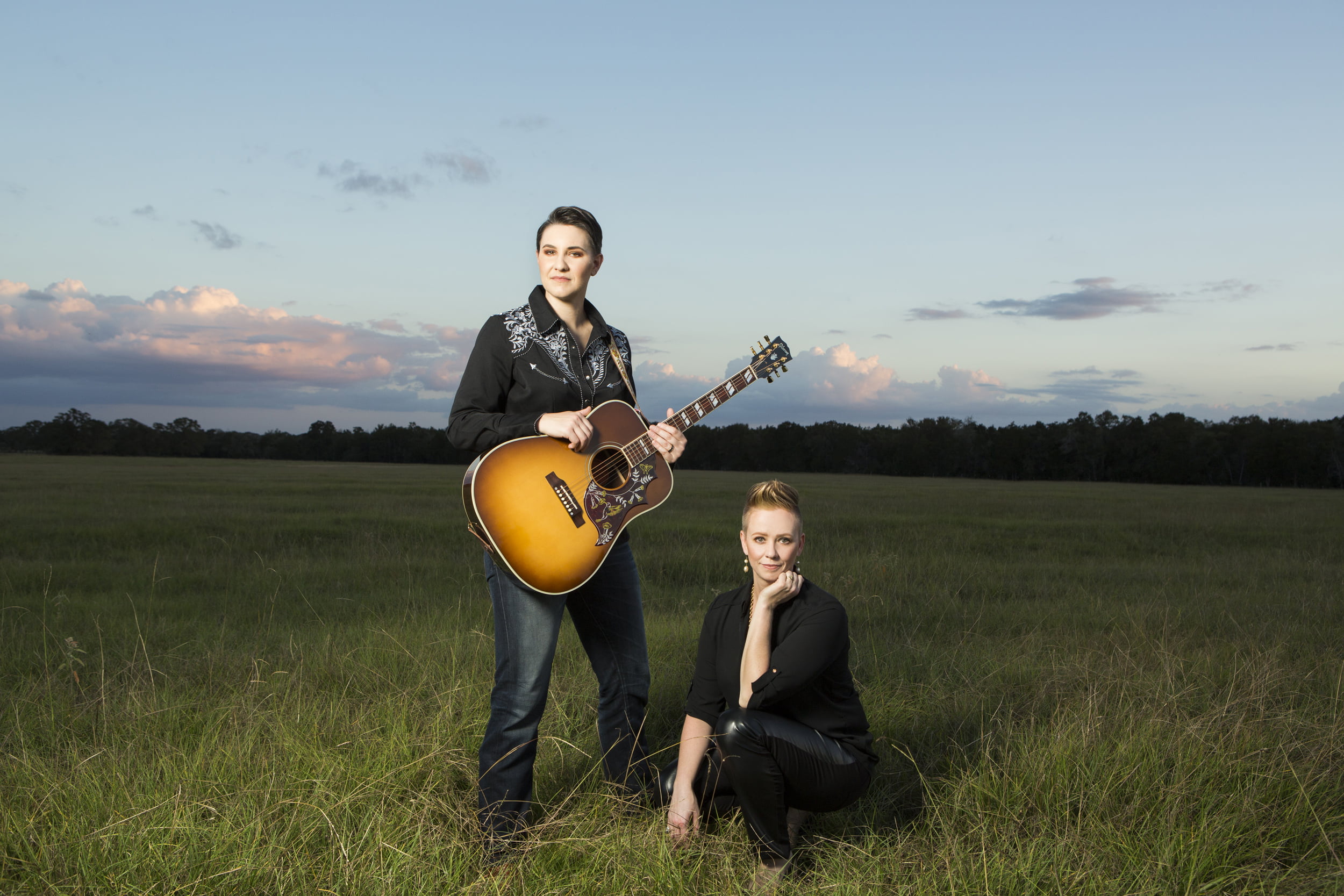
Shout & Shine conversations revolve around expectations: expectations about roots music and its constituent genres and to whom they belong; expectations about what artists and fans want and need; expectations about representation, visibility, community, tradition, history, politics, and so on.
One of the aspects of these interviews that is most compelling is how, even among just the artists of marginalized and underrepresented identities, a relatively small group of people in roots music, the variety of expectations — and perspectives and approaches — is astounding. Each interview has the potential to remind us that we all bring our own presuppositions, biases, and expectations into every conversation we have, even when we are doing our best to be cognizant of them.
Kristin Davidson and Carolyn Phillips, the folk/country duo Hardened & Tempered, most certainly illuminated the baggage of expectations brought to the table, but it also put a spotlight on how all human beings would benefit from stopping to appraise our assumptions from time to time. We could all stand to loosen our grips on our beliefs and dogmas, on the stereotypes we feel are valid, on the narratives we cling to — whether consciously or subconsciously. After all, the strongest steel isn’t rigid, unwavering, and hard. It’s flexible, it’s malleable, it’s giving. That kind of softness makes it stronger. It can make us stronger, too.
Your name, itself — Hardened & Tempered — and the first line of your bio, “Hard enough to hold an edge, soft enough not to break,” sounds like the LGBTQ+ experience distilled. How much of your identities went into the name?
Kristin Davidson: There are a couple of different meanings that went into the name. One is, quite literally, the reference to steel. Because I play the pedal steel, one of my favorite pastimes has been rebuilding old motorcycles, and I also know how to weld. So there’s literally a steel reference in that. But we also liked it as …
Carolyn Phillips: … a metaphor.
KD: Yeah, a kind of metaphor for the balance that we always try to aspire to. We’re both pretty intense individuals, and we do intense things, but certainly, learning how to soften up over the years has taught us to be a little stronger, too.
CP: We were actually talking to one of our close friends in Sante Fe, as we were trying to figure out our name, and he mentioned how he thought of us in this way (hardened and tempered) as individuals, but also as a couple. “Soft,” tempered steel is actually stronger than the hard stuff. That softness makes us stronger. I think that it’s a life lesson from growing up, in general. I think, in every aspect of my life, that rigidity hasn’t been a strong point. When I can meet others with kindness, I actually get that back.
What did your individual journeys to roots music look like?
KD: My deep dive into music, especially lyrically based music, started as far back as I can remember. As I grew up playing the guitar, I always had guitar teachers pointing me in the direction of blues. I definitely gravitated towards folk as a genre. I probably became most aware of it in my early 20s. Lucinda Williams was a culmination of that journey — she was a gateway for me, in a lot of ways. That sophisticated simplicity in her writing, with the blues and the roots influences, led me to explore the different sub-genres that supported her in a more detailed way.
CP: I was more of a late bloomer to all of it. I grew up in a small town in rural Nebraska and graduated with a class of 19 people. My music exposure at that time was pretty limited. I didn’t start getting into roots music until I met Kristin, which was in my 20s, as well.
The first song on your album, The Trailer Sessions, is “My Wildest Ride” and, in the first verse, we hear a woman singing female pronouns, “… The prettiest girl I’d seen.” What’s the story behind that?
KD: I like to step into the shoes of whoever the character is, regardless of gender. “My Wildest Ride” is a song I wrote for a friend and his wife, so they’re actually male and female characters in the song, because I wanted to write a song that honored them. What I think is fun is my voice giving voice to both characters.
In my experience in bluegrass, women will sing classic songs without changing the pronouns, and no one bats an eye at it. But if a man happens to sing a song from a female perspective, they’re almost always changing the pronouns. I like that you’re keeping the song central there.
KD: That’s one of my pet peeves! When I hear a male song covered by a female artist, it always irritates me if she were to change the pronouns. Occasionally, you run across artists who don’t. There’s something more magical that happens when the pronouns don’t change. I don’t know — it’s more fun and it’s transcendent, in a way.
Do you feel like queerness makes you more likely to appreciate that or to do that in your own music?
CP: I think so.
KD: Yeah, sure!
CP: We never want to be boxed into anything. That’s how we both live our lives. We just let “us” be who we are. Because we’ve had to explore that all of our lives, we’ve gained this freedom to live this way.
So the songs on your record range from being total story songs to totally personal.
KD: Oh, definitely. The first song, like we said, is about friends of ours. But then, going into track two, with “Heartbreak Transit Line,” that is a character and a set of circumstances I imagined, versus “Centerville,” which is very much written from my experience. I think, even when I have a movie-like image that develops in my brain, when I’m invested in developing a certain character, I always ask myself, “What about this character is something that I can relate to personally?” That’s a great exercise, because usually I create these characters in circumstances that I have not lived myself. I guess it’s an exercise in empathy.
Where does “Family Secrets” fall on the story song to personal song scale? I hear that line in there, “I can’t fall in love without reminding you of your regrets.” It makes me think of my family — and the families of so many LGBTQ+ people out there — who will never be fully supportive of queer love and the happiness we gain from it.
CP: [Laughs] That’s a loaded question!
KD: [Laughs]
CP: This came from, quite literally, a family secret that we’re not sure we should tell, because it involves a still-living family member. [Laughs]
KD: But yes, you’re absolutely right. Those couple of lines and down through the hook, “You can’t deny what you won’t confess about the family secrets …”
See, that sounds like the closet to me.
KD: And part of it is. That factored into it. But I had been reading a lot about epigenetics and considering my own family secrets. My mom found this old newspaper article about some great-great-great grandfather of ours that committed a triple murder/suicide type of situation, and it made national news in like, 1906. You could probably mine I don’t know how many country songs from it. That was one of the things that I grew up knowing, because my dad didn’t consider it something to keep secret from me, but then I’m not sure my cousins knew.
Then, of course, our own experiences falling in love factored in — that’s an intense enough thing on its own, to be falling in love without adding in the external dynamics and reactions. You don’t always know where that external influence is coming from or why. It could have something totally different driving it. Like a family secret. There was a whole bunch of information bouncing around in my head [while writing “Family Secrets”]. But I have to say, that chorus was one of those things that just popped out, and I’m not sure how.
I think the important thing here is representation. LGBTQ+ people who listen to your music see themselves reflected in it — where they don’t normally see themselves in Americana or country at all. For instance, I keep finding these bits and pieces of your songs that I can relate to as a gay man, that may or may not be coming from a LGBTQ+ starting point at all, but your visibility allows listeners to connect those dots, if they so wish. Do you consider that while you write and perform?
KD: I don’t think I think about it overtly, but I take what you just said as a tremendously high compliment. It’s such an inside-out process, to start with the seed of creation and then watch it launch into something that can exist on its own. When I first started writing, I didn’t sing, so I was used to writing words that were brought to life by someone else’s voice. I’m more grounded with the songs now, but it’s still such an inside-out experience for me. I just hope people listen and like the songs. I’m always so complimented by the fact that people relate to them.
What is the dynamic in Austin, Texas, and in the music scene and in your communities? How does it feel playing regionally, going from the progressive echelon of Austin to the deep red areas surrounding it?
KD: We haven’t been in Austin that long, so it’s hard to provide any sort of global context to it, but Austin has been very good to us. I’d say it’s a very relaxed and open community.
CP: It feels pretty fluid to me. That’s been our experience even on tour.
KD: In, like, rural Nebraska.
CP. Yeah. Again, I take it back to, you know, how I have survived in this world is by just being myself and being kind, and that’s usually what I’m met with, fortunately. Being out there, being in different rural communities, playing music, and being gay gives [our audiences] exposure to different types of people that they maybe otherwise wouldn’t have had. I hope by us being out there, being who we are, and being good people, we can continue to help represent and show who our community is. There are fewer barriers in place than we hear about sometimes.