Since the very beginning of the cowboy genre, cowboy songs and cowboy poetry have been closely related. Many of the best-known traditional cowboy songs started out as poems and many cowboys have recited song lyrics as poetry. The first man to collect cowboy songs was a New York-bred cowpuncher named Jack Thorp. As Thorp observed in his book, Pardner of the Wind: “Cowboy songs were always sung by one person, never by a group. I never did hear a cowboy with a real good voice; if he had one to start with, he always lost it bawling at cattle, or sleeping out in the open, or tellin’ the judge that he didn’t steal that horse.”
That old-time cowboy singing was mostly done a cappella, as there were not many guitars to be found on the trail drives or in the cow camps. It also seems that there was a fine line between “singing” and “reciting.”
This tradition of setting cowboy poems to music has continued to the present day. My old friend and mentor Don Edwards was master of this. He taught me that if you find an old poem or a set of lyrics with no music, then you just make up your own tune and make your own song out of it. That’s part of the cowboy songster tradition. – Andy Hedges
“The Strawberry Roan” – Harry Jackson
This is the most famous of all bronc ridin’ songs and one of the most famous of all cowboy songs. It was originally written as a poem by Curley Fletcher in 1914. The original title was “The Outlaw Broncho.” Rumor has it that Fletcher wrote the poem about a bronc ride made by the legendary cowboy artist and writer Will James.
Even though the poem became one of the most recorded cowboy songs of all time, Curley Fletcher never made a dime off of it due to unscrupulous copyrighters and publishers. This recording by Harry Jackson is a great example of the old-time unaccompanied style of cowboy singing.
“Sierry Petes” – Gail Steiger
“Sierry Petes” was written as a poem by Arizona cowboy Gail Gardner in 1917. It’s been set to music many times and is better known as “Tying Knots in the Devil’s Tail.” Many folks have failed to give proper credit to Gail Gardner and have also failed to get the words right. This is the original version recited by Gail Gardner’s grandson, Gail Steiger.
“Sierra Peaks” – Ian Tyson
A fun version by the great Ian Tyson with a corrupted title, some incorrect words, and a modern beat. Ian Tyson revitalized cowboy music in the 1980s with both his versions of traditional cowboy songs and his original compositions.
“The Dixie Cowboy” – Taylor’s Kentucky Boys
Montana cowboy D.J. O’Malley published a poem entitled “After the Roundup” in the Miles City Stock Grower’s Journal in 1893. It became known as “When the Work’s All Done this Fall” and a 1925 recording by Carl T. Sprague sold over 900,000 copies. I’ve always loved this obscure version by Taylor’s Kentucky Boys with an alternate melody.
“The Long Road West” – Don Edwards
Henry Herbert Knibbs was a poet, novelist, hobo, and owner of a violin repair shop. He never earned a dime as a working cowboy, but his poetry entered the oral tradition of working cowboys. “The Long Road West” speaks to the kinship between cowboys, hobos, and sailors. It was set to music by the great Don Edwards.
“The Old Cowman” – Andy Hedges & Brenn Hill
In his book Classic Cowboy Songs, Don Edwards tells the story of how he fell asleep reciting this poem one night and woke with the melody in his head. This song is more relevant now than when it was written, over 100 years ago. I recorded this version with my pard Brenn Hill for my 2023 album of cowboy duets entitled Roll On, Cowboys.
“Spanish is the Lovin’ Tongue” – Michael Martin Murphey
Originally written as a poem entitled “A Border Affair” by Charles Badger Clark. I think that Michael Martin Murphey plays the definitive version of this song. And it was also the first song that Murph sang onstage at the National Cowboy Poetry Gathering in Elko, Nevada, when he showed up at one of the early gatherings. It always reminds me of All the Pretty Horses by Cormac McCarthy.
“The Westerner” – Andy Hedges
I found the “The Westerner” in Charles Badger Clark’s 1915 book Sun & Saddle Leather. The poem speaks to the values of folks who live in the rural West. I hope that my melody does it justice. It is the title track of my new album.
“Shadow on the Cutbank” – Trinity Seely
This is a modern-day poem set to music – the poem by horseman, cowboy, and poet Joel Nelson, and the melody by horsewoman and singer-songwriter Trinity Seely. The poem is Joel Nelson’s answer to the historians who have written the cowboy off as a vanishing breed.
“Hitting the Trail Tonight” – Buck Ramsey
“Hittin’ the Trail Tonight” was a signature song for the late great Texas cowboy singer and poet Buck Ramsey. Originally written as a poem by classic cowpuncher poet Bruce Kiskaddon, folklorist and musician Hal Cannon set this one to music sometime in the mid-1980s. I asked Hal about this piece and he told me that he “always felt there is something about Kiskaddon’s words that feel good in the mouth as they come out.” This one will have you singin’ along.
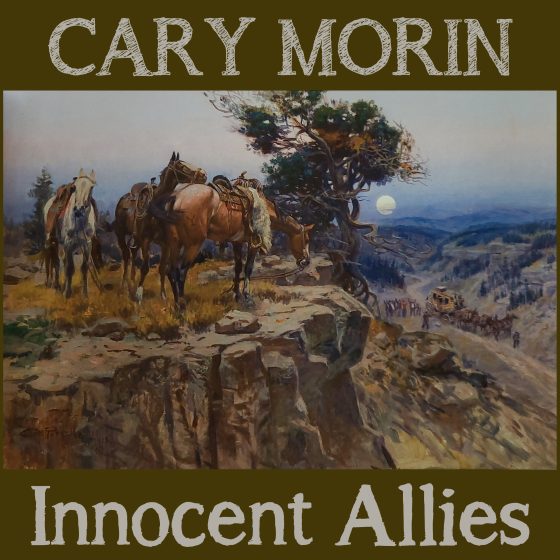
Guitarist Cary Morin’s (Crow/Assiniboine) new album, Innocent Allies, includes a striking painting on its cover created by renowned Western painter/sculptor Charles M. Russell (1864-1926), who spent his formative years as an artist in Morin’s home state, Montana. Innocent Allies, Russell’s work, depicts horses, cowboys, and settlers, routine subjects for the visual artist. The piece references how the iconic beasts of burden, who helped build the American West, were often innocent partakers in the violence, imperialism, and White Supremacy of American empire advancing across the rural, montane, wide expanses of the West.
For the new record, Morin leverages his expansive musical vocabulary – flatpicking, fingerstyle guitar, blues, folk, singer-songwriter, rock and roll and pop textures, and instrumental lyricism – to synthesize more than a dozen of Russell’s paintings and works into songs and tunes. The result is pastoral, evocative, and certainly cinematic. But these songs, as Russell’s body of work, are not sanitizations of the past or representations of American mythmaking and revisionism.
Morin views these paintings with a hefty dose of nostalgia, mentioning throughout our telephone conversation how this art was ubiquitous throughout his youth, his life in Montana, and its influence reaches well into his present, while he tours the country playing guitar from his new home base in Colorado. But that nostalgia isn’t predicated upon turning blind eyes to the atrocities endemic to Americana imaginations of “cowboys and indians,” Manifest Destiny, and the genocide and displacement of Native peoples.
The cover art for Cary Morin’s ‘Innocent Allies,’ including Charles M. Russell’s visual work by the same title.
Like Russell before him, Morin offers a grounded, realistic, and eyes-wide-open perspective not only on Russell’s body of work and those iconic images, but on the entire American societal construction of the West, as well. He does so with a formless and gorgeous genre fluidity and with playing styles entirely his own. Each track is stunning and expansive, even in their moments of intimacy and coziness.
Innocent Allies is a delicious record, made ever more fascinating by its unique concept, its nuanced inspirations and influences, and Morin’s one-of-a-kind voice on guitar. We began our interview chatting about the album’s conception before discussing Montana bluegrass, the constructive uses of genre, Beyoncé’s impeccable choice in Rhiannon Giddens’ banjo playing, and so much more.
I wanted to begin by asking you about the art of Charles M. Russell and how it inspired the new album, Innocent Allies – not only is his work on the cover, but it’s also very clear that these are cinematic and very artful songs. They’re very evocative. How did you take a different medium than your own and translate it into your own art?
Cary Morin: The album and the artwork all comes from my upbringing in Montana in the ‘70s. People from Montana all know that Charlie Russell is our most famous artist that ever came out of Montana. There have been a bunch of [artists] actually, but he’s kind of the top of the pile. When I was a kid – probably even today, too – anywhere in the state, you’re gonna be surrounded by his paintings or his sculptures.
He moved from St. Louis, Missouri when he was, I think 16? His parents gave him a train ticket to go out [West] and they wanted him to work on a sheep ranch owned by a friend of theirs for a while to get this fascination that he had with Montana out of his system. But it kind of backfired. He ended up living out his days there, for the most part. He gradually became a really advanced sculptor and painter, eventually getting to the point where he could really [demonstrate] action in the things that he created. He could [depict] minute muscles and forces and accurate movement – same in his paintings.
He ended up doing thousands of paintings and sculptures. They’re in collections all over the world now. Not only in Montana, but there are some museums around the U.S. that have huge bodies of work from him. When I was a kid, the coffee table books that were soon to follow his work, my dad and my mom ended up having all of them. My dad was a huge fan of his books, his writing, his stories, the letters that he wrote to everybody, the paintings, the sculptures.
With that stuff just always laying around when I was a kid, I became pretty familiar with it. I’m by no means an expert at that, but I just grew up around it all and know it pretty well. With this album, originally I was going to do a tribute album. It was going to be as country as I could make it. I’m not really a country player, I grew up in Montana. I can understand how it’s put together, and I could play some pedal steel. I’m pretty much a novice, but I know enough to get by, at least in the studio. So, [originally], it was all going to be all written by another artist.
After a while, I just couldn’t get my head around putting out an album where I didn’t write a single song on it. I think we were at home listening to Red Headed Stranger and I thought, “Man, I really love the production on this.” That was another favorite of my dad’s. He loved Willie Nelson.
I thought the production feel of [that record] would go along with the paintings in the coffee table book that was sitting right in front of us. It was kind of like a moment and a suggestion. The more I thought about it, the more I was like, “This takes care of everything.” I know a fair bit about Charlie Russell and his paintings are so accurate, they all tell stories. So I just started writing stories about the paintings. Looking at them and trying to imagine that scene and that moment of time that he captured. I wondered what happened before that moment and maybe what happened after that moment. Pretty soon we had a good pile of songs. It was a really fun process. At the time, we didn’t know what we were going to do with it. I mean, maybe I felt like it was a good idea, but after if it ever got done, then what?
Well, it definitely sounds like your own kind of sculptural process to get to this album. Carving something and then seeing where it leads you; starting with an idea, but then following the art wherever it goes.
I want to ask you about genre, because we’re having this conversation in “the zeitgeist” right now with Beyoncé and with Lana Del Rey and other people “going country.” On one hand, genre feels so important in this moment and on the other hand, it feels like we are accelerating ever faster toward being in a post-genre world. When I listen to this album, like you’re saying, it does remind me of Red Headed Stranger. It is straight up and down country to me.
But I wonder how you view genre, yourself? Is identifying with genre useful to you? Do you think it’s kind of a vestige of the past? How do you identify with genre at this point and with this record?
Well, with me in particular, that’s a pretty interesting question, because in the early ‘70s, when I was starting to play music and get interested in music, I lived in Montana. With my dad being a military guy, I didn’t really have access to a lot of albums of a wide, eclectic variety of genres and of sounds. But I did end up listening to classical music and my folks were big country fans. My oldest brother was a rock fan. I would stumble across things. I became a bluegrass fan from the influence of my best friends.
I didn’t really understand genres. I just heard music and I liked it. I didn’t really know how to put labels on it. I wasn’t aware of publications that would outline where the boundaries are on music. I didn’t think of things as a specific genre – although, you know, I sure liked the way that Doug Kershaw played fiddle, however I came across that! Or, I really appreciated the way Chubby Checkers played piano. That was all from Louisiana, but I had no idea what Louisiana was, or what Canadian music was, or any of that. It was all just music that I liked.
Having grown up without all that knowledge, I think it did have an effect on how I play music, because I would kind of bounce from genre to genre. I played with a band for 20 years, and we would play like the way Stevie Ray Vaughan played blues guitar. I didn’t really understand that much about blues music, but I thought what he did on David Bowie’s album was amazing. And so that had an influence on the way I play guitar. I really love Pat Metheny, and that had an influence on how I play guitar. I really love Mark Knopfler. It’s like all these genres couldn’t be any farther apart, but they all had a place in my mind. I maybe didn’t realize it at the time, but all those little influences would end up having an effect on how I make albums.
Genres now, that I hear on the radio – which is really only when I drive around – that’s [usually] like a public station, a community radio station, so I don’t really hear pop music. But, everything’s kind of starting to sound the same. I don’t know why that is. I think that maybe money has something to do with it. You know, “What sells?” What the buying public listens to, in order for advertising to be sold. I guess I don’t really pay attention to it too much. But I think that a lot of it’s driven by money.
You know, I can’t understand why Beyoncé would shout out to the world, “I’m gonna face country music!” and have that feel [like a] benefit. I think that she would only do that if she was motivated by something other than her love of Hank Williams. [Laughs] You know what I mean?
[Laughs] it’s hard to imagine! And then, at the same time, in the 100-ish years country music has been around, this seems to be a routine move. There’s always this moment where the people on the inside aren’t making that much money, or feel like they aren’t making much money, and you see someone like Lana or Beyoncé coming and you think, “Wait… There’s money to be made here? What? Tell me more about this!!”
Exactly!
From listening to your music, I think I would describe you as “genre agnostic.”
But I was curious what your feeling was on the Beyoncé announcement and the press coming out on that.
I found it really interesting, because I’ve known Rhiannon [Giddens] for years. She played with Pura Fé an artist/group that I played with in Europe for like five years. To hear her pick up a fretless banjo and just beat it into submission, I was like, “Holy God!” I had never heard anybody play a fretless banjo before, let alone like that. What a perfect choice for Beyoncé. She picked one of the best banjo players that I’ve ever met. I was surprised and impressed.
Yeah, me too. And also to have Robert Randolph playing steel on the tracks. Beyoncé and her team very clearly knew that she couldn’t appear like a “carpetbagger.” It’s not the most perfect term in this context, you know what I mean. She didn’t want to be viewed as somebody who was interloping – she did a good job at that “authenticity signaling” for sure.
It’s a wild thing to watch happen and to watch the discourse, in the wake of the two tracks, half of the people being like, “That’s not country” and half of the people being like, “Black folks invented country music, Indigenous folks invented country music, this is nothing new.” To watch those factions bump up against each other again, it’s kind of endlessly fascinating to me.
Like John Travolta having a hand in the revival of Texas music! Some idea that somebody somewhere along the line has and it catches on and takes off. I like it, too. I think culturally, I love it when things evolve. I do remember when I was a kid that I would hear on the radio what people call “country music” and go, “Boy, isn’t this happening in what is called Southern rock already?” There’s always players borrowing from other players.
And then it’s the studio musicians that played in that stuff. They may have showed up on a Bob Marley album somewhere along the line, too, because they played in a studio. Hell, man, when I was a kid I didn’t even know who Bob Marley was. I think it’s great that people learn from each other.
I wanted to ask you about bluegrass. You talked a little bit about what bluegrass means to you earlier in our conversation, but also when we premiered your track, “Whiskey Before Breakfast,” but I wanted to give you a chance to talk about your bluegrass influence again – we are the Bluegrass Situation, after all. What does bluegrass mean to you as a genre, as a picker?
That also goes back to the ‘70s. When I was talking about all the music that I either got from my family or from older brothers and my best buddies – bluegrass was a pretty big deal in Montana back in those days. I remember early on listening to these albums that didn’t exist in my friends’ houses. Hearing about Flatt & Scruggs and maybe I heard it on TV. I’d see things on Hee Haw And it definitely piqued my interest.
But the stuff that was going on in Montana, there was a band called Live Wire String Choir, which was a Montana bluegrass band. There was another one called Lost Highway Band that was a little bit electrified, but still bluegrass. And then there was the Mission Mountain Wood Band, which was kind of the king of all of them. They were straight ahead bluegrass, but from around Missoula. They actually appeared on Hee Haw one time, although I never saw that episode. They had an album called In Without Knocking back in the day and I was maybe around 12 years old, something like that. Everybody was buying that album. We had a copy of it, so I was learning those songs.
I think there was a plane accident and a lot of the band didn’t survive, but there’s one guy, his name is Rob Quist, who was one of the founders of the band. He still plays shows in Montana. His music and that band’s music turned me on to bluegrass. Through investigation and through the help of friends, I learned more and more about it. I got way into flatpicking. I never had an American-made guitar when I was a kid. I didn’t really realize the importance of that.
I was still fascinated with Tony Rice, and still fascinated with the crazy melodies that David Bromberg pumped out. I love John Hartford – so it was, I guess, a personal quest of mine. I have some friends that are pretty good bluegrass players. But I left Montana when I was 18 and I kind of pursued bluegrass for a while, but then I kind of got back into fingerpicking and fingerstyle guitar and eventually electric guitar.
And all that Clarence White stuff that I had heard and the Will the Circle Be Unbroken album, a lot of those artists that were kind of starting to press the boundaries of bluegrass music caught my attention. Eventually, I just abandoned that piece of guitar [playing] altogether and got really into playing electric guitar for many years. It wasn’t until maybe 20 years ago that I started really getting back into playing acoustic guitar. I never really abandoned electric, but I started playing fingerstyle guitar and pursuing it. I’d play for five, ten hours a day, daily. I just couldn’t get it out of my mind, largely thanks to Kelly Joe Phelps.
The early acoustic experiences that I had never really went away and I was really interested in creating music based on all of those influences throughout my life.That’s where the fingerstyle thing came back in.
I think the tune that I like the best on the album is “Bullhead Lodge.” And I love the Charles Russell painting that inspired it. I wondered if you could take us into your composition process for “Bowhead Lodge” and specifically, how you were synthesizing those related paintings while you were improvising, composing the tune – because I think that’s really fascinating.
Well, thank you. I’m glad that that song resonates with you. First of all, Charlie’s painting of his cabin on Lake McDonald – Charlie painted from memory, he’s not a guy that you would see sitting out in the middle of the fields with an easel, as romantic as that looks, he wasn’t that guy. He ended up painting a lot of depictions of his view of the lake from Bullhead Lodge. There are so many of them and they’re all just serene.
I was playing a show with Phil Cook in North Carolina and at sound check, he said, “Cary, we could just play this thing…” and he played this short, open-tuning melody. “We could play this thing for 10 minutes and people would love it,” he said.
We just kind of sat there and tweaked it for a little while. I don’t remember the melody he played. We didn’t do that during the show. But, I always remember him saying, “Play the simple thing and people will love it.” When I was looking at those paintings of Lake McDonald, I just started playing this melody. It wasn’t really written on the spot, I suppose. I goofed around with it for a couple of hours, but then I came up with sort of four variations of a similar melody. I started with a simple one and then changed it and changed it and changed it until the chords finally changed into what tags the song.
Because of that process, I like that song too, because it’s a great memory. I was glad that it made it onto the album. People have been talking about that recording, it seems like it’s resonated with folks.
Photo Credit: Grayson Reed
This website uses cookies to improve your experience. We'll assume you're ok with this, but you can opt-out if you wish.AcceptRejectRead More
Privacy & Cookies Policy
Privacy Overview
This website uses cookies to improve your experience while you navigate through the website. Out of these, the cookies that are categorized as necessary are stored on your browser as they are essential for the working of basic functionalities of the website. We also use third-party cookies that help us analyze and understand how you use this website. These cookies will be stored in your browser only with your consent. You also have the option to opt-out of these cookies. But opting out of some of these cookies may affect your browsing experience.
Necessary cookies are absolutely essential for the website to function properly. This category only includes cookies that ensures basic functionalities and security features of the website. These cookies do not store any personal information.
Any cookies that may not be particularly necessary for the website to function and is used specifically to collect user personal data via analytics, ads, other embedded contents are termed as non-necessary cookies. It is mandatory to procure user consent prior to running these cookies on your website.