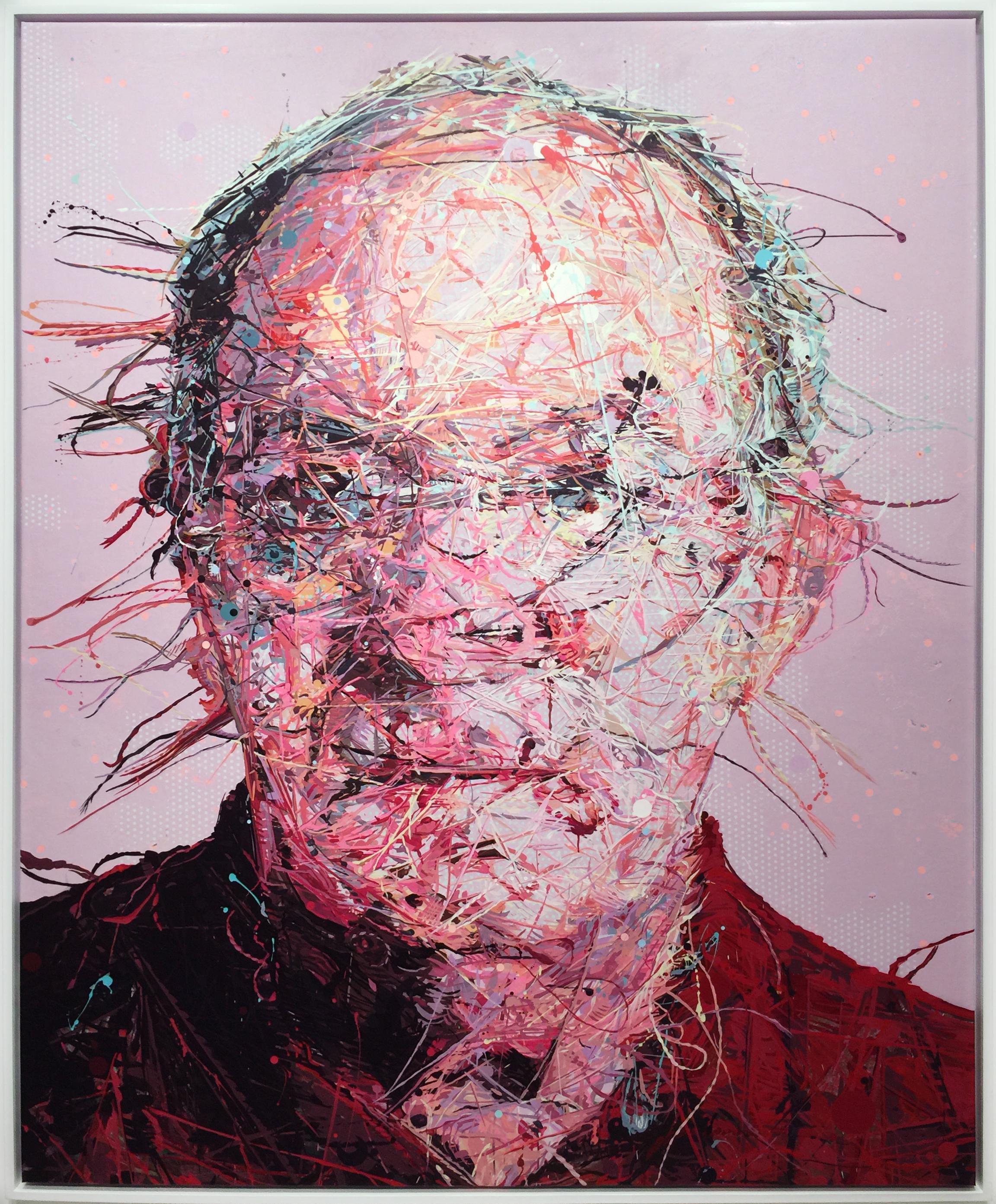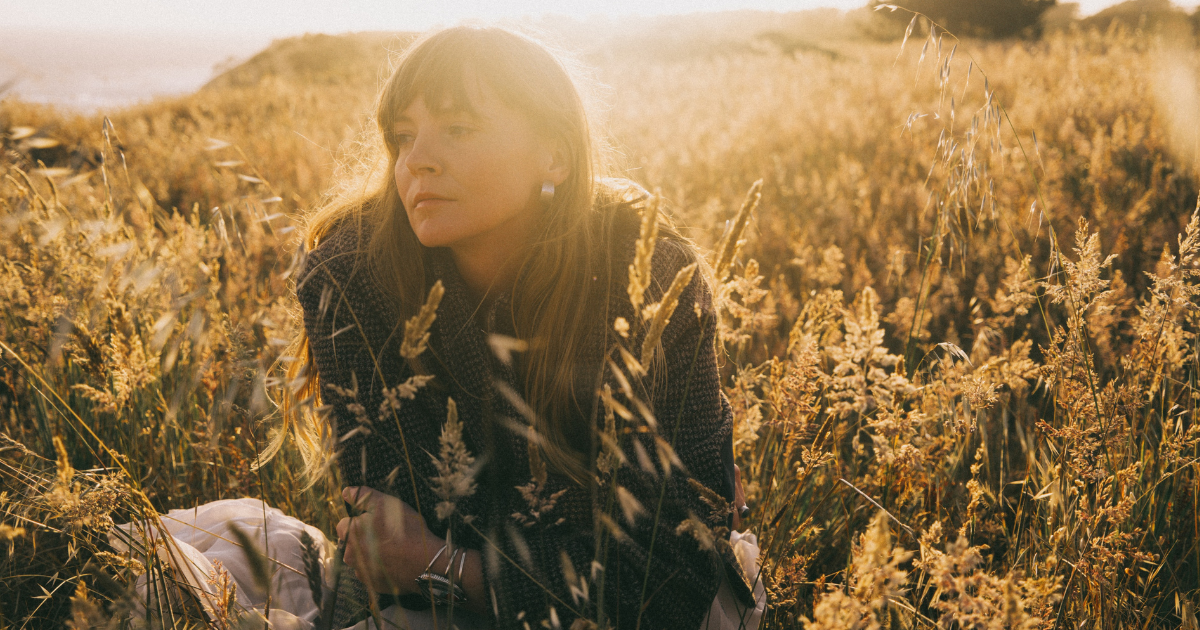
Courtney Marie Andrews Doesn’t Fear Vulnerability

Courtney Marie Andrews’ story begins in Phoenix, Arizona. An only child raised by her mother, she found solace and an outlet for her creativity and imagination in music. She planted her music roots in a self-described “feminist punk band” and began touring while in her teens. Along the way, she recorded a number of albums – best known are Honest Life (2016), GRAMMY-nominated Old Flowers (2020), and Loose Future (2022) – lived in a number of cities, and worked and toured with a number of musicians, including rock band Jimmy Eat World.

Andrews eventually made her way to Nashville, where she now resides. There, she creates music and other art, fueling her soul and inspiration with long walks and her love of animals, bonding with friends’ dogs, and feeding an assortment of “porch animals,” mostly cats, who take up residence outside her door.

In addition to music, Andrews expresses herself through painting and poetry. She has published two collections: 2021’s Old Monarch (2021) and the recent Love Is a Dog That Bites When It’s Scared. Her music, writings, and artwork explore a broad scope of emotions and experiences: loss, grief, fearless love, deep darkness, pure joy, and acceptance of the entire spectrum.

These outpourings are at the essence of her new release, Valentine (out January 16 via Thirty Tigers). Written in the throes of anticipatory grief, the album plummets into the vortex of her trajectory. While the message is raw, the recording is anything but. Valentine is an unfiltered look into Andrews’ heart, filled with waves of sounds and layers of instrumentation.

Among the numerous instruments she plays on Valentine, Andrews is featured on an assortment of guitars and basses, including a 1973 Martin D-28, 1968 Gibson B-45 12-string, 1970s high-strung Japanese Epiphone, Gibson J-45, Epiphone Casino, 1972 Fender P-Bass, 1960s Kay K5915 bass, and 1960s Teisco six-string bass. Longtime friend and colleague Jerry Bernhardt joins her on various instruments, with drummer Chris Bear rounding out the trio. The album was recorded by Michael Harris at Valentine Recording Studios in Los Angeles and produced by Bernhardt and Andrews.

BGS reached Andrews via Zoom for an Artist of the Month conversation.

Has Nashville changed you as a songwriter?

Courtney Marie Andrews: I thought it would deeply shift everything for me, but if anything, it made me want to do other things as well, maybe subconsciously. I started painting and focusing on poetry. But that core sense of self, that songwriter self, will always be with me wherever I go. It’s hard to say how it has shaped me until I’m looking back on my life 20, 30, 40 years from now.

But I will say the community I’ve found here is profound. I’m a Western girl. I’ve lived in Arizona and Seattle up until pretty much my 30s, and I didn’t realize how lonely the West can be. I think that’s apparent in my early work as a songwriter. That subject is throughout the work. When I moved here, I was almost overwhelmed by how much people wanted to hang out. It took a while to adjust and now I can’t imagine it any other way, not having that community to feel into and understand this work, because it is a strange career. So I think more [that] it has affected me personally, but I’ve always continued to write and been on this journey on my own and in my own time.

This is a stripped-down album – only three musicians, including you, and one of them is also your co-producer. Did you know, when the songs were written, that this is how it needed to be done?

I completely funded this album on my own, so if I’m being frank, it was an economical choice. Originally, we would have loved to have a band, but in hindsight, ultimately it created the record it created and I wouldn’t have had it any other way. There’s some power to it being a very condensed group of people, because the focus is a little bit more zoned in, and it becomes a vibe if it’s coming from a few core people, rather than everybody adding their stroke to what you’re doing – which I think is also valid. But looking back, it was probably the best thing we could have done, having Jerry and I playing all the instruments and Chris Bear, of course, on drums.

You played a number of guitars on Valentine. Do the songs determine the guitar, or does the guitar sometimes direct the song?

The songs ultimately lead the way on feeling and vibe. Jerry and I wanted to layer the record. There are a lot of different layers of guitars. We would varispeed one guitar up, so it’s super-high, and then we’d varispeed one guitar lower, so it’s super-low, to create the rounder sound, especially if you’re listening in headphones or on a high-definition speaker system.

But it’s definitely song-driven, whatever the feeling. “Best Friend” is just my guitar and Jerry’s twelve-string. We didn’t go much further than that, because the song was meant to be a bit sparser as far as the depth goes.

“Everyone Wants To Feel Like You Do” is about a certain type of misogyny where it’s, “I do whatever I want and I don’t care about the consequences, nor am I held accountable for the consequences.” The song was written with that feeling, and I thought it would be funny if I played guitar like that, where I didn’t care, so I over-distorted my guitar and played as crazy as I could to assert my power.

How do songwriting, poetry, and painting each fulfill a different side of your artistry and emotions? Is there ever some cross-pollinating?

I wanted to tell the same story with a different perspective, so there is cross-pollinating in terms of the source of the material, where it’s coming from, where I’m at in my life, whatever darkness or lightness I feel. It all sources from the same well of emotion and experience. But there are different ways of telling the same story. I found that when I was songwriting exclusively, I would write the same song over and over again. Whereas if I take a step back, do a different medium, and come back to songwriting, I feel fresher.

Ultimately and forever, I’ll always identify and feel the deepest connection with songwriting. That’s the first thing I fell in love with. It’s the thing I understand the most. But the mystery of these other mediums has really flourished.

There’s a natural through-line between poetry and lyrics. What about painting? Do lyrics sometimes inspire a painting? Does something you create on canvas ever become words in one of the other mediums?

There’s not a lot of crossover. I don’t look at painting like I would look at a page or a song. Painting is, for me, a place to describe emotions that are unexplainable. That’s why painting is so cool. It’s almost equivalent to jazz; it’s more of a feeling that you can’t describe. That was enticing to me. To express myself as a word person who ultimately values words so much, it was important to think outside of the box a little bit. Painting allows that. To not be confined by words is really interesting.

Tell us about your recent Artist in Residence at the Iowa City Songwriters Festival. You performed and did a reading from your new book, but what does “artist in residence” mean at this particular event?

Because Iowa City is a UNESCO World Heritage City of Literature, there’s a heavy college-funded element. I’m not sure if that was their direct funding, but they definitely have more of a collegiate approach to an artist in residence. I’ve done some residencies where they don’t want anything from you. They just say, “Come up and write whatever you want. We don’t care.” But this one was definitely a bit more mentorship-driven. I led a class, a songwriting workshop. I also had one-on-one mentorships with young songwriters, people who are just getting started. They had a packed schedule for me, but it was so lovely.

I think their ultimate goal is to prop up songwriting among the other literature of the world, having songwriting classes in college, and having it there with poetry, fiction, nonfiction, memoirs, memoir writing, and all that. I think that’s ultimately what they’re trying to attain with the residency program. So it was great.

I’ve found that I really love to talk about songwriting in that way. I think that, in our culture, it’s a dying thing, at least from where I’m sitting, to seek out opportunities to learn from elders, from people who’ve been doing it a long time. The more we can do that in our culture, the better off we’ll be. It’s an incredible festival, and I would highly recommend people going. The people who run it are just wonderful.

When you lead workshops and do one-on-one mentoring, is it as much a learning experience for you as it is a teaching experience?

Absolutely. I think to teach is to be a constant student. The moment you feel like you’ve figured it all out … I don’t know if that’s a good thing. Even as I speak about songwriting, I say things that open doors all the time to myself. It’s good to be endlessly curious.

Do you think being an only child contributes to your storytelling ability through songwriting and poetry? Living inside your head, escaping into your own head, in a way that might have been different if you had been surrounded by siblings?

Oh yeah, absolutely. Because I was a latchkey kid, I spent a lot of time alone. If I didn’t have a friend to play with, I had to go into the inner landscape of my mind. That was my way of communicating in a deeper way that I couldn’t quite get in my home life if my mom wasn’t home. I can attribute a lot of my childhood to that. I was a deeply imaginative kid and would create stories all the time. So I think the loneliness also fueled what I do now.

Do you draw from those past emotions when expressing what you’re currently experiencing?

How it manifests is that it’s like a period of reckoning when I’m writing songs. I’m generally alone. I find it very hard to write if I know somebody is even in the next room. I’ve had weird moments in my life where I wrote at soundcheck and stuff, but when I listen back to those things that I’ve written around people, it’s not as dialed in. So when I’m writing, I’m alone and reckoning with the life that I’m leading, or the life of others. It feels like this very quiet thing that needs to happen.

Are you an old-school pen-and-paper writer or have you gone the way of voice memos?

I do both. I exclusively use a green book to write in. It doesn’t matter what color green. They all are green, though, green-colored notebooks, generally the Moleskine variety or that look. I have plenty of them in a pile. [And] I love Micron, the ballpoint art pens. I really don’t like the standard DMV pen. I’m a little bit bougie when it comes to my pens. I like the flow of a Micron. I write and then voice memo. Generally, once I’m done writing a song, I try and always get it down in its unproduced form. I think it’s important to have that, and the phone happens to be the easiest way.

Is playing guitar, just playing, as much a part of songwriting as writing lyrics?

Oh, yeah. I love the guitar. I love open tunings. I love acoustic guitar music, Hawaiian slack key, and classical Spanish-style guitar on a nylon. I love to play and try and emulate that style. And so in certain works, it’s the first thing that happens. There’s many ways to come to a song, but one of them is [to] play a chord progression I like and sing gibberish, and that sometimes leads to a song. In that case, absolutely I need the guitar. But yeah, the instrument can definitely lead the way. It just depends.

When you spoke earlier about adapting to the Nashville community, it brought up the thought that growing up as “an only” maybe affects our social skills to a degree. It can make community something new, as opposed to something you’re used to having around you.

Yeah. I feel that. I have a hard time with small talk for this reason. I want to go immediately for the jugular, as far as intense conversations. I go from zero to a hundred. It’s really hard for me to be like, “Hey, how are you doing?” I feel like such an actor in those circumstances. Of course I’ve learned to do it by way of being a musician – you have to talk to new people every day. But small talk doesn’t do it for me. I have a hard time going in a simple, surface level.

In the bio accompanying this album, you said, “I was in one of the darkest periods of my life and songs were the only way I could reckon with it. I felt cursed and the only mental cure felt like songwriting and painting.” Have you always felt that darkness?

Obviously, as a teenager, I went through a pretty wild part of my life where I felt dark, but I think I actually denied my darkness for a very long time. I lived in a haze of denial and hope, which is a beautiful thing. It can do wonderful things for your mental health. But you also can’t really grow if you’re living in that state.

When I was younger, especially in my early twenties, I always had this hope – “Oh, one day things are going to change.” That denial, that hope, kept me in this holding place, which for a time was really nice, and as a matter of defense and self-preservation, I stayed there for a long time. It wasn’t until I started therapy that I realized I always had this underlying darkness. When I had that, we worked on that, and real things started to happen. Things in life that are so hard that happen to all of us – it became deeply dark and profound to experience that in a more awake state.

How did that help with writing this album?

During a lot of writing this, I was caretaking for my family member who was terminal. If you’ve ever been in that situation, it is all-consuming. The only way I could turn my brain off from that was to write. It wasn’t “I need to write an album.” It was “I need to get back to myself for a moment.” I wouldn’t say it was a conscious decision. It was just I know how I am, and I know that songs are my only way of regulating in these crazy times.

You once said you felt embarrassed by the vulnerability of your songwriting. Where do you draw the line, or do you draw one, between what needs to be said for yourself and what needs to be said for listeners for whom you are the voice? How do you do this and protect your mental health when performing these songs every night?

I’ve always said that once the song is written, it’s not mine. It also transforms for me as I sing it. There are songs I wrote fifteen years ago that I still perform, that have taken on completely new meaning and feel different to me when I sing them. I honestly can’t remember the headspace I was in when I wrote them, or the origin of them, or who I was thinking about, to a strong degree, but I feel differently about them.

As far as what needs to be said, ultimately I try to relate to people, or first myself, and then you put the song out and it becomes a different thing. I try, in an artistic space, to be as true to myself as possible. I try not to put up any walls in that space. As far as my life where I’m not playing music, that’s a different thing. But music is a safe space to say whatever the hell I want to say. That’s the reason it’s such a powerful thing. It’s a safe place for me to communicate. Whatever walls are up in a song are walls that I have up with myself. That’s always very apparent when you write a song. It’s not quite clicking and you’re like, “I’ve got some walls up to my subconscious, clearly.” So the extent to which the boundaries, the walls, are up is truly only the stage at which my heart is at in that moment.

Did that happen with Valentine – the walls, maybe the fear of the vulnerability? It’s deeply personal and powerful, going deeper and deeper into those emotions as your journey is sequenced.

I hate to say it, because I don’t want to sound trite, but making albums, making bodies of work like this, fear is the last thing on my mind. Obviously, natural fears come up: Is it going to be what I wanted, what I envisioned in my dreams? But as far as songwriting and being vulnerable in a song, that’s not the fear. In fact, if I got very close to the heart in a song, it’s generally the ones that I’m like, “That’s a good one. I got there. I got to the essence of this thing I was feeling.”

Being vulnerable in life can be really hard in my personal life, in some ways, and I think that is more where the fear is. But, for whatever reason, the way I direct it is okay in a song, and I’ve made up my mind for that to be true. I don’t know why; I guess it just makes sense to me. Human emotion makes the most sense to me in the backdrop of music.

As far as sequencing, Jerry and I argued quite deeply about the sequencing, but ultimately it did go to a place where once we got the sequence, it was undeniable. Side A and Side B are completely different frames of minds. Side A, you’re fighting for love and you’re desperate. Side B is a resignation – this is how it is, this is how it’s always been, and this is my childhood. By the end, in “Hangman,” you’re just “This is how it is, and you can fight for it or you can walk away.” So the sequencing was purposeful. I wanted it to be a journey. I think records should be like that. They shouldn’t be all one color or palette the whole way through.


Explore more of our Artist of the Month content featuring Courtney Marie Andrews here.

Photo Credit: Wyndham Garnett
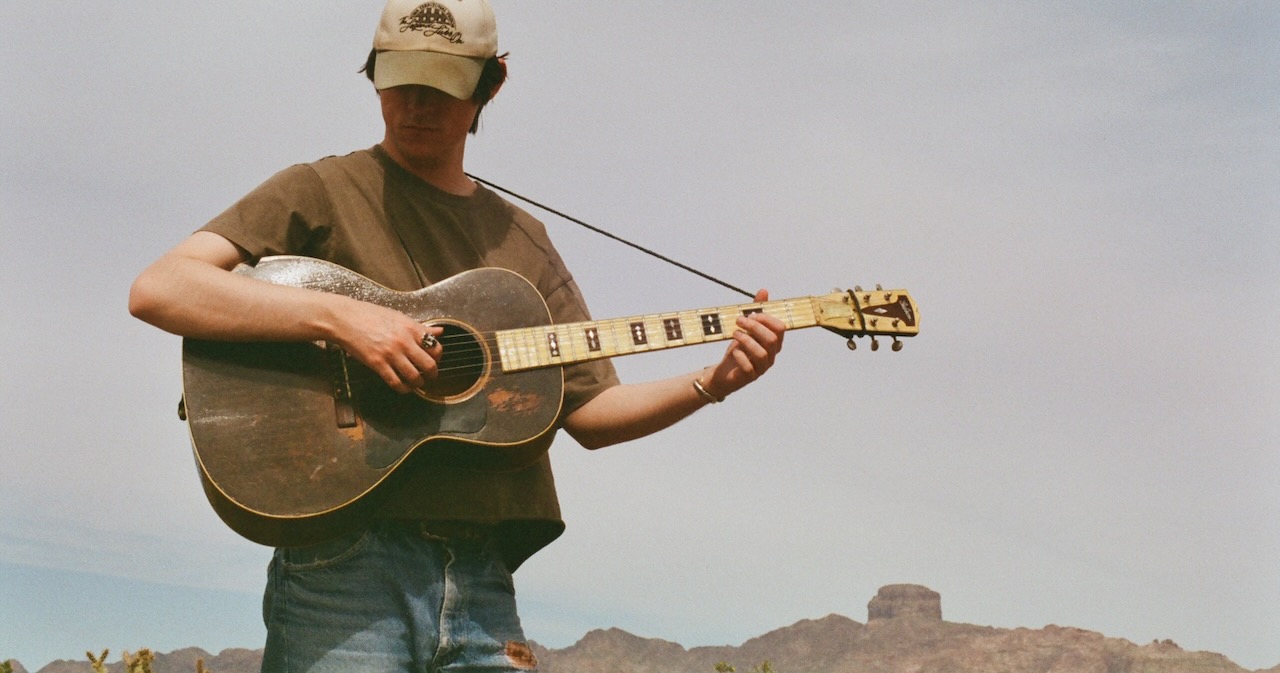
Guitarist Cameron Knowler’s Poetic Portrait of Yuma, AZ and the Gorgeous, Bleak Southwest

It’s a warm, summery day in early April when I sit down with archivist, writer, and guitarist Cameron Knowler on the shores of Old Hickory Lake in Middle Tennessee. Both Knowler and myself happen to now live in Old Hickory, a small village in Davidson County that was formerly a DuPont company town and is nestled on the edges of the eponymous, manmade US Army Corps of Engineers lake on the Cumberland River.

The setting is a far cry – geographically, topographically, and ecologically – from Knowler’s hometown of Yuma, Arizona, a place that serves as the inspiration, background, and foreground of his stunning new solo guitar album, CRK (released April 4 by Worried Songs). Knowler’s upbringing in Yuma was traumatic and bleak, not exactly a storybook experience by any measure. Still, like many roots musicians and creatives, the landscapes and dioramas of the wild west California/Arizona border town have become the guitarist-composer’s primary muse.

CRK sounds like the desert. Like hot, searing parking lots. Like mesquite and cactuses and roadrunners and mesas and red rocks. Stark flatpicked and finger-plucked melodies give equal consideration and immortalization to sweeping natural landscapes and small, depressingly human settings, too. Unlike so many of his subjects and inspirations in and around Yuma, this collection of compositions never moves to pave over the intricacies, nuances, and subversions Knowler finds in revisiting his hometown in music and memories. Still, the album is as gorgeous and transportive as any of our favorite famous paintings of the Old West, or soundtracks to iconic western films, or depictions of ancient pueblos. Perhaps his subject is a strip mall or a vignette of the proverbial “suburban hell,” but in this context each feels like an entire universe unto itself, a dreamscape – a home.

CRK opens with a gorgeous prose poem set to music, a track titled “Christmas in Yuma.” Immediately, the record is thereby attached through terroir and tradition to other western artists like Steinbeck and McCarthy. The album’s package is ornamented with gorgeous photographs, polaroids, bits of imagery, printed art, and poetry, further evoking artists we associate with the Southwest like Dorothea Lange and Linda Hogan. But the stories herein are told almost exclusively by guitar – usually Knowler solo as centerpiece, but sometimes joined by ensembles including guitarists Jordan Tice (who co-produced the project) and Rich Hinman, as well as other instrumentalists like Rayna Gellert, Robert Bowlin, Jay Bellerose, and more. The guitar is an instrument so pervasive and ubiquitous we often forget how aptly it can showcase these kinds of narratives, and how at home the six-string always feels in the West.

But with CRK, listeners won’t ever forget those facts. This is a narrative album. Is it also a technical achievement, intricate and intriguing and complex? Absolutely. But making an impressive guitar album was clearly not Knowler’s goal. Telling stories, with his medium being the guitar and the traditions that encircle it, was his chief aim. To say the project is successful in this regard would be an embarrassingly trite understatement.

And so, while watching the springtime water birds and snacking on lunch – with Knowler’s neck, wrists, and fingers dripping in Native-smithed silver and turquoise – we two sat down on the banks of a long, twisting lake on the Cumberland River in Nashville to discuss the guitar, the desert, and the little town on the banks of the Colorado River called Yuma – that Cameron Knowler once, and still, calls home.

I wanted to start by talking about place. I’m obsessed with how music has been slowly but surely divorced from its relationship to place over time. Your album, what jumped out at me immediately was it has such a strong relationship to place. How do you take something physical, tangible, geographical – a place like Yuma or Old Hickory Lake – and translate that into your medium? How do you think about evoking landscape or evoking an image with music?

Cameron Knowler: That’s a great question. I have like 10 ways of responding to that. As you said, music is getting divorced from place and I think it’s something of a cliche at this point that we’re losing regionalism. In the sense that, even with bow strokes– fiddlers in Galax, Virginia are different than fiddlers in northern Virginia. Not consciously, necessarily, but just as a colloquialism. As a part of their place. I didn’t [have] an old man or an old woman playing a fiddle who taught me tunes, I never had any of that [regionalism]. Instead, the “white kid from the suburbs” phenomenon happened. When I moved to Texas, I got connected with a regional fiddler in Terlingua, Texas – kind of [where the movie], Paris, Texas started. I learned his repertoire, which was interesting in that he learned a lot from Brad Leftwich when they were young and living in Santa Barbara. That was the void that I was missing. Not even musically, just in my life. I lost my mom, I lost my dad, I didn’t have family, so to me that was a cue, like a clue.

Then it flips, because there is a robust fiddle tradition of the Tohono O’odham [Nation] right there on the Yuma, Arizona/California border. But that’s not my culture. I could have gone in and said, “I’m gonna learn this tune” – or melody or whatever. Then that [could be] my way into the landscape. Instead of coming at it from an internal perspective, it was an external perspective, basically like a western painter. Like an oil painter painting Tucson or Walpi.

To answer your question, it’s slippery, ’cause you can’t go on stage and say, “Okay, this instrumental song is about a grocery store that I grew up driving by.” [Laughs] I can’t say that. It does come from that place, but I don’t say that. For me, the visual aspects of the record, I weigh them as equally, I would say, as the sonics. I think that’s where I can insert song titles – all the song titles on the record are related to Yuma.

There’s this tradition of stark solo or nearly solo acoustic guitar as an iconic sound of “the Wild West.” One of the first things I thought about listening to CRK is the score and soundtrack for Brokeback Mountain, so much of it is just solo plucked, tender guitar. Then of course in other music that evokes the West, you have sweeping strings and countrypolitan country and western. Even in that context you’ll often hear nylon-string guitar out front, solo. There’s something about unadorned guitar that is connected to landscapes.

But what I’m hearing you say is it’s not about translating the grandeur of Western landscapes at all. It’s about the grocery store, or it’s about the building that burned down, or it’s about a stretch of miles and miles of highway.

Totally. Yes. There’s so much programmed into the sound. David Rawling says, “The sound of a minor chord is a cowboy dying,” which is such a great way of saying that.

I believe this is true of the development of the flat-top guitar in general. At a certain point in 1934 or 1933, when the dreadnoughts start to get developed, there’s something about that that conveniently carries forward the agenda of interrelated musics – like Hawaiian music and bluegrass music for two totally different agendas. Then that [sound and body style] becomes the golden standard. But there were so many other brands and makers and thinkers from different cultures making guitars that, in an alternate universe not far from our own at all, would’ve been the golden standard. I feel the same way about the tradition of the music itself, right? And a dreadnought itself can do an infinite number of things, but just the format itself excludes a lot. As a constant instrument to play solo.

Another thing that David Rawlings says about his small guitar is that the smallest things sound the biggest, when they are in their own diorama – describing what he does with Gillian [Welch]. That’s his goal, to convince listeners that the “baby dinosaur” [small guitar] can actually eat them. Working in miniature, making little boats in glass bottles, you open yourself up, it’s an entire universe. The littlest things sound the biggest. In that way, there’s opportunity in the format itself.

I think people like Norman Blake and John Steinbeck are both hyper-regionalists who synthesize very eclectic sources to create something that is uniquely their own, but also totally comes outta left field. ‘Cause yeah, you think about Norman and certain people would say he is a flatpicker. Some people would say he was a pot smoking hippie who played with John Hartford – and they’re both equally true! Tying together otherwise disparate histories is a compelling format and is rewarding to the solo practitioner, I think.

We should talk about Steinbeck. We talked about it a couple of weeks ago when we first met by chance. But you starting the album with “Christmas in Yuma,” immediately I was like, “Oh, I know where we are. I know what we’re doing.” We’re in the West, there’s poetry/prose poetry happening. That song feels like it’s part of a longstanding tradition. Immediately I was thinking about a couple of my favorite Steinbeck passages listening to that.

Starting with poetry, starting with spoken word over that beautiful sound bed that you’ve created for it, what does that accomplish for you as an opening to a record?

Two things come to mind. Kenneth Patchen, who made these poetry records for the Folkways label in the ‘50s backed by a jazz band and it was almost comical, but he took it so seriously and it’s so convincing when you just forget what the format actually is. The great Texas – I don’t even wanna say outsider artist, but in terms of how he’s viewed – outsider artist Terry Allen, with some of his concept records like Lubbock (On Everything) with the pedal steel. You can do anything at that point. That’s why I started [CRK] out that way.

Also, quite frankly, Ice Cube’s records – I’m thinking of N.W.A. – start out with these sound collages of him getting arrested or walking down a cell block, or the imagined character is. To me, he could do anything after that point. He could make the amazing record that it became, or he could have done some something entirely different. I just think it’s an earnest way of saying, “I’m not trying to do what you [already] know.” We all know that everyone is infinitely complex, but in terms of what they release, it’s fine to not be infinitely complex?

For me, it’s not a flatpicking record. It’s not a fingerpicking record. I’m really not trying to make it a guitar record, so to speak. I wanted to make it a narrative record. [“Christmas in Yuma”] was just an earnest way of saying, “I’m not what you think I might be.”

It’s also a tradition in these roots and folk music spaces to play with expectation. People generally know what a solo guitar record is gonna sound like and what it’s gonna be and what it’s gonna do. I’m imagining a program director at a radio station putting on the record and doing the 30-second listen through – and the first song is poetry?!

I think maybe that’s what you’re talking about? Whatever conscious or subconscious projection you might have about what this album is in your hand, or what this is about to be as you put it on, you want to play with that projection. You’re saying, “I’m gonna tell you what this is.”

That is a beautiful point because, not to go too far back [in my history], but I was “unschooled” and I didn’t have a high school diploma or a GED. [Through all the hardships I’ve faced], I’ve learned this notion of leveraging. I surveyed how I was going to be able to reach people, and it gets more representative of myself as [time] goes. But it’s always been under the guise of leveraging unexpected muscle groups towards something else. That’s just built into this like fight or flight thing. I just have nothing to lose.

Your point about the radio DJ – or whoever that’s listening to the poetry – I think that’s a unique opportunity. At that point, they’re suspending judgment. If I wanna listen to a guitar record, I’m gonna listen to Leo Kottke 6- and 12-String Guitar. It’s perfect. It does exactly what it needs to do.

People should continue to try to make records like that. To me, it’s not a push against that at all. It’s starting out on a different foot. You may end up in a place that, by design, is very different than you would if you just tried to hit it on the nose. You can still hit it on the nose. Then you might even have a chance to open it up to somebody. Sometimes people just don’t know who Norman Blake is. But then, there’s a tune like “Yuma Ferry.” Who plays like that? Norman plays like that. If I were to make a whole record of “Yuma Ferry”-style tunes, I think everybody listening would know that it was a Norman Blake type of thing.

Let’s talk about “Christmas in Yuma” a little more in detail, because I’m curious about how you created it. Was it the poem that made the music happen, or the music demanded to have a poem set to it? What was the creative process like for the track?

I woke up from a nap on December 21, 2021, and I just went to Google Docs and typed it out. It just came out like that. The recording process, I had my friends Harry and Dylan sit down with me in our friend Marshall’s studio and we just recorded improvisations with the loose framework. [It’s read by my friend] Jack Kilmer, who similarly grew up in the Southwest. His father, like my mother, was also Christian Scientist. Those are all the things that were vibrating around. I was like, “He has to do it.” He’s an amazing voice actor, amazing actor, and just a great musician. Very musical and a beautiful artist. I had him do it first.

Then we went to the studio and we just said, “This is how long the track is. We’re not gonna play to the track. We’re just gonna play.” There was one take that was like the perfect length of time and I just put it under there. All those sonic features that interact with the vocal are totally incidental.

The music of CRK is so evocative and so visual and is so good at text painting, but I wanted to talk about your work in other media and about how you curated the package for the album, too. You’re so multifaceted in what media you’re working in – archives, photography, visual art, written word, music, melody. How do you see all those forms converging and diverging with this project specifically? Because I see your eye for detail at every level. You can just tell from the package that the whole thing is art to you, not just the songs.

Photography, it is always fiction. That, to me, is the beauty of it. If there’s a picture of someone jumping, you don’t really know where they jumped from. Or if they smile, they are actually crying? Maybe this person crying is not the good guy. Maybe they’re the bad guy.

You can start to track things like that, as the smile gets “invented” throughout photography. But it’s this line of fiction that, if you spend enough time with it, you can infer things right or wrong in there. They can all take you to a different place. Movies are that way, but you lose a little bit with the moving image. ‘Cause then you see the speed at which they’re moving, even if the frame rate isn’t representative of reality.

But then, say you’re playing jazz standards and you’re playing things with semantic content that came from a show, a Broadway show in the ‘40s. You’re shackled by the semantic content of that. I think it’s a convenient metaphor, in my opinion, to see photography and instrumental music as this thing, where – back to working in miniature – smaller things give you more room to insert yourself into it. I shouldn’t say more room, but there’s more fiction to play with, I would argue.

There’s less to compete with.

Right? In terms of things being programmed to you. In movies, you have the aesthetics, you have the costumes, you have the music, you have all this stuff. With photo books, the way that they’re sequenced by gestures is such a fitting way of dealing with sequencing things that aren’t visual. There’s a lot of inspiration from the photo book as a tradition, in terms of sequencing. And how with photojournalism, we don’t really have an American, coalesced identity of the West without the photography of the Dust Bowl. I’ve spent a lot of time looking at FSA photographs and there’s some great Dorothea Lange photographs in Yuma from May of 1935 which can be seen via the Library of Congress. I actually licensed one of them that was not within the purview of her [federal] work from the Oakland Museum and that’s in the song folio for CRK.

Obviously, Norman Blake is a really important musician to you and Dave Rawlings is as well. You’re talking about wanting to make music, wanting to make a record that isn’t just another acoustic guitar, flatpicking, flat-top record. Norman and Dave are great examples of guitarists who make albums that aren’t just the same old same old, and aren’t just products, they’re art. Both showcase that simple solo guitar, that miniature world we’re talking about, can be so expansive and huge and lush. But who are the others? Who are the folks that modeled for you that having your own voice and perspective on your instrument was more important than just doing it to do it. Or to be “best” or to sell yourself as a product for consumption?

For banjo, I think John Hartford. I love the idea that Blake Mills said, he called guitar an instrument for assholes. [Laughs] What I love about that is, no matter how you look at a guitar, the guitar is always a toy. [Andrés] Segovia tried to institute a formal repertoire. The bluegrass people tried to, the rock people [tried to]. Is Jimi Hendrix the definitive repertoire for the guitar? AC/DC? But, it’s still a toy. It’s still marketed as a toy.

I don’t need a million people to listen to my music to make a living or to keep doing it. It’s all within the art/archives, how to make these raw ingredients that are embedded into everyone into something that’s not commercial, but digestible.

In terms of other people [who inspired me]. John Fahey. Leo Kottke, but I didn’t fingerpick up until about three and a half years ago. About 80% of the record is finger picking. To your point about the poem earlier, there’s more outside of the solo, acoustic guitar canon of stuff, too. People like Rambling Jack Elliot and Sam Shepard, yeah.

One final point, I would play these solo concerts in Texas of just flatpicking melodies, like four flatpicking melodies in four different keys. And I was just like beating my head up against a wall, trying to tell some sort of cinematic, fiddle tune-driven [story over an entire set of just flatpicking]. I wanted there to be an arc. Through stubbornness, I decided I was going to learn how to fingerpick convincingly, where I had control of each voice. It’s really hard. It was a pain in my ass to figure that shit out.

But yeah, I see them all as tools: the poetry, the flatpicking, the fingerpicking, the drumming. It could be seen as pushing back against commercialism or whatever, but in some ways it’s actually the opposite. I was like, “I want more. I want a diverse audience. I want as many people to listen to this as possible.” Not sheer numbers, but in terms of who they are and what their listening diets are. Not just everybody in the audience being someone who will already know each of those fiddle tunes.


Photo Credit: Steve Perlin

Cary Morin’s ‘Innocent Allies’ is An Unfiltered Palette of the American West

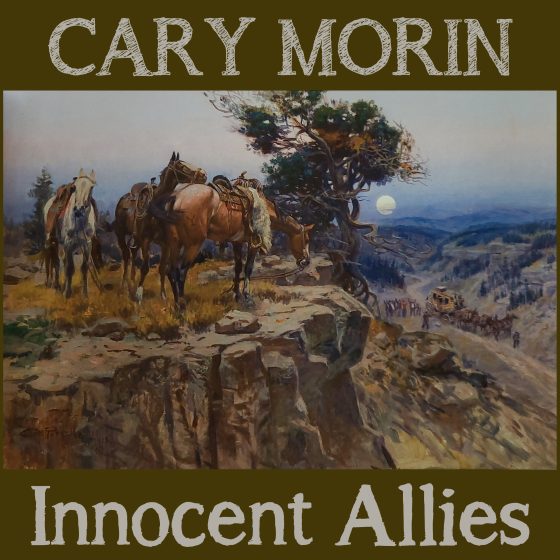
Guitarist Cary Morin’s (Crow/Assiniboine) new album, Innocent Allies, includes a striking painting on its cover created by renowned Western painter/sculptor Charles M. Russell (1864-1926), who spent his formative years as an artist in Morin’s home state, Montana. Innocent Allies, Russell’s work, depicts horses, cowboys, and settlers, routine subjects for the visual artist. The piece references how the iconic beasts of burden, who helped build the American West, were often innocent partakers in the violence, imperialism, and White Supremacy of American empire advancing across the rural, montane, wide expanses of the West.

For the new record, Morin leverages his expansive musical vocabulary – flatpicking, fingerstyle guitar, blues, folk, singer-songwriter, rock and roll and pop textures, and instrumental lyricism – to synthesize more than a dozen of Russell’s paintings and works into songs and tunes. The result is pastoral, evocative, and certainly cinematic. But these songs, as Russell’s body of work, are not sanitizations of the past or representations of American mythmaking and revisionism.

Morin views these paintings with a hefty dose of nostalgia, mentioning throughout our telephone conversation how this art was ubiquitous throughout his youth, his life in Montana, and its influence reaches well into his present, while he tours the country playing guitar from his new home base in Colorado. But that nostalgia isn’t predicated upon turning blind eyes to the atrocities endemic to Americana imaginations of “cowboys and indians,” Manifest Destiny, and the genocide and displacement of Native peoples.

The cover art for Cary Morin’s ‘Innocent Allies,’ including Charles M. Russell’s visual work by the same title.

Like Russell before him, Morin offers a grounded, realistic, and eyes-wide-open perspective not only on Russell’s body of work and those iconic images, but on the entire American societal construction of the West, as well. He does so with a formless and gorgeous genre fluidity and with playing styles entirely his own. Each track is stunning and expansive, even in their moments of intimacy and coziness.

Innocent Allies is a delicious record, made ever more fascinating by its unique concept, its nuanced inspirations and influences, and Morin’s one-of-a-kind voice on guitar. We began our interview chatting about the album’s conception before discussing Montana bluegrass, the constructive uses of genre, Beyoncé’s impeccable choice in Rhiannon Giddens’ banjo playing, and so much more.

I wanted to begin by asking you about the art of Charles M. Russell and how it inspired the new album, Innocent Allies – not only is his work on the cover, but it’s also very clear that these are cinematic and very artful songs. They’re very evocative. How did you take a different medium than your own and translate it into your own art?

Cary Morin: The album and the artwork all comes from my upbringing in Montana in the ‘70s. People from Montana all know that Charlie Russell is our most famous artist that ever came out of Montana. There have been a bunch of [artists] actually, but he’s kind of the top of the pile. When I was a kid – probably even today, too – anywhere in the state, you’re gonna be surrounded by his paintings or his sculptures.

He moved from St. Louis, Missouri when he was, I think 16? His parents gave him a train ticket to go out [West] and they wanted him to work on a sheep ranch owned by a friend of theirs for a while to get this fascination that he had with Montana out of his system. But it kind of backfired. He ended up living out his days there, for the most part. He gradually became a really advanced sculptor and painter, eventually getting to the point where he could really [demonstrate] action in the things that he created. He could [depict] minute muscles and forces and accurate movement – same in his paintings.

He ended up doing thousands of paintings and sculptures. They’re in collections all over the world now. Not only in Montana, but there are some museums around the U.S. that have huge bodies of work from him. When I was a kid, the coffee table books that were soon to follow his work, my dad and my mom ended up having all of them. My dad was a huge fan of his books, his writing, his stories, the letters that he wrote to everybody, the paintings, the sculptures.

With that stuff just always laying around when I was a kid, I became pretty familiar with it. I’m by no means an expert at that, but I just grew up around it all and know it pretty well. With this album, originally I was going to do a tribute album. It was going to be as country as I could make it. I’m not really a country player, I grew up in Montana. I can understand how it’s put together, and I could play some pedal steel. I’m pretty much a novice, but I know enough to get by, at least in the studio. So, [originally], it was all going to be all written by another artist.

After a while, I just couldn’t get my head around putting out an album where I didn’t write a single song on it. I think we were at home listening to Red Headed Stranger and I thought, “Man, I really love the production on this.” That was another favorite of my dad’s. He loved Willie Nelson.

I thought the production feel of [that record] would go along with the paintings in the coffee table book that was sitting right in front of us. It was kind of like a moment and a suggestion. The more I thought about it, the more I was like, “This takes care of everything.” I know a fair bit about Charlie Russell and his paintings are so accurate, they all tell stories. So I just started writing stories about the paintings. Looking at them and trying to imagine that scene and that moment of time that he captured. I wondered what happened before that moment and maybe what happened after that moment. Pretty soon we had a good pile of songs. It was a really fun process. At the time, we didn’t know what we were going to do with it. I mean, maybe I felt like it was a good idea, but after if it ever got done, then what?

Well, it definitely sounds like your own kind of sculptural process to get to this album. Carving something and then seeing where it leads you; starting with an idea, but then following the art wherever it goes.

I want to ask you about genre, because we’re having this conversation in “the zeitgeist” right now with Beyoncé and with Lana Del Rey and other people “going country.” On one hand, genre feels so important in this moment and on the other hand, it feels like we are accelerating ever faster toward being in a post-genre world. When I listen to this album, like you’re saying, it does remind me of Red Headed Stranger. It is straight up and down country to me.

But I wonder how you view genre, yourself? Is identifying with genre useful to you? Do you think it’s kind of a vestige of the past? How do you identify with genre at this point and with this record?

Well, with me in particular, that’s a pretty interesting question, because in the early ‘70s, when I was starting to play music and get interested in music, I lived in Montana. With my dad being a military guy, I didn’t really have access to a lot of albums of a wide, eclectic variety of genres and of sounds. But I did end up listening to classical music and my folks were big country fans. My oldest brother was a rock fan. I would stumble across things. I became a bluegrass fan from the influence of my best friends.

I didn’t really understand genres. I just heard music and I liked it. I didn’t really know how to put labels on it. I wasn’t aware of publications that would outline where the boundaries are on music. I didn’t think of things as a specific genre – although, you know, I sure liked the way that Doug Kershaw played fiddle, however I came across that! Or, I really appreciated the way Chubby Checkers played piano. That was all from Louisiana, but I had no idea what Louisiana was, or what Canadian music was, or any of that. It was all just music that I liked.

Having grown up without all that knowledge, I think it did have an effect on how I play music, because I would kind of bounce from genre to genre. I played with a band for 20 years, and we would play like the way Stevie Ray Vaughan played blues guitar. I didn’t really understand that much about blues music, but I thought what he did on David Bowie’s album was amazing. And so that had an influence on the way I play guitar. I really love Pat Metheny, and that had an influence on how I play guitar. I really love Mark Knopfler. It’s like all these genres couldn’t be any farther apart, but they all had a place in my mind. I maybe didn’t realize it at the time, but all those little influences would end up having an effect on how I make albums.

Genres now, that I hear on the radio – which is really only when I drive around – that’s [usually] like a public station, a community radio station, so I don’t really hear pop music. But, everything’s kind of starting to sound the same. I don’t know why that is. I think that maybe money has something to do with it. You know, “What sells?” What the buying public listens to, in order for advertising to be sold. I guess I don’t really pay attention to it too much. But I think that a lot of it’s driven by money.

You know, I can’t understand why Beyoncé would shout out to the world, “I’m gonna face country music!” and have that feel [like a] benefit. I think that she would only do that if she was motivated by something other than her love of Hank Williams. [Laughs] You know what I mean?

[Laughs] it’s hard to imagine! And then, at the same time, in the 100-ish years country music has been around, this seems to be a routine move. There’s always this moment where the people on the inside aren’t making that much money, or feel like they aren’t making much money, and you see someone like Lana or Beyoncé coming and you think, “Wait… There’s money to be made here? What? Tell me more about this!!”

Exactly!

From listening to your music, I think I would describe you as “genre agnostic.”

But I was curious what your feeling was on the Beyoncé announcement and the press coming out on that.

I found it really interesting, because I’ve known Rhiannon [Giddens] for years. She played with Pura Fé an artist/group that I played with in Europe for like five years. To hear her pick up a fretless banjo and just beat it into submission, I was like, “Holy God!” I had never heard anybody play a fretless banjo before, let alone like that. What a perfect choice for Beyoncé. She picked one of the best banjo players that I’ve ever met. I was surprised and impressed.

Yeah, me too. And also to have Robert Randolph playing steel on the tracks. Beyoncé and her team very clearly knew that she couldn’t appear like a “carpetbagger.” It’s not the most perfect term in this context, you know what I mean. She didn’t want to be viewed as somebody who was interloping – she did a good job at that “authenticity signaling” for sure.

It’s a wild thing to watch happen and to watch the discourse, in the wake of the two tracks, half of the people being like, “That’s not country” and half of the people being like, “Black folks invented country music, Indigenous folks invented country music, this is nothing new.” To watch those factions bump up against each other again, it’s kind of endlessly fascinating to me.

Like John Travolta having a hand in the revival of Texas music! Some idea that somebody somewhere along the line has and it catches on and takes off. I like it, too. I think culturally, I love it when things evolve. I do remember when I was a kid that I would hear on the radio what people call “country music” and go, “Boy, isn’t this happening in what is called Southern rock already?” There’s always players borrowing from other players.

And then it’s the studio musicians that played in that stuff. They may have showed up on a Bob Marley album somewhere along the line, too, because they played in a studio. Hell, man, when I was a kid I didn’t even know who Bob Marley was. I think it’s great that people learn from each other.

I wanted to ask you about bluegrass. You talked a little bit about what bluegrass means to you earlier in our conversation, but also when we premiered your track, “Whiskey Before Breakfast,” but I wanted to give you a chance to talk about your bluegrass influence again – we are the Bluegrass Situation, after all. What does bluegrass mean to you as a genre, as a picker?

That also goes back to the ‘70s. When I was talking about all the music that I either got from my family or from older brothers and my best buddies – bluegrass was a pretty big deal in Montana back in those days. I remember early on listening to these albums that didn’t exist in my friends’ houses. Hearing about Flatt & Scruggs and maybe I heard it on TV. I’d see things on Hee Haw
And it definitely piqued my interest.

But the stuff that was going on in Montana, there was a band called Live Wire String Choir, which was a Montana bluegrass band. There was another one called Lost Highway Band that was a little bit electrified, but still bluegrass. And then there was the Mission Mountain Wood Band, which was kind of the king of all of them. They were straight ahead bluegrass, but from around Missoula. They actually appeared on Hee Haw one time, although I never saw that episode. They had an album called In Without Knocking back in the day and I was maybe around 12 years old, something like that. Everybody was buying that album. We had a copy of it, so I was learning those songs.

I think there was a plane accident and a lot of the band didn’t survive, but there’s one guy, his name is Rob Quist, who was one of the founders of the band. He still plays shows in Montana. His music and that band’s music turned me on to bluegrass. Through investigation and through the help of friends, I learned more and more about it. I got way into flatpicking. I never had an American-made guitar when I was a kid. I didn’t really realize the importance of that.

I was still fascinated with Tony Rice, and still fascinated with the crazy melodies that David Bromberg pumped out. I love John Hartford – so it was, I guess, a personal quest of mine. I have some friends that are pretty good bluegrass players. But I left Montana when I was 18 and I kind of pursued bluegrass for a while, but then I kind of got back into fingerpicking and fingerstyle guitar and eventually electric guitar.

And all that Clarence White stuff that I had heard and the Will the Circle Be Unbroken album, a lot of those artists that were kind of starting to press the boundaries of bluegrass music caught my attention. Eventually, I just abandoned that piece of guitar [playing] altogether and got really into playing electric guitar for many years. It wasn’t until maybe 20 years ago that I started really getting back into playing acoustic guitar. I never really abandoned electric, but I started playing fingerstyle guitar and pursuing it. I’d play for five, ten hours a day, daily. I just couldn’t get it out of my mind, largely thanks to Kelly Joe Phelps.

The early acoustic experiences that I had never really went away and I was really interested in creating music based on all of those influences throughout my life.That’s where the fingerstyle thing came back in.


I think the tune that I like the best on the album is “Bullhead Lodge.” And I love the Charles Russell painting that inspired it. I wondered if you could take us into your composition process for “Bowhead Lodge” and specifically, how you were synthesizing those related paintings while you were improvising, composing the tune – because I think that’s really fascinating.

Well, thank you. I’m glad that that song resonates with you. First of all, Charlie’s painting of his cabin on Lake McDonald – Charlie painted from memory, he’s not a guy that you would see sitting out in the middle of the fields with an easel, as romantic as that looks, he wasn’t that guy. He ended up painting a lot of depictions of his view of the lake from Bullhead Lodge. There are so many of them and they’re all just serene.

I was playing a show with Phil Cook in North Carolina and at sound check, he said, “Cary, we could just play this thing…” and he played this short, open-tuning melody. “We could play this thing for 10 minutes and people would love it,” he said.

We just kind of sat there and tweaked it for a little while. I don’t remember the melody he played. We didn’t do that during the show. But, I always remember him saying, “Play the simple thing and people will love it.” When I was looking at those paintings of Lake McDonald, I just started playing this melody. It wasn’t really written on the spot, I suppose. I goofed around with it for a couple of hours, but then I came up with sort of four variations of a similar melody. I started with a simple one and then changed it and changed it and changed it until the chords finally changed into what tags the song.

Because of that process, I like that song too, because it’s a great memory. I was glad that it made it onto the album. People have been talking about that recording, it seems like it’s resonated with folks.


Photo Credit: Grayson Reed

Harmonics with Beth Behrs: Courtney Marie Andrews

This week, in the final installment of our Americana April series here on Harmonics, host Beth Behrs speaks with folk singer-songwriter Courtney Marie Andrews, who has just released Old Monarch, a beautiful collection of poetry, and her very first of its kind. Beth’s own deep love of poetry makes for a perfect pair in this episode.

LISTEN: APPLE • SPOTIFY • STITCHERAMAZON • POCKET CASTS • MP3

On top of her songwriting and poetry, Andrews also had a deep passion for painting, and she and Beth discuss the difference between various artistic outlets and how she moves through a creative block, as well as the joy of creating art simply for the sake of creating art, not necessarily as something to be shared with the world — or with anyone, for that matter.

Growing up in the Sonoran desert of Arizona, Andrews has been influenced by the beauty and vastness of the desert since a young age, and the desert and nature in general continue to inspire her art and spirituality to this day. And as we will never know the answers to the major questions of the universe in this realm, she finds comfort in embracing the beauty in the mysteries of life, rather than in the answers.

Andrews discusses the feeling of recently playing her first live show to an audience since the pandemic began, reads us some poetry from Old Monarch, and so much more on this episode.

Also check out our first two installments of Americana April featuring Fiona Prine and Margo Price.


Listen and subscribe to Harmonics through all podcast platforms and follow Harmonics and Beth Behrs on Instagram for series updates!

This episode of Harmonics is brought to you by BLUblox: blue light blocking glasses, backed by science. Reclaim your energy and block out the unhealthy effects of blue light on your mental and physical health. Take 15% off your order with code “HARMONICS”

BGS 5+5: Belle Adair

Artist: Matthew Green (of Belle Adair)
Hometown: Muscle Shoals, AL
Latest Album: Tuscumbia
Rejected Band Name: Sorry Saints

If you had to write a mission statement for your career, what would it be?

Trust yourself and your own instincts more than others. Don’t capitulate.

Which elements of nature do you spend the most time with and how do those impact your work?

I do a lot of trail running and hiking, now that I’m living in Philadelphia. There are some beautiful trails and sights around the Wissahickon Creek. It’s mostly a mechanism to clear my mind and reduce anxiety, but it’s also a good time to think about new songs I’m working on.

If you could spend 10 minutes with John Lennon, Dolly Parton, Hank Williams, Joni Mitchell, Sister Rosetta, or Merle Haggard how would it go?

I’d have to choose Joni. I’d ask her to play “Woodstock” twice and, once she was finished, I’d thank her profusely until our time was up.

How do other art forms — literature, film, dance, painting, etc — inform your music?

My wife is a painter. I wake up to her work every day. Either I’m seeing it or we’re talking about it. I can’t say exactly how it informs my music, but I know that it does. It has to. It’s just too important to me.

What’s the weirdest, hardest, nerdiest, or other superlative thing about songwriting that most non-writers wouldn’t know?

I usually sing nonsense lyrics when I’m first working out the melody to a song. Even though the words make little sense, I can always find some nugget in there that feels right that I can build around. It’s good to let the subconscious play its role.

Cayce Zavaglia: Would You Please Be Quiet Please

"The longer you look at an object, the more abstract it becomes, and, ironically, the more real.

– Lucian Freud"

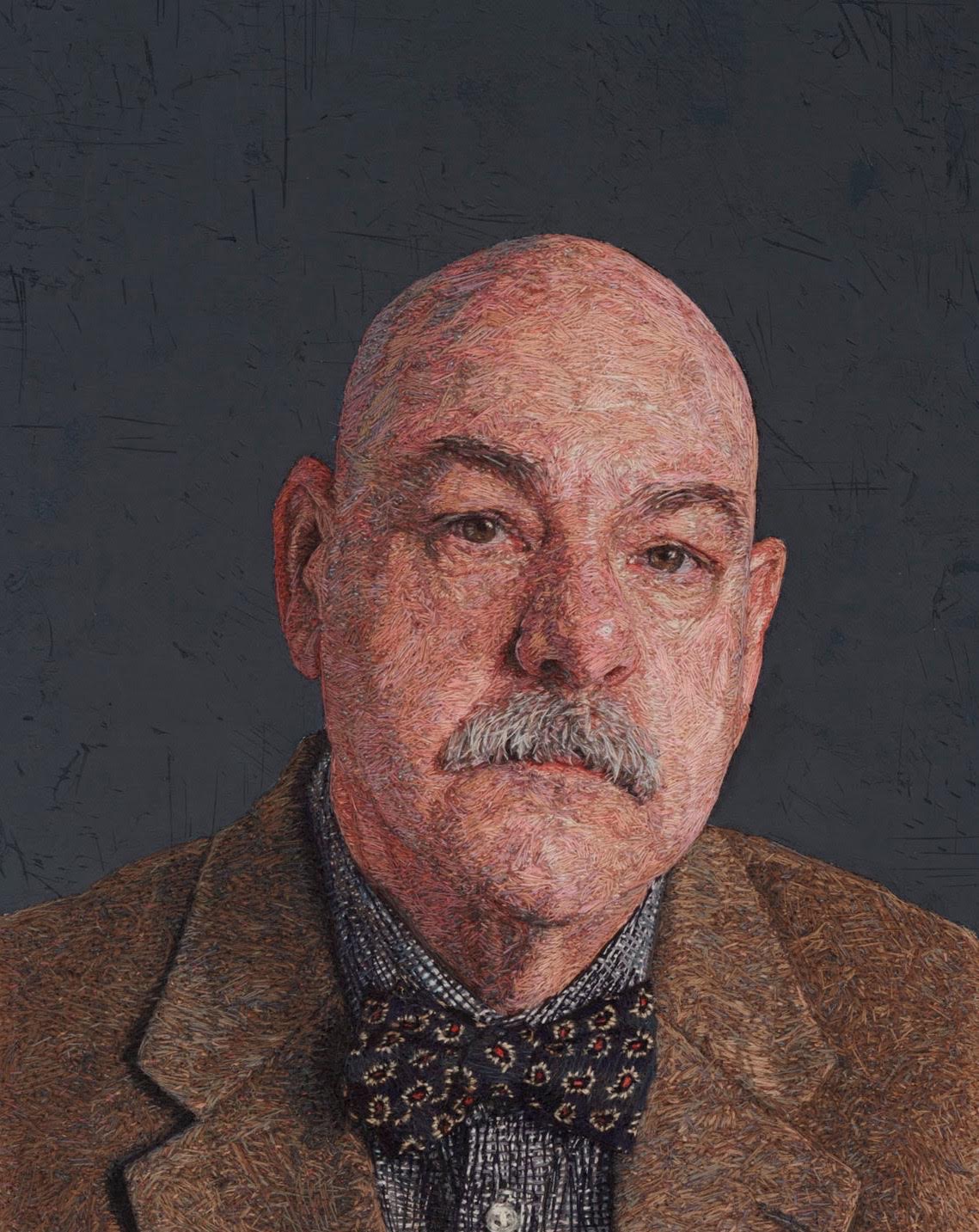
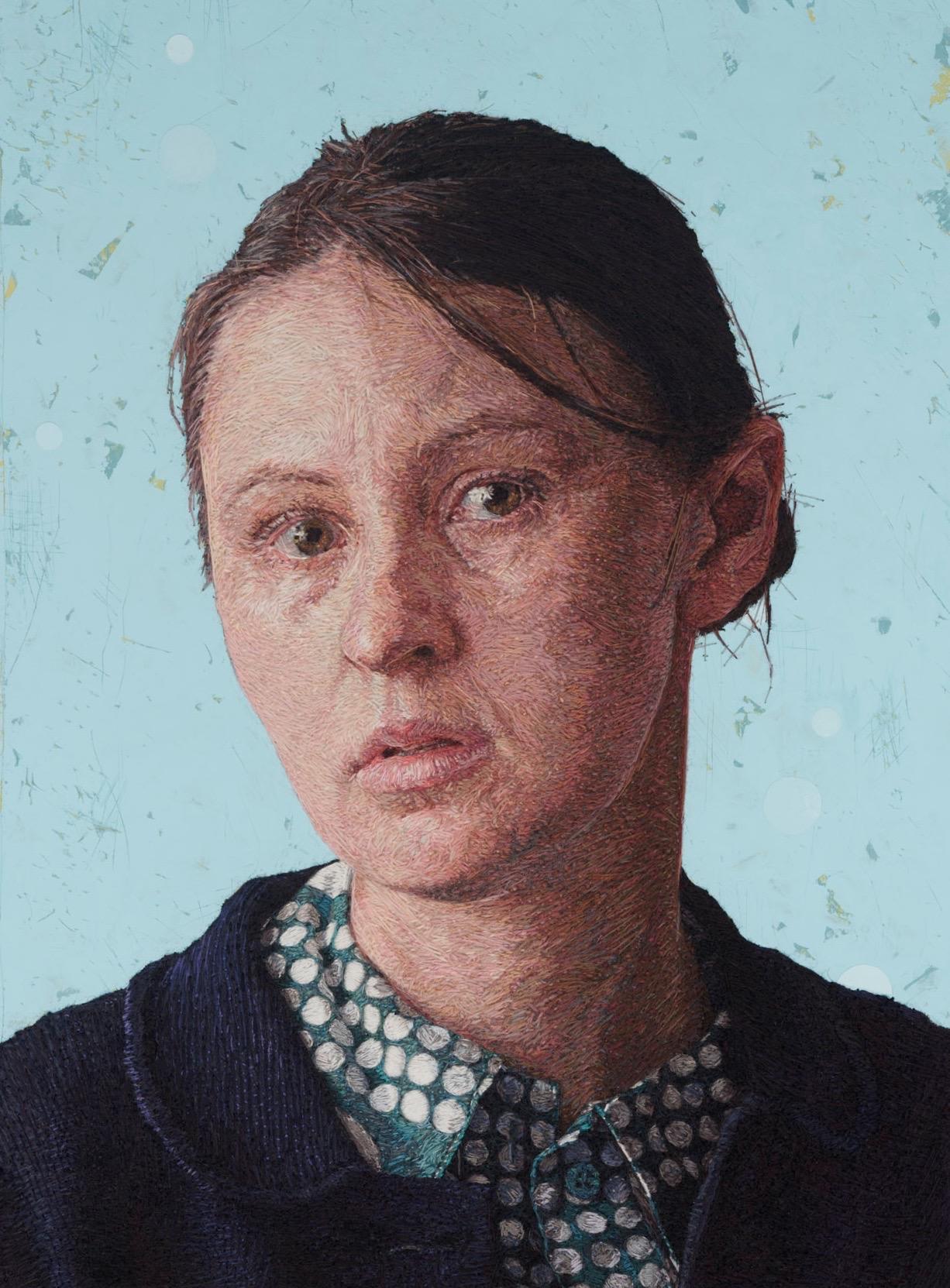
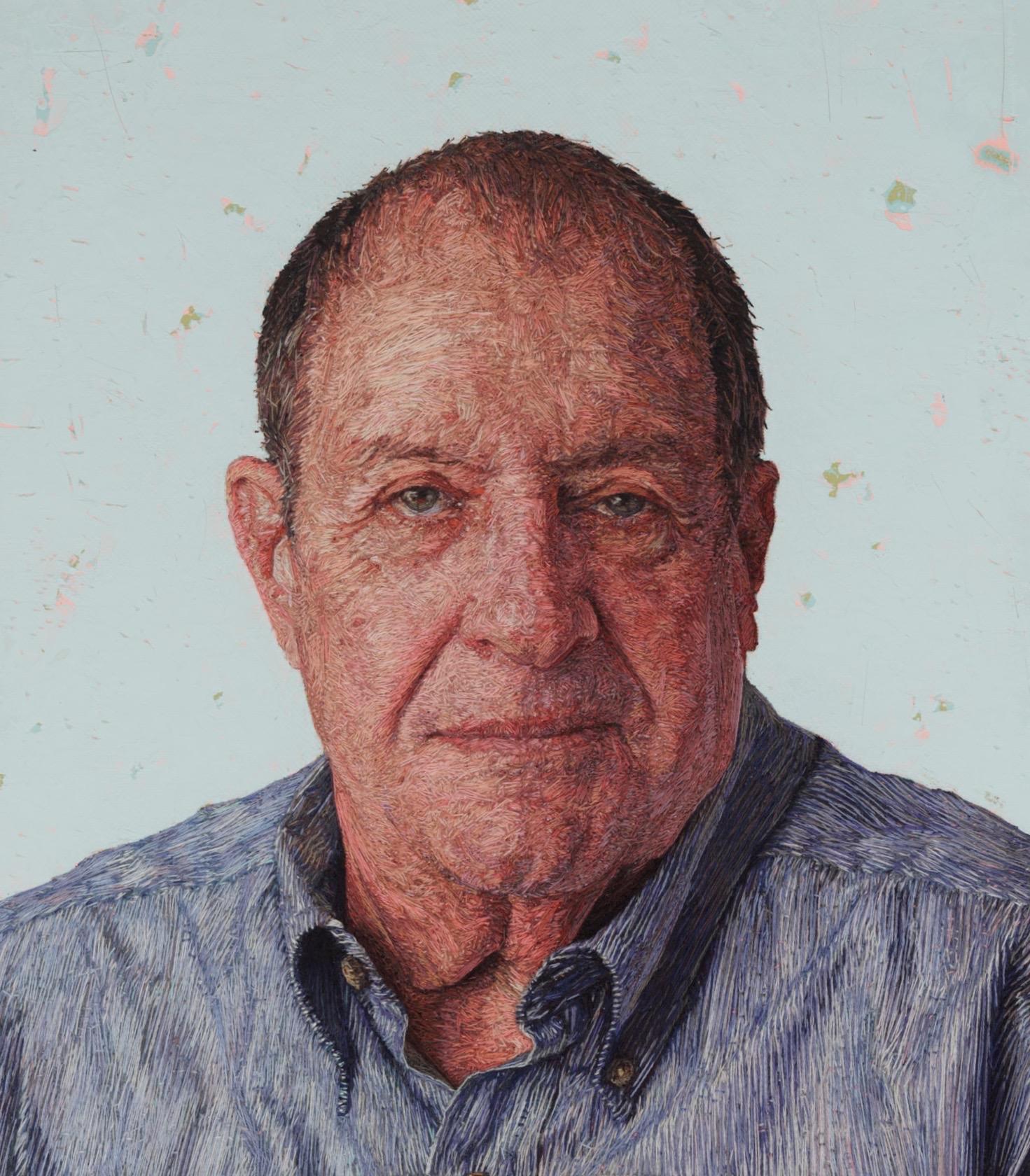
Cayce Zavaglia makes intensely detailed embroideries of wool and thread that have the look of photorealistic paintings … although, from a distance, Zavaglia’s portraits seem to be nearer the surface than they actually are. Upon a closer viewing, one can see labor-intense striations of stitching and color set to a simple background that makes the face of the sitter the center of attention. Letting one’s eyes wander throughout the portraits is a delight. There is detail found in layer after layer of the artist’s work, from common things like a bow tie or an intense red coat, to the shoulders of one of the sitter’s brown suits.

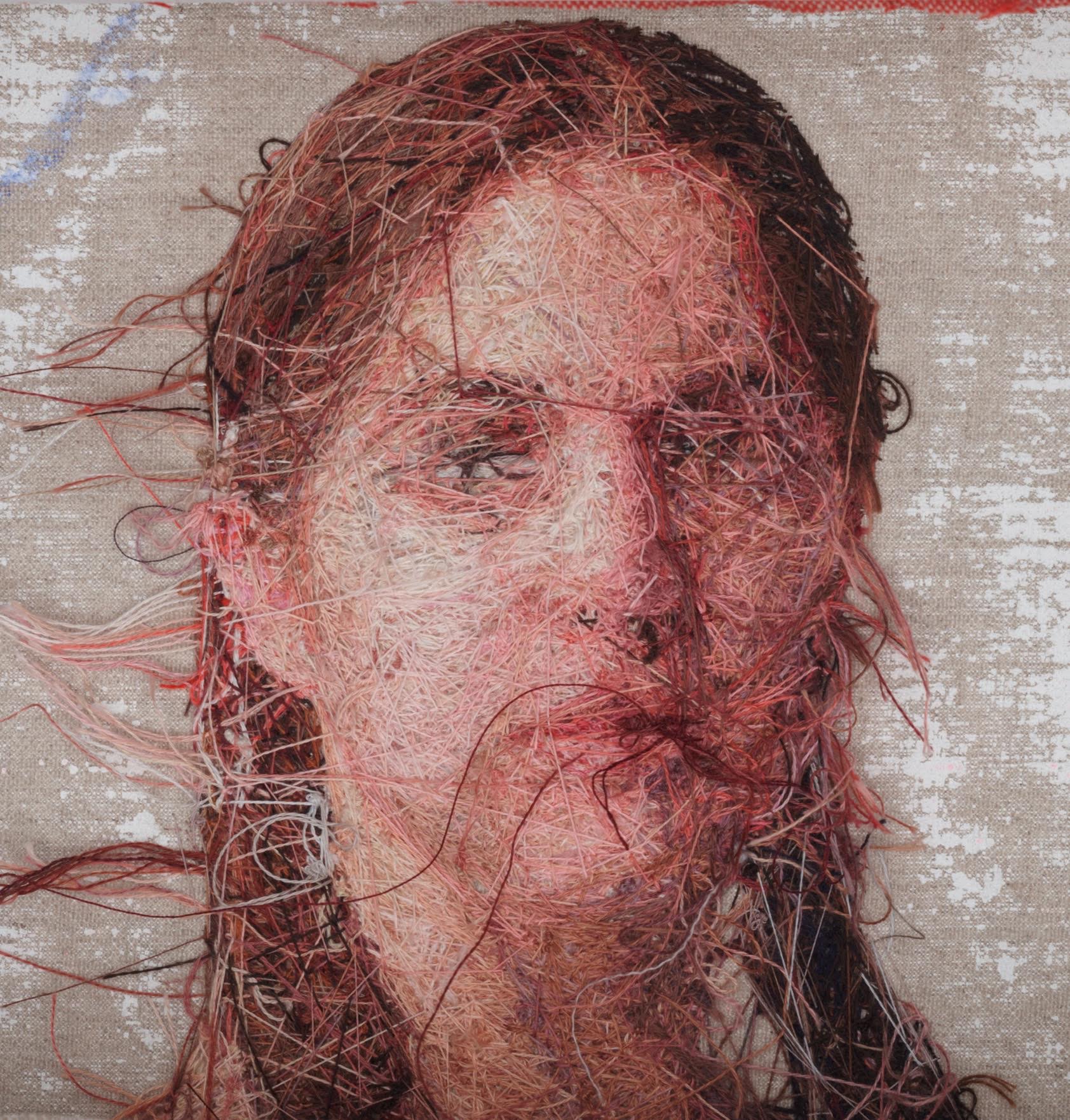
The faces in these pieces have the intensity and precision that only a master can make, but Zavaglia doesn’t only create lucid and precise portraits. In her Verso series, some of the embroideries are turned backwards, as it were, to exhibit the hidden side of the sitter, as strands of threads wildly jut out and offer another, secret perspective of the subject. While the formal precision holds in these Verso series, as well, the viewer is delighted by the surprise of the wildness within — the loose ends adding visual grace notes to the form.

Zavaglia recently had a show in New York City at Lyons-Weir Gallery, which attracted the likes of Chuck Close and found Zavaglia, who had with some trepidation secretly sent Close slides of her work in 2004, with a marvelous and haunting show. One wants to touch every inch of these pieces in order to know them better, but in the end, there is magic here in trusting the eye’s vigilant gaze while living in Zavaglia’s detailed and original work.

You began embroidering canvas about 12 years ago. How did this idea of stitching portraits occur to you?

I spent my childhood years in Australia … til I was 13. My embroidery pieces stem from a work I made as a kid in which I embroidered an image of a sheep station out of crewel wool. Something about that work resonated with me, and it never left me. I studied painting in undergrad and grad school. When I was pregnant and starting a family, I could no longer be around turpentine, varnish, and chemicals, and I kept thinking about that first exposure to embroidery. I wondered if it were possible to embroider a portrait and eventually tried sewing one. I made a small self-portrait out of crewel wool to reference this embroidery from my childhood, but the image was too small and the wool was too thick. So, I had to play around with the scale and experiment with technique. I’ve been making the embroidered works for about 14 years now.

Do you generally work from photographs in order to create portraits?

Yes. I always work from photographs. I usually have a photo session and take about 150 photos. Usually the sitter is nervous … and I kind of am, too. I never choose an image from the first 80 pictures — it takes about that long to know what I am looking for and for the sitter to get comfortable.

There is such precision in your work. Could you talk a bit about the labor that’s involved in such pieces?

Over the years, the technique has become more and more obsessive. In the beginning, I was trying to figure out how to create the illusion of hair, flesh, and cloth out of wool … the stitches were much looser and I used fewer colors. Because I was not trained in embroidery, I did not quite know what I was doing, but knew what I wanted the end product to look like. I practiced “renegade embroidery,” making up my own stiches and relying on my background in drawing and painting to use thread as a drawing tool and attempt a portrait. The making of each piece was the “on-the-job training” that informed the technique of making the next portrait.

Did you always work with figures and faces, or was there a time in your career for more abstract work?

I have always been drawn to the figure. I did figurative painting as an undergraduate student and in graduate school. I was always a little apprehensive to make a direct portrait of a friend or family member. In undergrad, I would do collages, which represented someone I knew. In graduate school, I decided to actually paint portraits of the people in my life. In these early paintings, I tried to incorporate more of the body; people in them had huge heads with little bodies and big hands — they had a bit of humor to them. In the embroideries, I decided to strip away all the gimmicks and just do a portrait of someone I knew against a minimal background. Throughout the years, one thing has remained constant … and that is the direct gaze of the subject toward the viewer. I am still not tired of this pose.

I have never made abstract work in the past, but have recently started to make a series of abstract portraits based on the reverse side of my embroideries. When I turned my embroidery over a few years ago and noticed this other side, it was an exciting discovery that allowed me to introduce paint back into my work. I now do the embroidered portraits and have a separate series of “Verso” works, which are small gouache and large-format acrylic paintings based on this reverse image. This back side is messy, tangled, knotted, and has lots of loose ends. It is my hope that, by focusing on this reverse side and using it to inspire my paintings, that it would initiate a conversation about the divergence between our presented and private selves.

What draws you toward the faces you create?

I only do portraits of family and friends. I like the personal connection and it definitely inspires the work. I look at it like a visual diary of those in my life and the aging process … as some sitters I have repeated several times.

Who are some artists that you admire or at least draw inspiration from?

Coming from a background in painting, I am still primarily inspired by painters. In undergrad, I worshipped Lucien Freud and loved the way he handled the paint. In graduate school, I looked a lot at Elizabeth Peyton. I was more drawn to the way she handled the paint and the supports she worked on. Today, I am relooking at Chuck Close and his current work. Also, Alex Katz is a big influence. I love photographer Loretta Lux’s work, and have revisted Peyton and Freud to see how their work has changed over the years.

When did you begin as an artist? Was it always in your blood, so to speak?

I was crafting and making before I was looking and making art. My mum taught me how to cross-stitch and my grandmother taught me to crochet and make crafts. What I love about this current body of work I am making is that it references the world of craft and tradition, but does it in a sneaky way. The work comes across as figurative painting and you only see that it is embroidered if you look closer. I have always resisted the label “fiber artist” because I think of myself as an artist who happens to use thread and wool … at the moment. However, I do love that so many other artists are incorporating traditional craft techniques into their work and doing it in a new and sophisticated sort of way. The art world is now definitely taking notice.

***

There are a few occasions when the written word must submit or is overcome, at the very least, by the image. Though countless articles are subsumed each and every day by “the image-dominated media,” it seems not just conventional but proper to let Zavaglia’s pieces speak for themselves. It was a warmer day in early December when several people gazed upon her work at Lyons-Weir in Chelsea, in rapt attention, their eyes scanning each and every inch of the pieces, the onlookers’ mouths like O’s that opened and then closed. They were overcome by beauty and submitted to it. Cayce Zavaglia is one of those artists that sees to it that one shuts up — and shuts out — the rest of the world. Beholding her work is a privilege, like seeing the past and future reside and dovetail within faces — and objects — that gaze back at the viewer, demanding a reciprocal silence.