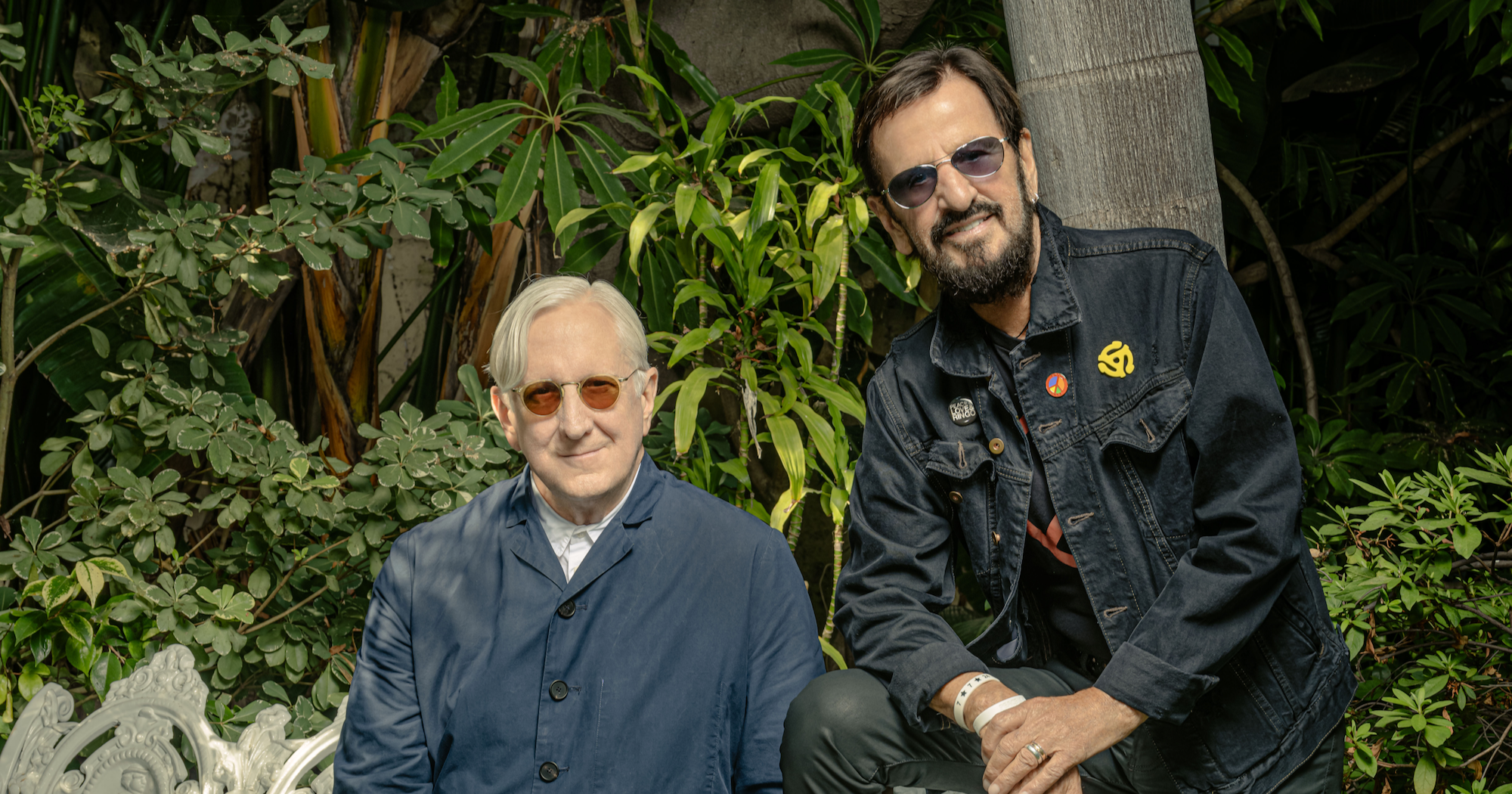
Ringo Starr and T Bone Burnett in Conversation

On a sunny day in late April, I stood outside an ad hoc interview room at the Sunset Marquis in West Hollywood waiting for my turn to speak to Ringo Starr.

Sporadic laughter boomed through the door as the hazy afternoon light danced on the doorknob hanger. Instead of the usual “Do Not Disturb,” this one simply said, “Peace.” The verbiage, apropos for Ringo, served as one part levity and one part beta-blocker as I prepared to speak to a Beatle.

When the door opened, I was surprised and delighted to come face to face with Phil Rosenthal (of Somebody Feed Phil). The unabashed smile on his face foreshadowed the similar joy I would feel taking the same steps through that door just 25 short minutes later.

And yet another revelation unfolded as I walked in the room to find both Mr. Starr and T Bone Burnett, producer of Ringo’s newest album, Long Long Road. The ensuing discussion covered their relationships with genre, synesthesia, and inevitably bobbed and weaved across the rich musical history of these two icons.

Do I get both of you today?

Ringo Starr: Yes!

Excellent!

T Bone Burnett: Only if you want.

RS: Hi. I’m Ringo.

Ha! Yes. The man of the hour. How are you?

RS: Good. Excellent.

Thank you so much for having me.

RS: Oh, it’s our pleasure.

TB: Her dad is a great songwriter, a great guitar player from Muscle Shoals.

RS: We were just talking to someone else about that today.

Really? You were talking about Muscle Shoals today?

RS: Well, we didn’t actually mention it, but we were talking about the music that, for me, started with Johnny Ray and people like that. I was a teenager, and then it went up to country music, and then I got into blues music, and then I got into pop of the day music.

I love country music. And he’s the country boy [as he points to T Bone Burnett].

That’s a fantastic segue to my first question. So as we mentioned, I grew up in Muscle Shoals, and I had this record player that was a little battery-operated blue Volkswagen bus. Do you remember these?

TB: Yeah, I do!

It would ride around the record, and it had a little speaker in it, and I would lay on the ground, and I’d listen to Abbey Road. But it was also around the same time that the video for “Act Naturally,” the duet with Buck Owens, came out. So, for me, you were very genre-fluid from a very early age. I’m curious about a couple of things genre-wise, and T Bone, please jump in on this too.

TB: Okay, I’ll jump in, and I’ll say that the Beatles probably invented what became known as “country rock.” You know, with “I Don’t Want to Spoil the Party.”

RS: And what were the two that were Carl Perkins?

TB: “Honey Don’t” and “Matchbox.”

RS: “Honey Don’t” was the best line I ever heard.

TB: Yeah, it is a killer title.

RS: “Matchbox” was a blues song, really.

TB: Well, “Matchbox” was an old Blind Lemon Jefferson song.

RS: Yes. The interesting thing is I did those in the ’60s, and we just found a Carl Perkins tune that we’d never heard, and we’ve done it on this record. “I Don’t See Me in Your Eyes Anymore.”

I love it.

RS: It is so beautiful and he was just a cool guy. You know, I was a teenager when I first heard him, and it was like, “Oh yeah!”

T Bone: Yeah, he was cool. He, [Carl], had heard “Matchbox” or his dad had heard it by Blind Lemon Jefferson, but they could only remember a few words of it, so he rewrote it as a rockabilly song.

So you knew of country music when you were growing up, you were aware of it.

RS: I did. I was aware of country music. I loved it because it was emotional, and I was a teenager. That’s what we are at that age.

[Ringo singing:] “ Well the wife is dead and I’m leaving home. I got no money for the jukebox.”

Perfect for teenagers.

When I say the words “country music” to you now, what do you think of? Who or what or how do you think of it?

RS: I still think a lot about the people from yesterday, who I came in with. You’ve got to say Willie. I mean, he’s magical and still out there. Thank you, Willie. And who used to open for Willie?

TB: Waylon?

RS: Waylon! He was great. I have to think back.

TB: Well Hank Williams…

RS: Well, no, Hank was where we came in. And Hank Snow. No one mentions him. He was Canadian. Patsy Cline. There’s too many really.

I was talking to someone the other week and they asked, “What is your all-time favorite record?” I couldn’t answer. There is too much that I love. “Who’s your favorite artist?” I start with Ray Charles. And Stevie, and down that line. But I can’t answer it. We were on TV, and I stopped it. I said, “I just can’t answer.” There are too many in my life to say, “That’s the one.”

Plead the 5th.

Do you ever feel constrained by genre? Or inspired by it? What is your relationship with the idea of it?

RS: I’m a pop-rock music drummer. I’ll play whatever you’re gonna give me. If you want it heavy, I’ll hit the cymbals. Heavy metal has some great acts going down. We would jam sometimes and be that.

TB: Oh, well, I mean, the Beatles invented heavy metal, really.

RS: Yeah. It’s just playing the same shit, but heavier.

TB: “Everybody’s Got Something to Hide Except Me and My Monkey” or “Helter Skelter.”

RS: “Helter Skelter” was a jam. We had no song, nothing, we were just jamming, and then Paul came in with, “Hey! Helter Skelter.” Like “Say It’s Your Birthday,” there was someone in the newspaper who we knew, and it was their birthday, and we were jamming. Paul stepped up again, and we got another song. We were like that. You could jump in, any one of us could jump in. I’ve got odd lines we aren’t gonna talk about on certain tracks.

[A publicist chimes in to say:] “T Bone you have five more minutes before you have to leave and then you’ll go and he’ll stay in.”

RS: And then I’ll go and then you’ll stay in. [Laughter]

Well, let’s go back to the Volkswagen.

RS: Let’s get back to it.

Because I have a little bit of synesthesia, I think.

TB: I have that, too.

RS: What have you got?

TB: I see colors when I hear music.

RS: Oh, great!

So, “Octopus’s Garden” was very purple for me. “Act Naturally” is very orangey gold. I’m curious if you’ve ever experienced anything like that. And if it’s not colors, if there are certain textures that you’re looking for in a song, when you’re casting songs for an album? And T Bone, this question’s for you too, since you have it.

RS: T Bone will give me a lot of songs, and I listen to them and I picked my six at the beginning. There were only three I didn’t use. That’s how we started this. In the end, we were talking in my little studio and I said to him, “How many songs have you got?” And he had nine. It gave me the courage to ask him if he would produce the record. All the songs were not on my mind; we were just hanging out like two guys. But it turned into a fellowship.

TB: Well, I can tell you that the Beatles stuff that first came out was very dark blue, all of it. “Don’t Bother Me” especially was the most dark blue of them. It was interesting that the album cover that first came out over here [in the U.S.] was dark blue. So it all sort of coalesced, I think.

That was one of those blessed moments that happen occasionally on earth, you know? Where everybody heard the same thing at the same time.

Absolutely.

RS: I never saw colors. I mean, I did see colors some days… You know what I mean?

[All laugh]

RS: When I listened, it’s how I felt. A sad song, a happy song, a rock song– some of it will move you, and some of it moved me.

TB: Well, I’d better go. But thank you, great to see you again.

Yeah, you too. Nice to see you again.

[As T Bone got up to leave, his wife entered the room and chatter ensued, but he added before walking out the door:]

TB: By the way, “I Want to Hold Your Hand” was very dark blue.

Well, you know, what’s funny is, I had a synesthesia question for Ringo about you, because I didn’t know you were going to be here. But I was going to say that your musical color and texture is exactly like what you are wearing, to me.

TB: Oh, is that right? That’s wild. Thank you! Nice to see you all.

RS: God Bless, peace and love!

Tell me about what it is like for you working in Nashville? Tell me what it feels like working with those players.

RS: I did have experience in the early ’70s when Pete Drake invited me to come, because we were working on a George Harrison record. You know, we keep talking about the steps we take, the moves we make. And I was there with George, and I’m playing for him and he’d called Pete – I didn’t know Pete. Pete had landed at Heathrow, and the car George was sending broke down, so we sent my car. And then he arrived. “Hey, hoss, I see you like country music.”

“Yeah, yeah, I do. How do you know?”

He said, “All those cassettes in your car.”

And then a few days later, he’s saying, “You should come to Nashville.” And I thought, “I’m not going to Nashville. I’m doing stuff here. I don’t have a month or six weeks to go to Nashville.” He said, “A month? Six weeks? Nashville Skyline took two days.” And I said, “I’m coming.” And I went, and we did the same thing.

On the first day, five songs were picked in the morning. Between us, we listened to them all. Five songs were recorded, and five songs were finished. And the next day, we picked five songs. Anyway, it went on the same way, and it was finished. And it took two days, so that was great.

Well, Ringo, you have one of the finest reputations in the music business.

RS: As a drummer or else?

EM: As a drummer, as a human.

RS: Or as a tall person?

The tallest around.

Just for being so kind to people and emanating peace and love, obviously. And you’ve been such a beacon of that for so many decades. Especially in the last couple of weeks I’ve been thinking a lot about that, after finding out that I was going to talk to you. I was curious, I’m sure it’s mostly innate, but do you ever feel like it’s a responsibility – in terms of how you are in the public, in terms of what songs you’re picking? I’m particularly thinking of “Choose Love.”

RS: I just do my best, you know, to pick the songs that give you some movement, and you say, “Oh, I’d like to sing that.” That’s what I’m with these two country songs with T Bone. I mean, I don’t really do it in a political way, that it says this or that. It’s usually peace and love. If I write it, it’s always peace and love – I don’t know what the question was.

Just wondering if it ever feels like a responsibility to you.

RS: You know, I’ve had many a good year, but some years I’ve made really bummer mistakes. It’s like that’s when your brain wins. I mean, even on this record, I’ve got the lines about “let the stuff come in, but let it go.” And I’ve been pretty good at that for a long time. Not that it’s every second of my life. Sometimes it gets in. And it stays in your thoughts. Then you’re in hell. I’m blessed that that doesn’t happen half as much anymore. I can just dump the thought that comes in and deal with whatever it is.

I was going to ask you about that line in particular, because I think it does this beautiful job of talking about a meditative quality of finding peace without being preachy or telling people “how to” and I really love that.

RS: I meditated this morning. I meditate every morning, this time since ‘92. You know, we went to the Maharishi in India with the boys. And I was worried, you know, “Am I doing it properly?” I was talking to him [Maharishi] and he says, “Ringo, even if you fall asleep, you must have been tired.”

And it taught me a great lesson. I was into like, madness and stuff, you know, “It must be this. It must be me. What’s the problem?” And now I get quite calm.

That’s wonderful. Yeah. It comes across on this album. You’re talking about your own experience and that’s–

RS: What else can I talk about? I can’t talk about yours, you know? But thank you.

Tell me about the band that played on this record.

RS: T Bone’s whole band is great. The rest of Nashville is so great. They all came out to help me. To be there. It is in my heart.

Last January, when I was there and back three times. And every time when I’ve played at the Ryman… I’ve been playing there for the last 15 years with the All Stars, but when I go on that stage, I feel all the guys and all the gals who stood on that stage.

And then what happens? The Grand Ole Opry invited me to do three songs. And I go on that stage that has the Ryman circle that the singers stand on. It is magical. For me, coming from England, it was really magical to get on that stage. And the people are great. It is built for music coming out and hitting everybody, because it was a gospel church. I’m still moved. I get on the stage, and I have to go through a minute of, “Wow, wow!”


Photo Credit: Dan Winters
Bluegrass Memoirs: Old-time, Ragtime, & Mrs. Etta Baker

On October 3, 2020, during IBMA’s Virtual World of Bluegrass, I watched the Bluegrass Situation‘s presentation of Shout & Shine Online, the fifth annual showcase celebrating equity and inclusion in bluegrass and roots music. This year it featured Black performers, including Jerron “Blind Boy” Paxton, the blues, folk, bluegrass, and jazz multi-instrumentalist and vocalist from South Los Angeles. Not only do I enjoy his music, I also relish his asides and introductions. He knows a lot about musical sources, histories and meanings.  

Introducing his music, Paxton explained that “ragtime” was the word people in his home community used to describe what others might call “old-time” or “traditional” — music that rekindled a shared past. At neighborhood and family social gatherings, he said, people would ask for his music by saying, “Play some of that ragtime music!” 

For many people ragtime evokes the aural image of a piano played in the style of early 20th century composer Scott Joplin, an African American whose “Maple Leaf Rag” starred in the soundtrack of the 1973 hit film The Sting. (Paxton performed an arrangement of “Maple Leaf Rag” on five-string banjo for his Shout & Shine Online set.) The basic structure of this solo piano music involves the left hand keeping the rhythm often with large leaps in the bass register — often referred to as “stride” — while the right hand plays syncopated melody on the upper register. 

In this form, ragtime is thought of as an urban phenomenon, straddling the border between popular and classical, and as the musical precursor of jazz. Joplin, for instance, composed an opera in 1911, and Julliard piano professor Joshua Rifkin’s 1971 LP of Joplin’s works earned a Grammy nomination. Pioneer jazz pianists like Jelly Roll Morton included ragtime in their repertoires.

Ragtime had another manifestation in the southeast, where Black musicians adapted it to the guitar in a fingerpicking style. Here, the right hand did all the work: the thumb picking the rhythm on the bass strings while the index and middle fingers ragged the tune on the higher strings.

The guitar was more affordable and portable than the piano. Ragtime guitar was featured by early 20th century itinerant musicians like Arnold Shultz in western Kentucky and Blind Boy Fuller in North Carolina. But it was not just the music of popular entertainment, it was also, as Paxton explained, social community music, performed for friends and neighbors. 

In 1957, ragtime fingerpicking was a “new thing” within the folk music world that I was becoming acquainted with as a college student. I switched from nylon- to steel-string guitar and started wearing picks on my right hand. One of the recordings popular with us at Oberlin College was a track Peggy Seeger fingerpicked and sang on her 1955 Folkways LP, Songs of Courting and Complaint: “Freight Train.” She’d learned the song and its guitar accompaniment from the Black woman who worked as her family’s maid, North Carolinian Elizabeth “Libba” Cotten, its composer.

In 1958 Peggy’s brother Mike Seeger produced Cotten’s first album for Folkways. “Freight Train,” already her best-known song, was on it:

Another tune we were trying to fingerpick in our dorm rooms and dining hall jam sessions was “Railroad Bill.” That song had been recorded by Virginia multi-instrumentalist and virtuoso Hobart Smith back in the ’40s. 

“Discovered” at the White Top (Virginia) folk festival in 1936, Smith and his sister, singer Texas Gladden, subsequently performed at the White House and were recorded for the Library of Congress by Alan Lomax in 1942. In 1946, Lomax introduced Hobart to New York record company owner Moses Asch. One of Asch’s new Disc label 78s launched Smith’s version of “Railroad Bill” into aural tradition among ’50s fingerpickers. Lomax recorded Smith again in 1959:

Smith had studied and learned fiddle and banjo with African American musician neighbors at a time when the realities of segregation forced him and his friends to visit them surreptitiously. He was inspired to take up the guitar when he saw an itinerant Black bluesman, whom he identified as Blind Lemon Jefferson. 

“Railroad Bill” was a well-known song in the southeast. Another song with a similar melody was “The Cannon Ball,” which Maybelle Carter of the famous Carter Family learned from Burnsville, North Carolina, native Lesley Riddle. In the late twenties and early thirties Riddle, an African American, accompanied A.P. Carter on song collecting trips and taught the family several songs they later recorded. Here’s a 1936 radio transcription of Maybelle singing and picking “The Cannon Ball”:

Mike Seeger recorded Riddle several times between 1965 and 1978; in 1993 Rounder issued a CD with 14 performances, including “The Cannon Ball”:

Riddle’s version, with its C to E chord change, is even closer to “Railroad Bill” than Maybelle’s. But in the mid-’50s, when I first became interested in this tune, no LP recordings of it were available. 

That changed in 1956, when a new version of “Railroad Bill” was released on an album, Instrumental Music of the Southern Appalachians. The first piece on the “B” side, it was fingerpicked by Mrs. Etta Baker: 

By the time I arrived at Oberlin College in 1957 it was an underground favorite; the hip older students spoke about trying to play like Mrs. Etta Baker. Copies of the album were passed around.

This album was on the new folk music label Tradition. Based in New York, Tradition hit the ground running in 1956 with at least 14 albums representing Greenwich Village trends in the mid-’50s folk revival: lots of ballads, plenty of Irish and English singers, popular radio performers, folklore collectors, flamenco artists, new concert sensations, and two albums of field recordings in the style of Folkways — one from Ireland, and this one from Appalachia. The recordings for Instrumental Music of the Southern Appalachians were made by Tradition owner Diane Hamilton along with Liam Clancy and Paul Clayton in the summer of 1956. 

Diane Hamilton was the pseudonym of Diane Guggenheim (1924–1991), an American mining heiress with a lifelong interest in traditional music, particularly Irish. At the time of the recording, Liam Clancy, soon to become part of the famous Clancy Brothers and Tommy Makem, had just arrived in New York, following an attachment with Hamilton. His brother Paddy was president of her new company.

New Englander Paul Clayton had studied folklore at the University of Virginia while pursuing a career as a folksinger. He recorded many albums from the mid-’50s until his troubled life ended in 1967 at the age of 36. Today he’s perhaps best known as a songwriter. His “Gotta Travel On” was a country hit in 1958, and his friend Bob Dylan borrowed from one of his songs to compose “Don’t Think Twice.” In 1956 Tradition had just released Paul’s album, Whaling and Sailing Songs from the Days of Moby Dick.

In his notes for Instrumental Music of the Southern Appalachians, Clayton described the album as “the result of a folk-song collecting trip during the Summer of 1956.” Hamilton and Clancy had recently arrived in New York from Ireland; Clancy was keen on collecting southern folk songs, and Clayton, who’d done a lot of that, was the obvious choice for expert guide. 

The three met in Chapel Hill, North Carolina, and headed west for a collecting trip to Appalachia. Their exact itinerary is unknown, but they went as far west as Beech Mountain, the highest point in the eastern U.S., well-known for its folk traditions. There they recorded folktale collector and performer Richard Chase doing three old-time dance tunes on the harmonica. In nearby Banner Elk, Mrs. Edd Presnell played three old-time tunes on her Appalachian dulcimer — an instrument then rarely heard on recordings that Clayton had studied and used in his performances. 

The trio also visited Hobart Smith in his Saltville, Virginia, home, seventy miles north of Beech Mountain, recording four fiddle tunes and one banjo piece. 

Their travel also took them to Blowing Rock, about a 25 mile drive from Beech Mountain, where they stopped in at the Moses H. Cone Mansion (also known as Flat Top Manor) a popular regional park on the Blue Ridge Parkway.

Etta Baker, her father Boone Reid, and other family members were vacationing in the area, visiting the mansion. Reid, a musician himself, noticed Clayton was toting a guitar. He told Clayton of Baker’s musical talent and asked him to listen to Etta play her signature, “One Dime Blues.” According to Baker, “Paul was amazed. He got directions to our home and he was over the next day with his tape-recorder along with Liam Clancy and Diane Hamilton.”

They recorded five pieces. “Later,” says Clayton, “We met more of… a very talented family living in Morganton or Gamewell,” and they recorded two banjo pieces each by Boone Reid, then 79 years old, and Etta’s brother-in-law, her sister Cora Phillips’ husband Lacey. 

Clayton’s notes indicate that they recorded “considerable instrumental material,” from which they chose “typical and best-performed” examples. This considerable material subsequently disappeared, leaving us today with only the album’s 20 tracks

These include many familiar pieces from the local old-time repertoire. By following Harry Smith’s precedent in not identifying the color of performers’ skin, Clayton made the point that these musical traditions were regional, not racial. Perhaps since dulcimer player Mrs. Presnell’s first name was not given, all of the musicians were identified on the album notes as “Mr.” or “Mrs.” This lent an air of respect to the names of people often described elsewhere as “informants.” 

Because of her fine guitar playing Mrs. Etta Baker was, for us, the most memorable performer on the album. A word of explanation — Mr. Hobart Smith was a fine fiddler, but in 1956 the fiddle hadn’t caught on in the folk revival. That wouldn’t start to happen until a few years later when the New Lost City Ramblers appeared.

With the exception of Smith, who led a string band for a while, the folks on this album made music as part of their social life, playing for their own enjoyment and that of family and friends. Sometimes they provided music for dancing — square dancing, and solo step dancing.

Here’s a good example of ragtime guitar used for solo step dancing: Earl Scruggs playing “Georgia Buck” live in 1961. 

Another version was released in 1964 on the The Fabulous Sound of Flatt & Scruggs (Col CL 2255/CS 9055). The album notes say: “Georgia Buck, played by Scruggs on the guitar, represents the rhythmic beat of the old-time buck dancers.” 

According to NCPedia, “buck dancing is a folk dance that originated among African Americans during the era of slavery. It was largely associated with the North Carolina Piedmont and, later, with the blues. The original buck dance, or ‘buck and wing,’ referred to a specific step performed by solo dancers, usually men; today the term encompasses a broad variety of improvisational dance steps.” 

The Traditional Tune Archive describes “Georgia Buck” as “a black Southern banjo song,” so it’s interesting that Earl played it on the guitar in a style resembling that of Baker, Smith, Riddle and Carter. Where did he learn it that way? We don’t know, but Lester makes a point of describing his music as “hot” during the video and other musicians can be heard saying the same thing off-camera, seemingly endorsing the idea that this is good ragtime.

There are many stories of young white southern musicians learning from older black musicians in their hometown. One example: In 1972-73, Kenny Baker, then playing fiddle with Bill Monroe, did two albums with Buck Graves of guitar fingerpicking he’d learned from his brother, who’d taken lessons from “Earnest Johnson, a blind, black guitarist who sold peanuts in Jenkins, Kentucky during the thirties.” Rebel reissued them in 1989 as The Puritan Sessions (CD 1108).

Listening to Etta Baker on Instrumental Music of the Southern Appalachians was as close to taking lessons in that style of guitar as most of us undergrad folkies got. After the release of the album, she was not heard again on records for many years. Like Libba Cotten, Baker was a working woman with little time for making music. By the time she retired in 1973 from the Skyland Textile mill in Morganton, North Carolina, she’d endured family tragedies — the deaths of her husband and a son. After retirement she began accepting requests to perform and her music career developed. More about that next time…


Neil V. Rosenberg is an author, scholar, historian, banjo player, Bluegrass Music Hall of Fame inductee, and co-chair of the IBMA Foundation’s Arnold Shultz Fund.

Photo of Neil V. Rosenberg: Terri Thomson Rosenberg

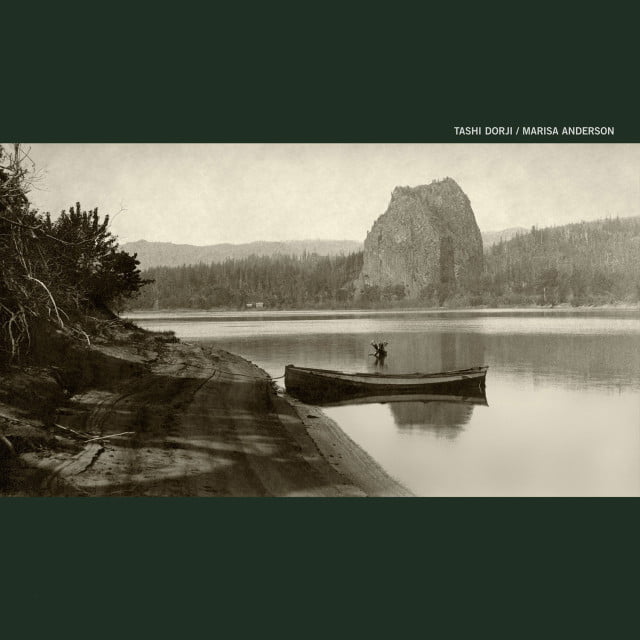
Marisa Anderson, ‘House Carpenter/See That My Grave Is Kept Clean

With "House Carpenter/See That My Grave Is Kept Clean," Anderson weaves together two traditional songs into a new, enchanting composition. She arrived at the song after she was asked to participate in a concert that celebrated the Anthology of American Folk Music, the seminal six-LP compilation of American music put together by Harry Smith that was first released in 1952. Her task was to present an original arrangement from a song out of the Anthology, but she ended up picking two tunes instead of one.

"I knew I wanted to play 'House Carpenter' and, in researching the song, I realized I wanted to contextualize it in a way that was meaningful to me. I played my way through many of the songs on the Anthology and decided that 'See That My Grave Is Kept Clean' was the best match for my intention. Going from one song to the next also offers a  rhythmic challenge that keeps me interested," she explains.

You might recognize "House Carpenter," an old ballad with English roots that's been done many times over (including by Nickel Creek), while "See That My Grave Is Kept Clean" was written by famed bluesman Blind Lemon Jefferson. Anderson's rhythm twists and turns with her fleet picking, and you'll need a few listens to pick up on all the intricacies of her playing.

Anderson's unified take on these tunes appears on a new split record that she has with another guitar wizard, Asheville's own Tashi Dorji. You can pick it up via Footfalls Records now.