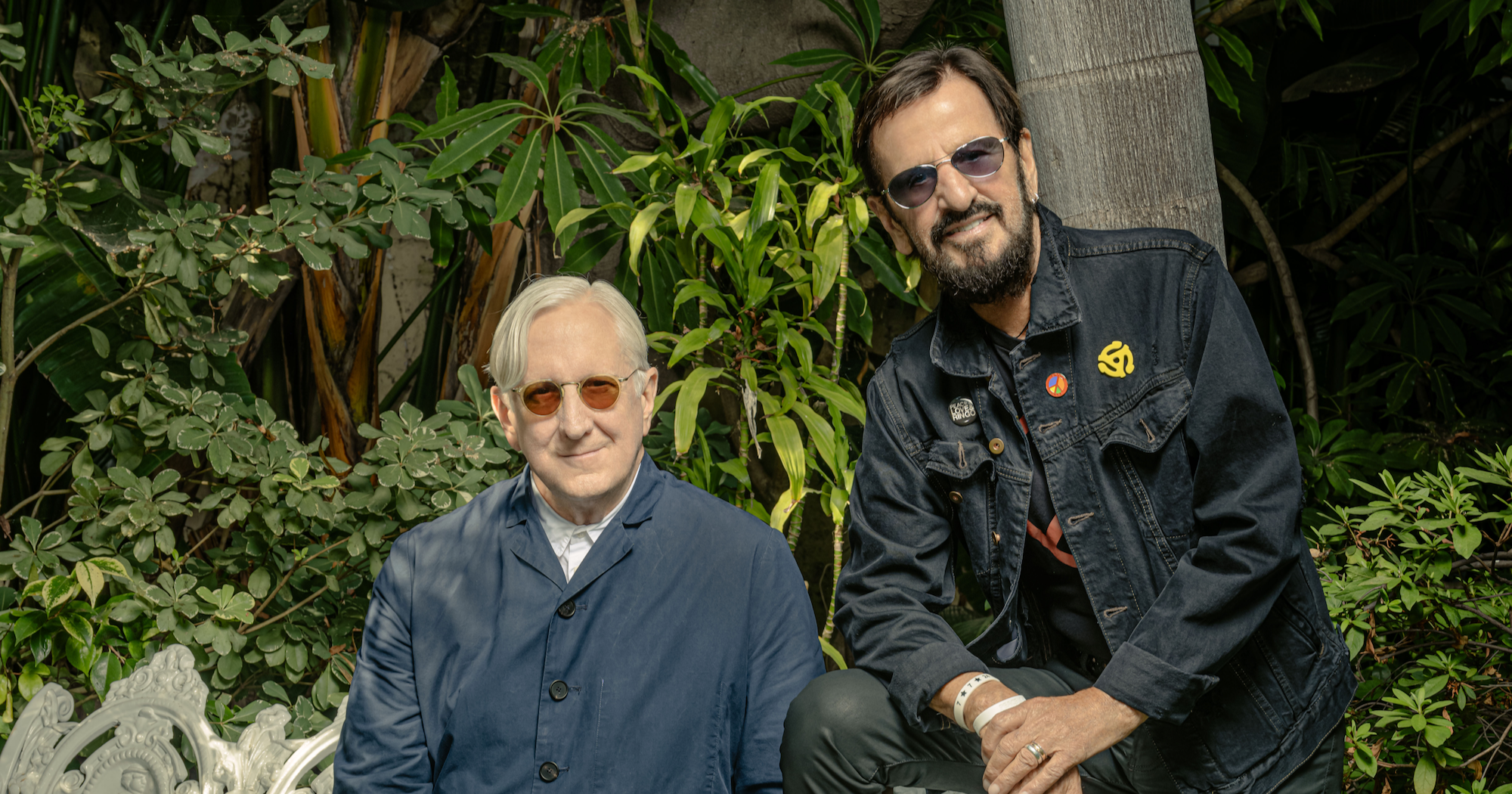
Ringo Starr and T Bone Burnett in Conversation

On a sunny day in late April, I stood outside an ad hoc interview room at the Sunset Marquis in West Hollywood waiting for my turn to speak to Ringo Starr.

Sporadic laughter boomed through the door as the hazy afternoon light danced on the doorknob hanger. Instead of the usual “Do Not Disturb,” this one simply said, “Peace.” The verbiage, apropos for Ringo, served as one part levity and one part beta-blocker as I prepared to speak to a Beatle.

When the door opened, I was surprised and delighted to come face to face with Phil Rosenthal (of Somebody Feed Phil). The unabashed smile on his face foreshadowed the similar joy I would feel taking the same steps through that door just 25 short minutes later.

And yet another revelation unfolded as I walked in the room to find both Mr. Starr and T Bone Burnett, producer of Ringo’s newest album, Long Long Road. The ensuing discussion covered their relationships with genre, synesthesia, and inevitably bobbed and weaved across the rich musical history of these two icons.

Do I get both of you today?

Ringo Starr: Yes!

Excellent!

T Bone Burnett: Only if you want.

RS: Hi. I’m Ringo.

Ha! Yes. The man of the hour. How are you?

RS: Good. Excellent.

Thank you so much for having me.

RS: Oh, it’s our pleasure.

TB: Her dad is a great songwriter, a great guitar player from Muscle Shoals.

RS: We were just talking to someone else about that today.

Really? You were talking about Muscle Shoals today?

RS: Well, we didn’t actually mention it, but we were talking about the music that, for me, started with Johnny Ray and people like that. I was a teenager, and then it went up to country music, and then I got into blues music, and then I got into pop of the day music.

I love country music. And he’s the country boy [as he points to T Bone Burnett].

That’s a fantastic segue to my first question. So as we mentioned, I grew up in Muscle Shoals, and I had this record player that was a little battery-operated blue Volkswagen bus. Do you remember these?

TB: Yeah, I do!

It would ride around the record, and it had a little speaker in it, and I would lay on the ground, and I’d listen to Abbey Road. But it was also around the same time that the video for “Act Naturally,” the duet with Buck Owens, came out. So, for me, you were very genre-fluid from a very early age. I’m curious about a couple of things genre-wise, and T Bone, please jump in on this too.

TB: Okay, I’ll jump in, and I’ll say that the Beatles probably invented what became known as “country rock.” You know, with “I Don’t Want to Spoil the Party.”

RS: And what were the two that were Carl Perkins?

TB: “Honey Don’t” and “Matchbox.”

RS: “Honey Don’t” was the best line I ever heard.

TB: Yeah, it is a killer title.

RS: “Matchbox” was a blues song, really.

TB: Well, “Matchbox” was an old Blind Lemon Jefferson song.

RS: Yes. The interesting thing is I did those in the ’60s, and we just found a Carl Perkins tune that we’d never heard, and we’ve done it on this record. “I Don’t See Me in Your Eyes Anymore.”

I love it.

RS: It is so beautiful and he was just a cool guy. You know, I was a teenager when I first heard him, and it was like, “Oh yeah!”

T Bone: Yeah, he was cool. He, [Carl], had heard “Matchbox” or his dad had heard it by Blind Lemon Jefferson, but they could only remember a few words of it, so he rewrote it as a rockabilly song.

So you knew of country music when you were growing up, you were aware of it.

RS: I did. I was aware of country music. I loved it because it was emotional, and I was a teenager. That’s what we are at that age.

[Ringo singing:] “ Well the wife is dead and I’m leaving home. I got no money for the jukebox.”

Perfect for teenagers.

When I say the words “country music” to you now, what do you think of? Who or what or how do you think of it?

RS: I still think a lot about the people from yesterday, who I came in with. You’ve got to say Willie. I mean, he’s magical and still out there. Thank you, Willie. And who used to open for Willie?

TB: Waylon?

RS: Waylon! He was great. I have to think back.

TB: Well Hank Williams…

RS: Well, no, Hank was where we came in. And Hank Snow. No one mentions him. He was Canadian. Patsy Cline. There’s too many really.

I was talking to someone the other week and they asked, “What is your all-time favorite record?” I couldn’t answer. There is too much that I love. “Who’s your favorite artist?” I start with Ray Charles. And Stevie, and down that line. But I can’t answer it. We were on TV, and I stopped it. I said, “I just can’t answer.” There are too many in my life to say, “That’s the one.”

Plead the 5th.

Do you ever feel constrained by genre? Or inspired by it? What is your relationship with the idea of it?

RS: I’m a pop-rock music drummer. I’ll play whatever you’re gonna give me. If you want it heavy, I’ll hit the cymbals. Heavy metal has some great acts going down. We would jam sometimes and be that.

TB: Oh, well, I mean, the Beatles invented heavy metal, really.

RS: Yeah. It’s just playing the same shit, but heavier.

TB: “Everybody’s Got Something to Hide Except Me and My Monkey” or “Helter Skelter.”

RS: “Helter Skelter” was a jam. We had no song, nothing, we were just jamming, and then Paul came in with, “Hey! Helter Skelter.” Like “Say It’s Your Birthday,” there was someone in the newspaper who we knew, and it was their birthday, and we were jamming. Paul stepped up again, and we got another song. We were like that. You could jump in, any one of us could jump in. I’ve got odd lines we aren’t gonna talk about on certain tracks.

[A publicist chimes in to say:] “T Bone you have five more minutes before you have to leave and then you’ll go and he’ll stay in.”

RS: And then I’ll go and then you’ll stay in. [Laughter]

Well, let’s go back to the Volkswagen.

RS: Let’s get back to it.

Because I have a little bit of synesthesia, I think.

TB: I have that, too.

RS: What have you got?

TB: I see colors when I hear music.

RS: Oh, great!

So, “Octopus’s Garden” was very purple for me. “Act Naturally” is very orangey gold. I’m curious if you’ve ever experienced anything like that. And if it’s not colors, if there are certain textures that you’re looking for in a song, when you’re casting songs for an album? And T Bone, this question’s for you too, since you have it.

RS: T Bone will give me a lot of songs, and I listen to them and I picked my six at the beginning. There were only three I didn’t use. That’s how we started this. In the end, we were talking in my little studio and I said to him, “How many songs have you got?” And he had nine. It gave me the courage to ask him if he would produce the record. All the songs were not on my mind; we were just hanging out like two guys. But it turned into a fellowship.

TB: Well, I can tell you that the Beatles stuff that first came out was very dark blue, all of it. “Don’t Bother Me” especially was the most dark blue of them. It was interesting that the album cover that first came out over here [in the U.S.] was dark blue. So it all sort of coalesced, I think.

That was one of those blessed moments that happen occasionally on earth, you know? Where everybody heard the same thing at the same time.

Absolutely.

RS: I never saw colors. I mean, I did see colors some days… You know what I mean?

[All laugh]

RS: When I listened, it’s how I felt. A sad song, a happy song, a rock song– some of it will move you, and some of it moved me.

TB: Well, I’d better go. But thank you, great to see you again.

Yeah, you too. Nice to see you again.

[As T Bone got up to leave, his wife entered the room and chatter ensued, but he added before walking out the door:]

TB: By the way, “I Want to Hold Your Hand” was very dark blue.

Well, you know, what’s funny is, I had a synesthesia question for Ringo about you, because I didn’t know you were going to be here. But I was going to say that your musical color and texture is exactly like what you are wearing, to me.

TB: Oh, is that right? That’s wild. Thank you! Nice to see you all.

RS: God Bless, peace and love!

Tell me about what it is like for you working in Nashville? Tell me what it feels like working with those players.

RS: I did have experience in the early ’70s when Pete Drake invited me to come, because we were working on a George Harrison record. You know, we keep talking about the steps we take, the moves we make. And I was there with George, and I’m playing for him and he’d called Pete – I didn’t know Pete. Pete had landed at Heathrow, and the car George was sending broke down, so we sent my car. And then he arrived. “Hey, hoss, I see you like country music.”

“Yeah, yeah, I do. How do you know?”

He said, “All those cassettes in your car.”

And then a few days later, he’s saying, “You should come to Nashville.” And I thought, “I’m not going to Nashville. I’m doing stuff here. I don’t have a month or six weeks to go to Nashville.” He said, “A month? Six weeks? Nashville Skyline took two days.” And I said, “I’m coming.” And I went, and we did the same thing.

On the first day, five songs were picked in the morning. Between us, we listened to them all. Five songs were recorded, and five songs were finished. And the next day, we picked five songs. Anyway, it went on the same way, and it was finished. And it took two days, so that was great.

Well, Ringo, you have one of the finest reputations in the music business.

RS: As a drummer or else?

EM: As a drummer, as a human.

RS: Or as a tall person?

The tallest around.

Just for being so kind to people and emanating peace and love, obviously. And you’ve been such a beacon of that for so many decades. Especially in the last couple of weeks I’ve been thinking a lot about that, after finding out that I was going to talk to you. I was curious, I’m sure it’s mostly innate, but do you ever feel like it’s a responsibility – in terms of how you are in the public, in terms of what songs you’re picking? I’m particularly thinking of “Choose Love.”

RS: I just do my best, you know, to pick the songs that give you some movement, and you say, “Oh, I’d like to sing that.” That’s what I’m with these two country songs with T Bone. I mean, I don’t really do it in a political way, that it says this or that. It’s usually peace and love. If I write it, it’s always peace and love – I don’t know what the question was.

Just wondering if it ever feels like a responsibility to you.

RS: You know, I’ve had many a good year, but some years I’ve made really bummer mistakes. It’s like that’s when your brain wins. I mean, even on this record, I’ve got the lines about “let the stuff come in, but let it go.” And I’ve been pretty good at that for a long time. Not that it’s every second of my life. Sometimes it gets in. And it stays in your thoughts. Then you’re in hell. I’m blessed that that doesn’t happen half as much anymore. I can just dump the thought that comes in and deal with whatever it is.

I was going to ask you about that line in particular, because I think it does this beautiful job of talking about a meditative quality of finding peace without being preachy or telling people “how to” and I really love that.

RS: I meditated this morning. I meditate every morning, this time since ‘92. You know, we went to the Maharishi in India with the boys. And I was worried, you know, “Am I doing it properly?” I was talking to him [Maharishi] and he says, “Ringo, even if you fall asleep, you must have been tired.”

And it taught me a great lesson. I was into like, madness and stuff, you know, “It must be this. It must be me. What’s the problem?” And now I get quite calm.

That’s wonderful. Yeah. It comes across on this album. You’re talking about your own experience and that’s–

RS: What else can I talk about? I can’t talk about yours, you know? But thank you.

Tell me about the band that played on this record.

RS: T Bone’s whole band is great. The rest of Nashville is so great. They all came out to help me. To be there. It is in my heart.

Last January, when I was there and back three times. And every time when I’ve played at the Ryman… I’ve been playing there for the last 15 years with the All Stars, but when I go on that stage, I feel all the guys and all the gals who stood on that stage.

And then what happens? The Grand Ole Opry invited me to do three songs. And I go on that stage that has the Ryman circle that the singers stand on. It is magical. For me, coming from England, it was really magical to get on that stage. And the people are great. It is built for music coming out and hitting everybody, because it was a gospel church. I’m still moved. I get on the stage, and I have to go through a minute of, “Wow, wow!”


Photo Credit: Dan Winters
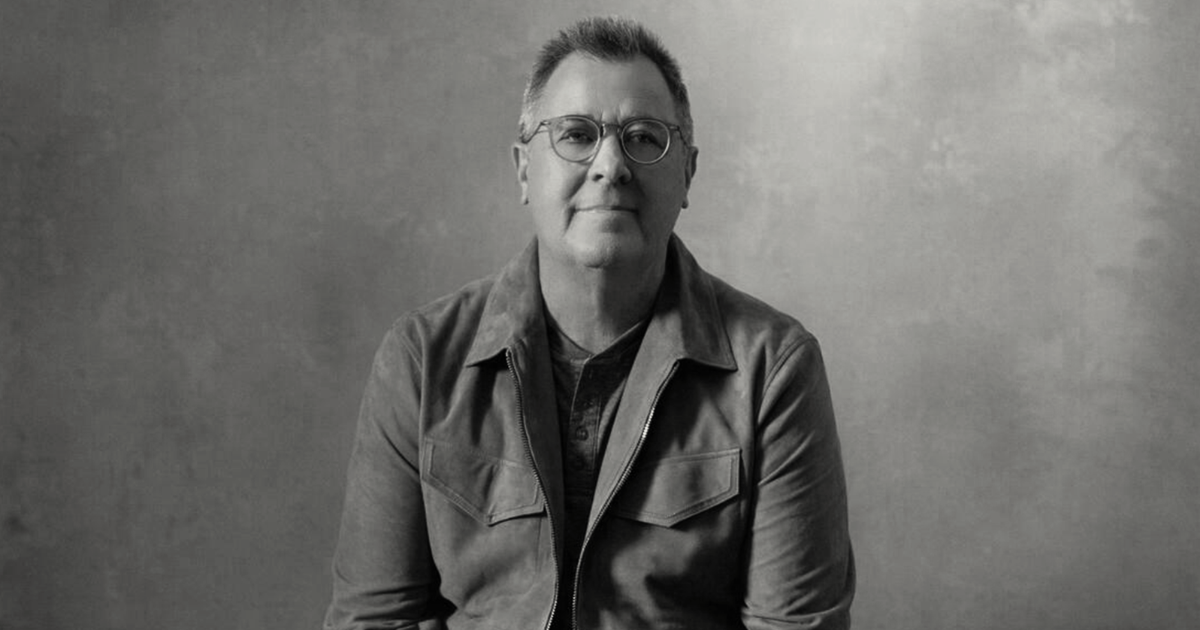
Vince Gill Has Done It All (Part 2)

Poaching from Elvis, well over 50,000,000 Vince Gill fans can’t be wrong.

The longevity Gill discussed in Part 1 of this interview has taken him from bluegrass beginnings to a genre-inclusive 50 years as one of country’s most beloved and sought-after artists.

It’s not always been easy, however. No one, regardless of talent or fan loyalty, is immune from freedom of the keyboard and Gill is no stranger to the highs and lows of public opinion. Mostly it’s outpourings of gratitude from the millions whose lives his music touches. Sometimes it’s claptrap about his now decade-long tenure in the Eagles, or venomous spewing over songs like “March On, March On,” from Secondhand Smoke, the second in his series of retrospective EPs being released monthly.

In Part 2 of his conversation with Good Country, Gill discusses, among other things, the aforementioned decade-long tenure with the Eagles, bullying – with a few choice words for those who inflict it – his scrolling habits, and he indulges us in a rapid-fire round of closing questions.

In the arc of this 50-year project, it is not unnoticed that Hotel California turns 50 this year. Do you have memories of listening to that album as a young man, as you now find yourself onstage playing those songs?

Vince Gill: I had all the Eagles records. We did a lot of their songs in my bluegrass days, and it’s completely surreal. I’m starting my tenth year of being in that band and continuing that legacy of songs. What I value most about getting to play with these guys, what I’ve learned most, is how important songs are – all the notes, all the licks, all the riffs, all that stuff. Getting to relearn that at this stage of life has been pretty profound in the way that I’m trying to write songs. I’m patient in the way I write. I’m patient to wait for it to come – the right words, to not settle on anything, and really edit and work and edit and work and continue to try to be mindful of how important the song is.

What I’m mindful of with the Eagles is the tragedy. More important than the fact that I get to do it is that if Glenn had not passed away, I would not have gotten to do this and I’m grateful I’m the one they called. I met all those guys in, I think, 1980, when I was living [in California]. In a million years, would I have ever thought this would have happened? No. But I am careful of how I couch everything, because it came from something tragic and I am respectful of that.

Glenn was a really good friend of mine, actually, and his son Deacon is doing a great job up there of carrying on his dad’s tradition. I think I’m a great fit for them in the way I play guitar and sing, and sing harmony, and play all the instruments I do. I’m not saying I’m better than anybody else they could have gotten. I’m just saying what I do suits them really well.

Jedd Hughes described you as “one of the greatest band leaders I’ve ever worked with. He’s listening to everything and everyone, always, so you can read his cues pretty easily.” First part of the question: Where did you learn to lead?

Because I’m a musician, I think I come at it different and I operate under the mindset that every note is equal. You’re not more important because you’re the lead singer. You’re not more important because you play the lead solo in the song. I value every note the same. Spending my life in the studio like I have, knowing what you play and do has to sit well and play well with others, you have to listen to everybody else.

It’s amazing what you can accomplish if you don’t care who gets the credit. Sometimes people play only to be noticed and that doesn’t necessarily constitute the right thing for the song. They say in Nashville all the time, “Just serve the song.” That’s all I’ve ever tried to do. If someone’s playing something and doing something, don’t do something to distract it. Do something to enhance it, to support it.

Second part: How does that translate to arrangements and contributions from the musicians you work with?

Great players all listen to each other and you’re dealing with a caliber of musicians that already know what not to do, so you don’t have to waste time going, “Hey, don’t play that, that’s too much, that’s not necessary.” Every time I’m in there playing, I take every note, examine it, and make it move me, make it sit just right.

Once again, if you’re playing with that caliber of people, which I fortunately am – my band is usually made up of a lot of studio musicians and amazing players – they like playing with me because I’m a player, too. I’m not just someone up there singing the songs. So I think I have their respect, and that points you once again towards, “What’s the best thing for the song? What’s the best arrangement idea? What’s the best part to play? What’s the best part not to play?” That’s it in a nutshell.

I’m surrounded by musicians that can all play me under the table, straight up. That’s the truth. I’m grateful to have them, grateful to get to play with them, and it makes for a very democratic spirit. Even in the way we record, I’m not heavy-handed. I’m not telling people what to play. Oftentimes we’ll be in there and they’ll say, “Do you like this?” I go, “I don’t have any idea. I’ve never even heard this song before. I know I wrote it, but we’re in here trying to figure it out, so we’re just going to figure it out all together.”

It creates a great spirit in there if everybody feels like they’re all walking on equal ground, everybody has a right to an opinion, everybody has a right to try something, nobody gets shut down, nobody gets put off. It’s an amazing experience. I don’t ever do demos with my songs. I just write them and then I show them to the guys on the floor. I go, “This is how it goes. Let’s figure it out.” They naturally gravitate towards something great and you just follow them off the cliff! It’s wonderful to watch other people’s gifts.

Earlier you described yourself as “the happiest son of a bitch in the world” who just loves sad songs. In that happiness, however, you have experienced much grief. Your faith is strong. Have you ever lost or questioned it during times of loss?

When I think about faith, I don’t think of it so much [from] the religious point of view. I think faith in humanity – more than Baptist or Methodist, or heaven or hell, or any of that stuff. None of these questions have ever been answered, so to pretend you know the answers seems a little, I don’t know, pretentious almost. That might not be a good word. But, no. It all comes from loving deep. The people I love, I love them deeply. They matter to me.

Music is where I go to grieve. It’s where I go to get through loss. It’s where all those things are. I tell everybody it’s cheaper than therapy. I just write about it.

I never feel the need to fix everything in my life. My relationship with my dad, if it was funky or whatever, I said, “It’s not my place to change him. It’s my job to accept him.” Once I could do that, we had a great relationship. You don’t have to be like me for me to like you. You don’t have to think like I do for me to like you.

I’ve been told more often than not, “Why I like your songs is you are able to say what I wish I could say. You are able to express feelings I have that I don’t know how to.” Maya Angelou sought me out and asked me to come and meet her when she was in Nashville years ago. She told me, “‘Go Rest High’ was a lifesaver to me. It helped me get through the loss of my brother.” Those kinds of things make you go, “I’m going to try to find a way to be emotional about things and not only help myself, but help other people too.” I think if you can portray in a story what someone’s going through, you have a chance to make people feel better.

You can’t name-drop Maya Angelou and just go on to the next question! We need to back up a little bit.

She was speaking at Vanderbilt and wanted to meet. [My wife] Amy [Grant] and I went and afterward we got to go back and say hi. She said, “You mean a lot to me, because your song helped me get through one of the hardest times of my life.” It was a great visit.

You’ve released the fourth EP in your series. Which chapter is this and do you know what’s to follow?

It’s uptempo-y and groove-y, kind of like “Liza Jane” and “One More Last Chance” and some of those fun songs. Each record is, on purpose, similar-driven. The record after this fourth one will be a lot of real country-country stuff, real traditional stuff. The one after that is going to be more like “I Still Believe In You” and “Don’t Let Our Love Start Slippin’ Away,” from a more rocking side. I don’t want to say the word “pop,” but it is. It feels like an Eagles record or a Fleetwood Mac record at times. The inspirations are all in there.

The one after that is real bluesy R&B-ish. Are you hip to Lamont Landers? He’s a soul singer from Alabama. You look at him and go, “There’s no way this voice is coming out of that dude.” He does all these really cool things. I found him and I got him to come and sing on one of my songs that’s coming out later in the year. He’s just such a cool dude. I’ve been trying to turn people on to him.

How did you find him?

Scrolling.

You’re a scroller!

Oh, heavily guilty. I tell Amy it’s my TV now instead of channel surfing. Once in a while you’ll come upon a great young musician, or a great young singer, or a great comedian. There’s so many options, and if you stop on something, it’ll start giving you hundreds of things just like that.

The algorithm gets you.

Yeah, exactly. But it’s entertaining, and I found a couple of people to track down and
have them sing on my record because I like what they do.

What do you scroll?

YouTube, Facebook, Instagram. Most of the stuff is pointless, but there’s a nugget once in a while.

How do you handle the cruelty of social media? It can get to anyone, especially when it’s directed toward you.

It can, if you let it. That’s the life we live in now. You can’t go perform and not have everybody have a camera out and put it up and showing it and seeing it. You have a bad night and everybody’s going to rip you for it. It’s like, “How much negativity can you continue putting out there, saying negative things?” It’s never going to stop, you know that, but it’s still entertaining to read.

I read it to be informed and I don’t mind taking it. I’ve lived with critics being critical of everything I’ve ever done. It comes with the territory. If you’re brave enough to stand up there and speak through a microphone, you know you’re going to get judged to some degree. Once in a while, somebody will say something and I say, “That’s fair. That’s truthful.” Other people will say things and I go, “You don’t even know what the hell you’re talking about, but you have an opinion that’s inflammatory towards me, and you couldn’t be more wrong.” I know that, so it doesn’t have an impact.

Sadly, people have to get on there, the keyboard warriors. They think they finally have a voice. Being able to post and have an opinion, they think that gives them a voice. But in the grand scheme of things, it doesn’t. I know that, so I just take it with a grain of salt and move on.

Perhaps being 68 years old with experience and success makes that easier than for a young person just starting out.

People are still critical of me being in the Eagles. They say, “Now it’s a cover band and you shouldn’t be there,” blah, blah, blah. You know it’s coming, so press on. Say whatever you want. Say it to my face and see what happens to you!

I can’t control any of it. I can control me. I can control my heart, what my heart thinks, what my heart feels. If you hate what I do, that’s okay. A lot of people don’t like what I do. I’m used to that. You’re not going to stop me.

Earlier we talked about hope. I just hope people respond. I don’t mind if they respond negatively. You don’t want that, you’d rather not, but it’s funny how you can get a hundred good reviews on a record and one bad and you only remember the bad one. That’s human nature. It’s not a weakness. It just goes to show how being cruel and negative towards someone has an impact.

I think about the times I was in school and was talked to in a negative way, and how it lasted. I remembered it forever. There was a girl I was in a band with for a little bit. She sang in this choir at the school that was really well thought of, and the choir director told her, “You are wasting your time with that guy and his banjo and bluegrass. He’s a fool.” And I just want to go, “Na-na-na-na-na!” But you remember it. And an English teacher that kicked me out of the class for saying something she didn’t like and painted me a certain way. You remember it.

My own kids, one teacher said to my youngest daughter, “My dog has more manners than you.” Things like that … my hundred-year-old mother is still pissed off about that! She’s still, “I’d like to get my hands on that teacher!” We’ve got a good bit of redneck in us!

I watch my sweet wife take slings and arrows all the time and the way she handles it is so beautiful to watch and so inspiring. It’s helped me do the same thing.

Can you play everything you hear in your head?

Probably. I hope so! It’s funny you brought that up, because being a musician and a singer, people say, “How do you get inspired to sing?” or “How do you get inspired to play?” Well, before I play something, in my head, I’m saying, “How would you sing this?” And when I’m getting ready to sing something, I ask myself, “How would you play this? What kind of rhythm? What kind of phrasing?” All those things.

I think the real difference [between] a good singer and a great singer is the way they phrase. Ray Charles could phrase like nobody’s business. Jerry Lee Lewis, when he sang country songs, could phrase like nobody else. George Jones could phrase like nobody else. You go on and on and look at all the greatest singers, and they’re unique because more so the way they phrased than how many notes they sang.

What is the difference between playing guitar and being a guitarist?

Oh, man. I don’t know if there is. I think it’s the same thing. It all comes from the same heart. It all comes from the same ears. I just play what I think fits. I think that’s what being a great guitarist is – playing what fits.

I saw something the other day that said, “I refuse to name who I think the greatest guitar player is,” and it makes sense to me because there’s no such thing. Everybody goes at it in a different way and has a different spirit about it, has a different way they want to play and statement they want to make. Then it becomes a matter of your preference, of what you like best, that defines what the best guitar player is.

I just like people that are gifted, and people that are musical, and they play what’s in their hearts and what they feel. If you feel it like they do, game over. If you don’t, you move on. Not every great guitar player moves me. It might move you. I think we’re lucky that we can be subjective and not have to all feel the same way about the same things.

Let’s close with a lightning round. Anything goes, whatever comes to mind. An album you wish you had played on.

Hotel California.

A song you wish you had written.

’Till I Gain Control Again” by Rodney Crowell.

A session in which you wish you could have been a fly on the wall.

Together Again” by Buck Owens.

A concert you attended that made your head spin.

Paul McCartney.

A guitar solo you wish you could claim as your own.

Oh, gosh. I might have to go with a Chet Atkins solo, because he’s the first person I ever saw play live when I was a little boy.


Editor’s Note: Check out part one of our Good Country conversation with Vince Gill here.

Want more Good Country? Sign up to receive our monthly email newsletter – and much more music! – direct to your inbox.

Photo Credit: David McClister

Saddle Up and Get to Know the Artists Behind ‘Cowboy Carter’

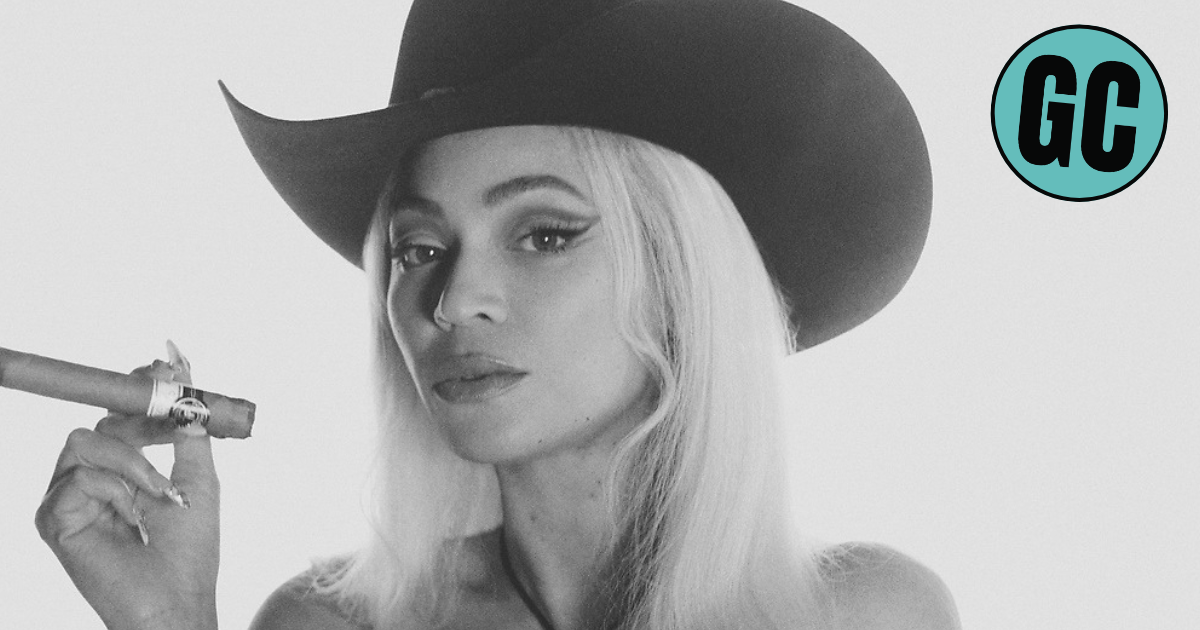
On March 29, Beyoncé rode sidesaddle onto the world stage and took us all by storm with the release of her eighth studio album, Cowboy Carter.

Cowboy Carter arrived as the second installment of a three-act project that commenced with Renaissance in 2022. Renaissance incorporated house, disco, hyperpop, R&B, and funk while reclaiming the Black queer roots of dance music. On Cowboy Carter, she similarly reclaims the Black roots of country, blending it with folk, rock, R&B, hip-hop, classical, house, and gospel throughout.

Prior to the release of Cowboy Carter, country has been a longstanding muse for Beyoncé. While her affiliation with the genre was popularized by Lemonade’s “Daddy Lessons,” her first country-leaning performance dates back to nearly a decade earlier when she performed “Irreplaceable” with Sugarland at the American Music Awards in 2007.

Potent and impeccably saturated, Cowboy Carter makes clear that country is inarguably a huge part of Beyoncé’s creative and cultural identity. However, her presence in the genre has not always been well-received; in an Instagram caption 10 days before the album’s release, Beyoncé revealed that CC was largely inspired by an experience where she “did not feel welcomed” into the country fold. Many speculate that this refers to her appearance at the 2016 CMA Awards. The network received racist backlash after she performed “Daddy Lessons” with the Chicks, prompting the erasure of the song’s video from the show’s website (though a representative from CMA later denied the correlation between those two events).

Of Cowboy Carter Beyoncé writes, “The criticisms I faced when I first entered this genre forced me to propel past the limitations that were put on me.”

Beyoncé alchemizes a multitude of influences and collaborators across the gargantuan album in order to achieve the monumental musical feats of CC. With a credits list that sprawls for seemingly miles, Beyoncé enlists a number of guest artists, co-writers, producers, and musicians. Between them, they represent the Black roots of country, pay tribute to Black Americans’ impact on the genre, include legendary country artists and well-known side musicians and collaborators that assert the project’s roots in country, and represent the bright and diverse present and future of country by featuring several lesser-known Black country artists, many of which are also genre-bending in their own work.

In a list that is by no means comprehensive, here are just a few of the contributors that brought their musical magic to Cowboy Carter.

Rhiannon Giddens

“Texas Hold ‘Em” made history as the first hit single by a solo Black woman to top the Billboard’s Hot Country Songs Chart and 10 weeks later, as of this writing, it maintains its gilded perch. Fittingly, the song opens with the warmth and drive of the legendary Rhiannon Giddens strumming a standalone fretless, clawhammer gourd banjo. The talented multi-instrumentalist, singer, composer of many mediums, and roots scholar also sprinkles notes of viola throughout the track.

It is no coincidence that Giddens’ banjo playing, like much of her work, pays homage to the lineage of Black influence throughout roots music. Referred to by many as a “performing historian,” Giddens has spent her career shedding light upon the cross-cultural interweavings of the genre. Here, in an interview, she details the West African origins of the banjo, an instrument essential to American country music that was initially brought to the Americas by enslaved Black folks who used gourds and other accessible materials to recreate instruments of their homelands. By showcasing Giddens on the track, Beyoncé introduces a sonic representative of overlooked histories while uplifting one of the most celebrated Black musicians in modern day roots music.

Robert Randolph

Raised in a secluded religious community, Robert Randolph grew up without secular music. The renowned pedal steel guitarist heard only the music played within the House of God Church of Orange, New Jersey, for decades. He learned the instrument through Sacred Steel, a Black gospel tradition developed in the ’30s that highlighted the steel guitar during religious services.

During his early adulthood, Randolph became exposed to the world of music beyond; as he absorbed jazz, blues, funk, rock, and soul, he soon set out layering his gorgeous pedal steel tones upon a fusion of genres, particularly alongside his band, Robert Randolph and the Family Band. Across his musical arc, he epitomizes Beyoncé’s philosophy that music is transcendent; “All music is related,” he says. “Gospel is the same as blues. The only thing that changes is hardcore gospel people are singing about God and Jesus and in the blues people are singing about ‘my baby left me’ and whiskey.”

Justin Schipper

Like Robert Randolph, Justin Schipper is also credited for steel guitar on the track “16 Carriages.” A Nashville-based composer, multi-instrumentalist, songwriter, and producer, Schipper is a prominent figure in the current country landscape. His talents have landed him on tour with Josh Turner and Shania Twain (playing pedal steel and dobro), and he has gigged with the likes of Carrie Underwood, Chris Stapleton, Kris Kristofferson, Florida Georgia Line, and more.

Cam

Cam (given name Camaron Ochs) co-produced and co-wrote five songs on CC. An American country singer and songwriter, Cam began her career songwriting for musical giants in the industry such as Sam Smith and Miley Cyrus. Since then, she’s released three of her own studio albums with songs inspired by the songwriting styles of Patsy Cline, Ray Charles, Bonnie Raitt, Willie Nelson, and Joni Mitchell, amongst others. A prominent figure in the current country landscape, Cam lends crucial insights and layers with each of her contributions.

Sean & Sara Watkins

Renowned in the current bluegrass/newgrass scene, this sibling duo lends guitar (Sean) and fiddle (Sara) to the track “II Most Wanted.” Sean and Sara epitomize the familial quality so integral to bluegrass; their first band, Nickel Creek, was formed in 1989 alongside virtuoso Chris Thile when Sara and Chris were only 8 years old and Sean was 12. The siblings have been playing together ever since; Nickel Creek would go on to release seven albums, the latest of which, Celebrants, was released last year.

In 2002, the pair began The Watkins Family Hour as a monthly musical showcase featuring their friends and other collaborators in Los Angeles. Spanning over 20 years, the WFH has blossomed expansively. In fact, the pair released their third studio album, Vol. II, in 2022, a celebration of the project and the community surrounding it. Similarly to CC, the list of features for Vol. II is extensive, featuring the likes of Madison Cunningham, Willie Watson, Jackson Browne, and Fiona Apple, amongst others.

Stevie Wonder

A child prodigy who became blind shortly after birth, Stevie Wonder is widely regarded as one of the most influential musicians of the 20th century. He makes his contribution to CC by layering tasteful harmonica atop the sonically rich layers of “Jolene,” a reimaginative cover in the shape of Dolly Parton’s 1973 classic. Much like Beyoncé herself, Wonder is a trailblazer who, as Beyoncé stated in her Innovator Award speech at the iHeartRadio Awards, “defied any label placed upon [him].” From jazz to soul to funk to R&B to gospel to pop and beyond, Stevie Wonder has influenced and inspired creators across infinite genres and blendings with his vibrant propensity for experimentation. In the same speech, Beyoncé poured out a fountain of gratitude towards the legend, who presented her award —“Thank you so much Stevie, I love you,” she said. “I love you and I honor you. I want to thank you for making a way for all of us. […] Whenever anyone asks me if there’s anyone I can listen to for the rest of my life, it’s always you. So thank you, God bless you.”

Brittney Spencer, Tanner Adell, Tiera Kennedy, and Reyna Roberts

These four women are responsible for the ethereal background and third verse vocals for “Blackbiird.” Additionally, Spencer, Roberts, and Kennedy also lend background vocals to “Tyrant,” while Adell’s voice is woven into the sweeping harmonies of “Ameriican Requiem.”

Initially released in 1968 on The Beatles’ self-titled album, (colloquially known as “The White Album”), Paul McCartney wrote “Blackbird” in response to witnessing on television the harassment and violence that Black students endured upon attending newly-integrated schools. In 2018, he told GQ that he was particularly influenced by the young women who constituted, in part, the Little Rock Nine in Alabama — a nickname for the first nine Black students to desegregate the formerly all-white Central High School in Little Rock, Arkansas.

As McCartney explained to TODAY, “In England, a ‘bird’ is a girl, so I was thinking of a Black girl going through this; now is your time to arise; set yourself free; take these broken wings.”

Within her illustrious arrangement of the classic, Beyoncé pairs the initial guitar track recorded by McCartney with the vocals of herself and these four Black women whose careers are actively altering the historically whitewashed landscape of country. By including them, Beyoncé nods towards McCartney’s intended meaning of the song while actively uplifting these young women so that they may prosper in a genre that undervalues and mistreats the Black artists who continue to give it wings. Brittney Spencer, Tanner Adell, Tiera Kennedy, and Reyna Roberts each have burgeoning careers in the genre that are largely influenced by traditional country sounds and themes.

Willie Nelson & Dolly Parton

In addition to inviting in many Black artists and roots musicians, Beyoncé strategically inserts more commercially successful country greats whose values align with her own. As Willie Nelson tells his faux-radio station listeners in the track “Smoke Hour II,” “Sometimes you don’t know what you like until someone you trust turns you onto some real good shit. And that, ladies and gentlemen, is why I’m here.” This line candidly demonstrates an awareness of the unfortunate truth that a vast array of today’s country fans are white listeners unlikely to take this music seriously without ample accreditation from respected white artists.

Merely four days after the release of CC, likely due in part to the inclusion of Willie and Dolly, the number of first-time listeners of Beyoncé’s music had increased by 85% on Spotify.

Willie Nelson, who celebrates his 91st birthday this year, is renowned for his left-leaning activism (especially advocating for the legalization of marijuana — hence the nomenclature of his feature tracks “Smoke Hour” and “Smoke Hour II”) and his role in pioneering the Outlaw Country movement. Outlaw Country began in the ’60s as a subgenre to rebel against the conservative suppressions, sonic and otherwise, of the country industry at the time. Willie and his like-minded contemporaries strove to achieve creative freedom beyond the political and sonic standards that dominated Nashville.

Similarly, Dolly Parton has used her platform, influence, and capital to enact social change. In addition to being an advocate for LGBTQ+ rights, she donated $1 million to Vanderbilt University in 2020 to go towards vaccine research amidst the early stages of the COVID-19 pandemic.

As of 2024, Willie Nelson and Dolly Parton are widely regarded as two of the most successful American country artists of all time. Nelson holds 12 Grammys from 57 nominations, and continues to tour (in fact, he is actively on the road again right now). Dolly has accrued a total of 11 Grammys from 50 nominations over the course of her career and recently gave a dazzling performance at the 2023 NFL Thanksgiving Halftime Show. The amount of esteem and respect each has garnered throughout their careers grants Cowboy Carter a certain amount of credibility within the wider country circuit.

However, it is clear that Beyoncé doesn’t just merely use these two for their name recognition. She is, indubitably, a seasoned scholar in the history of American country music and respects the discography of both artists immensely. While both give narrative voice-overs, Dolly also lends background vocals to “Tyrant” and, of course, shares songwriting credits for the innovative cover of her song “Jolene” that appears on the album.

Willie Jones & Shaboozey

Willie Jones joins Beyoncé on CC to lend his resonant, smoky vocals on the duet track, “Just for Fun,” and to “Jolene.” Having gotten his start as a contestant on the X Factor in 2012, Jones is currently making a name for himself as contemporary Black country artist that Grammy.com refers to as a “country-rap iconoclast.” As proves to be a crucial theme throughout Cowboy Carter, Jones galvanizes cross-genre musings to make a sound that is entirely his own.

Similarly, Shaboozey is a rapping Black country artist who represents the future of the genre. Combining hip-hop, rock, country, and Americana, Shaboozey further embodies the blending spirit behind CC. His contributions to the album include rapping verses on both “Spaghettii” and “Sweet Honey Buckiin.”

Linda Martell

Beyoncé ingeniously laced together Cowboy Carter to demonstrate the past, present, and future of Black musicians who have influenced the American roots music; and Linda Martell stands as a crowned example of the past. Martell, now 82, was the first commercially successful Black woman in country. In 1969, she made history as the first Black woman to play the Grand Ole Opry, and she held the status of highest peaking single by a Black woman on Billboard’s Hot Country Singles Chart for her song “Color Him Father” until Beyoncé’s very own “Texas Hold ‘Em” took its place.

However, Martell’s success was short-lived; she left Nashville and country music altogether in 1974 after receiving racist backlash following the release of her first album. Nearly every live show was corroded by racial slurs from belligerent audiences, and her label eventually shelved her music when her single, “Bad Case of the Blues,” failed to do the numbers they were expecting. As Martell postulates on the CC track “Spaghettii,” “Genres are a funny little concept, aren’t they? In theory, they have a simple definition that’s easy to understand. But in practice, well, some may feel confined.”

While Martell’s career arc fell victim to the confines of hegemonic racism within Nashville (and the country at large), her appearance on Cowboy Carter pays tribute to her historical strides for Black artists nevertheless. The track “The Linda Martell Show” (wherein Martell poses as the host of her own radio show) acts as a foil to Willie Nelson’s “Smoke Hour” — Beyoncé here reimagines the career of Martell, granting her the accreditation to host her own show, something history previously never afforded her.

Miley Cyrus & Post Malone

Beyoncé’s respect for innovation rings loud and clear in her inclusion of Miley Cyrus and Post Malone on CC. Each share a vocal duet with Beyoncé on the album — Miley sings “II Most Wanted” and Post Malone contributes to the track “Levii’s Jeans.”

Though both are primarily known as pop artists, each has a career largely informed by their capacity to genrebend. Miley, daughter of country icon Billy Ray Cyrus and God-daugher of Dolly Parton, adds additional credibility to Beyoncé’s country venture. Throughout her career, Miley has traversed country, rock, pop, and R&B.

Similarly, Post Malone has woven together pop, alternative R&B, hip-hop, and indie throughout his career, and many speculate that he will soon release a country album.

It should be noted that both Miley Cyrus and Post Malone have been able to immerse themselves in genres that are historically Black throughout their respective careers. That both have moved between country and R&B without controversy is telling; their capacity to do so seamlessly and successfully demonstrates how white artists are able to express themselves fluidly without systemic repercussions. It is this very ease that Beyoncé wishes to cultivate for artists of every race; in her Instagram post about the release of the album, she writes, “My hope is that years from now, the mention of an artist’s race, as it relates to releasing genres of music, will be irrelevant.”

Raphael Saddiq

Referred to by music critic Robert Chrisgau as the “preeminent R&B artist of the ’90s,” Raphael Saddiq made mark as an American singer, songwriter, record producer, and multi-instrumentalist. He rose to fame in the ’90s with his R&B/soul group, Tony! Toni! Toné!, and went on to have a successful solo career. Additionally, he has produced songs for musical giants such as Erykah Badu, Stevie Wonder, TLC, D’Angelo, Solange Knowles (Beyoncé’s sister), John Legend, and more.

He is credited 18 times over the course of Cowboy Carter for his producing, writing, and instrumental contributions to the tracklist.


Photo Credit: Mason Poole

BGS 5+5: Patrick Davis

Artist: Patrick Davis
Hometown: Formerly Camden, South Carolina; now Nashville, Tennessee
Latest Album: Couch Covers (2020); Carolina When I Die (upcoming)

(Editor’s Note: Hear the premiere of Patrick Davis’s latest single, “Wrong Side of the Tracks,” below.)

What’s your favorite memory from being on stage?

One of my favorite memories on a stage took place 15 years or so ago, back when the great Guy Clark agreed to play a round in a small Nashville venue with me and my friend Jedd Hughes. Guy and I were writing that week and I told him about the show and then asked if he would want to join and somehow he said sure. There was no higher compliment I could have received than Guy agreeing to sit beside me and Jedd and trade songs and stories for an evening. It was like he accepted us – maybe not as equals, but at least as somehow worthy. It was, and still is, a rather incredible memory. Guy has been gone for a while now, but I will forever carry that night with me.

What has been the best advice you’ve received in your career so far?

When I first arrived in Nashville an old writer sat me down and said, “Patrick, if you have a plan B you should take it, because the music business is a harsh place and if you are not 100% fully committed you will not last.” And after 20+ years I have to say he was right. I have seen many folks come through the music world and if they have any outs, the odds of them sticking with it, which is what it takes to succeed, are almost zero.

If you had to write a mission statement for your career, what would it be?

Never give up, never ever give up. (And yes, I know this is a Jimmy Valvano quote… but it should be every musician’s motto as well.)

Since food and music go so well together, what is your dream pairing of a meal and a musician?

I would love to have simple fish & chips with a few Guinness in the corner of a proper pub in the UK or Ireland with Eric Clapton, or maybe Keith Richards or hell, Paul McCartney. Just talk and see where it goes. Those guys are the last of a dying breed and I would love to hear some stories, maybe gain a little wisdom, a song idea, or even just a good buzz.

What was the first moment that you knew you wanted to be a musician?

I heard “Tangerine” by Led Zeppelin and immediately asked my guitar-playing father if he could teach me how to play that intro. It forever changed my life – the second I realized that I too could play an A-minor and make it sound at least somewhat similar to what Jimmy Page was playing, I was hooked!!


Photo Credit: Zach Sinclair

BGS 5+5: JD Clayton

Artist: JD Clayton
Hometown: Fort Smith, Arkansas
Latest Album: Long Way From Home (out January 27, 2023)
Personal Nicknames: JD

Which artist has influenced you the most … and how?

Jack Johnson has influenced me more than any other artist. I know that might seem like it’s out of left field but it’s the truth. My dad was given a CD in the summer of 2001 by a friend who had just gone out to California. The CD was Brushfire Fairytales, Jack’s first album. From my earliest years, I can remember riding my bike around the backyard as my dad tinkered with projects while Jack’s albums played from a Sony CD/cassette player. I can remember my dad with tab booklets learning Jack’s songs on the back porch. It was my earliest idea of being a singer-songwriter. And I always knew I wanted to make albums and tour like Jack Johnson.

What rituals do you have, either in the studio or before a show?

Typically in the studio I like to light some incense and turn all of the lights out except for a few lamps. This helps me get into a very interesting head space and I can clearly see my vision for the song. When I’m on the road I like to get the boys together before we take the stage to pray and I ask one of the players to say something of encouragement. Then we sing the classroom song that Jack Black sings in School of Rock… “Lawrence is good at piano…” at the top of our lungs which ends with us all pointing to each other and saying “you’re perfect, you’re perfect… no you’re perfect.” If you know, you know.

What’s the toughest time you ever had writing a song?

I was writing my song “Cotton Candy Clouds” which appears on my debut album, Long Way From Home. I had about three different versions of the song and I could not figure out how it needed to work within the parameters of the song’s form. I originally wrote it on piano and rewrote it on acoustic to give it more of an upbeat, swinging feel. I showed it to the producer and he couldn’t follow my vision for the song. So, I came home and went for a long walk around the park. I took my phone out and hummed into my voice memo app what I was hearing in my head. As soon as I walked back to my house, I wrote out the form as you hear it on the record. Thankfully I had hired some great musicians to be in the studio who were patient with me as we learned the song together.

Which elements of nature do you spend the most time with and how do those impact your work?

I’d say water has impacted my work the most. My hometown of Fort Smith was founded on the Arkansas River and that region is known as the River Valley. I grew up swimming on the city swim team with my sister so we were constantly at the pool. We would do a two-hour workout in the mornings and then come home to play in our pool at home. I love floating on the Mulberry River in the summertime. It’s the perfect place to unwind for the day. And when I’m not writing or playing shows I try to go fly fishing with my brother and dad. The water is what I know best and I think it has helped shape me into the artist I am today.

Since food and music go so well together, what is your dream pairing of a meal and a musician?

My dream pairing of a meal and a musician would be a peanut butter & jelly sandwich and Paul McCartney. The peanut butter & jelly sandwich is tough because it has to be made correctly. Any variations and you’ve ruined it. It requires two pieces of soft white wheat bread taken from the center of the loaf. The peanut butter has to be Smucker’s Chunky peanut butter. If it isn’t chunky don’t bother coming for lunch. As far as jelly goes, I’m not picky. But I do lean towards strawberry. I haven’t the slightest clue if Paul likes PB&J but I would love to ask him some questions about Sgt. Pepper and Ram.


Photo Credit: Sean O’Halloran

BGS 5+5: Kelley Mickwee

Artist: Kelley Mickwee
Hometown: Austin, Texas, by way of Memphis, Tennessee

Which elements of nature do you spend the most time with and how do those impact your work?

All of the elements. Mother Nature, the universe and the natural world are my religion and informs my spirituality, so I’d say nature inspires everything I do. As far as on the daily, I have to do something outside at some point no matter what the weather or where I am or how busy I get. It could be anything, from digging and planting in the garden, pruning, cutting the grass, and watering the plants to taking long hikes with my dog, Moe. If I am in town, you can usually find me at one of our off-leash dog hiking trails with Moe. It’s very centering and really impacts my mental health and general well being. Especially when the sun is shining. And THAT, in turn, gives me the inspiration, energy and right mindset to sit down with a pen or with my guitar to work on a song. Or do anything, really.

How often do you hide behind a character in a song or use “you” when it’s actually “me”?

Not enough. Ha! I learned pretty early on as a songwriter that for me to write the best lines I can, I have to just speak from experience from the first person and be as open and honest as I can or am comfortable. I definitely have many “character” songs about other people or from their stories, especially songs that are co-writes, because then you are sharing a narrative with another writer so who knows how many people/experiences are wrapped up in that one song? But, in general, I tend to write from a first-person experience or relationship. Especially if it’s a song I write alone or start on my own before sharing with a co-writer.

What other art forms — literature, film, dance, painting, etc. — inform your music?

I think as songwriters, we are constantly getting input from all kinds of sources and storing it away for when we sit down to write a song. This could be anything from a conversation we had, or another song we heard on the radio, or a movie we just watched. I have written several songs from quick lines I wrote down while watching a film or a documentary. And I am always searching for inspiration and guidance from poetry, especially lately. I took an online poetry course in 2020 and it really gave me some new tools to use when writing lyrics.

Since food and music go so well together, what is your dream pairing of a meal and a musician?

This one was easy! A locally sourced vegan meal in London with Paul McCartney. I am actually a pescatarian who doesn’t eat or drink dairy, so not technically a vegan. But…when in London with Paul McCartney!

What’s the toughest time you ever had writing a song?

Every time! It is not easy for me to complete a song. Very very rarely do they just roll off the end of my pen, or float down from the sky, just waiting to be written down. I have many songwriter friends who have story after story of songs just spilling out of them and it makes me envious of that feeling. I do have one maybe two that came out, say, in a day. But even those were painful and agonizing at times. Like finishing a thesis that’s due the next day. Gosh! That sounds awful. I just mean, I want every line to count and be the best line it can be and as honest and original as possible. I think that’s where the good stuff lives. And so, if it takes me a bit longer to get there, so be it. Because the end result, a song I am proud of and can’t wait to sing, is SO sweet and rewarding, in all of the ways.


Photo credit: Taylor Prinsen

The Show on the Road – Menahan Street Band (The Daptone Sound)

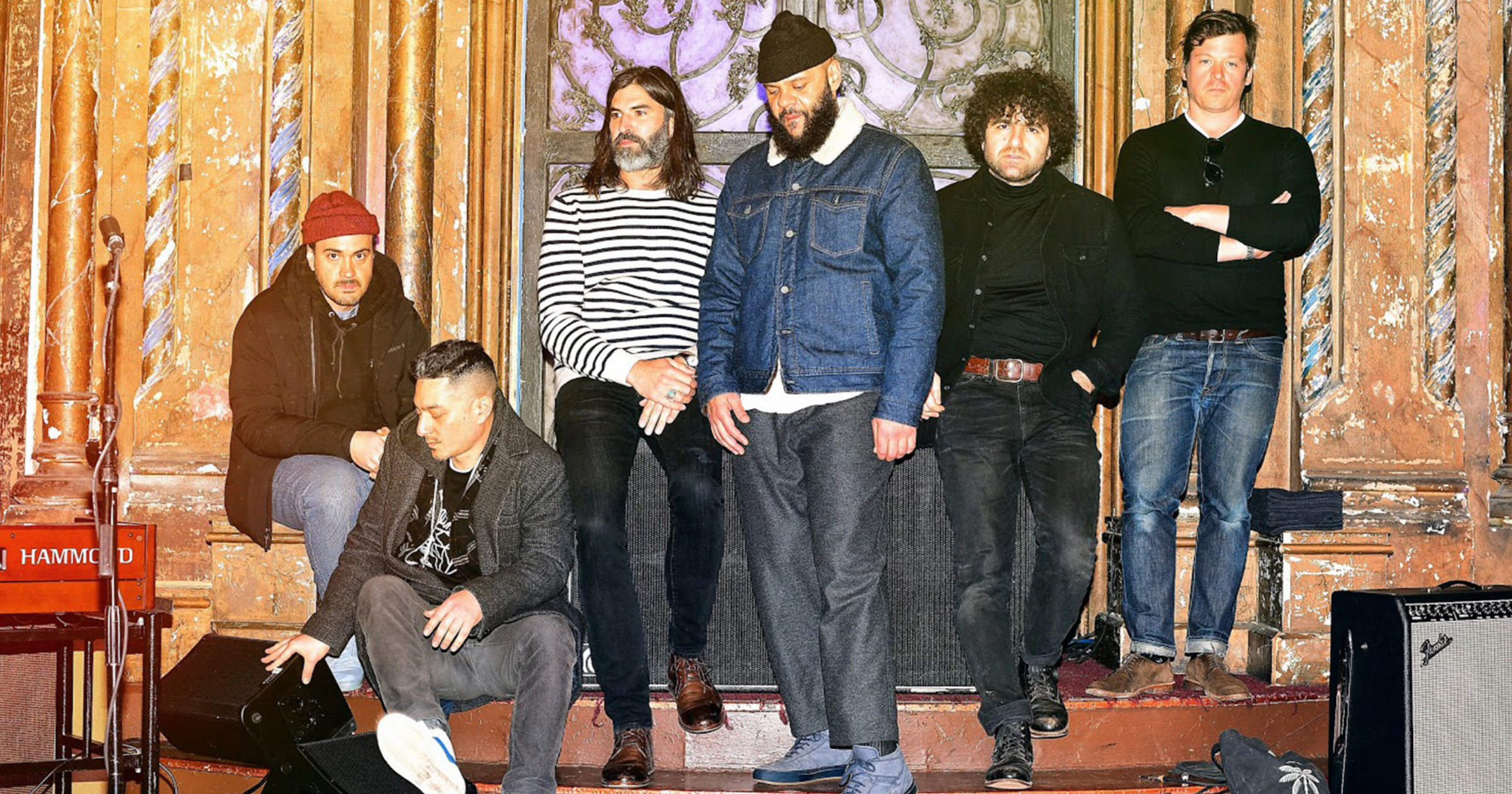
This week, The Show On The Road brings you a rare conversation with Thomas Brenneck and Homer Steinweiss, the braintrust behind brass-forward instrumental supergroup the Menahan Street Band. If Tarantino and Scorsese ever needed a custom-made, 1970’s greasy-soul soundtrack, MSB might be the perfect choice. While the timeless Daptone Records sound has gone worldwide thanks to breakout stars like the late Sharon Jones and Charles Bradley, most don’t know the bandleaders and songwriters behind their intricately arranged works.

LISTEN: APPLE PODCASTSSPOTIFYSTITCHER

Guitarist/producer Thomas Brenneck has been the secret sauce in helping hitmaker Mark Ronson create vintage backdrops for crossover stars like Amy Winehouse, while Homer Steinweiss’ slinky drumming can be heard across the Daptone universe, including on Jones, Winehouse, and Lee Fields and The Expressions records, not to mention his work with Lady Gaga, St. Vincent, and Bruno Mars. For the first time in a decade, MSB — which includes Dave Guy (The Roots), Leon Michaels (The Black Keys) and Nick Movshon (The Expressions) — have reconvened the troops to create their most effortlessly cinematic collection yet: the cheekily titled The Exciting Sounds Of The Menahan Street Band. The album art alone signifies a sensual, intimate evening is ahead to whoever listens. Is the design NSFW? Maybe.

Brenneck called into the episode taping from outside L.A. and Steinweiss from his studio in New York City. The conservation jumped back to how they formed the group in 2007, how they convinced Bradley to join them in making new music (he had been doing James Brown impression work), and how they find that out-of-body, improvisational zen zone which creates their aural moods of mystery and intrigue — showcased best in the reverb-y Bond-like jam “Starchaser.”

A favorite surreal moment that Brenneck mentioned was driving through Brooklyn hearing their song sampled by Jay-Z. For a moment, their horns were blaring from every car radio in the city. While hip-hop legends often find their beats and backdrops from classic soul and R&B vinyl, notables like Eminem, Kendrick Lamar, Travis Scott and 50 Cent have mined the funky MSB catalog for years. Sir Paul McCartney also used their services. If you need an instant vibe, they’ve got you. Even in sparkling trumpet-led themes like “Glovebox Pistol,” which clocks in at a minute and eight seconds long, you can see a velvet-boothed, smoke-filled scene unfolding, bringing to mind the lush scores of The Godfather or The Score.

Only recently have star backing-bands like The Wrecking Crew, The Swampers, and the Muscle Shoals Rhythm Section come to be appreciated for creating some of the most beloved songs in the American pop canon, from The Beach Boys and Aretha Franklin to Paul Simon, Bob Dylan, and The Staples Singers. It can be argued that in the 21st century, Brenneck and Steinweiss (and the work of The Menahan Street Band) deserve to be included in that conversation. With one listen of The Exciting Sounds Of The Menahan Street Band, you are transported — exactly where is up to you.


Photo credit: Shervin Lainez

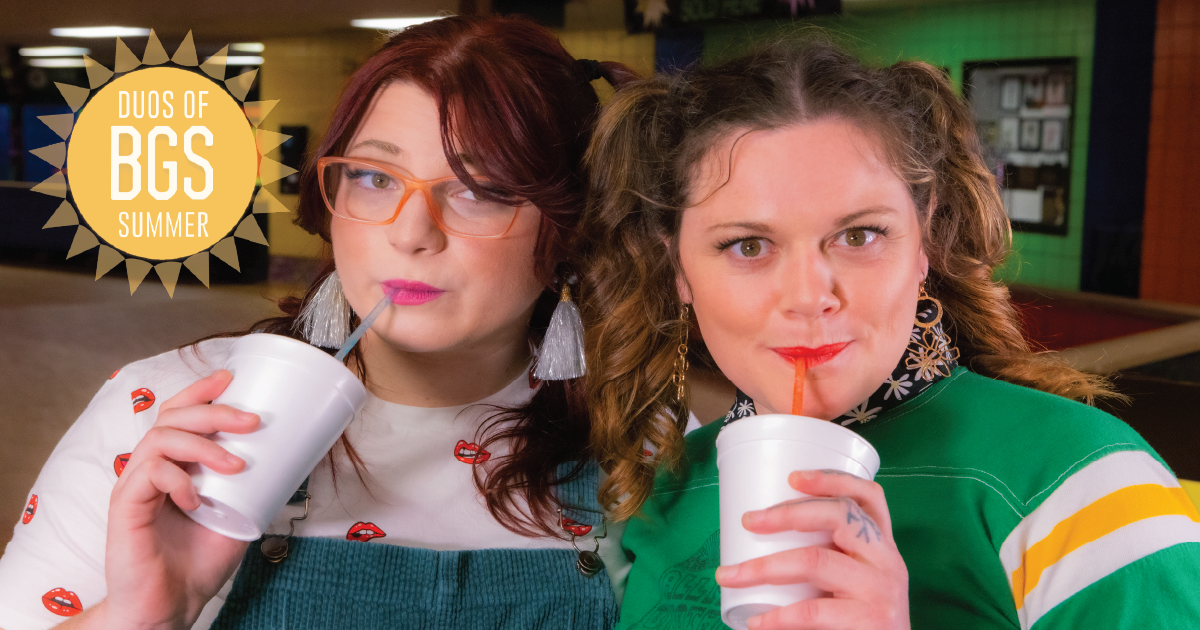
BGS 5+5: River Kittens

Artist: River Kittens (Mattie Schell and Allie Vogler)
Hometown: St. Louis, Missouri
Newest Album: Soaking Wet

What’s your favorite memory of being on stage?

Well, I have been performing since I was a kid… and there have certainly been some amazing highlights I’ll never forget as an adult (playing Allman Family Revival at the Beacon Theater for one!), but I think the most special for me was a community theater production of The Music Man when I was probably 11 years old. I played Winthrop (a boy part of course… the bowl cut helped), my mom played Mrs. Paroo, my dad played Marcellus Washburn, even my sister and Aunt Janet were in the show. I look back in those memories and think, “Wow, our family was like half of that musical! How cool!” It was a cool thing to share as a family and really made me fall in love with musical theater, which really shaped so much about the kind of performer I have become. Long live Broadway! 😂 — Mattie

One time we were playing this four-hour gig and we were just kinda getting through our songs. It was hot and we felt like we were background music. I was definitely in an auto pilot state. But this lady in the audience starts laughing. She’s laughing at one of our funnier songs, “Dressing on the Side.” It was her first time hearing it and she was cracking up to our lyrics, while I was just deadpan playing the song trying to get through it. Her hilarious reaction quickly brought me back to reality and had me laughing real hard during the rest of the song, and show. Just by laughing she was able to pull me out of a funk and my song probably pulled her out of one too. It was a really genuine, hilarious moment and a good reminder to enjoy playing my songs that I’ve played a thousand times for the people who haven’t heard them before.

Also gotta mention the time I put a praying mantis on my microphone (Missouri outdoor gig) and I went to sing in it and he charged at my face and tried to get me. That was hilarious. — Allie

Which elements of nature do you spend the most time with and how do those impact your work?

There is nothing better than playing music outdoors. It just feels right. I think I come from a long line of porch-sitting musicians. I know my great-grandfather used to play and dance on the front porch with my grandma and her nine siblings. I have a huge family and we have a gathering called June Jam every year on some farmland in Illinois. Friends and family come from all over and we camp out and potluck and jam into the wee hours of the morning. It’s my favorite time of year. I bought a kayak a few years ago and paddle the Mississippi River quite often. The Mississippi has influenced a lot of my songwriting. I’ve lost friends to that river, I’ve had some of the most memorable family moments on that river, I’ve had countless jams along that river, but it never ceases to fill me with wonder and awe to be out there in the middle of it. It’s incredibly inspiring. — Mattie

Which artist has influenced you the most … and how?

This is a hard one, but I’ll have to say Paul McCartney. His melodies have been ingrained in my head since childhood. I’m a huge fan of all of his projects and his personality in general. He is such a prolific musician and everything he writes makes me really feel something. RAM is definitely a favorite album. And he just seems so fun loving from all the interviews I’ve seen on the internet. — Allie

Well, although this is a question I get often, it’s always a tough one to answer. It honestly depends on what year it was. Haha But for the sake of brevity, I’ll say The Band. I really dove into their catalog in my early 20s and haven’t seen music the same since. My Uncle Wayne (another huge influence who happened to give me my first mandolin) lent me a copy of Levon’s book This Wheel’s on Fire and it resonated with me and really inspired me. The Band was a group that had some serious talent and killer songwriting that just grabs you, but they never took themselves too seriously. That mentality is always a goal of mine because music should always be fun, especially when it’s good. — Mattie

What’s the toughest time you ever had writing a song?

I’m working on something for my grandmother, and I have been for a while. She always wanted me to sing, and I want to write the perfect song for her. I do know that when the words come, they’ll pour. There’s a lot of imaginary walls in songwriting, for me anyway. I gotta either climb them or let them fall down, and honestly the lyrics are better when the walls fall down. They’re more like floodgates. — Allie

I wrote a tune based off of a local legend in the area I’m from on the Mississippi River. There is an old house in Alton, Illinois, that was part of the Underground Railroad and it has a massive widow’s peak. There’s a story of the wife of a river boat captain who watched him sail off and when he never returned, she waited for him in that widow’s peak until the day she died. It took me ten years to write that song, because I wanted it to be a little haunting and do the story justice. But then I thought, “What the hell was she waiting for?” So I changed the story up a bit. I wanted better for this woman, I didn’t want her to wait around, I wanted her to take action. I gave her a much happier, purposeful ending and that’s when I was able to finish writing. — Mattie

Since food and music go so well together, what is your dream pairing of a meal and a musician?

I’ll go get some street tacos and a beer with just about anybody but if I get to choose, I’m takin’ Randy Newman out for crawfish, oysters, and Sandinistas. Then we’re hitting the piano bars. — Allie


Photo courtesy of Big Hassle

The Show on the Road – Parker Millsap

This week, we feature a conversation with one of the rising stars in our current roots music renaissance: Parker Millsap, a gifted Oklahoma-born singer-songwriter who grew up in a Pentecostal church and creates a fiery gospel backdrop for his tender then window-rattling rock ‘n’ roll voice.


LISTEN: APPLE PODCASTSSPOTIFYSTITCHER
When you’ve been touring hundreds of days a year down southern backroads from Tulsa to Tallahassee since you were a teenager like Parker Millsap has, you know a thing or two about how to keep your head when things go off the rails. But it was the forced year-long break during the pandemic that really made him stop and accept how far he’s come from his intense, anxious, folky debut Palisade in 2012, which was released when he was 19. His soulful, self-assured new record Be Here Instead displays a relentlessly hard-working performer who no longer has to chase the next gig for gas money, or has to worry if the world will accept his work. Holed up outside of Nashville with his wife, Millsap let the songs do the talking.

His brawnier, self-titled record from 2014 showed his rebellious electric side coming to the fore, followed by his beloved, fire-and–brimstone bopping breakout The Very Last Day two years later, which confronted our country’s obsession with destruction. Then there was the toothier, glossier, pop-leaning Other Arrangements, which finally brings us to his soulful newest record, Be Here Now. It’s not hard to see that this young songwriter is coming into his prime years. With a new maturity and wisdom behind his writing, standout, incendiary songs like “Dammit” are allowed to unfold in a distortion-dipped, John Lee Hooker meets U2 slow-burn build; never resolving, never relenting while he confronts the tough truths and hypocrisies that are threaded into our modern lives. What is our purpose? What can we do about the violence and greed all around us? Without pushing or preaching, the song is trying to convince its listener to never give up in making our broken world a little better every day.

What always set Millsap’s songwriting apart, though, isn’t just his ability to get us fired up with stomping roots-n-roll hysterics (though he’s pretty great at that), it’s the tender left-turns he takes when he goes acoustic, bringing the volume down and the emotion up. Reminiscent of a southern Paul McCartney, his scratchy, soulful tenor shines most on his gorgeous ballads — think “Jealous Sun” (from The Very Last Day) as his own “Yesterday” or on the newest record, the psychedelic and heart-string pulling “Vulnerable,” which asks us all to try and see our own weaknesses and past wounds as potential strengths.

While it is bittersweet to not be able to kick off his new record release this April with a typical cross-country tour, on April 23 Parker will be playing Be Here Instead in its entirety with his longtime band live on Mandolin — which you can stream from anywhere.


Photo credit: Tim Duggan

The Show on the Road – Bettye LaVette

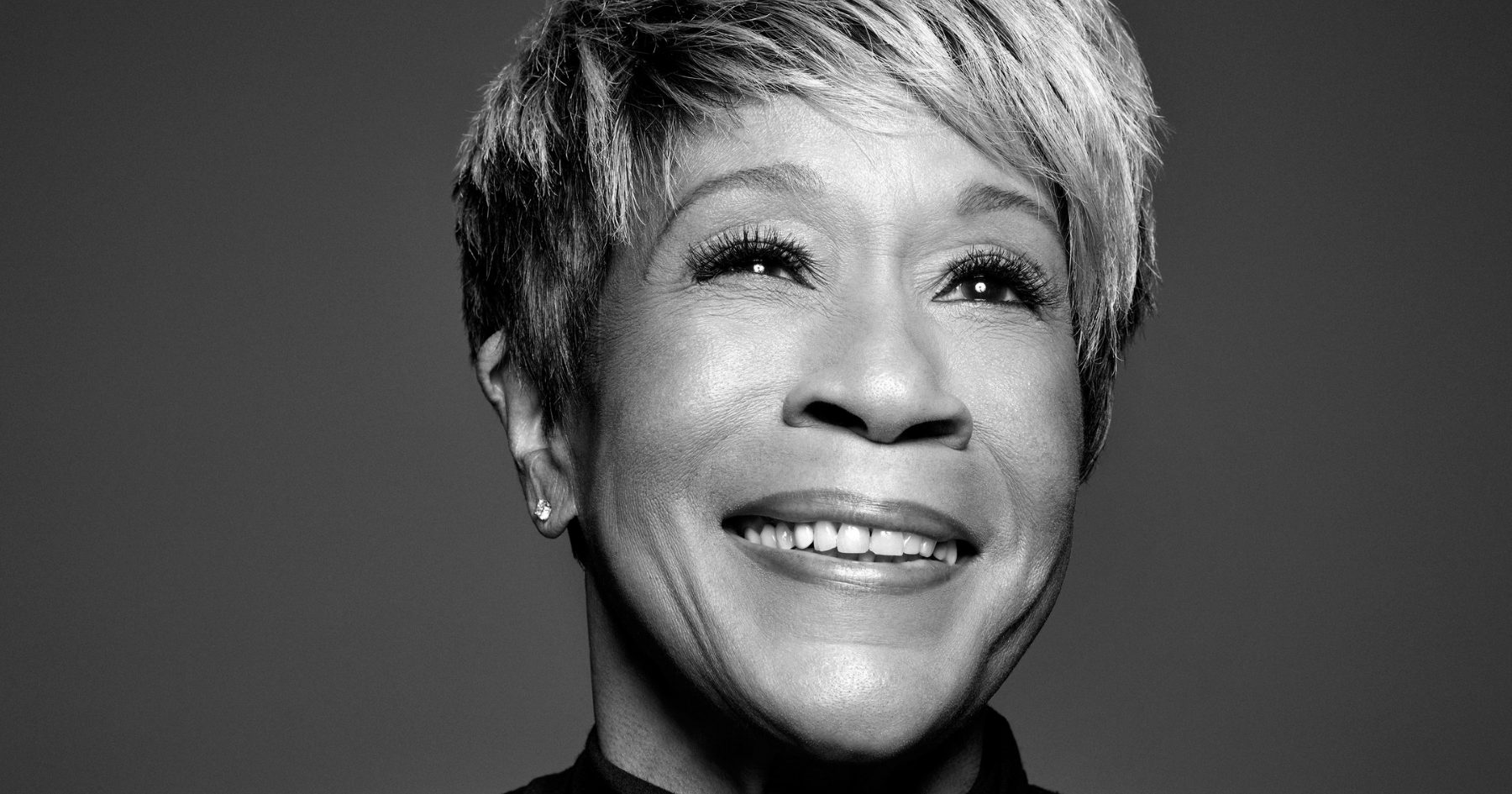
This week on The Show On The Road, we feature an intimate conversation with beloved soul and R&B singer, Bettye LaVette.

LISTEN: APPLE PODCASTSSPOTIFYSTITCHER

Covering her remarkable six decades in show-business, we dive deep into LaVette‘s beginnings as a Detroit hit-making teenager during Motown’s heyday (her neighbor was Smokey Robinson), to her early career touring with Otis Redding and James Brown, and the hard times that followed, as a music industry steeped in racist and sexist traditions largely turned its back on her.

While other soulful song stylists like Sharon Jones, Tina Turner, Mavis Staples and others saw their status and popularity rise with time, LaVette remains an underrated, best kept secret on the Americana circuit, with younger listeners just discovering her remarkable work covering anyone and everyone from The Beatles to Neil Young to Billie Holiday.

After nearly dropping out of music, her remarkable comeback began in 2005 with a string of acclaimed records — bringing her from half-filled bars to singing “Blackbird” at The Hollywood Bowl with a 32-piece orchestra, being nominated for five Grammy awards, and being inducted into the Blues Hall of Fame.

One thing you’ll notice immediately is her fiery laugh, which punctuates the episode — even when telling the darkest stories, like her early manager getting shot and her 1960s hits being recorded by white artists, leaving her versions largely forgotten. Her Grammy-nominated newest LP Blackbirds, produced by legendary drummer Steve Jordan, shows her at her most vulnerable best.


Photo credit: Mark Seliger