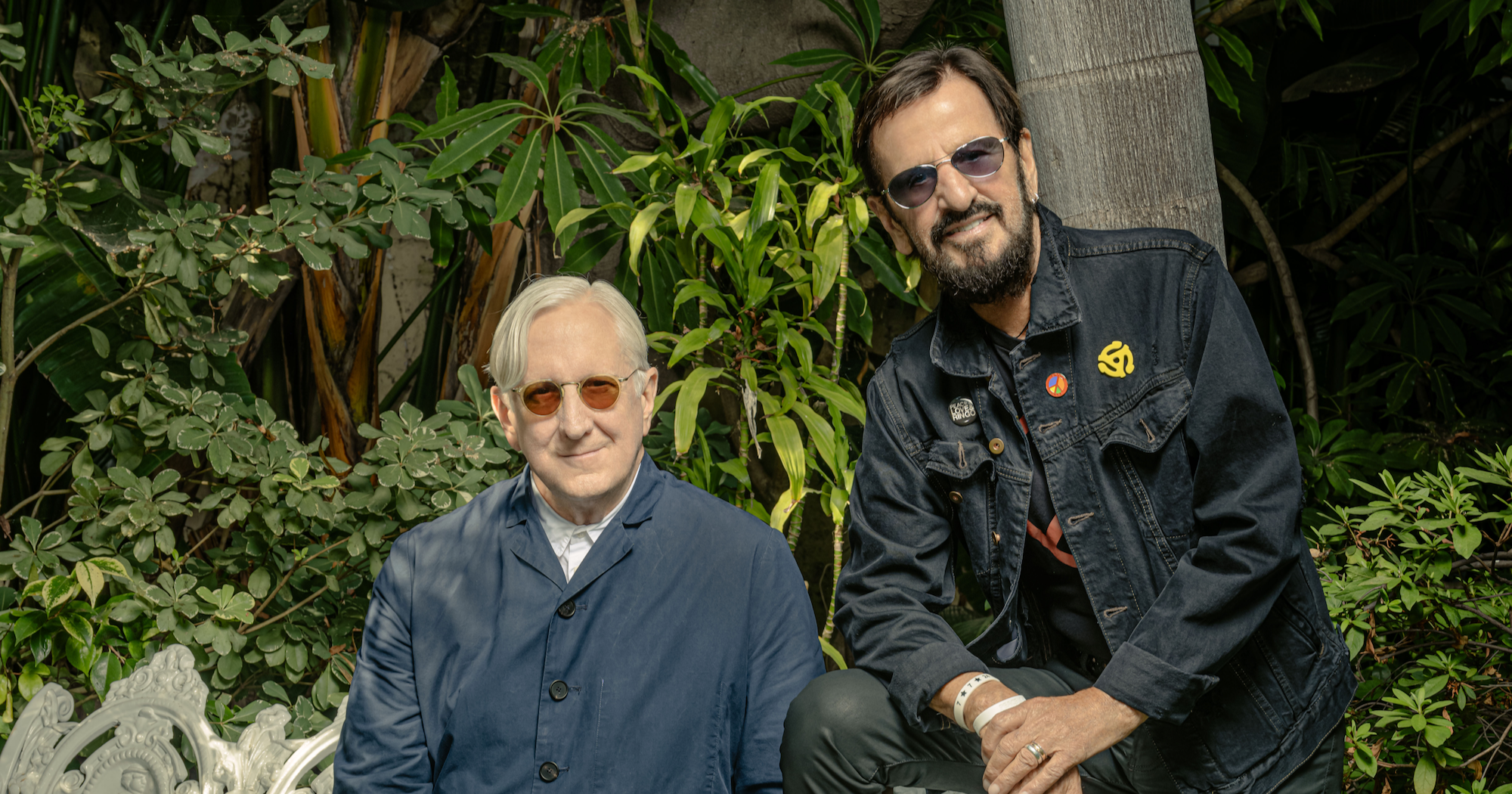
On a sunny day in late April, I stood outside an ad hoc interview room at the Sunset Marquis in West Hollywood waiting for my turn to speak to Ringo Starr.
Sporadic laughter boomed through the door as the hazy afternoon light danced on the doorknob hanger. Instead of the usual “Do Not Disturb,” this one simply said, “Peace.” The verbiage, apropos for Ringo, served as one part levity and one part beta-blocker as I prepared to speak to a Beatle.
When the door opened, I was surprised and delighted to come face to face with Phil Rosenthal (of Somebody Feed Phil). The unabashed smile on his face foreshadowed the similar joy I would feel taking the same steps through that door just 25 short minutes later.
And yet another revelation unfolded as I walked in the room to find both Mr. Starr and T Bone Burnett, producer of Ringo’s newest album, Long Long Road. The ensuing discussion covered their relationships with genre, synesthesia, and inevitably bobbed and weaved across the rich musical history of these two icons.
Do I get both of you today?
Ringo Starr: Yes!
Excellent!
T Bone Burnett: Only if you want.
RS: Hi. I’m Ringo.
Ha! Yes. The man of the hour. How are you?
RS: Good. Excellent.
Thank you so much for having me.
RS: Oh, it’s our pleasure.
TB: Her dad is a great songwriter, a great guitar player from Muscle Shoals.
RS: We were just talking to someone else about that today.
Really? You were talking about Muscle Shoals today?
RS: Well, we didn’t actually mention it, but we were talking about the music that, for me, started with Johnny Ray and people like that. I was a teenager, and then it went up to country music, and then I got into blues music, and then I got into pop of the day music.
I love country music. And he’s the country boy [as he points to T Bone Burnett].
That’s a fantastic segue to my first question. So as we mentioned, I grew up in Muscle Shoals, and I had this record player that was a little battery-operated blue Volkswagen bus. Do you remember these?
TB: Yeah, I do!
It would ride around the record, and it had a little speaker in it, and I would lay on the ground, and I’d listen to Abbey Road. But it was also around the same time that the video for “Act Naturally,” the duet with Buck Owens, came out. So, for me, you were very genre-fluid from a very early age. I’m curious about a couple of things genre-wise, and T Bone, please jump in on this too.
TB: Okay, I’ll jump in, and I’ll say that the Beatles probably invented what became known as “country rock.” You know, with “I Don’t Want to Spoil the Party.”
RS: And what were the two that were Carl Perkins?
TB: “Honey Don’t” and “Matchbox.”
RS: “Honey Don’t” was the best line I ever heard.
TB: Yeah, it is a killer title.
RS: “Matchbox” was a blues song, really.
TB: Well, “Matchbox” was an old Blind Lemon Jefferson song.
RS: Yes. The interesting thing is I did those in the ’60s, and we just found a Carl Perkins tune that we’d never heard, and we’ve done it on this record. “I Don’t See Me in Your Eyes Anymore.”
I love it.
RS: It is so beautiful and he was just a cool guy. You know, I was a teenager when I first heard him, and it was like, “Oh yeah!”
T Bone: Yeah, he was cool. He, [Carl], had heard “Matchbox” or his dad had heard it by Blind Lemon Jefferson, but they could only remember a few words of it, so he rewrote it as a rockabilly song.
So you knew of country music when you were growing up, you were aware of it.
RS: I did. I was aware of country music. I loved it because it was emotional, and I was a teenager. That’s what we are at that age.
[Ringo singing:] “ Well the wife is dead and I’m leaving home. I got no money for the jukebox.”
Perfect for teenagers.
When I say the words “country music” to you now, what do you think of? Who or what or how do you think of it?
RS: I still think a lot about the people from yesterday, who I came in with. You’ve got to say Willie. I mean, he’s magical and still out there. Thank you, Willie. And who used to open for Willie?
TB: Waylon?
RS: Waylon! He was great. I have to think back.
TB: Well Hank Williams…
RS: Well, no, Hank was where we came in. And Hank Snow. No one mentions him. He was Canadian. Patsy Cline. There’s too many really.
I was talking to someone the other week and they asked, “What is your all-time favorite record?” I couldn’t answer. There is too much that I love. “Who’s your favorite artist?” I start with Ray Charles. And Stevie, and down that line. But I can’t answer it. We were on TV, and I stopped it. I said, “I just can’t answer.” There are too many in my life to say, “That’s the one.”
Plead the 5th.
Do you ever feel constrained by genre? Or inspired by it? What is your relationship with the idea of it?
RS: I’m a pop-rock music drummer. I’ll play whatever you’re gonna give me. If you want it heavy, I’ll hit the cymbals. Heavy metal has some great acts going down. We would jam sometimes and be that.
TB: Oh, well, I mean, the Beatles invented heavy metal, really.
RS: Yeah. It’s just playing the same shit, but heavier.
TB: “Everybody’s Got Something to Hide Except Me and My Monkey” or “Helter Skelter.”
RS: “Helter Skelter” was a jam. We had no song, nothing, we were just jamming, and then Paul came in with, “Hey! Helter Skelter.” Like “Say It’s Your Birthday,” there was someone in the newspaper who we knew, and it was their birthday, and we were jamming. Paul stepped up again, and we got another song. We were like that. You could jump in, any one of us could jump in. I’ve got odd lines we aren’t gonna talk about on certain tracks.
[A publicist chimes in to say:] “T Bone you have five more minutes before you have to leave and then you’ll go and he’ll stay in.”
RS: And then I’ll go and then you’ll stay in. [Laughter]
Well, let’s go back to the Volkswagen.
RS: Let’s get back to it.
Because I have a little bit of synesthesia, I think.
TB: I have that, too.
RS: What have you got?
TB: I see colors when I hear music.
RS: Oh, great!
So, “Octopus’s Garden” was very purple for me. “Act Naturally” is very orangey gold. I’m curious if you’ve ever experienced anything like that. And if it’s not colors, if there are certain textures that you’re looking for in a song, when you’re casting songs for an album? And T Bone, this question’s for you too, since you have it.
RS: T Bone will give me a lot of songs, and I listen to them and I picked my six at the beginning. There were only three I didn’t use. That’s how we started this. In the end, we were talking in my little studio and I said to him, “How many songs have you got?” And he had nine. It gave me the courage to ask him if he would produce the record. All the songs were not on my mind; we were just hanging out like two guys. But it turned into a fellowship.
TB: Well, I can tell you that the Beatles stuff that first came out was very dark blue, all of it. “Don’t Bother Me” especially was the most dark blue of them. It was interesting that the album cover that first came out over here [in the U.S.] was dark blue. So it all sort of coalesced, I think.
That was one of those blessed moments that happen occasionally on earth, you know? Where everybody heard the same thing at the same time.
Absolutely.
RS: I never saw colors. I mean, I did see colors some days… You know what I mean?
[All laugh]
RS: When I listened, it’s how I felt. A sad song, a happy song, a rock song– some of it will move you, and some of it moved me.
TB: Well, I’d better go. But thank you, great to see you again.
Yeah, you too. Nice to see you again.
[As T Bone got up to leave, his wife entered the room and chatter ensued, but he added before walking out the door:]
TB: By the way, “I Want to Hold Your Hand” was very dark blue.
Well, you know, what’s funny is, I had a synesthesia question for Ringo about you, because I didn’t know you were going to be here. But I was going to say that your musical color and texture is exactly like what you are wearing, to me.
TB: Oh, is that right? That’s wild. Thank you! Nice to see you all.
RS: God Bless, peace and love!
Tell me about what it is like for you working in Nashville? Tell me what it feels like working with those players.
RS: I did have experience in the early ’70s when Pete Drake invited me to come, because we were working on a George Harrison record. You know, we keep talking about the steps we take, the moves we make. And I was there with George, and I’m playing for him and he’d called Pete – I didn’t know Pete. Pete had landed at Heathrow, and the car George was sending broke down, so we sent my car. And then he arrived. “Hey, hoss, I see you like country music.”
“Yeah, yeah, I do. How do you know?”
He said, “All those cassettes in your car.”
And then a few days later, he’s saying, “You should come to Nashville.” And I thought, “I’m not going to Nashville. I’m doing stuff here. I don’t have a month or six weeks to go to Nashville.” He said, “A month? Six weeks? Nashville Skyline took two days.” And I said, “I’m coming.” And I went, and we did the same thing.
On the first day, five songs were picked in the morning. Between us, we listened to them all. Five songs were recorded, and five songs were finished. And the next day, we picked five songs. Anyway, it went on the same way, and it was finished. And it took two days, so that was great.
Well, Ringo, you have one of the finest reputations in the music business.
RS: As a drummer or else?
EM: As a drummer, as a human.
RS: Or as a tall person?
The tallest around.
Just for being so kind to people and emanating peace and love, obviously. And you’ve been such a beacon of that for so many decades. Especially in the last couple of weeks I’ve been thinking a lot about that, after finding out that I was going to talk to you. I was curious, I’m sure it’s mostly innate, but do you ever feel like it’s a responsibility – in terms of how you are in the public, in terms of what songs you’re picking? I’m particularly thinking of “Choose Love.”
RS: I just do my best, you know, to pick the songs that give you some movement, and you say, “Oh, I’d like to sing that.” That’s what I’m with these two country songs with T Bone. I mean, I don’t really do it in a political way, that it says this or that. It’s usually peace and love. If I write it, it’s always peace and love – I don’t know what the question was.
Just wondering if it ever feels like a responsibility to you.
RS: You know, I’ve had many a good year, but some years I’ve made really bummer mistakes. It’s like that’s when your brain wins. I mean, even on this record, I’ve got the lines about “let the stuff come in, but let it go.” And I’ve been pretty good at that for a long time. Not that it’s every second of my life. Sometimes it gets in. And it stays in your thoughts. Then you’re in hell. I’m blessed that that doesn’t happen half as much anymore. I can just dump the thought that comes in and deal with whatever it is.
I was going to ask you about that line in particular, because I think it does this beautiful job of talking about a meditative quality of finding peace without being preachy or telling people “how to” and I really love that.
RS: I meditated this morning. I meditate every morning, this time since ‘92. You know, we went to the Maharishi in India with the boys. And I was worried, you know, “Am I doing it properly?” I was talking to him [Maharishi] and he says, “Ringo, even if you fall asleep, you must have been tired.”
And it taught me a great lesson. I was into like, madness and stuff, you know, “It must be this. It must be me. What’s the problem?” And now I get quite calm.
That’s wonderful. Yeah. It comes across on this album. You’re talking about your own experience and that’s–
RS: What else can I talk about? I can’t talk about yours, you know? But thank you.
Tell me about the band that played on this record.
RS: T Bone’s whole band is great. The rest of Nashville is so great. They all came out to help me. To be there. It is in my heart.
Last January, when I was there and back three times. And every time when I’ve played at the Ryman… I’ve been playing there for the last 15 years with the All Stars, but when I go on that stage, I feel all the guys and all the gals who stood on that stage.
And then what happens? The Grand Ole Opry invited me to do three songs. And I go on that stage that has the Ryman circle that the singers stand on. It is magical. For me, coming from England, it was really magical to get on that stage. And the people are great. It is built for music coming out and hitting everybody, because it was a gospel church. I’m still moved. I get on the stage, and I have to go through a minute of, “Wow, wow!”
Photo Credit: Dan Winters